





1. Introduction
Transformations to sustainability are currently being challenged by multiple interconnected global crises, such as financial crises, the recent pandemic, climate change, and geopolitical conflict. These crises can have severe consequences for sustainability transformations, for instance, e.g., in the form of shifting budget priorities, social unrest, and environmental degradation (Geels et al., Reference Geels, Pereira and Pinkse2022; Moore et al., Reference Moore, Hermanus, Drimie, Rose, Mbaligontsi, Musarurwa and Olsson2023). Although the literature on such cascading, compounded, and synchronous crises dates back several decades (Biggs et al., Reference Biggs, Biggs, Dakos, Scholes and Schoon2011; Homer-Dixon et al., Reference Homer-Dixon, Walker, Biggs, Crépin, Folke, Lambin and Troell2015; Walker et al., Reference Walker, Barrett, Polasky, Galaz, Folke, Engström and De Zeeuw2009), it has recently seen a revival through the conceptualization of ‘polycrisis’, a common concept to capture these interconnected crises (Albert, Reference Albert2024; Delannoy et al., Reference Delannoy, Leveugle, Maniatakou and Jørgensen2025a; Lawrence et al., Reference Lawrence, Homer-Dixon, Janzwood, Rockstöm, Renn and Donges2024a; Søgaard Jørgensen et al., Reference Søgaard Jørgensen, Jansen, Avila Ortega, Wang-Erlandsson, Donges, Österblom, Olsson, Nyström, Lade, Hahn, Folke, Peterson and Crépin2024a; UNEP and ISC 2024).
The complex dynamics of the polycrisis makes it difficult to assess what strategies and responses will be required to continue advancing sustainability transformations. We therefore need frameworks that theorize the core dynamics of the polycrisis and their anticipated consequences. The Anthropocene traps framework aims at capturing some of the chronic dynamics and challenges that underlie the global polycrisis (Søgaard Jørgensen et al., Reference Søgaard Jørgensen, Jansen, Avila Ortega, Wang-Erlandsson, Donges, Österblom, Olsson, Nyström, Lade, Hahn, Folke, Peterson and Crépin2024a). The framework outlines 14 traps that manifest as locked-in societal trajectories, which are generated from four characteristics of the Anthropocene. Global traps (Gl) are generated from the cycles of growing social complexity, technological traps (Tc) from unintended consequences of technological complexity, and temporal (Tm) and connectivity traps (Co) from the increasing pace of change and global connectivity related to globalization (Table 1). While other frameworks emphasize single processes, such as global systems connectivity (Lawrence et al., Reference Lawrence, Homer-Dixon, Janzwood, Rockstöm, Renn and Donges2024a), or apply general system archetypes relevant at multiple scales (Collste et al., Reference Collste, Apetrei, Sweeney, Boucher, Goh, Hamant, Mandl, Mehers, Oda and De Vries2025), the Anthropocene traps aims to specifically identify a wider corpus of large-scale dynamics generating global polycrisis.
The 14 Anthropocene traps from Søgaard Jørgensen et al. (Reference Søgaard Jørgensen, Jansen, Avila Ortega, Wang-Erlandsson, Donges, Österblom, Olsson, Nyström, Lade, Hahn, Folke, Peterson and Crépin2024a)

Resilience is defined as including the ability to persist, adapt, and transform (Folke et al., Reference Folke, Carpenter, Walker, Scheffer, Chapin and Rockström2010; Walker et al., Reference Walker, Holling, Carpenter and Kinzig2004). Multiple capabilities to adapt or transform have been identified and are increasingly referred to as adaptive and transformative capacities (Folke et al., Reference Folke, Colding and Berkes2003; ML Moore et al., Reference Moore, Tjornbo, Enfors, Knapp, Hodbod, Baggio and Biggs2014; Olsson et al., Reference Olsson, Folke and Moore2022; Orr & Burch, Reference Orr and Burch2025). While there is a growing literature on the necessary capacities that are crucial for advancing sustainability transformations (Moore et al., Reference Moore, Olsson, Nilsson, Rose and Westley2018; Olsson et al., Reference Olsson, Folke and Moore2022; Reyers et al., Reference Reyers, Folke, Moore, Biggs and Galaz2018, Reference Reyers, Moore, Haider and Schlüter2022), including whether adaptive and transformative capacities counteract each other, it remains uncertain whether those capacities will also be adequate for navigating transformations while simultaneously dealing with the prospects of a growing polycrisis (Olsson & Moore, Reference Olsson and Moore2024). Søgaard Jørgensen et al. (Reference Søgaard Jørgensen, Jansen, Avila Ortega, Wang-Erlandsson, Donges, Österblom, Olsson, Nyström, Lade, Hahn, Folke, Peterson and Crépin2024a) discussed a sample of capacities for navigating Anthropocene traps and emphasized the potential fruitful interaction between social-ecological systems resilience and evolutionary literatures in identifying such capacities. But they stopped short of evaluating the adequacy of some of the more comprehensive sets of resilience capacities from the social-ecological systems literature. This is an urgent priority that will help assess the vulnerability of sustainability transformations to the polycrisis.
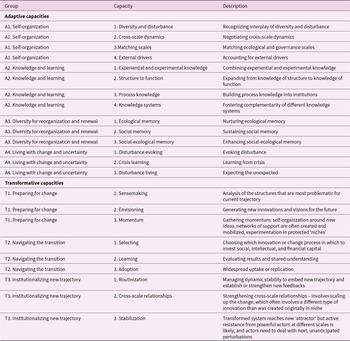
Here we provide a rapid assessment of the adequacy of resilience capacities for navigating Anthropocene traps with the aim to answer two questions: (a) to what degree can traps undermine resilience capacities and (b) to what degree are resilience capacities able to address Anthropocene traps. We do this through a thematic assessment of what capacities are at risk of being undermined by one or more of the 14 Anthropocene traps, and which capacities have the potential to address the general formation of traps or the specific consequences of one or more traps. We focus on 23 well-established resilience capacities from the social-ecological systems literature (Table 2), specifically 14 adaptive capacities (Folke et al., Reference Folke, Colding and Berkes2003) and the capacities to enact 9 transformative processes (ML Moore et al., Reference Moore, Tjornbo, Enfors, Knapp, Hodbod, Baggio and Biggs2014). The nine transformative capacities are grouped according to three stages of social-ecological transformations (T1–T3, ML Moore et al., Reference Moore, Tjornbo, Enfors, Knapp, Hodbod, Baggio and Biggs2014, table 2). The 14 adaptive capacities are grouped into 4 groups of the overarching processes they relate to (A1–A4, Folke et al., Reference Folke, Colding and Berkes2003, table). While many more individual capacities have been discussed in the literature, we focus on these two corpora due to their precedence and early attempts of synthesis. We end with a generalized overview of the evolutionary processes involved in these capacities thereby advancing the integration of social-ecological systems and evolutionary science as part of moving toward an Anthropocene synthesis of evolution and sustainability (Currie et al., Reference Currie, Borgerhoff Mulder, Fogarty, Schlüter, Folke, Haider, Caniglia, Tavoni, Jansen, Jørgensen and Waring2024; Søgaard Jørgensen et al., Reference Søgaard Jørgensen, Weinberger and Waring2024b).
Sets of adaptive and transformative capacities (Folke et al., Reference Folke, Colding and Berkes2003; ML Moore et al., Reference Moore, Tjornbo, Enfors, Knapp, Hodbod, Baggio and Biggs2014)

2. Methods
The overall approach of this analysis is to thematically code relationships between resilience capacities and Anthropocene traps. We performed thematic coding of relationships between the 23 resilience capacities and 14 Anthropocene traps focusing on individual pairwise relationships (14 × 23 relationships). We also coded the relevance of individual capacities to address the general formation of Anthropocene traps, which has been conceptualized to occur in 4 phases of initiation, scaling, masking, and trapping (23 relationships, Søgaard Jørgensen et al., Reference Søgaard Jørgensen, Jansen, Avila Ortega, Wang-Erlandsson, Donges, Österblom, Olsson, Nyström, Lade, Hahn, Folke, Peterson and Crépin2024a). The difference between the ability to address general trap formation or the dynamics of a specific trap can be compared to specified versus general resilience (Folke et al., Reference Folke, Carpenter, Walker, Scheffer, Chapin and Rockström2010).
The coding of relationships can be any combination of uni- or bidirectional and enabling or undermining interactions. From this list of possible combinations, we focused our analysis on three of the most common types of relationships: (1) threat, (2) addressed, and (3) coevolutionary race. Here, (1) threat indicates that an Anthropocene trap can potentially undermine the expression of the resilience capacity, (2) addressed indicates that the resilience capacity has potential to prevent or control the development or impacts of the Anthropocene trap, and (3) race indicates a bidirectional coevolutionary struggle, where the trap threatens to undermine the capacity and the capacity holds potential to address the trap. We here focus on overarching categorical themes to give a first overview of emergent patterns but acknowledge that relationships can be more complex, such as graded continuous relationships and that the benefit and presence of specific capacities would be context-sensitive in practice.
As the main material for the coding, we relied on the description of the causal processes leading to the traps and the outcomes of the traps in table 1 of Søgaard Jørgensen et al. (Reference Søgaard Jørgensen, Jansen, Avila Ortega, Wang-Erlandsson, Donges, Österblom, Olsson, Nyström, Lade, Hahn, Folke, Peterson and Crépin2024a) as well as the summary description of the capacities provided in table 1 of ML Moore et al. (Reference Moore, Tjornbo, Enfors, Knapp, Hodbod, Baggio and Biggs2014) and the main text of Folke et al. (Reference Folke, Colding and Berkes2003). These summaries were supported by consultation of three detailed full texts, whenever necessary. The coding was performed by three authors, PSJ, LD, and SM. PSJ and LD conducted a first set of coding supported by a short, written rationale for each relationship (supplementary materials). They carried out internal reviews of all coded relationships and rationales, and SM served as independent reviewer of all codes and rationales making suggestions for revisions. Disagreements were resolved through deliberations between the three. An important criterion for the coding included the capacity and trap acting directly on the other entity and not through indirect relationships on other capacities or traps. For visualization purposes, we performed hierarchical clustering analyses using average binary distance to group traps and capacities that exhibited similar patterns of interaction with the other entity. All analyses were performed in R 4.4.1 using the cluster and ComplexHeatmap package.
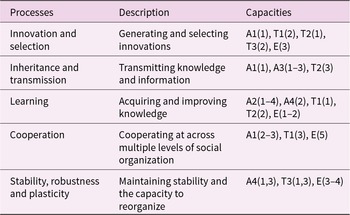
To advance the integration of social-ecological systems and the evolutionary literature, we allocated the resilience capacities to one or more of five groups of related evolutionary processes that they involve expression of. The five groups of processes address major evolutionary themes related to (1) innovation and selection (Hochberg et al., Reference Hochberg, Marquet, Boyd and Wagner2017; Perry et al., Reference Perry, Carter, Smolla, Akçay, Nöbel, Foster and Healy2021), (2) inheritance and transmission (Jablonka & Lamb, Reference Jablonka and Lamb2014, Reference Jablonka and Lamb2020; Laland & O'Brien, Reference Laland and O'Brien2011; Odling-Smee et al., Reference Odling-Smee, Erwin, Palkovacs, Feldman and Laland2013), (3) learning and knowledge (Heyes, Reference Heyes2018; Renn, Reference Renn2020), (4) cooperation (Waring et al., Reference Waring, Kline, Brooks, Goff, Gowdy, Janssen and Jacquet2015; Wilson et al., Reference Wilson, Ostrom and Cox2013; Wilson & Wilson, Reference Wilson and Wilson2007), and (5) stability, robustness, and plasticity (Kirschner & Gerhart, Reference Kirschner and Gerhart1998; Laland et al., Reference Laland, Uller, Feldman, Sterelny, Müller, Moczek and Odling-Smee2015; Payne & Wagner, Reference Payne and Wagner2019; Renn & Laubichler, Reference Renn, Laubichler and Stadler2017). In the allocation we also included six capacities proposed in Søgaard Jørgensen et al. (2024) for addressing Anthropocene traps, these are: (E1) recognizing traps, (E2a) measurement and foresight, (E3) reorganizing and innovating, (E4) being prepared for the unknown, and (E5) navigating conflict.
3. Results
3.1. Threats to resilience from Anthropocene traps
Ten of the fourteen Anthropocene traps have characteristics that undermine in total 18 of 23 resilience capacities (threat and race categories in Figures 1 and 2). These include all 9 transformative capacities and 9 of 14 adaptive capacities. The capacities receiving most threats are the transformative capacities of momentum (four traps) and adoption (three traps), whereas most other capacities were threatened by one to two traps (mean = 1.8 traps, Figure 2).
Relationships between Anthropocene traps and adaptive capacities (left) and transformative capacities (right). Relationship as defined in methods.

Pairwise relationships between capacities (A – Adaptive, T – Transformative) and traps (Gl – Global, Tc – Technological, Tm – Temporal, Co – Connectivity). Capacities with a general potential to prevent the formation and progression of traps are indicated in bold and with an asterisk (*). Clustering is based on binary categories of enabling capacities and undermining traps, respectively. Capacities (traps) situated closer to each other are more similar in the individual traps (capacities) they can address (undermine).

The most common threats to transformative and adaptive capacities were from different types of Anthropocene traps (co-evolutionary race and threat categories in Figures 1 and 2). The most common threats to transformative capacities were the global traps division and growth-for-growth traps (four capacities). For adaptive capacities, the most common threats were from temporal and connectivity traps, namely short-termism (five capacities) and biosphere disconnect (four capacities).
3.2. Adequacy of resilience capacities
Slightly less than half (10 of 23) of resilience capacities have general potential to prevent formation and progress of Anthropocene traps. Among these, transformative capacities have a higher ratio of representation (66%, 6/9) compared to adaptive capacities (30%, 4/14). The six transformative capacities were evenly distributed among the three stages of transformation (T1–T3), and adaptive capacities represented three out of four groups of adaptive capacities (A1–A4), all but A3: Diversity for organization and renewal (table 2).
Thirteen out of fourteen traps were specifically targeted by one or more of 18 resilience capacities (race and addressed categories in Figures 1 and 2). On average, capacities targeted 2.6 traps and traps were on average targeted by 3.3 capacities. The capacities targeting most traps were selecting, cross-scale dynamics (six traps), matching scales (five), and learning (four). The traps targeted by most capacities include biosphere disconnect (six capacities), short-termism and growth for growth (five), simplification, contagion, and infrastructure lock-in (four). In contrast, overshoot was not addressed directly by any capacities and technological autonomy only by one.
Transformative and adaptive capacities complement each other in the types of Anthropocene traps they target. Transformative capacities mainly address technology (11) and global traps (10), accounting for 21 out of 22 relationships. Adaptive capacities mainly target temporal and connectivity traps (15 of 24 relationships) and to less extent global traps (6).
3.3. Coevolutionary struggles
A large number of the above connections between traps and capacities were bidirectional, such that the development of the capacity is in a coevolutionary struggle with the progression of the trap (race category in Figures 1 and 2). Thus, 70% of threats from traps and 50% of targeting connections from capacities are in coevolutionary struggles. Eight traps representing all four trap types (global, technological, temporal, connectivity) were involved in these struggles. Among these, short-termism (five races), growth for growth and biosphere disconnect (four), division (three), misinformation and infrastructure lock-in (two) were involved in co-evolutionary struggles with more than one capacity.
3.4. Groups of capacities
Capacities were fairly evenly distributed between the five groups of evolutionary processes (Table 3). Groups ranged between four and six capacities per process except for knowledge and learning with nine capacities, indicating the focus on multiple types of learning and knowledge systems in the resilience literature. Adaptive capacities tended to cluster in the four groups of Folke et al. (Reference Folke, Colding and Berkes2003) as they address similar evolutionary processes, such as inheritance and transmission (A3) and learning (A2). In contrast, categories of transformative capacities (T1–T3) were often split among multiple groups of evolutionary processes, indicating that multiple types of processes are needed in each phase of transformation. The inheritance and transmission group did not have any capacities from Søgaard Jørgensen et al. (2024) revealing an important gap, especially in terms of addressing the short-termism trap.
Organizing capacities in five groups of evolutionary processes and trade-offs

4. Discussion and conclusions
Our rapid assessment reveals widepsread coevolutionary struggles in the Anthropocene between capacities supporting social-ecological resilience and the development of a global polycrisis. While almost half of resilience capacities have potential to address the general development of Anthropocene traps, most of these (six of nine) are also threatened and potentially undermined by one or more Anthropocene traps. Furthermore, all transformative capacities are challenged by at least one trap. There are multiple implications from these results, including the need to prioritize rapid progress on sustainability transformations, and the need for ongoing building or maintenance of both adaptive and transformative capacities, which we elaborate below.
While the momentum gained by large-scale sustainability efforts over the past decades is hopeful, the potential for polycrisis to undermine this progress is a cause for concern. If resilience capacities are developed and expressed with priority, they may proactively help to address global polycrisis and advance sustainability. However, the advancement of a global polycrisis in the form of Anthropocene traps threatens to overwhelm the possibility to express these crucial capacities. Mis- and disinformation threatens learning and sensemaking abilities, conflicts will challenge the capacity for large scale adoption and cooperation to scale up transitions, and climate and ecological disruption risk undermining capacities for routinization and stabilization In addition, crises related to overshoot and degradation of the biosphere can also affect the ability to tackle the causes of these problems themselves (Laybourn et al., Reference Laybourn, Evans and Dyke2023; Millward-Hopkins, Reference Millward-Hopkins2022).
Resilience and transformation studies have emphasized either the positive destabilizing effects of crises on transformations or focused on the challenges to transformations from single shocks (Cumming & Peterson, Reference Cumming and Peterson2017). Moore et al. (Reference Moore, Hermanus, Drimie, Rose, Mbaligontsi, Musarurwa and Olsson2023) identified five ways that the COVID-19 crisis potentially undermined transformative change efforts in six different African countries. Polycrisis research emphasizes that there are many more ways that capacities can be undermined by the collection of issues that combine in the Anthropocene. Here we show that the global polycrisis provides a major challenge to resilience capacities, but that questions about the distribution of capacities across actors and systems endure. We acknowledge that the capacities studied here have mainly been identified from small to medium scale case studies, and they do not comprehensively cover every aspect of complex systems change. In particular, we acknowledge that previous scholarship suggests that capacities are distributed across different actors in space and time (Olsson, Reference Olsson, Westley, McGowan and Tjörnbo2017; Westley et al., Reference Westley, Tjornbo, Schultz, Olsson, Folke, Crona and Bodin2013). This distribution can be difficult to measure and include in single case study approaches that occur in a narrow time period, and thus, there are many studies exploring the capacities of single actor groups (policy entrepreneurs, civil society, etc.) without considering broader systemic capacities over time.
The renewed attention to the study of both sustainability transformations and polycrisis capacities calls for frameworks to help organize and bridge the many suggestions for individual capacities (Orr & Burch, Reference Orr and Burch2025). We suggest there are at least two opportunities for future research then. First, there remains ongoing potential for new capacities to be identified at large scales, rather than only from small or medium-scale case studies, such as large-scale actor coalitions (Maniatakou et al., Reference Maniatakou, Olsson and Jørgensen2025), or the role of global institutional capacities for governing complex social-ecological interactions (Österblom & Folke, Reference Österblom and Folke2013; Rosen & Olsson, Reference Rosen and Olsson2013). Second, dynamics of transformations include capacities and agency directed at both breaking down the resilience of some existing relationships that hold traps in place, while also regenerating new configurations (Feola et al., Reference Feola, Vincent and Moore2021; Moore et al., Reference Moore, Hermanus, Drimie, Rose, Mbaligontsi, Musarurwa and Olsson2023; Olsson et al., Reference Olsson, Galaz and Boonstra2014). Future explorations of considering how these capacities are distributed across a system, and how that shapes the breaking down or regenerative aspects of resilience and traps would provide an important basis for further empirical and theoretical contributions.
While this study provides only an initial exploration of combining the frameworks, our rapid assessment suggests interesting complementarities between adaptive and transformative capacities that may further counteract pathways into traps and thereby reduce the risk of polycrisis. This finding challenges previous research which has indicated that some adaptive capacities could hinder transformative capacities (Marshall et al., Reference Marshall, Park, Adger, Brown and Howden2012), although supports other research that more explicitly see adaptation itself as possibly playing a transformational role in a system (Few et al., Reference Few, Morchain, Spear, Mensah and Bendapudi2017; O'Brien, Reference O'Brien2012; Pelling, Reference Pelling2010). Further exploration that aims to better understand the interactions of these capacities is needed. However, we suggest that, in some instances, there may be a high level of complementarity between adaptive and transformative capacities and the types of traps they address or are threatened by, as well as the many reinforcing interactions between Anthropocene traps (Søgaard Jørgensen et al., Reference Søgaard Jørgensen, Jansen, Avila Ortega, Wang-Erlandsson, Donges, Österblom, Olsson, Nyström, Lade, Hahn, Folke, Peterson and Crépin2024a). Specifically, our findings suggest that adaptive capacities may help address threats to transformative capacities by limiting the feedbacks that tend to accelerate the development of global traps. In practice, such complementarity could be seen, for example, through institutions that help build social-ecological memory and foresight to combat short-termism, as well as governance of global value chains and initiatives that create social linkages between distant communities that are ecologically linked in the Anthropocene, thereby preventing worsening of simplification and overshoot traps.
Our results point to a critical but still underappreciated area of polycrisis research related to the development of strategies capable of navigating multiple reinforcing crises (Lawrence et al., Reference Lawrence, Shipman, Janzwood, Arnscheidt, Donges, Homer-Dixon, Otto, Schweizer and Wunderling2024b; Søgaard Jørgensen et al., Reference Søgaard Jørgensen, Jansen, Avila Ortega, Wang-Erlandsson, Donges, Österblom, Olsson, Nyström, Lade, Hahn, Folke, Peterson and Crépin2024a). Existing work has largely focused on classifying types of polycrises (Zaki, Reference Zaki2025), analyzing the performance of legal and regulatory regimes (Kuhlmann et al., Reference Kuhlmann, Franzke, Peters and Dumas2024), or improving disaster risk reduction through increasingly sophisticated stress-testing of critical infrastructures (Jovanović, Reference Jovanović2025). Scholars have also paid more attention recently to transformative interventions rather than the complementarity between adaptive and transformative capacities (Rakowski et al., Reference Rakowski, Schaan, van, Herzon, Arth, Hagedorn and Pe'er2025). While these strands are valuable, our findings suggest that governance-oriented polycrisis research should adopt a more comprehensive view of how crises are generated and of the capacities needed to prevent and respond to them. This view aligns with recent calls for risk frameworks that capture how systemic risks emerge from cross-domain interdependencies (Liu & Renn, Reference Liu and Renn2025) and how institutional cohesion and collective sensemaking shape the ability to act under uncertainty (Richardson, Reference Richardson2025). Capacities-focused research in polycrisis could make tangible contributions by developing diagnostic tools for identifying weak cross-capacity linkages, designing interventions that strengthen coordination and learning across scales, and testing how different capacity configurations perform under compound and cascading scenarios.
Beyond both expanding the capacities and traps that could be considered in combination in the future, additional research could test applications of the method to specific case studies. For instance, governance and policy actors could use the method to perform anticipatory polycrisis scans to consider what comprehensive sets of crises that can undermine resilience and transformation strategies that are currently in development in their specific contexts. It is important that these scans go from considering single shocks to include both shocks and slowly growing crises (often referred to as lock-ins, protracted crisis or creeping change) and the way they are interacting or intertwined. Such scans should seek to identify additional capacities that can help prevent polycrisis from undermining and derailing transformations, including what combinations of existing and new capacities (referred to as ensembles) that prove the most potent. Available evidence from global databases shows that the polycrisis shocks are manifesting in diverse ways across regions (Delannoy et al., Reference Delannoy, Verzier, Bastien-Olvera, Benra, Nyström and Jørgensen2025b). Planning for the most effective combinations of capacities to drive sustainability transformations therefore need to be sensitive to local and regional context.
In conclusion, our results emphasize the need to focus on the co-development of adaptive and transformative capacities. However, we caution that many conventional approaches to ‘resilience building’ are eroding resilience rather than strengthening capacities (Eriksen et al., Reference Eriksen, Schipper, Scoville-Simonds, Vincent, Adam, Brooks and West2021; Reyers et al., Reference Reyers, Moore, Haider and Schlüter2022) and as such may be expressions rather than transformations of Anthropocene traps, such as short-termism, growth-for-growth, and biosphere disconnect.
Supplementary material
The supplementary material for this article can be found at https://doi.org/10.1017/sus.2026.10053.
Acknowledgements
We are thankful to two reviewers for insightful comments that helped improve the manuscript. A preprint of the article is available at https://osf.io/preprints/socarxiv/xtrmb_v1.
Author contributions
Peter Søgaard Jørgensen: Conceptualization, Formal analysis, Methodology, Project administration, Visualization, Writing – original draft, Writing – review & editing. Louis Delannoy: Formal analysis, Writing – review & editing. Sofia Maniatakou: Formal analysis, Writing – review & editing. Carl Folke: Validation, Writing – review & editing. Michele-Lee Moore: Validation, Writing – review & editing. Per Olsson: Validation, Writing – review & editing.
Funding statement
We acknowledge funding from the Erling-Persson Family Foundation, the IKEA foundation, the Marianne and Marcus Wallenberg Foundation, and the Marcus and Amalia Wallenberg Foundation. PSJ acknowledges funding from the European Union (ERC, INFLUX, 101039376), and the Swedish Research Council Formas (2020–00371). MLM and PO acknowledge funding from the European Union (ERC, Transmod, 101097891), Views and opinions expressed are however those of the author(s) only and do not necessarily reflect those of the European Union or the European Research Council. Neither the European Union nor the granting authority can be held responsible for them.
Competing interests
The authors declare that they have no known competing financial interests or personal relationships that could have appeared to influence the work reported in this paper.
Data availability
All data are available in the main article file or the supplementary materials.





 Open access

