

1. Introduction
The homology cobordism group $\Theta^3_\mathbb{Z}$
of homology spheres, introduced by González-Acuña [
Reference González-Acuña17
], has played a central role in the development of low-dimensional topology over the last five decades [
Reference Hom20, Reference Manolescu34, Reference Şavk45
]. The algebraic structure of
$\Theta^3_\mathbb{Z}$
of homology spheres, introduced by González-Acuña [
Reference González-Acuña17
], has played a central role in the development of low-dimensional topology over the last five decades [
Reference Hom20, Reference Manolescu34, Reference Şavk45
]. The algebraic structure of $\Theta^3_\mathbb{Z}$
is linked to several topological problems such as the three fibers conjecture [
Reference Kollár25, Reference Lawson28
], the disproof of the triangulation conjecture for topological manifolds in high dimensions [
Reference Manolescu33
], and so on. While it is known that the homology cobordism group contains an infinite rank summand by [
Reference Dai, Hom, Stoffregen and Truong5
], the existence of a torsion element is one of the most notable open problems about the structure of
$\Theta^3_\mathbb{Z}$
is linked to several topological problems such as the three fibers conjecture [
Reference Kollár25, Reference Lawson28
], the disproof of the triangulation conjecture for topological manifolds in high dimensions [
Reference Manolescu33
], and so on. While it is known that the homology cobordism group contains an infinite rank summand by [
Reference Dai, Hom, Stoffregen and Truong5
], the existence of a torsion element is one of the most notable open problems about the structure of $\Theta^3_\mathbb{Z}$
.
$\Theta^3_\mathbb{Z}$
.
Seifert fibered spheres have been core objects to study the structure of $\Theta^3_\mathbb{Z}$
. In particular, the subgroup
$\Theta^3_\mathbb{Z}$
. In particular, the subgroup $\Theta^3_{SF}$
generated by Seifert fibered spheres itself contains an infinite rank subgroup in
$\Theta^3_{SF}$
generated by Seifert fibered spheres itself contains an infinite rank subgroup in $\Theta^3_\mathbb{Z}$
[
Reference Fintushel and Stern14, Reference Furuta16
]. Moreover, the aforementioned infinite rank summand [
Reference Dai, Hom, Stoffregen and Truong5
] lies also in
$\Theta^3_\mathbb{Z}$
[
Reference Fintushel and Stern14, Reference Furuta16
]. Moreover, the aforementioned infinite rank summand [
Reference Dai, Hom, Stoffregen and Truong5
] lies also in $\Theta_{SF}^3$
. On the other hand, there are several infinite families of Seifert fibered spheres known to bound contractible manifolds or homology balls [
Reference Akbulut and Kirby1, Reference Casson and Harer3, Reference Fickle10, Reference Fintushel and Stern11
], namely trivial in
$\Theta_{SF}^3$
. On the other hand, there are several infinite families of Seifert fibered spheres known to bound contractible manifolds or homology balls [
Reference Akbulut and Kirby1, Reference Casson and Harer3, Reference Fickle10, Reference Fintushel and Stern11
], namely trivial in $\Theta_\mathbb{Z}^3$
. However, it is neither known in
$\Theta_\mathbb{Z}^3$
. However, it is neither known in $\Theta_\mathbb{Z}^3$
whether there exists a non-trivial Seifert fibered sphere of finite order, nor, more generally, whether there exists any non-trivial linear dependence among them. More precisely, we ask:
$\Theta_\mathbb{Z}^3$
whether there exists a non-trivial Seifert fibered sphere of finite order, nor, more generally, whether there exists any non-trivial linear dependence among them. More precisely, we ask:
Question 1·1. Are distinct Seifert fibered spheres always linearly independent in $\Theta_\mathbb{Z}^3$
, provided they do not bound homology balls?
$\Theta_\mathbb{Z}^3$
, provided they do not bound homology balls?
Hendricks, Manolescu and Zemke [
Reference Hendricks, Manolescu and Zemke19
] defined the notion of the local equivalence class of an involutive Heegaard Floer chain complex [
Reference Hendricks and Manolescu18
] of a homology sphere. Such classes form an abelian group $\mathfrak{I}$
, called the local equivalence group, together with the homomorphism:
$\mathfrak{I}$
, called the local equivalence group, together with the homomorphism:
 \[h\;:\;\Theta_\mathbb{Z}^3\rightarrow \mathfrak{I}.\]
Let $\mathfrak{I}_{SF}$
be the image of
$\mathfrak{I}_{SF}$
be the image of $\Theta_{SF}^3$
under h. While
$\Theta_{SF}^3$
under h. While $\mathfrak{I}_{SF}$
has been extensively studied in [
Reference Dai and Manolescu6, Reference Dai and Stoffregen8
] and is known to be isomorphic to
$\mathfrak{I}_{SF}$
has been extensively studied in [
Reference Dai and Manolescu6, Reference Dai and Stoffregen8
] and is known to be isomorphic to $\mathbb{Z}^\infty$
, it is nevertheless possible to find many linear dependences in
$\mathbb{Z}^\infty$
, it is nevertheless possible to find many linear dependences in $\mathfrak{I}_{SF}$
. Therefore, this fact and Question 1·1 motivate us to study the kernel of the restriction of h to
$\mathfrak{I}_{SF}$
. Therefore, this fact and Question 1·1 motivate us to study the kernel of the restriction of h to $\Theta^3_{SF}$
. For example, the Brieskorn spheres
$\Theta^3_{SF}$
. For example, the Brieskorn spheres $\Sigma(2, 3, 12n-7)$
for
$\Sigma(2, 3, 12n-7)$
for $n\ge 1$
are known to share the same local equivalence class [
Reference Hendricks and Manolescu18
], yet they were previously shown by Furuta [
Reference Furuta16
] to be linearly independent in
$n\ge 1$
are known to share the same local equivalence class [
Reference Hendricks and Manolescu18
], yet they were previously shown by Furuta [
Reference Furuta16
] to be linearly independent in $\Theta_\mathbb{Z}^3$
.
$\Theta_\mathbb{Z}^3$
.
Dai and Manolescu [ Reference Dai and Manolescu6 ] introduced a notion called monotone graded subroots of Seifert fibered spheres to simply determine their local equivalence classes. By analysing monotone graded subroots systematically, Dai and Stoffregen [ Reference Dai and Stoffregen8 ] proved that:
 \[\mathfrak{I}_{SF} = \langle h(B(n)) \rangle \cong \mathbb{Z}^\infty,\]
where B(0) is the Poincaré homology sphere $\Sigma(2,3,5)$
and B(n) is the Brieskorn sphere
$\Sigma(2,3,5)$
and B(n) is the Brieskorn sphere $\Sigma(2n+1, 4n+1, 4n+3)$
with
$\Sigma(2n+1, 4n+1, 4n+3)$
with $n \gt 0$
.
$n \gt 0$
.
Therefore, potential counterexamples to Question 1·1 arise from linear relations expressed in terms of this explicit basis $\{h(B(n))\}_{n\ge 0}$
of
$\{h(B(n))\}_{n\ge 0}$
of $\mathfrak{I}_{SF}$
. For any Seifert fibered sphere Y, there exists a unique homology sphere
$\mathfrak{I}_{SF}$
. For any Seifert fibered sphere Y, there exists a unique homology sphere $Z_Y$
as the linear expression of Y with respect to
$Z_Y$
as the linear expression of Y with respect to $\{B(n)\}$
such that
$\{B(n)\}$
such that $h(Y)=h(Z_Y)$
, or equivalently,
$h(Y)=h(Z_Y)$
, or equivalently,
 \[Y\# -Z_Y \in \operatorname{ker}(h).\]
We call such $Z_Y$
the associated homology sphere to Y with respect to
$Z_Y$
the associated homology sphere to Y with respect to $\{B(n)\}$
. For example, for any Y in the aforementioned family
$\{B(n)\}$
. For example, for any Y in the aforementioned family $\Sigma(2,3,12n-7)$
, the associated homology sphere
$\Sigma(2,3,12n-7)$
, the associated homology sphere $Z_Y$
is
$Z_Y$
is $\Sigma(2,3,5)=B(0)$
.
$\Sigma(2,3,5)=B(0)$
.
In this paper, we find certain conditions for a Seifert fibered sphere Y to guarantee that Y and the associated homology sphere $Z_Y$
are not anymore related in
$Z_Y$
are not anymore related in $\Theta_\mathbb{Z}^3$
. Such conditions are expressed in terms of the product
$\Theta_\mathbb{Z}^3$
. Such conditions are expressed in terms of the product $\mathcal{E} (Y)$
of the exponents of Y and the Fintushel–Stern R-invariant [
Reference Fintushel and Stern13
]. Note that any linear combinations of the homology spheres of the form
$\mathcal{E} (Y)$
of the exponents of Y and the Fintushel–Stern R-invariant [
Reference Fintushel and Stern13
]. Note that any linear combinations of the homology spheres of the form $Y\# -Z_Y$
are potential counterexamples to Question 1·1. We also prove their linear independence.
$Y\# -Z_Y$
are potential counterexamples to Question 1·1. We also prove their linear independence.
Theorem 1·2. Let Y be a Seifert fibered sphere and let $Z_Y$
be the associated homology sphere of the same image in
$Z_Y$
be the associated homology sphere of the same image in $\mathfrak{I}$
. If
$\mathfrak{I}$
. If $R(Y) \gt 0$
and
$R(Y) \gt 0$
and $\mathcal{E} (Y)$
is distinct from 30 and
$\mathcal{E} (Y)$
is distinct from 30 and $(2m+1)(4m+1)(4m+3)$
, then
$(2m+1)(4m+1)(4m+3)$
, then $Y\# -Z_Y$
is non-trivial in
$Y\# -Z_Y$
is non-trivial in $\ker{h}$
. Moreover, given such a family of homology spheres Y(n) with the associated Z(n), if all
$\ker{h}$
. Moreover, given such a family of homology spheres Y(n) with the associated Z(n), if all $\mathcal{E} (Y(n))$
are distinct, then
$\mathcal{E} (Y(n))$
are distinct, then $Y(n)\#-Z(n)$
are linearly independent in
$Y(n)\#-Z(n)$
are linearly independent in $\operatorname{ker} (h)$
up to rational homology cobordism.
$\operatorname{ker} (h)$
up to rational homology cobordism.
Note that the previously known examples, such as $\{\Sigma(2, 3, 12n-7)\}$
, also fall under Theorem 1·2. We remark that we obtain linear independence not only in
$\{\Sigma(2, 3, 12n-7)\}$
, also fall under Theorem 1·2. We remark that we obtain linear independence not only in $\Theta_\mathbb{Z}^3$
, but also in the rational homology cobordism group
$\Theta_\mathbb{Z}^3$
, but also in the rational homology cobordism group $\Theta_\mathbb{Q}^3$
of rational homology spheres. Together with the assumption on
$\Theta_\mathbb{Q}^3$
of rational homology spheres. Together with the assumption on $\mathcal{E}(Y)$
in Theorem 1·2, Furuta’s result [
Reference Furuta16
] is sufficient to prove linear independence in
$\mathcal{E}(Y)$
in Theorem 1·2, Furuta’s result [
Reference Furuta16
] is sufficient to prove linear independence in $\Theta^3_\mathbb{Z}$
of such homology spheres
$\Theta^3_\mathbb{Z}$
of such homology spheres $Y(n)\# -Z(n)$
. However, this does not directly imply linear independence in
$Y(n)\# -Z(n)$
. However, this does not directly imply linear independence in $\Theta_\mathbb{Q}^3$
, since the kernel of
$\Theta_\mathbb{Q}^3$
, since the kernel of $\Theta_\mathbb{Z}^3\rightarrow\Theta_\mathbb{Q}^3$
is known to be non-trivial [
Reference Akbulut and Larson2, Reference Fintushel and Stern12, Reference Şavk44, Reference Simone47
].
$\Theta_\mathbb{Z}^3\rightarrow\Theta_\mathbb{Q}^3$
is known to be non-trivial [
Reference Akbulut and Larson2, Reference Fintushel and Stern12, Reference Şavk44, Reference Simone47
].
To obtain their linear independence in $\Theta^3_\mathbb{Q}$
, we employ the
$\Theta^3_\mathbb{Q}$
, we employ the $r_s$
-invariants from the filtered instanton Floer homology, introduced by Nozaki, Sato and Taniguchi [
Reference Nozaki, Sato and Taniguchi38
]. They extended the previous work of Donaldson [
Reference Donaldson9
], Fintushel and Stern [
Reference Fintushel and Stern13, Reference Fintushel and Stern14
] and Furuta [
Reference Furuta16
] in instanton Floer theory.
$r_s$
-invariants from the filtered instanton Floer homology, introduced by Nozaki, Sato and Taniguchi [
Reference Nozaki, Sato and Taniguchi38
]. They extended the previous work of Donaldson [
Reference Donaldson9
], Fintushel and Stern [
Reference Fintushel and Stern13, Reference Fintushel and Stern14
] and Furuta [
Reference Furuta16
] in instanton Floer theory.
Note that Theorem 1·2 indicates that the d-invariant [
Reference Ozsváth and Szabó39
], the $\underline{d\mkern-2mu}\mkern2mu $
- and
$\underline{d\mkern-2mu}\mkern2mu $
- and $\bar{d}$
-invariants [
Reference Hendricks and Manolescu18
], and the
$\bar{d}$
-invariants [
Reference Hendricks and Manolescu18
], and the $\phi_n$
-invariants for all
$\phi_n$
-invariants for all $n\ge 1$
[
Reference Dai, Hom, Stoffregen and Truong5
] must vanish for homology spheres
$n\ge 1$
[
Reference Dai, Hom, Stoffregen and Truong5
] must vanish for homology spheres $Y(n)\# -Z(n)$
in Theorem 1·2. In other words, for any homology sphere Y obtained by a non-trivial linear combination of
$Y(n)\# -Z(n)$
in Theorem 1·2. In other words, for any homology sphere Y obtained by a non-trivial linear combination of $Y(n)\# -Z(n)$
, we see that:
$Y(n)\# -Z(n)$
, we see that:
 \[\underline{d} (Y) = d(Y) = \overline{d}(Y) = \phi_n(Y) = 0.\]
We observe that the d-invariant is not a complete rational homology cobordism invariant. One can find some homology spheres of infinite order in $\Theta^3_\mathbb{Q}$
with vanishing d-invariants from [
Reference Nozaki, Sato and Taniguchi38
]. We also note that the
$\Theta^3_\mathbb{Q}$
with vanishing d-invariants from [
Reference Nozaki, Sato and Taniguchi38
]. We also note that the $\bar{\mu}$
-invariant [
Reference Neumann36, Reference Siebenmann46
] vanishes by the result of [
Reference Dai and Stoffregen8
].
$\bar{\mu}$
-invariant [
Reference Neumann36, Reference Siebenmann46
] vanishes by the result of [
Reference Dai and Stoffregen8
].
On the other hand, Stoffregen [ Reference Stoffregen50 ] defined an analogous group in Seiberg–Witten Floer theory together with the homomorphism:
 \[\Theta^3_\mathbb{Z} \to \mathfrak{LE},\]
where the latter group denotes the local equivalence group of the $\operatorname{Pin}(2)$
-equivariant Seiberg–Witten Floer stable homotopy type. Recently, Dai, Sasahira, and Stoffregen [
Reference Dai, Sasahira and Stoffregen7
] proved that two Seifert fibered spheres have the same image in
$\operatorname{Pin}(2)$
-equivariant Seiberg–Witten Floer stable homotopy type. Recently, Dai, Sasahira, and Stoffregen [
Reference Dai, Sasahira and Stoffregen7
] proved that two Seifert fibered spheres have the same image in $\mathfrak{LE}$
if and only if they have the same image in
$\mathfrak{LE}$
if and only if they have the same image in $\mathfrak{I}$
. Therefore, for a Seifert fibered sphere Y, the homology sphere
$\mathfrak{I}$
. Therefore, for a Seifert fibered sphere Y, the homology sphere $Y\# -Z_Y$
lies in
$Y\# -Z_Y$
lies in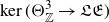 $\operatorname{ker}(\Theta^3_\mathbb{Z} \to \mathfrak{LE})$
when the associated homology sphere
$\operatorname{ker}(\Theta^3_\mathbb{Z} \to \mathfrak{LE})$
when the associated homology sphere $Z_Y$
to Y is also Seifert fibered. Moreover, they also fall under Theorem 1·2 as well.
$Z_Y$
to Y is also Seifert fibered. Moreover, they also fall under Theorem 1·2 as well.
For those homology spheres, the $\kappa$
-invariant [
Reference Manolescu32
] and the
$\kappa$
-invariant [
Reference Manolescu32
] and the $\kappa o_i$
-invariants for
$\kappa o_i$
-invariants for $i=0, \ldots, 7$
[
Reference Lin31
] from Seiberg–Witten Floer stable homotopy type, and the
$i=0, \ldots, 7$
[
Reference Lin31
] from Seiberg–Witten Floer stable homotopy type, and the $\delta$
-invariant [
Reference Frøyshov15
], the
$\delta$
-invariant [
Reference Frøyshov15
], the $\alpha$
-,
$\alpha$
-, $\beta$
-, and
$\beta$
-, and $\gamma$
-invariants [
Reference Manolescu33
], and the
$\gamma$
-invariants [
Reference Manolescu33
], and the $\underline{\delta}$
- and
$\underline{\delta}$
- and $\overline{\delta}$
-invariants [
Reference Stoffregen49
] from Seiberg–Witten Floer homology must vanish. Namely, for any homology spheres Y obtained by non-trivial linear combinations of
$\overline{\delta}$
-invariants [
Reference Stoffregen49
] from Seiberg–Witten Floer homology must vanish. Namely, for any homology spheres Y obtained by non-trivial linear combinations of $Y(n)\# -Z(n)$
, we also have the following:
$Y(n)\# -Z(n)$
, we also have the following:
 \[ \kappa (Y)= \kappa o_i (Y) = \alpha (Y)= \beta (Y) = \gamma (Y) = \underline{\delta} (Y) = \delta (Y) = \overline{\delta} (Y) = 0.\]
Based on [
Reference Dai and Stoffregen8
], we construct explicit examples of Theorem 1·2 by taking $\{Y(n)\}$
as the families of the Brieskorn spheres:
$\{Y(n)\}$
as the families of the Brieskorn spheres:
 \[Y_1(n) = \Sigma(4n+1, 6n+2, 12n+1) \quad \text{and} \quad Y_2(n)=\Sigma(4n-1, 6n-2, 12n-1).\]
Their monotone graded subroots and hence their local equivalence classes were computed by Karakurt and the second author [
Reference Karakurt and Şavk24
]. By using the fact that every monotone graded subroot is decomposed into simpler ones [
Reference Dai and Stoffregen8
, theorem 1·1], we first find associated homology spheres $Z_1 (n)$
and
$Z_1 (n)$
and $Z_2 (n)$
to
$Z_2 (n)$
to $Y_1(n)$
and
$Y_1(n)$
and $Y_2(n)$
, respectively. From these linear relations, we obtain infinitely many homology spheres lying in
$Y_2(n)$
, respectively. From these linear relations, we obtain infinitely many homology spheres lying in $\operatorname{ker}(h)$
as follows:
$\operatorname{ker}(h)$
as follows:
 \[ \{Y_1(n) \ \# \ -Z_1(n) \}_{n\geq 1} \cup \{Y_2(n) \ \# \ -Z_2(n) \}_{n \geq 1}.\]
These families satisfy the conditions of Theorem 1·2 so that we obtain a substantial structural difference between $\Theta^3_{SF}$
and
$\Theta^3_{SF}$
and $\mathfrak{I}_{SF}$
, providing affirmative evidence for Question 1·1. In other words, those families reprove an implicitly known result from other examples in several literature [
Reference Furuta16, Reference Hendricks and Manolescu18, Reference Nozaki, Sato and Taniguchi38
].
$\mathfrak{I}_{SF}$
, providing affirmative evidence for Question 1·1. In other words, those families reprove an implicitly known result from other examples in several literature [
Reference Furuta16, Reference Hendricks and Manolescu18, Reference Nozaki, Sato and Taniguchi38
].
Corollary 1·3. There are infinitely many homology spheres of the trivial local equivalence class that are linearly independent in the rational homology cobordism group.
Similarly, we provide examples of Theorem 1·2 whose local equivalence classes of Seiberg–Witten Floer stable homotopy type are also the same, by using the following family of the Brieskorn spheres:
 \[Y_3(n) = \Sigma(8n+1, 12n+1, 24n+5).\]
Relying on [
Reference Karakurt and Şavk24
], we find their associated homology spheres $Z_3 (n)$
that are Seifert fibered, so that the resulting homology spheres are as follows:
$Z_3 (n)$
that are Seifert fibered, so that the resulting homology spheres are as follows:
 \[\{Y_3(n)\ \# \ -Z_3(n)\}_{n\geq1}.\]
To the authors’ best knowledge, it is not known whether there exists a Seifert fibered sphere of the trivial local equivalence class but non-trivial in $\Theta^3_\mathbb{Q}$
. The reason is that it is difficult to compute the
$\Theta^3_\mathbb{Q}$
. The reason is that it is difficult to compute the $r_s$
-invariant in general when the Fintushel–Stern R-invariant [
Reference Fintushel and Stern13
] is negative. Moreover, Issa and McCoy [
Reference Issa and McCoy21
] proved that for a Seifert fibered sphere Y with
$r_s$
-invariant in general when the Fintushel–Stern R-invariant [
Reference Fintushel and Stern13
] is negative. Moreover, Issa and McCoy [
Reference Issa and McCoy21
] proved that for a Seifert fibered sphere Y with $d(Y) =0$
, R(Y) is always negative. Therefore, we conclude the introduction with the following question:
$d(Y) =0$
, R(Y) is always negative. Therefore, we conclude the introduction with the following question:
Question 1·4. Is there a Seifert fibered sphere Y with $d(Y)=0$
that does not bound a rational homology ball?
$d(Y)=0$
that does not bound a rational homology ball?
Conventions. Every manifold is assumed to be compact, connected, oriented and smooth. The connected sum of n copies of a manifold Y is denoted by nY. We use the terms “homology sphere” and “homology ball” to refer to an “integral homology 3-sphere” and an “integral homology 4-ball”, respectively. Y denotes a homology sphere unless otherwise stated. Seifert fibered spheres are oriented as the links of Brieskorn–Hamm complete intersection singularities in $\mathbb{C}^3$
, so they bound plumbed 4-manifolds with unique minimal negative definite plumbing graphs of central weights
$\mathbb{C}^3$
, so they bound plumbed 4-manifolds with unique minimal negative definite plumbing graphs of central weights $e\leq-1$
, see [
Reference Saveliev43
, section 1·1].
$e\leq-1$
, see [
Reference Saveliev43
, section 1·1]. $\mathbb{F}$
denotes the field of characteristic 2. Our grading shift convention for involutive Heegaard Floer invariants is in line with the one in [
Reference Dai and Stoffregen8
].
$\mathbb{F}$
denotes the field of characteristic 2. Our grading shift convention for involutive Heegaard Floer invariants is in line with the one in [
Reference Dai and Stoffregen8
].
2. Preliminaries on Floer theories
The proof of Theorem 1·2 involves two theories: involutive Heegaard Floer homology [
Reference Hendricks and Manolescu18
] and filtered instanton Floer homology [
Reference Nozaki, Sato and Taniguchi38
]. In this section, we briefly recall the basic concepts, key properties, and essential notions of each theory. For the first two subsections, we review the involutive Heegaard Floer homology and its local equivalence class in terms of monotone graded subroots. In the third, we consider an analogue in the Seiberg–Witten Floer theory. In the last, we briefly recall the filtered instanton homology and the construction of the $r_s$
-invariants.
$r_s$
-invariants.
2·1. Involutive Heegaard Floer homology and local equivalence group
In this subsection, we review the involutive Heegaard Floer theory and the notion of local equivalence. We will only consider the minus flavor of the Heegaard Floer chain complex $CF^-(Y)$
[
Reference Ozsváth and Szabó41
], which is a graded
$CF^-(Y)$
[
Reference Ozsváth and Szabó41
], which is a graded $\mathbb{F}[U]$
-module, where U is a formal variable of grading
$\mathbb{F}[U]$
-module, where U is a formal variable of grading $-2$
.
$-2$
.
Ozsváth and Szabó [
Reference Ozsváth and Szabó41
] defined the Heegaard Floer homology $HF^-(Y)$
for a closed 3-manifold Y, and proved that it is a diffeomorphism invariant. Hendricks and Manolescu [
Reference Hendricks and Manolescu18
] defined a homotopy involution
$HF^-(Y)$
for a closed 3-manifold Y, and proved that it is a diffeomorphism invariant. Hendricks and Manolescu [
Reference Hendricks and Manolescu18
] defined a homotopy involution $\iota$
on a Heegaard Floer chain complex by composing the map which arises from exchanging
$\iota$
on a Heegaard Floer chain complex by composing the map which arises from exchanging $\alpha$
-curves and
$\alpha$
-curves and $\beta$
-curves in the Heegaard diagram with the canonical chain homotopy equivalence based on the naturality [
Reference Juhász, Thurston and Zemke22
]. Then they introduced the involutive Heegaard Floer homology
$\beta$
-curves in the Heegaard diagram with the canonical chain homotopy equivalence based on the naturality [
Reference Juhász, Thurston and Zemke22
]. Then they introduced the involutive Heegaard Floer homology $HFI^-(Y)$
as the homology of the mapping cone of
$HFI^-(Y)$
as the homology of the mapping cone of $1+\iota$
on
$1+\iota$
on $CF^-(Y)$
. When Y is a homology sphere,
$CF^-(Y)$
. When Y is a homology sphere, $HFI^-(Y)$
gives rise to two homology cobordism invariants
$HFI^-(Y)$
gives rise to two homology cobordism invariants $\underline{d\mkern-2mu}\mkern2mu (Y)$
and
$\underline{d\mkern-2mu}\mkern2mu (Y)$
and $\bar{d}(Y)$
.
$\bar{d}(Y)$
.
Instead of computing $HFI^- (Y)$
directly, Hendricks, Manolescu and Zemke [
Reference Hendricks, Manolescu and Zemke19
] defined an equivalence relation of the involutive Heegaard Floer chain complexes of homology spheres. The equivalence class is a homology cobordism invariant. Moreover, the classes form an abelian group
$HFI^- (Y)$
directly, Hendricks, Manolescu and Zemke [
Reference Hendricks, Manolescu and Zemke19
] defined an equivalence relation of the involutive Heegaard Floer chain complexes of homology spheres. The equivalence class is a homology cobordism invariant. Moreover, the classes form an abelian group $\mathfrak{I}$
, called the local equivalence group, together with the homomorphism
$\mathfrak{I}$
, called the local equivalence group, together with the homomorphism $h\;:\;\Theta_\mathbb{Z}^3\rightarrow \mathfrak{I}$
as mentioned in Section 1.
$h\;:\;\Theta_\mathbb{Z}^3\rightarrow \mathfrak{I}$
as mentioned in Section 1.
Let $Y_1$
and
$Y_1$
and $Y_2$
be two homology spheres. Recall from [
Reference Hendricks and Manolescu18
] that a cobordism W from
$Y_2$
be two homology spheres. Recall from [
Reference Hendricks and Manolescu18
] that a cobordism W from $Y_1$
to
$Y_1$
to $Y_2$
with a self-conjugate spin
$Y_2$
with a self-conjugate spin $^c$
-structure
$^c$
-structure $\mathfrak{t}$
induces the
$\mathfrak{t}$
induces the $\iota$
-equivariant
$\iota$
-equivariant $\mathbb{F}[U]$
-chain map
$\mathbb{F}[U]$
-chain map $F_{W, \mathfrak{t}}\;:\; CF^-(Y_1)\rightarrow CF^-(Y_2)$
. Moreover, we have:
$F_{W, \mathfrak{t}}\;:\; CF^-(Y_1)\rightarrow CF^-(Y_2)$
. Moreover, we have:
Theorem 2·1. If two homology spheres $Y_1$
and
$Y_1$
and $Y_2$
are homology cobordant, then there exist two grading-preserving
$Y_2$
are homology cobordant, then there exist two grading-preserving $\iota$
-equivariant
$\iota$
-equivariant $\mathbb{F}[U]$
-chain maps
$\mathbb{F}[U]$
-chain maps $F\;:\;CF^-(Y_1)\rightarrow CF^-(Y_2)$
and
$F\;:\;CF^-(Y_1)\rightarrow CF^-(Y_2)$
and $G\;:\;CF^-(Y_2)\rightarrow CF^-(Y_1)$
where F and G induce isomorphisms on homology after localisation of U.
$G\;:\;CF^-(Y_2)\rightarrow CF^-(Y_1)$
where F and G induce isomorphisms on homology after localisation of U.
The local equivalence group is modeled on the homology cobordism group in the sense of Theorem 2·1.
Definition 2·2. Let C be a free, $\mathbb{Z}$
-graded and finitely generated chain complex over
$\mathbb{Z}$
-graded and finitely generated chain complex over $\mathbb{F}[U]$
with a grading-preserving
$\mathbb{F}[U]$
with a grading-preserving $\mathbb{F}[U]$
-equivariant homotopy involution
$\mathbb{F}[U]$
-equivariant homotopy involution $\iota$
. The pair
$\iota$
. The pair $(C, \iota)$
is called an
$(C, \iota)$
is called an $\iota$
-complex if the localisation of its homology is isomorphic to
$\iota$
-complex if the localisation of its homology is isomorphic to $\mathbb{F}[U, U^{-1}]$
, i.e.,
$\mathbb{F}[U, U^{-1}]$
, i.e.,
 \[U^{-1}H_*(C) \cong \mathbb{F}[U, U^{-1}].\]
Note that the involutive Heegaard Floer chain complex $(CF^-(Y), \iota)$
for a homology sphere Y is an
$(CF^-(Y), \iota)$
for a homology sphere Y is an $\iota$
-complex.
$\iota$
-complex.
Definition 2·3. Let $(C_1, \iota_1)$
and
$(C_1, \iota_1)$
and $(C_2, \iota_2)$
be two
$(C_2, \iota_2)$
be two $\iota$
-complexes. If there are grading-preserving
$\iota$
-complexes. If there are grading-preserving $\iota$
-equivariant chain maps
$\iota$
-equivariant chain maps $F\;:\;C_1\rightarrow C_2$
and
$F\;:\;C_1\rightarrow C_2$
and $G\;:\;C_2\rightarrow C_1$
which induce isomorphisms on the homology after localisation of U, then two
$G\;:\;C_2\rightarrow C_1$
which induce isomorphisms on the homology after localisation of U, then two $\iota$
-complexes are called locally equivalent.
$\iota$
-complexes are called locally equivalent.
It is proved in [
Reference Hendricks, Manolescu and Zemke19
] that the set of $\iota$
-complexes modulo local equivalence with the operation tensor product forms an abelian group
$\iota$
-complexes modulo local equivalence with the operation tensor product forms an abelian group $\mathfrak{I}$
, called the local equivalence group. The identity element of
$\mathfrak{I}$
, called the local equivalence group. The identity element of $\mathfrak{I}$
is given by the trivial complex consisting of a single
$\mathfrak{I}$
is given by the trivial complex consisting of a single $\mathbb{F}[U]$
-tower starting at grading zero, together with the trivial
$\mathbb{F}[U]$
-tower starting at grading zero, together with the trivial $\iota$
. Inverse elements in
$\iota$
. Inverse elements in $\mathfrak{I}$
are obtained by dualising
$\mathfrak{I}$
are obtained by dualising $\iota$
-complexes. Moreover, Hendricks, Manolescu and Zemke [
Reference Hendricks, Manolescu and Zemke19
] also proved that there is an
$\iota$
-complexes. Moreover, Hendricks, Manolescu and Zemke [
Reference Hendricks, Manolescu and Zemke19
] also proved that there is an $\iota$
-equivariant chain homotopy equivalence:
$\iota$
-equivariant chain homotopy equivalence:
 \[(CF^-(Y_1\#Y_2),\iota) \simeq ((CF^-(Y_1)\otimes CF^-(Y_2))[\!-\!2], \iota_1\otimes \iota_2),\]
where $[\!-\!2]$
denotes the grading shift by
$[\!-\!2]$
denotes the grading shift by $-2$
. By Theorem 2·1, the local equivalence class of Y is a homology cobordism invariant, and from the connected sum formula above we have the homomorphism defined as:
$-2$
. By Theorem 2·1, the local equivalence class of Y is a homology cobordism invariant, and from the connected sum formula above we have the homomorphism defined as:
 \[h\;:\; \Theta_\mathbb{Z}^3 \to \mathfrak{I}, \ \ h(Y) = (CF^-(Y)[\!-\!2], \iota),\]
where the d-invariant [
Reference Ozsváth and Szabó39
], the $\underline{d\mkern-2mu}\mkern2mu $
- and
$\underline{d\mkern-2mu}\mkern2mu $
- and $\bar{d}$
-invariants [
Reference Hendricks and Manolescu18
], and the
$\bar{d}$
-invariants [
Reference Hendricks and Manolescu18
], and the $\phi_n$
-invariants for all
$\phi_n$
-invariants for all $n \geq 1$
[
Reference Dai, Hom, Stoffregen and Truong5
] factor through
$n \geq 1$
[
Reference Dai, Hom, Stoffregen and Truong5
] factor through $\mathfrak{I}$
.
$\mathfrak{I}$
.
2·2. Monotone graded subroots for Seifert fibered spheres
In this subsection, we explain the roles of graded roots and their monotone graded subroots to describe local equivalence classes of Seifert fibered spheres. We follow the references [ Reference Dai and Manolescu6, Reference Dai and Stoffregen8, Reference Karakurt and Şavk24, Reference Némethi35 ].
In [
Reference Némethi35
], Némethi introduced two combinatorial objects to compute Heegaard Floer homology of Seifert fibered spheres effectively. The first object is called a graded root $(R,\nu)$
equipped with a grading function
$(R,\nu)$
equipped with a grading function $\nu$
on the vertex set of R, where R is an upwards-opening tree with an infinite downwards stem defined from the negative definite plumbing graph for a Seifert fibered sphere. The second one is a graded
$\nu$
on the vertex set of R, where R is an upwards-opening tree with an infinite downwards stem defined from the negative definite plumbing graph for a Seifert fibered sphere. The second one is a graded $\mathbb{F}[U]$
-module, called the lattice homology
$\mathbb{F}[U]$
-module, called the lattice homology $\mathbb{H} ^- (R)$
. It is combinatorially defined from
$\mathbb{H} ^- (R)$
. It is combinatorially defined from $(R,\nu)$
, whose grading is induced by
$(R,\nu)$
, whose grading is induced by $\nu$
with the formal variable U of grading
$\nu$
with the formal variable U of grading $-2$
. The grading on
$-2$
. The grading on $\mathbb{H}^-(R)$
is denoted by the same symbol
$\mathbb{H}^-(R)$
is denoted by the same symbol $\nu$
by abuse of notation. See [
Reference Dai and Manolescu6, Reference Némethi35
] for precise definitions.
$\nu$
by abuse of notation. See [
Reference Dai and Manolescu6, Reference Némethi35
] for precise definitions.
As observed in [
Reference Dai4, Reference Dai and Manolescu6
], for a Seifert fibered sphere, there is an involution J on the vertex set of R that reflects a graded root along the central vertical axis. We call the triple $(R,\nu,J)$
a symmetric graded root, and an example is depicted in Figure 1. Moreover, there is an
$(R,\nu,J)$
a symmetric graded root, and an example is depicted in Figure 1. Moreover, there is an $\mathbb{F}[U]$
–equivariant action
$\mathbb{F}[U]$
–equivariant action $J_*$
induced by J on
$J_*$
induced by J on $\mathbb{H} ^- (R)$
. See [
Reference Dai4
, section 2·1] for further discussion.
$\mathbb{H} ^- (R)$
. See [
Reference Dai4
, section 2·1] for further discussion.
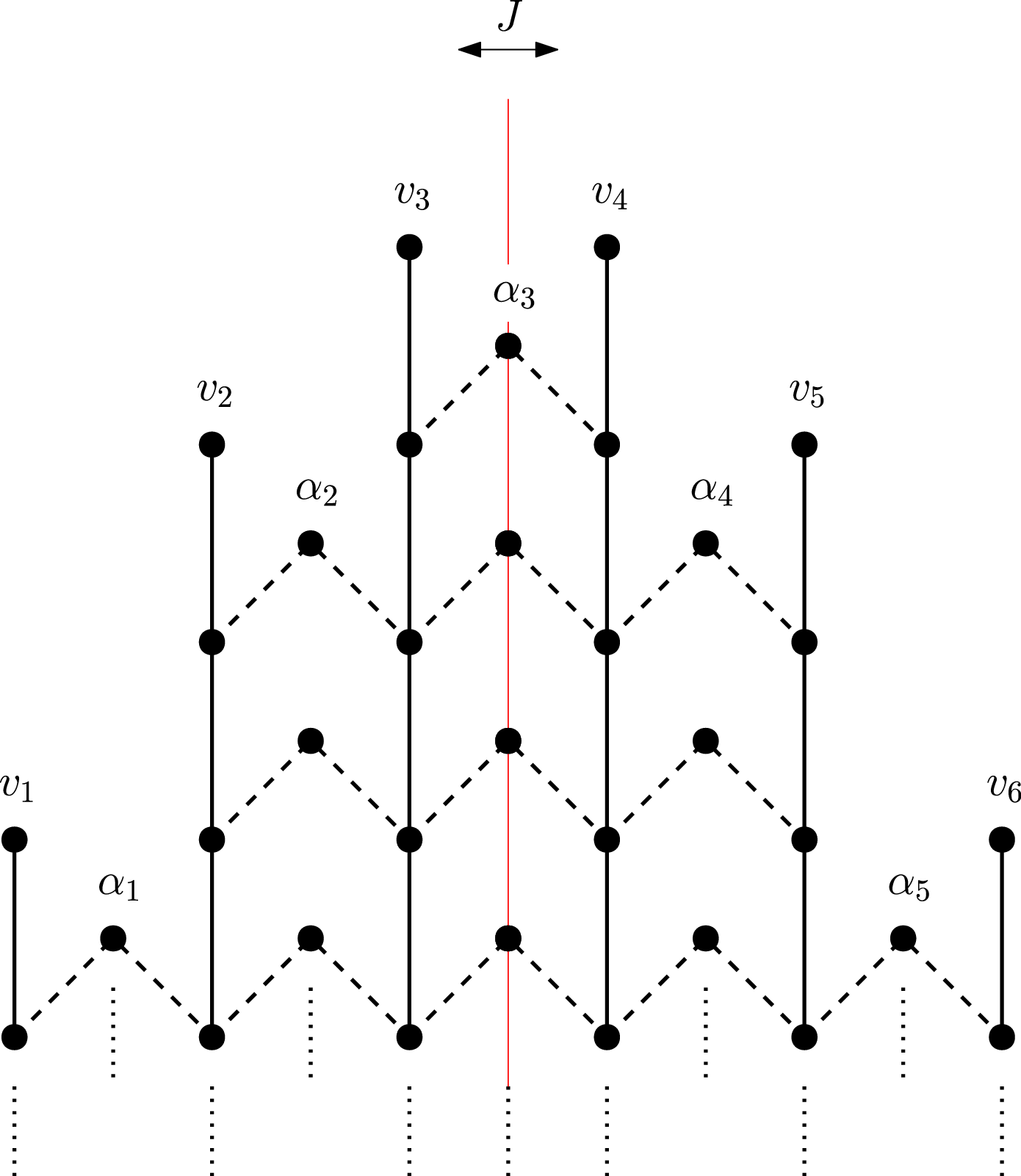
The graded root R with the involution J for the Brieskorn sphere $\Sigma(3,4,13)$
. The leaves and angles of R are labelled by
$\Sigma(3,4,13)$
. The leaves and angles of R are labelled by $v_1, \ldots v_6$
and
$v_1, \ldots v_6$
and $\alpha_1, \ldots \alpha_5$
, respectively.
$\alpha_1, \ldots \alpha_5$
, respectively.

By combining the results of Ozsváth and Szabó [
Reference Ozsváth and Szabó40
], Némethi [
Reference Némethi35
] and Dai and Manolescu [
Reference Dai and Manolescu6
], we have the following graded $\mathbb{F}[U]$
-module isomorphism:
$\mathbb{F}[U]$
-module isomorphism:
 \[F\;:\; HF^-(Y) \xrightarrow{\cong} \mathbb{H}^-(R)[\sigma] \quad \text{and} \quad F \circ \iota_* = J_* \circ F,\]
where $\sigma$
denotes a grading shift Footnote 1 and
$\sigma$
denotes a grading shift Footnote 1 and $\iota_*$
is the induced involution by
$\iota_*$
is the induced involution by $\iota$
on
$\iota$
on $HF^-(Y)$
.
$HF^-(Y)$
.
Following [
Reference Dai and Manolescu6
], we next construct a finitely generated free graded $\mathbb{F}[U]$
-chain complex whose homology is the same as
$\mathbb{F}[U]$
-chain complex whose homology is the same as $\mathbb{H}^-(R)$
. See [
Reference Dai and Manolescu6
, lemma 4·3] for a proof of this fact.
$\mathbb{H}^-(R)$
. See [
Reference Dai and Manolescu6
, lemma 4·3] for a proof of this fact.
Let $v_1, v_2, \ldots, v_n$
(resp.
$v_1, v_2, \ldots, v_n$
(resp. $\alpha_1, \alpha_2, \ldots, \alpha_{n-1}$
) be the leaves (resp. the upward-opening angles) of R, enumerated from left to right in lexicographic order. The grading of vertex
$\alpha_1, \alpha_2, \ldots, \alpha_{n-1}$
) be the leaves (resp. the upward-opening angles) of R, enumerated from left to right in lexicographic order. The grading of vertex $v_i$
and the grading of the vertex supporting angle
$v_i$
and the grading of the vertex supporting angle $\alpha_i$
are denoted by
$\alpha_i$
are denoted by $\nu(v_i)$
and
$\nu(v_i)$
and $\nu(\alpha_i)$
, respectively; see Figure 1.
$\nu(\alpha_i)$
, respectively; see Figure 1.
Then the generators of $C_*(R)$
are given as follows. For each leaf
$C_*(R)$
are given as follows. For each leaf $v_i$
, we place a single generator (also denoted by
$v_i$
, we place a single generator (also denoted by $v_i$
by abuse of notation) in grading
$v_i$
by abuse of notation) in grading $\nu(v_i)$
, so that we introduce an entire tower of generators
$\nu(v_i)$
, so that we introduce an entire tower of generators $\mathbb{F}[U]v_i$
. For each angle
$\mathbb{F}[U]v_i$
. For each angle $\alpha_i$
, we similarly place a single generator (denoted by also
$\alpha_i$
, we similarly place a single generator (denoted by also $\alpha_i$
by abuse of notation) in grading
$\alpha_i$
by abuse of notation) in grading $\nu(\alpha_i) + 1$
. We next define our differential to be identically zero on
$\nu(\alpha_i) + 1$
. We next define our differential to be identically zero on $v_i$
, and set
$v_i$
, and set
 \[\partial \alpha_i = U^{(\nu(v_i)-\nu(\alpha_i))/2}v_i + U^{(\nu(v_{i+1})-\nu(\alpha_i))/2}v_{i+1}\]
for $\alpha_i$
. Finally, we extend it to the entire complex linearly and
$\alpha_i$
. Finally, we extend it to the entire complex linearly and $\mathbb{F}[U]$
-equivariantly.
$\mathbb{F}[U]$
-equivariantly.
There is an involution J on $C_*(R)$
induced by J on R, and it is given by sending
$C_*(R)$
induced by J on R, and it is given by sending $v_i$
to
$v_i$
to $v_{n-i+1}$
,
$v_{n-i+1}$
, $\alpha_i$
to
$\alpha_i$
to $\alpha_{n-i}$
, and extending linearly and
$\alpha_{n-i}$
, and extending linearly and $\mathbb{F}[U]$
-equivariantly. See Figure 2. One can check that the pair
$\mathbb{F}[U]$
-equivariantly. See Figure 2. One can check that the pair $(C_*(R), J)$
forms an
$(C_*(R), J)$
forms an $\iota$
-complex. Moreover, J also induces the involution
$\iota$
-complex. Moreover, J also induces the involution $J_*$
on
$J_*$
on $\mathbb{H}^-(R)$
. See [
Reference Dai and Manolescu6
, section 4] and [
Reference Dai and Stoffregen8
, section 2·3] for more details.
$\mathbb{H}^-(R)$
. See [
Reference Dai and Manolescu6
, section 4] and [
Reference Dai and Stoffregen8
, section 2·3] for more details.
The standard complex $C_*(R)$
with the involution J that captures the lattice homology
$C_*(R)$
with the involution J that captures the lattice homology $\mathbb{H}^- (\Sigma(3,4,13))$
. Here, the solid (resp. the dashed) lines represent the action of U (resp.
$\mathbb{H}^- (\Sigma(3,4,13))$
. Here, the solid (resp. the dashed) lines represent the action of U (resp. $\partial$
).
$\partial$
).
In [ Reference Dai and Manolescu6 , section 6], Dai and Manolescu introduced the notion of a monotone graded subroot of a symmetric graded root R, to simply determine the local equivalence class of a Seifert fibered sphere.
Let $(R, \nu, J)$
be a symmetric graded root, and let
$(R, \nu, J)$
be a symmetric graded root, and let $\mathcal{G}_R$
be the image of the grading function
$\mathcal{G}_R$
be the image of the grading function $\nu\;:\; R \to \mathbb{Z}$
. For a positive integer n, let
$\nu\;:\; R \to \mathbb{Z}$
. For a positive integer n, let $h_1, \ldots, h_n$
(resp.
$h_1, \ldots, h_n$
(resp. $r_1, \ldots, r_n$
) be a sequence of decreasing (resp. increasing) even integers in
$r_1, \ldots, r_n$
) be a sequence of decreasing (resp. increasing) even integers in $\mathcal{G}_R$
such that
$\mathcal{G}_R$
such that $h_n \geq r_n$
. Then a monotone graded subroot
$h_n \geq r_n$
. Then a monotone graded subroot
 \[M=M(h_1,r_1; \ldots; h_n,r_n)\]
of R equipped with the same involution J is constructed in the following fashion:
-
(1) form the stem of M by drawing a single infinite tower with the uppermost vertex in grading $r_n$
;
$r_n$
; -
(2) if
$h_n \gt r_n$
, use leaves
$v_i$
and
$J v_i$
of R to introduce leaves
$v_i$
and
$J v_i$
of M in grading
$h_i$
for each
$1 \leq i \lt n$
; -
(3) connect
$v_i$
and
$J v_i$
to the stem by using two paths meeting the stem in grading
$r_i$
for each
$1 \leq i \lt n$
; -
(4) if
$h_n = r_n$
, then set
$v_n = J v_n$
at grading
$r_n$
in the second step.


By construction, the standard complex $(C_*(M), J)$
of a monotone graded subroot M is a subcomplex of
$(C_*(M), J)$
of a monotone graded subroot M is a subcomplex of $(C_*(R), J)$
, and it also forms an
$(C_*(R), J)$
, and it also forms an $\iota$
-complex itself, see [
Reference Dai and Manolescu6
, section 6]. However, this subcomplex is sufficient to describe the local equivalence class of a Seifert fibered sphere completely, as proven by Dai and Manolescu.
$\iota$
-complex itself, see [
Reference Dai and Manolescu6
, section 6]. However, this subcomplex is sufficient to describe the local equivalence class of a Seifert fibered sphere completely, as proven by Dai and Manolescu.
Theorem 2·4 ([
Reference Dai and Manolescu6
, theorems 4·5 and 6·1]). Let Y be a Seifert fibered sphere with a symmetric graded root R. Let M be a monotone graded subroot of R. Then the $\iota$
-complexes
$\iota$
-complexes $(CF^-(Y), \iota)$
,
$(CF^-(Y), \iota)$
, $(C_* (R), J)$
, and
$(C_* (R), J)$
, and $(C_* (M), J)$
are locally equivalent in
$(C_* (M), J)$
are locally equivalent in $\mathfrak{I}$
.
$\mathfrak{I}$
.
We now describe the parameterisation of a monotone graded subroot for a Seifert fibered sphere by using involutive correction terms $\underline{d}$
and
$\underline{d}$
and $\overline{d}$
. See Figure 3 for an example.
$\overline{d}$
. See Figure 3 for an example.
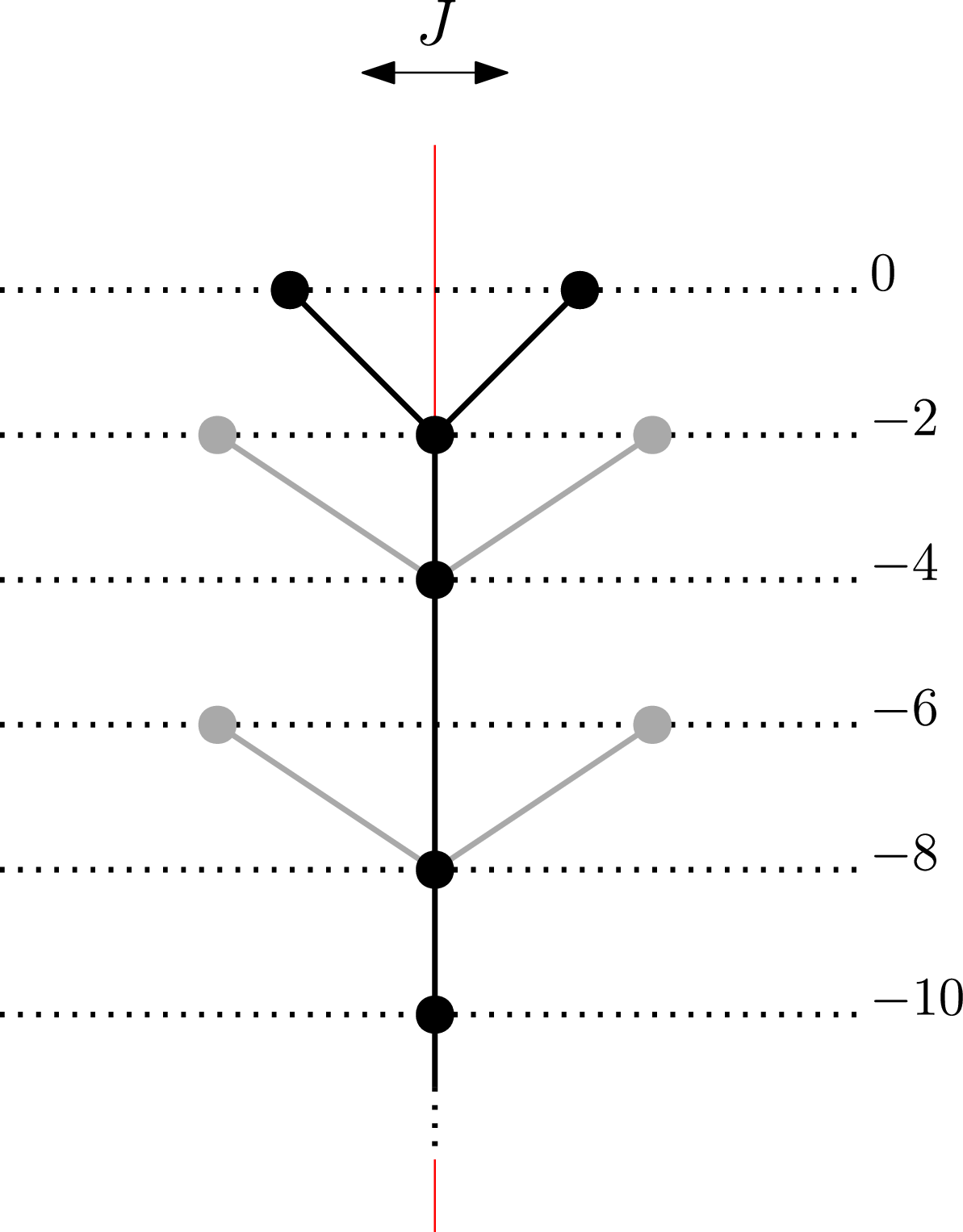
For the Brieskorn sphere $\Sigma(3,4,13)$
, the monotone graded subroot
$\Sigma(3,4,13)$
, the monotone graded subroot $M = M(0,-2)$
with the involution J is drawn in black, compare with Figure 1.
$M = M(0,-2)$
with the involution J is drawn in black, compare with Figure 1.
Theorem 2·5 ([
Reference Dai and Manolescu6
, section 8]; [
Reference Dai and Stoffregen8
, theorem 4·4]). Let Y be a Seifert fibered sphere with a graded root R. Then there exists a monotone graded subroot $M = M(h_1,r_1; \ldots; h_n,r_n)$
of R such that
$M = M(h_1,r_1; \ldots; h_n,r_n)$
of R such that
 \[h_1 = \overline{d}(Y) \quad \text{and} \quad r_n = \underline{d}(Y).\]
By following the convention in [
Reference Dai and Stoffregen8
], from now on, we will refer to the standard complex $(C_* (M), J)$
as just the monotone graded subroot M for simplicity.
$(C_* (M), J)$
as just the monotone graded subroot M for simplicity.
Now we present a theorem, provided by Dai and Stoffregen [ Reference Dai and Stoffregen8 ], to describe how a monotone graded subroot decomposes into simpler ones up to local equivalence.
Theorem 2·6 ([
Reference Dai and Stoffregen8
, theorem 4·2]). For any monotone graded subroot $M=M(h_1,r_1; \ldots;\; h_n,r_n)$
, we have the local equivalence:
$M=M(h_1,r_1; \ldots;\; h_n,r_n)$
, we have the local equivalence:
 \[M = \left ( \sum_{i=1}^{n} M(h_i,r_i) \right ) - \left ( \sum_{i=1}^{n-1} M(h_{i+1},r_i) \right ) .\]
Relying on the above results, Dai and Stoffregen further proved the following theorem. Recall that $B(0) = \Sigma(2,3,5)$
, and
$B(0) = \Sigma(2,3,5)$
, and $B(n) = \Sigma(2n+1, 4n+1, 4n+3)$
for
$B(n) = \Sigma(2n+1, 4n+1, 4n+3)$
for $n \geq 1$
.
$n \geq 1$
.
Theorem 2·7 ([
Reference Dai and Stoffregen8
, theorem 1·1]). The image $\mathfrak{I}_{SF}$
of the subgroup
$\mathfrak{I}_{SF}$
of the subgroup $\Theta_{SF}^3$
generated by the Seifert fibered spheres under the homomorphism h is infinitely generated, i.e.,
$\Theta_{SF}^3$
generated by the Seifert fibered spheres under the homomorphism h is infinitely generated, i.e.,
 \[\mathfrak{I}_{SF} = \langle h(B(n)) \rangle \cong \mathbb{Z}^\infty.\]
For any Seifert fibered sphere Y, there exists a unique homology sphere $Z_Y$
expressed as the linear combination of the basis elements
$Z_Y$
expressed as the linear combination of the basis elements $\{B(n)\}$
such that
$\{B(n)\}$
such that $h(Y)=h(Z_Y)$
, i.e., the homology sphere
$h(Y)=h(Z_Y)$
, i.e., the homology sphere $Y \# -Z_Y$
lies in
$Y \# -Z_Y$
lies in $\operatorname{ker}(h)$
. We call such
$\operatorname{ker}(h)$
. We call such $Z_Y$
the associated homology sphere to Y with respect to
$Z_Y$
the associated homology sphere to Y with respect to $\{B(n)\}$
. We omit the reference to the basis when it is clear from the context. In the final section of this article, beyond merely establishing the existence of
$\{B(n)\}$
. We omit the reference to the basis when it is clear from the context. In the final section of this article, beyond merely establishing the existence of $Z_Y$
and the linear independence of Y and
$Z_Y$
and the linear independence of Y and $Z_Y$
in
$Z_Y$
in $\Theta_\mathbb{Q}^3$
, we will explicitly construct
$\Theta_\mathbb{Q}^3$
, we will explicitly construct $Z_Y$
for a specific family Y by applying Theorem 2·6.
$Z_Y$
for a specific family Y by applying Theorem 2·6.
2·3. Local equivalence in Seiberg–Witten Floer theory
Based on the work of Manolescu [ Reference Manolescu32 ], Stoffregen [ Reference Stoffregen50 ] previously defined an analogous notion of the local equivalence class for homology spheres in Seiberg–Witten Floer theory, and computed these classes for Seifert fibered spheres. In this subsection, we present the equivalence between two notions of the local equivalence class in Seiberg–Witten Floer theory and the one in involutive Heegaard Floer theory for each Seifert fibered sphere.
As described in [
Reference Stoffregen50
], the local equivalence class of the $\operatorname{Pin}(2)$
-equivariant Seiberg–Witten Floer stable homotopy type SWF(Y) and of its associated chain complex of its spectrum also form abelian groups
$\operatorname{Pin}(2)$
-equivariant Seiberg–Witten Floer stable homotopy type SWF(Y) and of its associated chain complex of its spectrum also form abelian groups $\mathfrak{LE}$
and
$\mathfrak{LE}$
and $\mathfrak{CLE}$
, respectively, together with the homomorphisms:
$\mathfrak{CLE}$
, respectively, together with the homomorphisms:
 \[\Theta_\mathbb{Z}^3 \rightarrow \mathfrak{LE}\rightarrow\mathfrak{CLE},\]
where:
-
(1) the
$\kappa$
-invariant [
Reference Manolescu32
] and
$\kappa o_i$
-invariants [
Reference Lin31
] for
$i = 0, \ldots, 7$
factor through
$\mathfrak{LE}$
; -
(2) the
$\delta$
-invariant [
Reference Frøyshov15
], the
$\alpha$
-,
$\beta$
-, and
$\gamma$
-invariants [
Reference Manolescu33
], and the
$\underline{\delta}$
- and
$\overline{\delta}$
-invariants [
Reference Stoffregen49
] factor through
$\mathfrak{CLE}$
.


See [ Reference Manolescu34 , section 3] for further details.
Recall that SWF(Y) recovers the $\operatorname{Pin}(2)$
-equivariant Seiberg–Witten Floer homology of Y.Footnote 2 Motivated from the facts that
$\operatorname{Pin}(2)$
-equivariant Seiberg–Witten Floer homology of Y.Footnote 2 Motivated from the facts that $\mathbb{H}^-(R)$
is isomorphic to
$\mathbb{H}^-(R)$
is isomorphic to $HF^-(Y)$
[
Reference Némethi35
], and hence to the Seiberg–Witten Floer homology [
Reference Kutluhan, Lee and Taubes27, Reference Lidman and Manolescu29
], Dai, Sasahira and Stoffregen constructed the
$HF^-(Y)$
[
Reference Némethi35
], and hence to the Seiberg–Witten Floer homology [
Reference Kutluhan, Lee and Taubes27, Reference Lidman and Manolescu29
], Dai, Sasahira and Stoffregen constructed the $\operatorname{Pin}(2)$
-equivariant spectrum
$\operatorname{Pin}(2)$
-equivariant spectrum $\mathcal{H}(R)$
of the graded root R of Y, and proved the following:
$\mathcal{H}(R)$
of the graded root R of Y, and proved the following:
Theorem 2·8 ([
Reference Dai, Sasahira and Stoffregen7
, theorems 1·2 and 7·3]). Let Y be a Seifert fibered sphere with a graded root R. Then there is a $\operatorname{Pin}(2)$
-equivariant homotopy equivalence:
$\operatorname{Pin}(2)$
-equivariant homotopy equivalence:
 \[\mathcal{H}(R)\simeq SWF(Y).\]
In particular, for two Seifert fibered spheres $Y_1$
and
$Y_1$
and $Y_2$
, the following are equivalent:
$Y_2$
, the following are equivalent:
-
(i)
$h(Y_1)=h(Y_2)$
in
$\mathfrak{I}$
; -
(ii)
$[SWF(Y_1)] = [SWF(Y_2)]$
in
$\mathfrak{LE}$
.




In particular, if the associated homology sphere $Z_Y$
to a Seifert fibered sphere Y is itself a Seifert fibered sphere, then the homology sphere
$Z_Y$
to a Seifert fibered sphere Y is itself a Seifert fibered sphere, then the homology sphere $Y \# -Z_Y$
in
$Y \# -Z_Y$
in $\ker (h)$
also lies in the kernel of
$\ker (h)$
also lies in the kernel of $\Theta^3_\mathbb{Z} \to \mathfrak{LE}$
.
$\Theta^3_\mathbb{Z} \to \mathfrak{LE}$
.
2·4. Filtered instanton Floer homology and
$r_s$
-invariants

In this subsection, we briefly recall instanton Floer homology and its filtered version by Nozaki, Sato, and Taniguchi [ Reference Nozaki, Sato and Taniguchi38 ]. We follow the conventions and notations in [ Reference Nozaki, Sato and Taniguchi38 ].
For a given homology sphere Y, the Chern–Simons functional $cs_Y$
is defined on the space A(Y) of SU(2)-connections on the product principal SU(2)-bundle
$cs_Y$
is defined on the space A(Y) of SU(2)-connections on the product principal SU(2)-bundle $P_Y = Y \times SU(2)$
.Footnote
3
Since
$P_Y = Y \times SU(2)$
.Footnote
3
Since $cs_Y$
is invariant under the action of the group
$cs_Y$
is invariant under the action of the group $\operatorname{Map}_0(Y, SU(2))$
consisting of degree 0 maps in the gauge group,
$\operatorname{Map}_0(Y, SU(2))$
consisting of degree 0 maps in the gauge group, $cs_Y\;:\;A(Y)\rightarrow \mathbb{R}$
factors through the configuration space
$cs_Y\;:\;A(Y)\rightarrow \mathbb{R}$
factors through the configuration space $\widetilde{B}(Y) = A(Y) / \operatorname{Map}_0(Y, SU(2))$
. We consider the subset
$\widetilde{B}(Y) = A(Y) / \operatorname{Map}_0(Y, SU(2))$
. We consider the subset $\widetilde{B}^*(Y)$
which consists of the orbits of irreducible connections, namely the stabiliser subgroup is
$\widetilde{B}^*(Y)$
which consists of the orbits of irreducible connections, namely the stabiliser subgroup is $\{\pm I\}$
where I denotes the constant map to the identity in SU(2).
$\{\pm I\}$
where I denotes the constant map to the identity in SU(2).
We fix a Riemannian metric on Y and an appropriate perturbation $\pi$
of
$\pi$
of $cs_Y$
. Then we construct an infinite-dimensional analogue of Morse chain complex of
$cs_Y$
. Then we construct an infinite-dimensional analogue of Morse chain complex of $\widetilde{B}^*(Y)$
using the perturbed Chern–Simons functional
$\widetilde{B}^*(Y)$
using the perturbed Chern–Simons functional $cs_{Y,\pi}$
. The set
$cs_{Y,\pi}$
. The set $\widetilde{R}^*_\pi(Y)$
of the irreducible critical points of
$\widetilde{R}^*_\pi(Y)$
of the irreducible critical points of $cs_{Y,\pi}$
in
$cs_{Y,\pi}$
in $\widetilde{B}^*(Y)$
, consists of flat connections, namely, those with curvature
$\widetilde{B}^*(Y)$
, consists of flat connections, namely, those with curvature $F_A=0$
. The integer-valued Floer index ind, which is an analogue of the ordinary Morse index, is also well-defined on
$F_A=0$
. The integer-valued Floer index ind, which is an analogue of the ordinary Morse index, is also well-defined on $\widetilde{R}^*(Y)$
. Then the instanton Floer chain complex is defined as:
$\widetilde{R}^*(Y)$
. Then the instanton Floer chain complex is defined as:
 \[CI_i(Y)=\mathbb{Z}\{a \in \widetilde{R}_\pi^*(Y) \ | \ ind(a) = i\},\]
together with the boundary map $\partial\;:\; CI_i(Y) \rightarrow CI_{i-1}(Y)$
given by:
$\partial\;:\; CI_i(Y) \rightarrow CI_{i-1}(Y)$
given by:
 \[\partial (a) = \!\!\!\!\! \sum\limits_{{\substack{b \in \widetilde{R}^*_\pi(Y) \\ \text{ind}(b) = i-1}}} \!\!\!\!\!\!\#(M^Y(a, b)/\mathbb{R})b.\]
Here, $M^Y(a, b)$
denotes the 1-dimensional moduli space of instantons over the cylinder
$M^Y(a, b)$
denotes the 1-dimensional moduli space of instantons over the cylinder $\mathbb{R} \times Y$
where its restriction on
$\mathbb{R} \times Y$
where its restriction on $Y\times t$
is asymptotically a when t goes to
$Y\times t$
is asymptotically a when t goes to $-\infty$
and b when t goes to
$-\infty$
and b when t goes to $+\infty$
. Note that
$+\infty$
. Note that $\mathbb{R}$
acts on
$\mathbb{R}$
acts on $M^Y(a,b)$
by the translation.
$M^Y(a,b)$
by the translation.
The boundary map satisfies $\partial^2 = 0$
, so we obtain the instanton Floer homology
$\partial^2 = 0$
, so we obtain the instanton Floer homology $I_*(Y)$
, which does not depend on the choice of Riemannian metric and perturbation, and is a diffeomorphism invariant of Y. By taking the dual complex
$I_*(Y)$
, which does not depend on the choice of Riemannian metric and perturbation, and is a diffeomorphism invariant of Y. By taking the dual complex $CI^i(Y)$
, one can also obtain the instanton Floer cohomology
$CI^i(Y)$
, one can also obtain the instanton Floer cohomology $I^*(Y)$
.
$I^*(Y)$
.
Note that the chain complex only involves irreducible critical points. Let $\theta \in A(Y)$
be the product SU(2)-connection on
$\theta \in A(Y)$
be the product SU(2)-connection on $P_Y$
so that
$P_Y$
so that $\theta$
is a reducible critical point. Donaldson [
Reference Donaldson9
] introduced an obstruction cocycle
$\theta$
is a reducible critical point. Donaldson [
Reference Donaldson9
] introduced an obstruction cocycle $\theta_Y\;:\;CI_1(Y)\rightarrow \mathbb{Z}$
in the first instanton Floer cochain complex
$\theta_Y\;:\;CI_1(Y)\rightarrow \mathbb{Z}$
in the first instanton Floer cochain complex $CI^1(Y)$
to count the trajectories from irreducible solutions to
$CI^1(Y)$
to count the trajectories from irreducible solutions to $\theta$
as follows:
$\theta$
as follows:
 \[\theta_Y([a]) = \#(M^Y(a, \theta)/\mathbb{R}),\]
where $M^Y(a,\theta)$
is similarly defined to
$M^Y(a,\theta)$
is similarly defined to $M^Y(a,b)$
. See [
Reference Nozaki, Sato and Taniguchi38
] for a precise definition. The cocycle
$M^Y(a,b)$
. See [
Reference Nozaki, Sato and Taniguchi38
] for a precise definition. The cocycle $\theta_Y$
forms a well-defined cohomology class
$\theta_Y$
forms a well-defined cohomology class $[\theta_Y]\in I^1(Y)$
, which vanishes whenever Y bounds a negative definite 4-manifold.
$[\theta_Y]\in I^1(Y)$
, which vanishes whenever Y bounds a negative definite 4-manifold.
On the other hand, Fintushel and Stern [
Reference Fintushel and Stern14
] introduced the filtered instanton Floer homology $I_*^{[r,r+1]} (Y)$
for any fixed real number r whose filtrations are given by the Chern–Simons functional. We recall the recent work of Nozaki, Sato, and Taniguchi [
Reference Nozaki, Sato and Taniguchi38
] which extends the work of Fintushel and Stern to the filtered instanton Floer homology
$I_*^{[r,r+1]} (Y)$
for any fixed real number r whose filtrations are given by the Chern–Simons functional. We recall the recent work of Nozaki, Sato, and Taniguchi [
Reference Nozaki, Sato and Taniguchi38
] which extends the work of Fintushel and Stern to the filtered instanton Floer homology $I_*^{[s,r]} (Y)$
for a more general interval [s, r]. We write the set of real numbers:
$I_*^{[s,r]} (Y)$
for a more general interval [s, r]. We write the set of real numbers:
 \[\Lambda_Y = cs_Y(\widetilde{R}_\pi(Y)), \quad \Lambda_Y^* = cs_Y(\widetilde{R}^*_\pi(Y)) \quad \text{and} \quad \mathbb{R}_Y = \mathbb{R} - \Lambda_Y,\]
where $\widetilde{R}_\pi(Y)$
is the set of the orbits of all critical points of
$\widetilde{R}_\pi(Y)$
is the set of the orbits of all critical points of $cs_{Y,\pi}$
, whether irreducible or reducible.
$cs_{Y,\pi}$
, whether irreducible or reducible.
Definition 2·9. Let $s\in [\!-\!\infty, 0]$
,
$s\in [\!-\!\infty, 0]$
, $r\in \mathbb{R}_Y$
and
$r\in \mathbb{R}_Y$
and $\lambda_Y = \min\{|a-b| |a \neq b, a, b\in \Lambda_Y\}$
. The filtered instanton Floer chain complex is defined as:
$\lambda_Y = \min\{|a-b| |a \neq b, a, b\in \Lambda_Y\}$
. The filtered instanton Floer chain complex is defined as:
 \[CI_i^{[s, r]}(Y) = \begin{cases} \mathbb{Z}\{a \in \widetilde{R}_{\pi}^*(Y) \ | \ ind(a) = i, cs_{Y, \pi}(a)\in (s, r)\} & \text{if $s\in \mathbb{R}_Y$,}\\ \mathbb{Z}\{a \in \widetilde{R}_{\pi}^*(Y) \ | \ ind(a) = i, cs_{Y, \pi}(a)\in (s-\lambda_Y/2, r)\}& \text{if $s\in \Lambda_Y$,} \end{cases}\]
together with the boundary map given by the restriction of $\partial$
defined on the ordinary
$\partial$
defined on the ordinary $CI_i(Y)$
.
$CI_i(Y)$
.
Since $\partial^2=0$
, we have the filtered instanton Floer homology
$\partial^2=0$
, we have the filtered instanton Floer homology $I_*^{[s,r]}(Y)$
, which is a diffeomorphism invariant of Y. Technically, the chain complex can be defined for arbitrary intervals, however, we avoid the case when
$I_*^{[s,r]}(Y)$
, which is a diffeomorphism invariant of Y. Technically, the chain complex can be defined for arbitrary intervals, however, we avoid the case when $r\in \Lambda_Y$
to make the canonically defined map
$r\in \Lambda_Y$
to make the canonically defined map $i_{[s, r]}^{[s',r']}\;:\;CI_i^{[s,r]}(Y)\rightarrow CI_i^{[s',r']}(Y)$
behave well. More precisely.
$i_{[s, r]}^{[s',r']}\;:\;CI_i^{[s,r]}(Y)\rightarrow CI_i^{[s',r']}(Y)$
behave well. More precisely.
Lemma 2·10 ([
Reference Nozaki, Sato and Taniguchi38
, lemma 2·9]). Suppose $s\le s' \le 0 \le r \le r'$
where
$s\le s' \le 0 \le r \le r'$
where $r, r'\in \mathbb{R}_Y$
. If both [r, r’] and [s, s’] do not contain any value of
$r, r'\in \mathbb{R}_Y$
. If both [r, r’] and [s, s’] do not contain any value of $\Lambda_Y^*$
, then the map
$\Lambda_Y^*$
, then the map $i_{[s, r]}^{[s',r']}\;:\;CI_i^{[s,r]}(Y)\rightarrow CI_i^{[s',r']}(Y)$
defined by
$i_{[s, r]}^{[s',r']}\;:\;CI_i^{[s,r]}(Y)\rightarrow CI_i^{[s',r']}(Y)$
defined by
 \[ i_{[s,r]}^{[s',r']}(a)= \begin{cases} a &\text{if $a\in CI_i^{[s',r']}(Y)$,}\\ 0 &\text{otherwise,} \end{cases}\]
is a chain homotopy equivalence.
By taking duals of $CI_i^{[s,r]}(Y)$
and of the chain maps, we can also consider the filtered instanton Floer cochain complex
$CI_i^{[s,r]}(Y)$
and of the chain maps, we can also consider the filtered instanton Floer cochain complex $CI^i_{[s,r]}(Y)$
and its cohomology
$CI^i_{[s,r]}(Y)$
and its cohomology $I^i_{[s,r]}(Y)$
, and the dual maps on them.
$I^i_{[s,r]}(Y)$
, and the dual maps on them.
Let $Y_1$
and
$Y_1$
and $Y_2$
be two homology spheres. Now we consider an oriented cobordism W from
$Y_2$
be two homology spheres. Now we consider an oriented cobordism W from $Y_1$
to
$Y_1$
to $Y_2$
. As in other Floer theories, W induces a chain map between the instanton Floer chain complexes. In particular, when
$Y_2$
. As in other Floer theories, W induces a chain map between the instanton Floer chain complexes. In particular, when $b_1(W)=b_2^+(W)=0$
, the (co)chain maps preserve the Floer indices:
$b_1(W)=b_2^+(W)=0$
, the (co)chain maps preserve the Floer indices:
 \begin{align*} CW_i^{[s, r]}&\;:\;CI_i^{[s,r]}(Y_1)\rightarrow CI_i^{[s,r]}(Y_2);\\ CW^i_{[s, r]}&\;:\;CI^i_{[s,r]}(Y_2)\rightarrow CI^i_{[s,r]}(Y_1).\end{align*}
Let $\theta_Y^{[s,r]}$
be the restriction of
$\theta_Y^{[s,r]}$
be the restriction of $\theta_Y$
to
$\theta_Y$
to $CI_1^{[s,r]}(Y)$
. In [
Reference Nozaki, Sato and Taniguchi38
], Nozaki, Sato and Taniguchi observed that the map
$CI_1^{[s,r]}(Y)$
. In [
Reference Nozaki, Sato and Taniguchi38
], Nozaki, Sato and Taniguchi observed that the map $\theta_Y^{[s,r]}$
defines a cocycle in
$\theta_Y^{[s,r]}$
defines a cocycle in $CI^1_{[s,r]}(Y)$
. The cohomology class
$CI^1_{[s,r]}(Y)$
. The cohomology class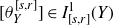 $[\theta_Y^{[s,r]}]\in I^1_{[s,r]}(Y)$
also behaves well under the induced map
$[\theta_Y^{[s,r]}]\in I^1_{[s,r]}(Y)$
also behaves well under the induced map $IW^1_{[s,r]}$
by
$IW^1_{[s,r]}$
by $CW^1_{[s,r]}$
on the first cohomology. More precisely,
$CW^1_{[s,r]}$
on the first cohomology. More precisely,
Theorem 2·11 ([
Reference Nozaki, Sato and Taniguchi38
, lemma 2·13]). If there is a negative definite cobordism W from $Y_1$
to
$Y_1$
to $Y_2$
with
$Y_2$
with $H^1(W;\;\mathbb{R})=0$
, then for
$H^1(W;\;\mathbb{R})=0$
, then for $r\in \mathbb{R}_{Y_1}\cap \mathbb{R}_{Y_2}$
,
$r\in \mathbb{R}_{Y_1}\cap \mathbb{R}_{Y_2}$
,
 \[IW^1_{[s,r]}\big(\big[\theta_{Y_2}^{[s,r]}\big]\big) = |H_1(W;\;\mathbb{Z})|\big[\theta_{Y_1}^{[s,r]}\big].\]
In particular, if Y bounds a negative definite 4-manifold, then the obstruction class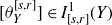 $[\theta_Y^{[s, r]}]\in I^1_{[s,r]} (Y)$
vanishes.
$[\theta_Y^{[s, r]}]\in I^1_{[s,r]} (Y)$
vanishes.
Let $i_{[s',r']}^{[s,r]}$
be the dual map of
$i_{[s',r']}^{[s,r]}$
be the dual map of $i^{[s',r']}_{[s,r]}$
. We use the same notation for the induced maps on (co)homology by abusing notation. One can observe from Lemma 2·10 that:
$i^{[s',r']}_{[s,r]}$
. We use the same notation for the induced maps on (co)homology by abusing notation. One can observe from Lemma 2·10 that:
Lemma 2·12 ([
Reference Nozaki, Sato and Taniguchi38
, lemma 2·15]). Suppose $s\le s' \le 0 \le r \le r'$
where
$s\le s' \le 0 \le r \le r'$
where $r, r'\in \mathbb{R}_Y$
. Then,
$r, r'\in \mathbb{R}_Y$
. Then,
 \[i_{[s',r']}^{[s,r]}\big[\theta_Y^{[s',r']}\big] = \big[\theta_Y^{[s,r]}\big].\]
Suppose $[\theta_Y^{[s, r]}]\neq 0$
. By definition of
$[\theta_Y^{[s, r]}]\neq 0$
. By definition of $i_{[s,r]}^{[s',r']}$
and Lemma 2·12,
$i_{[s,r]}^{[s',r']}$
and Lemma 2·12, $[\theta_Y^{[s, r']}]$
vanishes for some
$[\theta_Y^{[s, r']}]$
vanishes for some $r'\lt r$
and then
$r'\lt r$
and then $[\theta_Y^{[s, r'']}]=0$
for any
$[\theta_Y^{[s, r'']}]=0$
for any $r''\le r'$
. This “birth-death” property motivates to define the
$r''\le r'$
. This “birth-death” property motivates to define the $r_s$
-invariant to measure when the obstruction class
$r_s$
-invariant to measure when the obstruction class $[\theta_Y^{[s,r]}]$
begins to vanish. The coefficient ring is taken as
$[\theta_Y^{[s,r]}]$
begins to vanish. The coefficient ring is taken as $\mathbb{Q}$
, since one may want to divide
$\mathbb{Q}$
, since one may want to divide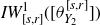 $IW^1_{[s,r]}([\theta_{Y_2}^{[s,r]}])$
by the non-zero integer
$IW^1_{[s,r]}([\theta_{Y_2}^{[s,r]}])$
by the non-zero integer $|H_1(W;\;\mathbb{Z})|$
to obtain
$|H_1(W;\;\mathbb{Z})|$
to obtain $[\theta_{Y_1}^{[s,r]}]$
as in Theorem 2·11.
$[\theta_{Y_1}^{[s,r]}]$
as in Theorem 2·11.
Definition 2·13 ([
Reference Nozaki, Sato and Taniguchi38
, definition 3·2]). Let $s\in [\!-\!\infty, 0]$
. The
$s\in [\!-\!\infty, 0]$
. The $r_s$
-invariant of Y is defined as:
$r_s$
-invariant of Y is defined as:
 \[r_s (Y) = \sup \big\{ r \in (0,\infty] \ | \ \big[\theta_Y^{[s, r]}\otimes id_\mathbb{Q}\big] = 0 \in I^1_{[s,r]} (Y;\;\mathbb{Q}) \big\}.\]
By definition and the vanishing property of the obstruction class, if Y bounds a negative definite 4-manifold, then $r_s(Y) = \infty$
for all
$r_s(Y) = \infty$
for all $s\in[\!-\!\infty, 0]$
. In particular, for any
$s\in[\!-\!\infty, 0]$
. In particular, for any $s\in[\!-\!\infty, 0]$
and any Seifert fibered sphere
$s\in[\!-\!\infty, 0]$
and any Seifert fibered sphere $\Sigma(a_1,\ldots, a_n)$
, we have
$\Sigma(a_1,\ldots, a_n)$
, we have
 \[r_s(\Sigma(a_1,\ldots,a_n))=\infty.\]
Nozaki, Sato and Taniguchi [
Reference Nozaki, Sato and Taniguchi38
, theorem 5·15] proved that the value $r_s(Y)$
is invariant under rational homology cobordism. They also obtained the following connected sum formula [
Reference Nozaki, Sato and Taniguchi38
, theorem 1·1(4)]
$r_s(Y)$
is invariant under rational homology cobordism. They also obtained the following connected sum formula [
Reference Nozaki, Sato and Taniguchi38
, theorem 1·1(4)]
 \[r_{s_1+s_2}(Y_1\#Y_2)\ge \min\{r_{s_1}(Y_1)+s_2, \ r_{s_2}(Y_2)+s_1\},\]
so it is useful to take $s=0$
to obtain linear independence in
$s=0$
to obtain linear independence in $\Theta_\mathbb{Q}^3$
.
$\Theta_\mathbb{Q}^3$
.
Theorem 2·14 ([
Reference Nozaki, Sato and Taniguchi38
, corollary 5·6, theorem 5·15]). Let $\{Y_i\}_{i\geq 1}$
be an infinite family of homology spheres. If all
$\{Y_i\}_{i\geq 1}$
be an infinite family of homology spheres. If all $r_0(Y_i)$
are distinct and finite, and
$r_0(Y_i)$
are distinct and finite, and $r_0(-Y_i)=\infty$
, then
$r_0(-Y_i)=\infty$
, then $\{Y_i\}_{i\geq 1}$
is linearly independent in
$\{Y_i\}_{i\geq 1}$
is linearly independent in $\Theta_\mathbb{Q}^3$
.
$\Theta_\mathbb{Q}^3$
.
Theorem 2·14 will play a crucial role in the proof of Theorem 1·2, coupled with the useful formula for $r_0(Y)$
for a Seifert fibered sphere Y such that
$r_0(Y)$
for a Seifert fibered sphere Y such that $R(Y) \gt 0$
, where R is the integer defined for a Seifert fibered sphere by Fintushel and Stern [
Reference Fintushel and Stern13
]. We close this section by presenting such a formula.
$R(Y) \gt 0$
, where R is the integer defined for a Seifert fibered sphere by Fintushel and Stern [
Reference Fintushel and Stern13
]. We close this section by presenting such a formula.
Theorem 2·15 ([
Reference Nozaki, Sato and Taniguchi38
, corollary 1·4]). Let Y be the Seifert fibered sphere $\Sigma(a_1,\ldots, a_n)$
. If
$\Sigma(a_1,\ldots, a_n)$
. If $R(Y) \gt0$
, then for any
$R(Y) \gt0$
, then for any $s\in [\!-\!\infty, 0]$
,
$s\in [\!-\!\infty, 0]$
,
 \[r_s(\!-\!Y) = \frac{1}{4a_1\cdots a_n} \cdot\]
3. Proof of Theorem 1·2 and examples
In this section, we prove Theorem 1·2 which establishes conditions on a Seifert fibered homology sphere Y to ensure that Y and the associated homology sphere $Z_Y$
are different in
$Z_Y$
are different in $\Theta^3_{\mathbb{Q}}$
, in terms of the product
$\Theta^3_{\mathbb{Q}}$
, in terms of the product $\mathcal{E} (Y)$
of its exponents and the Fintushel–Stern R-invariant [
Reference Fintushel and Stern13
]. It is evident that the homology sphere
$\mathcal{E} (Y)$
of its exponents and the Fintushel–Stern R-invariant [
Reference Fintushel and Stern13
]. It is evident that the homology sphere $Y \# -Z_Y$
lies in
$Y \# -Z_Y$
lies in $\operatorname{ker}(h)$
, and hence provides a potential counterexample for Question 1·1. We restate Theorem 1·2 in a slightly stronger way which clearly implies the version in Section 1.
$\operatorname{ker}(h)$
, and hence provides a potential counterexample for Question 1·1. We restate Theorem 1·2 in a slightly stronger way which clearly implies the version in Section 1.
Theorem 1·2. Let $\{Y(n)\}$
be a family of Seifert fibered sphere and let Z(n) be the associated homology spheres to Y(n) of the same image in
$\{Y(n)\}$
be a family of Seifert fibered sphere and let Z(n) be the associated homology spheres to Y(n) of the same image in $\mathfrak{I}$
. If
$\mathfrak{I}$
. If $R(Y(n)) \gt 0$
,
$R(Y(n)) \gt 0$
, $\mathcal{E} (Y(n)) \gt 30$
, and the integers
$\mathcal{E} (Y(n)) \gt 30$
, and the integers $\mathcal{E}(Y(n))$
and
$\mathcal{E}(Y(n))$
and $(2m+1)(4m+1)(4m+3)$
are all distinct, then
$(2m+1)(4m+1)(4m+3)$
are all distinct, then $\{Y(n)\} \cup \{Z(n)\}$
are linearly independent in
$\{Y(n)\} \cup \{Z(n)\}$
are linearly independent in $\Theta_\mathbb{Q}^3$
.
$\Theta_\mathbb{Q}^3$
.
Proof. Since Z(n) is a linear combination of $\{B(m)\}$
, it is enough to prove that
$\{B(m)\}$
, it is enough to prove that $\{Y(n)\}$
and
$\{Y(n)\}$
and $\{B(m)\}$
are linearly independent in
$\{B(m)\}$
are linearly independent in $\Theta_\mathbb{Q}^3$
. Because every Seifert fibered sphere bounds a negative definite 4-manifold, by Theorem 2·11 and the definition of the
$\Theta_\mathbb{Q}^3$
. Because every Seifert fibered sphere bounds a negative definite 4-manifold, by Theorem 2·11 and the definition of the $r_s$
-invariants,
$r_s$
-invariants,
 \[r_0(Y(n))=r_0(B(m))=\infty.\]
By the assumption $R(Y(n)) \gt 0$
, we can apply Theorem 2·15 to obtain
$R(Y(n)) \gt 0$
, we can apply Theorem 2·15 to obtain
 \[r_0(-Y(n)) = \frac{1}{4 \mathcal{E}(Y(n))} \cdot\]
Thus, under the assumptions that $\mathcal{E}(Y(n))$
and
$\mathcal{E}(Y(n))$
and $(2m+1)(4m+1)(4m+3)=\mathcal{E}(B(m))$
are finite and distinct, by Theorem 2·14, the proof is complete.
$(2m+1)(4m+1)(4m+3)=\mathcal{E}(B(m))$
are finite and distinct, by Theorem 2·14, the proof is complete.
Now we present explicit examples of the associated homology spheres $Z_1 (n)$
,
$Z_1 (n)$
, $Z_2 (n)$
, and
$Z_2 (n)$
, and $Z_3 (n)$
to the following families
$Z_3 (n)$
to the following families $Y_1 (n)$
,
$Y_1 (n)$
, $Y_2 (n)$
and
$Y_2 (n)$
and $Y_3 (n)$
of certain Seifert fibered spheres:
$Y_3 (n)$
of certain Seifert fibered spheres:
-
(1)
$Y_1(n) = \Sigma(4n+1, 6n+2, 12n+1)$
; -
(2)
$Y_2(n) = \Sigma(4n-1, 6n-2, 12n-1)$
; -
(3)
$Y_3 (n) = \Sigma(8n+1, 12n+1, 24n+5)$
,



respectively, in terms of B (n) using Theorem 2·6. Then we prove linear independence of them in $\Theta_\mathbb{Q}^3$
by using Theorem 1·2.
$\Theta_\mathbb{Q}^3$
by using Theorem 1·2.
It is well known that the graded root of the Poincaré homology sphere has the monotone graded subroot M(2, 2) since $\overline{d}(\Sigma(2,3,5)) = 2 = \underline{d}(\Sigma(2,3,5))$
. By Theorem 2·5, M(2, 2) is a single tower with the uppermost vertex in grading 2.
$\overline{d}(\Sigma(2,3,5)) = 2 = \underline{d}(\Sigma(2,3,5))$
. By Theorem 2·5, M(2, 2) is a single tower with the uppermost vertex in grading 2.
We next describe the monotone graded subroots of B(n) for $n \geq 1$
[
Reference Dai and Stoffregen8
] (see also [
Reference Stoffregen48
]) and the ones for the families
$n \geq 1$
[
Reference Dai and Stoffregen8
] (see also [
Reference Stoffregen48
]) and the ones for the families $Y_1 (n)$
,
$Y_1 (n)$
, $Y_2 (n)$
, and
$Y_2 (n)$
, and $Y_3 (n)$
[
Reference Karakurt and Şavk24
] (see also [
Reference Karakurt and Şavk23
]):
$Y_3 (n)$
[
Reference Karakurt and Şavk24
] (see also [
Reference Karakurt and Şavk23
]):
Theorem 3·1 ([
Reference Dai and Stoffregen8
, theorem 1·1]; [
Reference Karakurt and Şavk24
, theorem 1·2]). For $n\geq 1$
, the Brieskorn spheres B(n),
$n\geq 1$
, the Brieskorn spheres B(n), $Y_1(n)$
and
$Y_1(n)$
and $Y_2(n)$
have the monotone graded subroots
$Y_2(n)$
have the monotone graded subroots
 \[M(2n,0), \quad M(4n,0;\;2n,2n) \quad \text{and} \quad M(4n-2,0;\;2n,2n),\]
respectively, which are depicted in Figure 4. Moreover, the Brieskorn spheres $Y_3 (n)$
has the same monotone graded subroot as B(4n).
$Y_3 (n)$
has the same monotone graded subroot as B(4n).
The monotone graded subroots of B(n), $Y_1(n)$
and
$Y_1(n)$
and $Y_2(n)$
for
$Y_2(n)$
for $n \geq 1$
.
$n \geq 1$
.

Lemma 3·2. In the local equivalence group $\mathfrak{I}$
, we have the following for
$\mathfrak{I}$
, we have the following for $n \ge 1$
:
$n \ge 1$
:
-
(i)
$h(Y_1(n)) = h(B(2n) \ \# \ - B(n) \ \# \ nB(0))$
; -
(ii)
$h(Y_2(n)) = h(B(2n-1) \ \# \ - B(n) \ \# \ nB(0))$
; -
(iii)
$h(Y_3(n)) = h(B(4n))$
.



Proof. By applying Theorems 2·4 and 3·1 together, we first see that
 \[h(Y_1 (n)) = M(4n,0;\; 2n, 2n) \quad \text{and} \quad h(Y_2 (n)) = M(4n-2,0;\; 2n, 2n).\]
Note that M(2n, 2n) is the single tower with the uppermost vertex in grading 2n, and it is obtained by tensoring n copies of M(2, 2), where $M(2,2)=h(B(0))$
. So we have:
$M(2,2)=h(B(0))$
. So we have:
 \[M(2n,2n) = \underbrace{M(2,2) + \cdots + M(2,2)}_{n\text{ copies}}.\]
We next use Theorem 2·6 to decompose the monotone graded subroots above. Since $h\;:\; \Theta^3_\mathbb{Z} \to \mathfrak{I}$
is a homomorphism, for case (i), we have:
$h\;:\; \Theta^3_\mathbb{Z} \to \mathfrak{I}$
is a homomorphism, for case (i), we have:
 \begin{align*} h(Y_1 (n)) & = M(4n,0;\;2n,2n), \\ &= M(4n,0) + M(2n,2n) - M(2n,0), \\ &= M(4n,0) + \underbrace{M(2,2) + \cdots + M(2,2)}_{n\text{ copies}} - M(2n,0), \\ &= h(B(2n) \ \# \ - B(n) \ \# \ nB(0)).\end{align*}
One can similarly prove case (ii). Finally, case (iii) is a direct consequence of Theorem 3·1.
Therefore, the associated homology spheres $Z_1(n)$
,
$Z_1(n)$
, $Z_2(n)$
, and
$Z_2(n)$
, and $Z_3(n)$
respectively to
$Z_3(n)$
respectively to $Y_1(n)$
,
$Y_1(n)$
, $Y_2(n)$
, and
$Y_2(n)$
, and $Y_3(n)$
are as follows:
$Y_3(n)$
are as follows:
-
(1)
$Z_1 (n) = B(2n) \ \# \ - B(n) \ \# \ nB(0)$
; -
(2)
$Z_2 (n) = B(2n-1) \ \# \ - B(n) \ \# \ nB(0)$
; -
(3)
$Z_3 (n) = B(4n)$
.



As an application of Theorem 1·2, we will show that $\{ Y_i(n)\#-Z_i(n) \}_{n \geq 1}$
for
$\{ Y_i(n)\#-Z_i(n) \}_{n \geq 1}$
for $i=1,2,3$
, which lie in the kernel of h, are linearly independent in
$i=1,2,3$
, which lie in the kernel of h, are linearly independent in $\Theta_\mathbb{Q}^3$
.
$\Theta_\mathbb{Q}^3$
.
Theorem 3·3. The homology spheres
 \[\big \{ Y_1 (n) \# - Z_1 (n) \big \}_{n \geq 1} \ \cup \ \big \{ Y_2 (n) \# - Z_2 (n) \big \}_{n \geq 1}\]
are linearly independent in $\operatorname{ker}(h)$
and
$\operatorname{ker}(h)$
and $\Theta_\mathbb{Q}^3$
.
$\Theta_\mathbb{Q}^3$
.
Proof. By [
Reference Karakurt and Şavk23
, proposition 4·3], all of these homology spheres have negative definite plumbing graphs with central weights $e = -2$
. Thus, since
$e = -2$
. Thus, since $R(Y)=-2e-3$
for any Seifert fibered sphere Y [
Reference Neumann and Zagier37
], we have:
$R(Y)=-2e-3$
for any Seifert fibered sphere Y [
Reference Neumann and Zagier37
], we have:
 \[R(B(n)) = R(Y_1(n)) = R(Y_2(n)) = 1.\]
To apply Theorem 1·2, it is enough to show that all $\mathcal{E} (B(n))$
,
$\mathcal{E} (B(n))$
, $\mathcal{E}(Y_1(m))$
and
$\mathcal{E}(Y_1(m))$
and $\mathcal{E}(Y_2(k))$
for any positive integers n, m and k are distinct. It is clear that
$\mathcal{E}(Y_2(k))$
for any positive integers n, m and k are distinct. It is clear that $(2n+1)(4n+1)(4n+3)$
,
$(2n+1)(4n+1)(4n+3)$
, $(4m+1)(6m+2)(12m+1)$
and
$(4m+1)(6m+2)(12m+1)$
and $(4k-1)(6k-2)(12k-1)$
are never the same as
$(4k-1)(6k-2)(12k-1)$
are never the same as $2\cdot 3 \cdot$ $5 = 30$
.
$5 = 30$
.
Note that $(2n+1)(4n+1)(4n+3)$
is always odd. In contrast, we see that
$(2n+1)(4n+1)(4n+3)$
is always odd. In contrast, we see that $(4m\pm 1)$ $(6m\pm 2)(12m\pm 1)$
are always even. Thus, there are no pair of positive integers (n, m) such that
$(6m\pm 2)(12m\pm 1)$
are always even. Thus, there are no pair of positive integers (n, m) such that $(2n+1)(4n+1)(4n+3) = (4m\pm 1)(6m\pm 2)(12m\pm 1)$
.
$(2n+1)(4n+1)(4n+3) = (4m\pm 1)(6m\pm 2)(12m\pm 1)$
.
Finally, by dividing both of $(4m\pm 1)(6m\pm 2)(12m\pm 1)$
by 2, define
$(4m\pm 1)(6m\pm 2)(12m\pm 1)$
by 2, define $f(a) = (4a + 1)(3a+1)(12a+1)$
and
$f(a) = (4a + 1)(3a+1)(12a+1)$
and $g(b) = (4b-1)(3b-1)(12b-1)$
. Then for any
$g(b) = (4b-1)(3b-1)(12b-1)$
. Then for any $a \geq 1$
, we can see that
$a \geq 1$
, we can see that $g(a) \lt f(a) \lt g(a+1)$
. Since g(b) is strictly increasing when
$g(a) \lt f(a) \lt g(a+1)$
. Since g(b) is strictly increasing when $b \geq 1$
, there cannot exist a pair of positive integers (a, b) such that
$b \geq 1$
, there cannot exist a pair of positive integers (a, b) such that $f(a) = g(b)$
, which implies that
$f(a) = g(b)$
, which implies that $\mathcal{E}(Y_1(m))\neq \mathcal{E}(Y_2(k))$
, which completes the proof.
$\mathcal{E}(Y_1(m))\neq \mathcal{E}(Y_2(k))$
, which completes the proof.
On the other hand, consider $Y_3(n)$
and the associated one
$Y_3(n)$
and the associated one $Z_3(n)$
. In this case,
$Z_3(n)$
. In this case, $Z_3(n)$
is also Seifert fibered, so by Theorem 2·8, we see that
$Z_3(n)$
is also Seifert fibered, so by Theorem 2·8, we see that $\{ Y_3 (n) \# - Z_3 (n) \}_{n \geq 1}$
have the trivial local equivalence class of
$\{ Y_3 (n) \# - Z_3 (n) \}_{n \geq 1}$
have the trivial local equivalence class of $\operatorname{Pin(2)}$
-equivariant Seiberg–Witten Floer stable homotopy type in
$\operatorname{Pin(2)}$
-equivariant Seiberg–Witten Floer stable homotopy type in $\mathfrak{LE}$
. However, we also prove their linear independence in
$\mathfrak{LE}$
. However, we also prove their linear independence in $\Theta_\mathbb{Q}^3$
.
$\Theta_\mathbb{Q}^3$
.
Theorem 3·4. The homology spheres
 \[\big \{Y_3(n) \# - Z_3 (n) \big \}_{n \geq 1} \]
are linearly independent in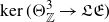 $\operatorname{ker}(\Theta^3_\mathbb{Z} \to \mathfrak{LE})$
and
$\operatorname{ker}(\Theta^3_\mathbb{Z} \to \mathfrak{LE})$
and $\Theta_\mathbb{Q}^3$
.
$\Theta_\mathbb{Q}^3$
.
Proof. For the same reason as in the proof of Theorem 3·3, we find that $R(Y_3(n)) = 1$
. Since
$R(Y_3(n)) = 1$
. Since
 \[(8n+1)(16n+1)(16n+3) \not \equiv (8m+1) (12m+1)(24m+5) \mod 4,\]
we conclude that $\mathcal{E} (Y_3 (n))$
and
$\mathcal{E} (Y_3 (n))$
and $\mathcal{E} (Z_3 (m))$
are distinct and we can apply Theorem 1·2.
$\mathcal{E} (Z_3 (m))$
are distinct and we can apply Theorem 1·2.
Note that our examples in Theorem 3·3 give other families of homology spheres whose local equivalence classes (also of Seiberg–Witten Floer types for Theorem 3·4) are trivial, yet which are linearly independent in $\Theta^3_\mathbb{Q}$
, as stated in Corollary 1·3.
$\Theta^3_\mathbb{Q}$
, as stated in Corollary 1·3.
Acknowledgements
The authors would like to thank Marco Golla, JungHwan Park, and Masaki Taniguchi for helpful conversations. The authors are also grateful to Hayato Imori and Imogen Montague for reading the draft and providing detailed feedback. The first author is partially supported by the Samsung Science and Technology Foundation (SSTF-BA2102-02) and the NRF grant RS-2025-00542968. The second author was supported by the CNRS postdoctoral fellowship at the Laboratoire de Mathématiques Jean Leray in Nantes Université, France.




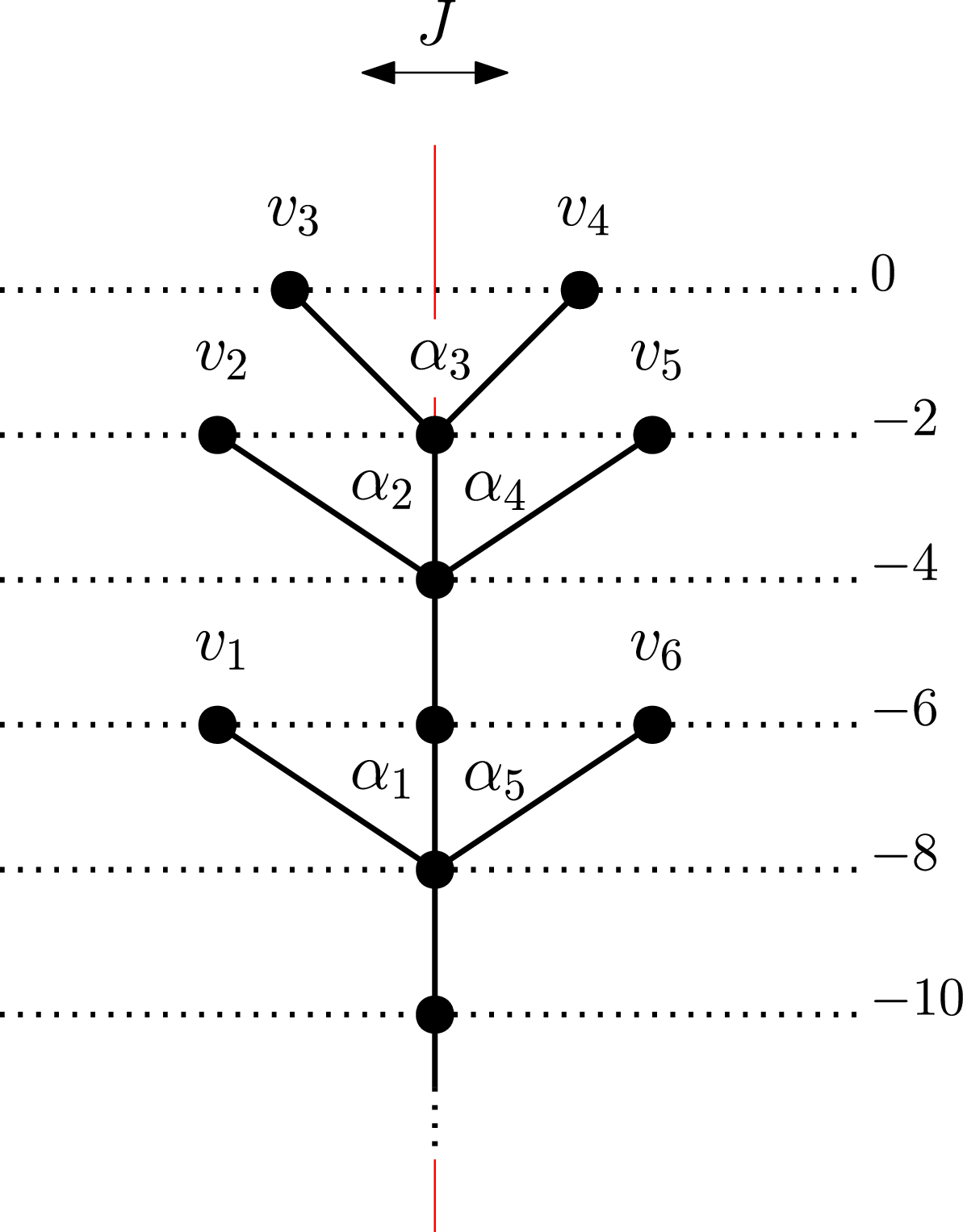
 Σ(3,4,13)
 v1,…v6
 α1,…α5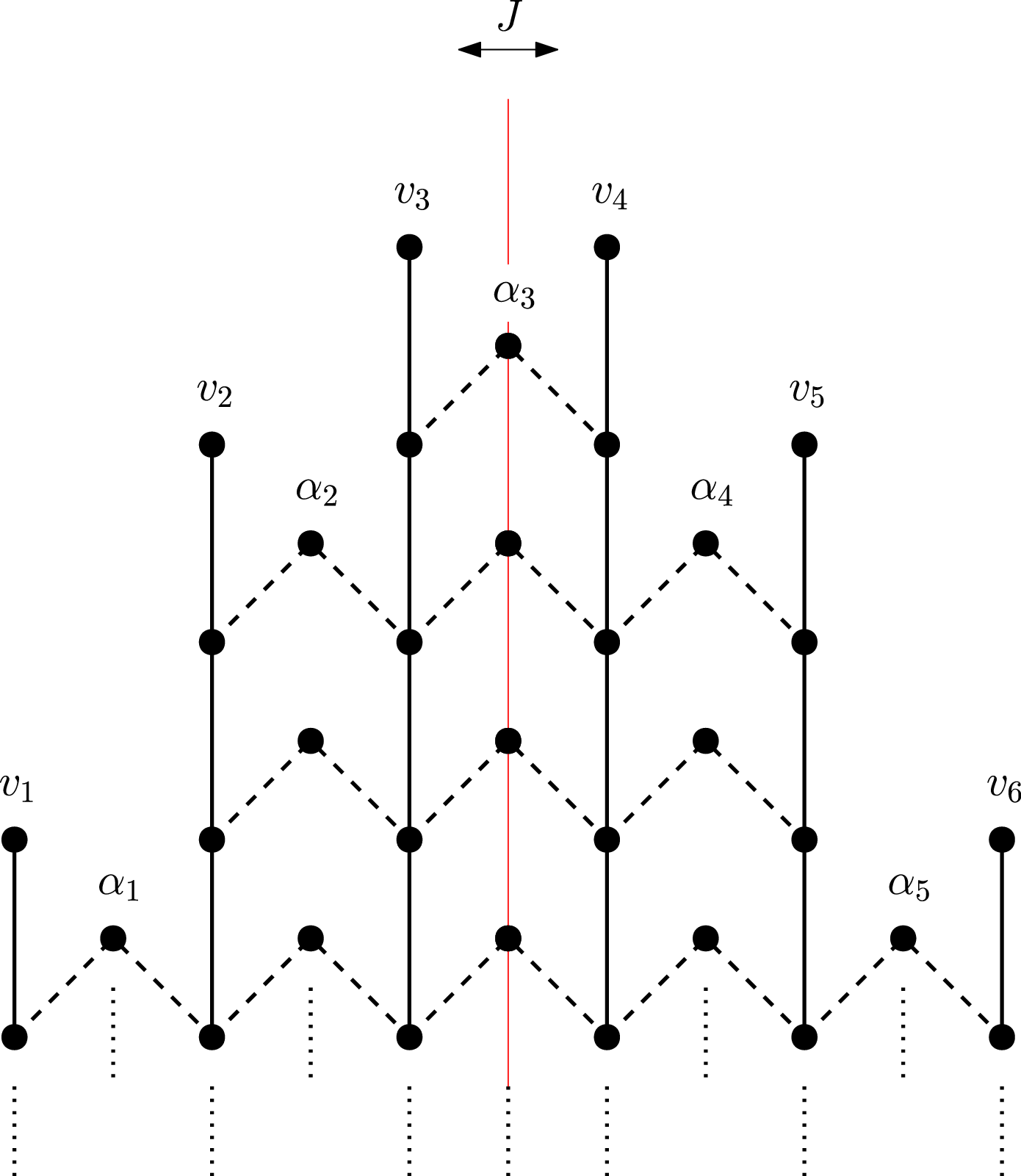
 C∗(R)
C∗(R) H−(Σ(3,4,13))
 ∂
∂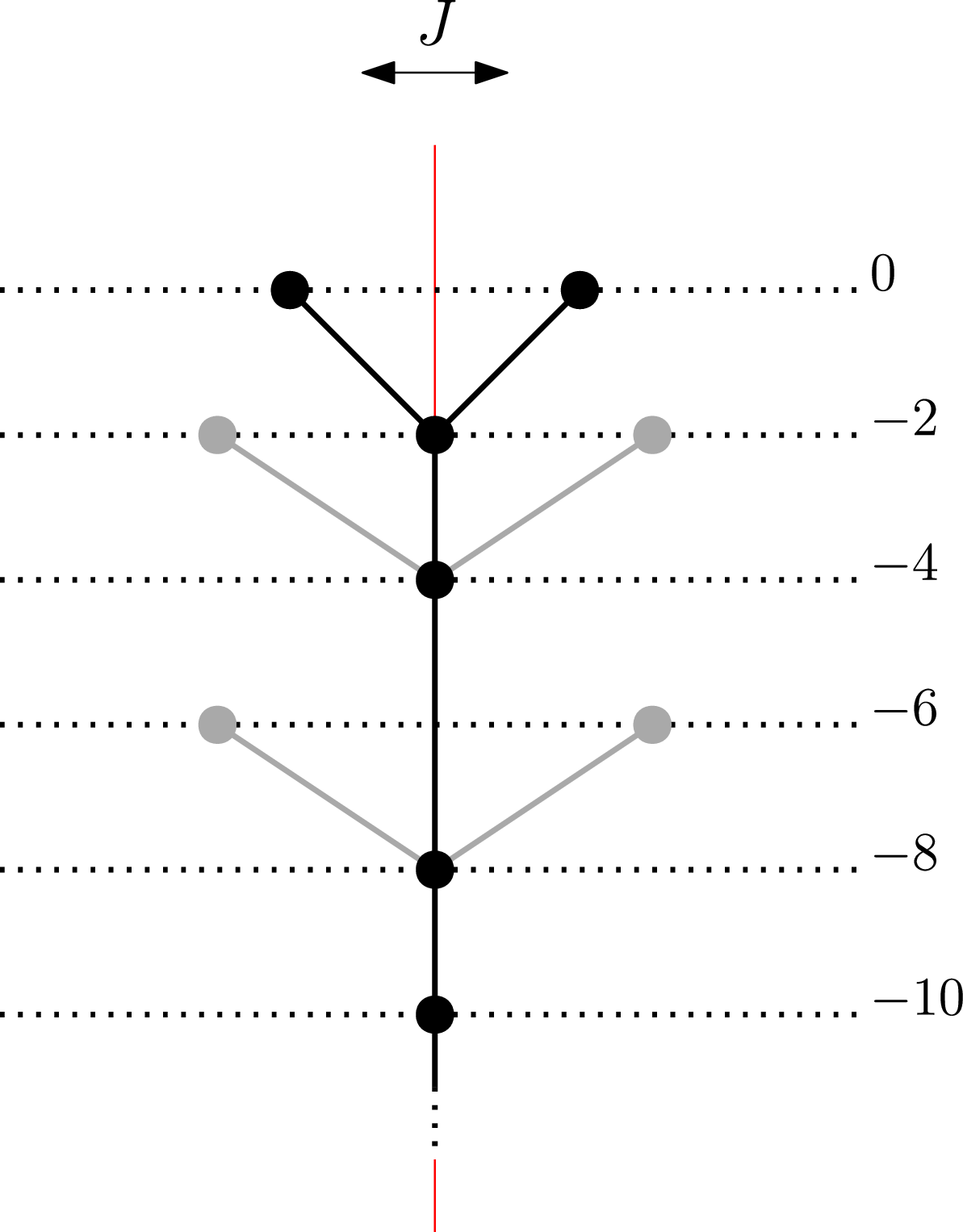
 Σ(3,4,13)
 M=M(0,−2)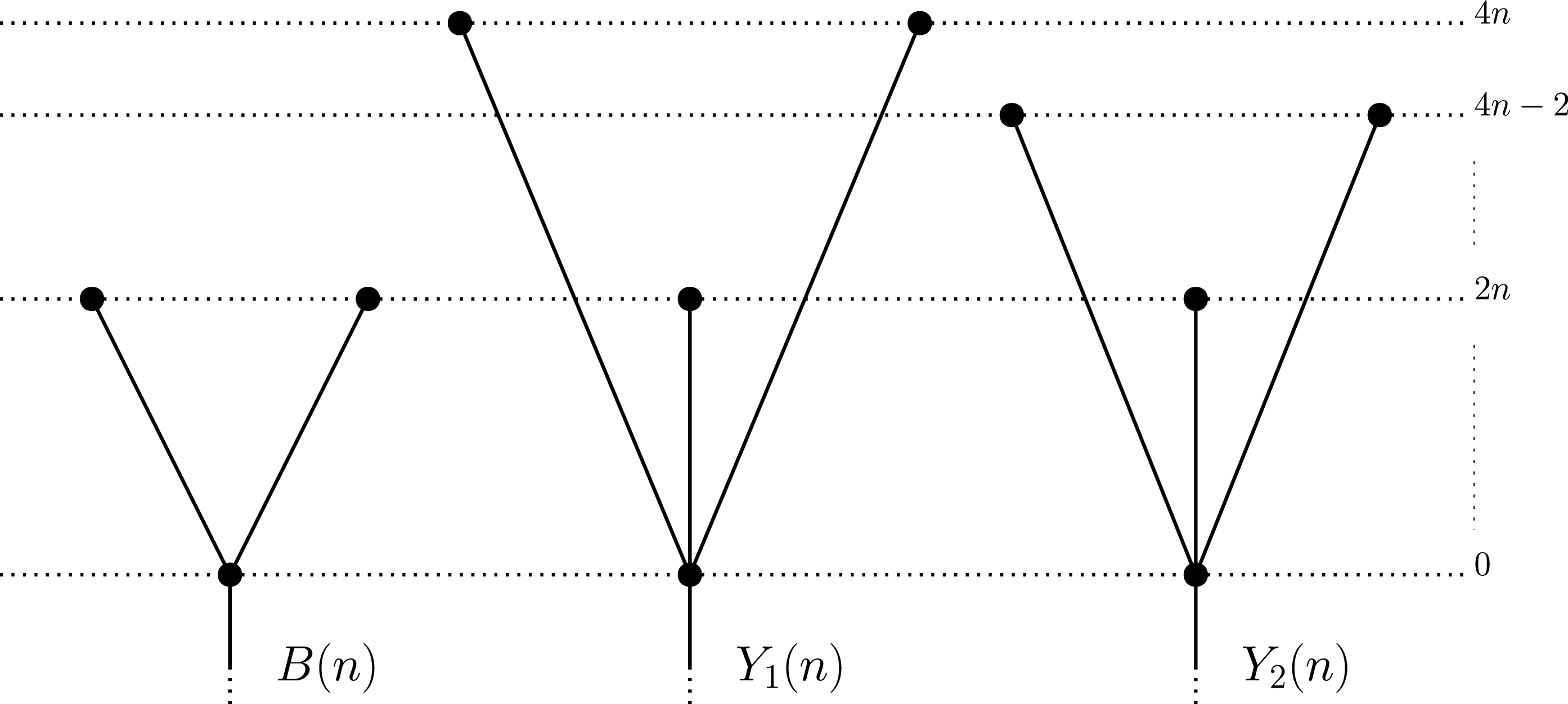
 Y1(n)
Y1(n) Y2(n)
Y2(n) n≥1
n≥1
 Open access

