


1. Introduction
The Design Research Quality (DRQ) Special Interest Group (SIG) of the Design Society seeks to enhance the quality of design research by recognising and supporting the diversity of perspectives that shape the field. Its ambition is to offer practical support, systems, and structures that enable collaboration and transparency across the design research community. By making quality both visible and accessible, we aim to accelerate and democratise the evolution of design research practices. In the short term, this involves identifying essential quality needs, unifying efforts to create a clearer focal point for discussion, and improving access to quality-related resources. Over the longer term, the objective is to deliver sustainable resources, such as a publication outlet, a quality guide, an educational framework, and a community hub to nurture a culture of reliable, relevant, and transparent design research. However, the field currently lacks a shared repository of materials on design research quality. There is no unified taxonomy of design research methods that helps researchers select appropriate approaches based on the constraints of their studies, nor is there a repository of methodological guidelines, exemplary papers, or other educational resources. As a result, many doctoral students complete their studies without having been exposed to the breadth of available research methods, often adopting the limited methodological traditions prevalent within their immediate disciplinary communities.
Although previous work has sought to describe aspects of design research practice, the limited scope of such efforts has left substantial gaps. The few existing studies (Reference Escudero-Mancebo, Fernández-Villalobos, Martín-Llorente and Martínez-MonésEscudero-Mancebo et al., 2023) have largely focused on a small number of engineering design journals, offering a narrow representation of the methods used across the wider design research landscape. These studies typically provide only basic classifications and lack the detailed characterisation required to guide researchers in selecting appropriate methods or understanding the trade-offs associated with their choices. Furthermore, the absence of structured resources means that researchers and educators lack the tools necessary to teach, learn, and apply these methods effectively. As a result, the field remains fragmented, with little consolidated guidance on methodological rigour, minimal interdisciplinary exchange of best practices, and differing taxonomies, which hinders communication between subfields.
This paper addresses these gaps by presenting a mapping of design research methods spanning multiple disciplines in which design is a central research activity, including engineering, human-computer interaction, and architecture. The resulting cartography characterises methods to support comparison and selection according to study objectives and constraints. For methods typical in design research, the mapping identifies and links key resources, including methodological guidelines, educational materials, and exemplary papers, to assist both new and experienced researchers in conducting rigorous studies. This represents only the initial stage of the mapping and is therefore far from complete, serving primarily as an illustrative starting point. By bringing these dimensions together into a coherent, accessible framework, this work aims to strengthen the methodological foundations of design research and foster a more informed, quality-focused research community with a more unified taxonomy.
This paper first reviews typologies of research methods and design research methods (Section 2). We then detail how we extracted empirical methods from expert-recommended handbooks to build a structured foundation for comparison (Section 3). It then develops an initial cartography of design research methods (Section 4), mapping research designs, data collection techniques, and risks. Next, we discuss its preliminary status and limitations (Section 5). We conclude with directions for future expansion toward a community-driven DRQ hub (Section 6).
2. Literature review
2.1. Typologies of research methods
Research methods are commonly classified along several dimensions, which helps in systematically analysing the literature, positioning one’s own contribution, and choosing appropriate methods. Such typologies also support the assessment of whether a given method is suitable for addressing the research questions posed in existing studies.
2.1.1. Basic vs. applied
Research is often differentiated by whether its primary contribution lies in generating theoretical knowledge or delivering practical solutions. Such a classification is based on the ultimate goal and beneficiaries of the research findings. Basic (or fundamental) research is driven by curiosity and the desire to expand knowledge purely for knowledge’s sake, without immediate practical application. Applied research is designed to solve specific, practical problems or to develop a specific technology or product.
2.1.2. Quantitative vs. qualitative vs. mixed
This common typology classifies research by the nature of the data collected and analysed: quantitative, qualitative or mixed (Reference WeyantWeyant, 2022). Quantitative methods focus on numerical data, often statistical analysis, and generalisability. Often employed to test pre-defined hypotheses, which is why it’s often referred to as explanatory or confirmatory. Qualitative methods, conversely, prioritise non-numerical data such as interviews, observations, and texts, aiming for a deep, contextual understanding of phenomena. It is often used to generate hypotheses and theories, which is why it is often referred to as exploratory. Mixed methods research systematically combines quantitative and qualitative approaches within a single study to gain a more comprehensive perspective, leveraging the strengths of each method to address complex research questions.
2.1.3. Experimental vs. observational
This typology distinguishes studies based on the researcher’s level of control over the variables. Experimental research involves direct manipulation of one or more independent variables (interventions) and random assignment of participants to conditions to determine causal relationships with dependent variables. In contrast, observational studies traditionally measure naturally occurring exposures and outcomes without investigator intervention, focusing on describing patterns, identifying correlations, and studying relationships as they exist in the real world. A similar distinction exists in clinical research, which broadly separates studies into experimental and observational categories based on whether the investigator assigns the exposures (Reference Grimes and SchulzGrimes & Schulz, 2002). Observational studies can be either analytical or descriptive: analytical studies include comparison groups (as in cohort, case–control, or cross-sectional designs), whereas descriptive studies, such as case reports or case series, do not.
However, this dichotomy between experimental and observational approaches becomes increasingly blurred in design research, where observation can involve a degree of structuring or intervention. Emerging methods such as Comparative Structured Observation (CSO) (Reference Mackay and McGrenereMackay & McGrenere, 2025) exemplify this hybridisation. CSO is an explicitly interventionist, qualitative approach in which researchers structure participants’ exposure to different design variants—through tasks or controlled sequences of naturally occurring events—to stimulate reflection and comparison. Although it borrows principles from experimental design (e.g., counterbalancing and validity control), its objective remains qualitative: to deepen understanding of how participants experience and evaluate design alternatives in ecologically valid settings. Such methods illustrate that observation in design research can be both structured and interventionist, occupying a middle ground between naturalistic observation and controlled experimentation, and offering new possibilities for methodological rigour and depth.
2.1.4. Interventionist vs. non-interventionist
Similar to the experimental-observational dichotomy, this typology centres on the active role of the researcher. Interventionist research designs involve the researcher deliberately introducing a change, treatment, or artefact (e.g., a new software, a new design method, or a new modelling language) to a group of participants to study its effect on outcomes of interest compared to a baseline or control condition. Non-interventionist research, however, is purely descriptive or analytical, studying existing situations, systems, or relationships without any attempt to influence or alter the study subjects or environment.
2.1.5. Descriptive vs. relational vs. experimental
Research can also be categorised by its primary motivation and target outcome, which reflects its proximity to real-world application. This hierarchy often organises studies by the complexity of the research question and the type of claim being made. These three main approaches are descriptive, relational, and experimental (Lazar, 2017). Descriptive research focuses solely on characterising a single variable or population (X is happening). Relational (or correlational) research examines the relationship - often statistical - between two or more variables (X is related to Y), though it cannot establish cause and effect. Experimental research, the most rigorous in this sequence, manipulates variables and controls for extraneous factors to establish a causal link (X is responsible for Y).
2.1.6. Confirmatory vs. exploratory
This pair describes the research intent relative to existing knowledge. Confirmatory research is theory-driven, and often uses statistical tests (like hypothesis testing) to validate, confirm, or falsify specific predictions or hypotheses derived from established theory or prior literature. Exploratory research, conversely, is undertaken when little is known about a topic, aiming to generate new hypotheses, discover patterns, and develop initial insights that can inform future, more focused, confirmatory studies.
In practice, many design studies combine exploratory and confirmatory aims within a single research study or program (Reference WeyantWeyant, 2022). This interplay is made explicit in mixed methods research designs, where qualitative and quantitative approaches are combined to leverage their respective strengths. For instance, convergent mixed methods merge qualitative and quantitative data collected concurrently to provide a comprehensive understanding of a research problem, often reconciling contradictions or explaining incongruent findings. Explanatory sequential designs begin with quantitative research to establish patterns or relationships, followed by qualitative inquiry to explain or contextualise those results, reflecting a primarily confirmatory-to-exploratory progression. Conversely, exploratory sequential designs start with qualitative investigation to uncover new insights or variables, which are then tested or measured quantitatively, representing an exploratory-to-confirmatory trajectory.
Thus, the confirmatory–exploratory distinction should be understood not as a strict dichotomy but as a continuum, where mixed methods designs enable iterative movement between discovering and testing knowledge. This dynamic is particularly valuable in design research, where early exploratory work often precedes the formulation and validation of design principles, frameworks, or interventions.
Most existing typologies provide only partial coverage of the methodological landscape. Each tends to construct its own cartography, limited to the scope of a specific discipline or research tradition. For instance, handbooks on human–computer interaction often emphasise experimental methods and a few qualitative techniques, such as surveys or questionnaires, while overlooking many other relevant methods. As a result, researchers, particularly those working in multidisciplinary contexts like Design, lack a unified entry point to navigate available methods, understand their defining characteristics, and assess the opportunities and risks associated with their use.
2.2. Typologies of design research methods
2.2.1. The multidisciplinary nature of design and design research
Design-related disciplines form a rich and diverse landscape, making the term design inherently broad and context-dependent. In engineering, it refers to the structured development of technical artefacts, while in the creative industries, it encompasses practices such as industrial and graphic design, where functionality meets aesthetics. Interaction and service design emphasise usability and experience, whereas architectural and urban design focus on shaping physical spaces. More recent areas, like experience design, further expand the notion. Consequently, design research is also multidisciplinary, drawing on methods from psychology, economics, sociology, ergonomics, human–computer interaction, UX, education science, […], and computer science rather than relying on a distinct methodological corpus. This hybridity reflects the complex nature of design inquiry, which often blends empirical, creative, and reflective dimensions.
The term design research can be interpreted in two distinct ways. It can refer to the preliminary research undertaken to ground, inform, and inspire the product development process. In other cases, it denotes a more systematic inquiry aimed at producing new knowledge.
2.2.2. Research for design vs. research through design vs. research about design
A foundational typology (Reference FraylingFrayling, 1993) distinguishes three modes of design research: Research for Design, Research through Design, and Research about Design (Reference Frankel and RacineFrankel & Racine, 2010). These modes differ in their aims, methods, and outcomes but form a virtuous cycle in which insights and questions flow bidirectionally between theory, application, and practice. Research for Design (often termed clinical research) supports the act of designing by providing contextual knowledge, user insights, or methodological tools to inform practice. Research through Design (applied research) generates knowledge by engaging in the act of designing itself - producing artefacts intended to transform the world “from its current state to a preferred state” (Reference Zimmerman, Forlizzi and EvensonZimmerman et al., 2007). Finally, Research about Design (basic research) studies design as a phenomenon (observable activities) and seeks to build theories about design. Together, these modes establish a continuum linking practice and theory: practical inquiries enrich conceptual understanding, while theoretical advances inform new applications. As noted (Reference Frankel and RacineFrankel & Racine, 2010), this interplay embodies a “virtuous cycle” in which knowledge, experience, and reflection circulate across levels of abstraction - practice tends to embody knowledge, while research tends to articulate it.
2.2.3. Design research methods
A recent literature review of papers published in four top-ranked engineering design journals (Reference Escudero-Mancebo, Fernández-Villalobos, Martín-Llorente and Martínez-MonésEscudero-Mancebo et al., 2023) identified seven research methods: ethnography, phenomenological study, hermeneutics, grounded theory, case study, and experiment. The Designer’s Research Manual (Reference Visocky O’Grady and Visocky O’GradyVisocky O’Grady & Visocky O’Grady, 2017) categorises methods differently, including ethnographic research (contextual inquiry, observational research, photo ethnography, self-ethnography, visual anthropology), marketing research (demographics, psychographics, focus groups, surveys, and questionnaires), and user experience research (A/B testing, analytics, card sorting, eye tracking, paper prototyping). However, it is unclear how the authors derived this taxonomy or why specific methods were assigned to each category. For instance, why is evaluation excluded from the user experience category?
3. Methods
The overall aim of this study is to assist novice design researchers in planning empirical studies and choosing appropriate research methods. Therefore, this study offers an overview of empirical methods in design research and emphasises the most common methods for orientation. Since design research is a very diverse field, with influences from very different disciplines, a second problem is addressed: different taxonomies for methods that are essentially the same. The procedure described below makes these overlaps transparent and initiates a unified taxonomy. In addition, expert assessments of the suitability and risks of the chosen research designs and data collection techniques are included to assist young researchers in planning empirical studies and selecting suitable methods. The assessment is grounded in the authors’ multidisciplinary expertise, which bridges the methodological foundations of design research and psychological inquiry with computer-mediated systems engineering. This academic perspective is complemented by practical experience in architecture and design for sustainability. Furthermore, the authors are active contributors to the DRQ SIG.
To methodically establish a basic body of research methods, we used the results of an international surveyFootnote 1 conducted by the DRQ SIG in collaboration with the Design Research Society. In the survey, 38 individuals participated, of whom 25 offered insights into their primary literature on design research methods. The findings from this literature survey served as the foundation for this study.
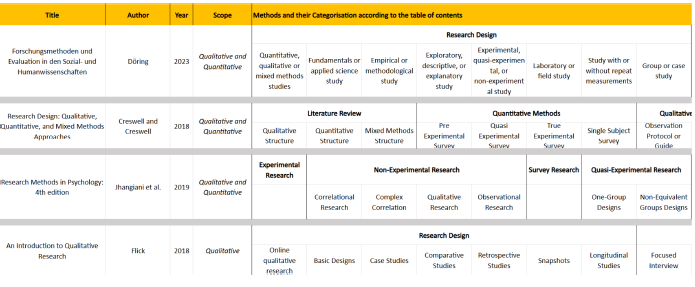
Excerpt of the research methods from the tables of contents of the handbooks, that were suggested by the survey (the complete table is accessible online2)

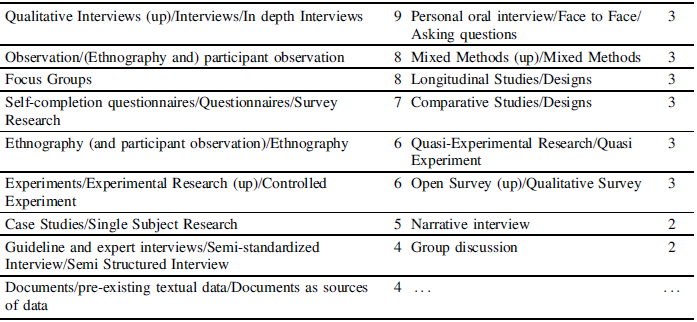
For transparent and comparable extraction of the methods in this body of literature, the corresponding tables of contents (freely accessible online) were used. From these, the methods were extracted, with their structures or groupings. Only empirical research designs and data collection techniques were integrated (Table 1). The methods listed in Table 1 were sorted, and their frequencies were tallied in Table 2 to identify the most common methods. All tables presented in the paper are partial extracts of the complete dataset, which is provided in full in an Excel file accessible onlineFootnote 2 .
Excerpt of the occurrence frequency of methods identified in the survey-suggested handbooks (the complete table is accessible online2)

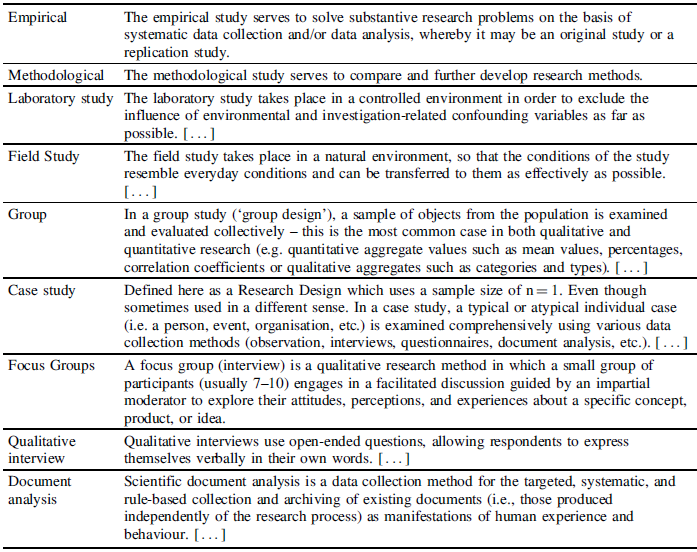
For the subsequent steps, key terms were clearly defined, as shown in Table 3. These definitions are important for understanding the main results, as many key terms are used in different ways. To obtain a clear overview, unambiguous definitions had to be chosen, even though these may be controversial.
Excerpt of the key term definitions (the complete list is accessible online2)

Then, an overview of methods was created using the structure of one book (Reference DöringDöring, 2023), which offered an overarching framework that was able to integrate all the methods described in the various resources. In particular, the scope of the methods described and their clear separation made it possible to integrate the other resources well. For clarity, a distinction was made between qualitative (Table 4) and quantitative methods (Table 5). Methods mentioned more than once in Table 2 were included in this overview in brackets, marking them as “common methods”. The suitability of possible research methods was then rated by the authors using the symbols ‘+’, ‘–’, and ‘o’, where ‘+’ indicates suitability, ‘–’ indicates limited suitability, and ‘o’ denotes that the method is not logically applicable. In the last step, risks and comments for each research design and data collection technique were added to each column and row. We want to clarify that physiological measures are not predominant over other design research methods. Their apparent visual dominance in the tables simply reflects the large number of distinct physiological techniques available, rather than an intentional bias toward them.
Excerpt of the qualitative research methods, their suitability, and associated risks

4. Mapping design research methods and guidance resources
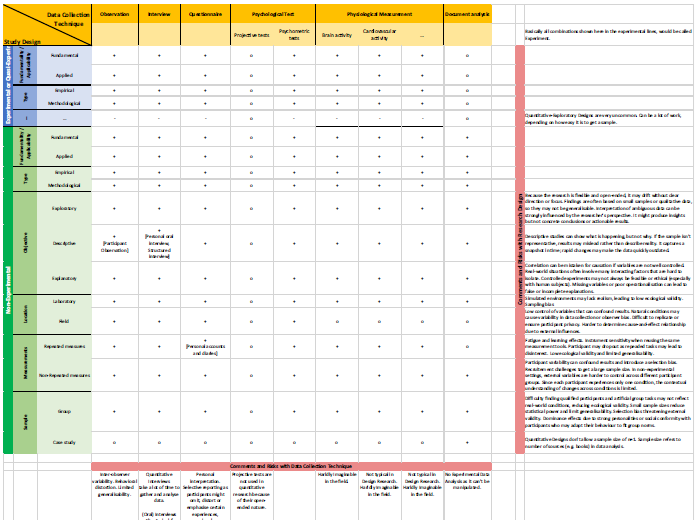
The results are two overviews (Design Research Maps; Table 4 and Table 5) of possible qualitative and quantitative design methods, their suitability and risks. On the x-axis are possible data collection techniques, and on the y-axis are research design factors. In addition, the research design factors ‘experimental and quasi-experimental’ and ‘non-experimental’ were separated as basic categories. Research design factors are also grouped according to type, objective, location, etc.
Excerpt of the quantitative research Methods, their suitability, and associated risks (qualitative research methods, their suitability, and associated risks are accessible online2)

Study designs are determined by several factors along the y-axis, not solely by the combination of the x-axis (data collection technique) and the y-axis (research design). For each study design, one design factor from each of the six groups (y-axis) is combined with one data collection technique (x-axis).
The process of determining a study design can be explained using a simple example. First, a decision must be made between qualitative and quantitative approaches, and the corresponding design research map must be selected. In this example, we have chosen a quantitative approach. Next, it must be determined whether to use a (quasi-)experimental, that is, interventionist, approach or a non-experimental approach (x-axis; green or blue area). Depending on what you choose, from now on, only the upper or lower part of the table is relevant. We used a non-experimental method, so we examined only the lower part of the table, which is green. Now we select a data collection technique from the y-axis. Here we choose an interview. We can now determine the interview type more precisely by excluding all boxes marked “0”. In this example, we do not need to consider the “Case Study” sample size further, as it is no longer permissible under our chosen quantitative approach. We would be cautious about boxes marked with a “-”, as they indicate an atypical combination. In our example, no boxes are marked with a minus sign, so we can put together the remaining combinations to suit our study objectives. We therefore proceed down the groups along the y-axis and select one option from each group. For example, we first determine whether it is an applied study rather than a fundamental study. Next, we select the type of study: Is it an empirical study or a methodological one? We could choose empirical here. We go through all the groups and may end up with the following combinations: quantitative, non-experimental, interview, applied, empirical, descriptive, laboratory, non-repeated-measures, and group. This corresponds to a typical structured interview design and broadly characterises the study design. For each of the chosen options within the groups (y-axis), we find typical risks on the right side of the table. The same applies to the chosen data collection technique (x-axis), where we observe typical risk below the table.
To increase complexity, several study designs can be combined in a single study, for example, qualitative study designs with quantitative study designs (mixed-methods design). Or a combination of data collection techniques, like an observation with a survey. Typical design research methods can still be characterised at the intersection of the x- and y-axes, providing a practical overview of different approaches, although a complete combination of all possible factors would be too complex and unwieldy for an introductory guide. Importantly, identifying the risks associated with a study also depends on this intersection: researchers must consider both the risks inherent in the research design (row) and those associated with the data collection technique (column). By explicitly evaluating these risks alongside methodological choices, researchers can ensure that the chosen combination of research design and data collection technique is feasible, appropriate, and aligned with the study’s objectives and constraints.
The ultimate goal is not only to reduce the barrier to selecting appropriate methods but also to act as a “showcase” or comprehensive repository for the vast array of existing methods. By aggregating methods from diverse disciplines – including engineering design, software design, HCI, architecture, […], and UX design – the mapping highlights the richness of the field and makes these disparate methods visible and accessible to the broader community. In the future, the community will be able to use these mappings as a centralised entry point to the DRQ Hub’s database of methodological resources, helping them discover methods from related design disciplines that they might otherwise overlook.
While the proposed mapping currently offers a high-level cartography of the field, it is designed to serve as the structural foundation for a broader DRQ ecosystem. To bridge the gap between this theoretical framework and its practical application, the DRQ SIG is actively developing a database of exemplary resources, including methodological guidelines and exemplary papers, a design research textbook, and teaching materials. These initiatives aim to enrich the current map with tangible assets, transforming the mapping from a static overview into a dynamic, navigable toolkit essential for doctoral training and the rigorous planning of empirical studies.
5. Discussion
The present work highlights both the opportunities and the limitations inherent in the current version of the cartography of design research methods. A first observation concerns the nature and origins of the methods that populate the initial cartography. Unsurprisingly, many of the methods captured thus far are generic and derive from the social sciences, reflecting the dominance of these traditions in existing methodological handbooks. While these methods remain foundational, their prominence obscures the presence of less widespread, domain-specific approaches that have emerged in response to particular epistemic or practical constraints encountered by design researchers. The development of Comparative Structured Observation (Reference Mackay and McGrenereMackay & McGrenere, 2025) in Human–Computer Interaction offers an illustrative example. Such domain-specific methods, despite their relative invisibility in mainstream methodological handbooks, represent important contributions to the methodological landscape of design research and will need to be explicitly incorporated into future iterations of the cartography. Other data collection techniques commonly used in design research, such as think-aloud protocols (Reference Alhadreti and MayhewAlhadreti & Mayhew, 2018) or confrontation interviews (Reference Mollo and FalzonMollo & Falzon, 2004) should also be considered for inclusion to more fully capture the diversity of empirical methods.
A second challenge lies in the heterogeneous ways in which research methods are organised across existing handbooks and disciplinary traditions. There is neither a unified classification system nor a commonly accepted organising logic for methods, leading to significant variability in their presentation, scope, and terminology. In developing the cartography, it was therefore necessary to propose a structure that could support researchers in filtering, selecting, and combining methods in a manner aligned with their research aims. The proposed structure seeks to help researchers navigate methods as combinations of data collection techniques and research designs, while explicitly situating these combinations in relation to research constraints (e.g., time, access to instruments, recruitment feasibility) and methodological risks. While this organisational framework remains preliminary, it offers a pragmatic foundation on which more systematic, shared classifications or flexible views that address specific researcher epistemologies or methodological concerns may be built.
Despite these advances, the cartography is limited by the small number of experts involved in its development. Only three experts contributed to the preliminary analysis, which constrains the diversity of perspectives represented and limits the reliability of the resulting classifications. The suitability ratings are initial author-defined estimates and are likely to evolve. For example, qualitative, non-experimental interviews with repeated measurements were rated as not suitable (“-”), which is certainly debatable, as are other cases. We frame the paper as a “proposal for a framework” rather than a definitive, final standard. A necessary next step is therefore to establish cross-community expert groups dedicated to specific research methods. These groups would be tasked with defining data collection techniques and research designs, assessing their suitability and risks, identifying exemplary papers, developing or consolidating methodological guidelines, and calculating inter-rater reliability scores at each step to ensure consensus. However, it is important to acknowledge that the aim of this early work was not to produce a definitive or exhaustive cartography. Rather, it was intended to demonstrate the feasibility and value of the approach, and to present a structured method for navigating research methods at a smaller scale. This initial proof-of-concept is designed to stimulate interest, attract participation from diverse design research communities, and elicit informed feedback that will guide future iterations.
At this stage, the cartography exists primarily as a set of interconnected spreadsheets, which have served as a flexible medium for collaborative construction. While functional, this format remains limited for supporting long-term navigation, exploration, and community engagement. The underlying structure developed through this work will ultimately support an online DRQ hub, providing a more intuitive and dynamic web-based environment for accessing and contributing to methodological resources. The development of such a platform is essential for realising the cartography’s potential as an open, living resource for the international design research community.
Integrating exemplary papers and methodological guidelines for each method proved challenging. Design research publications often dedicate limited attention to methodological rationale, transparency, or rigour, making it difficult to identify clear exemplars. This challenge suggests that the initiative may benefit from extending its scope beyond design research, drawing on reference papers and methodological guidance from adjacent fields where methodological reporting is more standardised. Such cross-disciplinary anchoring would not only strengthen the robustness of the cartography but also highlight opportunities for methodological borrowing and adaptation, supporting the mid-term development of a coherent set of empirical standards for engineering design research.
Finally, to move from theoretical validity to practical utility, we plan to transition to a collaborative co-development phase within a cross-community SIG. This group will oversee a multi-pronged evaluation strategy: beginning with target user testing to identify friction points in the interface, followed by participatory workshops at major international design conferences to stress-test the framework.
6. Conclusion
This paper addresses the current fragmentation in the design research community by presenting a comprehensive, multi-disciplinary cartography of design research methods. By characterising these methods and beginning to link them to methodological resources and exemplary papers, this work lays the foundation for a more unified and rigorous methodological practice. This framework serves not only as an educational resource for doctoral students but also as a guide for more experienced researchers seeking to select and justify appropriate methods. Short-term perspectives include community-based validation and the ongoing enrichment of the cartography through collaboration with volunteer experts in specific design research methods and established members of international research communities, where design research plays a central role, to celebrate the diversity of perspectives.
Looking forward, the long-term ambition of the DRQ SIG is to build directly upon this foundation to develop the Empirical Standards for Design Research, adapted from established disciplines, to provide shared criteria for methodological rigour. These standards are intended to stand as official, community-driven models of evidence that define the expectations for conducting, evaluating, and reporting studies, ultimately strengthening the methodological rigour and transparency of the design research discipline. As the initiative leaders, we will start by inviting volunteers from the aforementioned communities. In parallel with recruitment, we will establish common communication channels among participants, a contributing process, and define shared success criteria for the project. Inspired by the design process of the Empirical Standards for Software Engineering Research (Reference Ralph, Ali, Baltes, Bianculli, Diaz, Dittrich, Ernst, Felderer, Feldt, Filieri, de França, Furia, Gay, Gold, Graziotin, He, Hoda, Juristo, Kitchenham and VegasRalph et al., 2020), our initiative will follow a similarly collaborative approach. During the initial phase, researchers who wish to contribute will review the plan for drafting the standards and create a template outlining the core sections that each standard should contain. Each standard will be assigned to a team of method experts who will prepare an initial draft based on existing methodological and empirical literature. The drafts will subsequently be edited for consistency, condensed, compiled, and circulated internally for feedback and revision. The Empirical Standards for Design Research will be integrated with the cartography, creating a single, open, living, and community-driven DRQ hub that can be further enriched to support evidence-based design research, enabling cumulative learning, robust validation, and practical impact.


 Open access

