
Failures, it is said, are more instructive than successes; and thus far in flying machines there have been nothing but failures.
The scene: George Cayley’s Brompton Hall estate in Yorkshire, England. The time: one day in 1804 (the precise date is unknown). The character: a relatively young man of 31, carrying a wooden rod about a meter in length with a kite-like paper wing attached near the front end, and a cruciform paper tail at the back end (Figure 1.1). Sixth in a long line of baronets at Brompton Hall and self-educated particularly in scientific and technical matters, Sir George Cayley had been interested in mechanical flight for more than a decade. The object in his hands was of his own making, a small glider that embodied Cayley’s seminal thinking about flying machines. Four years earlier, in what can be described only as a stroke of genius, Cayley conceived the modern configuration airplane – a flying machine consisting of a fixed wing attached to a fuselage, with a tail in the back. The sole purpose of the fixed wing was to produce lift, sustaining the aircraft as it flew through the air. In turn, Cayley’s concept called for a completely separate mechanism to produce the forward thrust required to overcome the aerodynamic drag holding the aircraft back during its motion through the air. This idea completely overturned the prevailing wisdom that both lift and thrust should be generated simultaneously from a set of flapping wings trying to emulate bird flight. The action: Standing at the top of a hill, Cayley hand-launched his glider into the air and watched with pleasure as it glided silently and gracefully down the slope of the hill. The wing provided the lift, and the force of gravity pulling the glider down the hill was in this case, the separate mode of propulsion. In that first instant in 1804 when Cayley hurled his glider into the air, the modern configuration airplane took flight for the first time. It set the stage for the Wright brothers’ successful invention of the first practical airplane a century later, and for the evolution and revolutions in airplane design to follow in the twentieth century.
George Cayley’s sketch of his 1804 glider.

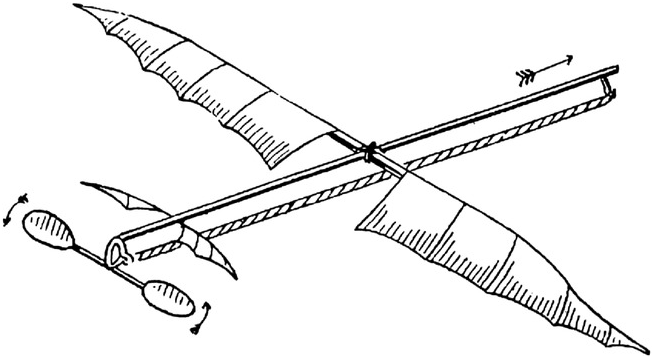
The scene: the Tuileries Gardens in the center of Paris. The time: Friday, August 18, 1871. The characters: Alphonse Penaud, a young Frenchman, and a small group of colleagues united by interest in flying machines. Penaud held in his hands a small wooden and cloth model airplane, about 20 inches in length with a fixed wing near the front, a horizontal and vertical tail near the back, and a propeller at the very end (Figure 1.2). The propeller was driven by a rubber band that stretched the length of the rod-like fuselage. The Tuileries were not a pleasant sight at that time, bordered by scenes of devastation from France’s defeat in the Franco-Prussian War just a year prior, and ravaged by subsequent civil warfare. But on that Friday, Penaud and his friends were oblivious to such matters, concentrating only on the model aircraft in his hands. Penaud designed the wings with a marked amount of dihedral, a geometric feature where each wing is bent upward through an angle at the fuselage. When viewed from the front of the plane, the wings formed a V-shape. Penaud intended the dihedral to provide inherent lateral stability – stability that would resist any undesirable rolling motion of the aircraft. Furthermore, he set the horizontal tail at a small negative (nose-down) angle to the fuselage to obtain proper longitudinal balance, so that the aircraft would fly in a more or less level path, rather than nosing up or down. The action: Ready for the test flight, Penaud wound the rubber band by turning the propeller through 240 revolutions. Holding the model at head height, he let go. The small aircraft flew beautifully, covering about 40 meters over the ground in 11 seconds, becoming the first flying machine to successfully exhibit the essential features of inherent stability. With this, Alphonse Penaud added the implementation of inherent stability to Cayley’s modern configuration airplane; Penaud’s design features have carried through to the present day.
Alphonse Penaud’s rubber-powered Planophore, 1871. Sketched by Octave Chanute in 1894.
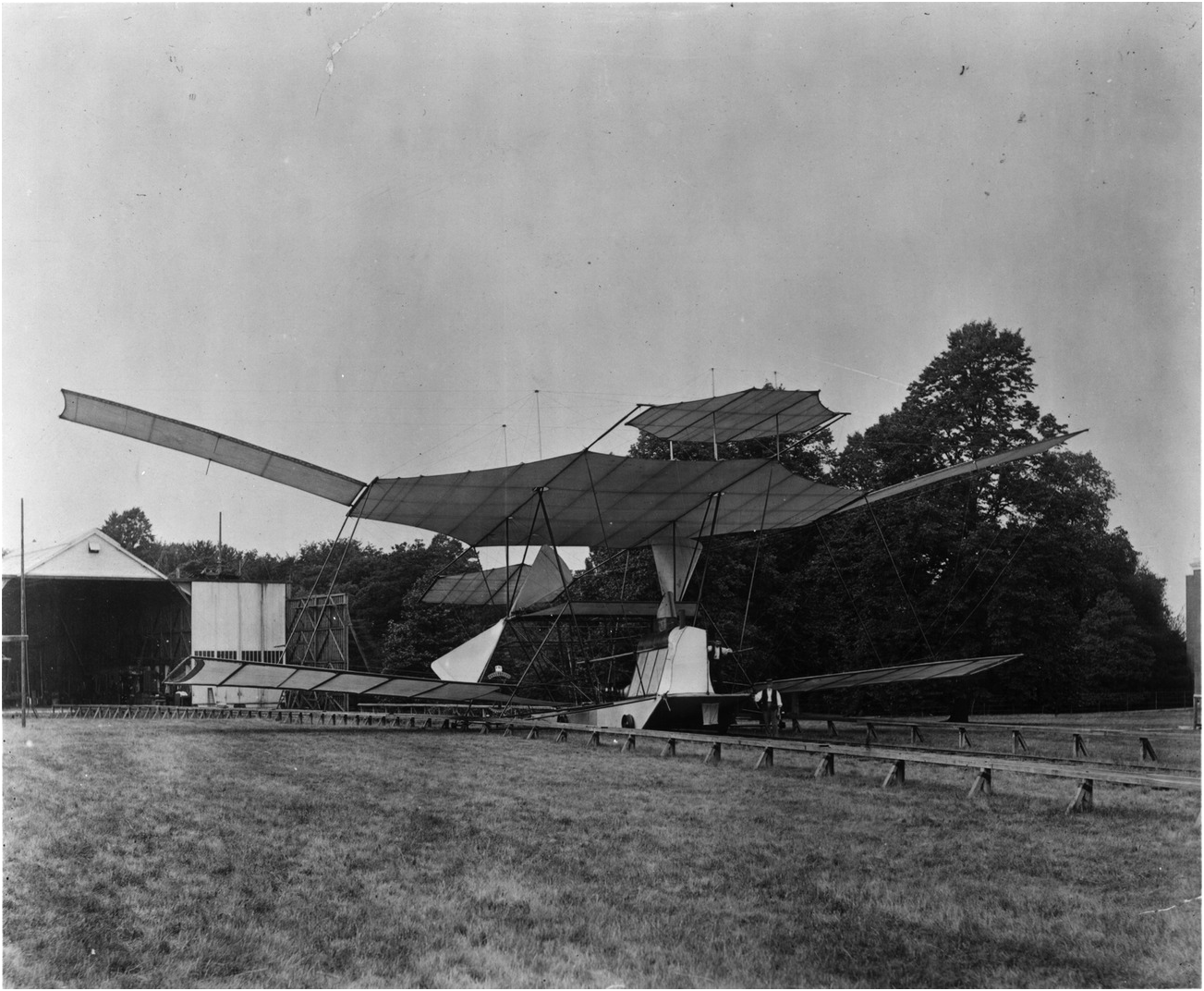
The scene: Baldwyns Park, Kent, England. The time: July 31, 1894. The characters: Hiram Maxim, a self-made inventor, made wealthy by his invention of the first machine gun in history and a group of technicians and helpers. In 1888, a group of businessmen challenged Maxim to design a flying machine. Thinking big, Maxim responded, designing and building the gigantic aircraft shown in Figure 1.3. It weighed 8,000 pounds, and had a very large wingspan of 104 feet (tip to tip); the total area of the lifting surfaces was 4,000 square feet. The machine was powered by two enormous propellers, each with a diameter of 17 feet, 10 inches, which were connected to two very efficient, lightweight steam engines of Maxim’s design, producing a total of 362 horsepower. Maxim mounted his machine on dual railway tracks for takeoff. Interested only in proving that a large flying machine could be designed that would have enough power and lift to get off the ground and sustain itself in flight, Maxim used a guard rail that limited the machine from climbing any higher than 2 feet off the ground. The action: Maxim and two other crew members climbed aboard. He applied full power and the machine accelerated down the rails, ran 600 feet, and then almost effortlessly lifted off the track. It smashed through its restraining rail and floated free, “giving those on board the sensation of being in a boat” as stated by Maxim. He immediately cut off the steam, and the huge machine settled gently back to the ground. By then it had covered over 1,000 feet in the air. Maxim never flew again, but he had demonstrated that a large heavier-than-air flying machine could generate enough lift to leave the ground under its own power. Suddenly, the day of the flying machine equipped with a prime mover with enough power (enough “steam”) to get off the ground had dawned.
Hiram Maxim and his large flying machine, 1894.
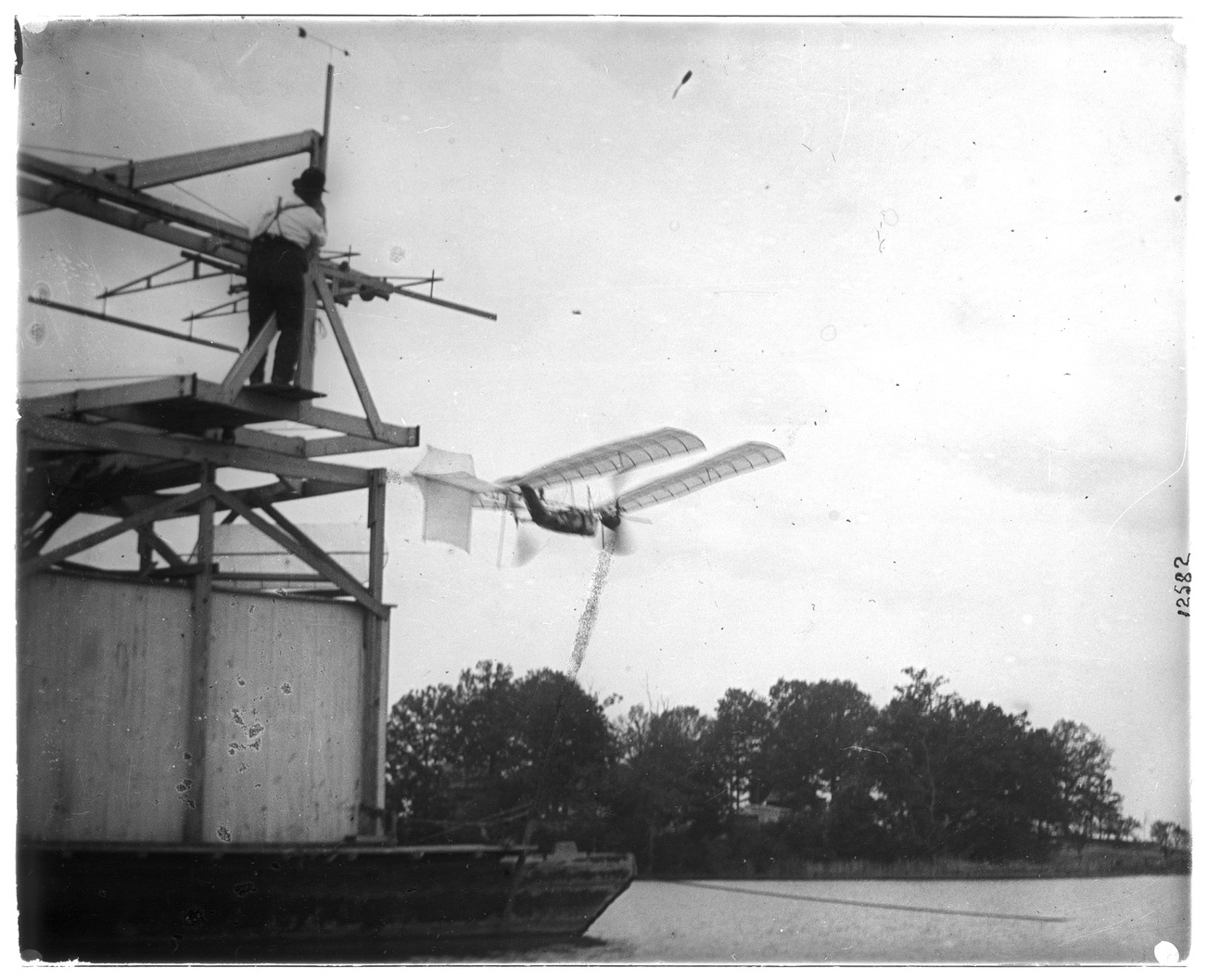
The scene: a houseboat moored off Chopawamsi Island near the western bank of the Potomac River at Quantico, Virginia, more than 3,000 miles to the west of Baldwyns Park, across the Atlantic Ocean. The time: about 3:05 pm on May 6, 1896, two years after Maxim’s powered liftoff. The characters: Samuel Pierpont Langley, third secretary of the Smithsonian Institution in Washington, D.C., accompanied by Alexander Graham Bell, his close friend. The action: Slung underneath a catapult mounted on the roof of the houseboat was a flying machine in the form of two equal sized rectangular wings, placed one behind the other (a tandem wing arrangement). Made from spruce and covered with China silk, each wing measured 13.1 feet from wing tip to wing tip. A horizontal and vertical tail was located at the rear of the machine. Between the two wings were dual propellers powered by a single lightweight one horsepower steam engine. The machine was too small to carry a pilot but too large to be considered a model. This was a serious flying machine designed by Langley and based on seven years of painstaking aerodynamic research carried out on a large whirling arm device. It was also based on observations of the flight of various rubber band-powered model aircraft that Langley tossed out of windows of the Smithsonian’s castle-like building in a large open area in downtown Washington. Langley called his flying machine an “aerodrome” (terminology based on his misinterpretation of a Greek term for such an object). On that day, the aerodrome was launched into a gentle breeze from a height of 20 feet above the river’s surface; initially it slowly descended about 3 or 4 feet, then began to climb steadily. Bell excitedly took a photograph of the aerodrome moments after launch (Figure 1.4). Bell was present because of his intense interest in powered flight, in addition to his close friendship with Langley. The aerodrome ultimately reached a height of 100 feet before it ran out of steam. By the time it had settled gently in the water, it had been in the air for one and a half minutes and had covered a distance of 3,300 feet.
Langley’s 1896 steam-powered aerodrome seen in a photo taken by Alexander Graham Bell.
The flight was momentous. It was the first truly successful sustained flight of a heavier-than-air powered machine in history. The earlier flight of Penaud’s rubber band-powered model and Maxim’s gargantuan machine pale in comparison. Langley had demonstrated to the world the technical feasibility of such powered flight beyond a shadow of a doubt. This demonstration was not lost on Orville and Wilbur Wright, who subsequently took the technical feasibility essentially for granted.
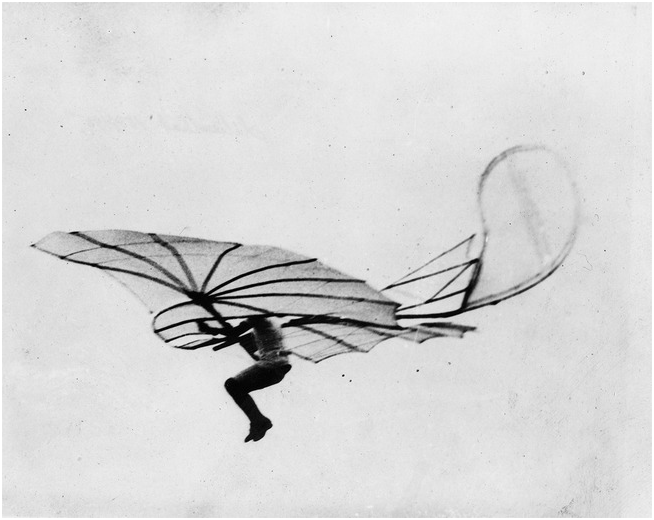
Powering a machine into the air is one thing: flying such a machine is quite another. At the same time that Langley launched his successful steam-powered aerodrome, Otto Lilienthal in Germany enjoyed successful flights in gliders of his own design. Lilienthal developed a passion for flying in 1861 at the age of 13. A mechanical engineer with a degree from the Berlin Trade Academy (now the respected Technical University of Berlin), Lilienthal carried out seminal aerodynamic research over two decades, culminating in his design of the first successful hang gliders in history. Lilienthal’s philosophy was to get into the air with gliders and learn how to fly a heavier-than-air machine before adding an engine. A photograph of Lilienthal flying one of his gliders is shown in Figure 1.5. Lilienthal’s “airman’s” philosophy differed from the brute-force approach of many previous flying machine inventors. Executing over 2,000 successful glider flights before his untimely death in a crash of one of his machines on August 9, 1896, Lilienthal pioneered the art of actually flying a heavier-than-air machine. With this, and with Langley’s definitive demonstration of the technical feasibility of heavier-than-air powered flight, the invention of the successful airplane was just around the corner.
Otto Lillienthal flying one of his gliders in 1893.
Missing, however, was a viable methodology for the technical design of the airplane. Would-be inventors in the nineteenth century were mainly flailing in the dark. No organized bulk of aeronautical data existed (except perhaps for the detailed aerodynamic experiments by Langley and Lilienthal). Granted, a great deal of empirical results, some useful and some not, were collected over the nineteenth century, and the basic overall configuration of the airplane (fixed wing, fuselage, and tail) became somewhat standard. Much of this was later inherited and reworked by the Wright brothers (Chapter 2). But there was no cohesive intellectual process for the design of an airplane – no agreed upon, technically sound method to even start the process. What do you do when you first sit down and begin the process of airplane design? Today, this beginning process is called conceptual airplane design. The history of the intellectual development of the process is indeed the subject of this book. People, Lilienthal and Langley included, simply used their own intuitive approaches and set forth.
The situation changed with the Wright brothers. One of the main reasons that the Wrights were the first to invent the successful airplane was that they developed a logical and technically sound methodology for airplane design.Footnote 1 We will examine the evolution of their methodology in the next chapter. They were the first of the grand designers.
Conceptual airplane design today can be defined as the intellectual process of creating on paper (or on a computer screen) a flying machine to (1) meet certain specifications and requirements established by potential users (or as perceived by the designers and manufacturers) and/or (2) pioneer innovative new ideas and technology.Footnote 2 An example of the former is the design of most commercial transports, starting at least with the Douglas DC-1 in 1932 that was designed to meet or exceed various specifications stipulated by an airline company. (The airline was TWA, named Transcontinental and Western Air at that time.) An example of the latter is the design of the experimental rocket-powered Bell X-1, the first airplane to exceed the speed of sound (October 14, 1947). Today, the conceptual design process is a sharply honed intellectual activity, a rather special one that is still tempered by good intuition developed via experience, by attention paid to past successful airplane designs, and by (generally proprietary) design procedures and databases that are part of every airplane manufacturer. Moreover, airplane designers today are much more aware of new scientific and engineering techniques and advances than in the past, and are much more inclined to incorporate new science in their design as long as that new science is reasonably proven. Throughout much of the twentieth century, however, this was not always the case. Engineering research in aeronautics has grown exponentially since the end of World War II; prior to that many advances in airplane design were empirical and intuitive, and only later did research explain why certain things worked. Indeed, the late aeronautical historian Richard K. Smith wrote in 1989 that “the airplane did more for science than science ever did for the airplane.”Footnote 3
The overall design of an airplane today is a result of 100 years of powerful mental effort, emotional inspiration, absolute dedication, and sometimes pure luck. In particular, a mental process for the first step in this design process – conceptual design – did indeed evolve and develop over this time. The major focus of this book is the study of that intellectual evolution.
Since the beginning, people have designed airplanes. They still do, in spite of the automation and artificial intelligence brought about by modern computers. Therefore, our study of the intellectual evolution of conceptual airplane design revolves around the case histories of six successful airplane designers; we shall label them as representatives of the “grand designers.” Although these grand designers are different people with different emotional and mental outlooks, we look for a common intellectual thread that ran through these people that made them successful designers. We will trace their contributions to the intellectual processes and methodology that now represent modern conceptual airplane design.
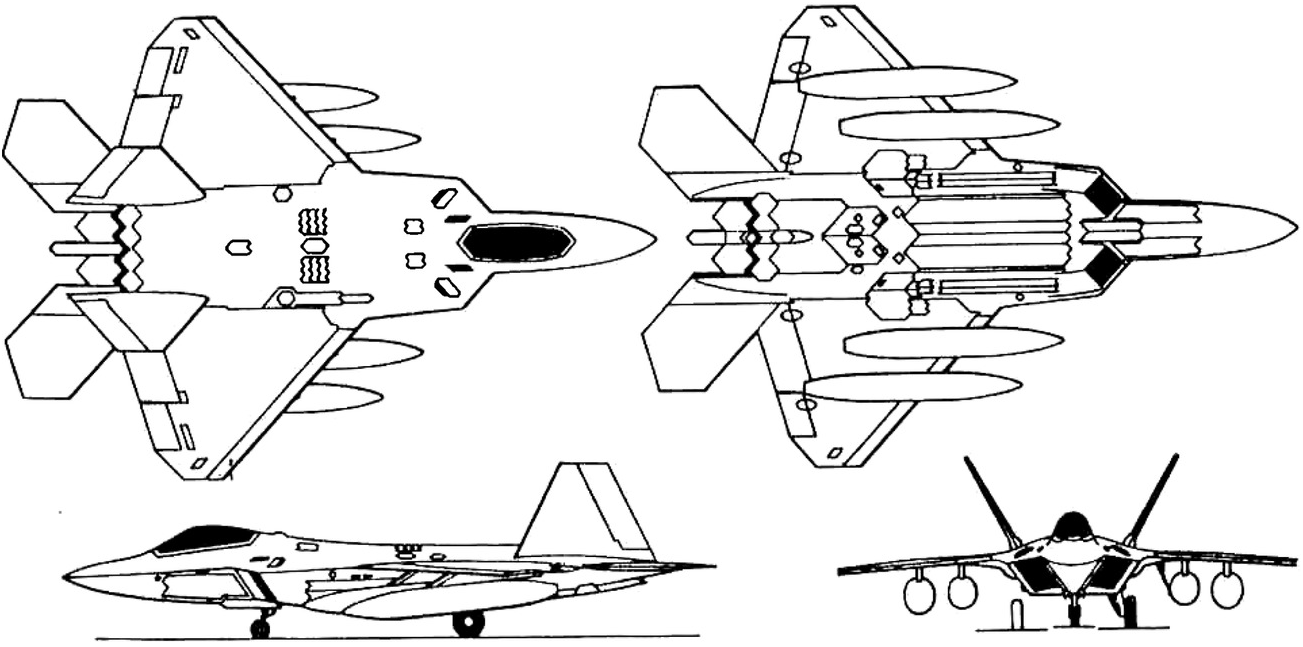
Through World War I, when a newly designed airplane took off on its initial flight, it had about as much chance of crashing on takeoff, or failing in some other equally dramatic fashion, as it did for a successful first flight. A testimonial to the progress in airplane design is that today, crashes do not mar the first flights of new aircraft. Consider the Lockheed-Martin F-22, a modern fighter incorporating advanced technology, including stealth (Figure 1.6). The F-22 flew for the first time on December 15, 2006, staying in the air for 58 minutes, climbing to altitudes of 20,000 feet at speeds up to 300 mph, and achieving angles of attack during maneuvers up to 14 degrees. The designers did not blink an eye. The methodology of airplane design had advanced to the point where successful first flights were almost taken for granted. Airplane design has come a long way since the turn of the twentieth century. Read on for the rest of the story.
Lockheed Martin F-22 Raptor.