





Introduction
Patients with advanced cancer present various symptoms as their disease progresses. Among these, fatigue, defined as a subjective feeling of tiredness, weakness, or lack of energy, is the most common symptom in patients with advanced cancer and is associated with decreased quality of life (QOL; Radbruch et al. Reference Radbruch, Strasser and Elsner2008; Walsh et al. Reference Walsh, Donnelly and Rybicki2000).
Thiamine, in its biologically active form thiamine pyrophosphate, is an essential coenzyme for oxidative cellular metabolism. However, as thiamine cannot be synthesized in the body and the physiological store is small, thiamine deficiency (TD) may occur after 2–3 weeks of decreased appetite (Sechi et al. Reference Sechi, Sechi and Fois2016).
Wernicke encephalopathy (WE) is a neuropsychiatric disorder that is caused by TD (Sechi and Serra Reference Sechi and Serra2007). Typically, cases present with 3 symptoms: mental state changes, cerebellar ataxia, and oculomotor dysfunction, but these symptoms are not disease-specific, and only 16% of patients exhibit all 3 symptoms, while 19% of patients are asymptomatic (Harper et al. Reference Harper, Giles and Finlay-Jones1986; Onishi et al. Reference Onishi, Ishida and Tanahashi2018). As the most useful diagnostic method at present is awareness by physicians (Sechi and Serra Reference Sechi and Serra2007), there is a need to increase knowledge of clinical symptoms.
Recent studies have reported an increasing number of cases of TD among cancer patients (Isenberg-Grzeda et al. Reference Isenberg-Grzeda, Shen and Alici2017; Onishi et al. Reference Onishi, Sato and Uchida2021). TD can lead to fatigue due to impaired glucose metabolism. A high rate of patients with advanced cancer, in particular, experience fatigue (Walsh et al. Reference Walsh, Donnelly and Rybicki2000), so such cases may include patients presenting with fatigue due to TD. However, to our knowledge, there are no case reports of TD in patients with advanced cancer whose main symptom is fatigue.
Here we report our experience with a patient with advanced lung cancer receiving palliative care who showed significant fatigue and seemed to have a worsened general condition. The results of detailed clinical observation and tests revealed a TD, and the patient was treated with intravenous administration of thiamine, after which her symptoms improved dramatically within a short time.
Case report
The patient was a 79-year-old woman who had been diagnosed with lung cancer and liver metastases 6 months previously. She was considered for chemotherapy but was not suited due to interstitial pneumonia. Thereafter, the treatment was to provide palliative care with outpatient follow-up.
Physical findings included a body weight of 49.1 kg (BMI = 21.42 kg/m2), which was 6 kg lower than at the time of initial diagnosis.
The patient was followed up as an outpatient thereafter, but no disturbance of consciousness or onset of mental illness was observed during this time. At 8 months after initial diagnosis, the patient developed shortness of breath, a feeling of weakness in her legs, decreased physical strength, and weight loss (44.4 kg, BMI = 19.37 kg/m2). Blood and biochemical tests, including thiamine, were conducted to investigate the cause. A blood sample was taken to test for thiamine as TD is not uncommon in cancer patients and the patient showed weight loss (Isenberg-Grzeda et al. Reference Isenberg-Grzeda, Shen and Alici2017; Onishi et al. Reference Onishi, Ishida and Tanahashi2018).
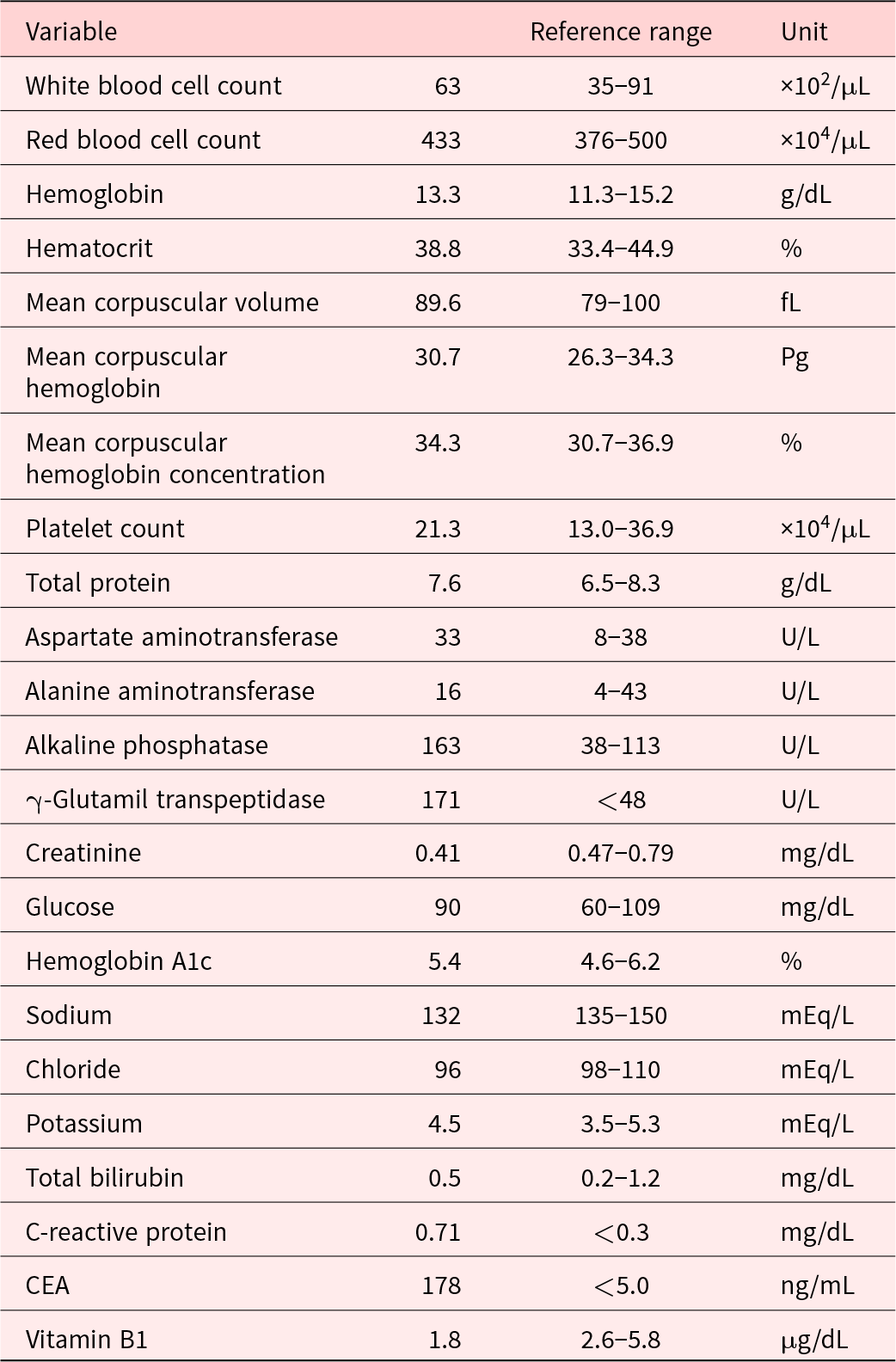
Blood and biochemical tests performed the next day revealed mild hyponatremia, but no findings that could explain the cause of the fatigue were found (Table 1). It should be noted that blood results for thiamine were not available at this point as it takes several days to obtain the results.
Laboratory examination

One week later, the patient returned to the hospital using a cane. She felt so tired that it was difficult for her to sit in the waiting room, so she lay on a bed in the clinic while waiting to be seen. The patient was so fatigued that she could not even sit on entering the examination room and immediately lay down on the bed. She had no disturbance of consciousness or oculomotor dysfunction.
On checking the results for thiamine results from the previous blood collection, it was found that the thiamine level had fallen significantly low at 1.8 μg/dL (normal range: 2.6–5.8 μg/dL). The patient intravenously administered 50 mg of thiamine. When the patient was examined again 15 minutes later, the patient’s fatigue had almost completely disappeared and her symptoms had significantly improved, with the patient able to sit for the examination and walk around the hospital without a cane. Thereafter, the patient was able to return home without using a cane. The patient continued to receive vitamin B1 orally at 75 mg/day. Thereafter, she was able to live peacefully until passing away 2 months later due to the progression of her cancer.
Discussion
We experienced a case of fatigue caused by TD in a lung cancer patient receiving palliative care. Thiamine administration dramatically improved the patient’s symptoms within a short period of time, and the patient’s QOL improved significantly. Given that fatigue is considered a relatively common symptom in patients with advanced cancer (Walsh et al. Reference Walsh, Donnelly and Rybicki2000), it is possible that cancer patients receiving palliative care may include those who experience these symptoms due to TD.
The trigger for the blood test for TD was the presence of weight loss and fatigue. If a blood test for TD had not been performed, the test data would show only mild hyponatremia, and this level of hyponatremia would not explain the marked fatigue. Furthermore, there were no symptoms indicative of WE, such as impaired consciousness or oculomotor dysfunction, so it is possible that the fatigue could be regarded as a worsening of the general condition due to cancer progression. As observed in this case, it is possible that symptoms caused by TD may be hidden among symptoms that are easily attributed to the progression of cancer; therefore, it may be a good idea to perform a blood test for TD toward a differential diagnosis.
The notable feature of this case is that the patient’s fatigue improved dramatically within a short period of time (just 15 minutes) after the intravenous administration of thiamine. Thiamine is a coenzyme in glucose metabolism (Sechi et al. Reference Sechi, Sechi and Fois2016), and research has shown that administration of the thiamine derivative, thiamine tetrahydrofurfuryl disulfide, to rats increased their activity levels within 10 minutes (Saiki et al. Reference Saiki, Matsui and Soya2018). These results support the rapid improvement in fatigue observed in this case and this should be kept in mind when dealing with patients entering end-of-life care.
In patients with WE, eye symptoms improve shortly after treatment, often rapidly; however, the recovery of psychiatric symptoms may begin within a few hours to a few days (Donnino et al. Reference Donnino, Vega and Miller2007). This seems to indicate that reaction times may vary depending on the symptoms.
There are several issues related to the treatment of this case. First, TD was suspected based on weight loss and fatigue, but thiamine was not administered at the time of blood collection. Cases in which thiamine levels decreased within a short period of time in cancer patients have been reported (Uchida et al. Reference Uchida, Ishida and Yoshioka2023), and in this case as well, the patient’s malaise worsened during the week after blood collection, suggesting that TD may have continued to progress. Therefore, thiamine should properly have been administered at the time of blood collection.
Second, the 50 mg of thiamine was administered intravenously. In the treatment guidelines for WE (Galvin et al. Reference Galvin, Brathen and Ivashynka2010), there is no consensus regarding the thiamine dosage in non-alcoholic patients, but many case reports state that WE can be resolved with the intravenous administration of 100–200 mg of thiamine. Although improvement with oral administration of thiamine has been reported (Onizawa et al. Reference Onizawa, Ishida and Uchida2022), we believe that the treatment of the patient in this case should have followed the recommendations from previous studies and guidelines.
In conclusion, we identified TD as the cause of fatigue in advanced cancer patients, and experienced a case in which the patient’s fatigue improved dramatically within a short period of time after the administration of thiamine. As TD may be the underlying cause of symptoms often experienced by patients with advanced cancer, such as fatigue, blood tests for thiamine as part of differential diagnosis followed by appropriate treatment may contribute to improving patient QOL.
Competing interests
The authors have no conflict of interest to declare.

 Open access

