


1. Introduction
A real number $x \in (0,1]$
is normal if, informally, for each base
$x \in (0,1]$
is normal if, informally, for each base $b\ge 2$
, its b-adic expansion contains every finite string with the expected uniform limit frequency (the precise definition is given in the next few lines). It is well known that most numbers x are normal from a measure theoretic viewpoint, see e.g. [
Reference Bergelson, Downarowicz and Misiurewicz5
] for history and generalisations. However, it has been recently shown that certain subsets of nonnormal numbers may have full Hausdorff dimension, see e.g. [
Reference Albeverio, Pratsiovytyi and Torbin1, Reference Barreira and Schmeling4
]. The aim of this work is to show that, from a topological viewpoint, most numbers are not normal in a strong sense. This provides another nonanalogue between measure and category, cf. [
Reference Oxtoby25
].
$b\ge 2$
, its b-adic expansion contains every finite string with the expected uniform limit frequency (the precise definition is given in the next few lines). It is well known that most numbers x are normal from a measure theoretic viewpoint, see e.g. [
Reference Bergelson, Downarowicz and Misiurewicz5
] for history and generalisations. However, it has been recently shown that certain subsets of nonnormal numbers may have full Hausdorff dimension, see e.g. [
Reference Albeverio, Pratsiovytyi and Torbin1, Reference Barreira and Schmeling4
]. The aim of this work is to show that, from a topological viewpoint, most numbers are not normal in a strong sense. This provides another nonanalogue between measure and category, cf. [
Reference Oxtoby25
].
For each $x \in (0,1]$
, denote its unique nonterminating b-adic expansion by
$x \in (0,1]$
, denote its unique nonterminating b-adic expansion by
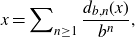 \begin{equation}x=\sum\nolimits_{n\ge 1}\frac{d_{b,n}(x)}{b^n},\end{equation}
with each digit $d_{b,n}(x) \in \{0,1,\ldots,b-1\}$
, where
$d_{b,n}(x) \in \{0,1,\ldots,b-1\}$
, where $b\ge 2$
is a given integer. Then, for each string
$b\ge 2$
is a given integer. Then, for each string ${\boldsymbol{s}}=s_1\cdots s_k$
with digits
${\boldsymbol{s}}=s_1\cdots s_k$
with digits $s_j \in \{0,1,\ldots,b-1\}$
and each
$s_j \in \{0,1,\ldots,b-1\}$
and each $n\ge 1$
, write
$n\ge 1$
, write $\pi_{b,{\boldsymbol{s}},n}(x)$
for the proportion of strings
$\pi_{b,{\boldsymbol{s}},n}(x)$
for the proportion of strings ${\boldsymbol{s}}$
in the b-adic expansion of x which start at some position
${\boldsymbol{s}}$
in the b-adic expansion of x which start at some position $\le n$
, i.e.,
$\le n$
, i.e.,
 \begin{equation*}\pi_{b,\,{\boldsymbol{s}},n}(x) \;:\!=\; \frac{\#\{i\in \{1,\ldots,n\}\;:\; d_{b,i+j-1}(x)=s_j \text{ for all }j=1,\ldots,k\}}{n}.\end{equation*}
In addition, let $S_{b}^k$
be the set of all possible strings
$S_{b}^k$
be the set of all possible strings ${\boldsymbol{s}}=s_1\cdots s_k$
in base b of length k, hence
${\boldsymbol{s}}=s_1\cdots s_k$
in base b of length k, hence $\#S_{b}^k=b^k$
, and denote by
$\#S_{b}^k=b^k$
, and denote by ${\boldsymbol{\pi}}^{k}_{b,n}(x)$
the vector
${\boldsymbol{\pi}}^{k}_{b,n}(x)$
the vector $(\pi_{b,{\boldsymbol{s}},n}(x)\;:\; {\boldsymbol{s}} \in S_{b}^k)$
. Of course,
$(\pi_{b,{\boldsymbol{s}},n}(x)\;:\; {\boldsymbol{s}} \in S_{b}^k)$
. Of course, ${\boldsymbol{\pi}}^{k}_{b,n}(x)$
belongs to the
${\boldsymbol{\pi}}^{k}_{b,n}(x)$
belongs to the $(b^k-1)$
-dimensional simplex for each n. However, the components of
$(b^k-1)$
-dimensional simplex for each n. However, the components of ${\boldsymbol{\pi}}^{k}_{b,n}(x)$
satisfy an additional requirement: if
${\boldsymbol{\pi}}^{k}_{b,n}(x)$
satisfy an additional requirement: if $k\ge 2$
and
$k\ge 2$
and ${\boldsymbol{s}}=s_1\cdots s_{k-1}$
is a string in
${\boldsymbol{s}}=s_1\cdots s_{k-1}$
is a string in $S_b^{k-1}$
, then
$S_b^{k-1}$
, then
 \begin{equation*}\pi_{b,{\boldsymbol{s}},n}(x)=\sum\nolimits_{s_k}\pi_{b,{\boldsymbol{s}} s_{k},n}(x)=\sum\nolimits_{s_0}\pi_{b,s_0{\boldsymbol{s}},n}(x)+O\!\left(1/n\right) \quad \quad \text{ as }n\to \infty,\end{equation*}
where $s_0{\boldsymbol{s}}$
and
$s_0{\boldsymbol{s}}$
and ${\boldsymbol{s}}s_k$
stand for the concatened strings (indeed, the above identity is obtained by a double counting of the occurrences of the string
${\boldsymbol{s}}s_k$
stand for the concatened strings (indeed, the above identity is obtained by a double counting of the occurrences of the string ${\boldsymbol{s}}$
as the occurrences of all possible strings
${\boldsymbol{s}}$
as the occurrences of all possible strings ${\boldsymbol{s}}s_k$
; or, equivalently, as the occurrences of all possible strings
${\boldsymbol{s}}s_k$
; or, equivalently, as the occurrences of all possible strings $s_0{\boldsymbol{s}}$
, with the caveat of counting them correctly at the two extreme positions, hence with an error of at most 1). It follows that the set
$s_0{\boldsymbol{s}}$
, with the caveat of counting them correctly at the two extreme positions, hence with an error of at most 1). It follows that the set $\textrm{L}^k_{b}(x)$
of accumulation points of the sequence of vectors
$\textrm{L}^k_{b}(x)$
of accumulation points of the sequence of vectors $({\boldsymbol{\pi}}^{k}_{b,n}(x)\;:\; n\ge 1)$
is contained in
$({\boldsymbol{\pi}}^{k}_{b,n}(x)\;:\; n\ge 1)$
is contained in $\Delta_{b}^k$
, where
$\Delta_{b}^k$
, where
 \begin{equation*}\begin{split}\Delta_{b}^k \;:\!=\; \left\{(p_{{\boldsymbol{s}}})_{{\boldsymbol{s}} \in S_{b}^k} \in \textbf{R}^{b^k}:\sum\nolimits_{{\boldsymbol{s}}} p_{{\boldsymbol{s}}}=1, \right. &p_{{\boldsymbol{s}}}\ge 0 \text{ for all }{\boldsymbol{s}} \in S_{b}^k, \\&\left.\text{ and }\sum\nolimits_{s_0}p_{s_0{\boldsymbol{s}}}=\sum\nolimits_{s_k}p_{{\boldsymbol{s}}s_k} \text{ for all }{\boldsymbol{s}} \in S_{b}^{k-1}\right\}.\end{split}\end{equation*}
Then x is said to be normal if
 \begin{equation*}\forall b\ge 2, \forall k\ge 1, \forall {\boldsymbol{s}} \in S_{b}^k, \quad\lim_{n\to \infty} \pi_{b,{\boldsymbol{s}},n}(x)=1/b^{k}.\end{equation*}
Hence, if x is normal, then $\textrm{L}_{b}^k(x)=\{(1/b^{k}, \ldots, 1/b^{k})\}$
. Olsen proved in [
Reference Olsen23
] that the subset of nonnormal numbers with maximal set of accumulation points is topologically large:
$\textrm{L}_{b}^k(x)=\{(1/b^{k}, \ldots, 1/b^{k})\}$
. Olsen proved in [
Reference Olsen23
] that the subset of nonnormal numbers with maximal set of accumulation points is topologically large:
Theorem 1·1. The set $\{x \in (0,1]\;:\; \textrm{L}_{b}^k(x)=\Delta_{b}^k \text{ for all }b\ge 2, k\ge 1\}$
is comeager.
$\{x \in (0,1]\;:\; \textrm{L}_{b}^k(x)=\Delta_{b}^k \text{ for all }b\ge 2, k\ge 1\}$
is comeager.
First, we strenghten Theorem 1·1 by showing that the set of accumulation points $\textrm{L}_{b}^k(x)$
can be replaced by the much smaller subset of accumulation points
$\textrm{L}_{b}^k(x)$
can be replaced by the much smaller subset of accumulation points ${\boldsymbol{\eta}}$
such that every neighbourhood of
${\boldsymbol{\eta}}$
such that every neighbourhood of ${\boldsymbol{\eta}}$
contains “sufficiently many” elements of the sequence, where “sufficiently many” is meant with respect to a suitable ideal
${\boldsymbol{\eta}}$
contains “sufficiently many” elements of the sequence, where “sufficiently many” is meant with respect to a suitable ideal $\mathcal{I}$
of subsets of the positive integers
$\mathcal{I}$
of subsets of the positive integers $\textbf{N}$
; see Theorem 2·1. Hence, Theorem 1·1 corresponds to the case where
$\textbf{N}$
; see Theorem 2·1. Hence, Theorem 1·1 corresponds to the case where $\mathcal{I}$
is the family of finite sets.
$\mathcal{I}$
is the family of finite sets.
Then, for certain ideals $\mathcal{I}$
(including the case of the family of asymptotic density zero sets), we even strenghten the latter result by showing that each accumulation point
$\mathcal{I}$
(including the case of the family of asymptotic density zero sets), we even strenghten the latter result by showing that each accumulation point ${\boldsymbol{\eta}}$
can be chosen to be the limit of a subsequence with “sufficiently many” indexes (as we will see in the next Section, these additional requirements are not equivalent); see Theorem 2·3. The precise definitions, together with the main results, follow in Section 2.
${\boldsymbol{\eta}}$
can be chosen to be the limit of a subsequence with “sufficiently many” indexes (as we will see in the next Section, these additional requirements are not equivalent); see Theorem 2·3. The precise definitions, together with the main results, follow in Section 2.
2. Main results
An ideal $\mathcal{I}\subseteq \mathcal{P}(\textbf{N})$
is a family closed under finite union and subsets. It is also assumed that
$\mathcal{I}\subseteq \mathcal{P}(\textbf{N})$
is a family closed under finite union and subsets. It is also assumed that $\mathcal{I}$
contains the family of finite sets Fin and it is different from
$\mathcal{I}$
contains the family of finite sets Fin and it is different from $\mathcal{P}(\textbf{N})$
. Every subset of
$\mathcal{P}(\textbf{N})$
. Every subset of $\mathcal{P}(\textbf{N})$
is endowed with the relative Cantor-space topology. In particular, we may speak about
$\mathcal{P}(\textbf{N})$
is endowed with the relative Cantor-space topology. In particular, we may speak about $G_\delta$
-subsets of
$G_\delta$
-subsets of $\mathcal{P}(\textbf{N})$
,
$\mathcal{P}(\textbf{N})$
, $F_\sigma$
-ideals, meager ideals, analytic ideals, etc. In addition, we say that
$F_\sigma$
-ideals, meager ideals, analytic ideals, etc. In addition, we say that $\mathcal{I}$
is a P-ideal if it is
$\mathcal{I}$
is a P-ideal if it is $\sigma$
-directed modulo finite sets, i.e., for each sequence
$\sigma$
-directed modulo finite sets, i.e., for each sequence $(S_n)$
of sets in
$(S_n)$
of sets in $\mathcal{I}$
there exists
$\mathcal{I}$
there exists $S \in \mathcal{I}$
such that
$S \in \mathcal{I}$
such that $S_n\setminus S$
is finite for all
$S_n\setminus S$
is finite for all $n \in \textbf{N}$
. Lastly, we denote by
$n \in \textbf{N}$
. Lastly, we denote by $\mathcal{Z}$
the ideal of asymptotic density zero sets, i.e.,
$\mathcal{Z}$
the ideal of asymptotic density zero sets, i.e.,
 \begin{equation}\mathcal{Z}=\left\{S\subseteq \textbf{N}\;:\; \textsf{d}^\star(S)=0\right\},\end{equation}
where $\textsf{d}^\star(S) \;:\!=\; \limsup_n \frac{1}{n}\#(S\cap [1,n])$
stands for the upper asymptotic density of S, see e.g. [
Reference Leonetti and Tringali20
]. We refer to [
Reference Hrušák14
] for a recent survey on ideals and associated filters.
$\textsf{d}^\star(S) \;:\!=\; \limsup_n \frac{1}{n}\#(S\cap [1,n])$
stands for the upper asymptotic density of S, see e.g. [
Reference Leonetti and Tringali20
]. We refer to [
Reference Hrušák14
] for a recent survey on ideals and associated filters.
Let $x=(x_n)$
be a sequence taking values in a topological vector space X. Then we say that
$x=(x_n)$
be a sequence taking values in a topological vector space X. Then we say that $\eta \in X$
is an
$\eta \in X$
is an $\mathcal{I}$
-cluster point of x if
$\mathcal{I}$
-cluster point of x if $\{n \in \textbf{N}\;:\; x_n \in U\} \notin \mathcal{I}$
for all open neighbourhoods U of
$\{n \in \textbf{N}\;:\; x_n \in U\} \notin \mathcal{I}$
for all open neighbourhoods U of $\eta$
. Note that Fin-cluster points are the ordinary accumulation points. Usually
$\eta$
. Note that Fin-cluster points are the ordinary accumulation points. Usually $\mathcal{Z}$
-cluster points are referred to as statistical cluster points, see e.g. [
Reference Fridy13
]. It is worth noting that
$\mathcal{Z}$
-cluster points are referred to as statistical cluster points, see e.g. [
Reference Fridy13
]. It is worth noting that $\mathcal{I}$
-cluster points have been studied much before under a different name. Indeed, as it follows by [
Reference Leonetti and Maccheroni19
, theorem 4·2] and [
Reference Kadets and Seliutin16
, lemma 2·2], they correspond to classical “cluster points” of a filter (depending on x) on the underlying space, cf. [
Reference Bourbaki7
, definition 2, p.69].
$\mathcal{I}$
-cluster points have been studied much before under a different name. Indeed, as it follows by [
Reference Leonetti and Maccheroni19
, theorem 4·2] and [
Reference Kadets and Seliutin16
, lemma 2·2], they correspond to classical “cluster points” of a filter (depending on x) on the underlying space, cf. [
Reference Bourbaki7
, definition 2, p.69].
With these premises, for each $x \in (0,1]$
and for all integers
$x \in (0,1]$
and for all integers $b\ge 2$
and
$b\ge 2$
and $k\ge 1$
, let
$k\ge 1$
, let $\Gamma_b^k (x,\mathcal{I})$
be the set of
$\Gamma_b^k (x,\mathcal{I})$
be the set of $\mathcal{I}$
-cluster points of the sequence
$\mathcal{I}$
-cluster points of the sequence $({\boldsymbol{\pi}}_{b,n}^k(x)\;:\;n\ge 1)$
.
$({\boldsymbol{\pi}}_{b,n}^k(x)\;:\;n\ge 1)$
.
Theorem 2·1. The set $\{x \in (0,1]\;:\; \Gamma_b^k (x,\mathcal{I})=\Delta_{b}^k \text{ for all }b\ge 2,k\ge 1\}$
is comeager, provided that
$\{x \in (0,1]\;:\; \Gamma_b^k (x,\mathcal{I})=\Delta_{b}^k \text{ for all }b\ge 2,k\ge 1\}$
is comeager, provided that $\mathcal{I}$
is a meager ideal.
$\mathcal{I}$
is a meager ideal.
The class of meager ideals is really broad. Indeed, it contains Fin, $\mathcal{Z}$
, the summable ideal
$\mathcal{Z}$
, the summable ideal $\{S\subseteq \textbf{N}\;:\; \sum_{n \in S}1/n<\infty\}$
, the ideal generated by the upper Banach density, the analytic P-ideals, the Fubini sum
$\{S\subseteq \textbf{N}\;:\; \sum_{n \in S}1/n<\infty\}$
, the ideal generated by the upper Banach density, the analytic P-ideals, the Fubini sum $\textrm{Fin}\times \textrm{Fin}$
, the random graph ideal, etc.; cf. e.g. [
Reference Balcerzak, Leonetti and Głąb3, Reference Hrušák14
]. Note that
$\textrm{Fin}\times \textrm{Fin}$
, the random graph ideal, etc.; cf. e.g. [
Reference Balcerzak, Leonetti and Głąb3, Reference Hrušák14
]. Note that $\Gamma_b^k (x,\mathcal{I})=\textrm{L}_b^k(x)$
if
$\Gamma_b^k (x,\mathcal{I})=\textrm{L}_b^k(x)$
if $\mathcal{I}=\textrm{Fin}$
. Therefore Theorem 2·1 significantly strenghtens Theorem 1·1.
$\mathcal{I}=\textrm{Fin}$
. Therefore Theorem 2·1 significantly strenghtens Theorem 1·1.
Remark 2·2. It is not difficult to see that Theorem 2·1 does not hold without any restriction on $\mathcal{I}$
. Indeed, if
$\mathcal{I}$
. Indeed, if $\mathcal{I}$
is a maximal ideal (i.e., the complement of a free ultrafilter on
$\mathcal{I}$
is a maximal ideal (i.e., the complement of a free ultrafilter on $\textbf{N})$
, then for each
$\textbf{N})$
, then for each $x \in (0,1]$
and all integers
$x \in (0,1]$
and all integers $b\ge 2$
,
$b\ge 2$
, $k\ge 1$
, we have that the sequence
$k\ge 1$
, we have that the sequence $({\boldsymbol{\pi}}_{b,n}^k(x)\;:\;n\ge 1)$
is bounded, hence it is
$({\boldsymbol{\pi}}_{b,n}^k(x)\;:\;n\ge 1)$
is bounded, hence it is $\mathcal{I}$
-convergent so that
$\mathcal{I}$
-convergent so that $\Gamma_b^k (x,\mathcal{I})$
is a singleton.
$\Gamma_b^k (x,\mathcal{I})$
is a singleton.
On a similar direction, if $x=(x_n)$
is a sequence taking values in a topological vector space X, then
$x=(x_n)$
is a sequence taking values in a topological vector space X, then $\eta \in X$
is an
$\eta \in X$
is an $\mathcal{I}$
-limit point of x if there exists a subsequence
$\mathcal{I}$
-limit point of x if there exists a subsequence $(x_{n_k})$
such that
$(x_{n_k})$
such that $\lim_k x_{n_k}=\eta$
and
$\lim_k x_{n_k}=\eta$
and $\textbf{N}\setminus \{n_1,n_2,\ldots\} \in \mathcal{I}$
. Usually
$\textbf{N}\setminus \{n_1,n_2,\ldots\} \in \mathcal{I}$
. Usually $\mathcal{Z}$
-limit points are referred to as statistical limit points, see e.g. [
Reference Fridy13
]. Similarly, for each
$\mathcal{Z}$
-limit points are referred to as statistical limit points, see e.g. [
Reference Fridy13
]. Similarly, for each $x \in (0,1]$
and for all integers
$x \in (0,1]$
and for all integers $b\ge 2$
and
$b\ge 2$
and $k\ge 1$
, let
$k\ge 1$
, let $\Lambda_b^k (x,\mathcal{I})$
be the set of
$\Lambda_b^k (x,\mathcal{I})$
be the set of $\mathcal{I}$
-limit points of the sequence
$\mathcal{I}$
-limit points of the sequence $({\boldsymbol{\pi}}_{b,n}^k(x)\;:\;n\ge 1)$
. The analogue of Theorem 2·1 for
$({\boldsymbol{\pi}}_{b,n}^k(x)\;:\;n\ge 1)$
. The analogue of Theorem 2·1 for $\mathcal{I}$
-limit points follows.
$\mathcal{I}$
-limit points follows.
Theorem 2·3. The set $\{x \in (0,1]\;:\; \Lambda_b^k (x,\mathcal{I})=\Delta_{b}^k \text{ for all }b\ge 2,k\ge 1\}$
is comeager, provided that
$\{x \in (0,1]\;:\; \Lambda_b^k (x,\mathcal{I})=\Delta_{b}^k \text{ for all }b\ge 2,k\ge 1\}$
is comeager, provided that $\mathcal{I}$
is an analytic P-ideal or an
$\mathcal{I}$
is an analytic P-ideal or an $F_\sigma$
-ideal.
$F_\sigma$
-ideal.
It is known that every $\mathcal{I}$
-limit point is always an
$\mathcal{I}$
-limit point is always an $\mathcal{I}$
-cluster point, however they can be highly different, as it is shown in [
Reference Balcerzak and Leonetti2
, theorem 3·1]. This implies that Theorem 2·3 provides a further improvement on Theorem 2·1 for the subfamily of analytic P-ideals.
$\mathcal{I}$
-cluster point, however they can be highly different, as it is shown in [
Reference Balcerzak and Leonetti2
, theorem 3·1]. This implies that Theorem 2·3 provides a further improvement on Theorem 2·1 for the subfamily of analytic P-ideals.
It is remarkable that there exist $F_\sigma$
-ideals which are not P-ideals, see e.g. [
Reference Farah11
, section 1·11]. Also, the family of analytic P-ideals is well understood and has been characterised with the aid of lower semicontinuous submeasures, cf. Section 3. The results in [
Reference Borodulin-Nadzieja and Farkas6
] suggest that the study of the interplay between the theory of analytic P-ideals and their representability may have some relevant yet unexploited potential for the study of the geometry of Banach spaces.
$F_\sigma$
-ideals which are not P-ideals, see e.g. [
Reference Farah11
, section 1·11]. Also, the family of analytic P-ideals is well understood and has been characterised with the aid of lower semicontinuous submeasures, cf. Section 3. The results in [
Reference Borodulin-Nadzieja and Farkas6
] suggest that the study of the interplay between the theory of analytic P-ideals and their representability may have some relevant yet unexploited potential for the study of the geometry of Banach spaces.
Finally, recalling that the ideal $\mathcal{Z}$
defined in (2) is an analytic P-ideal, an immediate consequence of Theorem 2·3 (as pointed out in the abstract) follows:
$\mathcal{Z}$
defined in (2) is an analytic P-ideal, an immediate consequence of Theorem 2·3 (as pointed out in the abstract) follows:
Corollary 2·4. The set of $x \in (0,1]$
such that, for all
$x \in (0,1]$
such that, for all $b\ge 2$
and
$b\ge 2$
and $k\ge 1$
, every vector in
$k\ge 1$
, every vector in $\Delta_b^k$
is a statistical limit point of the sequence
$\Delta_b^k$
is a statistical limit point of the sequence $({\boldsymbol{\pi}}_{b,n}^k(x)\;:\; n\ge 1)$
is comeager.
$({\boldsymbol{\pi}}_{b,n}^k(x)\;:\; n\ge 1)$
is comeager.
It would also be interesting to investigate to what extend the same results for nonnormal points belonging to self-similar fractals (as studied, e.g., by Olsen and West in [ Reference Olsen and West24 ] in the context of iterated function systems) are valid.
We leave as open question for the interested reader to check whether Theorem 2·3 can be extended for all $F_{\sigma\delta}$
-ideals including, in particular, the ideal
$F_{\sigma\delta}$
-ideals including, in particular, the ideal $\mathcal{I}$
generated by the upper Banach density (which is known to not be a P-ideal, see e.g. [
Reference Freedman and Sember12
, p.299]).
$\mathcal{I}$
generated by the upper Banach density (which is known to not be a P-ideal, see e.g. [
Reference Freedman and Sember12
, p.299]).
3. Proofs of the main results
Proof of Theorem
2·1. Let $\mathcal{I}$
be a meager ideal on
$\mathcal{I}$
be a meager ideal on $\textbf{N}$
. It follows by Talagrand’s characterisation of meager ideals [
Reference Talagrand28
, theorem 21] that it is possible to define a partition
$\textbf{N}$
. It follows by Talagrand’s characterisation of meager ideals [
Reference Talagrand28
, theorem 21] that it is possible to define a partition $\{I_1,I_2,\ldots\}$
of
$\{I_1,I_2,\ldots\}$
of $\textbf{N}$
into nonempty finite subsets such that
$\textbf{N}$
into nonempty finite subsets such that $S\notin \mathcal{I}$
whenever
$S\notin \mathcal{I}$
whenever $I_n\subseteq S$
for infinitely many n. Moreover, we can assume without loss of generality that
$I_n\subseteq S$
for infinitely many n. Moreover, we can assume without loss of generality that $\max I_n<\min I_{n+1}$
for all
$\max I_n<\min I_{n+1}$
for all $n \in \textbf{N}$
.
$n \in \textbf{N}$
.
The claimed set can be rewritten as $\bigcap_{b\ge 2}\bigcap_{k\ge 1}X_b^k$
, where
$\bigcap_{b\ge 2}\bigcap_{k\ge 1}X_b^k$
, where $X_{b}^k \;:\!=\; \{x \in (0,1]\;:\; \Gamma_b^k (x,\mathcal{I})=\Delta_{b}^k\}$
. Since the family of meager subsets of (0,1] is a
$X_{b}^k \;:\!=\; \{x \in (0,1]\;:\; \Gamma_b^k (x,\mathcal{I})=\Delta_{b}^k\}$
. Since the family of meager subsets of (0,1] is a $\sigma$
-ideal, it is enough to show that the complement of each
$\sigma$
-ideal, it is enough to show that the complement of each $X_{b}^k$
is meager. To this aim, fix
$X_{b}^k$
is meager. To this aim, fix $b\ge 2$
and
$b\ge 2$
and $k\ge 1$
and denote by
$k\ge 1$
and denote by $\|\!\cdot\! \|$
the Euclidean norm on
$\|\!\cdot\! \|$
the Euclidean norm on $\textbf{R}^{b^k}$
. Considering that
$\textbf{R}^{b^k}$
. Considering that $\{{\boldsymbol{\eta}}_1, {\boldsymbol{\eta}}_2, \ldots\} \;:\!=\; \Delta_b^k \cap \textbf{Q}^{b^k}$
is a countable dense subset of
$\{{\boldsymbol{\eta}}_1, {\boldsymbol{\eta}}_2, \ldots\} \;:\!=\; \Delta_b^k \cap \textbf{Q}^{b^k}$
is a countable dense subset of $\Delta_b^k$
and that
$\Delta_b^k$
and that $\Gamma_b^k(x,\mathcal{I})$
is a closed subset of
$\Gamma_b^k(x,\mathcal{I})$
is a closed subset of $\Delta_b^k$
by [
Reference Leonetti and Maccheroni19
, lemma 3·1(iv)], it follows that
$\Delta_b^k$
by [
Reference Leonetti and Maccheroni19
, lemma 3·1(iv)], it follows that
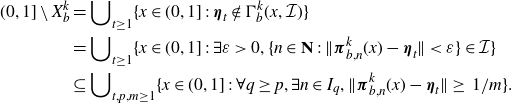 \begin{equation*}\begin{split}(0,1]\setminus X_b^k&= \bigcup\nolimits_{t\ge 1}\{x \in (0,1]\;:\; {\boldsymbol{\eta}}_t \notin \Gamma_b^k(x, \mathcal{I})\}\\&= \bigcup\nolimits_{t\ge 1}\{x \in (0,1]\;:\; \exists \varepsilon>0, \{n \in \textbf{N}\;:\; \|{\boldsymbol{\pi}}_{b,n}^k(x)-{\boldsymbol{\eta}}_t\|< \varepsilon\}\in \mathcal{I}\}\\&\subseteq \bigcup\nolimits_{t, p, m\ge 1}\{x \in (0,1]\;:\; \forall q\ge p, \exists n \in I_q, \|{\boldsymbol{\pi}}_{b,n}^k(x)-{\boldsymbol{\eta}}_t\|\ge\; {1}/{m} \}.\\\end{split}\end{equation*}
Denote by $S_{t,m,p}$
the set in the latter union. Thus it is sufficient to show that each
$S_{t,m,p}$
the set in the latter union. Thus it is sufficient to show that each $S_{t,p,m}$
is nowhere dense. To this aim, fix
$S_{t,p,m}$
is nowhere dense. To this aim, fix $t,p,m \in \textbf{N}$
and a nonempty relatively open set
$t,p,m \in \textbf{N}$
and a nonempty relatively open set $G\subseteq (0,1]$
. We claim there exists a nonempty open set U contained in G and disjoint from
$G\subseteq (0,1]$
. We claim there exists a nonempty open set U contained in G and disjoint from $S_{t,p,m}$
. Since G is nonempty and open in (0, 1], there exists a string
$S_{t,p,m}$
. Since G is nonempty and open in (0, 1], there exists a string $\tilde{{\boldsymbol{s}}}=s_1\cdots s_j \in S_b^j$
such that
$\tilde{{\boldsymbol{s}}}=s_1\cdots s_j \in S_b^j$
such that $x \in G$
whenever
$x \in G$
whenever $d_{b,i}(x)=s_i$
for all
$d_{b,i}(x)=s_i$
for all $i=1,\ldots,j$
. Now, pick
$i=1,\ldots,j$
. Now, pick $x^\star \in (0,1]$
such that
$x^\star \in (0,1]$
such that $\lim_n {\boldsymbol{\pi}}_{b,n}^k(x^\star)={\boldsymbol{\eta}}_t$
, which exists by [
Reference Olsen22
, theorem 1]. In addition, we can assume without loss of generality that
$\lim_n {\boldsymbol{\pi}}_{b,n}^k(x^\star)={\boldsymbol{\eta}}_t$
, which exists by [
Reference Olsen22
, theorem 1]. In addition, we can assume without loss of generality that $d_{b,i}(x^\star)=s_i$
for all
$d_{b,i}(x^\star)=s_i$
for all $i=1,\ldots,j$
. Since
$i=1,\ldots,j$
. Since ${\boldsymbol{\pi}}_{b,n}^k(x^\star)$
is convergent to
${\boldsymbol{\pi}}_{b,n}^k(x^\star)$
is convergent to ${\boldsymbol{\eta}}_t$
, there exists
${\boldsymbol{\eta}}_t$
, there exists $q \ge p+j$
such that
$q \ge p+j$
such that $\|{\boldsymbol{\pi}}^k_{b,n}(x^\star)-{\boldsymbol{\eta}}_{t} \|< \;{1}/{m}$
for all
$\|{\boldsymbol{\pi}}^k_{b,n}(x^\star)-{\boldsymbol{\eta}}_{t} \|< \;{1}/{m}$
for all $n \ge \min I_{q}$
. Define
$n \ge \min I_{q}$
. Define $V \;:\!=\; \{x \in (0,1]\;:\; d_{b,i}(x)=d_{b,i}(x^\star) \text{ for all }i=1,\ldots,\max I_{q}+k\}$
and note that
$V \;:\!=\; \{x \in (0,1]\;:\; d_{b,i}(x)=d_{b,i}(x^\star) \text{ for all }i=1,\ldots,\max I_{q}+k\}$
and note that $V\subseteq G$
because
$V\subseteq G$
because $d_{b,i}(x)=s_i$
for all
$d_{b,i}(x)=s_i$
for all $i\le j$
and
$i\le j$
and $x \in V$
, and
$x \in V$
, and $V\cap S_{t,m,p}=\emptyset$
because, for each
$V\cap S_{t,m,p}=\emptyset$
because, for each $x\in V$
, the required property is not satisfied for this choice of q since
$x\in V$
, the required property is not satisfied for this choice of q since ${\boldsymbol{\pi}}_{b,n}^k(x)={\boldsymbol{\pi}}_{b,n}^k(x^\star)$
for all
${\boldsymbol{\pi}}_{b,n}^k(x)={\boldsymbol{\pi}}_{b,n}^k(x^\star)$
for all $n \le \max I_q$
. Clearly, V has nonempty interior, hence it is possible to choose such
$n \le \max I_q$
. Clearly, V has nonempty interior, hence it is possible to choose such $U\subseteq V$
.
$U\subseteq V$
.
This proves that each $S_{t,m,p}$
is nowhere dense, concluding the proof.
$S_{t,m,p}$
is nowhere dense, concluding the proof.
Before we proceed to the proof of Theorem 2·3, we need to recall the classical Solecki’s characterisation of analytic P-ideals. A lower semicontinuous submeasure (in short, lscsm) is a monotone subadditive function $\varphi\;:\; \mathcal{P}(\textbf{N}) \to [0,\infty]$
such that
$\varphi\;:\; \mathcal{P}(\textbf{N}) \to [0,\infty]$
such that $\varphi(\emptyset)=0$
,
$\varphi(\emptyset)=0$
, $\varphi(\{n\})<\infty$
, and
$\varphi(\{n\})<\infty$
, and $\varphi(A)=\lim_m \varphi(A\cap [1,m])$
for all
$\varphi(A)=\lim_m \varphi(A\cap [1,m])$
for all $A\subseteq \textbf{N}$
and
$A\subseteq \textbf{N}$
and $n \in \textbf{N}$
. It follows by [
Reference Solecki26
, theorem 3·1] that an ideal
$n \in \textbf{N}$
. It follows by [
Reference Solecki26
, theorem 3·1] that an ideal $\mathcal{I}$
is an analytic P-ideal if and only if there exists a lscsm
$\mathcal{I}$
is an analytic P-ideal if and only if there exists a lscsm $\varphi$
such that
$\varphi$
such that
 \begin{equation}\mathcal{I}=\{A\subseteq \textbf{N}\;:\; \|A\|_\varphi=0\},\,\,\, \|\textbf{N}\|_\varphi =1,\,\,\,\text{ and }\,\,\varphi(\textbf{N})<\infty.\end{equation}
Here, $\|A\|_\varphi \;:\!=\; \lim_n \varphi(A\setminus [1,n])$
for all
$\|A\|_\varphi \;:\!=\; \lim_n \varphi(A\setminus [1,n])$
for all $A\subseteq \textbf{N}$
. Note that
$A\subseteq \textbf{N}$
. Note that $\|A\|_\varphi=\|B\|_\varphi$
whenever the symmetric difference
$\|A\|_\varphi=\|B\|_\varphi$
whenever the symmetric difference $A\bigtriangleup B$
is finite, cf. [
Reference Farah11
, lemma 1·3·3(b)]. Easy examples of lscsms are
$A\bigtriangleup B$
is finite, cf. [
Reference Farah11
, lemma 1·3·3(b)]. Easy examples of lscsms are $\varphi(A) \;:\!=\; \# A$
or
$\varphi(A) \;:\!=\; \# A$
or $\varphi(A) \;:\!=\; \sup_n \!({1}/{n})\#(A \cap [1,n])$
for all
$\varphi(A) \;:\!=\; \sup_n \!({1}/{n})\#(A \cap [1,n])$
for all $A\subseteq \textbf{N}$
which lead, respectively, to the ideals Fin and
$A\subseteq \textbf{N}$
which lead, respectively, to the ideals Fin and $\mathcal{Z}$
through the representation (3).
$\mathcal{Z}$
through the representation (3).
Proof of Theorem
2·3. First, let us suppose that $\mathcal{I}$
is an
$\mathcal{I}$
is an $F_\sigma$
-ideal. We obtain by [
Reference Balcerzak and Leonetti2
, theorem 2·3] that
$F_\sigma$
-ideal. We obtain by [
Reference Balcerzak and Leonetti2
, theorem 2·3] that $\Lambda_b^k (x,\mathcal{I})=\Gamma_b^k (x,\mathcal{I})$
for each
$\Lambda_b^k (x,\mathcal{I})=\Gamma_b^k (x,\mathcal{I})$
for each $b\ge 2$
,
$b\ge 2$
, $k\ge 1$
, and
$k\ge 1$
, and $x \in (0,1]$
. Therefore the claim follows by Theorem 2·1.
$x \in (0,1]$
. Therefore the claim follows by Theorem 2·1.
Then, we assume hereafter that $\mathcal{I}$
is an analytic P-ideal generated by a lscsm
$\mathcal{I}$
is an analytic P-ideal generated by a lscsm $\varphi$
as in (3). Fix integers
$\varphi$
as in (3). Fix integers $b\ge 2$
and
$b\ge 2$
and $k\ge 1$
, and define the function
$k\ge 1$
, and define the function
 \begin{equation*}\mathfrak{u}\;:\; (0,1]\times \Delta_b^k \longrightarrow \textbf{R}\;:\; (x,{\boldsymbol{\eta}}) \longmapsto \lim_{t\to \infty} \|\{n \in \textbf{N}\;:\; \|{\boldsymbol{\pi}}_{b,n}^k(x)-{\boldsymbol{\eta}}\|\le \; {1}/{t} \}\|_\varphi{,} \end{equation*}
where $\|\!\cdot\!\|$
stands for the Euclidean norm on
$\|\!\cdot\!\|$
stands for the Euclidean norm on $\textbf{R}^{b^k}$
. It follows by [
Reference Balcerzak and Leonetti2
, lemma 2·1] that every section
$\textbf{R}^{b^k}$
. It follows by [
Reference Balcerzak and Leonetti2
, lemma 2·1] that every section $\mathfrak{u}(x,\cdot)$
is upper semicontinuous, so that the set
$\mathfrak{u}(x,\cdot)$
is upper semicontinuous, so that the set
 \begin{equation*}\Lambda_b^k(x,\mathcal{I},q) \;:\!=\; \{{\boldsymbol{\eta}} \in \Delta_b^k \;:\; \mathfrak{u}(x,{\boldsymbol{\eta}}) \ge q\}\end{equation*}
is closed for each $x \in (0,1]$
and
$x \in (0,1]$
and $q \in \textbf{R}$
.
$q \in \textbf{R}$
.
At this point, we prove that, for each ${\boldsymbol{\eta}} \in \Delta_b^k$
, the set
${\boldsymbol{\eta}} \in \Delta_b^k$
, the set $X({\boldsymbol{\eta}}) \;:\!=\; \{x \in (0,1]\;:\; \mathfrak{u}(x,{\boldsymbol{\eta}}) \ge\; {1}/{2}\}$
is comeager. To this aim, fix
$X({\boldsymbol{\eta}}) \;:\!=\; \{x \in (0,1]\;:\; \mathfrak{u}(x,{\boldsymbol{\eta}}) \ge\; {1}/{2}\}$
is comeager. To this aim, fix ${\boldsymbol{\eta}} \in \Delta_b^k$
and notice that
${\boldsymbol{\eta}} \in \Delta_b^k$
and notice that
 \begin{equation*}\begin{split}(0,1]\setminus X({\boldsymbol{\eta}})&=\bigcup\nolimits_{t\ge 1}\{x \in (0,1]\;:\; \|\{n \in \textbf{N}\;:\; \|{\boldsymbol{\pi}}_{b,n}^k(x)-{\boldsymbol{\eta}}\|\le\; {1}/{t}\}\|_\varphi < \; {1}/{2}\}\\&=\bigcup\nolimits_{t\ge 1}\{x \in (0,1]\;:\; \lim_{h\to \infty} \varphi(\{n\ge h\;:\; \|{\boldsymbol{\pi}}_{b,n}^k(x)-{\boldsymbol{\eta}}\|\le\; {1}/{t}\})< \; {1}/{2}\}\\&=\bigcup\nolimits_{t,h\ge 1}\{x \in (0,1]\;:\; \varphi(\{n\ge h \;:\; \|{\boldsymbol{\pi}}_{b,n}^k(x)-{\boldsymbol{\eta}}\|\le \; {1}/{t}\})< \; {1}/{2}\}.\end{split}\end{equation*}
Denoting by $Y_{t,h}$
the inner set above, it is sufficient to show that each
$Y_{t,h}$
the inner set above, it is sufficient to show that each $Y_{t,h}$
is nowhere dense. Hence, fix
$Y_{t,h}$
is nowhere dense. Hence, fix $G\subseteq (0,1]$
,
$G\subseteq (0,1]$
, $\tilde{{\boldsymbol{s}}} \in S_b^j$
, and
$\tilde{{\boldsymbol{s}}} \in S_b^j$
, and $x^\star \in (0,1]$
as in the proof of Theorem 2·1. Considering that
$x^\star \in (0,1]$
as in the proof of Theorem 2·1. Considering that $\|\!\cdot\!\|_\varphi$
is invariant under finite sets, it follows that
$\|\!\cdot\!\|_\varphi$
is invariant under finite sets, it follows that
 \begin{equation*}\varphi(\{n\ge j^{\prime} \;:\; \|{\boldsymbol{\pi}}_{b,n}^k(x^\star)-{\boldsymbol{\eta}}\|\le \; {1}/{t}\})\ge \|\{n\ge j^{\prime} \;:\; \|{\boldsymbol{\pi}}_{b,n}^k(x^\star)-{\boldsymbol{\eta}}\|\le \; {1}/{t}\}\|_\varphi=\mathfrak{u}(x^\star, {\boldsymbol{\eta}})=1,\end{equation*}
where $j^\prime \;:\!=\; j+h$
. Since
$j^\prime \;:\!=\; j+h$
. Since $\varphi$
is lower semicontinuous, there exists an integer
$\varphi$
is lower semicontinuous, there exists an integer $j^{\prime\prime}>j^\prime$
such that
$j^{\prime\prime}>j^\prime$
such that
 \begin{equation*}\varphi(\{n\in [j^\prime, j^{\prime\prime}]\;:\; \|{\boldsymbol{\pi}}_{b,n}^k(x^\star)-{\boldsymbol{\eta}}\|\le \; {1}/{t}\})\ge\; {1}/{2}.\end{equation*}
Define $V \;:\!=\; \{x \in (0,1]\;:\; d_{b,i}(x)=d_{b,i}(x^\star) \text{ for all }i=1,\ldots,j^{\prime\prime}\}$
. Similarly, note that
$V \;:\!=\; \{x \in (0,1]\;:\; d_{b,i}(x)=d_{b,i}(x^\star) \text{ for all }i=1,\ldots,j^{\prime\prime}\}$
. Similarly, note that $V\subseteq G$
because
$V\subseteq G$
because $d_{b,i}(x)=s_i$
for all
$d_{b,i}(x)=s_i$
for all $i\le j$
and
$i\le j$
and $x \in V$
, and
$x \in V$
, and $V \cap Y_{t,h}=\emptyset$
because
$V \cap Y_{t,h}=\emptyset$
because $\varphi(\{n\ge h\;:\; \|{\boldsymbol{\pi}}_{b,n}^k(x)-{\boldsymbol{\eta}}\|\le\; {1}/{t}\})$
is at least
$\varphi(\{n\ge h\;:\; \|{\boldsymbol{\pi}}_{b,n}^k(x)-{\boldsymbol{\eta}}\|\le\; {1}/{t}\})$
is at least $\varphi(\{n\in [j^\prime, j^{\prime\prime}]\;:\; \|{\boldsymbol{\pi}}_{b,n}^k(x)-{\boldsymbol{\eta}}\|\le\; {1}/{t}\})\ge \; {1}/{2}$
for all
$\varphi(\{n\in [j^\prime, j^{\prime\prime}]\;:\; \|{\boldsymbol{\pi}}_{b,n}^k(x)-{\boldsymbol{\eta}}\|\le\; {1}/{t}\})\ge \; {1}/{2}$
for all $x \in V$
. Since V has nonempty interior, it is possible to choose
$x \in V$
. Since V has nonempty interior, it is possible to choose $U\subseteq V$
with the required property.
$U\subseteq V$
with the required property.
Finally, let E be a countable dense subset of $\Delta_b^k$
. Considering that
$\Delta_b^k$
. Considering that $X \;:\!=\; \{x \in (0,1]\;:\; E\subseteq \Lambda_b^k(x,\mathcal{I},\; {1}/{2})\}$
is equal to
$X \;:\!=\; \{x \in (0,1]\;:\; E\subseteq \Lambda_b^k(x,\mathcal{I},\; {1}/{2})\}$
is equal to $\bigcap_{{\boldsymbol{\eta}} \in E}X({\boldsymbol{\eta}})$
, it follows that the set
$\bigcap_{{\boldsymbol{\eta}} \in E}X({\boldsymbol{\eta}})$
, it follows that the set $X$
is comeager. However, considering that
$X$
is comeager. However, considering that
 \begin{equation*}\Lambda_b^k(x,\mathcal{I})=\bigcup\nolimits_{q>0}\Lambda_b^k(x,\mathcal{I},q)\end{equation*}
by [
Reference Balcerzak and Leonetti2
, theorem 2·2] and that $\Lambda_b^k(x,\mathcal{I},\; {1}/{2})$
is a closed subset such that
$\Lambda_b^k(x,\mathcal{I},\; {1}/{2})$
is a closed subset such that $E\subseteq \Lambda_b^k(x,\mathcal{I},\; {1}/{2})\subseteq \Lambda_b^k(x,\mathcal{I})\subseteq \Delta_b^k$
for all
$E\subseteq \Lambda_b^k(x,\mathcal{I},\; {1}/{2})\subseteq \Lambda_b^k(x,\mathcal{I})\subseteq \Delta_b^k$
for all $x \in X$
, we obtain that
$x \in X$
, we obtain that $\Lambda_b^k(x,\mathcal{I}, \; {1}/{2})=\Lambda_b^k(x,\mathcal{I})=\Delta_b^k$
for all
$\Lambda_b^k(x,\mathcal{I}, \; {1}/{2})=\Lambda_b^k(x,\mathcal{I})=\Delta_b^k$
for all $x \in X$
. In particular, the claimed set contains X, which is comeager. This concludes the proof.
$x \in X$
. In particular, the claimed set contains X, which is comeager. This concludes the proof.
4. Applications
4·1. Hausdorff and packing dimensions
We refer to [ Reference Falconer10 , chapter 3] for the definitions of the Hausdorff dimension and the packing dimension.
Proposition 4·1. The sets defined in Theorem 2·1 and Theorem 2·3 have Hausdorff dimension 0 and packing dimension 1.
Proof. Reasoning as in [ Reference Olsen23 ], the claimed sets are contained in the corresponding ones with ideal Fin, which have Hausdorff dimension 0 by [ Reference Olsen22 , theorem 2·1]. In addition, since all sets are comeager, we conclude that they have packing dimension 1 by [ Reference Falconer10 , corollary 3·10(b)].
4·2. Regular matrices
We extend the main results contained in [
Reference Hyde, Laschos, Olsen, Petrykiewicz and Shaw15, Reference Stylianou27
]. To this aim, let $A=(a_{n,i}\;:\; n,i \in \textbf{N})$
be a regular matrix, that is, an infinite real-valued matrix such that, if
$A=(a_{n,i}\;:\; n,i \in \textbf{N})$
be a regular matrix, that is, an infinite real-valued matrix such that, if ${\boldsymbol{z}}=({\boldsymbol{z}}_n)$
is a
${\boldsymbol{z}}=({\boldsymbol{z}}_n)$
is a $\textbf{R}^d$
-valued sequence convergent to
$\textbf{R}^d$
-valued sequence convergent to ${\boldsymbol{\eta}}$
, then
${\boldsymbol{\eta}}$
, then $A_n{\boldsymbol{z}} \;:\!=\; \sum_i a_{n,i}{\boldsymbol{z}}_i$
exists for all
$A_n{\boldsymbol{z}} \;:\!=\; \sum_i a_{n,i}{\boldsymbol{z}}_i$
exists for all $n \in \textbf{N}$
and
$n \in \textbf{N}$
and $\lim_n A_n{\boldsymbol{z}}={\boldsymbol{\eta}}$
, see e.g. [
Reference Cooke9
, chapter 4]. Then, for each
$\lim_n A_n{\boldsymbol{z}}={\boldsymbol{\eta}}$
, see e.g. [
Reference Cooke9
, chapter 4]. Then, for each $x \in (0,1]$
and integers
$x \in (0,1]$
and integers $b\ge 2$
and
$b\ge 2$
and $k\ge 1$
, let
$k\ge 1$
, let $\Gamma_{b}^k(x,\mathcal{I},A)$
be the set of
$\Gamma_{b}^k(x,\mathcal{I},A)$
be the set of $\mathcal{I}$
-cluster points of the sequence of vectors
$\mathcal{I}$
-cluster points of the sequence of vectors $\left(A_n{\boldsymbol{\pi}}_{b}^k(x)\;:\; n \ge 1\right)$
, where
$\left(A_n{\boldsymbol{\pi}}_{b}^k(x)\;:\; n \ge 1\right)$
, where ${\boldsymbol{\pi}}_{b}^k(x)$
is the sequence
${\boldsymbol{\pi}}_{b}^k(x)$
is the sequence $({\boldsymbol{\pi}}_{b,n}^k(x)\;:\; n\ge 1)$
.
$({\boldsymbol{\pi}}_{b,n}^k(x)\;:\; n\ge 1)$
.
In particular, $\Gamma_{b}^k(x,\mathcal{I},A)=\Gamma_{b}^k(x,\mathcal{I})$
if A is the infinite identity matrix.
$\Gamma_{b}^k(x,\mathcal{I},A)=\Gamma_{b}^k(x,\mathcal{I})$
if A is the infinite identity matrix.
Theorem 4·2. The set $\{x \in (0,1]\;:\; \Gamma_b^k (x,\mathcal{I},A)\supseteq \Delta_{b}^k \text{ for all }b\ge 2, k\ge 1\}$
is comeager, provided that
$\{x \in (0,1]\;:\; \Gamma_b^k (x,\mathcal{I},A)\supseteq \Delta_{b}^k \text{ for all }b\ge 2, k\ge 1\}$
is comeager, provided that $\mathcal{I}$
is a meager ideal and A is a regular matrix.
$\mathcal{I}$
is a meager ideal and A is a regular matrix.
Proof. Fix a regular matrix $A=(a_{n,i})$
and a meager ideal
$A=(a_{n,i})$
and a meager ideal $\mathcal{I}$
. The proof goes along the same lines as the proof of Theorem 2·1, replacing the definition of
$\mathcal{I}$
. The proof goes along the same lines as the proof of Theorem 2·1, replacing the definition of $S_{t,m,p}$
with
$S_{t,m,p}$
with
 \begin{equation*}S^\prime_{t,m,p} \;:\!=\; \{x \in (0,1]\;:\;\forall q\ge p, \exists n \in I_q,\|A_n{\boldsymbol{\pi}}^k_{b}(x)-{\boldsymbol{\eta}}_{t} \|\ge \; {1}/{m} \}.\end{equation*}
Recall that, thanks to the classical Silverman–Toeplitz characterisation of regular matrices, see e.g. [
Reference Cooke9
, theorem 4·1, II] or [
Reference Connor and Leonetti8
], we have that $\sup_n \sum_i |a_{n,i}|<\infty$
. Since
$\sup_n \sum_i |a_{n,i}|<\infty$
. Since $\lim_n {\boldsymbol{\pi}}_{b,n}^k(x^\star)={\boldsymbol{\eta}}_t$
, it follows that there exist sufficiently large integers
$\lim_n {\boldsymbol{\pi}}_{b,n}^k(x^\star)={\boldsymbol{\eta}}_t$
, it follows that there exist sufficiently large integers $q\ge p+j$
and
$q\ge p+j$
and $j_A \ge j$
such that, if
$j_A \ge j$
such that, if $d_{b,i}(x)=d_{b,i}(x^\star)$
for all
$d_{b,i}(x)=d_{b,i}(x^\star)$
for all $i=1,\ldots,j_A+k$
, then
$i=1,\ldots,j_A+k$
, then
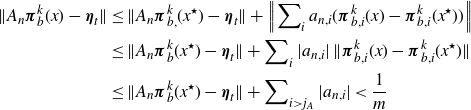 \begin{equation}\begin{split}\|A_n{\boldsymbol{\pi}}^k_{b}(x)-{\boldsymbol{\eta}}_{t} \|&\le \|A_n{\boldsymbol{\pi}}^k_{b, }(x^\star)-{\boldsymbol{\eta}}_{t}\|+\left\|\sum\nolimits_i a_{n,i}({\boldsymbol{\pi}}^k_{b,i}(x)-{\boldsymbol{\pi}}^k_{b,i}(x^\star))\right\|\\&\le \|A_n{\boldsymbol{\pi}}^k_{b }(x^\star)-{\boldsymbol{\eta}}_{t} \|+\sum\nolimits_i |a_{n,i}| \, \|{\boldsymbol{\pi}}^k_{b,i}(x)-{\boldsymbol{\pi}}^k_{b,i}(x^\star)\|\\&\le \|A_n{\boldsymbol{\pi}}^k_{b}(x^\star)-{\boldsymbol{\eta}}_{t}\|+\sum\nolimits_{i> j_A} |a_{n,i}|< \frac{1}{m}\end{split}\end{equation}
for all $n \in I_{q}$
. We conclude analogously that
$n \in I_{q}$
. We conclude analogously that $S^\prime_{t,m,p}$
is nowhere dense.
$S^\prime_{t,m,p}$
is nowhere dense.
The main result in [
Reference Stylianou27
] corresponds to the case $\mathcal{I}=\textrm{Fin}$
and
$\mathcal{I}=\textrm{Fin}$
and $k=1$
, although with a different proof; cf. also Example 4·10 below.
$k=1$
, although with a different proof; cf. also Example 4·10 below.
At this point, we need an intermediate result which is of independent interest. For each bounded sequence ${\boldsymbol{x}}=({\boldsymbol{x}}_n)$
with values in
${\boldsymbol{x}}=({\boldsymbol{x}}_n)$
with values in $\textbf{R}^k$
, let
$\textbf{R}^k$
, let $\textrm{K}\text{-}\textrm{core}({\boldsymbol{x}})$
be the Knopp core of
$\textrm{K}\text{-}\textrm{core}({\boldsymbol{x}})$
be the Knopp core of ${\boldsymbol{x}}$
, that is, the convex hull of the set of accumulation points of
${\boldsymbol{x}}$
, that is, the convex hull of the set of accumulation points of ${\boldsymbol{x}}$
. In other words,
${\boldsymbol{x}}$
. In other words, $\textrm{K}\text{-}\textrm{core}({\boldsymbol{x}})=\textrm{co}\, \textrm{L}_{{\boldsymbol{x}}}$
, where
$\textrm{K}\text{-}\textrm{core}({\boldsymbol{x}})=\textrm{co}\, \textrm{L}_{{\boldsymbol{x}}}$
, where $\textrm{co}\, S$
is the convex hull of
$\textrm{co}\, S$
is the convex hull of $S\subseteq \textbf{R}^k$
and
$S\subseteq \textbf{R}^k$
and $\textrm{L}_{{\boldsymbol{x}}}$
is the set of accumulation points of
$\textrm{L}_{{\boldsymbol{x}}}$
is the set of accumulation points of ${\boldsymbol{x}}$
. The ideal version of the Knopp core has been studied in [
Reference Kadets and Seliutin16, Reference Leonetti18
]. The classical Knopp theorem states that, if
${\boldsymbol{x}}$
. The ideal version of the Knopp core has been studied in [
Reference Kadets and Seliutin16, Reference Leonetti18
]. The classical Knopp theorem states that, if $k=2$
and A is a nonnegative regular matrix, then
$k=2$
and A is a nonnegative regular matrix, then
 \begin{equation}\textrm{K}\text{-}\textrm{core}(A{\boldsymbol{x}})\subseteq \textrm{K}\text{-}\textrm{core}({\boldsymbol{x}})\end{equation}
for all bounded sequences ${\boldsymbol{x}}$
, where
${\boldsymbol{x}}$
, where $A{\boldsymbol{x}}=(A_n{\boldsymbol{x}}\;:\; n\ge 1)$
, see [
Reference Knopp17
, p. 115]; cf. [
Reference Cooke9
, chapter 6] for a textbook exposition. A generalisation in the case
$A{\boldsymbol{x}}=(A_n{\boldsymbol{x}}\;:\; n\ge 1)$
, see [
Reference Knopp17
, p. 115]; cf. [
Reference Cooke9
, chapter 6] for a textbook exposition. A generalisation in the case $k=1$
can be found in [
Reference Maddox21
]. We show, in particular, that a stronger version of Knopp’s theorem holds for every
$k=1$
can be found in [
Reference Maddox21
]. We show, in particular, that a stronger version of Knopp’s theorem holds for every $k \in \textbf{N}$
.
$k \in \textbf{N}$
.
Proposition 4·3. Let ${\boldsymbol{x}}=({\boldsymbol{x}}_n)$
be a bounded sequence taking values in
${\boldsymbol{x}}=({\boldsymbol{x}}_n)$
be a bounded sequence taking values in $\mathbf{R}^k$
, and fix a regular matrix A such that
$\mathbf{R}^k$
, and fix a regular matrix A such that $\lim_n \sum_i |a_{n,i}|=1$
. Then inclusion (5) holds.
$\lim_n \sum_i |a_{n,i}|=1$
. Then inclusion (5) holds.
Proof. Define $\kappa \;:\!=\; \sup_n \|{\boldsymbol{x}}_n\|$
and let
$\kappa \;:\!=\; \sup_n \|{\boldsymbol{x}}_n\|$
and let ${\boldsymbol{\eta}}$
be an accumulation point of
${\boldsymbol{\eta}}$
be an accumulation point of $A{\boldsymbol{x}}$
. It is sufficient to show that
$A{\boldsymbol{x}}$
. It is sufficient to show that ${\boldsymbol{\eta}}\in K \;:\!=\; \textrm{K}\text{-}\textrm{core}({\boldsymbol{x}})$
. Possibly deleting some rows of A, we can assume without loss of generality that
${\boldsymbol{\eta}}\in K \;:\!=\; \textrm{K}\text{-}\textrm{core}({\boldsymbol{x}})$
. Possibly deleting some rows of A, we can assume without loss of generality that $\lim A{\boldsymbol{x}}={\boldsymbol{\eta}}$
. For each
$\lim A{\boldsymbol{x}}={\boldsymbol{\eta}}$
. For each $m \in \textbf{N}$
, let
$m \in \textbf{N}$
, let $K_m$
be the closure of
$K_m$
be the closure of $\textrm{co}\{x_m,x_{m+1},\ldots\}$
, hence
$\textrm{co}\{x_m,x_{m+1},\ldots\}$
, hence $K\subseteq K_m$
. Define
$K\subseteq K_m$
. Define $d({\boldsymbol{a}}, C) \;:\!=\; \min_{{\boldsymbol{b}} \in C} \|{\boldsymbol{a}}-{\boldsymbol{b}}\|$
for all
$d({\boldsymbol{a}}, C) \;:\!=\; \min_{{\boldsymbol{b}} \in C} \|{\boldsymbol{a}}-{\boldsymbol{b}}\|$
for all ${\boldsymbol{a}} \in \textbf{R}^k$
and nonempty compact sets
${\boldsymbol{a}} \in \textbf{R}^k$
and nonempty compact sets $C\subseteq \textbf{R}^k$
. In addition, for each
$C\subseteq \textbf{R}^k$
. In addition, for each $m \in \textbf{N}$
, let
$m \in \textbf{N}$
, let $Q_m({\boldsymbol{a}})\in K_m$
be the unique vector such that
$Q_m({\boldsymbol{a}})\in K_m$
be the unique vector such that $d({\boldsymbol{a}}, K_m)=\|{\boldsymbol{a}}-Q_m({\boldsymbol{a}})\|$
. Similarly, let
$d({\boldsymbol{a}}, K_m)=\|{\boldsymbol{a}}-Q_m({\boldsymbol{a}})\|$
. Similarly, let $Q({\boldsymbol{a}})$
be the vector in K which minimizes its distance with
$Q({\boldsymbol{a}})$
be the vector in K which minimizes its distance with ${\boldsymbol{a}}$
. Then, notice that, for all
${\boldsymbol{a}}$
. Then, notice that, for all $n,m \in \textbf{N}$
, we have
$n,m \in \textbf{N}$
, we have
 \begin{equation*}\begin{split}d(A_n{\boldsymbol{x}}, K) &\le \inf\nolimits_{{\boldsymbol{b}} \in K} \inf\nolimits_{{\boldsymbol{c}} \in \textbf{R}^k} (\|A_n{\boldsymbol{x}}-{\boldsymbol{c}}\|+\|{\boldsymbol{c}}-{\boldsymbol{b}}\|) \\&\le \inf\nolimits_{{\boldsymbol{c}} \in K_m} \inf\nolimits_{{\boldsymbol{b}} \in K} (\|A_n{\boldsymbol{x}}-{\boldsymbol{c}}\|+\|{\boldsymbol{c}}-{\boldsymbol{b}}\|) \\&\le \inf\nolimits_{{\boldsymbol{c}} \in K_m} \|A_n{\boldsymbol{x}}-{\boldsymbol{c}}\|+\sup\nolimits_{{\boldsymbol{y}}\in K_m} \inf\nolimits_{{\boldsymbol{b}} \in K}\|{\boldsymbol{y}}-{\boldsymbol{b}}\| \\&= d(A_n{\boldsymbol{x}},K_m)+\sup\nolimits_{{\boldsymbol{y}}\in K_m}d({\boldsymbol{y}},K).\end{split}\end{equation*}
Since $d({\boldsymbol{\eta}},K)=\lim_n d(A_n{\boldsymbol{x}}, K)$
by the continuity of
$d({\boldsymbol{\eta}},K)=\lim_n d(A_n{\boldsymbol{x}}, K)$
by the continuity of $d(\cdot,K)$
, it is sufficient to show that both
$d(\cdot,K)$
, it is sufficient to show that both $d(A_n{\boldsymbol{x}}, K_m)$
and
$d(A_n{\boldsymbol{x}}, K_m)$
and $\sup_{{\boldsymbol{y}} \in K_m} d({\boldsymbol{y}},K)$
are sufficiently small if n is sufficiently large and m is chosen properly.
$\sup_{{\boldsymbol{y}} \in K_m} d({\boldsymbol{y}},K)$
are sufficiently small if n is sufficiently large and m is chosen properly.
To this aim, fix $\varepsilon >0$
and choose
$\varepsilon >0$
and choose $m \in \textbf{N}$
such that
$m \in \textbf{N}$
such that $\sup\nolimits_{{\boldsymbol{y}}\in K_m}d({\boldsymbol{y}},K)\le\; {\varepsilon}/{2}$
. Indeed, it is sufficient to choose
$\sup\nolimits_{{\boldsymbol{y}}\in K_m}d({\boldsymbol{y}},K)\le\; {\varepsilon}/{2}$
. Indeed, it is sufficient to choose $m \in \textbf{N}$
such that
$m \in \textbf{N}$
such that $d({\boldsymbol{x}}_n, \textrm{L}_{{\boldsymbol{x}}})< \; {\varepsilon}/{2}$
for all
$d({\boldsymbol{x}}_n, \textrm{L}_{{\boldsymbol{x}}})< \; {\varepsilon}/{2}$
for all $n\ge m$
: indeed, in the opposite, the subsequence
$n\ge m$
: indeed, in the opposite, the subsequence $({\boldsymbol{x}}_j)_{j \in J}$
, where
$({\boldsymbol{x}}_j)_{j \in J}$
, where $J \;:\!=\; \{n\in \textbf{N}\;:\; d({\boldsymbol{x}}_n, \textrm{L}_{{\boldsymbol{x}}})\ge \; {\varepsilon}/{2}\}$
, would be bounded and without any accumulation point, which is impossible. Now pick
$J \;:\!=\; \{n\in \textbf{N}\;:\; d({\boldsymbol{x}}_n, \textrm{L}_{{\boldsymbol{x}}})\ge \; {\varepsilon}/{2}\}$
, would be bounded and without any accumulation point, which is impossible. Now pick ${\boldsymbol{y}} \in K_m$
so that
${\boldsymbol{y}} \in K_m$
so that ${\boldsymbol{y}}=\sum_j \lambda_{i_j} {\boldsymbol{x}}_{i_j}$
for some strictly increasing sequence
${\boldsymbol{y}}=\sum_j \lambda_{i_j} {\boldsymbol{x}}_{i_j}$
for some strictly increasing sequence $(i_j)$
of positive integers such that
$(i_j)$
of positive integers such that $i_1 \ge m$
and some real nonnegative sequence
$i_1 \ge m$
and some real nonnegative sequence $(\lambda_{i_j})$
with
$(\lambda_{i_j})$
with $\sum_{j} \lambda_{i_j}=1$
. It follows that
$\sum_{j} \lambda_{i_j}=1$
. It follows that
 \begin{equation*}d({\boldsymbol{y}},K)\le \left\|{\boldsymbol{y}}-\sum\nolimits_{j}\lambda_{i_j}Q({\boldsymbol{x}}_{i_j}) \right\|\le \sum\nolimits_{j}\lambda_{i_j} \left\|{\boldsymbol{x}}_{i_j}-Q({\boldsymbol{x}}_{i_j})\right\|\le \sum\nolimits_{j}\lambda_{i_j} d({\boldsymbol{x}}_{i_j}, L_{{\boldsymbol{x}}})\le \frac{\varepsilon}{2}.\end{equation*}
Suppose for the moment that A has nonnegative entries. Since A is regular, we get $\lim_n \sum_i a_{n,i}=1$
and
$\lim_n \sum_i a_{n,i}=1$
and $\lim_n \sum_{i<m}a_{n,i}=0$
by the Silverman–Toeplitz characterisation, hence
$\lim_n \sum_{i<m}a_{n,i}=0$
by the Silverman–Toeplitz characterisation, hence $\lim_n\sum_{i\ge m} a_{n,i}=1$
and there exists
$\lim_n\sum_{i\ge m} a_{n,i}=1$
and there exists $n_0 \in \textbf{N}$
such that
$n_0 \in \textbf{N}$
such that $\sum_{i\ge m} a_{n,i} \ge \; {1}/{2}$
for all
$\sum_{i\ge m} a_{n,i} \ge \; {1}/{2}$
for all $n\ge n_0$
. Thus, for each
$n\ge n_0$
. Thus, for each $n\ge n_0$
, we obtain that
$n\ge n_0$
, we obtain that $ d(A_n{\boldsymbol{x}},K_m)=\|A_n{\boldsymbol{x}}-Q_m(A_n{\boldsymbol{x}})\| \le \alpha_n+\beta_n+\gamma_n,$
where
$ d(A_n{\boldsymbol{x}},K_m)=\|A_n{\boldsymbol{x}}-Q_m(A_n{\boldsymbol{x}})\| \le \alpha_n+\beta_n+\gamma_n,$
where
 \begin{equation*}\alpha_n \;:\!=\; \left\| A_n{\boldsymbol{x}}-\frac{A_n{\boldsymbol{x}}}{\sum_i a_{n,i}}\right\|, \quad \beta_n \;:\!=\; \left\| \frac{A_n{\boldsymbol{x}}}{\sum_i a_{n,i}}-Q_m\!\left(\frac{A_n{\boldsymbol{x}}}{\sum_i a_{n,i}}\right)\right\|\end{equation*}
and
 \begin{equation*}\gamma_n \;:\!=\; \left\| Q_m\left(\frac{A_n{\boldsymbol{x}}}{\sum_i a_{n,i}}\right)-Q_m(A_n{\boldsymbol{x}})\right\|.\end{equation*}
Recalling that $\kappa=\sup_n \|{\boldsymbol{x}}_n\|$
, it is easy to see that
$\kappa=\sup_n \|{\boldsymbol{x}}_n\|$
, it is easy to see that
 \begin{equation*}\gamma_n \le \alpha_n\le \kappa \sum\nolimits_i |a_{n,i}| \cdot \left(1-\frac{1}{\sum\nolimits_i a_{n,i}}\right).\end{equation*}
In addition, setting $t_n \;:\!=\; \sum_{i\ge m}a_{n,i}/\sum_i a_{n,i} \in [0,1]$
for all
$t_n \;:\!=\; \sum_{i\ge m}a_{n,i}/\sum_i a_{n,i} \in [0,1]$
for all $n\ge n_0$
, we get
$n\ge n_0$
, we get
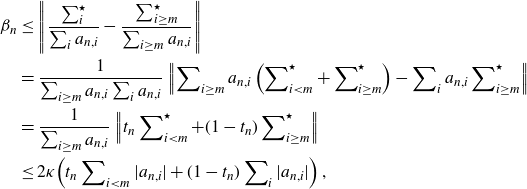 \begin{equation}\begin{split}\beta_n&\le \left\| \frac{\sum_i^\star}{\sum_i a_{n,i}}-\frac{\sum_{i\ge m}^\star}{\sum_{i\ge m} a_{n,i}}\right\|\\&=\frac{1}{\sum\nolimits_{i\ge m}a_{n,i}\sum\nolimits_{i}a_{n,i}}\left\| \sum\nolimits_{i\ge m}a_{n,i}\left(\sum\nolimits_{i< m}^\star+\sum\nolimits_{i\ge m}^\star \right)-\sum\nolimits_ia_{n,i}\sum\nolimits_{i\ge m}^\star\right\|\\&=\frac{1}{\sum\nolimits_{i\ge m}a_{n,i}}\left\| t_n\sum\nolimits_{i< m}^\star +(1-t_n)\sum\nolimits_{i\ge m}^\star\right\|\\&\le 2\kappa\!\left( t_n \sum\nolimits_{i<m} |a_{n,i}|+(1-t_n)\sum\nolimits_{i} |a_{n,i}|\right),\end{split}\end{equation}
where $\sum_{i \in I}^\star$
stands for
$\sum_{i \in I}^\star$
stands for $\sum_{i \in I}a_{n,i}{\boldsymbol{x}}_i$
. Note that the hypothesis that the entries of A are nonnegative has been used only in the first line of (6), so that
$\sum_{i \in I}a_{n,i}{\boldsymbol{x}}_i$
. Note that the hypothesis that the entries of A are nonnegative has been used only in the first line of (6), so that $\sum^\star_{i\ge m}/\sum_{i\ge m}a_{n,i} \in K_m$
. Since
$\sum^\star_{i\ge m}/\sum_{i\ge m}a_{n,i} \in K_m$
. Since $\lim_n \sum_{i<m}|a_{n,i}|=0$
,
$\lim_n \sum_{i<m}|a_{n,i}|=0$
, $\lim_n t_n=1$
, and
$\lim_n t_n=1$
, and $\sup_n \sum_i |a_{n,i}|<\infty$
by the regularity of A, it follows that all
$\sup_n \sum_i |a_{n,i}|<\infty$
by the regularity of A, it follows that all $\alpha_n, \beta_n, \gamma_n$
are smaller than
$\alpha_n, \beta_n, \gamma_n$
are smaller than ${\varepsilon}/{6}$
if n is sufficiently large. Therefore
${\varepsilon}/{6}$
if n is sufficiently large. Therefore $d(A_n{\boldsymbol{x}},K)\le \varepsilon$
and, since
$d(A_n{\boldsymbol{x}},K)\le \varepsilon$
and, since $\varepsilon$
is arbitrary, we conclude that
$\varepsilon$
is arbitrary, we conclude that ${\boldsymbol{\eta}}=\lim_n A_n{\boldsymbol{x}} \in K$
.
${\boldsymbol{\eta}}=\lim_n A_n{\boldsymbol{x}} \in K$
.
Lastly, suppose that A is a regular matrix such that $\lim_n \sum_i |a_{n,i}|=1$
and let
$\lim_n \sum_i |a_{n,i}|=1$
and let $B=(b_{n,i})$
be the nonnegative regular matrix defined by
$B=(b_{n,i})$
be the nonnegative regular matrix defined by $b_{n,i}=|a_{n,i}|$
for all
$b_{n,i}=|a_{n,i}|$
for all $n,i \in \textbf{N}$
. Considering that
$n,i \in \textbf{N}$
. Considering that
 \begin{equation*}d(A_n{\boldsymbol{x}}, K_m) \le \|A_n{\boldsymbol{x}}- B_n {\boldsymbol{x}}\|+d(B_n{\boldsymbol{x}}, K_m) \le \kappa \sum\nolimits_i |a_{n,i}-|a_{n,i}||+\varepsilon,\end{equation*}
and that $\lim_n\sum\nolimits_i |a_{n,i}-|a_{n,i}||= 0$
because
$\lim_n\sum\nolimits_i |a_{n,i}-|a_{n,i}||= 0$
because $\lim_n \sum_i a_{n,i}=\lim_n\sum_i |a_{n,i}|=1$
, we conclude that
$\lim_n \sum_i a_{n,i}=\lim_n\sum_i |a_{n,i}|=1$
, we conclude that $d(A_n{\boldsymbol{x}}, K_m) \le 2\varepsilon$
whenever n is sufficiently large. The claim follows as before.
$d(A_n{\boldsymbol{x}}, K_m) \le 2\varepsilon$
whenever n is sufficiently large. The claim follows as before.
The following corollary is immediate:
Corollary 4·4. Let ${\boldsymbol{x}}=({\boldsymbol{x}}_n)$
be a bounded sequence taking values in
${\boldsymbol{x}}=({\boldsymbol{x}}_n)$
be a bounded sequence taking values in $\mathbf{R}^k$
, and fix a nonnegative regular matrix A. Then inclusion (5) holds.
$\mathbf{R}^k$
, and fix a nonnegative regular matrix A. Then inclusion (5) holds.
Remark 4·5. Inclusion (5) fails for an arbitrary regular matrix: indeed, let $A=(a_{n,i})$
be the matrix defined by
$A=(a_{n,i})$
be the matrix defined by $a_{n,2n}=2$
,
$a_{n,2n}=2$
, $a_{n,2n-1}=-1$
for all
$a_{n,2n-1}=-1$
for all $n \in \textbf{N}$
, and
$n \in \textbf{N}$
, and $a_{n,i}=0$
otherwise. Set also
$a_{n,i}=0$
otherwise. Set also $k=1$
and let x be the sequence such that
$k=1$
and let x be the sequence such that $x_n=(\!-\!1)^n$
for all
$x_n=(\!-\!1)^n$
for all $n\in \textbf{N}$
. Then A is regular and
$n\in \textbf{N}$
. Then A is regular and $\lim Ax=3 \notin \{-1,1\}=\textrm{K}\text{-}\textrm{core}(x)$
.
$\lim Ax=3 \notin \{-1,1\}=\textrm{K}\text{-}\textrm{core}(x)$
.
Remark 4·6. Proposition 4·3 keeps holding on a (possibly infinite dimensional) Hilbert space X with the following provisoes: replace the definition of $\textrm{K}\text{-}\textrm{core}({\boldsymbol{x}})$
with the closure of
$\textrm{K}\text{-}\textrm{core}({\boldsymbol{x}})$
with the closure of $\textrm{co}\,\textrm{L}_{{\boldsymbol{x}}}$
(this coincides in the case that
$\textrm{co}\,\textrm{L}_{{\boldsymbol{x}}}$
(this coincides in the case that $X=\textbf{R}^k$
) and assume that the sequence
$X=\textbf{R}^k$
) and assume that the sequence ${\boldsymbol{x}}$
is contained in a compact set (so that
${\boldsymbol{x}}$
is contained in a compact set (so that $\textrm{K}\text{-}\textrm{core}({\boldsymbol{x}})$
is also nonempty).
$\textrm{K}\text{-}\textrm{core}({\boldsymbol{x}})$
is also nonempty).
With these premises, we can strenghten Theorem 4·2 as follows.
Theorem 4·7. The set $\{x \in (0,1]\;:\; \Gamma_b^k (x,\mathcal{I},A)=\Delta_{b}^k \text{ for all }b\ge 2, k\ge 1\}$
is comeager, provided that
$\{x \in (0,1]\;:\; \Gamma_b^k (x,\mathcal{I},A)=\Delta_{b}^k \text{ for all }b\ge 2, k\ge 1\}$
is comeager, provided that $\mathcal{I}$
is a meager ideal and A is a regular matrix such that
$\mathcal{I}$
is a meager ideal and A is a regular matrix such that $\lim_n\sum_i |a_{n,i}|=1$
.
$\lim_n\sum_i |a_{n,i}|=1$
.
Proof. Let us suppose that $A=(a_{n,i})$
is nonnegative regular matrix, i.e.,
$A=(a_{n,i})$
is nonnegative regular matrix, i.e., $a_{n,i}\ge 0$
for all
$a_{n,i}\ge 0$
for all $n,i \in \textbf{N}$
, and fix a meager ideal
$n,i \in \textbf{N}$
, and fix a meager ideal $\mathcal{I}$
, a real
$\mathcal{I}$
, a real $x \in (0,1]$
, and integers
$x \in (0,1]$
, and integers $b\ge 2$
,
$b\ge 2$
, $k\ge 1$
. Thanks to Theorem 4·2, it is sufficient to show that every accumulation point of the sequence
$k\ge 1$
. Thanks to Theorem 4·2, it is sufficient to show that every accumulation point of the sequence $(A_n{\boldsymbol{\pi}}_{b}^k(x)\;:\; n\ge 1)$
is contained in the convex hull of the set of accumulation points of
$(A_n{\boldsymbol{\pi}}_{b}^k(x)\;:\; n\ge 1)$
is contained in the convex hull of the set of accumulation points of $({\boldsymbol{\pi}}_{b,n}^k(x)\;:\; n\ge 1)$
, which is in turn contained into
$({\boldsymbol{\pi}}_{b,n}^k(x)\;:\; n\ge 1)$
, which is in turn contained into $\Delta_b^k$
. This follows by Proposition 4·3.
$\Delta_b^k$
. This follows by Proposition 4·3.
Since the family of meager sets is a $\sigma$
-ideal, the following is immediate by Theorem 4·7.
$\sigma$
-ideal, the following is immediate by Theorem 4·7.
Corollary 4·8. Let $\mathscr{A}$
be a countable family of regular matrices such that
$\mathscr{A}$
be a countable family of regular matrices such that $\lim_n\sum_i |a_{n,i}|=1$
. Then the set
$\lim_n\sum_i |a_{n,i}|=1$
. Then the set $\{x \in (0,1]\;:\; \Gamma_b^k (x,\mathcal{I},A)=\Delta_{b}^k \text{ for all }b\ge 2, k\ge 1, \text{ and all }A \in \mathscr{A}\,\}$
is comeager, provided that
$\{x \in (0,1]\;:\; \Gamma_b^k (x,\mathcal{I},A)=\Delta_{b}^k \text{ for all }b\ge 2, k\ge 1, \text{ and all }A \in \mathscr{A}\,\}$
is comeager, provided that $\mathcal{I}$
is a meager ideal.
$\mathcal{I}$
is a meager ideal.
It is worth to remark that the main result [
Reference Hyde, Laschos, Olsen, Petrykiewicz and Shaw15
] is obtained as an instance of Corollary 4·8, letting $\mathscr{A}$
be the set of iterates of the Cesàro matrix (note that they are nonnegative regular matrices), and setting
$\mathscr{A}$
be the set of iterates of the Cesàro matrix (note that they are nonnegative regular matrices), and setting $k=1$
and
$k=1$
and $\mathcal{I}=\textrm{Fin}$
. The same holds for the iterates of the Hölder matrix and the logarithmic Riesz matrix as in [
Reference Olsen and West24
, sections 3 and 4].
$\mathcal{I}=\textrm{Fin}$
. The same holds for the iterates of the Hölder matrix and the logarithmic Riesz matrix as in [
Reference Olsen and West24
, sections 3 and 4].
Next, we show that the hypothesis $\lim_n \sum_i |a_{n,i}|=1$
for the entries of the regular matrix in Theorem 4·7 cannot be removed.
$\lim_n \sum_i |a_{n,i}|=1$
for the entries of the regular matrix in Theorem 4·7 cannot be removed.
Example 4·9. Let $A=(a_{n,i})$
be the matrix such that
$A=(a_{n,i})$
be the matrix such that $a_{n,(2n-1)!}=-1$
and
$a_{n,(2n-1)!}=-1$
and $a_{n,(2n)!}=2$
for all
$a_{n,(2n)!}=2$
for all $n \in \textbf{N}$
, and
$n \in \textbf{N}$
, and $a_{n,i}=0$
otherwise. It is easily seen that A is regular. Then, set
$a_{n,i}=0$
otherwise. It is easily seen that A is regular. Then, set $b=2$
,
$b=2$
, $k=1$
, and
$k=1$
, and $\mathcal{I}=\textrm{Fin}$
. We claim that the set of all
$\mathcal{I}=\textrm{Fin}$
. We claim that the set of all $x \in (0,1]$
such that 2 is an accumulation point of the sequence
$x \in (0,1]$
such that 2 is an accumulation point of the sequence $\pi_{2,1}(x)=(\pi_{2,1,n}(x)\;:\; n\ge 1)$
is comeager. Indeed, its complement can be rewritten as
$\pi_{2,1}(x)=(\pi_{2,1,n}(x)\;:\; n\ge 1)$
is comeager. Indeed, its complement can be rewritten as $\bigcup_{m,p}S_{m,p}$
, where
$\bigcup_{m,p}S_{m,p}$
, where
 \begin{equation*}S_{m,p} \;:\!=\; \{x \in (0,1]\;:\; |A_n\pi_{2,1}(x)-2|\ge \; {1}/{m} \text{ for all }n\ge p\}.\end{equation*}
Let $x^\star\in (0,1]$
such that
$x^\star\in (0,1]$
such that $d_{2,n}(x^\star)=1$
if and only if
$d_{2,n}(x^\star)=1$
if and only if $(2i-1)!\le n<(2i)!$
for some
$(2i-1)!\le n<(2i)!$
for some $i \in \textbf{N}$
. Then it is easily seen that
$i \in \textbf{N}$
. Then it is easily seen that $\lim_n \pi_{2,1,n}(x^\star)=2$
. Along the same lines of the proof of Theorem 4·2, it follows that each
$\lim_n \pi_{2,1,n}(x^\star)=2$
. Along the same lines of the proof of Theorem 4·2, it follows that each $S_{m,p}$
is meager. We conclude that
$S_{m,p}$
is meager. We conclude that $\{x \in (0,1]\;:\; \Gamma_2^1 (x,\textrm{Fin},A)=\Delta_{2}^1\}$
is meager, which proves that the condition
$\{x \in (0,1]\;:\; \Gamma_2^1 (x,\textrm{Fin},A)=\Delta_{2}^1\}$
is meager, which proves that the condition $\lim_n \sum_i |a_{n,i}|=1$
in the statement of Theorem 4·7 cannot be removed.
$\lim_n \sum_i |a_{n,i}|=1$
in the statement of Theorem 4·7 cannot be removed.
In addition, the main result in [
Reference Stylianou27
] states that Theorem 4·2, specialised to the case $\mathcal{I}=\textrm{Fin}$
and
$\mathcal{I}=\textrm{Fin}$
and $k=1$
, can be further strengtened so that the set
$k=1$
, can be further strengtened so that the set
 $$\{ x \in (0,1]\;:\;\Gamma _b^1(x,{\rm{Fin}},A) \supseteq \Delta _b^1$$
for all
$$\{ x \in (0,1]\;:\;\Gamma _b^1(x,{\rm{Fin}},A) \supseteq \Delta _b^1$$
for all
 $$b \ge 2$$
and all regular A} is comeager. Taking into account the argument in the proof of Theorem 4·7, this would imply that the set
$$b \ge 2$$
and all regular A} is comeager. Taking into account the argument in the proof of Theorem 4·7, this would imply that the set
 \begin{equation}\{x \in (0,1]\;:\; \Gamma_b^1 (x,\textrm{Fin},A)= \Delta_{b}^1 \text{ for all }b\ge 2 \text{ and all nonnegative regular } A\}\end{equation}
should be comeager. However, this is false as it is shown in the next example.
Example 4·10. For each $y \in (0,1]$
, let
$y \in (0,1]$
, let $(e_{y,k}\;:\; k\ge 1)$
be the increasing enumeration of the infinite set
$(e_{y,k}\;:\; k\ge 1)$
be the increasing enumeration of the infinite set $\{n \in \textbf{N}\;:\; d_{2,n}(y)=1\}$
. Then, let
$\{n \in \textbf{N}\;:\; d_{2,n}(y)=1\}$
. Then, let $\mathscr{A}=\{A_y\;:\; y \in (0,1]\}$
be family of matrices
$\mathscr{A}=\{A_y\;:\; y \in (0,1]\}$
be family of matrices $A_y=\left(a^{(y)}_{n,i}\right)$
with entries in
$A_y=\left(a^{(y)}_{n,i}\right)$
with entries in $\{0,1\}$
so that
$\{0,1\}$
so that $a^{(y)}_{n,i}=1$
if and only if
$a^{(y)}_{n,i}=1$
if and only if $e_{y,n}=i$
for all
$e_{y,n}=i$
for all $y \in (0,1]$
and all
$y \in (0,1]$
and all $n,i \in \textbf{N}$
. Then each
$n,i \in \textbf{N}$
. Then each $A_y$
is a nonnegative regular matrix. It follows, for each ideal
$A_y$
is a nonnegative regular matrix. It follows, for each ideal $\mathcal{I}$
,
$\mathcal{I}$
,
 \begin{equation*}\{x \in (0,1]\;:\; \Gamma_2^1 (x,\mathcal{I},A)=\Delta_{2}^1\text{ for all }A \in \mathscr{A} \}=\emptyset.\end{equation*}
Indeed, for each $x \in (0,1]$
, the sequence
$x \in (0,1]$
, the sequence ${\boldsymbol{\pi}}_2^1(x)=({\boldsymbol{\pi}}_{2,n}^1(x)\;:\;n\ge 1)$
has an accumulation point
${\boldsymbol{\pi}}_2^1(x)=({\boldsymbol{\pi}}_{2,n}^1(x)\;:\;n\ge 1)$
has an accumulation point ${\boldsymbol{\eta}} \in \Delta_2^1$
. Hence there exists a subsequence
${\boldsymbol{\eta}} \in \Delta_2^1$
. Hence there exists a subsequence $({\boldsymbol{\pi}}_{2,n_k}^1(x)\;:\;k\ge 1)$
which is convergent to
$({\boldsymbol{\pi}}_{2,n_k}^1(x)\;:\;k\ge 1)$
which is convergent to ${\boldsymbol{\eta}}$
. Equivalently,
${\boldsymbol{\eta}}$
. Equivalently, $\lim A_y{\boldsymbol{\pi}}_2^1(x)={\boldsymbol{\eta}}$
, where
$\lim A_y{\boldsymbol{\pi}}_2^1(x)={\boldsymbol{\eta}}$
, where $y\in (0,1]$
is defined such that
$y\in (0,1]$
is defined such that $e_{y,k}=n_k$
for all
$e_{y,k}=n_k$
for all $k \in \textbf{N}$
. Therefore
$k \in \textbf{N}$
. Therefore $\{{\boldsymbol{\eta}}\}=\Gamma_2^1 (x,\mathcal{I},A_y)\neq \Delta_{2}^1$
. in particular, the set defined in (7) is empty.
$\{{\boldsymbol{\eta}}\}=\Gamma_2^1 (x,\mathcal{I},A_y)\neq \Delta_{2}^1$
. in particular, the set defined in (7) is empty.
Lastly, the analogues of Theorem 4·2 and Theorem 4·7 hold for $\mathcal{I}$
-limit points, if
$\mathcal{I}$
-limit points, if $\mathcal{I}$
is an
$\mathcal{I}$
is an $F_\sigma$
-ideal or an analytic P-ideal. Indeed, denoting with
$F_\sigma$
-ideal or an analytic P-ideal. Indeed, denoting with $\Lambda_b^k(x,\mathcal{I},A)$
the set of
$\Lambda_b^k(x,\mathcal{I},A)$
the set of $\mathcal{I}$
-limit points of the sequence
$\mathcal{I}$
-limit points of the sequence $(A_n{\boldsymbol{\pi}}_b^k(x)\;:\; n\ge 1)$
, we obtain:
$(A_n{\boldsymbol{\pi}}_b^k(x)\;:\; n\ge 1)$
, we obtain:
Theorem 4·11. Let A be a regular matrix and let $\mathcal{I}$
be an
$\mathcal{I}$
be an $F_\sigma$
-ideal or an analytic P-ideal. Then the set
$F_\sigma$
-ideal or an analytic P-ideal. Then the set $\{x \in (0,1]\;:\; \Lambda_b^k (x,\mathcal{I},A)\supseteq \Delta_{b}^k \text{ for all }b\ge 2, k\ge 1\}$
is comeager.
$\{x \in (0,1]\;:\; \Lambda_b^k (x,\mathcal{I},A)\supseteq \Delta_{b}^k \text{ for all }b\ge 2, k\ge 1\}$
is comeager.
Moreover, the set $\{x \in (0,1]\;:\; \Lambda_b^k (x,\mathcal{I},A)=\Delta_{b}^k \text{ for all }b\ge 2, k\ge 1\}$
is comeager if, in addition, A satisfies
$\{x \in (0,1]\;:\; \Lambda_b^k (x,\mathcal{I},A)=\Delta_{b}^k \text{ for all }b\ge 2, k\ge 1\}$
is comeager if, in addition, A satisfies $\lim_n\sum_i |a_{n,i}|=1$
.
$\lim_n\sum_i |a_{n,i}|=1$
.
Proof. The first part goes along the same lines of the proof of Theorem 2·3. Here, we replace ${\boldsymbol{\pi}}_b^k(x)$
with
${\boldsymbol{\pi}}_b^k(x)$
with $(A_n{\boldsymbol{\pi}}_b^k(x)\;:\; n\ge 1)$
and using the chain of inequalities (4): more precisely, we consider
$(A_n{\boldsymbol{\pi}}_b^k(x)\;:\; n\ge 1)$
and using the chain of inequalities (4): more precisely, we consider $j^{\prime\prime}\in \textbf{N}$
such that
$j^{\prime\prime}\in \textbf{N}$
such that $\varphi(\{n \in [j^\prime, j^{\prime\prime}]\;:\; \|A_n {\boldsymbol{\pi}}^k_b(x^\prime)-{\boldsymbol{\eta}}\|\le \; {1}/{2t}\})\ge \; {1}/{2},$
and, taking into considering (4), we define
$\varphi(\{n \in [j^\prime, j^{\prime\prime}]\;:\; \|A_n {\boldsymbol{\pi}}^k_b(x^\prime)-{\boldsymbol{\eta}}\|\le \; {1}/{2t}\})\ge \; {1}/{2},$
and, taking into considering (4), we define $V \;:\!=\; \{x \in (0,1]\;:\; d_{b,i}(x)=d_{b,i}(x^\star) \text{ for all }i=1,\ldots,k+j^{\prime\prime\prime}\}$
, where
$V \;:\!=\; \{x \in (0,1]\;:\; d_{b,i}(x)=d_{b,i}(x^\star) \text{ for all }i=1,\ldots,k+j^{\prime\prime\prime}\}$
, where $j^{\prime\prime\prime}$
is a sufficiently large integer such that
$j^{\prime\prime\prime}$
is a sufficiently large integer such that $\sum_{i>j^{\prime\prime\prime}}|a_{n,i}|\le \; {1}/{2t}$
for all
$\sum_{i>j^{\prime\prime\prime}}|a_{n,i}|\le \; {1}/{2t}$
for all $n \in [j^\prime, j^{\prime\prime}]$
.
$n \in [j^\prime, j^{\prime\prime}]$
.
The second part follows, as in Theorem 4·7, by the fact that every accumulation point of $(A_n{\boldsymbol{\pi}}_b^k(x)\;:\; n\ge 1)$
belongs to
$(A_n{\boldsymbol{\pi}}_b^k(x)\;:\; n\ge 1)$
belongs to $\Delta_b^k$
.
$\Delta_b^k$
.
Acknowledgments
P. Leonetti is grateful to PRIN 2017 (grant 2017CY2NCA) for financial support.


 Open access

