

Introduction
In the 1920s, growing public interest in Pennsylvania's past led state archaeologist Donald Cadzow to initiate archaeological investigations throughout the state. Cadzow's nascent efforts at the beginning of the 1930s proved premature. As with other parts of the USA, archaeological investigations were curtailed because of persistent economic problems associated with the Great Depression. Archaeology in Pennsylvania — and across the USA — was transformed following the inauguration of Franklin Delano Roosevelt (FDR) in 1933.
'Alphabet Soup' and American archaeology during the Great Depression
FDR initiated a series of job programmes referred to as 'Alphabet Soup' because they were commonly referred to by their acronyms. Among key elements of these job programmes were the provisions that they could not compete with private businesses and that most funds needed to be spent on labour. A pilot programme under the Federal Emergency Relief Administration (FERA) at Louisiana's Marksville Mounds proved that archaeology could successfully employ large numbers of workers and recover important information about the past (Reference LyonReference LyonLyon 1996).
The early days of New Deal excavations in Somerset County
These FERA excavations did not go unnoticed in Pennsylvania. Cadzow was soon charged with obtaining work relief funds to excavate 'key' areas, including Somerset County. Somerset County was selected partly because the American Indian history of this region was poorly known, but largely because prominent citizen Flora Black lived in the county. Using funds from the Civil Works Administration (CWA), Black interviewed farmers about possible archaeological sites they had encountered in their fields (Reference MeansReference MeansMeans 1998, Reference Means2000a & Reference Meansb).
The WPA years
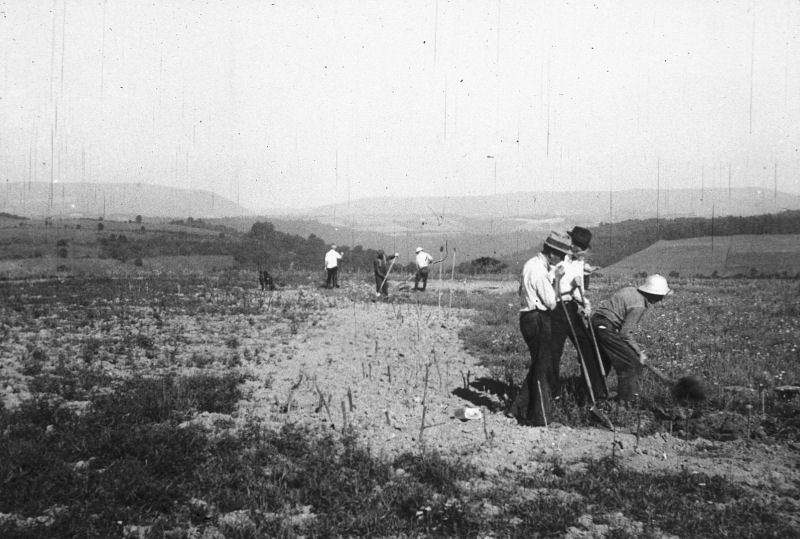
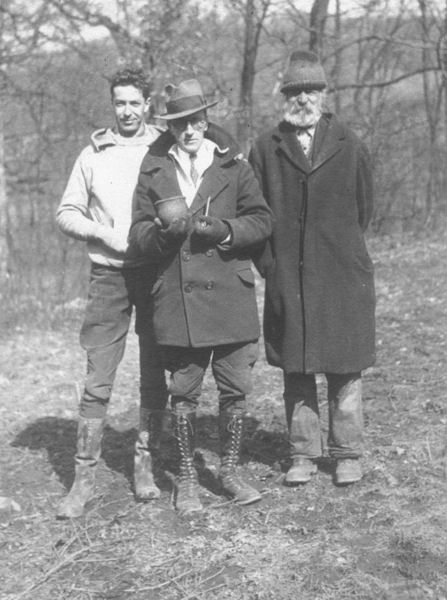
The majority of the New Deal excavations in Somerset County — and across the USA — were conducted under the Works Progress Administration (WPA) (Figure 1). WPA monies were directed toward local governments and organisations, often leading to political interference in all projects. Political issues would directly and indirectly affect Edgar E. Augustine, the man selected to direct the WPA excavations in Somerset County from 1935 to 1940 (Figure 2).
WPA excavations at Fort Hill, an American Indian village site (photograph: The State Museum of Pennsylvania).

'The oldest, the youngest, and the poorest' — Edgar Augustine stands in the centre of the image, with 79- or 80-year-old Marshall Turney on his left and an unknown individual on his right (photograph: The State Museum of Pennsylvania).

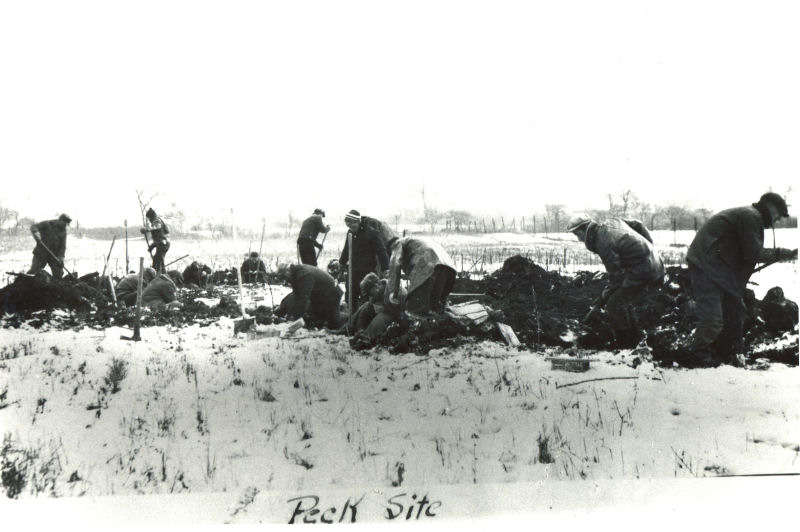
Augustine was not a formally trained archaeologist. It is unclear why he was selected to direct the WPA excavations in Somerset County, or what training he had received before he became a New Deal archaeologist. Ongoing research will hopefully address these questions. As a WPA archaeologist, Augustine regularly fought political opposition to maintain control over his excavations. While always keeping in mind that he needed to keep a group of men employed — these were work-relief excavations, after all — Augustine ensured that his field projects were systematically conducted. His meticulously kept records are available to researchers today (Figure 3).
WPA excavations at Peck 1, an American Indian village site. On occasion, WPA crews worked in extreme weather conditions because the failure to work could have led to premature termination of the project (photograph: The State Museum of Pennsylvania).

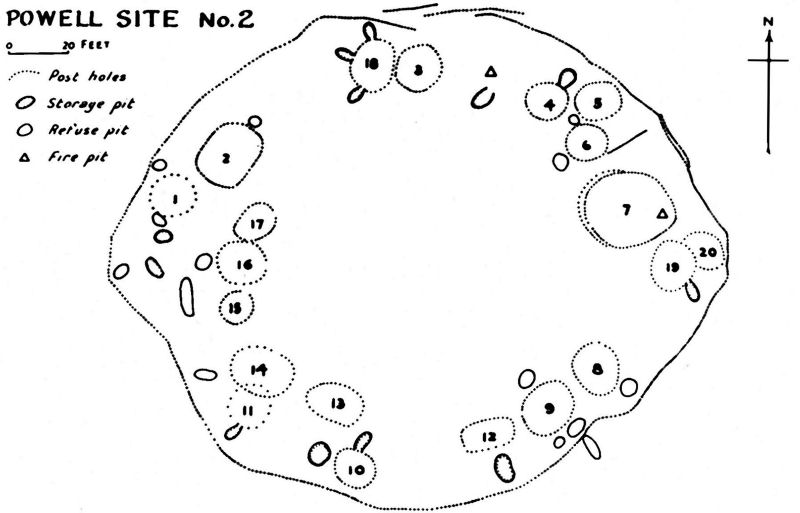
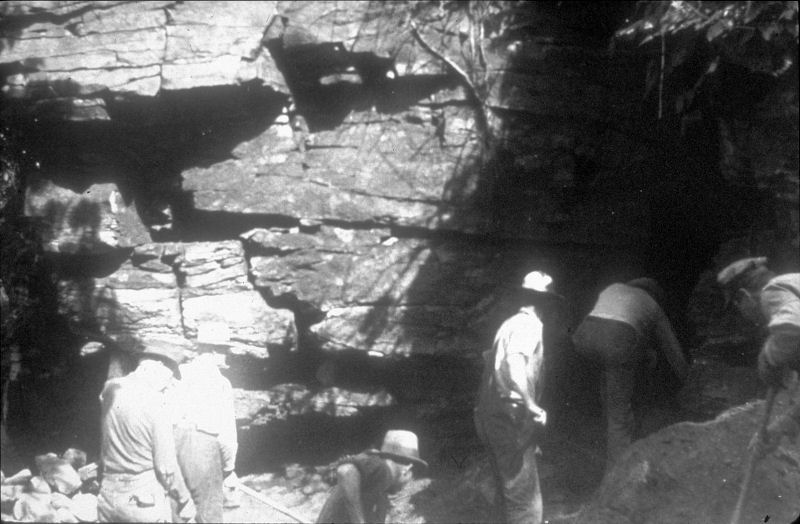
Most of the WPA excavations in Somerset County were directed at American Indian village sites (Figure 4). Village sites took considerable time and effort to excavate, and thus would occupy a work-relief crew over an extended period. If this was not the case, work-relief funds would have been withdrawn. A dozen American Indian village sites were excavated in just six years, representing at least 16 different occupations. Rockshelters were also investigated, as were small hills that prominent local citizens insisted represented burial mounds — they did not (Reference MeansReference MeansMeans 1998, Reference Means2000b & Reference Meansc) (Figure 5).
Schematic map of Powell 2, an American Indian village site (photograph: The State Museum of Pennsylvania).

Excavations at the Martz Rock Shelter in 1938 (photograph: The State Museum of Pennsylvania).

The legacy
Augustine's carefully documented excavations ensured that his findings would not be confined to the dustbins of history. Because Augustine's WPA crews completely or nearly completely excavated a dozen village sites — a feat rarely duplicated today — his field efforts have proven critical to understanding American Indian community dynamics in the region. These records demonstrate that community layouts were restructured at two separate village sites to maintain adherence to cosmological models used to plan these settlements. The careful documentation of field finds has also facilitated the dating of organic remains from these village sites through accelerator mass spectrometry, leading to a complete revision of existing regional chronological frameworks. Most village sites were shown to have dated after AD 1250, which contradicted previous notions that this region had been abandoned at this time (Reference MeansMeans 2005, Reference Means2007). Scholars have barely touched the wealth of data generated by the New Deal excavations in Somerset County and research is ongoing into the findings of work-relief archaeologists, as well as into the historical aspects of these efforts.