





1 Introduction
Let $X^{n+1}$
be the interior of a compact
$X^{n+1}$
be the interior of a compact $(n+1)$
-dimensional manifold
$(n+1)$
-dimensional manifold $\overline {X}$
with non-empty boundary
$\overline {X}$
with non-empty boundary $M = \partial X$
. A Riemannian metric
$M = \partial X$
. A Riemannian metric $g_{+}$
defined in X is called conformally compact if there is a defining function
$g_{+}$
defined in X is called conformally compact if there is a defining function $\rho $
for the boundary (i.e.,
$\rho $
for the boundary (i.e., $\rho> 0$
in X,
$\rho> 0$
in X, $M = \{ \rho = 0 \}$
, and
$M = \{ \rho = 0 \}$
, and $d\rho \neq 0$
on M) such that
$d\rho \neq 0$
on M) such that $\bar {g} = \rho ^2 \bar {g}$
defines a Riemannian metric (of some degree of regularity) on
$\bar {g} = \rho ^2 \bar {g}$
defines a Riemannian metric (of some degree of regularity) on $\overline {X}$
. Since defining functions are obviously not unique, a conformally compact metric
$\overline {X}$
. Since defining functions are obviously not unique, a conformally compact metric $g_{+}$
determines a conformal class of metrics on the boundary called the conformal infinity of
$g_{+}$
determines a conformal class of metrics on the boundary called the conformal infinity of $(X,g_{+})$
.
$(X,g_{+})$
.
If $g_{+}$
satisfies the Einstein condition
$g_{+}$
satisfies the Einstein condition
 $$ \begin{align} Ric(g_{+}) = - n g_{+}, \end{align} $$
then $g_{+}$
is called a Poincaré-Einstein metric. The model of Poincaré-Einstein metrics is the Poincaré model of hyperbolic space on the unit ball
$g_{+}$
is called a Poincaré-Einstein metric. The model of Poincaré-Einstein metrics is the Poincaré model of hyperbolic space on the unit ball $B^{n+1} = \{ x \in \mathbb {R}^{n+1} \, : \, |x| < 1 \}$
, where
$B^{n+1} = \{ x \in \mathbb {R}^{n+1} \, : \, |x| < 1 \}$
, where
 $$ \begin{align} g_H = \frac{4}{(1-|x|^2)^2} ds^2 \end{align} $$
and $ds^2$
is the Euclidean metric.
$ds^2$
is the Euclidean metric.
In this article we restrict our attention to $n = 3$
and consider two special, but important, classes of Poincaré-Einstein manifolds. In each case, we establish gap and rigidity theorems.
$n = 3$
and consider two special, but important, classes of Poincaré-Einstein manifolds. In each case, we establish gap and rigidity theorems.
We will extensively use the expansions of Poincaré-Einstein metrics at the boundary, the so-called Fefferman-Graham expansions. These expansions are guaranteed to exist to infinite order so long as $\bar {g}$
has at least
$\bar {g}$
has at least $C^2$
regularity up to the boundary; see [Reference Chruśchiel, Delay, Lee and Skinner10, Reference Anderson1]. Although it is known that Einstein metrics exist not satisfying either the hypothesis or the conclusion of this result ([Reference Bahuaud and Lee3]), we will assume as a matter of definition that all Poincaré-Einstein metrics have at least a
$C^2$
regularity up to the boundary; see [Reference Chruśchiel, Delay, Lee and Skinner10, Reference Anderson1]. Although it is known that Einstein metrics exist not satisfying either the hypothesis or the conclusion of this result ([Reference Bahuaud and Lee3]), we will assume as a matter of definition that all Poincaré-Einstein metrics have at least a $C^2$
compactification.
$C^2$
compactification.
1.1 Self-Dual Poincaré-Einstein metrics
Suppose $X = X^4$
is four-dimensional and oriented. If g is any Riemannian metric on X, then under the action of the Hodge-
$X = X^4$
is four-dimensional and oriented. If g is any Riemannian metric on X, then under the action of the Hodge- $\ast $
operator the bundle of two-forms splits into two rank-three sub-bundles of self-dual and anti-self dual two-forms
$\ast $
operator the bundle of two-forms splits into two rank-three sub-bundles of self-dual and anti-self dual two-forms
 $$ \begin{align} \Lambda^2(X) = \Lambda^2_{+}(X) \oplus \Lambda^2_{-}(X), \end{align} $$
corresponding to the $+1$
and
$+1$
and $-1$
eigenspaces of
$-1$
eigenspaces of $\ast $
. The Weyl curvature tensor of g, viewed as a linear map
$\ast $
. The Weyl curvature tensor of g, viewed as a linear map $W_g : \Lambda ^2(X) \rightarrow \Lambda ^2(X)$
, preserves the splitting (1.3). As a consequence, there are well defined bundle maps
$W_g : \Lambda ^2(X) \rightarrow \Lambda ^2(X)$
, preserves the splitting (1.3). As a consequence, there are well defined bundle maps $W_g^{\pm } : \Lambda ^2_{\pm }(X) \rightarrow \Lambda ^2_{\pm }(X)$
. We say that g is self-dual if
$W_g^{\pm } : \Lambda ^2_{\pm }(X) \rightarrow \Lambda ^2_{\pm }(X)$
. We say that g is self-dual if $W^{-} \equiv 0$
.
$W^{-} \equiv 0$
.
Examples of self-dual Poincaré-Einstein metrics (henceforth SDPE metrics) include, of course, the hyperbolic metric on the unit ball. Pedersen [Reference Pedersen22] gave an explicit family of $SU(2)$
-invariant self-dual Poincaré-Einstein metrics on
$SU(2)$
-invariant self-dual Poincaré-Einstein metrics on $B^4$
which we will discuss in more detail below (see also [Reference Matsumoto23]). More generally, given any
$B^4$
which we will discuss in more detail below (see also [Reference Matsumoto23]). More generally, given any $SU(2)$
-invariant conformal class
$SU(2)$
-invariant conformal class $[g]$
on
$[g]$
on $S^3$
, Hitchin [Reference Hitchin19] proved the existence of a SDPE metric
$S^3$
, Hitchin [Reference Hitchin19] proved the existence of a SDPE metric $g_{+}$
in
$g_{+}$
in $B^4$
whose conformal infinity is
$B^4$
whose conformal infinity is $[g]$
. The frequency conjecture of LeBrun [Reference LeBrun20], subsequently resolved by Biquard [Reference Biquard4], gives conditions under which a metric near the round metric on
$[g]$
. The frequency conjecture of LeBrun [Reference LeBrun20], subsequently resolved by Biquard [Reference Biquard4], gives conditions under which a metric near the round metric on $S^3$
is the conformal infinity of a SDPE metric.
$S^3$
is the conformal infinity of a SDPE metric.
LeBrun [Reference LeBrun21] showed that locally, the existence of self-dual Poincaré-Einstein metrics is unobstructed when the boundary metric is real analytic. More precisely, if $M^3$
is real analytic and g is a real analytic metric on
$M^3$
is real analytic and g is a real analytic metric on $M^3$
, then there is an
$M^3$
, then there is an $\epsilon> 0$
and a SDPE metric
$\epsilon> 0$
and a SDPE metric $g_{+}$
defined on
$g_{+}$
defined on $X = M^3 \times (0,\epsilon )$
whose conformal infinity is given by
$X = M^3 \times (0,\epsilon )$
whose conformal infinity is given by $(M^3,[g])$
. Subsequently, Fefferman-Graham ([Reference Fefferman and Graham13], Chapter 5) gave a different proof of this fact.
$(M^3,[g])$
. Subsequently, Fefferman-Graham ([Reference Fefferman and Graham13], Chapter 5) gave a different proof of this fact.
There is, however, a global obstruction to the existence of SDPE metrics with given conformal boundary, which follows from the Atiyah-Patodi-Singer index theorem:
 $$ \begin{align} \int_X \left( |W^{+}_{g_{+}}|^2 - |W^{-}_{g_{+}}|^2 \right) \, dv_{g_{+}} = 12 \pi^2 \left( \tau(X) - \eta(M,[g]) \right), \end{align} $$
where $\tau (X)$
is the signature of X and
$\tau (X)$
is the signature of X and $\eta (M,[g])$
is the eta-invariant of the boundary. (Here and throughout the paper, the operator norm of the Weyl tensor is used; i.e.,
$\eta (M,[g])$
is the eta-invariant of the boundary. (Here and throughout the paper, the operator norm of the Weyl tensor is used; i.e., $|W^{\pm }|^2 = \frac {1}{4} W^{\pm }_{ijk\ell } \left (W^{\pm }\right )^{ijk\ell }$
). If
$|W^{\pm }|^2 = \frac {1}{4} W^{\pm }_{ijk\ell } \left (W^{\pm }\right )^{ijk\ell }$
). If $g_{+}$
is SDPE, then (1.4) implies
$g_{+}$
is SDPE, then (1.4) implies
 $$ \begin{align} \int_X |W^{+}_{g_{+}}|^2 \, dv_{g_{+}} = 12 \pi^2 \left( \tau(X) - \eta(M,[g]) \right). \end{align} $$
In particular,
 $$ \begin{align} \tau(X) \geq \eta(M,[g]), \end{align} $$
with equality if and only if $(X,g_{+})$
is hyperbolic. We will refer to this inequality as the signature obstruction.
$(X,g_{+})$
is hyperbolic. We will refer to this inequality as the signature obstruction.
One of our main results gives a new obstruction to the existence of self-dual Poincaré-Einstein metrics in terms of topological invariants of the bulk and conformal invariants of the boundary (see Theorem 1.2 below). One such invariant is the well-known Yamabe invariant; the other invariant is ‘local’ (i.e., can be expressed in terms of the curvature and its derivatives). To describe this invariant we need to introduce some additional notation.
Let $(M^3, g)$
be a closed, three-dimensional Riemannian manifold. Let P denote the Schouten tensor of g, and
$(M^3, g)$
be a closed, three-dimensional Riemannian manifold. Let P denote the Schouten tensor of g, and
 $$ \begin{align*} C_{ijk} = \nabla_k P_{ij} - \nabla_j P_{ik} \end{align*} $$
the Cotton tensor. We can equivalently view C as a symmetric two-tensor by defining
 $$ \begin{align*} \mathcal{C}_{ij} &= \mu_i^{\ k\ell} C_{j k \ell}, \end{align*} $$
where $\mu $
is the volume form. It is well known that C is a conformal invariant; hence
$\mu $
is the volume form. It is well known that C is a conformal invariant; hence $\mathcal {C}$
is:
$\mathcal {C}$
is:
 $$ \begin{align*} \widetilde{g} = e^{2w}g \ \Rightarrow \ \mathcal{C}_{\widetilde{g}} = e^{-4w} \mathcal{C}_g. \end{align*} $$
It is also well known that in dimension three, non-vanishing of the Cotton tensor is the obstruction to a metric being locally conformally flat.
One can construct other (non-obvious) conformal invariants from the Cotton tensor, and two such invariants will play a key role in our work on SDPE metrics:
Theorem 1.1. Let $(M,g)$
be a three-dimensional Riemannian manifold. Let
$(M,g)$
be a three-dimensional Riemannian manifold. Let $C = C_g$
denote the Cotton tensor, and
$C = C_g$
denote the Cotton tensor, and $\mu = \mu _g$
the volume form with respect to g. Also, define the symmetric two-tensors
$\mu = \mu _g$
the volume form with respect to g. Also, define the symmetric two-tensors
 $$ \begin{align*} B_{ij} &= \nabla^k C_{ijk}, \\ \mathcal{C}_{ij} &= \mu_i^{\ k\ell} C_{j k \ell}, \end{align*} $$
where $\mu $
is the volume form of
$\mu $
is the volume form of $(M,g)$
. Then
$(M,g)$
. Then $\langle B, \mathcal {C} \rangle _g$
and
$\langle B, \mathcal {C} \rangle _g$
and $|\mathcal {C}|_g^2$
are pointwise conformal invariants: if
$|\mathcal {C}|_g^2$
are pointwise conformal invariants: if $\widetilde {g} = e^{2w_0} g$
,
$\widetilde {g} = e^{2w_0} g$
,
 $$ \begin{align} \begin{aligned} \langle \widetilde{B}, \widetilde{\mathcal{C}} \rangle_{\widetilde{g}} &= e^{-7w_0} \langle B, \mathcal{C} \rangle_g, \\ |\widetilde{\mathcal{C}}|^2_{\widetilde{g}} &= e^{-6w_0} |\mathcal{C}|^2_g. \end{aligned} \end{align} $$
Consequently, when it converges
 $$ \begin{align} I(M^3,[g]) = \int_M \dfrac{ \langle B, \mathcal{C} \rangle }{|\mathcal{C}|^{4/3}} \, dv_g \end{align} $$
is an integral conformal invariant.
The conformal invariance of $\langle B, \mathcal {C}\rangle $
does not seem to be known to experts, and its construction may be of independent interest. We also remark that B is the three-dimensional version of the Bach tensor.
$\langle B, \mathcal {C}\rangle $
does not seem to be known to experts, and its construction may be of independent interest. We also remark that B is the three-dimensional version of the Bach tensor.
Since the integral in (1.8) may not converge, in general we define
 $$ \begin{align} I_0(M^3, [g]) := \limsup_{\epsilon \to 0} \int_M \dfrac{ \langle B, \mathcal{C} \rangle }{\left( \epsilon + |\mathcal{C}|^2\right)^{2/3}} \, dv_g \in [-\infty,\infty]. \end{align} $$
For example, when $(M^3,g)$
is locally conformally flat (hence
$(M^3,g)$
is locally conformally flat (hence $\mathcal {C} = 0$
),
$\mathcal {C} = 0$
), $I_0(M^3,[g]) = 0$
.
$I_0(M^3,[g]) = 0$
.
Our next result shows that when the invariant $I_0$
and the Yamabe invariant of the conformal infinity of a SDPE metric are both positive, then the signature obstruction can be sharpened:
$I_0$
and the Yamabe invariant of the conformal infinity of a SDPE metric are both positive, then the signature obstruction can be sharpened:
Theorem 1.2. Let $(X^4,g_{+})$
be an oriented, self-dual, four-dimensional Poincaré-Einstein manifold. Let
$(X^4,g_{+})$
be an oriented, self-dual, four-dimensional Poincaré-Einstein manifold. Let $M^3 = \partial X^4$
, and
$M^3 = \partial X^4$
, and $(M^3,[g])$
denote the conformal infinity of
$(M^3,[g])$
denote the conformal infinity of $(X^4,g_{+})$
. Assume
$(X^4,g_{+})$
. Assume
-
(i) $I_0(M^3,[g]) \geq 0$
,
$I_0(M^3,[g]) \geq 0$
, -
(ii)
$Y(M^3, [g])> 0$
.


Then either $g_{+}$
is hyperbolic, or
$g_{+}$
is hyperbolic, or
 $$ \begin{align} \tau(X^4) \geq \eta \left(M^3, [g]\right) + \frac{1}{3} \chi(X^4). \end{align} $$
Specializing to the ball, we have
Corollary 1.3. Let $g_{+}$
be a self-dual, four-dimensional Poincaré-Einstein metric on
$g_{+}$
be a self-dual, four-dimensional Poincaré-Einstein metric on $B^4$
with conformal infinity
$B^4$
with conformal infinity $(S^3,[g])$
. Assume
$(S^3,[g])$
. Assume
-
(i)
$I_0(S^3,[g]) \geq 0$
, -
(ii)
$Y(S^3, [g])> 0$
.

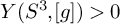
Then either $g_{+}$
is hyperbolic, or
$g_{+}$
is hyperbolic, or
 $$ \begin{align} \eta \left(S^3, [g]\right) \leq -\frac{1}{3}. \end{align} $$
Interestingly, Theorem 1.2 also gives obstructions to the existence of self-dual Poincaré-Einstein fillings:
Corollary 1.4. Let $(M^3,[g])$
be a conformal three-manifold satisfying
$(M^3,[g])$
be a conformal three-manifold satisfying
-
(i)
$I_0(M^3,[g]) \geq 0$
, -
(ii)
$Y(M^3, [g])> 0$
.


Then there are infinitely many smooth, non-diffeomorphic manifolds $Y^4$
with the following properties:
$Y^4$
with the following properties:
-
•
$\partial Y^4 = M^3$
, -
•
$Y^4$
and
$(M^3,[g])$
satisfy the signature obstruction (1.6), -
•
$Y^4$
does not admit a self-dual Poincaré-Einstein metric
$g_{+}$
whose conformal infinity is given by
$(M^3,[g])$
.


For all $k \geq 1$
, the connected sum of k copies of
$k \geq 1$
, the connected sum of k copies of $S^2 \times S^1$
admits locally conformally flat metrics with positive scalar, and therefore satisfies the assumptions of Corollary 1.4:
$S^2 \times S^1$
admits locally conformally flat metrics with positive scalar, and therefore satisfies the assumptions of Corollary 1.4:
Corollary 1.5. Let g be a locally conformally flat metric of positive scalar curvature on $M^3 = k \left ( S^2 \times S^1\right )$
. Then there are infinitely many smooth, non-diffeomorphic manifolds
$M^3 = k \left ( S^2 \times S^1\right )$
. Then there are infinitely many smooth, non-diffeomorphic manifolds $Y^4$
satisfying the conclusions of Corollary 1.4.
$Y^4$
satisfying the conclusions of Corollary 1.4.
For metrics g near the round metric of $S^3$
satisfying the ‘positive frequency’ condition of LeBrun, Biquard’s existence result and Corollary 1.3 above implies
$S^3$
satisfying the ‘positive frequency’ condition of LeBrun, Biquard’s existence result and Corollary 1.3 above implies $I_0(S^3,[g]) < 0$
. In Pedersen’s construction of
$I_0(S^3,[g]) < 0$
. In Pedersen’s construction of $SU(2)$
-invariant SDPE metrics on
$SU(2)$
-invariant SDPE metrics on $B^4$
, the conformal infinities are given by the Berger spheres, whose construction we briefly recall. Let
$B^4$
, the conformal infinities are given by the Berger spheres, whose construction we briefly recall. Let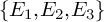 $\{ E_1, E_2, E_3 \}$
be the basis of the Lie algebra
$\{ E_1, E_2, E_3 \}$
be the basis of the Lie algebra $\mathfrak {su}(2)$
given by
$\mathfrak {su}(2)$
given by
 $$ \begin{align*} E_1 = \begin{pmatrix} i & 0 \\ 0 & -i \end{pmatrix}, E_2 = \begin{pmatrix} 0 & 1 \\ -1 & 0 \end{pmatrix}, E_3 = \begin{pmatrix} 0 & i \\ i & 0 \end{pmatrix}, \end{align*} $$
and let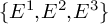 $\{ E^1, E^2, E^3 \}$
be the dual basis of one-forms. The one-parameter family of left-invariant metrics
$\{ E^1, E^2, E^3 \}$
be the dual basis of one-forms. The one-parameter family of left-invariant metrics
 $$ \begin{align*} g_{\epsilon} = \epsilon E^1 \otimes E^1 + E^2 \otimes E^2 + E^3 \otimes E^3 \end{align*} $$
on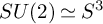 $SU(2) \simeq S^3$
are called the Berger metrics. When
$SU(2) \simeq S^3$
are called the Berger metrics. When $\epsilon = 1$
, then
$\epsilon = 1$
, then $g_1 = g_0$
, the round metric on
$g_1 = g_0$
, the round metric on $S^3$
. In particular, Pedersen’s examples give a one-parameter family
$S^3$
. In particular, Pedersen’s examples give a one-parameter family $(g_{+})_{\epsilon }$
of SDPE metrics on
$(g_{+})_{\epsilon }$
of SDPE metrics on $B^4$
with
$B^4$
with $(g_{+})_1 = g_H$
, the hyperbolic metric. A tedious calculation gives
$(g_{+})_1 = g_H$
, the hyperbolic metric. A tedious calculation gives
 $$ \begin{align} I(S^3, [g_{\epsilon}]) = - 12 \sqrt[3]{6}\pi^2 \epsilon^4 |\epsilon - 1|^{2/3} \leq 0, \end{align} $$
with equality holding only for $\epsilon = 1$
; i.e.,
$\epsilon = 1$
; i.e., $g_1 = g_0$
. In particular, Theorem 1.2 does not apply to these metrics.
$g_1 = g_0$
. In particular, Theorem 1.2 does not apply to these metrics.
1.2 Even Poincaré-Einstein metrics
Let $(X^4,g_{+})$
be a four-dimensional Poincaré-Einstein manifold with conformal infinity
$(X^4,g_{+})$
be a four-dimensional Poincaré-Einstein manifold with conformal infinity $(M^3,[g])$
. By the work of Graham-Lee (see [Reference Graham and Lee15, Reference Graham14]), given
$(M^3,[g])$
. By the work of Graham-Lee (see [Reference Graham and Lee15, Reference Graham14]), given $\hat {g} \in [g]$
there is a unique defining function
$\hat {g} \in [g]$
there is a unique defining function $r> 0$
in a neighbourhood of M such that
$r> 0$
in a neighbourhood of M such that $g_{+}$
can be expressed as
$g_{+}$
can be expressed as
 $$ \begin{align} g_{+} = r^{-2} \left( dr^2 + h_r \right), \end{align} $$
where $h_r$
is a family of metrics on M with an expansion of the form
$h_r$
is a family of metrics on M with an expansion of the form
 $$ \begin{align} h_r = \hat{g} + g^{(2)} r^2 + g^{(3)} r^3 + \cdots, \end{align} $$
with $g^{(i)}$
tensors on M. The tensor
$g^{(i)}$
tensors on M. The tensor $g^{(3)}$
is formally undetermined, and can be viewed as the Neumann data corresponding to the Dirichlet data
$g^{(3)}$
is formally undetermined, and can be viewed as the Neumann data corresponding to the Dirichlet data $\hat {g}$
.
$\hat {g}$
.
Definition 1.6. We say that $g_{+}$
is even if
$g_{+}$
is even if $g^{(3)} = 0$
.
$g^{(3)} = 0$
.
It follows from [Reference Graham14, p. 34 and Lemma 2.2] that the property of evenness does not depend on the choice of conformal representative of $[g]$
, and hence is conformally invariant. Also, as the name suggests, evenness implies that
$[g]$
, and hence is conformally invariant. Also, as the name suggests, evenness implies that $g^{(2k+1)} = 0$
for all
$g^{(2k+1)} = 0$
for all $k \geq 0$
in the expansion (1.14); see the same source. Hyperbolic metrics and their quotients are examples of even metrics.
$k \geq 0$
in the expansion (1.14); see the same source. Hyperbolic metrics and their quotients are examples of even metrics.
Anderson [Reference Anderson2] showed that even metrics arise in the first variation of the renormalized volume. More precisely, suppose h is an infinitesimal Einstein deformation (i.e., h is in the kernel of the linearized Einstein operator with respect to $g_{+}$
; see Section 2 of [Reference Anderson2] for details). If
$g_{+}$
; see Section 2 of [Reference Anderson2] for details). If $h_0= h\vert _{TM}$
denotes the induced variation of the boundary metric
$h_0= h\vert _{TM}$
denotes the induced variation of the boundary metric $\hat {g}$
, then
$\hat {g}$
, then
 $$ \begin{align} V'(h) = \frac{d}{dt} V\left(g_{+} + th\right)\big|_{t=0} = -\frac{1}{4} \oint_M \langle h_0 , g^{(3)} \rangle_{\hat{g}} \, dA_{\hat{g}} \end{align} $$
(see Theorem 2.2 of [Reference Anderson2]). In particular, we see that if $g_{+}$
is even, then it is a critical point of the renormalized volume functional.
$g_{+}$
is even, then it is a critical point of the renormalized volume functional.
The formula (1.15) follows from Anderson’s formula for the renormalized volume:
 $$ \begin{align} V = \frac{4}{3} \pi^2 \chi(X) - \frac{1}{6} \int_X |W_{g_{+}}|^2 \, dv_{g_{+}}. \end{align} $$
Notice this gives the topological bound
 $$ \begin{align} V \leq \frac{4}{3} \pi^2 \chi(X), \end{align} $$
with equality if and only if $g_{+}$
is hyperbolic. In particular, for any Poincaré-Einstein metric on the ball
$g_{+}$
is hyperbolic. In particular, for any Poincaré-Einstein metric on the ball $B^4$
we have
$B^4$
we have
 $$ \begin{align*} V \leq \frac{4}{3} \pi^2, \end{align*} $$
and equality it only attained for the hyperbolic metric.
Our next result gives a ‘gap’ result for the renormalized volume for even metrics:
Theorem 1.7. Let $(X^4, g_{+})$
be an even Poincaré-Einstein manifold with conformal infinity
$(X^4, g_{+})$
be an even Poincaré-Einstein manifold with conformal infinity $(M^3,[g])$
. If
$(M^3,[g])$
. If $Y(M^3,[g])> 0$
, then either
$Y(M^3,[g])> 0$
, then either $g_{+}$
is hyperbolic, or
$g_{+}$
is hyperbolic, or
 $$ \begin{align} V \leq \min\left\{ \frac{2}{3} \pi^2 \chi(X^4), - \frac{\sqrt{6}}{2} Y(M^3,[g])^{3/2} + \frac{4}{3} \pi^2 \chi(X^4) \right\}. \end{align} $$
In particular, if $g_{+}$
is an even Poincaré-Einstein metric on
$g_{+}$
is an even Poincaré-Einstein metric on $B^4$
, then either
$B^4$
, then either $g_{+}$
is hyperbolic, or
$g_{+}$
is hyperbolic, or
 $$ \begin{align} V \leq \min \left\{ \frac{1}{2} V_0, V_0 - \frac{\sqrt{6}}{2} Y(M^3,[g])^{3/2} \right\}, \end{align} $$
where $V_0 = \frac {4}{3}\pi ^2$
is the renormalized volume of the hyperbolic metric.
$V_0 = \frac {4}{3}\pi ^2$
is the renormalized volume of the hyperbolic metric.
By a result of Chang-Qing-Yang [Reference Chang, Qing and Yang7], if $X^4$
is not diffeomorphic to
$X^4$
is not diffeomorphic to $B^4$
and
$B^4$
and $M^3$
is not diffeomorphic to
$M^3$
is not diffeomorphic to $S^3$
, then
$S^3$
, then
 $$ \begin{align*} V \leq \frac{2}{3} \pi^2 \chi(X^4). \end{align*} $$
Therefore, (1.18) is an improvement on their inequality only when $X = B^4$
and
$X = B^4$
and $M = S^3$
, or if the Yamabe invariant of the conformal infinity is sufficiently large. The dependence of the upper bound on the Yamabe invariant of the conformal infinity relies on a result of Chang-Ge [Reference Chang and Ge6], which gives a comparison between the Yamabe invariant of the conformal infinity and the ‘type-I’ Yamabe invariant of the interior (see Section 2).
$M = S^3$
, or if the Yamabe invariant of the conformal infinity is sufficiently large. The dependence of the upper bound on the Yamabe invariant of the conformal infinity relies on a result of Chang-Ge [Reference Chang and Ge6], which gives a comparison between the Yamabe invariant of the conformal infinity and the ‘type-I’ Yamabe invariant of the interior (see Section 2).
An interesting example is given by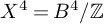 $X^4 = B^4 / \mathbb {Z}$
and
$X^4 = B^4 / \mathbb {Z}$
and $M^3 = S^2 \times S^1$
. In this case
$M^3 = S^2 \times S^1$
. In this case $X^4$
admits a hyperbolic metric obtained as the quotient of the standard hyperbolic metric on
$X^4$
admits a hyperbolic metric obtained as the quotient of the standard hyperbolic metric on $B^4$
along an isometry. These metrics are obviously even, and the renormalized volume
$B^4$
along an isometry. These metrics are obviously even, and the renormalized volume $V = 0$
. For any other (non-hyperbolic) even metric on
$V = 0$
. For any other (non-hyperbolic) even metric on $B^4 / \mathbb {Z}$
, (1.19) implies
$B^4 / \mathbb {Z}$
, (1.19) implies
 $$ \begin{align} V \leq - \frac{\sqrt{6}}{2} Y(M^3,[g])^{3/2} < 0. \end{align} $$
There is an obvious parallel between the question of the existence of non-hyperbolic even Poincaré-Einstein metrics on $B^4$
, and the existence of non-round Einstein metrics on
$B^4$
, and the existence of non-round Einstein metrics on $S^4$
. In both cases, the metrics are critical points of a natural geometric variational problem. Furthermore, the associated canonical metrics (the hyperbolic metric in the former case, and the round metric in the latter) are isolated; i.e., in a sufficiently small neighbourhood there are no other examples. For both cases there is also a notion of ‘positivity’: for even metrics the sign of the Yamabe invariant of the conformal infinity, and for Einstein metrics the sign of the Einstein constant. We end with the following natural question:
$S^4$
. In both cases, the metrics are critical points of a natural geometric variational problem. Furthermore, the associated canonical metrics (the hyperbolic metric in the former case, and the round metric in the latter) are isolated; i.e., in a sufficiently small neighbourhood there are no other examples. For both cases there is also a notion of ‘positivity’: for even metrics the sign of the Yamabe invariant of the conformal infinity, and for Einstein metrics the sign of the Einstein constant. We end with the following natural question:
Question 1.8. Suppose $g_{+}$
is an even Poincaré-Einstein metric on
$g_{+}$
is an even Poincaré-Einstein metric on $B^4$
whose conformal infinity is of positive Yamabe type. Is
$B^4$
whose conformal infinity is of positive Yamabe type. Is $g_{+}$
hyperbolic?
$g_{+}$
hyperbolic?
1.3 Organization of the paper
In Section 2 we prove an elementary inequality for the Yamabe invariant that follows from the Chern-Gauss-Bonnet formula. We also record an estimate for the Yamabe invariant of Poincaré-Einstein manifolds due to Chang and Ge which will be used in the proof of Theorem 1.7. In Section 3 we prove a key Weitzenböck formula for the (weighted) Weyl tensor.
In Sections 4 and 5 we present the proofs of Theorems 1.2 and 1.7, assuming certain expansions for the Weyl tensor of a Poincaré-Einstein metric. These expansions, which build on the formulas in Chapter 5 of [Reference Fefferman and Graham13], are worked out in Sections 6 and 7.
2 Estimates of the Yamabe invariant
In this section prove two estimates for the Yamambe invariant in our setting that will be needed in the proofs of the main results.
Let $(X,M,h)$
be a compact Riemannian four-manifold with non-empty boundary
$(X,M,h)$
be a compact Riemannian four-manifold with non-empty boundary $M = \partial X$
. Let
$M = \partial X$
. Let $R_h$
denote the scalar curvature of h and
$R_h$
denote the scalar curvature of h and $H = H_h$
the mean curvature of M with respect to h. Define
$H = H_h$
the mean curvature of M with respect to h. Define $\mathcal {E}_h : W^{1,2}(X) \rightarrow \mathbb {R}$
by
$\mathcal {E}_h : W^{1,2}(X) \rightarrow \mathbb {R}$
by
 $$ \begin{align} \mathcal{E}_h[\phi] = \int_X \left( |\nabla_h \phi|^2 + \frac{1}{6} R_h \phi^2 \right) \, dv_h + \frac{1}{3} \oint_{M} H \phi^2 \, dA_h. \end{align} $$
The quantity $\mathcal {E}$
is conformally invariant in the sense that if
$\mathcal {E}$
is conformally invariant in the sense that if $\widetilde {h} = e^{2w} h$
, then
$\widetilde {h} = e^{2w} h$
, then
 $$ \begin{align} \mathcal{E}_{\widetilde{h}}[\phi] = \mathcal{E}_h[e^w \phi]. \end{align} $$
We also define the Yamabe functional
 $$ \begin{align} \mathcal{Y}_h[\phi] = \dfrac{\mathcal{E}_h[\phi]}{\left(\int_X |\phi|^4 \, dV_h \right)^{1/2}}. \end{align} $$
The (type I-) Yamabe invariant is defined by
 $$ \begin{align} Y_1(X,M,[h]) = \inf_{\phi \in W^{1,2}(X) \setminus \{0\}} \mathcal{Y}_h[\phi]. \end{align} $$
By standard conformal transformation laws, an equivalent definition is given by
 $$ \begin{align} Y_1(X,M,[h]) = \inf_{\tilde{h} \in [h]} \dfrac{\frac{1}{6} \int_X R_{\tilde{h}} \, dv_{\tilde{h}} + \frac{1}{3} \oint_{M} H_{\tilde{h}} \, dA_{\tilde{h}}}{\left( vol(X,\tilde{h}) \right)^{1/2}}. \end{align} $$
A function $v \in W^{1,2}$
attaining
$v \in W^{1,2}$
attaining $Y_1(X,M,[h])$
defines a (smooth) conformal metric
$Y_1(X,M,[h])$
defines a (smooth) conformal metric $h_1 = v^2 h$
satisfying
$h_1 = v^2 h$
satisfying
 $$ \begin{align} \begin{aligned} R_{h_1} &= \frac{1}{6} Y_1(X,M,[h]) \ \ \text{in }X, \\ H_{h_1} &= 0 \ \ \text{on }M \end{aligned} \end{align} $$
(see [Reference Escobar12]).
Using the Chern-Gauss-Bonnet formula, we obtain the following elementary inequality for the Yamabe invariant:
Lemma 2.1. Let $(X,M,h)$
be a compact Riemannian four-manifold with non-empty boundary
$(X,M,h)$
be a compact Riemannian four-manifold with non-empty boundary $M = \partial X$
. Assume
$M = \partial X$
. Assume
-
(i) M is umbilic with respect to h.
-
(ii)
$Y_1(X,M,[h]) \geq 0$
.

Then
 $$ \begin{align} 8 \pi^2 \chi(X) \leq \int_X |W_{h}|^2 \, dv_{h} + \frac{3}{2} Y_1(X,M,[h])^2. \end{align} $$
Proof. By conformal invariance we may assume that M is minimal with respect to h (see Lemma 1.1 of [Reference Escobar12]). As in the proof of Theorem 6.1 of [Reference Escobar12], let $\{ v_i \}$
be a minimizing sequence for
$\{ v_i \}$
be a minimizing sequence for $Y_1(X,M,[h])$
obtained by the standard sub-critical regularization procedure. More precisely, each
$Y_1(X,M,[h])$
obtained by the standard sub-critical regularization procedure. More precisely, each $v_i$
is a solution of the PDE
$v_i$
is a solution of the PDE
 $$ \begin{align} \begin{aligned} - \Delta_h v_i + \frac{1}{6} R_h v_i &= Y_1(X,M,[h]) v_i^{3 - \delta_i} \ \ \text{in }X, \\ \frac{\partial v_i}{\partial \nu} &= 0 \ \ \text{on }M, \end{aligned} \end{align} $$
where $\nu $
is the outward unit normal with respect to h and
$\nu $
is the outward unit normal with respect to h and $\delta _i \to 0$
as
$\delta _i \to 0$
as $i \to \infty $
. Moreover, we may assume that
$i \to \infty $
. Moreover, we may assume that $v_i$
is normalized so that
$v_i$
is normalized so that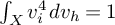 $\int _X v_i^4 \, dv_h = 1$
. Here and throughout,
$\int _X v_i^4 \, dv_h = 1$
. Here and throughout, $\Delta _h = \delta _h \nabla _h = h^{ij}\nabla _i \nabla _j$
.
$\Delta _h = \delta _h \nabla _h = h^{ij}\nabla _i \nabla _j$
.
By standard regularity properties (see [Reference Cherrier9], Theorem 1), we may assume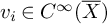 $v_i \in C^{\infty }(\overline {X})$
and
$v_i \in C^{\infty }(\overline {X})$
and $v_i> 0$
. By (2.8), the scalar curvature and mean curvature of
$v_i> 0$
. By (2.8), the scalar curvature and mean curvature of $h_i = v_i^2 h$
are given by
$h_i = v_i^2 h$
are given by
 $$ \begin{align} \begin{aligned} R_{h_i} &= 6 Y_1(X,M,[h]) v_i^{- \delta_i} \ \ \text{in X}, \\ H_{h_i} &= 0 \ \ \text{on }M. \end{aligned} \end{align} $$
In particular, since the boundary is minimal with respect to $h_i$
, it is totally geodesic. Therefore, by the Chern-Gauss-Bonnet formula
$h_i$
, it is totally geodesic. Therefore, by the Chern-Gauss-Bonnet formula
 $$ \begin{align} \begin{aligned} 8 \pi^2 \chi(X) &= \int_X |W_{h_i}|^2 \, dv_{h_i} - \frac{1}{2} \int_X |E_{h_i}|^2 \, dv_{h_i} + \frac{1}{24} \int_X R_{h_i}^2 \, dv_{h_i} \\ &\leq \int_X |W_{h_i}|^2 \, dv_{h_i} + \frac{1}{24} \int_X R_{h_i}^2 \, dv_{h_i}. \end{aligned} \end{align} $$
By (2.9) and the volume normalization,
 $$ \begin{align} \begin{aligned} \int_X R_{h_i}^2 \, dv_{h_i} &= 36 Y_1(X,M,[h])^2 \int_X v_i^{4 - 2\delta_i} \, dv_h \\ &\leq 36 Y_1(X,M,[h])^2 \left( \int_X v_i^4 \, dv_h \right)^{1 - \delta_i/2} \left( \int_X dv_h \right)^{\delta_i/2} \\ &= 36 Y_1(X,M,[h])^2 \operatorname{\mathrm{Vol}}\left(h\right)^{\delta_i/2}. \end{aligned} \end{align} $$
Combining this with (2.10) and using the conformal invariance of the $L^2$
-norm of the Weyl tensor, we find
$L^2$
-norm of the Weyl tensor, we find
 $$ \begin{align} 8 \pi^2 \chi(X) \leq \int_X |W_{h}|^2 \, dv_{h} + \frac{3}{2} Y_1(X,M,[h])^2 \operatorname{\mathrm{Vol}}\left(h\right)^{\delta_i/2}. \end{align} $$
Letting $i \to \infty $
, we arrive at (2.7).
$i \to \infty $
, we arrive at (2.7).
Now let $(X,g_{+})$
be a four-dimensional Poincaré-Einstein manifold with conformal infinity
$(X,g_{+})$
be a four-dimensional Poincaré-Einstein manifold with conformal infinity $(M^3,[g])$
. Various estimates for the Yamabe invariant of the boundary relative to the Yamabe invariant of a compactification appear in [Reference Gursky and Han17], [Reference Chen, Lai and Wang8], [Reference Raulot25], [Reference Wang and Wang26], [Reference Chang and Ge6]. The following estimate of Chang-Ge will be used in the proof of Theorem 1.7:
$(M^3,[g])$
. Various estimates for the Yamabe invariant of the boundary relative to the Yamabe invariant of a compactification appear in [Reference Gursky and Han17], [Reference Chen, Lai and Wang8], [Reference Raulot25], [Reference Wang and Wang26], [Reference Chang and Ge6]. The following estimate of Chang-Ge will be used in the proof of Theorem 1.7:
Lemma 2.2. (See [Reference Chang and Ge6]) Let $(X,g_{+})$
be a four-dimensional Poincaré-Einstein manifold with conformal infinity
$(X,g_{+})$
be a four-dimensional Poincaré-Einstein manifold with conformal infinity $(M^3,[g])$
. Assume
$(M^3,[g])$
. Assume $Y(M^3,[g]) \geq 0$
. Then
$Y(M^3,[g]) \geq 0$
. Then
 $$ \begin{align} Y_1(X,M,[\bar{g}])^2 \geq 2 \sqrt{6} Y(M^3,[g])^{3/2}, \end{align} $$
where $\bar {g} = r^2 g_{+}$
is any (smooth) compactification of
$\bar {g} = r^2 g_{+}$
is any (smooth) compactification of $(X,g_{+})$
.
$(X,g_{+})$
.
3 A Weitzenböck formula
The main result of this section is the following:
Theorem 3.1. Let $(X^4,g_{+})$
be an oriented four-dimensional Poincaré-Einstein manifold. Let
$(X^4,g_{+})$
be an oriented four-dimensional Poincaré-Einstein manifold. Let $\rho> 0$
be a defining function, and
$\rho> 0$
be a defining function, and $\bar {g} = \rho ^2 g_{+}$
. Define
$\bar {g} = \rho ^2 g_{+}$
. Define
 $$ \begin{align*} Z_{\bar{g}}^{+} &= \rho W_{g_{+}}^{+}. \end{align*} $$
Then $Z^{+} = Z^{+}_{\bar {g}}$
satisfies
$Z^{+} = Z^{+}_{\bar {g}}$
satisfies
 $$ \begin{align} \frac{1}{2} \Delta |Z^{+}|^2 = |\nabla Z^{+}|^2 - 6 \operatorname{\mathrm{tr}} \left( W^{+} \circ \left( Z^{+} \right)^2 \right) + \frac{1}{2} R |Z^{+}|^2, \end{align} $$
where the covariant derivatives and curvature are with respect to the metric $\bar {g}$
. Also, away from the zero locus of
$\bar {g}$
. Also, away from the zero locus of $|Z^{+}|$
,
$|Z^{+}|$
,
 $$ \begin{align} |\nabla Z^{+}|^2 \geq \frac{5}{3} |\nabla |Z^{+}||^2. \end{align} $$
Theorem 3.1 will follow from a more general result. Let $(X,g_0)$
be an oriented, four-dimensional manifold such that the self-dual Weyl tensor is harmonic:
$(X,g_0)$
be an oriented, four-dimensional manifold such that the self-dual Weyl tensor is harmonic:
 $$ \begin{align} \left( \delta_{g_0} W^{+}_{g_0} \right)_{j k \ell} = \nabla_{g_0}^m \left( W^{+}_{g_0} \right)_{mjk\ell} = 0. \end{align} $$
Given a conformal metric $g = e^{2w}g_0$
, the conformal transformation formula for the Riemannian connection implies
$g = e^{2w}g_0$
, the conformal transformation formula for the Riemannian connection implies
 $$ \begin{align} \left( \delta_g W_g^{\pm} \right)_{jk\ell} = \left( \delta_{g_0} W^{\pm}_{g_0} \right)_{j k \ell} + \nabla_{g_0}^m w \left( W^{\pm}_{g_0}\right)_{mjk\ell}. \end{align} $$
In particular, the condition (3.3) is not conformally invariant. However, the formula (3.4) easily implies the following:
Lemma 3.2. Suppose $(X,g_0)$
is an oriented, four-dimensional manifold whose self-dual Weyl tensor is harmonic. Given a conformal metric
$(X,g_0)$
is an oriented, four-dimensional manifold whose self-dual Weyl tensor is harmonic. Given a conformal metric $g = e^{2w}g_0$
, let
$g = e^{2w}g_0$
, let
 $$ \begin{align} Z^{+}_g = e^w W_{g_0}^{+} \in \Gamma\left( \mathcal{W}^{+}\right), \end{align} $$
where $\mathcal {W}^{+} \subset \mathcal {W}$
is the sub-bundle of self-dual algebraic Weyl tensors. Then
$\mathcal {W}^{+} \subset \mathcal {W}$
is the sub-bundle of self-dual algebraic Weyl tensors. Then $Z^{+} = Z^{+}_g$
is harmonic with respect to g:
$Z^{+} = Z^{+}_g$
is harmonic with respect to g:
 $$ \begin{align} \delta_g Z^{+} = 0. \end{align} $$
In [Reference Derdzinski11], Derdzinski showed that the condition $\delta _{g_0} W^{+}_{g_0} = 0$
implies that
$\delta _{g_0} W^{+}_{g_0} = 0$
implies that $W^{+}_{g_0}$
satisfies the following Weitzenböck formula:
$W^{+}_{g_0}$
satisfies the following Weitzenböck formula:
 $$ \begin{align} \begin{aligned} \frac{1}{2} \Delta_{g_0} |W^{+}_{g_0}|^2 &= |\nabla_{g_0} W^{+}_{g_0}|^2 - 18 \det W^{+}_{g_0} + \frac{1}{2} R_0 |W^{+}_{g_0}|^2 \\ &= |\nabla_{g_0} W^{+}_{g_0}|^2 - 6 \operatorname{\mathrm{tr}}_{g_0} \left( W^{+}_{g_0} \circ \left( W^{+}_{g_0} \right)^2 \right) + \frac{1}{2} R_0 |W^{+}_{g_0}|^2, \end{aligned} \end{align} $$
where the norms are with respect to $g_0$
. If
$g_0$
. If $g = e^{2w}g_0$
, since
$g = e^{2w}g_0$
, since $Z^{+}$
is harmonic with respect to g, it satisfies a similar Weitzenböck formula:
$Z^{+}$
is harmonic with respect to g, it satisfies a similar Weitzenböck formula:
Corollary 3.3. Suppose $(X,g_0)$
is an oriented, four-dimensional manifold whose self-dual Weyl tensor is harmonic. Given a conformal metric
$(X,g_0)$
is an oriented, four-dimensional manifold whose self-dual Weyl tensor is harmonic. Given a conformal metric $g = e^{2w}g_0$
, let
$g = e^{2w}g_0$
, let $Z^{+} = Z^{+}_g$
be defined as in (3.5). Then
$Z^{+} = Z^{+}_g$
be defined as in (3.5). Then $Z^{+}$
satisfies
$Z^{+}$
satisfies
 $$ \begin{align} \frac{1}{2} \Delta_g |Z^{+}|^2 = |\nabla Z^{+}|^2 - 6 \operatorname{\mathrm{tr}} \left( W^{+} \circ \left( Z^{+} \right)^2 \right) + \frac{1}{2} R |Z^{+}|^2. \end{align} $$
Proof. It is possible to give a proof by the same methods as the proof (3.7) in [Reference Derdzinski11]. However, it is much more straightforward to simply use the fact that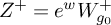 $Z^{+} = e^w W^{+}_{g_0}$
, and use the standard conformal transformation formulas for the Riemannian connection and scalar curvature to observe
$Z^{+} = e^w W^{+}_{g_0}$
, and use the standard conformal transformation formulas for the Riemannian connection and scalar curvature to observe
 $$ \begin{align*} |\nabla Z^{+}|_g^2 &= e^{-8w} \Big\{ |\nabla_{g_0} W^{+}_{g_0}|_{g_0}^2 - 5 \langle \nabla_{g_0} w, \nabla_{g_0} |W^{+}_{g_0} \rangle_{g_0} + 15 |\nabla_{g_0} w|_{g_0}^2 |W^{+}_{g_0}|^2_{g_0} \Big\}, \\ \Delta_g |Z^{+}|_g^2 &= e^{-8w} \Big\{ \Delta_{g_0} |W^{+}_{g_0}|^2_{g_0} - 6 ( \Delta_{g_0} w ) |W^{+}_{g_0}|^2_{g_0} - 10 \langle \nabla_{g_0} w, \nabla_{g_0} |W^{+}_{g_0} \rangle_{g_0} + 24 |\nabla_{g_0} w|_{g_0}^2 |W^{+}_{g_0}|^2_{g_0} \Big\}, \\ R_g |Z^{+}|_g^2 &= e^{-8w} \Big\{ R_{g_0} |W^{+}_{g_0}|^2_{g_0} - 6( \Delta_{g_0} w ) |W^{+}_{g_0}|^2_{g_0} - 6 |\nabla_{g_0} w|_{g_0}^2 |W^{+}_{g_0}|^2_{g_0} \Big\}. \end{align*} $$
Corollary 3.4. Suppose $(X,g_0)$
is an oriented, four-dimensional manifold whose self-dual Weyl tensor is harmonic. Given a conformal metric
$(X,g_0)$
is an oriented, four-dimensional manifold whose self-dual Weyl tensor is harmonic. Given a conformal metric $g = e^{2w}g_0$
, let
$g = e^{2w}g_0$
, let $Z^{+} = Z^{+}_g$
be defined as in (3.5). Then away from the zero locus of
$Z^{+} = Z^{+}_g$
be defined as in (3.5). Then away from the zero locus of $|Z^{+}|$
,
$|Z^{+}|$
,
 $$ \begin{align} |\nabla Z^{+}|^2 \geq \frac{5}{3} |\nabla |Z^{+}||^2. \end{align} $$
Proof. The Kato inequality (3.2) was proved for the self-dual Weyl tensor in [Reference Gursky and LeBrun18] (see also [Reference Calderbank, Gauduchon and Herzlich5]), but the proof for $Z^{+}$
is obviously the same.
$Z^{+}$
is obviously the same.
The proof of Theorem 3.1.
Suppose $(X^4, g_{+})$
is an oriented, four-dimensional Poincaré-Einstein manifold. The Einstein condition implies that the self-dual Weyl tensor
$(X^4, g_{+})$
is an oriented, four-dimensional Poincaré-Einstein manifold. The Einstein condition implies that the self-dual Weyl tensor $W^{+}_{g_{+}}$
is harmonic. Therefore, given a defining function
$W^{+}_{g_{+}}$
is harmonic. Therefore, given a defining function $\rho> 0$
, we can apply Corollaries 3.3 and 3.4 with
$\rho> 0$
, we can apply Corollaries 3.3 and 3.4 with $g_0 = g_{+}$
and
$g_0 = g_{+}$
and $e^w = \rho $
, and Theorem 3.1 follows.
$e^w = \rho $
, and Theorem 3.1 follows.
4 The proof of Theorem 1.2 and its corollaries
The proof of Theorem 1.2.
Suppose $(X^4,g_{+})$
is an oriented, self-dual, four-dimensional Poincaré-Einstein manifold with conformal infinity
$(X^4,g_{+})$
is an oriented, self-dual, four-dimensional Poincaré-Einstein manifold with conformal infinity $(M^3,[g])$
. We assume
$(M^3,[g])$
. We assume
-
(i)
$I_0(M^3,[g]) \geq 0$
, -
(ii)
$Y(M^3, [g])> 0$
.


Choose a representative in the conformal infinity (which we again denote g) and let $r> 0$
be the special defining function associated to g. Let
$r> 0$
be the special defining function associated to g. Let $\bar {g} = r^2 g_{+}$
. The proof of Theorem 1.2 is based on the following proposition:
$\bar {g} = r^2 g_{+}$
. The proof of Theorem 1.2 is based on the following proposition:
Proposition 4.1. Under the assumptions of Theorem 1.2,
 $$ \begin{align} Y_1(X,M,[\bar{g}])^2 \leq \frac{2}{3} \int_X |W^{+}_{g_{+}}|^2 \, dv_{g_{+}}. \end{align} $$
Before giving a proof of this proposition, let us show how Theorem 1.2 follows. Again, as observed by J. Qing in [Reference Qing24], since $Y(M^3, [g])> 0$
it follows that
$Y(M^3, [g])> 0$
it follows that $Y_1(X,M,[\bar {g}])> 0$
. Also, the Fefferman-Graham expansion implies that M is totally umbilic with respect to
$Y_1(X,M,[\bar {g}])> 0$
. Also, the Fefferman-Graham expansion implies that M is totally umbilic with respect to $\bar {g}$
. Therefore, by Lemma 2.1 we have
$\bar {g}$
. Therefore, by Lemma 2.1 we have
 $$ \begin{align} 8 \pi^2 \chi(X) \leq \int_X |W_{\bar{g}}|^2 \, dv_{\bar{g}} + \frac{3}{2} Y_1(X,M,[\bar{g}])^2 = \int_X |W_{g_{+}}|^2 \, dv_{g_{+}} + \frac{3}{2} Y_1(X,M,[\bar{g}])^2. \end{align} $$
Combining with (4.1), we obtain
 $$ \begin{align} 8 \pi^2 \chi(X) \leq 2 \int_X |W^{+}_{g_{+}}|^2 \, dv_{g_{+}}. \end{align} $$
By the Atiyah-Patodi-Singer index formula,
 $$ \begin{align*} \int_X |W^{+}_{\bar{g}}|^2 \, dv_{\bar{g}} = 12 \pi^2 \left( \tau(X) - \eta(M,[g]) \right), \end{align*} $$
hence
 $$ \begin{align*} 8 \pi^2 \chi(X) \leq 24 \pi^2 \left( \tau(X) - \eta(M,[g]) \right), \end{align*} $$
which gives (1.10).
The proof Proposition 4.1.
Let $Z^{+} = r W^{+}_{g_{+}}$
. By Theorem 3.1,
$Z^{+} = r W^{+}_{g_{+}}$
. By Theorem 3.1, $Z^{\pm }$
satisfy
$Z^{\pm }$
satisfy
 $$ \begin{align} \frac{1}{2} \Delta_{\bar{g}} |Z^{\pm}|^2 = |\nabla_{\bar{g}} Z^{\pm}|^2 - 6 \operatorname{\mathrm{tr}} \left( W^{\pm}_{\bar{g}} \circ \left( Z^{\pm} \right)^2 \right) + \frac{1}{2} R_{\bar{g}} |Z^{\pm}|^2. \end{align} $$
Since $Z^{\pm }$
and
$Z^{\pm }$
and $W^{\pm }$
are trace-free,
$W^{\pm }$
are trace-free,
 $$ \begin{align*} \Big| \operatorname{\mathrm{tr}} \left( W^{\pm}_{\bar{g}} \circ \left( Z^{\pm} \right)^2 \right)\Big| \leq \frac{1}{\sqrt{6}} |W^{\pm}_{\bar{g}}||Z^{\pm}|^2. \end{align*} $$
Substituting this into (4.4), we have
 $$ \begin{align} \frac{1}{2} \Delta_{\bar{g}} |Z^{\pm}|^2 \geq |\nabla_{\bar{g}} Z^{\pm}|^2 - \sqrt{6} |W^{\pm}_{\bar{g}}| |Z^{\pm}|^2 + \frac{1}{2} R_{\bar{g}} |Z^{+}|^2. \end{align} $$
For $\epsilon> 0$
let
$\epsilon> 0$
let
 $$ \begin{align} f_{\epsilon} = \left( \epsilon + |Z^{+}|^2 \right)^{1/6}. \end{align} $$
Multiply (4.5) by $f_{\epsilon }^{-4}$
, and integrate over X:
$f_{\epsilon }^{-4}$
, and integrate over X:
 $$ \begin{align} \frac{1}{2} \int_X f_{\epsilon}^{-4} \Delta_{\bar{g}} |Z^{+}|^2 \, dv_{\bar{g}} \geq \int_X f_{\epsilon}^{-4} |\nabla_{\bar{g}} Z^{+}|^2 \, dv_{\bar{g}} + \frac{1}{2} \int_X \left( R_{\bar{g}} - 2 \sqrt{6} |W^{+}_{\bar{g}}| \right) f_{\epsilon}^{-4} |Z^{+}|^2 \, dv_{\bar{g}}. \end{align} $$
For the term on the left, we integrate by parts:
 $$ \begin{align} \begin{aligned} \frac{1}{2} \int_X f_{\epsilon}^{-4} \Delta_{\bar{g}} |Z^{+}|^2 \, dv_{\bar{g}} &= - \frac{1}{2} \int_X \langle \nabla_{\bar{g}} \left( f_{\epsilon}^{-4} \right), \nabla_{\bar{g}} |Z^{+}|^2 \rangle_{\bar{g}} \, dv_{\bar{g}} + \frac{1}{2} \oint_M f_{\epsilon}^{-4} \frac{\partial }{\partial \nu} |Z^{+}|^2 \, dA_{\bar{g}} \\ &= - \frac{1}{2} \int_X \langle \nabla_{\bar{g}} \left( f_{\epsilon}^{-4} \right), \nabla_{\bar{g}} \left( f_{\epsilon}^6 \right) \rangle_{\bar{g}} \, dv_{\bar{g}} + \frac{1}{2} \oint_M f_{\epsilon}^{-4} \frac{\partial }{\partial \nu} |Z^{+}|^2 \, dA_{\bar{g}} \\ &= 12 \int_X | \nabla_{\bar{g}} f_{\epsilon} |^2 \, dv_{\bar{g}} + \frac{1}{2} \oint_M f_{\epsilon}^{-4} \frac{\partial }{\partial \nu} |Z^{+}|^2 \, dA_g, \end{aligned} \end{align} $$
where $\nu $
is the outward normal to M with respect to
$\nu $
is the outward normal to M with respect to $g = \bar {g}|_M$
. For the first term on the right-hand side of (4.7), we use the refined Kato inequality
$g = \bar {g}|_M$
. For the first term on the right-hand side of (4.7), we use the refined Kato inequality $|\nabla _{\bar {g}} Z^{+}|^2 \geq \frac {5}{3}|\nabla _{\bar {g}} |Z^{+}||^2$
. Let
$|\nabla _{\bar {g}} Z^{+}|^2 \geq \frac {5}{3}|\nabla _{\bar {g}} |Z^{+}||^2$
. Let $X_Z = \left \{ p \in X: Z^+(p) \neq 0 \right \}$
. Then
$X_Z = \left \{ p \in X: Z^+(p) \neq 0 \right \}$
. Then
 $$ \begin{align} \begin{aligned} \int_X f_{\epsilon}^{-4} |\nabla_{\bar{g}} Z^{+}|^2 \, dv_{\bar{g}} &= \int_{X_Z}f_{\epsilon}^{-4}|\nabla_{\bar{g}}Z^+|^2\,dv_{\bar{g}} + \int_{X \setminus X_Z}f_{\epsilon}^{-4}|\nabla_{\bar{g}}Z^+|^2\,dv_{\bar{g}}\\ &\geq \frac{5}{3} \int_{X_Z} f_{\epsilon}^{-4} |\nabla_{\bar{g}} |Z^{+}||^2 \, dv_{\bar{g}} \\ &= \left( \frac{5}{3} \right) \left( \frac{1}{4} \right) \int_{X_Z} f_{\epsilon}^{-4}\frac{1}{|Z^{+}|^2} |\nabla_{\bar{g}} \left( |Z^{+}|^2 \right)|^2 \, dv_{\bar{g}} \\ &= \frac{5}{12} \int_{X_Z} f_{\epsilon}^{-4}\frac{1}{|Z^{+}|^2} |\nabla_{\bar{g}} \left( f_{\epsilon}^6 \right)|^2 \, dv_{\bar{g}} \\ &= 15 \int_{X_Z} f_{\epsilon}^{6}\frac{1}{|Z^{+}|^2} |\nabla_{\bar{g}} f_{\epsilon}|^2 \, dv_{\bar{g}} \\ &\geq 15 \int_{X_Z} f_{\epsilon}^{6}\frac{1}{\left( \epsilon + |Z^{+}|^2\right)} |\nabla_{\bar{g}} f_{\epsilon}|^2 \, dv_{\bar{g}} \\ &= 15 \int_{X_Z} |\nabla_{\bar{g}} f_{\epsilon}|^2 \, dv_{\bar{g}}\\ &= 15 \int_{X}|\nabla_{\bar{g}}f_{\epsilon}|^2\,dv_{\bar{g}}. \end{aligned} \end{align} $$
Combining (4.7), (4.8), and (4.9), we obtain
 $$ \begin{align} \frac{1}{2} \oint_M f_{\epsilon}^{-4} \frac{\partial }{\partial \nu} |Z^{+}|^2 \, dA_{\bar{g}} \geq 3 \int_X |\nabla_{\bar{g}} f_{\epsilon}|^2 \, dv_{\bar{g}} + \frac{1}{2} \int_X \left( R_{\bar{g}} - 2 \sqrt{6} |W^{+}_{\bar{g}}| \right) f_{\epsilon}^{-4} |Z^{+}|^2 \, dv_{\bar{g}}. \end{align} $$
We can rewrite the last term above as
 $$ \begin{align*} \frac{1}{2} \int_X &\left( R_{\bar{g}} - 2 \sqrt{6} |W^{+}_{\bar{g}}| \right) f_{\epsilon}^{-4} |Z^{+}|^2 \, dv_{\bar{g}} \\ & = \frac{1}{2} \int_X \left( R_{\bar{g}} - 2 \sqrt{6} |W^{+}_{\bar{g}}| \right) f_{\epsilon}^{-4} \left( f_{\epsilon}^6 - \epsilon \right) \, dv_{\bar{g}} \\ &= \frac{1}{2} \int_X \left( R_{\bar{g}} - 2 \sqrt{6} |W^{+}_{\bar{g}}| \right) f_{\epsilon}^2 \, dv_{\bar{g}} - \frac{1}{2} \epsilon \int_X \left( R_{\bar{g}} - 2 \sqrt{6} |W^{+}_{\bar{g}}| \right) f_{\epsilon}^{-2} \, dv_{\bar{g}}. \end{align*} $$
Since $f_{\epsilon } \geq \epsilon ^{1/6}$
,
$f_{\epsilon } \geq \epsilon ^{1/6}$
,
 $$ \begin{align*} - \frac{1}{2} \epsilon \int_X \left( R_{\bar{g}} - 2 \sqrt{6} |W^{+}_{\bar{g}}| \right) f_{\epsilon}^{-2} \, dv_{\bar{g}} = O(\epsilon^{2/3}). \end{align*} $$
Consequently, (4.10) implies
 $$ \begin{align} 3 \int_X |\nabla_{\bar{g}} f_{\epsilon}|^2 \, dv_{\bar{g}} + \frac{1}{2} \int_X R_{\bar{g}} f_{\epsilon}^2 \, dv_g \leq \sqrt{6} \int_X |W^{+}_{\bar{g}}| f_{\epsilon}^2 \, dv_{\bar{g}} + \frac{1}{2} \oint_M f_{\epsilon}^{-4} \frac{\partial }{\partial \nu} |Z^{+}|^2 \, dA_{\bar{g}} + O(\epsilon^{2/3}). \end{align} $$
It follows from the Fefferman-Graham expansions that the mean curvature of M with respect to $g = \bar {g}|_M$
vanishes. Therefore, dividing (4.11) by
$g = \bar {g}|_M$
vanishes. Therefore, dividing (4.11) by $3$
we get
$3$
we get
 $$ \begin{align} \begin{aligned} \mathcal{E}_{\bar{g}}[ f_{\epsilon} ] &\leq \frac{\sqrt{6}}{3} \int_X |W^{+}_{\bar{g}}| f_{\epsilon}^2 \, dv_{\bar{g}} + \frac{1}{6} \oint_M f_{\epsilon}^{-4} \frac{\partial }{\partial \nu} |Z^{+}|^2 \, dA_g + O(\epsilon^{2/3}) \\ &\leq \frac{\sqrt{6}}{3} \left( \int_X |W^{+}_{g_{+}}|^2 \, dv_{g_{+}} \right)^{1/2} \left( \int_X f_{\epsilon}^4 \, dv_{\bar{g}} \right)^{1/2} + \frac{1}{6} \oint_M f_{\epsilon}^{-4} \frac{\partial }{\partial \nu} |Z^{+}|^2 \, dA_g + O(\epsilon^{2/3}). \end{aligned} \end{align} $$
Claim 4.2.
 $$ \begin{align} \liminf_{\epsilon \to 0} \oint_M f_{\epsilon}^{-4} \frac{\partial }{\partial \nu} |Z^{+}|^2 \, dA_g = - 4 I_0(M^3,[g]). \end{align} $$
Assuming the claim for now, by (4.12) and the assumption that $I_0(M^3,[g]) \geq 0$
, we have
$I_0(M^3,[g]) \geq 0$
, we have
 $$ \begin{align} \mathcal{E}_{\bar{g}}[ f_{\epsilon} ] \leq \frac{\sqrt{6}}{3} \left( \int_X |W^{+}_{g_{+}}|^2 \, dv_{g_{+}} \right)^{1/2} \left( \int_X f_{\epsilon}^4 \, dv_{\bar{g}} \right)^{1/2} + O(\epsilon^{2/3}). \end{align} $$
If $g_{+}$
is not hyperbolic, then there is a
$g_{+}$
is not hyperbolic, then there is a $c_0> 0$
(independent of
$c_0> 0$
(independent of $\epsilon $
) such that
$\epsilon $
) such that
 $$ \begin{align*} \int_X f_{\epsilon}^4 \, dv_{\bar{g}} \geq c_0> 0. \end{align*} $$
Therefore,
 $$ \begin{align} \mathcal{Y}_{\bar{g}}[ f_{\epsilon} ] \leq \frac{\sqrt{6}}{3} \left( \int_X |W^{+}_{g_{+}}|^2 \, dv_{g_{+}} \right)^{1/2} + O(\epsilon^{2/3}), \end{align} $$
and (4.1) follows.
The proof of Claim 4.2 .
By the definition of $Z^{+}$
and the conformal transformation law for the Weyl tensor,
$Z^{+}$
and the conformal transformation law for the Weyl tensor,
 $$ \begin{align*} |Z^{+}|^2 &= |Z^{+}|_{\bar{g}}^2 \\ &= \big| r W^{+}_{g_{+}} \big|_{\bar{g}}^2 \\ &= r^2 \big| W^{+}_{g_{+}} \big|_{\bar{g}}^2 \\ &= r^2 \big| r^{-2} W^{+}_{\bar{g}} \big|_{\bar{g}}^2 \\ &= r^{-2} | W^{+}_{\bar{g}} |^2_{\bar{g}}. \end{align*} $$
By Proposition 7.3,
 $$ \begin{align*} |Z^{+}|^2 &= r^{-2} \big\{ r^2 |\mathcal{C} |^2 + 4 r^3 \langle B, \mathcal{C} \rangle + O(r^4) \big\} \\ &= |\mathcal{C} |^2 + 4 r \langle B, \mathcal{C} \rangle + O(r^2), \end{align*} $$
where B and $\mathcal {C}$
are with respect to
$\mathcal {C}$
are with respect to $g = \bar {g}|_{TM}$
. It follows that
$g = \bar {g}|_{TM}$
. It follows that
 $$ \begin{align} f_{\epsilon} \big|_M = \left( \epsilon + |\mathcal{C} |^2 \right)^{1/6}. \end{align} $$
Also, since r is a special defining function, $\nu = - \frac {\partial }{\partial r}\vert _M$
, hence
$\nu = - \frac {\partial }{\partial r}\vert _M$
, hence
 $$ \begin{align} \begin{aligned} \frac{\partial }{\partial \nu} |Z^{+}|^2 &= - \frac{\partial}{\partial r} \big\{ |\mathcal{C}|^2 + 4 r \langle B, \mathcal{C} \rangle + O(r^2) \big\} \big|_{r=0}\\ &= - 4 \langle B , \mathcal{C} \rangle. \end{aligned} \end{align} $$
Therefore, combining (4.16) and (4.17), we find
 $$ \begin{align*} \liminf_{\epsilon \to 0} \oint_M f_{\epsilon}^{-4} \frac{\partial }{\partial \nu} |Z^{+}|^2 \, dA_g &= \liminf_{\epsilon \to 0} \oint_M \dfrac{- 4 \langle B, \mathcal{C} \rangle}{\left( \epsilon + |\mathcal{C} |^2 \right)^{2/3}} \, dA_g \\ &= - 4 \limsup_{\epsilon \to 0} \oint_M \dfrac{\langle B, \mathcal{C} \rangle}{\left( \epsilon + |\mathcal{C} |^2 \right)^{2/3}} \, dA_g \\ &= - 4 I_0(M^3,[g]). \end{align*} $$
The proof of Corollary 1.4.
Suppose $(M^3,[g])$
is a conformal three-manifold satisfying
$(M^3,[g])$
is a conformal three-manifold satisfying
-
(i)
$I_0(M^3,[g]) \geq 0$
, -
(ii)
$Y(M^3, [g])> 0$
.


Let $X_0$
be any smooth four-manifold such that
$X_0$
be any smooth four-manifold such that $\partial X_0 = M$
. For
$\partial X_0 = M$
. For $k \geq 0$
, let
$k \geq 0$
, let $X_k$
be the manifold with boundary obtained by deleting a ball in the interior of
$X_k$
be the manifold with boundary obtained by deleting a ball in the interior of $X_0$
and taking a connected sum with k copies of
$X_0$
and taking a connected sum with k copies of $\mathbb {CP}^2$
:
$\mathbb {CP}^2$
: $X_k = X_0 \, \sharp \, k \mathbb {CP}^2$
. Then
$X_k = X_0 \, \sharp \, k \mathbb {CP}^2$
. Then $\partial X_k = M$
, and by properties of the signature,
$\partial X_k = M$
, and by properties of the signature, $\tau (X_k) = \tau (X_0) + k$
. Therefore, if we take
$\tau (X_k) = \tau (X_0) + k$
. Therefore, if we take $k_0$
large enough,
$k_0$
large enough,
 $$ \begin{align} \tau(X_{k_0})> \eta(M^3,[g]). \end{align} $$
Next, Let $Y_{\ell }$
be the manifold obtained by deleting a ball in the interior of
$Y_{\ell }$
be the manifold obtained by deleting a ball in the interior of $X_{k_0}$
and taking a connected sum with
$X_{k_0}$
and taking a connected sum with $\ell $
copies of
$\ell $
copies of $S^2 \times S^2$
. Then
$S^2 \times S^2$
. Then $\partial Y_{\ell } = M$
, and
$\partial Y_{\ell } = M$
, and
 $$ \begin{align*} \chi(Y_{\ell}) &= \chi(X_{k_0}) + 2 \ell, \\ \tau(Y_{\ell}) &= \tau(X_{k_0}). \end{align*} $$
It follows that for all $\ell $
sufficiently large, say
$\ell $
sufficiently large, say $\ell> \ell _0$
,
$\ell> \ell _0$
,
 $$ \begin{align} \tau(Y_{\ell}) = \tau(X_{k_0}) < \eta(M^3,[g]) + \frac{1}{3} \chi(Y_{\ell}), \end{align} $$
while
 $$ \begin{align} \tau(Y_{\ell}) = \tau(X_{k_0})> \eta(M^3,[g]). \end{align} $$
In particular, $Y_{\ell }$
satisfies the signature obstruction.
$Y_{\ell }$
satisfies the signature obstruction.
If $\ell> \ell _0$
and
$\ell> \ell _0$
and $Y_{\ell }$
admits a self-dual Poincaré-Einstein metric
$Y_{\ell }$
admits a self-dual Poincaré-Einstein metric $g_{+}$
whose conformal infinity is given by
$g_{+}$
whose conformal infinity is given by $(M^3,[g])$
, then by Theorem 1.2 either
$(M^3,[g])$
, then by Theorem 1.2 either $g_{+}$
is hyperbolic, or we have
$g_{+}$
is hyperbolic, or we have
 $$ \begin{align*} \tau(Y_{\ell}) \geq \eta(M^3,[g]) + \frac{1}{3} \chi(Y_{\ell}). \end{align*} $$
Since this contradicts (4.19), $g_{+}$
must be hyperbolic. However, in this case the Atiyah-Patodi-Singer index formula implies
$g_{+}$
must be hyperbolic. However, in this case the Atiyah-Patodi-Singer index formula implies $\tau (Y_{\ell }) = \eta (M^3,[g])$
, but this contradicts (4.20).
$\tau (Y_{\ell }) = \eta (M^3,[g])$
, but this contradicts (4.20).
5 The proof of Theorem 1.7
The proof of Theorem 1.7.
Let $(X^4, g_{+})$
be an even Poincaré-Einstein manifold. Let
$(X^4, g_{+})$
be an even Poincaré-Einstein manifold. Let $(M^3,[g])$
denote the conformal infinity, and assume
$(M^3,[g])$
denote the conformal infinity, and assume $Y(M^3,[g])> 0$
.
$Y(M^3,[g])> 0$
.
Choose a representative (which we also denote g) in the conformal infinity $[g]$
, and let
$[g]$
, and let $r> 0$
be the special defining function associated to g. Let
$r> 0$
be the special defining function associated to g. Let $\bar {g} = r^2 g_{+}$
. The proof of Theorem 1.7 is based on the following proposition, whose proof parallels the proof of Proposition 4.1:
$\bar {g} = r^2 g_{+}$
. The proof of Theorem 1.7 is based on the following proposition, whose proof parallels the proof of Proposition 4.1:
Proposition 5.1. Under the assumptions of Theorem 1.7,
 $$ \begin{align} Y_1(X,M,[\bar{g}])^2 \leq \frac{2}{3} \int_X |W_{g_{+}}|^2 \, dv_{g_{+}}. \end{align} $$
Before giving a proof of this proposition, let us show how Theorem 1.7 follows. First, as observed by J. Qing in [Reference Qing24], since $Y(M^3, [g])> 0$
it follows that
$Y(M^3, [g])> 0$
it follows that $Y_1(X,M,[\bar {g}])> 0$
. Also, the Fefferman-Graham expansion implies that M is totally umbilic with respect to
$Y_1(X,M,[\bar {g}])> 0$
. Also, the Fefferman-Graham expansion implies that M is totally umbilic with respect to $\bar {g}$
. Therefore, by Lemma 2.1 we have
$\bar {g}$
. Therefore, by Lemma 2.1 we have
 $$ \begin{align} 8 \pi^2 \chi(X) \leq \int_X |W_{\bar{g}}|^2 \, dv_{\bar{g}} + \frac{3}{2} Y_1(X,M,[\bar{g}])^2 = \int_X |W_{g_{+}}|^2 \, dv_{g_{+}} + \frac{3}{2} Y_1(X,M,[\bar{g}])^2. \end{align} $$
Combining with (5.1), we obtain
 $$ \begin{align} 8 \pi^2 \chi(X) \leq 2 \int_X |W_{g_{+}}|^2 \, dv_{g_{+}}. \end{align} $$
By Anderson’s formula for the renormalized volume (5.4),
 $$ \begin{align} V = \frac{4}{3} \pi^2 \chi(X) - \frac{1}{6} \int_X |W_{g_{+}}|^2 \, dv_{g_{+}}, \end{align} $$
which by (5.3) implies
 $$ \begin{align} V \leq \frac{2}{3} \pi^2 \chi(X). \end{align} $$
Also, by Lemma 2.2 we have
 $$ \begin{align*} 2 \sqrt{6} Y(M^3,[g])^{3/2} \leq Y_1(X,M,[\bar{g}])^2, \end{align*} $$
hence by (5.1)
 $$ \begin{align*} 2 \sqrt{6} Y(M^3,[g])^{3/2} \leq \frac{2}{3} \int_X |W_{g_{+}}|^2 \, dv_{g_{+}}. \end{align*} $$
Again appealing to Anderson’s formula (5.4) we get
 $$ \begin{align} V \leq \frac{4}{3} \pi^2 \chi(X) - \frac{\sqrt{6}}{2} Y(M^3,[g])^{3/2}. \end{align} $$
 $$ \begin{align*} V \leq \min \left\{ \frac{2}{3} \pi^2 \chi(X),\frac{4}{3} \pi^2 \chi(X) - \frac{\sqrt{6}}{2} Y(M^3,[g])^{3/2} \right\}. \end{align*} $$
The proof of Proposition 5.1.
Let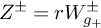 $Z^{\pm } = r W^{\pm }_{g_{+}}$
. By (4.5),
$Z^{\pm } = r W^{\pm }_{g_{+}}$
. By (4.5),
 $$ \begin{align} \frac{1}{2} \Delta_{\bar{g}} |Z^{+}|^2 \geq |\nabla_{\bar{g}} Z^{+}|^2 + \frac{1}{2} \left( R_{\bar{g}} - 2 \sqrt{6} |W^{+}_{\bar{g}}| \right) |Z^{+}|^2. \end{align} $$
Let
 $$ \begin{align} \begin{aligned} Z &= Z^{+} + Z^{-} \\ &= rW_{g_{+}}. \end{aligned} \end{align} $$
It follows that
 $$ \begin{align*} |Z|^2 &= |Z^{+}|^2 + |Z^{-}|^2, \\ |\nabla_{\bar{g}} Z|^2 &= |\nabla_{\bar{g}} Z^{+}|^2 + |\nabla_{\bar{g}} Z^{-}|^2, \end{align*} $$
where the second follows since the connection preserves the splitting (1.3). Consequently, by (5.7) we have
 $$ \begin{align} \frac{1}{2} \Delta_{\bar{g}} |Z|^2 = |\nabla_{\bar{g}} Z|^2 - \sqrt{6} |W^{+}_{\bar{g}}| |Z^{+}|^2 - \sqrt{6} |W^{-}_{\bar{g}}| |Z^{-}|^2 + \frac{1}{2} R_{\bar{g}} |Z|^2. \end{align} $$
An elementary Lagrange-multiplier argument gives
 $$ \begin{align*} \max_{\substack{x^2 + y^2 = 1, \\ a^2 + b^2 = 1}} \left( ax^2 + by^2 \right) = 1, \end{align*} $$
hence
 $$ \begin{align} - \sqrt{6} |W^{+}_{\bar{g}}| |Z^{+}|^2 - \sqrt{6} |W^{-}_{\bar{g}}| |Z^{-}|^2 \geq - \sqrt{6} |W_{\bar{g}}| |Z|^2. \end{align} $$
Substituting this into (5.9) gives
 $$ \begin{align} \frac{1}{2} \Delta_{\bar{g}} |Z|^2 &\geq |\nabla_{\bar{g}} Z|^2 + \frac{1}{2} \left( R_{\bar{g}} - 2\sqrt{6} |W_{\bar{g}}|\right) |Z|^2. \end{align} $$
Let $\epsilon> 0$
, and define
$\epsilon> 0$
, and define
 $$ \begin{align} f_{\epsilon} = \left( \epsilon + |Z|^2 \right)^{1/6}. \end{align} $$
Multiply (5.11) by $f_{\epsilon }^{-4}$
, and integrate over X:
$f_{\epsilon }^{-4}$
, and integrate over X:
 $$ \begin{align} \frac{1}{2} \int_X f_{\epsilon}^{-4} \Delta_{\bar{g}} |Z|^2 \, dv_{\bar{g}} \geq \int_X f_{\epsilon}^{-4} |\nabla_{\bar{g}} Z|^2 \, dv_{\bar{g}} + \frac{1}{2} \int_X \left( R_{\bar{g}} - 2\sqrt{6} |W_{\bar{g}}|\right) f_{\epsilon}^{-4} |Z|^2 \, dv_{\bar{g}}. \end{align} $$
For the term on the left, we integrate by parts:
 $$ \begin{align} \begin{aligned} \frac{1}{2} \int_X f_{\epsilon}^{-4} \Delta_{\bar{g}} |Z|^2 \, dv_{\bar{g}} &= - \frac{1}{2} \int_X \langle \nabla_{\bar{g}} \left( f_{\epsilon}^{-4} \right), \nabla_{\bar{g}} |Z|^2 \rangle_{\bar{g}} \, dv_{\bar{g}} + \frac{1}{2} \oint_M f_{\epsilon}^{-4} \frac{\partial }{\partial \nu} |Z|^2 \, dA_{g} \\ &= - \frac{1}{2} \int_X \langle \nabla_{\bar{g}} \left( f_{\epsilon}^{-4} \right), \nabla_{\bar{g}} \left( f_{\epsilon}^6 \right) \rangle_{\bar{g}} \, dv_{\bar{g}} + \frac{1}{2} \oint_M f_{\epsilon}^{-4} \frac{\partial }{\partial \nu} |Z|^2 \, dA_{g} \\ &= 12 \int_X | \nabla_{\bar{g}} f_{\epsilon} |^2 \, dv_{\bar{g}} + \frac{1}{2} \oint_M f_{\epsilon}^{-4} \frac{\partial }{\partial \nu} |Z|^2 \, dA_g, \end{aligned} \end{align} $$
where $\nu $
is the outward normal to M with respect to
$\nu $
is the outward normal to M with respect to $g = \bar {g}|_M$
.
$g = \bar {g}|_M$
.
For the first term on the right-hand side of (5.13), we use the refined Kato inequality in (3.2):
 $$ \begin{align} \int_X f_{\epsilon}^{-4} |\nabla_{\bar{g}} Z|^2 \, dv_{\bar{g}} &\geq \frac{5}{3} \int_X f_{\epsilon}^{-4} \left( |\nabla_{\bar{g}} |Z^{+}||^2 + |\nabla_{\bar{g}} |Z^{-}||^2 \right) \, dv_{\bar{g}}. \end{align} $$
We claim that (away from the zero loci of $|Z^{\pm }|$
)
$|Z^{\pm }|$
)
 $$ \begin{align} \frac{5}{3} f_{\epsilon}^{-4} \left( |\nabla_{\bar{g}} |Z^{+}||^2 + |\nabla_{\bar{g}} |Z^{-}||^2 \right) \geq 15 |\nabla_{\bar{g}} f|^2. \end{align} $$
To see this, compute
 $$ \begin{align*} \nabla_{\bar{g}} f &= \frac{1}{6} \left( \epsilon + |Z|^2 \right)^{-5/6} \left( 2 |Z^{+}| \nabla_{\bar{g}} |Z^{+}| + 2 |Z^{-}| \nabla_{\bar{g}} |Z^{-}| \right) \\ &= \frac{1}{3} f^{-5} \left( |Z^{+}| \nabla_{\bar{g}} |Z^{+}| + |Z^{-}| \nabla_{\bar{g}} |Z^{-}| \right); \end{align*} $$
hence,
 $$ \begin{align*} |\nabla_{\bar{g}} f|^2 = \frac{1}{9} f^{-10} \Big( |Z^{+}|^2 |\nabla_{\bar{g}} |Z^{+}||^2 + 2 |Z^{+}||Z^{-}|\langle \nabla_{\bar{g}} |Z^{+}|, \nabla_{\bar{g}} |Z^{-}| \rangle + |Z^{-}|^2 |\nabla_{\bar{g}} |Z^{-}||^2 \Big). \end{align*} $$
Therefore,
 $$ \begin{align*} \frac{5}{3} & f_{\epsilon}^{-4} \left( |\nabla_{\bar{g}} |Z^{+}||^2 + |\nabla_{\bar{g}} |Z^{-}||^2 \right) - 15 |\nabla_{\bar{g}} f|^2 \\ &= \frac{5}{3} f_{\epsilon}^{-10} \Big\{ f_{\epsilon}^6 \left( |\nabla_{\bar{g}} |Z^{+}||^2 + |\nabla_{\bar{g}} |Z^{-}||^2 \right) - \Big( |Z^{+}|^2 |\nabla_{\bar{g}} |Z^{+}||^2 \\ & \ \ \ \ + 2 |Z^{+}||Z^{-}|\langle \nabla_{\bar{g}} |Z^{+}|, \nabla_{\bar{g}} |Z^{-}| \rangle + |Z^{-}|^2 |\nabla_{\bar{g}} |Z^{-}||^2 \Big) \Big\} \\ &\geq \frac{5}{3} f_{\epsilon}^{-10} \Big\{ \left( |Z^{+}|^2 + |Z^{-}|^2 \right) \left( |\nabla_{\bar{g}} |Z^{+}||^2 + |\nabla_{\bar{g}} |Z^{-}||^2 \right) - \Big( |Z^{+}|^2 |\nabla_{\bar{g}} |Z^{+}||^2 \\ & \ \ \ \ + 2 |Z^{+}||Z^{-}|\langle \nabla_{\bar{g}} |Z^{+}|, \nabla_{\bar{g}} |Z^{-}| \rangle + |Z^{-}|^2 |\nabla_{\bar{g}} |Z^{-}||^2 \Big) \Big\} \\ &= \frac{5}{3} f_{\epsilon}^{-10} \Big| |Z^{+} \nabla_{\bar{g}} |Z^{-}| - |Z^{-}| \nabla_{\bar{g}} |Z^{+}| \Big|^2 \\ &\geq 0, \end{align*} $$
as claimed.
Substituting (5.16) into (5.15) and combining with (5.13) and (5.14) we obtain
 $$ \begin{align} \frac{1}{2} \oint_M f_{\epsilon}^{-4} \frac{\partial }{\partial \nu} |Z|^2 \, dA_{\bar{g}} \geq 3 \int_X |\nabla_{\bar{g}} f_{\epsilon}|^2 \, dv_{\bar{g}} + \frac{1}{2} \int_X \left( R_{\bar{g}} - 2 \sqrt{6} |W_{\bar{g}}| \right) f_{\epsilon}^{-4} |Z|^2 \, dv_{\bar{g}}. \end{align} $$
We can rewrite the last term above as
 $$ \begin{align*} \frac{1}{2} \int_X \left( R_{\bar{g}} - 2 \sqrt{6} |W_{\bar{g}}| \right)& f_{\epsilon}^{-4} |Z|^2 \, dv_{\bar{g}} = \frac{1}{2} \int_X \left( R_{\bar{g}} - 2 \sqrt{6} |W_{\bar{g}}| \right) f_{\epsilon}^{-4} \left( f_{\epsilon}^6 - \epsilon \right) \, dv_{\bar{g}} \\ &= \frac{1}{2} \int_X \left( R_{\bar{g}} - 2 \sqrt{6} |W_{\bar{g}}| \right) f_{\epsilon}^2 \, dv_{\bar{g}} - \frac{1}{2} \epsilon \int_X \left( R_{\bar{g}} - 2 \sqrt{6} |W_{\bar{g}}| \right) f_{\epsilon}^{-2} \, dv_{\bar{g}}. \end{align*} $$
Since $f_{\epsilon } \geq \epsilon ^{1/6}$
,
$f_{\epsilon } \geq \epsilon ^{1/6}$
,
 $$ \begin{align*} - \frac{1}{2} \epsilon \int_X \left( R_{\bar{g}} - 2 \sqrt{6} |W_{\bar{g}}| \right) f_{\epsilon}^{-2} \, dv_{\bar{g}} = O(\epsilon^{2/3}). \end{align*} $$
Consequently, (5.17) implies
 $$ \begin{align} \begin{aligned} 3 \int_X |\nabla_{\bar{g}} f_{\epsilon}|^2 \, dv_{\bar{g}} + & \frac{1}{2} \int_X R_{\bar{g}} f_{\epsilon}^2 \, dv_g \\ &\leq \sqrt{6} \int_X |W_{\bar{g}}| f_{\epsilon}^2 \, dv_{\bar{g}} + \frac{1}{2} \oint_M f_{\epsilon}^{-4} \frac{\partial }{\partial \nu} |Z|^2 \, dA_{\bar{g}} + O(\epsilon^{2/3}). \end{aligned} \end{align} $$
It follows from the Fefferman-Graham expansions that the mean curvature of M with respect to $g = \bar {g}|_M$
vanishes. Therefore, dividing (5.18) by
$g = \bar {g}|_M$
vanishes. Therefore, dividing (5.18) by $3$
we get
$3$
we get
 $$ \begin{align} \mathcal{E}_{\bar{g}}[ f_{\epsilon} ] \leq \frac{\sqrt{6}}{3} \int_X |W_{\bar{g}}| f_{\epsilon}^2 \, dv_{\bar{g}} +\frac{1}{6} \oint_M f_{\epsilon}^{-4} \frac{\partial }{\partial \nu} |Z|^2 \, dA_{\widehat{g}} + O(\epsilon^{2/3}), \end{align} $$
where $\mathcal {E}$
is defined in (2.1).
$\mathcal {E}$
is defined in (2.1).
To estimate the right-hand side of (5.19), we first observe that
 $$ \begin{align} \frac{\sqrt{6}}{3} \int_X |W_{\bar{g}}| f_{\epsilon}^2 \, dv_{\bar{g}} \leq \frac{\sqrt{6}}{3} \left( \int_X |W_{\bar{g}}|^2 \, dv_{\bar{g}} \right)^{1/2} \left(\int_X f_{\epsilon}^4 \, dv_{\bar{g}} \right)^{1/2} \end{align} $$
Claim 5.2. The boundary integrand in (5.19) vanishes:
 $$ \begin{align} \frac{\partial }{\partial \nu} |Z|^2 = 0. \end{align} $$
Assuming the claim for now, it follows from (5.19) and (5.20) that
 $$ \begin{align} \begin{aligned} \mathcal{E}_{\bar{g}}[ f_{\epsilon} ] &\leq \frac{\sqrt{6}}{3} \left( \int_X |W_{\bar{g}}|^2 \, dv_{\bar{g}} \right)^{1/2} \left(\int_X f_{\epsilon}^4 \, dv_{\bar{g}} \right)^{1/2} + O(\epsilon^{2/3}) \\ &= \frac{\sqrt{6}}{3} \left( \int_X |W_{g_{+}}|^2 \, dv_{g_{+}} \right)^{1/2} \left(\int_X f_{\epsilon}^4 \, dv_{\bar{g}} \right)^{1/2} + O(\epsilon^{2/3}), \end{aligned} \end{align} $$
where the second line follows by the conformal invariance of the $L^2$
-norm of the Weyl tensor. By the definition of Z,
$L^2$
-norm of the Weyl tensor. By the definition of Z,
 $$ \begin{align*} \int_X f_{\epsilon}^4 \, dv_{\bar{g}} \geq \int_X |Z|^{4/3} \, dv_{\bar{g}} = \int r^4 |W_{\bar{g}}|_{\bar{g}}^{4/3} \, dv_{\bar{g}}. \end{align*} $$
It follows that if $(X,g_{+})$
is not hyperbolic, then there is a
$(X,g_{+})$
is not hyperbolic, then there is a $c_0> 0$
such that
$c_0> 0$
such that
 $$ \begin{align*} \left( \int_X f_{\epsilon}^4 \, dv_{\bar{g}} \right)^{1/2} \geq c_0> 0, \end{align*} $$
independent of $\epsilon $
. Dividing (5.22) by
$\epsilon $
. Dividing (5.22) by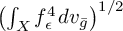 $\left ( \int _X f_{\epsilon }^4 \, dv_{\bar {g}} \right )^{1/2}$
, we get
$\left ( \int _X f_{\epsilon }^4 \, dv_{\bar {g}} \right )^{1/2}$
, we get
 $$ \begin{align} \mathcal{Y}_{\bar{g}}[ f_{\epsilon} ] \leq \frac{\sqrt{6}}{3} \left( \int_X |W_{g_{+}}|^2 \, dv_{g_{+}} \right)^{1/2} + O(\epsilon^{2/3}), \end{align} $$
where $\mathcal {Y}_{\bar {g}}$
is the Yamabe functional associated to
$\mathcal {Y}_{\bar {g}}$
is the Yamabe functional associated to $\bar {g}$
(see (2.3). Letting
$\bar {g}$
(see (2.3). Letting $\epsilon \to 0$
, (5.1) follows.
$\epsilon \to 0$
, (5.1) follows.
The proof of Claim 5.2.
By (5.8) and the conformal transformation law for the Weyl tensor,
 $$ \begin{align*} |Z|^2 &= |Z|_{\bar{g}}^2 \\ &= \big| r W_{g_{+}} \big|_{\bar{g}}^2 \\ &= r^2 \big| W_{g_{+}} \big|_{\bar{g}}^2 \\ &= r^2 \big| r^{-2} W_{\bar{g}} \big|_{\bar{g}}^2 \\ &= r^{-2} | W_{\bar{g}} |^2_{\bar{g}}. \end{align*} $$
 $$ \begin{align*} |Z|^2 &= r^{-2} \big\{ r^2 |\mathcal{C} |^2 + O(r^4) \big\} \\ &= |\mathcal{C} |^2 + O(r^2), \end{align*} $$
where $\mathcal {C}$
is with respect to
$\mathcal {C}$
is with respect to $g = \bar {g}|_M$
. Since r is a special defining function,
$g = \bar {g}|_M$
. Since r is a special defining function, $\nu = - \frac {\partial }{\partial r}\vert _M$
, hence
$\nu = - \frac {\partial }{\partial r}\vert _M$
, hence
 $$ \begin{align} \begin{aligned} \frac{\partial }{\partial \nu} |Z|^2 &= - \frac{\partial}{\partial r} \big\{ |\mathcal{C}|^2 + O(r^2) \big\} \big|_{r=0}\\ &= 0, \end{aligned} \end{align} $$
as claimed.
6 Expansions for four-dimensional Poincaré-Einstein metrics
In this section we calculate the expansion of the Weyl tensor that was needed in the proofs of the main results. Let $(X^4, g_{+})$
be an oriented four-dimensional Poincaré-Einstein manifold with conformal infinity
$(X^4, g_{+})$
be an oriented four-dimensional Poincaré-Einstein manifold with conformal infinity $(M,[\widehat {g}])$
, where
$(M,[\widehat {g}])$
, where $M = \partial X$
. We fix a representative of the conformal infinity which we also denote by
$M = \partial X$
. We fix a representative of the conformal infinity which we also denote by $\widehat {g}$
, and let
$\widehat {g}$
, and let $r> 0$
denote a special defining function associated to
$r> 0$
denote a special defining function associated to $\widehat {g}$
. Let
$\widehat {g}$
. Let $\bar {g} = r^2 g_{+}$
.
$\bar {g} = r^2 g_{+}$
.
In this section we closely follow the conventions and notation of Chapter 5 of [Reference Fefferman and Graham13]. If $\{ \partial _1, \partial _2, \partial _3 \}$
is an oriented local basis of coordinate vector fields on M, then
$\{ \partial _1, \partial _2, \partial _3 \}$
is an oriented local basis of coordinate vector fields on M, then $\{ \partial _0, \partial _1, \partial _2, \partial _3 \}$
is an oriented local basis for a neighbourhood in X. We use lower case Greek indices when labelling components of tensor fields on X (e.g.,
$\{ \partial _0, \partial _1, \partial _2, \partial _3 \}$
is an oriented local basis for a neighbourhood in X. We use lower case Greek indices when labelling components of tensor fields on X (e.g., $0 \leq \alpha \leq 3$
), and lower case Latin indices for tensor fields on M (e.g.,
$0 \leq \alpha \leq 3$
), and lower case Latin indices for tensor fields on M (e.g., $1 \leq i \leq 3$
). The
$1 \leq i \leq 3$
). The $0$
-index always corresponds to
$0$
-index always corresponds to $\partial _r$
.
$\partial _r$
.
By the Fefferman-Graham expansions,
 $$ \begin{align} g_{ij} = \widehat{g}_{ij} - r^2 \widehat{P}_{ij} + r^3 g^{(3)}_{ij} + r^4 g^{(4)}_{ij} + O(r^5), \end{align} $$
where $\widehat {P}$
is the Schouten tensor with respect to
$\widehat {P}$
is the Schouten tensor with respect to $\widehat {g}$
. This implies the following expansions for the Christoffel symbols:
$\widehat {g}$
. This implies the following expansions for the Christoffel symbols:
 $$ \begin{align} \begin{aligned} \bar{\Gamma}_{ij}^k &= \widehat{\Gamma}_{ij}^k - \frac{1}{2} r^2 \big[ \widehat{\nabla}_i \widehat{P}_j^k + \widehat{\nabla}_j \widehat{P}_i^k - \widehat{\nabla}^k \widehat{P}_{ij} \big] + O(r^3), \\ \bar{\Gamma}_{ij}^0 &= r \widehat{P}_{ij} - \frac{3}{2} r^2 g^{(3)}_{ij} - 2 r^3 g^{(4)}_{ij} + O(r^4), \\ \bar{\Gamma}_{i0}^k &= - r \widehat{P}_i^k + \frac{3}{2} r^2 (g^{(3)})_i^k + r^3 \big[ 2 (g^{(4)})_i^k - (\widehat{P}^2)_i^k \big] + O(r^4), \\ \bar{\Gamma}_{0j}^k &= \bar{\Gamma}_{00}^k = \bar{\Gamma}_{00}^0 = 0. \end{aligned} \end{align} $$
where $\widehat {\nabla }$
is the connection with respect to
$\widehat {\nabla }$
is the connection with respect to $\widehat {g}$
. Using these formulas and the formulas from page 48 of [Reference Fefferman and Graham13], we conclude
$\widehat {g}$
. Using these formulas and the formulas from page 48 of [Reference Fefferman and Graham13], we conclude
 $$ \begin{align} \begin{aligned} \overline{R}_{ijk\ell} &= \widehat{R}_{ijk\ell} + \frac{1}{2}r^2 \Big[ \widehat{\nabla}_j C_{i k \ell} - \widehat{\nabla}_{i} C_{j k \ell} - \widehat{g}_{ik} (\widehat{P}^2)_{j \ell} + \widehat{g}_{i \ell} (\widehat{P}^2)_{j k} \\ & \ \ \ \ \ + \widehat{g}_{j k} (\widehat{P}^2)_{i \ell} - \widehat{g}_{j \ell} (\widehat{P}^2)_{ik} - 4 \widehat{P}_{ik} \widehat{P}_{j \ell} + 4 \widehat{P}_{jk} \widehat{P}_{i\ell} \Big] + O(r^3), \\ \overline{R}_{i 0 j 0} &= \widehat{P}_{ij} - 3r g^{(3)}_{ij} + r^2 \big[ (\widehat{P}^2)_{ij} - 6 g^{(4)}_{ij} \big] + O(r^3), \\ \overline{R}_{0ijk} &= - r C_{ijk} + \frac{3}{2} r^2 \big[ \widehat{\nabla}_k g^{(3)}_{ij} - \widehat{\nabla}_j g^{(3)}_{ik} \big] + O(r^3), \end{aligned} \end{align} $$
where C is the Cotton tensor with respect $\widehat {g}$
:
$\widehat {g}$
:
 $$ \begin{align*} C_{ijk} = \widehat{\nabla}_k \widehat{P}_{ij} - \widehat{\nabla}_j \widehat{P}_{ik}. \end{align*} $$
6.1 Expansion of the Weyl tensor
To obtain expansions for the Weyl tensor, we first need expansions of the Schouten tensor $\overline {P}$
with respect to
$\overline {P}$
with respect to $\bar {g}$
. Since
$\bar {g}$
. Since $g_{+} = r^{-2} \bar {g}$
, the conformal transformation law for the Schouten tensor implies
$g_{+} = r^{-2} \bar {g}$
, the conformal transformation law for the Schouten tensor implies
 $$ \begin{align} P_{g_{+}} = \bar{P} + \dfrac{\bar{\nabla}^2 r}{r} - \frac{1}{2} \dfrac{|\bar{\nabla} r|^2}{r^2} \bar{g}. \end{align} $$
By the Einstein condition and the fact that r is a special defining function, this gives
 $$ \begin{align} \overline{P} = -\dfrac{\bar{\nabla}^2 r}{r}. \end{align} $$
Using the formulas for the Christoffel symbols in (6.2), we get
 $$ \begin{align} \begin{aligned} \overline{P}_{ij} &= \widehat{P}_{ij} - \frac{3}{2} r g^{(3)}_{ij} - 2 r^2 g^{(4)}_{ij} + O(r^3), \\ \overline{P}_{i0} &= 0,\\ \overline{P}_{00} &= 0. \end{aligned} \end{align} $$
By the standard decomposition of the curvature tensor,
 $$ \begin{align*} \overline{W}_{\alpha \beta \gamma \delta} = \overline{R}_{\alpha \beta \gamma \delta} - \bar{g}_{\alpha \gamma} \overline{P}_{\beta \delta} + \bar{g}_{\alpha \delta} \overline{P}_{\beta \gamma} + \bar{g}_{\beta \gamma} \overline{P}_{\alpha \delta} - \bar{g}_{\beta \delta} \overline{P}_{\alpha \gamma}. \end{align*} $$
Using the formulas in (6.3) and (6.6), this implies
 $$ \begin{align} \begin{aligned} \overline{W}_{ijk\ell} &= \frac{3}{2} r \big[ \widehat{g}_{ik} g^{(3)}_{j\ell} - \widehat{g}_{i\ell} g^{(3)}_{jk} - \widehat{g}_{jk} g^{(3)}_{i \ell} + \widehat{g}_{j \ell} g^{(3)}_{ik} \big] + r^2 B_{ijk\ell} + O(r^3), \\ \overline{W}_{i 0 j 0} &= -\frac{3}{2} r g^{(3)}_{ij} + r^2 \big[ (\widehat{P})^2_{ij} - 4 g^{(4)}_{ij} \big] + O(r^3), \\ \overline{W}_{0ijk} &= - r C_{ijk} + \frac{3}{2} r^2 \big[ \widehat{\nabla}_k g^{(3)}_{ij} - \widehat{\nabla}_j g^{(3)}_{ik} \big] + O(r^3), \end{aligned} \end{align} $$
where for notational convenience we define
 $$ \begin{align} \begin{aligned} B_{ijk\ell} &= \frac{1}{2}\big( \widehat{\nabla}_j C_{ik\ell} - \widehat{\nabla}_i C_{jk\ell} \big) - \frac{1}{2} \widehat{g}_{ik} (\widehat{P}^2)_{j \ell} + \frac{1}{2} \widehat{g}_{i\ell} (\widehat{P}^2)_{jk} + \frac{1}{2} \widehat{g}_{jk} (\widehat{P}^2)_{i \ell} - \frac{1}{2} \widehat{g}_{j\ell} (\widehat{P}^2)_{ik}\\ & \ \ \ \ \ \ + 2 \big[ \widehat{g}_{ik} g^{(4)}_{j\ell} - \widehat{g}_{i\ell} g^{(4)}_{jk} - \widehat{g}_{jk} g^{(4)}_{i \ell} + \widehat{g}_{j \ell} g^{(4)}_{ik} \big]. \end{aligned} \end{align} $$
Note that the formula for $\overline {W}_{ijk\ell }$
implies that B is a curvature-type tensor on M.
$\overline {W}_{ijk\ell }$
implies that B is a curvature-type tensor on M.
We can use the above expansions to explicitly compute $g^{(4)}$
:
$g^{(4)}$
:
Proposition 6.1. Let $(X,g_{+})$
be a four-dimensional Poincaré-Einstein manifold, and
$(X,g_{+})$
be a four-dimensional Poincaré-Einstein manifold, and $\widehat {g}$
a representative in the conformal infinity with associated special defining function r. Then
$\widehat {g}$
a representative in the conformal infinity with associated special defining function r. Then
 $$ \begin{align} g^{(4)}_{ij} = \frac{1}{4} \Big( \widehat{\nabla}^k C_{ijk} + (\widehat{P}^2)_{ij} \Big). \end{align} $$
Proof. On M, we define the tensor
 $$ \begin{align} \begin{aligned} B_{ij} &= \widehat{g}^{k \ell} B_{ikj\ell} \\ &= \frac{1}{2} \widehat{\nabla}^k C_{ijk} - \frac{1}{2} (\widehat{P}^2)_{ij} - \frac{1}{2} |\widehat{P}|^2 \widehat{g}_{ij} + 2 \big( g^{(4)}_{ij} + \text{tr}_{\widehat{g}} \, g^{(4)} \, \widehat{g}_{ij} \big). \end{aligned} \end{align} $$
Since $\overline {W}$
and
$\overline {W}$
and $g^{(3)}$
are trace-free,
$g^{(3)}$
are trace-free,
 $$ \begin{align*} 0 &= \bar{g}^{\alpha \beta} \overline{W}_{i \alpha j \beta} \\ &= \bar{g}^{00} \overline{W}_{i0j0} + \bar{g}^{k \ell} \overline{W}_{ikj\ell} \\ &= \Big\{ -\frac{3}{2} r g^{(3)}_{ij} + r^2 \big[ (\widehat{P})^2_{ij} - 4 g^{(4)}_{ij} \big]+ O(r^3) \Big\} \\ & \ \ \ \ \ \ + \big\{ \widehat{g}^{k\ell} + O(r^2) \big\} \Big\{ \frac{3}{2} r \big[ \widehat{g}_{ij} g^{(3)}_{k\ell} - \widehat{g}_{i\ell} g^{(3)}_{jk} - \widehat{g}_{jk} g^{(3)}_{i \ell} + \widehat{g}_{k \ell} g^{(3)}_{ij} \big] + r^2 B_{ikj\ell} + O(r^3) \Big\} \\ &= r^2 \big[ \widehat{P}^2_{ij} - 4 g^{(4)}_{ij} + B_{ij} \big] + O(r^3), \end{align*} $$
hence
 $$ \begin{align} 4 g^{(4)}_{ij} = \widehat{P}^2_{ij} + B_{ij}. \end{align} $$
Taking the trace gives
 $$ \begin{align*} 4 \text{tr}_{\widehat{g}} \, g^{(4)} &= |\widehat{P}|^2 + \text{tr}_{\widehat{g}} \, B \\ &= |\widehat{P}|^2 + \big( - 2 |\widehat{P}|^2 + 8 \text{tr}_{\widehat{g}} \, g^{(4)} \big) \\ &= - |\widehat{P}|^2 + 8 \text{tr}_{\widehat{g}} \, g^{(4)}, \end{align*} $$
so that
 $$ \begin{align} \text{tr}_{\widehat{g}} \, g^{(4)} = \frac{1}{4} |\widehat{P}|^2. \end{align} $$
Returning to (6.11), we have
 $$ \begin{align} \begin{aligned} 4 g^{(4)}_{ij} &= \widehat{P}^2_{ij} + B_{ij} \\ &= \widehat{P}^2_{ij} + \frac{1}{2} \widehat{\nabla}^k C_{ijk} - \frac{1}{2} (\widehat{P}^2)_{ij} - \frac{1}{2} |\widehat{P}|^2 \widehat{g}_{ij} + 2 \big( g^{(4)}_{ij} + \text{tr}_{\widehat{g}} \, g^{(4)} \, \widehat{g}_{ij} \big) \\ &= \widehat{P}^2_{ij} + \frac{1}{2} \widehat{\nabla}^k C_{ijk} - \frac{1}{2} (\widehat{P}^2)_{ij} - \frac{1}{2} |\widehat{P}|^2 \widehat{g}_{ij} + 2 g^{(4)}_{ij} + 2 \big( \frac{1}{4} |\widehat{P}|^2 \big) \widehat{g}_{ij} \\ &= \frac{1}{2} \widehat{\nabla}^k C_{ijk} + \frac{1}{2} (\widehat{P}^2)_{ij} + 2 g^{(4)}_{ij}, \end{aligned} \end{align} $$
and (6.9) follows.
Lemma 6.2. We have
 $$ \begin{align} B_{ijk\ell} = \widehat{g}_{ik} \widehat{\nabla}^m C_{j\ell m} - \widehat{g}_{i \ell} \widehat{\nabla}^m C_{j k m} - \widehat{g}_{jk} \widehat{\nabla}^m C_{i \ell m} + \widehat{g}_{j \ell} \widehat{\nabla}^m C_{i k m}, \end{align} $$
and
 $$ \begin{align} B_{ij} = \widehat{\nabla}^k C_{ijk}. \end{align} $$
Proof. Note that (6.15) is immediate from (6.11) and Proposition 6.1.
Since $B_{ijk\ell }$
is a curvature-type tensor defined on a three-dimensional vector space, its fully trace-free part must vanish:
$B_{ijk\ell }$
is a curvature-type tensor defined on a three-dimensional vector space, its fully trace-free part must vanish:
 $$ \begin{align*} Z_{ijk\ell} &:= B_{ijk\ell} - \big( \widehat{g}_{ik} B_{j\ell} - \widehat{g}_{i\ell} B_{jk} - \widehat{g}_{jk} B_{i\ell} + \widehat{g}_{j \ell} B_{ik} \big) + \frac{1}{2} \text{tr}_{\widehat{g}} \, B \, \big( \widehat{g}_{ik} \widehat{g}_{j\ell} - \widehat{g}_{i\ell} \widehat{g}_{jk} \big) \\ &=0. \end{align*} $$
We thus obtain the following.
Proposition 6.3. Let $(X,g_{+})$
be a four-dimensional Poincaré-Einstein manifold, and
$(X,g_{+})$
be a four-dimensional Poincaré-Einstein manifold, and $\widehat {g}$
a representative in the conformal infinity with associated special defining function r. Then
$\widehat {g}$
a representative in the conformal infinity with associated special defining function r. Then
 $$ \begin{align} \begin{aligned} \overline{W}_{ijk\ell} &= \frac{3}{2} r \big[ \widehat{g}_{ik} g^{(3)}_{j\ell} - \widehat{g}_{i\ell} g^{(3)}_{jk} - \widehat{g}_{jk} g^{(3)}_{i \ell} + \widehat{g}_{j \ell} g^{(3)}_{ik} \big] + r^2 B_{ijk\ell} + O(r^3), \\ \overline{W}_{i 0 j 0} &= -\frac{3}{2} r g^{(3)}_{ij} - r^2 B_{ij} + O(r^3), \\ \overline{W}_{0ijk} &= - r C_{ijk} + \frac{3}{2} r^2 \big[ \widehat{\nabla}_k g^{(3)}_{ij} - \widehat{\nabla}_j g^{(3)}_{ik} \big] + O(r^3), \end{aligned} \end{align} $$
where $B_{ijk\ell }$
and
$B_{ijk\ell }$
and $B_{ij}$
are given by (6.14) and (6.15).
$B_{ij}$
are given by (6.14) and (6.15).
6.2 Expansions of
$\overline {W}^{\pm }$

As in [Reference Fefferman and Graham13], we denote the volume form of $g_r$
by
$g_r$
by $\mu $
, and the volume form of
$\mu $
, and the volume form of $\bar {g}$
by
$\bar {g}$
by $\overline {\mu }$
. Obviously
$\overline {\mu }$
. Obviously
 $$ \begin{align*} \overline{\mu}_{ijk\ell} = 0, \end{align*} $$
since the boundary is three-dimensional. As pointed out in [Reference Fefferman and Graham13],
 $$ \begin{align} \overline{\mu}_{0ijk} = \sqrt{\det g_r} \epsilon_{ijk}. \end{align} $$
We begin with the expansion of $\overline {W}^{+}_{ijk\ell }$
(i.e., all tangential components). To do this, we first compute the expansion of
$\overline {W}^{+}_{ijk\ell }$
(i.e., all tangential components). To do this, we first compute the expansion of $(\star \overline {W})_{ijk\ell }$
:
$(\star \overline {W})_{ijk\ell }$
:
 $$ \begin{align} \begin{aligned} (\star \overline{W})_{ijk\ell} &= \frac{1}{2} \overline{\mu}_{ij}^{\ \ \rho \sigma} \overline{W}_{\rho \sigma k \ell} \\ &= \frac{1}{2}\overline{\mu}_{ij \nu \theta} \bar{g}^{\nu \rho} \bar{g}^{\theta \sigma} \overline{W}_{\rho \sigma k \ell} \\ &= \overline{\mu}_{ijm0} \, \bar{g}^{mp} \overline{W}_{p0k\ell} \\ &= \sqrt{\det g_r} \, \bar{g}^{mp} \epsilon_{ijm} \overline{W}_{0 pk\ell}. \end{aligned} \end{align} $$
From the expansions of $g_r$
above we know
$g_r$
above we know
 $$ \begin{align*} \sqrt{\det g_r} \, \bar{g}^{mp}\, \epsilon_{ijm} &= \big( 1 + O(r^2) \big) \big( \widehat{g}^{mp} + O(r^2) \big) \sqrt{\det \widehat{g}} \, \epsilon_{ijm}\\ &= \widehat{g}^{mp} \sqrt{\det \widehat{g}} \, \epsilon_{ijm} + O(r^2) \\ &= \widehat{\mu}_{ij}^{\ \ p} + O(r^2), \end{align*} $$
where $\widehat {\mu }$
is the volume form of
$\widehat {\mu }$
is the volume form of $\widehat {g}$
. Then using the expansion of
$\widehat {g}$
. Then using the expansion of $\overline {W}$
in (6.7), we get
$\overline {W}$
in (6.7), we get
 $$ \begin{align} (\star \overline{W})_{ijk\ell} = - r \, \widehat{\mu}_{ij}^{\ \ p} \, C_{pk\ell} + \frac{3}{2} r^2 \big( \widehat{\nabla}_{\ell} g^{(3)}_{pk} - \widehat{\nabla}_k g^{(3)}_{p \ell} \big) \widehat{\mu}_{ij}^{\ \ p} + O(r^3). \end{align} $$
Combining with the first formula in (6.7) gives
 $$ \begin{align} \begin{aligned} \overline{W}^{+}_{ijk\ell} &= \frac{1}{2} \big( \overline{W}_{ijk\ell} + (\star \overline{W})_{ijk\ell} \big) \\ &= r \Big\{ \frac{3}{4} \big[ \widehat{g}_{ik} g^{(3)}_{j\ell} - \widehat{g}_{i\ell} g^{(3)}_{jk} - \widehat{g}_{jk} g^{(3)}_{i \ell} + \widehat{g}_{j \ell} g^{(3)}_{ik} \big] -\frac{1}{2} \, \widehat{\mu}_{ij}^{\ \ p} \, C_{pk\ell} \Big\} \\ & \ \ \ \ + r^2 \Big\{ \frac{1}{2} B_{ijk\ell} + \frac{3}{4} \big( \widehat{\nabla}_{\ell} g^{(3)}_{pk} - \widehat{\nabla}_k g^{(3)}_{p \ell} \big) \widehat{\mu}_{ij}^{\ \ p}\Big\} + O(r^3). \end{aligned} \end{align} $$
Similarly,
 $$ \begin{align} \begin{aligned} \overline{W}^{-}_{ijk\ell} &= \frac{1}{2} \big( \overline{W}_{ijk\ell} - (\star \overline{W})_{ijk\ell} \big) \\ &= r \Big\{ \frac{3}{4} \big[ \widehat{g}_{ik} g^{(3)}_{j\ell} - \widehat{g}_{i\ell} g^{(3)}_{jk} - \widehat{g}_{jk} g^{(3)}_{i \ell} + \widehat{g}_{j \ell} g^{(3)}_{ik} \big] +\frac{1}{2} \, \widehat{\mu}_{ij}^{\ \ p} \, C_{pk\ell} \Big\} \\ & \ \ \ \ + r^2 \Big\{ \frac{1}{2} B_{ijk\ell} - \frac{3}{4} \big( \widehat{\nabla}_{\ell} g^{(3)}_{pk} - \widehat{\nabla}_k g^{(3)}_{p \ell} \big) \widehat{\mu}_{ij}^{\ \ p}\Big\} + O(r^3). \end{aligned} \end{align} $$
Next we compute $(\star \overline {W})_{i0j0}$
:
$(\star \overline {W})_{i0j0}$
:
 $$ \begin{align*} (\star \overline{W})_{i0j0} &= \frac{1}{2} \bar{g}^{km} \bar{g}^{\ell p} \overline{\mu}_{0ik\ell} \overline{W}_{0jmp} \\ &= \frac{1}{2} \bar{g}^{km} \bar{g}^{\ell p} \sqrt{ \det g_r } \, \epsilon_{ik\ell} \overline{W}_{0jmp}. \end{align*} $$
Consequently,
 $$ \begin{align} (\star \overline{W})_{i0j0} = -\frac{1}{2} r \, \widehat{\mu}_i^{\ mp} \, C_{jmp} + \frac{3}{4} r^2 \big( \widehat{\nabla}_{p} g^{(3)}_{jm} - \widehat{\nabla}_m g^{(3)}_{jp} \big)\widehat{\mu}_i^{\ mp} + O(r^3), \end{align} $$
and
 $$ \begin{align} \begin{aligned} \overline{W}^{+}_{i0j0} &= \frac{1}{2} \big( \overline{W}_{i0j0} + (\star \overline{W})_{i0j0} \big) \\ &= r \Big\{ -\frac{3}{4} g^{(3)}_{ij} - \frac{1}{4} \,\widehat{\mu}_i^{\ mp} \, C_{jmp} \Big\} \\ & \ \ + r^2 \Big\{ -\frac{1}{2} B_{ij} + \frac{3}{8} \big( \widehat{\nabla}_{p} g^{(3)}_{jm} - \widehat{\nabla}_m g^{(3)}_{jp} \big) \widehat{\mu}_i^{\ mp} \Big\} + O(r^3). \end{aligned} \end{align} $$
Likewise,
 $$ \begin{align} \begin{aligned} \overline{W}^{-}_{i0j0} &= r \Big\{ -\frac{3}{4} g^{(3)}_{ij} + \frac{1}{4} \,\widehat{\mu}_i^{\ mp} \, C_{jmp} \Big\} \\ & \ \ + r^2 \Big\{ - \frac{1}{2} B_{ij} - \frac{3}{8} \big( \widehat{\nabla}_{p} g^{(3)}_{jm} - \widehat{\nabla}_m g^{(3)}_{jp} \big) \widehat{\mu}_i^{\ mp} \Big\} + O(r^3). \end{aligned} \end{align} $$
Finally,
 $$ \begin{align*} (\star \overline{W})_{0ijk} &= \frac{1}{2} \bar{g}^{\ell p } \bar{g}^{q m} \overline{\mu}_{0i \ell m} \overline{W}_{pq jk} \\ &= \frac{1}{2} \bar{g}^{\ell p} \bar{g}^{q m} \sqrt{ \det g_r } \, \epsilon_{i \ell m} \overline{W}_{pqjk}; \end{align*} $$
hence
 $$ \begin{align*} (\star \overline{W})_{0ijk} &= \frac{3}{4} r \Big\{ \widehat{g}_{jp} g^{(3)}_{kq} - \widehat{g}_{kp} g^{(3)}_{jq} - \widehat{g}_{jq} g^{(3)}_{kp} + \widehat{g}_{kq} g^{(3)}_{jp} \Big\}\, \widehat{\mu}_i^{\ pq} + \frac{1}{2} r^2 \widehat{\mu}_i^{\ pq} B_{pq jk} + O(r^3). \\ \end{align*} $$
It follows that
 $$ \begin{align} \begin{aligned} \overline{W}^{+}_{0ijk} &= r \Bigg\{ \frac{3}{8} \Big[ \widehat{g}_{jp} g^{(3)}_{kq} - \widehat{g}_{kp} g^{(3)}_{jq} - \widehat{g}_{jq} g^{(3)}_{kp} + \widehat{g}_{kq} g^{(3)}_{jp} \Big]\, \widehat{\mu}_i^{\ pq} - \frac{1}{2} C_{ijk} \Bigg\} \\ & \ \ \ \ + r^2 \Big\{ \frac{1}{4} \widehat{\mu}_i^{\ pq} B_{pqjk} + \frac{3}{4} \big[ \widehat{\nabla}_k g^{(3)}_{ij} - \widehat{\nabla}_j g^{(3)}_{ik} \big]\Big\} + O(r^3), \end{aligned} \end{align} $$
 $$ \begin{align} \begin{aligned} \overline{W}^{-}_{0ijk} &= r \Bigg\{ - \frac{3}{8} \Big[ \widehat{g}_{jp} g^{(3)}_{kq} - \widehat{g}_{kp} g^{(3)}_{jq} - \widehat{g}_{jq} g^{(3)}_{kp} + \widehat{g}_{kq} g^{(3)}_{jp} \Big]\, \widehat{\mu}_i^{\ pq} - \frac{1}{2} C_{ijk} \Bigg\} \\ & \ \ \ \ + r^2 \Big\{ - \frac{1}{4} \widehat{\mu}_i^{\ pq} B_{pqjk} + \frac{3}{4} \big[ \widehat{\nabla}_k g^{(3)}_{ij} - \widehat{\nabla}_j g^{(3)}_{ik} \big]\Big\} + O(r^3), \end{aligned} \end{align} $$
Summarizing, we have
Proposition 6.4. Let $(X,g_{+})$
be an oriented, four-dimensional Poincaré-Einstein manifold. Let
$(X,g_{+})$
be an oriented, four-dimensional Poincaré-Einstein manifold. Let $\widehat {g}$
be a representative of the conformal infinity, and r the associated special defining function, and
$\widehat {g}$
be a representative of the conformal infinity, and r the associated special defining function, and $\bar {g} = r^2 g_{+}$
. Then
$\bar {g} = r^2 g_{+}$
. Then
 $$ \begin{align} \begin{aligned} \overline{W}^{\pm}_{ijk\ell} &= r \Big\{ \frac{3}{4} \big[ \widehat{g}_{ik} g^{(3)}_{j\ell} - \widehat{g}_{i\ell} g^{(3)}_{jk} - \widehat{g}_{jk} g^{(3)}_{i \ell} + \widehat{g}_{j \ell} g^{(3)}_{ik} \big] \mp \frac{1}{2} \, \widehat{\mu}_{ij}^{\ \ p} \, C_{pk\ell} \Big\} \\ & \ \ \ \ + r^2 \Big\{ \frac{1}{2} B_{ijk\ell} \pm \frac{3}{4} \big( \widehat{\nabla}_{\ell} g^{(3)}_{pk} - \widehat{\nabla}_k g^{(3)}_{p \ell} \big) \widehat{\mu}_{ij}^{\ \ p}\Big\} + O(r^3), \\ \overline{W}^{\pm}_{i0j0} &= r \Big\{ -\frac{3}{4} g^{(3)}_{ij} \mp \frac{1}{4} \,\widehat{\mu}_i^{\ mp} \, C_{jmp} \Big\} + r^2 \Big\{ -\frac{1}{2} B_{ij} \pm \frac{3}{8} \big( \widehat{\nabla}_{p} g^{(3)}_{jm} - \widehat{\nabla}_m g^{(3)}_{jp} \big) \widehat{\mu}_i^{\ mp} \Big\} + O(r^3), \\ \overline{W}^{\pm}_{0ijk} &= r \Bigg\{ \pm \frac{3}{8} \Big[ \widehat{g}_{jp} g^{(3)}_{kq} - \widehat{g}_{kp} g^{(3)}_{jq} - \widehat{g}_{jq} g^{(3)}_{kp} + \widehat{g}_{kq} g^{(3)}_{jp} \Big]\, \widehat{\mu}_i^{\ pq} - \frac{1}{2} C_{ijk} \Bigg\} \\ & \ \ \ \ + r^2 \Big\{ \pm \frac{1}{4} \widehat{\mu}_i^{\ pq} B_{pqjk} + \frac{3}{4} \big[ \widehat{\nabla}_k g^{(3)}_{ij} - \widehat{\nabla}_j g^{(3)}_{ik} \big]\Big\} + O(r^3), \end{aligned} \end{align} $$
where the tensors $B_{ijk\ell }$
and
$B_{ijk\ell }$
and $B_{ij}$
are given by (6.8) and (6.10).
$B_{ij}$
are given by (6.8) and (6.10).
7 Expansions for even and self-dual metrics
In this section we state two key corollaries of the preceding calculations.
Corollary 7.1. Let $(X,g_{+})$
be an even, four-dimensional Poincaré-Einstein manifold, and
$(X,g_{+})$
be an even, four-dimensional Poincaré-Einstein manifold, and $\widehat {g}$
a representative in the conformal infinity with associated special defining function r. Then
$\widehat {g}$
a representative in the conformal infinity with associated special defining function r. Then
 $$ \begin{align} \begin{aligned} \overline{W}_{ijk\ell} &= r^2 B_{ijk\ell} + O(r^3), \\ \overline{W}_{i 0 j 0} &= - r^2 B_{ij} + O(r^3), \\ \overline{W}_{0ijk} &= - r C_{ijk} + O(r^3), \end{aligned} \end{align} $$
where $B_{ijk\ell }$
and
$B_{ijk\ell }$
and $B_{ij}$
are given by (6.14) and (6.15). In particular,
$B_{ij}$
are given by (6.14) and (6.15). In particular,
 $$ \begin{align} |\overline{W}|^2_{\bar{g}} = r^2 |C|^2 + O(r^4). \end{align} $$
Also, we have
 $$ \begin{align} \begin{aligned} \overline{W}^{\pm}_{ijk\ell} &= \mp \frac{1}{2} r \, \widehat{\mu}_{ij}^{\ \ p} \, C_{pk\ell} + \frac{1}{2} r^2 B_{ijk\ell} + O(r^3), \\ \overline{W}^{\pm}_{i0j0} &= \mp \frac{1}{4} r \,\widehat{\mu}_i^{\ mp} \, C_{jmp} -\frac{1}{2} r^2 B_{ij} + O(r^3), \\ \overline{W}^{+}_{0ijk} &= - \frac{1}{2} r C_{ijk} \pm \frac{1}{4} r^2 \widehat{\mu}_i^{\ pq} B_{pqjk} + O(r^3). \end{aligned} \end{align} $$

Corollary 7.2. If $(X,g_{+})$
is an oriented, self-dual Poincaré-Einstein manifold, then
$(X,g_{+})$
is an oriented, self-dual Poincaré-Einstein manifold, then
 $$ \begin{align} \begin{aligned} \overline{W}^{+}_{ijk\ell} &= - r \, \widehat{\mu}_{ij}^{\ \ p} \, C_{pk\ell} + r^2 B_{ijk\ell} + O(r^3), \\ \overline{W}^{+}_{i0j0} &= -\frac{1}{2} r \, \mathcal{C}_{ij} - r^2 B_{ij} + O(r^3), \\ \overline{W}^{+}_{0ijk} &= - r C_{ijk} + \frac{1}{2} r^2 B_{pqjk} \, \widehat{\mu}_i^{\ pq} + O(r^3), \end{aligned} \end{align} $$
where
 $$ \begin{align} \mathcal{C}_{ij} = \widehat{\mu}_i^{\ k\ell} C_{j k \ell}. \end{align} $$
Proof. Since $g_{+}$
is self-dual, it follows from (6.21) that
$g_{+}$
is self-dual, it follows from (6.21) that
 $$ \begin{align} \begin{aligned} &\frac{3}{4} \big[ \widehat{g}_{ik} g^{(3)}_{j\ell} - \widehat{g}_{i\ell} g^{(3)}_{jk} - \widehat{g}_{jk} g^{(3)}_{i \ell} + \widehat{g}_{j \ell} g^{(3)}_{ik} \big] = - \frac{1}{2} \, \widehat{\mu}_{ij}^{\ \ p} \, C_{pk\ell}, \\ & \ \ \ \ \ \ \ \ \frac{3}{4} \big( \widehat{\nabla}_{\ell} g^{(3)}_{pk} - \widehat{\nabla}_k g^{(3)}_{p \ell} \big) \widehat{\mu}_{ij}^{\ \ p} = \frac{1}{2} B_{ijk\ell}. \end{aligned} \end{align} $$
Note that the first formula above is equivalent to (5.5) of Theorem 5.3 in [Reference Fefferman and Graham13].
Substituting these into (6.20) we get the first formula in (7.4). The proof of the other two formulas is similar.
Determining the expansion of the norm of the Weyl tensor is much more involved in the self-dual case, so we state it as a separate result:
Proposition 7.3. If $(X,g_{+})$
is an oriented self-dual Poincaré-Einstein manifold, then
$(X,g_{+})$
is an oriented self-dual Poincaré-Einstein manifold, then
 $$ \begin{align} |\overline{W}^{+}|_{\bar{g}}^2 = r^2 \, |\mathcal{C}|_{\widehat{g}}^2 + 4 r^3 \, \langle B, \mathcal{C} \rangle + O(r^4). \end{align} $$
Proof. First, we note that
 $$ \begin{align} \begin{aligned} |\overline{W}^{+}|_{\bar{g}}^2 &= \frac{1}{4} \bar{g}^{\alpha \mu} \bar{g}^{\beta \nu} \bar{g}^{\gamma \delta} \bar{g}^{\sigma \tau} \overline{W}^{+}_{\alpha \beta \gamma \sigma} \overline{W}^{+}_{\mu \nu \delta \tau} \\ &= \frac{1}{4} \bar{g}^{ip} \bar{g}^{jq} \bar{g}^{kr} \bar{g}^{\ell s} \overline{W}^{+}_{ijk\ell} \overline{W}^{+}_{pq rs} + \bar{g}^{ip} \bar{g}^{jq} \bar{g}^{kr} \overline{W}^{+}_{0ijk} \overline{W}^{+}_{0 pqr} \\ & \ \ \ \ + \bar{g}^{ip} \bar{g}^{jq} \overline{W}^{+}_{i 0 j 0} \overline{W}^{+}_{p 0 q 0} \\ &:= I_1 + I_2 + I_3. \end{aligned} \end{align} $$
By the first formula in (7.4),
 $$ \begin{align} I_1 &= \frac{1}{4} \bar{g}^{ip} \bar{g}^{jq} \bar{g}^{kr} \bar{g}^{\ell s} \overline{W}^{+}_{ijk\ell} \overline{W}^{+}_{pq rs}\nonumber \\ &= \frac{1}{4} \big( \widehat{g}^{ip} + O(r^2) \big)\big( \widehat{g}^{jq} + O(r^2) \big) \big( \widehat{g}^{kr} + O(r^2) \big) \big( \widehat{g}^{\ell s} + O(r^2) \big) \Big\{ - r \, \widehat{\mu}_{ij}^{\ \ m} \, C_{mk\ell} + r^2 B_{ijk\ell}\nonumber \\ & \ \ \ + O(r^3) \Big\} \Big\{ - r \, \widehat{\mu}_{pq}^{\ \ n} \, C_{nrs} + r^2 B_{pqrs} + O(r^3) \Big\}\nonumber \\ &= \frac{1}{4} r^2 \, \widehat{g}^{ip} \widehat{g}^{jq} \widehat{g}^{kr} \widehat{g}^{\ell s} \widehat{\mu}_{ij}^{\ \ m} \widehat{\mu}_{pq}^{\ \ n} C_{mk\ell} C_{nrs} - \frac{1}{2} r^3 \, \widehat{g}^{ip} \widehat{g}^{jq} \widehat{g}^{kr} \widehat{g}^{\ell s} \widehat{\mu}_{ij}^{\ \ m} \widehat{\mu}_{pq}^{\ \ n} C_{mk\ell} B_{pqrs} + O(r^4)\nonumber \\ &= \frac{1}{4} r^2 \, \widehat{\mu}^{pqm} \widehat{\mu}_{pq}^{\ \ n} C_{mk\ell} C_n^{\ k \ell} - \frac{1}{2} r^3 \, \widehat{\mu}^{pqm} C_{m k \ell} B_{pq}^{\ \ k \ell} + O(r^4). \end{align} $$
It will be convenient to rewrite the second term on the right. First, by skew-symmetry of the volume form,
 $$ \begin{align} - \frac{1}{2} \, \widehat{\mu}^{pqm} C_{m k \ell} B_{pq}^{\ \ k \ell} = - \frac{1}{2} \, \widehat{\mu}^{mpq} B_{pq}^{\ \ k \ell} C_{m k \ell}. \end{align} $$
Claim 7.4.
 $$ \begin{align} - \frac{1}{2} \widehat{\mu}^{mpq} B_{pq}^{\ \ k \ell} C_{m k \ell} = \langle B, \mathcal{C} \rangle = B_i^j \mathcal{C}_j^i. \end{align} $$
Proof. In the following, we will repeatedly use the identity
 $$ \begin{align} \widehat{\mu}^{pij} \widehat{\mu}_{pk\ell} = \delta_{ik} \delta_{j \ell} - \delta_{jk} \delta_{i \ell}. \end{align} $$
From this, it follows that
 $$ \begin{align*} \frac{1}{2} \widehat{\mu}^m_{\ jk} \mathcal{C}_{mi} &= \frac{1}{2} \widehat{\mu}^m_{\ jk} \widehat{\mu}_m^{\ pq} C_{ipq} \\ &= \frac{1}{2} \widehat{\mu}_{mjk} \widehat{\mu}^{mpq} C_{ipq} \\ &= \frac{1}{2} \big( \delta_{jp} \delta_{kq} - \delta_{jq} \delta_{kp} \big) C_{ipq} \\ &= \frac{1}{2} \big( C_{ijk} - C_{ikj} \big) \\ &= C_{ijk}, \end{align*} $$
which can also be expressed as
 $$ \begin{align} C_{ijk} = \frac{1}{2} \widehat{\mu}_{mjk} \mathcal{C}_i^m. \end{align} $$
Since $C_{[mk\ell ]} = 0$
, we can rewrite the term in (7.11) as
$C_{[mk\ell ]} = 0$
, we can rewrite the term in (7.11) as
 $$ \begin{align} \begin{aligned} - \frac{1}{2} \widehat{\mu}^{mpq} B_{pq}^{\ \ k \ell} C_{m k \ell} &= \frac{1}{2} \widehat{\mu}^{mpq} B_{pq}^{\ \ k \ell} C_{k\ell m} + \frac{1}{2} \widehat{\mu}^{mpq} B_{pq}^{\ \ k \ell} C_{\ell m k }. \end{aligned} \end{align} $$
Hence, by (7.13),
 $$ \begin{align} \begin{aligned} - \frac{1}{2} \widehat{\mu}^{mpq} B_{pq}^{\ \ k \ell} C_{m k \ell} &= \frac{1}{4} \widehat{\mu}^{mpq} B_{pq}^{\ \ k \ell} \widehat{\mu}_{s\ell m} \mathcal{C}^s_k + \frac{1}{4} \widehat{\mu}^{mpq} B_{pq}^{\ \ k \ell} \widehat{\mu}_{smk} \mathcal{C}^s_{\ell} \\ &= - \frac{1}{4} \widehat{\mu}^{mpq} \widehat{\mu}_{m \ell s} B_{pq}^{\ \ k \ell} \mathcal{C}^s_k - \frac{1}{4} \widehat{\mu}^{mpq} \widehat{\mu}_{msk} B_{pq}^{\ \ k \ell} \mathcal{C}^s_{\ell} \\ &= - \frac{1}{4} \big( \delta_{p \ell} \delta_{q s} - \delta_{\ell q} \delta_{ps} \big) B_{pq}^{\ \ k \ell} \mathcal{C}^s_k - \frac{1}{4} \big( \delta_{ps} \delta_{qk} - \delta_{sq} \delta_{pk} \big) B_{pq}^{\ \ k \ell} \mathcal{C}^s_{\ell} \\ &= B_s^k \mathcal{C}_k^s. \end{aligned}\\[-34pt]\nonumber \end{align} $$
For the first term in the last line of (7.9), we use the identity (7.12) to show
 $$ \begin{align*} \frac{1}{4} r^2 \, \widehat{\mu}^{pqm} \widehat{\mu}_{pq}^{\ \ n} C_{mk\ell} C_n^{\ k \ell} = \frac{1}{4} |\mathcal{C}|^2. \end{align*} $$
Combining with Claim 7.4, we get
 $$ \begin{align} I_1 = \frac{1}{4} r^2 |\mathcal{C}|^2 + r^3 \, \langle B , \mathcal{C} \rangle + O(r^4). \end{align} $$
Using the second formula in (7.4) we find
 $$ \begin{align} \begin{aligned} I_2 &= \bar{g}^{ip} \bar{g}^{jq} \bar{g}^{kr} \overline{W}^{+}_{0ijk} \overline{W}^{+}_{0 pqr} \\ &= \big( \widehat{g}^{ip} + O(r^2) \big)\big( \widehat{g}^{jq} + O(r^2) \big) \big( \widehat{g}^{kr} + O(r^2) \big) \Big\{ - r C_{ijk} + \frac{1}{2} r^2 B_{pqjk} \, \widehat{\mu}_i^{\ pq} + O(r^3) \Big\} \\ & \ \ \ \times \Big\{ - r C_{pqr} + \frac{1}{2} r^2 B_{abqr} \, \widehat{\mu}_p^{\ ab} + O(r^3) \Big\} \\ &= r^2 \, \widehat{g}^{ip} \widehat{g}^{jq} \widehat{g}^{kr}C_{ijk} C_{pqr} - r^3 \, \widehat{g}^{ip} \widehat{g}^{jq} \widehat{g}^{kr} C_{ijk} B_{abqr} \, \widehat{\mu}_p^{\ ab} + O(r^4) \\ &= \frac{1}{2} r^2 |\mathcal{C}|^2 - r^3 \, \widehat{\mu}^{iab} B_{ab}^{\ \ jk} C_{ijk} + O(r^4). \end{aligned} \end{align} $$
By Claim 7.4, this can be expressed as
 $$ \begin{align} I_2 = \frac{1}{2} r^2 |\mathcal{C}|^2 + 2 r^3 \, \langle B, \mathcal{C} \rangle + O(r^4). \end{align} $$
Finally,
 $$ \begin{align} \begin{aligned} I_3 &= \bar{g}^{ip} \bar{g}^{jq} \overline{W}^{+}_{i 0 j 0} \overline{W}^{+}_{p 0 q 0} \\ &= \big( \widehat{g}^{ip} + O(r^2) \big) \big( \widehat{g}^{jq} + O(r^2) \big) \Big\{ -\frac{1}{2} r \, \mathcal{C}_{ij} - r^2 B_{ij} + O(r^3) \Big\} \Big\{ -\frac{1}{2} r \, \mathcal{C}_{pq} - r^2 B_{pq} + O(r^3) \Big\} \\ &= \frac{1}{4} r^2 \, |\mathcal{C}|_{\widehat{g}}^2 + r^3 \, \widehat{g}^{ip} \widehat{g}^{kq} \mathcal{C}_{ij} B_{pq} + O(r^4) \\ &= \frac{1}{4} r^2 \, |\mathcal{C}|_{\widehat{g}}^2 + r^3 \, \langle B, \mathcal{C} \rangle + O(r^4). \end{aligned} \end{align} $$
8 A conformal invariant in dimension three
The proof of Theorem 1.1.
Although it is possible to verify (1.7) directly, we will give a ‘holographic’ construction of the invariants.
Let $(M,g)$
be a three-dimensional Riemannian manifold. By Theorem 5.3 of [Reference Fefferman and Graham13], there is an
$(M,g)$
be a three-dimensional Riemannian manifold. By Theorem 5.3 of [Reference Fefferman and Graham13], there is an $\epsilon> 0$
and a (formal) self-dual Poincaré-Einstein metric
$\epsilon> 0$
and a (formal) self-dual Poincaré-Einstein metric $g_{+}$
defined on
$g_{+}$
defined on $X = M \times [0,\epsilon )$
whose conformal infinity is
$X = M \times [0,\epsilon )$
whose conformal infinity is $(M,[g])$
. By ‘formal’, we mean that
$(M,[g])$
. By ‘formal’, we mean that $g_{+}$
can be expressed as
$g_{+}$
can be expressed as
 $$ \begin{align*} g_{+} = r^{-2} \left( dr^2 + g_r \right), \end{align*} $$
where $g_r$
is a one-parameter family of metrics on M that is determined to infinite order. In particular, if we write
$g_r$
is a one-parameter family of metrics on M that is determined to infinite order. In particular, if we write
 $$ \begin{align*} g_r = g + g^{(2)} r^2 + g^{(3)} r^3 + g^{(4)} r^4 + \cdots, \end{align*} $$
then the Einstein condition determines $g^{(2)}$
and
$g^{(2)}$
and $g^{(4)}$
, while the self-duality condition determines
$g^{(4)}$
, while the self-duality condition determines $g^{(3)}$
(see (7.6)). Then, by the proof of Proposition 7.3,
$g^{(3)}$
(see (7.6)). Then, by the proof of Proposition 7.3,
 $$ \begin{align} |\overline{W}^{+}|_{\bar{g}}^2 = r^2 \, |\mathcal{C}_{g}|_{g}^2 + 4 r^3 \, \langle B_g, \mathcal{C}_g \rangle_g + O(r^4), \end{align} $$
where $\bar {g} = r^2 g_{+} = dr^2 + g_r$
. Since
$\bar {g} = r^2 g_{+} = dr^2 + g_r$
. Since
 $$ \begin{align*} |W^{+}_{g_{+}}|^2_{g_{+}} = r^4 |\overline{W}^{+}|_{\bar{g}}^2, \end{align*} $$
(8.1) implies
 $$ \begin{align} |W^{+}_{g_{+}}|^2_{g_{+}} = r^6 \, |\mathcal{C}_{g}|_{g}^2 + 4 r^7 \, \langle B_g, \mathcal{C}_g \rangle_g + O(r^8). \end{align} $$
Now, let $\tilde {g} \in [g]$
, and write
$\tilde {g} \in [g]$
, and write
 $$ \begin{align} \tilde{g} = e^{2w_0} g \end{align} $$
for some $w_0 \in C^{\infty }(M)$
. If we write
$w_0 \in C^{\infty }(M)$
. If we write $g_{+}$
in normal form with
$g_{+}$
in normal form with
 $$ \begin{align*} g_{+} = \tilde{r}^{-2} \left( d\tilde{r}^2 + \tilde{g}_{\tilde{r}} \right), \end{align*} $$
where $\tilde {g}_{\tilde {r}} \vert _{\tilde {r} = 0} = \tilde {g}$
, then (8.2) becomes
$\tilde {g}_{\tilde {r}} \vert _{\tilde {r} = 0} = \tilde {g}$
, then (8.2) becomes
 $$ \begin{align} |W^{+}_{g_{+}}|^2_{g_{+}} = \tilde{r}^6 \, |\mathcal{C}_{\tilde{g}}|_{\tilde{g}}^2 + 4 \tilde{r}^7 \, \langle B_{\tilde{g}}, \mathcal{C}_{\tilde{g}} \rangle_{\tilde{g}} + O(\tilde{r}^8). \end{align} $$
By Lemma 2.2 of [Reference Graham14],
 $$ \begin{align*} \tilde{r} = r e^w, \end{align*} $$
where w has an expansion that consists of only even powers of r:
 $$ \begin{align*} w = w_0 + O(r^2), \end{align*} $$
where $w_0$
is given in (8.3). In particular,
$w_0$
is given in (8.3). In particular,
 $$ \begin{align} \begin{aligned} \tilde{r}^6 &= r^6 e^{6w_0} + O(r^8), \\ \tilde{r}^7 &= r^7 e^{7w_0} + O(r^9). \end{aligned} \end{align} $$
Substituting these into (8.4) and comparing with (8.2), we get (1.7).
Acknowledgements.
The authors would like to thank Alice Chang for informing us of her work with Yuxin Ge, which we quote in Lemma 2.2, and for numerous enlightening conversations. The first author acknowledges the support of NSF grant DMS-2105460. The second author acknowledges the support of Simons Foundation grant 966614
Competing interests
The authors declare that they have no competing interests.


 Open access

