


Impact statements
Rewilding represents a transformative approach to conservation, emphasising the restoration of ecological processes and ecosystem resilience. This manuscript addresses a critical gap in rewilding practice by advocating for the integration of qualitative monitoring techniques alongside traditional quantitative methods. By embracing complexity, uncertainty and the dynamic nature of ecosystems, this work challenges the prevailing reliance on quantitative metrics that often fail to capture the holistic, interdependent and unpredictable nature of rewilding outcomes.
We call for a shift in monitoring practice that reflects changes in underlying mindsets – recognising humans as part of nature, valuing biodiversity intrinsically as well as instrumentally and moving beyond mechanistic approaches to embrace systems thinking. This aligns with social-ecological systems (SES) thinking, which emphasises the interconnectedness of human and natural systems. By incorporating qualitative measures – such as human–nature relationships, cultural values and place-based knowledge – monitoring can support both ecological and institutional transformation.
A key contribution of this manuscript is the suggestion that Holling’s panarchy – a framework for understanding adaptive cycles and cross-scale interactions – can inform rewilding monitoring. By focusing on interactions between fast and slow variables, this approach enhances existing rewilding guidelines that emphasise adaptive management and supports the development of context-sensitive theories of change.
Ultimately, this work seeks to inspire a more nuanced and responsive understanding of rewilding, promoting a shift from anthropocentric and utilitarian perspectives towards relational and adaptive approaches. By advancing the integration of qualitative and quantitative monitoring, it supports rewilding’s transformative potential in shaping resilient landscapes and institutions.
Introduction
Growing awareness of environmental degradation has spurred research into its root causes and critical reflection on the effectiveness of conservation and policy responses, as well as the motivations and values shaping them, particularly drawing from environmental humanities and social sciences (e.g., Merchant, Reference Merchant1989; Griffin, Reference Griffin, Worthy, Allison and Bauman2019; Larsen and Harrington, Reference Larsen and Harrington2021). These studies demonstrate how scientific rationalism has influenced the institutions and assumptions underpinning nature conservation and related sciences, reinforcing biases towards quantitative, objective science (Merchant, Reference Merchant1989; Jepson and Canney, Reference Jepson and Canney2003; Hakkarainen et al., Reference Hakkarainen, Anderson, Eriksson, van Riper, Horcea-Milcu and Raymond2020), while limiting engagement with complex systems thinking (Davila et al., Reference Davila, Plant and Jacobs2021) and alternative knowledge systems (Dawson et al., Reference Dawson, Coolsaet, Bhardwaj, Brown, Lliso, Loos, Mannocci, Martin, Oliva, Pascual, Sherpa and Worsdell2024). The Intergovernmental Science–Policy Platform on Biodiversity and Ecosystem Services (IPBES) Transformative Change Assessment (IPBES, Reference O’Brien, Garibaldi, Agrawal, Bennett, Biggs, Calderón Contreras, Carr, Frantzeskaki, Gosnell, Gurung, Lambertucci, Leventon, Liao, Reyes García, Shannon, Villasante, Wickson, Zinngrebe and Perianin2024) emphasises that addressing biodiversity loss requires fundamental, system-wide shifts in values, structures and practices. This includes transcending dominant scientific paradigms by embracing diverse knowledge systems, including Indigenous and local knowledge, and fostering interdisciplinarity to better understand and respond to the complex interactions between people and nature. The report calls for a move away from reductionist, positivist science towards integrative, relational and context-sensitive frameworks that support adaptive learning and action.
Literature promoting transformation often focuses on seeking alternative paradigms, proposing alternative ethics for the future (e.g., Leopold, Reference Leopold1949; Merchant, Reference Merchant and Merchant2017; Murray, Reference Murray2024) or examples from the past or present (including Indigenous worldviews, e.g., Battiste and Henderson, Reference Battiste and Henderson2000; Berkes, Reference Berkes2017; Wall Kimmerer, Reference Wall Kimmerer2013). This is supported by deep institutional reform to counter the dominance of scientific rationalism or colonial values (e.g., Merchant, Reference Merchant1989; Cusicanqui, Reference Cusicanqui2012; Abson et al., Reference Abson, Fischer, Leventon, Newig, Schomerus, Vilsmaier, von Wehrden, Abernethy, Ives, Jager and Lang2017; Büscher and Fletcher, Reference Büscher and Fletcher2019; Omarjee, Reference Omarjee2019) and a shift towards holistic thinking (e.g., Leopold, Reference Leopold1949; Lovelock, Reference Lovelock1975; Merchant, Reference Merchant and Merchant2017) or a relational turn that places relationship at the centre of concern, as opposed to being human- or nature-centric (Allison, Reference Allison, Worthy, Allison and Bauman2019; Wirzba, Reference Wirzba, Worthy, Allison and Bauman2019; Murray, Reference Murray2024).
The development of a SES framework (Holling, Reference Holling2001; Berkes et al., Reference Berkes, Colding and Folke2002; Liu et al., Reference Liu, Dietz, Carpenter, Alberti, Folke, Moran, Pell, Deadman, Kratz, Lubchenco, Ostrom, Ouyang, Provencher, Redman, Schneider and Taylor2007; Ostrom, Reference Ostrom2009) is an example of the shift towards holistic and relational thinking in conservation. It reflects broader trends in science, which move from reductionist to integrative approaches – emphasising relationships over components, interdisciplinarity over disciplinary silos and adaptive processes over fixed structures (Capra and Luisi, Reference Capra and Luisi2014). Rather than studying social and ecological systems separately, SES frameworks frame human–nature relations as entangled and co-evolving (Latour, Reference Latour and McGee2015). Systems science seeks to leverage scientific knowledge to help humanity navigate the complexity, uncertainty and dynamism of coupled human–natural systems. This does not reject science, but calls for a shift in its focus – from controlling and predicting isolated components, to understanding relationships, feedbacks, and emergent properties across scales. Table 1 summarises key distinctions between traditional and transformative conservation paradigms – highlighting shifts in ethical orientation, system views and approaches to monitoring and goal setting. This transformation is already underway and shifts can be seen in policy, practice and research, for example, towards landscape-scale and community-led practices in many rewilding initiatives (Convery et al., Reference Convery, Carver, Beyers, Hawkins, Fallon, Derham, Hertel, Lyons, Locquet, Engel, Cao and Kun2025; Hawkins et al., Reference Hawkins, Carver and Convery2025). However, we remain in a liminal space where these concepts and practices are still being shaped, debated and interpreted in diverse ways and, as we demonstrate in this perspective article, there remain normative, governance and technical barriers to achieving wider transformation.
Summary of the conceptual shifts in conservation paradigms and ethics as outlined in the introduction (drawing from the literature cited in the Introduction)

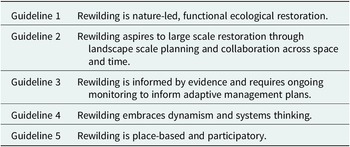
Rewilding reflects this paradigm shift within environmental management. It started as a movement to shift the goals of conservation, from those focused on ecological composition in isolated protected areas, to those focused on function, acknowledging the dynamic interactive processes that occur across scales from the individual to the landscape (Lorimer et al., Reference Lorimer, Sandom, Jepson, Doughty, Barua and Kirby2015; Carver et al., Reference Carver, Convery, Hawkins, Beyers, Eagle, Kun, Van Maanen, Cao, Fisher, Edwards, Nelson, Gann, Shurter, Aguilar, Andrade, Ripple, Davis, Sinclair and Bekoff2021). This focus on interactions across scale and its application to multi-functional landscapes has spurred the integration of social and ecological aspects of systemic change into rewilding goals, and particularly a focus on SES or landscape resilience (Hawkins et al., Reference Hawkins, Carver and Convery2025). Launched at the 2025 World Conservation Congress, the IUCN “Guidelines for rewilding” (Carver et al., Reference Carver, Convery, Hawkins, Hertel, Fallon, Lyons, Beyers, Locquet, Derham and Kun2025a) include a vision for wild, resilient landscapes that support both nature and people. Here, “wild” emphasises the creative agency of nature, acknowledging that the composition of these dynamic systems is not predictable (Derham et al., Reference Derham, Mathews and Johnson2025; Hawkins et al., Reference Hawkins, Carver and Convery2025). This approach to rewilding recognises the interdependent interactions that occur between humans and the rest of nature. It therefore includes goals for ecosystem integrity and resilience, improved human wellbeing and shifting human–nature relationships from those based on exploitation to stewardship and reciprocity (Hawkins et al., Reference Hawkins, Carver and Convery2025; Carver et al., Reference Carver, Convery, Hawkins, Hertel, Fallon, Lyons, Beyers, Locquet, Derham and Kun2025a). Given this holistic perspective, the accompanying five guidelines (Table 2) demonstrate that place-based and participatory approaches, adaptive management, systems thinking and monitoring are fundamental to rewilding application (Hawkins et al., Reference Hawkins, Convery and Carver2024; Carver et al., Reference Carver, Convery, Hawkins, Hertel, Fallon, Lyons, Beyers, Locquet, Derham and Kun2025a). However, the IUCN guidelines document also notes that, despite these aspirations, the bias towards quantitative monitoring techniques and lack of guidance on achievable monitoring methods for social learning and adaptive management are inhibiting rewilding theory and practice from realising these essential paradigm shifts.
The five guidelines for rewilding from Carver et al. (Reference Carver, Convery, Hawkins, Hertel, Fallon, Lyons, Beyers, Locquet, Derham and Kun2025a)

In this perspective article, we argue that there remains an overreliance on quantitative monitoring approaches in rewilding and outline the importance of monitoring approaches that include qualitative and quantitative aspects of change. Quantitative metrics – such as plant or animal counts, biodiversity indices, human–wildlife conflict rates and natural capital accounts – remain valuable but must be linked to qualitative indicators that reflect deeper systemic changes in pursuit of rewilding goals of ecosystem resilience, enhanced human–nature coexistence and evolving cultural relationships with nature. Given the renewed focus on system resilience in rewilding goals (Hawkins et al., Reference Hawkins, Carver and Convery2025; Carver et al., Reference Carver, Convery, Hawkins, Hertel, Fallon, Lyons, Beyers, Locquet, Derham and Kun2025a), we propose the application of Holling’s panarchy (2001) to the design of rewilding monitoring. Panarchy is a conceptual framework that describes how systems undergo cycles of growth, accumulation, restructuring and renewal across multiple scales. It emphasises the dynamic interplay between fast-changing variables (such as species populations or public attitudes) and slow-changing variables (such as nutrient cycles or cultural norms), and how these interactions shape system resilience and transformation. Holling’s “rule of hand” proposes that effective management of complex systems requires monitoring at least three to five interacting components, operating at three qualitatively different speeds, and governed by non-linear causation. This approach helps identify leverage points for adaptive management and supports learning in the face of uncertainty. By integrating the qualitative and quantitative aspects of system dynamics through the panarchy model, we can begin to understand the interrelationships that shape rewilding outcomes. This shift in monitoring will leverage the institutional reform necessary to achieve the transformative change inherent in rewilding – supporting the goal of wild and resilient systems that enhance human wellbeing both where rewilding is being applied and within the institutions that govern them.
Rewilding and systems thinking
Rewilding emerged as a transdisciplinary and holistic approach to conservation, shaped by a diverse group of activists, conservation scientists, ecologists and environmental philosophers. The breadth of perspectives fostered a conceptualisation of rewilding that combined ecological restoration with environmental ethics, activism and participatory landscape planning (Johns, Reference Johns, Pettorelli, Durant and du Toit2019; Fisher and Carver, Reference Fisher, Carver and Hawkins2021). Over time, rewilding’s plurality has expanded, reflecting regional contexts and diverse governance models. However, this has also led to tensions and concern that the concept lacks clarity or coherence (Jorgensen, Reference Jorgensen2015; Hayward et al., Reference Hayward, Scanlon, Callen, Howell, Klop-Toker, Blanco, Balkenhol, Bugir, Campbell, Caravaggi, Upton and Weise2019; Carver et al., Reference Carver, Hawkins, Convery, Beyers, Derham and Cao2025b). One of the key debates is around the role of humans in rewilding (Carver et al., Reference Carver, Hawkins, Convery, Beyers, Derham and Cao2025b). In North America, rewilding has focused on self-sustaining ecosystems and the freedom of keystone species to move across landscapes (Soule and Noss, Reference Soule and Noss1998). In Europe, early efforts centred on abandoned agricultural landscapes where humans played a passive or “hands-off” role in ecosystem recovery (Pereira and Navarro, Reference Pereira and Navarro2015). Those seeking common ground among these approaches have focused on the goal of non-human autonomy, restoring “autonomous biotic and abiotic agents and processes” (Prior and Ward, Reference Prior and Ward2016) in a landscape. However, in many contexts a “hands off” approach can be inappropriate, for example in working agricultural lands in Europe (Jacqmarcq et al., Reference Jacqmarcq, Siggery and Collins2024) or in Australia where this can conflict with Indigenous concepts of Caring for Country (Derham et al., Reference Derham, Mathews and Johnson2025). There are ongoing concerns that a goal of non-human autonomy can be interpreted as misanthropic and lead to the exclusion of human agency, stewardship roles or the separation of human culture and nature (e.g., Ward, Reference Ward2019; Arias, Reference Arias2024; Derham et al., Reference Derham, Mathews and Johnson2025).
The functional ecological goals of rewilding highlight a second key tension in rewilding practice. A central driver of rewilding was concern over increasingly positivistic approaches to conservation science (Bocking, Reference Bocking2015; Murray, Reference Murray2017), which supported a shift away from fixed compositional goals towards functional ecological restoration focused on natural dynamism – reflecting a move from parts to process inherent in systems thinking (Carver et al., Reference Carver, Convery, Hawkins, Beyers, Eagle, Kun, Van Maanen, Cao, Fisher, Edwards, Nelson, Gann, Shurter, Aguilar, Andrade, Ripple, Davis, Sinclair and Bekoff2021). However, many traditional monitoring frameworks still reflect assumptions that ecosystems behave like machines – predictable, controllable and reducible to measurable parts. This mechanistic worldview, shaped by over 300 years of Enlightenment science (Capra and Luisi, Reference Capra and Luisi2014), underpins the dominance of quantitative metrics and SMART objectives in conservation that also pervades rewilding (Corlett, Reference Corlett, Pettorelli, Durant and du Toit2019). While few managers would explicitly claim to treat ecosystems as simple systems, many conservation practices rely on linear models and fixed targets that assume ecological stability and predictability (Holling and Meffe, Reference Holling and Meffe1996). For example, setting goals solely based on restoring historical species compositions or achieving specific biodiversity indices reflects a simplified view of ecological dynamics. This compositional focus is evident in UK Site of Special Scientific Interest condition assessments and in Australia’s Environment Protection and Biodiversity Conservation Act habitat classifications, where only species from prescribed diagnostic lists count towards meeting condition criteria.
Holling’s work on forest pest outbreaks, such as the spruce budworm system, illustrates how management based on linear prediction and control can reduce resilience and lead to system collapse (Holling, Reference Holling1978; Holling and Meffe, Reference Holling and Meffe1996). In these cases, suppressing natural disturbances to maintain compositional stability ultimately exacerbated pest outbreaks and forest degradation. Ecosystems that are managed to produce a single type of value – such as timber, carbon credits or specific biodiversity targets – can become overly simplified and rigid. This narrow focus reduces their ability to adapt to change, making them brittle and more vulnerable to collapse (Holling and Meffe, Reference Holling and Meffe1996). Rewilding, by contrast, aims to restore ecological dynamism and resilience by supporting diverse processes and relationships across scales. Achieving this vision requires a shift in how success is monitored: away from fixed, compositional endpoints and towards approaches that can capture complexity, uncertainty and emergent change.
In practice, many rewilding projects continue to rely on compositional goals – such as restoring wood pasture or managing stocking densities – because these are easier to measure and align with existing institutional frameworks (Hawkins et al., Reference Hawkins, Convery and Carver2024). Because of its appeal, the term rewilding is also inconsistently applied to projects more akin with traditional conservation or ecological restoration. Such approaches risk undermining the transformative potential of rewilding by reinforcing familiar paradigms, rather than embracing the uncertainty and complexity inherent in living systems.
Key to alleviating these tensions has been the work of the IUCN’s Rewilding Thematic Group, which developed a definition and guiding principles for rewilding (Carver et al., Reference Carver, Convery, Hawkins, Beyers, Eagle, Kun, Van Maanen, Cao, Fisher, Edwards, Nelson, Gann, Shurter, Aguilar, Andrade, Ripple, Davis, Sinclair and Bekoff2021) and launched the “IUCN Guidelines for rewilding” in 2025 (Carver et al., Reference Carver, Convery, Hawkins, Hertel, Fallon, Lyons, Beyers, Locquet, Derham and Kun2025a). These guidelines address uncertainty around human roles in rewilding by emphasising that rewilding is nature-led, human-enabled – where humans play a supportive, stewardship role (Hawkins et al., Reference Hawkins, Convery and Carver2024; Carver et al., Reference Carver, Convery, Hawkins, Hertel, Fallon, Lyons, Beyers, Locquet, Derham and Kun2025a). They incorporate a vision for rewilding that combines ecological restoration to enhance the creative agency of wild nature with social and systemic change to foster coexistence and system resilience (Hawkins et al., Reference Hawkins, Carver and Convery2025). For the purposes of this paper, we align with this social-ecological vision for rewilding. This vision is supported by five guidelines (Table 2) for applying rewilding – emphasising systems thinking and an adaptive, collaborative, place-based governance approach, along with a five-step theory of change framework to guide practitioners (Hawkins et al., Reference Hawkins, Convery and Carver2024). Despite the emphasis on adaptive management and systems thinking in the guidelines, there remains a critical gap in guidance around what should be monitored to support rewilding outcomes. While the framework outlines the importance of iterative learning and feedback, it does not specify the types of variables – social or ecological – that practitioners should track. The rewilding vision focuses on qualities of human–nature relationships and resilience, but these are hard to quantify, and practitioners often revert to compositional goals due to regulatory pressures, funding mechanisms and entrenched monitoring systems. The lack of monitoring guidance contributes to the continued reliance on familiar, quantitative metrics that are easier to measure and justify within existing institutional structures. In the following section, we outline current quantitative approaches to rewilding monitoring and argue that, while useful, they are insufficient on their own to capture the complexity and transformative potential of rewilding.
Quantitative approaches to rewilding monitoring
Theoretical monitoring frameworks have been proposed in academic literature to conceptualise rewilding. Several proposals pose rewilding as a process of moving along a gradient of decreasing anthropogenic influence and increasing ecological integrity, reflecting a wilderness continuum model (Carver et al., Reference Carver, Convery, Hawkins, Beyers, Eagle, Kun, Van Maanen, Cao, Fisher, Edwards, Nelson, Gann, Shurter, Aguilar, Andrade, Ripple, Davis, Sinclair and Bekoff2021; Figure 1). Ceausu et al. (Reference Ceausu, Hofmann, Navarro, Carver, Verburg and Pereira2015) focus on wilderness to propose an approach to map opportunities for rewilding using quantitative metrics of human influence (artificial night light, human accessibility score, proportion of harvested primary productivity, deviation from potential natural vegetation). Torres et al.’s (Reference Torres, Fernández, Ermgassen, Helmer, Revilla, Saavedra, Perino, Mimet, Rey-Benayas, Selva, Schepers, Svenning and Pereira2018) framework centres on ecological integrity, positioning this aim on one end of a gradient and measuring progress through the reduction of human inputs and outputs. Perino et al. (Reference Perino, Pereira, Navarro, Fernández, Bullock, Ceaușu, Cortés-Avizanda, van Klink, Kuemmerle, Lomba, Pe’er, Plieninger, Benayas, Sandom, Svenning and Wheeler2019) develop this further, identifying dispersal, trophic complexity and stochastic disturbance as contributing to ecological integrity. The frameworks outlined above largely conceptualise socio-cultural factors as obstacles to ecological aims, reinforcing the assumed dichotomy between humans and the rest of nature. This perspective may be effective for small-scale projects but becomes problematic at larger scales where coexistence, habitat heterogeneity, and ongoing stewardship are necessary. By framing human presence primarily as a limiting factor, these models overlook the role of humans as ecological participants, an idea central to more holistic perceptions of nature and culture supported by the IUCN guidelines for rewilding.
The wilderness continuum model [source: Carver et al., Reference Carver, Convery, Hawkins, Beyers, Eagle, Kun, Van Maanen, Cao, Fisher, Edwards, Nelson, Gann, Shurter, Aguilar, Andrade, Ripple, Davis, Sinclair and Bekoff2021, after Carver, Reference Carver2014, Lesslie and Taylor, Reference Lesslie and Taylor1985, and Van Maanen and Convery, Reference Van Maanen, Convery, Convery, Davis and Holdgate2016].

More practical guidance for rewilding monitoring has been developed by rewilding organisations, and these tend to emphasise biodiversity monitoring techniques that are readily accessible to practitioners (Rewilding Britain, n.d.; Holmes et al., Reference Holmes, Eagle and Hees2023). They also suggest other quantitative metrics to monitor ecosystem services and rewilding outcomes, such as water quality and carbon sequestration, while considering cultural ecosystem services through quantitative indicators like recreational access and the economic value of ecotourism opportunities. These approaches are well demonstrated by innovations in natural capital accounting platforms, such as those used at the Natural Capital Laboratory in Scotland (White et al., Reference White, Leese, Convery, Rooney, Hawkins, Convery, Carver and Beyers2022).
Importantly, quantitative monitoring is not only widespread – it is structurally embedded in conservation practice through site designation criteria, funding mechanisms and regulatory frameworks. Its prevalence is increasing through policy instruments such as habitat banking and biodiversity net gain, which require measurable outputs to demonstrate compliance and justify investment (Kedward et al., Reference Kedward, zu Ermgassen, Ryan-Collins and Wunder2023). While these techniques reflect pragmatic strategies to quantify the benefits of rewilding and make it more appealing to policymakers and stakeholders (Cerqueira et al., Reference Cerqueira, Navarro, Maes, Marta-Pedroso, Honrado and Pereira2015; Pettorelli et al., Reference Pettorelli, Barlow, Stephens, Durant, Connor, Bühne, Sandom, Wentworth, Toit and Nuñez2018), this instrumental framing risks reinforcing a narrow, utilitarian perspective. It may limit the transformative potential of rewilding by privileging economic or functional values over deeper ethical, cultural, relational and evolutionary considerations unless implemented with the strategic objective of enhancing resilience and restoring connectivity across landscapes.
While we acknowledge the issues with various quantitative metrics for measuring rewilding progress, we are not advocating for the elimination of biodiversity, ecosystem services and ecosystem monitoring techniques. These metrics can be valuable components of a comprehensive and holistic monitoring approach. However, the predominance of quantitative approaches to monitoring poses a significant barrier to advancing rewilding policies and practices. A more balanced approach that integrates both quantitative and qualitative methods is essential for capturing the full complexity and transformative potential of rewilding.
Rewilding, resilience and Holling’s panarchy
Rewilding, as articulated in recent guidelines (Hawkins et al., Reference Hawkins, Carver and Convery2025; Carver et al., Reference Carver, Convery, Hawkins, Hertel, Fallon, Lyons, Beyers, Locquet, Derham and Kun2025a), is not prescriptive about the future composition of ecosystems. Instead, it focuses on qualities such as wildness, sustainability and resilience – qualities that are emergent, context-dependent and shaped by dynamic interactions across scales. This open-ended vision encourages an adaptive, creative and collaborative approach to rewilding application.
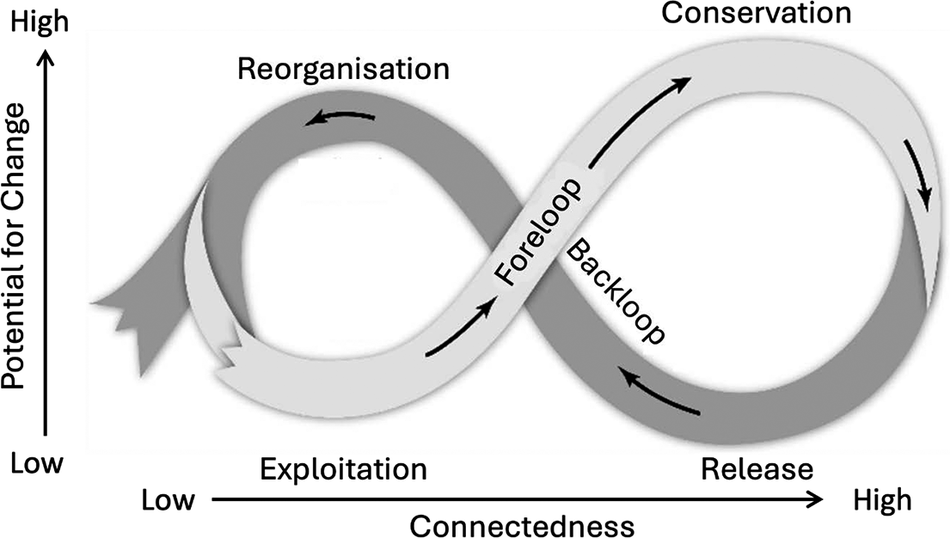
To support this vision, monitoring frameworks must evolve beyond static metrics and compositional endpoints. Holling’s panarchy (Holling, Reference Holling2001; Gunderson and Holling, Reference Gunderson and Holling2002) offers a promising approach to aid the design and monitoring of rewilding interventions. Developed through decades of ecological research and systems thinking (Gunderson et al., Reference Gunderson, Holling, Allen, Gunderson, Allen and Holling2010), panarchy describes how complex systems undergo adaptive cycles of growth, accumulation, collapse and renewal across nested scales (Figure 2). These stages reflect how systems build potential (e.g., accumulated resources, knowledge or biodiversity) and connectedness (the strength of interactions between system components) over time. In the growth and conservation phases, systems become increasingly structured and efficient, but also more rigid. When systems become over-connected, their components are so tightly linked that they lose flexibility – making them less able to adapt to change and more vulnerable to disturbance. This rigidity can lead to a collapse phase, where connections loosen and resources are released. While disruptive, this phase creates space for reorganisation, allowing new relationships, structures or innovations to emerge. The cycle then begins anew, supporting transformation and resilience across scales.
A simplified version of the adaptive cycle based on Holling (Reference Holling, Clark and Munn1986). This figure illustrates how systems grow and become resilient by accumulating potential and increasing connectedness. As systems mature, they may become rigid or “over-connected,” reducing their resilience. A disturbance can trigger collapse, releasing resources and loosening connections, which allows for reorganisation and renewal. The cycle helps explain how systems evolve through change and adaptation.

These cycles are shaped by interactions between fast-changing variables (e.g., species populations, public attitudes), typically monitored using quantitative methods, and slow-changing variables (e.g., cultural norms, governance structures, nutrient cycles), which often require qualitative approaches. Holling’s “rule of hand” suggests that monitoring three to five interacting components across scales provides sufficient complexity to support adaptive management without becoming intractable. Evaluating interactions between fast- and slow-changing variables helps reveal how short-term dynamics interact with deeper systemic structures, shaping resilience and transformation. By explicitly recognising both types of variables, panarchy provides a practical framework for integrating quantitative and qualitative monitoring to better determine whether rewilding is achieving its goal of system resilience.
The Cornwall Beaver Project (Jones and Jones, Reference Jones and Jones2023) offers an illustrative case description of a pilot project to discover the impacts of beavers on a farm environment and the hydrological characteristics of a small stream that was prone to periodic flooding. Formal monitoring was confined to measures of stream flow and silt deposition. These are fast ecological variables that at larger levels of spatial and temporal scale contribute to the restoration of landscape-level resilience by reducing the rate of soil loss and storing water in wetlands and ground water. Local wildlife enthusiasts made occasional visits to the beaver enclosure to record the presence of bats, birds, insects and tree felling. On the social side, shifts in public attitudes were formally monitored as part of the beaver project and found to change rapidly as people watched, discussed and learned about beaver behaviour. Government policy towards beaver reintroduction in England was tracked subsequently and changed from trials where beavers were strictly confined to small enclosures in 2014, to the point where conditional wild release was permitted in 2025. This relatively rapid policy change illustrates how social learning can affect public attitude and how small-scale social movements can coalesce to create a widespread cascade of change to enhance resilience in ecosystems and landscapes (Figure 3).
A simplified panarchy framework based on Holling (Reference Holling2001), illustrating the hierarchical arrangement of adaptive cycles operating at three levels of scale in the context of a rewilding initiative. The rewilding trial in Cornwall demonstrated the effects of beavers on geomorphological processes (large and slow scale) and the arrival of species not previously found at the project site (small and fast scale). Public participation and social learning (small and fast) changed policy (large and slow).

To operationalise Holling’s “rule of hand” – which proposes monitoring three to five interacting components at different speeds – practitioners can draw from the rewilding vision itself. Hawkins et al. (Reference Hawkins, Carver and Convery2025) propose a framework that organises rewilding aims into ecological and socio-cultural change. These domains offer a practical starting point for selecting variables that reflect both fast and slow dynamics and that are meaningful within the local context.
For example:
-
• Ecological variables might include fast-changing indicators such as species population trends or water flow, alongside slower variables like ecological integrity or evolutionary potential.
-
• Socio-cultural variables could include public sentiment or media narratives (fast), and deeper shifts in human–nature relationships, ecological knowledge or connection to place (slow).
Importantly, the practical application of rewilding must also acknowledge the realities faced by landowners and stakeholders, particularly those whose livelihoods and cultural identities are closely tied to traditional land management practices. Bridging the gap between philosophical aspirations and pragmatic land management requires robust stakeholder engagement. The IUCN guidelines for rewilding advocate for co-creating a shared vision for resilient landscapes through participatory processes, then undertaking social and ecological assessments before prioritising interventions. This step-by-step approach – grounded in inclusive dialogue and place-based knowledge – can help build trust, identify shared values and foster adaptive governance structures that accommodate both ecological goals and human needs.
Crucially, these participatory processes also offer an opportunity to co-identify and track the three to five key variables, as proposed by Holling’s “rule of hand.” The adaptive framework outlined in the guidelines supports iterative assessment of conditions, allowing practitioners and stakeholders to collaboratively select indicators that reflect ecological, socio-cultural and systemic outcomes. Some of the outcomes proposed by Hawkins et al. (Reference Hawkins, Carver and Convery2025) – such as coexistence, landscape heterogeneity, and human–nature reciprocity – can serve as guiding metrics. These are not universally fixed, but adaptable to place, requiring qualitative interpretation and participatory approaches. Monitoring them may involve mixed methods such as interviews, participatory mapping or narrative analysis, alongside ecological surveys and spatial data. This ensures that monitoring systems are not only scientifically robust but also socially and culturally responsive, supporting adaptive management in complex, living landscapes.
Conclusions and future perspectives
Rewilding, as a dynamic and evolving process, is best understood as an ongoing adaptation to ecological and social change rather than a fixed endpoint. This perspective aligns with efforts to improve coexistence and coevolution of human–nature relationships at landscape scales. Recognising rewilding as a continuous process shifts the focus towards resilience, adaptability and transformability as components of ecosystem coevolution.
At the heart of this shift is a change in the mental models that shape how we perceive and interact with nature. These underlying beliefs, values and ethics influence both individual behaviour and institutional structures. In the context of rewilding, key mindset changes include recognising that humans are part of nature, that biodiversity holds intrinsic as well as utilitarian value, and that mechanistic, reductionist approaches are insufficient for understanding the complexity of living systems. Such shifts in perspective lay the foundation for institutional transformation – reshaping how conservation is understood, governed and practiced.
Taken together, these insights highlight the need for a paradigm shift in how rewilding is monitored and evaluated. By integrating qualitative and quantitative approaches – guided by systems thinking, participatory processes and place-based knowledge – rewilding can move beyond static targets towards a more adaptive, inclusive and resilient practice. Monitoring becomes not just a tool for measurement, but a means of learning, reflection, and transformation. This supports not only ecological change across landscapes but also institutional transformation – shaping how rewilding is understood, governed and implemented over time. In doing so, monitoring becomes a catalyst for rewilding’s broader vision: fostering coexistence, embracing uncertainty and enabling the coevolution of people and nature in wild, dynamic systems.
Open peer review
To view the open peer review materials for this article, please visit http://doi.org/10.1017/ext.2026.10011.
Data availability statement
There is no data associated with this manuscript.
Author contribution
Both authors made substantial contributions to conceptualisation, writing – original draft and writing – review and editing.
Financial support
This research received no specific grant from any funding agency, commercial or not-for-profit sectors.
Competing interests
The authors declare there are no conflicts of interest.




 Open access


Comments
No accompanying comment.