


If a patient with psychosis is referred for psychodynamic psychotherapy, what might this be like? In what ways would it be similar or different from cognitive–behavioural therapy (CBT) or general psychiatric supportive interventions? How would it fit in with other aspects of treatment? And would it be likely to help?
This is the last of three articles in Advances (see Reference Martindale and SummersMartindale 2013; Reference Summers and MartindaleSummers 2013a) that consider the contribution of psychodynamic approaches in psychosis. They have been written in response to the suggestion in the National Institute for Health and Care Excellence (NICE) schizophrenia guidelines that healthcare professionals consider using psychoanalytic and psychodynamic principles to help them understand patients' experiences and interpersonal relationships (National Institute for Health and Clinical Excellence 2009). The first two articles outlined a modern approach to using psychodynamic principles to understand psychosis and develop a case formulation. In this article we will discuss the use of such principles in therapy. We focus on supportive psychodynamic psychotherapy (SPP) for psychosis, which is a specific model that has been tested in semi-randomised trials (Reference Rosenbaum, Valbak and HarderRosenbaum 2005, Reference Rosenbaum, Valbak and Harder2006, Reference Rosenbaum, Harder and Knudsen2012).
Psychodynamic therapy for psychosis – past and present
Descriptions of psychoanalytically based therapies with patients in psychotic states appeared for the first time in the years around World War I (Reference BjerreBjerre 1912; Reference BertschingerBertschinger 1916; Reference KempfKempf 1919), but the ideas behind SPP are mainly the outcome of the two decades succeeding World War II (e.g. Reference BeckBeck 1952; Reference FedernFedern 1952; Reference Fromm-ReichmannFromm-Reichmann 1959; Reference ArietiArieti 1974). It is important to underline that these post-war authors considerably modified the technique for psychoanalytically oriented therapies for psychosis so that they now contained prominent supportive elements and aimed to reduce the risk of regression and of overwhelming anxiety in the patient. For example, in these modified approaches the couch is not used, the patient is not left in anxiety-provoking silence and the therapist aims to avoid a psychotic transference (which may undermine the therapeutic alliance).
Supportive psychodynamic psychotherapy uses the modified approaches described by these and other post-war authors (Reference FroschFrosch 1983; Reference McGlashanMcGlashan 1983; Reference Stone, Albert and ForrestStone 1983; Reference GarfiedGarfield 1995; Reference HingleyHingley 1997) and is explained in a detailed manual (available on request). In SPP the therapist's task is to actively attempt to understand the patient as a person with conflicts, identity difficulties and emotional sadness and confusion, and to let the patient feel that the therapist understands them (Reference Fromm-ReichmannFromm-Reichmann 1959). A basic rule for the treatment is an atmosphere of genuine respect for the patient and what they say. The therapist must listen actively to incoherent, dissociated and/or fragmented ideas, and make sufficient attempts to look at and clarify meaningful threads of the patient's narrative in a non-judgemental way so that communication can continue.
As has been discussed in the previous linked articles (Reference Martindale and SummersMartindale 2013; Reference Summers and MartindaleSummers 2013a), from a psychodynamic perspective, psychosis is often a response to unbearable affects and circumstances and it is to be expected that those very affects will frequently emerge in the therapeutic setting, not unusually within therapists themselves (counter-transference). Therapists will often have to struggle within themselves with difficult feelings such as significant anxiety, loneliness, aggressive hatred and also frustration from a lack of improvement (Reference Fromm-ReichmannFromm-Reichman 1959). Being aware of these internal processes may help the therapist to listen to and clarify the meaningful connections between these feelings and the problems that provoked or maintain the patient's psychosis – connections that otherwise may be easily overlooked and disregarded.
An evidence-based treatment
Recently, results from the Danish National Schizophrenia (DNS) Project (Reference Rosenbaum, Harder and KnudsenRosenbaum 2012) have strengthened the evidence for the effectiveness of psychodynamic treatment in psychosis. The project is a prospective, comparative, multicentre study (14 centres) in which a group who received treatment as usual (TAU) plus SPP (n = 119) was compared with a group treated with TAU only (n = 150). Symptom and functional improvement on the Global Assessment of Functioning scale significantly favoured SPP in combination with TAU over TAU alone.
The areas that are focused on in SPP are intrinsic to contemporary psychodynamic thinking (Reference Rosenbaum and HarderRosenbaum 2007), but also bear a close relationship to other, newer conceptualisations of psychosis and psychosis treatment, such as those based on attachment theory and mentalising (Reference Lysaker, Buck and FogleyLysaker 2012). Attachment research indicates the relevance of attachment disturbance to psychosis and supports both the psychodynamic conceptualisation of psychosis and a psychodynamic approach to therapy which specifically addresses attachment needs within adult relationships generally and the therapy relationship specifically. Mentalising or metacognitive capacities (capacities to reflect on one's own and others' internal experience) develop largely within attachment relationships, and provide a foundation for the development of self and self-agency and for solving personal and interpersonal problems (Reference Liotti, Gumley, Moskowitz, Schafer and DorahyLiotti 2008). These can be impaired in different ways in people with psychosis and improved by psychodynamic therapy (Reference Lysaker, Buck, Dimaggio and LyskakerLysaker 2010). Thus, psychodynamic therapy combines a number of ingredients for which there is evidence of effectiveness.
If we take the view that in the absence of randomised controlled trial (RCT) evidence other levels of evidence should be considered, then the available evidence from non-randomised trials, case series and investigation of components of therapy supports the view that psychodynamic therapy can be an effective treatment for some people who experience psychosis (Reference Summers, Rosenbaum, Read and DillonSummers 2013b) and could reasonably be made available as a treatment option.
What does SPP look like?
We give below an outline of the approach which is described in the manual referred to earlier, and which we used in the DNS Project (Reference Rosenbaum, Harder and KnudsenRosenbaum 2012).
Initial assessment and discussion of therapy
In the first few sessions of SPP, the therapist makes a psychodynamic assessment and formulation, which includes the type of information discussed in our second article (Reference Summers and MartindaleSummers 2013a). Furthermore, this formulation includes exploring the possible phases and sequences in the development of an individual's psychopathology, especially how traumatic events and relationships are subjectively experienced and are connected to later life patterns and habits. It also includes the dynamics of the person's main interpersonal relationships across their childhood and adult lives, the subjective experiences of their self and others in these relationships and the emotional meanings attributed to these. The therapist might use questions such as:
‘Could you tell me about yourself in such a way that I can get a picture of you as the person you are – and what is characteristic for the way you see and think about yourself and about problems in your life?’
The therapist discusses the recent psychotic episode in depth and works out with the patient factors that have led to this and to the admission or referral. Useful questions could include:
-
• Tell me what, in your opinion, led to this situation where you find you need help from mental health services?
-
• What do you find to be your most important problems?
-
• Where do you think your problems stem from?
-
• What situation(s) might worsen your problems or symptoms?
-
• Who or what do you think could help to solve the problems?
Each problem that the patient mentions is considered separately. The therapist frequently expresses empathy with the patient and clarifies their mental sufferings, and at the same time elicits the patient's healthy resources and emphasises and encourages these.
Many patients will respond concretely or with limited detail. The therapist attempts to encourage a deepening of rapport through careful attention to the topics and also to responses within themselves that appear to help this or to work against it. The therapist may sometimes be able to help the situation by showing empathy and respect for the patient's difficulty in elaboration, by reflecting their own understanding of what is being said and their own responses to it, and by avoiding pressing the patient to say more when this is increasing their discomfort.
The therapist notes for future reference areas of the patient's life that are probably emotionally complex and painful but which the patient glosses over or rationalises – denial being among the most common unconscious defence mechanisms against too painful realities (Reference Martindale and SummersMartindale 2013).
The initial assessment also contributes to creating a robust therapeutic alliance, which research has shown is of major importance (Reference Frank and GundersonFrank 1990). It is a necessary and decisive pre-phase to the therapy. For the patient this pre-phase is probably experienced as therapy in itself. And so it should be, even though the frames of the therapy are agreed at the end of this pre-phase.
The therapist also provides information about the purpose and structure of therapy. For example:
‘I can sense that it is very hard for you to think about the fact that you have become ill. In my experience, nothing is gained in the long run by trying to close your eyes to that. It is always important to try to act in a healthy way as you are doing, although you and I recognise that along with your good health, there is also another vulnerable side, and the therapy is intended to help you cope with this. The best way of dealing with having become ill is to talk about your vulnerability here in therapy. Together we will try to make sense of what may at times feel meaningless.’
An important area is the dynamic understanding of the inclination to distrust medication:
‘It is understandable that you would rather be free of the feeling of being ill. You may, for instance, feel like stopping medication without telling me. You may think that it has no effect, and you might want to try to prove that by stopping it. If you have such thoughts or feelings, my suggestion is that you resolve to tell me before you do anything. We will then try to make sense of them together and so make a joint effort to protect you from possibly working against your own progress. Is that okay?’
If the patient's history contains information about other possible self-destructive elements (e.g. substance misuse), these are also discussed with the patient as factors that might impede real progress.
After the initial sessions
Following the initial sessions, the therapist reflects and formulates a set of hypotheses. These will cover several areas, all of which are important to consider in supervision, which should be available as necessary.
A picture of the patient's life history and illness
This includes hypotheses about the dynamics of the healthy aspects of the patient's personality, current life problems and emotional difficulties in facing these, especially difficulties in grieving the reality of having become disturbed. The dynamics of traumatic factors are highlighted.
Suicidal and/or violent thoughts and impulses, both current and in the earlier course of the illness
It is important that the therapist gives the patient a clear sense that they have an eye for suicidal impulses, self-destructiveness and violent behaviour, that they regard these as something which has meaning in the context of the patient's life, and that they are prepared to help the patient avoid acting on these impulses.
The degree of awareness and sense of illness
The patient must know that the therapist regards them as having a condition for which treatment is needed. The therapist should expect to be challenged on this and needs to have answers ready. In these cases, it may be particularly important to discuss with the patient hypotheses as to why such decompensation has occurred at this time. These hypotheses should be phrased tentatively, for example:
‘Is it conceivable that after you felt so humiliated by X and his girlfriend, you started to worry that other people might also be making fun of you and this got worse and worse until you got into a state of mind where you sometimes started to read this possibility into every situation you encountered. Might what is happening now be seen as an expression of this terrible worry with the lack of sleep making it harder for you to think as clearly about things as was usual for you?’
The possibilities of building a stronger therapeutic alliance and of stimulating hope
A stronger therapeutic alliance with the patient can be used to stimulate their hope of getting better, i.e. becoming more themselves, with greater self-understanding, less mistrust, higher self-esteem and less anxiety. The therapist also begins to clarify what obstacles may get in the way of these changes.
The nature and role of the psychotic functioning and its manifestation in the transference and countertransference
An understanding of the patient's psychotic functioning, its role for them and how it is likely to manifest in the transference and counter-transference can help the therapist to avoid unwittingly aggravating or supporting it.
The middle phase
The middle phase is usually reached within 3–6 months. At this stage it may be that treatment has progressed and helpful work has been done, with the patient feeling that they are securely attached to the therapy and are making progress. Or, it may be that a creative therapeutic relationship has formed but progress has been slow. In other situations, a destructive/difficult therapeutic relationship may have developed where the patient is mentally absent, has regressed or does not, for a variety of reasons, manage to work with the therapist or engage in the process of psychotherapy. A further possibility is that the patient does engage but only impulsively and egocentrically, appearing totally preoccupied by symptoms or some other issue but no new meaning or perspective seems to be available or useful for them.
The middle phase is normally a phase in which the therapist experiences some difficulties in seeing progress or feels things are at a standstill. The patient may tend just to repeat what they have said previously. Some therapists may start to doubt that psychotherapy is right for the patient or to think that medication alone would do just as much good.
Even in situations where the patient still has major psychotic symptoms, the therapist needs to trust that development of the self can provide the patient with qualities that go beyond the effect of medication. They need to trust in the existence of some normally functioning aspects of the patient's personality (Reference Freud and StracheyFreud 1940; Reference BionBion 1957; Reference Martindale and SummersMartindale 2013), and support these more sane parts in a consistent and straightforward manner. The therapist's aim is to help the patient expand the sane attitudes and thoughts and diminish the psychotic functioning. For example:
Over some weeks a patient increasingly indicated that he was able to consider aspects of the therapist and his own relatives that he might be able to trust, while some feelings of mistrust persisted, but diminished.
Another aim is to help the patient find some personal meaning in their symptoms, and in this way try to master them instead of letting them concretely dominate their conscious life. For example:
A patient's persecuting voices finally became less threatening when he was helped to realise that they were an outcome of a disappointment in love some years earlier, when he was rejected by a girl he had dared to approach.
The essential idea is that there should be a gradual build up of empathic collaboration in meaning-making that becomes increasingly internalised by the patient and which may be crucial in the long term to reducing the patient's anxiety and distrust in relationships. Some therapists may understand this as helping the patient to connect words or thoughts with (unconscious) emotions and ideas that have become dissociated or fragmented. Others may understand this process as creating a space for reflection and consensual validation or development of metacognitive capacity (Reference Lysaker, Buck, Dimaggio and LyskakerLysaker 2010).
Persons in psychotic states of mind often find it difficult to express what they feel and they may have a hard time believing that the therapist understands that. When they do express themselves, they may have difficulty believing that their thoughts and ideas can be understood by other people. Ordinary words such as ‘talking together’, ‘relationships’, ‘group’, ‘understanding’, ‘ending’, ‘looking forward to’ or ‘mourning’ may hold totally different meanings to a patient in a psychotic state than they do for the therapist. The therapist may express awareness of such possible discrepancies and may use their knowledge to explore what the words may mean to the patient as well as to the therapist, so that gradually areas of shared communication may be created and enlarged. For example:
A patient was convinced that, whatever he said or thought, other people would diagnose him as paranoid. By taking the last few exchanges in the therapy session and investigating each sentence for its possible meanings (from both patient and therapist perspectives), it became clear for the patient that none of what had been said so far was understood by the therapist as him being paranoid. The patient then tried to remember an example, but in thinking about this together, this example could also be deconstructed as having meanings connected with his life without paranoid undertones.
Termination
Transition towards ending therapy in SPP is always gradual. Certain themes and previous self-destructive ways of thinking and relating are no longer repeated, and the termination phase can be felt as a potential new beginning.
Four to six months prior to ending, the therapist summarises what has been worked with thus far and what they think the patient will still have to deal with, will need to think about or is likely to encounter. Time is taken to talk about how the patient might be able to handle the termination of therapy. What thoughts and feelings does the ending provoke? What strategies may be used to help with the ending? What precautions might need to be taken concerning difficult situations in the future?
About 1 month before the end, a summary is prepared of what has been accomplished and what still remains to be worked on either by the patient alone or in a possible future therapeutic setting. In the summary, emphasis is put on those areas in which the patient has recovered autonomy and made progress. The therapist points out in very concrete terms how the gains can be put to good use. New perspectives are always presented to the patient in such a way that they can see the ideas as options, but not as the only possibility.
During the termination phase, the therapist invites the patient to give them feedback about their manner of relating, helpfulness, availability or unavailability, ability to listen, etc. The therapist highlights ‘blunders’ that may have affected the patient and from which the therapist has learnt.
During the entire termination phase it is important that the therapist remains empathic with the patient's experience of the shortcomings of the therapy and where there has not been (sufficient) progress. The termination phase should have the character of a joint project coming to a close that both parties have learned from and from which the patient is now going to have to find new ways of moving forwards by themselves.
Case vignette
Anna was offered SPP a few weeks after she first presented to an early psychosis service. She had seen a psychiatrist, accepted a prescription for an antipsychotic and was having regular contacts with a care coordinator, who was helping her address some practical issues with college and accommodation and discussing with her practical strategies for coping with voices and paranoia. Anna's distressing psychotic symptoms and suicidal thoughts had already subsided significantly, but she was continuing to feel very wary of other people and finding it hard to leave the house or to be alone for long.
Anna agreed with the team that her symptoms might be linked in some way to her very difficult childhood experiences. Her mother had had a violent partner and suffered recurrent depression with suicide attempts and hospital admissions; and in addition to the lack of care and safety as a result of her mother's mental health problems, Anna herself had been sexually abused by her stepfather.
The team offered Anna CBT but she said that although she did think she needed counselling, she had had some CBT before and did not want more. She declined family appointments as she did not want to make her mother anxious about her. The team discussed Anna's situation with a psychodynamic therapist and agreed that SPP might be offered to her. The care coordinator and psychiatrist were already familiar with the approach and able to discuss with Anna what it entailed. Before the therapy started, the team met with the therapist and talked about what Anna's therapy might involve.
Over the first 6 sessions, the therapist talked with Anna in detail about her life, her view of herself and her relationships with important people throughout her life. He explored the content of Anna's psychotic symptoms and how these seem to relate to her daily life now and to her past. In that connection the therapist suggested that Anna was perhaps harbouring ‘lack of safety’ feelings, fear of not being met with positive feelings from others and fear of not being accepted. The therapist also talked with Anna about the purpose of therapy, about practical arrangements and the importance of trying to discuss in therapy such things as suicidal thoughts. Anna told her care coordinator that she felt the therapist was very nice, but she thought therapy would be hard work.
In the following weeks the therapist discussed with Anna ideas about a dynamic formulation of her problems and strengths, covering her healthy functioning as well as the problems that she and the therapist had identified. The therapist's hypotheses were developed with the help of reflection on his countertransference in the here-and-now and in his supervision as well as from listening to the pain of Anna's childhood story and its repetition in her present life where it was expressed both by anxiety and anger. For example, the therapist noticed he was feeling unusually confident of being valued and able to help, and also noticed that Anna sometimes tended to avoid eye contact when he spoke to her. He hypothesised that Anna found it difficult to experience negative feelings about people she was depending on for help. He thought that that this was likely to be related at least in part to Anna having experienced her most important early attachment figure, her mother, as unable to face anger or criticism without collapsing. This left Anna feeling that anger or other dissatisfied feelings were inevitably destructive. Her previous psychotic fragmentation protected her from experiencing this in relationships.
Over the next 3–4 months, Anna would come to therapy with accounts of current concerns about her life, and with the support of the therapist was able to see some repeating patterns in these which related to the themes that she and the therapist had agreed seemed important. Anna said she thought the therapy was helping her understand herself better.
At the same time in Anna's life outside therapy, things seemed very stuck. She was still rarely seeing friends and said she felt too anxious to leave the house. At a review meeting, she said she could not manage anything else in addition to the therapy because therapy took up so much of her energy. The team began to express concerns about whether this therapy was right for Anna. The therapist himself started to feel anxious that the therapy was already almost half way through the planned 12 months, and might end without Anna achieving anything. Anna then started to speak about what happened with her stepfather. Her voices and paranoia got worse.
It was now 5 months before the date the therapy was due to end, and the therapist started to talk to Anna about this. His countertransference was of feeling uncomfortably aware of how he would have preferred to be able to offer Anna a longer time, and he considered bending the rules for her. Anna made no eye contact and seemed to lose focus, then said that she felt too tired to talk. Later, she explained that at this point her voices had been particularly loud and contemptuous of herself and the therapist. There was a similar pattern in the following sessions whenever the therapist made any reference to the time remaining. The therapist commented that conversations about the length of therapy seemed very difficult for Anna, and Anna suddenly looked him in the eye and said she felt really disappointed, she had really thought the therapy was going to be the thing that made a difference to her, and she didn't think the therapist understood just how hard it had been for her to come. The therapist encouraged Anna to say more about feeling let down. Anna said the voices had disappeared as she spoke and the therapist observed that Anna had been able to make eye contact throughout this whole conversation.
In the last few months of the therapy, Anna talked about some new developments in her life. For the first time she had been talking to her mother about her abuse and about feeling let down by her, and she felt closer to her mother rather than worried about her. She had started to go out with friends regularly. She had talked to them about being ill and been surprised at their supportive responses. She had re-started her college course and begun some voluntary work. Her voices and paranoia had been less prominent and her psychiatrist had suggested reducing her medication.
A few weeks before the therapy ended the therapist spent some time writing a letter for Anna in which he talked about some of this along with other themes in the therapy.
In the final session, Anna talked about her sadness at losing the therapist's support and cried a little. However, she showed no sign of difficulty with eye contact. She said that since she had spoken about feeling annoyed and disappointed that the therapist had limited the length of the therapy, she could think about its end without hearing any voices.
Cognitive therapy elements in psychodynamic treatment
With the introduction of CBT in the treatment of psychosis, psychodynamic treatment was challenged both on its outcomes and on its techniques. Guidelines from NICE recommend that CBT is offered to patients with psychosis, defining it as:
‘a discrete psychological intervention where service users:
-
• establish links between their thoughts, feelings or actions with respect to the current or past symptoms, and/or functioning, and
-
• re-evaluate their perceptions, beliefs or reasoning in relation to the target symptoms.
In addition, a further component of the intervention should involve:
-
• service users monitoring their own thoughts, feelings or behaviours with respect to the symptom or recurrence of symptoms, and/or
-
• promotion of alternative ways of coping with the target symptom, and/or
-
• reduction of distress, and/or
-
• improvement of functioning' (National Institute for Health and Clinical Excellence 2009: p. 258).
Even though some CBT techniques are incompatible with a psychodynamic approach, it is clear that there are considerable areas of overlap between CBT and psychodynamic therapy. Some CBT techniques are not only compatible but are an essential part of a psychodynamic approach. An example is the investigation of voices, where psychodynamic therapists, like CBT therapists, will want to know about the content of what the voices say and their nature, characteristics, developmental history and provoking factors, and their possible links with other events and experiences. Many of the therapist attitudes identified as core components of CBT for psychosis in a Delphi study (Reference Morrison and BarrattMorrison 2010) are also part of the approach of therapists with a psychodynamic orientation.
Advantages and disadvantages of SPP
The cost of SPP may easily be seen as a drawback. It is a relatively long therapy, offered for at least 40 sessions, compared with CBT, for which NICE guidelines currently recommend up to 20 sessions. The training for SPP therapists is also generally longer and more expensive than that of CBT therapists; for example, in the DNS Project, therapists had 1–4 years of training and for the majority this will have included meeting a requirement for personal therapy. Therefore the costs of SPP either need to be balanced by reduced costs in other areas such as in-patient care or its benefits need to be considered sufficient to justify its higher costs.
However, there are potentially important benefits to offering SPP. The overarching advantage is that it is a different approach from CBT and thus – so long as it is effective – it has the potential to meet different needs. Different therapies do seem to affect different aspects of psychological functioning (Reference Lysaker, Buck, Dimaggio and LyskakerLysaker 2010; Reference Adshead and FonagyAdshead 2012): this is very important as current treatments for psychosis leave a lot of scope for improvement in outcomes (Reference WarnerWarner 2003).
One advantage of all psychodynamic therapies is that they attend to relationship issues and specifically to the patient–therapist relationship, which is an important aspect of success in all treatment approaches, including medication. The DNS Project provided some modest evidence to support the view that a psychodynamically informed approach is better able to keep ill patients actively involved in treatment (Reference Rosenbaum, Harder and KnudsenRosenbaum 2012).
Among psychodynamic therapies for psychosis, in common with other supportive approaches, SPP has the advantage of being adapted to limitations in the patient's capacity for reflection and exploration. As the therapy aims to avoid provoking psychotic decompensation and promotes adaptive non-psychotic defences and coping, it becomes more realistic to expect that worthwhile progress may be achieved safely in out-patient settings. At the same time, the flexibility of SPP allows the therapy to adapt to the individual and their stage of recovery (Reference FullerFuller 2013) and provide opportunity for exploration when patients are able to use this.
Supportive psychodynamic psychotherapy has the advantage of focusing simultaneously and systematically on three areas (Reference Rosenbaum, Harder and KnudsenRosenbaum 2012):
-
• difficulties with tolerating, understanding and dealing with emotional experience
-
• difficulties with mentalising linked to the development of self-agency, and a coherent sense of self and life history
-
• difficulties with forming emotional bonds and maintaining interpersonal relationships.
Together, these difficulties contribute to considerable distress, social withdrawal and problems in functioning in education, work and family roles, so that SPP thus targets areas crucial to psychological and social recovery.
If there is more than one effective form of therapy, then there is an additional important argument for making available more than one approach, which is that patients express a wish for choice and a dislike of being restricted to any single model (Reference BorneoBorneo 2008).
Who should be offered SPP?
For most interventions in psychosis there are important uncertainties about which approach is most helpful and when they should be offered. Even antipsychotic medication, the centrepiece of treatment in recent decades, is no longer accepted as appropriate for every patient experiencing psychosis (Reference Bola, Lehtinen and CullbergBola 2009, Reference Bola, Kao and Soydan2012; Reference AaltonenAaltonen 2011; Reference Morrison, Hutton and ShiersMorrison 2012). Cognitive–behavioural therapy has by far the strongest evidence base of any psychological therapy for individuals with psychosis, but it has not been shown to be superior to other psychological therapies (Reference Jones, Hacker and CormackJones 2012), and many patients want access to other therapy options (Reference BorneoBorneo 2008).
Each patient will have different needs. One aspect of this is the heterogeneity in the symptom patterns, causes and contexts of psychotic illness. Different forms of psychosis are likely to be associated with different problems in psychological functioning, amenable to different forms of intervention. The needs of an individual patient will probably change during the course of illness and recovery – this is also a crucial factor in treatment needs (Reference FullerFuller 2013).
In addition, patients differ in what treatments they find acceptable. This in turn is likely to have an important impact on how effective such treatments are likely to be for them.
Recommendations from NICE
Amidst this uncertainty, the NICE (2009) recommendation regarding psychodynamic therapy for people with schizophrenia is that it should not be offered. This conclusion is based exclusively on RCT evidence. However, confusingly, the NICE guidance also recommends that psychodynamic principles may be used to understand the experience and relationships of people with psychosis – and relationships, of course, include those with therapists. A supportive therapy such as SPP where the therapist applies psychodynamic principles to understand the therapist–patient relationship might thus fit better with NICE's category of supportive therapy and counselling than with their psychodynamic therapy category, which describes a dated approach involving a therapist who waits for material to emerge and retains a degree of opacity to assist in the development of a transference relationship (see National Institute for Health and Clinical Excellence 2009: para. 8.6.1). For supportive therapies, NICE make the recommendation that these should not routinely be offered as specific interventions, but that service user preferences may be taken into account, especially if other ‘more efficacious’ psychological treatments are not available locally (para. 8.6.7.1.).
There is an additional problem in accepting at face value the recommendation that psychodynamic therapies should not be offered to people who experience psychosis. This is that psychodynamic therapy may be an effective, RCT-supported intervention for a problem the patient has in addition to their psychosis or at a time when they are not experiencing any psychotic symptoms.
Selection criteria
For all forms of treatment for psychosis (e.g. pharmacological, cognitive–behavioural), we need further research into how best to match treatments to patients. We are aware of one direct study of selection criteria for psychodynamic psychotherapy in general, which suggests that treatment goals of experiencing emotions more fully and integrating unconscious experience are a useful, positive indication (Reference Watzke, Rüddel and JürgensenWatzke 2010). Evidence from RCTs of psychodynamic psychotherapy in psychosis suggests that patients likely to benefit most are those with better premorbid interpersonal functioning, and who establish a secure therapeutic alliance within the first few months (Reference Summers, Rosenbaum, Read and DillonSummers 2013b). Supportive psychodynamic psychotherapy has been studied only in early psychosis, and thus the evidence for its effectiveness is strongest for this phase. However, clinical experience and other evidence supports the view that need-adapted psychodynamic approaches may be valuable in other phases of illness too (Reference AaltonenAaltonen 2011; Reference Seikkula, Alakare and AaltonenSeikkula 2011). There are also theoretical arguments for offering a supportive psychodynamic therapy to people whose acute symptoms have subsided and who want to work on issues that may continue to affect their potential for a more complete recovery and resilience against relapse.
Regarding contraindications to using psychodynamic therapies, clinical experience suggests that significant substance misuse may be a relative contraindication, as may be the absence of the positive indicators discussed here. However, even with a non-selective approach as in the DNS Project, where SPP was made available indiscriminately to newly diagnosed patients with first-episode psychosis, the therapy appears to have been a beneficial addition to TAU (Reference Rosenbaum, Valbak and HarderRosenbaum 2005, Reference Rosenbaum, Valbak and Harder2006, Reference Rosenbaum, Harder and Knudsen2012).
As well as lacking information on how best to match interventions to patients with psychosis, we also lack information on how different approaches can be combined to best effect. In the DNS Project, SPP was combined with TAU which included medication, psychoeducation and contacts with psychologists and psychiatrists. More recently, it has been suggested that psychodynamic approaches to therapy might usefully build on prior work in a cognitive–behavioural model (Reference Garrett and TurkingtonGarrett 2011).
However, we do have evidence that services which offer psychodynamic therapy for patients with psychosis can obtain excellent results (Reference Seikkula, Alakare and AaltonenSeikkula 2011). In the service described by Seikkula et al, many staff are trained in psychodynamic psychotherapy and a central principle has been that ‘treatment should be flexibly adapted to the specific needs of the patient and the family, using the therapy methods most suited to the case’.
We believe that in the absence of RCT evidence about the efficacy and place of psychodynamic therapy, we should take account of the non-RCT evidence that does exist, but which was not evaluated by NICE. We suggest that an evidence-based approach and respect for patient choice and satisfaction supports making SPP available as a treatment option in psychosis services. A pragmatic approach might be to offer SPP to patients who express a preference for this kind of treatment, who have residual problems following CBT, where transference issues are expected to hinder therapeutic approaches which do not specifically consider these, or where CBT is not available but individual therapy is indicated. It might well be appropriate at the same time to limit this offer to patients for whom substance misuse is not a major issue.
Conclusions
We have described in some detail supportive psychodynamic psychotherapy (SPP), a contemporary approach to psychodynamic psychotherapy for psychosis. We hope to have shown that this differs in important ways from traditional forms of psychoanalytic psychotherapy and that, despite the lack of RCTs of contemporary psychodynamic approaches, studies do suggest that SPP is an evidence-based treatment which it is appropriate to make available within modern psychosis services.
MCQs
Select the single best option for each question stem
-
1 Which of the following statements is true:
-
a psychodyamic therapy is not mentioned in the 2009 NICE guidelines for schizophrenia
-
b there is no evidence for the effectiveness of psychodyamic therapies in psychosis
-
c SPP is linked with attachment theory and mentalising
-
d in SPP the therapist always waits for the patient to speak
-
e SPP does not have a place in first-episode psychosis services.
-
-
2 Which of the following is not a feature of SPP:
-
a the building of a therapeutic alliance
-
b developing a formulation
-
c fostering a psychotic transference
-
d engaging the non-psychotic aspects of the patient
-
e developing the capacity to manage painful affects.
-
-
3 Which of the following is correct about SPP:
-
a the therapist advises against taking medication
-
b the therapist is careful not to show much empathy
-
c the therapist should not address feelings about the ending of therapy
-
d the therapist will often feel discouraged in the middle phase
-
e idealisation of the therapy is to be welcomed.
-
-
4 Which of the following is false:
-
a SPP is different in all ways from CBT
-
b NICE recommends that service user preferences may be taken into account
-
c SPP particularly focuses on relationship issues d SPP is not only of use for those who already have good insight
-
d more research is needed to clarify which patients who are vulnerable to psychosis benefit from which kind of therapeutic approach.
-
-
5 Which of the following statements is false:
-
a SPP has shown positive results in semi-randomised trials
-
b SPP has a manual as a guide to the therapy
-
c there is some evidence that patients with extensive substance misuse do well in SPP
-
d SPP is not based on the traditional psychoanalytic approach and technique e monitoring countertransference is very important in SPP.
-
MCQ answers
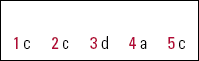
| 1 | c | 2 | c | 3 | d | 4 | a | 5 | c |



eLetters
No eLetters have been published for this article.