

Introduction
Spix’s Macaw Cyanopsitta spixii, which became extinct in the wild in Brazil in October 2000 (Juniper Reference Juniper2002), has been the focus of significant conservation efforts. These efforts have followed an Action Plan published by the Brazilian government in 2012, with updates in 2016 and 2019. The primary goal of the 2019 Action Plan is: “To carry out the reintroduction of Spix’s Macaws in their original range by 2024, aiming for continuous population growth and the conservation of habitats through community involvement in sustainable practices” (ICMBio 2019).
The Action Plan’s goal was achieved in 2022, when 20 Spix’s Macaws were released back into their natural habitat in the Caatinga Forest Domain. The initial results of the reintroduction project were remarkable: a first-year survival rate of 58.3% (CI: 37.8–78.7%), with 65% of the Spix’s Macaws establishing stable activity areas within 5 km of the release site, excluding temporary long-distance forays. In addition, 85% of the released macaws exhibited flock cohesion. Several formed pair-bonds with conspecifics, engaged in nest cavity exploration, breeding behaviour, and territorial defence of nest-sites. Three females laid and incubated eggs, with two pairs successfully hatching and rearing chicks in artificial nest cavities. The release project has been supported by the local community through participatory monitoring and volunteer reporting of sightings of reintroduced birds (Association for the Conservation of Threatened Parrots unpublished data; Purchase et al. Reference Purchase, Lugarini, Ferreira, Vercillo, Stafford and White2024).
In 2023, our team conducted a population viability analysis (PVA), concluding that a minimum viable population size of 20 birds is required to sustain the species in the wild, assuming no external factors disrupt the population. The study further assessed potential catastrophes and annual losses, finding that if the population of 20 birds is subjected to these threats – particularly the loss of five individuals per year – the probability of extinction rises to 100%. Consequently, supplementation of the wild population with captive-bred birds is essential to establish a sustainable population. Several scenarios were examined, and annual supplementation with 20 individuals was identified as the optimal strategy to stabilise the wild population most efficiently (Vercillo et al. Reference Vercillo, Oliveira-Santos, Novaes, Purchase, Purchase and Lugarini2023).
Unfortunately, no releases were carried out in 2023 or 2024, and during this time, 11 of the 20 birds released in 2022 have been lost. Six birds died (four predated by birds of prey, one by a wild or feral cat, and one due to electrocution), four disappeared after flying away, and one was recaptured after becoming lost three times. Despite these challenges, nature showed resilience as five wild birds hatched: two in 2023, which died either before or upon fledging, and three in 2024, with one being moved into captivity and two successfully fledging and flying free after three months.
The Spix’s Macaw Action Plan concluded in July 2024, and the Brazilian government shifted its conservation strategy, making captive breeding the priority once again, with no further releases authorised. In light of this situation, we updated the 2023 PVA to assess the impact of this decision on the wild Spix’s Macaw population and to reaffirm the critical importance of annual supplementation.
Methods
We employed the PVA method to predict the dynamics and persistence of the reintroduced population (Boyce Reference Boyce1992). This model estimates the probability of extinction (PE) by simulating various scenarios based on life history data, including biological, environmental, and genetic factors (Boyce Reference Boyce1992; Brito Reference Brito2009). The PVA models were generated using VORTEX software (Lacy and Pollak Reference Lacy and Pollak2023), applying the same methods and parameters as in 2023 (Vercillo et al. Reference Vercillo, Oliveira-Santos, Novaes, Purchase, Purchase and Lugarini2023). The current status of the population (11 birds – 9 adults and 2 juveniles) was factored into the analysis.
Six scenarios were modelled:
-
1) Base scenario: 20 birds, no external threats.
-
2) Scenario 2: 20 birds, external threats (catastrophes, predation, poaching – five birds lost per year), no supplementation.
-
3) Scenario 3: 20 birds, external threats, 20 birds supplemented annually for 20 years.
-
4) Scenario 4: 11 birds, external threats, one-time release of 10 birds.
-
5) Scenario 5: 11 birds, external threats, 10 birds supplemented annually.
-
6) Scenario 6: 11 birds, external threats, no supplementary releases.
To evaluate the impact of the supplementary population on the captive population and ensure that it does not compromise long-term viability, we collected data from the species studbook from 2023 and updated it with data through August 2024.
Results
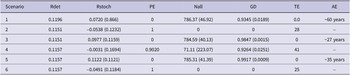
The PVA results underscored the necessity of annual supplementation. In scenarios without supplementary releases (Scenarios 2 and 6), extinction probability reached 100%, and a one-time release (Scenario 4) still yielded a 90% probability of extinction (Table 1).
Effects of catastrophes, threats, and supplementation on the simulated population. Rdet = determined growth rate; Rstoch = stochastic growth rate; PE = probability of extinction; Nall = mean population size; GD = genetic diversity; TE= average time to extinction; AE = estimate of the year when the population reaches stability, (–) indicates no stability. Standard deviation of the variables appears in parentheses

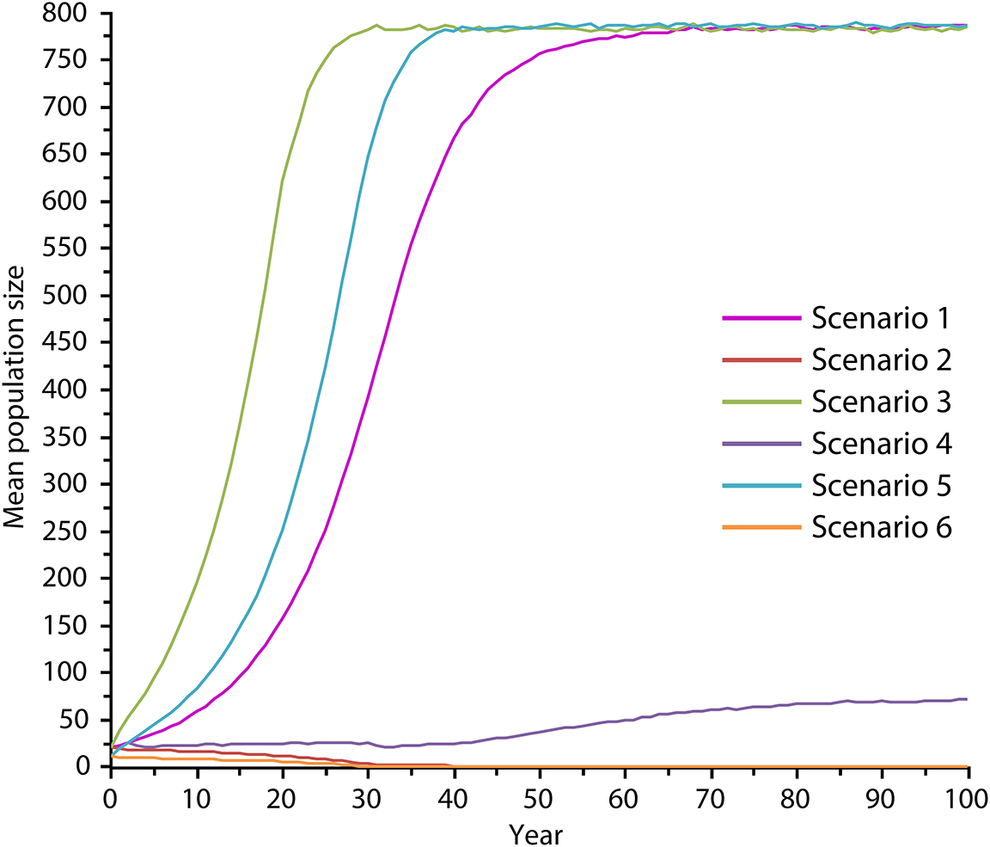
The number of birds released annually influences the population’s growth rate (Figure 1). With 20 birds supplemented each year, population stability could be achieved in approximately 27 years, whereas releasing only 10 birds annually would delay stability to around 35 years (Table 1)
Mean population size of Spix’s Macaw Cyanopsitta spixii under different scenarios.
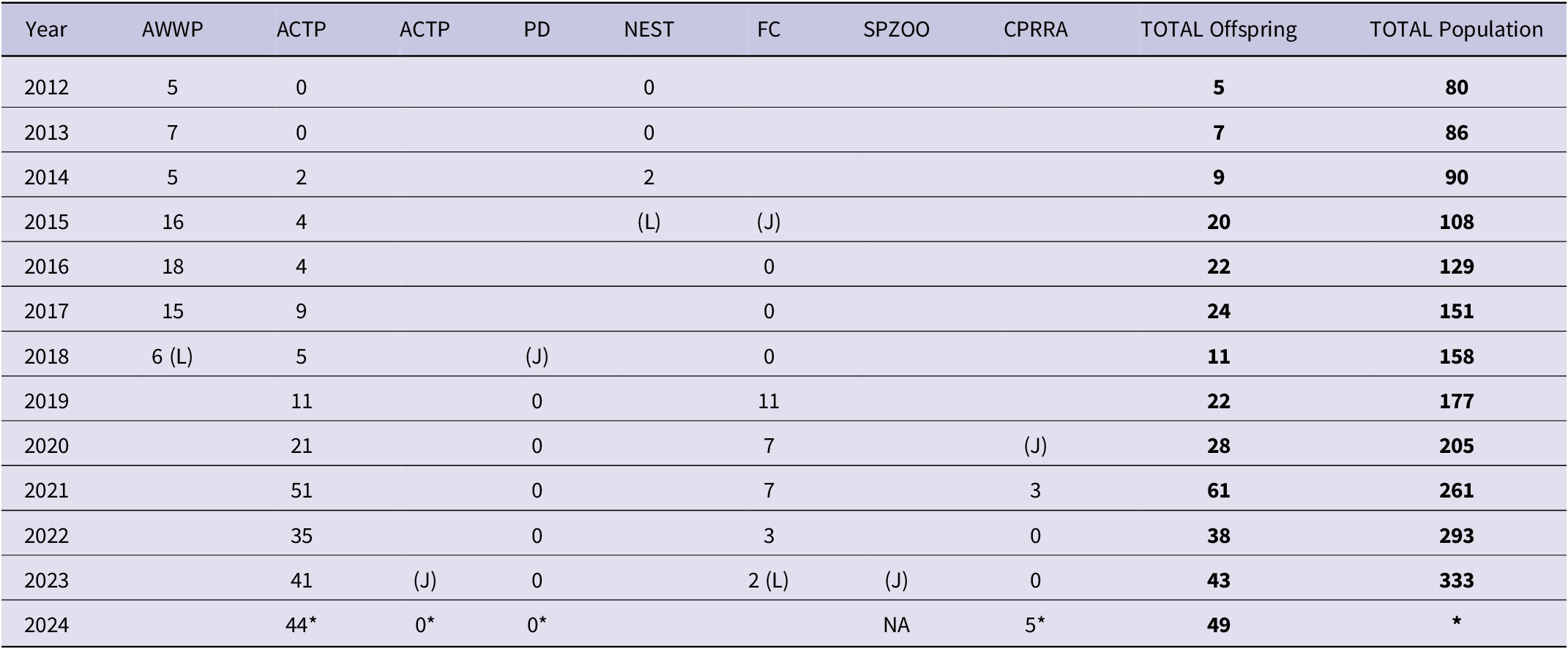
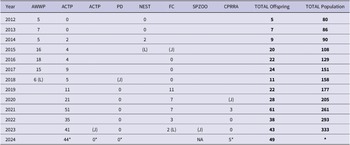
Over the past 13 years, the captive population has increased fourfold and produced 339 birds. Table 2 shows a consistent growth in the captive population and the number of offspring per year. The fertility rate increased, from five birds in 2012 to 61 in 2021. The 2024 breeding season is still ongoing, but so far, 49 new chicks have been recorded. Over the last five complete seasons (2019–2023), the average annual offspring production was approximately 38 birds, with 83% of the offspring produced in Germany. Currently, the only facility producing offspring in Brazil is the Spix’s Macaw Reintroduction and Release Center, located at the release site.
Spix’s Macaw Cyanopsitta spixii captive offspring production by year and holder from 2012 until the present, including the total number of individuals alive at end of the respective calendar year. The holders are: AWWP (Al Wabra Wildlife Preservation), Qatar; ACTP (Association for the Conservation of Threatened Parrots), Germany with a facility in India; PD (Pairi Daiza Zoo), Belgium; Criadouro Nest, Brazil; FC (Fazenda Cachoeira), Brazil; SPZOO (São Paulo Zoo), Brazil; CPRRA (Spix’s Macaw Reintroduction and Release Center), Brazil. (J) indicates the joining year of the captive programme and (L) indicates the leaving year. The 2024 breeding season is not over, and the numbers can eventually change due to loss of chicks (*) and no information was available (NA) for SPZOO
Discussion
The survival of the wild Spix’s Macaw population hinges on the annual release of captive-bred birds. Delays in these releases jeopardise the entire reintroduction effort and push the species back towards extinction. The optimal scenario involves releasing 20 birds per year, but even releasing 10 birds annually would support continuous population growth.
The captive population is well-established, consistently growing, and showing increasing fertility rates each year. The recommended number of birds for release – 20 individuals – represents approximately 50% of the average annual offspring in captivity. As the ex-situ population continues to expand, this proportion will decrease, further reducing any impact on the captive population.
Currently, the vast majority of offspring was produced between 2021 and 2024, with only a fraction of the birds expected to approach maturity in 2025. As more birds are expected to show breeding readiness, the breeding output of the population is expected to show an increased trend over the years to come. Therefore, supplementing the wild population with 20 individuals each year remains a sustainable strategy, not compromising the long-term viability of the captive population.
In contrast, if no further releases are made to address inherent Allee effects and promote population growth, the wild population will be driven to the brink of extinction. Maintaining a consistent release schedule is crucial, even if it means releasing fewer than 20 birds in some years (Armstrong and Wittmer Reference Armstrong and Wittmer2011; Deredec and Courchamp Reference Deredec and Courchamp2007; Stephens and Sutherland Reference Stephens and Sutherland1999; White et al. Reference White, Abreu, Benitez, Johnson, Lopez and Ramirez2021). Failing to release additional birds at this juncture places the newly established wild population in unnecessary danger and threatens the success of the entire reintroduction programme.
The project has undergone years of development to reach its current stage, which includes a fully operational release centre, active engagement from the local community, and on-going efforts to restore native vegetation, particularly riparian forests. Postponing the planned releases will not only jeopardise the survival of the wild Spix’s Macaw but also risk undermining the commitment of the local community and partner organisations who have invested significantly in this initiative.
Furthermore, the restoration efforts play a crucial role in mitigating the impacts of climate change. The project area has recently been classified as the first arid zone in Brazil (INPE and CEMADEN 2023), highlighting the urgent need for effective restoration strategies to address climate-related challenges and ensure the long-term success of the reintroduction project.
Therefore, we urge all stakeholders involved in Spix’s Macaw conservation to act swiftly to ensure a release in 2024 and to sustain annual releases in the coming years.


 Open access

