

Introduction
Global migration has led many countries to become multicultural societies (International Organisation for Migration, 2010). Language barriers have been identified as a major obstacle to migrants receiving appropriate healthcare. In Sweden, there is a law (Förvaltningslagen, 1986: 223) stating that people who do not understand or speak Swedish have the right to an interpreter in all contacts with public authorities. In a foreign country, the family can be an important support as many migrants have a limited social network (Giger and Davidhizar, Reference Giger and Davidhizar2008). Health-care professionals often rely on family members as interpreters, although they feel insecure in encounters with families from other cultures than their own (Free et al., Reference Free, Green, Bhavnani and Newman2003; Hultsjö and Hjelm, Reference Hultsjö and Hjelm2005; Gill et al., Reference Gill, Beaven, Calvert and Freemantle2011). Individualized and holistic care should focus on the interaction between health-care staff, patients and families. It is important to investigate the families’ perspective because family members represent a basic social unit in healthcare. Their involvement is perceived as a source of mutual support, security and fulfilment for the patient. The family member who is a relative of an individual who needs an interpreter in her/his health-care contacts also faces problems in communication when using an interpreter because of the trinity of the individual, family members and health-care providers (Giger and Davidhizar, Reference Giger and Davidhizar2008). No previous study has been found focusing on adults’ experiences and describes their family members’ use of interpreters in health-care encounters.
Literature review
From the patients’ (Hadziabdic et al., Reference Hadziabdic, Heikkilä, Albin and Hjelm2009) and health-care staff's (Hadziabdic et al., Reference Hadziabdic, Albin, Heikkilä and Hjelm2010) perspective, the benefits of using professional interpreters were their ability to interpret literally, objectively and without having any relation to the patient. A previous study (Barron et al., Reference Barron, Holterman, Shipster, Batson and Alam2010) found that patients were unaware that health-care staff could access interpreting services for their health-care consultations.
Reliance on family members as interpreters is common in healthcare (Free et al., Reference Free, Green, Bhavnani and Newman2003; Gerrish et al., Reference Gerrish, Chau, Sobowale and Birks2004; Gill et al., Reference Gill, Beaven, Calvert and Freemantle2011). Earlier studies have found that the positive aspects of using family members as interpreters are that they can protect confidentiality within their own communities, offer support in consultations and enable shared understanding of advice and instructions once the consultation is over (Rhodes and Nocon, Reference Rhodes and Nocon2003; Edwards et al., Reference Edwards, Temple and Alexander2005). However, professional interpreters have been found in previous systematic literature reviews (Flores, Reference Flores2005; Karliner et al., Reference Karliner, Jacobs, Chen and Mutha2007) to be more effective than other types of interpreters in bridging communication barriers.
Research on interpreter use in healthcare has previously focused on experiences of using interpreters from the perspectives of health-care staff (etic, outsider knowledge; Rosenberg et al., Reference Rosenberg, Leanza and Seller2007; Fatahi et al., Reference Fatahi, Hellström, Skott and Mattsson2008; Hadziabdic et al., Reference Hadziabdic, Albin, Heikkilä and Hjelm2010) and patients (emic, insider knowledge; Edwards et al., Reference Edwards, Temple and Alexander2005; Hadziabdic et al., Reference Hadziabdic, Heikkilä, Albin and Hjelm2009; MacFarlane et al., Reference MacFarlane, Dzebisova, Karapish, Kovacevic, Ogbebor and Okonkowo2009). However, there are studies focusing on bilingual young people's experiences of interpreting (Free et al., Reference Free, Green, Bhavnani and Newman2003; Green et al., Reference Green, Free, Bhavnani and Newman2005; Yang and Gray, Reference Yang and Gray2008). The youngsters felt that they were being used because of limitations in interpreter services. Family members saw this as part of their responsibilities as family members, concerned about the well-being of the person for whom they were interpreting (Rosenberg et al., Reference Rosenberg, Seller and Leanza2008). However, no previous studies have been found investigating how adults experience and describe their family members’ use of interpreters in health-care encounters when their family member(s) face language barriers in these encounters. The families’ perspective is important because health-care professionals provide healthcare to the individual and the family, and health-care staff face the need to use interpreters in their contacts when they meet language barriers. Examining the family members’ perspective gives the opportunity for etic (outsider) knowledge of the use of interpreters in health-care encounters. Therefore, it is best to examine the variations and similarities of experiences that exist in family members’ experiences of the use of interpreters in order to supply the missing piece to ensure a holistic view of all parties involved in the health-care encounter. The family's expertise and involvement must be recognized, acknowledged and used throughout the health-care process. Furthermore, this study contributes to the increased knowledge and understanding of interpreter use in healthcare and the implications this has for healthcare, such as improved health-care outcomes and lower costs for healthcare through the tool of improved communication (Giger and Davidhizar, 2008; Leininger and McFarland, Reference Leininger and McFarland2006).
Aim
The aim was to explore adults’ experiences of their family members’ use of interpreters in health-care encounters.
Method
Design
An exploratory qualitative approach was adopted. Focus groups were used for data collection as the group process enables members to express views that might not have been disclosed in an individual interview (Krueger and Casey, Reference Krueger and Casey2009).
Participants and procedure
Purposive sampling was used to ensure a range of participants differing in age and educational level and representing different perspectives (Krueger and Casey, Reference Krueger and Casey2009). The study included adult individuals who had Serbo-Croat (Bosnian/Croatian/Serbian) as their native language, and who had accompanied a family member and thus experienced the use of an interpreter in health-care encounters from a family member. The reason for choosing this migrant group was that individuals from former Yugoslavia constitute the second largest group of migrants living in Sweden (Sveriges Officiella Statistisk (SCB) 2009).
Representatives of migrants’ associations for former Yugoslavians in south Sweden, localized in an immigrant-dense region, were contacted to invite people to participate. A time was set for an information meeting. All participants also received written information, about the aim of the study focusing on the use of an interpreter in health-care encounters from their perspective as a family member, on the implementation of the study, and stating that participation was voluntary. Written information was given in Swedish and Serbo-Croat and the first author's contact details, together with a prepaid envelope. Those interested in participating sent their address to the first author who contacted them to set a time and place for the interview.
Two men and eight women, aged 29–61 years (median 45 years), length of residence in Sweden 12–18 years (median 17 years) with different educational levels, seven with high school level and three with university educational level had participated in the study. All were refugees, born in former Yugoslavia and with valid residence permits. Three focus-group interviews with 10 individuals were conducted. Two groups comprised female participants and the third group had two men and one woman.
Data collection
Data were collected between May and September 2009. A semi-structured interview guide was used as a prompt to encourage discussion (Krueger and Casey, Reference Krueger and Casey2009), on the basis of a literature review and experiences from previous studies (Hadziabdic et al., Reference Hadziabdic, Heikkilä, Albin and Hjelm2009; Hadziabdic et al., Reference Hadziabdic, Albin, Heikkilä and Hjelm2010). The interview guide was translated into Serbo-Croat to improve the quality of the information received and to increase reporting within the group (Hennink, Reference Hennink2007). As preferred by informants, all interviews were conducted in Serbo-Croat by the same investigator (first author) who was a native speaker, thereby reducing communication barriers (Hennink, 2007; Krueger and Casey, Reference Krueger and Casey2009). Examples of questions in the interview guide were: How did you perceive the use of interpreters for your near ones? What functioned well? What functioned less well and why? Written informed consent, including information about the voluntary nature of participation and assurance of confidentiality, was obtained before the interviews. Thus, the participants were informed again that the focus was on their family members’ use of interpreters in health-care encounters and about the implementation of the study.
The first focus group was held to test the interview guide and the role of the moderator (Hennink, 2007; Krueger and Casey, Reference Krueger and Casey2009). The focus group turned out well and the data were found to be of good quality, requiring no corrections, and were therefore included in the analysis.
The focus groups took place in a setting chosen by participants in a secluded room at an immigrants’ association for former Yugoslavians, in an office at the first author's workplace and at one informant's workplace. The moderator conducted the focus-group discussion with participants and made field notes immediately after the sessions to recall the group discussions (Hennink, Reference Hennink2007). Mini focus groups (mainly three participants) were used in order to make it possible for the moderator to take notes and observe the group interaction (Krueger and Casey, Reference Krueger and Casey2009). These notes described topics discussed, impressions of the topics discussed, interaction patterns and group dynamic and level of participation. Non-verbal communication was also registered. Each session lasted about 1 h and included three to four individuals. The interaction in each group was lively, with knowledge transfer and supportive communication. Body language was noted, demonstrating active engagement.
The interaction in the focus-group interviews was particularly intensive while discussing literal interpretation and interpreters’ nationality.
Interviews were audio taped, transcribed verbatim and then translated into Swedish by the first author. The translation was checked by a professional translator (Hennink, Reference Hennink2007: Squires, Reference Squires2008) and showed high agreement.
Ethical considerations
Swedish law (SFS, 2003: 460) was followed. Written informed consent was obtained from the participants (World Medical Association Declaration of Helsinki, 2008). To preserve the confidentiality of the data, the tapes and transcripts were anonymized and coded by number. The analysis and presentation of the data were carried out in a way that concealed the participants’ identity. Participants could withdraw from the focus groups at any time without explanation. All data were stored in a locked space to which only the first author had access. To preserve the confidentiality of the participants, they agreed that discussions held within the group should be confidential and not be shared outside it. The first author pointed out that she could not guarantee that others in the group would maintain confidentiality.
Data analysis
Data analysis was performed as described by Krueger and Casey (Reference Krueger and Casey2009), as this method considers the influence of interaction in the group, to identify patterns and discover relationships between ideas. The data sources included field notes, summary expressions and verbatim discussion. Analysis of data proceeded simultaneously with data collection until no new information emerged.
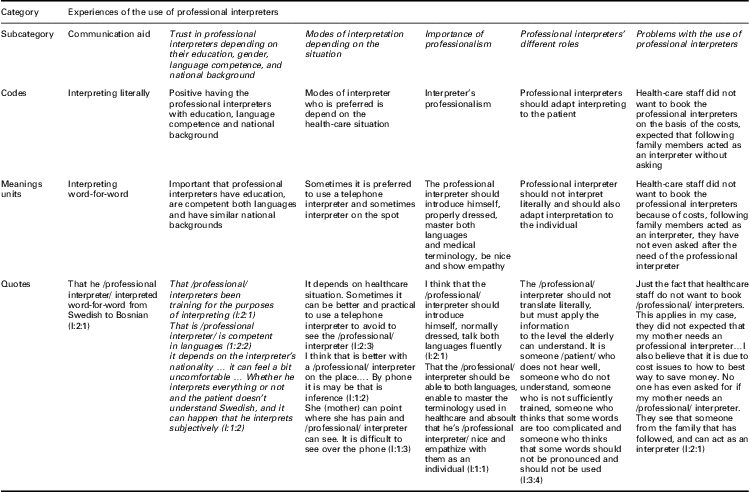
Analysis started with notes directly after the group interviews about what the informants said and the interaction in the group (see Table 1; Krueger and Casey, Reference Krueger and Casey2009; Morgan, Reference Morgan2010). Thereafter, the text from field notes and interviews was read several times to give a comprehensive picture of the data. The text was coded and opinions with similar meanings were grouped in subcategories according to their differences and similarities. The process of grouping codes assisted in developing an understanding of the patterns in the data. Comparisons were made during the whole analysis between subcategories and the text as a whole. When no new information appeared, subcategories with similar meanings were combined into categories (Krueger and Casey, Reference Krueger and Casey2009).
Example over the data analysis step

Rigour
Investigator triangulation was used to validate the findings (Patton, Reference Patton2002). The first author performed the analysis and established subcategories. Categories were checked and discussed with the co-authors to ensure that they agreed with the interview material. Quotations were used to illuminate the results and to verify the categorization to ensure conformability (Patton, Reference Patton2002). To increase the credibility, analysis proceeded to the point where no new information was obtained. This was reached after three focus-group interviews, as Krueger and Casey (Reference Krueger and Casey2009) suggest often occurs. Dependability was ensured by giving careful descriptions of the sampling procedure and data analysis (Patton, Reference Patton2002). To achieve trustworthiness in the translation, it was checked by a professional translator for the accuracy of transcription (Hennink, Reference Hennink2007; Squires, Reference Squires2008).
Findings
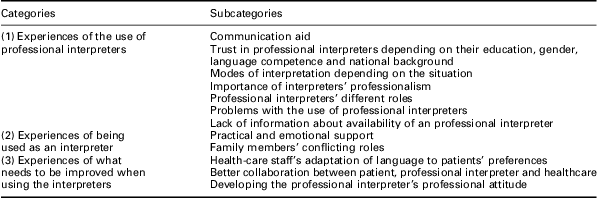
Three categories – (1) Experiences of the use of professional interpreters; (2) Experiences of being used as an interpreter; and (3) Experiences of what needs to be improved when using interpreters – were identified from family members’ experiences of the interpretation situation with the respective subcategories (Table 2). The second category, the experiences of being used as an interpreter, was an incidental finding stated by the majority of the respondents.
Three categories with the respective subcategories exploring family members’ experiences of the use of interpreters in healthcare
Experiences of the use of professional interpreters
Communication aid
Some participants found the use of professional interpreters beneficial for their relatives. They felt that a professional interpreter ensured a literal transfer of information and privacy during an intimate/sensitive examination. Furthermore, they valued the existence of a law to ensure them the same right to correct information as native Swedes in contacts with healthcare. This inspired trust among family members in supporting their relatives in matters relating to healthcare.
I appreciate that he /professional interpreter/ interpreted word-for-word from Swedish to Bosnian (I:2:1).
Whatever your condition … in Sweden you have the right to phone and ask for an interpreter (I:3:1).
Some family members disliked their loved ones using professional interpreters, because the interpreters could give information they did not want the patient to hear, especially bad news. They related this to generational and cultural issues in their home country.
there's still the old idea that you shouldn't say it directly to … patients … you tell the family (I:3:4).
Trust in professional interpreters depending on their education, gender, language competence and national background
The participants perceived that professional interpreters’ education, skills in both languages and medical terminology increased their trust in the interpreters. Other essential factors were same gender as the patient, wearing non-provocative or neutral clothes and being of the same age. The interpreters’ professional attitude was important, shown by their behaviour towards the patient and the ability to keep the code of confidentiality. Continuous use of a particular professional interpreter and face-to-face interpretation were felt to give security for their near ones.
it /the professional interpreter's sex/ is significant for elderly women in gynaecological examinations. … For elderly men if a young girl comes to interpret for them, they might feel uncomfortable (I:2:2).
…/The professional interpreter/ should be properly dressed. You can't come dressed just any way, for example with dirty, wrinkled and torn clothes (I:1:3).
… /The professional interpreter/ comes and introduces himself and behaves professionally towards you, observes confidentiality and also informs you about professional secrecy (I:2:1).
There were informants who found it important that the patient and professional interpreter had the same origin and the same native dialect. It was the language that conveyed about the national background. They suspected the professional interpreter's objectivity if he/she had a strong national agenda and doubted whether the patient answered honestly in those interpretation situations.
… it depends on the interpreter's nationality … it can feel a bit uncomfortable … Whether he interprets everything or not and the patient doesn't understand Swedish, and it can happen that he interprets subjectively (I:1:2).
Some of the informants did not trust the professional interpreter to maintain confidentiality. They felt that there was no guarantee that the interpreter would not take advantage of the information given during the consultation.
Modes of interpretation depending on the situation
The informants stated that modes of interpretation were dependent on the care situations, the patient's age and gender. Using telephone interpretation, family members or bilingual health-care professionals as interpreters could be advantageous in sensitive matters, as they felt the patients trusted these modes more. In relation to mental health, some accepted an unknown professional interpreter, which gave the opportunity to remain anonymous on subjects that were difficult to talk about. Using telephone interpretation was considered a good alternative for young people.
It /the mode of interpretation/ depends on the disease. … when it comes to sensitive things that the people find it hard to talk to strangers about, it's better to have bilingual health care staff if they're available. … then you know that the information won't go any further and that a psychiatrist can't pass the details to others (I:1:1).
The informants perceived that the family members predominantly preferred a face-to-face professional interpreter as it enabled observing body language. The interpreter's professional attitude and good language skills were also factors that helped ensure adequate treatment for their relatives, especially regarding bad news.
a /professional/ interpreter on the spot is better because if you're with the doctor and say “It hurts here” /pointing at the body/ … feel more trust when … you can see through his reactions … it's better to have a professional interpreter who can express himself better so that the patient will understand better (I:2:3).
The potential influence of negative personal feelings between patient and professional interpreter could be a risk when using face-to-face interpreters. Family members as interpreters were perceived as a disadvantage because of their limited language knowledge, and also as it could have negative effect on the family member's work and private life, when she/he was obliged to follow the patient to different encounters. There were also negative experiences of the use of bilingual health professionals because they were perceived as not interpreting objectively and because interpreting was not part of their work assignment and therefore was regarded as stressful for the staff.
Informants felt that on unexpected visits their relatives seldom had access to a face-to-face professional interpreter. In those cases, the health-care staff expected accompanying family members to interpret or use telephone interpreters. However, face-to-face professional interpreters were mostly used when visits were planned.
Importance of professionalism
According to the participants, the ideal qualities of a professional interpreter were skill in languages and medical terminology, and ability to adapt to different dialects. Most of the informants emphasized that the professional interpreters need to have a professional attitude by being polite, introducing themselves and showing empathy. Some considered that a professional interpreter wearing neutral clothes and of middle age could improve an interpretation situation.
…the /professional/ interpreter should introduce himself, /be/ normally dressed, talk both languages fluently (I:2:1).
… master the terminology used in examinations… (I:1:1).
Professional interpreters’ different roles
Informants felt that the professional interpreter had an important role as a communication aid. There were informants who found it important that professional interpreters transfer the information literally and objectively, even regarding bad news, for example a cancer diagnosis. Others considered that professional interpreters should adjust the interpretation to the patient's age, hearing and educational level.
… the /professional/ interpreter should not translate word-for-word but should adapt the information to a level that old people understand. There are some who don't hear well, don't see well, don't understand well, someone not well enough educated who thinks that certain words are too complicated and someone who thinks that some words are shameful and shouldn't be used (I:3:4).
Most informants felt that the professional interpreter could also have an important role in helping patients with practical matters such as meeting the patients at the entrance and getting to know them. Others approved the current policy forbidding professional interpreters to have any contact with the patient outside the interpreter situation, so that their role as family member was to help with practical matters and not interpret.
Problems with the use of professional interpreters
Participants found it problematic that health-care staff did not book professional interpreters or ask for patients’ wishes about the use of a professional interpreter, and that they expected the accompanying family member and/or bilingual health-care staff to act as an interpreter. The health-care staff's unwillingness to book professional interpreters was related to economic issues, in their opinion. Other factors that were perceived as problematic were professional interpreters who broke off the consultation prematurely.
…that they /care staff/ just don't want to book /professional/ interpreters. … that it's because of the cost, how they can best save money. Nobody has even asked if my mother needs an interpreter …someone from the family has come and can act as interpreter (I:2:1).
it has happened that he /professional interpreter/ apologized for having to end a conversation because he had to go to the other side of town to interpret for others (I:1:3).
Lack of information about the availability of a professional interpreter
Sometimes informants found that written information sent to the patients’ home did not state whether a professional interpreter was booked. The family members then had to ensure that a professional interpreter would be present during the consultation.
when he /patient/ is called … I phone to check if an interpreter has been ordered. It sometimes says in the letter that an interpreter is ordered but not always (I:1:3).
Experiences of being used as an interpreter
An incidental finding, but one stated by the majority of the respondents, was the experiences of being used as an interpreter.
Practical and emotional support
Informants discussed a number of benefits deriving from interpreting experiences. There were emotional benefits in enjoying helping the family and having their interpretation skills trusted more than an unknown interpreter. They valued the opportunity as interpreters to obtain more information as they were able to ask additional questions, share understanding of advice and give practical and emotional support during/after the consultation.
…when I interpret for my mother I find out much more than when it's a professional interpreter … because I'm the one who asks questions, not my mother (I:2:1).
There were also disadvantages of interpreting: it was a great responsibility, it takes time from their work and family life and it was difficult to ensure complete information transfer because of limited language skills (Swedish/medical terminology). Moreover, there were negative emotional consequences. Some participants felt that they could not be objective and transfer complete information. Others reported that some consultations involved sensitive information, difficult to interpret because they could be blamed for holding the ideas expressed by health-care staff.
… feels great responsibility … must learn certain words in Swedish that you don't use every day (I:1:1).
I can't be there to interpret every time it's needed. Although I try, leave work early, organize it somehow so the children don't have to be there. But there have been situations when I was forced to have my children with me (I:2:1).
For example my father-in-law had diabetes and … I interpreted for him about what he could eat or not. I get the feeling that he didn't like me telling him, as if it was me forbidding him to eat things (I:3:2).
Family members’ conflicting roles
Family members discussed their role of interpreting negative news. Some felt that it was important to ensure literal transfer of information to their relatives because it was the law, and the health-care staff expected them to do it. Those situations were perceived as emotionally difficult and they wished not to be used as interpreters. Others felt it was their duty not to transfer all information but to adapt it to patients in a gentler way. They explained that it was related to a generational and cultural issue from the home country where the older people were not comfortable with such statements. Further, they stated that it was emotionally difficult to pass negative news on to relatives as it might upset them. The informants who adapted the information in the interpretation situation preferred being interpreters for their near ones.
…could never interpret a cancer diagnosis for someone close to me … would put it in a milder way… older people are not used to the direct way of expressing a message like that (I:3:4).
But according to the law … you have to interpret word-for-word (I:3:1).
Participants considered that they could be more objective in their interpretation when they interpreted for persons with whom they had no close emotional ties.
Experiences of what needs to be improved when using interpreters
Health-care staff's adaptation of language to suit patients’ preferences
It was suggested that, to facilitate professional interpreter use, health-care staff must ensure that both the interpreter and patient have correctly understood the information. This could be done by health-care staff using easy Swedish and simple medical terminology and by talking slowly.
A doctor can … try to explain to a /professional/ interpreter in simpler Swedish (I:1:2).
There were also desires that health-care staff should not expect family members to act as interpreters in all care situations and that they should ask about the patients’ preferences.
Better collaboration between patient, professional interpreter and healthcare
The participants wished that professional interpreters should be employed permanently to ease availability and access. They also suggested that it would be better to clarify the policy for when and how bilingual health-care staff should be used as interpreters. Other suggestions included written information in both languages in the letter that patients received at home, better cooperation with other care institutions, better accessibility to professional interpreters and continuity in the use of professional interpreters. Furthermore, better documentation of the patient's communication status, including the appropriate language and practical help such as booking a taxi was important. Someone suggested developing an agency for non-Swedish-speaking patients where they could turn for help in booking interpreters.
… that there is better contact with home help, … that /professional/ interpreters are available (I:2:1).
important that GPs write that the patient also needs help to get from home to the hospital (I:1:2).
There should be a single number that they [patients] can call to get an answer in their own language so that they themselves can talk. … Mostly you have to be able to speak Swedish yourself to be able to book a /professional/ interpreter (I:3:4).
Developing the interpreter's professional attitude
It was emphasized that, to facilitate communication with patients, professional interpreters should be trained in the native language and how to encounter different people. Further, the professional interpreter should ensure that information is correctly understood by patients, and meet the patients before consultations to get to know each other. The professional interpreter should be available at the appointed time and throughout the consultation.
…after every conversation you should ask the patients if they have understood everything, to be able to talk more with the doctor about it. … that they /professional/ interpreters/ should do that, it ought to be their duty (I:1:3).
…there should be enough time set aside for the patient. … both patient and /professional/ interpreter should come at least fifteen minutes earlier, if they are meeting for the first time … to make contact and get to know each other (I:1:1).
Discussion
This study is the first investigation focusing on experiences of a near one's use of interpreters from adult family members’ perspective. The main findings were that there was great variation in family members’ experiences of using interpreters for their near ones. Family members had different views about whether the professional interpreter should interpret literally or not, the type and mode of interpretation and the interpreter's professional role. In situations where they were used as interpreters, family members felt their role was to act as practical and emotional support, which could lead to both positive and negative emotions.
The experiences of interpreting were related to the nature of the consultation. For some participants, literal transfer of information was essential in all consultations. Others did not want their relatives to have bad news translated, which was related to generational and cultural issues. It was an interesting finding when people from same culture perceived this differently. This study was based on individuals from former Yugoslavia of differing age and educational status but with similar migrational and socio-economic status. The degree of individuals’ acculturation and educational levels may influence their health-care needs (Berry, Reference Berry1997) and experiences of the use of professional interpreters. However, more studies are needed to investigate whether this may be because of acculturation and whether the findings also apply to other migrant groups. Thus, some informants’ desires were contrary to the Swedish Health and Medical Services Act (SFS, 1982: 763), which states that patients need to be fully and directly informed about serious health conditions, and contrary to professional guidelines in Sweden (Kammarkollegiet, 2010), which state that professional interpreters should translate literally. Culture has an impact on how people respond to illness. In all countries, the model of healthcare, social policy and health education is strongly influenced by cultural and religious factors (Giger and Davidhizar, Reference Giger and Davidhizar2008). It is common in many countries not to convey negative news directly to the patient and inform the family instead (Blackhall et al., Reference Blackhall, Frank, Murphy, Michel, Palmer and Azen1999). This is important to consider in interpretation situations where there is a difference between what is stated in health-care laws, which aim for patient autonomy and cultural groups, where patient autonomy may be seen as harmful.
The professional interpreter's use of the right dialect, associated with his/her origin, was important for having trust in the process. This finding was in contrast to earlier studies of patients’ (Hadziabdic et al., Reference Hadziabdic, Heikkilä, Albin and Hjelm2009) and health-care staff's perspectives (Hadziabdic et al., Reference Hadziabdic, Albin, Heikkilä and Hjelm2010), where professional interpreters’ dialect was not related to the ethnic origin of interpreters except insofar as it ensured better understanding. The professional interpreter's use of dialect was important for some informants and might be because of history. Besides the alphabet, Serbo-Croat languages differ in vocabulary, grammar and intonation (Resic, Reference Resic2006). The dissimilarities between family members’ and patients’ perspective may be because of the different roles they have during the consultation; this was not directly compared in this study and needs to be further studied. Trust between parties in interpreter consultations is essential as a prerequisite for effective communication and to provide quality care (Greenhalgh et al, Reference Greenhalgh, Robb and Scambler2006; Robb and Greenhalgh, Reference Robb and Greenhalgh2006; Rosenberg et al., Reference Rosenberg, Leanza and Seller2007). Furthermore, other personal qualities of professional interpreters discussed by participants were similar to the patients’ (Edwards et al., Reference Edwards, Temple and Alexander2005; Hadziabdic et al., Reference Hadziabdic, Heikkilä, Albin and Hjelm2009) and health-care staff's (Hadziabdic et al., Reference Hadziabdic, Albin, Heikkilä and Hjelm2010) preferences.
In Sweden, there is a legal right (Förvaltningslagen, 1986: 223) to access an interpreter in all encounters with public authorities. The recommendation is to use licensed health-care interpreters particularly trained for this (Kammarkollegiet, 2010). However, the incidental finding suggests that there will always be some situations in which family members contribute as interpreters in healthcare. The duties of the family members in interpretation situations were perceived differently by informants. There was disagreement regarding the role of the family as interpreters, especially in the delivery of bad news. This was in contrast to patients’ wishes for literal interpretation (Hadziabdic et al., Reference Hadziabdic, Heikkilä, Albin and Hjelm2009). In previous studies (Rosenberg et al., Reference Rosenberg, Leanza and Seller2007; Fatahi et al., Reference Fatahi, Hellström, Skott and Mattsson2008; Hadziabdic et al., Reference Hadziabdic, Albin, Heikkilä and Hjelm2010), health-care professionals were suspicious of the ability of family members as interpreters in conveying essential information to migrant patients and family members, as the interpreters focused on the well-being of their near ones (Rosenberg et al., Reference Rosenberg, Seller and Leanza2008). This study's finding is in agreement with previous findings (Ho, Reference Ho2008) that judgements of family members as interpreters should be made on a case-by-case basis, as they may have varying abilities to interpret for their near ones. It is important that health-care staff allow patients and their families to decide an acceptable level of involvement on the basis of the trust patients have in family members as interpreters. However, in the first instance, the health-care staff should explore patients’ wishes through the use of an independent professional interpreter.
Participants in this study experienced an emotional disadvantage with the interpreter role for their family members. It had a negative impact on their social life and they wanted their relatives to receive social support in the form of practical support and information from different health-care institutions, which has not been previously described. Health-care staff need to examine family functions in relation to families’ social properties to meet their wishes (Giger and Davidhizar, Reference Giger and Davidhizar2008). Social support from health-care services could be very important in maintaining and promoting the health of participants and their relatives (Debs-Ivall, Reference Debs-Ivall2007). Additional support, in the form of increased collaboration between different health-care institutions, is also warranted to facilitate appropriate healthcare for foreign-born people (Debs-Ivall, Reference Debs-Ivall2007). The limitations and potential dangers of family members as interpreters include lack of familiarity with medical terminology, misrepresentation, translation errors, a tendency to summarize or omit data, subjectivity and ethical conflicts, as also found in young people's experiences of interpreting (Free et al., Reference Free, Green, Bhavnani and Newman2003; Green et al., Reference Green, Free, Bhavnani and Newman2005; Yang and Gray, Reference Yang and Gray2008).
Finally, an interesting finding was that the informants felt that health-care staff did not ask about either the patient's wish for a professional interpreter or the family members’ wish to interpret. This is contrary to the Swedish Health and Medical Services Act (SFS, 1982: 763) and World Health Organization (WHO) (1994) recommendations in which the main goal is individualized care and autonomy. Health-care staff are required to involve the patient in the decision process and avoid placing a family member in the emotional position of conveying devastating news to a family member (SFS, 1982: 763). It is essential that both the patient's and the family's voices be heard to achieve communication and good patient care and autonomy.
Limitations and strength of the study
Our study is limited because of the number of participants; only 10 people took part and of these only two were men. The collection and analysis of data in the study proceeded until no new information was added (Krueger and Casey, Reference Krueger and Casey2009). The study attempted to recruit an equal balance of men and women, without success. However, in Europe, it is mostly women who are involved in the care of their family members (Socialstyrelsen, 2006), as represented by the participants in this study. The difficulties of running a mixed-gender focus group, for example the peacock effect (Krueger and Casey, Reference Krueger and Casey2009), could also be viewed as a limitation in this study. Men have a tendency to speak more frequently and with more authority when in groups with women, which might lead to limited possibilities for women to express their views (Krueger and Casey, Reference Krueger and Casey2009). However, there were no signs of dominance as the interaction in the group was lively, all expressed themselves in an equal way and after the analysis of the three groups, no new information was added to the data.
One limitation of this study could be that there was no assistant moderator during the focus-group interviews, for practical and financial reasons. Therefore, a mini focus-group design (three to four individuals) was chosen to make it possible for the moderator to facilitate the group process and also to take notes about the interactions during and after the interview (Carey, Reference Carey1994; Krueger and Casey, Reference Krueger and Casey2009). Mini focus groups also eliminated the risk of frustration resulting from participants not having enough time or opportunity to express themselves in larger groups. An effort was made to minimize the effect of the absence of an assistant moderator. Furthermore, allowing participants in focus groups to respond in their native language increased their comfort level with the moderator, who had a similar cultural and linguistic background, which also helped to maximize the quality of data (Squires, Reference Squires2008; Krueger and Casey, Reference Krueger and Casey2009). Otherwise, the disadvantages could be that it limits the total range of experiences because the group was smaller. A group with fewer participants will have fewer total experiences than a larger one; conversely, larger groups work well when the participants do not have a lot of knowledge about the topic (Krueger and Casey, Reference Krueger and Casey2009). However, the outcome depends more on the involvement of the participants in each group and their interaction than on the actual number of participants (Krueger and Casey, Reference Krueger and Casey2009). When having an exploratory aim one should run groups of smaller size, as the prime objective is to obtain the maximum amount of information (Tang and Davis, Reference Tang and Davis1995). There was lively interaction in the focus groups, and after three groups had been analysed, no new information was added to the data. The study provides a deeper understanding of the studied topic, and as the results were carefully collected and analysed they may be transferred to other settings or groups with similar characteristics (Krueger and Casey, Reference Krueger and Casey2009).
Participants were from former Yugoslavia, of differing age and educational status but with similar migrational and socio-economic status. The slight differences between the informants’ backgrounds may have the result that some family members felt less confident and were afraid to express their views. However, there were no indications of this during the focus-group interviews. The ability to communicate in the group was supported by the openness of informants while discussing sensitive topics such as the interpreter's nationality.
Cross-language research has the potential for altered meaning (Squires, Reference Squires2008); the use of interpreted data must be noted as a limitation in this study. However, the translation of data was checked by a professional translator for accuracy in the transcriptions (Hennink, Reference Hennink2007; Squires, Reference Squires2008).
Another limitation might be that the interviews were held at different venues, after participants’ desires. In our study, the venue for the focus groups needed to be both neutral and socially acceptable to participants. However, the venues were accessible and easy to find, neutral and quiet so that participants were not likely to have needed to explain their reason for their presence (Krueger and Casey, Reference Krueger and Casey2009). The strength of the investigation was that focus groups worked well with the current population through the good interaction and group climate during the interviews.
Conclusion
The findings emphasized that there was no agreement in family members’ experiences of their near ones’ use of interpreters; instead it depended on the situation and the individual. Perceptions differed as to whether the interpreter should interpret literally or not, the type and mode of interpretation, the interpreter's professional role and the families’ roles when used as interpreters. Family members desired to adapt interpretation to the patients’ preferences, the nature of interpretation and their own satisfaction with interpreting for near ones.
Implications for nursing practice
Health-care professionals need to be aware of different family members’ views about interpreting literally and objectively. It is vital in individual care planning to provide information about the patients’ right to an interpreter and to ascertain individual preferences. Nurses need to organize a good interpretation situation with the patient's active involvement and choose the appropriate interpreter according to the nature of the interpretation, the patient's preference and family members’ satisfaction with interpretation for their near ones. Health-care professionals also need to be able to cooperate with members of the patient's social network to ensure communication and retain autonomy in patient-centred and high-quality healthcare.
Acknowledgements
The authors are grateful to Dr Alan Crozier, professional translator, for reviewing the language. They also thank representatives of migrants’ associations for former Yugoslavians for the collaboration that resulted in this manuscript. Author contributions: EH and KHj were responsible for the study conception and design and EH, KHj, BA and KHe were responsible for drafting of the manuscript. EH performed the data collection and data analysis under the critical scrutiny of KHj, BA and KHe. KHj, BA and KHe supervised the study.