

Introduction
Semiotics can be defined as the international field devoted to the study of the innate capacity of all living beings to produce and understand signs in the communicative process. Social semiotics focuses on those human communicative practices that implicate verbal, visual, bodily and object-based modalities. The basic premise is that people are always in the process of interpreting their social interactions and experiences with reference to the practices and conventions of the culture within which they live. No material object, event, text, or action has meaning in and of itself. Rather meanings are made in and through social practices which advance semiotic claims drawn from the range of acceptable semiotic resources and actions. All societies are characterized by regular and repeatable patterns of meaning-making. These patterns are thus typical of that society and help to define and reproduce it, as well as to distinguish it from all other societies.
Social identity formation is one of the most complicated and often contentious kinds of signifying practices. It encompasses the formation of self and the relationships of individual to groups within specific cultural contexts. It thus includes the production of self-perceptions, personal characteristics, social roles and cultural affiliations. Examples include age cohorts, political parties, social movements, religious associations and tribal communities. The social distinctions we recognize today are the legacy of the diversity of identities operational in the past. The challenge for archaeologists interested in social identity is thus twofold: to document the variety of ways people in the past marked out similarities and differences, and to investigate how some of these distinctions have given rise to those of the present day. Social identities always exist within social hierarchies, and these hierarchies are themselves characterized by histories and complex entanglements. As Graeber and Wengrow (Reference Graeber and Wengrow2021) remind us, social change is a temporal process, but the forms it takes are neither unilineal, nor inevitable. Moreover, how we characterize the past is directly linked to our vision of new social possibilities for the future.
My essay is a consideration of some of the implications of semioidentity for archaeological interpretation. I define semioidentity as that component of semiotics that deals with the sign–identity relationship in its pragmatic (social) and metapragmatic (philosophical) dimensions. Such an approach offers a valuable contribution to archaeological interpretation by highlighting the different kinds of sign relations and their functions in cultural reproduction. In particular, it emphasizes how indexical signs anchor interpretation to provide opportunities for additional higher-order claims about society. I begin with a discussion of semiotic resources, particularly those derived from a Peircean semiotic approach. I then address semiotic ideology, what a particular culture counts as a sign and how it operates in association with other signs. Finally, I present an interpretation of the Pueblo Revolt period in the southwestern US to illustrate some of the advantages of a semiotic approach to the study of the Pueblo Indian cultural revitalization movement.
Semiotic resources
Like atoms in physics, signs are the essential building blocks for semiotic analysis. And as in physics with its wave and particle theories of light, there are two influential models. These are the dyadic model developed by the Swiss linguist Ferdinand de Saussure and the triadic model developed by the American philosopher Charles Sanders Peirce. It is important to state at the outset that both approaches are incomplete and are best regarded as works in progress. Neither is inherently superior to the other, since they do different things and serve different purposes (see Parmentier Reference Parmentier1997). That being said, I hold that the Peircean model offers certain advantages for archaeology because of its direct engagement with the material world (see Preucel & Bauer Reference Preucel and Bauer2001; Preucel 2006; Reference Preucel2021).
To review, Saussure’s dyadic model defines the sign as a two-part relationship between the signifier (sound image) and signified (concept), both being mental ideas. This relationship is regarded as arbitrary, and the classic case is language, where words refer to their objects due to social convention. This model has been extremely influential in the humanities and social sciences giving rise to the major intellectual movements known as structuralism, deconstruction and post-structuralism. Peirce’s triadic model proposed the sign relation as a three-part structure consisting of the sign, the object and the interpretant. In this case, the sign (representamen) is linked to an object (an actual thing-in-the-world) producing an interpretant (an idea or action). Arbitrariness is only one of three possible kinds of semiotic relationships. This model has been especially influential in cultural and linguistic anthropology.
Most scholars are familiar with Peirce’s popular icon, index and symbol typology and I provide only a brief review here. An Icon is a sign that refers to an object by virtue of its particular characteristics. It is ‘mimetic’, in the way that a diagram or a painting represents its object. An Index is a sign that denotes its object by being affected or modified by that object. It can be thought of as a pointer or indicator—for example, a weathervane is an index that indicates the direction of the wind. Here the weathervane functions by being physically affected by the wind. A Symbol is a sign that obtains its character by virtue of some law, usually an association of general ideas. In this case, meaning is the result of social convention. For example, a national flag has no inherent meaning, yet it is commonly taken as a symbol of a country.
It is useful to make two observations. First, no sign is inherently an icon, an index, or a symbol. Rather a sign is interpreted as a particular kind at a specific moment in time for a given purpose. Meaning thus depends not upon some essential characteristic of the sign, but rather upon its reception by some interpretant, the sign that it produces in response in the communicative process. This insight, sometimes termed Peirce’s ‘pragmatic maxim’, indicates that signs can only be properly distinguished a posteriori, namely after the fact, by identifying their effects in the world. It also means that a semiotic analysis must be sensitive to the local social structures that govern how one sign generates another sign in a particular way (Layton Reference Layton2003).
Second, the three sign types are not of an equivalent status. They bear a hierarchical relationship to one another. All indices involve icons and all symbols are indexical because they act through tokens or replicas. So, for example, the weathervane functions as an index of the wind. But it also contains an icon, since the action of the wind causes the weathervane to move into a position such that it is oriented in the same direction as the movement of the wind. This hierarchical insight has proven crucial in understanding the evolution of language and culture. For example, biological anthropologists have argued that while all animals have the capacity to interpret iconic and indexical signs, only humans have the capacity of symbolic interpretation (Deacon Reference Deacon1997).
The famous icon/index/symbol typology is based on the sign–object relation. However, Peirce distinguished two other sets of sign types based on the sign–sign relation and the sign–interpretant relation. The signs associated with the relationships of the sign to itself are termed qualisigns (qualities), sinsigns (existent objects) and legisigns (general laws). Those associated with the relationships of the sign to its interpretant are rhemes (signs whose interpretants represent them as being icons), dicents (signs whose interpretants represent them as being indices) and arguments (signs whose interpretants represent them as being symbols). Together these three trichotomies constitute his sign typology and can be combined to express 10 different possible signs. There are, as yet, relatively few studies that have taken full advantage of these sign types (but see Munn Reference Munn1986). Parmentier (Reference Parmentier2016, 60) notes that their consideration may clarify important semiotic issues, including disambiguating the perspectives of past actors and present analysts.
Signs of recognition
The first step in any archaeological study is the recognition of a thing-in-the-world as an object made by a person at some past time. In this case, the identification of an object as an artifact is an index of human agency. This might seem obvious to us today, but it was a very real issue in the eighteenth-century debates about the antiquity of humans. In fact, Glyn Daniel (Reference Daniel1967, 46) regarded the recognition that flaked stone tools were in fact human products and not ‘elf shot’ or ‘thunder bolts’ as one of the major advances in understanding human prehistory. We now understand these same flaked stone tools as Acheulian hand axes produced by Homo heidelbergensis and evidence for over 1.2 million years of human existence. Today we recognize not just objects, but soils, plant and animal communities, and indeed whole landscapes, as being made or modified by past human activity.
Now the act of recognition, that is ‘seeing something as something’, always depends on some degree of prior knowledge supplied by the interpreter. Indeed, Peirce defines the sign as ‘anything whatever, real or fictile, which is capable of a sensible form, is applicable to something other than itself, that is already known, and that is capable of being so interpreted in another sign which I call its Interpretant as to communicate something that may not have been previously known about its Object’ (CP MS. 654.7, 1910, cited in Parmentier Reference Parmentier1994, 24–5, my emphasis). It is this preexisting knowledge when applied to the object, however tentative and even when wrong, that permits the possibility of the interpretive act in the first place. Without it, interpretation cannot proceed, and knowledge cannot grow. Archaeologists have always appreciated this insight and have embraced analogy as a way of using prior knowledge to elucidate a particular case.
Gordon Willey (Reference Willey1977) has summarized three kinds of analogy: specific historical analogy, general comparative analogy and specific comparative analogy. Specific historical analogy or ethnographic analogy is the interpretation of an archaeological context using information drawn from ethnographically known cultures from the same geographical region and within the same general culture-historical tradition (Willey Reference Willey1977, 85). There is an assumption that the prehistoric context shares a historical relationship with the modern one. General comparative analogy is based upon general knowledge of life itself. That is, it is based upon a ‘bits and pieces’ approach drawing insights from a range of cultures, time periods and geographical locations. Willey (Reference Willey1977, 86) notes that often it is all that the archaeologist has available to use and that it is fraught with potential problems, such as personal bias. Specific comparative analogy is the interpretation of an archaeological context by means of an ethnographic model based on some connection other than a historical one, such as ecological similarity. Willey (Reference Willey1977, 86) regards it as a middle-range model, free from the limitations of specific historical analogy and more within the bounds of human experience than the general comparative approach.
The limitations of analogy have been well discussed in archaeology (see Wylie Reference Wylie1985), but the method remains a key component in all interpretation. From a semiotic perspective, analogy is an interpretative mode that functions by establishing a degree of resemblance between two disparate contexts. The context of interest is the object, and the analogue is the sign. The relationship produced by the sign–object association is the interpretant, new knowledge which can itself be revised in light of additional information in an ongoing semiotic process. Willey’s analogy typology grounds the similarities between cultural forms according to the temporal and spatial distances separating them. There is an assumption that the strongest analogies are those cases where the temporal and spatial distances are minimal (direct historical analogy). But where such analogies are not feasible, other options exist that can draw insights from a cross-cultural comparison (specific comparative analogy) or from more general understandings of human behaviour (general comparative analogy).
Terrence Deacon provides a helpful example illustrating how signs can change modes depending on their interpretive context which I quote in full:
Consider, for example, an archaeologist who discovers some elaborate markings on clay tablets. It is natural to assume that these inscriptions were used symbolically by the people who made them perhaps as a kind of writing. But the archaeologist cannot read the writing because there is no Rosetta stone to use in decoding them. The archaeologist infers that to someone in the past they may have been symbolically interpretable, because they resemble symbols seen in other contexts. Being unable to interpret them symbolically, he interprets them iconically. Some of the earliest inscription systems from the ancient Middle Eastern civilizations of the Fertile Crescent were in fact recovered in contexts that provided additional clues to their representations. Small clay objects were marked with repeated imprints, then sealed in vessels that accompanied trade goods sent from one place to another. Their physical association with these other artifacts has provided archaeologists with indexical evidence to augment their interpretations. Different marks apparently indicated a corresponding number of items shipped, probably used by the recipient of the shipment to be sure that all items were delivered. No longer merely iconic of other generic writing-like marks, they now can be given indexical and tentative symbolic interpretations because something more than resemblance is provided. (Deacon Reference Deacon1997, 72)
Here Deacon makes clear that what counts as an interpretation is simply one moment in the interpretive process given the available semiotic resources at hand. The inscription on the clay tablet cannot be read because there is no Rosetta stone available. And yet the archaeologist recognizes that it could be read (and therefore as potentially symbolic) because it (as an icon) resembles tablets known from other archaeological contexts that can be read (specific comparative analogy). Here, we are also identifying a pattern (as an index) which points to control over both production (standardization) and distribution (presence at multiple sites). This has additional implications for interpreting the society’s political organization and technological development (an indexical sign pointing to a symbolic sign). However, should a Rosetta stone be found, the inscription might then be read. In this case, the intention (a symbol) of the ancient craftsperson could potentially be understood. So, in this example, the same tablet functions alternatively as an icon, an index and a symbol, depending upon the status of the argument being put forth and the kinds of semiotic resources available. However, it is the recognition of the tablet as an index of past human activity that permits the analysis in the first place.
Deacon’s example demonstrates the dynamic nature of the sign relation. Nothing is permanently an object, sign, or interpretant since each type shifts in subsequent interpretations. This is why the process of semiosis is infinite. For Peirce, interpretation is cumulative, tending towards truth in the long term. It proceeds in such a fashion that additional information is systematically brought to bear on the case following the principles of the scientific method. This process typically results in the initial interpretation being modified and sometimes even discarded in those cases where it is contravened by the new information. All interpretations are necessarily provisional and the strength of any one interpretation depends upon the kinds and numbers of the semiotic linkages deployed, much like Peirce’s famous cable analogy whereby different strands are not only mutually supporting but mutually constraining (Wylie Reference Wylie1989).
Semiotic ideologies
A semiotic anthropology is the study of the use of signs in the mediation of culture. But, as we have observed, signs are only signs if they are interpreted as such. What I recognize as a sign may not be what you recognize as a sign, much less what someone in the past recognized as a sign. However, culture performs a strong constraining force on how we engage with the world. It mediates reflection on the attributions that characterize conscious self-understandings as well as those tacit understandings that index membership in a group (Lee & Urban Reference Lee and Urban1989; Shaw Reference Shaw1994). While there is considerable variability across cultures, it is obviously not the case that anything goes. Here the notion of semiotic ideology, borrowed from ‘language ideology’ in linguistics (see Schieffelin et al. Reference Schieffelin, Woolard and Kroskrity1998), is particularly useful.
Webb Keane (Reference Keane2018, 65) defines semiotic ideology as a people’s basic assumptions about what signs are, what functions signs they serve and what consequences they produce. He further explains that semiotic ideology goes beyond language, since it engages with the full range of possible sign vehicles and sensory modalities, including ‘sound, smell, touch, muscular movement, pain, affect, and other somatic phenomena’ (Keane Reference Keane2018, 65). Keane further notes (Reference Keane2018, 66) that signs can be taken to be interpretable on a variety of grounds—for example, whether a society considers the sign’s relation to the world to be arbitrary, logical, natural, or divinely ordained. Differences between semiotic ideologies can thus be quite profound and often underpin radically different representational economies.
Take signs of life. What a culture does and does not consider to be alive and thus a social actor is culturally variable. For Ojibwe people, some rocks are considered animate. Irving Hallowell (Reference Hallowell and Diamond1960, 24) famously asked William Berens, an Ojibwe chief and friend, about whether stones and rocks were alive. Berens paused for a moment and answered that not all of them were alive, but some were. Hallowell was struck by his comment and asked for further elaboration. Berens explained that he had a stone which his grandfather had given him, which had some round holes that looked like eyes or mouths but otherwise appeared inanimate. Under special ritual circumstances, his grandfather would tap this stone with a knife and a human mouth would appear in the stone, from which a bag of medicine could be retrieved. Here we see the interpretive process at work—a belief that a special stone resembling a human mouth (an iconic sign) can thus be activated through physical manipulation (an indexical sign) to provide healing benefits (a symbolic sign). So, living life in the fullest sense, that is ‘life in the sense of longevity, health and freedom from misfortune’ is achieved in cooperation with other living beings (not all of whom are human) (Hallowell Reference Hallowell and Diamond1960, 45). Interestingly, Hallowell did not conclude from this example that Ojibwe people believed fantastical things. Rather he suggested that an understanding of their psychology required the consideration of the interactions of humans and other-than-humans in human affairs.
Similarly, different societies can favour different semiotic modalities. Gananath Obeyesekere has contrasted societies with a high tolerance of cultural symbolization from those societies with lower tolerances. He observes that the former societies tend to have a greater potential for ‘reflexivity, awareness, or self-consciousness’, since their form of symbolization encourages intellectual and philosophical reflection (Obeyesekere Reference Obeyesekere1990, 51). He observes that the maintenance of boundaries between self and others, reality and illusion, inside and outside, are highly marked in Western society, but of little significance in Hindu society. Here the true reality is ‘not the phenomenal external world of economic want and external scarcity but rather the set of meanings, symbols, and cultural values that were created and concurrently mediated through unconscious and preconscious processes’ (Obeyesekere Reference Obeyesekere1990, 65). For Hindu people, the everyday world of reality is ‘maya, “illusion,” whose true nature must be seen and overcome’ (Obeyesekere Reference Obeyesekere1990, 65).
Valentine Daniel has elaborated this idea further. The category of ur (substance) is the overarching metaphor for Tamil society and it tends to attract all other signs towards itself. It is directly implicated in the growth of self in the face of contrary and differentiating forces. Knowing someone’s ur is based upon the principle of shared substances across individuals. He then contrasts Western and Siddha medical practices. He suggests that Siddha diagnosis and treatment rely almost exclusively on iconicity as expressed by the sharing of pulses between physician and patient when the physician reads the pulse and the shared qualities between a drug and the patient’s body substance (Daniel Reference Daniel1984, 231). He then describes Western biomedicine as relying on indexical (cause and effect, allopathy) and symbolic (somatization) modes of representation (Daniel Reference Daniel1984, 232). This insight reveals the value of medical anthropology where different semiotic ideologies are routinely taken into consideration.
A semiotic case study: the archaeology of the Pueblo Revolt period
I now present an example of how semiotic archaeology can provide new insights into a historical event. I focus here on the Pueblo Revolt period from 1680 to 1696, a topic on which I have published extensively (Aguilar & Preucel Reference Aguilar2019; Capone & Preucel Reference Capone, Preucel and Preucel2002; Ferguson & Preucel Reference Ferguson, Preucel, Rykwert and Atkin2005; Liebmann et al. Reference Liebmann, Ferguson and Preucel2005; Preucel Reference Preucel2006; Preucel & Aguilar Reference Preucel, Aguilar and Whiteley2018; Preucel et al. Reference Preucel, Traxler, Wilcox and Schlanger2002). I am most interested in identifying some of the semiotic practices that helped produce a pan-Pueblo identity in the context of their cultural revitalization movement. I take my inspiration from Richard Parmentier’s (Reference Parmentier1987) study of the intersections of myth, history and polity in a Micronesian society impacted by colonialism. For him, the ‘cultural coding of eventfulness’ is a semiotic process in which a society’s historical consciousness is expressed by signs in various media and organized by culturally specific classification schemas (Parmentier Reference Parmentier1987, 4–5). History is thus a universal cultural category, but its expression varies depending upon a society’s semiotic rules and resources.
Parmentier approaches history-making in his study of Belau, an Austronesian people in western Micronesia. He draws a distinction between two culturally significant sign modalities, what he terms ‘signs in history’ and ‘signs of history’. Signs in history refers to those phenomenologically based speech acts, valorisation of objects and performances that are implicated in political strategies and focus attention on specific processes and events as they are happening (Parmentier Reference Parmentier1987, 11–15). They are pragmatic embodiments of social action and the loci of historical intentionality. In contrast, signs of history refer to those representational practices that encode and classify events as history. They thus refer to how a particular society objectifies its past and typically involve origin stories, supernatural beings and mythic heroes (Parmentier Reference Parmentier1987, 11–15). Because of their metapragmatic character, they are resources that are especially useful in discourses to legitimize future political events. The relationships between these two temporal sign types are complex and, as Parmentier notes, in traditional oral societies ‘signs in history’ can also function as ‘signs of history’, depending upon the interpretive context. In what follows, I discuss some of the ways Pueblo people forged a common identity based upon a new historical consciousness established during the Pueblo Revolt Period.
The Pueblo Revolt period as a cultural revitalization movement
The Pueblo Revolt of 1680 refers to the time when Pueblo Indian people joined together in a military alliance to assert their political sovereignty and forcibly evict the Spanish colony from New Mexico. The Pueblo people enjoyed a 12-year respite until Diego de Vargas mounted his successful reconquest in 1692 (Espinosa Reference Espinosa1942). Pueblo people resisted this return of Spanish rule and raided the colonists, stealing their livestock. Vargas retaliated, attacking the Pueblo people at their mesa villages in 1694. This led to a second Pueblo Revolt in 1696 which Vargas quickly put down (Espinosa Reference Espinosa1988). The period from 1680 to 1696 is thus of special historical interest since it was a time when Pueblo people reimagined themselves and their collective futures. My goal here is to illustrate how an archaeological consideration of the semiotic processes at work can expand our understanding of historical events and their ongoing cultural significance.
The standard interpretation of the Pueblo Revolt offered by Borderlands historians is that it was a cultural revitalization movement (Knaut Reference Knaut1995; Weber Reference Weber1999). I advocate this view but seek to reframe it through a consideration of Puebloan Indian semiotic practices, expressed in speech acts and manifested in material culture (Preucel Reference Preucel2006). More specifically, I am interested in how Pueblo people reconceptualized their worlds during the turbulent period of Spanish colonialism—how they responded to the social trauma as they went about the task of remaking their lives. My methods involve working back and forth across the Spanish ethnohistorical record, archaeological data and Pueblo Indian oral history to construct a more inclusive narrative.
Signs in history
Aspects of the Pueblo Indian Revolt period discourse can be found in the captive testimonies recorded in 1681 as part of Gov. Antonio de Otermín’s failed reconquest attempt (Hackett & Shelby Reference Hackett and Shelby1942). Pedro Naranjo, a San Felipe Pueblo medicine man, related that prior to the revolt, Popé and other key leaders made a tour of the different pueblos and preached a revitalization discourse. Popé ordered the people to
instantly break up and burn the images of the holy Christ, the Virgin Mary and the other saints, the crosses, and everything pertaining to Christianity, and that they burn the temples, break up the bells, and separate from the wives whom God had given them in marriage and take those whom they desired. In order to take away their baptismal names, the water, and the holy oils, they were to plunge into the rivers and wash themselves with amole, which is a root native to the country, washing even their clothing, with the understanding that there would thus be taken from them the character of the holy sacraments…. They thereby returned to the state of their antiquity … that this was the better life and the one they desired, because the God of the Spaniards was worth nothing and theirs was very strong, the Spaniard’s God being rotten wood. (Hackett & Shelby Reference Hackett and Shelby1942, 247)
This speech is a classic example of a ‘sign in history’. Popé’s goal was to build an alliance across Pueblo communities by reminding the people of the hardships they faced under Spanish rule and the advantages they enjoyed when living under their own authority. His speech indexed aspects of time (returning to the state of antiquity), purification (washing off the holy sacraments) and nativism (destroying everything pertaining to Christianity). Popé’s speech was compelling and had immediate effect. On 10 August 1680, Pueblo people revolted against the Spanish church and crown, killing 380 colonists and 21 Franciscan priests, breaking up church bells, burning religious statues and setting fire to mission churches. World-(re)making was thus linked to the erasure of Spanish influence. In practice, this nativism was selective, since Pueblo people did not in fact give up Spanish crops or livestock and the Zuni people even protected a beloved priest (Ferguson Reference Ferguson and Preucel2002).
The Pueblo Revolt precipitated a major shift in settlement (Ferguson & Preucel Reference Ferguson, Preucel, Rykwert and Atkin2005; Liebmann et al. Reference Liebmann, Ferguson and Preucel2005). Many Pueblo people chose to leave their mission village homes and construct new villages located high on the mesas of the Tewa, Keres, Jemez, Hopi and Zuni districts (Fig. 1). These mesas were formidable strongholds and clearly served defensive purposes. They are characterized by fortifications on the trails and cliff edges including ramparts, defensive walls and stone ammunition piles (Aguilar Reference Aguilar2019). However, these mesa locations were more than redoubts—they were sacred places where Pueblo people regularly held ceremonies and communicated with spiritual beings prior to the Revolt period. Joseph Aguilar has noted that by choosing to live on their mesas, Pueblo people were literally seeking strength from their ancestors (Aguilar, Reference Aguilar2019). The need to vacate their mission village homes may have been required by the acts of violence that took place during the revolt. In fact, the death of the missionaries and destruction of the churches and conventos may have ‘polluted’ the mission villages and made them inhospitable sites for the revival of traditional religious practices.
Cochiti mesa, New Mexico.

Signs of history
A subset of the mesa villages was likely interpreted as ‘signs of history’, that is, as signs consciously created to embody a group’s history. Three villages, Kotyiti in the Cochiti district and Patokwa and Boletsawka in Jemez district, appear to have been built according to a model of the primordial village, known as White House—the first village occupied by the Keres people after emerging from the underworld. This idea resonates with a story recorded by Matilda Coxe Stevenson (Reference Stevenson1894) that recounts how a Zia Indian village was founded in the image of White House. According to oral history, the chief asks Swallow to fly north to study the architecture of White House and bring back the details of the buildings, including how they joined another. Swallow did so and the chief was pleased, for he had been thinking about White House, which was very beautiful. He then ordered everyone to work, since great effort was required to build a village after the plan of White House. When it was complete, the chief named it Kóasaia. While it is difficult to know whether this story dates to the Revolt period, it nonetheless reveals a relationship between mythohistory and village architecture.
The three villages are constructed in the form of ‘double plaza pueblos’ (Fig. 2). Each is a rectangular structure with a central roomblock dividing the village in half and creating two plazas. Both Kotyiti and Patokwa have kivas in each plaza, but Boletsawka has two kivas immediately outside the village (Liebmann Reference Liebmann2014). This plaza dualism physically referenced the fundamental moiety principle underlying Pueblo Indian social organization. The Keres and Jemez people are characterized by the Turquoise and Pumpkin division, while the Tewa are characterized by the Winter and Summer division. This principle facilitated the integration of refugees from multiple villages into the new mesa communities; for example, Kotyiti was home to people from Cochiti and San Marcos pueblos. It is also intriguing that, after the revolt, Tano and Tewa people remodelled the villa of Santa Fe into a fortified redoubt with two plazas (Twitchell Reference Twitchell1914, 118). In semiotic terms, these double plaza villages functioned as indexical icons, lending material support to the revitalization discourse by physically embodying the moiety social structure established at the time of emergence from the underworld and lived at White House.
Double-plaza villages of the post Revolt period. (A) Patokwa (Jemez district); (B) Boletsakwa (Jemez district); (C) Kotyiti (Cochiti district).

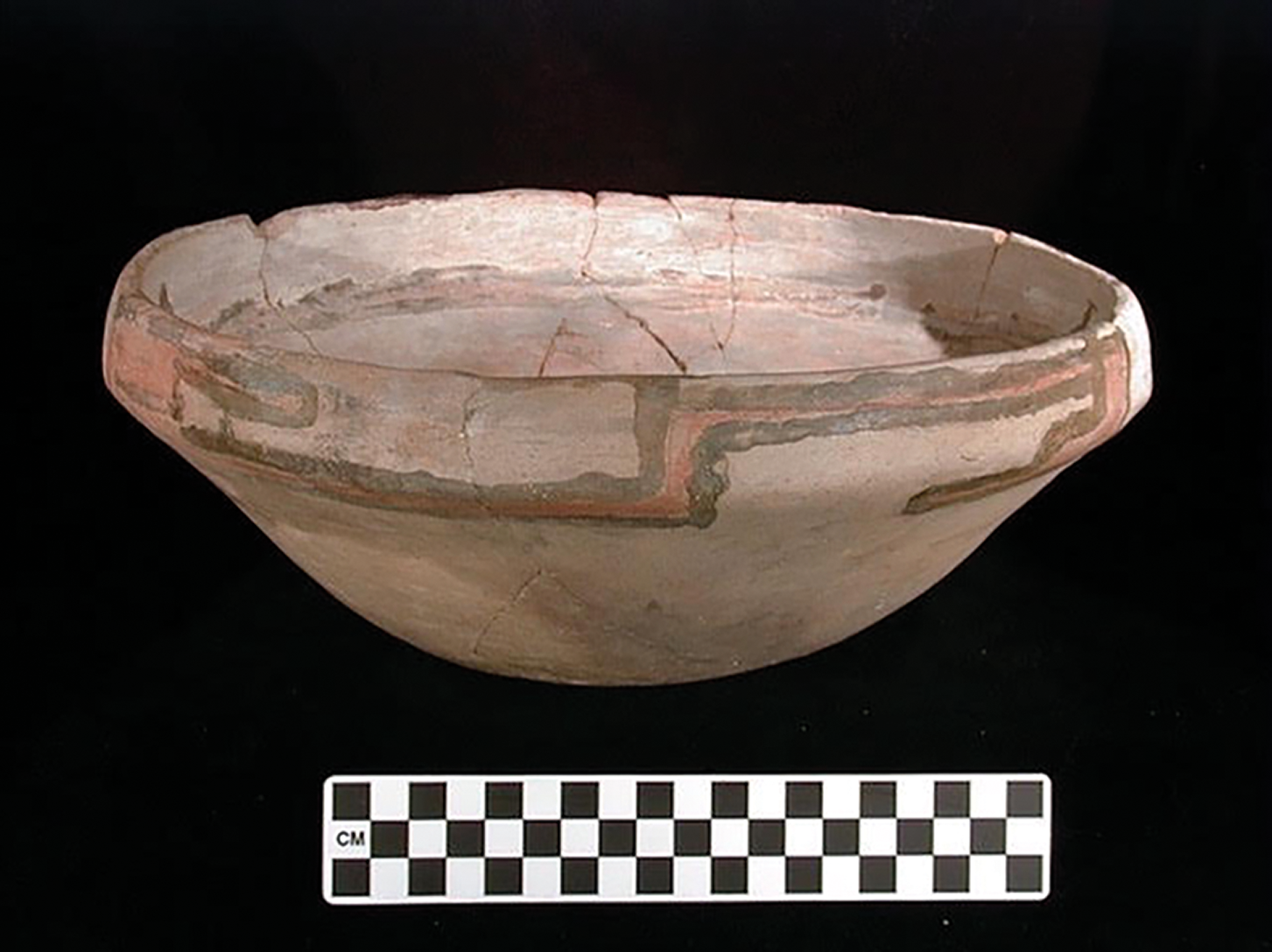
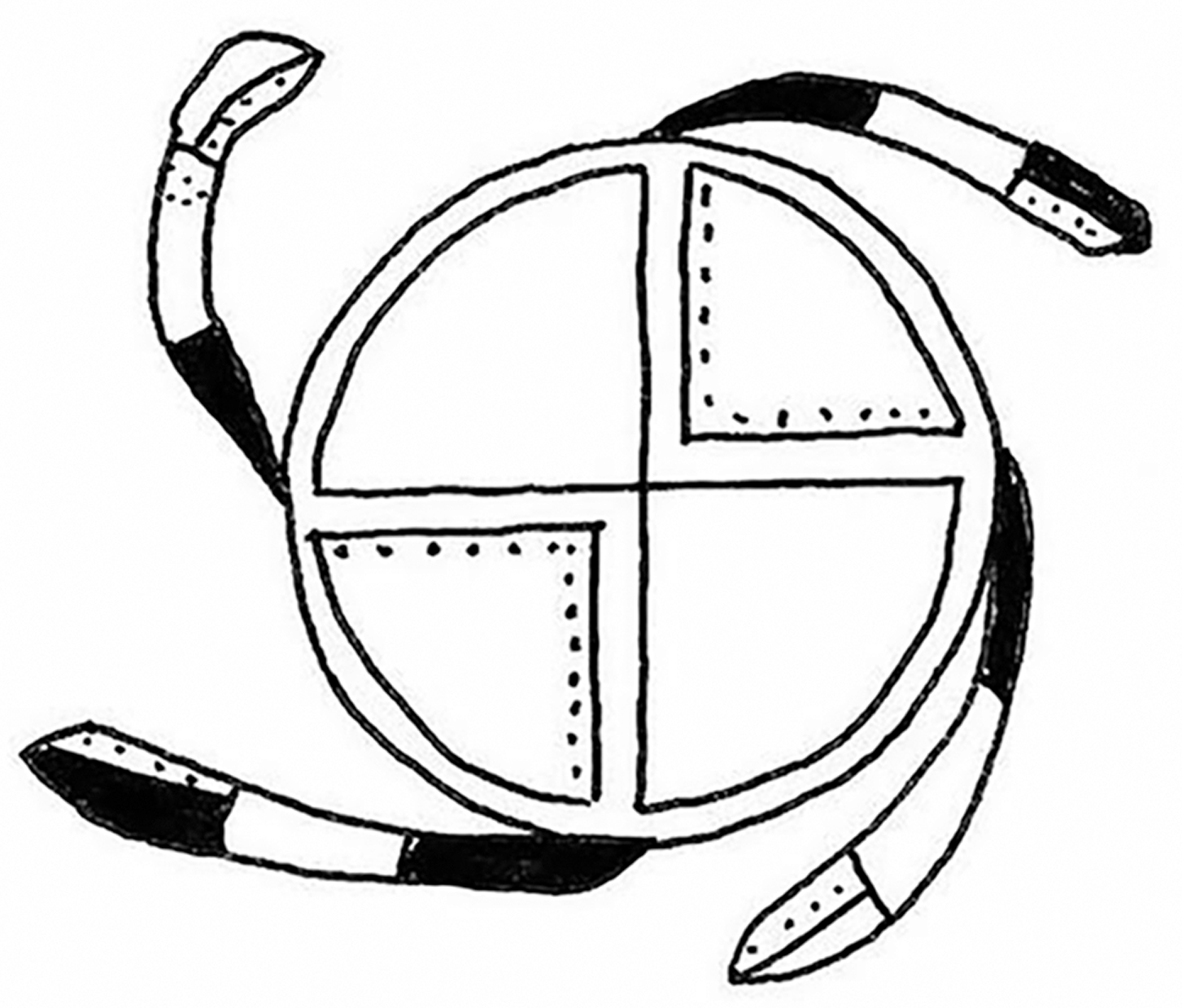
Pueblo women also participated in this discourse by means of their pottery production. Some Keres women painted the ‘double headed key’ motif on their serving bowls (Fig. 3). This distinctive motif was popular on pottery produced during the late 1500s but fell out of favour (Capone & Preucel Reference Capone, Preucel and Preucel2002). Its revival on Revolt period pottery (in some cases it is the only design element used) likely indexed key cultural values such as the moiety social structure as well as the principals of balance and harmony characteristic of the good life prior to Spanish colonization (Liebmann & Preucel Reference Liebmann and Preucel2007). Tewa Indian women also contributed to this discourse by painting representational designs on their water jars. One Tewa Polychrome sherd from Kotyiti features a shield divided into four quadrants with pendant eagle feathers (Fig. 4). This image of a shield may have functioned iconically to represent an actual shield of a Tewa warrior, but it undoubtedly indexed the protective qualities of shields, especially important during a time of war.
Glaze F bowl with double-headed key motif (Laboratory of Anthropology, Museum of Indian Arts and Cultures, Santa Fe).
Drawing of a shield on a Tewa Polychrome jar sherd.
Pueblo Indian historical consciousness
This study of the Pueblo Revolt period has identified some of the semiotic modalities, underlying the cultural revitalization movement. Pueblo leaders professed a revolt discourse (sign in history) based upon the elimination of Spanish influence and the advocacy of right living according to their ancestral laws. I have proposed that after the revolt, Pueblo leaders deployed site location and village architecture as a strategy for realizing their new world order. They abandoned their mission homes and moved their villages to prominent mesas that had longstanding spiritual significance (sign in history). Some of the new villages were built in the form of double plaza pueblos and likely iconically referenced White House, the mythological first village, while simultaneously indexing the fundamental moiety principle (sign of history). Keres women revived an old pottery design indexing balance and harmony to link revolt ideology and food consumption (sign in history functioning as a sign of history). Together these material practices generated a shared historical consciousness that served to unite refugees from different communities as they imagined new, inclusive futures. As Alfonso Ortiz put it,
The Pueblo Revolt marked the beginning of the most intensive period of cultural revitalization undertaken by the Pueblos thus far in historic times. The period between 1680 and 1696 was also one in which occurred the greatest dislocations and mass movements of Pueblo people in historic times. If the Pueblos by this time still did not share a sense of cultural similarity, they certainly shared at least a sense of common historical destiny. (Ortiz Reference Ortiz, DeMaillie and Ortiz1994, 300)
Conclusions
Semioidentity is the subset of semiotic analysis that investigates the culturally specific ways in which people make and communicate social distinctions. I have discussed the advantages of a Peircean-inspired archaeology and the semiotic resources it offers. I do this as a corrective to the standard definition of the symbol used in archaeology. Symbolic and structural archaeologists have generally adopted the Saussurean view of the sign (Hodder Reference Hodder1982; Leone Reference Leone, Meltzer, Fowler and Sabloff1986). A Peircean-based approach draws attention to a broader range of possible sign modes. These modes greatly expand interpretive possibilities, since all cultures make use of them in their representational practices. The culturally favoured practices of meaning making are known as semiotic ideologies, which are complex cultural constructions that typically incorporate different combinations of semiotic modes. Peirce’s semiotic insights also have implications for evaluating the strength of interpretations. They imply that the most reliable interpretations—that is, those most likely to be true in the long term—are those that incorporate multiple sign types, since their functions will act to constrain one another.
I have suggested that Peirce’s semiotics is of special interest in archaeology because it explicitly accommodates the engagement with the material world, what Peirce famously called ‘the outward clash’. Here the indexical sign is an important starting-point in interpretation (Joyce Reference Joyce, Renfrew and Morley2007). It allows archaeologists to anchor interpretation and provides opportunities for additional higher-order, symbolic claims about ideology and belief systems. I have illustrated this process with my Pueblo Revolt case study. I investigate some of the linguistic and material practices that Pueblo people used to create a new form of pan-Pueblo identity uniting different villages into a common political cause, an aspect of the cultural revitalization movement not noted by Borderlands historians. The call ‘to live in accordance with the laws of the ancestors’ was given physical expression and social force by the form and location of the new villages and even by the ceramics they used in their daily lives. The association of village form and pottery design, two rather different material domains, would be highly unlikely without considering their semiotic affordances, how they co-indexed the values of harmony and balance during a traumatic period of culture conflict.
Acknowledgements
I want to acknowledge my colleagues, past and present, who have influenced my semiotic thinking. These include Asif Agha, Woody Aguilar, Alex Bauer, Chip Colwell, Zoe Crossland, Terry Deacon, Peter van Dommelen, Paja Faudree, Yannis Hamilakis, Ian Hodder, Rosemary Joyce, Webb Keane, Mark Leone, Lynn Meskell, Steve Mrozowski, Alfonso Ortiz, Rick Parmentier, Michael Silverstein, Greg Urban, and Gordon Willey. I thank John Robb and two anonymous reviewers for their suggestions on how to clarify my ideas. Finally, I am grateful to Mauro Puddu for inviting me to present an early version of this paper over Zoom in his IDENTIS Symposium at Ca’ Foscari University of Venice, Italy, from 25–26 May 2022.



 Open access

