




Bilingual dictionaries have long been a vital tool for understanding and using foreign languages.Footnote 1 Whether pocket-sized or multi-volume, whether on paper, on screen or on papyrus, dictionaries are essential to language learners and scholars today and have been for thousands of years. But what were ancient bilingual dictionaries actually like? When Romans encountered an unfamiliar Greek word, or Greeks an unfamiliar Latin word, what kind of resource did they reach for, and how likely was it to contain the word they sought? Until recently a clear answer to that question was available, but the discovery of a new dictionary fragment on papyrus throws the current understanding into doubt.
Like other types of ancient literature, ancient bilingual dictionaries survive in two forms: as (largely) intact works via the medieval tradition and as small fragments of ancient copies. The dictionaries preserved in medieval manuscripts include two large works, the Latin–Greek glossary of Ps.-Philoxenus with c.11,000 entries and the Greek–Latin glossary of Ps.-Cyrillus with c.15,000 entries, as well as many smaller glossaries.Footnote 2 Both from internal evidence and from comparison with the ancient fragments, it had long seemed clear that some of the small glossaries were old and represented the only types of dictionaries in use for most of antiquity: Latin and Greek speakers using each other's languages would have relied on little glossaries containing at most a few thousand words, not normally arranged in alphabetical order. Only in Late Antiquity did large dictionaries in alphabetical order come into use, with the creation of the ancestors of Ps.-Philoxenus, Ps.-Cyrillus and other dictionaries/glossaries now lost. It ought not to be possible to find an early papyrus fragment closely related to Ps.-Philoxenus—but that is what has turned up.
1 PS.-PHILOXENUS’ GLOSSARY
Ps.-PhiloxenusFootnote 3 is hardly a household name, but his work is of great importance for our understanding of ancient vocabulary, since it preserves numerous rare and archaic words with their explanations. To quote Gustav Loewe, ‘The work falsely attributed to Philoxenus is beyond doubt the best and as it were the most learned of all the bilingual glossaries that exist.’Footnote 4 As often in the case of ancient glossaries, the interpretations of many readings are doubtful, and therefore the best edition of Ps.-Philoxenus prints not a corrected text but a transcript of the manuscript, with corrections in a separate volume.Footnote 5 The extracts below, which present the transcript on the left and modern interpretations on the right, give a sense of what the glossary is like:Footnote 6
1.1 Sample extracts
- Dubingeniosus αφυης
‘without talent’ (ἀφυής)
- Ducitur αγεται· ελκεται
‘he/she is led’ (ἄγεται, ἕλκεται)
- Ductile ελκυστον
‘movable’, neuter (ἑλκυστόν)
- Ducimus υπειλήφαμεν
‘we consider’ (ὑπειλήφαμεν ‘we have understood’)
- Duellum πόλεμος· αρχαιος
‘war’ (πόλεμος, ἀρχαίως ‘war, in archaic language’)
- Duellona πολεμεική
‘Bellona’ (πολεμική ‘[goddess] of war’)
- Dúint δοίεν δωσωσιν
‘may they give’ (δοῖεν, δῶσιν)
- Duit δοίη
‘may he/she give’
- Dulce γλυκυ
‘sweet’, neuter (γλυκύ)
- Dulcior γλυκυτερος
‘sweeter’ (γλυκύτερος)
- Dulcium πλακουντα
‘cake’, accusative (πλακοῦντα)
- Dulcissimus γλυκυτατος
‘sweetest’ (γλυκύτατος)
- Dulcacidum οξυγλυκον
‘sweet and sour drink’ (ὀξύγλυκυ?)
- Ducale αγωγευσοτων· κτηνον
‘leading-rein’ (ἀγωγεὺς ὁ τῶν κτηνῶν ‘leading-rein of animals’)
- Ductus αγωγέυσυδατος· υδραγώγιō
‘aqueduct’ (ἀγωγεὺς ὕδατος, ὑδραγώγιον)
- Duodecies δοδεκατον
‘twelve times’ (δωδέκατον ‘twelfth’); there is a variant reading δωδεκάκις ‘twelve times’, on which Goetz comments ‘quo non opus’
- Duae αιδυο
‘two’, feminine nominative plural (αἱ δύο)
- Duas τας δυο
‘two’, feminine accusative plural (τὰς δύο)
- Deliquit liquefecit ήμαρτεν
‘he/she dissolved’ (delĭcuit from deliquesco and/or delīquit from delinquo, ἥμαρτεν ‘he/she erred’)
- Deliquium solis εκληψις ηλιου
‘eclipse of the sun’ (ἔκλειψις ἡλίου)
- Delfinus δελφιν
‘dolphin’ (delphinus, δελφίν)
- Delubrum καθιδρυμα ξοανον ανάθημα
‘shrine’ (καθίδρυμα, ξόανον, ἀνάθημα ‘shrine, image, offering’)
- Deliberandi τουσκεπτεσθαι
‘of considering’ (τοῦ σκέπτεσθαι)
- Delegauit αφώρισεν
‘he/she delegated’ (ἀφώρισεν)
- Delatio αναφορά
‘denunciation’ (ἀναφορά)
- Lib7 de of̅f̅o pro consulis
(the source of this word is the) Liber de officio proconsulis
- Delitum απογαλακτισθεν
‘weaned’, neuter (delicum, ἀπογαλακτισθέν)
- Delituit έλαθεν
‘he/she hid’ (ἔλαθεν)
- Deliberauite διασκεψασθαι
‘to have considered’ (deliberauisse, διασκέψασθαι)
- Deliberantes λογιζομενον
‘considering’ (λογιζόμενοι?)
- Delinquere αμαρτάνειν
‘to fail’ (ἁμαρτάνειν)
- Deliciae σπατάλαι
‘delight’ (σπατάλαι ‘luxuries’)
These extracts illustrate many of the main characteristics of Ps.-Philoxenus: inclusion of rare words (dubingeniosus occurs only here, and delicus, dulcium and ducale are rare),Footnote 7 correct interpretation of archaic forms (even many native Latin speakers of Cicero's day would have had trouble explaining duint and duit), accurate information on usage (duellum was indeed archaic language), occasional citation of sources (both mainstream authors like Horace and obscure ones: the Liber de officio proconsulis cited here is known only from references in Ps.-PhiloxenusFootnote 8), alphabetization by two or three letters only and a mixture of inflected forms with what we would think of as citation forms. Sometimes a single Latin word is given several Greek equivalents, either synonyms (as with ductus) or different from each other (as with duint); on the other hand, where there are two Latin words they are not necessarily both equivalents of the Greek word (as with deliquit, where both liquefecit and ἥμαρτον appear to be glosses of deliquit, on which they offer different interpretations). The two languages normally match in form as well as in meaning and, when Greek words are ambiguous, articles may be added to make the form of the Latin clear (as with duae and duas). But the matches are not always exact and sometimes seem to represent the equivalent that might appear in a particular context rather than a literal translation of the lemma in isolation (as when the present ducimus is glossed with the perfect ὑπειλήφαμεν).
1.2 Sources
Where does the information in this glossary come from? Scholars have devoted considerable energy to answering this question.Footnote 9 The ultimate sources of many entries are clearly literary texts; literary sources are particularly likely for inflected forms such as delituit and duint, but citation forms can also appear in literary texts, as dulcior does at Verg. Ecl. 7.37. In Laistner's edition of Ps.-Philoxenus delituit is marked as derived from Verg. G. 3.417, duint as derived from Cic. Cat. 1.22 and dulcior as perhaps derived from the Eclogues passage.Footnote 10 At first glance such attributions seem arbitrary: all these forms are also found in numerous other passages,Footnote 11 and moreover dulcior in the Eclogues passage should be feminine, not masculine as Ps.-Philoxenus’ gloss indicates. But there is a reason for the choice of these particular passages: words found in Cicero's Catilinarians and in Virgil appear far more frequently in Ps.-Philoxenus than words found in most other texts, and a number of entries preserve explicit references to Virgil, so it is thought that the compiler of the glossary used those texts as sources.Footnote 12 Hence a word found both in Plautus and in one of the Catilinarians probably comes from Cicero, but one found both in Virgil and in a work of Cicero other than the Catilinarians probably comes from Virgil. The reason the masculine form of the Greek equivalent of dulcior is not counter-evidence for Virgilian provenance is that scholars envision the initial collection and glossing to have been a Latin–Latin process, with Greek glosses later substituted for the Latin ones or simply added to them (as with deliquit above); any Latin gloss for dulcior would probably have been ambiguous as to gender and therefore would probably have been translated into Greek with a masculine. Indeed a few entries in Ps.-Philoxenus are still Latin–Latin, for example deterreret detraheret;Footnote 13 since the Latin–Latin entries are often taken from Horace,Footnote 14 the source of this entry could be the occurrence of deterreret at Sat. 1.4.112.
But not all entries were taken directly from literature. The Liber de officio proconsulis cited in one of the extracts above may have been a legal glossary, and many entries are thought to come from a Latin–Latin lexicon entitled De uerborum significatu, originally composed in the Augustan period by Marcus Verrius Flaccus and epitomized (probably in the second century a.d.) by Sextus Pompeius Festus. An explicit reference to Festus is probably concealed in the entry Adoriosus ενδοξος· ασπομπιϊος· αδορνικηας· πεμπιος (= Adoriosus ἔνδοξος ὡς Πομπήϊος, Ador νίκη ὡς Πομπήϊος).Footnote 15 Verrius Flaccus’ version of this lexicon is lost, and only about a third of Festus’ version survives, meaning that for most of the lexicon we have only a further epitome made in the eighth century by Paul the Deacon. Despite this drawback it is notable that many of the lemmata in Festus/Paul also appear in Ps.-Philoxenus, often with glosses that could be derived from the longer, Latin explanations given by Festus/Paul.Footnote 16
In the modern world Latin–English and English–Latin dictionaries tend to contain largely the same words; the difference is primarily one of organization. We might therefore expect Ps.-Philoxenus to contain mostly the same words as the large Greek–Latin dictionary, Ps.-Cyrillus, but this is not the case: only a minority of the words in each lexicon are found in both. For example, Ps.-Philoxenus includes 1,011Footnote 17 Latin words beginning with D- and Ps.-Cyrillus 978, but only 238 of those words occur in both dictionaries, and only 186 occur in both with the same Greek equivalents.Footnote 18 This difference is part of a larger pattern: ancient bilingual glossaries do not typically share many entries with each other, unless they are historically related. Thus of the 2,110 Latin words beginning with D- that appear in ancient bilingual glossaries, only 21 per cent occur in more than one glossary; the remaining 79 per cent include 33 per cent occurring only in Ps.-Philoxenus, 29 per cent only in Ps.-Cyrillus and 15 per cent only in the Hermeneumata glossaries.Footnote 19
Broadly speaking, Ps.-Cyrillus has more everyday vocabulary and Ps.-Philoxenus more obscure and archaic terminology. The two seem to be different selections of the Latin vocabulary, made with different goals in mind.Footnote 20 Yet some of the shared glosses are nevertheless identical, and in a few cases it is unlikely that these agreements could have come about otherwise than from a shared source.Footnote 21 Therefore, it is generally agreed that both glossaries drew from a lost work that contained the shared material; this work must have been a bilingual glossary, since both lemmata and glosses match in the shared entries that survive.
1.3 Composition process and dating
The discovery of this shared source led scholars to ask whether it might have been the source of more than just the entries now shared between Ps.-Philoxenus and Ps.-Cyrillus. After all, if the compilers of one or both glossaries had taken more entries from the shared source, we would not be able to identify those entries by comparing the two surviving glossaries. In the end, scholars concluded that more entries had indeed been taken, and in fact that the shared source had probably been an enormous proto-glossary that contained all or most of the material now found in Ps.-Philoxenus as well as all or most of the material now in Ps.-Cyrillus: the two extant glossaries were thought to be simply (or at least mostly) extracts from the proto-glossary, with their different characteristics arising from the different selections made by their compilers.Footnote 22 According to this theory, the other sources of Ps.-Philoxenus were actually sources of the proto-glossary. The proto-glossary was argued to have been in the order Latin–Greek, like Ps.-Philoxenus, since some of the Greek–Latin entries in Ps.-Cyrillus look like originally Latin–Greek entries that have been inverted.Footnote 23
Thus far both editors of Ps.-Philoxenus agreed, but they disagreed about the composition process of the proto-glossary. Goetz envisioned a gradual accretion of numerous different sources; in this he followed Loewe, Dammann and Rudorff, who had developed this theory as the composition process for Ps.-Philoxenus’ glossary itself before the idea of the proto-glossary was suggested.Footnote 24 Lindsay and Laistner, however, saw a simpler two-step process taking place over a short period: first, the compilation of the proto-glossary directly from sources available to its creator (not via earlier glossaries), and then the excerpting and partial rearrangement of the material now in Ps.-Philoxenus and Ps.-Cyrillus.Footnote 25 The nature of the composition process matters because Ps.-Philoxenus contains material from lost sources such as Festus: if Lindsay and Laistner were right about the simplicity of the composition process, modern scholars may be able to disentangle it and restore earlier phases of the glossary tradition, including the lost sources. If Goetz and Loewe were right, however, the glossaries have a history too long and too complex to make such restorations successful.
These differences affected how scholars approached specific problems in the text. For example, about six hundred of the entries in Ps.-Philoxenus occur twice, either in exactly the same form or in closely related forms where one is likely to be a corruption of the other. Loewe and Goetz thought that this situation arose from the compiler's use of two historically related sources, both of which contained the entries that appear twice.Footnote 26 Lindsay and Laistner, on the other hand, thought that most of the double entries were deliberate cross-references, accidental repetitions or cases where a scribe added a corrected entry but failed to delete the original incorrect one.Footnote 27
Both the proto-glossary and the extant Ps.-Philoxenus and Ps.-Cyrillus glossaries are normally dated to Late Antiquity, most likely the sixth century. This dating has not been reconsidered since 1865, when Rudorff examined such evidence as was then available and tentatively suggested the early sixth century.Footnote 28 Loewe stated explicitly that he accepted Rudorff's dating;Footnote 29 later scholars largely avoided mentioning the dating issue directly, but an assumption of a sixth-century date runs through their work. Thus, for example, Laistner suggests that the proto-glossary was composed in a south Italian monastery not founded until the middle of the sixth century,Footnote 30 Goetz wonders whether the use of Festus was direct or indirect,Footnote 31 and Lindsay, suggesting that the compilation took place in Italy and speculating about the use of papyrus, cites a sixth-century papyrus glossary as an example of what the glossary might once have looked like and remarks ‘The use of papyrus continued in Italy for a fairly long time.’Footnote 32
2 PAPYRUS FRAGMENTS OF BILINGUAL GLOSSARIES
Since Rudorff's day the discovery of numerous fragments of ancient bilingual glossaries on papyrus has shed more light on what types of glossaries were in use at different periods and the extent to which the glossaries preserved in medieval manuscripts are related to ancient fragments.Footnote 33 These papyri are one of the reasons why Rudorff's dating continues to be accepted, since they have until now implied that the large bilingual glossaries are indeed products of Late Antiquity. They fall into four groups: glossaries ordered by topic (thirteen examples, including some that probably contained only a single topic), glossaries in alphabetical or alphabetical and grammatical order (five examples plus the newly discovered fragment in P.Vars. 6),Footnote 34 running vocabulary lists for extracts from Virgil (three examples) and glossaries with no discernible ordering principle (three examples).
2.1 Non-alphabetical glossaries
The three unordered glossaries range in date from the first century b.c. to the fourth century a.d. and are thus all relatively early.Footnote 35 They show no signs of relationship with any of the glossaries preserved in medieval manuscripts, and they must all have been fairly small, since a glossary with thousands of entries is largely useless if not organized in some fashion. The three running glossaries to Virgil, which all date to the fifth or sixth century a.d., are also unrelated to glossaries surviving via the medieval manuscript tradition and also likely to have been fairly small, since they seem to provide vocabulary for particular passages rather than for entire texts.Footnote 36
The thirteen glossaries ordered by topic (known as classified glossaries or capitula), on the other hand, often do show a relationship to the classified glossaries found in medieval manuscripts. These papyri tend to be early, with eleven datable to the first through fourth centuries.Footnote 37 The medieval manuscripts to which they are related all belong to the Hermeneumata Pseudodositheana, a collection of bilingual materials preserved in nine different versions that range in date from the Carolingian period to the Renaissance and are all to some extent interrelated.Footnote 38 Most of the thirteen papyri containing classified glossaries reveal a relationship to the Hermeneumata, or even to a particular Hermeneumata version, by a high percentage of matching word pairs, strings of entries in the same order, and identically phrased section headings.Footnote 39 The glossaries in these papyri are therefore likely to be ancestors of the Hermeneumata classified glossaries surviving in medieval manuscripts, and hence they were probably not larger than the surviving Hermeneumata classified glossaries. These surviving glossaries range in size from a few hundred entries to a few thousand; they are not tiny, but nothing approaching the size of Ps.-Philoxenus.Footnote 40 It is therefore likely that in antiquity none of the classified glossaries was ever anywhere near as large as Ps.-Philoxenus.
2.2 Alphabetical glossaries
The five ancient fragments in alphabetical or partially alphabetical order represent the closest parallels to Ps.-Philoxenus.Footnote 41 The earliest of these, P.Oxy. 3452, dates to the second century a.d. and is alphabetized by two letters; thus the section for words beginning with σ- begins Σάραπις, σάρξ, σαλπιστής, σάρον, σάλπιγξ, σανδάλια, σείγα.Footnote 42 This alphabetization allows one to calculate (by assuming that the percentage of words beginning with particular letter pairs was the same as in the OLD) that the complete glossary probably had c.1,400 entries. This papyrus shows no signs of relationship to any other known glossaries.Footnote 43
From the third century a.d. come two fragments, P.Sorb. I 8 and P.Sorb. inv. 2069, that are alphabetized by the first letter only; these glossaries simply group together all words beginning with the same letter.Footnote 44 This system makes their original size harder to calculate, but enough survives to make it likely that neither glossary was originally extensive; each may have had fewer than 1,000 entries.Footnote 45 These glossaries are both unrelated to other known glossaries.Footnote 46
From the sixth century a.d. come a pair of fragments, one now in Cologne and the other now in Göttingen, that are believed to have belonged originally to different halves of the same work.Footnote 47 The Cologne fragment, a Greek–Latin glossary, is alphabetized by four or five letters, but the Göttingen one, a Latin–Greek glossary, is arranged first by ending (we have the end of the section for Latin nouns and adjectives in -is and the beginning of the section for ones in -tas), and within each section is alphabetized on the Latin by one or two letters. The original size of the glossary represented by the Cologne fragment was large, perhaps 16,000 entries; the original size of the glossary represented by the Göttingen fragment is harder to calculate but was probably not small.Footnote 48 There has been considerable debate about whether these fragments are related to surviving glossaries; current thinking is that they are related to Ps.-Cyrillus but only distantly.Footnote 49
Thus far the papyrus glossaries have suggested that until Late Antiquity bilingual lexica were fairly small and completely unrelated to the alphabetical glossaries surviving via the manuscript tradition: the only papyrus fragment so far discussed that might approach Ps.-Philoxenus in size or that might be related to a surviving alphabetical glossary dates to the sixth century. But another alphabetical glossary, only recently discovered, complicates that picture. This papyrus, P.Vindob. inv. L 27, dates to the fourth century a.d. and was previously thought to be a classified glossary; it has recently been reinterpreted as a partly alphabetical glossary like the Göttingen fragment.Footnote 50 It contains Latin neuter nouns and adjectives that begin with co- and end with -um, with their Greek glosses; the original glossary must have contained at least thirty such entries. Such a scale suggests that the original could have been large.Footnote 51 It also seems to be distantly related to several of the glossaries surviving via the manuscript tradition, though not to Ps.-Philoxenus or to Ps.-Cyrillus.Footnote 52
3 P.VARS. 6
3.1 Evidence for identification and reconstruction
In 1935 a small papyrus fragment bearing a list of Greek words was published as P.Vars. 6.Footnote 53 The editor, Jerzy (Georgius) Manteuffel, remarked that traces of another column were visible to the left of the Greek words, and those traces were subsequently identified as the ends of Latin words.Footnote 54 Closer investigation reveals a striking correspondence between the text on this papyrus and Ps.-Philoxenus’ glossary. Twelve of the Greek words on the papyrus are either completely legible or sufficiently legible that only one reading is likely: ἕως, ἐκδέρει, ἐργώδης, ἐξουσία, εὐμέριστος, ἐπαύσατο, εὐδίδακτος, ἔκλειψις, ἐγκοίμητρον (spelled ενκοιμηθρον), Ἐνυώ (spelled Ενοιω), ἐκπύρωσις and ἑξῆς. These all occur in Ps.-Philoxenus, and six—ἐκδέρει, ἐργώδης, εὐμέριστος, ἐπαύσατο, ἐκπύρωσις and ἑξῆς—do not occur in any other bilingual glossaries. This makes it likely that the missing Latin words should be supplemented from Ps.-Philoxenus.
The P.Vars. glossary must have been alphabetically ordered by the Latin, which was in the first column, and it is clear that in the section covered by this papyrus the Latin words began with D-. Of the twelve Greek words just mentioned, eight appear in Ps.-Philoxenus only with (an) equivalent(s) beginning with D-: dum, donec and donicum for ἕως, deglubat for ἐκδέρει, diuiduus for εὐμέριστος, destitit and desiit for ἐπαύσατο, docibilis for εὐδίδακτος, defectio for ἔκλειψις, dormitorium for ἐγκοίμητρον, and deflagratio for ἐκπύρωσις. Two appear with multiple Latin equivalents including at least one beginning with D-: dicio, arbitrium, licentia and potestas for ἐξουσία and deinceps and porro for ἑξῆς. The remaining two Greek words appear in Ps.-Philoxenus only with Latin equivalents that do not begin with D-, but they both have an obvious equivalent beginning with D- that also appears in Ps.-Philoxenus with a different Greek gloss: difficilis for ἐργώδης and Duellona for Ἐνυώ.
These equivalents fit well with the scanty remains of the Latin column on the papyrus. Duellona, dormitorium, deflagratio and diuiduus fit the traces before their respective Greek equivalents, and dicio and desiit are short enough to fit in front of ἐξουσία and ἐπαύσατο, where short Latin words must have stood. One set of Latin traces allows us to decide between two possible supplements: εὐδίδακτος occurs in Ps.-Philoxenus with docibilis and in Ps.-Cyrillus with docilis, but the latter is too short to be restored on this papyrus, effectively bringing to seven the number of entries in this papyrus that cannot match any surviving glossary except Ps.-Philoxenus.
In addition to the twelve securely identifiable Greek words, the papyrus also has some whose readings are less certain. Two of these can be read as words occurring in Ps.-Philoxenus with Latin equivalents in D-: ἐλαττοῖ with deminuit and καταδρομή with decursus. One line can be read as containing variants of a word that occurs in Ps.-Philoxenus with a Latin equivalent in D-: ἐκκλίνειν and an erroneous εκκλιει, both probably with declinare (which Ps.-Philoxenus pairs with the aorist infinitive ἐκκλῖναι). One seems to be a misspelling of a word that does not occur in Ps.-Philoxenus but appears in Ps.-Cyrillus with a Latin equivalent in D-: εἰσαγγελεύς (here apparently spelled ισανγελευς) with delator (which appears in Ps.-Philoxenus with other Greek equivalents). Finally, one cannot easily be read to match any entry in the glossaries. Accordingly the papyrus text can be restored as follows.
3.2 Text, translation and notes
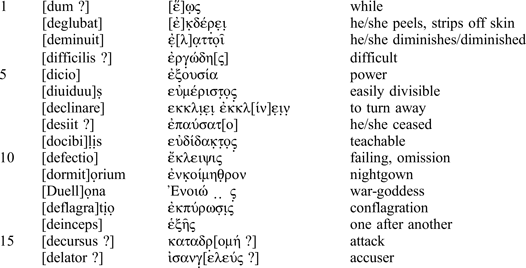
Notes (references to CGL II are to Ps.-Philoxenus unless otherwise specified):
1 Cf. dum έως (CGL II 57.23), donec εως (CGL II 55.52), donicum εως (CGL II 55.53). Any of these might have stood here.
2 Cf. deglubat εκδέρει (CGL II 41.24); Manteuffel read [ἔκ]δερε, but the right-hand edge of κ and the bottom tip of ι are both visible.
3 Cf. deminuit ελαττόι· ηλάττωσεν (CGL II 42.38). Manteuffel read [ε .]ποι, but the first intact letter is too wide for π, and its crossbar extends too far to the right; ττ is much more likely.
4 Cf. difficile δυσχαιρές· δυσκολον (CGL II 49.16), operosus εργωδης· περιεργός (CGL II 138.53). The latter is the only appearance of ἐργώδης in the glossary tradition, but it does not offer an ideal match: ἐργώδης means ‘difficult’ (cf. LSJ), while operosus means ‘diligent’, ‘active’, ‘toilsome’, ‘busy’ and ‘ornate’ (cf. OLD). The pair difficilis ἐργώδης is a better match and therefore likely to have been deployed by an ancient lexicographer at some point.
5 Cf. dicio εξουσια (CGL II 49.5) and diciones εξουσιαι (CGL II 48.36); ἐξουσία also appears with arbitrium (CGL II 19.4), licentia (CGL II 123.1) and potestas (CGL II 154.54).
6 Cf. diuiduus ευδιαίρετος· αυθαιρετος· ευμέριστος· διαμε μερισμενος (CGL II 53.26), diuidulum ευμεριστō (CGL II 53.34). In Latin, only the long horizontal top of s is visible.
7 Cf. declinare εκκλιναι (CGL 38.44). The traces at the end of the second word are well preserved, but the handwriting at that point is notably more cursive than elsewhere in the papyrus, making their interpretation doubtful. If this reading is right, the scribe wanted to write the present infinitive, accidentally omitted the first ν, and then stopped and rewrote the whole word (leaving a space after the end of the first attempt) without crossing out the first attempt. Manteuffel read ἔκτ̣α̣νε ἐκκλ[η]σία, which is incompatible with the traces of the first word.
8 Cf. desiit απαύσατο· επικλασμός (CGL II 45.25), destitit απέστη· επαυσατο (CGL II 46.9).
9 Cf. docibilis ευδιδακτος· ευμαθής (CGL II 54.15), dociuilis ευδιδακτος· ευμαθής (CGL II 55.44); εὐδίδακτος appears in Ps.-Cyrillus (CGL II 316.41) with docilis, which is too short to fit the Latin traces here. The l is visible only in its long tail stretching below the other letters, and the i in a horizontal top stroke that seems to be a serif. Admittedly, the i in line 11 has no serif, and one could argue that the visible stroke has to come from s or t (e is implausible since its lower strokes would have also been visible), but in that case the Latin word would have to be severely misspelled: no Latin words end in -ss or -ts.
10 Cf. defectio εκλιψις· απονεμηθεις· αφορισθεις (CGL II 40.26).
11 Cf. dormitorium ενκοίμηθρον (CGL II 55.23). For the meaning, see Colloquia Monacensia–Einsidlensia 2c with commentary.Footnote 55 Manteuffel read ἐνκ̣οίμητρον, but the vertical is too far to the right for τ.
12 That is, Bellona, Ἐνυώ. Cf. Duellona πολεμεική (CGL II 56.34, the only attestation of Duellona in CGL), Bellona ενυώ· ερινυς· θεα πολεμική (CGL II 28.52). There is probably a blank space after Ἐνοιώ, and then traces that look like γ̣λ̣ς̣. Possible supplements include [Ἐ]ρ̣[ι]ν̣[ύ]ς̣, which fits well with Ps.-Philoxenus but less well with the papyrus (the surface after Ἐνοιώ does not seem sufficiently damaged that an entire letter could have been lost, and there is inadequate space for υ); Μᾶς, which fits much better with the papyrus but is not in CGL at all (Μᾶ is a Cappadocian name for Enyo [Strabo 12.2.3] and therefore attractive here, but Μᾶς would apparently be a genitive); and options that do not seem to make any sense, such as πᾶς, γᾶς or perhaps Ἰάς. Manteuffel read ἐνοικί[δ]ι[ο]ς, but the ω is certain.
13 Cf. deflagratio εκπυρωσις (CGL II 40.34). Manteuffel read ἐκπύρω[σι]ς.
14 Cf. deinceps τελευταιō επιταεξης (CGL II 38.14 with reading of manuscript c: see apparatus criticus and CGL VI 316, which interprets the Greek as τελευταῖον, ἔπειτα, ἑξῆς), deinceps εξήσαναρχαιεκ του λοιπου (CGL II 41.37, Greek interpreted CGL VI 316 as ἑξῆς, ἀπ’ ἀρχῆς, ἐκ τοῦ λοιποῦ). ἑξῆς also appears with porro (CGL II 153.58).
15–16 Manteuffel read καὶ ἄδη̣[λα οἷα μηδέπω] ἶσαν ἰ[ς τὸ μάθημα?], with a note “ἶσαν l. ἦσαν?”; I think this is intended to mean ‘and obscure things such as were not yet in learning’ and that the rationale for restoring continuous text rather than single words here was that these lines do not begin with Ε- and therefore did not fit with Manteuffel's concept of the text as a list of Greek words beginning with Ε-. But if the text is in fact Ps.-Philoxenus, there is no reason not to restore individual words here; moreover, the third letter of line 15 is clearly not ι but τ.
15 The sixth letter is probably ρ or η, and there is only one entry in Ps.-Philoxenus whose Latin begins with d- and whose Greek begins with καταδρ- or καταδη-: decursus καταδρομή (CGL II 39.42).
16 That is, εἰσαγγελεύς; cf. εισαγγελευς delator (CGL II 286.42), though this is in Ps.-Cyrillus rather than in Ps.-Philoxenus. delator does appear in Ps.-Philoxenus, but only with other Greek equivalents, including καταγγελεύς (CGL II 41.41) and κατήγορος (CGL II 41.58); see CGL VI 317 s.v. delator.
3.3 Date
Manteuffel dated P.Vars. 6 to the third century a.d. on the grounds that it is written on the back of a documentary text (P.Vars. 16, a list of names and numbers) which he dated by its handwriting to the late second or early third century.Footnote 56 But all the comparanda he cites for the script of P.Vars. 16 are in fact from the second century, and it looks as though the possibility of a third-century date for that text may have arisen from confusion rather than deliberate decision.Footnote 57 Using a more modern collection of comparanda one arrives at a mid second-century date for P.Vars. 16.Footnote 58
The Greek handwriting of P.Vars. 6 itself is neat and roughly bilinear, partly literary but with a few ligatures and cursive forms. The κ is open, shaped similarly to a modern cursive U, and the long ξ is made in a single stroke. Good parallels for both the κ and the ξ, as well as for most of the other letters, can be found on the first hand of P.Oxy. 2192, dated to the end of the second century. P.Tebt. II 318, dated to a.d. 166, is similar in overall appearance but has different shapes for κ and ξ. A κ similar to the one in P.Vars. 6 appears in P.Oxy. 3593, which is dated to a.d. 238–44; many of the other letters on this papyrus also look similar to P.Vars. 6, but there is no ξ. P.Ryl. II 176, dated to the beginning of the third century, has both κ and ξ similar to P.Vars. 6, though many other letters look different and overall the writing is more cursive.
The Latin script of P.Vars. 6 is difficult to date, because so little of it remains; an analysis of its overall appearance is impossible. Nevertheless, there is one complete example each of a (without crossbar), i, m, n, r (open), s and v, and a striking long diagonal tail of an l. All these letters except l (which has a similar but shorter tail) are matched in P.Oxy. 894, dated to a.d. 195–6; the long-tailed l can be found in P.Oxy. 1114, dated to a.d. 237, which also shares the forms of a, i, m, n and v (but not r or s) with P.Vars. 6. The r, s and n (but not a, i, m or v) are paralleled in P.Mich. III 166, dated to a.d. 128.Footnote 59
The copying of P.Vars. 6 can thus be located in a narrow window at the end of the second and the beginning of the third century.
4 THE IMPLICATIONS OF THIS DISCOVERY
4.1 The papyrus, Ps.-Philoxenus and the proto-glossary
This discovery necessitates a re-evaluation of the history of the Ps.-Philoxenus glossary. For one thing, P.Vars. 6 is not at all closely related to Ps.-Cyrillus.Footnote 60 Therefore, Ps.-Philoxenus and Ps.-Cyrillus, or their sources, were already distinct by c. a.d. 200: those two glossaries cannot have been separately excerpted from a huge proto-glossary in Late Antiquity (cf. 1.3 above). In theory they could have been separately excerpted from the proto-glossary sometime before the late second/early third century, but that would require the existence, in the second century a.d. or earlier, of an enormous bilingual proto-glossary in alphabetical order. This would require an even more radical shift in our understanding of the history of bilingual glossaries than abandoning the idea of the proto-glossary, which therefore now needs to be abandoned. The only concrete evidence in favour of the proto-glossary was the existence of some entries in Ps.-Philoxenus and Ps.-Cyrillus that seemed to come from a common source; a more plausible and economical explanation for that evidence is that the shared source was a small Latin–Greek glossary containing only (or primarily) the shared entries rather than an enormous one containing everything now found in both glossaries. If the proportion of shared entries in the D- section of Ps.-Philoxenus is typical of the work as a whole, there are c.2,000 shared entries in total, so the shared source may have been about that length.
Another implication is for the date of Ps.-Philoxenus’ glossary. If that glossary is really in this papyrus, then it must have been composed three or four centuries earlier than has long been thought. But before concluding that that is the case, further investigation is needed to determine the exact relationship between the glossary in P.Vars. 6 and the work we know as Ps.-Philoxenus. Though evidently closely related they are not identical, since the entries are in a different order and there are several significant differences in the readings. Three possibilities exist: 1) the glossary in the papyrus basically is Ps.-Philoxenus, but it underwent some changes during the six or seven centuries between the papyrus and our ninth-century manuscript of Ps.-Philoxenus. 2) The glossary in the papyrus was smaller than Ps.-Philoxenus and is only one of a number of different sources that were later combined to make the Ps.-Philoxenus we know. 3) The glossary in the papyrus is not a direct ancestor of our Ps.-Philoxenus at all, but stands in the position of a great-aunt rather than a grandmother; some of the entries that differ from Ps.-Philoxenus were originally as Ps.-Philoxenus has them and have been changed in the papyrus version.
4.2 Order of entries
The order of the entries in the papyrus is not only different from that in the manuscripts of Ps.-Philoxenus but also striking in itself, for although the main alphabetization is clearly by first letter of the Latin, there is a secondary alphabetization on the Greek: fourteen entries in a row have glosses beginning with Ε-. Such secondary alphabetization on the glosses probably arises out of re-alphabetization from Greek–Latin to Latin–Greek, a process that periodically occurred with ancient glossaries and has left traces on a number of them. To re-alphabetize a Greek–Latin glossary, an ancient scribe would have taken a fresh roll of papyrus and gone through the entire glossary repeatedly, first copying out all the entries for Latin words beginning with A-, then all the entries for Latin words beginning with B-, etc. This procedure naturally resulted in a dictionary in which, within each section for Latin words beginning with a particular letter, the individual entries were alphabetized on the Greek.
But what about lines 15 and 16, in which the Greek words begin with Κ- and Ι- respectively? These cannot simply represent the next section after Ε-, both because Ι- should precede Κ- and because it is inconceivable that a glossary section large enough to have at least fourteen Greek words beginning with Ε- had none beginning with Η-, Θ-, or Z-. The best explanation for lines 15 and 16 is that they were added after the glossary had been re-alphabetized on the Latin; if someone had then wanted to insert an additional entry for a Latin word beginning with D-, he or she would not have felt any need to consider where it fell in the Greek alphabetization but would only have been looking for a place in the D- section with room for another entry, such as the top or bottom of a column.Footnote 61
The Ps.-Philoxenus glossary as preserved in medieval manuscripts also has an unusual order: the Latin words are arranged in Greek alphabetical order, ABGDEHFICLMNOPQRSTV. This Greek ordering applies only to the first letter of each word, however; alphabetization of subsequent letters (almost always the second, usually the third and sometimes the fourthFootnote 62) follows the Latin alphabetical order. It therefore seems likely that the glossary's original Greek-speaking author alphabetized entries by only one letter, and a Latin speaker later in the tradition introduced further alphabetization within each section.Footnote 63 If the glossary in the papyrus is Ps.-Philoxenus, therefore, the difference in the order of the entries is probably caused by that further alphabetization, which would have eliminated the secondary alphabetization on the Greek visible in the papyrus.
Therefore, the order of the entries on the papyrus does not indicate that the glossary in the papyrus is not Ps.-Philoxenus. What it does indicate is that the glossary itself is older than the copy in this papyrus: a Greek–Latin glossary was first re-alphabetized and then expanded with additional entries before this copy was made.
4.3 Duellona
Duellona, an archaic variant of Bellona, was already obsolete by the first century b.c.Footnote 64 As a lemma in a Latin–Greek glossary an obsolete word is unproblematic, but in a Greek–Latin glossary Duellona would have to be a gloss, and the use of an obsolete word as a gloss is unlikely. Does the inclusion of this word suggest that the glossary goes back to a time when it was not yet obsolete, that is, to the second century b.c.? If the glossary is that old, it is much older than any other language-learning materials of which we have direct or even indirect evidence. Perhaps such an age cannot be completely ruled out, since some second-century b.c. Latin speakers evidently learned Greek, but it is by no means certain. Another possibility is that the glossary could have been re-alphabetized more than once, going through an earlier Latin–Greek phase before the Greek–Latin phase. It might seem unlikely that anyone would go to the effort of re-alphabetizing a work into an order it had previously had, rather than simply using a copy of the older version, but there might have been a good reason to do so. Perhaps the person who did the second re-alphabetization was unaware of the glossary's history and/or did not have access to a copy of the older version, or perhaps the glossary had been expanded since the first re-alphabetization and the later scribe wanted a Latin–Greek version of the newer, larger glossary.
We cannot be sure exactly what happened, but in either case the glossary in the papyrus must have even more of a history than is evident from its ordering alone. It must either have been re-alphabetized twice (with enough of an interval between the two to cause a second re-alphabetization to be plausible) before being expanded, or it must go back to the second century b.c. The glossary must therefore be substantially older than the papyrus copy we have; this means that, instead of being three or four centuries earlier than the assumed date of Ps.-Philoxenus, it is at least four or five centuries earlier.
4.4 Words from identifiable sources of Ps.-Philoxenus
The papyrus seems to have contained a number of entries that previous studies of Ps.-Philoxenus have assigned to particular sources. Laistner's edition of Ps.-Philoxenus specifies the sources of many glosses, including for deflagratio Cicero.Footnote 65 If that attribution is correct, at least some of the material that the Ps.-Philoxenus glossary took from literary sources was already in the papyrus glossary. (And given the shorter time frame now available between the composition of the literary texts themselves and their incorporation into the glossary, the intermediate Latin–Latin phase now seems much less likely.Footnote 66)
The papyrus also contains three entries that Laistner traced to Festus: deglubat, deinceps and Duellona.Footnote 67 These attributions suggest that the Festus material was also already in the papyrus glossary—and they call into question the idea that Festus himself was the source of all the material that Laistner ascribes to him. If the compiler of the glossary had been working in Late Antiquity, Festus would have been a special treasury of material difficult to access in other ways. But someone compiling a bilingual glossary in (or before) the early second century a.d. would have had access to many other sources of rare and archaic Latin vocabulary.Footnote 68 Regardless of whether the actual source of the ‘Festus’ material is Festus himself or (an)other work(s) of Latin philology or both, however, that source had already been used by the time of the papyrus glossary.
The papyrus also contains some of the material that Ps.-Philoxenus shares with Ps.-Cyrillus: line 11 matches both Ps.-Philoxenus’ dormitorium ενκοίμηθρον and Ps.-Cyrillus’ εγκοιμηθρον dormitorium.Footnote 69 Both words in this entry are extremely rare, so the match is unlikely to be coincidental: this entry was taken from the shared source, which therefore had already been used by the compiler of the papyrus glossary. As observed above (section 4.1), the shared source is likely to have been a Latin–Greek glossary of c.2,000 entries.
The rest of the entries on the papyrus cannot easily be assigned to any of these three sources, a fact that implies the existence of additional sources for the papyrus glossary. The overall picture of this glossary that emerges, therefore, is of something similar to Ps.-Philoxenus itself in terms of sources; the papyrus glossary does not look like just one of the sources of Ps.-Philoxenus.
4.5 Size of the papyrus glossary
The original size of the papyrus glossary is also crucial to the question of whether it is Ps.-Philoxenus or merely one of the sources of Ps.-Philoxenus. The glossary is written on the back of a document; that position might suggest a short text, but copies of short documents were sometimes kept together on a longer roll, so a long text is not impossible. The preserved part of another Latin–Greek alphabetical glossary, P.Sorb. inv. 2069, is also on the back of a document, but nevertheless that glossary was clearly much longer than the document itself.
The multiple sources suggest a large glossary. It is unlikely that an individual source was used more than once in the history of the same glossary, so once any source can be identified as having been used by the compiler of the papyrus glossary, it is reasonable to suppose that all the Ps.-Philoxenus entries from that source were already in the papyrus glossary. Therefore, if all the ‘Festus’ entries really do come from Festus, then those entries must all have been in the papyrus glossary—but, as we have seen, those entries may have several sources, and therefore it is possible that only some were already in the papyrus glossary. The source shared with Ps.-Cyrillus, however, is likely to have been a single source, and therefore it is probable that all the c.2,000 entries Ps.-Philoxenus has from that source were already in the papyrus glossary. And those entries formed a relatively small percentage of the whole glossary, since most of the entries in the papyrus are not in Ps.-Cyrillus. Therefore, the glossary in the papyrus must originally have been large; in fact it cannot have been much smaller than the Ps.-Philoxenus glossary as we now have it. It cannot have been just one of a number of sources of Ps.-Philoxenus; it can only have been that glossary or a close relative of similar size and composition.
5 CONCLUSION
Because the glossary in P.Vars. 6 is either Ps.-Philoxenus or a close relative of similar size and composition, and is substantially earlier than a.d. 200, the Ps.-Philoxenus glossary must go back at least to the second century a.d. and probably earlier. It is not a creation of Late Antiquity but of the Early Empire or perhaps even the Republic. Therefore, large bilingual glossaries in alphabetical order already existed at that early period, and other bilingual glossaries surviving via the medieval manuscript tradition may also be much earlier than previously thought. These glossaries are the product of a long, complex creation process that does not allow for the confident reconstruction of specific sources, but that nevertheless preserves a large body of old lexicographical material in fairly good condition.

 Open access

