





Introduction
Early literacy development results from multiple skills that play different roles over time. There is a consensus in the literature on the crucial role of phonological skills (Ehri et al., Reference Ehri, Nunes, Stahl and Willows2001; Sprenger-Charolles et al., Reference Sprenger-Charolles, Siegel, Béchennec and Serniclaes2003), especially in learning correspondences between graphemes and phonemes (Sprenger-Charolles et al., Reference Sprenger-Charolles, Siegel, Béchennec and Serniclaes2003). However, these correspondences are insufficient for accurately reading and spelling all words, especially in an inconsistent orthographic system such as English, in both reading and spelling and French spelling (Veronis, Reference Veronis1988; Ziegler et al., Reference Ziegler, Jacobs and Stone1996, Reference Ziegler, Stone and Jacobs1997). Morphological awareness, the ability to analyze words into smaller units, morphemes—the smallest meaningful units—or to manipulate them (Carlisle, Reference Carlisle and Feldman1995), has been shown to be an important predictor of literacy learning (Ardanouy & Quémart, Reference Ardanouy and Quémart2025; Deacon & Levesque, Reference Deacon and Levesque2024; Levesque & Deacon, Reference Levesque and Deacon2022). A substantial body of research has established a link between morphological awareness and general literacy skills (e.g., reading fluency, accuracy, comprehension, and spelling) in elementary school children (Desrochers et al., Reference Desrochers, Manolitsis, Gaudreau and Georgiou2018; Duncan, Reference Duncan2018; Kirby et al., Reference Kirby, Deacon, Bowers, Izenberg, Wade-Woolley and Parrila2012). However, its role in the earliest stages of literacy acquisition remains less clearly established. While some studies suggest that morphological awareness contributes to early literacy development (e.g., Casalis & Louis-Alexandre, Reference Casalis and Louis-Alexandre2000), others report limited or non-significant effects (Kirby et al., Reference Kirby, Deacon, Bowers, Izenberg, Wade-Woolley and Parrila2012; Manolitsis et al., Reference Manolitsis, Georgiou, Inoue and Parrila2019). Importantly, young children already demonstrate sensitivity to morphological structure in oral language (Treiman & Bourassa, Reference Treiman and Bourassa2000; Treiman & Cassar, Reference Treiman and Cassar1996), and early morphological skills have been shown to predict later reading outcomes (Cohen-Mimran et al., Reference Cohen-Mimran, Reznik-Nevet, Gott and Share2022), suggesting that the foundations for such effects are present early on.
Building on this evidence, the aim of the current study is to test the early contribution of derivational morphological awareness on literacy skills (reading fluency and word spelling) and, more specifically, to assess whether this effect is present on morphologically derived words (in reading and spelling) but also on more general measures of reading and spelling. To do this, we recruited two groups of children that we longitudinally followed: a first sample followed from Grade 1 to Grade 2 and a second sample followed from Grade 2 to Grade 3. We also offer to control for the main parameters that have been reported to contribute to literacy learning, namely vocabulary level, phonological awareness, nonverbal reasoning, and children’s initial literacy level.
The role of morphology knowledge in the development of literacy
A growing number of models explaining reading and spelling acquisition integrate the morphological dimension as an integral component (Direct and Indirect Effect model of Reading (DIER) model, Kim, Reference Kim, Alves, Limpo and Joshi2020; binding agent theory, Kirby & Bowers, Reference Kirby, Bowers, Cain, Compton and Parrila2017; the Morphological Pathway Framework, Levesque et al., Reference Levesque, Breadmore and Deacon2021; and Integration of Multiple Patterns (IMP) theory, Treiman & Kessler, Reference Treiman and Kessler2014). Among these, the Morphological Pathway Framework (Levesque et al., Reference Levesque, Breadmore and Deacon2021) provides a useful account of how morphological awareness contributes to literacy through multiple pathways. In this model, morphological awareness operates via three routes: a direct pathway to text comprehension and two indirect pathways involving morphological decoding and morphological analysis. Morphological decoding—defined as the use of morphemic units to read or spell complex words—is particularly relevant in the early stages of literacy acquisition, as it allows learners to process larger orthographic units beyond grapheme–phoneme correspondences. This mechanism is therefore central to the present study.
As hypothesized in another model with a developmental perspective, the Integration of Multiple Patterns (Treiman, Reference Treiman2017; Treiman & Kessler, Reference Treiman and Kessler2014), morphological awareness is thought to be beneficial for spelling. Precisely, this model envisages that learning to spell relies on multiple types of knowledge: phonological patterns, graphotactic patterns, and morphological patterns. This model highlights the role of statistical learning in spelling acquisition (see also Pacton & Commissaire, Reference Pacton and Commissaire2024): learners identify patterns in the texts they read, whether these patterns are probabilistic or valid for all words. The more spelling patterns a word aligns with, the more likely learners are to spell it correctly. Specifically, these authors hypothesized that morphology could influence young learners’ (aged 5–6) orthographic choices, complementing the role of phonological skills. This recent literature challenges previous models (Ehri, Reference Ehri2005; Seymour et al., Reference Seymour, Aro and Erskine2003) that hypothesize that the use of morphology takes place in later phases of reading acquisition, rather than in the early ones. Overall, the most recent models of reading acquisition postulate that morphological awareness contributes to learning to read and spell, but several issues remain to be clarified: the age at which morphological awareness begins to play a role, whether it occurs in a similar manner for reading and spelling, and whether these phenomena vary as a function of the consistency of the orthographic systems.
Morphological awareness and reading
The predictive role of morphological awareness in reading acquisition (fluency and decoding) is now well established (Kim, Reference Kim, Alves, Limpo and Joshi2020; Levesque et al., Reference Levesque, Breadmore and Deacon2021). However, findings are less consistent in early literacy. Several studies have reported no predictive effect of morphological awareness skills in kindergarten on reading abilities in Grade 1 (Apel et al., Reference Apel, Diehm and Apel2013; Casalis & Colé, Reference Casalis and Colé2009; Casalis & Louis-Alexandre, Reference Casalis and Louis-Alexandre2000; Diamanti et al., Reference Diamanti, Grande, Protopapas, Melby-Lervåg and Lervåg2024; Kirby et al., Reference Kirby, Deacon, Bowers, Izenberg, Wade-Woolley and Parrila2012). When morphological awareness skills were measured in Grade 1 to predict outcomes in Grades 2 or 3, the findings were more mixed: in some cases, no effect was found on pseudoword decoding (Kirby et al., Reference Kirby, Deacon, Bowers, Izenberg, Wade-Woolley and Parrila2012; Kruk & Bergman, Reference Kruk and Bergman2013), while in others, a significant effect emerged (Robertson & Deacon, Reference Robertson and Deacon2019). Similarly, although some studies report no predictive effect on real-word decoding or fluency (Manolitsis et al., Reference Manolitsis, Grigorakis and Georgiou2017, Reference Manolitsis, Georgiou, Inoue and Parrila2019), others report significant effects when methodological controls are more extensive (Casalis & Louis-Alexandre, Reference Casalis and Louis-Alexandre2000; Kirby et al., Reference Kirby, Deacon, Bowers, Izenberg, Wade-Woolley and Parrila2012; Kruk & Bergman, Reference Kruk and Bergman2013; Robertson & Deacon, Reference Robertson and Deacon2019), suggesting that these differences are likely driven by study design rather than reflecting true inconsistencies in the underlying relationship. Indeed, these inconsistencies may reflect differences in study design, including the use of cross-sectional versus longitudinal approaches and the extent to which key covariates are controlled. Importantly, longitudinal studies incorporating autoregressive controls remain relatively rare in early literacy research (Deacon et al., Reference Deacon, Benere and Pasquarella2013; Kruk & Bergman, Reference Kruk and Bergman2013), despite being critical for isolating the unique contribution of morphological awareness.
Another possible explanation lies in the differences in orthographic consistency across the languages under study. Several studies showed that morphological awareness plays a different role across languages, with a possible greater (or at least more observable) contribution for opaque than transparent orthographies (Manolitsis et al., Reference Manolitsis, Georgiou, Inoue and Parrila2019; Mousikou et al., Reference Mousikou, Beyersmann, Ktori, Javourey-Drevet, Crepaldi, Ziegler, Grainger and Schroeder2020). For example, in a longitudinal study conducted from the beginning to the end of 2nd grade, Desrochers et al. (Reference Desrochers, Manolitsis, Gaudreau and Georgiou2018) compared the contribution of morphological awareness to various measures of literacy in English (opaque orthography), French (consistent orthography in reading and inconsistent in spelling), and Greek (transparent orthography). The results showed that morphological awareness was a unique predictor, after controlling for phonological awareness and rapid automatized naming, of (1) reading comprehension in the three languages, (2) reading fluency in French and English, and (3) reading accuracy in English. Moreover, in languages with a rather consistent orthographic system for reading (such as French or Italian), it seems that morphological awareness has a role to play in young or struggling readers, particularly in terms of reading fluency (Burani et al., Reference Burani, Marcolini, De Luca and Zoccolotti2008; Lefèvre et al. Reference Lefèvre, Law, Quémart, Anders and Cavalli2023; Marcolini et al., Reference Marcolini, Traficante, Zoccolotti and Burani2011). In sum, while knowledge of grapheme–phoneme correspondences is sufficient for reading accuracy in consistent orthographic systems, morphology plays a role in accelerating reading fluency.
The majority of studies focused on the role of morphological awareness on “general” reading skills: word reading accuracy and fluency, connected text reading, and comprehension (Deacon et al., Reference Deacon, Benere and Pasquarella2013; Desrochers et al., Reference Desrochers, Manolitsis, Gaudreau and Georgiou2018; Kirby et al., Reference Kirby, Deacon, Bowers, Izenberg, Wade-Woolley and Parrila2012). However, a significant methodological challenge is that standardized word-reading tests typically include both monomorphemic and multimorphemic words without distinction, making it impossible to isolate and specifically evaluate morphological decoding. This mechanism is often inferred from the statistical relationship between morphological awareness and general reading scores. Yet, in classical standardized tests, multimorphemic words are often unevenly scattered and in the minority compared to monomorphemic words (Levesque & Deacon, Reference Levesque and Deacon2022). As a result, the contribution of morphological awareness to morphological decoding is often inferred rather than directly tested.
To address this, Levesque and Deacon (Reference Levesque and Deacon2022) propose a specific methodological approach that involves concurrently assessing two relationships: the relationship between morphological awareness and a broader reading test (containing both types of words) and the relationship between morphological awareness and a reading test composed exclusively of multimorphemic words (e.g., derived words). If the relationship between morphological awareness and the multimorphemic word test is significantly stronger than the relationship with broader reading skills, it provides evidence that both relationships are (at least in part) reflective of the specialized process of morphological decoding. Levesque and Deacon (Reference Levesque and Deacon2022) conducted a longitudinal study with children followed from Grade 3 to Grade 4, controlling for phonological awareness and vocabulary level but also for the children’s reading level in Grade 3 (autoregressive model). They found a predictive cross-lagged role of morphological awareness assessed in Grade 3 on morphological-derived word reading assessed in Grade 4 but did not find a unique contribution to general reading measures. These results refine our understanding of the contribution of morphological awareness to morphologically derived word reading, which seems to be achieved through morphological decoding at least in English, while normal reading scores could rely more on other linguistic and cognitive skills. As the study of Levesque and Deacon (Reference Levesque and Deacon2022) is focused on the contribution of morphological awareness in Grade 3–4, it would be interesting to investigate if this contribution is also active in earlier stages of reading acquisition. Indeed, while phonological decoding is undeniably the core mechanism of learning to read, morphological decoding is also a putative candidate in the helping role of reading acquisition and, moreover, spelling acquisition, although the latter has received less research attention.
Morphological awareness and spelling
Although reading and spelling are closely related, they differ in key cognitive demands, as spelling requires active production, including working memory and letter retrieval, whereas reading mainly involves recognition. The Morphological Pathway Framework (Levesque et al., Reference Levesque, Breadmore and Deacon2021) hypothesizes that morphological decoding may be more heavily recruited to reduce cognitive load during spelling production at all levels: input identification, central orthographic processes, and peripheral motor processes (Bonin et al., Reference Bonin, Méot, Lagarrigue and Roux2015). It therefore appears particularly relevant to study the relationship between morphological awareness and spelling, especially in relation to morphological decoding processes.
Several studies have shown that, very early in spelling development, children (aged 5 to 7) already use morphological information when spelling words (Deacon & Bryant, Reference Deacon and Bryant2006; Kemp, Reference Kemp2006; Sénéchal, Reference Sénéchal2000; Treiman & Cassar, Reference Treiman and Cassar1996; Wolter et al., Reference Wolter, Wood and D’zatko2009) even though at this early stage such knowledge is not always sufficient to produce correct spellings (Treiman & Cassar, Reference Treiman and Cassar1996). The latter authors showed, for example, that children spell final consonants belonging to two distinct morphemes (as in tuned) more accurately than those belonging to a single morpheme (as in brand), thus revealing an early morphological sensitivity in their spelling productions, even though this finding was not replicated by Larkin and Snowling (Reference Larkin and Snowling2008).
Cross-sectional studies have constituted a first step in identifying the relationship between morphological awareness and spelling (Ardanouy et al., Reference Ardanouy, Lefèvre, Delage and Zesiger2024; Casalis et al., Reference Casalis, Deacon and Pacton2011; Fejzo, Reference Fejzo2016; Nagy et al., Reference Nagy, Berninger and Abbott2006). For example, Casalis et al. (Reference Casalis, Deacon and Pacton2011), in a study with French-speaking children in Grades 3 and 4, showed that morphological awareness predicted not only the spelling of derived words but also general standardized measures of spelling. As for the longitudinal studies that have been conducted, they provide evidence of the predictive relationship of morphological awareness for later spelling skills (Deacon et al., Reference Deacon, Kirby and Casselman-Bell2009; Desrochers et al., Reference Desrochers, Manolitsis, Gaudreau and Georgiou2018; Manolitsis et al., Reference Manolitsis, Georgiou, Inoue and Parrila2019). The contribution is different depending on the orthographic consistency, with an earlier and more important contribution in transparent orthographies (Desrochers et al., Reference Desrochers, Manolitsis, Gaudreau and Georgiou2018; Manolitsis et al., Reference Manolitsis, Georgiou, Inoue and Parrila2019).
Finally, it should be noted that few studies have differentiated the impact of morphological awareness on general standardized word spelling versus morphologically complex word spelling (morphological decoding; assessed by a derived word dictation). Casalis et al. (Reference Casalis, Deacon and Pacton2011), with a cross-sectional sample of French-speaking children in Grades 3 and 4, reported correlations between morphological awareness and general measures of spelling, but also with derived words (see also for Greek: Grigorakis & Manolitsis, Reference Grigorakis and Manolitsis2021). Most of the existing studies have assessed morphological awareness using both mono and plurimorphemic words without making any distinction between them (Deacon et al., Reference Deacon, Kirby and Casselman-Bell2009; Desrochers et al., Reference Desrochers, Manolitsis, Gaudreau and Georgiou2018; Manolitsis et al., Reference Manolitsis, Georgiou, Inoue and Parrila2019). As in the reading literature, this makes it difficult to disentangle whether the contribution of morphological awareness reflects a general effect on spelling or a more specific mechanism of morphological decoding. Crucially, while morphological decoding has been investigated in reading, it has rarely been examined in spelling, and even less so in young children. As a result, it remains unclear whether morphological awareness supports spelling through the same mechanism in the early stages of literacy acquisition. In order to clarify the contribution of morphological awareness in spelling, both the relation with derived word spelling and with standardized word spelling should be assessed concurrently (in line with the model of Levesque et al., Reference Levesque, Breadmore and Deacon2021).
The current study
As mentioned above, several studies have examined the role of morphological awareness in early primary literacy development, but their results are sometimes inconsistent, with the role appearing at different grade levels and for different tasks (Kirby et al., Reference Kirby, Deacon, Bowers, Izenberg, Wade-Woolley and Parrila2012; Manolitsis et al., Reference Manolitsis, Georgiou, Inoue and Parrila2019). More specifically, it remains unclear when morphological awareness begins to contribute to literacy development, with some studies suggesting an early influence from the very beginnings of literacy learning, while others indicate a later effect, once foundational reading skills are established (Ehri, Reference Ehri2005; Levesque et al., Reference Levesque, Breadmore and Deacon2021; Seymour et al., Reference Seymour, Aro and Erskine2003; Treiman, Reference Treiman2017).
Moreover, not all of the reported studies control for the same parameters, which are nevertheless crucial to assess the role of morphological awareness beyond skills already identified as important, such as vocabulary, non-verbal reasoning, and phonological awareness. Another important aspect is the ability to test spelling skills separately from reading skills. Indeed, spelling is not simply the inverse of reading; it requires more demanding cognitive skills. Spelling may rely on morphology at an earlier stage because morphemes serve as an intermediate unit between graphemes and words, which can help reduce the inconsistency of opaque orthographic systems such as French (Levesque et al., Reference Levesque, Breadmore and Deacon2021). In line with this perspective, distinguishing between general literacy measures and tasks specifically targeting morphological decoding is critical to understanding the mechanisms underlying literacy development.
Furthermore, to our knowledge, no study has simultaneously tested spelling and reading skills (standardized tasks) as well as the reading and spelling of morphologically derived words to verify whether the role of morphological awareness is similar across these different tasks. This distinction is essential to determine whether the contribution of morphological awareness reflects a general effect on literacy or a more specific mechanism of morphological decoding. As shown by Levesque and Deacon (Reference Levesque and Deacon2022) for reading, the role of morphological awareness can be indirect for reading fluency tasks but specific for morphological decoding (assessed by the reading of morphologically derived words).
Studies become scarcer when focusing specifically on French (Casalis & Louis-Alexandre, Reference Casalis and Louis-Alexandre2000; Casalis et al., Reference Casalis, Deacon and Pacton2011; Desrochers et al., Reference Desrochers, Manolitsis, Gaudreau and Georgiou2018; Sénéchal, Reference Sénéchal2000), even though the English orthographic system is very different from that of French. Indeed, the French orthographic system is unique in that it is relatively transparent for reading—12.4% inconsistency for monosyllabic words compared to 30% in English—but opaque for spelling—79.1% inconsistency for monosyllabic words compared to 76% in English (Ziegler et al., Reference Ziegler, Jacobs and Stone1996)—and only about one in two words can be spelled correctly using phoneme–grapheme correspondence rules (Pacton & Afonso-Jaco, Reference Pacton and Afonso-Jaco2015). Additionally, the French orthographic system has a rich morphological structure, with 70–80% of words being derived according to Rey-Debove (Reference Rey-Debove1984). We can thus hypothesize that the contribution of morphological awareness in French might be greater for spelling than for reading.
The current study, therefore, aims to extend previous research by examining the early contribution of morphological awareness through the mechanism of morphological decoding assessed by morphologically derived word reading or spelling in relation to standardized reading fluency and word spelling in French. By keeping separate morphologically derived word reading or spelling and reading fluency or word spelling, we test the hypothesis that morphological decoding is more represented in the link between morphological awareness and morphologically derived words compared to standardized reading fluency or word spelling. Thus, we hypothesize a stronger relationship between morphological awareness and morphologically derived reading/spelling compared to morphological awareness and reading fluency/word spelling. Crucially, we also examine whether this relationship remains significant when controlling for prior levels of reading and spelling using autoregressive models, allowing us to assess the unique longitudinal contribution of morphological awareness.
To this aim, we recruited two longitudinal cohorts of French-speaking children. The first cohort was followed from Grade 1 to Grade 2, and the second one from Grade 2 to Grade 3. The two cohorts were parts of an accelerated longitudinal design (ALD, Galbraith et al., Reference Galbraith, Bowden and Mander2017). This design allows data collection over a shorter time span while limiting participant attrition. We specifically chose this age group because, as shown in the literature, it is at this stage that the contribution of morphological awareness typically emerges around Grade 2 or Grade 3 (Casalis & Louis-Alexandre, Reference Casalis and Louis-Alexandre2000; Deacon et al., Reference Deacon, Kirby and Casselman-Bell2009, Reference Deacon, Benere and Pasquarella2013; Kirby et al., Reference Kirby, Deacon, Bowers, Izenberg, Wade-Woolley and Parrila2012; Robertson & Deacon, Reference Robertson and Deacon2019). We could potentially observe differences between Grade 1 and Grade 3. This design will allow us to capture any changes occurring during this critical period.
To complete the main objective, we tested the predictive relationship of morphological awareness on morphologically derived words (reading and spelling), word spelling, and reading fluency, controlling for nonverbal reasoning, vocabulary level, phonological awareness, and initial levels of reading and spelling modeled with a structural equation model. We predicted an early longitudinal contribution of derivational morphological awareness, primarily for literacy skills involving morphologically derived words (reading and spelling), particularly in younger participants. We further expected the contribution to general reading fluency to emerge later, particularly in the older cohort. Moreover, we can expect a stronger effect on spelling, given the higher cognitive demands of the task and previous findings showing a very early impact (Deacon & Bryant, Reference Deacon and Bryant2006; Sénéchal, Reference Sénéchal2000; Treiman & Cassar, Reference Treiman and Cassar1996). Finally, we expect to find larger effects of morphological awareness in older than younger children (i.e., children followed from Grade 2 to Grade 3) because morphological awareness is thought to improve through exposure to written language, so it is likely to strengthen as children progress through their schooling (Berninger et al., Reference Berninger, Abbott, Nagy and Carlisle2010; Carlisle, Reference Carlisle2003; Colé et al., Reference Colé, Royer, Leuwers and Casalis2004; Duncan, Reference Duncan2018).
Method
Participants
Two samples of children were recruited independently and followed longitudinally. The children were recruited from six different French schools in the area around [name deleted to maintain the integrity of the review process]. One of the schools was located in a priority education network (i.e., a French government schooling program to compensate for the low socio-economic level of specific areas). Children from this school represented 29% of the first sample and 28% of the second sample. The first sample of children (hereafter Sample 1) included 131 Grade 1 children (66 girls) with an average age of 6 years and 10 months (SD = 4.26 months) when first tested and an average age of 7 years and 11 months (SD = 4.81 months) when retested at the end of grade 2. Sixty-one percent of this sample was monolingual and spoke French at home. The remaining children were simultaneous bilinguals, having acquired French before the age of 3. The [name deleted to maintain the integrity of the review process] regional office estimated in 2010 that 30% of the population was multilingual, which is consistent with our findings on the number of multilingual children in the sample [reference deleted to maintain the integrity of the review process]. The second sample of children (hereafter Sample 2) included 162 Grade 2 children (87 girls) with an average age of 7 years and 10 months (SD = 4.53 months) when tested for the first time and an average age of 8 years and 10 months (SD = 4.81 months) when tested a second time at the end of the following school year. Fifty-seven percent of this sample were monolinguals, and the rest were simultaneous bilinguals as defined earlier.
Measures
Morphological awareness
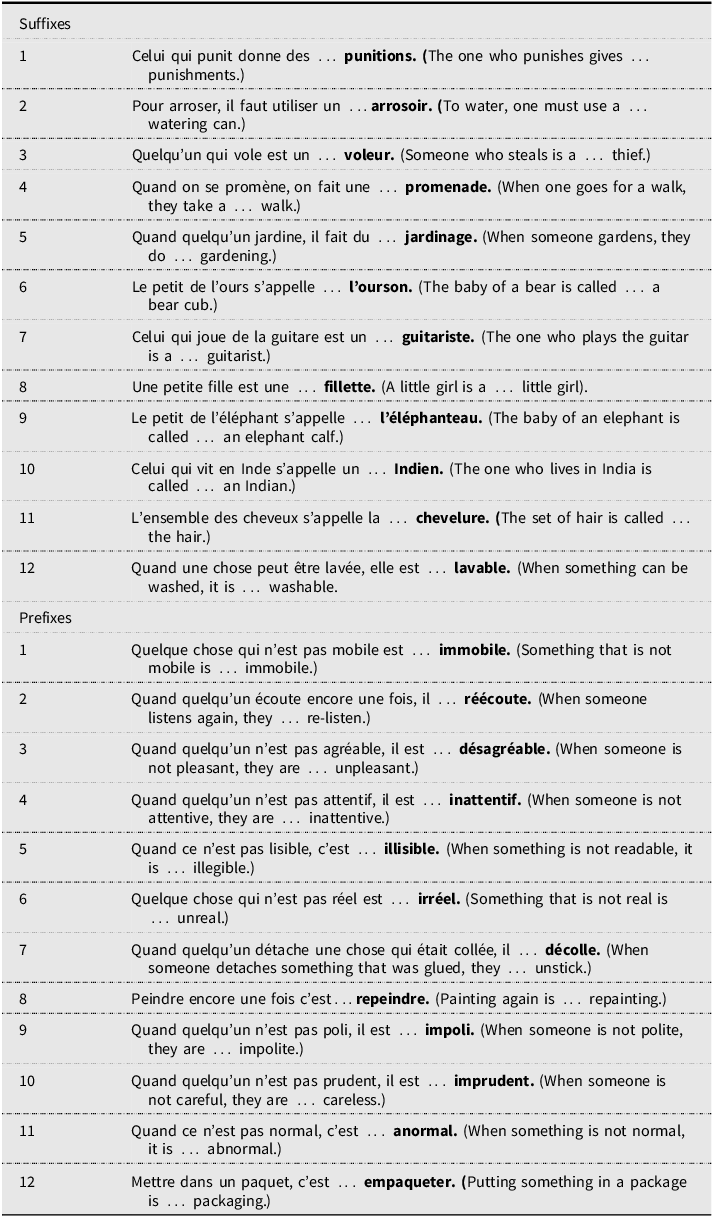
The tests used to assess derivational morphological awareness were part of the MORPHOTE battery (Casalis & Macchi, Reference Casalis and Macchi2016). All tasks were performed orally, both in terms of the presentation of the stimuli and the responses given by the children. All the task items are presented in Appendix A.
Word analogy. In the analogy task, the experimenter first presented a pair of morphologically related words, in which both shared the same root, and the second word was obtained by adding a suffix to the first word (i.e., rapide [quick]/rapidement [quickly]). The participant was expected to perform the same operation with other roots (i.e., silence [quiet] → silencieusement [quietly]). This task was divided into two subtests: 12 items had stable derivations (phonologically transparent as above) and 12 items had unstable derivations (i.e., chirurgie [surgery]/ chirurgien [surgeon]; musique [music] → musicien [musician]). Each correct response earned one point. The Cronbach alpha was α = 0.92.
Production. For the derived word production task, the child had to complete a sentence read by the experimenter by providing a morphological derivation of a word present in the sentence. Two subtests made up this task: half of the words were suffixed words and half were prefixed words. For example, for suffixed words, the child heard the sentence “Une personne qui travaille dans une ferme est un … – fermier” [A person who works on a farm is a … – farmer]; and for prefixed words, the child heard “Faire à nouveau c’est… – refaire” [To do something again is to … – redo]. Each subtest contained 12 items; one point was awarded for each correct answer. The Cronbach alpha was α = 0.91.
Odd one out. In the odd one out task, the experimenter gave four words, and the child had to determine which word did not belong to the same family as the others. All the items were closely related in phonology and spelling, i.e., chantier [yard], chanteur [singer], chanter [to sing], and chanson [song], the odd word being chantier. The maximum score was 10 points, one point per correct answer. The Cronbach alpha was α = 0.70.
Reading fluency task
The reading text subtest of the EVALEO (Evaluation du langage écrit et oral [Written and spoken language assessment]) battery was used to determine reading fluency (Launay et al., Reference Launay, Maeder, Roustit and Touzin2018). The participant was instructed to read a text as quickly and as accurately as possible and was stopped after three minutes. The score corresponded to the number of words correctly read in three minutes.
Morphologically derived word reading
Morphological decoding can be defined as the correct splitting up of morphologically complex words into morphemes to ensure correct pronunciation (Nunes et al., Reference Nunes, Bryant and Barros2012). To assess this skill, two experimental tasks were created in which the child was asked to read morphologically complex words (i.e., derived words) as quickly and as accurately as possible in one minute. The time constraint was added to ensure that the morphological decoding was automatized and not dependent on grapho-phonological decoding because of the relative transparency of the French spelling system for grapheme-to-phoneme correspondences (Lee et al., Reference Lee, Wolters and Grace Kim2023). The two tasks consisted of reading word lists that contained morphologically complex words: one task with prefixed words and one with suffixed words. These two tasks were matched for frequency (Mpref = 10.53, Msuff = 10.16, t(59) = 0.12, p = 0.91), orthographic consistency (Mpref = 74.26, Msuff = 73.72, t(59) = 0.52, p = 0.60), and syllable length (Mpref = 2.88, Msuff = 2.80, t(59) = 0.56, p = 0.58). These tasks gave 2 accuracy scores, one for each list of the number of words read correctly in the time limit. The word lists for both tasks are available in Appendix B.
Word spelling
We used a standardized lexical written spelling test from the BALE battery (Jacquier-Roux et al., Reference Jacquier-Roux, Lequette, Pouget, Valdois and Zorman2010). It consisted of a dictation of 10 inconsistent monomorphemic words (i.e., the word août [august] pronounced /ut/ in French). Each correctly spelled word earned one point. The Cronbach alpha was α = 0.82.
Morphologically derived word spelling
We created two word dictation tasks, matched for frequency (Mpref = 12.07, Msuff = 13.21, Z = 0.37, p = 0.72), length (M = 2.5 syllables for each list, p = 1), and consistency (Mpref = 72.26, Msuff = 71.10, Z = 0.37, p = 0.72). All words contained spelling inconsistencies. Therefore, participants had to rely on their spelling awareness of affixes. Children were asked to spell four words from each category: prefixes and suffixes. The prefixed words were autocar [coach], kilomètre [kilometer], ennemi [enemy], and effort [effort]. Suffixed words were cuisinier [cook], aviation [aviation], cuvette [basin], and chauffage [heating]. Each correctly spelled morpheme earned one point (8 points for prefixed words and 8 points for suffixed words). Cronbach’s alpha for the prefixed words task was 0.60 (which is an acceptable threshold for short scales of 10 items or less; Loewenthal & Lewis, Reference Loewenthal and Lewis2021) and for the suffixed words task, 0.72.
Vocabulary
Receptive vocabulary was assessed by a forced-choice picture-word matching test using the standardized EVALEO battery (Launay et al., Reference Launay, Maeder, Roustit and Touzin2018). This is a computerized test in which the child, after hearing a word, is asked to choose the appropriate picture out of four. This test has been adapted to allow for group testing in class: the pictures were projected on the classroom whiteboard, and the children had to answer in a booklet by circling the letter that corresponded to one of the four pictures (only one answer was possible). The test contained 34 words (20 nouns, 3 adjectives, and 11 verbs). The rating was done by the EVALEO software by entering the participants’ answers, resulting in a maximum score of 134. The Cronbach’s alpha reported by the test was 0.80.
Nonverbal reasoning
Raven’s progressive matrices (Raven et al., Reference Raven, Court and Raven1998) were used to assess children’s nonverbal reasoning skills. The test was adapted for group testing. The children had to circle the correct answer in a booklet, and the stimuli were presented in another booklet. Each correct response earned one point, the maximum score being 36. According to the manual, the Cronbach’s alpha was between 0.83 and 0.93.
Phonological skills.
Deletion of the initial phoneme. We used the standardized phoneme deletion subtest of the EVALEO battery (Launay et al., Reference Launay, Maeder, Roustit and Touzin2018), in which the child was asked to remove the first sound of a pseudo-word (15 items) spoken by the experimenter. The pseudo-words were monosyllabic with variable vowel (V) and consonant (C) compositions: five CV or VC pseudo-words, five CVC, and five CCV pseudo-words. The test was timed and resulted in a duration and an accuracy score. We computed an efficiency score that considered both dimensions (number of correct items/total time). The Cronbach’s alpha given by the test was 0.76.
Phonemic fusion. The phonemic fusion task was also extracted from the EVALEO test battery (Launay et al., Reference Launay, Maeder, Roustit and Touzin2018). The child was asked to blend sounds that were pronounced one after the other. The ten pseudo-words were monosyllabic, half with a CVC and half with a CCV composition. The maximum score was 10 points. Here again, we computed a composite score combining the duration of the task and the accuracy score (number of successful items/total time). The Cronbach’s alpha given by the test was 0.75.
Pseudo-word repetition. We used the pseudo-word repetition task of the EVALEO battery (Launay et al., Reference Launay, Maeder, Roustit and Touzin2018), in which the child was asked to repeat 20 pseudo-words consisting of one to five syllables, some of which contained clusters. For example, the child had to repeat the pseudoword /skytʃ/. The maximum score was 20, one point for each correct word. The Cronbach’s alpha given by the test was 0.77.
Rapid Automatized Naming (RAN). In the experimental RAN task we used, children were asked to name very common objects (a door, shoes, a house, a goat, French fries, and a car) arranged in an array of 24 pictures as quickly as possible. Before the experimental phase, the experimenter named the items consecutively to ensure that the word labels were known to the child. The total time taken to name all the items and the number of errors were measured. Both scores were combined into an efficiency score: number of well-named items/total time.
Procedure
This study was approved by the ethics commission of the University of Geneva (PSE20201003.11). All parents of the children signed a consent form. The first testing session took place between mid-April and mid-June, and the second session took place 12 to 14 months later, in June of the following school year. The reading, morphological awareness, and phonological awareness tests were conducted individually in a quiet room by trained research assistants and the first author. The written spelling, nonverbal reasoning, and vocabulary tasks were collectively administered class by class.
Statistical analyses
To address our research hypotheses, we conducted a series of confirmatory multivariate analyses from the structural equation modeling (SEM) framework. All were performed with the lavaan package (v0.6-15) implemented in R (R Core Team, 2022). The main goal of the analysis was to test the unique longitudinal contribution of morphological awareness to reading and spelling. To control for the longitudinal autocorrelation of reading and spelling skills, these skills were measured at both time points. Therefore, we checked the measurement invariance across evaluation time points (Mackinnon et al., Reference Mackinnon, Curtis and O’Connor2022) to ensure that the scores from these tasks measure the same latent variable. We compared three levels of measurement invariance, i.e., configural invariance, metric invariance, and scalar invariance. Configural invariance is observed when the structure of the measurement model is the same across evaluation time points (i.e., same composition of the latent variable), while factor loadings and intercepts are estimated freely according to the time of evaluation. Metric invariance is observed when structures and factor loadings are equal. Scalar invariance is observed when structure, equal factor loading, and equal intercepts are similar across evaluation time points. Scalar or metric invariance must be obtained to establish the equivalence of latent variables measured over time (Cheung & Rensvold, Reference Cheung and Rensvold2002; Little, Reference Little2013; Steenkamp & Baumgartner, Reference Steenkamp and Baumgartner1998).
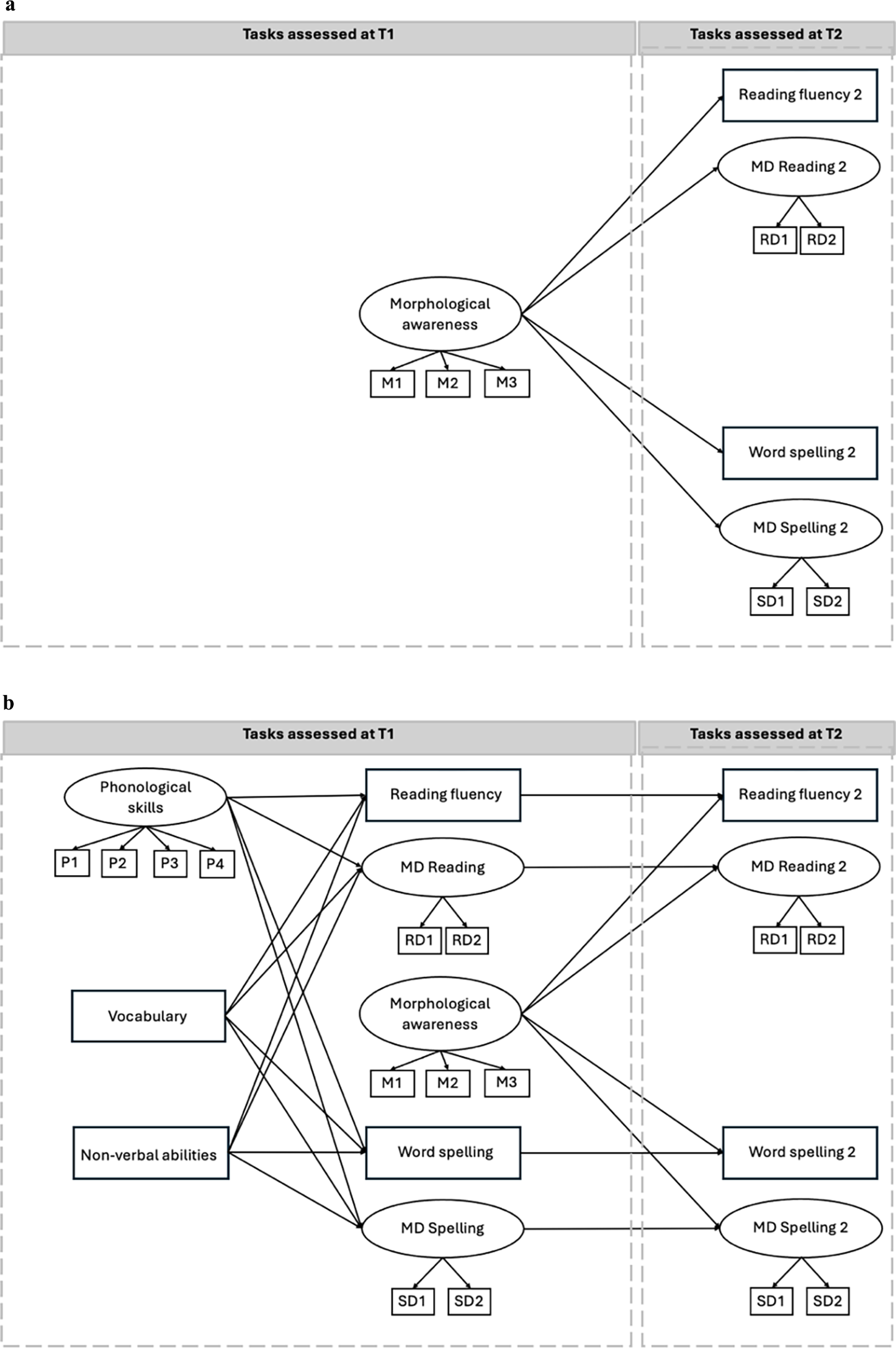
As for the structural equation modeling part, we first examined a restricted model focusing only on the longitudinal prediction of morphological awareness on reading and spelling skills. This initial model excluded the autoregressive path and all control variables (phonology, vocabulary, and non-verbal reasoning). In a second step, we fitted the full hypothetical model (as presented in Figure 2b). Comparing the two models provides insight into the relative contribution of the auto-regressive effect and the control variables to the final model’s results. For all computed models, the paths were estimated using maximum likelihood estimation with robust standard errors (MLR), which is a good estimator to prevent the non-normality of some data and the non-independence of some observations ( Mueller & Hancock, Reference Mueller and Hancock2018). Multi-group analysis was then performed to assess the difference in latent variable intercepts and loadings as well as regression coefficients between the two samples (Sample 1 vs. Sample 2). A significant difference favoring the model with freely estimated regression coefficients over the group-constrained models would indicate a potential developmental dynamic difference between the groups.
Representation of longitudinal measurement invariance of morphological decoding in reading and spelling.
Note. RD1: Prefixed word reading; RD2: Suffixed word reading; SD1: Prefixed word spelling; SD2: Suffixed word spelling.

Hypothesized model of the cross-lagged influence of morphological awareness on reading (general reading and morphological decoding) and spelling (general spelling and morphologically derived spelling) with (a) in a restricted model and (b) the full hypothetical model with the control skills and the autoregressive paths. Only the latent variables and the regressions are pictured.
Note. P1: Phonemic fusion; P2: Deletion of initial phoneme; P3: Pseudo-word repetition; P4: Rapid automatized naming; M1: Word analogy; M2: Production of derived word; M3: Odd one out; MD: Morphological decoding; MD: Morphologically derived; RD1: Prefixed word reading; RD2: Suffixed word reading; SD1: Prefixed word.
To evaluate the goodness of fit of the model, we used the following indices: a Tucker-Lewis index (TLI) and comparative fit index (CFI) at or higher than 0.95, a Root Mean Square Error of Approximation (RMSEA) lower than 0.06, and a Standardized Root Mean Square Residual (SRMR) lower than 0.08 (Hu & Bentler, Reference Hu and Bentler1999; Kline, Reference Kline2016). The Satorra-Bentler scaled chi-square difference test was used to demonstrate a possible difference between the models (Satorra & Bentler, Reference Satorra and Bentler2001).
Results
Descriptive analyses
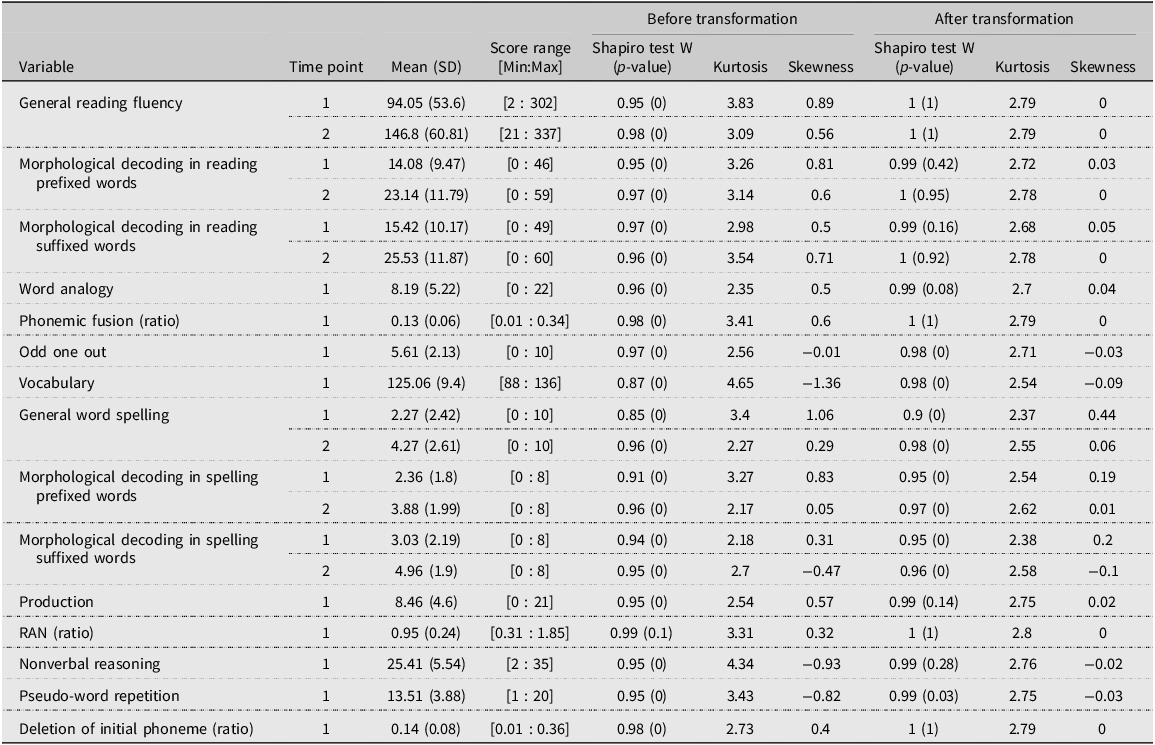
Table 1 shows the means and standard deviations of all considered measures, separating out the two samples of children. As detailed in Appendix C, the initial distribution characteristics of the modeling variables showed non-normality. Consequently, we transformed the data using the non-parametric method (Liu et al., Reference Liu, Lafferty and Wasserman2009) to achieve better normality prior to modeling; Appendix C confirms that this transformation improved the distributions. Correlation coefficients between all measures for samples 1 and 2 are reported separately in Appendix D.
Descriptive statistics for Sample 1 and Sample 2 measures at both time points

Measurement invariance
Longitudinal measurement invariance was tested on morphologically derived words in reading and spelling. One measurement model was fitted for each in three different versions: configural, metric, and scalar.
Morphologically derived words in reading
Among the three versions of the measurement model for morphological decoding in reading, the one with the lowest Akaike Information Criterion (AIC) is the metric model (configural model AIC = 1663.2, metric model AIC = 1659.4, scalar model AIC = 1953.3). The metric model showed a good fit to the data (χ2 (3) = 1.79, p = 0.62, CFI = 1.00, TLI = 1.00, RMSEA = 0.00, SRMR = 0.005). The metric model is pictured in Figure 1. Prefixed word reading (RD1) was significantly explained by the latent variable at both time points (β = 0.97, SE = 0.37, Z = 26.24, p < 0.001, CI = [0.89, 1.04]). Suffixed word reading (RD2) was also significantly explained by the latent variable at both time points (β = 0.97, SE = 0.37, Z = 26.22, p < 0.001, CI = [0.89, 1.04]).
Morphologically derived words in spelling
Among the three versions of the measurement model for morphological decoding in spelling, the one with the lowest AIC is the metric model (configural model AIC = 2902.9, metric model AIC = 2899.1, scalar model AIC = 3141.8). The metric model showed a good fit to the data (χ2 (3) = 7.2, p = 0.06, CFI = 0.99, TLI = 0.98, RMSEA = 0.06, SRMR = 0.02). The model is pictured in Figure 1. Prefixed word spelling (SD1) was explained significantly by the latent variable at both time points (β = 0.75, SE = 0.05, Z = 16.57, p < 0.001, CI = [0.67, 1.84]). Suffixed word spelling was also significantly explained by the latent variable (β = 0.81, SE = 0.04, Z = 19.47, p < 0.001, CI = [0.73, 0.89]).
In summary, all of the measurement models presented here meet the requirements to be included in the following autoregressive SEM.
Longitudinal contribution of morphological awareness to reading and spelling acquisition
In this study, we aimed to specify the contribution of morphological awareness to the reading and spelling development in French-speaking children over time. To do this, we created a hypothetical autoregressive model that focused on reading and spelling gains (Figure 2a). We decided to propose a single model that brought together both reading and spelling modeling in view of the links between these two components and their strong covariation.
Prior to estimating the full SEM, we performed a restricted model. This model specifically examined the cross-lagged effect of morphological awareness (T1) on literacy skills (T2), omitting autoregressive paths and all control variables (phonological skills, non-verbal reasoning, and vocabulary). We compared four models to determine the optimal level of constraint across groups: (1) unconstrained, (2) constrained intercepts (scalar invariance), (3) constrained intercepts and factor loadings (strong factorial invariance), and finally, (4) constrained intercepts, loadings, and regression paths (full structural invariance).
The chi-squared difference tests were non-significant across all comparisons, suggesting that imposing constraints did not significantly worsen model fit. Consequently, the most parsimonious model was selected based on information criteria. The fully structurally invariant model (constrained intercepts, loadings, and regressions) yielded the lowest AIC (5161.0) and Bayesian Information Criterion (BIC; 5378.1), confirming its superiority over the model with only intercept and loading constraints (AIC = 5164.7, BIC = 5396.5) and the less restricted alternatives. Since the fully constrained model (intercepts, loadings, and regressions) was selected based on the lowest AIC and BIC, we established full structural invariance, confirming that both the measurement of the constructs and the specific effect of morphological awareness on literacy skills are statistically equivalent across all groups.
This model showed very good goodness of fit indices (RMSEA = 0.048; SRMR = 0.00; Robust CFI = 1.00; Robust TLI = 1.02). Morphological prediction of morphologically derived word spelling was significant, with a fully standardized coefficient of β = 0.571 (Z = 5.791, p < 0.001; CI95% = [0.46, 0.94]). Moreover, morphological awareness significantly predicted word spelling (β = 0.47; Z = 7.90, p < 0.001; CI95% = [0.55, 0.92]). Finally, morphology was also a strong predictor for both morphologically derived word reading (β = 0.52; Z = 5.61, p < 0.001; CI95% = [0.40, 0.82]) and reading fluency (β = 0.51; Z = 7.55, p < 0.001; CI95% = [0.57; 0.97]).
For the full model with the control skills and the autoregressive paths, we first included all variables by allowing covariances for all variables of interest, and then we removed the paths that negatively impacted the model according to the parsimony framework (Agresti & Finlay, Reference Agresti and Finlay2009). We initially included the following control variables: vocabulary, phonological skills, and nonverbal reasoning. We also added the two latent variables of morphologically derived words (in reading and spelling) with the metric constraints calculated during the measurement invariance testing and also the variables that measured word spelling and reading fluency. The paths of interest, namely the contribution of morphological awareness to morphological decoding and word spelling and reading skills, are also included.
This first model showed a limited fit to the data (χ2 (3) = 564.40, p < .001, CFI = 0.93, TLI = 0.91, RMSEA = 0.09, SRMR = 0.14). To improve the model, we removed the paths for lexicon and nonverbal reasoning because they were never significantly related to our four variables of interest: morphologically derived words in reading (p = 0.67 and p = 0.28, respectively) and spelling (p = 0.18 and p = 0.35), but also the standardized measures of spelling (p = 0.07 and p = 0.74) and reading (p = 0.81 and p = 0.26). Removing such non-significant control paths was crucial for obtaining a better and more parsimonious model, since it is known that estimating many paths is costly for the overall fit of the model (Kline, Reference Kline2016). The new model showed, indeed, an improved fit (χ2(135) = 385.47, p < 0.001, CFI = 0.95, TLI = 0.94, RMSEA = 0.08, SRMR = 0.05), which was confirmed with the result of the likelihood ratio test comparing the 2 models (Δχ2(56)=155.34, p < 0.001).
Testing the multi-group effect
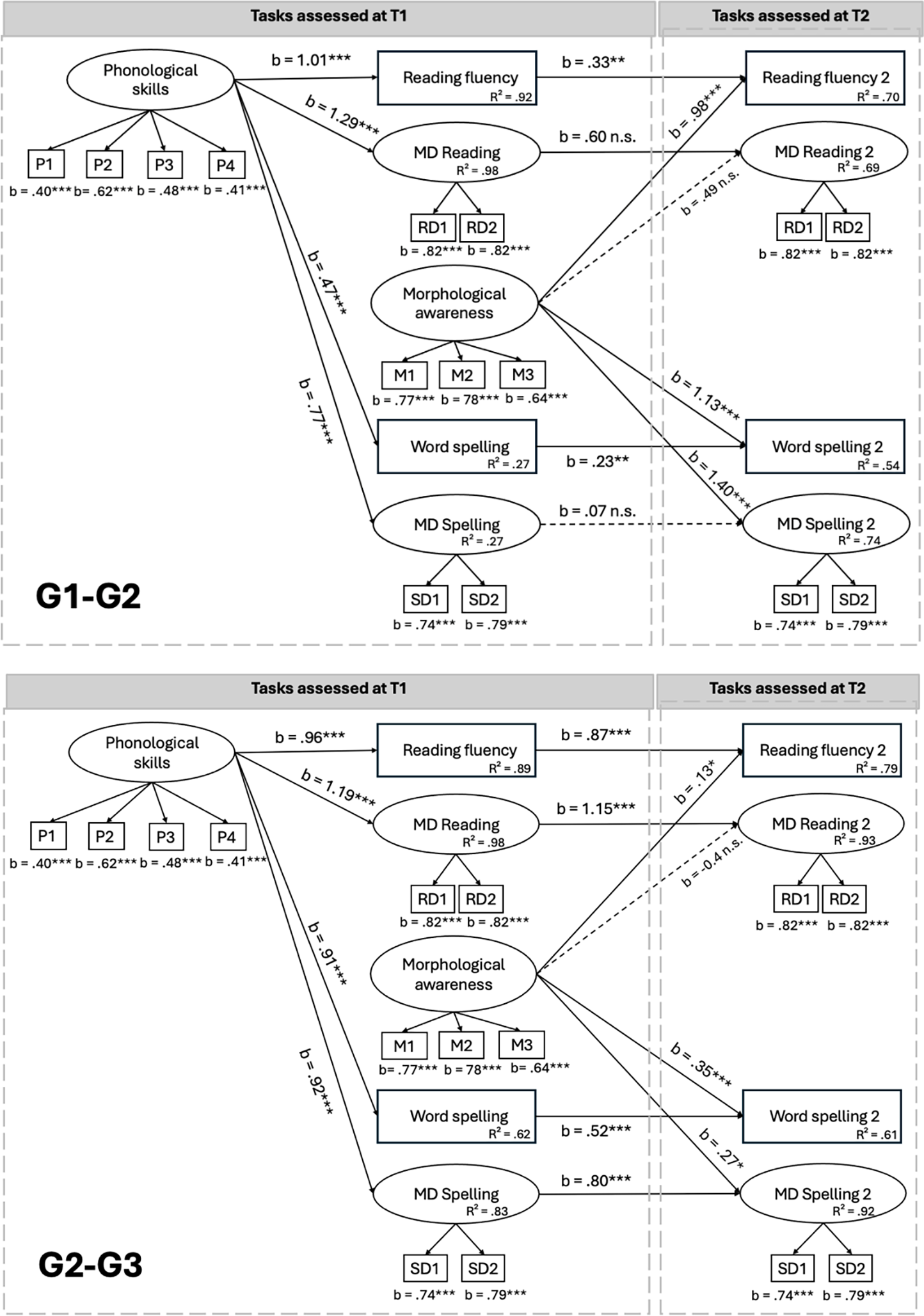
In the objective to know if there were some differences across the two samples, we performed a multi-group analysis contrasting the same model structure as in the restricted model analysis. Model comparison was conducted to determine the optimal level of measurement invariance across groups. Based on the Akaike Information Criterion (AIC), the model that fixed factor loadings and intercepts but allowed regression coefficients to be freely estimated demonstrated the best fit (AIC = 10,658) among the tested models (Model 1: AIC = 10,674; Model 2: AIC = 10663; Model 4: AIC = 10,746). This retained model (Figure 3) provides evidence that the latent variables measure the same construct across groups (strict invariance), while suggesting that the regression coefficients between the latent variables differ between the groups. Comparison of this retained model with a model imposing full equality constraints across all parameters (regression coefficients included) was significant (Δχ2(12) = 105.78, p < 0.001), supporting the decision to allow regression coefficients to vary. The retained model was also compared to a model with freely estimated intercepts (Model 4), showing a non-significant difference (Δχ2(13) = 21.83, p = 0.05); we chose to retain the model with the best AIC in this case. The final model is illustrated in Figure 4, and all the estimate details are presented in Table 2. The final model with standardized coefficients is presented in Appendix E.
Restricted model picturing the cross-lagged influence of morphological awareness on reading (reading fluency and morphologically derived words) and spelling (word spelling and morphologically derived spelling). Only the latent variables and the regressions are pictured.
Note. MD: Morphologically derived; M1: Word analogy; M2: Derived word production; M3: Odd one out; RD1: Prefixed word reading; RD2: Suffixed word reading; SD1: Prefixed word.
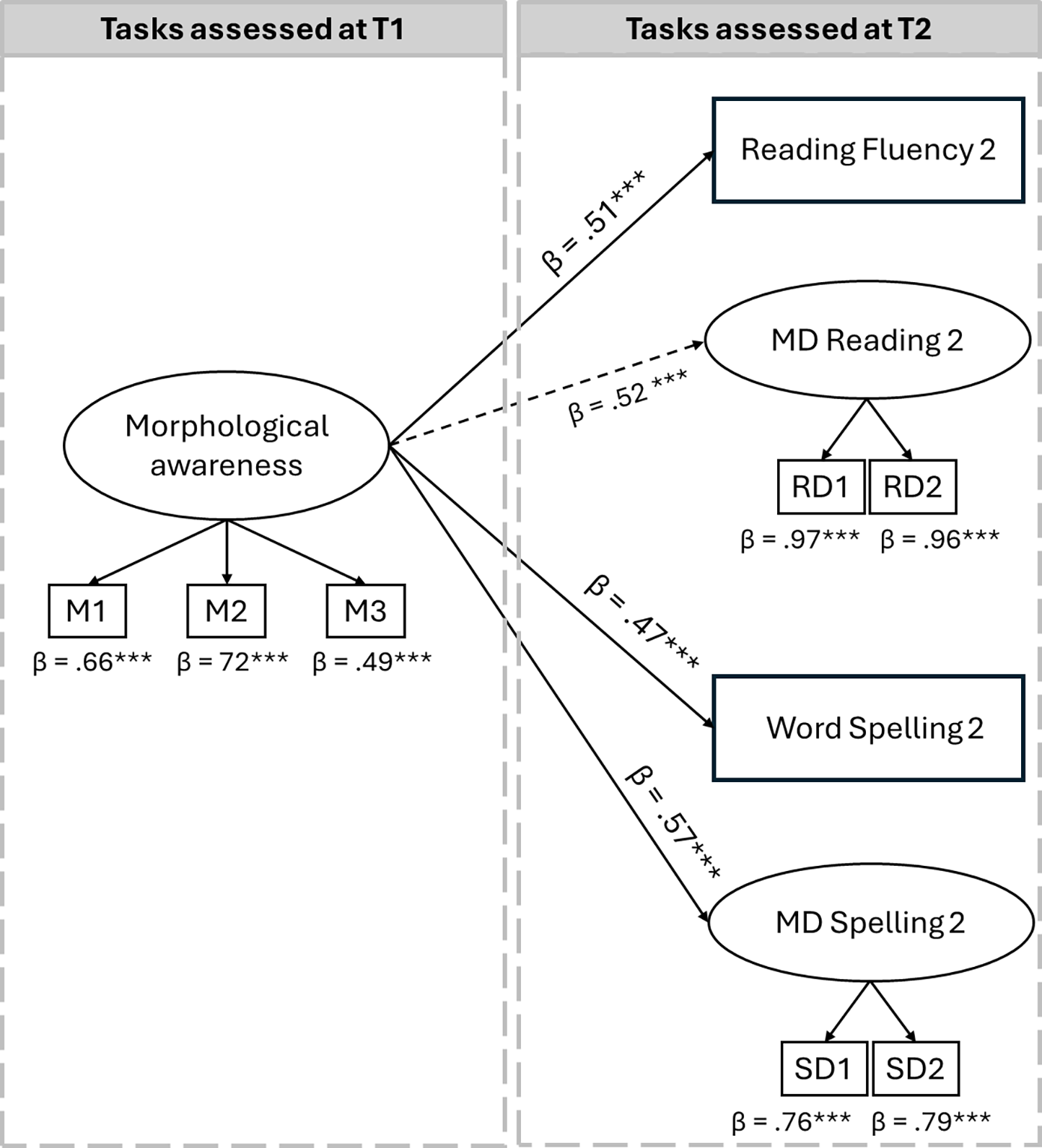
Figure 3. Long description
A diagram of the predictive role of morphological awareness in reading and spelling acquisition. The diagram is divided into two main sections: Tasks assessed at T1 and Tasks assessed at T2. In the Tasks assessed at T1 section, there is an oval labeled Morphological awareness with three arrows pointing to three boxes labeled M1, M2, and M3, with beta values of .66, .72, and .49 respectively. In the Tasks assessed at T2 section, there are four main components: Reading Fluency 2, MD Reading 2, Word Spelling 2, and MD Spelling 2. Arrows from Morphological awareness point to Reading Fluency 2, MD Reading 2, Word Spelling 2, and MD Spelling 2 with beta values of .51, .52, .47, and .57 respectively. MD Reading 2 and MD Spelling 2 each have two boxes below them labeled RD1 and RD2 for MD Reading 2, and SD1 and SD2 for MD Spelling 2, with beta values of .97 and .96 for RD1 and RD2, and .76 and .79 for SD1 and SD2 respectively.
Final structural model testing the contribution of morphological awareness to morphological decoding in spelling and reading and to general measures of reading and spelling for both samples.
Note. Solid lines represent significant coefficients (p < 0.05), and dashed lines represent non-significant coefficients (p > 0.05). P1: Phonemic fusion; P2: Deletion of initial phoneme; P3: Pseudo-word repetition; P4: Rapid Automatized Naming; RD1: Prefixed word reading; RD2: Suffixed word reading; SD1: Prefixed word spelling; SD2: Suffixed word spelling; M1: Word analogy; M2: Production of derived word; M3: Odd one out; MD: Morphologically derived word.
Paths detailed statistical estimates
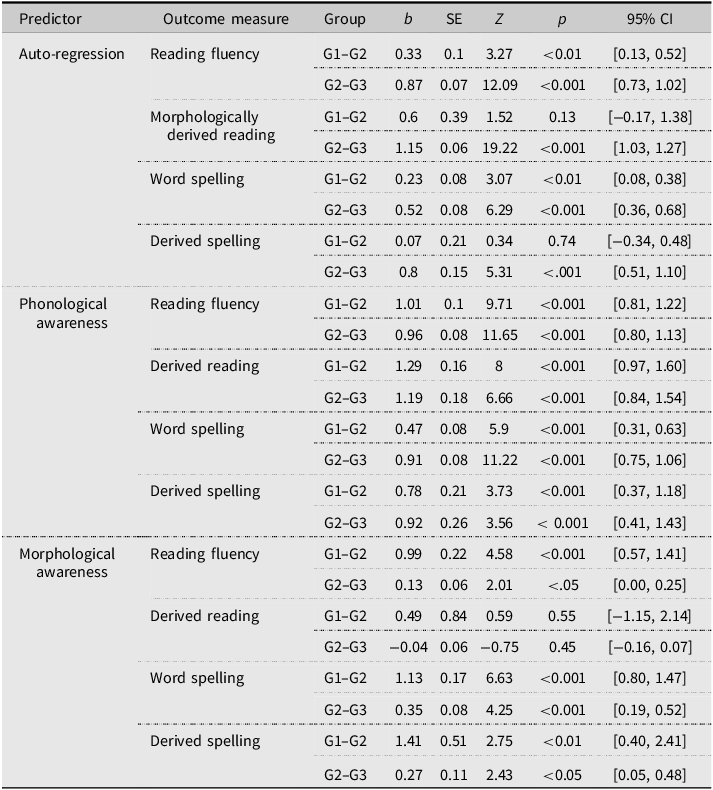
Table 2. Long description
The table presents statistical estimates of predictors for various outcome measures across different groups. It has 15 rows and 8 columns. The columns are labeled Predictor, Outcome measure, Group, b, SE, Z, p, and 95% CI. The predictors include Auto-regression, Phonological awareness, and Morphological awareness. The outcome measures are Reading fluency, Morphologically derived reading, Word spelling, and Derived spelling. The groups are G1-G2 and G2-G3. Each row provides the values for b, SE, Z, p, and 95% CI for the respective predictor and outcome measure. Notable trends include significant p-values for most comparisons, indicating differences between groups.
Note: The beta are presented unstandardized in the table to allow for multi-group comparisons.
Auto-regressive effects
The auto-regressive effect on reading fluency is significant in both groups, with a strengthened relation in the second group (G1–G2: b = 0.33; p < 0.01; G2–G3: b = 0.87; p < 0.001). The auto-regressive effect on morphologically derived words in reading was significant in the older children group (b = 1.15; p < 0.001) but not in the younger group (b = 0.60; p = 0.13). The evaluation at the earliest time point (G1) of morphologically derived words could not be developed enough to have an impact on the subsequent development. The auto-regressive effect on word spelling was significant in both groups (G1–G2: b = 0.23; p < 0.01; G2–G3: b = 0.52; p < 0.001) but with a stronger effect in the group of G2–G3, which also confirms a strengthened relation in older children, as for reading fluency. The auto-regressive effect on morphologically derived words in spelling showed a significant effect in the older group (G2–G3: b = 0.8; p < 0.001) but not in the younger group (G1–G2: b = 0.07; p = 0.74). Overall, the auto-regressive effects showed a strengthened effect in the older group compared to the younger one. The difference in coefficients and significances shows a different developmental dynamic in the early stages of learning to read and spell. More specifically, the acquisition of reading and spelling seems to accelerate along with the grades.
Phonological skills contribution
In the final model, the latent variable measuring phonological skills explains significantly the reading fluency variable (G1–G2: b = 1.01; p < 0.001; G2–G3: b = 0.96; p < 0.001) and the reading morphologically derived words variable (G1–G2: b = 1.29; p < 0.001; G2–G3: b = 1.19; p < 0.001). The coefficients seem to slightly diminish between the two groups. The effect of phonological skills in word spelling was significant in both groups (G1–G2: b = 0.47; p < 0.001; G2–G3: b = 0.91; p < 0.001) as well as in the morphologically derived words’ spelling (G1–G2: b = 0.78; p < 0.001; G2–G3: b = 0.92; p < 0.001). The coefficients of the contribution of phonological skills on spelling are stronger in the second group than in the group with younger children, which means that phonological skills are more linked to spelling later than grade 1.
Morphological awareness lagged effect on T2 assessment
On reading, the lagged morphological awareness prediction was focused on reading fluency in both groups (G1–G2: b = 0.99; p < 0.001; G2–G3: b = 0.13; p < 0.05), with a stronger effect in the younger sample (G1–G2). The lagged effect on morphologically derived words in reading was not significant for both groups (G1–G2: b = 0.49; p = 0.55; G2–G3: b = −0.04; p = 0.45). The prediction of morphological awareness was significant on T2 word spelling in both groups (G1–G2: b = 1.13; p < 0.001; G2–G3: b = 0.35; p < 0.001) and on T2 morphologically derived words in spelling (G1–G2: b = 1.41; p < 0.01; G2–G3: b = 0.27; p < 0.05). The prediction of morphological awareness seems to be stronger in the earliest phase of spelling acquisition and diminishes in the second group.
To empirically evaluate the statistical power of our final SEM given the sample size (n = 293), a post-hoc power analysis was conducted to determine that our model’s fit results were not due to insufficient power. We employed the approach by Moshagen and Bader (Reference Moshagen and Bader2024) using the semPower R package, which assesses the power to detect the goodness-of-fit based on the observed model fit statistics. Specifically, the analysis determined the power to reject the null hypothesis of poor fit, given the observed Root Mean Square Error of Approximation (RMSEA = 0.077) and the model’s degrees of freedom (df = 294). The results of the post-hoc analysis indicated a statistical power superior to 0.99. This result confirms that the sample size provided excellent statistical power to detect the model’s goodness-of-fit.
Discussion
Our study aimed to better understand the contribution of morphological awareness to spelling and reading acquisition during the early stages of writing development in French-speaking children. More specifically, the aim was to determine whether the contribution of morphological awareness to reading and spelling was on standardized reading and spelling skills or/and rather on morphologically derived words in controlling phonological awareness, vocabulary, and nonverbal reasoning. We selected two samples of children in the early stages of literacy acquisition (Grades 1 to 2; Grades 2 to 3) to test whether the contribution of morphology was already effective at that age and whether it evolved as a function of age and literacy level within an accelerated longitudinal design (ALD, Galbraith et al., Reference Galbraith, Bowden and Mander2017). We built an autoregressive model for longitudinal data by including spelling and reading measures in the same model in light of their complementarity (Bosman & van Orden, Reference Bosman, van Orden, Perfetti, Rieben and Fayol1997), controlling for nonverbal reasoning, phonological skills, and vocabulary level. Our main results show a unique contribution of morphological awareness to standardized text reading fluency, on word spelling, together with an effect on morphologically derived words during spelling only. A difference between the models was found between the samples G1–G2 and G2–G3, particularly regarding the auto-regressive effects in the sample G1–G2, which are not present between both time points for morphologically derived words’ spelling and reading.
In regard to the control variables, we do not observe any effect of vocabulary or nonverbal reasoning on reading or spelling skills. However, the lack of a significant effect does not mean that future study should not consider them as confounding variables, especially because some previous studies have shown their importance (Giazitzidou & Padeliadu, Reference Giazitzidou and Padeliadu2022; Grigorakis & Manolitsis, Reference Grigorakis and Manolitsis2021; Manolitsis et al., Reference Manolitsis, Georgiou, Inoue and Parrila2019). While the importance of phonological skills in literacy acquisition is already well established, our study further supports this finding and suggests phonological awareness plays an equally important role at this age in both cohorts in reading but becomes more important in word spelling in the G2–G3 sample, as we can observe that the beta estimate is more important in the latter group and the two CIs do not overlap. These results are in line with those of Ardanouy et al. (Reference Ardanouy, Lefèvre, Delage and Zesiger2024) for French spelling or Suggate (Reference Suggate2016) for reading.
Morphological awareness and reading
Our results did not show a contribution of morphological awareness to morphologically derived words in reading. These results are contradictory to those found by Levesque and Deacon (Reference Levesque and Deacon2022). In their study, these authors only found a contribution of morphological awareness to morphologically derived words in reading. This difference can be explained by the fact that Levesque and Deacon’s study was conducted in English, a language with a more inconsistent reading system than French (Ziegler et al., Reference Ziegler, Jacobs and Stone1996). It would appear that French-speaking children do not need to recruit their morphological awareness skills to read multimorphemic words fluently, or to a lesser degree than English-speaking children, because their phonological skills are sufficient. Unlike English, adding an affix to a root does not usually change the pronunciation of the word in French. We suspect that the role of morphological decoding may emerge later in children’s schooling because older children will be exposed to more morphologically complex words as they progress through school (Carlisle, Reference Carlisle2003; White et al., Reference White, Power and White1989). Also, we know that the use of phonological awareness gives way to morphological awareness for reading around Grade 3 (Kirby et al., Reference Kirby, Deacon, Bowers, Izenberg, Wade-Woolley and Parrila2012; Singson et al., Reference Singson, Mahony and Mann2000). It would therefore be interesting to replicate this study with older participants to test whether morphological decoding remains unused.
The lagged effect of morphological awareness on text reading fluency is consistent with the results of two longitudinal studies of French-speaking children that have also found a direct contribution of morphological awareness to general reading measures (Casalis & Louis-Alexandre, Reference Casalis and Louis-Alexandre2000; Desrochers et al., Reference Desrochers, Manolitsis, Gaudreau and Georgiou2018) and more precisely on reading fluency. These results seem to be in line with those found in languages with a transparent orthographic system, where morphological awareness is a predictor of reading fluency (Burani et al., Reference Burani, Marcolini, De Luca and Zoccolotti2008; Desrochers et al., Reference Desrochers, Manolitsis, Gaudreau and Georgiou2018; Giazitzidou & Padeliadu, Reference Giazitzidou and Padeliadu2022; Marcolini et al., Reference Marcolini, Traficante, Zoccolotti and Burani2011). French-speaking children therefore use their morphological awareness, in addition to other components such as phonological skills, for reading texts, after only one to two years of formal literacy learning.
A first hypothesis in accordance with the framework offered by Levesque & Deacon (Reference Levesque and Deacon2022) is that the association observed between morphological awareness and text reading fluency may not reflect morphological decoding per se. In accordance with Levesque and Deacon (Reference Levesque and Deacon2022), the morphological decoding mechanism should manifest itself through a stronger link between morphological awareness and the reading of morphologically derived words than between morphological awareness and text reading fluency. Since this pattern is not observed here, the contribution of morphological awareness to text reading fluency may rely on broader linguistic or cognitive processes rather than on morphological decoding specifically.
A second hypothesis is that reading morphologically derived words is different from reading a text, which may explain the difference in results. Reading a complete text requires recruiting cognitive skills involved in sequencing the decoding of several words one after the other, an activity that is costly for beginning readers and requires access to meaning. For this activity, children therefore appear to rely on their morphological awareness.
Morphological awareness and spelling
For spelling, our results show a dual contribution of morphological awareness: one to standardized word spelling, and another to morphologically derived words in spelling. The longitudinal contribution of morphological awareness to word spelling skills, assessed by a standardized test, had already been shown by several authors (Deacon et al., Reference Deacon, Kirby and Casselman-Bell2009; Manolitsis et al., Reference Manolitsis, Georgiou, Inoue and Parrila2019), but only in one study with French-speaking children (Desrochers et al., Reference Desrochers, Manolitsis, Gaudreau and Georgiou2018). One explanation for this finding could be that children use their knowledge of morphology to spell the words in the word spelling task that are for the most part (9 out of 10 words) base words, thus allowing for the formation of other words of the same family (even if they are monomorphemic words). For example, the word *ville [city] has many morphological derivatives: village and *villageois [villager]. If children use their knowledge of derived words, they will be able to write a related word of the same family.
To our knowledge, no study has reported the contribution of morphological awareness to morphologically derived words in spelling among children, moreover, in the earliest stage of spelling acquisition. Our statistical model showed that this relation, between morphological awareness assessed in the first year and morphological decoding in spelling assessed in the following year, is significant in both samples. This effect was one of the most expected, especially since it was consistent with the Morphological Pathways Framework (Levesque et al., Reference Levesque, Breadmore and Deacon2021) that hypothesizes that morphological awareness plays a role in the spelling of multimorphemic words. In other words, children use their knowledge of morphemes to spell these words. Since the French writing system is particularly inconsistent in spelling (Ziegler et al., Reference Ziegler, Jacobs and Stone1996), children need to use their morphological awareness in addition to phonological information to spell more accurately, because morphemes are islands of regularity among the majority of irregularities (Rastle, Reference Rastle2018).
In addition, comparing the strength of the associations between morphological awareness and the two spelling outcomes provides further insight into the role of morphological decoding. For the younger cohort (G1–G2), the contribution of morphological awareness was substantial for both morphologically derived word spelling (b = 1.13) and standardized word spelling (b = 1.40). For the older cohort (G2–G3), these contributions were smaller but still comparable (b = 0.35 for morphologically derived word spelling; b = 0.27 for word spelling). Although the effect of morphological awareness is not consistently stronger for morphologically derived words than for simple word spelling, the pattern suggests, according to the Morphological Pathways Framework (Levesque et al., Reference Levesque, Breadmore and Deacon2021), that morphological decoding may nonetheless play a role, albeit a modest one, in spelling. The similarity of effect sizes indicates that children may draw on their morphological knowledge not only when spelling derived forms, but also when spelling base words, possibly through the activation of morphological families or morphemic representations.
Acquisition dynamic of reading and spelling (auto-regressive effects)
Interestingly, our two samples differ in terms of dynamic acquisition measured, by the auto-regressive effects. Indeed, for the auto-regressive effects on word spelling and reading measures, we observe an increasing auto-regressive effect (b = 0.33 vs. b = 0.87 for reading and b = 0.23 vs. b = 0.80 for spelling). These results are particularly interesting as they highlight the acceleration of the acquisition of reading and spelling along the first elementary grades.
Furthermore, there is a difference in the way performance in the previous year predicts performance in the following year between general reading and word spelling. In reading, the scores of the previous year predict a larger part of the results of the following year (b = 0.33 for reading fluency vs. b = 0.23 for word spelling in Grade 1), the reading decoding system being already well in place at the end of Grade 1 in French. However, for spelling, the prediction of the scores is less important, which reflects a period of great progression in the first grades since it is the beginning of the construction of the orthographic lexicon (b = 0.87 for reading fluency and b = 0.52 in word spelling). This dissociation between reading and spelling could be the reflection of the asymmetry of consistency between reading and spelling in French.
Concerning morphologically derived words, in Sample 1, children’s performance both in reading and spelling at Grade 1 does not predict their skills at Grade 2. One possible explanation for this finding is the low performance observed in these tasks at Grade 1. At this stage, children appear to have an insufficient grasp of the spelling or reading of derived words. Exposure to morphologically derived words occurs later (Kuo & Anderson, Reference Kuo and Anderson2006), and the instruction provided in Grade 1 primarily focuses on mastering grapheme–phoneme correspondences and vice versa with simple words (Ehri & Flugman, Reference Ehri and Flugman2018). In sum, the auto-regressive effect reveals the instability of children’s literacy skills at the end of Grade 1, suggesting they are not yet reliable indicators (or weaker ones) of future achievement. However, from Grade 2 onwards, the prediction becomes much stronger for typical readers, showing an acceleration of literacy acquisition, as demonstrated, for example, in the study by Hulslander et al. (Reference Hulslander, Olson, Willcutt and Wadsworth2010).
Including auto-regressors in the predictive model is crucial for accurately assessing the unique contribution of morphological awareness to later reading and spelling skills. Without controlling for prior performance, morphological awareness appears to predict all later literacy outcomes, likely reflecting the stability of these skills over time. However, when previous-year scores are included as auto-regressors, the predictive role of morphology becomes more specific and limited: it no longer accounts for all components of later reading, including morphologically derived word reading. This indicates that the apparent broad effect of morphological awareness is partly driven by baseline abilities and that controlling for these initial levels provides a more precise understanding of its true developmental contribution.
Effect size variation in the relationship between morphological awareness and literacy across groups
The contribution of morphological awareness to general reading fluency and word spelling shows the same pattern of effect size across groups: a stronger effect in the younger group (G1–G2) compared to the second group (G2–G3) based on the non-overlap of confidence intervals. This pattern is contrary to our hypothesis. It may arise for two reasons. First, the auto-regressive effect is likely strengthened with grade level. This increase reduces the unexplained variance in the second group (G2–G3), while, in the first group, it allows morphological awareness to account for a larger proportion of the remaining variance. Thus, in the G1–G2 group, morphological awareness is a more powerful predictor than the auto-regressive effect. However, in the G2–G3 group, the strengthened auto-regressive effect becomes a more robust predictor of future literacy acquisition, diminishing the relative importance of morphological awareness.
Second, the development of written language does not seem to be linear but rather follows complex dynamics. In this framework, for reading, we can state that at the beginning of learning, the learner appears to rely particularly on their morphological knowledge to read fluently (while still maintaining the role of phonological awareness; see Inoue et al., Reference Inoue, Georgiou and Parrila2023). However, this contribution seems to weaken before increasing again (Berninger et al., Reference Berninger, Abbott, Nagy and Carlisle2010) when reading becomes a medium for comprehension, as shown by other studies (Deacon & Levesque, Reference Deacon and Levesque2024; Levesque & Deacon, Reference Levesque and Deacon2022). A parallel explanation can be offered for the role of morphological awareness in spelling development. Initially, it could facilitate the acquisition of spelling, especially for large morphological units. As learners master phono-grapheme correspondences, the direct contribution of morphological awareness likely decreases. However, it may become more influential later, particularly when spelling longer and morphologically complex words.
Implications and limitations
Our results are particularly interesting since they support the hypotheses described in the Morphological Pathways Framework (Levesque et al., Reference Levesque, Breadmore and Deacon2021). Depending on the orthographic consistency of languages, the contribution of morphological awareness can take different forms. English-speaking children need to use morphemes, units larger than phonemes, to decode accurately, whereas French-speaking ones, facing a rather transparent system, do not seem to need these units systematically to read multimorphemic words, as hypothesized by the grain size theory (Ziegler & Goswami, Reference Ziegler and Goswami2005). Nevertheless, depending on the activity that was performed (word reading or text reading, reading accuracy or reading fluency), the recruitment of morphological awareness seems to vary as a function of the cognitive demands of the task. This hypothesis needs to be tested in older children, in whom morphological awareness would be more developed. For spelling, our results confirm the contribution of morphological awareness to morphological decoding, as proposed by Levesque et al. (Reference Levesque, Breadmore and Deacon2021) in their model. However, our results also find support for a contribution of morphological awareness to word spelling in French-speaking children; thus, a direct pathway could be added to the current model. These results need, however, to be replicated in languages with a more transparent orthography to check whether this double contribution, on standardized word spelling and on morphologically derived words, is also observed.
One of the most important limitations of our study lies in the measures we used to build our model. Indeed, morphologically derived words are a latent variable for reading and spelling, while the “general” measures of spelling and reading are only represented by manifest variables. It would have been interesting to compare latent variables on the same level. Also, we were not able to directly compare reading and spelling performance because we measured reading using a text reading task (to measure fluency), whereas we tested spelling via the dictation of single words. However, a sentence dictation for children of Grade 1 is a very demanding test and would have led to a floor effect, so we preferred to use a test that was more adapted to the skills of such young children. Moreover, it would have been interesting to create a latent variable “morphological decoding in reading/spelling” and to verify that it was different from standardized reading and spelling measures. Nevertheless, we only have one task assessing the reading fluency (the same for word spelling); therefore, we cannot test a bi-factor and test if this variable is separate from the 2 others that load on the latent variable.
A further limitation concerns the absence of an a priori power analysis. Although desirable, conducting a meaningful power analysis for the present SEM was not feasible due to the lack of prior studies reporting effect sizes for these specific constructs and this developmental age range. As a result, any power estimate would have been highly speculative. We therefore relied on reporting a post hoc power analysis that showed that the sample size was adequate to detect the misfit of our model.
Finally, there is a fine line between tasks that assess morphologically derived words’ reading or spelling and those that test standardized reading or spelling, particularly for reading, because both reading tasks are performed under time constraints, which reflects reading fluency. Indeed, for reading, we used a timed test of morphologically complex word identification to elicit the use of morphemic units. For morphologically derived words’ spelling, we used a complex word spelling test with words whose orthographic structure could only be inferred by morpheme-level knowledge. Nevertheless, it cannot be excluded that these tests also tapped general reading and spelling skills. We can only infer that these morphologically derived word reading or spelling tasks allow participants to engage in morphological decoding processes. Tests that finely assess morphological decoding in reading and spelling should be developed in future research.
Conclusion
The results of the current study provide a better understanding of the early contribution of morphological awareness to literacy skills. Morphological awareness assessed at time 1 predicts general reading and spelling skills a year later in French-speaking children followed from Grades 1 to 2 and from Grades 2 to 3. Morphological awareness skills can thus be considered a cornerstone of literacy acquisition. In languages like French, given the number of morphologically derived words that children encounter during their schooling, morphological awareness should not be overlooked and should be widely taught and practiced, promoting literacy development. In summary, our results indicate that the teaching of derivational morphology should be encouraged in schools, early in the learning of reading and writing, in order to make reading and spelling more transparent.
Replication package
All materials, data, and scripts are available on this OSF link: https://osf.io/phxcg/.
Appendix A
Morphological awareness tasks
a) Word analogy

b) Production
c) Odd one out

Note: The expected answer is in bold.
Appendix B
Morphological decoding in reading
Prefixed words

Suffixed words

Distributions are characteristics of the variables that are used in the following modeling analysis (transformed data were used in the structural equation modeling analyses)
Appendix C Long description
The table presents data on various reading and spelling measures, comparing their distributions before and after transformation. It includes columns for variable names, time points, mean values with standard deviations, score ranges, Shapiro test W values, kurtosis, and skewness. The table has 15 rows and 12 columns. Each row represents a different measure, such as general reading fluency, morphological decoding, word analogy, phonemic fusion, odd one out, vocabulary, general word spelling, morphological decoding in spelling, production, RAN ratio, nonverbal reasoning, pseudo-word repetition, and deletion of initial phoneme. The columns detail the mean and standard deviation, score range, Shapiro test W value, kurtosis, and skewness for each measure at different time points before and after transformation. Notable trends include changes in kurtosis and skewness values after transformation, indicating improved normality in the data distributions.
Note: Mean and SD are calculated before transformation as well as the score range. Shapiro test, Kurtosis, and Skewness are calculated on the raw data and transformed data.
Correlation matrix between all variables, bottom left for sample 1 (grade 1–grade 2), and top right for sample 2 (grade 2–grade 3)
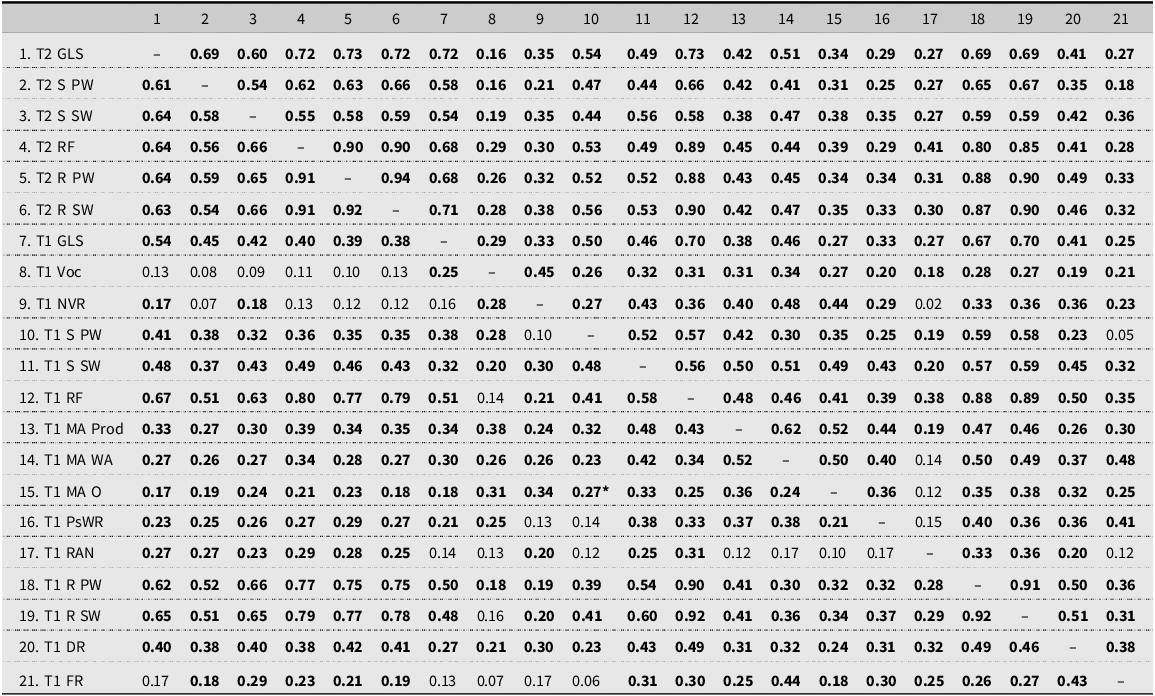
Appendix D Long description
The table presents correlation coefficients between multiple variables for two samples. It has 21 rows and 21 columns, with each cell containing a correlation value. The rows and columns are labeled with variable names such as T2 GLS, T2 S PW, T2 S SW, T2 RF, T2 R PW, T2 R SW, T2 GLS, T1 Voc, T1 NVR, T1 S PW, T1 S SW, T1 RF, T1 MA Prod, T1 MA WA, T1 MA O, T1 PSWR, T1 RAN, T1 R PW, T1 R SW, T1 DR, and T1 FR. Each cell in the table shows a correlation coefficient value, indicating the relationship between the variables in the corresponding row and column. The table is divided into two sections: the bottom left for sample 1 and the top right for sample 2.
MA: Morphological Awareness; WA: Word Analogy; Prod: Production task; O: Odd one out; RF: Reading Fluency; R: Reading; PW: Prefixed Words; SW: Suffixed Words; GLS: General Lexical Spelling; S: Spelling; PA: Phonological Awareness; DR: Deletion Ratio; FR: Fusion Ratio; PsWR: Pseudo-Word Repetition; RAN: Rapid Automatized Naming ratio; Voc: Vocabulary; NVR: NonVerbal Reasoning.
In bold: p < 0.05
Appendix E
Representation of the final model by groups with standardized parameters.
Note. Solid lines represent significant coefficients (p < 0.05), and dashed lines represent non-significant coefficients (p > 0.05). P1: Phonemic fusion; P2: Deletion of initial phoneme; P3: Pseudo-word repetition; P4: Rapid automatized naming; RD1: Prefixed word reading; RD2: Suffixed word reading; SD1: Prefixed word spelling; SD2: Suffixed word spelling; M1: Word analogy; M2: Production of derived word; M3: Odd one out; MD: Morphologically derived word. The betas are presented standardized in this figure.

Figure E1. Long description
A diagram illustrating the development of early literacy skills across two groups, showing the relationships between phonological skills, morphological awareness, reading fluency, and word spelling at two time points. Panel G1-G2: This panel shows the relationships between various literacy skills assessed at two time points, T1 and T2. Phonological skills, assessed by P1, P2, P3, and P4, influence reading fluency and MD Reading, which in turn affect morphological awareness and word spelling. MD Reading and MD Spelling are measured by RD1, RD2, SD1, and SD2. Morphological awareness, assessed by M1, M2, and M3, also impacts word spelling. The diagram includes standardized beta coefficients indicating the strength of these relationships. Panel G2-G3: This panel similarly shows the relationships between literacy skills assessed at T1 and T2 for a different group. Phonological skills influence reading fluency and MD Reading, which affect morphological awareness and word spelling. The relationships are indicated by standardized beta coefficients. Both panels illustrate the complex interplay between different literacy skills over time.
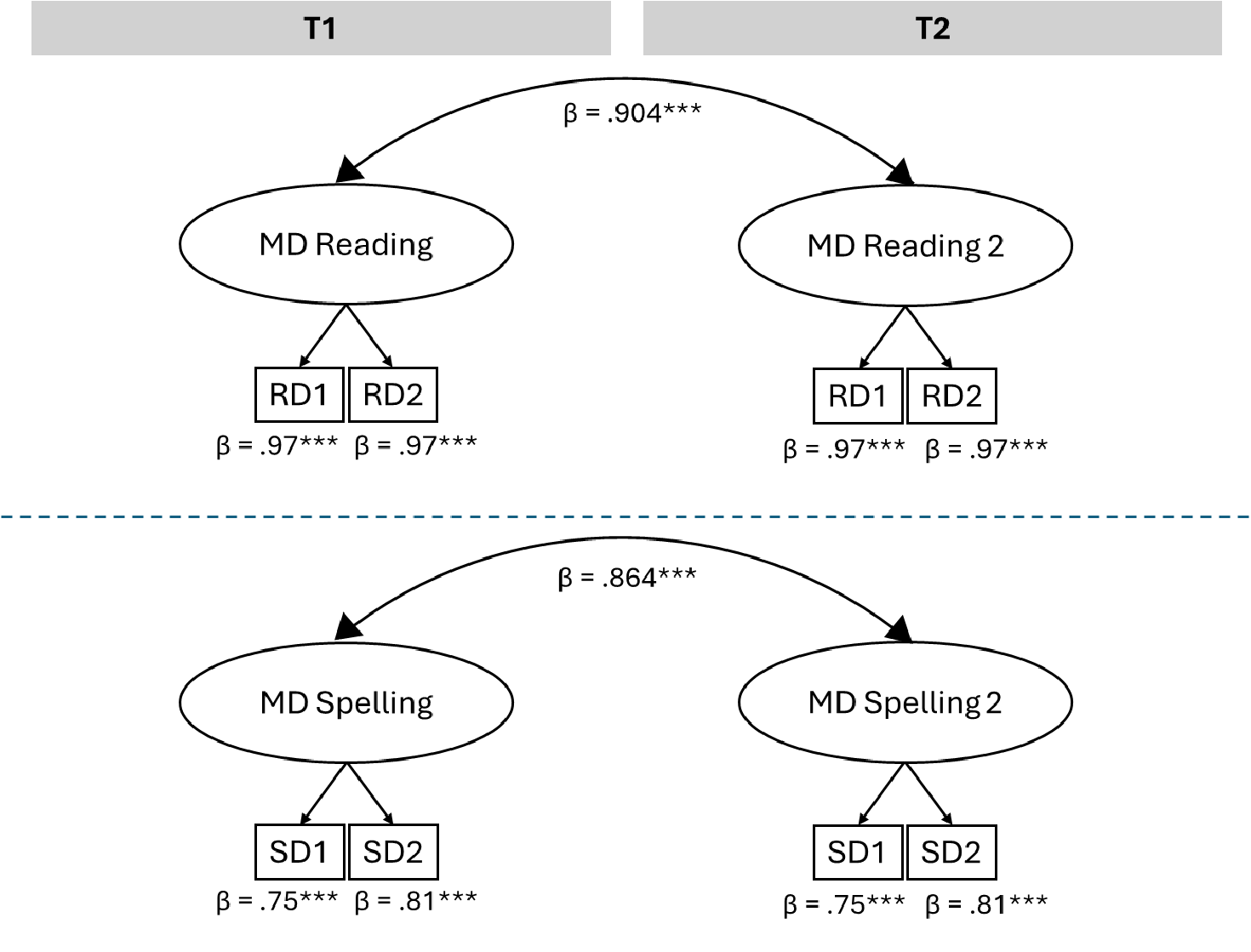
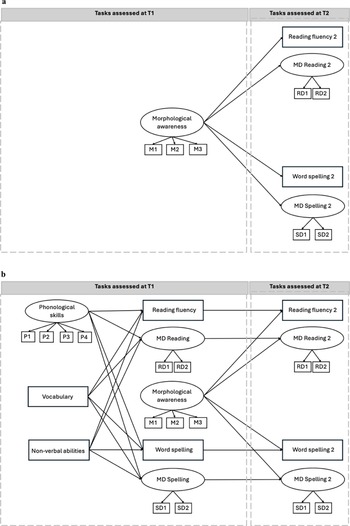
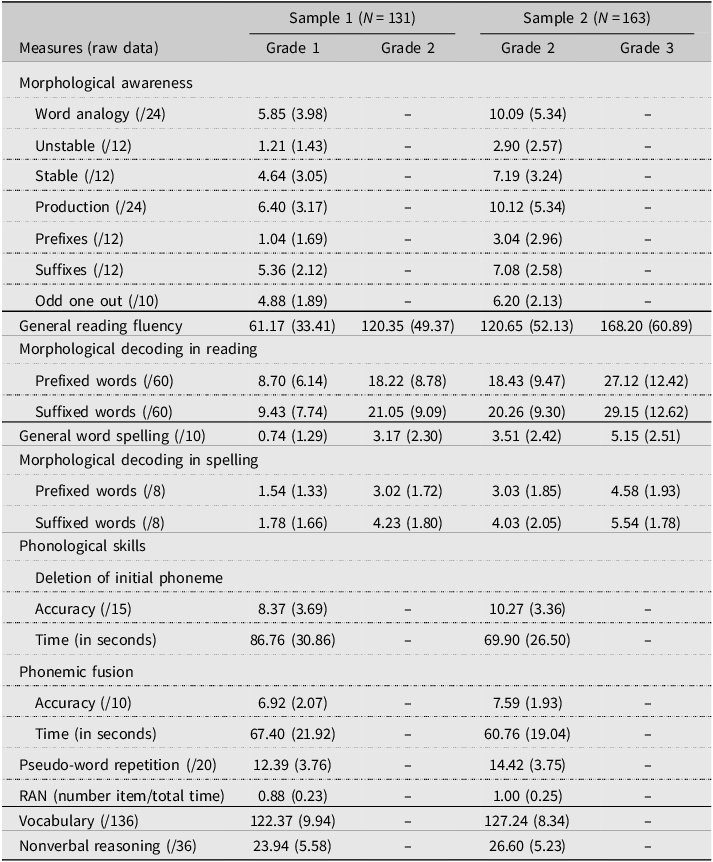
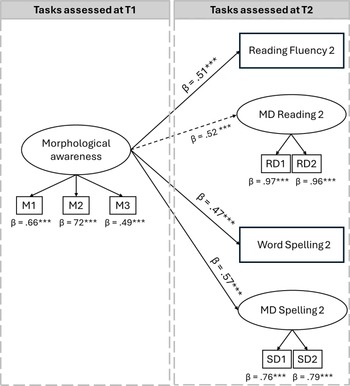
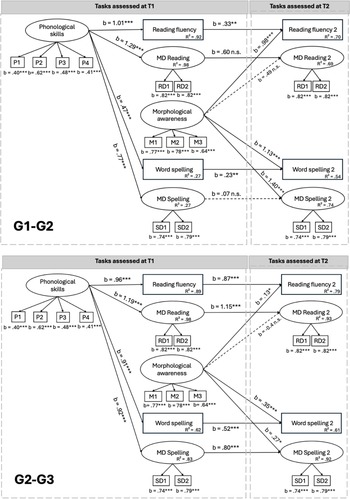
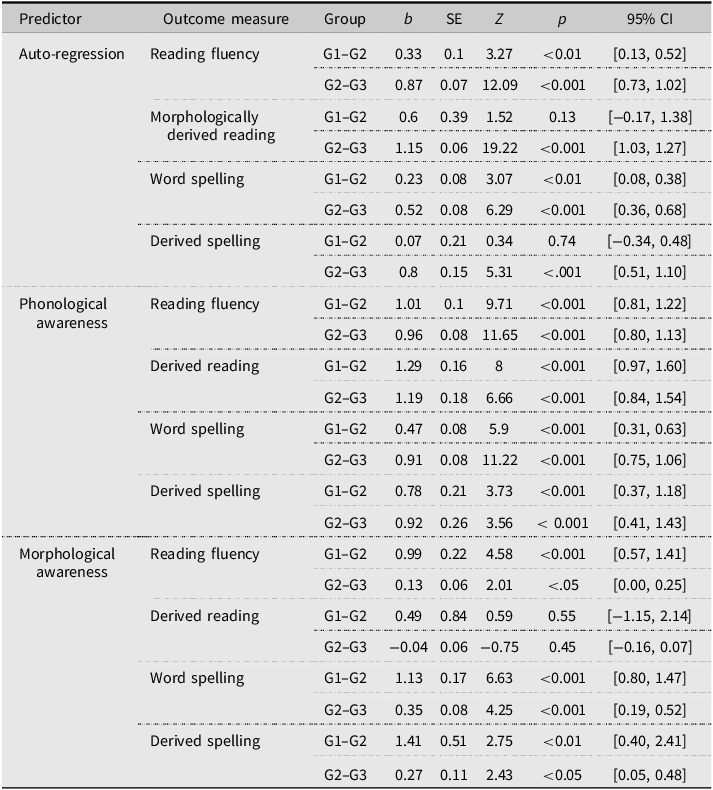
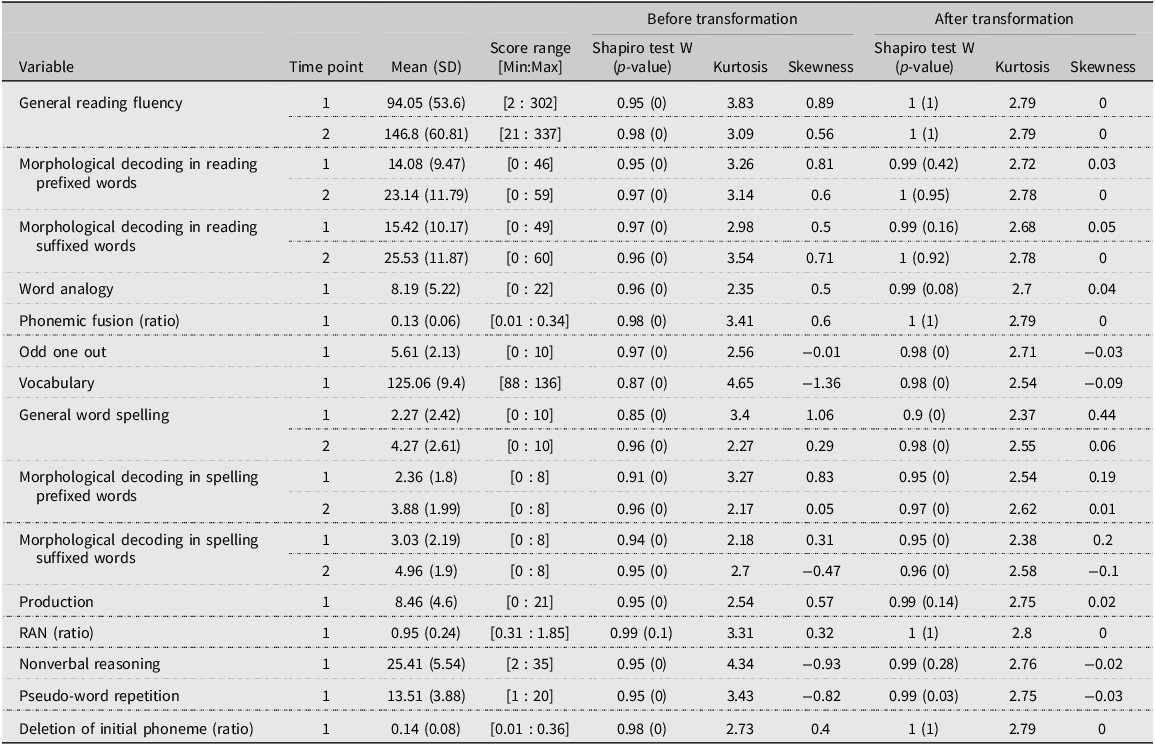
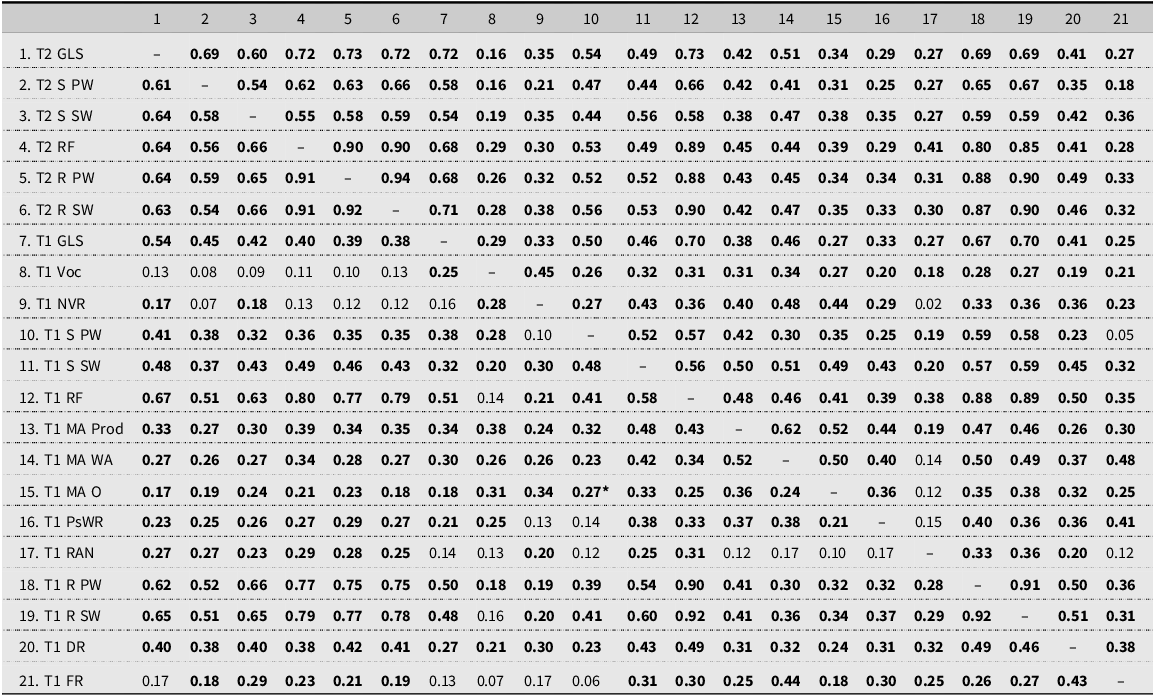
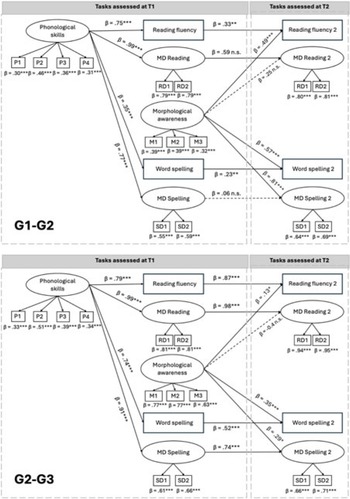

 Open access

