





Introduction
Why do governments ban some extremist organisations and not others? Legislative activity and legal scholarship describe legal thresholds for organisational banning. But there is a mismatch between which organisations are susceptible to a ban by meeting those thresholds and the smaller number of organisations actually banned. How can we make sense of this empirical puzzle? What conditions underlie banning decisions, and what do they reveal about a democracy’s response to extremism?
Democratic regimes have long histories of contending with extremist actors. Several climacterics – the aftermath of the Second World War, reactions to the 2001 terrorist attacks and recent domestic extremism incidents – spurred development of legal tools for banning parties and organisations. Notwithstanding scholarly contention over the efficacy of bans (eg Downs Reference Downs2002; Capoccia Reference Capoccia2005; Minkenberg Reference Minkenberg2006; Bale Reference Bale2007), political will to apply bans has grown. Numerous European states have applied bans in recent years; even states that historically rejected banning – such as Denmark,Footnote 1 the Netherlands,Footnote 2 and SwedenFootnote 3 – are shifting their position (Zeller and Vaughan Reference Zeller and Vaughan2024). Thus, to understand how banning decisions are made is to understand an important, increasingly widespread democratic response to extremism.
This article investigates why organisational bans are imposed by looking at cases of German far-rightFootnote 4 organisations over the last three decades. Germany is an influential case: it has a large, transnationally influential far-right movement scene, and it is the archetype of militant democracy, where laws selectively restrict political rights to protect democratic order (Loewenstein Reference Loewenstein1937). Germany’s model of militant democracy has influenced the development of democracy safeguards elsewhere. A two-step fuzzy-set qualitative comparative analysis (QCA) is used on a novel dataset of far-right organisations monitored by Germany’s Federal Office for the Protection of the Constitution (Bundesamt für Verfassungsschutz, BfV) to explain differences in banning decisions. QCA is useful for detecting patterns of necessity and sufficiency for bans, and the two-step variant captures the difference between situational and organisational factors. Follow-on case studies show how these conditions trigger causal mechanisms underlying banning decisions.
Several findings emerge from this research. High far-right visibility is necessary to prompt bans, indicating that bans are pragmatic tools responding to public and political pressure rather than purely principled applications of law. Governments act not just on legal violations but amid broader concerns over mobilisation. Within situations where far-right activity is highly visible, there are four sufficient patterns of organisational banning: against neo-Nazi movement organisations, against longstanding hubs in the far-right scene, against aggressive militant organisations, and against neo-Nazi sham parties. Social and political pressure, case studies reveal, plays a decisive role in compelling authorities to act. Non-state action emerges as a vital component of countering far-right activism. Most importantly, the study highlights an underlying inconsistency in banning practices: meeting legal thresholds is not enough; situational dynamics are equally important. The crucial implication is that bans in militant democracy are not only about banning ideologically or behaviourally unlawful groups, but also responding to wider circumstances. Adopting this approach suggests state actors should be attentive to the efficacy of banning, particularly how such action affects related extremist organisational ecologies and activity. Evidence in the case studies shows that state actors do sometimes consider these broader effects, notably claiming that bans have a chilling effect on other extremist organisations. But there are also signs that banning is sometimes more of a political tool for signalling responsiveness rather than a means of disrupting and diminishing extremist threats.
Theory and practice of banning organisations in democracies
Democratic regimes have regularly confronted extremist threats within their societies. Elaborating on a long line of liberal political philosophy, Karl Popper (Reference Popper2013) referred to the fundamental ‘paradox of tolerance’ that open societies must address: intolerant social forces cannot be allowed free rein, or they will undermine and overcome tolerant forces and undo the open society. From this perspective on democratic theory, measures to disrupt intolerant forces are a necessary feature of democracy, not just some types of democratic systems. Systems with laws and institutions that protect a state’s democratic order through selective and qualified restrictions of certain political rights are what Karl Loewenstein (Reference Loewenstein1937) termed ‘militant democracy’. Several states in interwar Europe fended off extremist challenges using militant democracy measures (Capoccia Reference Capoccia2005). Following the Second World War, many states instituted laws to repel the sort of antisystem threats that toppled the Kingdom of Italy and the Weimar Republic.
The most severe instrument of militant democracy is the organisational ban (whether of parties or other groupings). Scholarship on banning has engaged intensively with the point of efficacy: are bans effective protection against extremist threats? Perspectives vary widely, from endorsement (eg Botsch, Kopke, and Virchow Reference Botsch, Kopke, Virchow, Melzer and Serafin2013) and cautious support (eg Bale Reference Bale2007) to variants of scepticism (Downs Reference Downs2002; Capoccia Reference Capoccia2005; Minkenberg Reference Minkenberg2006). Yet the focus on efficacy need not precede the question of why bans have been imposed. It remains unclear why some extremist organisations get banned while others are permitted to continue their activities. Taking a mid-range theoretical perspective, that is, studying the recurring practice of banning in democracies and why bans are imposed, can illuminate normative discussions about whether bans should be used.
A large swathe of research on militant democracy focuses on party bans. Scholarship is preoccupied with party bans because political parties are recognised, privileged groupings in most democratic systems, so banning closes a central mode of political participation.Footnote 5 Important work establishes the paradigmatic logics underlying party bans, though they also speak to the wider category of organisational bans. Niesen (Reference Niesen2002) argued bans are justified in three ways: (1) ‘anti-extremism’, repulsing challenges to political centrism; (2) ‘negative republicanism’, outlawing the party of preceding authoritarian regimes (and successor parties, cf. Bourne and Veugelers Reference Bourne and Veugelers2022); and (3) ‘civic society’, disbanding parties that fail to recognise certain groups of co-citizens (eg racist parties). Similarly, though focusing more narrowly on legal justifications, Bligh (Reference Bligh2013) identifies a division between ‘Weimar’ and ‘legitimacy’ paradigms. Whereas Weimar-based rationales justify bans against avowedly antisystem parties that seek to gain power and dismantle democracy, more common recently is the legitimacy paradigm in which a ban is justified if parties ‘threaten certain elements within the liberal constitutional order, such as the commitment to equality and nondiscrimination, the absolute commitment to a nonviolent resolution of disputes, or secularism’ (Ibid., p. 1345). These paradigmatic logics highlight judicial agency in shaping militant democracy responses to extremism (Steuer Reference Steuer2022),Footnote 6 even in systems where executive authorities are responsible for initiating banning action.Footnote 7
More empirically oriented research maps the terrain of party bans. Recently, Bourne and Casal Bértoa (Reference Bourne and Casal Bértoa2017) provided a sorely needed catalogue of banned parties across Europe and analysis of legal rationales. They also notably find that experience of authoritarian rule is not a reliable explanatory condition for imposing party bansFootnote 8 ; instead, one must look at a party’s characteristics, especially ideology and orientation towards violence. Investigations of authoritarian ‘successor parties’ (Bourne and Veugelers Reference Bourne and Veugelers2022) and violent right-wing extremist parties (Ellinas Reference Ellinas2020) confirm the significance of ideology and connection to violence for banning decisions.
Studies that go beyond party bans to provide a fuller conception of militant democracy’s banning practices are rare but instructive. Pedahzur (Reference Pedahzur2001) identifies three types of democratic responses to extremism (militant democracy, defending democracy, and immunised democracy) and traces their manifestations in responses to political parties, social movements and terrorist groups, and society generally. This perspective connects the rich literature on party bans to research about designating terrorist groups, banning associations (ie non-party organisations), and restricting extremist activity (Payandeh Reference Payandeh2010; Allchorn Reference Allchorn2019; Zeller Reference Zeller2021, Reference Zeller2022). Pedahzur (Reference Pedahzur2001) does not examine the complex causation and underlying processes of why proscriptive responses are imposed – the aim of this study – but establishes an analytical framework useful for expanding beyond the focus on state-imposed bans presented below.
Terrorism and security studies have routinely examined bans as one measure in a wide and seemingly ever-growing array of counter-terrorism instruments. Although some of this research underscores domestic-level machinations (eg Jarvis and Legrand Reference Jarvis and Legrand2020), the lion’s share conceives of bans as inextricably linked to foreign policy (Beck and Miner Reference Beck and Miner2013; Chou Reference Chou2016; Jarvis and Legrand Reference Jarvis and Legrand2018; Lee and Tominaga Reference Lee and Tominaga2023; Renard and Rekawek Reference Renard and Rekawek2024) – unsurprisingly, since transnational terrorist threats preoccupied many states after the 2001 terrorist attacks. This conception is appropriate and revealing when dealing with internationally active terrorist groups like Kurdistan Workers’ Party (Sentas Reference Sentas2018) and Tamil Tigers (Nadarajah Reference Nadarajah2018). But it can obscure group-level characteristics and domestic political considerations, the ‘micro-foundations of terrorism designation’ (Chou Reference Chou2016, 1137), that are often pivotal in banning decisions. Similarly, studies focused on conflict resolution typically concentrate on the consequences of bans for peace processes. Bans can affect states’ mediating capacities and delegitimise actors essential for conflict resolution (Sentas Reference Sentas2018). Here, too, international dimensions overshadow domestic conditions and limit the applicability of conflict resolution research findings to cases more confined within one country’s territory.
Associational bans are more closely related to party bans in that the international relations dimension is not so significant as in cases of banning terrorist groups that mainly operate abroad. Case studies of banned organisations offer insight into why bans are imposed (eg Bourne Reference Bourne2018; Macklin Reference Macklin2018; Kotonen Reference Kotonen2021; Zeller and Vaughan Reference Zeller and Vaughan2024, 1001–3). Connections to violence and the positioning of ban decision-makers emerge as key factors. However, these studies fall short of explaining why some organisations are banned and others are not. Some have gone beyond single cases, though Minkenberg (Reference Minkenberg2006) summarily considers French and German cases; and Bleich and Lambert (Reference Bleich and Lambert2013) highlight contextual conditions while omitting organisational characteristics – neither provides a clear explanation for banning decisions.
From these research fields emerge stable contextual elements in modern organisational banning. Legal and normative democratic theory suggests shifting paradigms to justify bans, from protecting constitutional democratic systems to determining the boundaries of legitimate political activism. The latter paradigm reigns supreme for recent organisational bans in European democracies (Zeller and Vaughan Reference Zeller and Vaughan2024). Similarly, though post-war European democracies are divided between those with experience of authoritarian rule and those without, with the former typically instituting more militant democracy instruments, counter-terrorism research has traced the uptake of banning practices in the latter group, particularly since 2001. These longer-term developments mean that explaining why organisations are banned is more important and more widely relevant now. Extant theories offer perspectives on justifications and normative implications of banning, but there is a disconnect from actual banning decisions.
Examining more variable elements can connect banning practices to theoretical propositions. Prior research offers clues about two sets of factors: situational factors surrounding a banning decision and organisational factors of the target of a ban (cf. Beck and Miner Reference Beck and Miner2013; Chou Reference Chou2016; Lee and Tominaga Reference Lee and Tominaga2023).
First, several situational factors, which may not directly pertain to any specific organisation, can affect banning decisions. Situational factors relate to conditions of organised extremism in a country, as when Islamist attacks heighten attention to Islamist organisations or gang violence heightens attention to gang organisations. For far-right organisations, banning decisions might be responses to the intensity or extent of the organised far right in the country or the disposition of key state actors. Common metrics of intensity include far-right violent incidents, homicides with far-right ideological motives, and far-right agitation. Frequent far-right violence can create a sense of urgency about addressing this problem and thus motivate a ban. This effect might happen directly, within state agencies or government ministries, or indirectly, as a result of media attention or civil society advocacy. Particularly extreme far-right violence, homicides, can attract attention to the danger posed by far-right organisations and thereby motivate a ban. And frequent far-right propaganda incidents can heighten awareness of far-right organisations and thus motivate a ban. Many states maintain statistics related to intensity, which, when elevated or otherwise made more salient, can create situations that motivate banning decisions. Common metrics of extent include estimates of the number of individuals in far-right organisations. High numbers of individuals involved in far-right groups can be regarded as a threat to society at large and especially to certain social groups commonly targeted by far-right actors, and so motivate a ban. In particular, the number that are considered likely to behave violently may propel banning action to preserve public safety. Finally, the ideological position of decision-makers may make them more or less receptive to banning options. Leaders of state agencies and government ministries typically have the competence to ban organisations. When such key figures are predisposed to view far-right activity as a lethal threat, they may more readily take banning action against far-right organisations.
Second, the characteristics of specific organisations influence whether they become the target of banning action or not. Such characteristics are often spelt out in law and ban announcements: an organisation’s ideology, orientation towards or connection to violence, and organisational type. Several states have laws that explicitly proscribe agitation for totalitarian ideologies or, more specifically, promoting ideologies of previous authoritarian regimes (Zeller and Vaughan Reference Zeller and Vaughan2024). In some states, this characteristic of ideological agitation is legally sufficient to justify a ban. In the same vein, if an organisation is adjudged to be inherently violent, this characteristic might also motivate a ban. Organisational type matters for banning procedures. As described above, political parties often have a privileged status and are more shielded from banning compared to other types of organisations. Lastly, an intrinsic element of organisational banning is the prohibition of continuing an organisation’s activity. Legal frameworks, therefore, include provisions enabling the dissolution of successor organisations or other efforts to continue a banned group’s activity in some other organisational guise.
Extant research establishes these two important sets of factors, situational and organisational. However, it has not used them to provide a systematic explanation of why some organisations are banned and others are not. But banning deserves explanation; more importantly, it must be explicable, or else a core element of militant democracy’s defence against extremism is not only ineffective but also risks being arbitrary. This study delves into this theoretically weighty issue by examining cases of banned and not-banned far-right organisations in Germany.
Methods
This study examines why German governments have bannedFootnote 9 some far-right organisations and not others. Germany is the ideal context to study banning decisions for three reasons. First, Germany is influential for other countries – on both sides of banning decisions. Germany’s far-right scene is large and transnationally connected (eg Heft et al. Reference Heft, Knüpfer, Reinhardt and Mayerhöffer2021); the activism of German far-right groups often diffuses to other contexts, presenting similar possible banning cases. Furthermore, though its militant democracy is an outlier in rate of banning, Germany’s laws and practices have informed other states’ actions over the last three decades. Post-socialist constitutions in countries like Poland and Hungary emulate provisions in Germany’s Basic Law that enable banning. As counter-terrorism policies have developed since 2001, Germany, along with the UK (Jarvis and Legrand Reference Jarvis and Legrand2020) and US (Lee and Tominaga Reference Lee and Tominaga2023), has influenced global proscription frameworks. Recently, European states that rarely (if ever) imposed bans have shifted, taking legislative steps to enable banning (cf. Zeller and Vaughan Reference Zeller and Vaughan2024, 995). This development is closely connected to increased state responsiveness that emerged in the aftermath of attacks in Norway (2011) and New Zealand (2019). Germany has joined responses to the ‘Christchurch Call’Footnote 10 and influenced transnational policies against far-right violence and organising.Footnote 11 Second, Germany presents numerous cases of bans and non-bans for analysis to derive general conclusions about banning decisions rather than conclusions particular to one or two organisations. Third, German security services monitor organisations classified as ‘right-wing extremist’ and report annually on their activity. This presents data on organisations banned as well as those merely monitored.
Investigating why German governments have banned far-right organisations, this study adopts an ambitious methodological approach aligned with ontological assumptions about banning decisions. Extant research suggests certain causal features mark banning decisions. Some conditions may be necessary for bans, while others may be sufficient. Different combinations of conditions may motivate a ban (ie conjunctural causation). And there are probably multiple sufficient combinations of conditions motivating bans (ie equifinality). The methods of previous research fall into two categories: inferential statistics (eg Beck and Miner Reference Beck and Miner2013; Chou Reference Chou2016; Lee and Tominaga Reference Lee and Tominaga2023) or case studies (eg Macklin Reference Macklin2018; Kotonen Reference Kotonen2021; Bourne Reference Bourne2018). The analysis here avoids the particularism of isolated case studies without abandoning the search for necessity and sufficiency underlying the complex causation of banning decisions. Two-step fuzzy-set QCA with follow-on case studies is employed to explain differences in banning outcomes.
QCA (Ragin Reference Ragin2000; Schneider and Wagemann 2012) is an ideal tool to investigate banning decisions.Footnote 12 It applies Boolean algebra to disentangle complex causality. Cases are calibrated (assigned scores in potentially causal conditions) and then represented in a truth table, which can be logically minimised to identify sufficient conditions for the outcome (banning). Two QCA techniques are combined in this study. First, fuzzy-set QCA allows the cases’ membership in sets to be partial (‘fuzzy’), capturing both differences in kind and in degree. Fuzzy sets can accommodate continuous data, with calibrations retaining differences in degree. Second, two-step QCA can account for a division between remote and proximate conditions (Schneider and Wagemann 2012; Schneider Reference Schneider2019). Below, I discuss motivations for a ban and delineate between situational and organisational conditions. Second, the two-step technique enables analysis of these two condition types and enables inclusion of more conditions than the one-step procedure (Schneider Reference Schneider2019). Two-step QCA is the perfect tool to examine banning decisions about specific organisations, but that unfold within particular situations.
This methodological approach follows a regularity theory of causality (Mahoney and Acosta Reference Mahoney and Acosta2022), where causation is a relationship between X and Y characterised by temporal order, spatiotemporal connection, and constant conjunction. Within this paradigm, QCA is part of multimethod research, useful for identifying general regularities, while process tracing can identify causal chains for individual cases (Mahoney and Acosta Reference Mahoney and Acosta2022, 1895). Literature on combining QCA and case studies offers guidance on applying these techniques to complement each other (eg Schneider and Rohlfing Reference Schneider and Rohlfing2013; Schneider Reference Schneider2024), especially using QCA to guide case selection for targeted causal investigations.
Data
This study examines banning decisions at the German national level. It takes far-right organisations as cases to explain why some are banned and others are not. The analysis uses a novel dataset of far-right organisations monitored by Germany’s Federal Office for the Protection of the Constitution (Bundesamt für Verfassungsschutz, BfV). The BfV is tasked with monitoring threats to Germany’s constitutional order. It works with similar regional agencies, but the BfV takes responsibility for monitoring organisations active in more than one region. BfV intelligence provides substantiating evidence for bans imposed by the Federal Minister of the Interior, so, notwithstanding the sometimes-questioned veridicality of BfV data, it is the source for input to ban decisions.
BfV reports also define and delimit the study’s population. Generally, political organisations are groupings of two or more people aiming to advocate for and advance political goals, and engaged in mobilising support, seeking influence, and securing organisational survival (Fraussen and Halpin Reference Fraussen and Halpin2018, 26). ‘Far-right’ refers to a diverse ideological array, including radical right shades that accept democracy but reject liberalism and extreme right shades that reject democracy in favour of authoritarian systems, but which typically subscribe to ideological features of nationalism, nativism, racism, xenophobia, and authoritarianism (cf. Mudde Reference Mudde2019). While BfV reports cover ‘right-wing extremist’ organisations, ‘far-right’ is the more fitting adjective for the range of organisations monitored. This study considers all organisations active in more than one region and, therefore, falling under the purview of the BfV’s intelligence-gathering operations and within the federal interior minister’s power to ban.Footnote 13 Before an organisation is banned, it is monitored by the BfV, which must justify this monitoring with reference to factual indications of an organisation’s anti-constitutional, criminal, and/or terrorist purpose or activities.
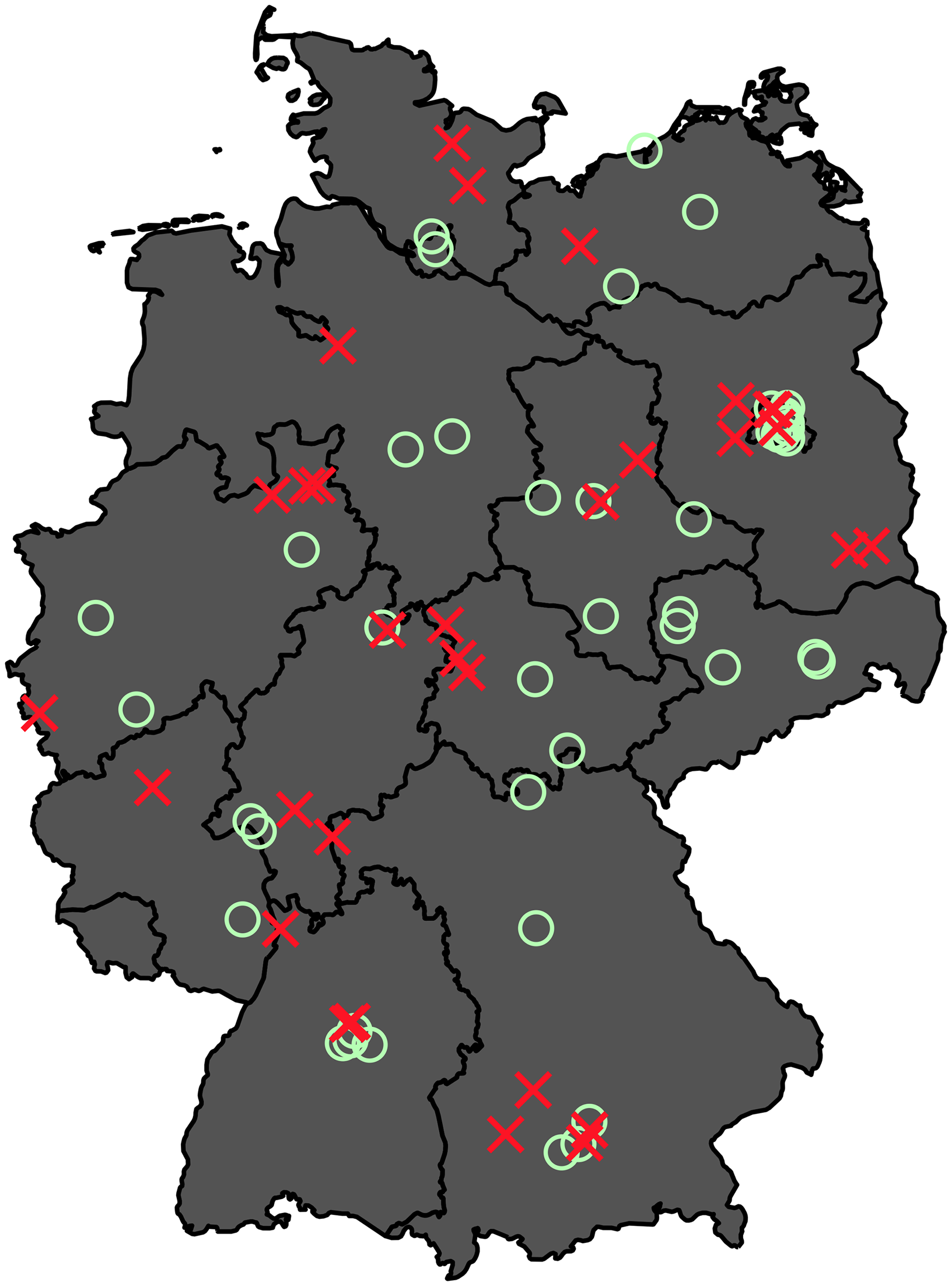
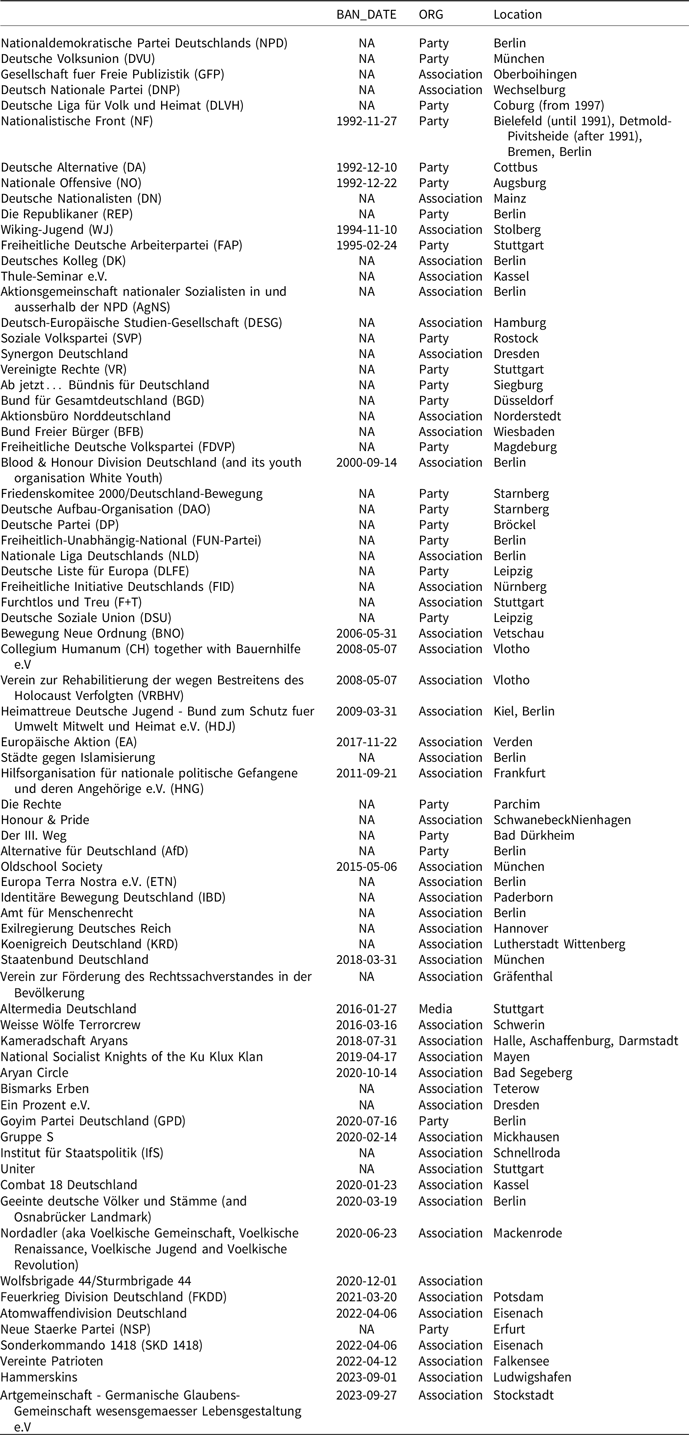
This study’s population is all far-right organisations (excluding organisational sub-groups, music groups, commercial operations and websites, and organisations based abroad) monitored by the BfV between 1990 and 2023. In total, this comprises 74 organisations, listed in Table 5, 31 of which have been banned. 49 are associations, while 24 at least made some pretence of being a political party; one organisation (Altermedia Deutschland) was a news media outlet. The organisations’ main centres of activity, in Figure 1, are distributed around Germany, apart from a dense cluster in Berlin.
Far-right organisations active in more than one region in Germany and monitored by the BfV, 1990–2023. The green circles represent the (main) sites of organisations not banned. The red crosses represent organisations banned under the Law of Associations or Criminal Code §§129/129a.
Conditions underlying ban decisions
Broadly, two sets of conditions could motivate a ban decision: situational and organisational. Bans occur within certain contexts and situations. Here, context is narrowed to Germany and its national-level administration, but the sorts of situational conditions described above can affect banning decisions. Simultaneously, bans are not arbitrary; organisational characteristics do matter. This analysis investigates whether combinations of situational and organisational conditions are necessary or sufficient for ban decisions.Footnote 14
Situational conditions
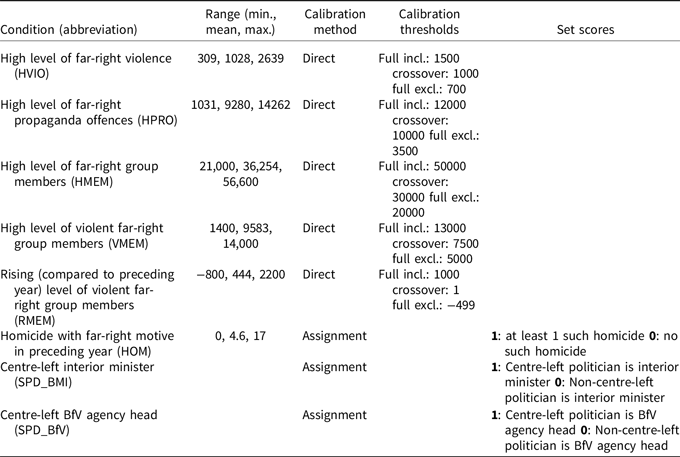
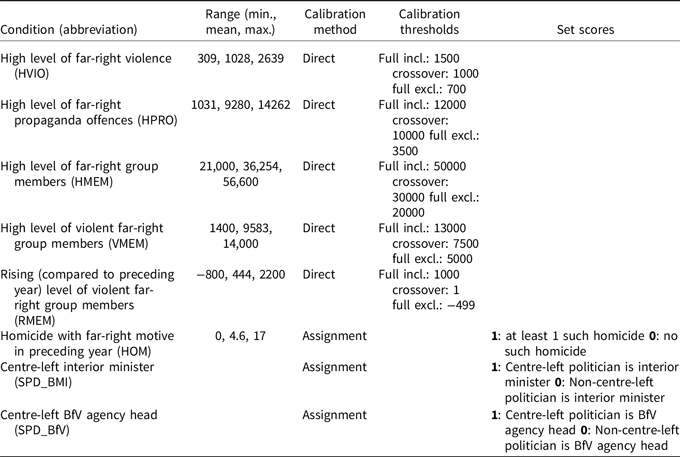
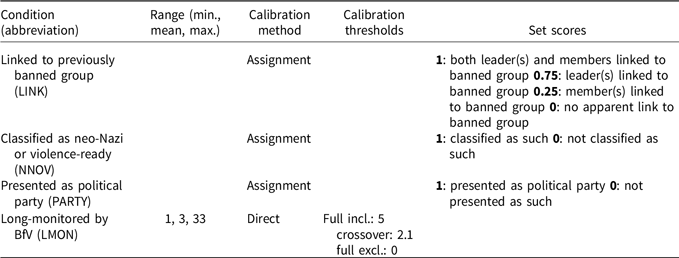
Several situational conditions might affect banning. They are not organisational characteristics but rather closely related environmental factors that might provoke banning decisions. Eight situational conditions, summarised in Table 1, are analysed.Footnote 15
Situational conditions in banning decisions against far-right organisations and their calibration for QCA
High level of far-right violence (HVIO).
To capture HVIO, I use annual figures on violent crimes with a far-right motivation. These figures are connected to the cases (ie far-right organisations) based on the year in which they were banned or the last year they were mentioned in a BfV report.Footnote 16 For example, Wiking-Jugend was banned in 1994, so the number of violent incidents from that year is used to measure HVIO surrounding the Wiking-Jugend ban; similarly, Deutsche Nationalisten (not banned) was last mentioned in the 1998 BfV report, so that year’s number is used to measure HVIO, the last occasion when a ban decision seems plausible. The fuzzy set is calibrated so that years when more than 1000 violent far-right incidents occurred represent HVIO and years when fewer occurred do not. Besides representing a number that is likely to attract media attention, 1000 incidents is an optimal threshold because it is near the mean (1054) and median (990) for incidence rates among the data.Footnote 17 The ‘direct method’ of calibration uses a logistic function to fit raw data around this crossover point and the other qualitative anchors of full set membership (1) and full non-set membership (0), reported in Table 1 (Schneider and Wagemann 2012, 35).
High level of far-right propaganda offences (HPRO).
To capture HPRO, I rely on propaganda offences with a far-right motivation.Footnote 18 Figures are connected to cases in the same manner as for HVIO. The set is calibrated so that years when more than 10,000 incidents occurred represent HPRO and years when fewer occurred do not. This threshold is near the mean (9565) and median (11055) for incidence rates among the data.Footnote 19 Again, the direct method is used to calibrate this fuzzy set.
High level of far-right group members (HMEM).
To capture HMEM, I rely on BfV figures on individuals involved in at least one far-right organisation. These figures are connected to cases in the same manner as for HVIO. The set is calibrated so that years when there were more than 30,000 individuals represent HMEM and years with fewer individuals do not. Again, the direct method is used to calibrate this fuzzy set.
High level of violent far-right group members (VMEM).
To capture VMEM, I rely on BfV figures on individuals involved in far-right organisations categorised by the BfV as violent (gewaltbereit). These figures are connected to the cases in the same manner as for HVIO. The set is calibrated so that years when there were more than 7500 individuals represent HMEM and years with fewer individuals do not. Again, the direct method is used to calibrate this fuzzy set.
Rising level of violent far-right group members (RMEM).
Rising numbers of violent far-right individuals may represent intensifying threats to public safety and so motivate a ban. To capture RMEM, I use the same figures for VMEM, but take the difference from the preceding year. Any increase in violent far-right individuals represents RMEM. These figures are connected to the cases in the same manner as for HVIO. Again, the direct method is used to calibrate this fuzzy set.
Homicide with far-right motive in preceding year (HOM).
To capture HOM, I use BfV figures for whether there were any far-right homicides in the preceding year. These figures are connected to the cases in the same manner as for HVIO. The set is calibrated so that years when there were any such homicides represent HOM and years without any do not. The cases were assigned membership scores in this crisp set.
Centre-left interior minister (SPD_BMI).
Party affiliation of the minister responsible for bans may contribute to banning decisions. In Germany since 1990, the interior minister has belonged either to one of two right-wing parties, the Christian Democratic Union (CDU) or the Christian Social Union (CSU), or to a centre-left party, the Social Democratic Party (SPD). SPD politicians led the ministry from late 1998 to 2005 (Otto Schily), and late 2021 to 2025 (Nancy Faeser). Accordingly, cases banned or last mentioned in a BfV report from 1999 to 2005 or from 2022 were calibrated as set members (1); all others were non-members (0).
Centre-left BfV agency head (SPD_BfV).
Party affiliation or alignment of the BfV president may contribute to a banning decision. In Germany since 1990, the BfV president has belonged either to the CDU or the SPD, or (from mid-1995 to mid-1996) been unaffiliated. SPD politicians led the BfV from mid-1995 to mid-2012 (Peter Frisch and Heinz Fromm). Accordingly, for this crisp set, cases banned or last mentioned in a BfV report from 1996 to 2012 were calibrated as set members (1); all others were non-members (0).
Organisational conditions
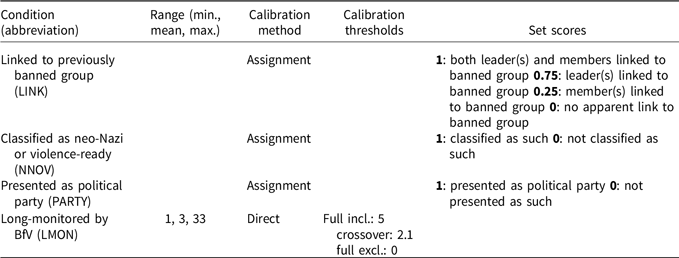
In line with the organisational factors discussed above, the following four conditions, summarised in Table 2, relate to factors considered in extant research on terrorist designation (eg Beck and Miner Reference Beck and Miner2013; Chou Reference Chou2016; Lee and Tominaga Reference Lee and Tominaga2023) but more importantly correspond to legal grounds for bans under German law.
Organisational (proximate) conditions in banning decisions against far-right organisations and their calibration for QCA
Linked to a previously banned group (LINK).
The Associations Law (Article 9 Section 2 ${\rm{\S}}$
8) outlaws forming replacement organisations (Ersatzorganisationen) or using existing organisations to continue banned organisations’ activities. The role of leading figures is particularly conspicuous, and the activist biographies of various types of German far-right movement leaders (Virchow Reference Virchow2013a) are pockmarked with numerous organisational affiliations. Links, especially among leaders, may motivate a ban.
${\rm{\S}}$
8) outlaws forming replacement organisations (Ersatzorganisationen) or using existing organisations to continue banned organisations’ activities. The role of leading figures is particularly conspicuous, and the activist biographies of various types of German far-right movement leaders (Virchow Reference Virchow2013a) are pockmarked with numerous organisational affiliations. Links, especially among leaders, may motivate a ban.
To capture LINK, I rely primarily on whether BfV reports mentioned any individuals affiliated with a named organisation. This information was supplemented with news reports and archival records pertaining to these individuals to identify any connection to a previously banned group. The set is calibrated by assigning fuzzy-set scores: if organisation leaders and members were affiliated with a banned group, the case is a full member (1); if just a leader(s) was affiliated with a banned group, the case is more in than out of the set (0.75); if just a member(s) was affiliated, the case is more out than in (0.25); and if no apparent links are present, then the case is a full non-member (0).
Classified as neo-Nazi or violence-ready (NNOV).
Germany’s militant democracy is not just abstractly orientated against extremist threats but also specifically against neo-Nazi threats, and any promotion of National Socialism’s racist nationalism. In a 2009 ruling,Footnote 20 the Constitutional Court affirmed that (neo-)Nazism is an exceptional case and the Basic Law does ‘impose boundaries on the propagandistic endorsement’ of Nazism (Bundesverfassungsgericht 2009). Therefore, BfV classification as neo-Nazi is legally sufficient for a ban.Footnote 21 Similarly, violence as a threat to public safety has justified proscriptive action (eg Zeller Reference Zeller2022). The BfV categorises some groups as prone to engage in violent activity (gewaltbereit), which can justify a ban. The process underlying the BfV’s categorisation is obscure – a fit subject for expert interview research – but the outcome is evident in annual BfV reports. To calibrate this crisp set, analysis takes far-right organisations’ classification in BfV reports and assigns neo-Nazi and/or violence-ready cases as set members (1) and all other cases as non-members (0).
Presented as political party (PARTY).
The standard for banning political parties is higher than for other organisations. Consequently, some far-right groups have sought the protection of party status, even if they have neither prospect nor intention of winning representation. The Constitutional Court decided, in 1994 cases against the Freiheitliche Deutsche Arbeiterpartei and the Nationale Liste, that simply claiming party status is insufficient to qualify legally as a party. Nevertheless, the possibility of deterring or at least delaying a ban makes masquerading as a party an appealing strategy. Organisations participating in elections or declaring themselves a party are assigned as set members (1) and all other cases as non-members (0).
Long-monitored by BfV (LMON).
Different conditions may be relevant for ban decisions depending on how long the BfV has monitored an organisation.Footnote 22 LMON is calibrated so that any organisation monitored for three or more years is at least a partial member of the set. The direct method was used to calibrate this fuzzy set.
Patterns of German bans against far-right organisations
This section details the QCA results.Footnote 23 First, a necessity analysis on only the situational conditions is performed. Then, the QCA proceeds to sufficiency analysis.
Necessity analysis
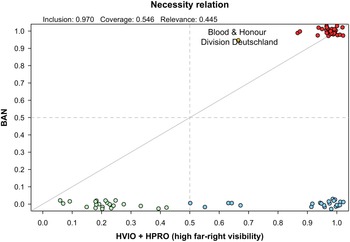
As in other variants, two-step QCA begins with necessity analysis, but only on the situational conditions. The analysis tested for conditions or disjunctionsFootnote 24 that were present whenever a ban was imposed; this would indicate necessity. No single condition seems necessary, but one disjunction, in Table 3, surpasses thresholds for necessity.Footnote 25
Possible necessary disjunction. inclN refers to consistency, the degree to which data accord with the possible necessity relationship; RoN refers to relevance of necessity, the degree to which the necessity relationship is not trivial; covN refers to coverage, the relation in size between the disjunction and the outcome set

It appears that a high level of far-right violence (HVIO) or a high level of far-right propaganda offences (HPRO) is necessary for a banning decision. However, two further considerations are needed to assert this necessity. First, a disjunction should represent a higher-order concept that is plausibly necessary (cf. Schneider Reference Schneider2024, 71ff.). The HVIO+HPRO disjunction suggests the higher-order construct of high far-right visibility, which is plausibly necessary for banning. Second, there should be no deviant cases for consistency in kind; in other words, no case should violate the statement of necessity (cf. Schneider and Rohlfing Reference Schneider and Rohlfing2013). Figure 2 visualises this consideration: while there is some deviance in degree (notably, Blood & Honour Deutschland), there are no cases in the upper-left quadrant (ie cases banned but with neither condition from the necessary disjunction).Footnote 26
With these tests passed, a high degree of far-right visibility (HVIO+HPRO) is indeed necessary for a ban. This finding suggests there is a pragmatic background to banning decisions in Germany: far-right organisations are active, too, in years where there is not a high degree of far-right visibility. That banning decisions come only when there is that visibility suggests banning in Germany is about more than just organisational characteristics and (non-)conformity with the law – they are political responses to broader circumstances.
Following Schneider’s (Reference Schneider2019) procedure, this necessary combination of conditions is carried over to the next step: sufficiency analysis.
Sufficiency analysis
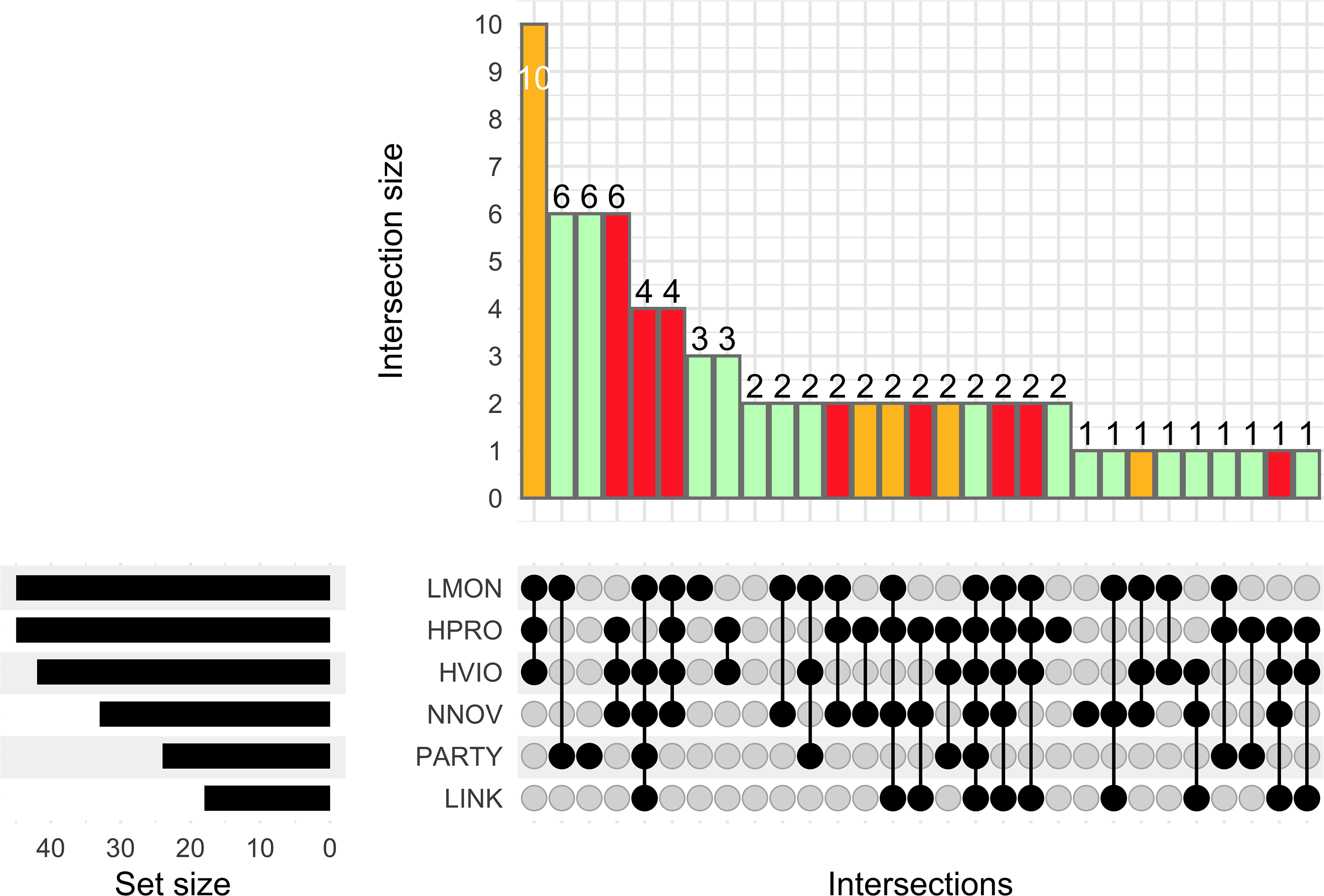
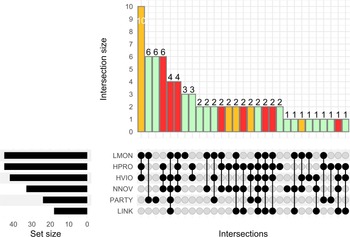
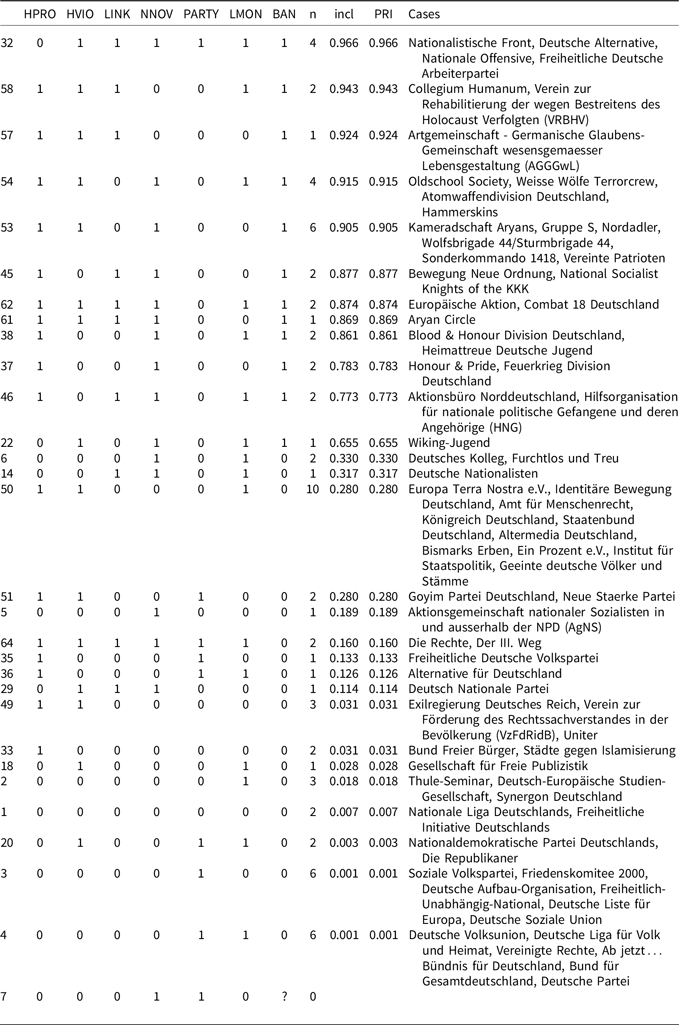
The first step in sufficiency analysis is to create a truth table. In a truth table (Table 6 in the supplementary material), each column denotes a different condition set; ‘each row denotes a qualitatively different combination of conditions, [that is], the difference between cases in different rows is a difference in kind rather than a difference in degree’ (Schneider and Wagemann 2012, 92). By sorting calibrated cases into rows representing the same combination of conditions, the truth table creates empirical groupings of similar cases. It shows which rows co-occur with the outcome and how consistently. Each case is represented by one – and only one – row, or combination of conditions. This is true for fuzzy-set membership, too, because the qualitative anchor of 0.5 separates set members and non-members. Thus, far-right organisation cases are sorted into the rows that reflect conditions in their case: the ‘n’ column records the number of cases in each row; the ‘cases’ column lists them.Footnote 27 Figure 3 visualises truth table information.
Necessary disjunction of situational conditions representing ‘high far-right visibility’ (HPRO + HVIO). Points jittered to display more clearly the clusters of cases.
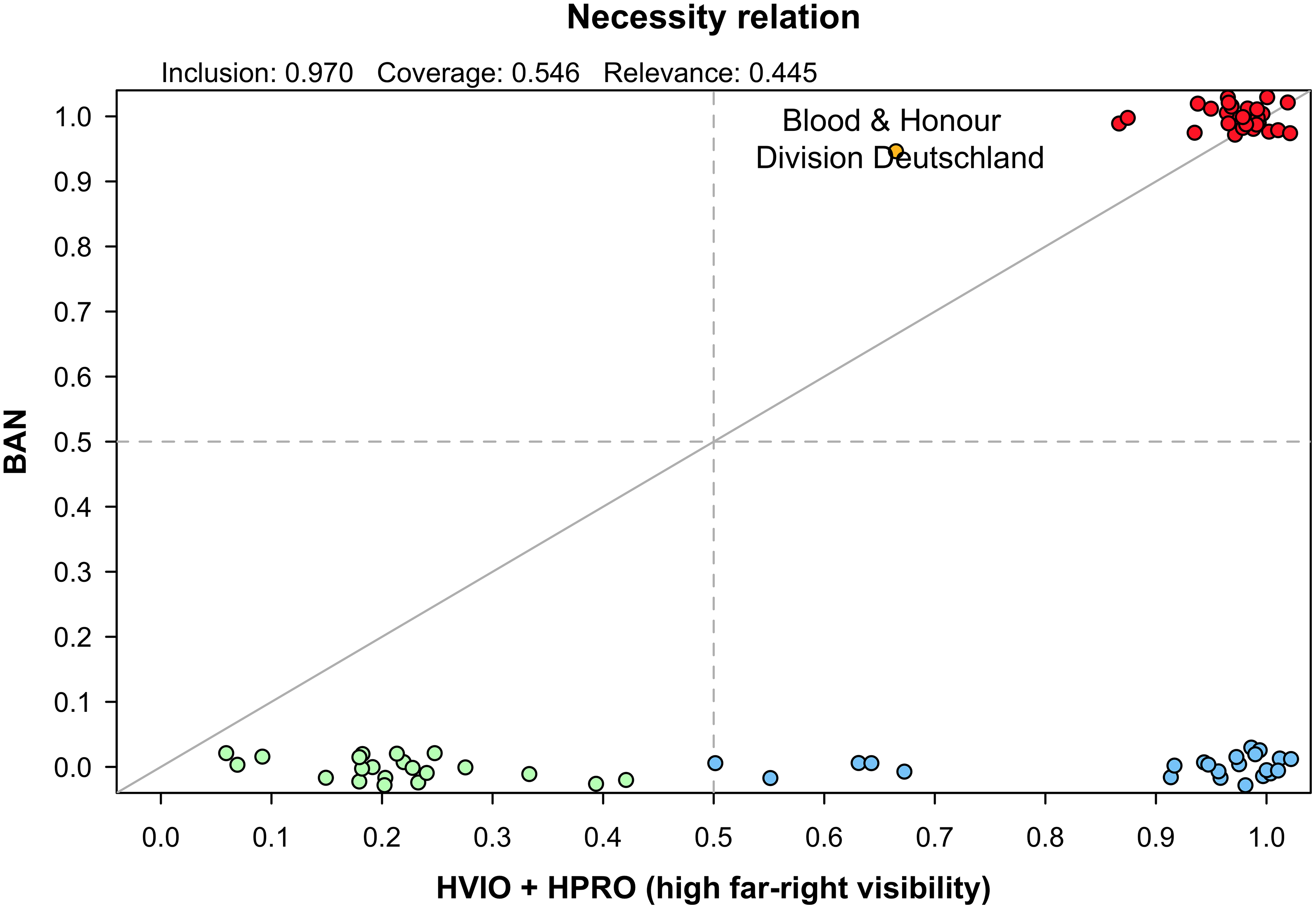
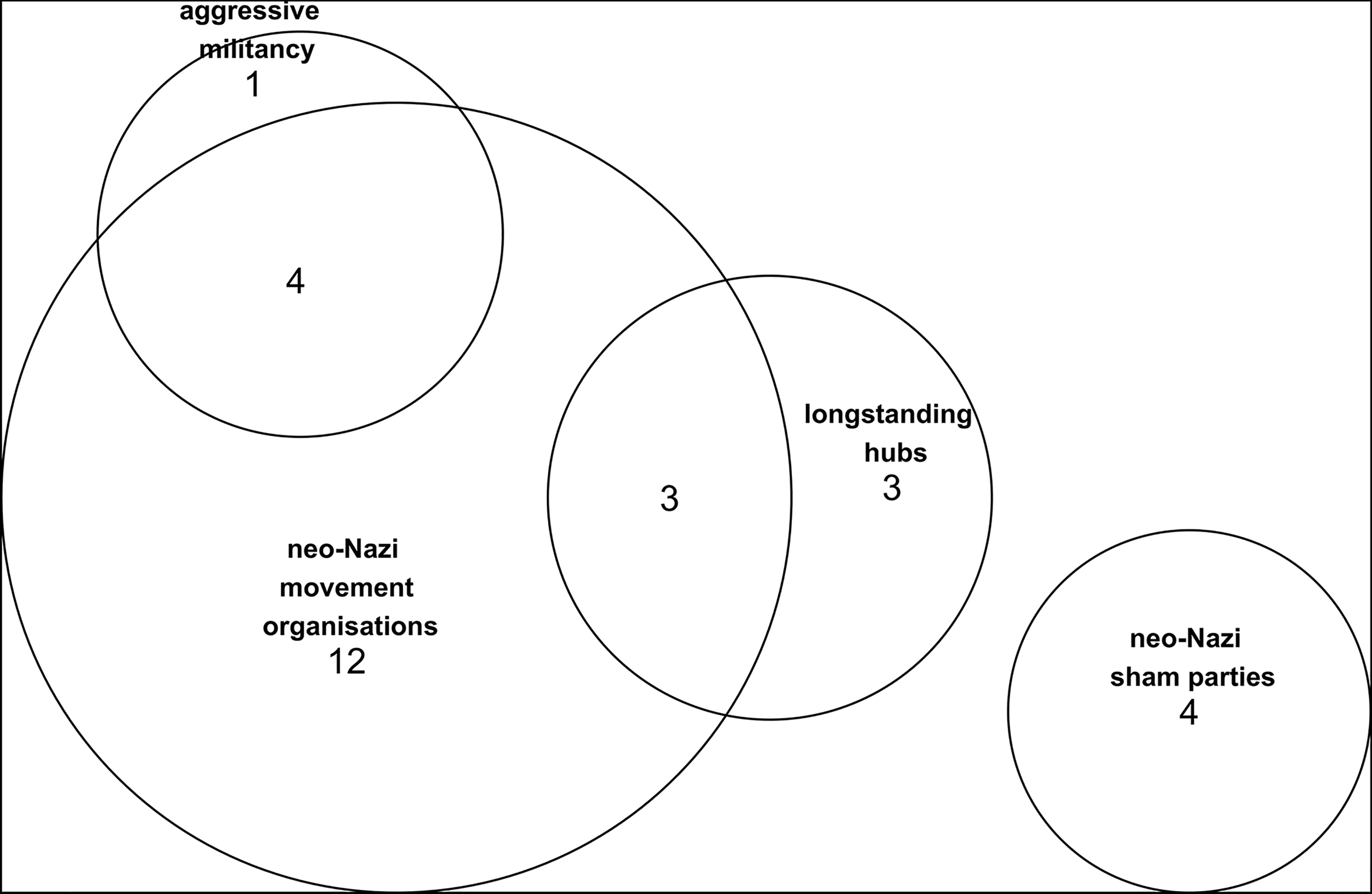
Set intersections of QCA model. Red bars represent truth table rows where cases were banned; green, not banned; and orange, inconsistent rows.
In logically minimisingFootnote 28 the truth table, the analysis aims to identify mutually exclusive types of banning patterns. This aim recommends the conservative solution (Schneider Reference Schneider2019, 1117),Footnote 29 where minimisation only takes account of observed evidence, not including logical remainders (ie rows without any cases in them).
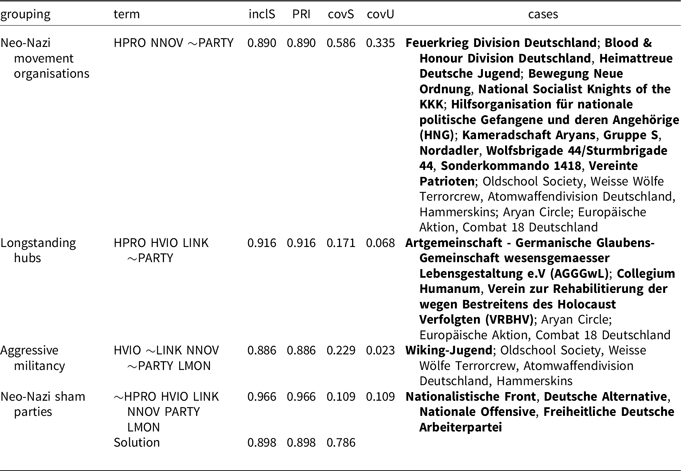
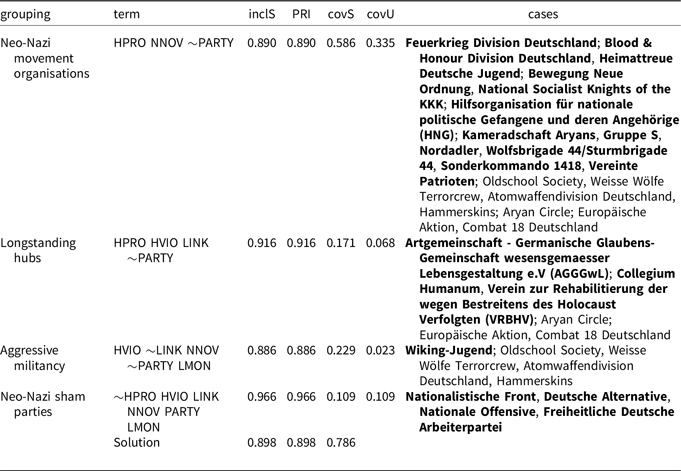
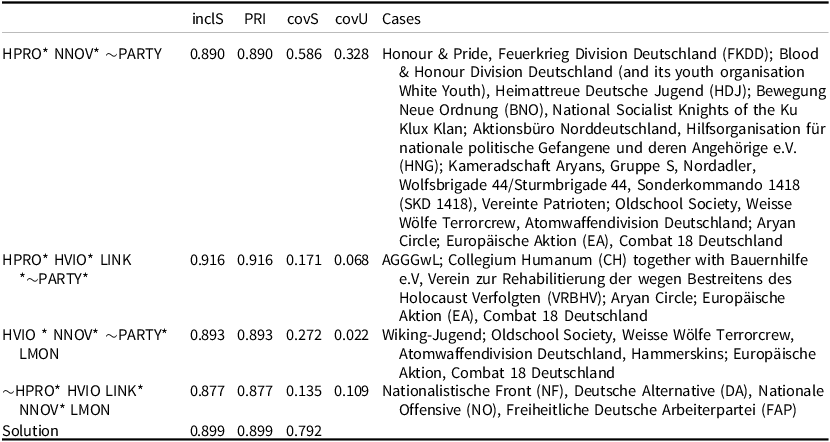
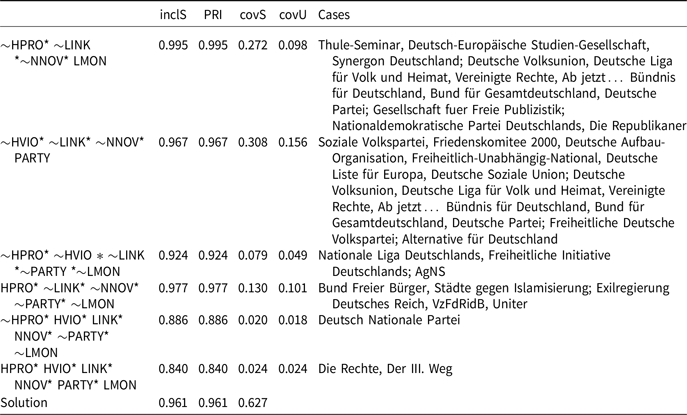
Minimisation produces four patterns of conditions that motivate bans, shown in Table 4. Each pattern is a sufficient statement. For example, the terms in the first row of Table 4 can be read as follows: a high level of far-right propaganda (HPRO) and neo-Nazi or violent classification (NNOV) and not a party ( $\sim $
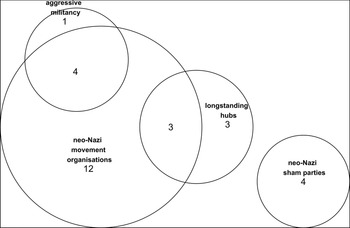
PARTY) is sufficient to ban a far-right organisation (BAN). A diverse collection of 19 organisations is covered by this pattern (12 are ‘uniquely covered’, ie only covered by this pattern), but all essentially neo-Nazi movement organisations.
$\sim $
PARTY) is sufficient to ban a far-right organisation (BAN). A diverse collection of 19 organisations is covered by this pattern (12 are ‘uniquely covered’, ie only covered by this pattern), but all essentially neo-Nazi movement organisations.
Sufficiency solution (conservative). Typical, uniquely covered cases of each solution terms are in bold. Key: HVIO = high level of far-right violence, HPRO = high level of far-right propaganda offences, LINK = linked to previously banned group, NNOV = classified as neo-Nazi or violence-ready, PARTY = presented as political party, LMON = long-monitored by the BfV
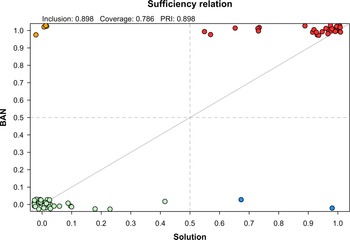
The first term covers Honour & Pride and Aktionsbüro Norddeutschland, but they were not banned. These puzzling cases are represented by the two points in the lower-right quadrant of Figure 4
Cases
Truth table
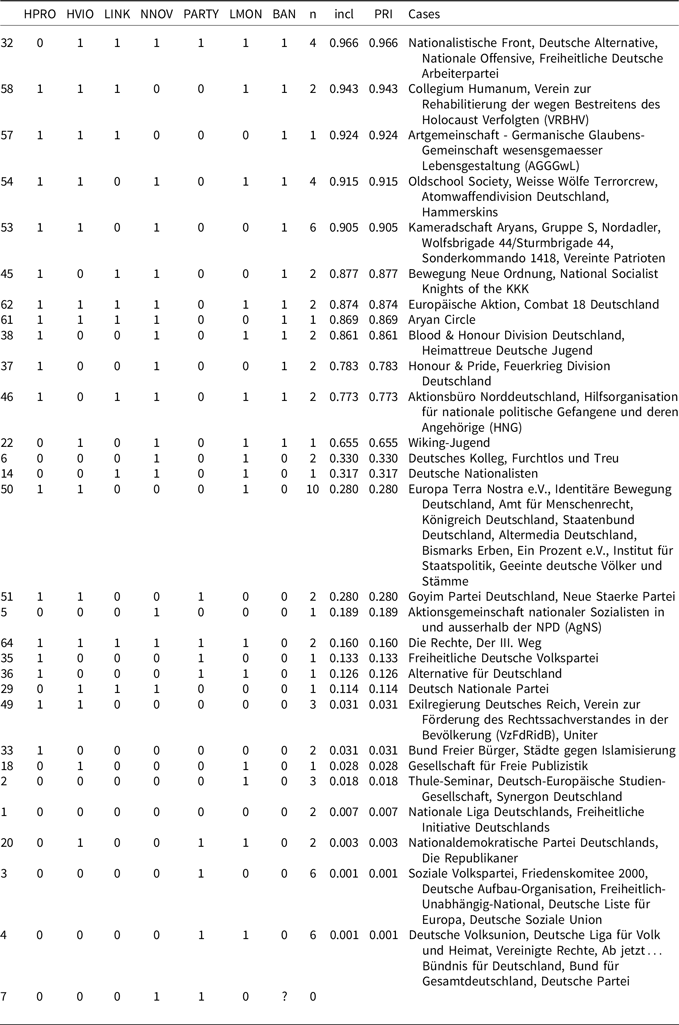
There are 34 further truth table rows (ie logically possible combinations of conditions) for which there are no empirical manifestations in the data.
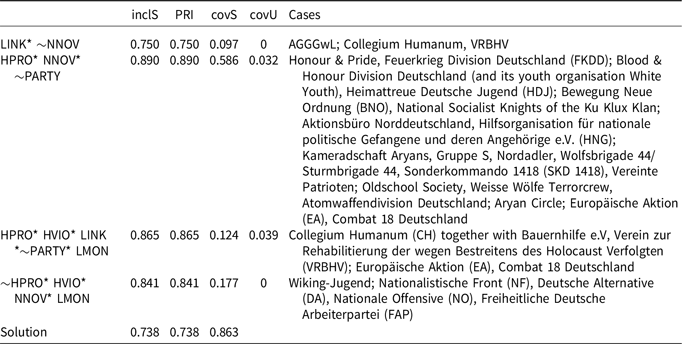
Sufficiency solution (intermediate)
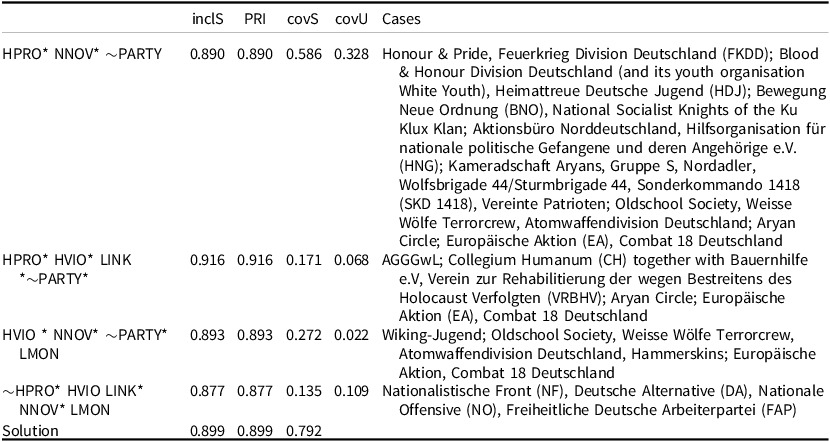
Sufficiency solution (parsimonious). There is model ambiguity in this solution. The first solution version is presented
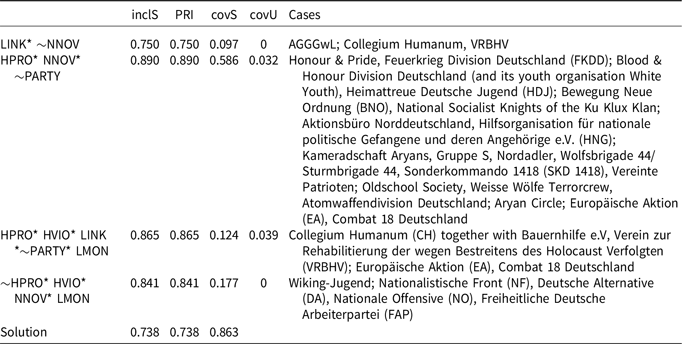
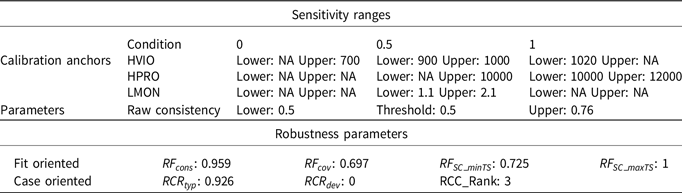
Parameters of fit for the robust core (RC). Cons. Suf refers to ‘sufficiency consistency’; Cov. Suf refers to ‘sufficiency coverage’; and PRI stands for ‘proportional reduction in inconsistency’

Robustness protocol report. $R{F_{cons}}$
refers to ‘robustness fit consistency’, whether the ideal solution (ie the solution presented in the article) is fully consistent with the robust core;
$R{F_{cons}}$
refers to ‘robustness fit consistency’, whether the ideal solution (ie the solution presented in the article) is fully consistent with the robust core; $R{F_{cov}}$
refers to ‘robustness fit coverage’, whether the ideal solution covers the same cases as the robust core;
$R{F_{cov}}$
refers to ‘robustness fit coverage’, whether the ideal solution covers the same cases as the robust core; $R{F_{SC\_minTS}}$
refers to ‘robustness fit space covered minimum test solution’, whether the ideal solution coincides with the minimum of the test solution(s);
$R{F_{SC\_minTS}}$
refers to ‘robustness fit space covered minimum test solution’, whether the ideal solution coincides with the minimum of the test solution(s); $R{F_{SC\_maxTS}}$
refers to ‘robustness fit space covered maximum test solution’, whether the ideal solution coincides with the maximum of the test solution(s);
$R{F_{SC\_maxTS}}$
refers to ‘robustness fit space covered maximum test solution’, whether the ideal solution coincides with the maximum of the test solution(s); $RC{R_{typ}}$
refers to ‘robustness case ratio typical’, whether all typical cases are robust;
$RC{R_{typ}}$
refers to ‘robustness case ratio typical’, whether all typical cases are robust; $RC{R_{dev}}$
refers to ‘robustness case ratio deviant’, whether all deviant consistency in kind cases are robust;
$RC{R_{dev}}$
refers to ‘robustness case ratio deviant’, whether all deviant consistency in kind cases are robust; $RCC\_Rank$
refers to ‘robustness case classifications rank’, whether case classifications violate subset relations with minTS (shaky) and maxTS (possible)
$RCC\_Rank$
refers to ‘robustness case classifications rank’, whether case classifications violate subset relations with minTS (shaky) and maxTS (possible)
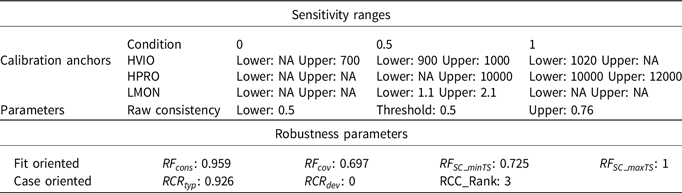
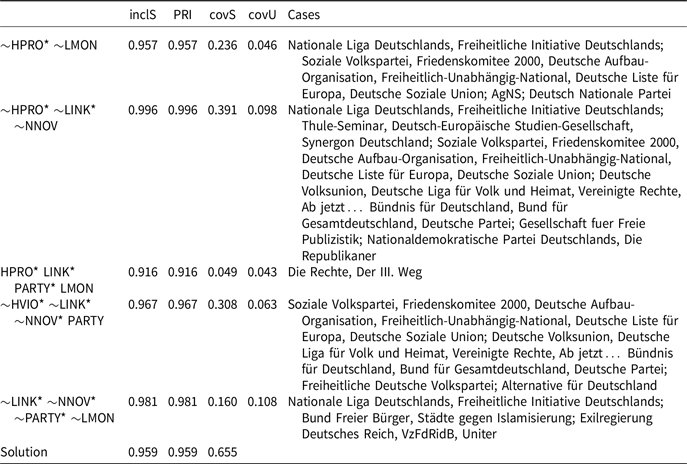
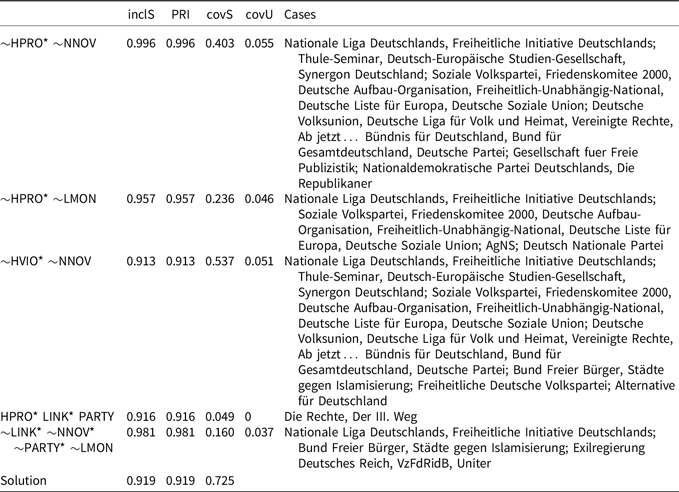
Sufficiency solution for ’not banned’ (conservative)

Sufficiency solution for ’not banned’ (intermediate)
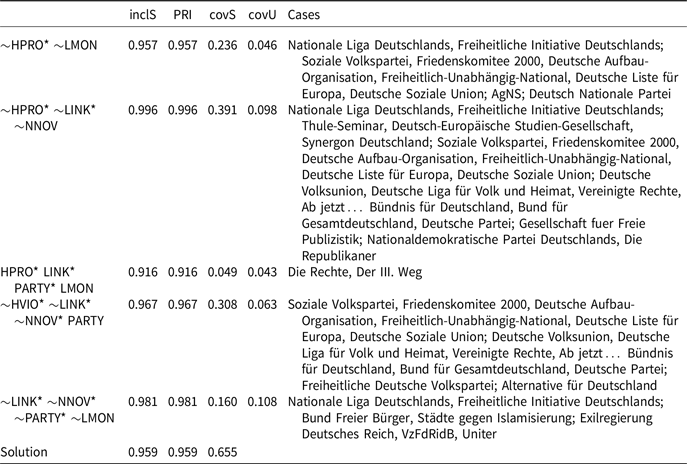
Sufficiency solution for ’not banned’ (parsimonious)
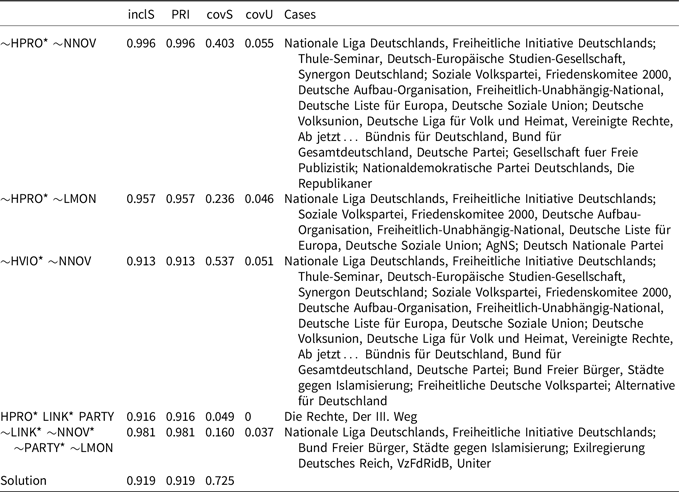
The second pattern covers six organisations (three uniquely). This pattern represents several organisations that served for years as stable hubs of far-right activity. All were active for many years, and most were monitored for at least four years before being banned.
The third pattern covers five organisations (one uniquely) that espoused particularly aggressive militancy. The Wiking-Jugend, for example, emulated the Hitler Youth. Its marches and paramilitary training were prototypical of attempts to revive the Nazism in the 1990s. The 1994 ban against the organisation stunted that attempt.
The fourth pattern covers four organisations (all uniquely). They are all neo-Nazi sham parties banned in the early 1990s. Despite being stylised as a party, the Federal Constitutional Court ruled the Freiheitliche Deutsche Arbeiterpartei did not actually qualify as such. Similarly, the Federal Administrative Court upheld bans against Deutsche Alternative and Nationale Offensive by ruling that they were not parties. All four were banned through the Associations Law.
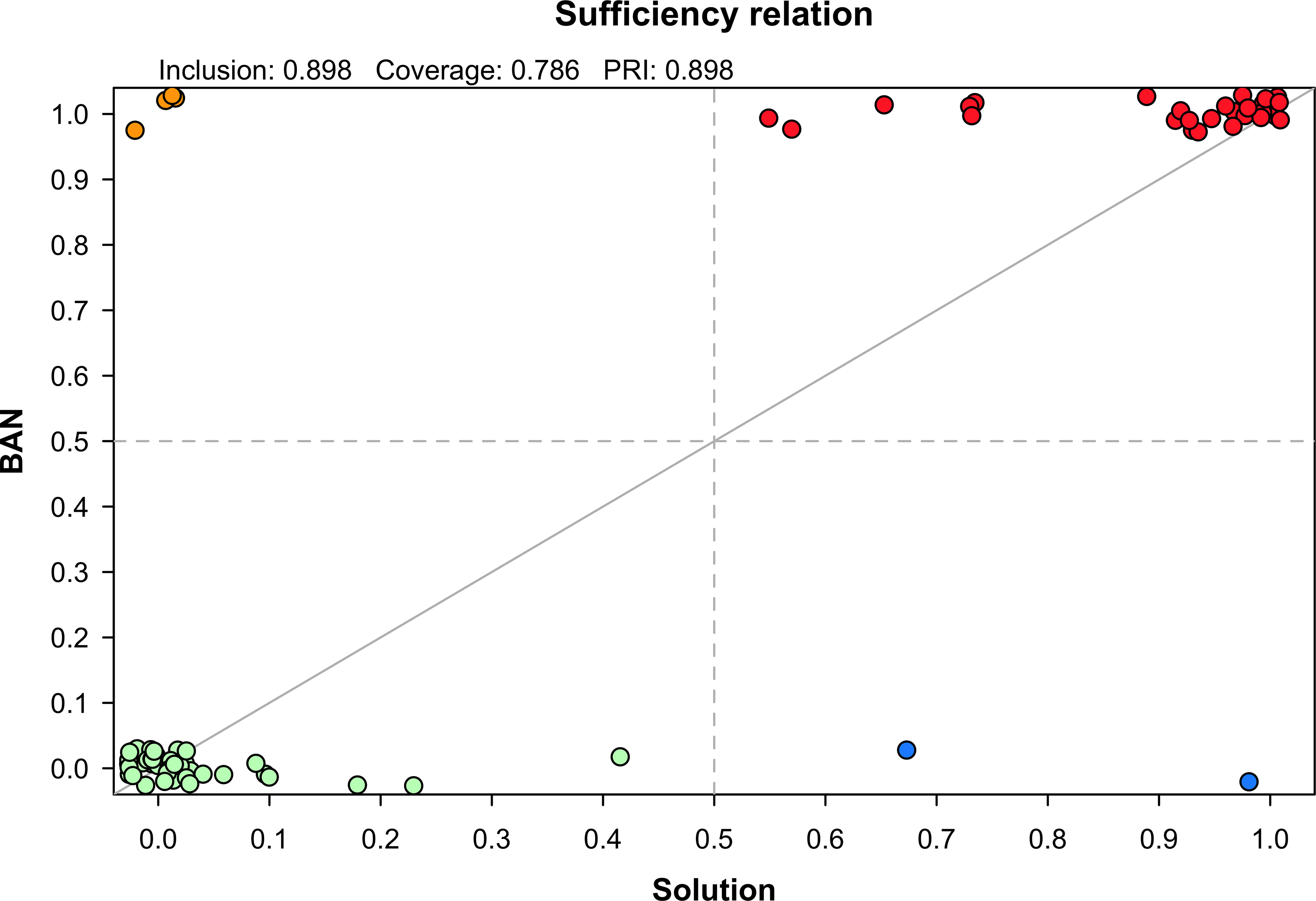
These patterns represent separate sufficient combinations of conditions. Table 4 displays the patterns’ coverageFootnote 30 and consistency (or ‘inclusion’, inclS)Footnote 31 as well as the cases covered.Footnote 32 Figure 4 plots the solution and outcome. Cases in the upper-right quadrant are typical: banned organisations covered by one or more patterns. The lower-left quadrant contains irrelevant cases, not covered by any patterns and perhaps, therefore, not banned. The lower-right quadrant contains deviant cases for consistency in kind: Honour & Pride and Aktionsbüro Norddeutschland. They are covered by the solution but were not banned. While such cases are typically problematic because they violate the statement of sufficiency (Schneider and Rohlfing Reference Schneider and Rohlfing2013), here, I contend, they are problematic only in that they indicate underlying inconsistency in the German government’s banning decisions. Lastly, in the upper-left quadrant are deviant cases for coverage: Altermedia Deutschland, Staatenbund Deutschland, Geeinte deutsche Völker und Stämme, and Goyim Partei Deutschland. These cases were banned but are not covered by the solution. They do ‘not provide evidence against the statement of sufficiency because we do not expect the outcome to occur when no sufficient term from the solution is present’ (Schneider and Rohlfing Reference Schneider and Rohlfing2013, 574). Instead, these cases suggest the QCA model is not sufficiently specified to account for them (‘underfitting of the solution’). Investigating them could identify a missing condition that differentiates them from non-banned cases in the same truth table row.
Sufficient solution. (Points jittered.) Points in upper-right quadrant represent banning cases covered by the solution. Two puzzling cases represented by the solution but not covered are in the lower-right quadrant. The upper-left quadrant represents deviant coverage cases, where the QCA model’s conditions apparently are not enough to explain why a ban was imposed.
Some cases are covered by multiple patterns. Cases in overlapping areas in Figure 5 are causally overdetermined. Thus, these seven cases are unsuitable for investigating mechanisms underlying different banning patterns. Fortunately, many uniquely covered typical cases do suit that purpose.
Solution patterns and overlaps. Circles are proportional representations of the coverage of each pattern.
Robustness
Oană and Schneider (Reference Oană and Schneider2021) formulate a robustness protocol of QCA solutions. Applying their procedure shows the conservative sufficiency solution presented here is fairly robust from a parameters of fit perspective: changes to model specifications do not drastically alter the results, but the specifications used in the analysis enabled the most consistent and highest number of cases to be explained. The full robustness protocol is reported in the online supplementary material.
Causal mechanisms case studies
This section presents two case studies that reveal causal mechanisms underlying two QCA patterns. Case studies can interrogate the causation suggested by QCA (Schneider Reference Schneider2024). The case studies focus on the ‘longstanding hubs’ and ‘neo-Nazi sham parties’ patterns. Whereas the other patterns contain highly likely ban causes – being classified as neo-Nazi or as violent are conspicuous – the patterns of longstanding hubs and neo-Nazi sham parties are more puzzling. Both suggest some insulation from banning: longstanding organisations evidently avoided banning for years, and organisations that act as parties do so knowing that legal hurdles to ban parties are much higher. So how did bans come about within these patterns? Here, Nationale Offensive and Collegium Humanum were selected as typical, uniquely covered cases, thereby minimising problems related to causal overdetermination and enabling a targeted search for mechanisms linking conditions to banning decision outcomes (cf. Schneider and Rohlfing Reference Schneider and Rohlfing2013, 573).
Neo-Nazi sham parties: Nationale Offensive (NO)
The NO was founded on 3 July 1990 by disaffected members of the (as yet unbanned) Freiheitliche Deutsche Arbeiterpartei. Newly founded as it was, NO’s leaders nevertheless had long records of far-right activism. Several had been members of the ‘Committee for celebrations of Adolf Hitler’s 100th birthday’ (Komitees zur Vorbereitung der Feierlichkeiten zum 100. Geburtstag Adolf Hitlers, KAH), which formed in 1984 to replace the banned Aktionsfront Nationaler Sozialisten/Nationale Aktivisten (ANS/NA).Footnote 33 NO leaders and members were directly connected to previously banned groups. Headquartered in Augsburg, the NO built a party structure; the BfV described it as a party in its 1990 report (Bundesministerium des Innern 1991, 99). Little more than a year after its founding, NO had gained as many as 100 members, participated in demonstrations honouring Rudolf Hess and supporting a SS war criminal that was on trial, and had become active in Bavaria, Baden-Württemberg, North Rhine–Westphalia, Thuringia, and Berlin (Deutscher Bundestag 1991). Yet its feats as a party were laughable: it failed to gather enough signatures to participate in 1990 Bavarian regional elections; it managed 0.2 per cent at local elections in Singen-Konstanz; and in 1992, Baden-Württemberg regional elections, the NO garnered 183 votes of five million cast, 0.00004 per cent (rounding up).
Interior Minister Rudolf Seiters (CDU) banned NO under the Associations Law on 22 December 1992. The organisation, said Seiters, ‘created and fuelled a xenophobic mood’. Though ambiguously phrased, Seiters presumably referred to the spike in far-right violence that gripped Germany in 1992, conspicuously including a deadly arson attack in Mölln in late November, which killed a woman and two children and injured nine others. There was no implication that the NO was involved, but merely that the high level (and particularly shocking incidents) of far-right violence generated pressure on Seiters to act (Der Spiegel 1993). Such was the rash haste of Seiters’s department that the NO is repeatedly confused in the ban announcement with the Deutsche Alternative (DA), a group Seiters banned two weeks earlier (Ibid.).
However, the NO, the DA and the Nationalistische Front (NF) filed suit in January 1993, claiming that Seiters could not ban them because they were parties. Their appeal pointed out that the federal elections officer (Bundeswahlleiter) registered them as parties and the Bundestag had recognised their status by accepting their party financial reports (Ibid.). The Federal Administrative Court quashed this appeal, asserting they were not legally parties merely by styling themselves as such and that their failure to participate in federal or regional parliamentary elections – the Court evidently disregarded the NO’s 183 votes in Baden-Württemberg in 1992 – showed a lack of requisite ‘serious will to participate in parliament’ (DPA 1993). Thus, banning the NO (and the DA and NF) was upheld.
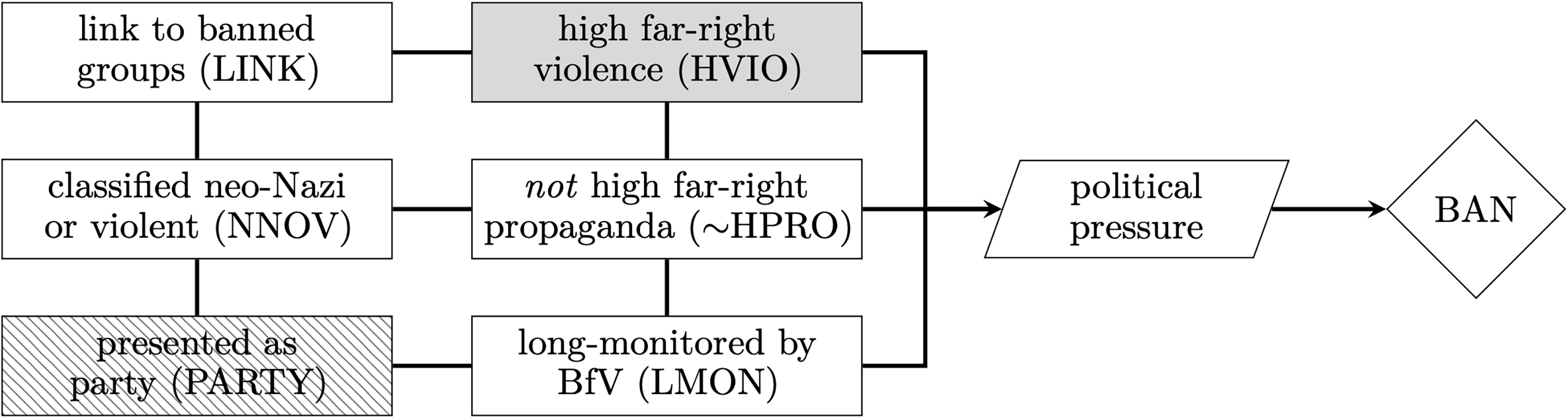
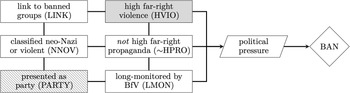
Depicted in Figure 6, the mechanism underlying the neo-Nazi sham parties banning pattern – indeed, covering not just the NO, but also the other cases in this pattern – is of political pressure on the responsible minister, stemming from indignation about far-right violence (HVIO). This condition was key. Resultant pressure prompted action against groups susceptible to banning by virtue of their neo-Nazi character (NNOV) and links to banned groups (LINK). That the NO was a registered party was rejected by the government, a determination the judiciary subsequently confirmed.
Causal process of banning Nationale Offensive (NO). The conditions (rectangles) are sufficient to trigger a political pressure mechanism (trapezoid), in turn causing a ban. Conditions in the first column were present from the NO’s creation; those in the second column manifested in the year it was banned. The hatched PARTY condition represents that this was rejected by authorities, whereas the shaded HVIO condition was causally pivotal.
An informative epilogue came in the government’s response to a parliamentary inquiry in 1994 (Deutscher Bundestag 1994). Asked about the effects of banning these sham parties, the government asserted the bans achieved ‘widespread uncertainty and a lack of prospects in the right-wing extremist scene, far-reaching suppression of group activity by breaking up organisational structures and confiscating organisations’ assets, and the seizure of weapons’ (Deutscher Bundestag 1994, 8). Moreover, the government claimed a sort of chilling effect: other groups ‘have at least restricted their agitation activities to avoid bans’ (Ibid.). Conversely, it acknowledged BfV intelligence-gathering may have been disrupted, that activists might have used banning processes to propagandise, that bans could radicalise members (ie make them more conspiratorial and aggressive), and that they might acquire heightened senses of solidarity by going through the banning process (Ibid., p. 9). The response concludes that these negative effects are uncertain, visible (if they ever materialised) only after some time, while the positive effects are achieved directly through ban enforcement. This is a clear articulation of the instrumental logic, the pragmatism underlying the German state’s use of bans.
Longstanding hubs: Collegium Humanum (CH)
A former Nazi Party functionary, Werner Georg Haverbeck, with his wife, Ursula Haverbeck-Wetzel, founded the CH in 1963 in Vlotho (North Rhine–Westphalia). After her husband’s death in 1999, Haverbeck-Wetzel assumed organisational leadership. Initially active in environmental and peace advocacy, CH took on an unmistakeable far-right character in the 1980s. The CH house became a meeting point for far-right activists. In inspecting CH’s membership and affiliates, the challenge is not to identify whether there were links to banned organisations but rather to discover if there were any banned organisations to which the CH was not linked! From its base in Vlotho and another location in Thuringia, CH served as a stable hub for Germany’s far-right scene. Organising seminars, publishing bimonthly the Stimme des Gewissens that voiced Holocaust-denying conspiracy beliefs, and facilitating far-right activist meetings comprised the bulk of CH’s activity.
Interior Minister Wolfgang Schäuble (CDU) announced a ban of CH (and its subsidiary organisation Bauernhilfe e.V., as well as the Verein zur Rehabilitierung der wegen Bestreitens des Holocaust Verfolgten) on 7 May 2008. The announcement justified the ban by asserting that CH was directed against Germany’s constitutional order and repeatedly violated laws against Holocaust denial (Bundesministerium des Innern 2008). CH appealed. The ruling, which denied their appeal on 5 August 2009, offered two justifications: first, CH publications repeatedly denied the Holocaust, for which Haverbeck-Wetzel was fined; and second, CH publications showed an affinity to and attempted to promote National Socialism (Bundesverwaltungsgericht 2009). Thus, the ideology propagandised through CH’s Stimme des Gewissens was legally sufficient for banning.
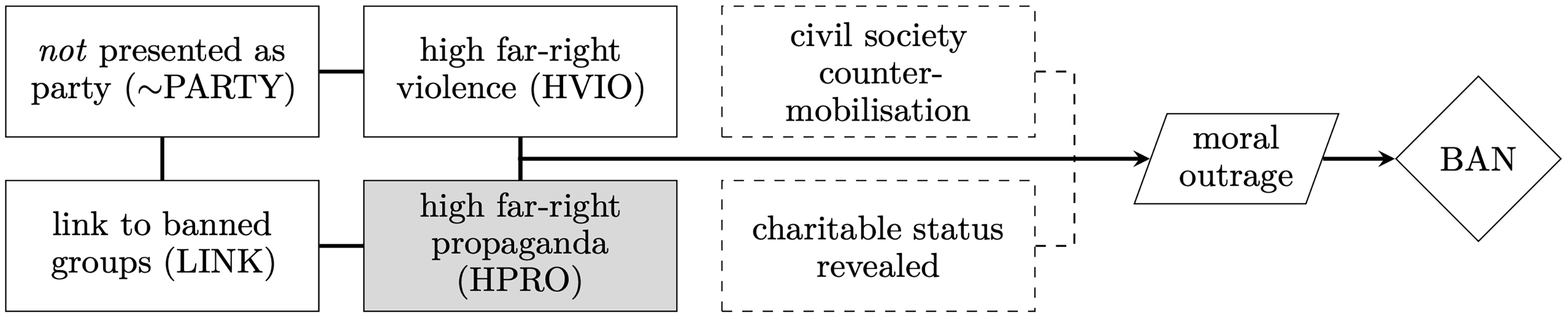
Yet there are several organisations subscribing to the same ideology and operating much the same as CH, but which are not banned. Why this organisation? The process behind banning CH is one of problematisation, moral shock, and only then banning. These are seemingly case-specific conditions, not captured in the QCA. First, over a long period, counter-mobilising actors worked to problematise the CH’s activities. The Mendel-Grundmann-Gesellschaft (MGG) researched Holocaust victims from Vlotho. Though long active, MGG was particularly engaged in outreach in the 2000s following conspicuous activism by Haverbeck-Wetzel and her acolytes (cf. Deuring et al. Reference Deuring, Kuhlmann, Kusche and Wienecke2013, 12). Similarly provoked by CH activism, the ‘Vlotho Alliance against “Collegium Humanum” ’ (Vlothoer Bündnis gegen das Collegium Humanum) was formed in autumn 2004 by the local Green Party. The Alliance consisted of members from other parties, schools, unions, churches, and anti-fascist activists (Ibid.) – a counter-mobilising coalition. Protests outside the CH house were the Alliance’s most common tactic, but it also cultivated support from SPD Bundestag representatives. Nevertheless, it is doubtful this counter-mobilisation alone would have moved the government to ban CH. Second, a news agency report sparked moral shock. On 19 December 2007, Tagesschau revealed that CH had charitable status (Gemeinnützigkeit), meaning its income was tax-exempt (Gensing Reference Gensing2007). In effect, German taxpayers were subsidising CH’s Holocaust-denying activism. This revelation elevated indignation about CH from local-level activism to national political scandal. Haverbeck-Wetzel inflamed the situation by writing a threatening letter to the Chairwoman of the Central Council of Jews in Germany (Zentralrats der Juden in Deutschland) after she advocated banning CH. A large group of Bundestag representatives filed a parliamentary motion (Antrag) demanding the government to ‘examine whether the prerequisites for a ban under the Associations Law are met and, if so, to ban the “Collegium Humanum” association’ (Künast and Kuhn Reference Künast and Kuhn2008). Third, only after the problematising work of groups in Vlotho and the moral shock provided by news reporting, the federal government banned CH.
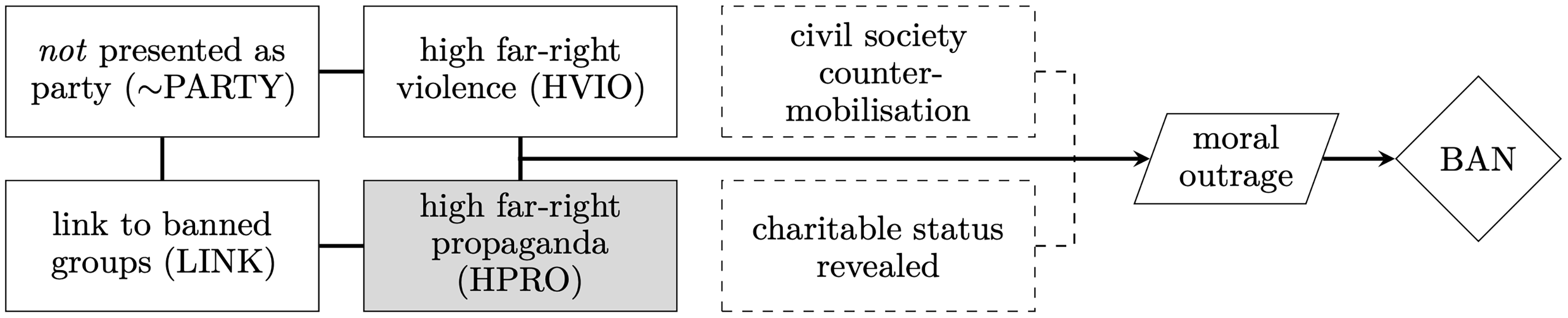
Depicted in Figure 7, the process behind the CH ban is unclear from the QCA pattern alone. There was indeed high far-right visibility, and it was consequential; it was a visibility specifically and deliberately focused on CH. Such incidents of high visibility ‘intensify political will’ to take action against the far right (Zeller and Vaughan Reference Zeller and Vaughan2024, 999). This case confirms the finding in other studies (eg Virchow Reference Virchow, Hasse, Rosenthal and Twisselmann2013b; Zeller Reference Zeller2021, Reference Zeller, Kondor and Littler2023) that private counter-mobilisation is often needed to prod state authorities into action.
Causal process of banning Collegium Humanum (CH). The conditions (rectangles), especially far-right propaganda visibility, triggered a moral shock mechanism (trapezoid), in turn causing a ban. Additional conditions (dashed rectangles) also contributed to triggering the mechanism causing the ban.
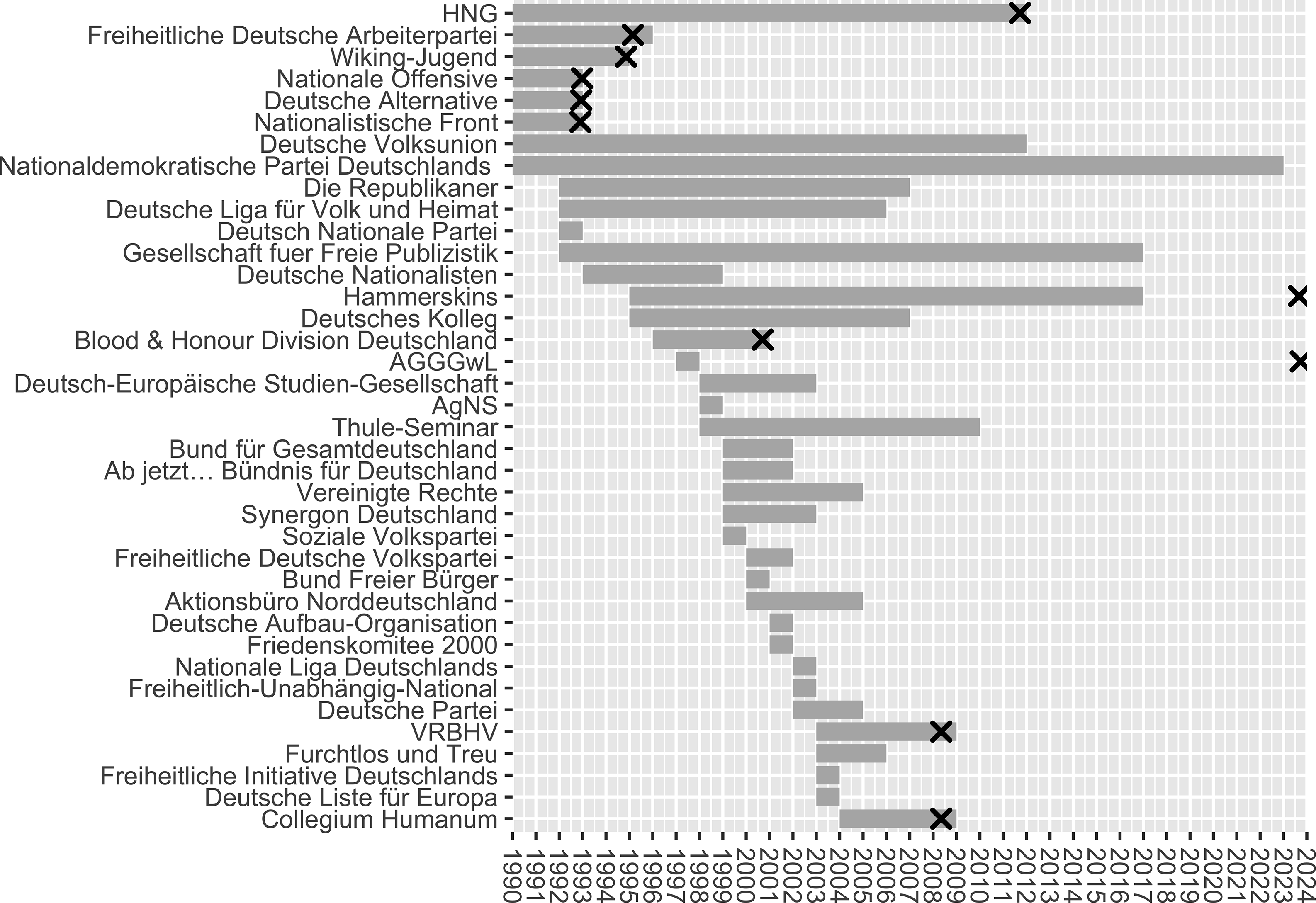
Timeline plot 1. The grey bars indicate the years in which an organisation was monitored (ie mentioned in BfV reports). Black Xs indicate when an organisation was banned.
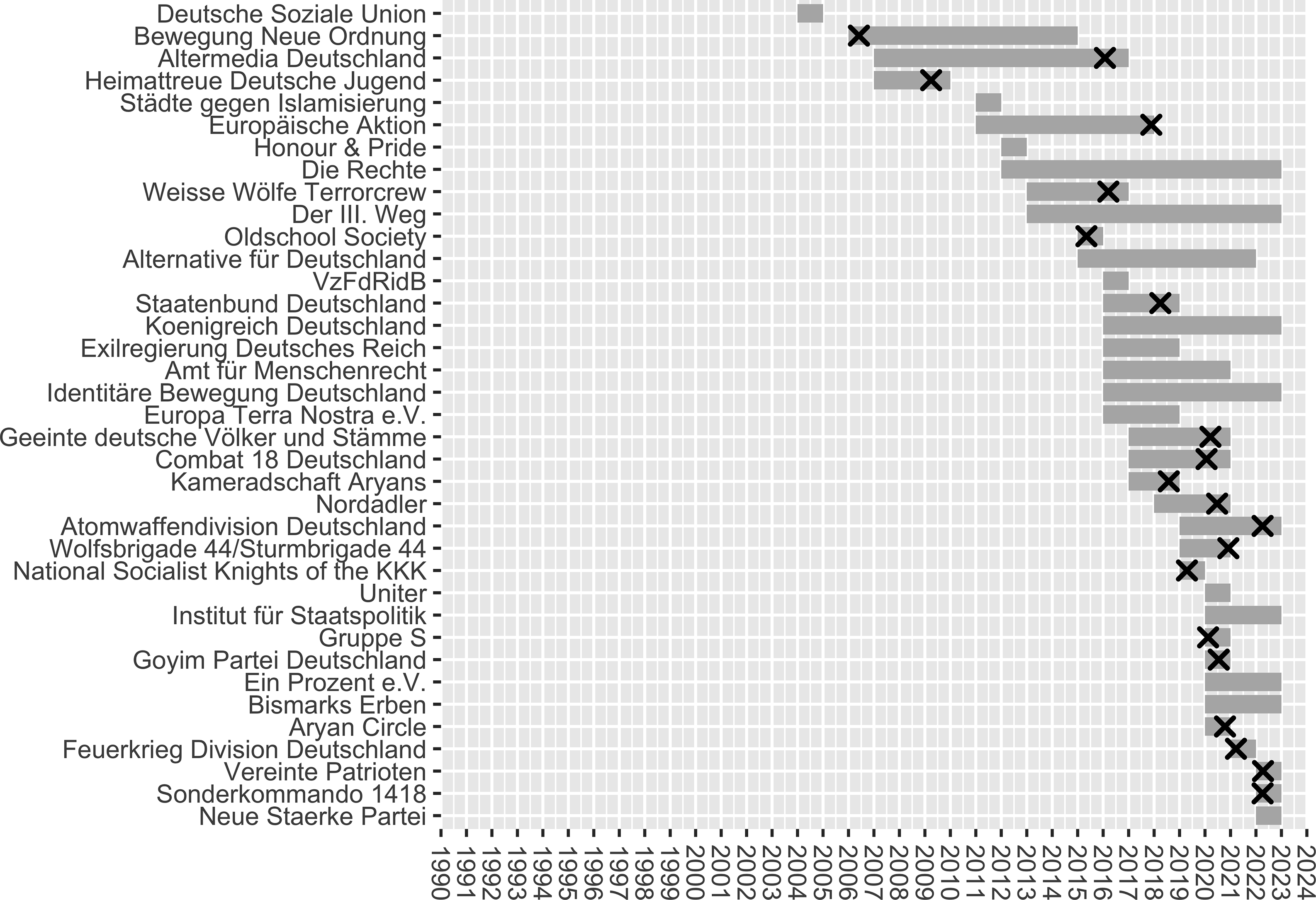
Timeline plot 2. The grey bars indicate the years in which an organisation was monitored (ie mentioned in BfV reports). Black Xs indicate when an organisation was banned.
Robustness plot. The relation between the minimal test solution set, the maximal test solution set, and the initial solution (ie the conservative solution presented in the article).

Conclusions
Recently, more states have turned to bans and militant democracy measures as a way to constrain extremist activism (Zeller and Vaughan Reference Zeller and Vaughan2024). Yet the case of Germany, militant democracy archetype, shows that banning is sometimes a pragmatic tool of politics rather than a principled response to illegality or a targeted response to systemic threats.
This study produced three main findings. First, it revealed the necessity of high far-right visibility (in the form of violence and/or propaganda activities) to prompt banning action. Two case studies showed that social and political pressure, particularly after conspicuous and egregious far-right incidents, form the mechanistic link between far-right visibility and banning decisions – even if those organisations are not directly connected to those incidents. Extant research identifies institutional veto players’ role in banning (Bourne and Veugelers Reference Bourne and Veugelers2022); this study demonstrates the decisive influence social mobilisation can have in urging authorities to impose a ban.
Second, the study uncovered four sufficient patterns of organisational banning in Germany: against neo-Nazi movement organisations, against longstanding far-right hubs, against aggressive militant organisations, and against neo-Nazi sham parties. In the two typical cases traced, movements, media, and political actors generated pressure to ban. Non-state action is often a vital component in prompting authorities to apply militant democracy measures.
Third, the study exposed inconsistency in Germany’s banning practices. Organisational characteristics alone cannot explain organisational bans. There are numerous German neo-Nazi organisations, numerous with links to previously banned groups, but which are not themselves banned despite meeting legally sufficient thresholds. Situational factors are causally significant and cannot be ignored. The necessary combination of situational and organisational conditions helps not only to explain why some far-right organisations are banned but also why some are not. The crucial implication is that Germany’s militant democracy and banning decisions are apparently not merely about proscribing ideologically or behaviourally unlawful groups, but also responding to wider circumstances. The record of banning action is one of a pragmatic political response to organisational illegality and broader factors, not a principled response to organised anti-constitutional activity.
This pragmatism entails risks and benefits for democratic governance and responses to extremism. Pragmatic banning practices risk arbitrariness, the inequitable application of proscription laws. This posture’s normative consequences, where only some organisations that act against the constitutional democratic system are banned, are profound and deserve fuller consideration. Simultaneously, this study shows pragmatic banning practices are responsive to popular input. Such responsiveness – indeed, more formalised in constituent assemblies (Olsen and Tuovinen Reference Olsen and Tuovinen2023) – has been suggested to enhance the legitimacy of bans, though citizens may be wary of imposing proscriptive action (eg Pradel et al. Reference Pradel, Zilinsky, Kosmidis and Theocharis2024). Yet pragmatic banning practices also suggest state actors should be attentive to bans’ efficacy, how banning effects wider organisational ecologies and extremist activity. Although there is evidence of state actors considering efficacy, there are also indications that banning is sometimes a political tool rather than a targeted response to threats.
These findings extend beyond the German context. Many democracies have instituted and applied militant democracy instruments, such as laws enabling bans. Yet surveying organised extremist activity shows the same inconsistency between organisations that are banned and those that are not. Pragmatism seemingly underlies banning practices in other countries, though further research could establish whether similar popular pressure mechanisms are at work. Similar dynamics to those uncovered here are likely present in other contexts.
Supplementary material
The supplementary material for this article can be found at https://doi.org/10.1017/S1475676525100121
Data availability statement
All data analysed in this study are included in the published article.
Acknowledgements
I am indebted to Maik Fielitz for his early and informative comments on this project. Participants at Humboldt University’s Contemporary Research on Far-Right Politics workshop provided crucial feedback. Members of the colloquium within the Chair of Comparative Politics at Ludwig-Maximilians- Universität München offered invaluable feedback about framing and presenting the analysis. Teresa Völker kindly offered comments to help polish the article.
Funding statement
This research was not funded by any specific grant or funding agency.









 Open access

