

Old people living at home and suffering from chronic illnesses are increasingly at the risk of losing their physical mobility and functional capacity. The loss of mobility usually has serious detrimental effects on the mental and social capabilities and on the overall agency of elderly people. Standard home care services seldom include systematic measures aimed at supporting the mobility of the clients, and traditional methods of exercise and physical therapy are not easy to adapt to the circumstances of home care. There is a growing need for new concepts of mobility that could meet the needs of home care of elderly clients.
In this chapter, I examine a process of collective concept formation in the home care of the elderly in the city of Helsinki in Finland (Engeström, Nummijoki, & Sannino, Reference Engeström, Nummijoki and Sannino2012). In Helsinki, home care workers’ routine tasks normally did not include measures to facilitate and support their clients’ physical mobility and the workers commonly resist such tasks as additional workload. During a lengthy process of intervention research conducted by my research team, a new instrument called mobility agreement was introduced to facilitate the inclusion of regular mobility exercises in home care visits and in the daily lives of the clients. In encounters between home care workers and their elderly clients, aimed at implementation of the mobility agreement, a new concept of mobility began to emerge (for an overview of the process, see Nummijoki, Reference Nummijoki2020).
I will analyze this process with the help of the epistemological and methodological principle of ascending from the abstract to the concrete, understood as pathway to and modus operandi of theoretical concepts, as explicated and developed by Il’enkov (Reference Il’enkov1982) and Davydov (Reference Davydov1990). In particular, I will dwell on the key notion of germ cell and apply it in the analysis of collective formation of a new concept of physical mobility.
The formation of theoretical concepts is often regarded as primarily a textual and language-bound process. In this case, the formation and expansion of the germ cell took place primarily by means of bodily movements and sensations, supported by simple pictorial artifacts. My analysis contributes to discussions of embodied cognition (e.g., Chemero, Reference Chemero2013; Clark, Reference Clark2008; Danish et al., Reference Danish, Enyedy, Saleh and Humburg2020; Dourish, Reference Dourish2001; Gallagher, Reference Gallagher2005; Gibbs, Reference Gibbs2005; Shapiro, 2011; Shotter, Reference Shotter2011; Stewart, Gapenne, & DiPaolo, Reference Stewart, Gapenne and Di Paolo2010) by presenting the challenge of collective concept formation in the wild.
I will begin the analysis with an overview of thirteen video-recorded encounters between home care workers and their clients, mediated by the new mobility agreement tools. These encounters were recorded in 2008 and 2009. I will then analyze in detail one home care visit which was conducted in 2011, after two years of implementation of the mobility agreement. This was a follow-up visit, conducted in a particularly reflective mode with a good amount of joint remembering and reconstructing of the experiences gained.
I will discuss the findings of the analysis by elaborating on the key characteristics of the new concept of mobility that is emerging among home care workers and their clients. I will also discuss the broader implications of the principle of ascending from the abstract to the concrete to future studies of concept formation in the wild.
5.1 Germ Cell and Ascending from the Abstract to the Concrete
Ascending from the abstract to the concrete is a method of grasping the essence of an object by tracing and reproducing theoretically the logic of its development, of its historical formation through the emergence and resolution of its inner contradictions. A theoretical concept is initially produced in the form of an abstract, simple explanatory relationship, a germ cell. This initial abstraction is enriched and transformed step by step into a concrete system of multiple, constantly developing and expanding manifestations. In other words, the initial simple idea is transformed into a complex new form of activity.
In this framework, abstract refers to something partial, separated from the concrete whole. In empirical thinking based on comparisons and classifications, abstractions capture arbitrary, only formally interconnected properties. In dialectical-theoretical thinking, based on ascending from the abstract to the concrete, an abstraction captures the smallest and simplest, genetically primary unit of the whole functionally interconnected system (Il’enkov, Reference Shank and Abelson1977; Davydov, Reference Davydov1990; Falmagne, Reference Falmagne, Martin, Nelson and Tobach1995).
Ascending from the abstract to the concrete is achieved through specific epistemic or learning actions. Together these actions form an expansive cycle or spiral. As explained in Chapter 3, an ideal-typical sequence of epistemic actions in ascending from the abstract to the concrete moves from the initial action of questioning through the actions of analyzing and modeling a new solution to the actions of testing the new model, implementing it in practice, reflecting on the process, and consolidating it in collaboration with other activity systems.
A theoretical concept may be understood as dialectical movement from the abstract to the concrete. In other words, the concept is a way of moving within a domain, not a static definition (although movement certainly requires forming relatively stable signposts; see Cussins, Reference Cussins1992). In the dialectical movement of ascending from the abstract to the concrete, the germ cell plays a crucial role (Haug, Reference Haug1974; Il’enkov, Reference Il’enkov1982; Davydov, Reference Davydov1990). The movement is not linear; it typically involves also steps back, to reexamining and remodeling the germ cell.
A theoretical concept is manifested in a particular action with objects, or a system of such actions. This is echoed by Prinz and Clark (Reference Prinz and Clark2004, p. 58) when they declare that “concepts are action-oriented.” Davydov (Reference Davydov1990, p. 301) points out that “a theoretical concept can exist as a method of deriving the individual from the general, but still not have terminological formulation.” This means that concepts are much more than verbal definitions. Proponents of embodied cognition argue that concepts are foundationally bound to our bodies, movements, and physical actions. What might be the nature of this embodiment and enaction?
Hutchins (Reference Hutchins, Stewart, Gapenne and Di Paolo2010, pp. 428–429) argues that “bodily action does not simply express previously formed mental concepts; bodily practices including gesture are part of the activity in which concepts are formed.” This means that concepts are created in practices of moving and experiencing the body.
In some circumstances, the body itself becomes a cognitive artifact, upon which meaningful environmentally coupled gestures can be performed …. In such settings, motion in space acquires conceptual meaning and reasoning can be performed by moving the body. … Courses of action then become trains of thought.
Hutchins further points out that multimodal concepts are likely to become more stable than single-mode representations. Multimodal integration may be accomplished by embedding the representations in durable material media, or “material anchors” (Hutchins, Reference Hutchins2005). Another way to accomplish multimodal integration is to enact representations in bodily movements, turning such bodily movements into “somatic anchors” for concepts (Hutchins, Reference Hutchins, Stewart, Gapenne and Di Paolo2010, p. 445). Hutchins also remarks that embodied thinking and acting benefit from “the variability inherent in social interaction” – yet “we know least about this aspect” (Hutchins, Reference Hutchins, Stewart, Gapenne and Di Paolo2010, p. 445).
Analysis of the stepwise formation of a new concept of mobility in practical negotiations and joint physical exercises between a home care worker and an elderly client offers an opportunity to bring together the dialectical idea of ascending from the abstract to the concrete with the help of a germ cell on the one hand, and key ideas from embodied and enactive cognition on the other hand. Accordingly, the key questions of this chapter are: Can we identify a germ cell of a new concept of mobility in home care workers’ and clients’ practical efforts to integrate physical mobility exercises into the routines of home care services and the client’s daily chores? How and by what actions did the actors use and develop the germ cell to ascend toward the concrete? What was the role of embodiment and physical enactment, and in particular the role of embodied social interaction, in this process of ascending from the abstract to the concrete?
5.2 Home Care and the Challenge of Mobility: Standing up from the Chair as Candidate Germ Cell
In popular imagery, there are two dominant broad notions of mobility: the one of an athlete or adventurer, and the one of a busy, interconnected business person. The first one of these emphasizes physical prowess and exceeding one’s bodily limitations, and the second one emphasizes swift networking and global transitions aided by mobile technologies. Both of these dominant imageries are strongly achievement-oriented and competitive, they emphasize the individual as the locus and generator of mobility, and they see movement (e.g., exercise, travel) primarily as a somewhat heroic feat in its own right, largely separate from other activities it may serve.
Neither one of the dominant cultural images of mobility is appropriate for home care. In the home care of elderly people in poor health, a qualitatively different concept of mobility is needed. Instead of achievement-oriented it must be sustainability-oriented, instead of individually focused it must be collaborative, and instead of separate from other activities it must be embedded and integrated into the daily life activity of the elderly.
Elderly people living in their homes become brittle and their environment narrows over the years. They are vulnerable in many ways. An increasingly recognized syndrome in older adults is frailty. Frailty as a syndrome manifests the following core clinical features: loss of strength and sense of postural balance, weight loss, low levels of activity, poor endurance or fatigue, and slowed-down performance. The presence of three or more of these features is associated with adverse outcomes including falls, new or worsened function impairment, hospitalization, and death. Frailty is often associated with symptomatic long-term disease, decline in function, and reduced survival. The biological basis of frailty is postulated to involve a cycle of age- or disease-related physiological decline that includes loss of skeletal muscle mass. The rates of loss of muscle mass and strength accelerate after the age of 50 and again after the age of 75, with observed changes in muscle fibers and muscle atrophy (Boockvar & Meier, Reference Boockvar and Meier2006).
When an elderly home care client’s physical mobility fades away, it causes a chain of events that will have significant social costs. Predictive signs of the decline of an older person’s functional capability are reduction of movement in the outdoors, difficulty getting up from a chair, gait slowing, and difficulties coping on the stairs. Fear of falling because of frailty can be a real reason for loss of mobility in the elderly. After a few falls, some people become so frightened and anxious that they will not attempt to get up and stand without external help and support. The environment begins to appear dangerous: steps, rugs, and poor lighting combined with problems like poor vision from cataracts or macular degeneration can lead to increased falling when combined with physical fragility. Physical fragility has many causes in the elderly: osteoarthritis, muscle wasting, and slowed reflexes are very common, and postural hypotension (abnormally low blood pressure) also contributes to unsteadiness.
In Helsinki as well as in most large cities of the industrialized world, basic home care means ensuring medication, nursing, nutrition, and hygiene. As the need for and volume of home care services has grown, services that support the client’s independence and promote quality of life and participation in social life have been largely cut away from home care (National Audit Office’s Report, Reference Namian2010, pp. 8, 115). A paradox of home care is that home care workers perform daily chores for the clients although they know that getting up from the chair and doing these daily chores with the worker would much better support the elderly clients’ mobility and functional capacity (Jones, Reference Jones2007; Tulle, Reference Tulle2004). Making sandwiches for the old person and serving the sandwiches to him or her instead of making the sandwiches with the client by letting the old person get up from the chair and set the table and make his or her own sandwich as he or she wishes is often preferred because the client’s medication, nutrition, blood pressure, and pulse measurements are seen as standard routines that do not seem to leave room for anything else.
Knowledge and good intentions alone seldom lead to significant change in routine behavior, especially when the change seems to require increased work and effort. As Leont’ev (Reference Leont’ev1978, p. 65) emphasized, the formation of effective intentions and goals is “not an instantaneous act but a relatively long process of approbation of the goals by action and by their objective filling.” Citing Hegel, Leont’ev pointed out that a person “cannot determine the goal of his acting as long as he has not acted” (p. 65).
Thus, the transformation facilitated by my research group in Helsinki home care, with Jaana Nummijoki as the key interventionist-researcher in the field, was built on the practical introduction of the mobility agreement and mobility exercises in regular home care visits. In these encounters, both the worker and the client faced the challenge of taking new actions. The home care worker would present to the client the simple idea of agreeing to do regularly certain physical exercises, embedded in normal household chores, with the support of the home care worker and a visual booklet. The exercises were initiated right away. Often both the worker and the client realized that the exercises were actually rewarding and not very laborious. The embedding and anchoring of these exercise actions into the daily routines would take time and needed to be persistently monitored and pursued.
However, implementing new instruments and corresponding practical actions is not enough. Eventually, a new insight and new commitment need to emerge and take conscious shape. This is the essence of collective concept formation. Such a stepwise articulation process needs to be built on and around a core idea, a germ cell. We tentatively identified such a germ cell for a new concept of mobility in an early analysis of this implementation process (Nummijoki & Engeström, Reference Nummijoki, Engeström, Daniels, Edwards, Engeström, Gallagher and Ludvigsen2010).
We suggest that getting up from the chair, or sit-to-stand, may be such a germ cell for the emerging conceptualization of mobility and functional capacity within home care for the elderly. This means that the transformation effort in home care may be analyzed as a process of expansive concept formation at work.
Getting up from the chair, or sit-to-stand, is extensively used as a rehabilitation and intervention technique and central item in tests of physical mobility and functional capacity (e.g., Alexander et al., Reference Alexander, Galecki, Grenier, Nyquist, Hofmeyer, Grunawalt, Medell and Fry-Welch2001; Barnett et al., Reference Barnett, Smith, Lord, Williams and Baumand2003; Bohannon et al., Reference Bohannon, Barreca, Shove, Lambert, Masters and Sigouin2008; Carvalho Marques, & Mota, Reference Carvalho, Marques and Mota2008; Fahlman et al., Reference Fahlman, Topp, McNevin, Morgan and Boardley2007; Krebs Scarborough, & McGibbon, Reference Krebs, Scarborough and McGibbon2007; Lord et al., Reference Lord, Murray, Chapman, Munro and Tiedemann2002; Rosie & Taylor, Reference Rosie and Taylor2007; Shumway-Cook et al., Reference Shumway-Cook, Silver, LeMier, York, Cummings and Koepsell2007). However, its importance and expansive potential as the initial step and gateway to other forms of physical mobility have not been recognized and discussed theoretically.
In home care encounters, standing up from the chair (or sit-to-stand) emerges as a germ cell because in practice one has to get up to reach the upright position in order to move. It is foundational for any other kind of physical movement. In other words, it can be seen as the smallest and simplest initial unit of a complex totality; as something ubiquitous, so commonplace that it is often taken for granted and goes unnoticed; and as opening up a perspective for multiple applications, extensions, and future developments. These are three of the four criteria of a germ cell named earlier in Chapter 3. Figure 5.1 depicts an instructional diagram used to demonstrate the correct procedure for the exercise of standing up from the chair.

Perhaps the most demanding criterion of a germ cell is that it must carry in itself the foundational contradiction of the complex whole. The inner contradiction of standing up from the chair is implicitly visible in Figure 5.1. The person gets up without grabbing a piece of furniture for support, just using his or her own muscles. The natural temptation, especially for a frail person, is to use the edge of a table or the armrests of the chair as support when getting up. This way, standing up from the chair is easier and safer – but it also reinforces dependency and does not optimally develop one’s own muscular strength and coordination. The contradiction at the core of the germ cell is depicted in diagrammatic form in Figure 5.2.
Standing up from the chair as an internally contradictory germ cell of sustainable mobility.

The core contradiction is between safety and autonomy, two inseparable but opposing sides of keeping on living, the existential object of an elderly person’s life activity. For the subject, the contradiction typically manifests itself as a critical conflict between the fear of falling and the need to move (for the notion of critical conflict, see Sannino, Reference Sannino2008; Vasilyuk, Reference Vasilyuk1988). The safety motive leads one to use furniture as support to make standing up from the chair easier and safer – which also means that one becomes increasingly dependent on external support. The autonomy motive leads one to rely on one’s own muscles when standing up from the chair, which is harder and riskier but also fosters one’s independence. Neither part of the contradiction can be eliminated. Safety and autonomy both repel and require one another. Such an inner contradiction can only be transcended by working on it, by actively moving between the two poles to generate a new thirdness, that is, finding smart ways to break out of the literally paralyzing conflict and expanding one’s mobility beyond standing up from the chair.
5.3 Data and Method
Standing up from the chair as a candidate germ cell is basically a working hypothesis that needs to be grounded, expanded, and enriched to test its viability. As a first step of grounding, we scrutinized in detail a sample of thirteen videotaped home care visits conducted in 2008 and 2009. These visits were recorded shortly after the mobility agreement was introduced, and they represented the home care workers’ and clients’ early efforts to include mobility exercises in their daily routines. At the time of the collection of these data, standing up from the chair was not yet identified as a potential germ cell; it was one exercise among many others recommended. As the condition and care of the clients of these initial visits were subsequently followed by means of patient records and home care workers’ notes, we noticed that standing up from the chair played a varied but consistently important role in practically all these cases. An overview of the functioning of standing up from the chair, or sit-to-stand, in these visits and the subsequent developments in the condition and care of the clients is given in Table 5.1.
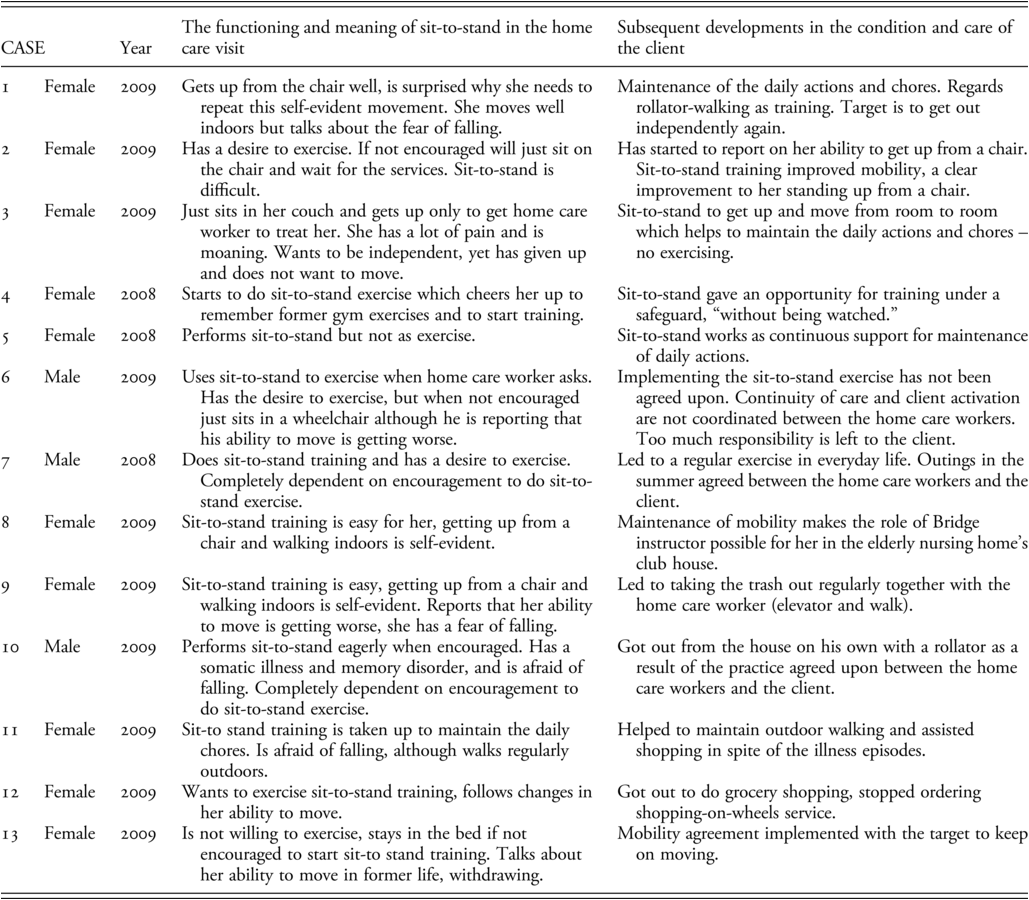
Table 5.1 demonstrates a wide variety of meanings and uses of standing up from the chair, as the cases ranged from practically immobile wheelchair-bound persons to clients who felt that sit-to-stand was self-evident and easy. For us, the most important lesson from this overview was the realization that sit-to-stand is more pervasive and ubiquitous than any other element of the mobility agreement and associated exercises in our data.
Another important lesson was that the consequences of sit-to-stand were not quick fixes or sudden changes in behavior. They took time and seldom manifested themselves as radical breakthroughs. Often we saw short-term ups and downs but significant improvement over the long term. This posed the difficult challenge of longitudinal follow-up and analysis. Systematic longitudinal follow-up of selected cases requires a lot of resources. It was made particularly difficult by the fact that there was high turnover among the home care workers, which led to frequent ruptures and restarts in the care. The age and precarious state of health of the clients also created ruptures in the form of hospitalizations, and eventual death.
To get access to the longitudinal process of concept formation in the wild, we recorded in April 2011 a follow-up home care visit to an eighty-seven-year-old client, here called Anne. During this visit, besides the regular services and mobility exercises, the emphasis was on joint reconstruction of the client’s and the home care workers’ experiences of implementing the mobility agreement over the past two years. In effect, the visit was largely devoted to collaborative retrospective reconstruction of events and experiences related to the client’s mobility, including standing up from the chair. In the analysis, these reconstructions were backed up and enriched with the help of the patient records and nurses’ notes of this client. The visit lasted 116 minutes and 48 seconds and consisted of 2084 speaking turns.
The participants of the visit were, besides Anne, her home care nurse we call Tina, and the researcher Jaana. Together with another home care worker, Tina had worked with Anne consistently over the past two years, a type of continuity often missing in home care. This continuity of care and long-term trustful relationship made it possible for the client to engage in the reconstruction of her experiences. The researcher Jaana, besides being at the time a doctoral candidate in my research group, was also a qualified physical therapist and an experienced worker and manager in Helsinki home care. This allowed Jaana to be also a discussion partner in the visit. Jaana was not a direct superior to Tina in the home care organization. In the transcript, also the physical therapist and the health center doctor are mentioned. The former was an expert often called to help at the start of the implementation of the mobility agreement. The latter was responsible for diagnoses and other important medical decisions concerning the client.
In the transcript of the visit, there are many occasions in which the client Anne used rather minimal or partial verbal expressions. While this probably in part reflected the unavoidable asymmetry involved in professional–client interactions in health care, Anne’s views were so consistent and distributed throughout the transcript that they can hardly be interpreted merely as results of pressure or manipulation from the professionals. A careful look into Anne’s gestures, body movements, and uses of the material environment also enriched the picture of her communicative contribution.
In the following, I use the actions involved in ascending from the abstract to the concrete as an analytical grid with the help of which I identify passages of talk and physical interaction during the visit relevant to this type of concept formation. In the video and transcript of the home care visit to Anne, I identified passages that represent the actions of questioning, modeling, examining the model, implementing, and reflecting on the process. For the purposes of this analysis, I name these five types of actions as (1) articulating a conflict of motives, (2) forming a germ cell, (3) examining the germ cell model, (4) implementing the model by ascending to the concrete, and (5) reflecting on the process and its outcomes. Action type 1, articulating a conflict of motives, is basically a combination of the first two actions of ascending from the abstract to the concrete, namely questioning and analyzing. Because of the retrospective nature of conversation in this visit, the transcript does not contain here-and-now questioning and analysis of the existing practice. Instead, it contains important segments in which the original experiencing of the conflict of motives was recollected, both emotionally and analytically.
Because the discourse in the home care visit was primarily – but not exclusively – retrospective, these actions are to a large extent reconstructed and reported on rather than enacted online during the visit. However, there was also a significant element of enactment of actions here-and-now, including jointly accomplished physical actions. To capture this interplay between retrospective-verbal and online-enacted aspects of the interaction in the visit, I will represent focal segments of the data with the help of tables in which facts from the medical records, talk in the transcript, and relevant physical actions on video are displayed side by side in their own columns. In the column representing actions on video, I include only the most salient examples that have direct connections to the actions performed by means of talk. This selectivity is also necessary for the readability of the tables.
5.4 Concept Formation in the Case of Anne
5.4.1 Articulating a Conflict of Motives
The conflict of motives that launched the concept formation process in Anne’s case was manifested in multiple successive forms and events. Three of these were made explicit in the discourse during the home care visit analyzed here. The data on these three segments are presented in Table 5.2.
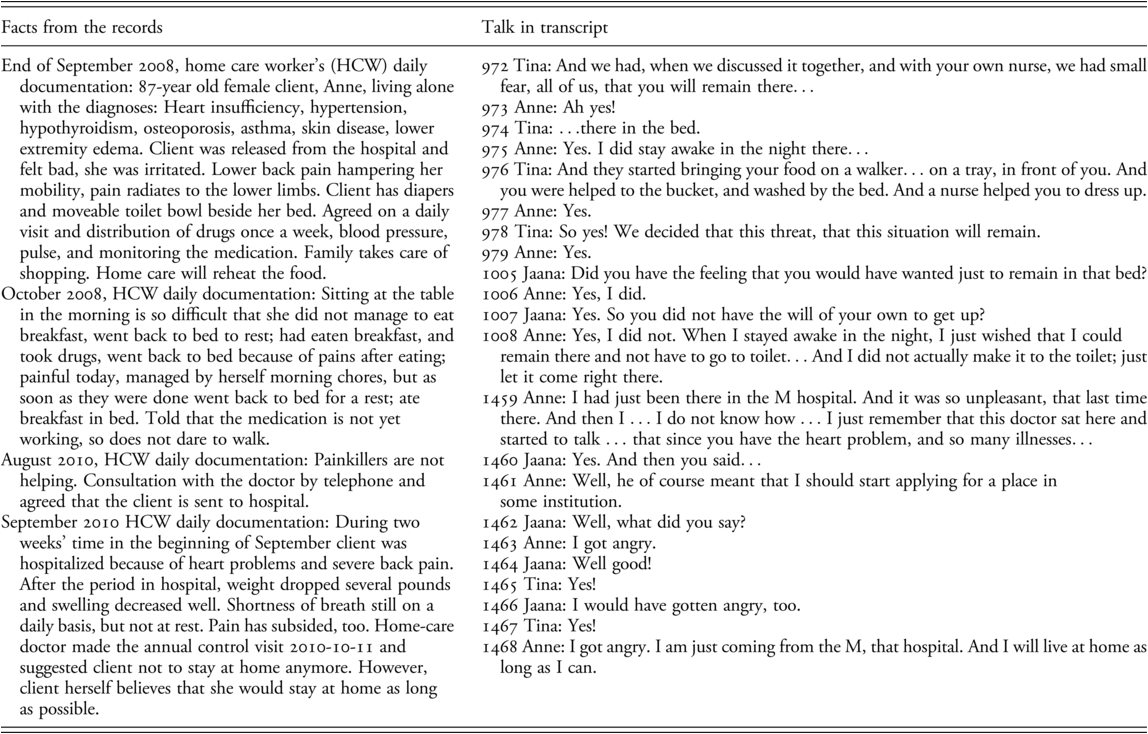
In the first segment of Table 5.2, Anne’s nurse Tina recollected that at the end of 2008, after Anne was sent home from the hospital, the nurses who participated in Anne’s home care were afraid that Anne would permanently remain in bed and become increasingly dependent on being helped by nurses in all daily routines. In the second segment, the researcher Jaana asked Anne whether she actually wanted to remain in bed at the time recollected by Tina. Anne replied that all she wanted was indeed to stay in bed, to not even have to go to toilet.
Little by little Anne got better with the support of home care, but in September 2010 she got worse again. She spent two weeks in the hospital. In the third segment, which occurred a few minutes later in the visit, Anne recollected an incident in which a physician suggested that Anne might start applying for a permanent place in a hospice or a similar institution due to her severe health problems. This suggestion made Anne angry, and she declared: “And I will live at home as long as I can.”
In other words, in September 2010 Anne was again practically bedridden and unwilling to get up, that is, increasingly dependent on help from professional caregivers. Basically, a person who is unable to get up from the bed does not belong to home care anymore. Yet very shortly after that, in October 2010, Anne was appalled by the suggestion that she should leave home and be placed in a hospice. She wanted to continue living at home with a significant degree of autonomy. Notice that this conflict of motives was also emotionally quite strongly experienced by both Anne and the nurses. Anne talked about anger (turn 1463: “I got angry”); the nurse talked about fear (turn 972: “…we had small fear, all of us, that you will remain there…”).
5.4.2 Forming a Germ Cell
The formation of standing up from the chair as a germ cell came up in four segments of the visit (see Table 5.3).
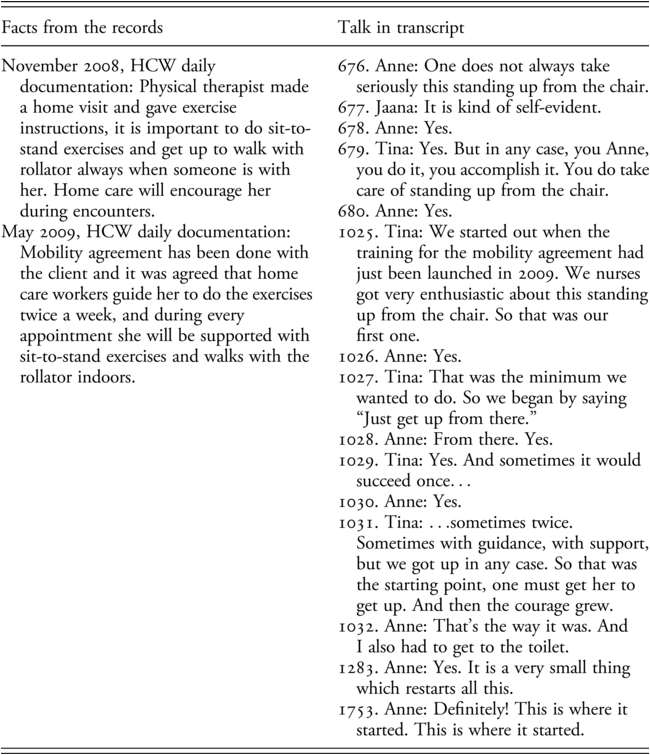
In the first segment, the ubiquitous and self-evident character of standing up from the chair was discussed. In the second segment, Tina and Anne reconstructed in some detail the beginning of the rebuilding of Anne’s mobility by means of “Just get up from there” (turn 1027). In the third segment, Anne pointed out that “It is a very small thing which restarts all this” (turn 1283). In the fourth segment, she again emphasized that “This is where it started” (turn 1753). It seems clear that in Anne’s case standing up from the chair, or from the bed, was indeed the beginning and foundation upon which later achievements were built.
5.4.3 Examining the Germ Cell Model
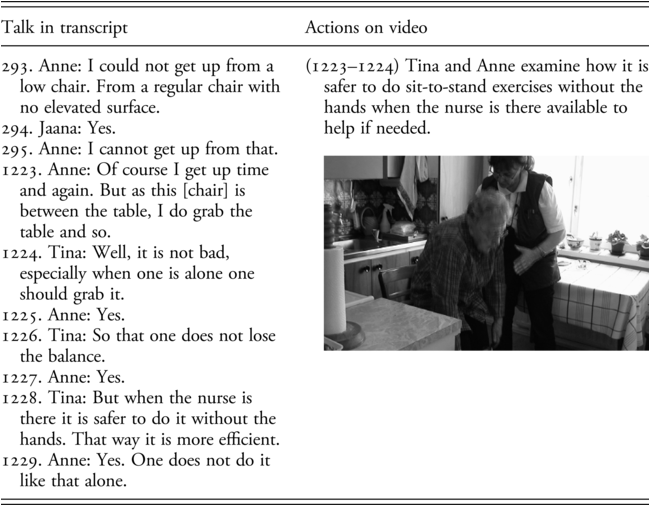
There were two segments in which the germ cell was examined, to illuminate its limits. In the first segment reproduced in Table 5.4, Anne explained that she could not get up from a low chair without support. In other words, the model worked well with a relatively high kitchen chair, but not with a low armchair or sofa in which the angle of the knees made getting up difficult. In the second segment, Anne pointed out that she in fact often used the table as support even when she was getting up from a kitchen chair. Tina responded by explaining that it is indeed safer to use support when one is alone, but when the nurse is present, one should do it “without the hands” as that is more efficient (turn 1228). This made it clear that the model was not a dogmatic prescription. Deliberate shifts between the poles of safety and autonomy were needed.
5.4.4 Implementing the Model by Ascending to the Concrete
The visit was rich in segments dealing with the implementation of the germ cell and ascending toward the concrete. We identified six trails of implementation and expansion of the germ cell. These were (1) straightening of the back and gaining a better posture, (2) taking regular walks, (3) using sit-to-stand as a diagnostic aid, (4) teaching relatives to do mobility exercises, (5) setting the table, and (6) being in a better mood, taking care of oneself. The meaning of these six trails is clarified with the help of the data displayed in Tables 5.5 to 5.10.
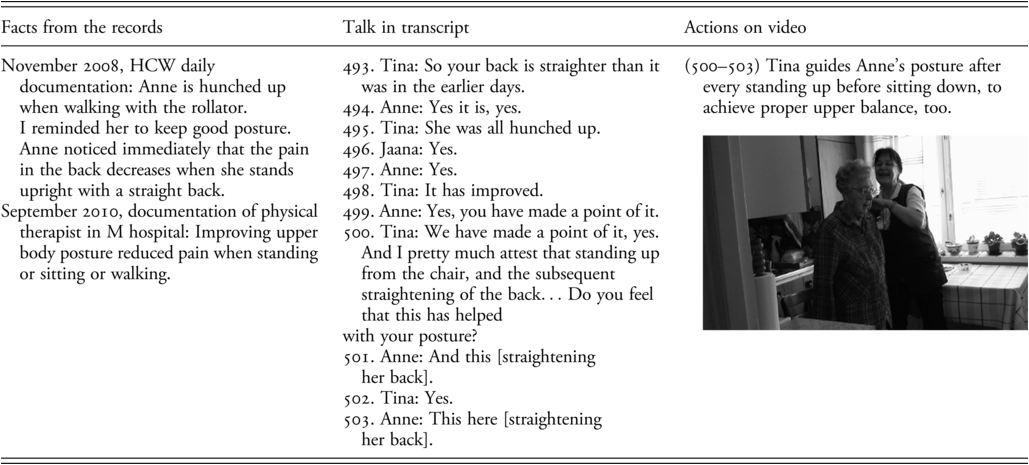
The first trail toward the expanded concrete was manifested in a segment in which the participants discussed Anne’s straightening of the back and gaining a better posture as a result of sit-to-stands (Table 5.5). This segment is interesting in that it began with verbal reconstruction of the past (turn 495: “She was all hunched up”) and simultaneously proceeded to here-and-now enacted physical implementation in which Tina and Anne jointly displayed and examined Anne’s posture (see the photo in Table 5.5). The joint physical enactment was accompanied by minimal verbal attunements (turns 501 to 503).
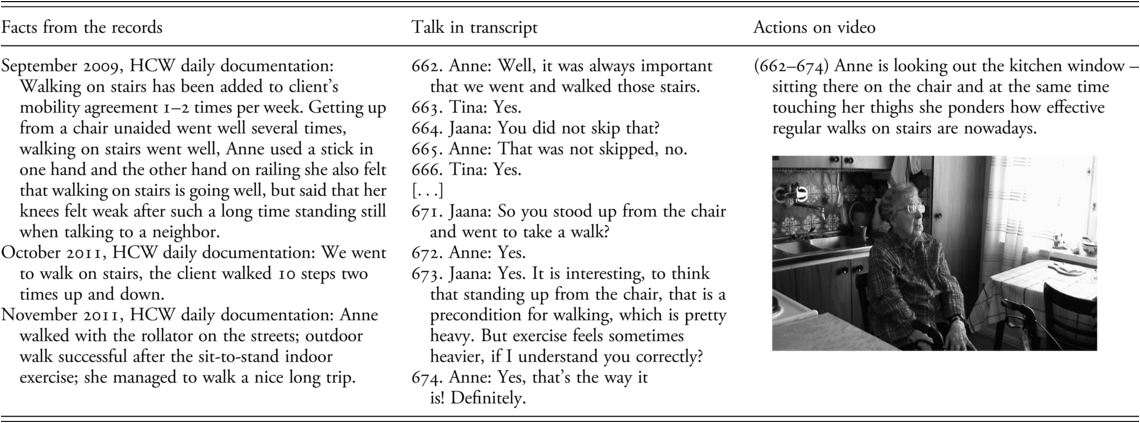
The second trail toward the concrete was the taking of regular walks into the stairs of the apartment (Table 5.6).
Anne emphasized that walking the stairs was never skipped (turns 664–665). Jaana pointed out the direct continuity from standing up from the chair to walking. Anne agreed. While the transition from standing up to walking may seem self-evident, it is not at all so for a frail old person. Walking regularly up and down the stairs is literally a trail that expands one’s mobility from the small germ cell toward more open-ended movement in space. The records show that this expansion eventually led to lengthy walks outside the house.
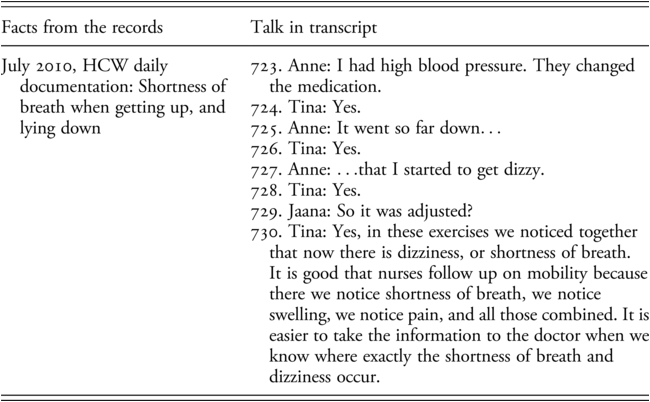
The third trail consisted in using sit-to-stand as a diagnostic aid for noticing dizziness, shortness of breath, and pain in the client (Table 5.7).
In the segment displayed in Table 5.7, Anne took up the fact that her blood pressure medication was changed (turn 723) after she and her nurse noticed that she became dizzy when performing the sit-to-stands (turn 727). Tina expanded on this experience, pointing out the broad uses of sit-to-stand as a diagnostic aid. It is noticeable that sit-to-stand was jointly and collaboratively used as a diagnostic device. It was a thoroughly shared germ cell, constructed, used, and expanded in social interaction.
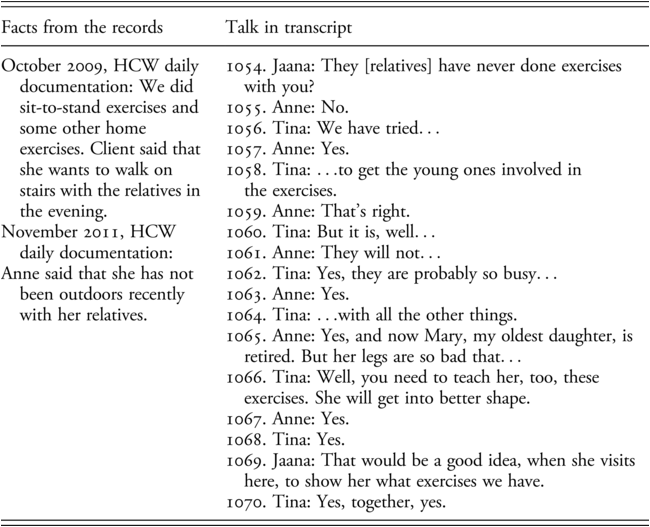
The fourth trail was that of teaching the client’s relatives to do mobility exercises (Table 5.8).
The segment in Table 5.8 is interesting in that again the conversation began with reconstructing the past (Turn 1056: “We have tried…”) but then it moved toward the future, envisioning possible new collaborative actions to be conducted with relatives (Turn 1066: “Well, you need to teach her, too”). This demonstrates the dynamic nature of implementation as an open-ended search for new trails toward the concrete.
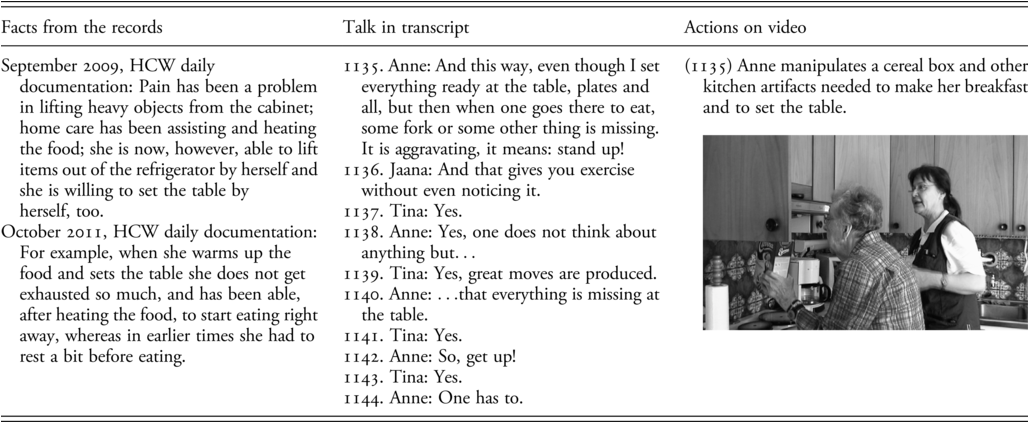
The fifth trail was that of setting the table. The client reported on having turned the daily chore of setting the table into an extension of the germ cell of standing up from the chair (Table 5.9).
Anne’s account in the segment displayed in Table 5.9 is almost a textbook example of the uses of double stimulation, that is, the power of material artifacts in the enhancement of human will and action in the face of a conflict of motives (Sannino, Reference Sannino2015, Reference Sannino2020, Reference Sannino2022). To put it in somewhat simplified terms, Anne more or less deliberately forgot some utensils when setting the table; the missing utensils then served as second stimuli that prompted Anne to make the effort and stand up from the chair to fetch what was missing.
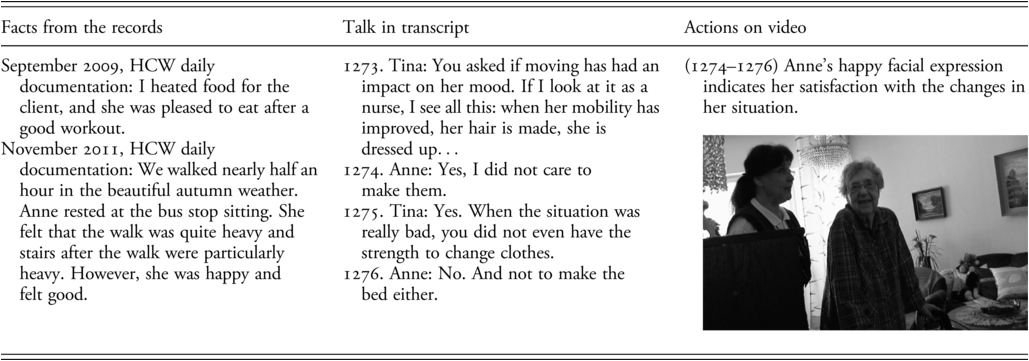
The last trail was that of being in a better mood and taking care of oneself and one’s apartment as a consequence of the increased mobility (Table 5.10).
Anne’s happy face in the photo in Table 5.10 tells perhaps more than the transcript. It was corroborated by the home care worker’s documentation from November 2011, reporting Anne’s happiness and good feeling after they “walked nearly half an hour in the beautiful autumn weather.”
The six trails taken together may be seen as multidirectional expansion of the germ cell. If not yet a fully concrete mode of sustainable mobility, the trails taken together are at least a strong indication of the possibility of forming such a new, embodied theoretical concept and way of life.
5.4.5 Reflecting on the Process and its Outcomes
In the transcript of the home care visit, we identified several small segments in which Anne and Tina reflected on the procedures and outcomes of the mobility exercises. Table 5.11 displays two of those. The first reflection was focused on procedures, and the second one was focused on outcomes.
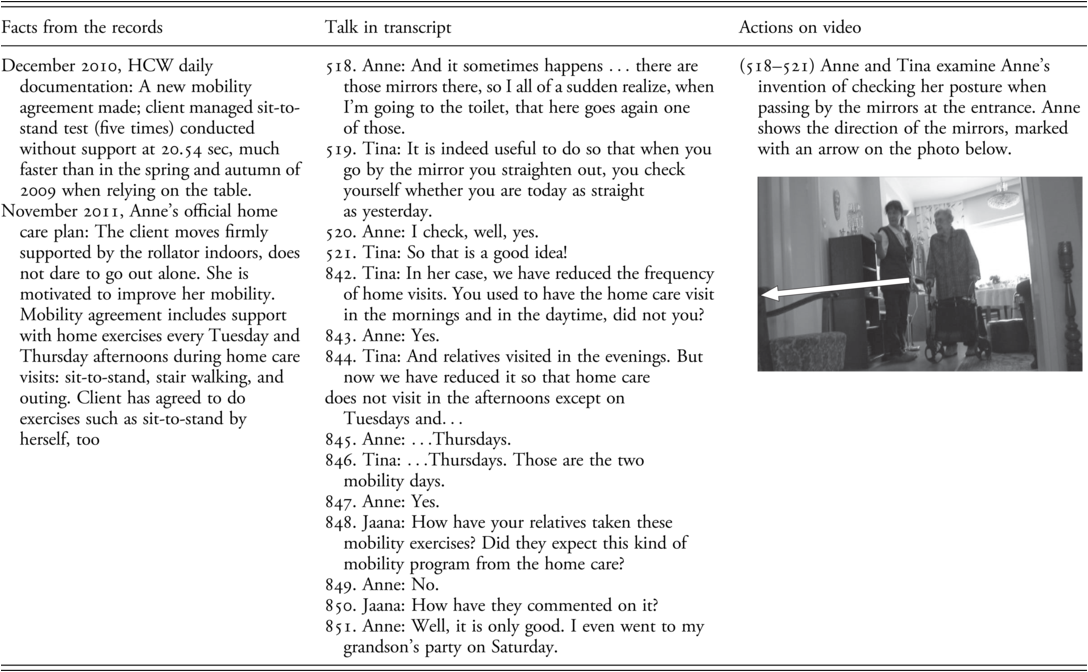
In the first segment in Table 5.11, Anne took up her use of the mirrors as instruments for checking and correcting her posture. This was another interesting and innovative way of using the material artifacts of the environment to support reflective concept formation. In the second segment, Tina reported that the mobility exercises had made it possible to reduce the frequency of home care visits to Anne’s house. Anne also mentioned that she had even attended her grandson’s party recently. These were outcomes that had significance and consequences for Anne, for the home care services, and for Anne’s family.
5.5 Interactive Physical Enactment
Tables 5.4 to 5.6 and Tables 5.9 to 5.11, in the column “actions on video,” present six examples of interactive physical enactment which contributed to accomplishing the ascending from the abstract to the concrete in the formation of an expansive concept of sustainable physical mobility. Three types of enactment may be identified in these examples.
The first type of enactment was that of physically performing and/or examining movements or exercises aimed at the new concept of mobility. Examples of this type of enactment are presented in Tables 5.4 and 5.5. In the former example, Tina and Anne examined how it was safer to do sit-to-stand exercises without the hands when the nurse was there, ready to help if needed. In the latter example, Tina guided Anne’s posture after every standing up before sitting down, to achieve also proper upper balance. These enactments were more than rote repetitions of prescribed movements. They were saturated with interactive investigation and experimentation, aimed at pushing forward in the development of mobility.
The second type of enactment was that of using material artifacts of the environment to enhance the concept formation. Examples of this type of enactment are presented in Tables 5.9 and 5.11. In the former example, Anne manipulated kitchen artifacts needed to make her breakfast and to set the table. This physical demonstration was intertwined with Anne’s verbal reconstruction of how she would forget some utensils when setting the table; the missing utensils would then serve to prompt Anne to make the effort and stand up from the chair and fetch what was missing. In the latter example, Anne and Tina examined Anne’s invention of checking her posture when passing by the mirrors in the entrance. These two were perhaps the most powerful examples of Anne’s inventive and dynamic engagement with the emergent concept of mobility.
The third type of enactment was that of using bodily gestures and facial expressions to enhance the interactive construction of an observation, idea, or feeling. Examples of this type of enactment are presented in Tables 5.6 and 5.10. In the former example, Anne touched her thighs to explain how effective were the regular walks on stairs. This gesture effectively connected the notion of regular walks to the important aim and effect of strengthening the thigh muscles. In the latter example, Anne displayed a happy facial expression indicating her satisfaction with the changes in her situation. The facial expression made visible Anne’s present condition and thus effectively complemented and enriched Anne’s verbal utterances which focused on the negative features of her past condition.
5.6 Discussion
At the beginning of the analysis, I asked: Can we identify a germ cell of a new concept of mobility in home care workers’ and clients’ practical efforts to integrate physical mobility exercises into the routines of home care services and the client’s daily chores? Standing up from the chair was our candidate for such a germ cell. An analysis based on a single case is necessarily limited, but I maintain that Anne’s case lends strong support to the hypothesis. The case enriches our understanding of this germ cell. An aggravated conflict of motives made standing up a vital focus of joint efforts at the beginning of Anne’s case. Standing up from the chair remained the solid core and object of reflection through the process of forming the embodied concept of sustainable mobility in Anne’s case.
The germ cell was formed through repeated collaborative physical enactment. Interestingly enough, there was little evidence of continuing use of the visual exercise brochure. It seems that the bodily action schemas and associated physical artifacts (chairs, tables, stairs, utensils) served as a rich reservoir for mediation and material anchoring which had made the brochure relatively unimportant. This does not mean that the concept formation process was nonverbal or unarticulated. Physical enactments were regularly accompanied by verbal exchanges between Anne and the nurse, and the reflective verbal reconstruction of events and experiences of the past two years was performed with ease and personal engagement.
My second question was: How and by what actions did the actors use and develop the germ cell to ascend toward the concrete? In the analysis of the home care visit, I identified segments that represent six trails of expanding from the abstract toward the concrete. The outcomes of the analysis are summarized in a diagrammatic form in Figure 5.3.

Figure 5.3 depicts ascending from the abstract to the concrete not simply as a vertical progression. Movement from the abstract germ cell toward the concrete is depicted as multidirectional, star-like expansion by means of trails in space. This view connects the dialectical theory of concept formation with the ideas of cognitive trails (Cussins, Reference Cussins1992) and lines of wayfaring (Ingold, Reference Ingold2007). Such a merger of ideas is, of course, also problematic and in need of further critical elaboration (see Engeström, Reference Engeström2009, p. 13). I will return to it in Chapter 8.
In the analysis, I did not identify segments containing specific actions of analysis that would lead to the discovery and modeling of the germ cell. This seems to be largely a consequence of the retrospective nature of the data. Such actions of analysis and modeling have probably initially been performed in a predominantly enactive mode and are thus very difficult to reconstruct afterward. What remains accessible is the client’s and the nurse’s firm understanding of and commitment to standing up from the chair as a cornerstone of sustainable mobility. This does not seem to be merely a dogma or a belief inculcated by authorities. How exactly, in the minute detail of situated actions, did the nurse and the client reach this understanding and commitment is beyond the reach of the present analysis.
My third question was: What was the role of embodiment and physical enactment, and in particular the role of embodied social interaction, in the process of ascending from the abstract to the concrete? The answer is twofold. On the one hand, the whole process of implementing the mobility agreement was built on jointly performing physical exercises right from the start. On the other hand, in the specific case of Anne, the home care visit analyzed above was to a large extent retrospective and verbal.
In spite of this peculiarity, I identified three types of important bodily enactments in the visit, namely (1) physically performing and/or examining movements aimed at implementing the new concept, (2) using material artifacts of the environment to enhance the concept formation, and (3) using bodily gestures and facial expressions to enhance the interactive construction of an observation, idea, or feeling. These interactive physical enactments were at the core of the concept formation process, not just peripheral additional features in it.
5.7 Conclusion
In what sense was this really concept formation? Could it not be explained simply as a case of teaching Anne some exercise routines and thus changing her behavior through repetition and habituation?
Concept formation in the wild is foundationally a societal and collective process that takes shape in a distributed fashion not reducible to individual learning, cognition, and behavior. Greeno and van de Sande (Reference Greeno and van de Sande2007, p. 12) see a concept “as a family of interrelated constraints and affordances that functions in organizing some aspect of the community’s activities.” Consequently, “conceptual growth by a community or group is change in the concepts and conceptions it uses in communicating, understanding, reasoning, solving problems, and making decisions, or in the distribution of participation in these activities across members of the community or group” (p. 12).
In concept formation in the wild, it is quite common that a new concept must be formed even though nobody knows exactly what it is (Engeström et al., Reference Engeström, Pasanen, Toiviainen, Haavisto, Yamazumi, Engeström and Daniels2005). The shape and contents of the new concept remain open and loose for an extended period (Löwy, Reference Löwy1992). As Greeno and van de Sande state, “practices also include concepts … that are implicit, that is, they are not specified by labels or discussed in specific terms in discourse, but still function, often normatively, in organizing the community’s activities” (p. 12). In the case discussed in this chapter, the emerging new concept of mobility did not have a fixed verbal label or an authorized description. However, several facts indicate that it was and is a genuinely expansive new concept, taking shape and having durable impact in the multi-organizational field of home care in the City of Helsinki and beyond.
The Helsinki Health Centre’s mobility agreement effort was awarded with the Mayor’s Prize for Achievement in 2010. The Helsinki Health Centre Strategy and Balanced Score Card document for 2011–2013 stated: “Home care clients have a care-plan which includes the mobility agreement. Measure for monitoring this is sit-to stand test as part of the mobility agreement: first measurement in first quarter and the final measuring in fourth quarter of the year, and the results will be recorded in electronic health database.” The Finnish National Audit Office’s Report (Reference Namian2010, p. 97) mentioned the Helsinki home care model and the regular sit-to-stand exercises as recommended advances. The city of Helsinki has decided to stabilize an appropriate concept of mobility support in home care. This concept must be sustainability-oriented, collaborative, and integrated into the daily activities of the elderly. In 2022 about seventy percent of all the city’s home care clients had a mobility agreement. The efforts of Anne and Tina analyzed in this chapter were spearheads of a much broader longitudinal and organizational conceptual change (for an overview, see Nummijoki, Reference Nummijoki2020, pp. 121–123).
What is new in the concept of mobility being developed in the daily encounters between old people and their home care workers? First of all, the emerging new concept is a way to transcend and overcome the contradiction between safety and autonomy, or between fear of falling and need to move. Mobility, as exemplified by standing up from the chair, is not just any movement or exercise. It is movement aimed at strengthening the muscles and improving the balance that make further movement possible and safe and reduce or eliminate the fear of falling. Smart movement overcomes the fear of movement. Secondly, the new concept embeds and integrates mobility into necessary everyday chores and actions, into the flow of the life activity of the old person. It is not movement and exercise as separate actions aimed at improvement of physical condition. It is movement necessarily needed to get by. Thirdly, the new concept sees mobility as accomplished and largely performed together, jointly between the client and the home care worker (or some significant other). It is not mobility of an isolated individual. As we saw in Anne’s case, this social distribution is also material distribution, relying on often innovative uses of everyday household artifacts such as chairs, tables, stairs, mirrors, and utensils. Finally and perhaps most importantly, the new concept frames physical mobility in terms of sustainability rather than in terms of achievement and competition. That is why I call the new concept sustainable mobility.
The analysis I have presented is based on a dialectical understanding of concepts as theoretical generalizations. It builds on the principle of ascending from the abstract to the concrete. In this framework, mastery of a theoretical concept consists in reflective movement from an initial abstraction – a germ cell – to multiple interconnected concrete manifestations and expansive implementations – and back. Such a concept is essentially a future-making device that cannot be reduced to a static definition.
The formation of complex, contested concepts in the wild is typically widely distributed in time as well as in social and physical space. Thus, ascending from the abstract to the concrete in the formation of a new concept of sustainable mobility for home care in Helsinki has been going on for a number of years. It is a movement that has no absolute ending point.
Prolonged processes of concept formation have been analyzed in detail retrospectively by historians, philosophers, and psychologists of scientific cognition (e.g., Arsen’ev, Bibler, & Kedrov, Reference Arsen’ev, Bibler and Kedrov1967). To capture and record key steps of such a temporally and spatially distributed process in vivo is a daunting challenge. In this chapter, the analysis is focused on a home care visit in which the delivery of services such as physical mobility exercises was intertwined with retrospective recollection and discussion of experiences and events from the past two years. This allowed me to reconstruct the main steps in the ascending from the abstract to the concrete in the case of Anne. While certainly less reliable than an analysis of a comprehensive longitudinal set of here-and-now observations and recordings, the procedure used here yielded richer data than a simple interview in which a subject is asked to recollect past events. In Anne’s case, the recollection took place within the context of a real care visit, inserted in the flow of actions and embodied interactions of ongoing care and service delivery. Such a mix gives weight to the recollections produced. For instance, when Anne told her nurse and the researcher that “I even went to my grandson’s party on Saturday” (turn 851 in Table 5.11), this recollection has weight. It can be easily verified, and its consequential importance is immediately visible: this old person went to a party on her own feet and on her own initiative, yet less than one year earlier she was fearfully confined to the bed.
To go beyond recollections and reconstructions in the analysis of ascending from the abstract to the concrete, the process may be deliberately condensed and intensified by means of formative interventions (Engeström, Reference Engeström2011; Engeström, Sannino, & Virkkunen, Reference Engeström, Sannino and Virkkunen2014; Sannino, Engeström, & Lemos, Reference Sannino, Engeström and Lemos2016). This opens up the methodological challenges of intervention research. If an intervention imposes on the subjects a procedure, such as ascending from the abstract to the concrete, how can it lead to new knowledge beyond the tautological result that the subjects do what they are asked to do? In studies of concept formation in the wild, these challenges must be faced and resolved (for starters, see Engeström & Sannino, Reference Engeström and Sannino2012b). I will return to this in Chapter 9.
In this chapter, I have analyzed in some detail the stepwise formation of a functional theoretical concept, following the principle of ascending from the abstract to the concrete. The principle of double stimulation is equally important for a dialectical understanding of concept formation, and the two principles are intertwined in practice. In the next chapter, I will examine concept formation in the wild through the lens of double stimulation. I will again use data and examples from our intervention studies on home care, specifically on the implementation of the mobility agreement to foster sustainable mobility among frail elderly persons living at home.


 Open access