


Thinking about the motivation behind my interest in concepts, I find myself recalling a memorable event early in my career. This event serves as a point of entry for discussing how my learning about concepts evolved – thereby also providing an overview of basic ideas in the present volume.
Memorable Event
The context of this memorable event was my doctoral dissertation at the University of Chicago, which analyzed the politics of squatter settlements in Lima, Peru. These lower-class communities were established through squatter invasions that occupied vacant land in the periphery of the city. Although members of these communities seized the land illegally and typically at night, there was frequently covert approval, or deliberate acquiescence, on the part of relevant authorities.
By forming the settlements, the residents created for themselves the opportunity to build and expand their own houses and in other ways take initiatives for developing their communities. This extensive self-help and problem solving was, in turn, sometimes seen by scholars as playing an important role in addressing poverty. Debates on squatter-settlement formation, among both scholars and policy makers, therefore became entwined with the broader discussion of poverty.
Researchers at the time commonly contrasted the world of squatter settlements with the experience of residing in slums (tugurios), located in established areas of the city and involving old, often deteriorated housing in which the residents were renters. They were often dangerous areas, commonly with lower levels of trust among neighbors, and they afforded far less opportunity for self-help and community problem-solving. Consequently, they placed key features of squatter settlements in sharp relief. The difference appeared to me relatively straightforward, and the contrast provided a valuable framing for my study.
When it came time for my dissertation defense in the autumn of 1970, the committee included Morton Kaplan, a distinguished international relations scholar, who pressed me on this contrast between squatter settlements and slums. He was not satisfied, feeling that I had not adequately nailed down the distinction. After a discussion in which he continued to express skepticism and frustration, he made a memorable comment: “Mr. Collier, can’t you be analytic?”
I was chagrined, and, not surprisingly, I became strongly motivated to learn about forming and operationalizing concepts, as well as finding effective ways to communicate about them.
Data Containers and “Good” Concepts
How should we understand this distinction between squatter settlements and slums? Giovanni Sartori’s (Reference Sartori1970) classic article on concept misformation had just been published, and it quickly became a point of reference among comparativists. Surely, no one could accuse Sartori of not being analytic.
Sartori’s article offered various suggestions. He argued that concepts were “data containers” (Reference Sartori1970: 1062). Following this metaphor, a central issue was whether the definition established a container that brought together empirical observations in a coherent way appropriate to the goals of the research – and to wider norms about meaning in the relevant substantive field.
In my study, a productive way of pinning down the difference between squatter settlements and slums was to distinguish between defining properties and variable properties.Footnote 1 Regarding defining properties, squatter settlements were lower-class communities, involving newly constructed housing, formed through occupying vacant land – and the residents typically were not renters. By contrast, the slums were also lower-class communities, but occupying preexisting housing, and the residents were renters. I treated the dimensions of self-help and community problem solving as variable properties. This contrast can also be stated in terms of an alternative framing: The defining properties were my independent variable, the variable properties my dependent variable.
It should be emphasized that squatter settlements versus slums was not a simple dichotomy. Over many years, squatter settlements became old communities, in some cases more like slums. In parallel, slums could be renovated, in effect making them more like new communities, and hence more like squatter settlements.
On the one hand, the inadequacy of a simple dichotomy is hardly surprising. Many valuable dichotomies can be, and possibly should be, treated in terms of gradations. Both approaches can be useful.
On the other hand, I was not well prepared to address this issue. The treatment of categorical versus graded relationships is a complex topic that scholars much more recently have debated in published research (Collier and Adcock Reference Collier and Adcock1999;Footnote 2 Brady and Kaplan Reference Brady and Kaplan2000).Footnote 3 The basic insight was clear: With change over time, patterns shift. To capture this change, the analyst could construct a zero-to-one scale, with slum scored as zero, squatter settlement scored as one, and gradations in between. Alternatively, the researcher might adjust the concepts with the addition of adjectives, for example “renovated slum” and “deteriorated squatter settlement.”
At the time, I did not have a handle on these issues, and this was doubtless part of Professor Kaplan’s concern about my study.
An obvious further point was that the data container was identified by a name – that is, the term that designated the concept.Footnote 4 The term facilitated and structured scholarly communication. “Squatter settlement” and “slum” were perhaps not lively labels, and concern with selecting terms led me to observe carefully other scholars’ choices about concept labels. Did their concepts and terms concisely and vividly pinpoint the distinctions and scope of meaning they sought to convey? Had they found the right vocabulary to communicate their arguments? These questions could be relevant to the titles of articles and books, to major concepts employed in a given analysis, to the names of variables, and to the scores on a given variable.
Many years later, John Gerring drew together his answers to these questions in his article “What Makes a Concept Good?” (Reference Gerring1999). Among his several criteria for good concepts (370) was that of “resonance,” that is, did the term reverberate? Resonance could help convince a reader that the term referred to a concept that made sense.
Gerring offered as an illustration one of my all-time favorite examples of compelling concepts, which definitely had high resonance: Albert Hirschman’s (Reference Hirschman1970) “exit, voice, and loyalty” as alternative responses to decline in firms, organizations, and states. This set of labels was remarkably vivid and self-explanatory. Gerring also cited Stephen Krasner’s (Reference Krasner1977) “makers, breakers, and takers” as alternative responses to the formation of international regimes – again, a compelling typology with high resonance.
Another example I have found especially compelling was the anthropologist John Murra’s (Reference Murra, Masuda, Shimada and Morris1985) idea of a “vertical archipelago.” This expression engagingly characterized the economic and social organization of Indigenous communities in the Andes mountains – involving clustering at different elevations. I was drawn to Murra’s concept given my work in Peru, and “vertical archipelago” was certainly another striking example of an intriguing concept with high resonance.
In the titles of my own publications, I also sought to use vivid terms – and hopefully valuable concepts. In D. Collier and R. Collier (Reference Collier, Berins Collier and Malloy1977) we used the title to pose the question “Who Does What, to Whom, and How?” to tease out the diverse power relationships entailed in subtypes of corporatism. “Democracy with Adjectives,” my article with Steven Levitsky (Reference Collier and Levitsky1997) likewise directly expressed our main idea, and with some resonance.Footnote 5 I liked the title Shaping the Political Arena (R. Collier and D. Collier Reference Collier and Collier1991), which conveyed the main focus of the book: the path-dependent process through which transitions at an earlier period structured the arena in which politics would be played out.
Squatter settlement and slum certainly did not rank with any of these high-resonance examples. Nonetheless, I thought the terms appropriate, and I continued to use them in my subsequent work.
Learning from Teachers and Colleagues
Looking beyond the issue of squatter settlements and slums, I learned a great deal over many years from teachers and colleagues – who helped me gain a better grasp of concepts and concept analysis.
When I started graduate school at the University of Chicago in 1965, I was strongly interested in Latin America, yet no faculty member in the political science department had that focus. As of my second year, I intended to write a dissertation on American politics, working with Theodore Lowi – himself a talented user of vivid concepts and terms. I planned to establish a new way of operationalizing his innovative typology (Reference Lowi1964) of “arenas of power”: distribution, redistribution, and regulation. Here, a typology had sparked my interest in pursuing a research project.
However, in 1967 Chicago hired Philippe Schmitter, and I thereby had an advisor to guide my research on Latin America. From the beginning of his career, Schmitter did innovative work with concepts. When he arrived at Chicago, he was developing models of regional integration in Latin America. In addition – in what became his 1971 book on Brazil – he played a key role in launching the large literature on corporatism, understood as a nonpluralistic system of group representation.Footnote 6
In subsequent decades, he followed an impressive path of introducing new concepts, covering a broad range of topics involving the intermediation of national, class, sectoral, and occupational interests.Footnote 7 The work on corporatism was a first step in this trajectory, which also encompassed wide-ranging innovation in the conceptualization of democracy.Footnote 8 The conceptualization of democracy included his idea of partial regimes (Schmitter Reference Schmitter1992), which served to focus the analysis of democratic consolidation. He also did extensive conceptual work on the European Union. In one article, he had the goal of “imagining the future of the Euro-polity with the help of new concepts” (Reference Schmitter and Marks1996: 121). Building on the interplay between territorial representation and functional representation, he constructed a typology that mapped out the structure of four alternative futures, involving different combinations of territorial and functional components: consortium, confederation, federal state, and condominium.Footnote 9
Further, Schmitter introduced a specific understanding of “conceptualist,” declaring himself an “unrepentant conceptualist” (Reference Schmitter2007: chap. 8). By this he meant a scholar whose contributions centrally involved formulating new concepts and refining established concepts. This was not a methodological commitment, but rather a substantive commitment. He argued that his conceptual innovations addressed theoretical anomalies; or bridged the insights of different disciplines; or came to grips with divergent paths of change in different world regions; or derived in part from the synergies of doing research in multiple languages. The novelty of his ideas did indeed have diverse sources, and he played a key role in pushing scholars to think about concepts – and sometimes to rethink their own concepts.
For example, in response to criticism of his initial formulation, he proposed that corporatism should be viewed not as a form of interest representation, as he had suggested in 1974, but rather as a form of interest intermediation (Reference Schmitter1977: 35–36n1). This change pointed to an interaction, as opposed to what might potentially be seen as the one-way relationship of representation.
Overall, Schmitter’s work was an inspiration for many scholars – and certainly for me. His concepts were clear, vivid, and useful. The methodology of concept analysis has the fundamental goal of refining concepts to achieve precisely these qualities – that is, clarity, vividness, and usefulness. Hence, although he saw his priorities as a “conceptualist” as a substantive commitment (as mentioned), for me his work added up to strongly endorsing the methodological enterprise of concept analysis.
My first faculty appointment was at Indiana University, Bloomington, from 1970 to 1978, where the political science department proved to be intellectually lively and engaging. Two influences especially merit note. First, my colleague Alfred Diamant had published a book (Reference Diamant1960) that analyzed corporatism in Austria in the period following World War I. This was a remarkable coincidence, given Schmitter’s focus and the relative novelty of the topic in US political science at the time. This intrigued me, and it also intrigued Schmitter, who twice during our years in Bloomington came down from Chicago to visit Diamant and other colleagues.
Second, at Indiana University I was greatly struck by the work of Elinor and Vincent Ostrom on public choice theory. At that time, they formulated their ambitious goal to create “a different approach to the study of public administration” (V. Ostrom and E. Ostrom Reference Ostrom and Ostrom1971: 203). In this framework, they worked with emerging concepts such as “the tragedy of the commons” – the tendency toward depletion of common-pool resources; and the “exclusion principle” – involving the question of who can get access to a resource. The lucidity of their analysis made a strong impression, convincing me that if the methodology of concept analysis could contribute to creating concepts with this degree of clarity, it was a worthwhile endeavor. It should be added that their approach likewise made a strong impression on the Nobel Prize Committee for Economics, which in 2009 awarded the prize to Elinor Ostrom.
In 1978, I moved to Berkeley, which was a wonderful setting for developing ideas about concepts. My collaboration with Henry Brady was pivotal, given his long-standing interest in dissecting and measuring concepts – for example, ethnic identity (Brady and Kaplan Reference Brady and Kaplan2000) and political participation (Brady, Verba, and Schlozman Reference Brady, Verba and Schlozman1995/96). We twice taught a joint graduate seminar on concepts and measurement, both times drawing a large number of students. One important product of this collaboration was the two editions of Rethinking Social Inquiry (2004, 2010).
The political theorist Hanna Pitkin was a towering figure in the political science department. I was fascinated by the skill with which she untangled complex, and often normatively contested, concepts – which too often were given sharply contrasting meanings by different scholars: representation, justice, reification, utilitarianism, “the social,” and a good many others (Pitkin Reference Pitkin1967, Reference Pitkin1972, Reference Pitkin1987, Reference Pitkin1990, Reference Pitkin1998).
Kenneth Jowitt’s (Reference Jowitt1974, Reference Jowitt1983) Weberian reconceptualization of Leninism and his analysis of neotraditionalism were very influential in the department. Graduate students flocked to his courses, drawn by his remarkable talent for connecting compelling concepts with rich detail. One semester, I audited his undergraduate course.
I also learned a great deal from Ernst Haas, who had a long-standing interest in concept analysis. His earlier work included untangling the concepts of balance of power (Reference Haas1953) and collective security (Reference Haas1955). Subsequently he worked extensively with the concept of epistemic communities – that is, networks of experts who share a given theory of knowledge.Footnote 10 (It may be noted that Ernst Haas had been Schmitter’s dissertation advisor.)
I was likewise strongly influenced by the Berkeley school of cognitive linguistics, within which Eleanor Rosch (Reference Rosch1973) was a pioneer. George Lakoff’s extension of this tradition centrally included his theory of conceptual metaphor (Lakoff and Johnson Reference Lakoff and Johnson1980). He also analyzed “radial” conceptual structures (Lakoff Reference Lakoff1987). In the radial pattern, concepts did not have sharp boundaries and the subtypes were only partial approximations of the root concept. This perspective stood in sharp contrast to Sartori’s view of well-bounded concepts.Footnote 11 Lakoff strongly influenced my own research, leading me, in my coauthored work with Mahon (Collier and Mahon Reference Collier and Mahon1993) and Levitsky (Collier and Levitsky Reference Collier and Levitsky1997),Footnote 12 to convey the idea of partial approximations with the expression “diminished subtypes.” We argued that this form of subtype was a valuable tool for avoiding conceptual stretching.
I likewise benefited greatly from spending a fellowship year at the Stanford Center for Advanced Study with Mark Turner, coauthor of Lakoff’s metaphor book (Lakoff and Johnson Reference Lakoff and Johnson1980). Turner was an excellent interlocutor, and this year provided myriad opportunities for discussing conceptual issues.
Transition to Publishing on Concepts
In the 1990s, I began to publish a series of articles on the analysis and application of concepts.Footnote 13 This work grew out of research with Ruth Berins Collier that led to our coauthored book Shaping the Political Arena: Critical Junctures, the Labor Movement, and Regime Dynamics in Latin America (Reference Collier and Collier1991). The book analyzed eight countries across seven decades of the twentieth century,Footnote 14 posing major challenges of conceptualization and comparison.
In Shaping the Political Arena, we explored how, in the initial decades of the twentieth century, the state – and often political parties acting through the state – introduced different forms of control and mobilization of the newly emerging working class. We conceptualized this episode as the “initial incorporation period,” defined as “the first sustained and at least partially successful attempt by the state to legitimate and shape an institutionalized labor movement” (Reference Collier and Collier1991: 783).
A central argument was that the incorporation period should be conceptualized as a critical juncture. This term characterized historical transitions that left an enduring legacy, involving the argument that once the critical juncture occurred in a specific way, this strongly influenced subsequent outcomes through a path-dependent process. Using other terms, a critical juncture may be thought of as a historical watershed, or a point of inflection, that yields a fundamental, enduring legacy. In our study, this legacy was the emergence and stability of distinct types of party systems.
Crucially, the causal connection between critical juncture and legacy could not be established unless both concepts were formulated and operationalized with great care. There was always the risk that analysts might overstate the stability of a given legacy, stretching the concept by applying it to cases that did not fit. Alternatively, researchers might fail to recognize the stability of a particular outcome, thereby erring in the other direction.
Many other dilemmas arose as well. To note one of them, in Argentina incorporation-type initiatives were taken at the provincial level prior to the rise of Perón at the national level (Gaudio and Pilone Reference Gaudio and Pilone1984). Were these subnational initiatives a critical juncture, or would that conclusion stretch the concept?Footnote 15
Undertaking these comparisons certainly pushed us to grapple with the formation and refinement of concepts, together with the challenge of moving back and forth between concepts and cases. This experience further stimulated my interest in concept analysis and in how it could help us advance our project. Two examples of tools that were important to us were disaggregation and typologies.
Disaggregation. The concept of corporatism was a central idea in the literature that we were addressing on the relationship between organized labor and the state. Yet, as we had put it in one article, for some purposes this concept “casts too broad a net” to be useful (D. Collier and R. Collier Reference Collier, Berins Collier and Malloy1977: 505). To address this problem, we built on Schmitter’s (Reference Schmitter1974) idea that corporatism involved an exchange.
Based on a quantitative data set we created on Latin American labor law, we disaggregated corporatism into two dimensions and explored their interplay over time in different countries: (1) inducements, or benefits which motivated unions to cooperate with the state, and (2) constraints, or controls which the state imposed on unions. This yielded fine-grained insight, for example, into the rise of Perón in Argentina during the incorporation period. Here we found strategic shifts in the balance between inducements and constraints as Perón sought to mobilize – but also control – the labor movement.
Typologies.Footnote 16 Organized systems of types – that is, typologies – played a central role in Shaping the Political Arena. Important parts of our argument involved typologies with more than two dimensions, and we faced the challenge of conveying this complexity to the reader. One solution can be illustrated with the treatment of party heritage.
We conceptualized the party heritage of incorporation in terms of four types of party systems: integrative party systems, stalemated party systems, multiparty polarizing systems, and systems with electoral stability and social conflict.
These four types of party structures were derived from three dimensions, centrally involving the position of the labor movement vis-à-vis the party system. In Figure 0.1, these three dimensions are represented with a cube: (1) union movement organizationally linked to party or parties of the center versus the left; (2) union movement usually in governing coalition; (3) stable centrist majority bloc in electoral arena. Based on these dimensions, the four types – with two countries corresponding to each – were located at four of the eight corners of the cube. Thus, as can easily occur with typologies based on multiple dimensions, across a given set of cases not all positions in the typology were occupied.
Dimensions of the party heritage: centrist majority bloc, union–party links, and coalitional role of unions.
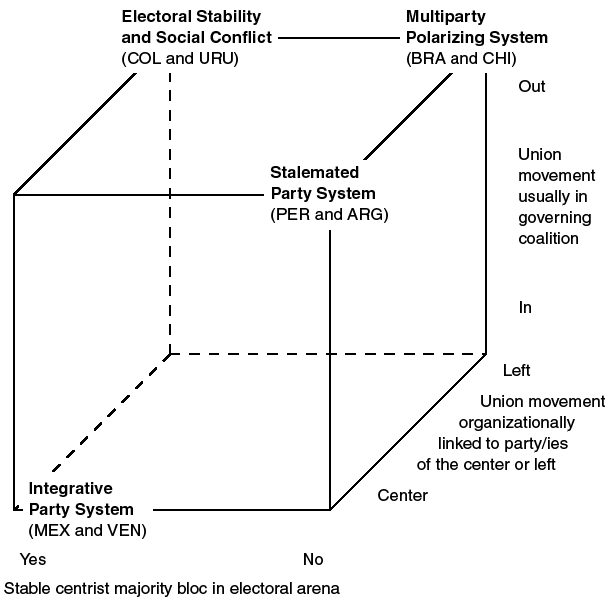
Figure 0.1 Long description
The image presents a two-dimensional plot with horizontal and vertical axes. The vertical axis represents “Electoral Stability and Social Conflict,” while the horizontal axis shows “Multiparty Polarizing System.” Each quadrant of the chart defines different party system categories, including “Integrative Party System” (bottom left), “Stalemated Party System” (middle), “Electoral Stability and Social Conflict” (top left), and “Multiparty Polarizing System” (top right).
The cube thus organized a great deal of information about the heritage of the critical juncture, presenting it in a readily understood form. Three dimensions were hard to convey to the reader, and we found the cube a great help in doing so.
Summing Up
These many experiences strongly influenced my work with concepts.Footnote 17 I encountered concepts that were intriguing and brought together ideas in an illuminating way. Yet such concepts can often be made more useful and given greater analytic leverage. Methods for analyzing concepts seek to achieve precisely this goal, which makes developing these methods all the more a worthwhile enterprise.
For example, the concept of corporatism was refined both by disaggregation and by shifting the overarching concept of which it was a specific type – from representation to intermediation. As we will see later in this book, it was also refined through the creation of subtypes. Corporatism and many other compelling concepts are not static. Rather, they present scholars with opportunities to make them more useful and to fine-tune their application. Of course, the risk of an undesirable proliferation of terms can certainly arise. However, as with the example of corporatism, these innovations in fact served to bring out more clearly the ideas that made the concept interesting to begin with. Innovation routinely strengthens concepts.
This observation leads to a final point. In my teaching over the years, at both the graduate and the undergraduate level, a central concern of mine has been to convey precisely this idea: Concepts can be improved, and this is well worth doing. I commented earlier that Berkeley has been a wonderful setting for developing ideas about concepts, and this has definitely been true in my classes. It has been my good fortune to have wonderful students, and they have taught me a lot. Working closely with them has helped me to continue learning about concepts.
Overview of This Book
Against this backdrop, I now turn to the organization of this book
The chapters that follow include nine of my previously published articles – all but one of them coauthored – juxtaposed with thirteen research notes by other authors, who map out ongoing innovation in work on concepts. My chapters might be seen as building blocks that provide a point of departure. The research notes then offer diverse perspectives, a couple of them in significant disagreement with my own approach.
Part I Traveling, Stretching, and Conceptual Hierarchies
The challenge of extending ideas and arguments developed in one context to other contexts – across time and space – is an abiding concern in the social sciences. Correspondingly, the first section focuses on the debate about conceptual stretching launched by Sartori. My three chapters in this section, as with my chapters in the rest of the book, have been somewhat revised. The goal has been to avoid misunderstandings generated by earlier versions.Footnote 18
Chapter 1, by David Collier and James E. Mahon, contrasts two perspectives on concepts. It opens with a concise summary of Sartori’s approach, emphasizing his focus on kind hierarchies and concepts with well-defined boundaries. The discussion then turns to family resemblance concepts and radial structures, emphasizing the importance of concepts that lack sharp boundaries and involve part–whole hierarchies. Working with such concepts opens a new avenue for dealing with conceptual stretching.
David Collier and Steven Levitsky, in Chapter 2, advance a series of arguments about “democracy with adjectives.” They extend the idea of concepts that lack sharp boundaries, focusing on the comparative democratization literature that emerged beginning in the 1980s. The chapter explores different forms of innovation in relation to a conceptual hierarchy – for example, creating subtypes, shifting the overarching concept, and shifting the root concept. The focus above all is on what they call diminished subtypes. They seek both to describe the literature from this perspective and to show how use of diminished subtypes serves to avoid conceptual stretching. The chapter includes a glossary of terms.
In Chapter 3, David Collier explores the concept of “corporatism” in the study of Latin American politics. In parallel to the chapter on democracy, this chapter shows how partially similar innovations – again involving subtypes, overarching concept, and root concept – played out in research on corporatism. The discussion concludes by suggesting that, toward the end of the twentieth century, corporatism might well be eclipsed as an important political phenomenon and, correspondingly, as a significant concept in the field.
Research Notes on Traveling, Stretching, and Conceptual Hierarchies
These three research notes take the discussion in quite different directions.
Kurt Weyland, in Chapter 4, argues for the importance of maintaining sharp conceptual boundaries in what he calls the present era of democratic anxiety. Weyland connects his argument with the current period of fundamental threats to democracy. He suggests that we need to respect the conceptual boundaries of basic political terms in order to avoid treating them as slogans that can be extended without adequate attention to their meaning. One of his examples is fascism. Weyland’s concern with boundaries parallels Sartori’s position, yet is adopted for a very different reason.
In Chapter 5, Michael Coppedge connects the discussion of “democracy with adjectives” to the insights of the V-Dem Project: The Varieties of Democracy Project – a major, large-scale, collaborative data collection initiative. Scholars now work in an era when major quantitative data sets are available for many more topics and concepts, a trend that V-Dem has creatively supported. Coppedge’s analysis puts the resources of V-Dem to excellent use, including a nuanced analysis of thresholds as one makes the transition from qualitative to quantitative data. He likewise uses the Venn diagrams of set theory to offer a fresh perspective on diminished subtypes. Overall, Coppedge’s discussion nicely demonstrates how V-Dem has greatly extended the conceptual and empirical horizon of scholars in the field of comparative and international studies.
Sarah Chartock, in Chapter 6, discusses the importance of corporatism in Latin America during the period 1995–2023. She suggests, contra Collier’s article on corporatism in this volume, Chapter 3, that the concept of corporatism remains highly relevant for understanding new social movements that emerged during four decades beginning roughly around 1980. Thus, the political phenomenon traveled, and the concept traveled with it.
Before we proceed to Part II, a final methodological observation should be made about analyzing conceptual hierarchies. The Kapiszewski, Groen, and Newman article “Constitutionalism with Adjectives” (Reference Kapiszewski, Groen and Newman2024) builds on a remarkable dataset to place the discussion of hierarchies on an entirely new footing, based on N=1,621. The analysis of constitutions taps key features of national political regimes, a focus parallel to that of Collier and Levitsky, discussed earlier (Chapter 2, this volume). Readers should see Kapiszewski et al., jointly with the Gerring-Cojocaru large-N study of contested concepts (Chapter 14, this volume), as pointing to a novel and valuable approach to concept analysis based on a large N.
Part II Typologies and Concept Formation
Typologies can play a central role in concept formation and comparison.
In Chapter 7, David Collier, Jody LaPorte, and Jason Seawright show how typologies can contribute to concept formation, measurement, and analytic rigor. This chapter provides an overview of debates on typologies, including the earlier vehemence of many quantitative researchers in rejecting typologies. It makes the case against those arguments, discusses different kinds of typologies, presents suggestions for good practices, and offers many illustrations. Table 7.1 lists kinds of typologies, and an appendix presents an extended inventory of examples, drawn from diverse substantive fields.
Research Notes on Typologies
The research notes illustrate the contribution of typologies to concept formation and comparison in both quantitative and qualitative research.
Simeon Nichter, in Chapter 8, explains how he used typologies to structure his quantitative research on political clientelism. He focuses on the contrast between persuasion and mobilization; efforts to shape the territorial composition of the electorate; the difference between electoral and relational clientelism; and the issue of conceptual stretching.
In Chapter 9, Danielle N. Lussier, explores the role of typologies in the primarily qualitative work within the field of post-communist studies. She provides a broad overview of the typologies that have emerged, calling the process of constructing and refining typologies, “typologizing.” She shows concretely how the field would have gained from more careful attention to developing and strengthening typologies.
Part III Untangling Concepts: Contestation, Pragmatism, and Disaggregation
Conceptual confusion and ambiguity are recurring problems in the social sciences, and the ongoing quest to address these problems is a central challenge of concept analysis. Sometimes scholars address this challenge with careful theoretical reasoning; alternatively, they may adopt a more pragmatic approach. Conceptual disaggregation is a standard tool employed here.
In Chapter 10, David Collier, Fernando Daniel Hidalgo, and Andra Olivia Miljanic introduce the idea of contested concepts. W. B. Gallie’s (Reference Gallie1955) classic article is a benchmark in research on this topic. The authors offer a detailed assessment of Gallie, evaluating debates on his ideas among political theorists. Two examples of contested concepts receive special attention: democracy and rule of law. Table 10.1 provides a concise summary of the analysis.
In Chapter 11, David Collier and Robert Adcock advocate a pragmatic approach to how scholars should make basic choices about formulating and measuring concepts. Their analysis focuses on sharp disagreements among prominent scholars as to whether the distinction between democracy and nondemocracy should be treated as dichotomous or graded. In the authors’ view, generic claims that the concept of democracy is inherently dichotomous, or is inherently graded, are incomplete. Part of the burden of demonstration should rest on more specific arguments about the goals of research. The authors thus take the pragmatic position that how scholars understand and operationalize a concept can and should partly depend on what they are going to do with it.
Chapter 12, by Ruth Berins Collier and David Collier, proposes disaggregating the concept of corporatism. This concept has usefully called attention to the importance of systems of interest group politics based on noncompeting groups that are officially sanctioned, subsidized, and supervised by the state. Yet these patterns have appeared in such diverse political contexts that the concept may be too broad to be useful. Based on an analysis of labor law in Latin America, this chapter argues that corporatism can be disaggregated so that it illuminates, rather than obscures, the contrasting power relationships with which it is associated.
Research Notes on Untangling Concepts
In Chapter 13, Scott Straus explores a key example of a contested concept: genocide. He especially focuses on the interplay between the enormous political importance of the concept and the degree to which it is embedded in international law. A postscript discusses – from the perspective of Straus’ analysis – the concept’s relevance to the war in the Middle East that began on October 7, 2023.
In Chapter 14, John Gerring and Lee Cojocaru take the analysis of contested concepts in a new direction: a large-N study focused on hundreds of concepts. They establish criteria for assessing both degree of contestation and reasons for contestation. Among the factors that influence whether a given concept is likely to be contested: It is more widely used, more abstract, and has a positive or negative normative valence. Differences by academic discipline are also important.
Marcus Kurtz, in Chapter 15, argues that disaggregation is an underappreciated tool for the formation and refinement of concepts. He shows, for example, how it facilitates dealing with cases that fit awkwardly in a given frame of comparison. Disaggregation can also address “middle cases,” as in the literature on hybrid regimes, and can help resolve the problem of tautology. He connects his analysis with the V-Dem project (Chapter 5, this volume) – the major, collaborative effort to create disaggregated measures of democracy – thereby linking the discussion to the idea of “granularity” identified with that project.
Part IV Measurement Validity
Careful work with concepts is valuable in its own right. Yet to carry out empirical analysis, researchers must connect their concepts with observations based on valid tools of measurement. This section addresses challenges that arise.
In Chapter 16, Robert Adcock and David Collier introduce key distinctions that illuminate discussions of measurement. The idea of systematized versus background concepts reminds researchers that for most concepts, there is an implicit background meaning that imposes constraints on specific operational definitions. The authors likewise offer an inventory of the basic levels and tasks entailed in connecting concepts with observations.
Jason Seawright and David Collier, in Chapter 17, focus on the options and trade-offs entailed in four approaches to measurement validation: the levels of measurement tradition, structural equation modeling with latent variables, the pragmatic approach, and the case-based method. They suggest that a high-quality measure will have relatively little measurement error, a strong argument for ordering its categories and spacing its measurement units, utility in meeting major research objectives, and a close correspondence to the empirical details of the cases measured. An appendix compares the datasets on which the analysis is based.
Research Notes on Measurement Validity
In Chapter 18, Jason Seawright explores the implications for assessing validity within two major new developments in the social sciences: the growing importance of research based on “big data” and the expanding importance of studies based on interpretive methods. Here again, we find a discussion of large-N analysis, in conjunction with what is sometimes qualitative research.
Robert Adcock, in Chapter 19, discusses his 2001 measurement validity article co-authored with David Collier (Chapter 16), expressing misgivings about how they used the terms qualitative versus quantitative. He sees this usage as involving one of several dubious dualisms that weaken research on methodology.
Part V Reaching Out to New Domains
A central goal throughout this volume is to identify new avenues for innovative work with concepts. In the research notes for this section, Zachary Elkins explores how scholars analyze the conceptual structure of texts with computers; Thad Dunning focuses on the underappreciated role in causal inference of careful work with concepts; and Benjamin Lessing examines concept formation in formal (i.e., mathematical) theory.
Thus, in Chapter 20, Zachary Elkins explains how basic steps in concept analysis, familiar to readers of this book, can be carried out by computer. He adopts the framework of “text as data,” using as a central example his comparative research on constitutions. These basic steps in concept analysis include mapping the semantic field; establishing the defining and elective properties of a concept; and identifying synonyms, antonyms, superordinate concepts, and subtypes. Further, through “linked open data,” also called the semantic web, texts can be widely shared, giving multiple scholars the opportunity to carry out this kind of analysis of a given text. Like the Kapiszewski et al. and the Gerring and Cojocaru studies discussed earlier, Elkins’ work builds on a large-N analysis. The chapter includes a glossary of terms.
Thad Dunning, in Chapter 21, underscores the key contribution of meticulous work with concepts in causal inference, including in experimental research. Two issues are crucial. The first is identifying the treatment. Have the researchers carefully formulated the concept they seek to measure with the treatment? If it is not a valid measure, then they cannot plausibly claim internal validity of causal inference vis-à-vis their conceptualization. The second issue is cumulative learning. Building on findings across experiments, achieving external validity of causal inference depends on establishing the conceptual equivalence of treatments in the different studies. Dunning shows how difficult this can be, offering an example – involving a comparison among highly diverse national contexts – of providing voters with positive or negative information about incumbents’ political performance.
In Chapter 22, Benjamin Lessing argues that formal theory is a valuable source of ideas about concepts and concept formation. It provides precise and parsimonious definitions of concepts and their range of variation; clarifies the relation among concepts (hierarchical, family resemblance, diminished subtypes); and makes arguments about aggregation and disaggregation. This chapter examines four examples: elasticity, audience costs, state-sponsored protection, and commitment problems. Lessing offers the practical advice that nonmodelers can learn a great deal from how formal theorists have worked with these concepts. The chapter includes a glossary of terms.
Part VI Teaching
Jennifer Bussell, in Chapter 23, discusses her own teaching about concepts and concept analysis. She reviews the challenges faced in the classroom and explains how she addresses some of them. For instance, she builds on the example of corruption, which illustrates the recurring problem that a given concept is used in highly inconsistent ways in the literature, yet this is not recognized by the scholars involved. This example invites students to practice untangling other concepts.
In Chapter 24, Zachary Elkins maps out another strategy for teaching concept analysis. He proposes a series of exercises that build on the day-to-day experience of students and teachers. Examples of topics include reconceptualization of a favorite concept, developing simple taxonomies, coining neologisms, asking “what is this a case of?” and responding to the question “what do you work on?”
Part VII Conclusion
In the Conclusion, Chapter 25, Zachary Elkins and David Collier build on the chapters of the book, with the goal of shedding further light on how scholars work with concepts. The discussion focuses centrally on the interplay among concepts, observations, and the substantive agendas that animate research. The opening example considers the relation between hyperfactualism and concepts, and a concluding discussion underscores the contribution of teaching concept analysis for energizing the field.

 Open access