




Introduction
Tenzing Tsondu, known professionally as Ding Zhen, is a Tibetan cyberstar (wanghong) who accidentally rose to fame in late 2020 after a short video of him, then a 19-year-old herder, went viral on Douyin. Amassing phenomenal fan support and endorsement from state media, Tenzing Tsondu soon landed a job at a local state-owned-enterprise (SOE) for tourism development and was invited to perform at prestigious events such as the CCTV’s online Spring Festival Gala. However, his stardom was met with a strong backlash from predominately male users in online communities, to the degree that his name became a derogatory term used by some social media users to label other celebrities considered ‘talentless’ (Zuo Reference Zuo2022). Responding to the negative reception, China Youth Daily, an official newspaper affiliated with the Communist Youth League, published an op-ed arguing that the ‘small town swots’ (xiaozhen zuotijia)Footnote 1 should not vent their personal grievances on Ding Zhen’ (Yang Reference Yang2020). This however further angered his critics, who, as this article will show, were prompted to direct their criticisms also to ‘the state’, which they considered to be complicit in betraying the value of meritocracy.
This article develops the concept of meritocratic nationalism as a central analytical lens to unpack the online backlash against Tenzing Tsondu and the official promotion of the internet celebrity among otherwise ‘patriotic’ internet users. The notion captures how the moral economy of merit as a structuring logic organizes normative perceptions of multiple relationships within and around the nation-state, including the reciprocal relationship between the self-improving individual and national development, the nation’s status within international society, and the naturalization of an array of social hierarchies within the nation. Meritocratic nationalism not only embeds ideals of individual achievement, education attainment, and productivity within narratives of national identity and regime legitimacy, but also sustains structural inequalities through racialized and gendered assumptions about who is capable of merit and whose success is legitimately meritorious.
Drawing on social media posts from Zhihu, China’s largest question-and-answer platform popular especially among urban professionals with an interest in technological expertise, we organize our analysis around the interlinked themes of ‘state betrayal’, gendered and racialized resentment, and transnational geopolitical imagination. First, critics frame state media’s endorsement of Ding Zhen as a betrayal to the meritocratic ideal the state is supposed to safeguard and a humiliation to the so-called ‘ordinary men’. However, this does not lead to a critique of meritocratic legitimacy itself but rather its reaffirmation. Secondly, through telling emotionally charged stories of suffering and precarity, internet users portray ‘ordinary Han males’ as victims not only to the reification of social stratification, but also to women and ethnic minorities depicted as ‘privileged’, and their success non-meritocratic. Despite its purported neutrality, we show that the language of merit is both racialized and gendered. Meritocratic nationalism reproduces established hierarchies between the Han as the industrious, productive, developmentalist subject and the minority subject as lacking such qualities, while performing a gendered gatekeeping of merit: ‘real men succeed through education and discipline, not through aesthetic appeal or feminine-coded fandom culture’. Thirdly, we also note the multifaceted representation of the international in the backlash. While some users criticize the state’s promotion of the Tibetan star for undermining meritocratic principles deemed central to China’s pursuit of upward mobility within a hostile international environment, others seek to rationalize it as a tactical move to improve China’s image to Western audiences. Furthermore, users deploy the image of ‘white American men’ as fellow victims of ‘political correctness’ to animate a racialized imagination of shared majoritarian grievance.
This research contributes to nationalism studies and broader debates on meritocracy, ‘post-racial’ racism, and the grievance politics of ethnic majority men. First, within nationalism studies, we highlight the role of the moral economy of merit in shaping narratives of national belonging, legitimacy, and exclusion. Meritocratic nationalism functions as a structuring logic that assigns or denies merit to individuals and groups by measuring their value against dominant ideals of self-improvement and productivity. Personal advancement through schooling, credentialism, and hard work is not merely an individual pursuit, but also a patriotic contribution to national strength. Conversely, those who attain recognition outside the Han-centric and masculine-coded ideal of merit are cast as a betrayal to the moral regime and detrimental to national development. Claims of betrayal and humiliation do not necessarily produce a critique of meritocratic ideology. Rather, they may lead to its reaffirmation and contribute to the grievance politics of dominant-group men through racialized and gendered narratives of reverse discrimination.
In this regard, the article has broader implications for critical scholarship on meritocracy, racism, and the construction of ethnic majority male victimhood in reactionary discourse (Banet-Weiser Reference Banet-Weiser2021; Gökarıksel et al. Reference Gökarıksel, Neubert and Smith2019; Homolar and Löfflmann Reference Homolar and Löfflmann2022). While Sandel’s (Reference Sandel2020) renowned critique of meritocracy in right-wing populism foregrounds the emotional cost of competitive individualism for dominant-group men, it understates how meritocratic discourse is also constitutive of the reactionary politics of majoritarian grievance. As this study makes clear, the same group who narrate enormous suffering in the market economy also weaponize the language of merit to police who is deserving of recognition and reward. The article thus highlights the role of meritocratic nationalism in the construction of majority male victimhood, which increasingly characterizes right-wing populist politics across the world. The moral economy of merit reasserts gender and racial hierarchies through perpetuating the myth of a level playing field and by policing what kind of merit counts or whose success is ‘deserved’. This serves to deny the existence of structural inequalities and frame limited efforts at redress as ‘reverse discrimination’ or undeserved ethnic favourism, enabling majority men to narrate themselves as the true victims of a broken system. Within the Chinese context, this grievance politics is articulated in a time of heightened assimilationist violence from the state (Leibold and Chen Reference Leibold and Chen2024; Roche et al. Reference Roche, Leibold and Hillman2023; Tobin Reference Tobin2022) and resurgent racism against minoritized groups online (Miao Reference Miao2020; Stroup Reference Stroup2024).
The article is structured as follows. We start by elaborating on the analytical lens of meritocratic nationalism and explaining the context of ethnic representation in China. After a brief introduction to our data and method, we provide a detailed analysis of how meritocratic logics structure narratives of betrayal, gendered and racialized resentment, and international imaginaries in the online backlash against Tenzing Tsondu’s stardom.
Meritocratic nationalism and the context of ethnic representation in China
We define meritocratic nationalism as a political-cultural formation that fuses national identity, regime legitimacy, and the naturalization of social hierarchies through a moral economy of merit, understood as the individual’s capacity for effort, talent, and productivity, typically validated through educational attainment and economic competition. In the Chinese context and beyond, we highlight three relational dimensions around and within the nation-state in which meritocratic nationalism operates as a structuring logic. First, it organizes the relationship between the individual citizen and the nation through a reciprocal ideal: individuals are expected to improve themselves through discipline, education, and a ‘self-development ethics’ (Hizi Reference Hizi2024); the nation-state promises safeguarding a meritocratic system of distributing rewards and recognition, which also aligns the individual’s pursuit of self-improvement with the larger goal of national development. The alignment is epitomized by slogans such as ‘study for the rise of China’ (wei zhonghua zhi jueqi er dushu), which recurs throughout our data.
The exam-based education system plays a crucial part in this relational dimension of meritocratic nationalism as both a means to acquire merit and its verification. Trémon (Reference Trémon2023, 268) notes that granting equal education opportunities is seen as essential to ‘meeting citizens’ aspirations of self-realization through education and keeping alive their faith in the Communist Party’s ability to foster the people’s well-being. Howlett (Reference Howlett2021, 32–33) argues that the public connect the examination system with the state’s willingness and capability to guarantee a meritocratic system offering the opportunity, if not the reality, of social mobility, which is crucial for political legitimacy. The education system in this sense is both a guarantor of meritocratic ideals and the mechanism through which meritocratic beliefs are reproduced. Howlett (Reference Howlett2021) also draws connections between meritocracy and developmentalism, which we understand as an ideology and discourse centred on the imperative to move away from being lagging behind (luohou) and to catch up with the advanced (xianjin) (Meinhof Reference Meinhof and Hizi2024) in a linear trajectory of progress.
This leads to the second relationship relevant to this study, namely that between the nation-state and other states in the international system. Meritocratic nationalism underpins the belief that a nation’s global status should correspond to its meritorious achievement and developmental success, measured in particular through its possession of techno-scientific knowledge and industrial capacity. As Krishna notes, merit-based explanations of global inequality have replaced earlier, racialist explanations that justified imperial dominance on the basis of innate superiorities and inferiorities. However, they implicitly perpetuate the racialized idea that ‘wealth or poverty is a consequence of qualities, skills, and native genius of different populations contained within sovereign borders’ (Krishna Reference Krishna2023, 10). Similarly, Slobodian (Reference Slobodian2018) uses ‘Volk capital’ to capture how the concept of ‘human capital’ (Nadal Reference Nadal2023) is collectivized to render national cultures or traditions as assets in global competition. Apart from the reproduction of racialized logics, the notion of meritocracy in international relations reifies the hierarchical binary between the backward and the advanced central to Chinese discourses of modernization (Meinhof Reference Meinhof2017), even though, within a developmentalist ethics, the backwardness is not innate but can, and should, be overcome through the effort and willingness to self-improve.
Finally, meritocratic nationalism sustains social hierarchies within the nation by framing certain bodies, often racialized and gendered, as less capable of merit. Here meritocratic ideology is implicated in the construction of racial otherness through two slightly different and interrelated mechanisms. First, racialized minorities are cast as ‘backward’ and ‘unproductive’, deviating from the ideal developmental subject whose meritorious achievement is validated through education and market competitions. Secondly, meritocratic reasoning is also employed to articulate a narrative of ‘reverse racism’ that denies structural inequalities and reframes institutional efforts at redress as the real source of injustice, fuelling majority grievance.
The politics of representing ethnic otherness in China draws on multiple ideological resources, from assumptions of cultural superiority/inferiority in traditional Sinocentric ordering and minzu policy under state socialism to market-oriented hierarchies in the post-reform era.Footnote 2 Writing on ‘internal Orientalism’, Schein (Reference Schein1997, 89) notes that gendered Orientalist narratives typically conflate ethnic minority with ‘such categories as female, rural, and backward’, while associating the Han with modernity, progress, and the figure of the male urbanite (Reference Schein1997, 89). Blum (Reference Blum2001, 177) emphasizes that Han hostility is especially pronounced towards those who are seen as refusing ‘the welcoming hand of the Chinese state’, ungrateful, or refuse to modernize.Footnote 3 Embedded here is what we might call a logic of developmentalist racism, a racializing discourse that not only resorts to innate or fixed qualities of superiority or inferiority, but also assigns groups differential value based on their perceived proximity to the ideal of the hard-working, self-improving, developmental subject. In this view, cultural difference is tolerated only if it is seen as transitional – if the group is willing to ‘catch up’ with and assimilate into the ‘advanced’ culture. Groups that are imagined as unwilling or unable to participate in this developmentalist trajectory are depicted as backward, resistant, or, as the last section shows, even a geopolitical threat vulnerable to foreign manipulations.
The second mechanism is reinterpreting structural redress as undeserved favouritism. It is here we find parallels between Han nationalists’ victimhood narrative (Leibold Reference James2010) and the discussion of meritocracy and ‘post-racial’ racism in countries like the United States. Au (Reference Au2016) argues that standardized testing not only sustains racial inequalities, but also masks them by naturalizing an ‘ideology of individual meritocracy’. A number of researchers have highlighted that meritocratic myths perpetuate ‘post-racial’ or ‘colourblind’ racism by assuming a level playing field, centring neoliberal frameworks of individual achievement, and rejecting efforts to recognize and redress structural inequalities as ‘reverse discrimination’ (Augoustinos et al. Reference Augoustinos, Tuffin and Every2005; Littler Reference Littler2018; Noble and Roberts Reference Noble, Roberts, Mukherjee, Banet-Weiser and Gray2019).Footnote 4 With the rise of right-wing populism, meritocratic reasoning helps facilitate the grievance politics of dominant-group men who narrate themselves as victims of ‘political correctness’ and ‘undeserving’ minorities. Sandel’s (Reference Sandel2020) offers a compelling critique of ‘meritocratic hubris’ and its role in producing class-based resentment and humiliation among members of the dominant group who feel they are ‘losers’ in competitive economies. However, it gives little attention to how meritocratic reasoning may also be used by the dominant group to justify racialized and gendered exclusion. As our analysis below makes clear, while users express frustration with hyper-competition and precarious labour condition despite high educational attainment, which seems to expose the cruelty of meritocracy, this does not necessarily reject the system’s logic. The grievance politics rather reaffirms it by constructing the minoritized and gendered other as undeserving beneficiaries, whose success as illegitimate or unfair.
A note on the further context of China’s ethnic politics is useful. The past decades have seen the intensification of assimilationist ethnic policy on one hand and the rise of ecotourism on the other, which involves the commercialization and Disneyfication of ethnic difference as carefully controlled and depoliticized consumer product. Under the so-called ‘second-generation ethnic policies’ and Xi Jinping’s landmark proposal for ‘forging a communal consciousness of the Chinese nation’ (zhulao zhonghua minzu gongtongti yishi), there has been a scaling back of preferential policies and increased suppression of mother tongue education in regions like Inner Mongolia, Xinjiang, and Tibet (Roche and Leibold Reference Roche and Leibold2020). Meanwhile, processes of dispossession and forced assimilation are accompanied with the making of indigenous lands into ecotourism sites for ‘tourists to appreciate “nature and folklore”’ (Salimjan Reference Salimjan2023). The aesthetics have been known in public culture as yuanshengtai (literally ‘the original ecological’). The buzzword captures how certain places, groups of people, and cultures are construed as ‘uncontaminated’, ‘spiritual’, or free from the corrupting influence of industrial capitalism, all while the concept itself is a creation of cultural industries and urban consumerist desires. Conceptualizing this ‘post-alteric imaginary’, scholars note that the remoteness of ‘ethnically marked’ regions is both derogated and celebrated, mobilized as a resource for ‘public image-making and profit’ in socioeconomic and cultural projects in which urban and rural, Han and minority actors participate (Luo et al. Reference Luo, Oakes and Schein2019, 273).
Situated within these dynamics, the seemingly polarized narratives about the young Tibetan cyberstar are symptomatic of the contingently formed tension between the post-alteric and the developmentalist modes of ethnic representation, shaped by the dynamics between state-sponsored ethnic tourism, fandom economy, and gendered popular nationalism. While the local state-owned company, which quickly recruited Ding Zhen after his rise to fame, capitalized on his perceived yuanshengtai aesthetics to boost ethnic tourism and local economy, officially affiliated actors at national levels also took the opportunity to promote his image as a story of ethnic unity and equality to both domestic and international audiences. In reaction to this, however, certain male-dominated online communities deem the economic and political value of the post-alteric imaginary illegitimate and insist on adhering to the developmentalist narrative of ethnic otherness, which they connect to meritocratic nationalism. The critics argues that an ‘uneducated’ ethnic minority person is not worthy of success, claiming that Ding Zhen’s rise to fame violates the moral economy of merit and exacerbates Han male feelings of victimhood and grievance.
Gender plays a central role in shaping the tensions between post-alteric and developmentalist modes of ethnic representation. As Yang (Reference Yang2023) shows, female-led fandom culture behind Ding Zhen’s popularity generates both romanticized and critical engagements that complicate binary readings of internal Orientalism. Within the backlash discourse, Ding Zhen’s male identity is integral to the way he is positioned as a ‘privileged’ out-group competitor of ‘ordinary Han males’ who has gained unwarranted access to resources such as jobs, fame, and female admiration. At the same time, he is also feminized through his association with fandom culture and perceived deviation from dominant meritocratic ideals defined by developmentalist, industrious, and productive subjectivity. This allows commenters to construe his stardom as symptomatic of a certain ‘crisis of masculinity’ and even a feminist conspiracy, while also reinforcing racialized othering and Han male victimhood. While appealing to the purported neutrality of merit, the Han-centric vision of meritocratic nationalism is built on racialized and gendered assumptions about who is capable of merit and whose success is seen as legitimately deserved. We will elaborate on these multifaceted processes after an introduction to the data and method.
Data and Method
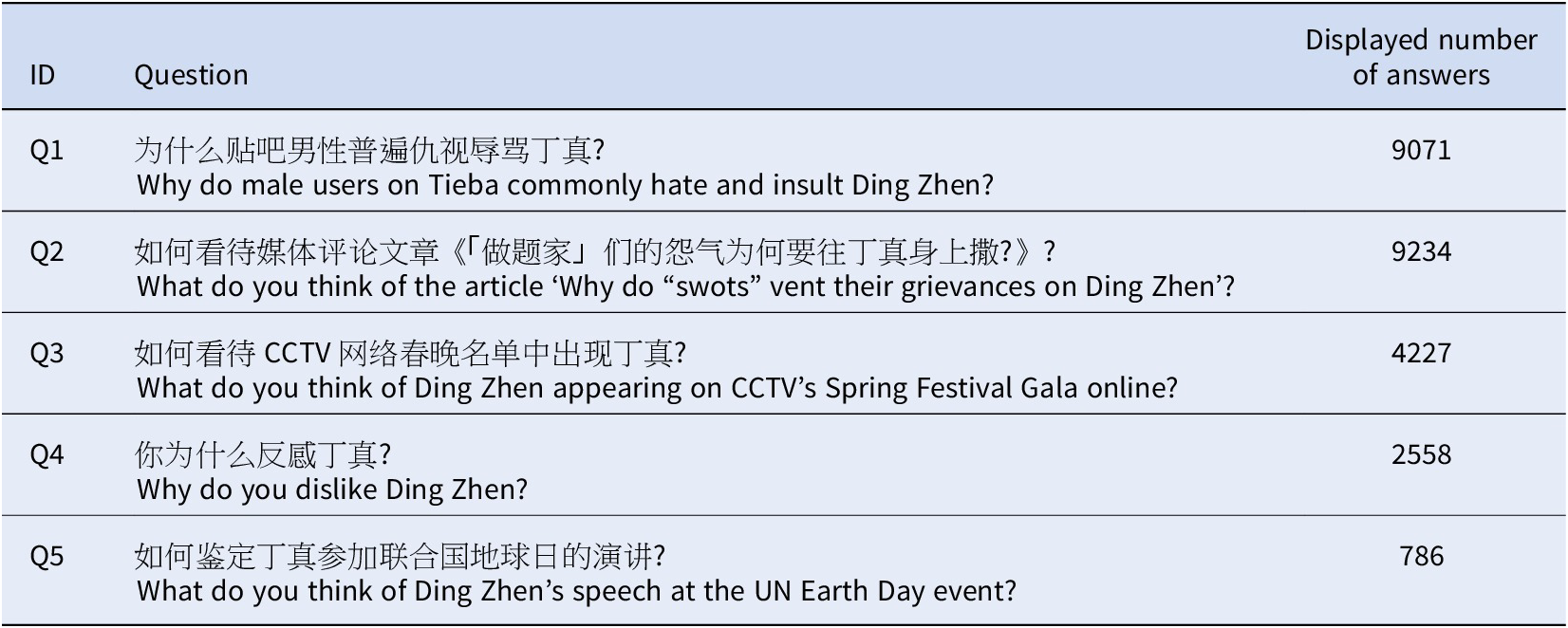
We have opted to draw on data from Zhihu, a knowledge-sharing platform popular among urban professionals. Previous research has noted the influence of misogyny, anti-feminism, and gender stereotypes in this community (Bao Reference Bao2024; Peng et al. Reference Peng, Hou, KhosraviNik and Zhang2023), similar to Hupu (Sun and Dai Reference Sun and Dai2024) and Tieba, which also saw significant backlashes against the Tibetan cyberstar. In the first step, we identified 178 question threads on the ‘Ding Zhen phenomenon’ through keyword search. We then narrowed down to five question threads (Table 1) based on their high level of engagement and relevance to our research objectives, which received around 25,000 answers in total. To construct a sample suitable for qualitative research, we ranked the answers by upvotes and selected the most upvoted 500 answers for analysis, a size comparable to similar studies (Peng et al. Reference Peng, Hou, KhosraviNik and Zhang2023; Xu Reference Xu2025).
Details of the question threads. Displayed number of answers was accessed on 7 March 2024
The functionality of upvote/downvote is understood here as a technological affordance constitutive of the ‘material-discursive practice’ (Graham and Rodriguez Reference Graham and Rodriguez2021, 2) in digital space. Social media affordance refers to the interplay between the materiality of digitally mediated technologies and agentic social construction (Bucher and Helmond Reference Bucher, Helmond, Burgess, Marwick and Poell2018). From this perspective, the upvote feature as a design element invites user engagement, affording a level of determinability for content visibility that is also linked to the perception of credibility (Prakasam and Huxtable-Thomas Reference Prakasam and Huxtable-Thomas2021). Zhihu’s interface includes a binary upvote/downvote mechanism that allows users to rate each ‘answer’. The platform employs the algorithmic Wilson score interval, as explained by a Zhihu employee (Huang Reference Huang2014), to govern these metrics, which means that an increase in upvotes correlates with a higher likelihood of visibility (Yang Reference Yang2022). This enables the content that aligns with the dominant discourse to be displayed atop, while rendering dissenting voices less visible. Furthermore, the number of upvotes can serve as a proxy for credibility, prompting users to further amplify popular viewpoints, fostering a semi-echo chamber characterized by ‘within-forum opinion congruency’ (Li et al. Reference Li, Suk, Zhang, Pevehouse, Sun, Kwon, Lian, Wang, Dong and Shah2024, 20). The analysis presented in the following pages must be contextualized with these considerations. Namely, we have chosen to focus on the dominant discourse by limiting ourselves to the highly upvoted posts, where counter-narratives are less likely to be found.Footnote 5 Our citation of vote numbers is an indicator of the within-forum influence of a particular speech, constituted through the socio-technical mechanisms described above, rather than an indicator of its representativeness in general.
Our analysis is generally informed by Feminist Critical Discourse Analysis, which encourages researchers to uncover discursive processes that naturalize gendered assumptions and hegemonic power relations (Lazar Reference Lazar2007). We also engage in an imminent critique of the material by highlighting the internal contradictions and paradoxes. Appendix 1 provides examples of the coding scheme.
Betrayal by the Meritocratic State
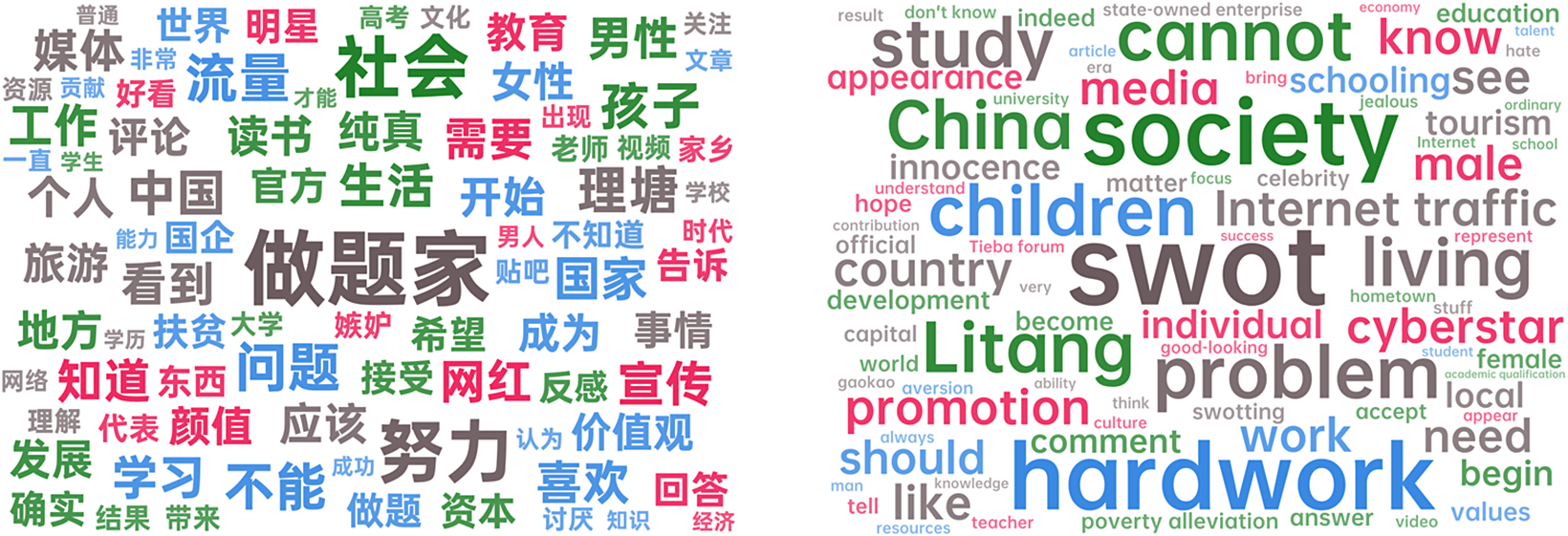
The belief that Tenzing Tsondu’s accidental ascendency to fame is a betrayal to the principle of meritocracy, which holds that the distribution of rewards should be based on ‘effort’ and ‘talent’, is the most prominent theme in the discussion, reflected in almost all the responses examined. As introduced earlier, the ideal of meritocracy in the Chinese context is fundamentally tied to the education system and the National College Entrance Examination (gaokao), whereby education is perceived as a means to acquire talent (through hard work) and standardized tests such as gaokao a verification of talent. As shown in Figure 1, terms related to this notion of education-based meritocracy – including nuli (hard work), xuexi (study), dushu (schooling), and jiaoyu (education) – top the word frequency chart. Furthermore, the valuing of education and the upholding of meritocratic principles are framed by critics of Ding Zhen or the Ding Zhen phenomenon as not only a societal ideal, but also the key to China’s national success and part of Chinese national identity, which we have conceptualized as meritocratic nationalism. It aligns individual aspirations for success with national development, both understood as attesting to the ‘fate-transforming power of diligence’ and knowledge, especially technical prowess. The state gains political legitimacy by presenting itself as a champion and guarantor of meritocratic values, and by the public’s continued belief in meritocracy leading to fairness and mobility.
Original and translated word clouds based on frequency.
For critics, therefore, even though private commercial actors’ promotion of the Tibetan boy, whose ‘success’ is seen as attributed to non-merit factors such as luck and ‘good appearance’, can be dismissed as the unethical manipulation of ‘capital’,Footnote 6 they read official media’s endorsement as a betrayal to the meritocratic ideology the state should stand behind and a humiliation to the ‘ordinary men’ deeply invested in the belief. The following excerpts are but some examples of the numerous answers making this argument:
In our country, teachers teach students these two phrases from a young age: one is ’education changes one’s fate’; another is ’you reap what you sow’. Official media’s promotion of Ding Zhen breaks one’s words completely…. The actions of the government are at odds with our national strategy of kejiao xingguo (revitalizing the nation through science, technology, and education) …. State media should make our children, especially the children of ordinary families, continue to believe that studying transforms one’s fate, rather than blatantly endorsing the transformation of one’s fate through a shortcut. (Q1, 44,283 upvotes, edited 25-8-2022)
How can this demonstrate correct values (jiazhiguan) for the students, not to mention the strategy of revitalizing the nation through science and technology? (Q3, 83,334 upvotes, edited 18-6-2022)
Are the men on Tieba not normal? Sorry I think they are the normal people in society. Because the Ding Zhen phenomenon blatantly torn down the values we have held for decades. It is a sheer humiliation to every Chinese who believes that ‘heaven rewards the diligent’ and success requires one’s fighting for it (Q1, 2,287 upvotes, 7-12-2020)
In suggesting that Tenzing Tsondu does not deserve the fame and rewards he has received due to an apparent lack of ‘effort’ and ‘talent’, Zhihu users claim that the state’s endorsement of his stardom not only subverts mainstream values (jiazhiguan), but also hinders the foundation of national development. His ‘undeservingness’ is contrasted to two different groups: one is those perceived as ‘real’ contributors to society who represent what an ideal meritocratic China should be; another is the ‘ordinary men’ who study hard, achieve high educational credentials, work hard, and still cannot ‘make it’ in a society characterized by hypercompetition and stratification. Users recall how the state used to promote ‘real heroes’ such as scientists, Olympian medallists, model workers, nurses, soldiers, and astronauts – role models regarded as not only talented and diligent, but also representative of national progress. One highly voted answer suggests that the key to China’s developmental success is the prioritization of education and the cultural phenomenon ‘is likely to undermine our national foundation (minzu genji)’. Employing a cultural essentialist narrative based on the China/West binary, the commenter argues that the prioritization of education and the gaokao system is ‘written in our blood’ and the most important legacy of Chinese traditional culture, whereas ‘the West’s culture of chivalry and piracy’ does not value education as much. Rejecting the criticism of ‘small town swots’ in China Youth Daily, they assert that it is the ‘small town swots’ that made China the second largest economy, precisely because the country maintains a fair system of gaokao and civil servant exams that gives every individual a chance to ‘transform their fate’ through hard work and gives society highly educated workers as the ‘most important productive force of economic development’ (Q2, 39,323 upvotes, 22-12-2020).
The meritocratic framing is hence fundamentally intertwined with a particular narrative of China’s national identity and its national success story, which, according to one succinct summary (Q2, 236 upvotes, 21-12-2020), depends on the valuing of ‘hard workers’ (nulizhe) rather than the ‘lucky dog’ (xingyun’er). Moreover, it involves reaffirming the developmentalist ideology which argues that the prioritization of education, scientific knowledge, and hard work is determined by China’s specific national conditions (Howlett Reference Howlett2021), the imperative to overcome backwardness, and the struggles against Western imperialism. Even in a context not immediately relevant to development or geopolitics – the controversy over the fame of an internet celebrity – we find a prime example of how social media users constitute themselves as ‘willing’ national and ‘geopolitical subjects’ (Eken Reference Eken2019, 218) through discursive practices online, which ironically lead them to accuse the state of betraying the ideology it has successfully hegemonized. As noted earlier, meritocratic nationalism as a structuring logic organizes not only the ideal relationship between the individual and the nation-state, but also the nation’s ‘deserved status ’within global hierarchy. The individual’s struggle for upward mobility through hard work and education is seen as crucial for and analogous with the nation’s struggle to overcome backwardness and subjugation in the international system. We will return to the geopolitical aspect later in the article.
In sum, the theme examined above denounces Tenzing Tsondu’s stardom and in particular state involvement in his promotion as a betrayal of meritocracy, which is tied to narratives of national identity and regime legitimacy. This spells out a seeming disjuncture between official and popular nationalisms, or a dissonance between the post-alteric and developmentalist modes of ethnic representation. Whereas state actors take the opportunity to capitalize on the post-alteric imaginary associated with Ding Zhen to showcase ethnic unity and boost ethnic tourism, online techno-nationalists criticize the state (guojia) or official media (guanmei) for betraying the principles it is supposed to safeguard and undermining the values it has instilled in society. Those who are most disappointed at the phenomenon are therefore those who are most emotionally invested in dominant ideas of meritocratic nationalism and developmentalism that are central to the Chinese regime’s legitimation. The sense of betrayal has not led them to question the meritocratic ideology itself or its functioning as a source of legitimation, but rather reaffirming it. In the following, we turn to the portrayal of the second contrasting group – the ‘ordinary Han males’ who work hard and yet lose out – and the construction of Han male victimhood, revealing that merit-based claims are neither gender-neutral nor post-racial.
Racialized and Gendered Resentment and Victimhood
Some of the most popular answers depicting the ‘ordinary Han males’ take the form of a first-person and second-person novella that generates affective resonance. For example, one top answer for Q1 (32,533 upvotes, 13-9-2021) fictionalizes a protagonist who grew up being beaten by his father for unsatisfactory performance at school, became determined to study hard to transform his fate, met his first love, and eventually made it to the university but could not fit in due to his humble background. He then saw the effortless ‘success’ of Ding Zhen on the internet while he was struggling to secure a job on an increasingly competitive (neijuan) and exploitative labour market. A similar story is told in a top answer for Q2 (26,565 upvotes, 13-12-2020): a fictional ‘Zhang Zhen’ from Hebei endured great suffering in the school system to get through the gaokao, worked hard to complete his MA, but still could not secure a job in a SOE ‘after 20 years of education’. He then found out that Ding Zhen landed a SOE job ‘just because of his pretty face’. With granular details and a strong emotional appeal to Zhihu users, these stories exemplify the ‘cruel optimism’ in the making of the developmental subject: the sacrifice and suffering of the present is tolerated ‘because of the promise of better futures to come’ (Berlin Reference Berlin2024, 3), when the suffering is also produced by the very promise. The sense of grievance in these fictional accounts and the society-wide discussion of buzzwords such as neijuan and xiaozhen zuotijia reflect a general disillusion with the promise of education-enabled mobility, emphasizing the persistence of social stratification and precarity within a hyper-competitive market economy.Footnote 7 However, in the discourse examined here, narratives about the unfairness experienced by ‘ordinary men’ are used not to formulate a systemic critique of meritocratic ideology, but rather to legitimate resentment against a gendered and racialized other and his presumably female fans through policing the boundaries of merit and deservingness.
The resentment is gendered in several aspects. First, in these real or imaginative personal accounts, told from a male perspective, Ding Zhen is portrayed as an undeserving winner of not only fame, state endorsement, and a desirable job, but also women as potential romantic partners whom the aggrieved men feel entitled to. The most highly voted answer in our sample, with 102,199 upvotes, is particularly detailed on the romantic relationship of a protagonist who ‘works harder than Ding Zhen’, is more talented, kinder, and makes more contribution to society. It suggests that the protagonist has to pay the caili,Footnote 8 own a house and a car, and ‘put his partner’s name on the property title document at the risk of losing his life’s fortune’ to get married. He cares for her, never argues with her even when she is ‘unreasonable’, and patiently tolerates her ‘childish temper’. The author goes on to say that Ding Zhen wins women’s heart and the state’s endorsement for doing nothing: ‘What do we hate? What are we angry about? Is it because of Ding Zhen? No! We hate this broken world with distorted values. We are angry because we are humiliated’ (Q1, 9-12-2020).
The patronizing tone in portraying the protagonist’s imaginative partner is hard to miss here. More importantly, it capitalizes on male victimhood by suggesting that women have a dominant position on the sexual marketplace, while also objectifying them as a marker of male success. In this narrative, men’s victimhood under the societal pressure of competing for economic and sexual partnership resources is prioritized, while women are imagined to be privileged, spoiled, and ‘have it easy’. A post comments that whether a woman succeeds by ‘competence’ or ‘attractive appearance’ (yanzhi), it would be received positively by society. And even if she fails, she can always ‘marry someone and ask a man to support her’ (Q1, 737 upvotes, 25-4-2022). This leads to the second mechanism by which the backlash against Ding Zhen is gendered: his image in fandom culture and his alleged ‘success by appearance only’ are associated with femininity, which is disparaged in the misogynistic discursive culture of certain online communities. By emphasizing his only quality being having a good appearance, users are also able to draw from and reinforce the internal Orientalist script we mentioned earlier, which others ethnic minority members on account of their distance from the ideal of productive, developmentalist, and hard-working masculinity.
It is worth noting that female wanghong celebrities who ‘accidentally’ rose to fame because of their attractive appearance have not been attacked in these communities on this scale. The language of meritocracy is not gender-neutral, but rooted in and reproducing gendered assumptions about success and what counts as merit. Success achieved via aesthetic appeal is coded as feminine, non-meritocratic, and thus illegitimate for male subjects. Appearance-based success is acceptable for women, but only because women’s success is devalued in general: it is always potentially less deserved than men’s, as the latter is assumed to be based on ‘real talent’. One post suggests that ‘throughout history men are judged by their talent, virtue, and competence, never an attractive face’. Echoing the misogynistic and homophobic discourse of civilizational decay, they claim that in Chinese history the feminization of men led to the invasion of China by barbarian tribes (Q1, 4,238 upvotes, 31-12-2021).
Moreover, some posts direct their anger and criticisms towards the female dominated fandom culture and feminism. As mentioned earlier, feminism, often referred to derogatorily through the homonym ‘female fist’ (nüquan 女拳), is generally represented in a negative light on Zhihu. Similarly, female-dominated fandom culture is looked down upon in communities like Zhihu, where the style of argumentation is presented as objective and rooted in technological expertise and scientific reasoning. Fandom culture, by contrast, is reduced to cult-like radicalism, anti-intellectual foolishness, or even a threat to social stability susceptible to the manipulation of ‘overseas forces’ (Global Times 2021). The controversy over Tenzing Tsondu thus offers another discursive opportunity for misogynistic users to discredit feminism as an evil force that victimizes men and fandom culture as contributing to the crisis of masculinity. Throwing a string of insults at the feminists, one poster connects the popularity of Ding Zhen with the rise of effeminate male idols, which they see as symptomatic of a crisis of ‘masculine aesthetics’. Using a rather academic language, they argue that the ‘aesthetic hegemony’ in fandom culture that favours ‘the little fresh meat’Footnote 9 look ‘devours, dissolves, and overwhelms’ the dying masculine aesthetics (Q4, 3,198 upvotes, 10-12-2020). A more extremist proponent of anti-feminism goes as far as saying that a concept such as ‘patriarchy’ is an excuse made up by feminists just as Lebensraum was an invention of the Nazis, reminiscent of the label ‘feminazi’ in Anglophone manosphere. Equating Ding Zhen’s stardom to a feminist conspiracy, they urge that men must ‘wake up’ before they are massacred (Q4, 119 upvotes, 3-1-2021). We thus see a strong self-victimizing trope in the backlash against feminism, arising in response to the perceived threat to traditional masculinity and male privilege.
As noted earlier, the racialization of ethnic minorities in China operates on a developmentalist and colonial logic that associates minority with backwardness, rurality, and femininity in need of a civilizing mission led by the Han urbanites (Schein Reference Schein1997). Whereas the connection between Tenzing Tsondu and the idea of ‘untainted’ nature becomes fetishized and profitable in the post-alteric digital economy, for techno-nationalists on Zhihu who see technology-led industrialization as the most important vehicle for national development, his lower education attainment and supposed lack of professional skills are mentioned with disdain and discriminated against. The word for illiterate people, wenmang, was referenced 44 times in our sample, as his attackers express shock and anger at the idolization of an ‘illiterate person’ with ‘no professional skills’ and ‘never integrated into modern society’ (Q4, 30,154 upvotes, 9-12-2020). Ironically Tenzin’s supporters romanticize his ‘innocence’ by describing his eyes as ‘never contaminated by exams’. The stigmatization of his education attainment and distance from ‘modern society’ not only reinforces the developmentalist racism permeating the representation of ethnic minorities, but also reproduces the meritocratic myth of a level playing field obscuring substantive material disparities between China’s wealthy coastal provinces and ethnic minority regions.Footnote 10 Furthermore, while Tenzing was literate in his native language, he was labelled a wenmang by Han Chinese netizens because of his inadequate knowledge of the Chinese language - a telling example of how Han-centrism normalizes discrimination against minoritized languages.
As the hostility towards minority groups in developmentalist racism is particularly directed at those who appear to ‘refuse to modernize’, Tenzing Tsondu, being at ease with living a herding lifestyle and not fluent in the Chinese language, epitomizes the kind of minority seen as unassimilated and ungrateful by Han nationalists. Many commenters emphasize that there are thousands of hardworking ethnic minority people who seek to transform their fate through education, who are far more deserving of the fame Tenzing Tsondu has. The intense feeling of betrayal, humiliation, and resentment observed in this discourse stems from the fact that Tenzing Tsondu’s incidental success shatters not only the framework of meritocracy and developmentalism many Han male netizens are identified with on a personal level, but also the established ideas of racialized hierarchy that view only minorities assimilated into Han culture as worthy of recognition.
Beyond the attack on Tenzing Tsondu’s deviation from dominant meritocratic norms, the discussion also features more blatantly racist representation of Tibetans as well as the recurrent trope of reverse racism. One answer recounts the user’s college experience of living with Tibetan dormmates, who are depicted as irritable and violent. Typical of Zhihu posts that often draw on personal experiences and rich in anecdotal details, it asserts that ‘the Tibetans I have met are vulgar and have no morality or suzhi to speak of’, which is followed by the statement that the user will avoid dealing with Tibetans even though they know that the ones they have met cannot represent all (Q4, 2,378 upvotes, 17-8-2021). This echoes a range of racialized framings found in our sample, which essentialize ethnic minorities, particularly Tibetans, as possessing inferior qualities and undeservingly privileged. Reminiscent of the grievance politics of ethnic majority men elsewhere, Han males are depicted as victims not only to a hyper-competitive precarious economy, but also to minorities and women who receive ‘unearned’ rewards. For instance, one post claims that Han males do not have an ‘aura’ (guanghuan, a metaphor for being advantaged) and have to ‘live under the guanghuan of the upper caste [referring to ethnic minorities]’. It suggests that Han males live an extremely stressful life only to see someone become successful because of their ‘face’ and ethnicity, which can only be read as ‘a denial of all your life so far’ and ‘all the efforts you have made are meaningless’ (Q1, 4,238 upvotes, 31-12-2021). Others employ sensationalist framings that refer to being Han as an ‘original sin’ (yuanzui), implying disadvantages and vulnerability to exploitation. The construction of Han male victimhood is facilitated by a moral economy of merit that channels discontent with precarity into racialized resentment, concealing ongoing structural violence against minoritized groups.
Meritocratic discourse in the gendered and racialized resentment against Tenzing Tsondu’s stardom appears contradictory and inconsistent. These contradictions, however, reveal how the policing of what counts as merit functions to justify inequalities and exclusion. On the one hand, users valorize the diligent and well-educated subject on the basis of their perceived productivity and competitiveness in the market economy. On the other hand, Tenzing Tsondu’s rise to fame through his ability to generate profitable traction in the digital economy is deemed illegitimate and immoral. On the one hand, numerous posts narrate the struggle of ‘ordinary men’ who suffer from educational inequality, exploitative working conditions, and social immobility. On the other, commenters seem as frustrated with the failures of meritocracy in reality as they are convinced of its fundamental fairness in principle. Instead of questioning the promise of social mobility based on individual merits – acquired and proved through education, they reaffirm it by framing Tenzing Tsondu’s lower educational attainment as a personal failure and one of the reasons why he does not ‘deserve’ his success. While internet users in these discussions complain emotionally about the reification of social stratification and the diminishing prospect for upward mobility, they offer no sympathy for someone from an impoverished region and a marginalized background whose ‘transformation of fate’ is deemed ‘too easy’. Through gendered and racialized assumptions about whose merit is ‘real’, the discourse of meritocratic nationalism helps naturalize structural relations of dominance and bolster the grievance politics of ethnic majority men.
Geopolitical Imaginary and Transnational Racialization
In the final section, we turn to the role of geopolitical and international imaginaries in the backlash discourse. Although a less prominent theme in the overall discussion, it sheds lights on the ever-present spectre of the international in everyday digital narratives of nationalism and provides an intriguing example of transnational racialization and identification, whereby Chinese users express sympathy with conservative white Americans by drawing parallels between their experiences.
As mentioned earlier, commenters situate their criticism of Ding Zhen’s stardom within an assessment of the nation’s relationship with ‘the West’ and its position within the global economy. Invoking China’s ‘history of humiliation’ and current challenges due to Western countries’ attempt to curtail its development, one answer argues that the state must continue to encourage the youth to ‘learn scientific knowledge’ and strengthen national power, which is its only ‘way out’, rather than misleading the future generation by promoting figures like Ding Zhen (Q5, 181 upvotes. 29-05-2021). Another commenter develops an analysis of China’s need to upgrade its industries from manufacturing low value-added to high value-added goods, asserting that ‘what we need is not innocent eyes, but the right to speak [at the international level], to say that we have earned the world’s respect through hard work… our educational resources are gained through our parents’ generation working day and night for Euro-Americans’ (Q2, 236 upvotes, 21-12-2020). For these members of the digital public, the discontent with Ding Zhen’s fame carries postcolonial nationalist sensibilities (Zhang Reference Zhang2023) that draw parallels between individuals’ aspiration for ‘transforming one’s fate’ through education and the nation’s ascendance in the international system against Euro-American dominance – again through hard work and the acquisition of technological power. While criticizing global inequalities, the narrative also reinforces meritocratic ideology in international relations, which has proved appealing to the ‘aspiring middle classes central to nation-building efforts in the global south’ (Krishna Reference Krishna2023,1)
However, some users use international and geopolitical imaginaries to rationalize the state’s endorsement of Tenzing Tsondu and seek to reconcile the tension between official and popular nationalisms. Their reasoning is that promoting the Tibetan star could pacify otherwise dangerous ethnic groups and refute Western criticisms of China’s ethnic policy. A highly voted post argues that some ‘ethnic groups are more likely to be bought, incited, and manipulated to make trouble for the motherland’. They contend that the state’s active promotion of a Tibetan cyberstar signals the message that they need not to do anything to gain ‘wealth, fame, and status’, which could discourage them from being manipulated by potential foreign hostile forces (Q5, 23,266 upvotes, 10-8-2021). The remark epitomizes the contradictions of Han-supremacist nationalism that both insists that the Tibetan people are an inseparable part of the ‘Chinese nation’ and constitutes them as permanent subjects of suspicion, inherently vulnerable to foreign manipulation.
Other users relate that Ding Zhen symbolizes a series of values that Westerners are most sympathetic with, such as ‘environmental protection’, ‘animal rights’, ‘ethnic culture’, ‘religion’, and ‘ethnic language’, thus making him a particularly effective tool for digital diplomacy – a way of ‘using magic to defeat magic’ or using master’s tools to dismantle master’s house (Q5, 116 upvotes, 2-5-2021). It is noted that the Ministry of Foreign Affairs spokesperson Hua Chunying posted several tweets in a row to promote the Tibetan star’s story to international audiences. However, the recognition that China is ‘appropriating Western values’ to counter ‘Western biases’ is also disputed. Some users complain that the state then should use this only for external propaganda (waixuan) rather than domestic communications, which would only hurt the hard-working ‘ordinary people’. Others believe that this goes beyond a strategic use of ‘Western values’, but shows that undesirable notions such as ‘identity politics’ and ‘political correctness’ have indeed affected China’s domestic society, which is an ‘alarming sign’ (Q2, 501 upvotes, 21-12-2020). While the evaluation is different, these remarks share a common implication that Western criticisms of China on the ground of human rights are not meritocratic, as real merit is defined by industrial and technological power. Whereas some users find the tactical use of a Tibetan cyberstar to improve international image agreeable, others express anxiety that such gestures risk undermining the nation’s self-image premised on meritocratic achievement.
The discussion also deploys somewhat unexpected transnational analogies. Several answers compare Tenzing Tsondu to Greta Thunberg (e.g., Q5, 7,374 upvotes, 25-4-2021; Q5, 6,634 upvotes, 25-4-2021), a figure who has been subject to much demonization in the Zhihu discourse community, which typically presents the Swedish activist as someone who embodies hypocritical and unrealistic progressive values (Zhang Reference Zhang2024). Furthermore, the following highly voted post is worth quoting at length:
When a white man from Texas, USA, realizes that despite working and living so hard, the TV keeps glorifying a Native American boy as ‘pure and real’ – even though that person hasn’t put in any real effort, even though it’s all just identity politics, and he’s handed resources you could never attain in your lifetime simply because he has a Native American face. In that moment, the white American has an emotional breakdown. The American dream shatters. His values collapse. As long as you’re not Native American, as long as you’re not a minority, your hard work, your stability, only serve to lower your united front valueFootnote 11. …Your entire life’s effort suddenly feels like a joke. (Q1, 31,794 upvotes, 23-4-2022)
Several things are notable in the transnational parallels constructed in these excerpts. First, internationally minded users on Chinese social media have been introduced to right-wing populist narratives against ‘identity politics’ initially by discussing problems they deem inflicting ‘the West’ (Zhang Reference Zhang2024). However, what we see here is this language of anti-identity politics, initially acquired by looking abroad, is interpolated into debates over domestic issues: the Tibetan star’s illegitimacy is constructed through transnational analogization with an international activist associated with progressive social movements or the trope of ‘undeserving minorities’ in another country, both of which have been established ‘enemy’ figures in reactionary discourse on Chinese social media. Secondly, the post encapsulates a transversal identification and solidarity with white American men, despite that US-China geopolitical rivalry remains a primary concern in online nationalism, based on a racialized and distorted imaginary of shared victimhood as fellow ethnic majority male. While the drawing of the parallel seems unexpected, which may explain the post’s popularity, it simply reinforces the tired narrative of reverse racism that presents the Han Chinese and white Americans as victims, and Tibetans and Native Americans as advantageous, concealing and defending ethno-supremacist structures in both societies. Ironically, in drawing this analogy, the post inadvertently suggests a parallel between Chinese rule in Tibet and US settler colonialism.
Conclusion
We have developed the concept of meritocratic nationalism as a structuring logic and analytical lens to unpack the online backlash against Tenzing Tsondu’s rise to fame. Scrutinizing the discussion in the Zhihu community, the article has demonstrated how the online backlash from predominantly Han male users constructs the Tibetan cyberstar’s success as a betrayal of meritocracy, tied to the ideal of the individual developmental subject and narratives of national identity. Economic grievances and the discontent with social stratification in a hyper-competitive and hyper-exploitative system are articulated not to challenge the legitimacy of meritocratic nationalism itself, but to reaffirm it. However, despite the purported neutrality of merit, our analysis shows that meritocratic nationalism is underpinned by racialized and gendered assumptions about who is capable of merit and whose success is deemed deservingly meritorious. Merit is only recognized when it aligns with dominant norms of masculinity, Han-ness, and developmentalist subjectivity. The meritocratic discourse is instrumentalized to bolster reactionary ideologies that deny the existence of racial inequalities and reframe dominant-group men as the true victim of unfair distribution of rewards.
This research therefore contributes not only to nationalism studies by theorizing how the moral economy of merit organizes a series of relationships and hierarchies within and around the nation, but also to the critical race and meritocracy literature, which has been centred on Global North and especially US experiences. Both our analysis and the commenters’ own deployment of international analogies reveal structural similarities between China and the US in how meritocracy, under developmentalist or neoliberal conditions, helps justify and naturalize ‘post-racial’ racial hierarchies. The myth of a level playing field sustains a narrative of ‘reverse racism’ that frames limited efforts at redress – whether through affirmative action, state multiculturalism, or symbolic representation – as non-meritocratic and granting privileges to undeserving minorities. The success of a racialized and feminized other is seen not as an exceptional individual story, but as evidence of a systemic betrayal of merit, where identity, not effort or talent, becomes the imagined basis for reward.
Furthermore, we show that the moral economy of merit is extended to normative perceptions of international relations, where a nation’s upward mobility within the international hierarchy is associated with meritocratic achievements, defined in particular through technological innovation, economic performance, and developmental success. The discussion thus positions the state’s promotion of Tenzing Tsondu within a geopolitical context, with some criticizing it for undermining the ideological foundation of national development, and others interpreting it as a tactical response to Western, non-meritocratic criticisms of China on the ground of human rights or liberal values. We have highlighted that Han male resentment also maps itself onto the figure of white American men as fellow victims of ‘identity politics’, which both reflects and constitutes the global appeal of the narrative of ethnic majority male victimhood. This transnational imagination of majority victimhood, framed as a shared experience of betrayal of meritocracy, is deployed to naturalize racial and gendered hierarchies domestically, denying and obscuring ongoing violence against minoritized groups.
While this article has focused on the backlash against Tenzing Tsondu’s digital fame and the logic of meritocratic nationalism, future research could look more closely at how the largely female gaze in fan economies reproduce and complicate internal Orientalist imaginaries, at times challenging dominant assumptions about education, modernity, and indigenous agency (Yang Reference Yang2023). Another important direction for future research lies in examining how the rise of Tibetan cyber-celebrities has been received and negotiated within Tibetan communities themselves, as well as among other minoritized groups in China. The growing presence of ethnic self-representation in Chinese digital culture (Hao Reference Hao2023; Khuanuud Reference Khuanuud2024) invites a closer look at how ethnic minority individuals and communities may navigate, challenge, or appropriate dominant post-alteric and developmentalist modes of representation discussed here.
Supplementary material
The supplementary material for this article can be found at http://doi.org/10.1017/nps.2026.10129.
Acknowledgements
We would like to thank the anonymous reviewers and the editorial team for their constructive criticisms and guidance. One anonymous reviewer’s suggestion on developing the concept of meritocratic nationalism has been particularly instructive for shaping this article. An earlier version was presented at the Digital Fringe Talk Seminar of the ‘Populism, Anti-Gender and Democracy’ research group at the University of Stavanger. We would like to thank Elisabeth Lund Engebretsen for the invitation and the audience for comments.
Disclosure
None.


 Open access

