




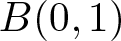
1. Introduction
This article is concerned with equations related to the truncated Laplacian in punctured balls and having lower-order terms with singular potentials. More precisely, we will consider both the existence of radial eigenfunctions for the eigenvalue problem
 \begin{align}
\left\{
\begin{array}{cl}
\displaystyle {\cal P}_k^\pm ( D^2 u) + \lambda_\gamma \frac{u}{r^\gamma} = 0 & \quad \hbox{in } B(0,1)\setminus \{0\}\\[2ex]
u=0 & \quad \hbox{on } \partial B(0,1)
\end{array}
\right.\end{align}
\begin{align}
\left\{
\begin{array}{cl}
\displaystyle {\cal P}_k^\pm ( D^2 u) + \lambda_\gamma \frac{u}{r^\gamma} = 0 & \quad \hbox{in } B(0,1)\setminus \{0\}\\[2ex]
u=0 & \quad \hbox{on } \partial B(0,1)
\end{array}
\right.\end{align}where  $\gamma \gt 0$, and the existence and asymptotic behaviour near the origin of radial positive solutions of
 \begin{equation}
{\cal P}_k^\pm ( D^2 u) + \mu \frac{u}{r^2} = u^p \qquad \hbox{in } B(0,1)\setminus \{0\}\, ,
\end{equation}
\begin{equation}
{\cal P}_k^\pm ( D^2 u) + \mu \frac{u}{r^2} = u^p \qquad \hbox{in } B(0,1)\setminus \{0\}\, ,
\end{equation}with  $p \gt 1$ and $0 \lt \mu \lt \lambda_2$.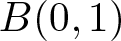 $B(0,1)$ will always denote the unit open ball centred at zero.
We will observe that in the case of  ${\cal P}_k^+$ the obtained results are analogous to the results for the Laplacian in dimension $k$, and, in particular, for $\gamma \gt 2$, the principal eigenvalue $\lambda_\gamma$ is $0$, while the obtained results for ${\cal P}_k^-$ deeply differ from the previous cases, and, in particular, the principal eigenvalue $\lambda_\gamma$ is $+\infty $ for any $\gamma\geq0$.
The operators  ${\cal P}_k^\pm$, often referred to as truncated Laplacians, are defined in the following way: for a symmetric matrix $X$, whose ordered eigenvalues are $\lambda_1\leq \lambda_2\cdots\leq \lambda_N$, and for an integer value $1\leq k\leq N$, one has
 \begin{equation*}{\cal P}_k^-(X) :=\sum_{i=1}^k \lambda_i\ \ \mbox{and }\ {\cal P}_k^+(X) :=\sum_{i=N-k+1}^N \lambda_i\, .\end{equation*}
 When evaluated on the Hessian matrix of the unknown function, the truncated Laplacians are second-order, degenerate elliptic operators which reduce to the standard Laplacian for 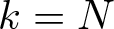 $k=N$. Because of their numerous applications, they have attracted some attention in both the PDE and geometry worlds. In particular, in differential geometry, they appear naturally when considering manifolds of partially positive curvature, see [Reference Sha20, Reference Wu21], or in problems concerning mean curvature flow in arbitrary codimension, see [Reference Ambrosio and Soner1]. In their treatment of PDE from a convex analysis point of view, Harvey and Lawson have studied the truncated Laplacian in different articles, see [Reference Harvey and Lawson16, Reference Harvey and Lawson17]. For other results in PDE, we refer e.g. to [Reference Birindelli and Galise6, Reference Birindelli, Galise and Ishii7, Reference Birindelli, Galise and Leoni9, Reference Caffarelli, Li and Nirenberg11, Reference Galise14, Reference Galise and Vitolo15, Reference Oberman and Silvestre19]. Closer to the present work is [Reference Birindelli, Galise and Ishii8], where Birindelli, Galise, and Ishii introduced for ${\cal P}_k^\pm$ the notion of generalized eigenvalue à la Berestycki, Nirenberg, Varadhan, see [Reference Berestycki, Nirenberg and Varadhan3], proving in particular the existence of a positive eigenfunction when $k=1$ for strictly convex domains. For other $k \gt 1$, the question of whether there exists or not an eigenfunction is still open, even for general strictly convex domains. We will see that even here, the case $k=1$ and the case $k \gt 1$ differ in nature.
In the present paper, we consider  ${\cal C}^2$ radial solutions of problems (1.1) and (1.2). As it is well-known, the eigenvalues of the Hessian matrix of a smooth radial function $u(r)$ for $r \gt 0$ are given by $\displaystyle \frac{u^\prime(r)}{r}$, with multiplicity $N-1$, and $u^{\prime\prime}(r)$. Therefore, for $1\leq k \lt N$, we get
 \begin{align*}
{\cal P}_k^+(D^2u)= \left\{
\begin{array}{ll}
\displaystyle u^{\prime\prime} +(k-1)\frac{u^\prime}{r} & \displaystyle \hbox{if } u^{\prime\prime}\geq \frac{u^\prime}{r}\\[2ex]
\displaystyle k\frac{u^\prime}{r}& \displaystyle \hbox{if } u^{\prime\prime}\leq \frac{u^\prime}{r}
\end{array}\right.
\end{align*}
\begin{align*}
{\cal P}_k^+(D^2u)= \left\{
\begin{array}{ll}
\displaystyle u^{\prime\prime} +(k-1)\frac{u^\prime}{r} & \displaystyle \hbox{if } u^{\prime\prime}\geq \frac{u^\prime}{r}\\[2ex]
\displaystyle k\frac{u^\prime}{r}& \displaystyle \hbox{if } u^{\prime\prime}\leq \frac{u^\prime}{r}
\end{array}\right.
\end{align*}and, analogously,
 \begin{align*}
{\cal P}_k^-(D^2u)= \left\{
\begin{array}{ll}
\displaystyle u^{\prime\prime} +(k-1)\frac{u^\prime}{r} & \displaystyle \hbox{if } u^{\prime\prime}\leq \frac{u^\prime}{r}\\[2ex]
\displaystyle k\frac{u^\prime}{r}& \displaystyle \hbox{if } u^{\prime\prime}\geq \frac{u^\prime}{r}
\end{array}\right.
\end{align*}
\begin{align*}
{\cal P}_k^-(D^2u)= \left\{
\begin{array}{ll}
\displaystyle u^{\prime\prime} +(k-1)\frac{u^\prime}{r} & \displaystyle \hbox{if } u^{\prime\prime}\leq \frac{u^\prime}{r}\\[2ex]
\displaystyle k\frac{u^\prime}{r}& \displaystyle \hbox{if } u^{\prime\prime}\geq \frac{u^\prime}{r}
\end{array}\right.
\end{align*} So, when applied to smooth radial functions, the operators  ${\cal P}_k^\pm$ switch from something like the Laplacian in dimension $k$ to a first-order operator, depending on the sign of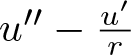 $u^{\prime\prime}-\frac{u^\prime}{r}$. In order to focus on the strictly degenerate cases, we will always suppose that $k\leq N-1$.
When considering problems (1.1), we are interested in proving the existence of positive solutions. In this case, the constants  $\lambda_\gamma$ are referred to as the principal eigenvalues associated with the operators ${\cal P}_k^\pm$ and the potential $r^{-\gamma}$ in the punctured ball.
The analogous problem for fully nonlinear uniformly elliptic operators has been recently studied in [Reference Birindelli, Demengel and Leoni4], where we considered in particular the eigenvalue problem
 \begin{align*}\left\{
\begin{array} {cl}
\displaystyle {\cal M}^\pm ( D^2 u) + \lambda_\gamma \frac{u}{r^\gamma} = 0 & \quad \hbox{in } B(0,1)\setminus \{0\}\\[2ex]
u=0 & \quad \hbox{on } \partial B(0,1)
\end{array}
\right.
\end{align*}
\begin{align*}\left\{
\begin{array} {cl}
\displaystyle {\cal M}^\pm ( D^2 u) + \lambda_\gamma \frac{u}{r^\gamma} = 0 & \quad \hbox{in } B(0,1)\setminus \{0\}\\[2ex]
u=0 & \quad \hbox{on } \partial B(0,1)
\end{array}
\right.
\end{align*} Here,  ${\cal M}^\pm$ are the Pucci extremal operators (see [Reference Caffarelli and Cabré10]). When $\gamma \lt 2$, we proved that the principal eigenvalue is strictly positive and finite, and there exist positive eigenfunctions which can be extended by continuity to the whole ball. Moreover, the eigenfunctions are shown to be of class ${\cal C}^1$ when $\gamma \lt 1$, and Hölder continuous with exponent $2-\gamma$ if $\gamma \geq 1$. In the case $\gamma =2$, we showed the non-existence of bounded super-solutions, and we provided the explicit expression of both eigenfunctions and the eigenvalues $\lambda_2$, thus extending to the fully nonlinear setting the explicit value of the best constant in Hardy’s inequality. Finally, for $\gamma \gt 2$, we proved that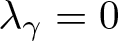 $\lambda_\gamma=0$.
For problem (1.1) considered here, we obtain similar results in the case of the operator  ${\cal P}_k^+$ and radically different results for the operator ${\cal P}_k^-$.
For both operators, as in [Reference Birindelli, Galise and Ishii7], we consider the Berestycki, Nirenberg, and Varadhan constants  $\lambda_\gamma$, which coincide with the demi-eigenvalues as defined by P.-L. Lions in [Reference Lions18] (see definitions (3.1) and (3.3)), as good candidates to be the principal eigenvalues.
In case of operator  ${\cal P}_k^+$, we attack the problem by first observing that if a positive $C^2(B(0,1)\setminus\{0\})$ radial eigenfunction $u$ related to a positive eigenvalue exists, then it must satisfy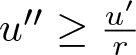 $u^{\prime\prime}\geq \frac{u^{\prime}}{r}$, so that $u$ actually is a radial eigenfunction for Laplace operator in dimension $k$. This property suggests applying, in order to prove the existence of eigenfunctions, the same strategy used in the uniformly elliptic case. For $\gamma \lt 2$ and $k\geq2$, after proving the validity of the maximum principle ‘below’ $\lambda_\gamma$, the strict positivity of $\lambda_\gamma$ and the existence of positive eigenfunctions are obtained by a standard approximation procedure from below. When $k\geq 3$, we can let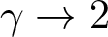 $\gamma\to 2$ and, by using the stability properties of the principal eigenvalues as well as their variational formulation in the case of linear operators, we obtain the explicit expressions
 \begin{align*}
\lambda_2=\left(\frac{k-2}{2}\right)^2\, ,\qquad u(r)=\frac{-\ln r}{r^{\frac{k-2}{2}}}\, ,
\end{align*}
\begin{align*}
\lambda_2=\left(\frac{k-2}{2}\right)^2\, ,\qquad u(r)=\frac{-\ln r}{r^{\frac{k-2}{2}}}\, ,
\end{align*}which are nothing but the well-known expressions respectively of the first eigenvalue and of the eigenfunction for the Laplace operator in dimension  $k$.
$k$.
We further show that 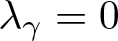 $\lambda_\gamma=0$ for $\gamma \gt 2$ and, in the separately considered case $k=1$, we prove that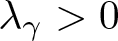 $\lambda_\gamma \gt 0$ for $\gamma \lt 1$ and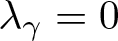 $\lambda_\gamma=0$ for $\gamma\geq 1$.
On the other hand, when considering problem (1.1) in the case of operator  ${\cal P}_k^-$, we see how crucial the degeneracy of ellipticity can be. Indeed, for any $\gamma\geq 0$, when $1\leq k\leq N-1$, we show for all $\mu \gt 0$ the existence of explicit positive radial solutions of
 \begin{equation}
{\cal P}_k^-(D^2v)+\mu \frac{v}{r^\gamma}=0\qquad \hbox{in } B(0,1)\setminus \{0\}\, ,
\end{equation}
\begin{equation}
{\cal P}_k^-(D^2v)+\mu \frac{v}{r^\gamma}=0\qquad \hbox{in } B(0,1)\setminus \{0\}\, ,
\end{equation}proving that
 \begin{equation*}\lambda_\gamma=+\infty\qquad \hbox{for all } \gamma\geq 0\, .\end{equation*}
For equation (1.3) we also provide several sufficient conditions for the validity of the maximum principle, see Proposition 3.10.
Next, let us consider the existence of radial positive solutions of equation (1.2) and their asymptotic behaviour near the origin. The analogous problem for uniformly elliptic operators has been recently studied in [Reference Birindelli, Demengel and Leoni5], where we considered solutions related to Pucci’s operators, namely positive radial functions  $u$ satisfying
 \begin{equation*}
{\cal M}_k^\pm ( D^2 u) + \mu \frac{u}{r^2} = u^p \qquad \hbox{in } B(0,1)\setminus \{0\}\, .
\end{equation*}
\begin{equation*}
{\cal M}_k^\pm ( D^2 u) + \mu \frac{u}{r^2} = u^p \qquad \hbox{in } B(0,1)\setminus \{0\}\, .
\end{equation*}The results obtained in [Reference Birindelli, Demengel and Leoni5] extend to the fully nonlinear framework the results obtained by Cirstea [Reference Cirstea12] and Cirstea and Du [Reference Cirstea and Du13] in the case of the Laplacian, that is, for the equation
 \begin{equation}
\Delta u + \mu \frac{u}{r^2} = u^p \qquad \hbox{in } B(0,1)\setminus \{0\}\, .
\end{equation}
\begin{equation}
\Delta u + \mu \frac{u}{r^2} = u^p \qquad \hbox{in } B(0,1)\setminus \{0\}\, .
\end{equation} Let us recall that, when 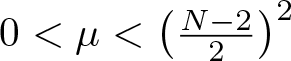 $0 \lt \mu \lt \left(\frac{N-2}{2}\right)^2$, there are three natural growth exponents associated with solutions of the above equation. The first one is the scaling invariance exponent $\frac{2}{p-1}$, and the other two are given by the roots of the equation
 \begin{equation*}
x^2-(N-2)x+\mu=0\, ,
\end{equation*}
\begin{equation*}
x^2-(N-2)x+\mu=0\, ,
\end{equation*}namely
 \begin{equation*}
\tau^{\pm} \, := \frac{N-2}{2} \pm \sqrt{\left(\frac{N-2}{2}\right)^2-\mu}\, .
\end{equation*}
\begin{equation*}
\tau^{\pm} \, := \frac{N-2}{2} \pm \sqrt{\left(\frac{N-2}{2}\right)^2-\mu}\, .
\end{equation*} The functions  $\frac{1}{r^{\tau^\pm}}$ are solutions of the homogeneous equation
 \begin{equation*}
\Delta u + \mu \frac{u}{r^2} = 0 \qquad \hbox{in } B(0,1)\setminus \{0\}\, ,
\end{equation*}
\begin{equation*}
\Delta u + \mu \frac{u}{r^2} = 0 \qquad \hbox{in } B(0,1)\setminus \{0\}\, ,
\end{equation*}and they appear as asymptotic growth exponents of solutions  $u$ of equation (1.4) when the superlinear term $u^p$ becomes negligible with respect to the singular term $\mu \frac{u}{r^2}$, or, in other words, when solutions are asymptotic to the solutions of the linearized equation at zero.
On the other hand, when either 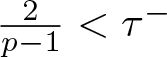 $\frac{2}{p-1} \lt \tau^-$ or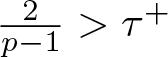 $\frac{2}{p-1} \gt \tau^+$, equation (1.4) has the exact solution
 \begin{equation*}
u(r)=\frac{C_p}{r^{\frac{2}{p-1}}}\, ,\qquad C_p= \left[ \left(\frac{2}{p-1}-\tau^-\right) \left(\frac{2}{p-1}-\tau^+\right)\right]^{\frac{1}{p-1}}\, .
\end{equation*}
\begin{equation*}
u(r)=\frac{C_p}{r^{\frac{2}{p-1}}}\, ,\qquad C_p= \left[ \left(\frac{2}{p-1}-\tau^-\right) \left(\frac{2}{p-1}-\tau^+\right)\right]^{\frac{1}{p-1}}\, .
\end{equation*}The asymptotic analysis of solutions of equation (1.4) reveals the following classification, see [Reference Birindelli, Demengel and Leoni5, Reference Cirstea12, Reference Cirstea and Du13]:
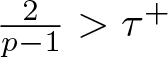
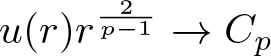
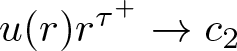
- if $\frac{2}{p-1} \gt \tau^+$, then solutions
$u$ satisfy either
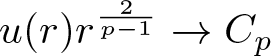
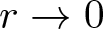
$u(r)r^{\frac{2}{p-1}}\to C_p$, or
$u(r)r^{\tau^-}\to c_1$, or
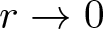
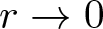
$u(r)r^{\tau^+}\to c_2$ as
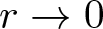
$r\to 0$, for some positive constants
$c_1$ and
$c_2$;
$\frac{2}{p-1} \gt \tau^+$, then solutions
$u$ satisfy either
$u(r)r^{\frac{2}{p-1}}\to C_p$, or
$u(r)r^{\tau^-}\to c_1$, or
$u(r)r^{\tau^+}\to c_2$ as
$r\to 0$, for some positive constants
$c_1$ and
$c_2$;- if
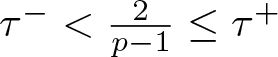
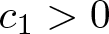
$\tau^- \lt \frac{2}{p-1}\leq \tau^+$, then any solution
$u$ satisfies
$u(r)r^{\tau^-}\to c_1$ as
$r\to 0$, for some
$c_1 \gt 0$;- if
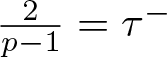
$\frac{2}{p-1}=\tau^-$, then any solution
$u$ satisfies
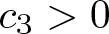
$u(r)r^{\tau^-}(-\ln r)^{\frac{\tau^-}{2}}\to c_3$ as
$r\to 0$, for some
$c_3 \gt 0$;- if
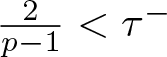
$\frac{2}{p-1} \lt \tau^-$, then any solution
$u$ satisfies
$u(r)r^{\frac{2}{p-1}}\to C_p$ as
$r\to 0$.









When considering solutions of equation (1.2) with the truncated Laplacians, once again, the pictures of the results for  ${\cal P}_k^+$ and ${\cal P}_k^-$ are different.
For operator  ${\cal P}_k^+$, we assume $k\geq 3$, and we obtain exactly the same classification result as above with the exponents $\tau^\pm$ now defined with $N$ replaced by $k$. This is due to the fact that our analysis in the end shows that solutions of equation (1.2) with ${\cal P}_k^+$ satisfy $u^{\prime\prime}\geq 0\geq u^{\prime}$, so that they are indeed solutions of the semilinear equation (1.4) in dimension $k$. Let us emphasize in particular that, for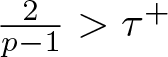 $\frac{2}{p-1} \gt \tau^+$, multiple asymptotic behaviours actually occur for solutions of equation (1.2) with ${\cal P}_k^+$.
This nonuniqueness phenomenon never occurs for operator  ${\cal P}_k^-$. Indeed, our analysis for equation (1.2) with ${\cal P}_k^-$ shows that solutions always satisfy the associated ordinary first-order equation, and then we deduce the explicit expression of solutions, at least for $r \gt 0$ sufficiently small. More precisely, assuming that $2\leq k\leq N-1$, we prove that for $r \gt 0$ small enough, one has
- if
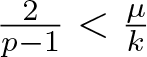
$\frac{2}{p-1}\neq \frac{\mu}{k}$, then any solution
$u$ is of the form
for some
\begin{equation*}
u(r) =\frac{1}{\left( c\, r^{\frac{\mu (p-1)}{k}}- \frac{r^2}{\frac{2k}{p-1}-\mu}\right)^{\frac{1}{p-1}}}
\end{equation*}
$c\in \mathbb R$;- if
$\frac{2}{p-1}= \frac{\mu}{k}$, then any solution
$u$ is of the form
for some
\begin{equation*}
u(r)= \frac{1}{r^{\frac{2}{p-1}}\left(c+\frac{(p-1)}{k}(-\ln r)\right)^{\frac{1}{p-1}}}
\end{equation*}
$c\in \mathbb R$.
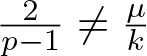


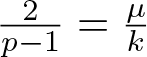


Hence, in this case, we obtain the following classification of the possible asymptotic behaviour as 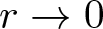 $r\to 0$ for solutions:
- if
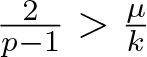
$\frac{2}{p-1} \gt \frac{\mu}{k}$, then
$u(r)r^{\frac{\mu}{k}}\to c_1 \gt 0$;- if
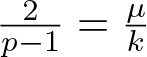
$\frac{2}{p-1}=\frac{\mu}{k}$, then
$u(r)r^{\frac{\mu}{k}}(-\ln r)^{\frac{\mu}{2k}}\to c_2 \gt 0$;- if
$\frac{2}{p-1} \lt \frac{\mu}{k}$, then
$u(r)r^{\frac{2}{p-1}}\to c_3 \gt 0$.



In conclusion, we can say that the results of the present paper, in a sense, complement those contained in [Reference Birindelli, Demengel and Leoni4, Reference Birindelli, Demengel and Leoni5] with respect to the uniform ellipticity assumption. Indeed, on the one hand, the results we obtain here for operator  ${\cal P}_k^+$ show that the uniform ellipticity assumption is not necessary, and in some cases, partial analogous conclusions can still be obtained. On the other hand, the present results for operator ${\cal P}_k^-$ show that a kind of control on the ellipticity of the operator is in general necessary, since in the case of strong degeneracy for the operator, the results for both problems (1.1) and (1.2) can be radically different.
2. Preliminaries
We begin by stating some technical results that will be used many times in the proofs of this paper. Let us recall that by 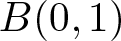 $B(0,1)$ we denote the unit ball of $\mathbb R^N$ centred at zero, and that the index $k$ will always be assumed to satisfy $1\leq k\leq N-1$.
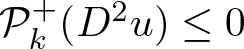
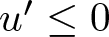
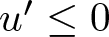
Lemma 2.1. Let  $u\in {\cal C}^2(B(0,1)\setminus \{0\})$ be a radial function. Then:
(i) if
${\cal P}_k^+ (D^2u)\leq 0$ in
$B(0,1)\setminus \{0\}$, then
$u^\prime\leq 0$ in
$B(0,1)\setminus \{0\}$;(ii) if
${\cal P}_k^- (D^2u)\leq 0$ in
$B(0,1)\setminus \{0\}$, then
$u^\prime$ has constant sign in a neighbourhood of zero. Moreover, if
$k\geq2$ and
$u$ is bounded from below, then
$u^\prime\leq 0$ in
$B(0,1)\setminus \{0\}$.







Proof. For the proof of (i), it is enough to observe that, when  $k\leq N-1$, one has
 \begin{equation*}
{\cal P}_k^+(D^2u)\geq k\, \frac{u^{\prime}}{r}\, .
\end{equation*}
\begin{equation*}
{\cal P}_k^+(D^2u)\geq k\, \frac{u^{\prime}}{r}\, .
\end{equation*} In order to prove (ii), let us first prove that if there exists 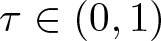 $\tau\in (0,1)$ such that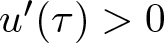 $u^{\prime}(\tau) \gt 0$, then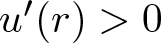 $u^{\prime}(r) \gt 0$ for all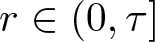 $r\in (0,\tau]$. Indeed, assuming by contradiction that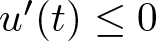 $u^{\prime}(t)\leq 0$ for some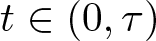 $t\in (0,\tau)$, one can find, by continuity, some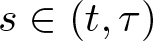 $s\in (t,\tau)$ such that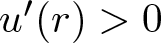 $u^{\prime}(r) \gt 0$ for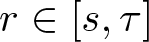 $r\in [s,\tau]$ and $u^{\prime}(s) \lt u^{\prime}(\tau)$. Then, since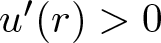 $u^{\prime}(r) \gt 0$ and ${\cal P}_k^- (D^2u(r))\leq 0$ for any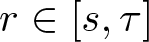 $r\in [s,\tau]$, we deduce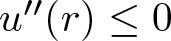 $u^{\prime\prime}(r)\leq 0$ by the definition of ${\cal P}_k^-$. Hence, by monotonicity, we get $u^{\prime}(s)\geq u^{\prime}(\tau)$, which is a contradiction to the choice of $s$.
$s$.
Next, we observe that only the following three possible cases can occur for the function  $u^{\prime}$:
(a) 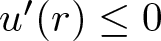 $u^{\prime}(r)\leq 0$ for all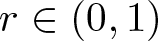 $r\in (0,1)$;
(b) 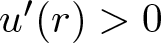 $u^{\prime}(r) \gt 0$ for all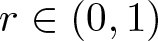 $r\in (0,1)$;
(c) there is a 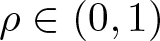 $\rho\in (0,1)$ such that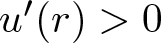 $u^{\prime}(r) \gt 0$ for all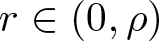 $r\in (0,\rho)$ and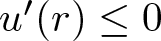 $u^{\prime}(r)\leq 0$ for all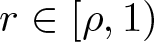 $r\in [\rho,1)$.
Indeed, if we assume that neither (a) nor (b) is the case, then there are 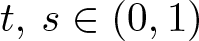 $t,\, s\in (0,1)$ such that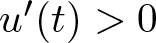 $u^{\prime}(t) \gt 0$ and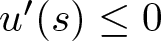 $u^{\prime}(s)\leq 0$. It follows from the argument above that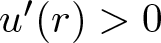 $u^{\prime}(r) \gt 0$ for all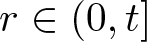 $r\in (0,t]$,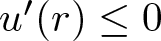 $u^{\prime}(r)\leq 0$ for all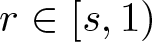 $r\in [s,1)$ and $t \lt s$. Then, it is easily seen that $u^{\prime}$ satisfies case (c) with
 \begin{equation*}
\rho=\inf \{r\in (0,1)\, |\, u^{\prime}(r)\leq 0\}\, .
\end{equation*}
\begin{equation*}
\rho=\inf \{r\in (0,1)\, |\, u^{\prime}(r)\leq 0\}\, .
\end{equation*} In the case  $k\geq 2$ and $u$ bounded from below, let us assume, by contradiction, that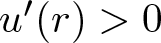 $u^{\prime}(r) \gt 0$ for $r$ small enough. Then, for $r$ in a right neighbourhood of zero, it must be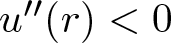 $u^{\prime\prime}(r) \lt 0$ and
 \begin{equation*}
0\geq {\cal P}_k^-(D^2u)= u^{\prime\prime} + (k-1)\, \frac{u^{\prime}}{r}= \frac{(r^{k-1}u^{\prime}(r))'}{r^{k-1}}\, .
\end{equation*}
\begin{equation*}
0\geq {\cal P}_k^-(D^2u)= u^{\prime\prime} + (k-1)\, \frac{u^{\prime}}{r}= \frac{(r^{k-1}u^{\prime}(r))'}{r^{k-1}}\, .
\end{equation*} Hence, the function 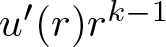 $u^\prime(r) r^{k-1}$ is monotone nonincreasing and strictly positive for $r$ small enough. This implies that, for some positive constant $c \gt 0$ and for $r$ sufficiently small, one has
 \begin{equation*}
u(r)\leq \left\{\begin{array} {ll}
\displaystyle -\frac{c}{r^{k-2}} & \hbox{if } k \gt 2\\[1ex]
c \, \ln r & \hbox{if } k=2
\end{array}\right.
\end{equation*}
\begin{equation*}
u(r)\leq \left\{\begin{array} {ll}
\displaystyle -\frac{c}{r^{k-2}} & \hbox{if } k \gt 2\\[1ex]
c \, \ln r & \hbox{if } k=2
\end{array}\right.
\end{equation*} Letting 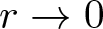 $r\to 0$, we obtain a contradiction to the boundedness from below of $u$.
$u$.
It then follows that  $u^{\prime}$ satisfies case (a) above.
Remark 2.2. By using the relationship
 \begin{equation*}{\cal P}_k^+(D^2(-u))=-{\cal P}_k^-(D^2u)\, ,
\end{equation*}
\begin{equation*}{\cal P}_k^+(D^2(-u))=-{\cal P}_k^-(D^2u)\, ,
\end{equation*}we immediately deduce from Lemma 2.1 the symmetric statements for sub solutions, namely
(i) if
${\cal P}_k^- (D^2u)\geq 0$ in
$B(0,1)\setminus \{0\}$, then
$u^\prime\geq 0$ in
$B(0,1)\setminus \{0\}$;(ii) if
${\cal P}_k^+ (D^2u)\geq 0$ in
$B(0,1)\setminus \{0\}$, then
$u^\prime$ has constant sign in a neighbourhood of zero. Moreover, if
$k\geq2$ and
$u$ is bounded from above, then
$u^\prime\geq 0$ in
$B(0,1)\setminus \{0\}$.


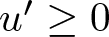

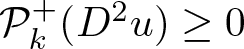



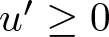

Our next result is more specific: we focus on solutions with a monotone right-hand side.
Lemma 2.3. Let  $g\in C^1(B(0,1)\setminus \{0\})$ be a radial function, satisfying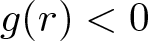 $g(r) \lt 0$ and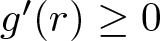 $g^\prime(r)\geq0$ for $0 \lt r \lt 1$. Then:
(i) if
$u\in C^2(B(0,1)\setminus \{0\})$ is a radial bounded from below solution of
then
\begin{equation*}
{\cal P}_k^+(D^2u)=g(r) \qquad \hbox{in } B(0,1)\setminus \{0\}\, ,
\end{equation*}
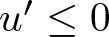
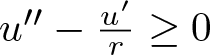
$u^\prime \leq 0$ and
$u^{\prime \prime}- {u^\prime \over r}\geq 0$ in
$B(0,1)$;(ii) if
$u\in C^2(B(0,1)\setminus \{0\})$ is a radial bounded from below solution of
with
\begin{equation*}
{\cal P}_k^-(D^2u)=g(r) \qquad \hbox{in } B(0,1)\setminus \{0\}\, ,
\end{equation*}
$k\geq 2$, then
$u^\prime \leq 0$ and
$u^{\prime \prime}- {u^\prime \over r}$ has constant sign in a neighbourhood of zero.





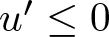
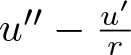
Proof. (i) The inequality 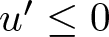 $u^{\prime}\leq 0$ follows from Lemma 2.1 (i). Next, let us assume by contradiction that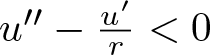 $u^{\prime \prime}- {u^\prime \over r} \lt 0$ in some interval contained in $(0,1)$. Then, from the equation, we get that in such an interval $u$ satisfies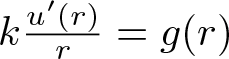 $k\frac{u^\prime(r)}{r}=g(r)$ and, by differentiating, we obtain the contradiction
 \begin{equation*}0 \gt \frac{k}{r} \left(u^{\prime \prime}- {u^\prime \over r}\right)=g'(r)\geq 0\, .\end{equation*}
 (ii) The inequality 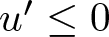 $u^{\prime}\leq 0$ follows from Lemma 2.1 (ii). Next, assuming by contradiction that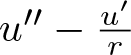 $u^{\prime\prime}-\frac{u^{\prime}}{r}$ changes sign infinitely many times as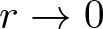 $r\to 0$, there exists an interval $(s,t)\subset (0,1)$ such that $u^{\prime\prime}(r)-\frac{u^{\prime}(r)}{r} \lt 0$ for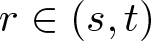 $r\in (s,t)$ and $u^{\prime\prime}(s)-\frac{u^{\prime}(s)}{s}=u^{\prime\prime}(t)-\frac{u^{\prime}(t)}{t}=0$. Then, in the interval $(s,t)$, $u$ satisfies
 \begin{equation*}
u^{\prime\prime}-\frac{u^{\prime}}{r}=g-k \frac{u^{\prime}}{r} \, ,
\end{equation*}
\begin{equation*}
u^{\prime\prime}-\frac{u^{\prime}}{r}=g-k \frac{u^{\prime}}{r} \, ,
\end{equation*}and then, by differentiation,
 \begin{equation*}
\left(u^{\prime\prime}-\frac{u^{\prime}}{r}\right)' = g'(r)- \frac{k}{r} \left( u^{\prime\prime}-\frac{u^{\prime}}{r}\right) \gt 0\, ,
\end{equation*}
\begin{equation*}
\left(u^{\prime\prime}-\frac{u^{\prime}}{r}\right)' = g'(r)- \frac{k}{r} \left( u^{\prime\prime}-\frac{u^{\prime}}{r}\right) \gt 0\, ,
\end{equation*}in contradiction with the boundary conditions  $u^{\prime\prime}(s)-\frac{u^{\prime}(s)}{s}=u^{\prime\prime}(t)-\frac{u^{\prime}(t)}{t}=0$.
As an immediate consequence of Lemmas 2.1 and 2.3, we deduce the following result for solutions of the eigenvalue problem for operator  ${\cal P}_k^+$.
Corollary 2.4. For  $\gamma\geq 0$ and $\mu \gt 0$, let $u\in C^2(B(0,1)\setminus \{0\})$ be a radial positive solution of
 \begin{equation*}
{\cal P}_k^+(D^2u)+\mu \frac{u}{r^\gamma}=0 \qquad \hbox{in } B(0,1)\setminus \{0\}\, .
\end{equation*}
\begin{equation*}
{\cal P}_k^+(D^2u)+\mu \frac{u}{r^\gamma}=0 \qquad \hbox{in } B(0,1)\setminus \{0\}\, .
\end{equation*} Then, 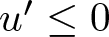 $u^\prime \leq 0$ and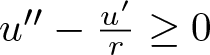 $u^{\prime \prime}- {u^\prime \over r}\geq 0$ in $B(0,1)\setminus \{0\}$.
Our last preliminary result is a comparison principle for radial solutions in the punctured ball satisfying a suitable growth condition around the singularity. The proof, based merely on the ellipticity property of the principal part and on the superlinear character of the absorption zero-order term, is given in [Reference Birindelli, Demengel and Leoni5] for Pucci’s extremal operator  $\mathcal{M}^+$, but it applies exactly in the same way to both operators ${\cal P}_k^\pm$.
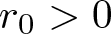
Theorem 2.5. Let  $\mu \gt 0$, $p \gt 1$,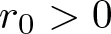 $r_0 \gt 0$ and let $u$ and $v$ be two positive radial functions in $C^2\left(B_{r_0}\setminus \{0\}\right)$ satisfying
 \begin{equation*}
{\cal P}_k^\pm(D^2u)+\mu \frac{u}{r^2} -u^p\geq 0 \geq {\cal P}_k^\pm(D^2v) +\mu \frac{v}{r^2} -v^p\quad \hbox{in } B_{r_0}\setminus \{0\}\, .
\end{equation*}
\begin{equation*}
{\cal P}_k^\pm(D^2u)+\mu \frac{u}{r^2} -u^p\geq 0 \geq {\cal P}_k^\pm(D^2v) +\mu \frac{v}{r^2} -v^p\quad \hbox{in } B_{r_0}\setminus \{0\}\, .
\end{equation*} Assume that  $u\, ,\ v \in C\left( \overline{B_{r_0}}\setminus \{0\}\right)$ and that there exist positive constants $c_1, c_2$ such that
 \begin{equation*} c_1 r^{-2\over p-1}\leq v(r)\quad \hbox{and }\quad u(r)\, , v(r) \leq c_2 r^{-2\over p-1}\quad \hbox{ for }\ 0 \lt r\leq r_0\, .\end{equation*}
 If  $u(r_0)\leq v(r_0)$, then $u\leq v$ in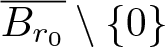 $\overline{B_{r_0}}\setminus \{0\}$.
3. Principal eigenvalues and eigenfunctions
3.1. The
${\cal P}_k^{+}$ case, with
$k\geq 2$


Let  $\gamma \gt 0$. Following the approach of [Reference Berestycki, Nirenberg and Varadhan3], we introduce
 \begin{align}
\begin{array}{c}
\displaystyle \bar \lambda_\gamma \, : = \sup \left\{\mu\in \mathbb R\, : \, \exists \, v \in {\cal C}^2 (B(0,1)\setminus\{0\}) \hbox{s.t. } v \gt 0\, , v \hbox{is radial, }\right.\\
\qquad\qquad\qquad\qquad \left. {\cal P}_k^+ ( D^2 v) + \mu v r^{-\gamma} \leq 0 \hbox{in } B(0,1)\setminus\{0\}\right\}\, ,
\end{array}
\end{align}
\begin{align}
\begin{array}{c}
\displaystyle \bar \lambda_\gamma \, : = \sup \left\{\mu\in \mathbb R\, : \, \exists \, v \in {\cal C}^2 (B(0,1)\setminus\{0\}) \hbox{s.t. } v \gt 0\, , v \hbox{is radial, }\right.\\
\qquad\qquad\qquad\qquad \left. {\cal P}_k^+ ( D^2 v) + \mu v r^{-\gamma} \leq 0 \hbox{in } B(0,1)\setminus\{0\}\right\}\, ,
\end{array}
\end{align}which will be referred to as the radial principal eigenvalue for  ${\cal P}_k^+$ and the potential $r^{-\gamma}$ in $B(0,1)\setminus \{0\}$.
We immediately observe that 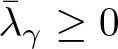 $\bar \lambda_\gamma\geq 0$, as it follows by using constant functions as super-solutions $v$. More than that, in the case $\gamma \lt 2$, an easy computation shows that the function $v(r)=1-r^\beta$ satisfies, for $0 \lt \beta \leq 2-\gamma$,
 \begin{equation*}
{\cal P}_k^+(D^2v)\leq -c \frac{v}{r^\gamma}
\end{equation*}
\begin{equation*}
{\cal P}_k^+(D^2v)\leq -c \frac{v}{r^\gamma}
\end{equation*}for some  $c \gt 0$ depending on $\beta$ and $k$. Hence, we deduce that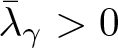 $\bar \lambda_\gamma \gt 0$ at least for $\gamma \lt 2$.
The aim of the following results is to provide sufficient conditions ensuring that  $\bar \lambda_\gamma$ actually is a positive eigenvalue associated with ${\cal P}_k^+$ and the potential $r^{-\gamma}$, meaning that there exist positive solutions of the Dirichlet problem
 \begin{align}
\left\{
\begin{array}{cl}
\displaystyle {\cal P}_k^+(D^2u) + \bar \lambda_\gamma \frac{u}{r^\gamma}=0 & \hbox{in } B(0,1)\setminus \{0\}\\[2ex]
\displaystyle u=0 & \hbox{on } \partial B(0,1)
\end{array} \right.
\end{align}
\begin{align}
\left\{
\begin{array}{cl}
\displaystyle {\cal P}_k^+(D^2u) + \bar \lambda_\gamma \frac{u}{r^\gamma}=0 & \hbox{in } B(0,1)\setminus \{0\}\\[2ex]
\displaystyle u=0 & \hbox{on } \partial B(0,1)
\end{array} \right.
\end{align} Let us start by proving a maximum principle ‘below’  $\bar\lambda_\gamma$.
Theorem 3.1. Let  $u\in {\cal C}^2 ( B(0,1)\setminus\{0\})\cap {\cal C}(\overline{B(0,1)})$ be a radial function satisfying
 \begin{equation*} {\cal P}_k^+ ( D^2 u) + \mu u r^{-\gamma} \geq 0 \qquad \hbox{in } B(0,1)\setminus \{0\}\end{equation*}
for some 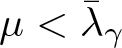 $\mu \lt \bar \lambda_\gamma$. If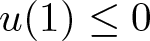 $u(1)\leq 0$, then
 \begin{equation*}u(r)\leq 0 \qquad \hbox{for } 0\leq r\leq 1\, .\end{equation*}
Proof. The proof proceeds as the proof of Theorem 2.7 in [Reference Birindelli, Demengel and Leoni4]. We sketch the steps for the reader’s convenience.
Since 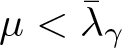 $\mu \lt \bar \lambda_\gamma$, by definition of $\bar \lambda_\gamma$ we can select $\mu^{\prime}$, with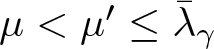 $\mu \lt \mu^{\prime}\leq \bar \lambda_\gamma$, for which there exists a positive radial function $v \in {\cal C}^2 (B(0,1)\setminus\{0\})$ satisfying
 \begin{equation*} {\cal P}_k^+ ( D^2 v) + \mu^{\prime} v r^{-\gamma} \leq 0 \hbox{in } B(0,1)\setminus\{0\}\, .\end{equation*}
 Without loss of generality, we can assume that 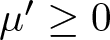 $\mu^{\prime}\geq 0$, $v(r)$ is continuous up to $r=1$ and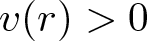 $v(r) \gt 0$ for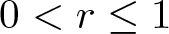 $0 \lt r\leq 1$. Moreover, by Lemma 2.1, $v$ is monotone nonincreasing for $r$ close to zero, so that there exists the limit $\lim_{r\to 0} v(r) = : v(0)\in (0,+\infty]$.
Let us consider the quotient function  $\frac{u}{v}$ and its supremum value on $B(0,1)\setminus \{0\}$. Arguing by contradiction, let us assume that the supremum is positive. Up to a normalization, we can assume that
 \begin{equation*}
\sup_{B(0,1)\setminus \{0\}}\frac{u}{v}=1
\end{equation*}
\begin{equation*}
\sup_{B(0,1)\setminus \{0\}}\frac{u}{v}=1
\end{equation*} Let 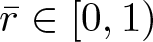 $\bar r\in [0,1)$ be any limit point of a maximizing sequence. If $\bar r \gt 0$, then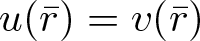 $u(\bar r)=v(\bar r)$ and testing the differential inequalities satisfied by $u$ and $v$ at $\bar r$ yields, by ellipticity,
 \begin{equation*}
\mu^{\prime} v(\bar r) {\bar r}^{-\gamma} \leq -{\cal P}_k^+ (D^2v(\bar r))\leq - {\cal P}_k^+ (D^2u(\bar r))\leq \mu u(\bar r) {\bar r}^{-\gamma}\, ,
\end{equation*}
\begin{equation*}
\mu^{\prime} v(\bar r) {\bar r}^{-\gamma} \leq -{\cal P}_k^+ (D^2v(\bar r))\leq - {\cal P}_k^+ (D^2u(\bar r))\leq \mu u(\bar r) {\bar r}^{-\gamma}\, ,
\end{equation*}which is a contradiction to the inequality 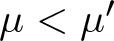 $\mu \lt \mu^{\prime}$.
On the other hand, if  $\bar r=0$ for all maximizing sequences, then 0 is a strict maximum point of $u-v$, with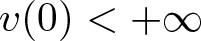 $v(0) \lt +\infty$,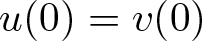 $u(0)= v(0)$ and $\mu^\prime v(0)-\mu u(0) \gt 0$. Hence, by the sub-additivity of operator ${\cal P}_k^+$ and by continuity, in a neighbourhood of zero, one has
 \begin{align*}
{\cal P}_k^+ ( D^2 ( u-v)(r))
&\geq {\cal P}_k^+(D^2u) -{\cal P}_k^+(D^2v)\geq \left(\mu^{\prime} v(r)-\mu u(r)\right)r^{-\gamma}\\
&\geq {1\over 2} \left( \mu^\prime v(0)- \mu u(0)\right) r^{-\gamma} \gt 0\, .
\end{align*}
\begin{align*}
{\cal P}_k^+ ( D^2 ( u-v)(r))
&\geq {\cal P}_k^+(D^2u) -{\cal P}_k^+(D^2v)\geq \left(\mu^{\prime} v(r)-\mu u(r)\right)r^{-\gamma}\\
&\geq {1\over 2} \left( \mu^\prime v(0)- \mu u(0)\right) r^{-\gamma} \gt 0\, .
\end{align*} By Remark 2.2, this implies that  $(u-v)^\prime \geq 0$ in a neighbourhood of zero, so that $u-v$ cannot achieve a strict maximum at zero.
Remark 3.2. Let us explicitly observe that the assumption  $k\geq 2$ is crucial for the validity of the maximum principle stated by Theorem 3.1. Indeed, it fails for $k=1$, as shown by the function $u(r)=1-r\in C(\overline{B(0,1)})\cap C^2 (B(0,1)\setminus \{0\})$,which satisfies
 \begin{equation*}
{\cal P}^+_1 (D^2u)=0 \qquad \hbox{in } B(0,1)\setminus \{0\} \end{equation*}
\begin{equation*}
{\cal P}^+_1 (D^2u)=0 \qquad \hbox{in } B(0,1)\setminus \{0\} \end{equation*}and 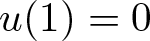 $u(1)=0$, $u \gt 0$ in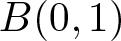 $B(0,1)$.
Thanks to the above maximum principle, we can prove the following existence result.
Proposition 3.3. Let  $b\geq 0$, $\gamma \lt 2$ and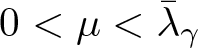 $0 \lt \mu \lt \bar \lambda_\gamma$
. Then, for any radial nondecreasing function
$0 \lt \mu \lt \bar \lambda_\gamma$
. Then, for any radial nondecreasing function  $f\in {\cal C}^1( B(0,1))$, such that $f \lt 0$ and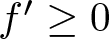 $f'\geq 0$ in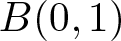 $B(0,1)$, there exists $u\in {\cal C}(\overline{B(0,1)})\cap {\cal C}^2(B(0,1)\setminus \{0\})$ solution of
 \begin{align*}
\left\{
\begin{array}{cl}
\displaystyle {\cal P}_k^+(D^2u) + \mu \frac{u}{r^\gamma}=\frac{f}{r^\gamma} & \hbox{in } B(0,1)\setminus \{0\}\\[2ex]
\displaystyle u=b & \hbox{on } \partial B(0,1)
\end{array} \right.
\end{align*}
\begin{align*}
\left\{
\begin{array}{cl}
\displaystyle {\cal P}_k^+(D^2u) + \mu \frac{u}{r^\gamma}=\frac{f}{r^\gamma} & \hbox{in } B(0,1)\setminus \{0\}\\[2ex]
\displaystyle u=b & \hbox{on } \partial B(0,1)
\end{array} \right.
\end{align*} Furthermore,  $u$ satisfies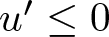 $u^\prime \leq0$ and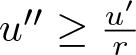 $u^{\prime \prime } \geq \frac{u^\prime}{r}$ in $B(0,1)\setminus \{0\}$.
Proof. Let us inductively define the following sequence of functions: we set 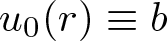 $u_0(r)\equiv b$ and, for $n\geq 1$,
 \begin{equation*}
u_n(r) \, : = b -\int_r^1 \frac{1}{s^{k-1}}\int_0^s \left(f(t)-\mu\, u_{n-1}(t)\right)t^{k-1-\gamma} dt\, ds\, .
\end{equation*}
\begin{equation*}
u_n(r) \, : = b -\int_r^1 \frac{1}{s^{k-1}}\int_0^s \left(f(t)-\mu\, u_{n-1}(t)\right)t^{k-1-\gamma} dt\, ds\, .
\end{equation*} The assumptions on  $\gamma$, $b$ and $f$ make $\{u_n\}$ a well-defined sequence of non-negative continuous functions in $[0,1]$, of class ${\cal C}^2$ in $(0,1)$ and satisfying
 \begin{align*}
u^{\prime}_n(r)\leq 0\, ,\quad u^{\prime\prime}_{n}(r)-\frac{u^{\prime}_n(r)}{r} &=- \frac{k}{r^k} \int_0^r \left(f(t)-\mu\, u_{n-1}(t)\right)t^{k-1-\gamma} dt \\
& +\left(f(r)-\mu\, u_{n-1}(r)\right)r^{-\gamma} \geq 0\, .
\end{align*}
\begin{align*}
u^{\prime}_n(r)\leq 0\, ,\quad u^{\prime\prime}_{n}(r)-\frac{u^{\prime}_n(r)}{r} &=- \frac{k}{r^k} \int_0^r \left(f(t)-\mu\, u_{n-1}(t)\right)t^{k-1-\gamma} dt \\
& +\left(f(r)-\mu\, u_{n-1}(r)\right)r^{-\gamma} \geq 0\, .
\end{align*} Hence, for every  $n\geq 1$, $u_n\in {\cal C}(\overline{B(0,1)})\cap {\cal C}^2(B(0,1)\setminus \{0\})$ is a radial positive solution of
 \begin{align*}
\left\{
\begin{array}{cl}
\displaystyle {\cal P}_k^+(D^2u_n) =\left( f-\mu\, u_{n-1}\right)\, r^{-\gamma} & \hbox{in } B(0,1)\setminus \{0\}\\[2ex]
\displaystyle u_n=b & \hbox{on } \partial B(0,1)
\end{array} \right.
\end{align*}
\begin{align*}
\left\{
\begin{array}{cl}
\displaystyle {\cal P}_k^+(D^2u_n) =\left( f-\mu\, u_{n-1}\right)\, r^{-\gamma} & \hbox{in } B(0,1)\setminus \{0\}\\[2ex]
\displaystyle u_n=b & \hbox{on } \partial B(0,1)
\end{array} \right.
\end{align*} Furthermore, a simple induction argument shows that  $u_n\geq u_{n-1}$ in $[0,1]$ for all $n\geq 1$. Since $f \lt 0$, this implies also that $u_n$ is not identically zero.
We claim that  $\{u_n$} is bounded in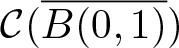 ${\cal C}(\overline{B(0,1)})$. Indeed, if not, dividing by $\|u_{n}\|_\infty=u_n(0)\rightarrow +\infty$ and defining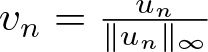 $v_n = \frac{u_n}{\|u_n\|_\infty}$, one gets that $v_n$ is a ${\cal C}^2( B(0,1)\setminus \{0\})$ radial function satisfying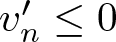 $v_n^\prime \leq 0$,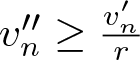 $v_n^{\prime \prime } \geq {v_n^\prime \over r}$ and
 \begin{align*}
\left\{
\begin{array}{cl}
\displaystyle {\cal P}_k^+ ( D^2 v_{n} ) = \left(\frac{f}{\|u_n\|_\infty}-\mu \, v_{n-1}\frac{\|u_{n-1}\|_\infty}{\|u_n\|_\infty}\right) r^{-\gamma}& \hbox{in } B(0,1)\setminus \{0\}\\[2ex]
\displaystyle v_n=\frac{b}{\|u_n\|_\infty} & \hbox{on } \partial B(0,1)
\end{array} \right.
\end{align*}
\begin{align*}
\left\{
\begin{array}{cl}
\displaystyle {\cal P}_k^+ ( D^2 v_{n} ) = \left(\frac{f}{\|u_n\|_\infty}-\mu \, v_{n-1}\frac{\|u_{n-1}\|_\infty}{\|u_n\|_\infty}\right) r^{-\gamma}& \hbox{in } B(0,1)\setminus \{0\}\\[2ex]
\displaystyle v_n=\frac{b}{\|u_n\|_\infty} & \hbox{on } \partial B(0,1)
\end{array} \right.
\end{align*}Furthermore,
 \begin{equation*} v^\prime_n \geq - \frac{1}{k-\gamma} \frac{\|f-\mu u_{n-1}\|_{\infty}}{\|u_n \|_\infty } r^{1-\gamma}\geq -C r^{1-\gamma}\, , \end{equation*}
which implies that  $\{v_n^\prime\}$ is locally uniformly bounded in $(0,1)$, and by the equation, so is $\{v_n^{\prime \prime}\}$. We can let $n\to \infty$ in $B(0,1) \setminus \{0\}$ and we get that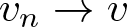 $v_n \rightarrow v$,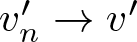 $v_n^\prime \rightarrow v^\prime $ locally uniformly and, by the equation,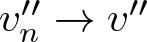 $v_n^{\prime \prime} \rightarrow v^{\prime \prime}$ as well. Furthermore, $v$ is ${\cal C}^2( B(0, 1)\setminus \{0\})$,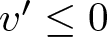 $v^\prime \leq 0$,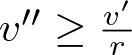 $v^{\prime \prime } \geq {v^\prime \over r}$, and, possibly considering a subsequence such that there exists the limit $\lim_{n\rightarrow\infty}\frac{\|u_{n-1}\|_\infty}{\|u_n\|_\infty}=c\leq 1$, $v$ satisfies
 \begin{equation*} {\cal P}_k^+ ( D^2 v) + c\mu v r^{-\gamma} = 0\, ,\ \ \ v(1) = 0\, .\end{equation*}
 By Theorem 3.1, we obtain  $v\equiv 0$, which contradicts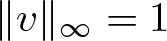 $\|v\|_\infty =1$.
Now, with  $\{u_n\}$ bounded, we can repeat what was done with $\{v_n\}$ and we obtain that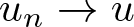 $u_n\rightarrow u$, where $u$ is a solution. Moreover, $u$ satisfies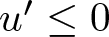 $u^\prime \leq0$ and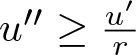 $u^{\prime \prime } \geq \frac{u^\prime}{r}$ in $B(0,1)\setminus \{0\}$ by Lemma 2.3.
We are now ready to prove our first existence result for eigenfunctions in the case  $\gamma \lt 2$.
Theorem 3.4. Suppose that  $\gamma \lt 2$. Then, there exists $u \gt 0$, $u\in C(\overline{B(0, 1)})\cap C^2(B(0,1) \setminus \{0\})$ solution of (3.2). Furthermore, $u$ satisfies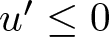 $u^\prime \leq0$ and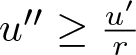 $u^{\prime \prime } \geq \frac{u^\prime}{r}$ in $B(0,1)\setminus \{0\}$.
Proof. Let us select a positive increasing sequence 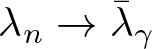 $\lambda_n\rightarrow \bar\lambda_\gamma$. By Proposition 3.3, for every $n\geq 1$, we can further consider a positive radial solution $u_n\in {\cal C} ( \overline{B(0,1)}) \cap {\cal C}^2(B(0,1)\setminus\{0\})$ of
 \begin{align*}
\left\{
\begin{array}{cl}
\displaystyle {\cal P}_k^+(D^2u_n) +\lambda_n \frac{u_n}{r^\gamma}= -\frac{1}{r^\gamma} & \hbox{in } B(0,1)\setminus \{0\}\\[2ex]
\displaystyle u_n=0 & \hbox{on } \partial B(0,1)
\end{array} \right.
\end{align*}
\begin{align*}
\left\{
\begin{array}{cl}
\displaystyle {\cal P}_k^+(D^2u_n) +\lambda_n \frac{u_n}{r^\gamma}= -\frac{1}{r^\gamma} & \hbox{in } B(0,1)\setminus \{0\}\\[2ex]
\displaystyle u_n=0 & \hbox{on } \partial B(0,1)
\end{array} \right.
\end{align*} More explicitly, the functions  $u_n$ satisfy
 \begin{align*}
\left\{
\begin{array}{cl}
\displaystyle
u_n''+(k-1)\frac{u_n'}{r}+\lambda_n \frac{u_n}{r^\gamma}= -\frac{1}{r^\gamma} & \hbox{for } 0 \lt r \lt 1\, ,\\[2ex]
\displaystyle u_n(1)=0 &
\end{array}\right.
\end{align*}
\begin{align*}
\left\{
\begin{array}{cl}
\displaystyle
u_n''+(k-1)\frac{u_n'}{r}+\lambda_n \frac{u_n}{r^\gamma}= -\frac{1}{r^\gamma} & \hbox{for } 0 \lt r \lt 1\, ,\\[2ex]
\displaystyle u_n(1)=0 &
\end{array}\right.
\end{align*} We claim that the sequence 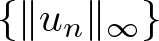 $\{\|u_n\|_\infty\}$ is unbounded. Indeed, assuming, on the contrary, that $\{u_n\} $ is uniformly bounded, we could extract from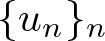 $\{u_n\}_n$ a subsequence uniformly converging to a function $u$ satisfying
 \begin{equation*} u^{\prime \prime} + ( k-1) {u^\prime \over r} +\bar \lambda_\gamma {u \over r^\gamma}= {-1\over r^\gamma} \, .\end{equation*}
 Moreover,  $u$ would belong ${\cal C}(\overline{B(0,1)})\cap {\cal C}^2(B(0,1)\setminus\{0\})$ and satisfy
 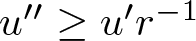 $ u^{\prime \prime}\geq u^{\prime }
r^{-1}$. Hence,
$ u^{\prime \prime}\geq u^{\prime }
r^{-1}$. Hence,  $u$ would be a positive bounded solution of
 \begin{equation*}{\cal P}_k^+ ( D^2 u) + \bar \lambda_\gamma \frac{u}{r^{\gamma}} = -r^{-\gamma}\qquad \hbox{in } B(0,1)\setminus \{0\}\, .\end{equation*}
 As a consequence, for  $\epsilon \gt 0$ sufficiently small, $u\in {\cal C}^2(B(0,1)\setminus\{0\})$ would be a positive radial function satisfying
 \begin{equation*}{\cal P}_k^+ ( D^2u) + (\bar\lambda_\gamma +\epsilon) \frac{u}{r^\gamma} \leq 0\end{equation*}
in contradiction with the definition of  $\bar\lambda_\gamma$.
This proves that the sequence 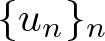 $\{u_n\}_n$ is not uniformly bounded. Then, by arguing on the normalized sequence
 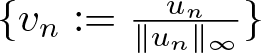 $\{v_n:=
\frac{u_n }{\|u_n\|_\infty}\}$, we can let
$\{v_n:=
\frac{u_n }{\|u_n\|_\infty}\}$, we can let  $n\to \infty$ in order to obtain a limit function $u$ as in the statement.
Let us now make an observation relying on Corollary 2.4. Since any eigenfunction  $u$ solving (3.2) actually satisfies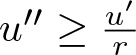 $u^{\prime\prime}\geq \frac{u^{\prime}}{r}$, then $u$ is a solution of the ordinary differential equation
 \begin{equation*}
u^{\prime\prime}+(k-1) \frac{u^{\prime}}{r} +\bar \lambda_\gamma \frac{u}{r^\gamma}=0\qquad \hbox{in } (0,1)\, .
\end{equation*}
\begin{equation*}
u^{\prime\prime}+(k-1) \frac{u^{\prime}}{r} +\bar \lambda_\gamma \frac{u}{r^\gamma}=0\qquad \hbox{in } (0,1)\, .
\end{equation*} Therefore, the existence of  $u$ can also be proved by following a variational approach for the above linear eigenvalue problem. The two approaches lead to the same result, as stated in the following proposition. Let us introduce the space ${\cal H}_0^{1,k}$ defined as the closure of the set
 \begin{equation*}
\{u\in C^1([0,1])\, :\ u(1)=0\, ,\ \int_0^1 (u^\prime)^2 r^{k-1} dr \lt +\infty \}
\end{equation*}
\begin{equation*}
\{u\in C^1([0,1])\, :\ u(1)=0\, ,\ \int_0^1 (u^\prime)^2 r^{k-1} dr \lt +\infty \}
\end{equation*}with respect to the norm
 \begin{equation*}
\|u\|_{{\cal H}_0^{1,k}}\, := \left( \int_0^1 \left( u(r)^2+ u^{\prime}(r)^2\right)\, r^{k-1}\, dr\right)^{1/2}\, .
\end{equation*}
\begin{equation*}
\|u\|_{{\cal H}_0^{1,k}}\, := \left( \int_0^1 \left( u(r)^2+ u^{\prime}(r)^2\right)\, r^{k-1}\, dr\right)^{1/2}\, .
\end{equation*}  ${\cal H}_0^{1,k}$ is nothing but the space consisting of radial functions belonging to the standard Sobolev space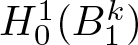 $H^1_0(B_1^k)$, where $B_1^k$ is the unit ball in $\mathbb R^k$.
Proposition 3.5. For any  $\gamma \lt 2$, one has
 \begin{equation*}\bar \lambda_\gamma= \lambda_{\gamma ,{\rm var}} \, : = \inf_{\{u\in {\cal H}_0^{1,k} \, :\ \int _0^1 u^2 r^{k-1-\gamma}dr = 1\} } \int_0^1
(u^\prime )^2 r^{k-1} dr \, .\end{equation*}
\begin{equation*}\bar \lambda_\gamma= \lambda_{\gamma ,{\rm var}} \, : = \inf_{\{u\in {\cal H}_0^{1,k} \, :\ \int _0^1 u^2 r^{k-1-\gamma}dr = 1\} } \int_0^1
(u^\prime )^2 r^{k-1} dr \, .\end{equation*}Proof. The existence of a minimum realizing the infimum defining  $\bar \lambda_{\gamma, {\rm var}}$ is classical.
Therefore, there exists 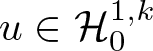 $u\in {\cal H}_0^{1,k}$, with $u \gt 0$, satisfying in the distributional sense
 \begin{equation*}
(u^{\prime}r^{k-1})'=- \lambda_{\gamma, {\rm var}} u \, r^{k-1-\gamma}\, .\end{equation*}
\begin{equation*}
(u^{\prime}r^{k-1})'=- \lambda_{\gamma, {\rm var}} u \, r^{k-1-\gamma}\, .\end{equation*} Hence, 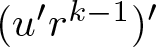 $(u^{\prime}r^{k-1})'$ is continuous in $(0,1)$ and this implies that $u$ is in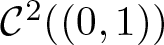 ${\cal C}^2((0,1))$. Thus, $u$ is a classical solution of
 \begin{equation*}
u^{\prime \prime } + ( k-1) \frac{u^\prime}{r} = - \lambda_{\gamma, {\rm var}} \frac{u}{r^\gamma} \ \mbox{in } (0,1)\, ,\quad u(1)=0\, .\end{equation*}
\begin{equation*}
u^{\prime \prime } + ( k-1) \frac{u^\prime}{r} = - \lambda_{\gamma, {\rm var}} \frac{u}{r^\gamma} \ \mbox{in } (0,1)\, ,\quad u(1)=0\, .\end{equation*} This implies in particular that  $(u^{\prime}(r) r^{k-1})' \lt 0$, and therefore there exists the limit $\lim_{r\to 0} u^{\prime}(r) r^{k-1}$, which must be less than or equal to zero. Indeed, if not, there exists some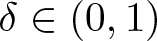 $\delta\in (0,1)$ such that $u^{\prime}(r) r^{k-1}\geq \delta$ for all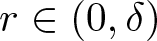 $r\in (0,\delta)$. This implies that, for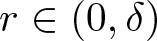 $r\in (0,\delta)$,
 \begin{equation*}
u(\delta)-u(r)=\int_r^\delta u^{\prime}(t)\, dt\geq \delta \int_r^\delta \frac{1}{t^{k-1}}\, dt\geq \delta \int_r^\delta \frac{1}{t}\, dt= \delta \ln \left( \frac{\delta}{r}\right)\, ,
\end{equation*}
\begin{equation*}
u(\delta)-u(r)=\int_r^\delta u^{\prime}(t)\, dt\geq \delta \int_r^\delta \frac{1}{t^{k-1}}\, dt\geq \delta \int_r^\delta \frac{1}{t}\, dt= \delta \ln \left( \frac{\delta}{r}\right)\, ,
\end{equation*}and, by sending 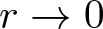 $r\to 0$, one gets $u(r)\to -\infty$, a contradiction to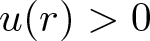 $u(r) \gt 0$.
Thus, one has 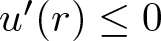 $u^{\prime}(r)\leq 0$ for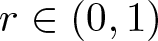 $r\in (0,1)$ and then $-\lambda_{\gamma, {\rm var}} u(r)r^{-\gamma}$ is increasing. Integrating the above equation yields
 \begin{equation*} u^\prime (r) r^{k-1} \leq -\lambda_{\gamma, {\rm var}} u(r) r^{-\gamma} \int_0^r s^{k-1}ds= -\frac{\lambda_{\gamma, {\rm var}}}{k}u(r) r^{k-\gamma}\, ,\end{equation*}
and then
 \begin{equation*} \frac{u^{\prime}}{r}\leq \frac{1}{k} \left( u^{\prime\prime}+(k-1) \frac{u^{\prime}}{r}\right)\, ,\end{equation*}
that is
 \begin{equation*}\frac{u^{\prime}}{r}\leq u^{\prime\prime}\, .\end{equation*}
 Hence,  $u\in {\cal C}^2(B(0,1)\setminus \{0\})$ is a positive radial solution of ${\cal P}_k^+ ( D^2 u) + \lambda_{\gamma, {\rm var}} ur^{-\gamma} =0$ and this implies, by definition, that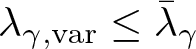 $\lambda_{\gamma, {\rm var}}\leq \bar \lambda_\gamma$. On the other hand, if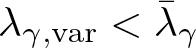 $\lambda_{\gamma, {\rm var}} \lt \bar \lambda_\gamma$, then Theorem 3.1 gives $u\leq 0$, which is impossible.
Thanks to the characterization given by Proposition 3.5, we can give the explicit expression of the eigenvalue and of an eigenfunction in the case  $\gamma=2$.
Theorem 3.6. Let  $\gamma=2$ and $k\geq 3$. Then
 \begin{equation*}
\bar \lambda_2 = \frac{(k-2)^2}{4}\end{equation*}
\begin{equation*}
\bar \lambda_2 = \frac{(k-2)^2}{4}\end{equation*}and the function
 \begin{equation*}
u(r)= \frac{- \ln r}{r^{\frac{k-2}{2}}}
\end{equation*}
\begin{equation*}
u(r)= \frac{- \ln r}{r^{\frac{k-2}{2}}}
\end{equation*}is an explicit solution of problem (3.2) with  $\gamma=2$.
Proof. As it is well-known (see e.g. [Reference Azorero and Peral2]), the value 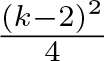 $\frac{(k-2)^2}{4}$ is nothing but the inverse of the best constant in Hardy’s inequality in dimension $k$. In other words, one has
 \begin{equation*}
\frac{(k-2)^2}{4}= \lambda_{2, {\rm var}}
\end{equation*}
\begin{equation*}
\frac{(k-2)^2}{4}= \lambda_{2, {\rm var}}
\end{equation*}and the function 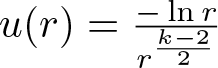 $u(r)= \frac{- \ln r}{r^{\frac{k-2}{2}}}$ is the explicit infinite energy solution of the eigenvalue problem
 \begin{align*}
\left\{
\begin{array}{cl}
\displaystyle -\Delta u = \lambda_{2,{\rm var}} \frac{u}{r^2} & \hbox {in } B(0,1)\subset \mathbb R^k\\[2ex]
\displaystyle u=0 & \hbox {on } \partial B(0,1)
\end{array}
\right.
\end{align*}
\begin{align*}
\left\{
\begin{array}{cl}
\displaystyle -\Delta u = \lambda_{2,{\rm var}} \frac{u}{r^2} & \hbox {in } B(0,1)\subset \mathbb R^k\\[2ex]
\displaystyle u=0 & \hbox {on } \partial B(0,1)
\end{array}
\right.
\end{align*} As a function of one variable,  $u$ belongs to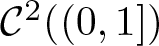 ${\cal C}^2((0,1])$ and satisfies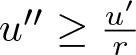 $u^{\prime\prime}\geq \frac{u^{\prime}}{r}$, so that $u$ is a classical solution in dimension $N$ of
 \begin{equation*}
{\cal P}_k^+ ( D^2 u) + \lambda_{2, {\rm var}} ur^{-2} =0\qquad \hbox{in } B(0,1)\setminus \{0\}\, .
\end{equation*}
\begin{equation*}
{\cal P}_k^+ ( D^2 u) + \lambda_{2, {\rm var}} ur^{-2} =0\qquad \hbox{in } B(0,1)\setminus \{0\}\, .
\end{equation*}Hence, by definition, we deduce
 \begin{equation*}\bar \lambda_2\geq \lambda_{2,{\rm var}}= \frac{(k-2)^2}{4}\, .\end{equation*}
 On the other hand, again by the definition of  $\bar \lambda_\gamma$, one easily sees that the value $\bar \lambda_\gamma$ is monotone nonincreasing with respect to $\gamma$, hence
 \begin{equation*}
\bar \lambda_2 \leq \lim_{\gamma \to 2^-} \bar \lambda_\gamma\, .
\end{equation*}
\begin{equation*}
\bar \lambda_2 \leq \lim_{\gamma \to 2^-} \bar \lambda_\gamma\, .
\end{equation*} By applying Proposition 3.5 and by using the stability with respect to  $\gamma$ of the variational eigenvalue, we then obtain
 \begin{equation*}
\bar \lambda_2 \leq \lim_{\gamma \to 2^-} \bar \lambda_\gamma= \lim_{\gamma \to 2^-} \lambda_{\gamma, {\rm var}}=\lambda_{2, {\rm var}}=\frac{(k-2)^2}{4}\, ,
\end{equation*}
\begin{equation*}
\bar \lambda_2 \leq \lim_{\gamma \to 2^-} \bar \lambda_\gamma= \lim_{\gamma \to 2^-} \lambda_{\gamma, {\rm var}}=\lambda_{2, {\rm var}}=\frac{(k-2)^2}{4}\, ,
\end{equation*}which concludes the proof.
We conclude this section by considering the case  $\gamma \gt 2$.
Theorem 3.7. If  $\gamma \gt 2$, then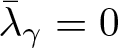 $\bar \lambda_\gamma=0$.
Proof. By contradiction, let us assume that for some  $\mu \gt 0$ there exists a positive radial function $v\in {\cal C}^2(B(0,1)\setminus \{0\})$ satisfying
 \begin{equation*}
{\cal P}^+_k(D^2v)+ \mu \frac{v}{r^\gamma}\leq 0\qquad \hbox{in } B(0,1)\setminus \{0\}\, .
\end{equation*}
\begin{equation*}
{\cal P}^+_k(D^2v)+ \mu \frac{v}{r^\gamma}\leq 0\qquad \hbox{in } B(0,1)\setminus \{0\}\, .
\end{equation*} Then, by Lemma 2.1, we have 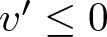 $v'\leq 0$. Moreover, by definition of ${\cal P}^+_k$, we have also that $v$ satisfies
 \begin{equation*}
v^{\prime\prime}+(k-1) \frac{v'}{r} +\mu \frac{v}{r^\gamma}\leq 0\qquad \hbox{for } 0 \lt r \lt 1\, .
\end{equation*}
\begin{equation*}
v^{\prime\prime}+(k-1) \frac{v'}{r} +\mu \frac{v}{r^\gamma}\leq 0\qquad \hbox{for } 0 \lt r \lt 1\, .
\end{equation*}Hence, we can apply e.g. the same proof of Theorem 1.3 in [Reference Birindelli, Demengel and Leoni4] in order to reach a contradiction.
3.2. The
${\cal P}_1^+ $ case

We consider here the eigenvalue problem for operator  ${\cal P}^+_1$, which has to be studied separately because of the lack of validity of the maximum principle given by Theorem 3.1, as observed in Remark 3.2.
Nonetheless, for  $\gamma \lt 1$, we still have a variational characterization of $\bar \lambda_\gamma$ analogous to Proposition 3.5. In this case, we set
 \begin{equation*}
\lambda_{\gamma, {\rm var}} \, := \inf_{\{v\in H^1((0,1))\, : v(1)=0\, ,\ \int_0^1 v^2(r) r^{-\gamma}dr=1\}} \int_0^1 (v'(r))^2dr\, .
\end{equation*}
\begin{equation*}
\lambda_{\gamma, {\rm var}} \, := \inf_{\{v\in H^1((0,1))\, : v(1)=0\, ,\ \int_0^1 v^2(r) r^{-\gamma}dr=1\}} \int_0^1 (v'(r))^2dr\, .
\end{equation*} Let us observe that, for  $\gamma \lt 1$, one has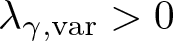 $\lambda_{\gamma, {\rm var}} \gt 0$, as it is easily follows by Hölder inequality.
Indeed, for any  $v\in C^1([0,1])$ satisfying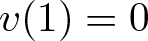 $v(1)=0$, one has
 \begin{equation*}
|v(r)|=\left| \int_r^1 v'(s)\, ds\right| \leq \left( \int_r^1 (v'(s))^2\, ds \right)^{1/2} (1-r)^{1/2}\, ,
\end{equation*}
\begin{equation*}
|v(r)|=\left| \int_r^1 v'(s)\, ds\right| \leq \left( \int_r^1 (v'(s))^2\, ds \right)^{1/2} (1-r)^{1/2}\, ,
\end{equation*}which yields
 \begin{equation*}
\int_0^1 v^2(r)r^{-\gamma}dr\leq \left(\int_0^1 (v'(r))^2dr\right)\, \int_0^1 (1-r)r^{-\gamma}dr= \frac{1}{(1-\gamma)(2-\gamma)} \int_0^1 (v'(r))^2dr\, .
\end{equation*}
\begin{equation*}
\int_0^1 v^2(r)r^{-\gamma}dr\leq \left(\int_0^1 (v'(r))^2dr\right)\, \int_0^1 (1-r)r^{-\gamma}dr= \frac{1}{(1-\gamma)(2-\gamma)} \int_0^1 (v'(r))^2dr\, .
\end{equation*}Hence, we have
 \begin{equation*}
\lambda_{\gamma, {\rm var}} \geq (1-\gamma)(2-\gamma)\, .
\end{equation*}
\begin{equation*}
\lambda_{\gamma, {\rm var}} \geq (1-\gamma)(2-\gamma)\, .
\end{equation*}(i) If
$\gamma \lt 1$, then
$\bar \lambda_\gamma =\lambda_{\gamma, {\rm var}} \gt 0$ and problem (3.2) with
$k=1$ has a positive radial solution belonging to
${\cal C}^2(B(0,1)\setminus \{0\})\cap {\cal C}^1(\overline{B(0,1)})$.(ii) If
$\gamma \geq 1$, then
$\bar \lambda_\gamma=0$.





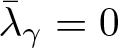
Proof. (i) By classical methods in the calculus of variations, the infimum defining  $\lambda_{\gamma, {\rm var}}$ is a minimum. Thus, there exists $u\in H^1((0,1))$, with $u \gt 0$ in $(0,1)$, satisfying in the distributional sense
 \begin{equation*}
u^{\prime\prime}= -\lambda_{\gamma, {\rm var}} u\, r^{-\gamma}\qquad \hbox{in } (0,1)\, ,
\end{equation*}
\begin{equation*}
u^{\prime\prime}= -\lambda_{\gamma, {\rm var}} u\, r^{-\gamma}\qquad \hbox{in } (0,1)\, ,
\end{equation*}and the boundary conditions
 \begin{equation*}
u^{\prime}(0)=0\, ,\quad u(1)=0\, .
\end{equation*}
\begin{equation*}
u^{\prime}(0)=0\, ,\quad u(1)=0\, .
\end{equation*} As a consequence, 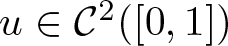 $u\in {\cal C}^2([0,1])$ satisfies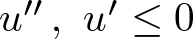 $u^{\prime\prime}\, ,\ u^{\prime}\leq 0$ in $[0,1]$. Moreover, by monotonicity, one has
 \begin{equation*}
u^{\prime}(r)=\int_0^r u^{\prime\prime}(s)\, ds =- \lambda_{\gamma, {\rm var}} \int_0^r u(s) s^{-\gamma}ds\leq - \lambda_{\gamma, {\rm var}} u(r) r^{1-\gamma} = u^{\prime\prime}(r) r\, .
\end{equation*}
\begin{equation*}
u^{\prime}(r)=\int_0^r u^{\prime\prime}(s)\, ds =- \lambda_{\gamma, {\rm var}} \int_0^r u(s) s^{-\gamma}ds\leq - \lambda_{\gamma, {\rm var}} u(r) r^{1-\gamma} = u^{\prime\prime}(r) r\, .
\end{equation*} Therefore,  $u\in {\cal C}^2(B(0,1)\setminus \{0\})\cap {\cal C}^1(\overline{B(0,1)})$ is a positive radial solution of
 \begin{align*}
\left\{\begin{array}{cl}
\displaystyle {\cal P}^+_1 (D^2u) + \lambda_{\gamma, {\rm var}} u r^{-\gamma}=0 & \hbox{in } B(0,1)\setminus \{0\}\\[2ex]
\displaystyle u=0 & \hbox{on } \partial B(0,1)
\end{array}\right.
\end{align*}
\begin{align*}
\left\{\begin{array}{cl}
\displaystyle {\cal P}^+_1 (D^2u) + \lambda_{\gamma, {\rm var}} u r^{-\gamma}=0 & \hbox{in } B(0,1)\setminus \{0\}\\[2ex]
\displaystyle u=0 & \hbox{on } \partial B(0,1)
\end{array}\right.
\end{align*}and this implies, by definition, that 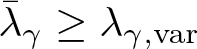 $\bar \lambda_\gamma\geq \lambda_{\gamma, {\rm var}}$.
Arguing by contradiction, let us suppose that 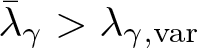 $\bar \lambda_\gamma \gt \lambda_{\gamma, {\rm var}}$. Then, there exist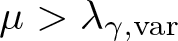 $\mu \gt \lambda_{\gamma, {\rm var}}$ and $v\in {\cal C}^2(B(0,1)\setminus \{0\})$ positive and radial such that
 \begin{equation*}
{\cal P}^+_1 (D^2v) + \mu v r^{-\gamma}\leq 0 \qquad \hbox{in } B(0,1)\setminus \{0\}\, .
\end{equation*}
\begin{equation*}
{\cal P}^+_1 (D^2v) + \mu v r^{-\gamma}\leq 0 \qquad \hbox{in } B(0,1)\setminus \{0\}\, .
\end{equation*} Without loss of generality, we can assume that 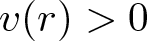 $v(r) \gt 0$ for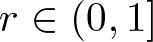 $r\in (0,1]$. Moreover, since $ {\cal P}^+_1 (D^2v)=\max \left\{v^{\prime\prime}\, ,\ \frac{v'}{r}\right\}$, we have that $v$ satisfy both the inequalities
 \begin{equation*}
v^{\prime\prime} + \mu v r^{-\gamma}\leq 0\, ,\quad v'+ \mu v r^{1-\gamma}\leq 0\qquad \hbox{for } 0 \lt r \lt 1\, .
\end{equation*}
\begin{equation*}
v^{\prime\prime} + \mu v r^{-\gamma}\leq 0\, ,\quad v'+ \mu v r^{1-\gamma}\leq 0\qquad \hbox{for } 0 \lt r \lt 1\, .
\end{equation*} In particular, we have that 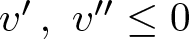 $v'\, ,\ v^{\prime\prime}\leq 0$ and there exists the limit $\lim_{r\to 0} v(r) =:\, v(0)\in (0,+\infty]$. We can now argue as in the proof of Theorem 3.1 in order to reach a contradiction. For up to a normalization, we can assume that
 \begin{equation*}
\sup_{B(0,1)\setminus \{0\}} \frac{u}{v}=1\, .
\end{equation*}
\begin{equation*}
\sup_{B(0,1)\setminus \{0\}} \frac{u}{v}=1\, .
\end{equation*} Let 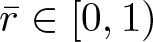 $\bar r\in [0,1)$ be any limit point of a maximizing sequence. If $\bar r \gt 0$, then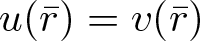 $u(\bar r)=v(\bar r)$ and $u^{\prime\prime}(\bar r)\leq v^{\prime\prime}(\bar r)$, so that
 \begin{equation*}
\mu v(\bar r) {\bar r}^{-\gamma} \leq -v^{\prime\prime}(\bar r))\leq - u^{\prime\prime}(\bar r))= \lambda_{\gamma,{\rm var}} u(\bar r) {\bar r}^{-\gamma}\, ,
\end{equation*}
\begin{equation*}
\mu v(\bar r) {\bar r}^{-\gamma} \leq -v^{\prime\prime}(\bar r))\leq - u^{\prime\prime}(\bar r))= \lambda_{\gamma,{\rm var}} u(\bar r) {\bar r}^{-\gamma}\, ,
\end{equation*}which gives the contradiction 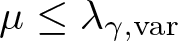 $\mu \leq \lambda_{\gamma,{\rm var}}$. If $\bar r=0$, then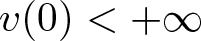 $v(0) \lt +\infty$,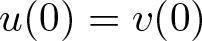 $u(0)= v(0)$, and $\mu v(0)-\lambda_{\gamma{\rm var}} u(0) \gt 0$. Hence, by continuity, in a neighbourhood of zero, one has
 \begin{equation*}(u-v)''(r)\geq \left(\mu v(r)-\lambda_{\gamma, {\rm var}} u(r)\right)r^{-\gamma}\geq {1\over 2} \left( \mu v(0)- \lambda_{\gamma, {\rm var}} u(0)\right) r^{-\gamma} \gt 0\, .\end{equation*}
 Since  $(u-v)'(0)\geq 0$, this implies that $(u-v)^\prime(r) \geq 0$ in a neighbourhood of zero, so that $u-v$ cannot achieve its maximum at zero. The contradictions reached in both cases prove that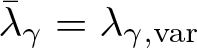 $\bar \lambda_\gamma= \lambda_{\gamma, {\rm var}}$ and the variational solution $u$ actually is a smooth solution of problem (3.2) with $k=1$.
(ii) By contradiction, let us assume that there exist  $\mu \gt 0$ and $v\in {\cal C}^2(B(0,1)\setminus \{0\})$ positive and radial such that
 \begin{equation*}
{\cal P}^+_1 (D^2v) + \mu v r^{-\gamma}\leq 0 \qquad \hbox{in } B(0,1)\setminus \{0\}\, .
\end{equation*}
\begin{equation*}
{\cal P}^+_1 (D^2v) + \mu v r^{-\gamma}\leq 0 \qquad \hbox{in } B(0,1)\setminus \{0\}\, .
\end{equation*} Then, as before, we have that  $v$ in particular satisfies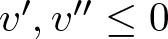 $v', v^{\prime\prime}\leq 0$ and
 \begin{equation*}
v^{\prime\prime}\leq - \mu v r^{-\gamma}\qquad \hbox{for } 0 \lt r \lt 1\, .
\end{equation*}
\begin{equation*}
v^{\prime\prime}\leq - \mu v r^{-\gamma}\qquad \hbox{for } 0 \lt r \lt 1\, .
\end{equation*} Hence, there exist 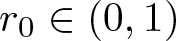 $r_0\in (0,1)$ and $c \gt 0$ such that $v^{\prime \prime } \leq -c r^{-\gamma}$ for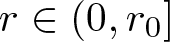 $r\in (0,r_0]$. As a consequence, for all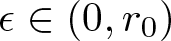 $\epsilon\in (0,r_0)$, we get
 \begin{equation*}
v'(r_0)\leq v'(\epsilon) -c \int_\epsilon^{r_0} \frac{dt}{t^\gamma}\leq -c \int_\epsilon^{r_0} \frac{dt}{t^\gamma}\, ,
\end{equation*}
\begin{equation*}
v'(r_0)\leq v'(\epsilon) -c \int_\epsilon^{r_0} \frac{dt}{t^\gamma}\leq -c \int_\epsilon^{r_0} \frac{dt}{t^\gamma}\, ,
\end{equation*}so that
 \begin{equation*}
v'(r_0)\leq -c \lim_{\epsilon\to 0^+} \int_\epsilon^{r_0} \frac{dt}{t^\gamma}=-\infty\, .
\end{equation*}
\begin{equation*}
v'(r_0)\leq -c \lim_{\epsilon\to 0^+} \int_\epsilon^{r_0} \frac{dt}{t^\gamma}=-\infty\, .
\end{equation*}3.3. The
${\cal P}_k^- $ case

As before, we introduce
 \begin{align}\begin{array}{c}
\displaystyle \underline{\lambda}_\gamma \, : = \sup \left\{\mu\in \mathbb R\, : \, \exists \, v \in {\cal C}^2 (B(0,1)\setminus\{0\}) \hbox{s.t. } v \gt 0\, , v \hbox{is radial, }\right.\\
\qquad\qquad\qquad\qquad \left. {\cal P}_k^-( D^2 v) + \mu v r^{-\gamma} \leq 0 \hbox{in } B(0,1)\setminus\{0\}\right\}
\end{array}
\end{align}
\begin{align}\begin{array}{c}
\displaystyle \underline{\lambda}_\gamma \, : = \sup \left\{\mu\in \mathbb R\, : \, \exists \, v \in {\cal C}^2 (B(0,1)\setminus\{0\}) \hbox{s.t. } v \gt 0\, , v \hbox{is radial, }\right.\\
\qquad\qquad\qquad\qquad \left. {\cal P}_k^-( D^2 v) + \mu v r^{-\gamma} \leq 0 \hbox{in } B(0,1)\setminus\{0\}\right\}
\end{array}
\end{align}but now the results deeply differ from the  ${\cal P}_k^+ $ case.
Theorem 3.9. For any  $\gamma \geq 0$ and any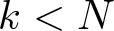 $k \lt N$, one has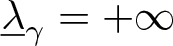 $\underline{\lambda}_\gamma=+\infty $.
Proof. Let us first consider the case  $\gamma \neq 2$.
For  $\mu \gt 0$, let $v(r) = e^{-\frac{\mu}{k(2-\gamma)} r^{2-\gamma}}$. Then $v$ satisfies
 \begin{equation*}\frac{dv}{dr} = -\frac{\mu}{k} \, v \, r^{-\gamma}.\end{equation*}
 Since 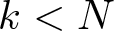 $k \lt N$, we have
 \begin{equation*} {\cal P}_k^-\!\big(D^2 v\big) \;\leq\; k \,\frac{dv}{dr}
= -\,\mu \, v \, r^{-\gamma}\qquad \text{in } B(0,1)\setminus \{0\}.\end{equation*}
\begin{equation*} {\cal P}_k^-\!\big(D^2 v\big) \;\leq\; k \,\frac{dv}{dr}
= -\,\mu \, v \, r^{-\gamma}\qquad \text{in } B(0,1)\setminus \{0\}.\end{equation*}which implies that 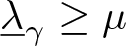 $\underline{\lambda}_\gamma \geq \mu$. By the arbitrariness of $\mu \gt 0$, one gets the desired result.
For  $\gamma = 2$, let us consider the function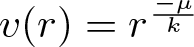 $v(r)= r^{-\mu \over k}$, which satisfies $v^\prime \leq 0\leq v^{\prime \prime }$ and
 \begin{equation*}\frac{v^\prime}{r} = -\frac{\mu}{k} v r^{-2}.\end{equation*}
 Hence,  $v$ is a positive solution in $B(0,1)\setminus \{0\}$ and, as before, we obtain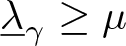 $\underline{\lambda}_\gamma \geq \mu$ for any $\mu \gt 0$.
The explicit solutions exhibited in the above proof can be used as barrier functions in order to prove the following maximum principle.
Proposition 3.10. For  $\mu \gt 0$, let $u\in C^2(B(0,1)\setminus \{0\})\cap C(\overline{B(0,1)} \setminus \{0\})$ be a radial solution of
 \begin{equation*} {\cal P}_k^- ( D^2 u(r)) + \mu u(r) r^{-\gamma} \geq 0\qquad \hbox{in } B(0,1)\setminus \{0\}\, ,\end{equation*}
satisfying 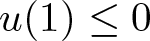 $u(1)\leq 0$. In any of the following cases
(1)
$\gamma \lt 2$ and
$u$ is bounded(2)
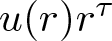
$\gamma = 2$ and there exists some
$\tau \gt 0$ such that
$u(r) r^\tau$ is bounded(3)
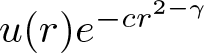
$\gamma \gt 2$ and there exists some constant
$c \gt 0$ such that
$u(r) e^{-c r^{2-\gamma}} $ is bounded




one has  $u\leq 0$ in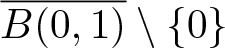 $\overline{B(0,1)} \setminus \{0\}$.
Proof. Case 1. For 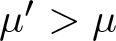 $\mu^\prime \gt \mu$, let us consider the function $v(r)= e^{-\frac{\mu^{\prime}}{k (2-\gamma)} r^{2-\gamma}}$, which is a positive radial solution of
 \begin{equation*} {\cal P}_k^- ( D^2 v) + \mu^\prime v r^{-\gamma} = 0\qquad \hbox{in } B(0,1)\setminus \{0\}\, .\end{equation*}
 Arguing by contradiction, let us suppose that the quotient function  $\frac{u}{v}$ has a positive supremum in $B(0,1)\setminus \{0\}$, that is
 \begin{equation*}\sup_{B(0,1)\setminus \{0\}} {u \over v} = :\, \eta \gt 0\, ,\end{equation*}
and let 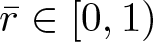 $\bar r\in [0,1)$ be any limit point of a maximizing sequence. If $\bar r \gt 0$, then $u(\bar r)=\eta v(\bar r)$ and one has
 \begin{equation*}-\mu \eta v( \bar r) {\bar r}^{-\gamma}= -\mu u( \bar r) {\bar r}^{-\gamma}\leq {\cal P}^-_k ( D^2 u(\bar r)) \leq {\cal P}_k^- ( D^2 (\eta v)(\bar r)) \leq -\mu^\prime \eta v( \bar r)
{\bar r}^{-\gamma} \, ,\end{equation*}
\begin{equation*}-\mu \eta v( \bar r) {\bar r}^{-\gamma}= -\mu u( \bar r) {\bar r}^{-\gamma}\leq {\cal P}^-_k ( D^2 u(\bar r)) \leq {\cal P}_k^- ( D^2 (\eta v)(\bar r)) \leq -\mu^\prime \eta v( \bar r)
{\bar r}^{-\gamma} \, ,\end{equation*}which gives the contradiction 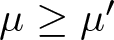 $\mu \geq \mu^{\prime}$.
On the other hand, if  $\bar r=0$, a contradiction can be reached by observing that, for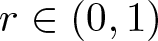 $r\in (0,1)$, the function $v$ satisfies $\frac{k}{r} v'=-\mu^{\prime} v r^{-\gamma}$, whereas $u$ satisfies $\frac{k}{r} u^{\prime}\geq -\mu u r^{-\gamma}$. Thus, for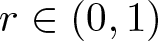 $r\in (0,1)$, one has
 \begin{equation*}\frac{k}{r}\left( u-\eta v\right)'\geq -r^{-\gamma} \left( \mu u-\mu^{\prime}\eta v\right)\geq -r^{-\gamma}(\mu-\mu^{\prime})\eta v \gt 0 \, .\end{equation*}
 Hence, the strictly increasing monotonicity of 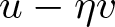 $u-\eta v$ contradicts the fact that $\bar r=0$.
Case 2. For  $\mu^\prime \gt \max \{\mu, \tau k\}$, let us consider the function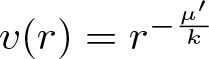 $v(r)= r^{-\frac{\mu^\prime }{k}}$, which satisfies
 \begin{equation*} {\cal P}_k^-( D^2 v) + \mu^\prime v r^{-2} = 0\qquad \hbox{in } B(0,1)\setminus \{0\}\, .\end{equation*}
 By the assumption on  $u$ and the choice of $\mu^{\prime}$, one has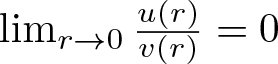 $\lim_{r \rightarrow 0} {u(r) \over v (r)} = 0$. Reasoning as above, we suppose by contradiction that
 \begin{equation*}\eta \, : = \sup_{B(0,1)\setminus \{0\}} {u \over v} \gt 0\, . \end{equation*}
 Then, the supremum of 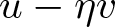 $u-\eta v $ is zero, and it is achieved at some point $\bar r \gt 0$. This yields a contradiction as in the previous case.
Case 3. For  $\mu^\prime \gt \max \{\mu, ck ( \gamma-2)\}$, we consider the function $v(r)=e^{-\frac{\mu^{\prime}}{k (2-\gamma)} r^{2-\gamma}}$ and we argue as in the previous cases.
4. The superlinear problem in the critical case
$\gamma = 2$

4.1. The superlinear problem for
${\cal P}^+_k$, with
$k\geq 3$


In this section, we are concerned with the existence and the asymptotic behaviour near zero of positive radial solutions  $u\in {\cal C}^2(B(0,1)\setminus \{0\})$ of the equation
 \begin{equation}
{\cal P}_k^+ ( D^2 u) + \mu {u\over r^2} = u^p\, ,
\end{equation}
\begin{equation}
{\cal P}_k^+ ( D^2 u) + \mu {u\over r^2} = u^p\, ,
\end{equation}with  $\mu \gt 0$ and $p \gt 1$. We will always assume that $k\geq 3$ and that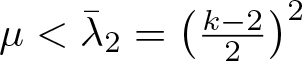 $\mu \lt \bar \lambda_2= \left(\frac{k-2}{2}\right)^2$.
For this problem, we can use the known results obtained for the semilinear equation having the Laplace operator as principal part in dimension  $k$, see [Reference Cirstea12] and [Reference Birindelli, Demengel and Leoni5]. In particular, looking at the results in [Reference Birindelli, Demengel and Leoni5] for $\Lambda=\lambda=1$ and in dimension $k\geq 3$, under the assumption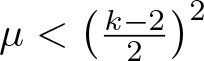 $\mu \lt \left(\frac{k-2}{2}\right)^2$ we showed that radial solutions of the equation
 \begin{equation}
\Delta u +\mu \frac{u}{r^2}=u^p\qquad \hbox{in } B(0,1)\setminus \{0\} \subset \mathbb R^k
\end{equation}
\begin{equation}
\Delta u +\mu \frac{u}{r^2}=u^p\qquad \hbox{in } B(0,1)\setminus \{0\} \subset \mathbb R^k
\end{equation}exist and can have only specific asymptotic behaviours at zero depending on the mutual values of  $p$,
$p$,  $\mu$, and $k$. More precisely, using the notation
 \begin{equation}
\tau^{\pm} \, := \frac{k-2}{2} \pm \sqrt{\left(\frac{k-2}{2}\right)^2-\mu}\, ,
\end{equation}
\begin{equation}
\tau^{\pm} \, := \frac{k-2}{2} \pm \sqrt{\left(\frac{k-2}{2}\right)^2-\mu}\, ,
\end{equation}we proved that there exist solutions  $u$ of the semilinear equation (4.2) satisfying
- either
$\lim_{r\to 0} u(r)r^{\frac{2}{p-1}}=0$, and in this case we proved that
$u^{\prime}\leq 0\leq u^{\prime\prime}$, see Proposition 4.2 in [Reference Birindelli, Demengel and Leoni5],- or
$\lim_{r\to 0} u(r)r^{\frac{2}{p-1}} \gt 0$, which can occur if and only if either
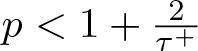
$p \lt 1+\frac{2}{\tau^+}$ or
$p \gt 1+\frac{2}{\tau^-}$, and in this case an explicit solution is given by
\begin{align*}
u(r)=\frac{K}{r^{\frac{2}{p-1}}}\, ,\qquad K=\left[ \left( \frac{2}{p-1}-\tau^-\right) \left( \frac{2}{p-1}-\tau^+\right)\right]^{\frac{1}{p-1}}\, .
\end{align*}



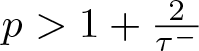

In any case, the constructed solutions are convex and nonincreasing functions of  $r$. Hence, they satisfy in particular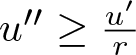 $u^{\prime\prime}\geq \frac{u^{\prime}}{r}$, so that they are solutions of (4.1). By applying Theorem 1.1 in [Reference Birindelli, Demengel and Leoni5], we then deduce the following existence result.
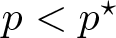
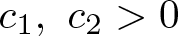
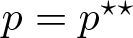
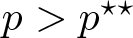
Theorem 4.1 Let us assume 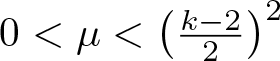 $0 \lt \mu \lt \left( \frac{k-2}{2}\right)^2$ and $p \gt 1$, and let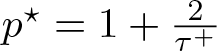 $p^\star= 1+\frac{2}{\tau^+}$ and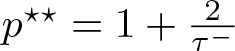 $p^{\star \star}=1+\frac{2}{\tau^-}$, with $\tau^\pm$ defined as in (4.3). Then:
(1) if
$p \lt p^{\star }$, then equation (4.1) has at least a solution
$u$ satisfying
(4.4)at least a solution\begin{equation}
r^{2\over p-1} u(r) \to K \qquad \hbox{as } r\to0\, ,
\end{equation}
$v$ satisfying
(4.5)and at least a solution\begin{equation}
r^{\tau^+} v(r) \to c_1 \qquad \hbox{as } r\to 0\, ,
\end{equation}
$w$ satisfying
(4.6)where\begin{equation}
r^{\tau^-} w(r) \to c_2 \qquad \hbox{as } r\to0\, ,
\end{equation}
$K \, := \left[\left( {2\over p-1}-\tau^+\right) \left( {2\over p-1}-\tau^-\right)\right]^{1\over p-1}$ and
$c_1,\ c_2 \gt 0$ are suitable constants;(2) if
$p^\star\leq p \lt p^{\star \star}$, then equation (4.1) has at least a solution
$u$ satisfying (4.6);(3) if
$p = p^{\star \star}$, then equation (4.1) has at least a solution
$u$ satisfying
(4.7)where\begin{equation}
r^{\tau^-} ( -\ln r)^{\tau^-/2}u(r) \to \bar K \qquad \hbox{as } r\to 0\, ,
\end{equation}
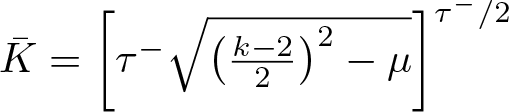
$\bar K = \left[ \tau^- \sqrt{\left(\frac{k-2}{2}\right)^2-\mu}\right]^{\tau^-/2}$;(4) if
$p \gt p^{\star\star} $, then equation (4.1) has at least a solution
$u$ satisfying (4.4).








Conversely, let us show that the asymptotic behaviours identified in Theorem 4.1 are the only possible ones for any solution  $u$ of equation (4.1). We are going to apply some of the arguments used in the proof of Theorem 1.2 in [Reference Birindelli, Demengel and Leoni5], which will be recalled for the reader’s convenience in the following preliminary result.
Lemma 4.2. Let  $u\in {\cal C}^2(B(0,1)\setminus \{0\})$ be a positive radial solution of (4.1). Then
(i)
$\limsup_{r \to 0} u(r)r^{\frac{2}{p-1}} \lt +\infty$;(ii) if
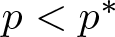
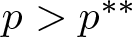
$\limsup_{r \to 0} u(r)r^{\frac{2}{p-1}} \gt 0$, then either
$p \lt p^*$ or
$p \gt p^{**}$ and
$u$ satisfies (4.4);(iii) if
$\lim_{r \to 0} u(r)r^{\frac{2}{p-1}}=0$, then
$u$ is a radial solution of the semilinear equation (4.2) in
$B(0,r_0)\setminus \{0\}\subset \mathbb R^k$ for some
$r_0 \gt 0$ sufficiently small.






Proof. (i) A direct computation shows that, for  $C \gt 0$ sufficiently large (actually, for any $C \gt 0$ if $p^*\leq p\leq p^{**}$), the function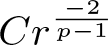 $C r^{-2\over p-1}$ is a super-solution of equation (4.1) . Hence, if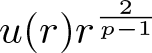 $u(r)r^{\frac{2}{p-1}}$ is bounded along a decreasing sequence $\{r_n\}$ converging to zero, then, by applying the standard comparison principle in every annulus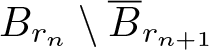 $B_{r_{n}}\setminus\overline{B}_{r_{n+1}}$, we deduce
 \begin{equation*}u(r)\leq C r^{-2\over p-1} \quad \hbox{for } 0 \lt r\leq r_1\, .
\end{equation*}
\begin{equation*}u(r)\leq C r^{-2\over p-1} \quad \hbox{for } 0 \lt r\leq r_1\, .
\end{equation*}Thus, arguing by contradiction, if statement (i) is false, then we have
 \begin{equation}
\lim_{r\to 0} u(r) r^{\frac{2}{p-1}}= +\infty\, .
\end{equation}
\begin{equation}
\lim_{r\to 0} u(r) r^{\frac{2}{p-1}}= +\infty\, .
\end{equation} This implies that, for  $r$ small enough, one has
 \begin{equation*}
\mathcal{P}^+_k(D^2u)= u^p -\mu \frac{u}{r^2} \geq {u^p \over 2} \gt 0\, .\end{equation*}
\begin{equation*}
\mathcal{P}^+_k(D^2u)= u^p -\mu \frac{u}{r^2} \geq {u^p \over 2} \gt 0\, .\end{equation*} By Remark 2.2, it then follows that  $u^{\prime}$ has constant sign in a right neighbourhood of zero and, therefore, by (4.8),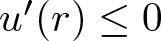 $u^{\prime}(r)\leq 0$ for $r$ small enough. We then have
 \begin{equation*} u^{\prime \prime} \geq {u^p\over 2}\, ,\end{equation*}
and also
 \begin{equation*}u^{\prime \prime} u^\prime \leq {u^p u^\prime \over 2}\, .\end{equation*}
Integrating, one gets
 \begin{equation*} (u^\prime )^2(r) - c u^{p+1} (r) \geq (u^\prime )^2(r_0) - c u^{p+1} (r_0)\end{equation*}
for 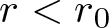 $r \lt r_0$ and for some $c \gt 0$. Using $u^{p+1}(r)\rightarrow +\infty$ as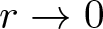 $r\to 0$, for $r$ small enough we get
 \begin{equation*}(u^\prime)^2 \geq \frac{c}{2} u^{p+1}\end{equation*}
or, equivalently,
 \begin{equation*} {-u^\prime \over u^{p+1\over 2}} \geq c_1 \gt 0\, .\end{equation*}
This yields
 \begin{equation*} u(r)^{1-p \over 2} \geq c_2 r\, ,\end{equation*}
for some 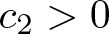 $c_2 \gt 0$: a contradiction to (4.8).
(ii) By applying the comparison principle Theorem 2.5 and by using exactly the same supersolutions constructed in Proposition 4.3 and Proposition 4.4 of [Reference Birindelli, Demengel and Leoni5], we can prove that if  $p^*\leq p\leq p^{**}$ then $\lim_{r\to 0} u(r)r^{\frac{2}{p-1}}=0$. Hence, under the assumption of statement (ii), we deduce that either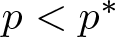 $p \lt p^*$ or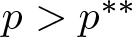 $p \gt p^{**}$. Moreover, by using again Theorem 2.5 and the barrier functions exhibited in the proof of statement 2 of Proposition 4.2 of [Reference Birindelli, Demengel and Leoni5], we obtain the asymptotic formula (4.4).
(iii) We need to prove that 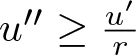 $u^{\prime\prime}\geq \frac{u^{\prime}}{r}$ for $r$ sufficiently small, under the assumption $\lim_{r \to 0} u(r)r^{\frac{2}{p-1}}=0$. We observe that, in this case, by equation (4.1), for $r$ sufficiently small one has
 \begin{equation*}
{\cal P}^+_k (D^2u)= \frac{u}{r^2} ( r^2 u^{p-1}-\mu ) \lt 0\, .
\end{equation*}
\begin{equation*}
{\cal P}^+_k (D^2u)= \frac{u}{r^2} ( r^2 u^{p-1}-\mu ) \lt 0\, .
\end{equation*} Hence, by Lemma 2.1, we have that 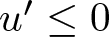 $u^{\prime}\leq 0$ for $r$ small enough. This in turn implies that the negative function $g(r)=u(r)^p-\mu \frac{u}{r^2}$ satisfies
 \begin{equation*}
g'(r)= u^{\prime}\left( p u^{p-1}-\frac{\mu}{r^2}\right) +2 \mu \frac{u}{r^3} \gt 0\, ,
\end{equation*}
\begin{equation*}
g'(r)= u^{\prime}\left( p u^{p-1}-\frac{\mu}{r^2}\right) +2 \mu \frac{u}{r^3} \gt 0\, ,
\end{equation*}and the conclusion follows by Lemma 2.3.
By using the above lemma and by applying Theorem 1.2 in [Reference Birindelli, Demengel and Leoni5], we immediately deduce the following classification result.
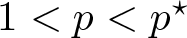
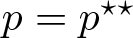
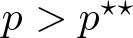
Theorem 4.3. Let  $u\in {\cal C}^2(B(0,1)\setminus \{0\})$ be a positive radial solution of (4.1) with $p \gt 1$ and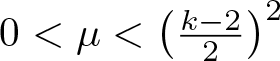 $0 \lt \mu \lt \left(\frac{k-2}{2}\right)^2$. Then, using the same notations as in Theorem 4.1, one has





4.2. The superlinear problem for
${\cal P}_k^-$, with
$2\leq k\leq N-1$


In this section, we focus on the equation
 \begin{equation}
{\cal P}^-_k ( D^2 u) + \mu \frac{u}{r^{2}} = u^p \quad \hbox{in } B(0,1)\setminus \{0\}\, ,
\end{equation}
\begin{equation}
{\cal P}^-_k ( D^2 u) + \mu \frac{u}{r^{2}} = u^p \quad \hbox{in } B(0,1)\setminus \{0\}\, ,
\end{equation}with  $N-1\geq k\geq 2$, $\mu \gt 0$ and $p \gt 1$. Our goal is to prove the existence of radial positive solutions $u\in C^2(B(0,1)\setminus\{0\})$ and to classify their asymptotic behaviour around zero in dependence of the mutual values of the parameters $k\, ,\ \mu$ and $p$.
$p$.
Let us start with a preliminary result which collects some properties of solutions.
Lemma 4.4. Let  $u\in C^2(B(0,1)\setminus\{0\})$ be a positive solution of (4.9) with $N-1\geq k\geq 2$, $\mu \gt 0$ and $p \gt 1$. Then:
(i)
$\limsup_{r\to 0} u(r)=+\infty$;(ii)
$\limsup_{r\to 0} u(r)r^{\frac{2}{p-1}} \lt +\infty$;(iii) if
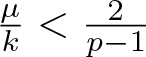
$\frac{\mu}{k} \lt \frac{2}{p-1}$, then the function
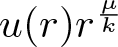
$u(r)r^{\frac{\mu}{k}}$ is monotone nondecreasing for
$0 \lt r \lt 1$;(iv) if
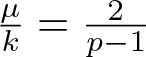
$\frac{\mu}{k}=\frac{2}{p-1}$, then the function
$u(r)r^{\frac{2}{p-1}}(-\ln r)^{\frac{1}{p-1}}$ is bounded for
$0 \lt r \lt 1$;(v) if
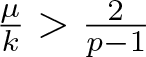
$\limsup_{r\to 0} u(r)r^{\frac{2}{p-1}} \gt 0$, then
$\frac{\mu}{k} \gt \frac{2}{p-1}$ and
$\liminf_{r\to 0} u(r)r^{\frac{2}{p-1}} \gt 0$;(vi) if
$\lim_{r\to 0} u(r)r^{\frac{2}{p-1}}=0$, then
$u$ satisfies
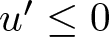
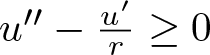
$u^{\prime}\leq 0$ and
$u^{\prime\prime}-\frac{u^{\prime}}{r}\geq 0$ for
$r \gt 0$ sufficiently small.










Proof. (i) By contradiction, let us assume that  $u$ is bounded. Then, for $r$ small enough, one has
 \begin{equation*} {\cal P}_k^-( D^2 u)= u\left ( u^{p-1}-\frac{\mu}{r^2}\right) \lt 0\, ,\end{equation*}
which yields, by Lemma 2.1, 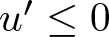 $u^\prime \leq 0$ in a neighbourhood of zero. This in turn implies that the function $g(r)= u^p(r)-\mu \frac{u(r)}{r^2}$ satisfies
 \begin{equation*}g^\prime(r)=u^\prime \left( p u^{p-1}-\frac{\mu}{r^2}\right) + 2 \mu \frac{u}{r^3} \gt 0\, ,\end{equation*}
so that, by Lemma 2.3,  $u$ is such that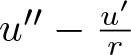 $u^{\prime\prime}-\frac{u^{\prime}}{r}$ has constant sign in a neighbourhood of zero. If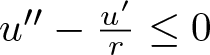 $u^{\prime\prime}-\frac{u^{\prime}}{r}\leq0$, we get that, in a neighbourhood of zero, $u$ is a bounded solution of
 \begin{equation*}
u^{\prime\prime}+(k-1) \frac{u^{\prime}}{r}= u^p-\mu \frac{u}{r^2}\, ,\end{equation*}
\begin{equation*}
u^{\prime\prime}+(k-1) \frac{u^{\prime}}{r}= u^p-\mu \frac{u}{r^2}\, ,\end{equation*}in contradiction with Proposition 4.1 of [Reference Birindelli, Demengel and Leoni5]. On the other hand, if 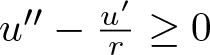 $u^{\prime\prime}-\frac{u^{\prime}}{r}\geq0$, then, for $r \gt 0$ small enough, $u$ satisfies
 \begin{equation*}
k \frac{u^{\prime}}{r}=u\left ( u^{p-1}-\frac{\mu}{r^2}\right)\leq - \frac{c}{r^2}\, ,
\end{equation*}
\begin{equation*}
k \frac{u^{\prime}}{r}=u\left ( u^{p-1}-\frac{\mu}{r^2}\right)\leq - \frac{c}{r^2}\, ,
\end{equation*}for some  $c \gt 0$, again contradicting the boundedness of $u$.
$u$.
(ii) We observe that, whatever  $\mu$ is, the function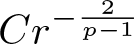 $C r^{-\frac{2}{p-1}}$ is a super-solution of equation (4.9) for $C \gt 0$ sufficiently large. Hence, arguing by contradiction as in the proof of Lemma 4.2 (i), we get that, if statement (ii) fails, then
 \begin{equation*}
\lim_{r\to 0} u(r)r^{\frac{2}{p-1}}=+\infty\, .
\end{equation*}
\begin{equation*}
\lim_{r\to 0} u(r)r^{\frac{2}{p-1}}=+\infty\, .
\end{equation*} This implies that, for  $r$ small enough, $u$ satisfies
 \begin{equation*}
\mathcal{P}_k^-(D^2u)= \frac{u}{r^2} \left( u^{p-1}r^2 -\mu\right) \gt 0\, .\end{equation*}
\begin{equation*}
\mathcal{P}_k^-(D^2u)= \frac{u}{r^2} \left( u^{p-1}r^2 -\mu\right) \gt 0\, .\end{equation*} Then, by Remark 2.2, we obtain 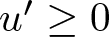 $u^\prime \geq 0$ and then $u$ bounded, in contradiction with statement (i).
(iii) Let  $0 \lt r_0 \lt 1$ be fixed. For any $\epsilon \gt 0$, the function
 \begin{equation*}
v(r)=\frac{\epsilon}{r^{\frac{2}{p-1}}}+ \frac{u(r_0)r_0^{\frac{\mu}{k}}}{r^{\frac{\mu}{k}}}
\end{equation*}
\begin{equation*}
v(r)=\frac{\epsilon}{r^{\frac{2}{p-1}}}+ \frac{u(r_0)r_0^{\frac{\mu}{k}}}{r^{\frac{\mu}{k}}}
\end{equation*}is convex and decreasing, and, as a radial function, it satisfies
 \begin{equation*}
{\cal P}_k^-(D^2v)+\mu \frac{v}{r^2}= k \frac{v^{\prime}}{r}+\mu \frac{v}{r^2}=\epsilon \frac{\mu-\frac{2k}{p-1}}{r^{\frac{2p}{p-1}}} \lt 0 \lt v^p\, .
\end{equation*}
\begin{equation*}
{\cal P}_k^-(D^2v)+\mu \frac{v}{r^2}= k \frac{v^{\prime}}{r}+\mu \frac{v}{r^2}=\epsilon \frac{\mu-\frac{2k}{p-1}}{r^{\frac{2p}{p-1}}} \lt 0 \lt v^p\, .
\end{equation*} Moreover, by statement (ii),  $u$ satisfies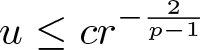 $u\leq c r^{-\frac{2}{p-1}}$. Hence, $u$ and $v$ satisfy the assumptions of Theorem 2.5 and, since $u(r_0)\leq v(r_0)$, we get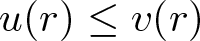 $u(r)\leq v(r)$ for all $0 \lt r\leq r_0$. Letting $\epsilon \to 0$ yields the conclusion.
(iv) Let us consider, in this case, for any 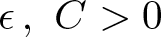 $\epsilon\, ,\ C \gt 0$, the function
 \begin{equation*}
v(r)=\frac{\epsilon}{r^{\frac{2}{p-1}}}+ \frac{C}{r^{\frac{2}{p-1}}(-\ln r)^{\frac{1}{p-1}}}\, .
\end{equation*}
\begin{equation*}
v(r)=\frac{\epsilon}{r^{\frac{2}{p-1}}}+ \frac{C}{r^{\frac{2}{p-1}}(-\ln r)^{\frac{1}{p-1}}}\, .
\end{equation*} For  $r_0$ sufficiently small and for $0 \lt r \lt r_0$, $v$ satisfies $v'\leq 0\leq v^{\prime\prime}$ and
 \begin{equation*}
{\cal P}_k^-(D^2v)+\mu \frac{v}{r^2} = k \frac{v'}{r}+\mu \frac{v}{r^2}=\frac{\mu \, C}{2 r^{\frac{2p}{p-1}}(-\ln r)^{\frac{p}{p-1}}}\leq v^p
\end{equation*}
\begin{equation*}
{\cal P}_k^-(D^2v)+\mu \frac{v}{r^2} = k \frac{v'}{r}+\mu \frac{v}{r^2}=\frac{\mu \, C}{2 r^{\frac{2p}{p-1}}(-\ln r)^{\frac{p}{p-1}}}\leq v^p
\end{equation*}if  $C$ is large enough, independently of $\epsilon \gt 0$. If, moreover, $C$ is chosen in such a way that $v(r_0)\geq u(r_0)$, we can apply Theorem 2.5 as before in order to conclude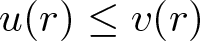 $u(r)\leq v(r)$ for $0 \lt r\leq r_0$. Letting $\epsilon \to 0$, we get the conclusion.
(v) By statements (iii) and (iv), we deduce that if 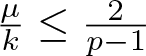 $\frac{\mu}{k}\leq \frac{2}{p-1}$, then $\lim_{r \to 0}u(r) r^{\frac{2}{p-1}}=0$. Hence, if $\limsup_{r \to 0}u(r) r^{\frac{2}{p-1}} \gt 0$, then, necessarily,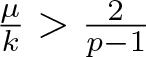 $\frac{\mu}{k} \gt \frac{2}{p-1}$ and there exist a decreasing sequence $\{r_n\}$ converging to zero and some positive constant $l$ such that
 \begin{equation*}
u(r_n) r_n^{\frac{2}{p-1}}\geq l\quad \hbox{for all } n\geq 1\, .
\end{equation*}
\begin{equation*}
u(r_n) r_n^{\frac{2}{p-1}}\geq l\quad \hbox{for all } n\geq 1\, .
\end{equation*} Let us consider the function 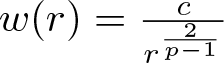 $w(r)=\frac{c}{r^{\frac{2}{p-1}}}$, with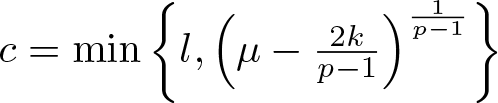 $c=\min \left\{l, \left(\mu -\frac{2k}{p-1}\right)^{\frac{1}{p-1}}\right\}$. Then, $w$ is a convex and decreasing function of $r \gt 0$ satisfying, as a radial function,
 \begin{equation*}
{\cal P}_k^-(D^2w)+\mu \frac{w}{r^2} = k \frac{w'}{r}+\mu \frac{w}{r^2}= \frac{c}{r^{\frac{2p}{p-1}}}\left( \mu-\frac{2k}{p-1}\right)\geq w^p\, .
\end{equation*}
\begin{equation*}
{\cal P}_k^-(D^2w)+\mu \frac{w}{r^2} = k \frac{w'}{r}+\mu \frac{w}{r^2}= \frac{c}{r^{\frac{2p}{p-1}}}\left( \mu-\frac{2k}{p-1}\right)\geq w^p\, .
\end{equation*} Since  $w(r_n)\leq u(r_n)$ for all $n\geq 1$, by applying the standard comparison principle in each annular domain $B(0,r_n)\setminus B(0, r_{n+1})$, we finally deduce $u(r)\geq w(r)$ for $0 \lt r \lt r_1$, which implies $\liminf_{r \to 0}u(r) r^{\frac{2}{p-1}}\geq c \gt 0$.
(vi) Let us argue as in the proof of statement (i). Under the assumption  $\lim_{r\to 0} u(r)r^{\frac{2}{p-1}}=0$, we have that $u$ satisfies $\mathcal{P}^-_k(D^2u)=g(r)$ with the function $g(r)=u^p-\mu \frac{u}{r^2}$ such that $g(r) \lt 0 \lt g'(r)$ for $r$ sufficiently small. Then, by Lemma 2.3, we deduce that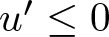 $u^{\prime}\leq 0$ and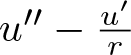 $u^{\prime\prime}-\frac{u^{\prime}}{r}$ has constant sign in a neighbourhood of zero. We observe that if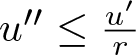 $u^{\prime\prime}\leq \frac{u^{\prime}}{r}$, then $u$ is concave, hence bounded, in contradiction with statement (i). Thus, one has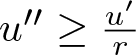 $u^{\prime\prime}\geq \frac{u^{\prime}}{r}$ for $r$ small enough.
We are now ready to prove the main result of this section.
Theorem 4.5. Let  $N-1\geq k\geq 2$, $\mu \gt 0$ and $p \gt 1$ be given.
(1) If
$p \lt 1+\frac{2k}{\mu}$ (i.e.
$\frac{\mu}{k} \lt \frac{2}{p-1}$), then a radial function
$u\in {\cal C}^2(B(0,1)\setminus \{0\}$ is a solution of equation (4.9) if and only if for
$r \gt 0$ sufficiently small
$u(r)$ is of the form
(4.10)for some\begin{equation}
u(r) =\frac{1}{\left( c\, r^{\frac{\mu (p-1)}{k}}- \frac{r^2}{\frac{2k}{p-1}-\mu}\right)^{\frac{1}{p-1}}}\, ,
\end{equation}
$c \gt 0$. In particular, any solution
$u$ satisfies
\begin{equation*}
\lim_{r\to 0} u(r)r^{\frac{\mu}{k}}=c^{\frac{1}{p-1}} \gt 0\, .
\end{equation*}(2) If
$p=1+\frac{2k}{\mu}$ (i.e.
$\frac{\mu}{k}=\frac{2}{p-1}$), then a radial function
$u\in {\cal C}^2(B(0,1)\setminus \{0\}$ is a solution of equation (4.9) if and only if for
$r \gt 0$ sufficiently small
$u(r)$ is of the form
(4.11)for some\begin{equation}
u(r)= \frac{1}{r^{\frac{2}{p-1}}\left(c+\frac{(p-1)}{k}(-\ln r)\right)^{\frac{1}{p-1}}}\, ,
\end{equation}
$c\in \mathbb R$. In particular, any solution
$u$ satisfies
\begin{equation*}
\lim_{r\to 0} u(r)r^{\frac{2}{p-1}}(-\ln r)^{\frac{1}{p-1}}=\left(\frac{k}{p-1}\right)^{\frac{1}{p-1}} \, .
\end{equation*}(3) If
$p \gt 1+\frac{2k}{\mu}$ (i.e.
$\frac{\mu}{k} \gt \frac{2}{p-1}$), then a radial function
$u\in {\cal C}^2(B(0,1)\setminus \{0\}$ is a solution of equation (4.9) if and only if for
$r \gt 0$ sufficiently small
$u(r)$ is of the form
(4.12)for some\begin{equation}
u(r) =\frac{1}{\left( c\, r^{\frac{\mu (p-1)}{k}}+\frac{r^2}{\mu -\frac{2k}{p-1}}\right)^{\frac{1}{p-1}}}\, ,
\end{equation}
$c\in \mathbb R$. In particular, any solution
$u$ satisfies
\begin{equation*}
\lim_{r\to 0} u(r)r^{\frac{2}{p-1}}=\left(\mu -\frac{2k}{p-1}\right)^{\frac{1}{p-1}}\, .\end{equation*}
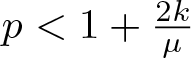
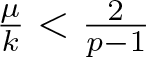



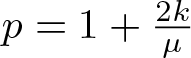
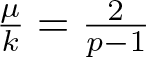



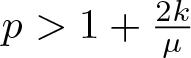
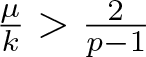



Proof. Case 1. A direct computation shows that each function  $u$ defined in (4.10) is a solution of
 \begin{equation}
k \frac{u^{\prime}}{r}+\mu \frac{u}{r^2}=u^p
\end{equation}
\begin{equation}
k \frac{u^{\prime}}{r}+\mu \frac{u}{r^2}=u^p
\end{equation}defined in some right neighbourhood of zero. Moreover, it is not difficult to check that 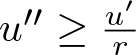 $u^{\prime\prime}\geq \frac{u^{\prime}}{r}$, hence any such $u$ is a radial solution of equation (4.9) defined in $B(0,1)\setminus \{0\}$ if $c \gt 0$ is chosen large enough.
Conversely, let  $u$ be a radial solution of (4.9). Under the current assumption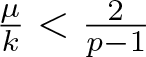 $\frac{\mu}{k} \lt \frac{2}{p-1}$, by Lemma 4.4 (iii), we have that $\lim_{r\to 0}u(r)r^{\frac{2}{p-1}}=0$. Hence, by Lemma 4.4 (vi), we deduce that $u$ satisfies the first-order equation (4.13) in an interval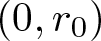 $(0,r_0)$ with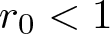 $r_0 \lt 1$ small enough. By uniqueness of solution for equation (4.13) we then conclude that $u$ has the expression given by (4.10) with
 \begin{equation}
c=\frac{r_0^{2-\frac{\mu (p-1)}{k}}}{\frac{2k}{p-1}-\mu}+\frac{1}{\left( u(r_0) r_0^{\frac{\mu}{k}}\right)^{p-1}}\, .
\end{equation}
\begin{equation}
c=\frac{r_0^{2-\frac{\mu (p-1)}{k}}}{\frac{2k}{p-1}-\mu}+\frac{1}{\left( u(r_0) r_0^{\frac{\mu}{k}}\right)^{p-1}}\, .
\end{equation} Case 2. We argue as in the previous case, first by observing that functions given by (4.11) are solutions of the first-order equation (4.13) and they satisfy 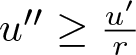 $u^{\prime\prime}\geq \frac{u^{\prime}}{r}$. Hence, formula (4.11) with $c\in \mathbb R$ provides solutions of equation (4.9). Conversely, given any solution $u$ of (4.9), we apply Lemma (4.4) (iv) and (vi) in order to deduce that there exists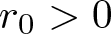 $r_0 \gt 0$ sufficiently small such that, for $0 \lt r\leq r_0$, $u$ is of the form (4.11) with
 \begin{equation*}
c=\frac{p-1}{k} \ln r_0+ \frac{1}{u(r_0)^{p-1}r_0^2}\, .
\end{equation*}
\begin{equation*}
c=\frac{p-1}{k} \ln r_0+ \frac{1}{u(r_0)^{p-1}r_0^2}\, .
\end{equation*} Case 3. As in the previous cases, a direct computation shows that any function  $u$ given by (4.12) is a radial solution of (4.9).
Conversely, let  $u$ be any solution of (4.9). We claim that $u$ satisfies $\limsup_{r\to 0} u(r)r^{\frac{2}{p-1}} \gt 0$. Indeed, if not, then, again by Lemma 4.4 (vi), we deduce that $u$ is a solution of equation (4.13) for $0 \lt r \lt r_0$, with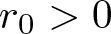 $r_0 \gt 0$ small enough. Then, $u$ has an expression given by (4.12), but none of these functions satisfies $\lim_{r\to 0} u(r)r^{\frac{2}{p-1}}=0$.
Hence, Lemma 4.4 (v) applies, yielding that, for any fixed  $0 \lt r_0 \lt 1$ there exist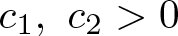 $c_1, \ c_2 \gt 0$ depending on $r_0$ such that $u$ satisfies
 \begin{equation*}
c_1r^{-\frac{2}{p-1}}\leq u(r) \leq c_2r^{-\frac{2}{p-1}} \quad \hbox{for } 0 \lt r\leq r_0\, .
\end{equation*}
\begin{equation*}
c_1r^{-\frac{2}{p-1}}\leq u(r) \leq c_2r^{-\frac{2}{p-1}} \quad \hbox{for } 0 \lt r\leq r_0\, .
\end{equation*} Thus, the functions  $u$ and
 \begin{equation*}
v(r)= \frac{1}{\left( c\, r^{\frac{\mu (p-1)}{k}}+\frac{r^2}{\mu -\frac{2k}{p-1}}\right)^{\frac{1}{p-1}}}\, ,
\end{equation*}
\begin{equation*}
v(r)= \frac{1}{\left( c\, r^{\frac{\mu (p-1)}{k}}+\frac{r^2}{\mu -\frac{2k}{p-1}}\right)^{\frac{1}{p-1}}}\, ,
\end{equation*}both radial solutions of equation (4.9) in  $B(0,r_0)\setminus \{0\}$, can be compared by means of Theorem 2.5. By choosing $c\in \mathbb R$ as in (4.14), we conclude that $u\equiv v$ in $B(0,r_0)\setminus \{0\}$.

 Open access

