





1 Introduction
Multidimensional computerized adaptive testing (MCAT) has revolutionized the field of educational and psychological assessments by dynamically selecting tailored items from a large test pool, thereby enhancing the efficiency and precision of latent ability estimates (van der Linden & Glas, Reference van der Linden and Glas2010). Powered by multidimensional item response theory (MIRT; Bock & Gibbons, Reference Bock and Gibbons2021), MCAT leverages multidimensional statistical inference to evaluate respondents’ multidimensional latent traits and allows for more comprehensive and efficient assessments compared to unidimensional approaches. MCAT’s adaptability and accuracy are also particularly crucial in high-stakes diagnostic assessments, such as in clinical psychology and psychiatry, where it can be substituted for in-person assessments by clinical professionals, especially in areas with limited medical resources (Gibbons et al., Reference Gibbons, Weiss, Frank and Kupfer2016).
A substantial body of research in MCAT has focused on item-selection strategies derived from experimental design principles. One prominent strategy is to select items that maximize the determinant of the Fisher information matrix evaluated at the current estimates of the latent traits (Segall, Reference Segall1996, Reference Segall, Linden and Glas2000), known as the D-optimality criterion. An alternative, the A-optimality criterion, aims to minimize the trace of the asymptotic covariance matrix, thereby reducing overall estimation variance (van der Linden, Reference van der Linden1999). In the absence of nuisance latent abilities, both A-optimality and D-optimality have demonstrated superior accuracy relative to other common experimental design criteria (Mulder & van der Linden, Reference Mulder and van der Linden2009).
Another prominent line of MCAT item-selection algorithms leverages Kullback–Leibler (KL) information, often within a Bayesian framework. A common approach is to select items that produce response distributions at the true latent trait value,
$\boldsymbol {\theta }_0$
 , that differs maximally from the response distributions generated at the other value of
$\theta $
, that differs maximally from the response distributions generated at the other value of
$\theta $
 (Chang & Ying, Reference Chang and Ying1996; Veldkamp & van der Linden, Reference Veldkamp and van der Linden2002). Moving beyond response distributions alone, some researchers propose maximizing the KL divergence between the current posterior distribution and the posterior distribution at the next selection step, thereby enhancing adaptation through updated trait estimates (Mulder & van der Linden, Reference Mulder and van der Linden2010). Another promising strategy is the mutual information (MI) criterion, which aims to maximize entropy reduction of the current posterior distribution, encouraging more and more accurate posterior estimates (Weissman, Reference Weissman2007). In particular, Wang and Chang (Reference Wang and Chang2011) demonstrate both theoretical and empirical advantages of the Bayesian MI item-selection rule over common experimental criteria such as D-optimality. More detailed theoretical comparison of KL information and Fisher information criteria is presented by Wang et al. (Reference Wang, Chang and Boughton2011).
Although numerous effective item-selection rules have been proposed in the MCAT literature, they all rely on one-step lookahead optimization of an information-theoretic criterion. Despite their ease of implementation and attractive theoretical properties, these selection rules are inherently myopic: they select items based solely on immediate information gain, ignoring how current choices influence future decisions, which can lead to suboptimal policies. For example, existing methods tend to favor items with high loading parameters (Chang, Reference Chang2015). However, CAT researchers also recommend reserving such items for the later stages of testing to improve efficiency (Chang & Ying, Reference Chang and Ying1999). Integrating heuristic guidance into existing selection rules remains challenging.
Addressing these limitations, we propose a novel deep CAT system that integrates a flexible Bayesian MIRT model with a non-myopic online item-selection policy, guided by reinforcement learning (RL) principles (Sutton & Barto, Reference Sutton and Barto2018). Leveraging recent advancements in Bayesian sparse MIRT (Li et al., Reference Li, Gibbons and Rockova2025), our framework seamlessly accommodates multiple latent factors with complex loading structures, while maintaining scalability in both the number of items and factors. To learn the optimal item-selection policy that prioritizes the assessment of target factors, we draw on contemporary RL methodologies and introduce a general double deep Q-learning algorithm (Mnih et al., Reference Mnih, Kavukcuoglu, Silver, Rusu, Veness, Bellemare, Graves, Riedmiller, Fidjeland, Ostrovski, Petersen, Beattie, Sadik, Antonoglou, King, Kumaran, Wierstra, Legg and Hassabis2015; van Hasselt et al., Reference van Hasselt, Guez and Silver2016). This algorithm efficiently trains a Q-network offline using only item parameter estimates; the learned network can then be deployed online to select optimal items based on the current multivariate latent factor posterior distribution. When the test terminates, our framework robustly characterizes the full latent factor posterior distributions rather than providing only a point estimate.
A primary contribution of our work is to show how the identification of the latent factor posterior distribution leads to substantial computational gains in online item selection. Given that such posterior distribution is deemed to be non-Gaussian and unknown, traditional Bayesian methods typically rely on expensive Markov chain Monte Carlo (MCMC) simulations (Béguin & Glas, Reference Béguin and Glas2001) and combined with additional data augmentation to handle categorical likelihood (Albert & Chib, Reference Albert and Chib1993; Polson et al., Reference Polson, Scott and Windle2013). Our approach achieves substantial acceleration by directly sampling latent factor posterior distributions (Botev, Reference Botev2016; Durante, Reference Durante2019; Li et al., Reference Li, Gibbons and Rockova2025). Notably, this improvement not only increases the efficiency of existing Bayesian item-selection procedures but also provides a computational foundation for training our proposed Q-learning algorithm through rapid, large-scale simulations of testing sessions.
Another critical advancement in our work is the integration of CAT within an RL framework. This approach addresses the practical need to prioritize accurate estimation and to overcome known limitations of greedy item-selection methods in sequential decision-making (Bertsekas & Tsitsiklis, Reference Bertsekas and Tsitsiklis1996). Building on the Bayesian MIRT foundation, our neural-network architecture incorporates the identified posterior parameters as state variables, allowing the model to learn optimal item-selection policies through a large amount of testing simulations. This formulation bridges the two paradigms: the Bayesian component provides statistically grounded representations of examinee uncertainty, while the RL component leverages these representations to optimize sequential decisions. The trained neural network is deployable on standard laptops without GPU acceleration, making it suitable for online adaptive testing applications. The sequential nature of CAT aligns naturally with deep Q-learning methods, which have demonstrated remarkable success across diverse application domains (Kalashnikov et al., Reference Kalashnikov, Irpan, Pastor, Ibarz, Herzog, Jang, Quillen, Holly, Kalakrishnan, Vanhoucke and Levine2018; Silver et al., Reference Silver, Huang, Maddison, Guez, Sifre, Driessche, Schrittwieser, Antonoglou, Panneershelvam, Lanctot, Dieleman, Grewe, Nham, Kalchbrenner, Sutskever, Lillicrap, Leach, Kavukcuoglu, Graepel and Hassabis2016). Notably, RL has been successfully employed in educational measurement settings to design personalized learning plans (Li et al., Reference Li, Xu, Zhang and Chang2023; Tan et al., Reference Tan, Han, Ye and Chen2020).
Finally, our work aligns with the emerging research trend of framing traditional statistical sequential decision-making problems as optimal policy learning tasks (Rainforth et al., Reference Rainforth, Foster, Ivanova and Smith2024). This perspective has appeared in Bayesian adaptive design (Chaloner & Verdinelli, Reference Chaloner and Verdinelli1995; Foster et al., Reference Foster, Ivanova, Malik and Rainforth2021; Sebastiani & Wynn, Reference Sebastiani and Wynn2000) and Bayesian optimization (Lam et al., Reference Lam, Willcox, Wolpert, Lee, Sugiyama, Luxburg, Guyon and Garnett2016; Srinivas et al., Reference Srinivas, Krause, Kakade and Seeger2010), where recent methods aim to move beyond one-step criteria toward policy learning that account for long-term consequences. Our contribution fits within this broader trend by providing a principled approach to cognitive and behavioral assessment.
The remainder of the article is organized as follows. Section 2 motivates our deep CAT framework using a cognitively complex item bank from a recent clinical study (Gibbons et al., Reference Gibbons, Lauderdale, Wilson, Bennett, Arar and Gallo2024). Section 3 reviews existing information-theoretic item-selection methods and outlines the necessity to reformulate CAT as an RL task. Section 4 introduces a general Bayesian framework that accelerates existing CAT item-selection rules and serves as the foundation for our Q-learning algorithm. Section 5 details our RL approach, including the neural network architecture and double Q-learning algorithm. Finally, Sections 6 and 7 evaluate our method through both simulations and real data experiments.
2 Adaptive high-dimensional cognitive assessment
Our proposed deep CAT system is motivated by the growing need for adaptive cognitive assessment in high-dimensional latent spaces. Cognitive impairment, particularly Alzheimer’s dementia (AD), is a major public health challenge, affecting 6.9 million individuals in the United States in 2024 (Alzheimer’s Association, 2024). Early detection of mild cognitive impairment (MCI), a precursor to AD, is crucial for slowing disease progression and improving patient outcomes (Huang et al., Reference Huang, Strombotne, Horner and Lapham2018). However, traditional neuropsychological assessments are costly, time-consuming, and impractical for frequent use, underscoring the need for more efficient and scalable assessment methods.
Recently, pCAT-COG, the first computerized adaptive test (CAT) item bank based on MIRT for cognitive assessment, demonstrated its potential as an alternative to clinician-administered evaluations (Gibbons et al., Reference Gibbons, Lauderdale, Wilson, Bennett, Arar and Gallo2024). The data were collected from
$730$
 participants. After careful item calibration and model selection, the final item bank consisted of
$J=57$
participants. After careful item calibration and model selection, the final item bank consisted of
$J=57$
 items covering five cognitive subdomains: episodic memory, working memory, executive function, semantic memory, and processing speed. Since each item comprised three related tasks, we used a binary score, where
$1$
items covering five cognitive subdomains: episodic memory, working memory, executive function, semantic memory, and processing speed. Since each item comprised three related tasks, we used a binary score, where
$1$
 indicates correct answers on all tasks for our analysis.
Following Gibbons et al. (Reference Gibbons, Lauderdale, Wilson, Bennett, Arar and Gallo2024), we fit a six-factor bifactor model (Gibbons & Hedeker, Reference Gibbons and Hedeker1992) to the
$730$
 by
$57$
by
$57$
 binary response matrix, with one primary factor representing the global cognitive ability and five secondary factors. This yields a
$57$
binary response matrix, with one primary factor representing the global cognitive ability and five secondary factors. This yields a
$57$
 by
$6$
by
$6$
 factor loading matrix, visualized in Figure 1, where rows correspond to pCAT-COG items and columns represent distinct factors.
Estimated bifactor factor loading matrix for pCAT-COG.

Figure 1 Long description
A heatmap displays factor loadings for variables V 1 through V 57 on the y-axis against six factors on the x-axis. The x-axis factors are Primary Factor, Executive Function, Episodic Memory, Processing Speed, Semantic Memory, and Working Memory. A vertical color scale on the right, labeled Value Scale, ranges from negative 0.75 in dark blue to 0.75 in dark red, with 0.00 represented by light gray.
* The Primary Factor column shows positive loadings (shades of red) for nearly all variables from V 1 to V 57, with a few exceptions like V 5 and V 41 which show light blue negative loadings.
* The Executive Function column shows a block of loadings for V 1 through V 18, with some negative blue values at the top and positive red values toward V 18.
* The Episodic Memory column contains a distinct block of positive red loadings for variables V 19 through V 30.
* The Processing Speed column contains a block of positive red loadings for variables V 31 through V 40.
* The Semantic Memory column contains a block of loadings for variables V 41 through V 48, featuring a mix of dark red and dark blue at the top of the block.
* The Working Memory column contains a block of positive red loadings for variables V 49 through V 57.
Areas outside these specific blocks are filled with light gray, indicating loadings near zero.
Since items in pCAT-COG are primarily designed to measure the general cognitive factor and only partially capture subdomain information, our goal is to develop an item-selection strategy that efficiently estimates the primary factor (first column) using as few items as possible while maintaining robustness to subdomain influences. Additionally, the selection algorithm must be computationally efficient to navigate a six-dimensional latent space in real time for seamless interactive testing. Online item selection is critical, as learning an optimal sequence from
$57$
 items offline presents an intractable combinatorial problem, even in a binary response setting.
Adaptive cognitive assessment is essential for cognitive assessment, as designing items is costly and administering all items is time-consuming. Our deep CAT system requires on average
$11.2$
 items to reduce the posterior variance of the primary factor from
$1$
items to reduce the posterior variance of the primary factor from
$1$
 to
$0.16$
to
$0.16$
 (posterior s.d.
$= 0.4$
(posterior s.d.
$= 0.4$
 ), whereas the next-best MI method requires
$12.6$
), whereas the next-best MI method requires
$12.6$
 items to achieve the same precision. The item bank is currently expanding to
$500$
items to achieve the same precision. The item bank is currently expanding to
$500$
 items with a more nationally representative sample. Success on this prototype dataset paves the way for broader deployment in clinical research.
3 From one-step optimization to policy learning
We formally define the problem of designing a CAT system from an RL perspective. Typical CAT systems consist of two components:
-
• Offline calibration: An MIRT model is fitted to a calibrated dataset $\boldsymbol {Y} \in \mathbb R^{N \times J}$
 to estimate the item characteristic parameters, where N represents the number of examinees, and J represents the number of items in the item bank.
 -
• Online deployment: Given the estimated item parameters, an item-selection algorithm is deployed online to adaptively select items for future examinees.

The performance of CAT can be measured by the number of items required to estimate an examinee’s latent traits with sufficient precision.
3.1 Notation and problem formulation
For the entirety of the article, we assume that the calibration dataset
$\boldsymbol {Y}$
 is binary, where each element
$y_{ij}$
is binary, where each element
$y_{ij}$
 represents whether subject i answered item j correctly. We consider a general two-parameter MIRT framework with K latent factors (Bock & Gibbons, Reference Bock and Gibbons2021). Let
$\boldsymbol {B} \in \mathbb R^{J \times K}$
represents whether subject i answered item j correctly. We consider a general two-parameter MIRT framework with K latent factors (Bock & Gibbons, Reference Bock and Gibbons2021). Let
$\boldsymbol {B} \in \mathbb R^{J \times K}$
 denote the factor loading matrix, and
$\boldsymbol {D} \in \mathbb R^J$
denote the factor loading matrix, and
$\boldsymbol {D} \in \mathbb R^J$
 denote the intercept vector. Throughout the article, boldface notation is used to denote vectors and matrices (e.g.,
$\boldsymbol {\theta }, \boldsymbol {B}$
denote the intercept vector. Throughout the article, boldface notation is used to denote vectors and matrices (e.g.,
$\boldsymbol {\theta }, \boldsymbol {B}$
 , and
$\boldsymbol {D}$
, and
$\boldsymbol {D}$
 ), while scalar quantity, such as
$D_{j}$
), while scalar quantity, such as
$D_{j}$
 , is written in standard font. For each examinee i with multivariate latent trait
$\boldsymbol {\theta }^{(i)} \in \mathbb R^K$
, is written in standard font. For each examinee i with multivariate latent trait
$\boldsymbol {\theta }^{(i)} \in \mathbb R^K$
 , the data-generating process for
$y_{ij}$
, the data-generating process for
$y_{ij}$
 is given by

where
$\boldsymbol {B}_j$
 is the jth row of
$\boldsymbol {B}$
is the jth row of
$\boldsymbol {B}$
 ,
$D_j$
,
$D_j$
 is the jth entry of
$\boldsymbol {D}$
is the jth entry of
$\boldsymbol {D}$
 , and
$\Phi (\cdot )$
, and
$\Phi (\cdot )$
 denotes the standard normal cumulative distribution function. The item parameters can be compactly expressed as
$\{\boldsymbol {\xi }_j\}_{j=1}^J := \{(\boldsymbol {B}_j, D_j)\}_{j=1}^J$
denotes the standard normal cumulative distribution function. The item parameters can be compactly expressed as
$\{\boldsymbol {\xi }_j\}_{j=1}^J := \{(\boldsymbol {B}_j, D_j)\}_{j=1}^J$
 . This two-parameter MIRT framework is highly general, imposing no structural constraints on the loading matrix and requiring no specific estimation algorithms for item parameter calibration.
Given the estimated item parameters, we need to design an item-selection algorithm that efficiently tests a future examinee with unobserved latent ability
$\boldsymbol {\theta } \in \mathbb R^K$
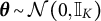
 . The sequential nature of the CAT problem makes Bayesian approaches particularly appealing. Without loss of generality, we assume a standard multivariate Gaussian prior on
$\boldsymbol {\theta } \sim \mathcal {N}(0, \mathbb I_K)$
. The sequential nature of the CAT problem makes Bayesian approaches particularly appealing. Without loss of generality, we assume a standard multivariate Gaussian prior on
$\boldsymbol {\theta } \sim \mathcal {N}(0, \mathbb I_K)$
 and introduce the following notation:
-
• For any positive integer n, let $[n]$
denote all the positive integers no greater than n. Let
$j\in [J]$
be the index for the items in the item bank. -
• Let $j_t$
denote the index of the item selected at step t based on an arbitrary item-selection rule. Define
$\mathcal {I}_{t}$
as the set of the first t administered items, and let
$R_{t} := [J] \setminus \mathcal {I}_{t-1} $
, the set of available items before the tth item is picked. -
• We use the shorthand notation $f(\boldsymbol {\theta } | \boldsymbol {Y}_{1:T})$
to represent the latent factor posterior distributions
$f(\boldsymbol {\theta }| \boldsymbol {Y}_{1:T}, \boldsymbol {\xi }_{1:T})$
after T items have been selected. Here, the response history is denoted by
$\boldsymbol {Y}_{1:T}:= [y_{j_1}, \dots , y_{j_T}]'$
, and the item parameters are given by
$\boldsymbol {\xi }_{1:T} := (\boldsymbol {B}_{1:T}, \boldsymbol {D}_{1:T})$
, where
$\boldsymbol {B}_{1:T}:=[\boldsymbol {B}_{j_1}, \dots , \boldsymbol {B}_{j_T}]'$
and
$\boldsymbol {D}_{1:T}:=[D_{j_1}, \dots , D_{j_T}]'$
.







At time
$(t+1)$
 , the algorithm takes the current posterior
$f(\boldsymbol {\theta }|\boldsymbol {Y}_{1:t})$
, the algorithm takes the current posterior
$f(\boldsymbol {\theta }|\boldsymbol {Y}_{1:t})$
 as input and outputs the next item selection
$j_{t+1}$
as input and outputs the next item selection
$j_{t+1}$
 . This process continues until at time
$T'$
. This process continues until at time
$T'$
 , either when the posterior variance of
$f(\boldsymbol {\theta }|\boldsymbol {Y}_{1:T'})$
, either when the posterior variance of
$f(\boldsymbol {\theta }|\boldsymbol {Y}_{1:T'})$
 falls below a predefined threshold
$\tau ^2$
falls below a predefined threshold
$\tau ^2$
 , or when
$T'=H$
, or when
$T'=H$
 , where
$H \leq J$
, where
$H \leq J$
 is the maximum number of items that can be administered. Hence, the goal of CAT is to minimize
$T'$
is the maximum number of items that can be administered. Hence, the goal of CAT is to minimize
$T'$
 given the estimated item parameters of the item bank.
3.2 Reviews of KL information item-selection rules
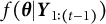
Given that our proposed deep CAT system is built on a general Bayesian MIRT framework (Li et al., Reference Li, Gibbons and Rockova2025), we briefly revisit common Bayesian item-selection rules and show in Section 4.1 how our framework can be used to accelerate these baseline methods. The popular KL expected a priori (EAP) rule selects the tth item based on the average KL information between response distributions on the candidate item at the EAP estimate
$\hat {\boldsymbol {\theta }}_{t-1} = \int _{\boldsymbol {\theta }} \boldsymbol {\theta } f(\boldsymbol {\theta } | \boldsymbol {Y}_{1:(t-1)}) d\boldsymbol {\theta }$
 , and random factor
$\boldsymbol {\theta }$
, and random factor
$\boldsymbol {\theta }$
 sampled from the posterior distribution
$f(\boldsymbol {\theta }| \boldsymbol {Y}_{1:(t-1)})$
sampled from the posterior distribution
$f(\boldsymbol {\theta }| \boldsymbol {Y}_{1:(t-1)})$
 (Veldkamp & van der Linden, Reference Veldkamp and van der Linden2002):

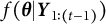
Rather than focusing on the KL information based on the response distributions, Mulder and van der Linden (Reference Mulder and van der Linden2010) propose the MAX Pos approach by maximizing the KL information between two subsequent latent factor posteriors
$f(\boldsymbol {\theta }| \boldsymbol {Y}_{1:(t-1)})$
 and
$f(\boldsymbol {\theta } | \boldsymbol {Y}_{1:t})$
and
$f(\boldsymbol {\theta } | \boldsymbol {Y}_{1:t})$
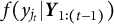
 . Intuitively, this approach prioritizes items that induce the largest shift in the posterior, formalized as

where
$f(y_{j_t}| \boldsymbol {Y}_{1:(t-1)})$
 represents the posterior predictive probability:

A third Bayesian strategy, the MI approach, maximizes the MI between the current posterior distribution and the response distribution of new item
$y_{j_{t}}$
 (Weissman, Reference Weissman2007). Rooted in experimental design theory (Rényi, Reference Rényi1961), we can also interpret MI as the entropy reduction of the current posterior distribution of
$\boldsymbol {\theta }$
(Weissman, Reference Weissman2007). Rooted in experimental design theory (Rényi, Reference Rényi1961), we can also interpret MI as the entropy reduction of the current posterior distribution of
$\boldsymbol {\theta }$
 after observing new response
$y_{j_t}$
after observing new response
$y_{j_t}$
 . More formally,

Given the impressive empirical success of the MI method (Wang & Chang, Reference Wang and Chang2011), we also introduce a competitive heuristic item-selection rule that chooses items with the highest predictive variance under the current posterior estimates, serving as an additional benchmark method. Formally, write
$c_{j_t} := f(y_{j_t} | \boldsymbol {Y}_{1:(t-1)})$
 as defined in (3.4), and consider the following criterion:

This rule selects the item
$j_t$
 that maximizes the variance of the predictive means, weighted by the current posterior
$f(\boldsymbol {\theta }|\boldsymbol {Y}_{1:(t-1)})$
that maximizes the variance of the predictive means, weighted by the current posterior
$f(\boldsymbol {\theta }|\boldsymbol {Y}_{1:(t-1)})$
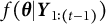 . In Appendix A of the Supplementary Material, we establish a connection between this selection rule and the MI method, showing that both favor items with high prediction uncertainty.
3.3 Reinforcement learning formulation
Existing item-selection rules face several limitations: first, these methods rely on one-step-lookahead selection, choosing items that provide the most immediate information without considering their impact on future selections, which can result in suboptimal policies (Sutton & Barto, Reference Sutton and Barto2018). Second, they are heuristically designed to balance information across all latent factors, rather than emphasizing the most essential factors of interest. Finally, these rules do not directly minimize test length, potentially increasing test duration without proportional gains in accuracy.
A more principled approach is to formulate item selection as an RL problem, where the optimal policy is learned using Bellman optimality principles rather than relying on heuristics that ignore long-term planning. Beyond addressing myopia, an RL-based formulation provides a direct mechanism to minimize the number of items required to reach a predefined posterior variance reduction threshold, explicitly guiding item selection toward accurately measuring the primary factors of interests.
More generally, consider a general finite horizon setting where each examinee can answer at most
$H \leq J$
 items, and the CAT algorithm terminates whenever the posterior variance of all factors of interest is smaller than a certain threshold
$\tau ^2$
items, and the CAT algorithm terminates whenever the posterior variance of all factors of interest is smaller than a certain threshold
$\tau ^2$
 , or when H is reached. Since H can be set sufficiently large, it serves as a practical secondary stopping criterion to prevent excessively long tests. Formally:
-
• State space $\ \mathcal {S}$
: The space of all possible latent factor posteriors
$\mathcal {S} := \{f(\boldsymbol {\theta } | \boldsymbol {Y}_{1:t}): t \in \{1, \ldots , H\}\}.$
The state variable in CAT represents the Bayesian estimate of the examinee’s latent traits as a multivariate distribution at time t. We may write
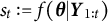
$s_t := f(\boldsymbol {\theta } | \boldsymbol {Y}_{1:t})$
, with
$s_0 := \mathcal {N}(0, \mathbb {I}_K)$
. The state space is discrete and can be exponentially large. Since there are J items in the item bank and the responses are binary, the total number of possible states is
$\sum _{t=1}^H \binom {J}{t} \cdot 2^t$
. -
• Action space $\ \mathcal {A}$
: The item bank
$[J]:= \{1, \ldots , J\}$
. However, at the tth selection time, the action space is the remaining items in the test bank that have not yet been selected
$R_t:= [J] \setminus \mathcal {I}_{t-1}$
, as we do not select the same item twice. -
• Transition kernel $\ \mathcal {P}: \mathcal {S} \times \mathcal {A} \rightarrow \Delta (\mathcal {S})$
, where
$\Delta (\mathcal {S})$
denotes the space of probability distributions over
$\mathcal {S}$
. The transition kernel
$\mathcal {P}$
specifies the stochastic rule that governs how the state evolves after an action is taken. In the CAT context, the kernel maps the current latent-trait estimate
$s_t$
and the selected item
$a_t$
to the next posterior state
$s_{t+1}$
. Conditional on
$(s_t, a_t)$
, the next estimate
$s_{t+1}$
depends on the examinee’s binary response
$y_t \in \{0,1\}$
to item
$a_t$
, which yields only two possible posterior updates. Because the true ability of the examinee and thus the response probability
$p(y_t = 1 \mid s_t, a_t)$
are unknown, the transition kernel in CAT is also unknown and must be approximated. -
• Reward function: To directly minimize the test length, we assign a simple 0–1 reward structure, where we assign negative rewards whenever more items are needed to reduce posterior variance to a given threshold. In a K-factor MIRT model, we often prioritize a subset of factors $\mathcal {K} \subset [K]$
(e.g.,
$\mathcal {K} = \{1\}$
for pCAT-COG), with the test terminating once the posterior variances of all factors in
$\mathcal {K}$
fall below the predefined threshold
$\tau ^2$
: (3.7) $$ \begin{align} R^{(t)}(s_t, a, s_{t+1}) = \begin{cases} -1 & \text{if } V_{t+1}> \tau^2, \\ 0 & \text{otherwise}, \end{cases} \end{align} $$where $V_{t+1} = \max _{k \in \mathcal {K}} \operatorname {Var}(\boldsymbol {\theta }_k \mid \boldsymbol {Y}_{1:(t+1)}) $
is the maximum marginal posterior variance among the prioritized factors
$\mathcal {K}$
. This also simplifies the learning of the value function, as the rewards are always bounded integers within
$[-H, -1]$
. We further illustrate the advantages of adopting this reward structure in Appendix E of the Supplementary Material.
















Rather than following a heuristic rule, we learn a policy
$\pi $
 that maps the current state (latent factor estimates) to a distribution over potential items:

Given an initial state
$S_0=s_0$
 and the discount factor
$\gamma \in (0,1]$
and the discount factor
$\gamma \in (0,1]$
 , the value function is

The expectation
$\mathbb {E}_\pi [\cdot ]$
 is taken over trajectories generated by drawing
$a_t$
is taken over trajectories generated by drawing
$a_t$
 from
$\pi (\cdot \mid s_t)$
from
$\pi (\cdot \mid s_t)$
 and then
$s_{t+1}$
and then
$s_{t+1}$
 from the transition kernel
$\mathcal {P}(\cdot \mid s_t,a_t)$
from the transition kernel
$\mathcal {P}(\cdot \mid s_t,a_t)$
 . Because direct evaluation of (3.8) is challenging, it is more convenient to consider the action-value function

with
$v_\pi (s)=\mathbb {E}_{a\sim \pi (\cdot \mid s)}Q_\pi (s,a)$
 . The optimal policy
$\pi ^{\star }$
. The optimal policy
$\pi ^{\star }$
 satisfies the Bellman equation (Bertsekas & Tsitsiklis, Reference Bertsekas and Tsitsiklis1996):

where
$s'$
 is the next posterior estimate after applying action a to the current posterior s, and
$v_{\pi ^\star }(s)=\max _{a} Q_{\pi ^\star }(s,a)$
is the next posterior estimate after applying action a to the current posterior s, and
$v_{\pi ^\star }(s)=\max _{a} Q_{\pi ^\star }(s,a)$
 . Since the state space grows exponentially and the transition kernel is unknown, solving for
$\pi ^*$
. Since the state space grows exponentially and the transition kernel is unknown, solving for
$\pi ^*$
 using traditional dynamic programming approaches becomes intractable (Sutton & Barto, Reference Sutton and Barto2018).
In practice, our deep Q-learning approach (Mnih et al., Reference Mnih, Kavukcuoglu, Silver, Graves, Antonoglou, Wierstra and Riedmiller2013) does not evaluate these expectations analytically. Let the transition
$(s,a,r,s')$
 represent one testing step, where item a is selected under state s, the reward r is observed, and the posterior is updated to
$s'$
represent one testing step, where item a is selected under state s, the reward r is observed, and the posterior is updated to
$s'$
 through the Bayesian MIRT model. We approximate the Bellman fixed point in (3.10) by fitting a parametric function
$Q_w$
through the Bayesian MIRT model. We approximate the Bellman fixed point in (3.10) by fitting a parametric function
$Q_w$
 that minimizes the squared temporal-difference loss:

where

Here,
$\mathcal {D}$
 (replay buffer) denotes a collection of previously observed testing steps
$(s,a,r,s')$
(replay buffer) denotes a collection of previously observed testing steps
$(s,a,r,s')$
 generated during simulation, which is used to approximate the expectation above by empirical averaging. The parameter
$\bar {w}$
generated during simulation, which is used to approximate the expectation above by empirical averaging. The parameter
$\bar {w}$
 corresponds to a delayed copy of the model parameters w, updated less frequently to stabilize the numerical optimization. We describe the full Q-learning algorithm in Section 5.
4 Accelerating item selection via posterior identification
The central insight of our deep CAT framework is that, by iteratively applying the E-step of the PXL-EM algorithm (Li et al., Reference Li, Gibbons and Rockova2025), the latent factor posteriors admit tractable posterior updates. This result is critical for RL, as the posterior distribution is deemed to be non-Gaussian and is analytically intractable under the traditional MIRT literature. By obtaining a tractable representation of this posterior, we can parameterize the examinee’s evolving ability and uncertainty as a well-defined state variable, which is an essential prerequisite for applying Q-learning to adaptive testing. The Bayesian MIRT formulation thus not only replaces costly MCMC procedures with efficient posterior updates under a probit link for existing Bayesian item-selection rules discussed in Section 3.2, but also supplies the statistical foundation that makes the subsequent RL framework feasible.
Specifically, we show that the latent factor posterior updates during CAT belong to an instance of the unified skew-normal distribution (Arellano-Valle & Azzalini, Reference Arellano-Valle and Azzalini2006), defined as follows.
Definition 4.1. Let
$\Phi _{T} \left \{ \boldsymbol {V}; \boldsymbol {\Sigma } \right \}$
 represent the cumulative distribution function of a T-dimensional multivariate Gaussian distribution
$N_{T}\left (0_{T}, \boldsymbol {\Sigma } \right )$
represent the cumulative distribution function of a T-dimensional multivariate Gaussian distribution
$N_{T}\left (0_{T}, \boldsymbol {\Sigma } \right )$
 evaluated at vector
$\boldsymbol {V}$
evaluated at vector
$\boldsymbol {V}$
 . A K-dimensional random vector
$\boldsymbol {\theta } \sim \operatorname {SUN}_{K, T}(\boldsymbol {\mu }, \boldsymbol {\Omega }, \boldsymbol {\Delta }, \boldsymbol {\gamma }, \boldsymbol {\Gamma })$
. A K-dimensional random vector
$\boldsymbol {\theta } \sim \operatorname {SUN}_{K, T}(\boldsymbol {\mu }, \boldsymbol {\Omega }, \boldsymbol {\Delta }, \boldsymbol {\gamma }, \boldsymbol {\Gamma })$
 has the unified skew-normal distribution if it has the probability density function:

Here,
$\phi _{K}(\boldsymbol {\theta }; \boldsymbol {\mu }, \boldsymbol {\Omega })$
 is the density of a K-dimensional multivariate Gaussian with expectation
$\boldsymbol {\mu }=\left (\mu _{1}, \ldots , \mu _{K}\right )' $
is the density of a K-dimensional multivariate Gaussian with expectation
$\boldsymbol {\mu }=\left (\mu _{1}, \ldots , \mu _{K}\right )' $
 , and a K by K covariance matrix
$\boldsymbol {\Omega } =\boldsymbol {\omega } \bar {\boldsymbol {\Omega }} \boldsymbol {\omega }$
, and a K by K covariance matrix
$\boldsymbol {\Omega } =\boldsymbol {\omega } \bar {\boldsymbol {\Omega }} \boldsymbol {\omega }$
 , where
$\bar {\boldsymbol {\Omega }}$
, where
$\bar {\boldsymbol {\Omega }}$
 is the correlation matrix and
$\boldsymbol {\omega }$
is the correlation matrix and
$\boldsymbol {\omega }$
 is a diagonal matrix with the square roots of the diagonal elements of
$\boldsymbol {\Omega }$
is a diagonal matrix with the square roots of the diagonal elements of
$\boldsymbol {\Omega }$
 in its diagonal.
$\boldsymbol {\Delta }$
in its diagonal.
$\boldsymbol {\Delta }$
 is a K by T matrix that determines the skewness of the distribution, and
$\boldsymbol {\gamma } \in \mathbb R^T$
is a K by T matrix that determines the skewness of the distribution, and
$\boldsymbol {\gamma } \in \mathbb R^T$
 controls the flexibility in departures from normality.
In addition, the
$(K+T) \times (K+T)$
 matrix
$\boldsymbol {\Omega }^{*}$
matrix
$\boldsymbol {\Omega }^{*}$
 , having blocks
$\boldsymbol {\Omega }_{[11]}^{*}=\boldsymbol {\Gamma }, \boldsymbol {\Omega }_{[22]}^{*}=\bar {\boldsymbol {\Omega }}$
, having blocks
$\boldsymbol {\Omega }_{[11]}^{*}=\boldsymbol {\Gamma }, \boldsymbol {\Omega }_{[22]}^{*}=\bar {\boldsymbol {\Omega }}$
 , and
$\boldsymbol {\Omega }_{[21]}^{*}=\boldsymbol {\Omega }_{[12]}^{*'}=\boldsymbol {\Delta }$
, and
$\boldsymbol {\Omega }_{[21]}^{*}=\boldsymbol {\Omega }_{[12]}^{*'}=\boldsymbol {\Delta }$
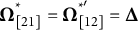 , needs to be a full-rank correlation matrix.
Suppose an arbitrary CAT item-selection algorithm has already selected T items with item parameters
$\boldsymbol {\xi }_{1:T} = (\boldsymbol {B}_{1:T}, \boldsymbol {D}_{1:T})$
 , where
$\boldsymbol {B}_{1:T}:=[\boldsymbol {B}_{j_1}, \dots , \boldsymbol {B}_{j_T}]'$
, where
$\boldsymbol {B}_{1:T}:=[\boldsymbol {B}_{j_1}, \dots , \boldsymbol {B}_{j_T}]'$
 and
$\boldsymbol {D}_{1:T}:=[D_{j_1}, \dots , D_{j_T}]'$
and
$\boldsymbol {D}_{1:T}:=[D_{j_1}, \dots , D_{j_T}]'$
 . Then it is possible to show the following result.
Theorem 4.1. Consider a K-factor CAT item-selection procedure after selecting T items, with
$\mathcal {N}(\boldsymbol {0}_K, \mathbb {I}_K)$
 prior placed on the test taker’s latent trait
$\boldsymbol {\theta }$
prior placed on the test taker’s latent trait
$\boldsymbol {\theta }$
 . If
$\boldsymbol {Y}_{1:T}=\left (y_{j_1}, \ldots , y_{j_T}\right )'$
. If
$\boldsymbol {Y}_{1:T}=\left (y_{j_1}, \ldots , y_{j_T}\right )'$
 is conditionally independent binary response data from the two-parameter probit MIRT model defined in (3.1), then

with posterior parameters

where
$\boldsymbol {C}_1 = \text {diag}(2y_{j_1}-1, \ldots , 2y_{j_T}-1) \boldsymbol {B}_{1:T}$
 and
$\boldsymbol {C}_2 = \text {diag}(2y_{j_1}-1, \ldots , 2y_{j_T}-1)\boldsymbol {D}_{1:T}$
and
$\boldsymbol {C}_2 = \text {diag}(2y_{j_1}-1, \ldots , 2y_{j_T}-1)\boldsymbol {D}_{1:T}$
 . The matrix
$\boldsymbol {C}_3$
. The matrix
$\boldsymbol {C}_3$
 is a T by T diagonal matrix, where the
$(t,t)$
is a T by T diagonal matrix, where the
$(t,t)$
 th entry is
$(\|\boldsymbol {B}_{t,T}\|_2^2 +1)^{\frac {1}{2}}$
th entry is
$(\|\boldsymbol {B}_{t,T}\|_2^2 +1)^{\frac {1}{2}}$
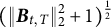 , with
$\boldsymbol {B}_{t, T}$
, with
$\boldsymbol {B}_{t, T}$
 representing the tth row of
$\boldsymbol {B}_{1:T}$
representing the tth row of
$\boldsymbol {B}_{1:T}$
 .
.
Theorem 4.1 provides an exact finite-sample Bayesian characterization of the latent factor posterior. With a multivariate normal prior on
$\boldsymbol {\theta }$
 and a probit MIRT likelihood, the posterior
$f(\boldsymbol {\theta }\mid \boldsymbol {Y}_{1:T})$
and a probit MIRT likelihood, the posterior
$f(\boldsymbol {\theta }\mid \boldsymbol {Y}_{1:T})$
 belongs to the unified skew-normal (SUN) family. This does not conflict with the empirical Bayes result of Chang and Stout (Reference Chang and Stout1993), which establishes asymptotic posterior normality as the number of items J grows; related discussion of Bayesian latent-trait estimation and asymptotic covariance properties in MIRT is given in Wang (Reference Wang2015). The finite-sample form is particularly relevant for CAT, where only a small number of items have been administered and large-sample normal approximations may be unreliable. This representation enables exact posterior calculations, improving uncertainty quantification and item selection in short tests. For ordinal responses under a probit link, closely related SUN-based approximations can also be developed as discussed in Li et al. (Reference Li, Gibbons and Rockova2025). The latent factor posterior can often be well approximated within the SUN family, although the representation is generally not exact.
According to Arellano-Valle and Azzalini (Reference Arellano-Valle and Azzalini2006), an arbitrary unified skew-normal distribution
$\boldsymbol {\theta } \sim \operatorname {SUN}_{K, T}(\boldsymbol {\mu }, \boldsymbol {\Omega }, \boldsymbol {\Delta }, \boldsymbol {\gamma }, \boldsymbol {\Gamma })$
 has a stochastic representation as a linear combination of a K-dimensional multivariate normal random variable
$\boldsymbol {V}_0$
has a stochastic representation as a linear combination of a K-dimensional multivariate normal random variable
$\boldsymbol {V}_0$
 , and a T-dimensional truncated multivariate normal random variable
$\boldsymbol {V}_{1, -\gamma }$
, and a T-dimensional truncated multivariate normal random variable
$\boldsymbol {V}_{1, -\gamma }$
 as follows:

where
$\boldsymbol {V}_0 \sim \mathcal {N}(0, \bar {\boldsymbol {\Omega }} - \boldsymbol {\Delta } \boldsymbol {\Gamma }^{-1} \boldsymbol {\Delta }') \in \mathbb R^{K}$
 , and
$\boldsymbol {V}_{1, -\gamma }$
, and
$\boldsymbol {V}_{1, -\gamma }$
 is a multivariate normal distribution
$ \mathcal {N}(0, \boldsymbol {\Gamma })$
is a multivariate normal distribution
$ \mathcal {N}(0, \boldsymbol {\Gamma })$
 truncated to
$\{\boldsymbol {V}_1 \in \mathbb {R}^{T}: V_{1i} \geq -\gamma _i \quad ,\forall i\}$
truncated to
$\{\boldsymbol {V}_1 \in \mathbb {R}^{T}: V_{1i} \geq -\gamma _i \quad ,\forall i\}$
 .
.
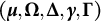
Based on Theorem 4.1, we have a closed-form expression for the posterior parameters
$(\boldsymbol {\mu }, \boldsymbol {\Omega }, \boldsymbol {\Delta }, \boldsymbol {\gamma }, \boldsymbol {\Gamma })$
 for
$\boldsymbol {\theta }$
for
$\boldsymbol {\theta }$
 . Recall that
$\boldsymbol {\Omega } = \boldsymbol {\omega } \bar {\boldsymbol {\Omega }} \boldsymbol {\omega }$
. Recall that
$\boldsymbol {\Omega } = \boldsymbol {\omega } \bar {\boldsymbol {\Omega }} \boldsymbol {\omega }$
 is the standard covariance correlation matrix decomposition from Definition 4.1, and hence the only unrealized stochastic terms in Equation (4.1) are
$\boldsymbol {V}_0$
is the standard covariance correlation matrix decomposition from Definition 4.1, and hence the only unrealized stochastic terms in Equation (4.1) are
$\boldsymbol {V}_0$
 and
$\boldsymbol {V}_{1, -\boldsymbol {\gamma }}$
and
$\boldsymbol {V}_{1, -\boldsymbol {\gamma }}$
 . This suggests that sampling from the latent factor posterior distribution
$f(\boldsymbol {\theta }|\boldsymbol {Y}_{1:T})$
. This suggests that sampling from the latent factor posterior distribution
$f(\boldsymbol {\theta }|\boldsymbol {Y}_{1:T})$
 requires two independent steps: sampling from a K-dimensional multivariate normal distribution
$\boldsymbol {V}_0$
requires two independent steps: sampling from a K-dimensional multivariate normal distribution
$\boldsymbol {V}_0$
 and a T-dimensional multivariate truncated normal distribution
$\boldsymbol {V}_1$
and a T-dimensional multivariate truncated normal distribution
$\boldsymbol {V}_1$
 . As a result, the direct sampling approach scales efficiently with the number of factors K, since generating samples from K-dimensional multivariate normal distributions is trivial. Moreover, in CAT settings, the test is typically terminated early, meaning T remains relatively small. When T is moderate (e.g.,
$T<1,000$
. As a result, the direct sampling approach scales efficiently with the number of factors K, since generating samples from K-dimensional multivariate normal distributions is trivial. Moreover, in CAT settings, the test is typically terminated early, meaning T remains relatively small. When T is moderate (e.g.,
$T<1,000$
 ), sampling from the truncated multivariate normal distribution remains computationally efficient using the minimax tilting method (Botev, Reference Botev2016). The exact proof of Theorem 4.1 and the sampling details can be found in Appendix B of the Supplementary Material.
The direct sampling approach provides substantial gains in both computational efficiency and numerical precision compared with traditional MCMC methods commonly used in the MIRT literature (Béguin & Glas, Reference Béguin and Glas2001; Jiang & Templin, Reference Jiang and Templin2019). In standard MIRT settings, the posterior distribution of the latent factors is typically regarded as intractable and non-Gaussian, requiring a Markov chain to be constructed via data-augmentation techniques (Albert & Chib, Reference Albert and Chib1993; Polson et al., Reference Polson, Scott and Windle2013) so that its stationary distribution approximates the posterior. This procedure entails repeated simulation of augmented data and is inherently sequential, which limits opportunities for parallelization. Moreover, it demands additional tuning, burn-in, and convergence diagnostics to ensure that the chain adequately converges to the posterior distribution. In contrast, Theorem 4.1 establishes that the posterior distribution can be expressed exactly as a unified skew-normal distribution, allowing direct and parallel sampling without the need for iterative convergence procedures.
Theorem 4.1 also plays a central role in our proposed deep Q-learning algorithm, as it fully characterizes the latent factor posterior distribution
$f(\boldsymbol {\theta }|\boldsymbol {Y}_{1:T})$
 , enabling the parameterization of the state variable
$s_T$
, enabling the parameterization of the state variable
$s_T$
 , which serves as an input to the Q-network illustrated in Section 5.1. We illustrate how Theorem 4.1 can be used to accelerate existing item-selection rules, and the same idea can be extended to fully Bayesian item-selection settings as considered by van der Linden and Ren (Reference van der Linden and Ren2020).
4.1 Accelerating existing rules
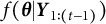
While Bayesian CAT criteria require multidimensional integration, these quantities are typically evaluated in practice via Monte Carlo approximation rather than analytic quadrature in moderate to high dimensions. In such Bayesian CAT implementations, the dominant computational cost lies in obtaining valid samples from the latent factor posterior. By providing exact posterior samples without Markov chain construction, our approach removes this primary bottleneck and renders the remaining Monte Carlo integration computationally efficient and easily parallelizable. For example, in computing the KL-EAP item-selection rule (3.2), we directly sample from
$f(\boldsymbol {\theta }|\boldsymbol {Y}_{1:(t-1)})$
 instead of resorting to MCMC and evaluate the integral via Monte Carlo integration. Since the EAP estimate
$\hat {\boldsymbol {\theta }}_{t-1}$
instead of resorting to MCMC and evaluate the integral via Monte Carlo integration. Since the EAP estimate
$\hat {\boldsymbol {\theta }}_{t-1}$
 remains fixed at time step t, evaluating the KL information term is straightforward. For the Max Pos item-selection rule in Equation (3.3), we again obtain i.i.d. samples from
$f(\boldsymbol {\theta }|\boldsymbol {Y}_{1:(t-1)})$
remains fixed at time step t, evaluating the KL information term is straightforward. For the Max Pos item-selection rule in Equation (3.3), we again obtain i.i.d. samples from
$f(\boldsymbol {\theta }|\boldsymbol {Y}_{1:(t-1)})$
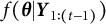 and compute the posterior predictive probabilities in (3.4). Although the density ratio
$\frac {f(\boldsymbol {\theta }|\boldsymbol {Y}_{1:(t-1)})}{f(\boldsymbol {\theta }|\boldsymbol {Y}_{1:t})}$
and compute the posterior predictive probabilities in (3.4). Although the density ratio
$\frac {f(\boldsymbol {\theta }|\boldsymbol {Y}_{1:(t-1)})}{f(\boldsymbol {\theta }|\boldsymbol {Y}_{1:t})}$
 is difficult to evaluate, we can leverage the conditional independence assumption of the MIRT model. In particular, we can express the joint distribution of
$(\boldsymbol {\theta }, y_{j_t})$
is difficult to evaluate, we can leverage the conditional independence assumption of the MIRT model. In particular, we can express the joint distribution of
$(\boldsymbol {\theta }, y_{j_t})$
 as
as

Using Equation (4.2), we rewrite the KL information term in Equation (3.3) as

Since
$f(y_{j_t}|\boldsymbol {\theta })$
 can be easily computed for each
$\boldsymbol {\theta } \sim f(\boldsymbol {\theta }| \boldsymbol {Y}_{1:(t-1)})$
can be easily computed for each
$\boldsymbol {\theta } \sim f(\boldsymbol {\theta }| \boldsymbol {Y}_{1:(t-1)})$
 , the online computation of Max Pos remains efficient.
Although the MI selection rule in Equation (3.5) has demonstrated strong empirical performance (Wang & Chang, Reference Wang and Chang2011), its computational complexity remains a significant challenge. By applying Equation (4.2), we can rewrite MI as

This formulation reveals that maximizing MI is structurally similar to Max Pos but requires much more computational effort. Unlike Max Pos, where sampling is performed from the current posterior
$f(\boldsymbol {\theta }|\boldsymbol {Y}_{1:(t-1)})$
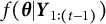 , MI requires sampling from future posteriors
$f(\boldsymbol {\theta }| \boldsymbol {Y}_{1:(t-1)}, y_{j_t})$
, MI requires sampling from future posteriors
$f(\boldsymbol {\theta }| \boldsymbol {Y}_{1:(t-1)}, y_{j_t})$
 . Since each candidate item
$j_t \in R_t$
. Since each candidate item
$j_t \in R_t$
 has two possible outcomes (
$y_{j_t} = 0$
has two possible outcomes (
$y_{j_t} = 0$
 or
$y_{j_t} = 1$
or
$y_{j_t} = 1$
 ), evaluating Equation (4.3) requires obtaining samples from
$|R_t| \times 2$
), evaluating Equation (4.3) requires obtaining samples from
$|R_t| \times 2$
 distinct posterior distributions. Even if sampling each individual posterior is computationally efficient, this approach becomes impractical for large item banks.
We hence propose a new approach to dramatically accelerate the computation of the MI quantity using the idea of importance sampling and resampling and bootstrap filter (Gordon et al., Reference Gordon, Salmond and Smith1993; Smith & Gelfand, Reference Smith and Gelfand1992). Rather than explicitly sampling the future posterior
$f(\boldsymbol {\theta }| \boldsymbol {Y}_{1:(t-1)}, y_{j_t})$
 for each
$j_t \in R_t$
for each
$j_t \in R_t$
 and
$y_{j_t} \in \{0, 1\}$
and
$y_{j_t} \in \{0, 1\}$
 , we can simply sample from the current posterior
$f(\boldsymbol {\theta } | \boldsymbol {Y}_{1:(t-1)})$
, we can simply sample from the current posterior
$f(\boldsymbol {\theta } | \boldsymbol {Y}_{1:(t-1)})$
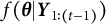 once, and then perform proper posterior reweighting. Under Equation (3.1), let
$p(\boldsymbol {\theta })$
once, and then perform proper posterior reweighting. Under Equation (3.1), let
$p(\boldsymbol {\theta })$
 be the prior on the latent factors
$\boldsymbol {\theta }$
be the prior on the latent factors
$\boldsymbol {\theta }$
 ,
$l_1(\boldsymbol {\theta })$
,
$l_1(\boldsymbol {\theta })$
 be the current data likelihood, and
$l_2(\boldsymbol {\theta })$
be the current data likelihood, and
$l_2(\boldsymbol {\theta })$
 denote the future data likelihood after observing
$y_{j_t}$
denote the future data likelihood after observing
$y_{j_t}$
 . We have the future posterior density as follows:

Equation (4.4) suggests that we can generate samples from
$f(\boldsymbol {\theta }| \boldsymbol {Y}_{1:(t-1)}, y_{j_t})$
 via reweighting and resampling from the current posterior samples
$f(\boldsymbol {\theta }|\boldsymbol {Y}_{1:(t-1)})$
via reweighting and resampling from the current posterior samples
$f(\boldsymbol {\theta }|\boldsymbol {Y}_{1:(t-1)})$
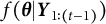 . Specifically, given a sufficiently large set of posterior samples
$(\boldsymbol {\theta }_1, \ldots , \boldsymbol {\theta }_M) \sim f(\boldsymbol {\theta }|\boldsymbol {Y}_{1:(t-1)})$
. Specifically, given a sufficiently large set of posterior samples
$(\boldsymbol {\theta }_1, \ldots , \boldsymbol {\theta }_M) \sim f(\boldsymbol {\theta }|\boldsymbol {Y}_{1:(t-1)})$
 , we assign distinct weights for each sample
$m \in \{1, \ldots , M\}$
, we assign distinct weights for each sample
$m \in \{1, \ldots , M\}$
 and future item
$j_t \in R_t$
and future item
$j_t \in R_t$
 :
:

To sample from
$f(\boldsymbol {\theta }|\boldsymbol {Y}_{1:(t-1)}, y_{j_t})$
 , we then draw from the discrete distribution over
$(\boldsymbol {\theta }_1, \ldots , \boldsymbol {\theta }_M)$
, we then draw from the discrete distribution over
$(\boldsymbol {\theta }_1, \ldots , \boldsymbol {\theta }_M)$
 , placing weight
$q_m$
, placing weight
$q_m$
 on
$\boldsymbol {\theta }_m$
on
$\boldsymbol {\theta }_m$
 . This approach eliminates the need to sample from
$|R_t| \times 2$
. This approach eliminates the need to sample from
$|R_t| \times 2$
 distinct posteriors directly, further accelerating MI computation and making it scalable for large item banks.
5 Learning optimal item-selection policy
Building on the Bayesian MIRT foundation established in the previous section, we now formulate the problem of CAT as an RL task. The Bayesian framework provides two key advantages that make this integration both principled and computationally feasible. First, the identified latent factor posterior distributions offer a well-defined representation of examinee knowledge, allowing their corresponding posterior parameters to be parameterized directly as state variables. Without such identification, encoding an unknown and analytically intractable posterior would be ambiguous. Second, because RL typically requires extensive simulations to learn an optimal policy, the acceleration achieved in online item selection enables rapid simulation of testing sessions, thereby substantially improving the efficiency of policy training.
As illustrated in Section 3.3, an RL approach addresses the myopic nature of traditional CAT selection rules, enables a more flexible reward structure, and directly minimizes the number of items required for performing online adaptive testing. Specifically, we propose a novel double Q-learning algorithm (Mnih et al., Reference Mnih, Kavukcuoglu, Silver, Rusu, Veness, Bellemare, Graves, Riedmiller, Fidjeland, Ostrovski, Petersen, Beattie, Sadik, Antonoglou, King, Kumaran, Wierstra, Legg and Hassabis2015; van Hasselt et al., Reference van Hasselt, Guez and Silver2016) for online item selection in CAT. The algorithm trains a deep neural network offline using only the item parameters estimated from an arbitrary two-parameter MIRT model. The offline training phase is completed before any live CAT administration. After training, the network weights are fixed, and online CAT only requires sequentially updating the posterior state and applying the learned network to select the next item. During online item selection, the neural network takes the current posterior distribution
$ s_t := f(\boldsymbol {\theta } \mid \boldsymbol {Y}_{1:t}) $
 as input and outputs the next item selection for step
$ (t+1) $
as input and outputs the next item selection for step
$ (t+1) $
 . The neural network architecture is described in Section 5.1, while the double deep Q-learning algorithm is detailed in Section 5.2.
5.1 Deep Q-learning neural network design
A potential reason that a deep RL approach has not been proposed in the CAT literature is the ambiguity arising from unidentified latent factor distributions. However, by Theorem 4.1, it is straightforward to compactly parameterize the posterior distribution at each time step t using the parameters
$\boldsymbol {C}_1 \in \mathbb R^{t \times K}$
 ,
$\boldsymbol {C}_2 \in \mathbb {R}^t$
,
$\boldsymbol {C}_2 \in \mathbb {R}^t$
 , and
$\text {diag}(\boldsymbol {C}_3) \in \mathbb R^t$
, and
$\text {diag}(\boldsymbol {C}_3) \in \mathbb R^t$
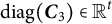 , where
$\text {diag}(\boldsymbol {C}_3)$
, where
$\text {diag}(\boldsymbol {C}_3)$
 represents the diagonal vector of
$\boldsymbol {C}_3$
represents the diagonal vector of
$\boldsymbol {C}_3$
 . This structured representation of the posterior enables item-selection policy learning via deep neural networks, which takes posterior parameters as input and outputs item selection.
Neural networks can be regarded as flexible function approximators that learn nonlinear mappings between inputs and outputs through a composition of simple transformations (Goodfellow et al., Reference Goodfellow, Bengio and Courville2016). In our framework, the deep neural network consists of two key components: an encoder and a classifier. At each time step t, the encoder maps the collection of posterior parameters to a latent representation in
$\mathbb {R}^{L}$
 , where L is a hyperparameter and represents the dimension of the latent feature space. The classifier then outputs a J-dimensional vector of estimated Q-values and selects the next item from the item bank that is expected to yield the highest Q-value.
Define the collection of the posterior parameters
$\tilde {\boldsymbol {\xi }}_t:= \{(\boldsymbol {C}_{1h}, C_{2h}, C_{3h})\}_{h=1}^{t}$
 , where
$\boldsymbol {C}_{1h} \in \mathbb {R}^{K}$
, where
$\boldsymbol {C}_{1h} \in \mathbb {R}^{K}$
 is the hth row of
$\boldsymbol {C}_1$
is the hth row of
$\boldsymbol {C}_1$
 ,
$C_{2h} \in \mathbb {R}$
,
$C_{2h} \in \mathbb {R}$
 is the hth element of
$\boldsymbol {C}_2$
is the hth element of
$\boldsymbol {C}_2$
 , and
$C_{3h} \in \mathbb {R}$
, and
$C_{3h} \in \mathbb {R}$
 is the hth elements in the diagonal of
$\boldsymbol {C}_3$
is the hth elements in the diagonal of
$\boldsymbol {C}_3$
 . Since the size of the posterior parameters
$\tilde {\boldsymbol {\xi }}_t$
. Since the size of the posterior parameters
$\tilde {\boldsymbol {\xi }}_t$
 grows over time, and permuting the tuples within
$\tilde {\boldsymbol {\xi }}_t$
grows over time, and permuting the tuples within
$\tilde {\boldsymbol {\xi }}_t$
 still describes the same posterior, we have to design a neural network that can take inputs of growing size, and can provide output that is permutation invariant of the inputs. One solution is to consider the weight sharing idea from the Bayesian experimental design literature (Foster et al., Reference Foster, Ivanova, Malik and Rainforth2021). Let
$\phi _1(.): \mathbb {R}^{K+2} \rightarrow \mathbb {R}^{L_1}$
still describes the same posterior, we have to design a neural network that can take inputs of growing size, and can provide output that is permutation invariant of the inputs. One solution is to consider the weight sharing idea from the Bayesian experimental design literature (Foster et al., Reference Foster, Ivanova, Malik and Rainforth2021). Let
$\phi _1(.): \mathbb {R}^{K+2} \rightarrow \mathbb {R}^{L_1}$
 denote an encoder component that maps each tuple
$(\boldsymbol {C}_{1h}, C_{2h}, C_{3h}) \in \mathbb {R}^{K+2}$
denote an encoder component that maps each tuple
$(\boldsymbol {C}_{1h}, C_{2h}, C_{3h}) \in \mathbb {R}^{K+2}$
 to an
$L_1$
to an
$L_1$
 -dimensional latent space, and consider the operation
$g_1(.)$
-dimensional latent space, and consider the operation
$g_1(.)$
 as follows:

Observe that
$g_1(.)$
 is capable of handling a growing number of inputs through summations of
$\phi _1(.)$
is capable of handling a growing number of inputs through summations of
$\phi _1(.)$
 functions over t. More importantly, permuting the order of the tuples in
$\tilde {\boldsymbol {\xi }}_t$
functions over t. More importantly, permuting the order of the tuples in
$\tilde {\boldsymbol {\xi }}_t$
 does not change the value of
$g_1(.)$
does not change the value of
$g_1(.)$
 , since summation is permutation invariant. Although the form of
$g_1$
, since summation is permutation invariant. Although the form of
$g_1$
 may look restrictive, any function
$f(.)$
may look restrictive, any function
$f(.)$
 operating on a countable set can be decomposed into the form
$\rho \circ g_1(.)$
operating on a countable set can be decomposed into the form
$\rho \circ g_1(.)$
 , where
$\rho (.)$
, where
$\rho (.)$
 is a suitable transformation that can be learned from another neural network (see Theorem 2 of Zaheer et al., Reference Zaheer, Kottur, Ravanbhakhsh, Póczos, Salakhutdinov and Smola2017).
In principle, the network design
$\rho \circ g_1(.)$
 , coupled with the Q-learning algorithm, is sufficient to learn the optimal policy. However, to enhance learning efficiency, we further enrich the state representation
$\tilde {\boldsymbol {\xi }}_t$
, coupled with the Q-learning algorithm, is sufficient to learn the optimal policy. However, to enhance learning efficiency, we further enrich the state representation
$\tilde {\boldsymbol {\xi }}_t$
 with a matrix of prediction quartiles
$\boldsymbol {\Psi }_t \in \mathbb R^{J \times Q}$
with a matrix of prediction quartiles
$\boldsymbol {\Psi }_t \in \mathbb R^{J \times Q}$
 , where each row contains a vector of quantiles of the predictive distribution for item j. We form these quantiles by first drawing samples
$\boldsymbol {\theta }_{1}, \ldots , \boldsymbol {\theta }_M \sim f(\boldsymbol {\theta } | \boldsymbol {Y}_{1:t})$
, where each row contains a vector of quantiles of the predictive distribution for item j. We form these quantiles by first drawing samples
$\boldsymbol {\theta }_{1}, \ldots , \boldsymbol {\theta }_M \sim f(\boldsymbol {\theta } | \boldsymbol {Y}_{1:t})$
 as in Section 4, and then computing the quantiles of the prediction samples
$\{\Phi (\boldsymbol {B}_j'\boldsymbol {\theta }_i + D_j)\}_{i=1}^M$
as in Section 4, and then computing the quantiles of the prediction samples
$\{\Phi (\boldsymbol {B}_j'\boldsymbol {\theta }_i + D_j)\}_{i=1}^M$
 for each item j. Since sampling from
$f(\boldsymbol {\theta }| \boldsymbol {Y}_{1:t})$
for each item j. Since sampling from
$f(\boldsymbol {\theta }| \boldsymbol {Y}_{1:t})$
 only needs to be done once, computing the matrix
$\boldsymbol {\Psi }_t$
only needs to be done once, computing the matrix
$\boldsymbol {\Psi }_t$
 online is computationally efficient.
This practice of augmenting the raw state variable with additional contextual features of the states (
$\boldsymbol {\Psi }_t$
 ) echoes the common strategy in the RL literature (Mnih et al., Reference Mnih, Kavukcuoglu, Silver, Rusu, Veness, Bellemare, Graves, Riedmiller, Fidjeland, Ostrovski, Petersen, Beattie, Sadik, Antonoglou, King, Kumaran, Wierstra, Legg and Hassabis2015; Schaul et al., Reference Schaul, Horgan, Gregor, Silver, Bach and Blei2015): learning tends to be more stable and efficient when the state representation captures not only the current ability estimate but also characteristics of the item bank. In our setting,
$\boldsymbol {\Psi }_t$
) echoes the common strategy in the RL literature (Mnih et al., Reference Mnih, Kavukcuoglu, Silver, Rusu, Veness, Bellemare, Graves, Riedmiller, Fidjeland, Ostrovski, Petersen, Beattie, Sadik, Antonoglou, King, Kumaran, Wierstra, Legg and Hassabis2015; Schaul et al., Reference Schaul, Horgan, Gregor, Silver, Bach and Blei2015): learning tends to be more stable and efficient when the state representation captures not only the current ability estimate but also characteristics of the item bank. In our setting,
$\boldsymbol {\Psi }_t$
 offers a richer description of the predictive distributions across items given the current estimates, effectively serving as additional covariates for item selection. Empirically, we find that incorporating
$\boldsymbol {\Psi }_t$
offers a richer description of the predictive distributions across items given the current estimates, effectively serving as additional covariates for item selection. Empirically, we find that incorporating
$\boldsymbol {\Psi }_t$
 substantially accelerates convergence toward the optimal item-selection policy. Including
$\boldsymbol {\Psi }_t$
substantially accelerates convergence toward the optimal item-selection policy. Including
$\boldsymbol {\Psi }_t$
 in the state representation is harmless, as it is a deterministic function of the posterior distribution; identical posteriors will always produce identical
$\boldsymbol {\Psi }_t$
in the state representation is harmless, as it is a deterministic function of the posterior distribution; identical posteriors will always produce identical
$\boldsymbol {\Psi }_t$
 , ensuring that the policy remains consistent across equivalent states.
In summary, Figure 2 describes the architecture of the policy network used in our approach. The same network is trained offline and then deployed during live CAT with fixed weights, so only the posterior state is updated sequentially during online administration. To select the
$(t+1)$
 th item, our proposed neural net takes two inputs: the posterior parameters
$\tilde {\boldsymbol {\xi }}_t$
th item, our proposed neural net takes two inputs: the posterior parameters
$\tilde {\boldsymbol {\xi }}_t$
 and the prediction matrix
$\boldsymbol {\Psi }_t$
and the prediction matrix
$\boldsymbol {\Psi }_t$
 , and outputs the selected item. Let
$\phi _2: \mathbb {R}^{J \times Q} \to \mathbb {R}^{L_2}$
, and outputs the selected item. Let
$\phi _2: \mathbb {R}^{J \times Q} \to \mathbb {R}^{L_2}$
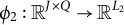 represent the encoder component that maps the matrix
$\boldsymbol {\Psi }_t \in \mathbb R^{J \times Q}$
represent the encoder component that maps the matrix
$\boldsymbol {\Psi }_t \in \mathbb R^{J \times Q}$
 to
$L_2$
to
$L_2$
 -dimensional space. Write
$L=L_1+L_2$
-dimensional space. Write
$L=L_1+L_2$
 and the concatenated outputs of
$g_1(.)$
and the concatenated outputs of
$g_1(.)$
 and
$\phi _2(.)$
and
$\phi _2(.)$
 as
$[g_1(\tilde {\boldsymbol {\xi }}_t)', \phi _2(\boldsymbol {\Psi }_t)']' \in \mathbb {R}^L $
as
$[g_1(\tilde {\boldsymbol {\xi }}_t)', \phi _2(\boldsymbol {\Psi }_t)']' \in \mathbb {R}^L $
 , we then define the classification component of neural network as
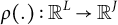
$\rho (.): \mathbb {R}^L \rightarrow \mathbb {R}^J$
, we then define the classification component of neural network as
$\rho (.): \mathbb {R}^L \rightarrow \mathbb {R}^J$
 , which maps the concatenated outputs of
$g_1(.)$
, which maps the concatenated outputs of
$g_1(.)$
 and
$\phi _2(.)$
and
$\phi _2(.)$
 to a J-dimensional logit vector. Denote the final policy network as
$\pi _{\phi }$
to a J-dimensional logit vector. Denote the final policy network as
$\pi _{\phi }$
 and recall that
$\rho (.)$
and recall that
$\rho (.)$
 represents the classification layer, our proposed network selects the item at time t corresponding to the maximum value of the following function:

We implement both primary and target Q-networks as simple feed-forward multilayer perceptron and find that their performance is largely insensitive to the exact choice of
$L_1$
 and
$L_2$
and
$L_2$
 , and does not require very large depth. All architectural details, such as layer sizes, activations, and optimizer settings, are provided in Appendix D of the Supplementary Material. This robustness suggests that our empirical improvements stem from the CAT-specific state design and augmentation rather than network complexity.
High-level architecture of the Q-network. The shared encoder
$\phi _1$
 maps each tuple of posterior parameters to
$\mathbb {R}^{L_1}$
maps each tuple of posterior parameters to
$\mathbb {R}^{L_1}$
 and the sum yields the permutation invariant representation
$g_1(\tilde {\boldsymbol {\xi }}_t)$
and the sum yields the permutation invariant representation
$g_1(\tilde {\boldsymbol {\xi }}_t)$
 . The matrix
$\boldsymbol {\Psi }_t$
. The matrix
$\boldsymbol {\Psi }_t$
 is encoded by
$\phi _2$
is encoded by
$\phi _2$
 . The concatenated vector in
$\mathbb {R}^{L}$
. The concatenated vector in
$\mathbb {R}^{L}$
 is passed to the classifier
$\rho $
is passed to the classifier
$\rho $
 to select the jth item (largest value in the J logits). This network is trained offline using Algorithm 1; during live CAT, its weights are fixed and only the posterior state is updated sequentially.

Figure 2 Long description
The flowchart consists of two main input branches.
Top Branch:
* Starts with a yellow box labeled posterior tuples containing the set of open parenthesis C sub 1 h, C sub 2 h, C sub 3 h close parenthesis from h equals 1 to t.
* An arrow labeled apply per tuple points to a gray box labeled phi sub 1 dot encoder (shared over h).
* An arrow leads to a summation symbol sigma with the label sum over h.
* The output is a yellow box labeled g sub 1 (tilde xi sub t) in blackboard bold R super L sub 1, noted as perm. invariant.
Bottom Branch:
* Starts with a yellow box labeled prediction quantiles containing Psi sub t in blackboard bold R super J times Q.
* An arrow points to a gray box labeled phi sub 2 dot encoder.
Convergence and Output:
* Arrows from both the top branch (g sub 1) and bottom branch (phi sub 2) point to a central purple box labeled open bracket g sub 1; phi sub 2 close bracket in blackboard bold R super L sub 1 plus L sub 2 equals blackboard bold R super L.
* An arrow leads to a green box labeled rho dot classifier.
* The final arrow points to a white box labeled item j.
5.2 Double deep Q-learning for CAT
In classical tabular Q-learning, the action-value function is stored as a Q-matrix whose rows correspond to states and whose columns correspond to actions. Such a representation is infeasible in CAT because the state space is combinatorially large and the state variable
$s_t$
 is represented by continuous posterior summaries rather than a small finite index. We therefore replace the tabular Q-matrix by a neural-network approximator
$Q_w(s,a)$
is represented by continuous posterior summaries rather than a small finite index. We therefore replace the tabular Q-matrix by a neural-network approximator
$Q_w(s,a)$
 . For a given state
$s_t$
. For a given state
$s_t$
 , the network in Figure 2 outputs the full vector of estimated Q-values before selecting the optimal item, which plays the same role as one row of a tabular Q-matrix, but is produced through function approximation rather than table lookup.
The standard Q-learning algorithm often overestimates Q-values because the same action-value approximation is used both to select the maximizing action and to evaluate it when constructing the temporal-difference target. To address this issue, we adopt the double Q-learning approach (van Hasselt et al., Reference van Hasselt, Guez and Silver2016), which replaces the single action-value approximation by two Q-networks with distinct roles. The primary network
$Q_w$
 is updated by gradient descent and is used to select the action with the largest estimated Q-value, while the target network
$Q_{\bar w}$
is updated by gradient descent and is used to select the action with the largest estimated Q-value, while the target network
$Q_{\bar w}$
 is a delayed copy used only to evaluate that selected action when forming the target. This is the neural-network analog of maintaining two Q-matrices in double Q-learning. The separation reduces overestimation bias and leads to more stable training. Specifically, compared with standard Q-learning, double Q-learning minimizes the same TD loss in (3.11) but replaces the target in (3.12) with

Our proposed algorithm is presented in Algorithm 1. The algorithm trains, entirely offline, the policy network illustrated in Figure 2. Once training is complete, the learned network is deployed during live CAT with fixed weights, and only the posterior state is updated sequentially as new responses are observed. Importantly, the offline training phase in Algorithm 1 relies only on the item parameters
$(\boldsymbol {B},\boldsymbol {D})$
 and simulated examinees drawn from a specified latent factor distribution (e.g.,
$\boldsymbol {\theta }_i \sim \mathcal {N}(0, \mathbb {I}_K)$
and simulated examinees drawn from a specified latent factor distribution (e.g.,
$\boldsymbol {\theta }_i \sim \mathcal {N}(0, \mathbb {I}_K)$
 ), rather than on observed item response data from the item bank. If prior information about the distribution of future online examinees is available, the simulation distribution can be adapted accordingly. In this manuscript, we consistently use a standard multivariate normal distribution to ensure comparability across methods and experiments.
Note that for the Q-learning to converge to an optimal policy, it is essential to adopt an
$\epsilon $
 -greedy policy, where the algorithm makes random item selections with probability
$\epsilon $
-greedy policy, where the algorithm makes random item selections with probability
$\epsilon $
 and gradually decreases
$\epsilon $
and gradually decreases
$\epsilon $
 over the course of training. For simplicity, the state variable
$s_t$
over the course of training. For simplicity, the state variable
$s_t$
 in Algorithm 1 is a compact representation of
$(\tilde {\boldsymbol {\xi }}_t, \boldsymbol {\Psi }_t)$
in Algorithm 1 is a compact representation of
$(\tilde {\boldsymbol {\xi }}_t, \boldsymbol {\Psi }_t)$
 defined in Section 5.1. In practice, we can terminate the training when both the rewards and the validation loss stabilize, indicating that the neural network has well approximated the optimal policy.

Long description
The algorithm is structured as follows:
* Header: Algorithm 1: Double Q-learning algorithm for Bayesian C A T (offline).
* Input: Item Parameters (B, D), total Episodes E, epsilon in range [epsilon-lower-bar, epsilon-upper-bar] with epsilon super (0) = epsilon-upper-bar, buffer H, target network update frequency T, batch size M.
* Output: Learned Q-network Q sub w for item selection.
* Step 1: Initialize primary Q-network Q sub w and target Q-network Q sub w-bar, with weights w sub 0 = w-bar sub 0.
* Step 2: Outer loop for i = 1 to E.
* Step 3: Draw theta sub i from Normal distribution (0, I sub K).
* Step 4: Set initial state s sub 0 := [Normal distribution (0, I sub K), Psi sub 0] and available item set R sub 0 = {1, ..., J}.
* Step 5: Inner loop for t = 0 to H.
* Step 6: Select action a sub t using epsilon-greedy policy. a sub t equals Random Selection with probability epsilon super (t), or arg max over a in R sub t of Q sub w (s sub t, a) otherwise.
* Step 7: Simulate response y sub t ~ Bernoulli (Phi (B prime sub a sub t times theta sub i + D sub a sub t)).
* Step 8: Update available item set R sub t+1 = R sub t minus a sub t.
* Step 9: Obtain new state s sub t+1 from (xi sub t+1, Psi sub t+1).
* Step 10: Compute reward r sub t.
* Step 11-12: If r sub t = 0, break and proceed to the next episode.
* Step 13: Store transition H sub i,t := (s sub t, a sub t, r sub t, R sub t, s sub t+1) into buffer H.
* Step 14-17: If size of H > batch size M, randomly sample M transitions from H. Compute a sub j = arg max over a in R sub j of Q sub w (s prime sub j, a). Compute target y super (j) which is -1 if r sub j = 0, or -1 + gamma times Q sub w-bar (s prime sub j, a sub j) otherwise. Perform batch gradient descent on loss: summation from j=1 to M of (y super (j) - Q sub w (s sub j, a sub j)) squared.
* Step 18: Decrease epsilon super (t) if epsilon super (t) >= epsilon-lower-bar.
* Step 19: Update the target network by setting w-bar = w if i is a multiple of T.
6 Simulation
6.1 Simulation design
To evaluate our approach in a challenging and realistic simulation setting, we randomly generated a
$5$
 -factor,
$150$
-factor,
$150$
 -item factor loading matrix
$\boldsymbol {B} \in \mathbb R^{150 \times 5}$
-item factor loading matrix
$\boldsymbol {B} \in \mathbb R^{150 \times 5}$
 . Each column of
$\boldsymbol {B}$
. Each column of
$\boldsymbol {B}$
 was initialized by randomly permuting
$150$
was initialized by randomly permuting
$150$
 equally spaced values, with the magnitude constrained to lie within
$[0.3, 3]$
equally spaced values, with the magnitude constrained to lie within
$[0.3, 3]$
 . We then imposed a lower triangular structure to ensure identifiability. To better reflect practical datasets, where items rarely load on all five factors, each item was required to load on the first factor and on at most two additional factors beyond the first. A visualization of the loading matrix can be found in Appendix F of the Supplementary Material. Item intercepts were independently drawn from
$\text {Unif}(-1.5, 1.5)$
. We then imposed a lower triangular structure to ensure identifiability. To better reflect practical datasets, where items rarely load on all five factors, each item was required to load on the first factor and on at most two additional factors beyond the first. A visualization of the loading matrix can be found in Appendix F of the Supplementary Material. Item intercepts were independently drawn from
$\text {Unif}(-1.5, 1.5)$
 .
.
The goal of the simulation is to accurately estimate the first three factors (
$ \mathcal {K} = \{1,2,3\} $
 ), while accounting for the presence of factors
$4$
), while accounting for the presence of factors
$4$
 and
$5$
and
$5$
 . Leveraging our proposed direct sampling approach outlined in Section 4, we implemented our double Q-learning algorithm alongside all existing methods discussed in Section 3.2. These include the EAP approach (Equation (3.2)), the Max Pos approach (Equation (3.3)), the MI approach (Equation (3.5)), and the Max Var approach (Equation (3.6)). We further modified all baseline information-based criteria so that they also target only the prioritized subset of factors
$\mathcal {K}=\{1,2,3\}$
. Leveraging our proposed direct sampling approach outlined in Section 4, we implemented our double Q-learning algorithm alongside all existing methods discussed in Section 3.2. These include the EAP approach (Equation (3.2)), the Max Pos approach (Equation (3.3)), the MI approach (Equation (3.5)), and the Max Var approach (Equation (3.6)). We further modified all baseline information-based criteria so that they also target only the prioritized subset of factors
$\mathcal {K}=\{1,2,3\}$
 . Specifically, the EAP, Max Pos, and MI rules are now written as integrals over
$\boldsymbol {\theta }_{\mathcal {K}}$
. Specifically, the EAP, Max Pos, and MI rules are now written as integrals over
$\boldsymbol {\theta }_{\mathcal {K}}$
 rather than all five factors. These adjustments ensure that all competing CAT algorithms are tuned to the same estimation target, making the simulation comparisons fair and directly comparable.
For performance evaluation, we generated
$N=500$
 online examinees with latent traits
$\boldsymbol {\theta }_i \stackrel {\mathrm {i.i.d.}}{\sim } \mathcal {N}(0, \mathbb {I}_5)$
online examinees with latent traits
$\boldsymbol {\theta }_i \stackrel {\mathrm {i.i.d.}}{\sim } \mathcal {N}(0, \mathbb {I}_5)$
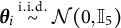 . For each examinee, we administered a
$50$
. For each examinee, we administered a
$50$
 -item test using each of the CAT algorithms. We then compared performance in terms of posterior variance reduction, mean-squared error (MSE), termination efficiency, and item exposure rates based on these
$500$
-item test using each of the CAT algorithms. We then compared performance in terms of posterior variance reduction, mean-squared error (MSE), termination efficiency, and item exposure rates based on these
$500$
 adaptive testing sessions.
For the Q-learning algorithm, we trained the Q-network for 80,000 episodes, with exploration parameter
$\epsilon $
 decreasing linearly from
$0.99$
decreasing linearly from
$0.99$
 to
$0.01$
to
$0.01$
 over 700,000 steps. We set a sufficiently large
$H=60$
over 700,000 steps. We set a sufficiently large
$H=60$
 items, with discount factor
$\gamma =0.95$
items, with discount factor
$\gamma =0.95$
 . To verify that the double Q-learning algorithm indeed converges to the optimal policy
$\pi ^*$
. To verify that the double Q-learning algorithm indeed converges to the optimal policy
$\pi ^*$
 , we provide further details on the training dynamics of our deep Q-learning algorithm, illustrating the increase in rewards until convergence in Appendix F.2 of the Supplementary Material.
6.2 Simulation results
To evaluate termination efficiency, we start with a standard multivariate Gaussian prior with unit marginal variances and terminate the test once the maximum posterior variance across all three target factors in
$\mathcal {K}$
 falls from
$1$
falls from
$1$
 to below
$\tau ^2 < 0.16$
to below
$\tau ^2 < 0.16$
 . In practice, practitioners may select the threshold
$\tau ^2$
. In practice, practitioners may select the threshold
$\tau ^2$
 based on the specific requirements of their application. Based on
$500$
based on the specific requirements of their application. Based on
$500$
 simulated adaptive testing sessions, Figure 3 illustrates how the percentage of completed test sessions increases as more items are administered. A faster growth rate of the completion percentages indicates faster posterior variance reduction. Notably, the purple Q-learning curve consistently rises more quickly than the others, demonstrating significant testing efficiency gains. As summarized in the second column of Table 1, Q-learning requires an average of only
$21.5$
simulated adaptive testing sessions, Figure 3 illustrates how the percentage of completed test sessions increases as more items are administered. A faster growth rate of the completion percentages indicates faster posterior variance reduction. Notably, the purple Q-learning curve consistently rises more quickly than the others, demonstrating significant testing efficiency gains. As summarized in the second column of Table 1, Q-learning requires an average of only
$21.5$
 items to reach the termination criterion for all three targeted factors, outperforming all other methods.
Number of items versus cumulative percentage of completed tests.

Figure 3 Long description
A line graph with the X axis labeled Number of Administered Items ranging from 0 to 50 and the Y axis labeled Cumulative Percentage of Completed Test Sessions ranging from 0.0 to 0.8. Five colored curves represent different methods.
* Q-Learning (purple) shows the steepest asymptotic curve, reaching 0.6 completion at 20 items and nearly 0.9 at 50 items.
* M I (green) and Max Var (pink) follow a similar steep trajectory, slightly below Q-Learning, both converging near 0.9 at 50 items.
* E A P (dark blue) shows a more linear and gradual increase, reaching approximately 0.8 at 50 items.
* Max Pos (orange) is the lowest curve, showing the slowest rate of completion and ending just below 0.8 at 50 items.
All curves remain at zero until approximately 10 items are administered, after which they diverge with varying slopes.
Comparison of win shares (W.S), termination, and computation

Table 1 Long description
The table consists of six columns: Algorithm, Avg termination (items), W.S dim1, W.S dim2, W.S dim3, and Avg time (s/item).
* E A P: 31.7 termination, 17.0% W.S dim1, 16.4% W.S dim2, 13.6% W.S dim3, and 0.037 seconds per item.
* Max Pos: 34.0 termination, 16.8% W.S dim1, 16.2% W.S dim2, 18.6% W.S dim3, and 0.055 seconds per item.
* M I: 23.2 termination, 19.0% W.S dim1, 21.4% W.S dim2, 20.2% W.S dim3, and 0.082 seconds per item.
* Max Var: 25.7 termination, 23.6% W.S dim1, 22.6% W.S dim2, 23.6% W.S dim3, and 0.038 seconds per item.
* Q-learning: 21.5 termination, 23.6% W.S dim1, 23.4% W.S dim2, 24.0% W.S dim3, and 0.064 seconds per item.
Q-learning shows the lowest termination and highest win shares across all dimensions, while E A P has the fastest computation time.
To assess early-stage performance, we compute the MSEs after
$20$
 items for each test session and summarize results using win shares, defined as the percentage of test takers for whom each method achieves the lowest MSE after
$20$
items for each test session and summarize results using win shares, defined as the percentage of test takers for whom each method achieves the lowest MSE after
$20$
 items. These win shares are reported across all three latent dimensions in Table 1. Notably, Q-learning achieves the best win shares across all three factors. This advantage at early stages is consistent with the training objective of Q-learning, which explicitly rewards rapid posterior variance reduction and early test termination, with the average stopping time occurring at around
$20$
items. These win shares are reported across all three latent dimensions in Table 1. Notably, Q-learning achieves the best win shares across all three factors. This advantage at early stages is consistent with the training objective of Q-learning, which explicitly rewards rapid posterior variance reduction and early test termination, with the average stopping time occurring at around
$20$
 items.
Table 2 reports the evolution of MSEs as a function of test length up to
$50$
 administered items. Consistent with the win share analysis, Q-learning exhibits competitive performance during the early stages of testing. In particular, at
$T=20$
administered items. Consistent with the win share analysis, Q-learning exhibits competitive performance during the early stages of testing. In particular, at
$T=20$
 and
$T=30$
and
$T=30$
 , Q-learning attains the smallest MSEs for Factors
$2$
, Q-learning attains the smallest MSEs for Factors
$2$
 and
$3$
and
$3$
 . As the test length increases, performance differences across methods diminish, and Q-learning achieves MSEs comparable to those of MI and Max Var. This pattern is expected, as the Q-learning policy is trained primarily on short-horizon testing trajectories: since most simulated tests terminate before
$30$
. As the test length increases, performance differences across methods diminish, and Q-learning achieves MSEs comparable to those of MI and Max Var. This pattern is expected, as the Q-learning policy is trained primarily on short-horizon testing trajectories: since most simulated tests terminate before
$30$
 items, the algorithm is exposed less frequently to long-horizon simulations during training. Additional visualizations of the MSE trajectories are provided in Appendix F.3 of the Supplementary Material.
MSEs between posterior mean and ground truth for the first three latent factors as a function of test length

Table 2 Long description
The table compares Mean Squared Errors (M S E) for five algorithms: E A P, Max Pos, M I, Max Var, and Q-learning. The columns represent the number of items: 10, 20, 30, 40, and 50. Across all factors and algorithms, M S E generally decreases as the number of items increases.
* Factor 1: M I and Max Var achieve the lowest errors. At 10 items, E A P is 0.175 and Q-learning is 0.221. By 50 items, M I reaches the minimum of 0.050.
* Factor 2: Max Var and Q-learning perform best at lower item counts. At 10 items, Max Var is 0.214. At 50 items, M I is lowest at 0.086.
* Factor 3: M I and Q-learning show the best performance. At 10 items, M I is 0.213. At 50 items, Q-learning and E A P both reach 0.085.
Specific values for Q-learning across Factor 1 are 0.221, 0.096, 0.071, 0.060, and 0.054. For Factor 2, they are 0.282, 0.138, 0.111, 0.096, and 0.087. For Factor 3, they are 0.233, 0.114, 0.098, 0.091, and 0.085.
Figure 4 summarizes the distribution of item exposure rates across the
$150$
 item bank for each CAT algorithm, where the exposure rate of an item is defined as the proportion of examinees whose test includes that item at least once. With test length
$H=50$
item bank for each CAT algorithm, where the exposure rate of an item is defined as the proportion of examinees whose test includes that item at least once. With test length
$H=50$
 and bank size
$J=150$
and bank size
$J=150$
 , the expected average exposure is
$H/J \approx 0.33$
, the expected average exposure is
$H/J \approx 0.33$
 , and all five algorithms yield mean and median exposure rates close to this benchmark. Differences across methods primarily arise in the tails of the exposure distribution. In particular, the EAP and Q-learning policies exhibit slightly higher upper quartile and maximum exposure rates, indicating a more selective use of highly informative items. Importantly, no method concentrates exposure excessively on a small subset of items, suggesting that all algorithms maintain reasonable item utilization in this simulation setting. For the Q-learning approach, incorporating explicit exposure control mechanisms into the learning objective, such as penalizing repeated use of highly exposed items, is a natural extension but is beyond the scope of the present study.
Distributions of item exposure rates.

Figure 4 Long description
The horizontal x-axis represents the Item exposure rate in percent, ranging from 0 to 100. A vertical dashed grey line, labeled average exposure in the legend, marks a baseline at approximately 33 percent. Five methods are listed on the y-axis from top to bottom.
* E A P: A dark blue box spanning from 7 to 55 percent with a median at 36 percent. Whiskers extend from 0 to 100 percent.
* Max Pos: A light blue box spanning from 19 to 45 percent with a median at 33 percent. Whiskers extend from 0 to 82 percent, with an outlier at 100 percent.
* M I: A dark red box spanning from 19 to 45 percent with a median at 35 percent. Whiskers extend from 0 to 70 percent, with an outlier at 100 percent.
* Max Var: A light orange box spanning from 26 to 40 percent with a median at 32 percent. This plot shows high outlier density near 0 and 60 percent, with individual outliers at 78 and 100 percent.
* Q-Learning: A pale yellow box spanning from 8 to 54 percent with a median at 31 percent. Whiskers extend from 0 to 100 percent.
The last column of Table 1 reports the average online item-selection time, highlighting the significant computational advantages of our direct sampling approach. Even the most computationally intensive MI approach requires only
$0.082$
 seconds per item selection, via our proposed posterior reweighting strategy. Q-learning adds only a single feed-forward pass per selection, keeping online latency under a few milliseconds on standard hardware without GPU acceleration. While training the Q-network offline using Algorithm 1 took approximately
$30$
seconds per item selection, via our proposed posterior reweighting strategy. Q-learning adds only a single feed-forward pass per selection, keeping online latency under a few milliseconds on standard hardware without GPU acceleration. While training the Q-network offline using Algorithm 1 took approximately
$30$
 hours for this exercise, this is a one-time investment that can be accelerated if GPUs are available; thereafter, the virtually instantaneous online policy makes the approach highly practical for real-time CAT deployment.
7 Cognitive function measurements
7.1 pCAT-COG data and experiment design
We revisit the problem of designing a deep CAT system for the pCAT-COG study, as outlined in Section 2. Since item response data for all
$N = 730$
 examinees across
$J = 57$
examinees across
$J = 57$
 items are available, we can directly use real item responses during evaluation rather than simulating testing sessions. In this experiment, all
$N=730$
items are available, we can directly use real item responses during evaluation rather than simulating testing sessions. In this experiment, all
$N=730$
 examinees are treated as online examinees. All CAT algorithms, including Q-learning, have access only to the estimated item parameters from the pCAT-COG study and do not observe the examinees’ binary item responses beyond those revealed sequentially during adaptive administration.
Given that pCAT-COG is designed to measure global cognitive ability (first column in Figure 1) while accounting for five cognitive subdomains, we specified the Q-learning reward function to reduce posterior variance for the primary factor (
$\mathcal {K} = \{1\}$
 ). This demonstrates the flexibility of our CAT system, as it can be tailored to the specific cognitive assessment needs. As in Section 6, we also modified all baseline CAT algorithms so that they also target only the primary factor by integrating only over the primary dimension for fair comparison.
Finally, this real-data experiment also serves as a robustness check for the proposed Q-learning approach. As described in Algorithm 1, the policy is trained using simulated examinees with latent factors drawn from a standard multivariate normal distribution. In contrast, the empirical factor correlations in pCAT-COG need not follow this distributional assumption. Evaluating Q-learning on real response data therefore provides evidence that the learned policy remains effective when the latent factor structure deviates from the training distribution used in simulation.
7.2 Results
The left subplot of Figure 5 shows that Q-learning again achieves the fastest test termination compared to other methods. As before, the test is dynamically terminated when the posterior variance drops from
$1$
 to below
$ \tau ^2 = 0.16 $
to below
$ \tau ^2 = 0.16 $
 , and the cumulative percentage of completed test sessions is computed over all
$730$
, and the cumulative percentage of completed test sessions is computed over all
$730$
 examinees. The second column of Table 3 shows that Q-learning reaches the desired posterior variance reduction threshold after only an average of
$11.2$
examinees. The second column of Table 3 shows that Q-learning reaches the desired posterior variance reduction threshold after only an average of
$11.2$
 items.
pCAT-COG: Primary factor posterior variance reduction (left) and estimation accuracy (right).

Figure 5 Long description
Two line graphs labeled a and b. Both share a legend containing five methods: E A P, Max Pos, M I, Max Var, and Q-learning.
Panel a, titled Number of Items vs. Cumulative Percentage of Completed Test Sessions, has an x-axis for Number of Administered Items from 0 to 50 and a y-axis for Cumulative Percentage of Completed Test Sessions from 0.0 to 1.0. All curves start at 0 and follow an S-shaped asymptotic increase toward 1.0. Q-learning and Max Var show the steepest initial ascent, reaching 0.8 completion by approximately 12 items. E A P and M I follow, while Max Pos is the slowest, requiring nearly 30 items to reach the 0.8 threshold.
Panel b, titled M S E Between Posterior Mean and Oracle Mean in Primary Dimension, has an x-axis for Number of Administered Items from 0 to 50 and a y-axis for M S E from 0.0 to 0.6. All curves show a decaying trend. Q-learning and Max Var exhibit the fastest initial drop in error, falling below 0.1 M S E by 15 items. Max Pos shows the highest sustained error, remaining above 0.1 M S E until approximately 25 items. By 50 items, all methods converge near zero error.
Comparison of termination efficiency, primary-factor accuracy, and computation for pCAT-COG

Table 3 Long description
The table consists of five columns: Algorithm, Average termination in items, Correlation, Win shares, and Average time in seconds per item.
* E A P: 15.1 items, 0.956 correlation, 17.7% win shares, 0.020 seconds per item.
* Max Pos: 18.5 items, 0.933 correlation, 16.7% win shares, 0.030 seconds per item.
* M I: 12.6 items, 0.959 correlation, 21.8% win shares, 0.038 seconds per item.
* Max Var: 13.0 items, 0.951 correlation, 20.9% win shares, 0.021 seconds per item.
* Q-learning: 11.2 items, 0.959 correlation, 22.9% win shares, 0.025 seconds per item.
Q-learning shows the best performance in termination efficiency, correlation, and win shares, while E A P is the fastest.
Note: Primary factor correlation and win shares (W.S) are computed after 20 administered items. Win shares denote the proportion of examinees for whom a method attains the smallest mean-squared error for the primary factor at this stage.
For further comparison, we consider adaptively selecting
$20$
 items for each test taker without dynamic termination. We chose the number
$20$
items for each test taker without dynamic termination. We chose the number
$20$
 because the Max Pos approach required the largest average of
$19.8$
because the Max Pos approach required the largest average of
$19.8$
 items for termination. The third column of Table 3 shows that the Q-learning approach achieves the highest
$0.959$
items for termination. The third column of Table 3 shows that the Q-learning approach achieves the highest
$0.959$
 correlation between the estimated primary factor posterior means and the ground truth after only
$20$
correlation between the estimated primary factor posterior means and the ground truth after only
$20$
 items. Additionally, the Q-learning approach attains the highest win shares in estimating the primary dimension across all
$ N = 730 $
items. Additionally, the Q-learning approach attains the highest win shares in estimating the primary dimension across all
$ N = 730 $
 examinees after
$20$
examinees after
$20$
 items. As defined in Section 6, win shares denote the proportion of examinees for whom a CAT method attains the smallest MSE. Since all
$57$
items. As defined in Section 6, win shares denote the proportion of examinees for whom a CAT method attains the smallest MSE. Since all
$57$
 items are ultimately administered in the real-data study, exposure rates are degenerate under full-length testing. We therefore report item exposure patterns based on the first
$30$
items are ultimately administered in the real-data study, exposure rates are degenerate under full-length testing. We therefore report item exposure patterns based on the first
$30$
 administered items in Appendix G.1 of the Supplementary Material.
Additionally, the right subplot of Figure 5 highlights the rapid decay of MSE in estimating the primary dimension with Q-learning. As summarized in Table 4, Q-learning achieves the smallest MSE at the early stages when
$T=10$
 and
$T=20$
and
$T=20$
 . At longer horizons when
$T=30$
. At longer horizons when
$T=30$
 and
$T=40$
and
$T=40$
 , the gains in MSE for the Q-learning approach diminish. This behavior is consistent with the simulation findings in Section 6 and reflects the reward specification used for Q-learning, which emphasizes rapid early-stage variance reduction. Because most simulated training trajectories generated in Algorithm 1 terminate well before 20 items, such performance behavior for Q-learning is expected.
Mean-squared errors (MSEs) as a function of test length

Table 4 Long description
The table compares the M S E of five algorithms: E A P, Max Pos, M I, Max Var, and Q-learning across test lengths of 10, 20, 30, and 40 items.
* E A P: 0.183 at 10 items, 0.079 at 20 items, 0.029 at 30 items, and 0.010 at 40 items.
* Max Pos: 0.217 at 10 items, 0.113 at 20 items, 0.067 at 30 items, and 0.016 at 40 items.
* M I: 0.165 at 10 items, 0.070 at 20 items, 0.032 at 30 items, and 0.014 at 40 items.
* Max Var: 0.165 at 10 items, 0.085 at 20 items, 0.038 at 30 items, and 0.014 at 40 items.
* Q-learning: 0.123 at 10 items, 0.072 at 20 items, 0.038 at 30 items, and 0.016 at 40 items.
Bolded values indicating the lowest error for each test length are: Q-learning at 10 items (0.123), M I at 20 items (0.070), and E A P at 30 items (0.029) and 40 items (0.010).
This experiment highlights the effectiveness of our Q-learning approach in high-dimensional cognitive function measurement. Unlike approaches that learn a fixed test design offline (Krantsevich et al., Reference Krantsevich, Hahn, Zheng and Katz2023), our framework enables fully dynamic item selection, maximizing the utilization of the item bank by exploring diverse testing trajectories. This termination efficiency is particularly valuable in cognitive assessment, where item development is costly, and can help mitigate practice effects and preserve items for future use.
8 Discussion
This work advocates for a deep RL perspective in the design of MCAT systems. We make two key contributions to the existing CAT literature: (1) a computational advancement that accelerates existing online item-selection rules within a flexible Bayesian MIRT framework and (2) a novel RL-based approach that mitigates myopic decision-making and prioritizes the assessment of primary factors of interest.
Theorem 4.1 not only provides an efficient parameterization of the latent factor posterior distributions for our proposed deep Q-learning approach, but also improves existing CAT item-selection algorithms, as detailed in Section 4. Leveraging direct sampling from unified skew-normal distributions, our methodology scales efficiently with a large number of factors and items, achieving near-instantaneous online selection by circumventing MCMC sampling and data augmentation. Additionally, our approach naturally extends to fully Bayesian item selection by accounting for uncertainties in item parameters, which is an essential consideration when the item bank is not well-calibrated as detailed in Appendix C of the Supplementary Material. Throughout the testing trajectory, our approach precisely characterizes the evolution of posterior distributions at each time step, providing a more robust measurement process beyond point estimates with difficult-to-compute standard errors.
Another key contribution of this work is the development of a robust deep double Q-learning algorithm with a customized reward structure that directly minimizes test length. As demonstrated in both simulations and real-data studies, our Q-learning algorithm consistently achieves the fastest posterior variance reduction while rapidly decreasing estimation bias. Moreover, its flexible reward function allows adaptation to different testing objectives, providing a principled framework for designing customized tests and overcoming the myopic nature of traditional CAT methods.
Our work also offers practical guidance for selecting the appropriate item-selection algorithms. Unlike the existing heuristic rules, one limitation of our deep CAT system is the requirement of offline training (Algorithm 1) before online deployment. For the pCAT-COG study, offline training took approximately
$12$
 hours on a single GPU as a one-time investment, but no GPU is needed for subsequent online item selection. Even when offline training is undesirable, our framework significantly accelerates existing methods. Experiments show that MI (Equation (3.5)) and our Max Var (Equation (3.6)) approaches often outperform other online item-selection rules, echoing the findings presented in Wang and Chang (Reference Wang and Chang2011).
A promising direction for future work is to address several limitations of the current Q-learning framework for CAT. First, the learned policy is tied to a specific item bank and must be retrained when the items are substantially modified or replenished, which may limit its immediate applicability in settings with frequent item updates. Second, as a model-free approach, Q-learning can be computationally expensive to train, particularly for long-horizon testing scenarios in which optimal policies depend on extended future trajectories. In addition, although the proposed approach does not rely on tabular exploration of the full state space and instead uses function approximation based on a compact posterior representation, scalability remains an important practical consideration as the state space grows exponentially. Our simulation results suggest that the method works well for moderate 150-item banks, but additional methodological development may be useful for extending the approach to substantially larger banks. Finally, while the proposed method yields reasonable item exposure patterns in our experiments, additional work is needed to incorporate explicit exposure control mechanisms directly into the learning objective.
Another exciting avenue is to explore alternative reward structures for our Q-learning algorithm. While the 0–1 reward structure is interpretable and stabilizes Q-network training, it provides sparse feedback, which may limit empirical performance. It is also important to understand when RL truly improves on myopic rules, since Chan and Farias (Reference Chan and Farias2009) showed that greedy policies can be near-optimal in some dynamic stochastic optimization problems. This requires careful assumptions about the reward function and the item bank properties, providing deeper insights into the trade-offs between RL and traditional item-selection strategies.
Supplementary material
The supplementary material for this article can be found at https://doi.org/10.1017/psy.2026.10106.
Data availability statement
The data and code that support the findings of this study are publicly available at the GitHub repository: https://github.com/JiguangLi/deep_CAT/tree/deep_cat.
Funding statement
R.G. acknowledges support from the National Institute on Aging (NIA) under Grant R56 AG084070-01, titled Adaptive Testing of Cognitive Function based on Multi-Dimensional Item Response Theory (2023–2025; R.G. – PI). V.R. acknowledges support from the National Science Foundation (NSF-DMS 1944740).
Competing interests
Dr. Gibbons founded the company Adaptive Testing Technologies that distributes traditional MIRT-based CATs for which competing interests are managed by the University of Chicago. The remaining authors declare none.
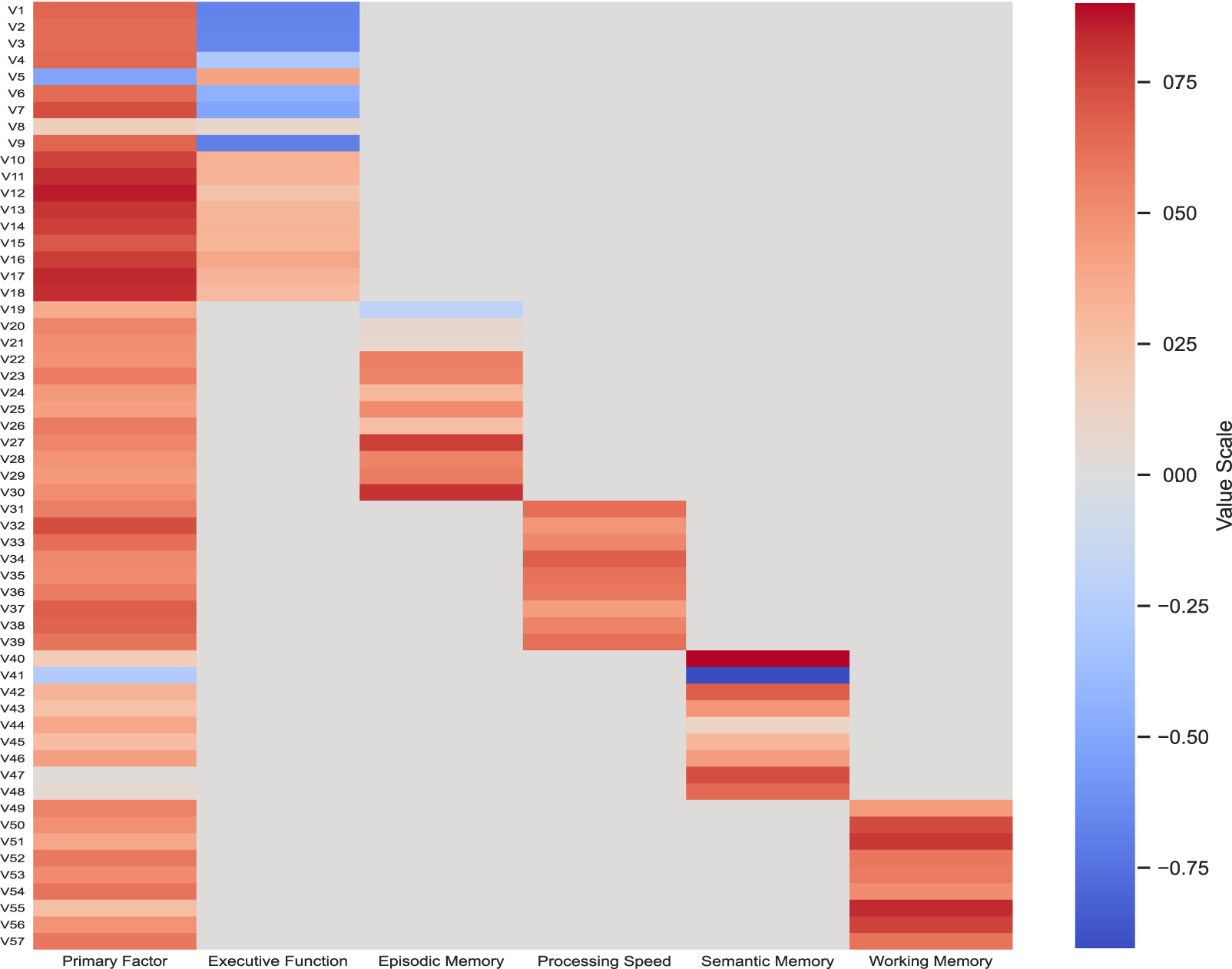
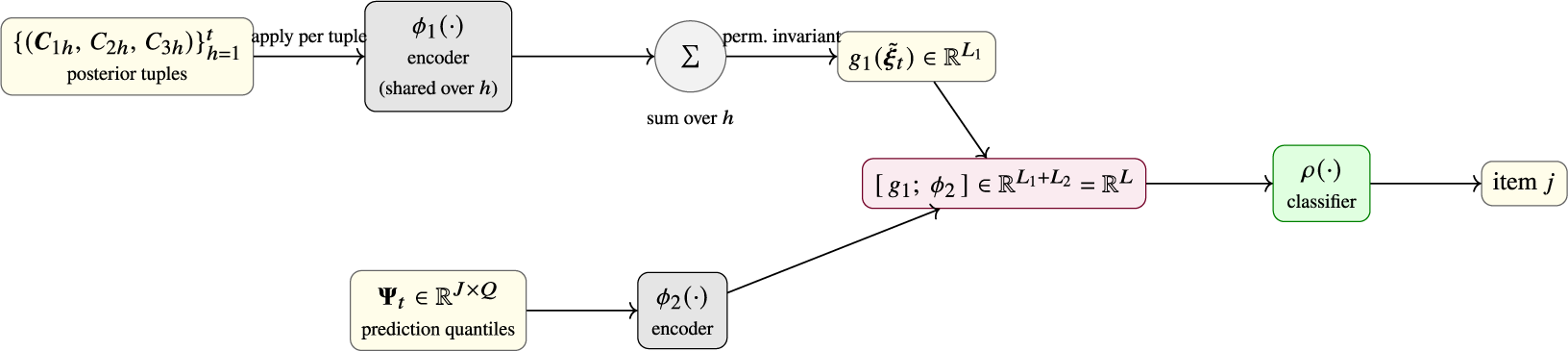


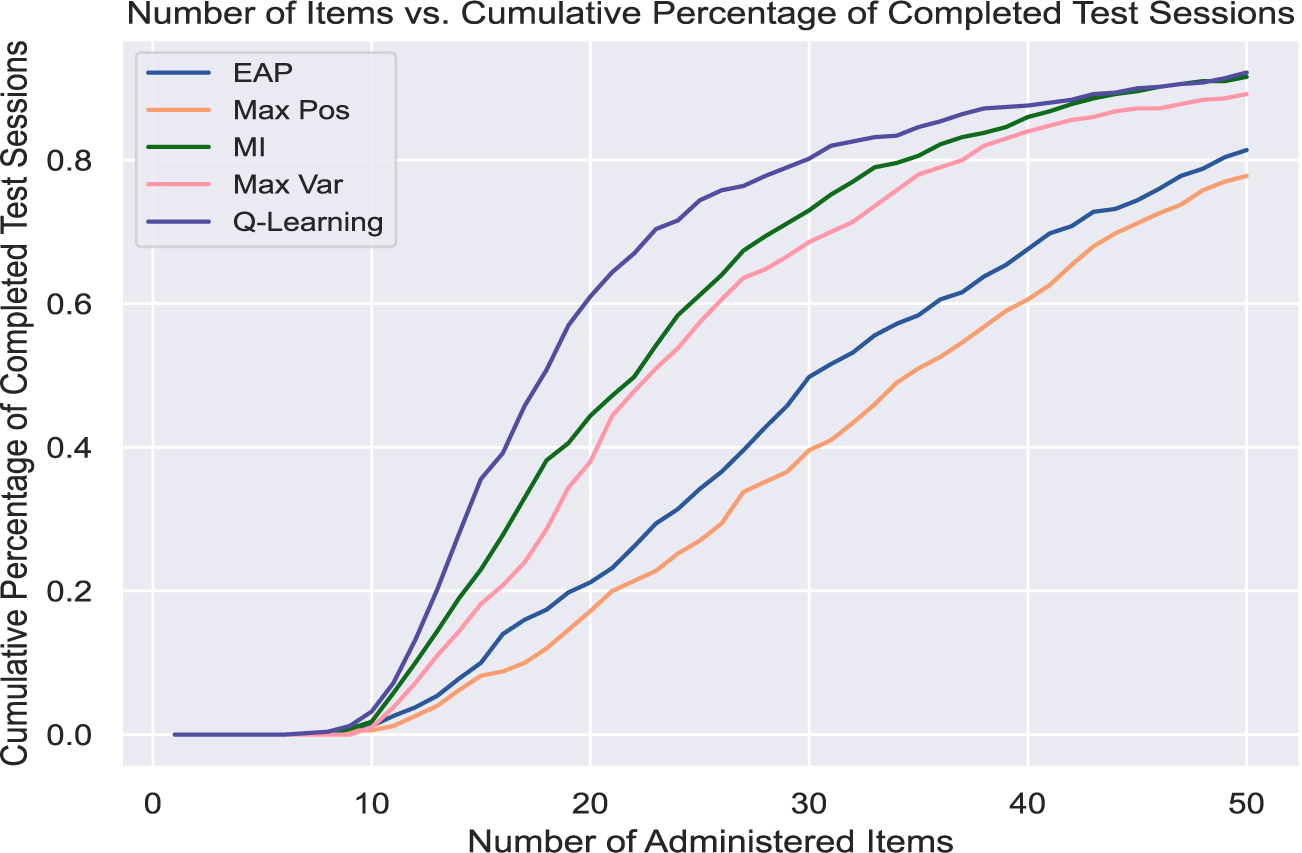
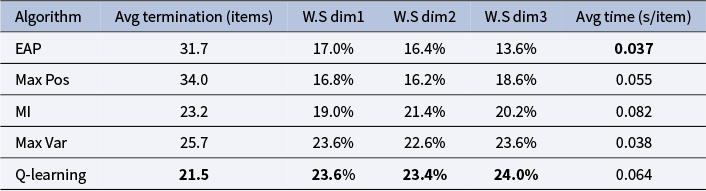
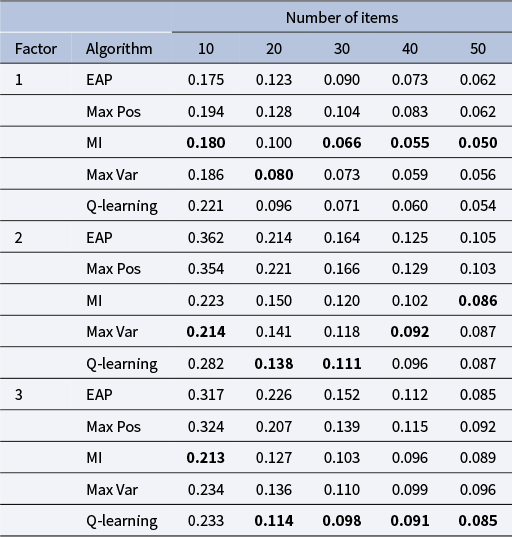
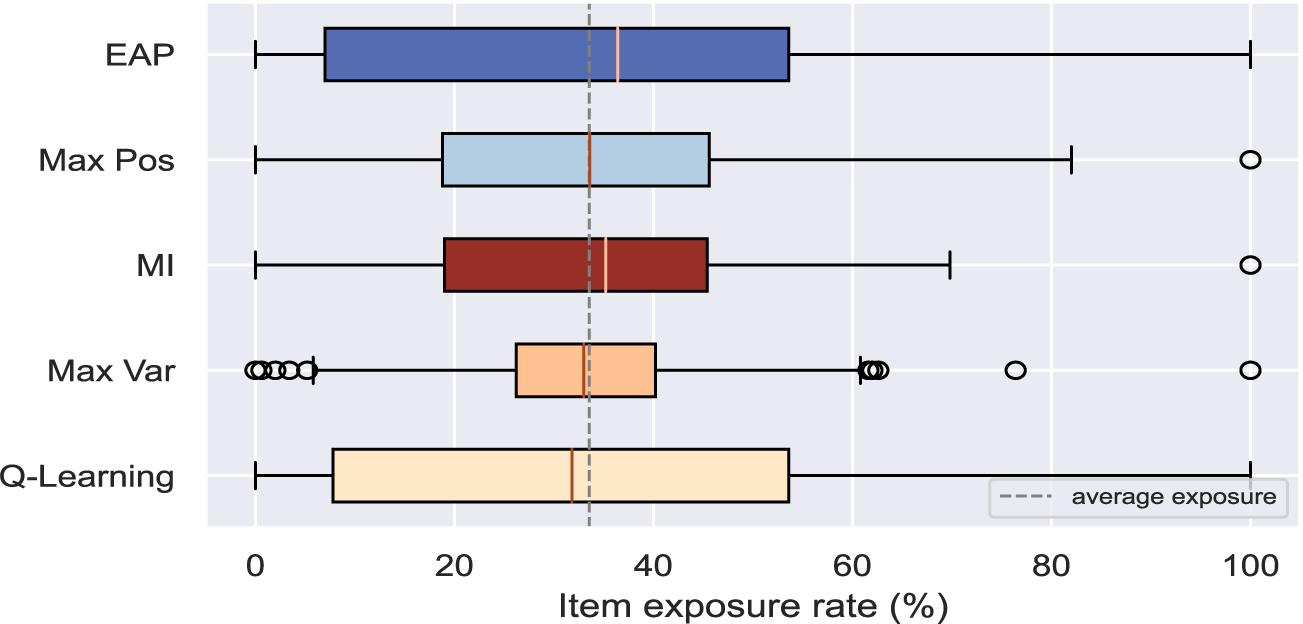
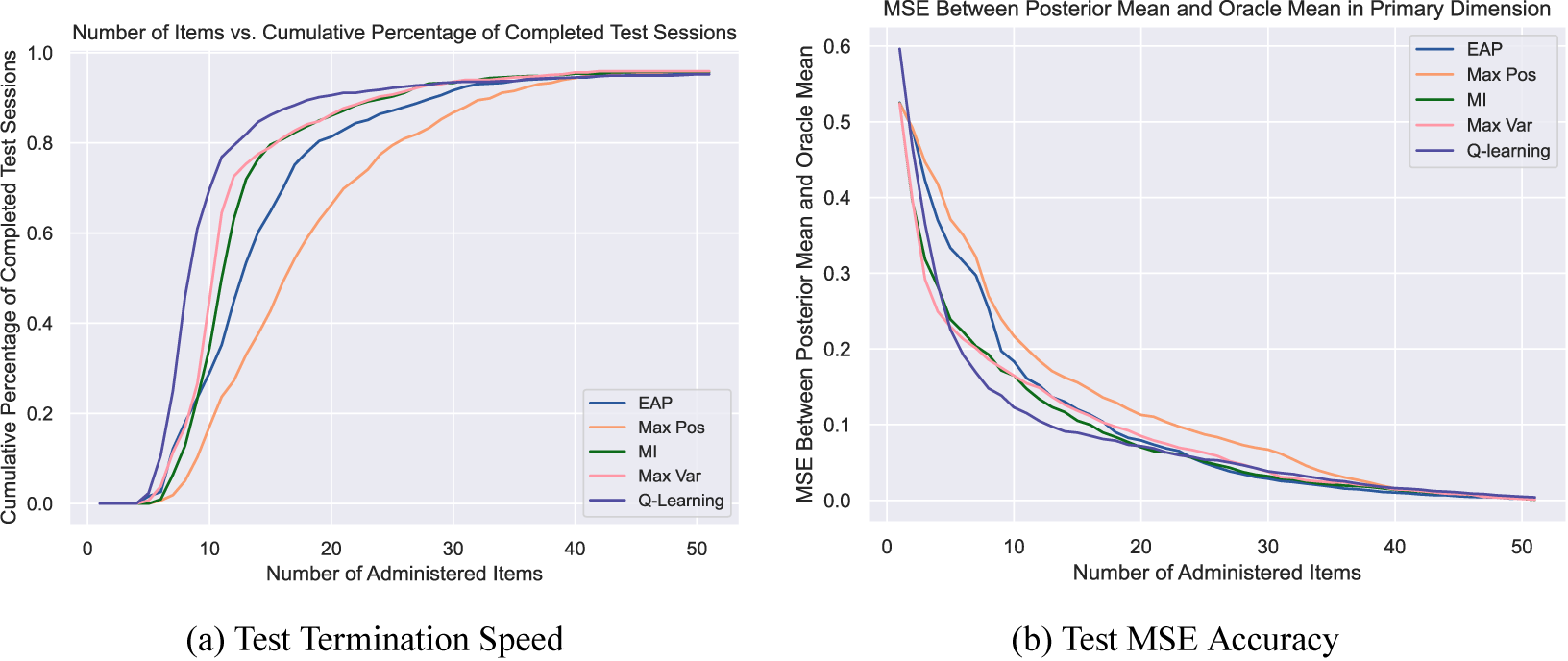
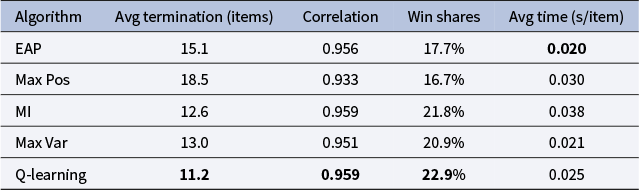
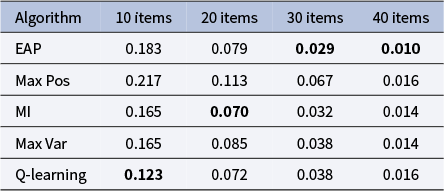


 Open access

