


Introduction
Support for populist parties in numerous European democracies has increased dramatically during the last few decades. Such parties have not only obtained representation in the national parliaments of most European countries but have also gained considerable influence over policy making (Röth, Afonso and Spies, Reference Röth, Afonso and Spies2018). Rising support for populist parties is widely viewed as one of the major internal threats to the legitimacy of liberal representative democracy in the western world (Norris and Inglehart, Reference Norris and Inglehart2019). As such, it is important to identify the factors that are associated with populist support.
This has been indeed the focus of numerous studies in recent decades (for an overview of the literature on explanations of the electoral success or failure of populist parties, see Arzheimer, Reference Arzheimer and Rydgren2018; Mols and Jetten, Reference Mols and Jetten2020; Mudde, Reference Mudde2007). However, despite the increasing attention devoted to the causes of the populist breakthrough in the literature, there are some aspects that remain largely unexplored. Among them, there have been few attempts to investigate whether and how decentralization affects the electoral performance of populist parties (Müller-Rommel, Reference Müller-Rommel1998; Arzheimer and Carter, Reference Arzheimer and Carter2006; Hakhverdian and Koop, Reference Hakhverdian and Koop2007; Mudde, Reference Mudde2007; Arzheimer, Reference Arzheimer2009).
This research gap is particularly surprising considering that this is the ‘golden era of decentralization’ (Siegle and O’Mahony, Reference Siegle, O’Mahony, Connerley and Smoke2010). The transfer of responsibilities from the central government to subnational authorities has been a prevalent trend in Europe over the past few decades (Hooghe, Marks and Schakel, Reference Hooghe, Marks and Schakel2010). One of the most notable consequences of the decentralization process has been the widespread introduction of regional elections (Dandoy and Schakel, Reference Dandoy and Schakel2013). Given that regional governments have gained influence over decision-making in several policy domains, regional elections have not only grown considerably in number, but also in importance: there is much more ‘at stake’ in these elections than even before (Schakel and Jeffery, Reference Schakel and Jeffery2013). One could expect populist parties, which massively claim to be close to ‘the people’, to be especially likely to begin participating in elections at local and regional levels, which, by definition, are the tiers of government closest to the citizens.
In fact, populist parties often secure subnational parliamentary representation before expanding to the national arena (Heinze, Reference Heinze and Weisskircher2023). For instance, the far-right Alternative for Germany (AfD) became the third-largest party in the Bundestag in 2017 only after gaining seats in 13 of Germany’s 16 state parliaments (Heinze, Reference Heinze2022). Similarly, Vox made its breakthrough on the Spanish political scene in the Andalusian regional elections of December 2018 before entering the national parliament (Mendes and Dennison, Reference Mendes and Dennison2021). In Austria, the regional branches of the Freedom Party (FPÖ) in Carinthia and Vienna were the ‘political incubator’ of two of the party’s most influential national leaders (Heinisch and Marent, Reference Heinisch and Marent2018). Meanwhile, in Belgium and Italy, two prominent populist parties, Flemish Interest and the Northern League, are – or were originally – regionalist parties. Even in centralized France, the National Rally (formerly National Front) built its political base through local and regional elections in the 1980s and 1990s before making significant gains at the national level (Kestilä and Söderlund, Reference Kestilä and Söderlund2007; Paxton and Peace, Reference Paxton and Peace2021; Peace and Paxton, Reference Peace and Paxton2024).
While these cases suggest that regional breakthroughs can pave the way for populist parties to enter the national arena, the literature remains divided on this issue. Some scholars suggest that the regional level is crucial for the national expansion of some of these populist parties (Vampa, Reference Vampa2020; Mendes and Dennison, Reference Mendes and Dennison2021; Heinze, Reference Heinze2022; Arzheimer, Reference Arzheimer and Weisskircher2023). Others, however, argue that decentralization and subnational representation may actually hinder their national success (Arzheimer and Carter, Reference Arzheimer and Carter2006; Mudde, Reference Mudde2007; Alonso and Rovira Kaltwasser, Reference Alonso and Rovira Kaltwasser2015; Ivaldi and Dutozia, Reference Ivaldi and Dutozia2018). This debate raises an important question: How does decentralization and subnational representation really impact the national electoral fortunes of populist parties?
This article aims to answer this question by presenting a theoretical and empirical account of how decentralization influences the electoral performance of populist parties in national elections. After reviewing the relevant literature, this paper assesses competing hypotheses regarding the effect of decentralization on the national success of populist parties. The central thesis of this article is that rather than a direct effect, decentralization has an indirect influence on populist parties’ national election results through (1) the establishment of regional elections and subnational parliaments and (2) the prominence of territorial cleavages. Results suggest that while regional representation significantly boost populist parties’ national vote share, this effect is contingent on the level of regional authority. Specifically, populist parties seem to benefit from subnational representation primarily in more centralized countries.
The empirical analysis is based on a dataset that encompasses national election results in 30 European countries between 1956 and 2018, and relies on one of the most fine-grained measurements of the degree of decentralization: the Regional Authority Index (Hooghe, Marks and Schakel Reference Hooghe, Marks and Schakel2010). While much of the literature on populist parties is dominated by single case studies or has focused on the emergence and electoral performance of populist parties in a small number of countries, mainly of Western Europe, this paper adopts a broad pan-European perspective by including in the analysis Western, Southern, Northern, Central and Eastern European countries. This paper has also a broad scope in the selection of parties to be analyzed and includes populist parties from all sides of the ideological spectrum.
In a broader perspective, there are two important areas where this paper makes a significant contribution. First, it provides new insights into the long-term institutional factors influencing the electoral success of populist parties by shedding light on a question that is currently rather underdeveloped: the effect of decentralization (Arzheimer and Carter, Reference Arzheimer and Carter2006; Mudde, Reference Mudde2007). Second, it adds to two growing streams of research that examine the unintended effects of subnational elections on national politics (Dinas and Foos, Reference Dinas and Foos2017) and the link between party-populist mobilization and ethno-territorial cleavages (Heinisch, Massetti and Mazzoleni, Reference Heinisch, Massetti and Mazzoleni2018).
The remaining part of this paper proceeds as follows. The next section gives a brief overview of previous research on the determinants of the electoral success of populist parties and reviews the relatively scarce existing empirical evidence about the effect of decentralization. Sections 3 and 4 present the theoretical argument of this paper, elaborating on when populist parties may benefit (or not) from decentralization. Cases and methods are introduced in Section 5. Section 6 presents the results of the empirical analysis. The final section concludes and suggests some directions for future research.
Previous research on populist parties and decentralization
Explaining the causes of the emergence and electoral success of populist parties in Europe has been the focus of much scholarly attention since the 1990s. The literature has often appealed to economic and cultural grievance-based explanations by focusing on the long-term structural factors that have fuelled the emergence of these parties, such as the deep social, economic and cultural transformations brought by the post-industrialization process (Kriesi et al., Reference Kriesi, Grande, Lachat, Dolezal, Bornschier and Frey2006). Yet, while these explanations are useful to understand why populist parties emerged at a specific time, they often fail to account for the differences in their electoral success between countries and also among individuals (Rydgren, Reference Rydgren2005).
To explain both individual and/or country-level variation on the electoral performance of populist parties, previous research has considered a wide range of factors. First, it has been well established that some people, depending on their socio-demographic characteristics, are more likely to vote for these parties. Support for populist parties in Europe is mainly drawn from men (Dingler, Lefkofridi and Marent, Reference Dingler, Lefkofridi, Marent, Heinisch, Holtz-Bacha and Mazzoleni2021), less-educated voters (Ivarsflaten and Stubager, Reference Ivarsflaten and Stubager2012) and the working class (Guth and Nelsen, Reference Guth and Nelsen2021). Second, contextual factors have also been shown to affect the electoral strength of populist parties. Aggregate-level studies have demonstrated that higher rates of immigration and unemployment are associated with rising support for populist parties, especially when both elements are combined (Golder, Reference Golder2003; Arzheimer, Reference Arzheimer2009). Third, past studies have emphasized the role of the political setting and institutional factors since they constitute the ‘political opportunity structure’ that facilitates or hinders the emergence and success of populist parties (Arzheimer and Carter, Reference Arzheimer and Carter2006). One of the common institutional predictors of the electoral performance of populist parties is the type of electoral system. Proportional representation, which generally facilitates the emergence of new parties, benefits populist parties (Becher, Menéndez González and Stegmueller, Reference Becher, Menéndez González and Stegmueller2023). Another institutional characteristic of the political system that has been identified as relevant in explaining the success of populist parties is decentralization (Müller-Rommel, Reference Müller-Rommel1998; Arzheimer and Carter, Reference Arzheimer and Carter2006; Hakhverdian and Koop, Reference Hakhverdian and Koop2007; Mudde, Reference Mudde2007; Arzheimer, Reference Arzheimer2009).
The transfer of power from central to sub-national authorities is one of the most widespread contemporary trends in governance around the world (Faguet, Reference Faguet2014). Consequently, a substantial body of literature has examined the impact of decentralization and the state structure, such as unitary versus federal systems, on various policy outcomes (Triesman, Reference Triesman2007). However, while previous research has indicated the potential influence of decentralization on the electoral success or failure of populist parties (Müller-Rommel, Reference Müller-Rommel1998; Arzheimer and Carter, Reference Arzheimer and Carter2006; Hakhverdian and Koop, Reference Hakhverdian and Koop2007; Mudde, Reference Mudde2007; Arzheimer, Reference Arzheimer2009), this topic has not received adequate research attention. Those few studies that have empirically investigated the relationship between decentralization and vote for populist parties have yielded inconsistent results.
Studies conducted in Asia, Latin America and the Caribbean have shown that decentralization is a robust predictor of the vote share for populist parties, particularly in patronage democracies (Kenny, Reference Kenny2017). Conversely, research in Europe presents a mixed picture: some studies indicate that support for populist parties tends to be higher in federal and decentralized countries compared to unitary states (Müller-Rommel, Reference Müller-Rommel1998; Hakhverdian and Koop, Reference Hakhverdian and Koop2007). However, other scholars suggest that rather than benefiting populist parties, decentralization may prevent their success (Arzheimer and Carter, Reference Arzheimer and Carter2006; Mudde, Reference Mudde2007; Arzheimer, Reference Arzheimer2009).
Case studies exploring the relationship between decentralization and the electoral support for populist parties within specific countries have similarly yielded inconclusive findings. In France, the National Rally has garnered voter support by historically maintaining a critical stance on decentralization, opposing regional autonomy, and strongly defending national unity and centralism (Graff, Reference Graff2015). Some scholars argue that regional elections and local government strategies have been crucial to the national success of the National Rally (Kestilä and Söderlund, Reference Kestilä and Söderlund2007; Paxton and Peace, Reference Paxton and Peace2021; Peace and Paxton, Reference Peace and Paxton2024). However, others suggest that the party’s strategy of ‘territorialization’ has actually hindered its national electoral prospects (Ivaldi and Dutozia, Reference Ivaldi and Dutozia2018). In Spain, the high degree of decentralization and, more specifically, the presence of a strong centre-periphery cleavage has been seen as a key factor in explaining both the absence of successful populist parties (Alonso and Rovira Kaltwasser, Reference Alonso and Rovira Kaltwasser2015) and their sudden rise (Vampa, Reference Vampa2020).
Given the limited and contradictory findings of previous studies, a systematic understanding of how decentralization impacts the electoral performance of populist parties is still lacking. Indeed, researchers have not treated the relation between decentralization and the performance of populist parties in much detail. The next section closely examines the potential effect of decentralization on the national success of populist parties and develops detailed and reasonable theoretical expectations.
Why decentralization may (especially) impact populist parties’ election results
Decentralization may affect the electoral performance of different types of parties, not only populist parties. For instance, previous research has shown that decentralization increases the strength of non state-wide parties in national elections (Brancati, Reference Brancati2008). Governing parties of all stripes also tend to benefit electorally from decentralization reforms (Meguid, Reference Meguid2015). In general, decentralization encourages the emergence of new parties because the establishment of elections for subnational governments provides new points of access to the political competition with lower barriers to entry (Chandler and Chandler, Reference Chandler and Chandler1987). New political contenders may benefit from a good electoral performance in elections at the subnational level in at least two ways. First, they can receive media attention that translates into ‘national publicity’ (Müller-Rommel, Reference Müller-Rommel1998). Second, they can gain representation in subnational parliaments, which gives them access to both economic and human resources, that is, money and party members (Dinas and Foos, Reference Dinas and Foos2017). In addition, voters would be more likely to support a party if ‘that party has a good track record in local or regional elections’ (Willey, Reference Willey1998, p. 660).
This enhanced visibility and additional organizational resources derived from successful participation in elections at the subnational level can provide a political advantage in subsequent national elections to all kinds of political parties. Why should decentralization and subnational elections be more relevant for populist parties than for other types of challengers? There are at least three reasons to consider that decentralization might be especially influential for the success of populist parties.
First, political competition in decentralized countries tend to be structured not only along the ideological left-right divide, but also along the territorial centre-periphery dimension (Elias, Szöcsik and Zuber, Reference Elias, Szöcsik and Zuber2015). Populist parties, whose success depend almost exclusively on their ability to mobilize latent resentments (Betz, Reference Betz1993), may exploit politically the territorial conflicts that are ‘at the heart’ of the centre-periphery cleavage. This is clearly the case in countries such as Italy or Belgium, where non state-wide parties have successfully combined pro-periphery demands with right-wing populism. The Northern League and Flemish Interest were originally created to defend the peripheral national identity of specific areas within their respective countries, namely Northern Italy and Flanders. Both parties successfully exploit widespread resentments against southerners and Walloons, respectively, and against the transfer of resources from the productive and wealthier north to the much less developed south (Betz, Reference Betz1993). At the opposite end of the centre-periphery dimension, the mobilisation of territorial resentments is also fundamental to explain the rise of some state-wide populist parties. The electoral success of Vox, for example, is primarily linked to the Catalan conflict, as the party has effectively exploited people’s concern over Spain’s national unity. While other factors such as the party’s ability to avoid the stigma of extremism have also contributed to its rise (Mendes and Dennison, Reference Mendes and Dennison2021), it is Vox’s positioning on the highly salient centre-periphery cleavage that stands out as the key factor in explaining support for Vox (Turnbull-Dugarte, Rama and Santana, Reference Turnbull-Dugarte, Rama and Santana2020; Vampa, Reference Vampa2020; Mendes and Dennison, Reference Mendes and Dennison2021). In fact, despite its broader nativist rhetoric, immigration occupies only 0.7 per cent of Vox’s manifesto for the 2019 Spanish regional elections, while anti-secessionist messages account for 16.1 per cent.Footnote 1
A second reason to consider that decentralization may especially affect populist parties is the fact that these parties are the main beneficiaries of localist sentiments (Fitzgerald, Reference Fitzgerald2018; Arzheimer and Bernemann, Reference Arzheimer and Bernemann2024). Traditionally, decentralization has been considered one of the best mechanisms to reduce conflict in ethnically diverse countries. However, a growing body of research suggests that political decentralization accentuates ethnic divisions and reinforces local and territorial identities (Brancati, Reference Brancati2006). Recent evidence suggests that there is a ‘pervasive and systematic role of ethno-territorial identity for explaining support for populist parties’ (Heinisch and Jansesberger, Reference Heinisch and Jansesberger2023). In her groundbreaking book, Fitzgerald (Reference Fitzgerald2018) develops a localist theory of populist support. According to Fitzgerald ‘local attachments underpin and motivate radical right support’ (Fitzgerald Reference Fitzgerald2018: 10). People that feel tied to their local communities would be more likely to support right-wing populist parties. The effect of territorial identity on populist support is not unique to the radical right. Previous research suggest that populist demand tends to be higher in regions where citizens have stronger territorial identities (Van Hauwaert, Schimpf and Dandoy, Reference Van Hauwaert, Schimpf and Dandoy2019).
Third, previous research has shown that populist parties tend to benefit more from bandwagon effects in second-order elections than other challenger parties (Schulte-Cloos, Reference Schulte-Cloos2018). Specifically, Schulte-Cloos demonstrates that good results of radical right-wing populist parties in elections to the European Parliament significantly contribute toward their success in subsequent national elections, especially when both elections are close in time. This is not the case for other challengers like green parties whose success in European elections does not translate into domestic gains. The vote share for populist parties in elections at the national level also increases with the proximity of local elections (Fitzgerald, Reference Fitzgerald2018). Political decentralization through the establishment or the rising importance of regional arenas of political competition may contribute to the emergence of further spillover effects that could affect the electoral performance of populist parties in national elections.
The (indirect) effect of decentralization on populist parties’ election results
As noted by Mudde (Reference Mudde2007), there is no agreement on whether decentralization has a positive or negative effect on the electoral performance of populist parties.
Some studies suggest that decentralization promotes the success of populist parties (Müller-Rommel, Reference Müller-Rommel1998; Arzheimer and Carter, Reference Arzheimer and Carter2006; Hakhverdian and Koop, Reference Hakhverdian and Koop2007). The most common explanation found in the literature is that the establishment of local and regional arenas of competition provide these parties with the opportunity to grow and develop politically from lowers to higher levels. Populist parties may take advantage of their success on regional elections and subnational parliamentary representation to gain national visibility and economic resources. Successful results in local and regional elections may cause spillover effects and help populist parties to project themselves as a viable electoral option in subsequent national elections.
By contrast, other scholars suggest that instead of benefiting populist parties, decentralization could make their national success less likely (Arzheimer and Carter, Reference Arzheimer and Carter2006; Mudde, Reference Mudde2007). These arguments are based in the second-order election model (Reif and Schmitt, Reference Reif and Schmitt1980). According to this model, radical parties are likely to have greater electoral success in regional elections than in national ones. The reason is that voters are more inclined to vote ‘with their hearts rather than their heads’ in the former because they perceive these elections as less relevant compared to first-order national elections, where there is much more at stake (Marsh, Reference Marsh1998). Instead of providing a platform from which to pursue national representation, sub-national representation could act as a ‘security valve’ by limiting the incidence of protest or expressive votes at the national level: citizens could actually use local and regional elections to express their discontent with mainstream parties instead of punishing them in the national arena.
Arguments found in previous research for both a positive and a negative effect of decentralization on the electoral performance of populist parties focus only on one aspect of decentralization – namely, political decentralization. Rather than the degree of decentralization by itself, it would be subnational representation that influences the national election results of populist parties. Indeed, the central thesis of this paper is that decentralization per se does not have a direct effect on the national electoral performance of populist parties. I propose instead two factors associated with decentralization that may contribute to the national success or failure of populist parties: subnational representation and the existence of a salient centre-periphery cleavage in the country.
Subnational representation
The primary and most apparent factor associated with decentralization that influences the performance of populist parties in national elections is having parliamentary representation at the regional level. This is what the literature implicitly suggests regarding the effect of decentralization (Müller-Rommel, Reference Müller-Rommel1998; Arzheimer and Carter, Reference Arzheimer and Carter2006; Hakhverdian and Koop, Reference Hakhverdian and Koop2007; Mudde, Reference Mudde2007).
Populist parties often achieve success in subnational elections due to their ability to capitalize on local grievances or issues that might not resonate as strongly at the national level. Although there are instances where the results of national and regional elections closely align, it’s not uncommon for voters to exhibit differences in their voting behaviour between these two types of elections (Dandoy and Schakel, Reference Dandoy and Schakel2013). Several factors contribute to the divergence in voting patterns between national and subnational elections. Voters may prioritize different issues and concerns at each level of government, leading to varied support for political parties. Additionally, regional identities and strategic considerations may influence voters’ choices, further contributing to disparities in election results between the two levels of government.
There are several examples of populist parties that have achieved success in subnational elections but have struggled to replicate that success at the national level. For instance, the Northern League has historically performed well in regional elections in northern Italy, particularly in regions like Lombardy and Veneto where there is a strong sentiment for greater autonomy. However, until recently, its success has been more limited in national elections where broader national-level issues are at stake. Similarly, the National Rally in France, the Progress Party in Norway, or AfD in Germany have succeeded locally, particularly in specific areas, by addressing local discontent or specific policy concerns, but have encountered challenges in national elections, where voters prioritize broader concerns.
As discussed above, successful participation in regional elections may have a positive or negative effect on the national electoral performance of populist parties.
On the one hand, local and regional arenas of competition offer populist parties the opportunity to extend their influence across different tiers of government. By capitalising on victories in regional elections and subsequent representation in subnational parliaments, populist parties can amplify their visibility and grant access to economic resources, which can help them to position themselves as credible contenders in forthcoming national elections. Parliamentary presence not only confers legitimacy upon populist parties but also normalizes their support (Valentim, Reference Valentim2021). This normalization can lead to increased electoral support for radical right parties in national elections as their presence in regional parliaments legitimizes their policies and ideologies, making them more acceptable to a broader segment of the electorate.
On the other hand, rather than serving as a stepping stone, subnational representation may actually hinder the national success of populist parties for at least three reasons. First, subnational elections may function as a barrier to the national success of populist parties by reducing the incidence of protest votes in national elections. In this scenario, citizens may choose to express their dissatisfaction with mainstream parties by casting their votes for populist parties in local and regional elections instead of in the more relevant national arena (Arzheimer and Carter, Reference Arzheimer and Carter2006). Second, the shift of focus towards local and regional politics may lead to the fragmentation of populist support across different geographical areas and may divert attention and resources away from cohesive national campaigns, ultimately hindering the ability of populist parties to translate regional success into meaningful gains at the national level (Ivaldi and Dutozia, Reference Ivaldi and Dutozia2018). Third, participation in subnational governments may have negative electoral consequences for populist parties. Research suggest that populist parties tend to moderate their radical positions when they assume government roles (Paxton and Peace, Reference Paxton and Peace2021), which can entail the risk of losing their core supporters. Additionally, antiestablishment and populist parties face higher political costs from joining government compared to mainstream parties (Riera and Pastor, Reference Riera and Pastor2022).
From these premises and in light of previous research, I posit the following two contrasting hypotheses:
-
H1a. Electoral support for populist parties in national elections is higher when they hold seats in regional parliaments.
-
H1b: Conversely, electoral support for populist parties in national elections is lower when they hold seats in regional parliaments.
An important yet unanswered question in previous research is when successful participation in regional elections benefits or hinders populist parties’ prospects at the national level. It is apparent that not all subnational elections hold equal significance; rather, some are more relevant than others depending on the degree of regional authority (Dandoy and Schakel, Reference Dandoy and Schakel2013; Schakel and Jeffery, Reference Schakel and Jeffery2013). Lower or higher degrees of regional authority respectively reduce or enhance the importance of subnational elections, thereby potentially impacting populist parties in diverse ways.
In countries where subnational governments have fewer responsibilities regional elections are less salient and have a second-order character. Second-order elections are characterized by low levels of electoral turnout, low levels of support for national governing parties and electoral gains for challenger parties (Marsh, Reference Marsh1998). Participating and gaining seats in subnational elections would be relatively easy for populist parties for two reasons. First, the costs of participation are lower. Second, the incidence of expressive votes is higher. In countries with low levels of decentralization, subnational representation could be used by populist parties as a ‘springboard’ to boost their electoral prospects in national elections.
By contrast, in contexts where political decentralization is high, regional elections are not really second-order elections (Schakel and Jeffery, Reference Schakel and Jeffery2013). Populist parties would find it more difficult to participate and obtain parliamentary representation at subnational levels. Not only would winning seats in subnational legislatures be more demanding in terms of resources, but voters would also be less likely to cast expressive votes and support challenger parties. In addition, once populist parties have obtained seats in subnational parliaments, leaping from the regional to the national arena would be more difficult. First, spillover effects between electoral arenas decrease when the degree of decentralization increases (Schakel, Reference Schakel2018). Second, there is less vote congruence between regional and national elections in highly decentralized countries (Schakel, Reference Schakel2013), that is, successful results in regional elections do not translate into successful results in national elections because citizens are more likely to vote differently in the two elections.
Drawing from these theoretical considerations, I propose the following hypotheses:
-
H2a: In contexts where the degree of decentralization is low, I anticipate a positive impact of subnational representation on the national electoral performance of populist parties. Within centralized systems, subnational representation can function as a ‘springboard’ for populist parties, facilitating their entry into the national political arena.
-
H2b: Conversely, within highly decentralized systems, I hypothesize that subnational representation will operate as a ‘security valve’, dampening the electoral success of populist parties at the national level. In such environments, I expect a negative or null effect of subnational representation on the electoral results of populist parties in national elections.
Territorial cleavages
There is a second factor related with decentralization that may affect the electoral performance of populist parties: the existence of a strong centre-periphery cleavage. It is still not clear whether decentralization eases or accentuates regional demands for more autonomy in heterogeneous countries. Although traditionally conceived as a tool for conflict resolution (Keil and Anderson, Reference Keil, Anderson, Detterbeck and Hepburn2018), decentralization can indeed reinforce territorial identities, fuel polarization on the centre-periphery dimension and increase the risk of ethnic conflict and secessionism (Brancati, Reference Brancati2006). In any case, decentralization is more common in countries with significant secessionist movements (Sorens Reference Sorens2004).
Ethnic and territorial cleavages and a distinctive regional identity vis-à-vis the nation state pave the way for populist mobilization (Heinisch, Massetti and Mazzoleni, Reference Heinisch, Massetti and Mazzoleni2018). As previous research has shown, populist parties ‘clearly embrace an identity-based territorial understanding of the people for which they claim to fight’ (Heinisch and Jansesberger, Reference Heinisch and Jansesberger2023, p. 216). The exaltation of the virtues of ‘the people’ – perceived as a homogeneous entity –, is one of the main features of the populist rhetoric. Some populist parties consider the population of the whole country as the ‘good people’, whereas others claim to represent and defend the inhabitants of a specific sub-national area (Heinisch, Massetti and Mazzoleni, Reference Heinisch, Massetti and Mazzoleni2018). Territorial conflicts easily fit into the ‘us versus them’ rhetoric characteristic of the populist discourse. Many non state-wide parties have successfully combined pro-periphery demands with populism. The most paradigmatic examples are those of the Northern League in Italy and Vlaams Belang in Belgium, but this feature is not exclusive to regionalist populist parties. Over recent years, we have seen a drift towards populism in the discourse of the main pro-independence mainstream parties in Catalonia (Barrio, Barberà and Rodríguez-Teruel, Reference Barrio, Barberà and Rodríguez-Teruel2018). In Scotland and Wales, regionalist parties that are not considered to be populist such as Plaid Cymru and the Scottish National Party have also adopted a populist discourse (Massetti, Reference Massetti2018). Territorial resentments can be equally mobilised by state-wide populist parties. Just like regionalists do, regional branches of state-wide populist parties can also take advantage of a strong regional identity to portray national elites and outsiders as enemies who threaten or do not respect the region’s distinctive historical and cultural traits. The regional branch of the Austrian Freedom Party (FPÖ) in Carinthia, for instance, has been able to exploit politically the strong sense of identity in this state, capitalising long-standing resentment against the political elite in Vienna (Heinisch and Marent, Reference Heinisch and Marent2018; Heinisch, Massetti and Mazzoleni, Reference Heinisch, Massetti and Mazzoleni2018).
Populism is not only compatible with regionalism but also with majority or state nationalism. Pro-autonomist or secessionist movements in some regions might exacerbate state-wide nationalism and demands for recentralization in other territories within the same country. This could be in turn politically exploited by state-wide populist parties, which can take advantage of people’s concerns over the country’s unity to mobilize support (Vampa, Reference Vampa2020).
The existence of territorial cleavages, however, could also diminish the likelihood of national success for populist parties. According to Alonso and Rovira Kaltwasser (Reference Alonso and Rovira Kaltwasser2015), a strong centre-periphery cleavage is detrimental to populist parties’ success. Populist parties would ‘have difficulty finding a space for themselves, given that nativism is to a certain extent already credibly occupied by established parties’ (Alonso and Rovira Kaltwasser, Reference Alonso and Rovira Kaltwasser2015, p. 8). In countries with a strong centre-periphery cleavage, territorial conflicts are a niche owned by regionalist and state-wide parties. Politicising these issues in a credible way will be more difficult for challenger parties.
This notion is exemplified by the cases of the Alternative for Germany (AfD) and Vox in Germany and Spain, respectively. Despite longstanding regional tensions within these countries, both AfD and Vox emerged as relatively latecomers to the political scene. In Germany, the AfD struggled to establish itself as a credible contender due to the dominance of established parties in addressing nativist concerns such as immigration. The AfD has been more successful in eastern Germany, were socio-economic grievances, Euroscepticism and dissatisfaction with mainstream parties resonate more deeply with voters (Schwob, Reference Schwob2022). As highlighted by Arzheimer (Reference Arzheimer and Weisskircher2023), the East-West divide in German politics has been crucial to the AfD’s success, with the party capitalizing on regional discontent in the East, and appealing to regional and even sub-regional identities, which somewhat limited its appeal to a broader national audience. In fact, without its current strong support in the eastern states, the AfD would struggle to surpass the electoral threshold (Arzheimer, Reference Arzheimer and Weisskircher2023). Similarly, Vox faced challenges in gaining traction in Spain’s political landscape, where territorial disputes have historically been monopolized by regionalist parties such as the Catalan and Basque minority nationalist movements. Additionally, the People’s Party (PP) has consistently capitalized on Spanish national identity and opposition to pro-independence movements (Gómez and Cabeza, Reference Gómez, Cabeza, Dandoy and Schakel2013), thereby occupying much of the political space that Vox sought to enter. The strong presence and historical legitimacy of these regional parties in addressing territorial grievances, combined with the PP’s established stance on national unity, meant that Vox had to navigate a crowded field to present itself as a nationalistic alternative. As a result, both the AfD and Vox encountered difficulties in effectively politicizing territorial cleavages and positioning themselves as viable alternatives to mainstream parties.
Building upon these two opposite perspectives, I put forth the following contrasting hypotheses:
-
H3a. Electoral support for populist parties in national elections is higher in countries with a strong centre-periphery cleavage.
-
H3b: Conversely, electoral support for populist parties in national elections is lower in countries with a strong centre-periphery cleavage.
Case selection, data and methods
While no agreement has been reached in the literature on a generally accepted definition of populism, there is a certain consensus on which parties to include in this category, with some case-by-case exceptions. The selection of populist parties included in this paper is based on the classification by Zulianello (Reference Zulianello2020), who provides one of the most comprehensive and updated list of populist parties in Europe. Zulianello’s list is in turn largely based on The PopuList by Rooduijn et al. (Reference Rooduijn, Pirro, Halikiopoulou, Froio, van Kessel, de Lange, Mudde and Taggart2023), and follows the ideational approach to identify populist parties. According to this definition, populism is a:
‘thin-centered ideology that considers society to be ultimately separated into two homogenous and antagonistic groups, “the pure people” versus “the corrupt elite”, and which argues that politics should be the expression of the volonté générale (general will) of the people’ (Mudde, Reference Mudde2007, p. 23).
Since populism is not linked to a particular position on the political spectrum, both right-wing and left-wing populist parties are included in the dataset. The literature on the European context has privileged the study of right-wing populist parties. However, the recent electoral success in Europe of parties that combine a populist discourse with a left-wing ideology has led to an increasing interest in left-wing populism. Following Zulianello’s classification (Reference Zulianello2020), there is also a third category of populist parties called ‘valence’ that are those parties that do not have a clear position on the left-right scale and tend to compete by focusing on non-positional issues (see also Zulianello and Larsen, Reference Zulianello and Larsen2023). As shown in Table 1, the dataset includes 59 populist parties from 30 countries between 1956 and 2018, and a total of 279 observations.Footnote 2
Cases in the dataset
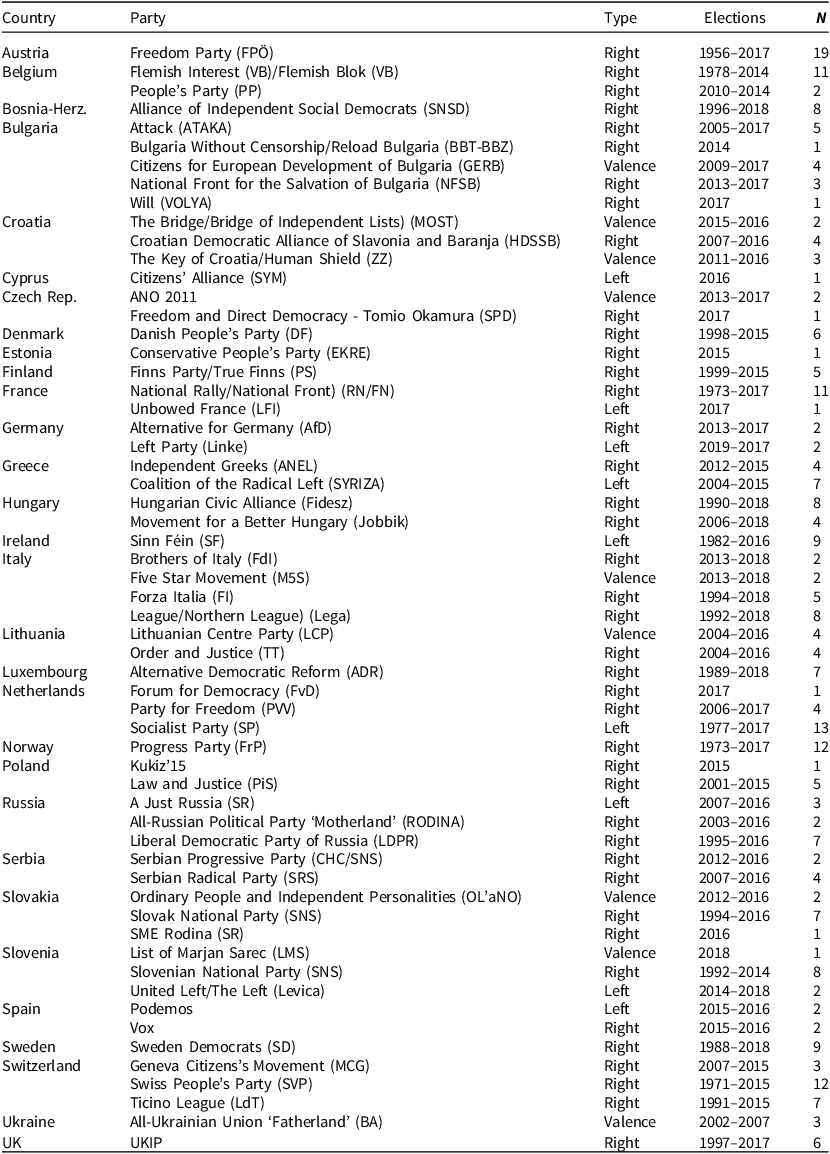
Note: Based on the classification by Zulianello (Reference Zulianello2020). Some parties that are on the list compiled by Zulianello are excluded from this table and from the analysis due to missing data in some independent variables: Blue Reform (Finland), Greek Solution (Greece), Self-determination Movement (Kosovo), The Independents (Liechtenstein), Civic 10 (San Marino), Brexit Party (UK) and Radical Party of Oleh Lyashko (Ukraine).
To test empirically the expectations regarding the impact of the level of decentralization on the national electoral performance of populist parties, this paper employs OLS regression analysis. The dependent variable is populist parties’ vote share in national elections. To measure the level of decentralization I rely on the Regional Authority Index (RAI) (Hooghe, Marks and Schakel, Reference Hooghe, Marks and Schakel2010; Hooghe et al., Reference Hooghe, Marks, Schakel, Chapman Osterkatz, Niedzwiecki and Shair-Rosenfield2016). The RAI index is one of the most comprehensive and fine-grained measurements of the level of authority of regional governments, covering 96 countries on an annual basis from 1950 to 2018. Whereas other indices fall short of reflecting the complex and multi-faceted character of decentralization, the RAI index is composed of ten different indicators in two dimensions: self-rule (institutional depth, policy scope, fiscal autonomy, borrowing autonomy, and representation) and shared rule (law making, executive control, fiscal control, borrowing control, and constitutional reform).
Subnational representation and territorial cleavage are measured as dichotomous variables. The former variable adopts the value 1 when the party has at least one seat in a regional parliament and 0 when the party does not have representation in any subnational parliament.Footnote 3 The latter captures whether there are movements of regionalism, separatism or stateless nationalism in the country.
Four additional variables are included in the statistical models to control for contextual and institutional factors that according to the literature may influence the electoral strength of populist parties. On the one hand, the international migrant stock (% of population born in another country) is incorporated into the statistical models to account for immigration rate in the country prior to the elections. Immigration is one of the most common short-term contextual factors to predict the level of support for right-wing populist parties (Golder Reference Golder2003). The data is drawn from the World Bank’s World Development Indicators.Footnote 4 On the other hand, the degree of (dis)proportionality of the electoral system represents a long-term institutional factor that has also been found to be relevant to explain country-level variation in the electoral performance of right-wing populist parties (Becher, Menéndez González and Stegmueller, Reference Becher, Menéndez González and Stegmueller2023). Therefore, the disproportionality of the electoral system, as calculated by Gallagher (Reference Gallagher1991), is included as a control variable. Since disproportionality encourages two-party systems and dampens the electoral prospects of small parties in general, I expect this variable to have a negative effect on the level of electoral support of right-wing populist parties. Finally, I also control for two further party characteristics that may impact vote share: party type (right-wing, left-wing or valence) and the number of days since the foundation of the party. Results are shown in Table 2.
Results from regression analysis (Dependent variable: vote share for populist parties in national elections)
***P ≤ 0.001, **P ≤ 0.01, *P ≤ 0.05.
Empirical results
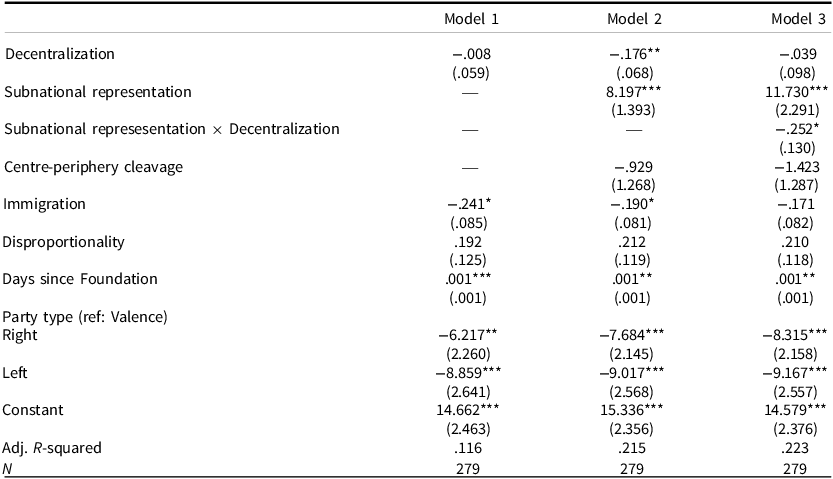
Table 2 presents three different regression models including a set of predictors of vote share for populist parties. Model 1 contains only decentralization as independent variable together with the control variables. Model 2 includes also the independent variables subnational representation and centre-periphery cleavage. Finally, an interaction between decentralization and subnational representation is added in Model 3.
As can be seen from Table 2, populist parties’ vote share appears to be unaffected by decentralization in Model 1. Decentralization becomes significant only when the other two independent variables are included in the analysis (Model 2). This is a rather interesting result. As predicted, decentralization by itself does not seem to be directly associated with either an increase or a decrease in support for populist parties. What seems to be relevant is having or not having subnational representation. To have seats in subnational parliaments increases the vote share of populist parties in national elections, supporting H1a.
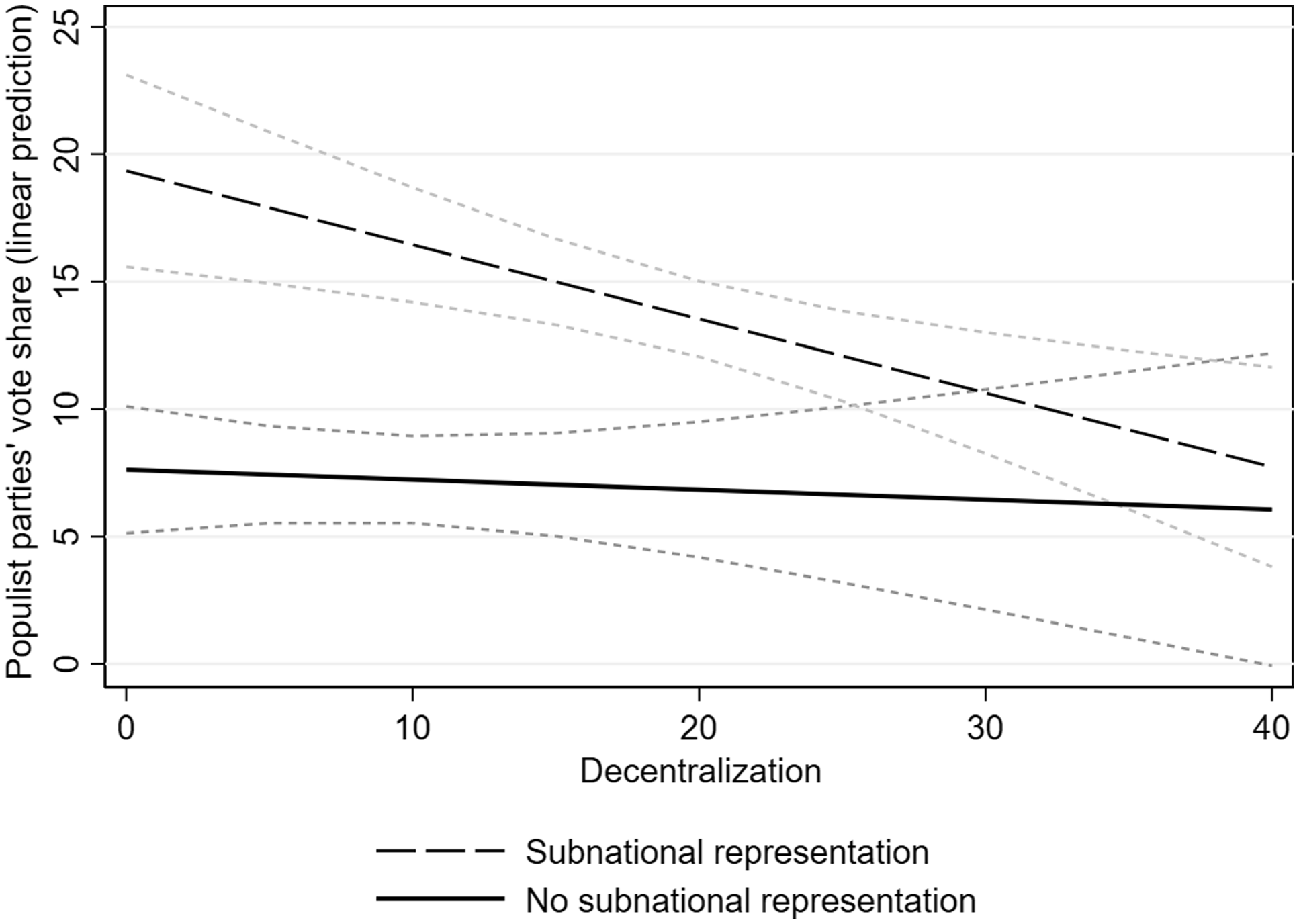
In addition, the effect of subnational representation is contingent on the level of decentralization. A significant interaction effect between decentralization and subnational representation is observed in Model 3. As shown in Figure 1, the predicted vote share for populist parties decreases as decentralization increases, but only when these parties have subnational representation. The negative effect of the degree of decentralization on the national success of populist parties vanishes when they do not have seats in regional parliaments. In other words, populist parties take advantage of subnational representation only in centralized countries. When there is a high degree of regional authority, having or not having seats in regional parliaments does not affect populist parties’ national election results. These results provide support for the hypotheses H2a and H2b.
Subnational representation and predicted vote share for populist parties
Finally, despite theoretical expectations (H3a and H3b), the analysis did not reveal a statistically significant relationship between the existence of a centre-periphery cleavage and the performance of populist parties in national elections. Several factors may contribute to this non-significant result. Firstly, the context-specific nature of centre-periphery dynamics suggests that the relationship between this cleavage and populist party success can vary significantly across different countries or regions. Unique contextual factors in each setting may have influenced the relationship in unexpected ways, hindering the generalization of findings. Secondly, mediating variables such as party strategies, electoral systems, or the presence of alternative cleavages may intervene in the relationship, altering its strength or direction. Lastly, the operationalization of the centre-periphery cleavage may not fully capture the complexity of these phenomena, potentially leading to underestimated effects.
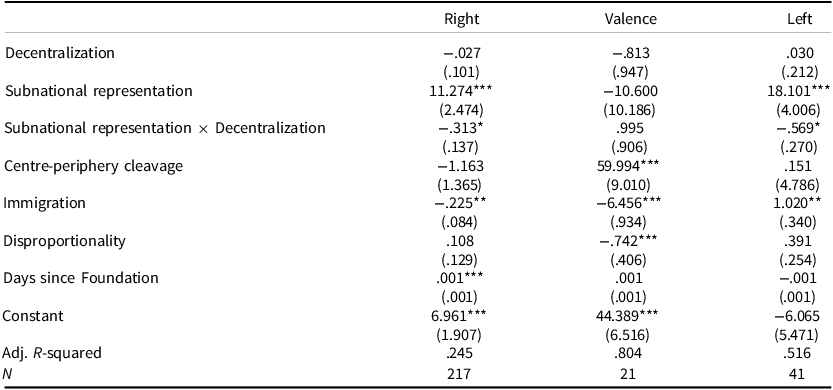
To assess whether there are differences in the relationship between decentralization and the electoral success of populist parties based on party ideology, and to demonstrate the robustness of the findings, I conducted separate regression analyses for left-wing, right-wing, and valence populist parties (Table 3). The results indicate that the significance and direction of the coefficients of the independent variables of interest remain consistent across both left-wing and right-wing populist parties. Specifically, regional parliamentary representation increases the national vote share for both left-wing and right-wing populist parties, and this effect is moderated by the level of decentralization. However, valence populist parties, which do not align on the left-right spectrum and focus on non-positional issues, show a different pattern. For these parties, subnational representation is not statistically significant, while centre-periphery conflicts significantly increase their vote share in national elections.Footnote 5
Results from regression analysis (Dependent variable: vote share for populist parties in national elections)
***P ≤ 0.001, **P ≤ 0.01, *P ≤ 0.05.
This difference likely stems from the nature of valence politics. Valence populist parties thrive by addressing issues that are widely perceived as important across the electorate, rather than aligning with specific ideological stances. Centre-periphery cleavages, which involve disputes over regional autonomy, identity, and resource distribution, can create a fertile ground for valence populist parties. These parties can capitalize on widespread dissatisfaction with how traditional parties handle regional conflicts, presenting themselves as unifying forces that transcend ideological divides. They can appeal to voters’ desires for effective governance and national cohesion, offering solutions that seem pragmatic rather than ideological. In contrast, right-wing and left-wing populist parties are often more ideologically driven and focused on issues that resonate with their specific bases, such as economic inequality for the left or immigration and national sovereignty for the right. As a result, centre-periphery conflicts do not have the same broad appeal or significance for these parties’ electoral success, explaining why this variable is not significant in their cases.
Discussion
This article has discussed different contrasting hypotheses on the role of decentralization on the election results of populist parties. The central thesis underlying this paper was that decentralization per se does not have a direct effect on populist parties’ national election results as previous research assumed. I have proposed instead two factors associated with decentralization that can contribute to the national success or failure of populist parties: subnational representation and the existence of a salient centre-periphery cleavage in the country. Indeed, results suggest that decentralization alone is not significantly associated with changes in support for populist parties. This may explain why previous empirical studies have found mixed evidence regarding the effect of decentralization on support for populist parties. What seems to be relevant is having seats in subnational parliaments. Subnational representation increases populist parties’ vote share in national elections. In addition, the effect of subnational representation depends on the degree of decentralization. Populist parties benefit from subnational representation primarily in countries with lower levels of decentralization. As regional authority increases, following subnational roads to national success becomes less likely for populist parties.
The present study is one of the first attempts to thoroughly examine the role of decentralization on the national success of populist parties in Europe. Although previous research has pointed towards a possible influence of the degree of decentralization on the electoral performance of populist parties, few studies have systematically investigated this relationship.
A limitation of this study is the use of macro-level data (i.e., election results). Future research could analyze this relationship at the micro-level. The absence of statistically significant findings regarding the link between centre-periphery conflicts and support for right- and left-wing populist parties highlights the need for further research. Subsequent studies could benefit from using individual-level data to explore how territorial identity and conflicts along the centre-periphery cleavage relate to populist voting. Specifically, future research could examine the influence of place-related attitudes, such as ‘place-based identities’ and ‘place resentments’ (Fitzgerald, Reference Fitzgerald2018; Arzheimer and Bernemann, Reference Arzheimer and Bernemann2024) on populist support. Place-based identities, which have been shown to favor the electoral success of local candidates (Schulte-Cloos and Bauer, Reference Schulte-Cloos and Bauer2023), may interact with centre-periphery conflicts to shape support for populist parties. Additionally, since this study uses a national measure of centre-periphery salience, future research could explore the relevance of regional or even local-level measures. Future research could also employ data on party positions to assess how populist parties politicize territorial conflicts in countries where the centre-periphery cleavage is prominent. Analyzing the interplay between regional or local identities and the politicization of territorial conflicts by populist parties could provide valuable insights into the strategies populist parties use to mobilize support.
Funding statement
This project has received funding from the European Union’s Horizon 2020 research and innovation programme under the Marie Skłodowska-Curie grant agreement No. 101034371.


 Open access

