


Introduction
Historically, firms have always been exposed to environmental changes and uncertainties. However, today's business environment has changed enormously. In contrast to previous developments, digitalization significantly affects the nature, scale and speed of environmental change and has the potential to break down traditional industry boundaries and business logics (Brenk, Lüttgens, Diener, & Piller, Reference Brenk, Lüttgens, Diener and Piller2019). Digitalization undoubtedly opens numerous business opportunities, but there are also downsides as current strategies, business models (BMs) and capabilities become obsolete (Rachinger, Rauter, Müller, Vorraber, & Schirgi, Reference Rachinger, Rauter, Müller, Vorraber and Schirgi2019; Witschel, Döhla, Kaiser, Voigt, & Pfletschinger, Reference Witschel, Döhla, Kaiser, Voigt and Pfletschinger2019).
Given the highly volatile, uncertain, complex and ambiguous environment (Schoemaker, Heaton, & Teece, Reference Schoemaker, Heaton and Teece2018), firms need guidance on how to overcome these threats. This is true even for traditional success stories, as in the case of the German industry and its world-renowned label ‘made in Germany’. Although digitalization is challenging for firms of all sizes, ages and industries (McAfee & Brynjolfsson, Reference McAfee and Brynjolfsson2017), it is recognized that manufacturing firms are particularly affected by these changes (Björkdahl, Reference Björkdahl2020; Laudien & Daxböck, Reference Laudien and Daxböck2016). To cope with environmental dynamism, firms need to innovate or adapt their current BMs (Kiel, Arnold, & Voigt, Reference Kiel, Arnold and Voigt2017; Rachinger et al., Reference Rachinger, Rauter, Müller, Vorraber and Schirgi2019; Saebi, Lien, & Foss, Reference Saebi, Lien and Foss2017; Westerman, Bonnet, & McAfee, Reference Westerman, Bonnet and McAfee2014; Zott & Amit, Reference Zott and Amit2017). Yet, only a few manufacturers are responding in a comprehensive and coordinated way and often fail to exploit new digital opportunities, which threatens their competitiveness (Björkdahl, Reference Björkdahl2020). Most manufacturing firms are predominantly preoccupied with achieving greater efficiency through digital technologies rather than focusing on growth-oriented strategies, such as business model innovation (BMI) (Björkdahl, Reference Björkdahl2020). Often path dependencies, resource rigidity, missing responsibilities and fear of cannibalization hinder BMI (Chesbrough, Reference Chesbrough2007; Doz & Kosonen, Reference Doz and Kosonen2010). However, to take advantage of digitalization, technological issues are not primarily decisive for the effectiveness of digitalization; it is also about building new capabilities and adapting existing resources, organizational activities and structures (Björkdahl, Reference Björkdahl2020). As the radical change associated with BMI in the digital context implies high requirements to the organization and management of a firm (Leih, Linden, & Teece, Reference Leih, Linden, Teece, Foss and Saebi2015; Schoemaker, Heaton, & Teece, Reference Schoemaker, Heaton and Teece2018), firms need specific capabilities, such as dynamic capabilities (DCs), to build and sustain competitive advantage and thus compete in the digital age. DCs are defined as a ‘firm's ability to integrate, build, and reconfigure internal and external competences to address rapidly changing environments’ (Teece, Pisano, & Shuen, Reference Teece, Pisano and Shuen1997, p. 516) and describe the set of required capabilities for BMI, as enabling resources and structural changes represent the core elements of this explanatory approach (Achtenhagen, Melin, & Naldi, Reference Achtenhagen, Melin and Naldi2013; Leih, Linden, & Teece, Reference Foss, Stieglitz, Foss and Saebi2015; Teece, Reference Teece2018a).
Despite the research progress related to the important role of DCs for firms adaptability in turbulent environments (Teece, Reference Teece2007; Wilden, Devinney, & Dowling, Reference Wilden, Devinney and Dowling2016) and more recently in the context of BMI (e.g., Achtenhagen, Melin, & Naldi, Reference Achtenhagen, Melin and Naldi2013; Inigo, Albareda, & Ritala, Reference Inigo, Albareda and Ritala2017; Leih, Linden, & Teece, Reference Leih, Linden, Teece, Foss and Saebi2015; Loon, Otaye-Ebede, & Stewart, Reference Loon, Otaye-Ebede and Stewart2020; Mezger, Reference Mezger2014; Teece, Reference Teece2018a), its implication for BMI in times of digitalization remain understudied. Considering that particularly in highly turbulent environments, as in the context of digitalization, DCs are continuously required to sense, seize and transform new digital business opportunities (Teece, Reference Teece2018a; Warner & Wäger, Reference Warner and Wäger2019; Witschel et al., Reference Witschel, Döhla, Kaiser, Voigt and Pfletschinger2019), it is surprising that this research stream is still underdeveloped. Similarly, Vial (Reference Vial2019) notes, ‘there is an interesting fit between DC as a conceptual foundation and DT as a phenomenon of interest (…) The ability for firms to design mechanisms that enable repeatable, continuous adaptation in spite of such rapid changes is therefore an important question’ (p. 133). Another unresolved question concerns the underlying components that explain how these DCs are developed and how they contribute to effective BMI (Loon, Otaye-Ebede, & Stewart, Reference Loon, Otaye-Ebede and Stewart2020). Notwithstanding ongoing advances in the microfoundation movement, only a few studies focus on microfoundations relevant to BMI in the digital age (Warner & Wäger, Reference Warner and Wäger2019; Witschel et al., Reference Witschel, Döhla, Kaiser, Voigt and Pfletschinger2019). However, understanding microfoundations that represent distinct individual's skills, routines, organizational and managerial process as well as structures (Felin, Foss, Heimeriks, & Madsen, Reference Felin, Foss, Heimeriks and Madsen2012; Teece, Reference Teece2007) is important, since it reveals relevant factors that affect DCs for BMI (Loon, Otaye-Ebede, & Stewart, Reference Loon, Otaye-Ebede and Stewart2020) and thus enrich theoretical understanding and practical knowledge on how firms identify, develop and implement digital BMs (Warner & Wäger, Reference Warner and Wäger2019; Witschel et al., Reference Witschel, Döhla, Kaiser, Voigt and Pfletschinger2019).
Given the aforementioned research shortcomings, this work echoes ongoing calls that emphasize the need to broaden our understanding of DCs from a microfoundational perspective (Barney & Felin, Reference Barney and Felin2013; Fainshmidt & Frazier, Reference Fainshmidt and Frazier2017; Fallon-Byrne & Harney, Reference Fallon-Byrne and Harney2017; Loon, Otaye-Ebede, & Stewart, Reference Loon, Otaye-Ebede and Stewart2020; Schilke, Hu, & Helfat, Reference Schilke, Hu and Helfat2018; Vial, Reference Vial2019). In this work, we argue that different environmental conditions and contexts, such as BMI in the digital age, require different capabilities, processes and structures. Therefore, adopting a microfoundational lens, we examine the relationship between DCs and BMI in the context of digitalization. Through our partial least square structural equation modeling (PLS-SEM) study among German manufacturing firms, we empirically confirm the positive effects of DCs and highlight the important role of strong DCs for BMI in the context of digitalization. Particularly, using a validated measurement construct that takes into account the underlying processes and structures of DCs that are becoming increasingly important in the digital age (Warner & Wäger, Reference Warner and Wäger2019; Witschel et al., Reference Witschel, Döhla, Kaiser, Voigt and Pfletschinger2019), we extend the current understanding of microfoundations and thus contribute to DC research, but also to the growing field of research investigating BMI from a DC perspective. Likewise, we contribute to the business perspective in digitalization research, which is still in its nascent stage and lacks empirical evidence on the question how and under what conditions firms can respond to digitalization (Hausberg, Liere-Netheler, Packmohr, Pakura, & Vogelsang, Reference Hausberg, Liere-Netheler, Packmohr, Pakura and Vogelsang2019; Vial, Reference Vial2019; Warner & Wäger, Reference Warner and Wäger2019; Witschel et al., Reference Witschel, Döhla, Kaiser, Voigt and Pfletschinger2019).
Given that the development and effectiveness of DCs is influenced by context-specific variables (Baía & Ferreira, Reference Baía and Ferreira2019; Teece, Pisano, & Shuen, Reference Teece, Pisano and Shuen1997; Wilden, Devinney, & Dowling, Reference Wilden, Devinney and Dowling2016; Wilden, Gudergan, Nielsen, & Lings, Reference Wilden, Gudergan, Nielsen and Lings2013; Zahra, Sapienza, & Davisson, Reference Zahra, Sapienza and Davisson2006), we also examine whether and to what extent environmental turbulence (ENVT) and organizational factors moderate the DC–BMI relationship. In doing so, we address criticisms related to research gaps in terms of boundary conditions (Schilke, Hu, & Helfat, Reference Schilke, Hu and Helfat2018) and thus follow Baía and Ferreira's (Reference Baía and Ferreira2019) claim that ‘for future research, the inclusion of both organization specific and environmental moderators seems pertinent and necessary’ (p. 18).
Finally, we respond to prevailing criticism that ‘extant literature has not addressed the link between dynamic capability and the different types of innovation, and how different types of innovation may influence the organizational performance’ (Zhou, Zhou, Feng, & Jiang, Reference Zhou, Zhou, Feng and Jiang2019, p. 733), and finally advance the ongoing debate on the role and consequences of DCs. While we generally acknowledge the indirect effect of DCs and propose BMI as a potential intermediate outcome of organizational performance, we argue, consistent with the position of prior research (e.g., Baía & Ferreira, Reference Baía and Ferreira2019; Helfat & Peteraf, Reference Helfat and Peteraf2009), that it is critical to first understand the direct DCs effect on potential intermediate outcomes before testing the BMI mediating mechanism on the DC–performance relationship. Thus, in this study, we explicitly focus on the DC–BMI relationship.
Theoretical background and hypotheses development
In recent years, the concept of BMI has received increasing attention in academia and practice. BMI, understood as the ‘new competitive advantage’ (Bashir & Verma, Reference Bashir and Verma2017), enables a firm to align with the changing environment and even disrupt market conditions by developing new business areas (Saebi, Lien, & Foss, Reference Saebi, Lien and Foss2017). However, despite the research progress on the important role of BMI, knowledge on how incumbents from traditional industries approach BMI in the digital age is scarce (Rachinger et al., Reference Rachinger, Rauter, Müller, Vorraber and Schirgi2019; Warner & Wäger, Reference Warner and Wäger2019; Witschel et al., Reference Witschel, Döhla, Kaiser, Voigt and Pfletschinger2019). In this context, scholars recently highlight the relevance of DCs as an enabler of BMI in times of digitalization (Teece, Reference Teece2018a; Warner & Wäger, Reference Warner and Wäger2019; Witschel et al., Reference Witschel, Döhla, Kaiser, Voigt and Pfletschinger2019). Nevertheless, Loon, Otaye-Ebede and Stewart (Reference Loon, Otaye-Ebede and Stewart2020) recently state, ‘While capabilities are essential for BMI, they are nonetheless “intermediate explanations” and do not themselves per se instructively inform academics and practitioners in how business models are innovated’ (p. 703). This critique is consistent with the general view in DCs research, that there is limited understanding on the underlying mechanisms on how DCs are build, expressed and transformed within firms (Fallon-Byrne & Harney, Reference Fallon-Byrne and Harney2017; Felin et al., Reference Felin, Foss, Heimeriks and Madsen2012; Schilke, Hu, & Helfat, Reference Schilke, Hu and Helfat2018). Also, Wilden, Devinney, and Dowling (Reference Wilden, Devinney and Dowling2016) note that empirical research to date has focused primarily on two foci, either the microfoundations of DCs and their outcome effects, or factors that determine the use of DCs (e.g., structure, culture, environmental context). They criticize this isolated view as oversimplified, neglecting the interdependencies of different system elements and levels of analysis and thus constraining theoretical and empirical progress in DC research. Consequently, ‘the effects of DCs (…) need to be investigated using a configurational mindset, that is, including both internal and external factors’ (Wilden et al., Reference Wilden, Devinney and Dowling2016, p. 1001). These gaps in the literature need to be resolved, as scholars argue that a microfoundational approach may unpack the black-box how firms build DCs for BMI (Loon, Otaye-Ebede, & Stewart, Reference Loon, Otaye-Ebede and Stewart2020), explain performance heterogeneity among firms (Felin et al., Reference Felin, Foss, Heimeriks and Madsen2012) and provide practical insights into how firms create sustainable advantage (Barney & Felin, Reference Barney and Felin2013).
Therefore, we go beyond the widespread abstract and generic view of DCs and focus specifically on microfoundations of DCs that relate to managerial and organizational processes, activities and structures, and explain how DCs manifest in BMI practice (Loon, Otaye-Ebede, & Stewart, Reference Loon, Otaye-Ebede and Stewart2020; Witschel et al., Reference Witschel, Döhla, Kaiser, Voigt and Pfletschinger2019). This is an important issue because recent studies show that opposed to non-digital context, the identification, development and implementation of BMs in digital context require different subcapabilities and processes (Warner & Wäger, Reference Warner and Wäger2019; Witschel et al., Reference Witschel, Döhla, Kaiser, Voigt and Pfletschinger2019). However, while these authors provide valuable insights into the role of DCs for BMI and suggest a set of microfoundations relevant to competing in the digital economy, the effect of these capabilities remain unexplored. We therefore build on these qualitative studies and examine the degree of strength of DCs as one factor that positively influences BMI of German manufacturers on their road to digitalization.
Second, to gain a deeper understanding of the DC–BMI relationship, we further consider contextual factors that may influence the formation of DCs as well as their potential outcome effects (Wilden et al., Reference Wilden, Devinney and Dowling2016). Consistent with current research, we posit that the effects of DCs are moderated by context-specific factors (Baía & Ferreira, Reference Baía and Ferreira2019; Schilke, Hu, & Helfat, Reference Schilke, Hu and Helfat2018). Thereby, research on DC and BMI found similar organizational and environmental moderators (Foss & Saebi, Reference Foss and Saebi2017; Schilke, Hu, & Helfat, Reference Schilke, Hu and Helfat2018). Regarding organizational factors, scholars indicate that strategic factors matter for both, BMI and DCs (Bereznoi, Reference Bereznoi2015; Teece, Reference Teece2018a) and are particularly relevant in the digital context (Kane, Palmer, Phillips, Kiron, & Buckley, Reference Kane, Palmer, Phillips, Kiron and Buckley2015). Moreover, leadership (Foss & Stieglitz, Reference Foss, Stieglitz, Foss and Saebi2015; Teece, Reference Teece2007) and firm's culture with entrepreneurial attributes (Karimi & Walter, Reference Karimi and Walter2016; Leih, Linden, & Teece, Reference Leih, Linden, Teece, Foss and Saebi2015; Witschel et al., Reference Witschel, Döhla, Kaiser, Voigt and Pfletschinger2019) and the design of organizational structure (Teece, Reference Teece2018a; Witschel et al., Reference Witschel, Döhla, Kaiser, Voigt and Pfletschinger2019) are further potential factors moderating the DC–BMI relationship. However, the role of organizational factors underlying the DC–BMI relationship is neither sufficiently discussed nor empirically validated, even though it is of high practical relevance which conditions are advantageous to address the challenges of digitalization and successfully transform a BM (Kane, Palmer, Phillips, Kiron, & Buckley, Reference Kane, Palmer, Phillips, Kiron and Buckley2016; Witschel et al., Reference Witschel, Döhla, Kaiser, Voigt and Pfletschinger2019). Therefore, we follow recent calls (Foss & Saebi, Reference Foss and Saebi2017; Teece, Reference Teece2018a; Witschel et al., Reference Witschel, Döhla, Kaiser, Voigt and Pfletschinger2019) and focus specifically on the moderating role of these factors. We also consider potential effects of ENVT, whose importance as an external moderator is well-recognized (Schilke, Hu, & Helfat, Reference Schilke, Hu and Helfat2018). This also applies for BMI research, as the competitiveness of BMs needs to be reassessed, particularly in turbulent environments (Leih, Linden, & Teece, Reference Leih, Linden, Teece, Foss and Saebi2015). Although all firms face the challenges of digitalization, they may be affected differently. Environmental dynamics such as regulatory changes or new technologies may not affect all companies equally, which therefore face varying degrees of turbulence in their business environment. Therefore, we examine the role of ENVT and, similar to Wilden and Gudergan (Reference Wilden and Gudergan2015), consider aspects associated with changes in technology, market, regulation, competition and competitive intensity.
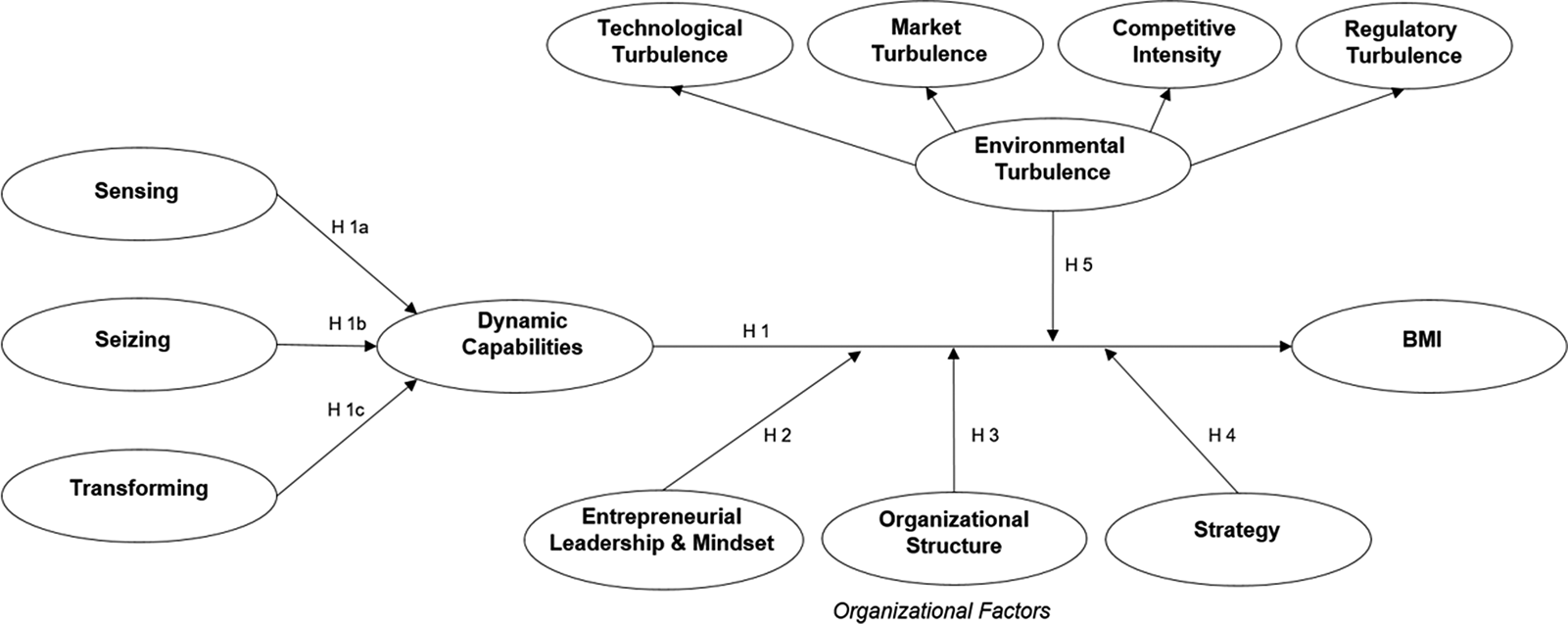
Figure 1 illustrates our research framework.
Research framework.
DCs for BMI and their microfoundations
Overall, there is growing consensus in current research that strong DCs are essential for BMI (e.g., Achtenhagen, Melin, & Naldi, Reference Achtenhagen, Melin and Naldi2013; Leih, Linden, & Teece, Reference Leih, Linden, Teece, Foss and Saebi2015; Schoemaker, Heaton, & Teece, Reference Schoemaker, Heaton and Teece2018; Witschel et al., Reference Witschel, Döhla, Kaiser, Voigt and Pfletschinger2019). Following Teece (Reference Teece2018a), the speed and degree of firm's alignment to changing environments are determined by the strength of DCs. Thus, a firm with limited DCs may recognize business opportunities but be unable to innovate its BM due to a lack of seizing and transforming capabilities. Firms with strong DCs have therefore a broader range of potential BMs that can lead to radical shifts (Teece, Reference Teece2018a). DCs also determine the speed of BMI, as strong sensing capabilities enable a firm to recognize business opportunities early, seize them quickly and transform the organization accordingly (Teece, Reference Teece2018a). Hence, firms with strong DCs can change their BMs before rivals do and may even shape their surrounding in their favor (Schoemaker, Heaton, & Teece, Reference Schoemaker, Heaton and Teece2018). Therefore, we hypothesize:
Hypothesis 1: The strength of DCs has a positive effect on BMI.
Since DCs are defined by the three dimensions, sensing, seizing and transforming (Teece, Reference Teece2007), we apply this disaggregated view to discuss in more detail the link between each dimension and BMI. We focus specifically on the microfoundations that are relevant in the digital age and which we call hereafter as subcapabilities (Warner & Wäger, Reference Warner and Wäger2019; Witschel et al., Reference Witschel, Döhla, Kaiser, Voigt and Pfletschinger2019).
First, we argue that the capability to sense new business opportunities is a crucial initial step for BMI, as strong sensing capabilities enable monitoring the external environment and identifying relevant opportunities and threats. This allows a firm to assess the durability of its BM and determine the need for change (Schoemaker, Heaton, & Teece, Reference Schoemaker, Heaton and Teece2018; Teece, Reference Teece2014). As high market dynamics with short technology and innovation cycles prevail in the digital age, deep market understanding and early recognition of trends are important subcapabilities of sensing (Day & Schoemaker, Reference Day and Schoemaker2016; Warner & Wäger, Reference Warner and Wäger2019; Witschel et al., Reference Witschel, Döhla, Kaiser, Voigt and Pfletschinger2019). Sensing also involves a deep understanding of customer requirements (Teece, Reference Teece2018a; Warner & Wäger, Reference Warner and Wäger2019; Witschel et al., Reference Witschel, Döhla, Kaiser, Voigt and Pfletschinger2019). Particularly concerning digital solutions, interactively experimenting with customers is relevant to identify latent needs (Day & Schoemaker, Reference Day and Schoemaker2016; Witschel et al., Reference Witschel, Döhla, Kaiser, Voigt and Pfletschinger2019). Since most digital BMs are customer-centric, firms must also design the value proposition and revenue model to ensure long-term success (Teece, Reference Teece2010, Reference Teece2018a; Witschel et al., Reference Witschel, Döhla, Kaiser, Voigt and Pfletschinger2019). Similarly, open innovation is increasingly important to identify digital business opportunities (Warner & Wäger, Reference Warner and Wäger2019; Westerman et al., Reference Westerman, Bonnet and McAfee2014; Witschel et al., Reference Witschel, Döhla, Kaiser, Voigt and Pfletschinger2019). Accordingly, seeking dialog with stakeholders outside the firm and involving them in a suitable form is an important subcapability of sensing (Inigo, Albareda, & Ritala, Reference Inigo, Albareda and Ritala2017; Witschel et al., Reference Witschel, Döhla, Kaiser, Voigt and Pfletschinger2019). Therefore, we propose:
Hypothesis 1a: The degree of sensing capabilities has a positive effect on BMI.
Second, sensing capabilities are required but not sufficient for BMI because the firm also has to seize the identified opportunities (Schoemaker, Heaton, & Teece, Reference Schoemaker, Heaton and Teece2018). This involves subcapabilities such as the identification, efficient deployment and allocation of relevant resources and competencies that enable the implementation of innovation activities to create and capture value from the most promising business opportunity (Leih, Linden, & Teece, Reference Leih, Linden, Teece, Foss and Saebi2015). Another key subcapability for the development and refinement of BMs represents the organization of the development team, as interdisciplinary knowledge needs to be brought together and bundled (Mezger, Reference Mezger2014). This is a very important feature particularly in a digital context (Teece, Reference Teece2018a; Witschel et al., Reference Witschel, Döhla, Kaiser, Voigt and Pfletschinger2019). The capability to develop new BMs in an agile and iterative manner is also highly relevant in the digital context (Mezger, Reference Mezger2014; Warner & Wäger, Reference Warner and Wäger2019; Witschel et al., Reference Witschel, Döhla, Kaiser, Voigt and Pfletschinger2019). To ensure that a new digital solution optimally satisfies customer needs, continuously testing products and services with end users and directly incorporating their feedback is also critical to success (Amit & Han, Reference Amit and Han2017; Witschel et al., Reference Witschel, Döhla, Kaiser, Voigt and Pfletschinger2019). Finally, data and IT security issues are critical to competitiveness. Similarly, the sustainable establishment of platforms plays a key role. Thus, firms must effectively implement these IT-based activities (Oswald & Kleinemeier, Reference Oswald and Kleinemeier2017; Porter & Heppelmann, Reference Porter and Heppelmann2015; Witschel et al., Reference Witschel, Döhla, Kaiser, Voigt and Pfletschinger2019). Therefore, we propose:
Hypothesis 1b: The degree of seizing capabilities has a positive effect on BMI.
Third, transforming capabilities are required to adapt, renew and reshape a firm's resource base or even its entire ecosystems to take full advantage of BMI (Schoemaker, Heaton, & Teece, Reference Schoemaker, Heaton and Teece2018). They enable a firm to transform elements of its organization and culture to address new opportunities identified in the sensing and seizing process (Teece, Reference Teece2018a). They are also required to address rigidities within a firm (Leih, Linden, & Teece, Reference Leih, Linden, Teece, Foss and Saebi2015), which is especially relevant for manufacturing firms, as they often develop strong resource rigidity over time. For instance, investments in highly specialized manufacturing assets usually imply the goal of high efficiency, which leads to rigidity (Teece, Reference Teece2018a), and in turn negatively affects a firm's ability to align its BM with environmental changes (Teece, Reference Teece2018a). Therefore, organizational measures and activities are required to ensure a sustainable organization (Day & Schoemaker, Reference Day and Schoemaker2016; Inigo, Albareda, & Ritala, Reference Inigo, Albareda and Ritala2017; Warner & Wäger, Reference Warner and Wäger2019; Witschel et al., Reference Witschel, Döhla, Kaiser, Voigt and Pfletschinger2019). The allocation and development of key competencies are further important subcapabilities of transforming. Digitalization requires many new competencies related to the use and application of digital technologies, which has to be built and developed (Oswald & Kleinemeier, Reference Oswald and Kleinemeier2017; Warner & Wäger, Reference Warner and Wäger2019; Witschel et al., Reference Witschel, Döhla, Kaiser, Voigt and Pfletschinger2019). Equally relevant is fostering internal information and knowledge-exchange to create transparency and change awareness among employees (Song, Lee, & Khanna, Reference Song, Lee and Khanna2016; Witschel et al., Reference Witschel, Döhla, Kaiser, Voigt and Pfletschinger2019). Moreover, collaboration with external partners and building ecosystems is important (Day & Schoemaker, Reference Day and Schoemaker2016; Schoemaker, Heaton, & Teece, Reference Schoemaker, Heaton and Teece2018; Warner & Wäger, Reference Warner and Wäger2019; Witschel et al., Reference Witschel, Döhla, Kaiser, Voigt and Pfletschinger2019). The ability to build relationships with strategic partners who have complementary resources and competencies is critical for successful BM scaling (Mezger, Reference Mezger2014; Rice, Liao, Martin, & Galvin, Reference Rice, Liao, Martin and Galvin2012; Witschel et al., Reference Witschel, Döhla, Kaiser, Voigt and Pfletschinger2019). We hypothesize:
Hypothesis 1c: The degree of transforming capabilities has a positive effect on BMI.
Role of organizational factors
Moderating effect of entrepreneurial leadership and mindset
Prior research has recognized the important role of leadership and cultural factors for BMI (Chesbrough, Reference Chesbrough2007; Foss & Stieglitz, Reference Foss, Stieglitz, Foss and Saebi2015). This is particularly important for BMI in the digital age, as digitalization implies a high degree of disruption and ongoing process of strategic renewal (Kane et al., Reference Kane, Palmer, Phillips, Kiron and Buckley2015; Schoemaker, Heaton, & Teece, Reference Schoemaker, Heaton and Teece2018; Vial, Reference Vial2019; Warner & Wäger, Reference Warner and Wäger2019; Witschel et al., Reference Witschel, Döhla, Kaiser, Voigt and Pfletschinger2019). Indeed, BMI is different in the digital age, as the speed and complexity of environmental change require greater commitment and involvement from top management (Kane et al., Reference Kane, Palmer, Phillips, Kiron and Buckley2015; Witschel et al., Reference Witschel, Döhla, Kaiser, Voigt and Pfletschinger2019). Regarding this, scholars (Karimi & Walter, Reference Karimi and Walter2016; Schoemaker, Heaton, & Teece, Reference Schoemaker, Heaton and Teece2018; Witschel et al., Reference Witschel, Döhla, Kaiser, Voigt and Pfletschinger2019) highlight the role of entrepreneurial leadership and a ‘culture that favors rapid response and the nurturing of specialized knowledge to be successful’ (Teece, Reference Teece2000, p. 42). Teece (Reference Teece2014) assumes that entrepreneurial leadership is positively associated with sensing, while Witschel et al. (Reference Witschel, Döhla, Kaiser, Voigt and Pfletschinger2019) view it as fundamental also for seizing. Thus entrepreneurial leadership and culture determine the ‘encouragement to experiment,’ ‘failure and learning culture,’ ‘willingness to invest in new ideas’ and ‘willingness to take risks and cannibalize’ (Karimi & Walter, Reference Karimi and Walter2016; Schoemaker, Heaton, & Teece, Reference Schoemaker, Heaton and Teece2018; Witschel et al., Reference Witschel, Döhla, Kaiser, Voigt and Pfletschinger2019), which we summarize as entrepreneurial leadership and mindset (ELMS).
It is generally accepted that, a ‘discovery-driven’ approach that focuses on experimentation and learning is preferable to BMI (Achtenhagen, Melin, & Naldi, Reference Achtenhagen, Melin and Naldi2013; Bereznoi, Reference Bereznoi2015; McGrath, Reference McGrath2010; Sosna, Trevinyo-Rodríguez, & Velamuri, Reference Sosna, Trevinyo-Rodríguez and Velamuri2010; Teece, Reference Teece2018b). These activities are also positively associated with DCs (Schoemaker, Heaton, & Teece, Reference Schoemaker, Heaton and Teece2018) and especially relevant for sensing and seizing (Mezger, Reference Mezger2014). In their concept of strategic agility, Doz and Kosonen (Reference Doz and Kosonen2010) emphasize experimentation as a leadership task, which helps to challenge the current BM and prototype new business ideas. Similarly, Teece (Reference Teece2010) indicates the need to experiment with BM and learn from competitors. Thus, we argue that a culture that encourages experimentation and learning creates positive conditions for the DC–BMI relationship.
However, experimenting with new ideas is costly and requires an adequate provision of funding (Achtenhagen, Melin, & Naldi, Reference Achtenhagen, Melin and Naldi2013; Kane et al., Reference Kane, Palmer, Phillips, Kiron and Buckley2015). There are many examples of companies that fell short of their expectations because they focused their investments only on technology while neglecting organizational factors (Kane et al., Reference Kane, Palmer, Phillips, Kiron and Buckley2015).
Overcoming risk aversion and willingness to break existing business patterns or even cannibalize the core business are further recognized entrepreneurial traits positively associated with innovativeness (Pérez-Luño, Wiklund, & Cabrera, Reference Pérez-Luño, Wiklund and Cabrera2011; Schoemaker, Heaton, & Teece, Reference Schoemaker, Heaton and Teece2018). It is argued that in digitally matured firms, risk-taking has become a cultural norm. It is therefore a key leadership task to transform the cultural mindset toward entrepreneurship and make it less risk-averse (Kane et al., Reference Kane, Palmer, Phillips, Kiron and Buckley2015; Leih, Linden, & Teece, Reference Leih, Linden, Teece, Foss and Saebi2015).
Accordingly, we argue that ELMS promotes cultural conditions that positively affect the DC–BMI relationship. ELMS promotes sensing and seizing, which leads to more creativity and innovation. Moreover, the future orientation and openness of an entrepreneurial culture stimulates flexibility and experimentation, reduces transformation barriers and thus fosters BMI (Teece, Reference Teece2018b). Therefore, we hypothesize:
Hypothesis 2: The degree of ELMS positively moderates the DC–BMI relationship.
Moderating effect of organizational structure
In current literature, the question whether an organic or mechanistic organizational structure is more favorable for DCs remains unclear (Wilden, Devinney, & Dowling, Reference Wilden, Devinney and Dowling2016). On the one hand, it is argued that a highly organic structure is beneficial for DCs to enhance firm's success (Teece, Reference Teece2000; Wilden et al., Reference Wilden, Gudergan, Nielsen and Lings2013). According to Teece (Reference Teece2000), an organization that has a decentralized, non-bureaucratic decision-making structure or even the ability to self-govern is highly flexible and can respond to external changes with a faster decision-making process. In particular, this type of structure can facilitate sensing and seizing activities. Conversely, others highlight the advantages of a mechanistic structure associated with centralized decision-making, high formalization and tight control of information flow. For example, different control mechanisms can foster innovation (Cardinal, Reference Cardinal2001), but also ‘enable efficient information processing, knowledge development and sharing, coordination and integration, and more generally, collective action’ (Felin et al., Reference Felin, Foss, Heimeriks and Madsen2012, p. 1364). Similarly, it can support BM stability and operational efficiency, but can also lead to rigidity and hinder BMI (Saebi, Reference Saebi, Foss and Saebi2015). Since we assume that a mechanistic structure impedes transforming capabilities, we expect that an organic structure, implying decentralized decision-making, low formalization and high integration (Burns & Stalker, Reference Burns and Stalker1961), will strengthen the DC–BMI relationship.
Scholars found that decentralization of decision-making positively affects DCs (Leih, Linden, & Teece, Reference Foss, Stieglitz, Foss and Saebi2015; Schoemaker, Heaton, & Teece, Reference Schoemaker, Heaton and Teece2018; Teece, Reference Teece2007; Wilden et al., Reference Wilden, Gudergan, Nielsen and Lings2013). One example is the leading hearing aid manufacturer Oticon, whose restructuring from a mechanistic to an organic structure led to a revival of innovative and entrepreneurial capabilities (Leih, Linden, & Teece, Reference Leih, Linden, Teece, Foss and Saebi2015). The new structure, characterized by low hierarchies, high degree of self-organization and project orientation, facilitated the capabilities of sensing and seizing (Leih, Linden, & Teece, Reference Leih, Linden, Teece, Foss and Saebi2015). Also, this structure combined with DCs, enhances firm's responsiveness and adaptability required in turbulent environments (Andersen & Nielsen, Reference Andersen and Nielsen2009; Rindova & Kotha, Reference Rindova and Kotha2001). Thus, we derive that a decentralized structure facilitates the DC–BMI relationship.
There are opposed views whether formalization constrains communication and knowledge exchange (Pertusa-Ortega, Zaragoza-Sáez, & Claver-Cortés, Reference Pertusa-Ortega, Zaragoza-Sáez and Claver-Cortés2010), which represents a key microfoundation of DCs. High formalization includes established work routines and limited decision-making autonomy (Agarwal, Reference Agarwal1993), which can impede essential elements of an entrepreneurial culture, for example, experimentation, risk-taking or exploration (Burns & Stalker, Reference Burns and Stalker1961; Menguc & Auh, Reference Menguc and Auh2010). Van der Panne, van Beers, and Kleinknecht (Reference Van der Panne, van Beers and Kleinknecht2003) found that a formalized structure counteracts the trial-error-approach that is important for BMI. Also, formalization is associated with a high level of bureaucracy (Menguc & Auh, Reference Menguc and Auh2010), which fosters rigidity and impedes creativity (Hartline, Maxham, & McKee, Reference Hartline, Maxham and McKee2000). Contrary, less formalization fosters the use of new information and opportunities, leading to more effective seizing capabilities (Deshpande & Zaltman, Reference Deshpande and Zaltman1982; Wilden et al., Reference Wilden, Gudergan, Nielsen and Lings2013). Therefore, we assume that low formalization will strengthen the DC–BMI relationship, as it stimulates idea generation, provides a setting to exploit these and increases flexibility during the transformation process.
Moreover, a decentralized structure requires high coordination and communication to align different departments and share best practices. Regarding this, scholars highlight the value of internal cooperation and knowledge-exchange for DCs (Achtenhagen, Melin, & Naldi, Reference Achtenhagen, Melin and Naldi2013; Leih, Linden, & Teece, Reference Leih, Linden, Teece, Foss and Saebi2015; Witschel et al., Reference Witschel, Döhla, Kaiser, Voigt and Pfletschinger2019). High integration enhances sensing by fostering creativity and diverse perspectives among employees. Also, seizing and transforming activities require high levels of internal communication and collaboration (Achtenhagen, Melin, & Naldi, Reference Achtenhagen, Melin and Naldi2013; Leih, Linden, & Teece, Reference Leih, Linden, Teece, Foss and Saebi2015). Thus, we assume that a high integration degree is favorable for the DC–BMI relationship.
Considering all aspects together, we hypothesize:
Hypothesis 3: A highly organic organizational structure positively moderates the DC–BMI relationship.
Moderating effect of strategy
Research has also highlighted the role of strategy for DCs and BMI (Foss & Saebi, Reference Foss and Saebi2017; Leih, Linden, & Teece, Reference Leih, Linden, Teece, Foss and Saebi2015; Teece, Reference Teece2014). Generally, there is consensus in literature that strategy and BMI need to be aligned (Kane et al., Reference Kane, Palmer, Phillips, Kiron and Buckley2016; Teece, Reference Teece2018a; Witschel et al., Reference Witschel, Döhla, Kaiser, Voigt and Pfletschinger2019). However, the role of strategy in the DC–BMI relationship is not clearly defined. Strategy is considered as an antecedent of DCs and of BMI, but also as a moderator of this relationship (Foss & Saebi, Reference Foss and Saebi2018; Schilke, Hu, & Helfat, Reference Schilke, Hu and Helfat2018). This depends on which strategic aspects are observed in the respective studies. While a strategic shift is considered as a trigger of BMI, different strategy types are regarded as potential moderators (Foss & Saebi, Reference Foss and Saebi2018). In this work, we refer to research findings that show that digital mature firms have a clear communicated and embedded vision and a digital strategy to guide digitalization (Bereznoi, Reference Bereznoi2015; Kane et al., Reference Kane, Palmer, Phillips, Kiron and Buckley2015) and thus expect that strategy affects the strength of DCs on BMI (Witschel et al., Reference Witschel, Döhla, Kaiser, Voigt and Pfletschinger2019). More recently, Witschel et al. (Reference Witschel, Döhla, Kaiser, Voigt and Pfletschinger2019) also found evidence for the moderating impact of strategic issues, which are crucial for DCs. While strategy can provide guidance for sensing, a firm's vision guides seizing and transforming. Similarly, Teece (Reference Teece2014) highlights the interaction between the DC-dimensions and Rumlet's elements of strategy. Thereby, sensing relates to diagnosis while seizing and transforming interacts with guiding policy and coherent action (Teece, Reference Teece2014). Hence, we hypothesize:
Hypothesis 4: A clear and organizational embedded vision and digital strategy positively moderates the DC–BMI relationship.
Role of ENVT
The core idea that DCs are helpful to address rapidly changing environments (Teece, Pisano, & Shuen, Reference Teece, Pisano and Shuen1997) and the organization's ability to influence its environment (Teece, Reference Teece2007) let assume that the strength of DCs is especially relevant in turbulent environments. Many scholars followed this view, which is why ENVT is the most frequently used moderator in literature (Schilke, Hu, & Helfat, Reference Schilke, Hu and Helfat2018; Wilden, Devinney, & Dowling, Reference Wilden, Devinney and Dowling2016). According to Teece (Reference Teece2018a), the strength of DCs determines the speed and degree of firm's BM alignment with environment changes. For this reason, we argue that DCs positively affect BMI. Both speed and degree of alignment seem to be especially crucial in a highly turbulent environment. In this regard, strong sensing is required to detect changes before rivals do and to understand their implications on the firm and competition (Schoemaker, Heaton, & Teece, Reference Schoemaker, Heaton and Teece2018). Also, strong seizing and transforming capabilities enable a firm to change its BMs adequately and timely. This way firms can differentiate and stay competitive (Wilden et al., Reference Wilden, Gudergan, Nielsen and Lings2013; Zahra, Reference Zahra1993). There is evidence that firms with strong DCs are faster in the BMI process, which may lead to a first-mover advantage (Wilden et al., Reference Wilden, Gudergan, Nielsen and Lings2013) and is particularly important for platform-based BMs (Schoemaker, Heaton, & Teece, Reference Schoemaker, Heaton and Teece2018). Moreover, a highly turbulent environment requires more fundamental organizational changes and thus an even higher need for transforming capabilities to address this turbulence and to soften rigidities. In contrast, firms operating in a stable environment or in a monopoly position have fewer needs for BMI than firms facing strong competition, new technology or regulatory shifts (Auh & Menguc, Reference Auh and Menguc2005; Wilden et al., Reference Wilden, Gudergan, Nielsen and Lings2013). We hence conclude that strong DCs seem to be especially required in turbulent environments and hypothesize:
Hypothesis 5: The degree of environmental turbulence positively moderates the DC–BMI relationship.
Methods
Data collection and sample
For our sample, we focused on the German manufacturing industry for several reasons. First, Germany as a global manufacturing leader and the most important pillar of economic strength is embracing the emerging Industry 4.0. Second, the digitalization trend is forcing the industry's players as traditional hardware natives to combine their physical products with digital services in order to create hybrid solutions for customers (Brenk et al., Reference Brenk, Lüttgens, Diener and Piller2019). Third, due to their long history and good reputation, companies are more rigid on the path to digitalization, as their success has positively reinforced their trust in conventional ways of working. Fourth, with digitalization, a paradigm shift is coming. The focus of strategic considerations will shift from a supply chain to an ecosystem view focusing on digital technologies, platforms and data-driven BMs (Demchenko, De Laat, & Membrey, Reference Demchenko, De Laat and Membrey2014). Accordingly, deeper BMI insights are especially important for German manufacturing firms.
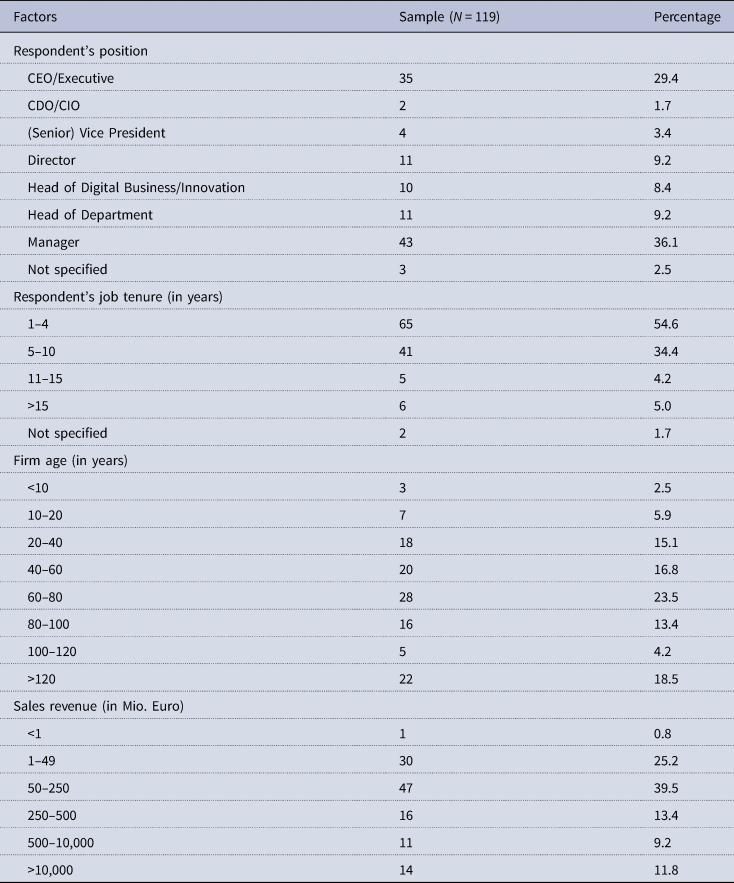
Standard & Poor's Capital IQ platform was used as a single-source to identify firms classified to the manufacturing industry applying the Standard Industry Classification codes 20–39. Using different platforms (e.g., XING, LinkedIn, firms' websites), we searched for key informants and finally sent personalized emails with a link to our online survey. To increase the response rate, we offered the questionnaire in German or English, assured confidentiality and anonymity and incentivized respondents to participate by offering the study results. During data collection, we continuously tracked response behavior and termination rate. This allowed making minor adjustments to improve the response rate. Finally, 123 of the 2061 contacted firms completed the questionnaire, resulting in a response rate of 5.97%. To address typically data collection issues, for example, missing data, outliers and suspicious response patterns (Hair, Hult, Ringle, & Sarstedt, Reference Hair, Hult, Ringle and Sarstedt2014), we checked the data and assessed their plausibility and correctness. Thereby, we removed one observation due to straight lining issues, where the respondent only selected ‘1 strongly disagree.’ Besides, since only observations covering more than 97% of the indicators were included, we deleted three observations due to missing data. The remaining missing data points were replaced by the mean value of the respective indicator. Thereby, we met the criteria for mean value replacement of a maximum of 5% missing values per indicator in any case (Hair et al., Reference Hair, Hult, Ringle and Sarstedt2014). This procedure resulted in a final sample size of 119 firms. For descriptive statistics of the sample and respondents, see Table 1.
Descriptive results of the respondents and sample
Structural modeling
For hypothesis testing we used PLS-SEM, which is increasingly used in management research (Hair, Sarstedt, Ringle, & Gudergan, Reference Hair, Sarstedt, Ringle and Gudergan2018). Besides, consistent with prior studies (e.g., Karimi & Walter, Reference Karimi and Walter2016; Wilden et al., Reference Wilden, Gudergan, Nielsen and Lings2013) and recommended by leading scholars in the area of PLS-SEM (Ringle, Wende, & Becker, Reference Ringle, Wende and Becker2015), we applied SmartPLS software.
We selected PLS-SEM for several reasons, which makes PLS-SEM appropriate to test our hypotheses. First, compared to covariance-based SEM (CB-SEM), the soft-modeling approach PLS-SEM is less suited for well-established theories, but more appropriate in exploratory research, where the objective is theory development (Hair et al., Reference Hair, Hult, Ringle and Sarstedt2014). Due to scarce theoretical and empirical knowledge on the proposed relationships, this study is categorized as preliminary exploratory. To the best of our knowledge, the relationship between DC, BMI, organizational factors and ENVT has not been empirically tested. Second, it allows including unobservable variables, which need to be measured indirectly by indicator variables (Fornell & Larcker, Reference Fornell and Larcker1981). In this study, the DC construct includes the capability to sense, seize and transform, which cannot be observed directly and hence need to be measured by several indicators. This also applies to the organizational factors and partly for the BM construct and ENVT. Third, reflective, formative and single-item constructs can be used directly by applying PLS-SEM, whereas the common factor approach CB-SEM is limited to the use of formative measurements and would require modifications of the construct specification (Hair et al., Reference Hair, Hult, Ringle and Sarstedt2014; Henseler, Ringle, & Sinkovics, Reference Henseler, Ringle and Sinkovics2009). This is an important feature, as we used all three kinds of measurement constructs. Fourth, PLS-SEM results are robust for potential non-normal distributed data with excess kurtosis and skewness (Ringle, Götz, Wetzels, & Wilson, Reference Ringle, Goetz, Wetzels and Wilson2009). Finally, PLS-SEM leads to higher statistical power than the alternative CB-SEM when testing a complex model with a relatively small sample size as in our study (Hair et al., Reference Hair, Hult, Ringle and Sarstedt2014; Reinartz, Haenlein, & Henseler, Reference Reinartz, Haenlein and Henseler2009).
Measures
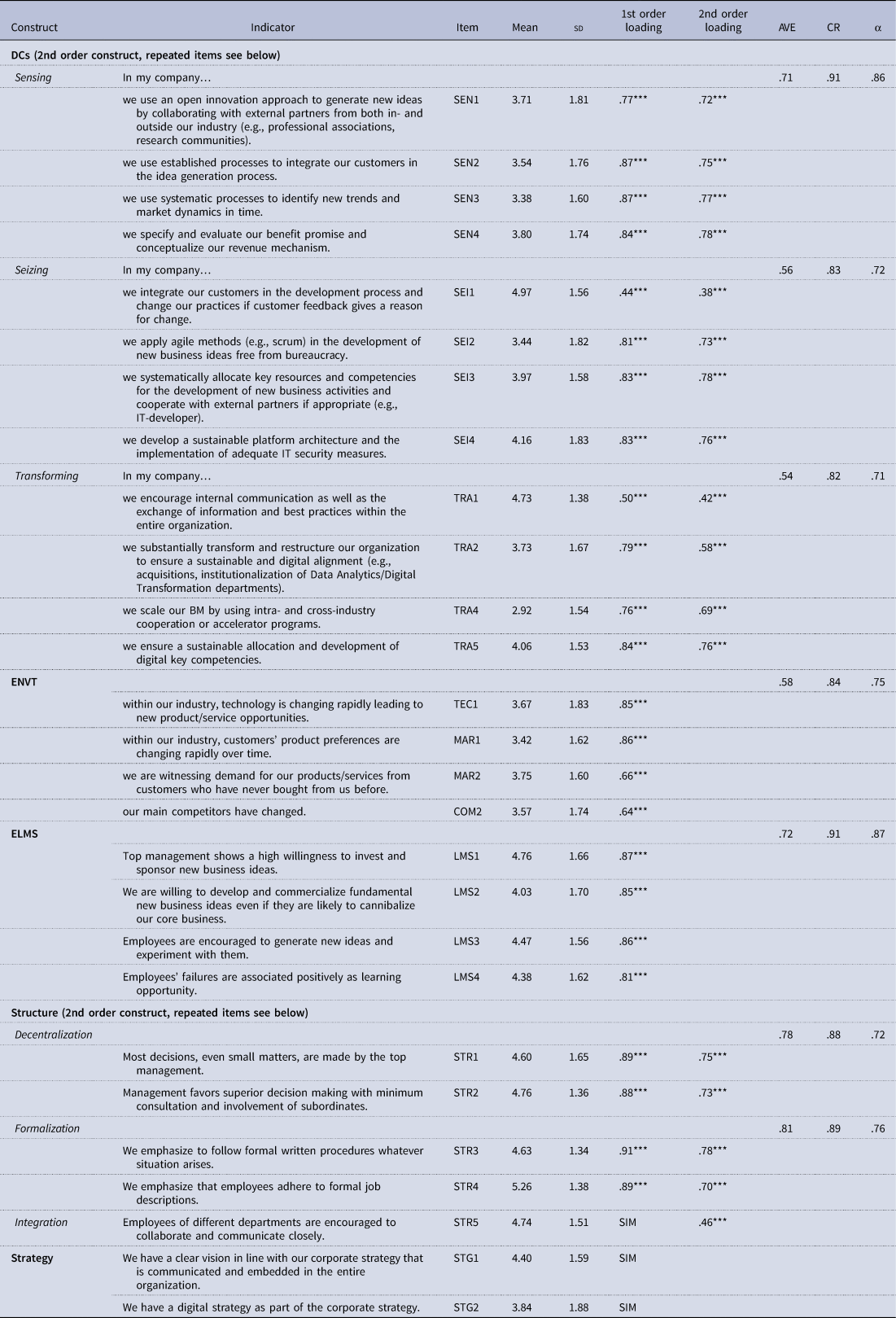
Given that the research area of this study is relatively new and only a limited number of empirical studies have examined the DC–BMI relationship, we had to develop new measurement constructs or at least partially adapt existing ones (see Appendix 1). For this, we first created a pool of indicators for each construct based on an extensive literature review, clustered them and defined the measurement scales in an iterative process. Finally, we partly adapted the indicators to set them into the context of digitalization. Feedback loops with external and independent researcher and a pilot study among graduate management students helped to optimize and validate our questionnaire design and minimize item ambiguity. This procedure, along with assuring respondent confidentiality helped to address common method bias concerns (Podsakoff, MacKenzie, Lee, & Podsakoff, Reference Podsakoff, MacKenzie, Lee and Podsakoff2003). All constructs, except the control variables, were measured applying a 7-point Likert scale, ranging from 1 ‘strongly disagree’ to 7 ‘strongly agree’. Table 2 shows the measurement scales with related test statistics.
Validated measurement constructs
Significance levels (p-values): *p < .1; **p < .05; ***p < .01.
Dynamic capabilities
Following Wilden et al. (Reference Wilden, Gudergan, Nielsen and Lings2013), we measured DCs as a type II multi-dimensional second-order index (reflective-formative type). We measured the higher-order component (HOC) of the DC construct formatively by the three lower-order components (LOCs) sensing, seizing and transforming, which were measured reflectively. For scale development, we compiled items drawn from various studies, whereby we mainly refer to Witschel et al. (Reference Witschel, Döhla, Kaiser, Voigt and Pfletschinger2019), since their work examines the relevant microfoundations for BMI in the digital age and thus fits to our research context. We measured sensing using four items: collaboration with external partners and customers in the ideation phase (Makkonen, Pohjola, Olkkonen, & Koponen, Reference Makkonen, Pohjola, Olkkonen and Koponen2014; Wilden et al., Reference Wilden, Gudergan, Nielsen and Lings2013; Witschel et al., Reference Witschel, Döhla, Kaiser, Voigt and Pfletschinger2019), use of established processes for customer integration (Fainshmidt & Frazier, Reference Fainshmidt and Frazier2017; Wilden et al., Reference Wilden, Gudergan, Nielsen and Lings2013; Witschel et al., Reference Witschel, Döhla, Kaiser, Voigt and Pfletschinger2019), systematic processes for timely trend and market recognition (Makkonen et al., Reference Makkonen, Pohjola, Olkkonen and Koponen2014; Witschel et al., Reference Witschel, Döhla, Kaiser, Voigt and Pfletschinger2019) and specification and evaluation of benefit promise and conceptualization of revenue mechanism (Witschel et al., Reference Witschel, Döhla, Kaiser, Voigt and Pfletschinger2019). For seizing, we also used four items: customer integration in the development process (Fainshmidt & Frazier, Reference Fainshmidt and Frazier2017; Wilden et al., Reference Wilden, Gudergan, Nielsen and Lings2013; Witschel et al., Reference Witschel, Döhla, Kaiser, Voigt and Pfletschinger2019), application of agile methods for developing new business ideas (Kurtmollaiev, Pedersen, Fjuk, & Kvale, Reference Kurtmollaiev, Pedersen, Fjuk and Kvale2018; Witschel et al., Reference Witschel, Döhla, Kaiser, Voigt and Pfletschinger2019), allocation of key resources and competencies (Makkonen et al., Reference Makkonen, Pohjola, Olkkonen and Koponen2014; Witschel et al., Reference Witschel, Döhla, Kaiser, Voigt and Pfletschinger2019) and implementation of sustainable IT platform architecture and IT security measures (Witschel et al., Reference Witschel, Döhla, Kaiser, Voigt and Pfletschinger2019). Transforming includes: degree of internal communication, information exchange and best practices (Makkonen et al., Reference Makkonen, Pohjola, Olkkonen and Koponen2014; Witschel et al., Reference Witschel, Döhla, Kaiser, Voigt and Pfletschinger2019), degree of transformation and restructuring to ensure sustainable and digital alignment (Fainshmidt & Frazier, Reference Fainshmidt and Frazier2017; Wilden et al., Reference Wilden, Gudergan, Nielsen and Lings2013; Witschel et al., Reference Witschel, Döhla, Kaiser, Voigt and Pfletschinger2019), use of intra and cross-industry cooperation or accelerator programs to scale new BMs (Witschel et al., Reference Witschel, Döhla, Kaiser, Voigt and Pfletschinger2019) and allocation and development of key digital competencies (Witschel et al., Reference Witschel, Döhla, Kaiser, Voigt and Pfletschinger2019).
Environmental turbulence
We measured ENVT through four dimensions. Thereof technological and market turbulence, and competitive intensity are similar to Jaworski and Kohli (Reference Jaworski and Kohli1993), Wilden et al. (Reference Wilden, Gudergan, Nielsen and Lings2013) and Wilden and Gudergan (Reference Wilden and Gudergan2015). Regulatory turbulence was added as a further dimension, which is particularly relevant in the digital context (Saebi, Reference Saebi, Foss and Saebi2015; Witschel et al., Reference Witschel, Döhla, Kaiser, Voigt and Pfletschinger2019). We adapted all items from other studies and explicitly referred to the context of digitalization. We assessed technological turbulence by asking for the speed of technological change leading to new product and service opportunities (Jaworski & Kohli, Reference Jaworski and Kohli1993; Wilden & Gudergan, Reference Wilden and Gudergan2015). The items for market turbulence cover the speed of changing customers' product preferences (Jaworski & Kohli, Reference Jaworski and Kohli1993; Schrauder, Kock, Baccarella, & Voigt, Reference Schrauder, Kock, Baccarella and Voigt2018; Wilden & Gudergan, Reference Wilden and Gudergan2015) and the degree to which firms witness demand from new customers (Jaworski & Kohli, Reference Jaworski and Kohli1993; Wilden & Gudergan, Reference Wilden and Gudergan2015). Competitive intensity considers the general degree of competition and the change of main competitors (Jaworski & Kohli, Reference Jaworski and Kohli1993; Wilden et al., Reference Wilden, Gudergan, Nielsen and Lings2013; Wilden & Gudergan, Reference Wilden and Gudergan2015). Finally, regulatory turbulence takes the impact of regulatory uncertainties into account.
Organizational factors
To measure organizational structure, we used a multi-dimensional second-order index (reflective-formative-type). Decentralization includes two items: the extent of decision-making by top management (Dedahanov, Rhee, & Yoon, Reference Dedahanov, Rhee and Yoon2017; Deshpande & Zaltman, Reference Deshpande and Zaltman1982; Hage & Aiken, Reference Hage and Aiken1967; Jaworski & Kohli, Reference Jaworski and Kohli1993) and the degree of involvement and consultation of subordinates in decision-making (Dedahanov, Rhee, & Yoon, Reference Dedahanov, Rhee and Yoon2017; Jaworski & Kohli, Reference Jaworski and Kohli1993; Khandwalla, Reference Khandwalla1977; Slevin & Covin, Reference Slevin and Covin1990). Formalization includes two items measuring the extent to which formal procedures and adherence to formal job descriptions are emphasized (Dedahanov, Rhee, & Yoon, Reference Dedahanov, Rhee and Yoon2017; Deshpande & Zaltman, Reference Deshpande and Zaltman1982; Jansen, van den Bosch, & Volberda, Reference Jansen, van den Bosch and Volberda2006). Integration includes one item addressing the extent of collaboration and communication across departments (Dedahanov, Rhee, & Yoon, Reference Dedahanov, Rhee and Yoon2017; Germain, Reference Germain1996).
For ELMS, we used a reflective construct with four items: willingness to invest in new ideas (Witschel et al., Reference Witschel, Döhla, Kaiser, Voigt and Pfletschinger2019), willingness to take risks (Karimi & Walter, Reference Karimi and Walter2016), degree to which employees are encouraged to experiment with new ideas (Karimi & Walter, Reference Karimi and Walter2016; Witschel et al., Reference Witschel, Döhla, Kaiser, Voigt and Pfletschinger2019) and the presence of a failure and learning culture (Cannon & Edmondson, Reference Cannon and Edmondson2005).
Finally, we measured strategic factors as a reflective measurement construct, including communication and embeddedness of a clear vision and corporate strategy, and the existence of a digital strategy as a part of a corporate strategy (Kane et al., Reference Kane, Palmer, Phillips, Kiron and Buckley2015; Witschel et al., Reference Witschel, Döhla, Kaiser, Voigt and Pfletschinger2019).
Business model innovation
As there is no generally accepted measurement construct for BMI (Foss & Saebi, Reference Foss and Saebi2017) and only a few validated scales exist (i.e., Clauss, Reference Clauss2017; Spieth & Schneider, Reference Spieth and Schneider2016), we developed a new construct by adapting and recombining existing ones. Thereby, we used the nine building blocks of a BM (Osterwalder & Pigneur, Reference Osterwalder and Pigneur2010) and allocated them to the dimensions value proposition, value delivery and value capture (Clauss, Reference Clauss2017; Osterwalder & Pigneur, Reference Osterwalder and Pigneur2010; Saebi, Lien, & Foss, Reference Saebi, Lien and Foss2017). In the next step, we defined a measurement scale for BMI, drawing on previous studies (Achtenhagen, Melin, & Naldi, Reference Achtenhagen, Melin and Naldi2013; Spieth & Schneider, Reference Spieth and Schneider2016; Clauss, Reference Clauss2017; Saebi, Lien, & Foss, Reference Saebi, Lien and Foss2017; Schrauder et al., Reference Schrauder, Kock, Baccarella and Voigt2018).
The extent of novelty of the three BM-dimensions is determined by asking if each BM element is new to the firm. Novelty of value proposition (NVP) includes four items asking for the extent to which products/services, addressed customer and market segments, relationships and distribution channels are new. Three items including the novelty of key activities, resources and partners measured the novelty of value delivery (NVD). Novelty of value capture (NVC) assesses if the underlying cost structure and the revenue mechanism are new to the firm. Thereby we explicitly asked whether the elements have changed in the context of digitalization. This way, we minimized the risk of including other drivers for change.
To define the scope of BMI, which considers how many BM elements are affected by digital-driven changes, we applied a cluster analysis (Saebi, Lien, & Foss, Reference Saebi, Lien and Foss2017). First, we determined the novelty of each BM dimension by calculating the average novelty of the BM elements in each dimension. The novelty scores of each dimension ranged from ‘1 – BM dimension is not new at all’ to ‘7 – BM dimension is completely new.’ Second, we ran a cluster analysis on the novelty scores of the three BM-dimensions: NVP, NVD and NVC. Here, we used statistic software IBM SPSS using K-means clustering. This allows classifying each firm into one cluster based on the extent of their BM novelty (see Table 3). Both clusters are significantly different from each other on a 1% level and contain a comparable number of firms with 64 in cluster 1 and 55 in cluster 2. Firms that fall into cluster 2 have high novelty scores for each dimension with centroid points of 5.02 for NVP, 4.89 for NVD and 4.57 for NVC, and are classified as business model innovators. Firms that fall into cluster 1 adapted their BM in the digital context and hence have relatively low centroid points of 2.93 for NVP, 2.41 for NVD and 2.02 for NVC. These firms we classified as business model adaptors (BMAs). In order to include these results in the PLS-SEM, we built a dummy variable for BMI of each firm with 1 = BMIs and 0 = BMAs (Saebi, Lien, & Foss, Reference Saebi, Lien and Foss2017). This serves as single-item construct for BMI, the endogenous variable of our model.
Cluster analysis BMI
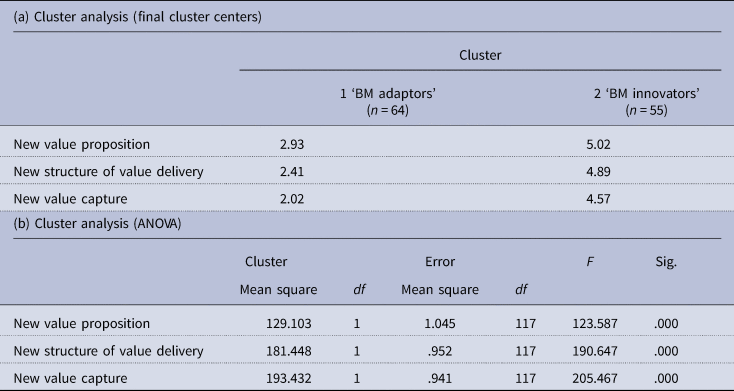
Note: The F-tests should be used only for descriptive purposes because the clusters have been chosen to maximize the differences among cases in different clusters. The observed significance levels are not correct for this and thus cannot be interpreted as tests of the hypothesis that the cluster means are equal.
Control variables
Following prior studies (Huergo & Jaumandreu, Reference Huergo and Jaumandreu2004; Roger, Reference Roger2004), we controlled for firm's size and age. Similar to Wilden et al. (Reference Wilden, Gudergan, Nielsen and Lings2013), we measured firm's age by asking the foundation year. For firm's size, we ask for number of employees and sales revenue. Due to missing data related to number of employees, we were only able to use sales revenue as an indicator for size.
Assessment of measurement constructs
Assessment of the DC measurement construct
As we conceptualized DCs as a reflective-formative construct (Wetzels, Odekerken-Schröder, & van Oppen, Reference Wetzels, Odekerken-Schröder and van Oppen2009; Wilden et al., Reference Wilden, Gudergan, Nielsen and Lings2013), we applied different quality criteria (Hair et al., Reference Hair, Sarstedt, Ringle and Gudergan2018). For the reflective LOCs of DCs, we examined internal consistency reliability, convergent validity and discriminant validity. In our original model, the first problem rose by the latent variable transforming, whose average variance extracted (AVE) was below the required threshold of .5. We found that TRA3 with a loading of .44 was the reason for this. Hence, based on the recommended outer-loadings relevance test for the transforming construct (Hair et al., Reference Hair, Hult, Ringle and Sarstedt2014), we removed TRA3 to attain a higher and significant value for AVE. Besides, we kept all other indicators with lower loadings, considering that the minimum requirements for indicator validity and AVE were met. Furthermore, the Fornell–Larcker criterion, testing discriminant validity, is met for all LOCs of DCs, also in relation to all other final constructs of the path model (Table 4). Regarding the cross-loadings, the results show that discriminant validity has been fulfilled, as the value of each factor was higher than the value of the latent variable. Similarly the factor loading values of each factor to its latent variable show that all values were above the threshold of .7. Notably, discriminant validity between the LOCs and HOC does not need to be established, as the HOC is measured formatively (Hair et al., Reference Hair, Sarstedt, Ringle and Gudergan2018). Consequently, all test statistics for LOCs meet the requirements for reflective measurements.
Correlations and Fornell–Larcker criterion
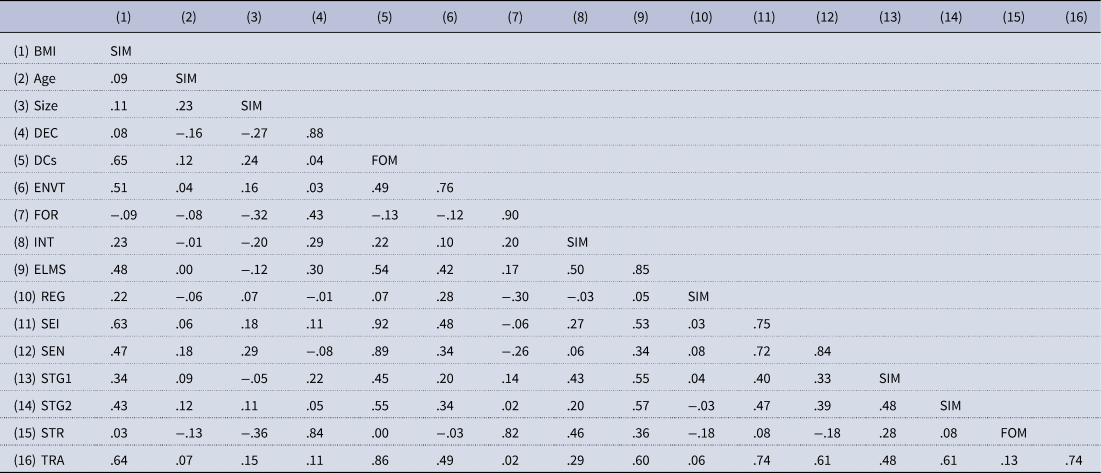
SIM, single-item measurement; FOM, formative measurement; BMI, business model innovation; DEC, decentralization; DCs, dynamic capabilities; ENVT, environmental turbulence; FOR, formalization; INT, integration; ELMS, entrepreneurial leadership and mindset; REG, regulatory; SEI, seizing; SEN, sensing; STG1, strategy 1; STG2, strategy 2; STR, structure; TRA, transforming.
Note: Values on the diagonal: the square root of AVE for reflective measurement constructs (this value must be greater that all correlations of the respective indicators to fulfill the Fornell–Larcker criterion).
To specify the HOC, we choose the repeated indicators approach used by Wilden et al. (Reference Wilden, Gudergan, Nielsen and Lings2013). Compared to the reflective LOCs, we conceptualized DCs using a formative composite model high-order index, which is supported by various evidence regarding expert validity (Wilden & Gudergan, Reference Wilden and Gudergan2015). To test for common method bias we applied multicollinearity testing, which is the appropriate method for PLS-SEM (Kock, Reference Kock2015; Ringle, Wende, & Becker, Reference Ringle, Wende and Becker2015). As shown in Table 5, the variance inflation factors (VIFs) are all below the suggested threshold of 5 (Hair, Risher, Sarstedt, & Ringle, Reference Hair, Risher, Sarstedt and Ringle2019) or ideally 3.3 (Kock, Reference Kock2015) and all weights are positive and significant at a 1% level (Figure 2).
Validation of the DC measurement construct.
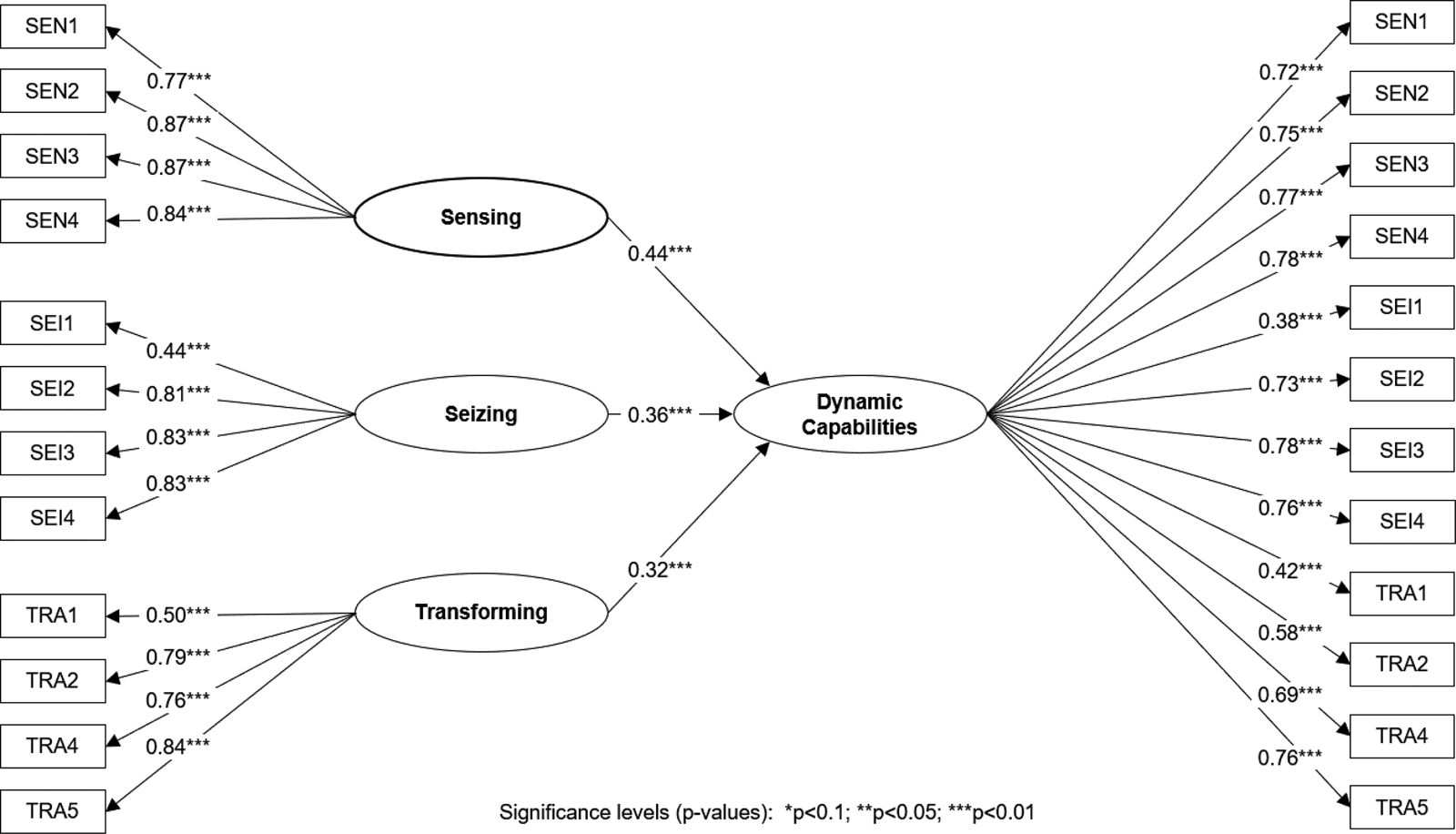
Quality criteria formative measurement DC

***Significant at .01 (two-tailed).
Consequently, our DC measurement construct fulfills all evaluation criteria and provides a reliable basis for further analysis.
Assessment of moderating factors
For the reflective measurement construct of ELMS, factor loading and AVE are above .5, the composite reliability (.91) and Cronbach's alpha (.87) exceeding .7. Thus, this construct fulfills the criteria of internal consistency reliability and convergent validity. In contrast, strategy could not be measured as a two-item reflective measure, as Cronbach's alpha of .65 is below .7. Thus, we tested the moderating effect of both strategy indicators using single-item measures. Furthermore, the second-order reflective-formative measure of organizational structure was assessed using the same criteria as for DCs. Both values for the reflective LOCs, internal consistency reliability and convergent validity, exceed the required threshold. The VIFs for the HOC are also below 5 and statistically significant (Table 6). Also, we can assume expert validity. Moreover, we note that an advanced measurement combining different organizational factors to test the impact of organizational alignment was not possible due to the construct's insufficient validity and reliability. Hence, we tested the moderating effect of each organizational factor separately.
Quality criteria formative measurement organizational structure

***Significant at .01 (two-tailed).
Next, we assessed ENVT. Originally, we planned to measure the degree of ENVT from the view of competition, market, technology and regulation. Since we included only six indicators for ENVT, we applied a six-item reflective measurement. Using an HOC, with each perspective as LOCs is not practical in our case due to the limited number of items measuring ENVT. Following the same validation procedure as for the LOCs of DCs, we excluded the items of competition and regulation, considering their low loadings and unsatisfied AVE of the latent variable representing ENVT. The final ENVT construct includes the change in technology, market and competition, while regulatory uncertainty (REG1) and overall competitive intensity (COM1) were studied separately. The final construct of ENVT fulfills all relevant validation criteria.
Finally, we assessed the discriminant validity of all reflective measurement constructs, using the Fornell–Larcker criterion. As Table 4 illustrates, discriminant validity is given. We also found that the constructs are sufficiently low correlated, except for the correlations between the DC-dimensions. However, as it is in their nature to relate closely to each other (Teece, Reference Teece2007), the measurement is still appropriate. Hence, we assume that our constructs are independent and suitable for deeper analysis.
Results
Analysis of the DC–BMI relationship and moderating effects
To test our hypotheses, we assessed the path coefficients, their statistical significance and effect sizes for each model. Besides, we compared the explanatory power (R 2) and predictive power (Q 2) of the respective model. Thereby, we used SmartPLS applying PLS algorithm, the bootstrapping procedure and blindfolding to calculate Q 2.Footnote 1
In model 1, we examined the DC–BMI relationship (Table 7). Here, the adjusted R 2 of BMI is substantial (.41). The result supports hypothesis 1, showing a positive direct effect of DCs on BMI (β = .66; p < .01). The results also support our hypotheses 1a–c, showing significant (p < .01) and positive indirect effects of all DC-dimensions. Thereby, sensing has the highest indirect effect (β = .27) on BMI, while seizing (β = .24) and transforming (β = .22) have slightly lower effects.
Main results DC–BMI relationships and moderating effects
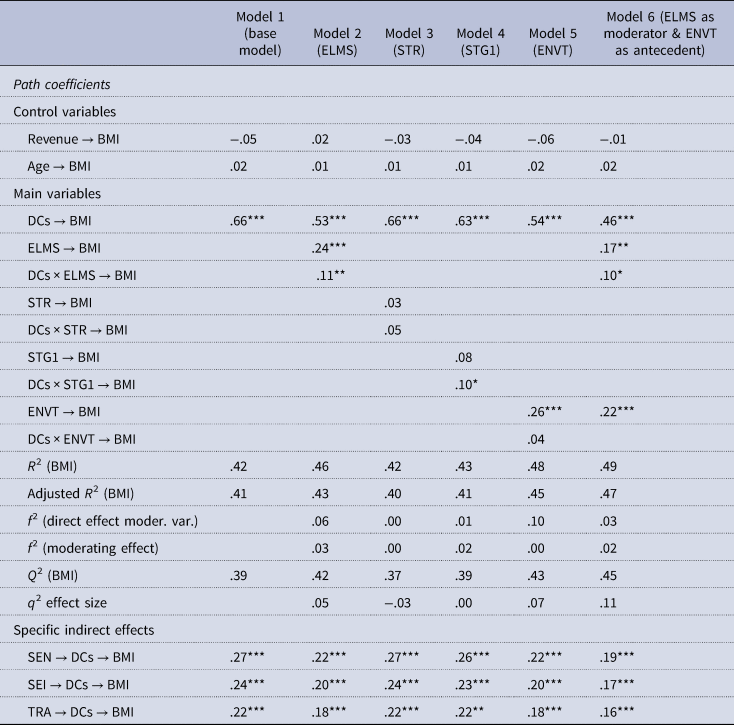
BMI, business model innovation; DCs, dynamic capabilities; ENVT, environmental turbulence; ELMS, entrepreneurial leadership and mindset; SEI, seizing; SEN, sensing; STG1, strategy 1; STR, structure; TRA, transforming.
Significance levels (p-values): *p < .1; **p < .05; ***p < .01.
Furthermore, we measured the moderating effects of ENVT and organizational factors on the DC–BMI relationship. As our variables are non-categorical, we used the product term approach, which is superior for continuous moderating variables used in our study (Henseler & Fassott, Reference Henseler, Fassott, Esposito Vinzi, Chin, Henseler and Wang2010). Thereby we applied the two-stage approach to model the interaction term. This is suggested if the moderator or, as in our case, the exogenous variable DCs, is measured formatively (Hair et al., Reference Hair, Hult, Ringle and Sarstedt2014). We conducted separated analyses for each moderator using the full sample and built a final model based on these results. Thereby we assessed two main criteria: the moderating effects by testing whether the moderators' path coefficients, which is also called interaction term, are statistically significant, and the strength of moderating effects using the effect size f 2. Thus, we compared the R 2 value of the base model with the R 2 value of each model that includes the respective moderating effect. Effect sizes of .35 represent large effects, while effect sizes of .15 and .02 represent medium and small effects.
We found that the DC–BMI relationship varies positively with the degree of ELMS (model 2). The moderating effect of .11 is positive, significant and hence supports hypothesis 2. Yet, due to f 2 = .03, the moderating effect is low. In model 3, we examined the moderating effect of an organic structure. Here the interaction effect (β = .05) and the direct effect (β = .03) are positive, but not significant. Since we found no evidence for moderating effects, we rejected hypothesis 3. Besides, we examined the effect of strategy on the DC–BMI relationship (model 4). While the direct effect of STG1 (β = .08) is positive but insignificant, its moderating effect is significant (β = .10; p < .1). Yet, due to f 2 = .02 the effect is small. In contrast, we found no significant results for STG2 (Appendix 2, model 7).
Lastly, we test the moderating effect of ENVT (model 5) and found a highly significant direct effect on BMI (β = .26), whereas the moderating effect is positive (β = .04), but insignificant. As the direct effect on BMI is considered small (f 2 = .10), our results do not support hypothesis 5. Also, we tested the moderating effects of COM1 (model 11) and REG (model 12). The results show insignificant values for the moderating effect. Yet, REG shows a direct effect (β = .18) on BMI with a small effect size (f 2 = .06). In contrast, COM1 has no significant direct effect on BMI.
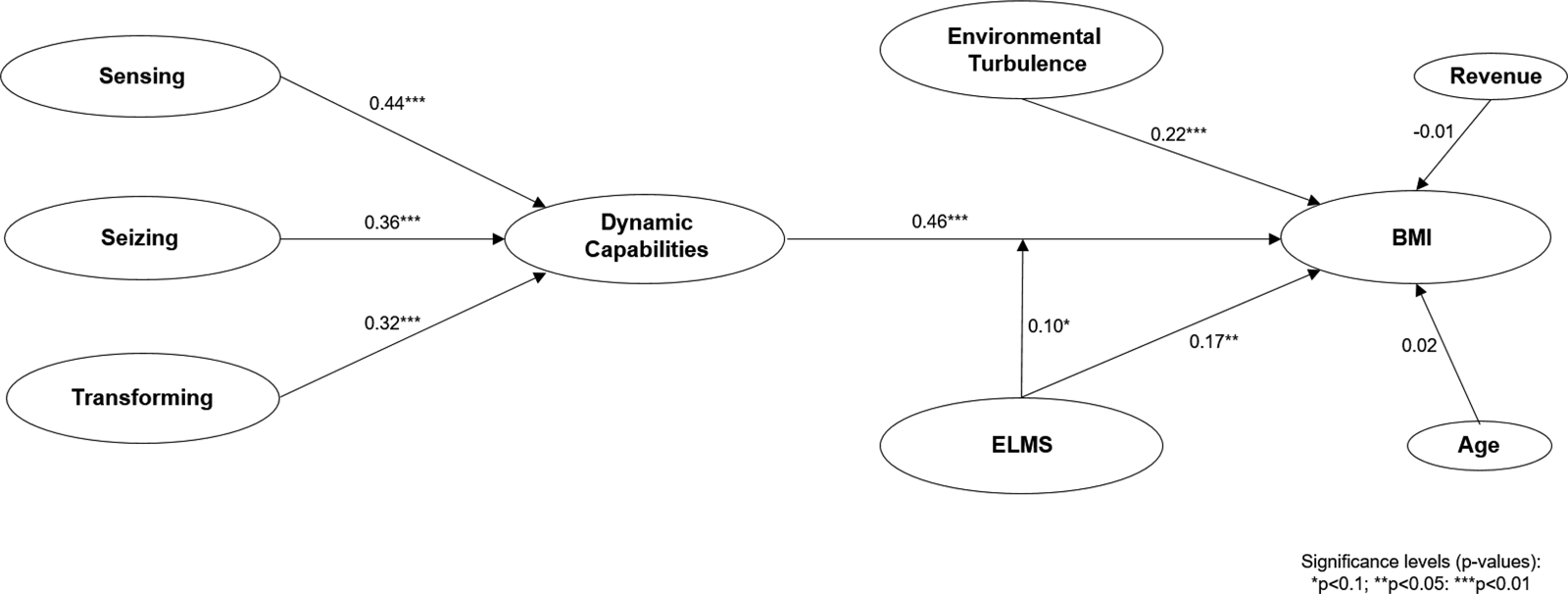
Based on our main results, we built model 6 (see Figure 3), which includes the effects of ELMS and ENVT. We developed the model as a combination of models 2 and 5 due to their significant results, effect sizes and high explanatory power of the respective models. Thus, model 6 has the highest explanatory power for BMI (adj. R 2 = .47) and shows significant path coefficients for ELMS and ENVT on BMI. Moreover, the results suggest that ELMS positively moderates the DC–BMI relationship with a small effect size (f 2 =.02). Remarkably, none of the control variables showed significance in all models.
Results model 6.
Finally, to examine each models' predictive relevance, we determined Stone–Geisser's Q 2 value (Geisser, Reference Geisser1974; Stone, Reference Stone1974) using the cross-validated redundancy approach as proposed by Hair et al. (Reference Hair, Hult, Ringle and Sarstedt2014). Q 2 values >0 indicate sufficient predictive relevance for the respective path model, which is applicable for endogenous single-item constructs (here BMI). All models 1–6 fulfill this criterion for the endogenous variable BMI. To compare the impact of predictive relevance between the different models, we calculated the q 2 effect size. We found that only ELMS in model 2 (q 2 = .05) and ENVT in model 5 (q 2 = .07), and the combination of these two in model 6 (q 2 = .11), have small predictive effects. For any other model, we found no predictive effect compared to the base model.
Additional analysis: the antecedents of DCs and BMI
Since we only found ELMS and STG1 as significant moderators, the question arises, which role the other contextual factors play in the DC–BMI relationship. As research highlights ENVT and STR not only as moderating factors but also as antecedents for DCs and BMI (e.g., Foss & Saebi, Reference Foss and Saebi2017; Schilke, Hu, & Helfat, Reference Schilke, Hu and Helfat2018) and our results above support the view of these factors as antecedents, we therefore conducted an additional analysis (Table 8).Footnote 2
Additional analysis – antecedents of DCs and BMI
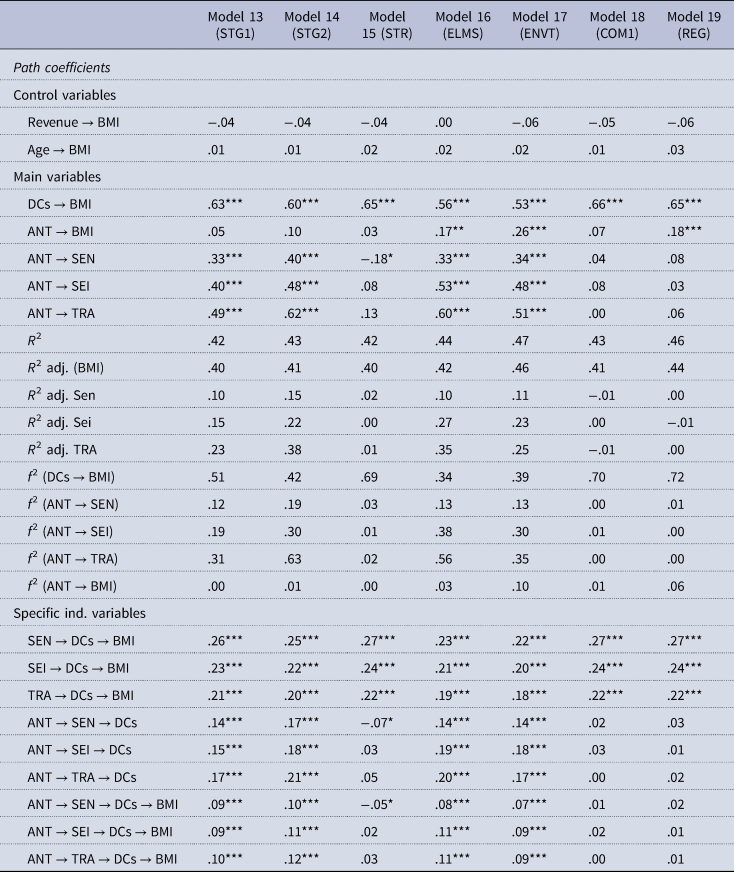
ANT, antecedent; BMI, business model innovation; COM1, competitive intensity 1; DCs, dynamic capabilities; ENVT, environmental turbulence; ELMS, entrepreneurial leadership and mindset; REG, regulatory; SEI, seizing; SEN, sensing; STG1, strategy 1; STG2, strategy 2; STR, structure; TRA, transforming.
First, we studied organizational factors as antecedents of BMI and DCs in one model. We found significant effects of organizational structure neither on BMI nor on DCs. In contrast, strategic factors (models 13 and 14) significantly affect sensing, seizing and transforming. Thereby, transforming (βSTG1 = .49; βSTG2 = .62) is stronger stimulated than seizing (βSTG1 = .40; βSTG2 = .48) and sensing (βSTG1 = .33; βSTG2 = .40). The effect size of the strategic factors on the DC-dimensions is medium (f 2 > .15) and even f 2 > .35 for STG2 on transforming, suggesting a large effect size. Yet, the direct effects of STG1 and STG2 on BMI are insignificant, which does not support the view that strategic factors are direct antecedents of BMI. As our results suggest that strategy is an antecedent of DCs, we conclude that strategic factors indirectly affect BMI. The significant specific indirect effects of STG1 and STG2 on BMI also indicate this. Although results reveal that ELMS positively moderates the DC–BMI relationship and directly affects BMI, we also found a significant direct effect of ELMS on the DC-dimensions (model 16). Hence, our results suggest a threefold role of ELMS, as a moderator of the DC–BMI relationship and as an antecedent of DCs and BMI. All direct and specific indirect effects are significant. Also, the effect of ELMS is particularly strong for transforming and seizing capabilities, while the effect on sensing is smaller but still substantial.
Second, we tested the role of ENVT as antecedent of DCs and BMI. As mentioned, we identified direct effects of ENVT and REG on BMI, whereas we found no significant influence of COM1. Besides the direct effects on BMI, we also studied the potential direct impact of environmental factors on DCs by building models 17–19, in which these factors act as antecedents of DCs and BMI. The direct effects of ENVT and REG on BMI did not change substantially. Regarding their effects on DCs, we found a highly significant direct impact of ENVT on sensing (β = .34), seizing (β = .48) and transforming (β = .51). This finding supports our hypothesis 5 that DCs are especially required in a turbulent environment. Thereby, seizing (f 2 = .30) and transforming (f 2 = .35) are stronger stimulated by ENVT than sensing (f 2 = .13). These direct effects are transferred to BMI, which account for the positive indirect effects of ENVT on BMI. As shown in ‘specified indirect effects,’ those indirect effects on BMI are significant (p < .01). In contrast, we cannot identify any significant direct impact of COM1 and REG on DCs, nor an indirect effect on BMI. The control variables show no significance.
Discussion
Relationship of DCs and BMI in the digital context
Our results confirm that DCs are an enabler of BMI (Achtenhagen, Melin, & Naldi, Reference Achtenhagen, Melin and Naldi2013; Foss & Saebi, Reference Foss and Saebi2017; Leih, Linden, & Teece, Reference Leih, Linden, Teece, Foss and Saebi2015; Teece, Reference Teece2018a; Witschel et al., Reference Witschel, Döhla, Kaiser, Voigt and Pfletschinger2019). Furthermore, we found that the DC-dimensions are not only unequally pronounced (Teece, Reference Teece2018a; Witschel et al., Reference Witschel, Döhla, Kaiser, Voigt and Pfletschinger2019), but also differ slightly regarding their effects on BMI. Although the dimensions are highly correlated, we found that sensing has the largest specific indirect effect on BMI, slightly lower effects for seizing and the lowest for transforming. From a processed view, sensing is ‘of utmost importance’ (Protogerou, Caloghirou, & Lioukas, Reference Protogerou, Caloghirou and Lioukas2012, p. 620), as this ability is considered as a starting point for BMI (Teece, Reference Teece2018a) and a fundamental component of sustainable competitive advantage (Teece, Reference Teece2007). Applied to our context, without strong sensing capabilities there is no systematic and early detection of new digital opportunities, and thus no appropriate response in form of seizing and transforming.
Moreover, we used and refined a newly developed conceptualization of DCs based on Witschel et al. (Reference Witschel, Döhla, Kaiser, Voigt and Pfletschinger2019), which is also similar to traditional ones of, for example, Wilden et al. (Reference Wilden, Gudergan, Nielsen and Lings2013). In our analysis, we were able to empirically validate this conceptualization that takes aspects of digitalization into account. Besides, our conceptualization is a combination of general and specific subcapabilities for digitalization. General subcapabilities are usually already established in an organization and need to be adapted in the digital context. However, specific subcapabilities emerged in the context of digitalization and became crucial for BMI (Witschel et al., Reference Witschel, Döhla, Kaiser, Voigt and Pfletschinger2019). In particular, our results confirm the findings of Witschel et al. (Reference Witschel, Döhla, Kaiser, Voigt and Pfletschinger2019), highlighting the role of internal and external cooperation as an important microfoundation for all DC-dimensions. This is also consistent with earlier findings indicating an increasing relevance of internal and external collaboration in turbulent environments (Helfat, Finkelstein, Mitchell, Peteraf, Singh, & Winter, Reference Helfat, Finkelstein, Mitchell, Peteraf, Singh and Winter2007), such as in the context of digitalization (Day & Schoemaker, Reference Day and Schoemaker2016; Witschel et al., Reference Witschel, Döhla, Kaiser, Voigt and Pfletschinger2019).
Surprisingly, the control variables had no significant impact in our models, contradicting the assumption that these factors are boundary conditions of BMI (Foss & Saebi, Reference Foss and Saebi2017; Karimi & Walter, Reference Karimi and Walter2016) and influence the DC-effects (Schilke, Hu, & Helfat, Reference Schilke, Hu and Helfat2018; Wilden et al., Reference Wilden, Gudergan, Nielsen and Lings2013). The digitalization context may provide an explanation, as the nature and impact of digitalization is so profound that it affects firms of all size, age and industries. Consequently, responding to digitalization becomes a strategic imperative, according to the much-quoted motto ‘digitalize or drown’ (Schreckling & Steiger, Reference Schreckling, Steiger, Oswald and Kleinemeier2017).
Role of organizational factors on the DC–BMI relationship
The result shows a strong interrelationship of ELMS and strategy with both main constructs DCs and BMI. Thereby, we conceptualized and validated a measurement construct that is similar to previous studies (Karimi & Walter, Reference Karimi and Walter2016; Schoemaker, Heaton, & Teece, Reference Schoemaker, Heaton and Teece2018) and show that ELMS moderates the DC–BMI relationship. Consistent with Karimi and Walter (Reference Karimi and Walter2016), ELMS also has a significant direct effect on BMI, but also acts as an antecedent of the DC-dimensions. Surprisingly, ELMS has the largest impact on transforming, with lower but still significant effects on seizing and sensing. This is in contrast to prior work suggesting that entrepreneurial leadership is especially relevant for sensing, while a managerial leadership style is positively associated with seizing and transforming (Teece, Reference Teece2007, Reference Teece2014; Witschel et al., Reference Witschel, Döhla, Kaiser, Voigt and Pfletschinger2019). One explanation for this could be that our ELMS definition differs slightly from the one of entrepreneurial and managerial leadership style used in the mentioned studies, as we consider not only leadership style, but also organizational culture. Nevertheless, we found that ELMS, associated with openness to change and risk-taking, is crucial for the transformation process, in which an organization often undergoes fundamental changes. Consequently, since we found a threefold role of ELMS as an antecedent of DCs and BMI and as a moderator of the DC–BMI relationship, we conclude that ELMS is a beneficial condition for doing business in the digital age as it encourages firms to transform their BM. Hence, the high relevance of ELMS supports the assumption that top management involvement is important for BMI (Foss & Stieglitz, Reference Foss, Stieglitz, Foss and Saebi2015; Kane et al., Reference Kane, Palmer, Phillips, Kiron and Buckley2015).
Moreover, we cannot confirm that an organic structure is positively associated with BMI and moderates DCs (Teece, Reference Teece2000, Reference Teece2007; Wilden et al., Reference Wilden, Gudergan, Nielsen and Lings2013). Indeed, we found no evidence that organizational structure affects the DC–BMI relationship, nor other construct. One explanation could be that neither extreme of the continuum between organic and mechanistic structure favors the DC–BMI relationship, but rather a mixture of both may be more beneficial. Thus, the relationship could be non-linear.
Concerning the strategic factors, we found no direct effect of strategy on BMI, but a significant, yet weak moderating effect of STG1 on the DC–BMI relationship. Hence, our findings provide limited evidence for the moderating role of strategic factors as suggested by Witschel et al. (Reference Witschel, Döhla, Kaiser, Voigt and Pfletschinger2019). In contrast, our results reveal that STG1 and STG2 act as antecedents of DCs and thus have indirect effects on BMI. This finding is consistent with Kane et al. (Reference Kane, Palmer, Phillips, Kiron and Buckley2015) and Bereznoi (Reference Bereznoi2015) and contributes to the understanding on how strategy affects BMI and empirically validates the importance of a clear and embedded vision combined with a digital strategy. Likewise, we show that strategy is highly important for all DC-dimensions, with the largest effect on transforming. This is similar to Teece (Reference Teece2014) and suggests that strategy provides the necessary guidance for sensing and seizing, while being particularly important for transforming. Thus, our results highlight the importance of strategic factors for the strength of DCs and BMI (Teece, Reference Teece2018a).
Role of environmental factors in the DC–BMI relationship
Against the prevalent view (Schilke, Hu, & Helfat, Reference Schilke, Hu and Helfat2018; Wilden et al., Reference Wilden, Gudergan, Nielsen and Lings2013; Witschel et al., Reference Witschel, Döhla, Kaiser, Voigt and Pfletschinger2019), we found no evidence for a moderating effect of ENVT on the DC–BMI relationship. Instead, we show that ENVT is an antecedent of DCs and BMI. Specifically, high ENVT positively influences DCs and thus indirectly affects BMI. Notably, the impact is greater on seizing and transforming than on sensing. This lets us assume that firms constantly need a moderate level of sensing, while seizing and transforming are mainly stimulated in a turbulent environment. Constant sensing is essential for identifying threats and opportunities in the context of digitalization and is thus a prerequisite of seizing and transforming. Besides, we found evidence that ENVT is an antecedent of BMI, reflecting the common understanding in literature and business practice that firms change or even radically innovate their BMs in highly dynamic environments (Sauer, Dopfer, Schmeiss, & Gassmann, Reference Sauer, Dopfer, Schmeiss, Gassmann, Gassmann and Sutter2016). Similar to ENVT, regulatory turbulence acts as an antecedent of BMI.
Managerial implications
Our conceptualization of DCs from a microfoundational view gives practitioners insights which subcapabilities are required to build strong DCs and how they influence BMI in the context of digitalization. Moreover, the significant weights of the DC-dimensions indicate that a firm must develop all DCs at the same time to innovate its BM, whereas sensing seems to be especially relevant. Thus, we provide guidance for management concerning their investments in DCs. Since a key concern for business practice is, which organizational conditions are beneficial to foster BMI and respond adequately to the major changes associated with digitalization, we shed light on this question. We thereby found evidence, that leadership and mindset should be entrepreneurial. Although, culture and leadership cannot be changed overnight, top management can exemplify these characteristics and initiate the organizational change toward an entrepreneurial mindset. Likewise, we create awareness for the importance of a clear vision and aligned corporate and digital strategy. Our findings implicate that both strategic aspects are antecedents of DCs and thus positively influence their strength. They seem to provide guidance to employees in the context of substantial change that digitalization entails. Finally, the role of ENVT as an antecedent of DCs underlines the high relevance for firms to build strong DCs in the context of digitalization. Furthermore, our results indicate the high relevance of BMI in the digital context, highlighting the need to constantly asses the appropriateness of the current BM.
Limitations and avenues for future research
Our analysis is not without limitations. First, we acknowledge limitations concerning the used data. Although we applied measures to minimize potential biases in data collection, we cannot completely exclude bias. We also used a relatively small sample. However, this is common in surveys involving top management (Wilden et al., Reference Wilden, Gudergan, Nielsen and Lings2013). Second, insignificant results of control variables, for example, firm size, may be caused by missing data related to employee numbers. Measuring revenue expressed as a logarithm of its absolute value (Wilden et al., Reference Wilden, Gudergan, Nielsen and Lings2013) would improve the results. Similarly, our insignificant results for organizational structure may be affected by the newly developed construct, involving aspects that are especially relevant in the digital context. Third, to achieve a more holistic view and minimize lower response rate, we used a lean survey design with single-item constructs to measure contextual factors, which is in contrast to related in-depth studies (Jaworski & Kohli, Reference Jaworski and Kohli1993; Karimi & Walter, Reference Karimi and Walter2016; Wilden et al., Reference Wilden, Gudergan, Nielsen and Lings2013). Using multi-item constructs, research could reveal additional insights related to the specific impact of different types of ENVT. Similarly, a more nuanced investigation of organizational factors is required to examine which organization design is beneficial for the DC–BMI relationship. Also examining to which extent these factors need to be congruent deserves more attention (Kane et al., Reference Kane, Palmer, Phillips, Kiron and Buckley2016; Witschel et al., Reference Witschel, Döhla, Kaiser, Voigt and Pfletschinger2019). Fourth, in our analysis we solely focused on moderation effects, which is one of the most growing research areas (Schilke, Hu, & Helfat, Reference Schilke, Hu and Helfat2018). Nevertheless, in line with other scholars (e.g., Baía & Ferreira, Reference Baía and Ferreira2019; Schilke, Hu, & Helfat, Reference Schilke, Hu and Helfat2018; Wilden et al., Reference Wilden, Gudergan, Nielsen and Lings2013) we encourage future work to examine causal mechanisms (i.e., mediators), which are still hardly explored. As a starting point, it would be interesting to study the role of entrepreneurial orientation or strategic factors (e.g., Ciampi, Demi, Magrini, Marzi, and Papa, Reference Ciampi, Demi, Magrini, Marzi and Papa2021) as mediators of the DC–BMI relationship. Similarly, future research could investigate the mediating role of DCs in enhancing firm performance. Fifth, although our results deliver valuable insights regarding the DC–BMI relationship in the digitalization context, we have neither an indication on the success of BMI nor the effect on firm performance. Investigating performance implications of DCs and extending the ongoing debate by introducing BMI as an intermediate outcome is important, since this would reduce ‘the relative scarcity of empirical research on the performance implications of dynamic capabilities, particularly on the mediating mechanisms of dynamic capabilities effects’ (Zhou et al., Reference Zhou, Zhou, Feng and Jiang2019, p. 742). Moreover, examining this relationship by considering contingency effects would be another fruitful research area (Baía & Ferreira, Reference Baía and Ferreira2019; Wilden et al., Reference Wilden, Gudergan, Nielsen and Lings2013). Sixth, we acknowledge the limitation regarding the use of a single-item construct for measuring BMI. Since this work did not involve a differentiated discussion of the results in terms of adaptors and innovators, we call to replicate this study and address this weakness. Similarly, the use of a more complex BMI scale would allow a more detailed analysis from a microfoundational perspective and improve understanding of DC effectiveness. Finally, we encourage scholars to build on this study and further deepen the understanding of the microfoundations of DCs that enable BMI in the digital context. For example, as our results indicate a high importance of relational capabilities, for example, cooperation with internal and external stakeholder or engagement in ecosystems, further studies could examine their optimal design, specific role and impact. Likewise, examining other industries, geographical areas or different firm characteristics would enhance the understanding of the role of DCs and their underlying microfoundations in different contextualization.
Conclusion
To refer to the title of our work, we conclude: when sailing in stormy waters, such as the age of digitalization, it is vital for firms to direct their sails through DCs and BMI. Or as Ella Wheeler Wilcox (1916), a famous American author and poet, would say: ‘One ship drives east and other drives west by the same winds that blow. It's the set of the sails and not the gales that determines the way they go.’
Appendix A
Scales and sources
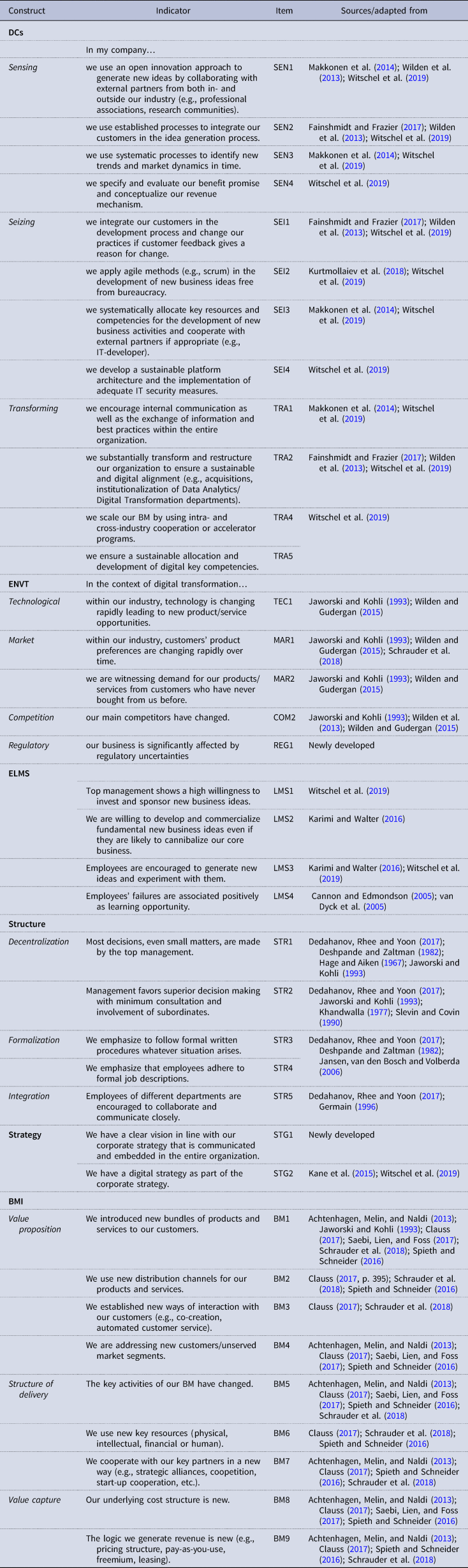
DC–BMI relationship and moderators (models 7–12)
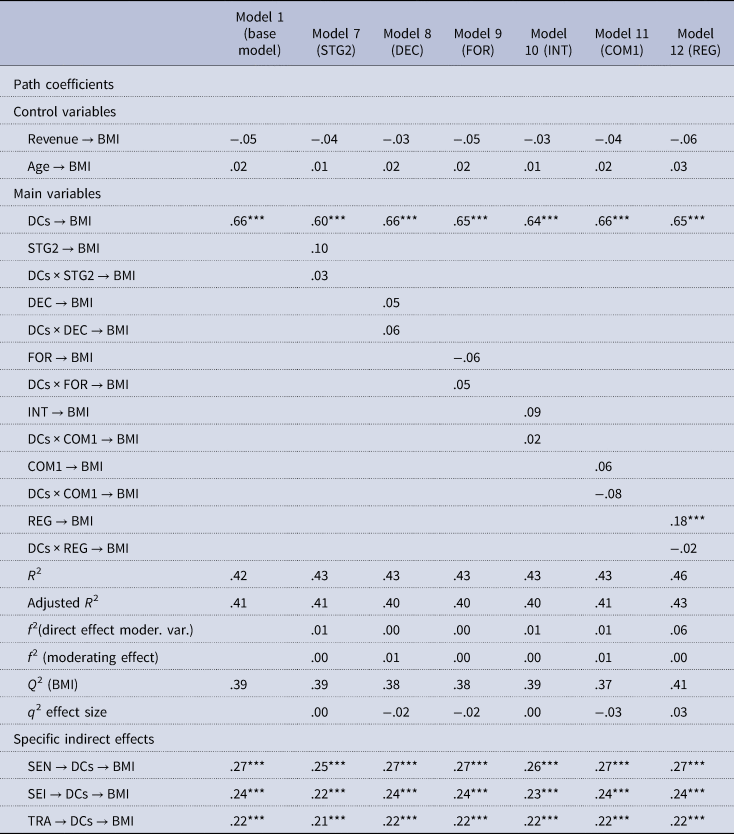
About the authors
Daliborka Witschel is a research and teaching associate at the Chair of Industrial Management, School of Business, Economics and Society at the Friedrich-Alexander-University Erlangen-Nürnberg, Germany. Her research interests are in the areas of business model innovation, strategic management, innovation management, dynamic capabilities and digital transformation. Her latest work was published in the Journal of Business Economics.
Dominik Baumann is a vendor manager at Amazon. He has broad professional experience in the fields of management consulting, strategy and from working in a fast-growing tech-startup backed by top-tier investors. He also worked in the fields of research and teaching at the Chair of Statistics and Econometrics as well as the Chair of Corporate Management at the Friedrich-Alexander-University Erlangen-Nürnberg, Germany. His practical and research interests lie at the intersection of strategy, innovation management and entrepreneurship.
Prof. Dr. Kai-Ingo Voigt is a full professor and holds the Chair of Industrial Management at theSchool of Business, Economics and Society at the Friedrich-Alexander-University Erlangen-Nürnberg, Germany. His research interests are in the areas of technology and innovation management, business model innovation, industrial value creation, Industry 4.0/Industrial Internet of Things, organizational creativity, as well as production and sustainability in industrial management. His work is published in various journals, including Journal of Product Innovation Management, European Management Journal, European Journal of Innovation Management, International Journal of Innovation Management, Journal of Business Economics, Technovation and Technological Forecasting and Social Change.


 Open access

