


In July 1924, Mexico City’s major newspapers reported that male students from the National Medical School and the National Preparatory School had attacked several “pelonas”—Mexico’s version of the flapper—dousing them with water and trying to shave their already shorn heads (Rubenstein Reference Rubenstein, Olcott, Vaughan and Cano2006; Serna Reference Serna2014).Footnote 1 According to an extensive article in the daily newspaper Excelsior published on July 23, these male students saw publicly shaming these women as a “national duty.”Footnote 2 Hair cropped “a la Bob [sic],” they argued, represented a rejection of the “dark braid” and “discreet nape” that they considered the “glories” of Mexican feminine beauty. Some of the young men interviewed for the article claimed that pelonas deserved to be punished because bobbed hair had the same provenance as the “taxicab,” “rapid lunch,” and “jazz-band.” As Excelsior’s reporter phrased it, Yankee cultural imperialism threatened to “shave” Mexico’s national character.
As the story developed over the following days, women’s fashions and their impact on national identity quickly became a secondary theme. Instead, newspaper coverage focused on the escalating tensions between the male students of the medical school and the National Military College, a near duel, and the efforts of various groups of men to one-up each other in their defense of Mexican womanhood. As news coverage of the incident shows, the male voices chiming in to express solidarity with the pelonas covered the political and social spectrum, from students and government bureaucrats to union leaders and laborers (most notably trolley car drivers).Footnote 3 In a series of letters published in the city’s newspapers, each group of men asserted that their stance toward women reflected Mexico’s true “national character.”Footnote 4 As Paula Gómez, a self-avowed pelona, pointed out in a letter to the Federal Prosecutor’s Office published in Excelsior, the official response to the entire incident was not to protect women but to protect “masculine honor.”Footnote 5 At the end of her missive, Gómez observed wryly that Mexican men—including notably those referred to as fifís, whose style and behavior were considered by many to be deeply problematic—copied North American fashions without fear of being attacked in the streets.Footnote 6
The posturing of men during what came to be called the “war on pelonas” reflects underlying anxiety about masculinity and national identity in postrevolutionary Mexico. To date this anxiety has been most fully explored via scholarly analyses of the public debate about national literature, masculinity, and nationalism engaged in by opposing literary factions, the contemporaneos and the estridentistas (Irwin Reference Irwin2003). However, as Paula Gómez’s observation suggests, questions about masculinity also emerged in the realm of popular culture, where they focused with increasing frequency on whether engagement with American mass culture was beneficial or detrimental to Mexico’s postrevolutionary nation-building project.
Fiction, anthropological studies, brief news items, and editorial cartoons thematized the perceived threat of US mass culture to Mexican men, demonstrating that the discourse about Mexican masculinity in the 1920s was inflected not only by revolutionary ideology and nationalist aesthetics but also by questions about the influence of American mass culture and the attitudes toward public space, sexuality, and work many believed it engendered. Concerns about if and how to integrate American mass culture into revolutionary Mexican society can be found in the discourse on two seemingly disparate groups of men: urban dandies, or fifís, as they were called in the 1920s; and returning migrants, whose encounters with consumer and popular culture in the United States shaped or, some would argue, warped their identification with Mexico.
With attention to masculinity and popular culture, this essay enters into the rich field of historical and cultural studies scholarship on Mexican masculinity (Rubenstein Reference Rubenstein, Gilbert, Rubenstein and Zolov2001; de la Mora Reference de la Mora2006; Macías-González and Rubenstein Reference Macías-González and Rubenstein2012; Wood Reference Wood2014). This scholarship, in dialogue with work on women’s challenges to gender norms during and after the revolution, has shown how gender and sexuality shaped the formation of modern Mexican national identity.Footnote 7 Throughout Latin America the transnational circulation of American mass culture offered new models of gender, including attitudes toward public space, sexuality, and consumption (see, for example, Karush Reference Karush2012; Milanesio Reference Milanesio2013; Serna Reference Serna2014). However, local encounters with forms of masculinity coded as American were never straightforward contests between the national and the foreign.Footnote 8 Rather, as William Roseberry (Reference Roseberry, Gilbert, Catherine and Ricardo1998, 515) reminds us, “foreign influences are introduced within preexisting social and cultural relations that reconfigure and localize or situate the foreign.”
In Mexico, American-influenced forms of masculinity—like the returning migrant or the fifí—entered into debates about the type of men Mexico’s postrevolutionary nationalist project required. These men disquieted politicians, intellectuals, and journalists precisely because of their exposure and sometimes immersion in American culture, but a closer look shows that this unease did not lead to a wholesale rejection of American culture. Rather, popular texts and policy makers alike promoted the judicious adoption of American values and customs, which could be used to support Mexico’s postrevolutionary nation-building project even as these men themselves seemed to reject attempts to mold their self-expression to the needs of the state.
Mexican masculinity: Models and mannequins
In nineteenth-century Mexico, as Robert McKee Irwin (Reference Irwin2003, 48–49) explains, gender roles were clearly circumscribed even as homosocial relations shaped the newly independent nation’s identity. During the porfiriato (the period between 1876 and 1911 when President Porfirio Díaz governed Mexico), the cultural and political elite lamented the hypermasculinity and assumed sexual promiscuity of lower-class men. At the same time, “civilized” masculinity threatened to veer into effeminacy, which gradually became synonymous with homosexuality and was perceived as equally dangerous to the national project (Macías-González and Rubenstein Reference Macías-González and Rubenstein2012, 9–10; Irwin Reference Irwin2003, xxii). On the eve of the revolution, contemporary observers described Mexico City, the country’s seat of political power, as a “territory of conservatism, decadence, and lack of masculinity” particularly in reference to the middle class (Piccato Reference Piccato2001, 22).
After the revolution, national discourse promoted a virile masculinity associated with revolutionary heroes (O’Malley Reference O’Malley1986; Irwin Reference Irwin2003). Images of this masculine ideal circulated in popular print and visual culture and became a key part of civic rituals. For example, the charro, the manly horseman identified by his flashy suit and prowess with both horses and women, became associated with lo mexicano both at home and abroad (Pérez Montfort Reference Ricardo2003, 121–148; Nájera-Ramírez Reference Nájera-Ramírez1994). And images of Mexican men as protagonists in the revolutionary struggle, which privileged figures such as Pancho Villa and Emiliano Zapata with their rugged military appearance, wide sombreros, and impressive mustaches, circulated widely via the artistic production of government-sponsored artists such as Diego Rivera (Folgarait Reference Folgarait1998; O’Malley Reference O’Malley1986, 3).
Mexico also needed men who were industrious, sober, and practical. Thus, the 1920s also saw the introduction of future-oriented, modern masculine types. The urban worker, as the historian John Lear (Reference Lear2014, 236) argues, emerged as an “essential actor” in Mexico’s visual culture, particularly in print media. While some of these representations focused on politics, many offered “a vision of the worker in terms of his aspirations as a citizen and consumer” (Lear Reference Lear2014, 237). Also, as Julio Moreno (Reference Moreno2003) documents, the state began to actively promote professions such as architecture and the law. In this context, the middle and upper classes encouraged men of all stations to improve themselves through education and sports, and attempted to impart the values of thrift, sobriety, and hard work to industrial and agricultural workers (Pierce Reference Pierce, Pierce and Toxqui2014). Publications of all political stripes encouraged men to save, drink in moderation, take their civic duties seriously, and practice self-discipline. For example, newsletters published by newly formed chambers of commerce in Mexico translated articles from American publications about marketing, success in business, hygiene, comportment, and self-improvement for their readership.Footnote 9 An editorial published in the city of Monterrey’s daily newspaper El Porvenir in 1924 summed up the relationship between personal development and the national project: “the energies of men, of a society, of a country find rest in the renovation of orientations or in a change of work, but never in the calm and smooth inertia, nor in easily enervating routine.”Footnote 10 Dress had particular valence within this discourse. Another journalist opined that “workers who wear jean overalls are much more elevated and have a better and higher conception of life” than those who wore the peasant’s traditional white cotton trousers and shirt.Footnote 11 Within this broad normative discourse, men exposed to American culture via migration threatened to strike a discordant note even as they might learn something of value during their sojourns in the United States.
Migration and mass culture
Migration from Mexico to the United States increased during the late teens and early 1920s. Under Porfirio Díaz an increase in foreign capital investment led to the modernization of Mexico’s agricultural sector and exacerbated social and economic inequalities in rural Mexico. At the same time, Mexico’s dramatically expanded railway system facilitated seeking employment in other parts of the country and the southwestern United States (Henderson Reference Henderson2011 14–15). The social and economic chaos the revolution left in its wake further encouraged migration. Violence, a lack of employment opportunities, inflation, and the threat of starvation, particularly in Mexico’s central plateau area, dovetailed with US mining, agriculture, and railroad industries’ need for cheap labor.Footnote 12 Labor contractors promised Mexican workers well-paying jobs, but once they arrived, workers faced substandard labor conditions, lower-than-expected pay, and racial discrimination. Despite the problems they faced in the United States, Mexicans continued to emigrate.
This increase in emigration worried the Mexican government. At the very moment that Mexico needed workers to rebuild its agricultural and mining industries, it was losing some of its most capable laborers to the United States. In response, the government instituted more systematic repatriation programs, urged consulates to help migrants, and began revising the laws governing migration under the guidance of a national advisory commission (Cardoso Reference Cardoso1976). The government also initiated an extensive propaganda campaign to deter laborers from leaving. In a book on the issue, Gustavo Durón González, a member of the federal Chamber of Deputies, labeled the losses due to emigration “shameful.” Migration, he asserted, was motivated by mistaken perceptions of the United States as a land of abundance and economic opportunity (Durón González Reference Durón González1925, 71, 117).Footnote 13
Repatriation brought its own problems. According to newspaper accounts, rather than returning with tales of wealth and opportunity, many repatriates returned disillusioned and “in misery.”Footnote 14 Others claimed that returning migrants brought back “the insanity, the vice created in desperation, a bitter [unreadable] for everything and against everything … this lack of will, this moral weakness that nullifies our proletariat and withers all enthusiasm and desire.”Footnote 15 Los Angeles-based journalist Francisco Naranjo observed, “immigration to the United States suits neither Mexico in general nor Mexicans in particular … they [Mexicans] don’t adapt to the customs of this country [the United States], but instead learn everything bad.”Footnote 16
But not everyone was pessimistic about what repatriates might bring back with them. Some believed that time spent in the United States would make peasants more modern, like the migrants Mexico’s own policies sought to attract (FitzGerald and Cook-Martín Reference FitzGerald and Cook-Martín2014). The anthropologist Manuel Gamio (Reference Gamio1935) contended that migrants’ exposure to modern agricultural and industrial techniques, increased levels of literacy, and strengthened sense of national and communal identity forged in the crucible of American racism could contribute to Mexico’s development. Durón González (Reference Durón González1925, 143) likewise maintained that returning migrants could be useful contributors to Mexico’s nation building project if their reentry was handled carefully. This tension between the risks and potential benefits to the nation of migration appeared in popular fiction, which offered both cautionary tales and models of how the values associated with the United States might be productively incorporated into modern Mexican society.
Fantasies of return
Carlos Noriega Hope was an editor, journalist, and screenwriter who from 1920 until his death in 1934 edited the weekly supplement El Universal Ilustrado. In the section “La novela semanal” (the weekly novel), which appeared from 1922 to 1925, Noriega Hope published short stories or serialized novels, including stories he wrote himself, alongside the work of avant-garde writers (Mahieux Reference Mahieux2011). In the late teens Noriega Hope spent time in Los Angeles exploring the world of Hollywood and writing about it for Mexican readers in essays published in installments in El Universal and later collected in El mundo de las sombras: El cine por dentro y por fuera (Reference Noriega Hope1920). Among his short stories, two take up the dilemmas posed by Mexican migration to the United States.
In two stories, Noriega Hope examines the potentially damaging effects of exposure to US mass culture in general and US cinema in particular.Footnote 17 The protagonist of each story spends time in the United States, a sojourn that precipitates questions about their national identity and relationship to Mexico. In each story, the main character’s encounters with US mass culture do not diminish their mexicanidad or their investment in the project of national development, but rather renew their sense of national identity and allegiance to the nation.
“La grande ilusión” (Noriega Hope Reference Noriega Hope1923b) recounts the experience of a young woman, Mercedes, devoted to the fast life in Mexico City. She accompanies a male ‘friend,’ Enrique, to his family’s hacienda, which is mortgaged to the hilt (11). There she falls in love with the estate’s new manager, Gonzalo Castillo, who has returned to Mexico after living in the United States. While their love is doomed by Mercedes’s rejection of traditional femininity, Noriega Hope offers a vision of the ways in which contact with US culture might help form the “useful” men Mexico needs. Gonzalo’s success in agriculture and indeed Mercedes’s attraction to him stem from his ability to balance the modern (coded as American) and the traditional (coded as Mexican).
In contrast to the “frivolous, selfish, and shallow” Enrique and his benevolent but past-bound uncle, the narrative presents Gonzalo as modern but, ultimately, deeply committed to Mexico’s nationalist project (22). The revolution (and a yearning for adventure) drew Gonzalo, a “Mexican citizen with a yanqui soul,” over the border where he got as far as San Antonio (17). Though fond of making up stories about a fictional life in New York based on a travel guide, he spent his time in the United States in Texas first as a dishwasher in a Greek café, then as a salesman at a dry goods store, and finally as the business partner of an ex-revolucionario on the run. On the dusty streets of San Antonio, Gonzalo learned what he considers to be the motto of the United States: “Place money here.” At the dry goods store, his boss teaches him how to be a “man of business” (18). But his primary motivation to excel in business, we learn, comes from the “arriviste films of Cecil B. de Mille,” which awaken in him dreams of “riches and refinements” (20). Later, back in Mexico, he fantasizes about ordering “the finest wedding dress in the New York department store … and Morrison chairs by mail” for his future bride (37). For Gonzalo—as many hoped for returning migrants—his “gringo education” allows him to contribute to Mexico’s development and modernization through a Yankee work ethic, keen business sense, and new habits of consumption focused on domesticity and family formation acquired in the United States (37).
Noriega Hope’s “‘Che’ Ferrati, inventor” (Reference Noriega Hope1923a), first published in “La novela semanal,” pursues similar themes. The narrative surveys the racial topography of silent Hollywood (one of Noriega Hope’s favorite topics), but it is also a cautionary tale about migration that celebrates Mexican nationalism in the face of Hollywood’s thin cosmopolitanism. Like the journalists who decried migrants’ belief that they would find untold riches on the other side of the border, Noriega Hope’s text uses the story of an aspiring Hollywood star to interrogate fantasies of migration to the United States.
The text establishes the fictional quality of the world that the protagonist, Federico Granados, inhabits in its opening description of Los Angeles. Federico tells the reader that Los Angeles had “turned out to be a city of operetta,” much like the grounds of the fictional Superb Pictures Corporation, where he has found work as an extra. On the studio lot, foreign lands and historical epochs are constructed out of “cardboard, ‘papier mache’ and paste” (7, 11–12). The studio, the city of Federico’s dreams, and perhaps the United States itself, are portrayed as deceptive illusions. Similarly, the story’s main characters live under their individual and collective fantasies. Federico had arrived in Los Angeles with a little money and “a stock of illusions” (9). Hazel van Buren, his “flapper” girlfriend, is described as “another deluded one” (9–10). Finally, the studio’s Argentine artistic director, the ‘Che’ Ferrati of the title, is described as “an abominable slave to his imagination,” an imagination fueled by and put in the service of the cinema through his work at the studio (20).
Although the story’s narrator describes Hollywood as a veritable “melting pot” of nationalities and ethnicities, this superficial cosmopolitanism is undermined by both racism and what the narrator refers to as “absorption” (28). Henri Le Goffic, the studio’s French star, had been “absorbed” by the American film industry as had Pola Negri, Ernst Lubitsch, and Max Linder, the narrator explains. But this type of assimilation was only available to some. At key moments in the text, Federico is referred to by studio executives as a “Mexican boy” or a “Latin boy,” phrases that imply that in the US masculinity is incompatible with certain ethnic or racial identities (43, 59). When Hazel meets Federico, she recoils from him upon learning that he is Mexican, but soon convinces herself, despite his protests to the contrary, that he has “Spanish blood, ‘like Tony Moreno,’” and had been born “among bullfights, flowers, warm sun, and stabbings in the street” (9).
In the course of the fantastical story, Federico assumes Le Goffic’s identity in a bid to save the film he had been working on at the time of his untimely death. This transformation, referred to as “duplication,” is achieved through makeup invented by Ferrati. So successful is this process that Federico is declared a “superior Le Goffic, more artistic, manlier” (39, 40). Although initially delighted with his new status, Federico’s masquerade provokes an identity crisis. In a dramatic moment, he accuses Ferrati of having no qualms about “killing me, in making me lose my own spirit, just to make money” (47).
Ultimately, Federico is disenchanted by his “flapper” girlfriend (who throws herself at Le Goffic as played by Federico), by Hollywood, and by the United States. The realities of the United States’ racial hierarchy and Hollywood’s fantasy machine overcome his initial attraction to the “other side.” Armed with a pocketful of cash saved while playing Le Goffic, Federico returns to Mexico, bringing back the “tools” necessary for him to succeed in his homeland—US capital—while rejecting US culture. He leaves behind “many things hated and very few loved” (62). Like Gustavo, Federico is sure that in his “tierruca”—“Mexico, his Mexico”—there must be “something to do … without the necessity of changing his face or changing his soul” (63). Like Gustavo, Federico also brings back with him his “gringo education,” which can be used in the service of the patria.
Noriega Hope’s fictional characters Gonzalo and Federico offer alternatives to the unproductive behavior of orphaned repatriates. They represent the ideal man who adopted those aspects of US mass culture that would contribute to the economic and social development of Mexico. They were Gamio’s ideal returning migrants—men who had experienced the “favorable influence which the American environment has upon his physical, intellectual, and moral development” but didn’t “find in that country a true homeland” (Gamio Reference Gamio1930, 176–177).
The fifí
In Noriega Hope’s short stories, exposure to American culture during sojourns in the United States presents a potential crisis that is resolved narratively by the characters’ return to Mexico, having judiciously appropriated American culture and values. But in postrevolutionary Mexico, American culture did not stop at the border. Cultural critics remarked on new habits of consumption, expanded opportunities to participate in commercial entertainment such as the cinema (which in the late teens and 1920s meant American films), and attitudes toward work and leisure, which were increasingly coded as coming from the United States and associated with urban life.
Anxieties about this type of masculinity increasingly focused on a new manifestation of an urban male type, the fifí, a label that began to circulate in the late teens.Footnote 18 The term may have come from the Guy Maupassant story “Mademoiselle Fifí” (1882), about a doomed, effeminate Prussian soldier, which had circulated in translation in Mexico.Footnote 19 In 1921 Francisco Javier Santamaria (Reference Santamaria1921, 176) noted that “in Mexico today we have the word fifí that everyone uses in general … to designate the fop [perimetre], dandy [pisaverde], or dapper [man] [almidonado]” (Santamaria. The fifí embodied much that alarmed some segments of Mexican society about modern life. Simultaneously perceived as hypersexual and effeminate (and sometimes, but not always, homosexual), he challenged the notion of virile revolutionary masculinity. His conspicuous consumption and resistance to productive labor defied all exhortations about the value of thrift and industry.
In this he had much in common with earlier incarnations of the dandy in Mexico. At the turn of the century, the idle, rich young men who frequented the city’s private clubs, the racetrack that had been built in the recently developed Condesa area, and the city’s poshest avenues were referred to as pollos (chicks) or lagartijos (lizards). Their inactivity became the stuff of sarcastic commentary both in the press and in popular visual culture where they were associated with early nineteenth-century figures called currutacos or petimetres, “individuals with an exaggerated attachment to fashionable clothing,” in the words of the Chicano literary scholar Guillermo Hernández (Reference Hernández1991, 22). Víctor M. Macías-González (Reference Macías-González, Victor and Rubenstein2012, 13) describes lagartijos as “elegant middle-to upper-class male[s],” who focused so intently on leisure, pleasure, and consumption that they “blurred traditional gender boundaries and represented a sterile or unproductive—and thus unmasculine—use of capital.” At the time, these urban dandies were associated with a widely held perception that elite men were sliding irretrievably into “effeminacy and homosexuality” (Macías-González and Rubenstein Reference Macías-González and Rubenstein2012, 10).
This usage, the fifí as a modern dandy, appears in the 1917 novel Entre “fifís”: Novela de costumbres mexicanas, the sole literary output of J. Villalobos Reyes. Rather than offering the readier picturesque scenes of rural Mexican life, as one might expect of a “novela de costumbres,” Villalobos introduces his readers to a set of distinctly urban and decidedly modern characters.Footnote 20 The novel’s plot revolves around timeworn themes of love and betrayal culminating in the sensational murder-suicide of a wandering wife and her cuckolded husband. Its action unfolds on the streets and in the cafes, cinemas, and streetcars of Mexico City.
Like the Latin American national novels of the nineteenth century, the story concerns itself with the fate of a couple (Sommer Reference Sommer1991).Footnote 21 A young bride from a modest background, Clara, falls victim to her fondness for luxury, betraying her husband with his wealthy employer, Don Antonio, who plies her with “bank notes and sacks of gold and silver,” his powerful automobile, and finally, “a set of diamonds of exquisite taste and incalculable worth” (Villalobos Reyes Reference Villalobos Reyes1917, 21). As if that were not sufficient, she betrays both her husband and her rich lover with another man, Luciano Delmar, the dissolute son of a moneyed family and one of the title’s eponymous “fifís.” This double betrayal precipitates the novels’ tragic ending: the deaths of both Clara and her husband.
Melodramatic plot aside, the novel offers sketches of different types of urban men. Clara’s husband, Jacinto, “an everyday type … tall, dark, black eyes,” is presented as the embodiment of middle-class sobriety. “A slave to his duty,” he works hard, goes to mass regularly, and on the rare occasion that he visits a cantina drinks “only a small beer” (23). His probity extends to sexual matters as well. He won’t even wear a small bunch of violets given to him by a shopgirl for fear that his wife might suspect infidelity. In contrast, Don Antonio represents Mexico’s corrupt ruling classes. Moneyed and powerful, he is described as clumsy, gluttonous, and lascivious (24).
The novel’s “fifís” represent an altogether different type of masculinity, one defined not by work or ownership but by spending and consumption. Luciano and his friend Joaquin Ledesma, young men in their late twenties, spend their days and nights lounging on the streets of Mexico City. Never seen in domestic settings or at work, they instead transit a series of public spaces from the “crystal vestibule of the Salon Bach” and the plush interior of the Restaurant “Sylvain” to the interiors of trolleys, Sanborns (an American-style café that became popular in Mexico in the early twentieth century), and crowded movie theaters. The lives of Luciano, the “pampered son of one of many rich men who wastes his immense fortune in love affairs and revels,” and his sidekick Ledesma, a man from a working-class background who “never has a cent to his name” but imitates the actions and dress of his wealthy friend and patron (61), are devoted to the pursuit of pleasures that can be purchased.
Indeed, the narrator highlights and compares acts of consumption throughout the novel. For example, as Luciano and Ledesma prepare to tuck into yet another multicourse meal at one of their favorite haunts, they see at another table “a young middle-class couple, who since the Sunday before had agreed to spend their eight pesos in eating well, with wine and everything, and had relished the projected menu for the entire week” (109). At another table a family from the provinces unfamiliar with urban dining find themselves faced with a lobster each. In a private dining room, a group of professional men drink champagne off the bare chest of a prostitute. Thus, in one scene the novel contrasts the virtue of delayed gratification, the need for education in the basics of consumer culture, and the moral corruption of the moneyed urban classes.
Luciano’s seduction of Clara puts the tension between modern masculinities in high relief. Many of their encounters take place in the modern space of the city. The lovers first glimpse each other on a streetcar en route from San Angel, a southern suburb, to the center of the city. Seated next to each other, they establish an instant intimacy, the kind of public privacy fostered by modern modes of transportation and sites of commercial leisure such as the movie theater. For their first illicit encounter, Luciano dresses in a beautiful, eye-catching charro suit and approaches their assigned meeting place on horseback (39). This almost comical gesture suggests the performativity of “traditional” Mexican masculinity. By having the same character play the urban rake and the “traditional” Mexicano, Villalobos suggests the problematic nature of both types of masculinity in modern Mexico.
But the real tragedy of the story is the way that the fifí contributes to the destruction of a middle-class marriage, which, the author implies, should be the basis of a new Mexico free of the corruption of industrialists and the decadence of the aristocracy. This point is made explicitly in another short story, “75 centavos” by Manuel González Ramírez, which was published in the popular magazine Revista de Revistas in 1928.Footnote 22 The protagonists—a poor young man who styles himself a “successor to Valentino,” rents a car he can’t afford, and buys clothes but lives in a hovel, and the daughter of a genteel but impoverished family who “would have liked to compare herself with some of the protagonists of American films”—form a marriage based on dreams of an abundant consumer culture, self-fashioning through clothing, and romance that ends in tragedy. Though the story does not use the term fifí, its male protagonist and the illusory social mobility promised by consumer culture spread by American cinema, which lure Mercedes away from her doctor-to-be fiancé, work to undermine appropriate family formation. The magazine’s educated readers could lay the blame for Mexico’s ills at the feet of American popular culture, which had so permeated Mexican society that it had deformed the values of the working poor and the middle class.
Entre fifís represents an early usage of the term with less explicit ties to American culture, but by 1920 the term was legible enough that the Douglas Fairbanks film The Mollycoddle was marketed in Mexico by United Artists as El fifí. Apparently, it aptly conveyed the film’s story of an effeminate, pampered dandy who must prove himself a man. Discussions of the fifí alluded again and again to the effects of American mass culture on Mexican society. In the place of the European goods and culture that had been the Porfirian elite’s objects of desire (Bunker Reference Bunker2012), American products and culture—from soap and furniture to film and jazz music—began to flood the marketplace as American companies made a concerted effort to conquer Latin American markets after World War I. American films were particularly effective not only in presenting audiences with a parade of consumer items to covet but also in offering lifestyles and behavior that some sought to emulate. Mexican men might not have wanted to imitate the forms of Mexican masculinity depicted on screen in the American films that dominated Mexican cinemas, but they did find images of a new physicality, suave cosmopolitanism, and romantic intensity worthy of emulation in American stars (Serna Reference Serna2014, 2).Footnote 23
First, the fifí was a man of almost slavish devotion to fashion. Accounts in the press suggest that young men modeled their self-presentation on the images they saw on screen or in the photographs published alongside reporting on the US film industry. The illustrated weekly Revista de Revistas noted that motion pictures offered young men “lessons in savoir faire” and taught numerous “apocryphal ‘Brummels’” how to “knot a tie and wear a handkerchief elegantly in [their] pockets.”Footnote 24 The editor of the women’s magazine El Hogar observed with disdain that boys modeled their attire and behavior on the male stars of American films.Footnote 25
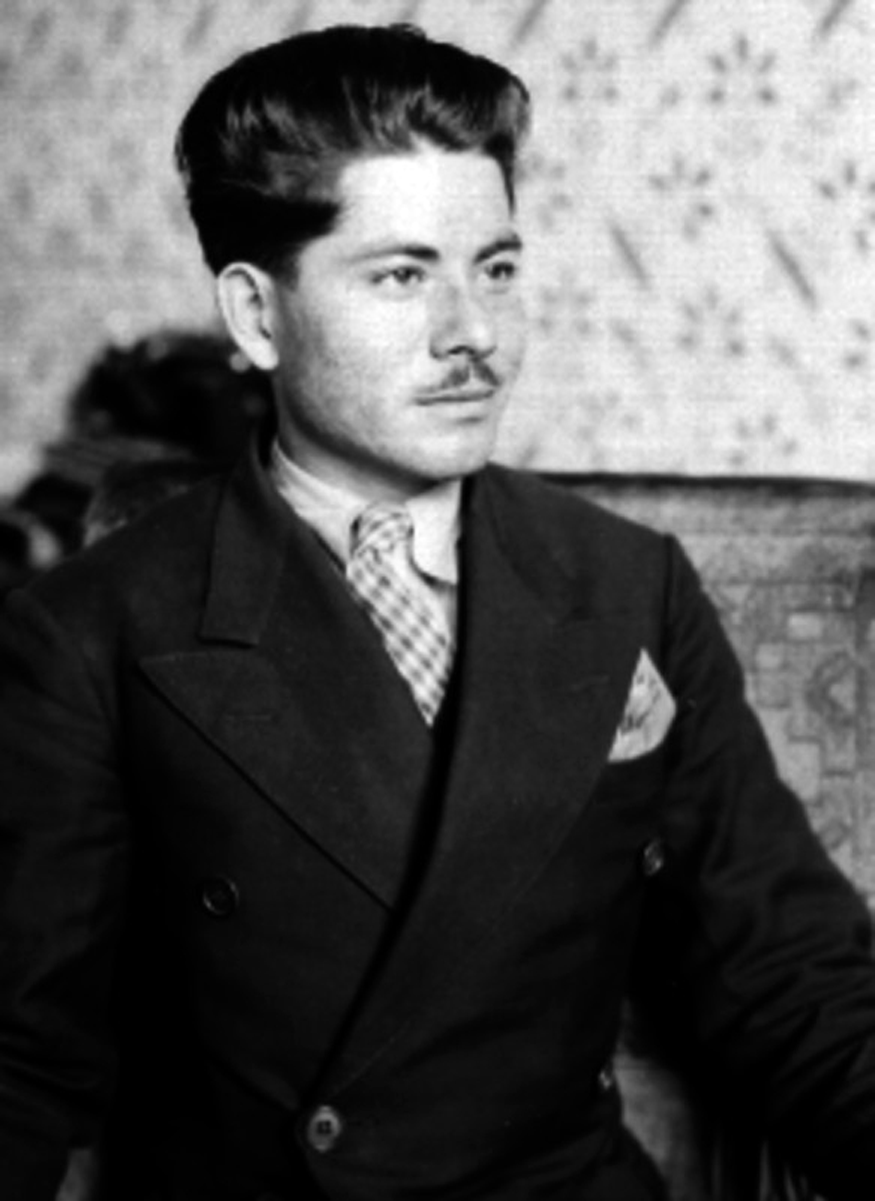
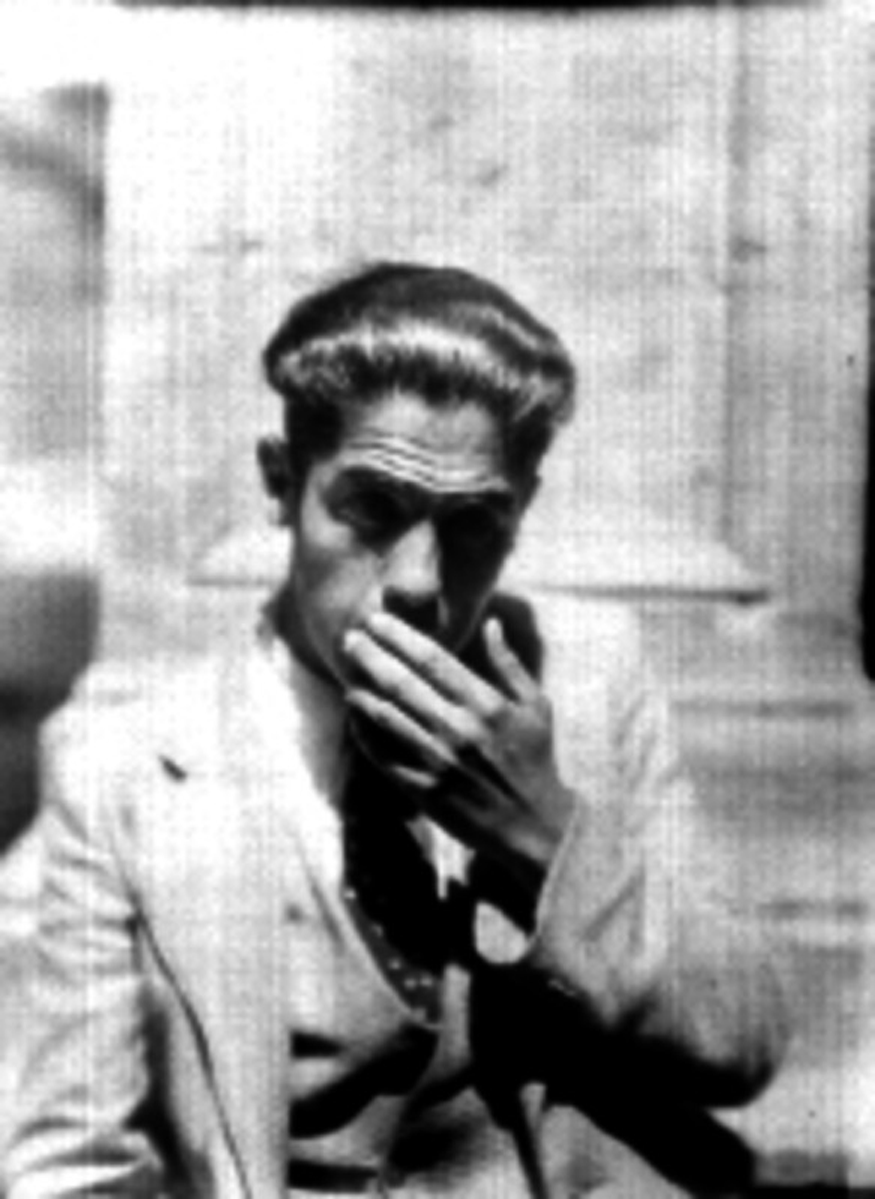
Like the pelona, whose bobbed hair and short skirts made her easily identifiable, the fifí adopted a uniform of sorts. Descriptions of his typical attire mention “balloon pants,” “Tutankahmen’ ties,” long draped jackets, and slicked-back hair styled “a la Boston.”Footnote 26 Balloon pants were likely some version of the Oxford Bag, while hair “a la Boston” may refer to the vogue for marcel-waved hair that first become popular in Boston (see figures 1 and 2). A Tutankahmen tie was likely one with “Egyptian patterns inspired by the discovery of King Tut’s tomb” that had come into vogue after its discovery in 1922 (Horsham Reference Horsham1989, 95–96; Costantino Reference Costantino1997, 36; Corson Reference Corson2001, 577; Peterson Reference Peterson2008, 271). A journalist writing for El Diario de Chihuahua in 1923 described the fifí’s uniform as consisting of “horrible … bell-like pants” with a “long suit jacket” and “a belt that goes up to his chest.”Footnote 27 Another journalist from the US-Mexico border described in 1923 the way that [Mexican] men “cut their hair … wanting to imitate Valentino … with those pants the fifís use now.”Footnote 28
A young man, possibly a fifí. Photo: Hombre vestido de traje sentado en un sillon, ca. 1925–1930, Archivo Casasola, Catalogue number 151930; Fototeca Nacional, D.R. Instituto Nacional de Antropología e Historia, México (CC)BY-NC-ND. https://www.mediateca.inah.gob.mx/islandora_74/islandora/object/fotografia%3A170452.
A young man who has been detained by the policy, possibly a fifí. Photo: Individuo en el interior de un edificio, ca. 1920, Archivo Casasola, catalogue number 146648; Fototeca Nacional, D.R. Instituto Nacional de Antropología e Historia, México (CC)BY-NC-ND. https://www.mediateca.inah.gob.mx/islandora_74/islandora/object/fotografia%3A159340.
Critics deemed the fifí’s sartorial sensibilities problematic on three counts. First, this imitative impulse threatened to obscure markers of class and race. In 1920, the style columnist for the Mexico City daily Excelsior wrote with exasperation that rather than the social elite, “employees, those of the middle class, and the fifís who fill our avenues” were fueling the vogue for American suits.Footnote 29 Many fifís, she went on to explain, had their suits made for them by low-end tailors with a keen eye for imitation. What is more, the fifí style also appealed to “boys from good families,” with the implication that on the street it might become difficult to distinguish members of the lower classes from their betters.Footnote 30 Sometimes this muddying of class distinctions took on racial dimensions. Though the fifí was sometimes depicted as phenotypically white, other visual representations made his racial identity more ambiguous or clearly represented him as dark-skinned and clearly dressing above his station.
Second, by calling attention to himself through personal appearance, the fifí threatened gender distinctions. The fifí’s appearance was described as “exaggerated” and “extravagant.” “They will,” one journalist wrote, “always have at hand recourse to the visual, a note out of tune, an extra gesture to make their ridiculous cuteness stand out.”Footnote 31 According to the women’s weekly El Hogar, these young men “adopt styles that should be exclusive to the weaker sex,” “cinch their waists as women did in the past century,” and use pants “wider than any of my skirts!” (see figures 3 and 4). These hyper-stylish young men groomed themselves like women, “curl[ing] their hair and cover[ing] their faces with creams and rice powders, suppressing in great measure an attribute essential to their sex that nature gave them, the mustache.”Footnote 32 This last observation about the link between masculinity and the mustache likely resonated even more in light of the ways in which mustached revolucionarios had become celebrated icons of masculinity.
“The New Balloon Type Fifí,” The Mexican American, December 1925, 8.
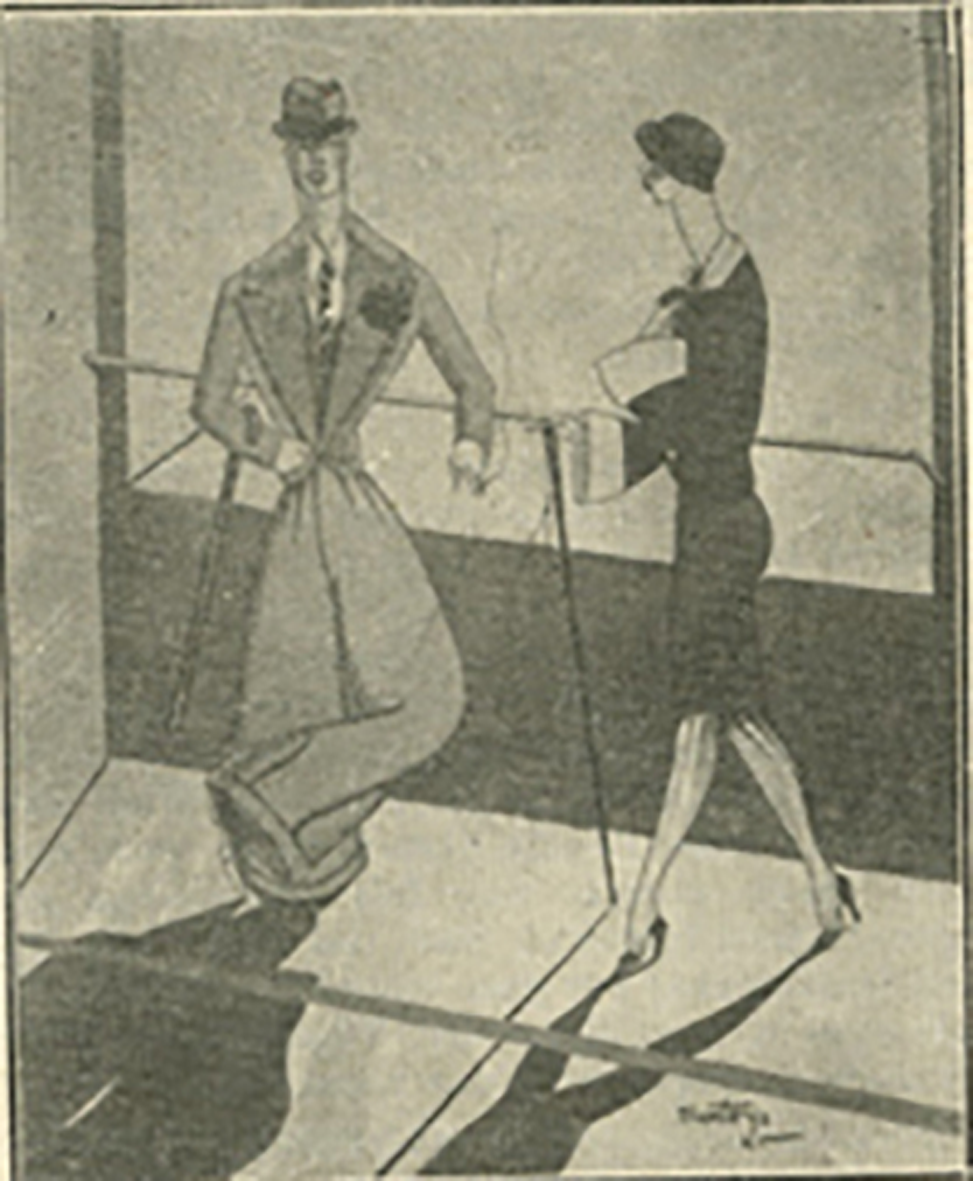
“Fifí at the Salon Azteca,” The Mexican American, October 1925, 15.

Finally, the fifí was widely perceived as engaging in disruptive if not dangerous acts of consumption. Rather than moving about the city industriously, these young men spent their time in the city’s “cabarets, dance academies, and other centers of juvenile corruption.Footnote 33 In a sketch written by the film actress and director Mimi Derba published in El Día Español, she notes that the fifí “passes his boredom and silliness in the streets, theaters, and cafes” (Derba Reference Derba1921, 77). This association of the fifí with the unproductive occupation of public space was likewise observed by the anonymous poet writing for a 1918 broadside published by the estate of printer A. Vanegas Arroyo: “They are the dandies of the barrio/Fifís of the salons…. If you’d like to have fun with imitation men in dances and kermesses you’ll see them dance danzón.”Footnote 34 But it was not merely their presence in these spaces that worried observers. An anonymous cinema inspector reported that young men he identified as fifís were annoying cinema patrons, “occupying themselves in calling the public’s attention in an inconvenient manner during the variety acts” that filled the time during reel changes.Footnote 35 Other similarly characterized groups of young men were accused of throwing fruit peels and other food from the balcony onto the spectators on lower levels, writing graffiti on the balcony walls, and making sexually suggestive remarks to young women who went to the movies alone or in pairs. Similar behavior—young men in the fifís’ trademark attire making “vulgar jokes” to women exiting a local cinema—was reported in Ciudad Chihuahua, the capital of the state of the same name.”Footnote 36
In other spaces of commercialized leisure, such as cabarets and dance halls, fifís practiced dances popularized by American films: the Charleston, the Fox Trot, and the Shimmy. Indeed, the Vanegas broadside links the fifí to the “One Step,” a dance derived from the Charleston. For Mexico’s emerging middle class, especially staunch Catholics, these new dance forms threatened decency. The editor of El Hogar decried the “foul influence” of the cinema, which was sending even boys from “good families” into public dances.Footnote 37 As in other parts of the world, the dances evoked comparisons to nervous or neurasthenic breakdown. Dancers “contorted and trembled” in paroxysms that depleted their physical, mental, and sexual energy.Footnote 38 A 1921 article in Las Noticias, a conservative publication associated with the Catholic Church, described with horror young girls who “immorally embrace the precious fifí while their bodies tremble at the same time in lewd convulsions, awakening the beasts of their desires.”Footnote 39 In this context the fifí, despite accusations of effeminacy, represented a perverse, licentious sexuality.
While in the United States this type of effeminate yet paradoxically oversexed man conjured associations with “Latin” countries—recall the hysteria associated with Rudolf Valentino—in Mexico this figure was perceived as an imitation, and a poor one at that, of American masculinity (Studlar Reference Studlar1996). One journalist opined that although fifís adopted American styles of dress, they “did not bother to imitate their [North American] virtues of sobriety, exactitude, and dedication to work.”Footnote 40 Indeed, the fifí was associated with conspicuous consumption that often he could not afford. In the poem cited above, “Los fifís,” the “dandies of the barrio” took their imitation of “los Gringos” to extremes:
Alquilan automóvil
Que quedan a deber
Desputes de pagarlo
Se queden sin comer
Pero no les importa
Si quieren presumir,
Se amarran bien la tripa
y gasten en vestir.Footnote 41
These observations, satirical though they may be, suggest that the fifí’s sartorial obsessions, preoccupation with leisure activities, and problematic sexuality were linked in the popular imagination to American customs and values. As a tongue-in-cheek poem published in El Universal Ilustrado asserted, this type of man was ill-suited to the demands of nation building:
es que no son las “niñas” solamente
las que vienen esclaves del ambiente
…
y pensar que en fifís de esta ralea
Están hoy el porvenir de la nación.Footnote 42
At the height of the “war against pelonas,” the newspaper El Universal noted that Mexican gallantry was losing its salience because of the “bastard push of a Saxon egalitarianism badly understood and even more poorly transplanted.”Footnote 43 “Mixing,” some opined, seemed inevitable, given the proximity of Mexico to its “dearly loved ‘bolillos’” (literally white rolls, but here Yankees).Footnote 44 Thus, the fífís’ adoption of US customs did not lead to anything valuable in terms of culture or national identity. Indeed, the consternation over young men’s incorrect adoption of “foreign customs” echoed concerns about the potential effects of migration—another phenomenon driven by Mexico’s proximity to the United States—on the nation-state.
Conclusion
In the 1920s, the type of man Paula Gómez referred to in her letter—the man who dressed in the latest American fashion, consumed rather than produced, and muddied clear distinctions between men and women—transits the pages of popular literature and the pages of the lighter sections of daily newspapers and magazines.Footnote 45 In these texts the fifí animates cautionary tales about the dangers of inappropriate consumption, the quick social mobility promised by American films, and the risks to national identity presented by young men’s contact with American mass culture. Although the fifí did not, as Gómez rightly pointed out, generate the public outcry that met the pelona, he, like the returning migrant, provoked worry about the potentially detrimental effects of this type of modern masculinity on Mexican society.
The fifí who consumed rather than produced, the migrant who abandoned his patria, and fictional aspiring film stars who were forced to deny their national identity in order to find success each demonstrate US mass culture’s threat to Mexico’s postrevolutionary nationalist project. These examples show how debates about masculinity in Mexico were inflected not only by revolutionary ideology or mythology but also by anxieties about the influence of American mass culture. The new fashions reflected attitudes toward public space, sexuality, and work that contradicted public discourse on frugality, hard work, and discipline.
When noticed at all, the fífí has been dismissed as a peripheral figure or one manifestation of broader cultural shifts. For example, Hernández (Reference Hernández1991, 122) dismissed fifís as “comic figures, who presented no real threat to the established norms,” while the historian Susanne Eineigel (Reference Eineigel2011, 108) reads the fifí as a representative of postrevolutionary, middle-class youth culture. By the 1940s the fifí would be eclipsed in Mexican mass culture by the pelado, the wisecracking working-class new arrival to the city who populated Golden Age comedies; the working-class hero with the heart of gold who starred in films about the city’s working poor; and the fashionable men who populated Mexico City’s vibrant night club scene (Rubenstein Reference Rubenstein, Gilbert, Rubenstein and Zolov2001; Vaughan Reference Vaughan2015, 78).
But the fifí did not disappear completely in the churn of Mexico’s midcentury modernity; perhaps he merely migrated northward. The fifí’s sartorial preoccupations and refusal of productivity reemerged at midcentury in the communities created by the first wave of Mexican migration to the United States. In his 1950 essay Labyrinth of Solitude, Octavio Paz (Reference Paz1980, 13) noted that pachucos, young men of Mexican origin, could be “identified by their language and behavior as well as the clothing they affect.” Paz associated the pachuco with exaggeration, impracticality, “something aesthetic,” and a refusal of conventional masculinity. The pachuco’s uniform—a zoot suit that consisted of a jacket that reached to the fingertips, draped pants pegged at the ankles, feather-adorned hats, watches on chains, and crepe-soled shoes—signified nihilistic ostentation for Paz. But, as historians have shown, that style celebrated the leisure and consumption denied their wearers by the dominant culture. Influenced by African American jazz culture, the zoot suit—particularly in the context of the Sleepy Lagoon trial and the Zoot Suit Riots—became a symbol of opposition to wartime norms of masculinity and a retort to Anglo racism.Footnote 46 The zoot-suiter, like his predecessor, refused normative demands that he serve the nation by consuming appropriately, working hard, and trading pleasure for moderation. He, too, took American mass culture and molded it to his own purposes in the context of social inequality and demands to assimilate to dominant gender norms that served the state.
While women’s adoption of new forms of self-presentation in the 1920s incited public debate and sometimes physical violence, men’s encounters with the values and behaviors modeled by American cinema or experienced in urban settings north of the US-Mexican border also caused anxiety. Both strident warnings about cultural imperialism and celebrations of revolutionary nationalism obscure this anxiety, which was often accompanied by proposals that sought to fold culture coded as “American” into the masculine ideals that Mexico’s postrevolutionary nation-building project demanded. Those same warnings and celebrations might also have obscured the transnational circuits that connected forms of masculinity which resisted the demands of nationalism.


 Open access

