
Skip to main content Accessibility help
×
  • Cited by 4
    • You may already have access via personal or institutional login
    • Select format
    • Publisher:
      Cambridge University Press
      Publication date:
      24 February 2023
      09 March 2023
      ISBN:
      9781108863308
      9781108495868
      Dimensions:
      (279 x 216 mm)
      Weight & Pages:
      2.41kg, 750 Pages
      Dimensions:
      Weight & Pages:
    You may already have access via personal or institutional login
  • Selected: Digital
    Add to cart View cart Buy from Cambridge.org

    Book description

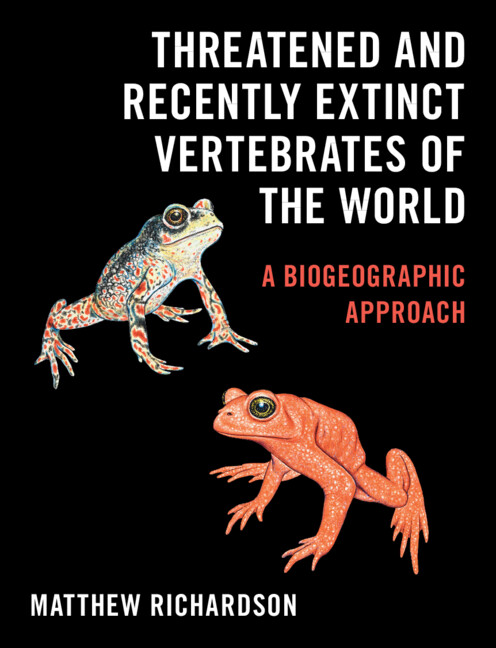
    Habitat loss and degradation are currently the main anthropogenic causes of species extinctions. The root cause is human overpopulation. This unique volume provides, for the very first time, a comprehensive overview of all threatened and recently extinct mammals, birds, reptiles, amphibians, and fishes within the context of their locations and habitats. The approach takes a systematic examination of each biogeographic realm and region of the world, both terrestrial and marine, but with a particular emphasis on geographic features such as mountains, islands, and coral reefs. It reveals patterns useful in biodiversity conservation, helps to put it all into perspective, and ultimately serves as both a baseline from which to compare subsequent developments as well as a standardization of the way threatened species are studied.

    Reviews

    ‘This colossal synthesis fills a void. It will find its place in many libraries, I'm sure.’

    Ivan Ineich Source: Bulletin de la Société Herpétologique de France

    ‘It seems inconceivable that the publisher could have produced a comprehensive volume of the global biogeographic distribution of threatened and recently extinct vertebrates, comprising an estimated 650,000 words (the main text alone) and including 24 pages of well-produced color plates at its listed price. But here it is, and we have Matthew Richardson to thank for it … the effort and achievement of this volume is enormous, and we can hope that it remains useful for decades to come.’

    Kevin Padian Source: The Quarterly Review of Biology

    Refine List

    Actions for selected content:

    Select all | Deselect all
    • View selected items
    • Export citations
    • Download PDF (zip)
    • Save to Kindle
    • Save to Dropbox
    • Save to Google Drive

    Save Search

    You can save your searches here and later view and run them again in "My saved searches".

    Please provide a title, maximum of 40 characters.
    ×

    Contents

    Metrics

    Altmetric attention score

    Full text views

    Total number of HTML views: 0
    Total number of PDF views: 0 *
    Loading metrics...

    Book summary page views

    Total views: 0 *
    Loading metrics...

    * Views captured on Cambridge Core between #date#. This data will be updated every 24 hours.

    Usage data cannot currently be displayed.

    Accessibility standard: Unknown

    Why this information is here

    This section outlines the accessibility features of this content - including support for screen readers, full keyboard navigation and high-contrast display options. This may not be relevant for you.

    Accessibility Information

    Accessibility compliance for the HTML of this book is currently unknown and may be updated in the future.
