





1. Introduction
Interfirm strategic alliances are contractual arrangements among two or more firms aimed at making cooperative and coordinated use of their resources for upstream and/or downstream value chain activities in order to enhance each partner’s competitive position (e.g., Amaldoss et al., Reference Amaldoss, Meyer, Raju and Rapoport2000; Amaldoss & Rapoport, Reference Amaldoss and Rapoport2005; Casson & Mol, Reference Casson, Mol, Shenkar and Reuer2006; Chan et al., Reference Chan, Kensinger, Keown and Martin1997; Hamel, Reference Hamel1991; Inkpen, Reference Inkpen2005; Spekman et al., Reference Spekman, Forbes III, Isabella and MacAvoy1998). Horizontal alliances among firms at the same level of the value chain include new product alliances (Kalaignanam et al., Reference Kalaignanam, Shankar and Varadarajan2007) and logistics alliances (Fawcett & Magnan, Reference Fawcett and Magnan2002). Vertical alliances across different levels of the value chain include buyer–supplier and distributor–manufacturer alliances (Anderson & Narus, Reference Anderson and Narus1990) that link firms at different levels of the value chain to facilitate downstream activities such as distribution, marketing, customer relationship management (CRM), or international market entry.
Despite the compelling economic arguments for pooling resources and forming alliances, an estimated half of all strategic alliances fail to reach their intended financial goals (Chakravarty et al., Reference Chakravarty, Zhou and Sharma2020; Dyer et al., Reference Dyer, Kale and Singh2001). Alliance success depends on both astute partner selection and the ability to capture ‘reasonable’ economic value from the partnership (Ha & Rothaermel, Reference Ha and Rothaermel2019; Holmberg & Cummings, Reference Holmberg and Cummings2009; Shah & Swaminathan, Reference Shah and Swaminathan2008). Yet, research suggests that managers can be remarkably myopic in forming strategic partnerships (Wassmer et al., Reference Wassmer, Dussauge and Planellas2010), and ‘dysfunctional’ alliances often persist despite missed performance objectives and financial losses (Delios et al., Reference Delios, Inkpen and Ross2004; Inkpen & Ross, Reference Inkpen and Ross2001; Klossek et al., Reference Klossek, Meyer and Nippa2015). Suboptimal alliances can persist due to a confluence of biases that often originate with individual managers and organizational leaders or even management groups (Klossek et al., Reference Klossek, Meyer and Nippa2015; Prahalad & Bettis, Reference Prahalad and Bettis1986; Ross & Staw, Reference Ross and Staw1993; Sleesman et al., Reference Sleesman, Conlon, McNamara and Miles2012).
A firm’s embedded social context, which includes relationships with current partners as well as how prospective partners relate with their current partners, can influence whether a firm maintains or breaks existing alliances (Greve et al., Reference Greve, Mitsuhashi and Baum2013), and/or seeks more lucrative alliance partners (Greve et al., Reference Greve, Mitsuhashi and Baum2013; Lazzarini et al., Reference Lazzarini, Miller and Zenger2008; Uzzi, Reference Uzzi1997). Moreover, managerial inertia may favor status quo alliances (Hannan & Freeman, Reference Hannan and Freeman1984; Klossek et al., Reference Klossek, Meyer and Nippa2015). Despite a wealth of research on embedded alliances, relatively little is known about how judgmental biases stemming from existing alliances may influence the formation of new alliances, even in the presence of strong economic imperatives for alliance formation (Al‐Laham et al., Reference Al‐Laham, Amburgey and Bates2008).
Prior studies have used experimental games to examine alliance formation in both general and managerial contexts (Agarwal et al., Reference Agarwal, Croson and Mahoney2010; Bolton et al., Reference Bolton, Chatterjee and McGinn2003; Chertkoff, Reference Chertkoff1971; Murninghan, Reference Murninghan1985; Rapoport & Kahan, Reference Rapoport and Kahan1984). These studies typically start with all entities as unattached singletons and examine how players add partners sequentially or simultaneously to build coalitions. They focus on which coalitions form and how rewards are allocated to members (relative to benchmarks based on various solution concepts for cooperative games). Typically, these studies do not examine how the starting condition of the coalition formation process can influence which coalitions eventually form. Alliance formation games starting with preexisting coalitions may end differently than those starting with singleton firms, despite identical resources and game parameters. The present research addresses this gap by directly investigating how the starting condition of a coalition formation process can bias managerial decisions on which coalitions to join and the division of contingent proceeds.
This paper contributes to the economics, strategy, and marketing literature on embedded alliances. We present two sets of experimental studies that examine how the mere presence of an existing alliance can bias the search for improved economic outcomes via alliance partner selection. We use a novel custom-designed computer game for our experiments. Participants play the role of a strategic manager of a focal firm in a hypothetical six firm industry. The focal firm’s five potential alliance partners are represented by computerized ‘bots’ programmed to respond rationally to all alliance offers. We examine how the participants in our experiments form alliances given configurations of their own and other (potential partner) firms’ resource endowments and the presence of specific existing alliances. Our empirical findings show that even when seeking improved economic positions, managers may exhibit judgmental biases that constrain their alliance offers and partner choices.
Study Set 1 (status quo maintenance) shows that given an existing suboptimal coalition partner, participants managing a focal firm include the suboptimal partner more often in future coalition offers than those in a control group (where the focal firm is unattached). In Study Set 2 (poaching avoidance) we find that participants make fewer offers to, and are less likely to form an alliance with, an optimal partner that is embedded in a prior alliance relative to the control case where no such prior partnership exists. In this situation, participants show a preference for partnering with unattached firms. However, this tendency to avoid poaching is attenuated when the existing coalition is seen as a powerful threat, and/or alternative partners are unavailable. We establish the economic downsides of such biased behaviors by comparing participants’ attained profits to the known profitability of the optimal coalition in our experiments. We conclude with a discussion of how selected environmental, firm, and decision-maker characteristics (e.g., turbulence, embedded relationships, and risk orientation) may moderate these results.
2. Status quo bias and poaching avoidance
Strategic alliances among firms are negotiated via interactions among boundedly rational managers acting individually or jointly as participants in a decision-making unit. Apart from individual differences in market assessments, managers may also reflect psychosocially rooted judgmental and motivational biases (Amit & Schoemaker, Reference Amit and Schoemaker1993) that limit their ability to make optimal or even economically rational decisions (Bazerman & Moore, Reference Bazerman and Moore2009). A target situation is judged not only on its own features but is often influenced by how its features contrast with those of a current contextual reference (Kahneman & Tversky, Reference Kahneman and Tversky1979).
In embedded contexts, a current alliance may feature firm relationships that anchor and constrain adjustments (Epley, Reference Epley, Derek and Koehler2008; Tversky & Kahneman, Reference Tversky and Kahneman1974) and/or stimulate affective evaluations that inhibit higher-level economic reasoning (Kahneman, Reference Kahneman2003). Thus, existing coalitions may create embedded contexts that constrain and limit the potential alliances that managers might consider. In addition, pressure at the individual, interpersonal, organizational, and interorganizational levels can lead decision-makers to construct biased assessments of the value of existing alliances (Klossek et al., Reference Klossek, Meyer and Nippa2015).
2.1. Status quo bias
A manager could choose to maintain the current status quo as either an unattached singleton firm or as an existing alliance member. Interfirm alliances are inherently risky and much uncertainty surrounds payouts from a joint venture (Bamford et al., Reference Bamford, Gomes-Casseres and Robinson2003). Alliances are notoriously vulnerable to opportunistic defection (Kogut, Reference Kogut1989) and half of all alliances eventually fail (Park & Ungson, Reference Park and Ungson2001). Yet, defecting from an existing coalition may be less likely if economic and reputational penalties are anticipated (Lieberman, Reference Lieberman1964).
With risky alternatives, cognitive biases may drive a status quo choice even if it is economically inferior (Samuelson & Zeckhauser, Reference Samuelson and Zeckhauser1988). First, research on ‘loss aversion’ (Kahneman et al., Reference Kahneman, Knetsch and Thaler1991; Thaler, Reference Thaler1980) shows that people attach more psychological weight to losses versus equivalent gains (Kahneman & Tversky, Reference Kahneman and Tversky1979). Second, behavioral and neuroscience studies report greater experienced regret for decision errors that stem from rejecting versus accepting a status quo option (Nicolle et al., Reference Nicolle, Fleming, Bach, Driver and Dolan2011). Hence, status quo choices may result from a desire to avoid regret. The status quo may also elicit emotional attachment that inhibits change (Ariely et al., Reference Ariely, Huber and Wertenbroch2005), and/or reflect a heuristic inference of ‘goodness’ due to familiarity (Eidelman & Crandall, Reference Eidelman and Crandall2012). Status quo maintenance may increase with the number of choice options because decisions become more difficult (Iyengar & Lepper, Reference Iyengar and Lepper2000). Fairness, trust, loyalty and reciprocity (e.g., Bolton & Chen, Reference Bolton and Chen2018; Tavits, Reference Tavits2008) may also lock managers into a status quo partnership.
Managers may view change as per se negative despite improved results net of transaction costs (Baron & Jurney, Reference Baron and Jurney1993). Although environmental turbulence could force their hand, managers may prefer the status quo in stable environments (Jaworski & Kohli, Reference Jaworski and Kohli1993). Commitment to a prior decision may escalate at the expense of objectively better options (Staw, Reference Staw1976). Similar escalation is seen in cohesive managerial groups (Myers & Lamm, Reference Myers and Lamm1976; Sleesman et al., Reference Sleesman, Conlon, McNamara and Miles2012), implying that such biases may also color firm-level alliance decisions. Mitsuhashi and Min (Reference Mitsuhashi and Min2016) show evidence of escalation of commitment and status quo preference in group decisions on managerial alliance formation. Using an airline codeshare dataset, the authors show that although maintaining existing ties lowers search costs and uncertainty, it can lead to suboptimal resource matching. The focal firm ‘allies with other firms that do not present the potentially best resource matching’ or ignores ‘potential partners that can present better resource matching’ than current allies (Mitsuhashi & Min, Reference Mitsuhashi and Min2016, p.288).
In summary, existing strategic coalitions may be ‘sticky’ and managers may be biased toward status quo maintenance. However, the underlying dynamics are relatively unexplored. Does the status quo alliance lead firms to abandon economic motivations? Does it systematically constrain the search for alliance partners? Does it alter partnership offer patterns relative to non-status quo situations? Study Set 1 examines these issues in the context of both vertical and horizontal alliances.
2.2. ‘Poaching’ existing coalitions
In its business incarnation, ‘poaching’ relates to the transactional risk that exists when two firms form an alliance and exchange proprietary information for a contracted purpose. Here, as in poaching in common-pool resources of property rights (De Geest et al., Reference De Geest, Kidwai and Portillo2022), a partner may misappropriate shared information for its own economic benefit (Clemons & Hitt, Reference Clemons and Hitt2004). We examine a different form of poaching in which a focal firm, perceiving an attractive alliance partner in an existing coalition with another firm, attempts to use economic incentives to ‘poach’ (lure) the potential partner away from its existing coalition. For example, an original equipment manufacturer (OEM) offering better economic terms to a competing OEM’s distributor partner is trying to ‘poach’ the competitor’s partner away from the existing alliance. Poaching may also describe a vendor’s effort to dislodge a competing vendor from an attractive customer relationship. Thus, QuestionPro’s aggressive (and often unsolicited) efforts to replace Qualtrics as the research platform partner for universities may be construed as ‘poaching’ an attractive client from Qualtrics to break an alliance that posed an entry barrier in a mature market.Footnote 1
Examples of competitive poaching in business contexts include ‘talent poaching’ in hiring (Gardner et al., Reference Gardner, Stansbury and Hart2010) and bidding on competitors’ keywords in search advertising (Bhattacharya et al., Reference Bhattacharya, Gong and Wattal2022). Yet, firms also have known to avoid poaching. Thus, despite the controversial legality of ‘no poach’ agreements (e.g., Carson et al., Reference Carson, Potter and Bianchi-Demicheli2024), managers often view employee poaching as violating an unwritten business code with reputational costs for the poacher and the poached target. The literature on human mate poaching (Schmitt, Reference Schmitt2004; Schmitt & Buss, Reference Schmitt and Buss2001) suggests that such biases may be rooted in social taboos about encroaching on existing relationships unless the potential partner shows overt interest. Reluctance to poach may also reflect uncertainty avoidance: one who deserts an existing alliance may be seen as less committed to relationships and more prone to infidelity than one previously unattached (Foster et al., Reference Foster, Jonason, Shrira, Campbell, Shiverdecker and Varner2014). Such norms may make managers reluctant to ‘poach’ a desirable partner from an existing alliance.Footnote 2 Marketplace sanctions may also be factor: a key factor in McDonalds dissolving its 40-year partnership with Heinz was the latter’s hiring of Burger King’s erstwhile CEO as its Chief Executive.Footnote 3
In summary, even if there is significant economic imperative to do so, a focal firm may avoid poaching attractive potential partners who are already in another existing coalition. In the absence of reputational effects, could poaching avoidance still lead a firm to avoid targeting an attractive potential partner that is already in a preexisting coalition? Could this lead to different offer patterns versus when the target firm is unattached? Does the focal firm seek out and make offers to unattached firms instead? Study Set 2 examines these aspects of the poaching avoidance phenomenon.
Poaching avoidance may be attenuated in some situations. Early studies on three-player coalition formation (e.g., Hoffman et al., Reference Hoffman, Festinger and Lawrence1954) found that individuals focus on their relative (vs. absolute) position in competitive contexts. If one player is an early leader, the two weaker ones tend to form an opposing coalition. Other studies of economic games with resource differences show that players often unite against a stronger player to achieve equal or greater strength (e.g., Chertkoff, Reference Chertkoff1975; Segal, Reference Segal1981). Thus, an unattached focal firm in a resource-based coalition game may perceive an existing alliance as a serious threat and try to join it. However, if excluded from the coalition, the firm may try to form a rival alliance. If this is infeasible, the unattached firm may then try to poach from the existing alliance to diminish the latter’s power. Study Set 2 also examines how poaching avoidance constrains a focal firm’s search for strategic partners, as reflected in its offers to economically optimal but attached (vs. unattached) partners.
3. Coalition game scenario
Several experimental studies have examined alliance formation both in general settings (e.g., Chertkoff, Reference Chertkoff1971; Gamson, Reference Gamson1961; Psathas & Stryker, Reference Psathas and Stryker1965; Segal, Reference Segal1981) and managerial contexts (e.g., Agarwal et al., Reference Agarwal, Croson and Mahoney2010; Bolton et al., Reference Bolton, Chatterjee and McGinn2003; Murninghan, Reference Murninghan1985; Rapoport & Kahan, Reference Rapoport and Kahan1984). These studies typically start with all entities as unattached singletons and examine how participants build coalitions by adding partners either sequentially or simultaneously (Komorita & Meek, Reference Komorita and Meek1978), The focus is on which coalitions form and how rewards are allocated among the members (relative to various solution concepts for cooperative games). In contrast, our research examines how preexisting coalitions alter the coalition formation process and outcomes relative to starting situations where all firms are singletons (e.g., Brams et al., Reference Brams, Jones and Kilgour2005).
We develop a resource-based coalition formation scenario in a multi-firm setting with upstream and downstream firms that can form horizontal or vertical alliances. The scenario incorporates three upstream (Firms A, B, and C) and three downstream (Firms X, Y, and Z) firms. Each firm is endowed with resources that yield relative strengths and weaknesses, capturing typical variations among firms in an industry. These resources allow firms to compete with other firms in a B2C or B2B market. Study participants manage a focal firm choosing how to form strategic alliances to improve their economic payoff. They select potential alliance partners and decide how to allocate joint gains from the coalition among the members.
Upstream firms use their resources to make marketable products. A coalition of multiple upstream firms can jointly make a single product. Similarly, downstream firms invest resources to develop efficient marketing processes. A coalition of multiple downstream firms jointly uses a single marketing process. With vertically related coalition partners, upstream and downstream partner(s) align their respective manufacturing and marketing resources. Firms (whether alone or in coalitions) receive payouts based on a mathematical formula known to the firms. Firms select coalition partners (if any) and make offers on how the surplus from the joint effort is divided. Offers, acceptances, and rejections are perfectly communicated (Rapoport & Kahan, Reference Rapoport and Kahan1984), and all firms have complete information. Firms communicate freely, know the resources of all other firms, and do not make covert agreements.
Upstream firms (manufacturers) in this scenario are endowed with two supply-side resources, a technology (t) of varying market worth, and capacity to produce a fixed quantity (q) of the upstream product. Downstream firms (distributors) are endowed with two demand-side resources: a market development capacity (m) such as a sales force, and a marketing process efficiency (e), such as a CRM system. Any upstream manufacturer’s product can be matched with a downstream distributor to access the end-user market. The upstream firms’ products differ in technical quality but have a common valuation for the marketing efficiency of the downstream firms. Similarly, the downstream firms differ in marketing efficiency, but have a common valuation for the upstream firms’ product technology.
For any alliance, some resources are complementary or additive, whereas others are compensatory or sub-additive (Amaldoss & Rapoport, Reference Amaldoss and Rapoport2005). The scenario allows additive and sub-additive resource-sharing at both the upstream and downstream levels. Upstream production capacity (q) is additive: alliance members pool production capacities. Downstream market development capability (m) is also additive: alliance members pool their salespeople. In contrast, upstream technology (t) is a sub-additive resource: alliance members retain the best available technology – maximum t. Similarly, downstream firms retain the most efficient marketing process available – maximum e. An upstream horizontal alliance expands product capacity or improves product technology. A downstream horizontal alliance expands market development capacity or improves marketing process efficiency. A vertical alliance extends control across both the supply and demand sides of the value chain.
Web Appendix W1 shows the mathematical formulation underlying this strategic alliance scenario. A coalition’s aggregate payout is captured in a value function, v(S), defined over the set S of coalition members. It has three formats, applying respectively to coalitions that are horizontal upstream-only, horizontal downstream-only, and vertical (both upstream and downstream). Specific parameters capture coordination costs and alliance synergies. Normative payouts for each coalescing firm (given all possible coalitions) are based on the Aumann and Dreze (Reference Aumann and Dreze1974) coalition structure value that extends the Shapley Value (SV) solution concept (Shapley, Reference Shapley, Kuhn and Tucker1953). The SV allocates the value gained by the collective based on each partner’s relative bargaining strength across all possible coalitions. Thus, given our resource set and game parameters, we analytically determine which coalitions should form and the collective value (payout) for each possible coalition. These yield the normative economic benchmarks for the coalition formation decisions. The game scenario and the underlying formulations are explained to the participants and their comprehension is tested using a pre-game quiz. All relevant values are computed and provided to the participants for use in decision-making.
4. Overview of studies
Unlike prior multi-person studies of cooperative games (e.g., Rapoport & Kahan, Reference Rapoport and Kahan1984), we focus on an individual participant’s coalition formation decisions. Our software allows the participant to make offers to five potential partners via a graphic user interface. These partners are programmed ‘bots’ that accept or reject coalition offers based on normative rules (Appendix W1). Participants manage a focal firm, knowing that their potential partners are ‘bots’. Apart from efficient data collection, our approach provides experimental control by fixing background factors, ruling out extraneous variation across conditions, and using ‘bots’ that act rationally. Thus, in each study condition, only the focal participant’s actions influence outcomes (Cheema et al., Reference Cheema, Chakravarti and Sinha2012). The participant’s observed actions are benchmarked to the optimal coalition and division of joint gains given our scenario (Amaldoss & Rapoport, Reference Amaldoss and Rapoport2005).
We emphasize that our game simulation design is guided by two goals. First, we wish to focus on how embeddedness perceptions intrinsic to the individual participant drive status quo bias and poaching avoidance, even when participants are explicitly told that potential coalition partners are ‘rational’ bots without the embeddedness perceptions that drive non-economic responses. This allows meaningful comparison to normative behaviors conditional on the game environment and the participants’ resource endowments. Second, although we try to create an environment that matches common strategic alliances, our goal is not to test the validity of the mathematical formulation underlying the game. Rather, the formulation merely describes a realistic game environment and provides normative solutions that are carefully explained to participants via a short case (Appendix W2).
4.1. General study protocol
Participants received a short take-home case that described the game scenario, provided the underlying mathematical formulation, illustrated its computational workings, and explained the decision task. After reviewing the case, each participant played a sequence of game rounds. A game round had a negotiation stage during which the focal player explored various coalitions with potential ‘bot’ partners by offering specific divisions of the joint gains. A player could negotiate simultaneously with one or more of the five other ‘bot’ firms. The focal player began by offering a coalition and payoff division to one or more ‘bots’. The ‘bots’ responded simultaneously, either accepting or rejecting the offer. The participant could wait to ratify an accepted offer and explore other options. The game round ended when an offer was ratified, and the players made a binding agreement.
A maximum of 12 offer iterations was allowed in each game round (a monthly offer in a calendar year). If no coalition was ratified within 12 iterations, the game round ended, and the focal player simply received their singleton coalition value. This feature reflects the urgency of forming alliances in a rapidly evolving industry and deters players from excessive use of iterative descending offers to find payout maximizing offers by trial and error. The ‘bots’ were programmed to behave rationally: accept offers at or above their globally optimal SV, reject otherwise. Their response was based on the principle of maximal share applied to the global game (n = 6, all 2n – 1 = 63 possible coalitions). As Kahan and Rapoport (Reference Kahan and Rapoport1984, p.316) note, ‘a coalition S offers maximal share to its members if the average payoff per member, [v(S)/|S|], exceeds the corresponding figure for any other feasible coalition in the game’. This principle matches the Aumann and Dreze (Reference Aumann and Dreze1974) coalition structure extension of the SV solution concept. Thus, the ‘bots’ in our game held out for their SV in the highest maximal share coalition if they belonged to that coalition. If a ‘bot’ did not belong in the highest maximal share coalition, it was programmed to consider the next best maximal share coalition that should form based on the expectation of the highest one forming, and so on.
The short case (Web Appendix W2) provided multiple examples to show how coalitions augment payout value, and how the value is computed using the mathematical formulation in Appendix W1. We tested participants’ understanding of the basic game and how the ‘bots’ made accept/reject decisions, using data only from those who passed the test. As noted, participants did not need to master the mathematical details of the model – the computer provided the payout value for any coalition. Web Appendices W3 and W4 provide screenshots of the interface.
The data were collected in two separate phases.Footnote 4 We used 95 participants (62.1% male; average age 30.1 years; and average work experience 6.7 years), all of whom were graduate business students at one of four large US research universities. Each participant played six game rounds: two practice rounds (using only unattached singletons firms), followed by four reward-eligible rounds that produced the data reported here. Each participant was randomly assigned to one of five fixed sequences of game rounds and provided data for four studies, each with a between-participants design. No participant saw the same study twice.
Prior to each game round, participants saw a pop-up instruction screen. They answered several open-ended questions after each round and provided demographic data before being debriefed and compensated. They received a US$25 participation fee and were told they could receive an additional performance reward of US$100 if they had the highest aggregate payout across the four reward-eligible game rounds. Five separate US$100 rewards were given, one for each study sequence. The data were collected either in a computer laboratory or via email. We could not monitor the time spent on studying the case, but our measurements showed that the median time for the four game rounds was 62 minutes.Footnote 5
5. Study Set 1: ‘Status quo bias’
Study Set 1 contains two experiments examining if a status quo bias inhibits managers from exiting a current alliance, even when it is economically advantageous to do so. Study 1.1 features an existing two-firm coalition that involves the focal firm in either a vertical or horizontal alliance. The optimal alliance (given our scenario) is a three-firm coalition that includes the focal firm, but not the initial partner. In Study 1.2, the focal firm in an existing two-firm vertical alliance. Here, the optimal is a two-firm coalition involving the focal firm but not the original partner. In each study, we examined the realized alliances, the offers that were made, and the payouts relative to a control condition where all firms started unattached.
5.1. Study 1.1: Status quo (three-firm optimal coalition)
Study 1.1 embeds a three-firm optimal coalition size. Table 1, Panel A shows the distribution of resource endowments and standalone (singleton) values of the three upstream (A, B, and C) and three downstream (X, Y, and Z) firms. At each industry level, there is a firm with ‘balanced’ resources (B and X, respectively) as well as two firms (upstream: A and C; downstream: Y and Z) with ‘unbalanced’ resources (high on one, low on the other). The participants manage the focal (upstream) Firm C that has a moderate singleton value of 560. Thus, upstream Firms A and C (downstream Firms Y and Z) have complementary resources. The downstream Firm X (the ‘balanced’ firm with a standalone value of 896) is a strong vertical alliance candidate for Firm C. The normative benchmark (Table 1, Panel A) given our mathematical formulation shows that it is optimal for focal Firm C to form the three-firm vertical ACX coalition that offers the highest maximal share payout (4990) of all 63 possible coalitions. Of the 32 coalitions that involve focal Firm C, the ACX coalition offers the highest SV payout (1842).
Status quo bias studies - Resource ratings and standalone firm values

Study 1 parameters: γ = 4; δ = 0.6.
* indicates member of optimal focal alliance.
The data are from 57 participants assigned randomly to three study conditions. Twenty participants were assigned to the control Condition U (Unattached) in which all six firms started as unattached singletons. Nineteen were assigned to Condition V in which the focal Firm C is in a suboptimal Vertical coalition CY at the outset (Table 1, Panel A: SV for Firm C = 683, 37.1% of the maximum payoff). The remaining 18 participants were assigned to Condition H in which the focal Firm C is in a suboptimal Horizontal coalition CB at the outset (Table 1, Panel A: SV for Firm C = 842, 45.7% of the maximum payoff). We anticipated that focal Firm C’s search for economic improvement will be inhibited by a status quo bias. Thus, relative to the control Condition U, a significantly higher percentage of focal Firm C players in Condition V [Condition H] is expected to include the vertical Firm Y [horizontal Firm B] in their final coalition despite the suboptimal expected payout. This bias should be also reflected in the offers data for focal Firm C.
Procedure. Participants in all conditions received a pop-up message at the start of the game round: ‘Your firm is FIRM C in this round’. Those in Condition V (H) received corresponding messages: ‘You will start this round already in an alliance with FIRM Y (B). Your firm has a long history of partnership with FIRM Y (B)’. The main game screen in Condition V (H) graphically showed a vertical (horizontal) coalition between the focal Firm C and Firm Y (B). In both conditions, the top of the screen showed the agreed upon alliance terms in the list of offers. Participants in control Condition U saw no existing alliances. A participant could make at most 12 iterative offers. If no coalition was secured within 12 iterations, the game ended, and the participant received Firm C’s standalone value. After completing the game, all participants described the factors they considered in developing their coalition formation strategy and if any aspect of the game was confusing. Those in Conditions V and H were then asked directly if and how being in a coalition at the outset impacted their play.
Results. The data were analyzed using a logit model with age and gender as covariates. In the control Condition U (focal Firm C starting unattached) only 1 of 20 participants (5%) included Firm Y in their final coalition. In Condition V (focal Firm C in starting vertical coalition with Firm Y) 9 of 19 participants (47.4%) maintained Firm Y in their final coalition. This difference is significant (χ 2(1) = 10.18, p < .01). In Condition H (focal Firm C in starting horizontal coalition with Firm B), 9 of 18 participants (50%) maintained Firm B in their final coalition. In contrast, in the control Condition U, only 4 of 20 participants (20%) retained Firm B in their final coalition. This difference is also significant (χ 2(1) = 3.86, p = .05). Also, no participant in Condition V (Condition H) included Firm B (Firm Y) in their final coalition. Neither age nor gender were significant (ps > .70) and were dropped for all analyses. Thus, compared to those who started unattached, a higher proportion of participants in both the vertical and horizontal coalition conditions retained the (suboptimal) initial partner in their final coalition. This implies that a status quo bias may have inhibited the focal firm’s search for an optimal alliance partner.
What proportion of participants in each condition achieved the optimal ACX coalition? In the control Condition U, 10 of 20 participants (50%) formed the optimal ACX coalition. In Condition V, only 6 of 19 participants (31.6%) achieved the optimal coalition. In Condition H, the number was only 7 of 18 participants (38.9%). Although not significant (χ 2(1) = 1.18, p = .28), the difference in proportions between the control U and the pooled V and H conditions is directionally consistent with a status quo bias. The complexity of locating the three-firm ACX coalition may have attenuated the difference between U and the V/H conditions.
Additional evidence for the status quo bias emerges from the offers data. As expected, participants managing the unattached Firm C in control Condition U made fewer offers on average to Firm Y than those in Condition V for whom Firm Y was the suboptimal initial partner (M U = 0.8, s.d. = 1.58 vs. M V = 2.16, s.d. = 2.95; one-tailed t = 1.81, p = .04).Footnote 6 Similarly, participants in Condition U, also averaged significantly fewer offers to Firm B than those in Condition H where Firm B was the suboptimal initial partner (M U = 0.45, s.d. = 1.0 vs. M H = 1.78, s.d. = 2.94; one-tailed t = 1.91, p = .04). We also examined the possibility that those managing unattached focal Firm C (which had a lower starting profit than Condition V or H) were more motivated to search for profitable coalitions. However, the mean number of offers in each of the three conditions did not differ (M U = 7.60, M V = 6.63, M H = 7.06; F(2,54) = 0.38; p = .69). There were also no significant differences in mean number of offers made by those who included the initial alliance partner versus those who did not (Condition V: M Y = 6.0, M NO Y = 7.2; F(1,17) = .52, p = .48; Condition H: M B = 6.6, M NO B = 7.7; F(1,16) = .54, p = .48). Thus, participants who started in an alliance searched no less than their unattached control counterparts; their offers simply included their initial partner more often as they searched for better outcomes.
As expected, alliance decisions consistent with a status quo bias lowered payout. In Condition V, those who included the suboptimal initial alliance partner Y in their final coalition earned a lower average payout versus those who did not (M Y = 820.1 vs. M NoY = 1271.9; F(1,17) = 13.12; p < .01). Similarly, in Condition H, those who included the suboptimal initial partner B in their final coalition also earned a lower average payout versus those who did not (M B = 898.8 vs. M NoB = 1469.2; F(1,16) = 34.50, p < .001). Also, in control Condition U, the average payout for participants who formed the optimal coalition was higher relative to those who did not (M OPT = 1380.0 vs. M NoOPT = 645.2; F(1,18) = 28.89, p < .001).
Discussion: Responses to post-game questions provide insights into the participants’ behaviors. Those starting in a coalition were split on whether this affected their game play. Of the 37 participants, 24 (64.9%) acknowledged an impact of the initial alliance. Of these, only 7 (29.2%) attained the optimal ACX coalition. In contrast, of the 12 who claimed no impact, 6 (50%) achieved the optimal. Notably, those indicating that the prior alliance affected their game play but abandoned the original partner experienced conflict: ‘I initially wanted to preserve the coalition, but … not in my economic interest to do so’, ‘I tried combinations that … include Y, but could not find anything close to the result I got’, and ‘It gave me pause initially, but … when I did the math the existing coalition did not make as much sense as others …’.
Some respondents who reported being influenced by the initial alliance and stayed with the initial partner alluded to loyalty. Thus: ‘… important to maintain the contract … provided a standard for setting my position in negotiations’; ‘… already had a contract on the table that both parties agreed to, I knew what kind of offer my partner would accept’. However, for other participants, the initial alliance was simply a baseline for evaluating other proposals. One stated, ‘… the 683 profit in the CY coalition … floor profit in any new possible coalition … negotiate as long as my profit in coalition ACYZ … at least 683’. Although loyalty was not a factor for these players, their search strategies embedded the initial partner and inhibited their goal of attaining economically better coalitions.
In summary, Study 1.1 shows that a status quo bias for retaining an initial partner may have inhibited search for economically optimal strategic alliances and led to suboptimal outcomes. In both vertical and horizontal initial alliances, the initial alliance affected most participants, driving suboptimal offers and final outcomes that included the initial partner. Only a small subset of participants recognized the economic advantage of abandoning the initial partner. This evidence of a status quo bias emerges in a deterministic game with little historical context, computer-aided optimal coalition search, and ‘bot’ partners that carry no emotional baggage and act rationally. The effects may be stronger in field settings where the embedded history may allow alliances to persist even after they have lost economic relevance (Klossek et al., Reference Klossek, Meyer and Nippa2015).
5.2. Study 1.2: Status quo (two-firm optimal coalition)
Study 1.2 embeds a two-firm optimal coalition. Table 1, Panel B shows the respective resource endowments and the standalone values of the upstream (A, B, and C) and downstream (X, Y, and Z) firms. Here B and Z are firms with ‘balanced’ resources and two upstream firms (A and C), and two downstream firms (X and Y) have ‘unbalanced’ resources. Participants manage the focal (downstream) Firm Z. This firm has the strongest standalone value (1156; 58.4% of attainable maximum share SV of 1978). Given our mathematical formulation, it is optimal for focal Firm Z to form the two-firm vertical BZ coalition. This coalition offers the highest maximal share payout (3888).
The data are from 38 participants assigned randomly to two study conditions. Nineteen participants were assigned to the control Condition U (all firms unattached). The remainder were assigned to Condition V where the focal Firm Z is initially in a suboptimal vertical coalition AZ (SV for Firm Z = 1822.5; 92.1% of the maximum payoff). Although the initial coalition yields a good payout in Condition V, we expected that the optimal two-firm coalition would be easier to locate than in the prior study. As before, we expected that a status quo bias would inhibit focal Firm Z’s search for better economic outcomes. Thus, relative to the control Condition U, a higher percentage of focal Firm Z participants in Condition V would include the suboptimal initial partner A in their final coalition.
Procedure. The procedure was similar to Study 1.1. Participants in control Condition U and Condition V received instructions on the game screen. If no coalition was formed within 12 iterations, the game ended with the participant receiving focal Firm Z’s standalone value. Post-game, all players were asked to describe their alliance formation strategy and if any aspect of the game was confusing. Those in control Condition U were also asked if starting as a downstream (vs. upstream) firm influenced their decisions. Condition V participants were asked if the initial coalition influenced their play.
Results. In control Condition U (focal firm initially unattached), only 1 of 19 participants (5.3%) included Firm A in the final coalition. However, in Condition V, where participants started in a vertical coalition with Firm A, 10 of 19 participants (52.6%) retained the suboptimal Firm A in their final coalition. This difference is significant (χ 2(1) = 11.61, p < .001). Thus, relative to participants who started unattached, more participants in Condition V retained their initial suboptimal partner. Next, we examine the proportion of participants in each condition who achieved the optimal BZ coalition. In control Condition U, 15 of 19 participants (78.9%) had the optimal BZ as their final coalition. In Condition V (initial vertical alliance), only 8 of 19 participants (42.1%) achieved the BZ coalition. The two proportions are significantly different (χ 2(1) = 5.56, p = .02). Although the two-firm (vs. the three-firm) optimal coalition was simpler to find, the proportion of participants making the optimal decision was higher in control Condition U than in Condition V.
The offer data shed light into the alliance search process. On average, participants in control Condition U and Condition V did not differ in the number of offers (M U = 5.32, s.d. = 3.43; M V = 6.37; s.d. = 3.04; two-tailed t = 0.97, p = .34), showing similar extents of search for better partners. They also did not differ in the number of exclusive offers to the optimal Firm B (M U = 1.63, s.d. = 1.5; M V = 2.16, s.d. = 2.27; two-tailed t = 0.83, p = .41). Thus, they were also equally able to identify the target optimal partner. However, they differed in their propensity to include the suboptimal initial partner Firm A in their offers to optimal Firm B (M U = 0.0, s.d. = 0.0; M V = 0.37; s.d. = 0.6; one-tailed t = 2.62, p < .01). Indeed, those in control Condition U made no offers that included Firm A. Notably, Condition V participants who did (vs. did not) retain their initial partner Firm A showed equivalent levels of overall search (M A = 5.4; M No A = 7.4; F(1,17) = 2.3, p = .15).
Overall, the search data confirm that a status quo bias favoring the initial alliance partner affected payoffs for participants in Condition V. Those who retained Firm A (the initial partner) in their final coalition had a lower average payout than those who did not (M A = 1822.5 vs. M NoA = 1911.6; F(1,16) = 42.24; p < .001).Footnote 7 Notably, no Condition V participants who formed an alliance had a payout less than 1822.5 (vs. in control Condition U where five participants formed alliances with lower payouts). Thus, a status quo bias sometimes has heuristic value: a strong initial coalition may mitigate the risk of a loss during search for better payouts.
Discussion: Post-game responses show that participants starting in an initial coalition were split as to whether this affected their play. Eleven of nineteen players (57.9%) in Condition V acknowledged an impact. Only three of these attained the optimal BZ coalition. Of the seven who claimed no impact, five achieved the optimal (the other two retained the suboptimal initial partner in the final coalition). Also, among those who admitted an initial alliance influence, several stated that it was a ‘safe fallback’, offered ‘security’, or a ‘benchmark’. Interestingly, several who indicated no influence noted that the coalition was not optimal: ‘I soon found out that Firm A was not the best firm to make an alliance with…’
Study 1.2 confirms that a status quo bias favoring an initial partner can influence alliance decisions and lead to suboptimal payouts. The differences in the coalition formation behavior and payout performance of unattached and initially aligned firms are more prominent when the optimal coalition is easier to find. The initially aligned firms do not search less but tend to retain a suboptimal initial partner even as they try to improve their payouts.
Overall, the two studies in Study Set 1 examine coalition formation when the focal firm is not an unattached singleton but is in an existing coalition with another firm. We find evidence consistent with a status quo bias, whereby the presence of the initial alliance alters the search process. Even though the focal firm seeks to improve its economic position, its search for partners is inhibited by the initial alliance. There is no reduction in the amount of search, but the status quo bias fosters a tendency to include the initial partner in subsequent coalition formation efforts. This results in final coalitions that are economically suboptimal. The effect occurs for both vertical and horizontal alliances and is more prominent when the optimal coalition is relatively easy to find. In a later section of the paper, we discuss potential moderators that may place boundary conditions on our results.
6. Study Set 2: ‘Poaching existing alliances’
Study Set 2 examines situations in which an initially unattached (singleton) focal firm perceives an attractive potential alliance partner that is already in an existing alliance. The focal firm then has an economic imperative to poach the attractive partner(s) away from the existing alliance. Yet, business norms against poaching, social sanctions, and uncertainty as to whether a poached partner may be opportunistic and uncommitted could inhibit poaching, even if it is economically advantageous. We examine this possibility in three studies. Study 2.1 examines a complex alliance situation where the focal upstream firm is unattached, but an attractive downstream partner is in an existing two-firm horizontal coalition with another downstream firm. The optimal coalition involves three firms: the focal firm must align with an unattached downstream firm and poach the attractive partner from the existing downstream coalition.
Studies 2.2 and 2.3 involve simpler two-firm optimal coalitions. In Study 2.2, an unattached focal upstream firm has an attractive upstream partner in a vertical coalition with a downstream firm. Here, the focal firm simply needs to poach away the attractive upstream partner to form its optimal coalition. Study 2.3 tests directly for poaching avoidance and examines selected boundary conditions. We examine an unattached focal downstream firm. In one situation, this firm can form an optimal coalition either with an unattached upstream partner or poach an equally attractive upstream partner from an existing two-firm horizontal coalition. In a second situation, the attractive attached potential partner is embedded in a relatively large and powerful three-firm vertical coalition. We contrast the coalitions that form, the search process, and the associated payouts to those in a control condition where all firms start unattached.
6.1. Study 2.1: Poaching existing alliances (three-firm optimal coalition)
Consider an emerging market where a powerful conglomerate is considering entry into a hitherto unorganized retail market for produce. The downstream distribution system consists of unorganized cooperatives, some of which are in prior alliances. The conglomerate can reorganize this market by poaching a stronger cooperative from an inefficient previous alliance and also attracting another cooperative with complementary resources to operate under the alliance umbrella. Similar situations characterize the unorganized distribution sector in many emerging markets and motivated the stylized scenario used for Study 2.1. How might the conglomerate’s alliance decisions be influenced by its stance with respect to poaching partners?
Table 2, Panel A shows the resource endowments and standalone values of the upstream (A, B, and C) and downstream (X, Y, and Z) firms in the scenario for Study 2.1. The focal (upstream) Firm C has balanced resources and the highest standalone value (1024). The two other upstream firms are also balanced but weaker, so Firm C should look downstream for vertical alliances. Downstream Firms X and Z have unbalanced resources but can jointly create a powerful coalition with C. However, Firm X is in a suboptimal alliance with Y, whereas Firm Z is unattached. Of focal firm C’s 32 feasible coalitions, our mathematical formulation identifies that the three-firm vertical CXZ coalition is optimal: highest maximal share payout of 4990 (Table 2, Panel A: SV for C = 1871). To attain this optimal, C must both form an alliance with Z, and poach X from the current XY coalition.
Study Set 2: Poaching studies - Resource ratings and standalone firm values
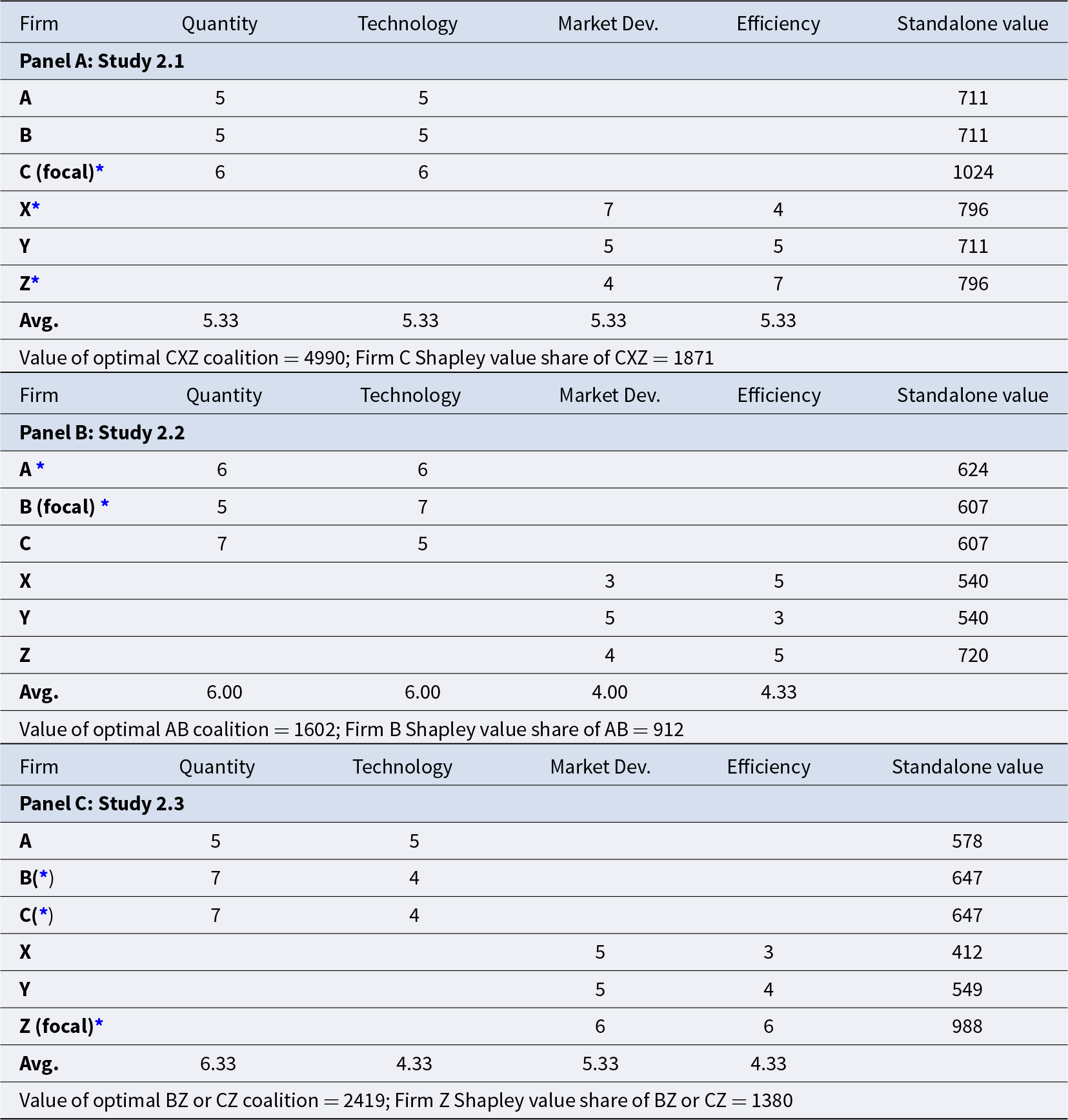
Parameters: Study 2.1: γ = 4, δ = 0.6; Studies 2.2 and 2.3: γ = 3, δ = 0.6.
* indicates member of optimal focal alliance.
The data are from 38 participants assigned randomly to each of two study conditions. In Condition U, all six firms start unattached. In Condition H, an attractive potential downstream partner X is in an existing horizontal alliance with an unattractive Firm Y. The downstream Firm Z, an attractive third member of the optimal CXZ coalition, is unattached. If reluctant to poach an existing alliance, focal Firm C would be less likely to align with Firm X when it is attached (Condition H) versus when it is unattached (control Condition U).
Procedure. The procedures matched those in Study Set 1. Participants in Conditions U and H received their respective instructions on a game screen. If no coalition formed within 12 iterations, the game ended with the participant receiving Firm C’s standalone value. Post-game, participants indicated the factors they considered in forming coalitions and confusing aspects of the game (if any). Those in control Condition U were also asked if they had tried to form smaller coalitions before forming larger ones. Those in Condition H were asked if the initial XY coalition affected their play.
Results. In control Condition U (all firms unattached), 10 of 19 participants (52.6%) added Firm X to their final coalition. In Condition H (coalition XY present at outset), 7 of 19 players (36.8%) included (poached) Firm X in their final coalition. Although directionally consistent with expectations, the difference is not significant (χ 2(1) = 0.96, p = .33). Taken together, in control Condition U (X and Y unattached), coalitions including either X or Y formed in 15 of 19 cases (78.9%). In contrast, in Condition H, only 10 of 19 participants (52.6%) poached either X or Y from the existing coalition. This difference approaches significance (χ 2(1) = 2.98, p = .08).
The offer data showed that offers involving either Firm X or Y (but not both) were more frequent in Condition U (X and Y unattached) versus Condition H where X and Y were in a preexisting alliance (M U = 4.47, s.d. = 2.67; M H = 2.37, s.d. = 2.34; one-tailed t = 2.28, p < .01). Further, offers made only to Firm X (but not Y) were also more frequent in the control Condition U than in Condition H (M U = 3.26, s.d. = 2.45; M H = 2.0, s.d. = 1.97; one-tailed t = 1.75, p < .05). These data show evidence consistent with poaching avoidance. Importantly, the average number of offers did not differ between conditions (M U = 6.16, s.d. = 3.0; M H = 6.74, s.d. = 3.02; two-tailed t = 0.59, p = .56). Thus, participants searched with equal intensity for improved profits, but those in Condition H avoided poaching the existing XY coalition.
Interestingly, relative to those in Condition U, participants in Condition H had a distinct preference for the unattached downstream Firm Z. Six players in Condition H formed the CZ coalition, versus zero in Condition U. This difference is significant (χ 2(1) = 9.45, p < .01). In Condition H, players avoided poaching the existing XY coalition and preferred the unattached Firm Z as an alliance partner. Thus, participants show a clear preference for partnering with the unattached downstream firm.
In this scenario, the optimal CXZ coalition was not easy to locate. Only six participants in the control Condition U (31.6%) and four participants in Condition H (21.1%) were able to form this optimal coalition. These proportions do not differ (χ 2(1) = 0.55, p = .46). Overall, only 26.3% of the participants achieved the optimal coalition suggesting that the three-firm optimal posed a challenge. Notably, participants in Condition H who poached either X or Y from the XY coalition did better than those who did not (M POACH = 1548.8; M NOT POACH = 1364.5; F(1,17) = 8.53, p = .01). These results show that poaching avoidance (e.g., forming the CZ alliance instead) lowered payouts.
Discussion: Responses to the post-game questions provided additional insights. In Condition H, 14 of 19 participants (73.6%) stated that the presence of the XY coalition influenced their game play. Of these, only two poached Firm X to achieve the optimal CXZ coalition. Of the five who indicated that the existing XY alliance had no impact on their play, two formed the optimal coalition.
Condition H participants who did not poach (either X or Y) noted various motivations such as: ‘… good to have my own downstream firm due to the power Firms X and Y would have if I didn’t’, ‘Firm Z … feeling left out would be willing to form an alliance’, and ‘I wanted to determine what Firm X would make … and try to score higher’. Two players stated that they wanted ‘to get in on’ the existing alliance. Participants who did poach (either X or Y) showed a sharp contrast. Several were highly competitive: ‘I did not look into partnering with them…it would take a high bid to get them to break the contract’; ‘I attacked them immediately’; and ‘I tried an alliance with both first, got frustrated … ignored them … came back to try them individually’. The initial alliance was clearly of concern to these participants.
In summary, in Study 2.1, the search and coalition outcomes data suggest that managers avoided poaching from the horizontal XY coalition. This had negative payout consequences in Condition H: those who did not poach had lower payouts relative to those who did.
6.2. Study 2.2: Poaching existing coalitions (two-firm optimal coalition)
In Study 2.2, we used a two-firm optimal coalition. The resource endowments and standalone values of the upstream (A, B, and C) and downstream (X, Y, and Z) firms are shown in Table 2, Panel B. The focal (upstream) Firm B has unbalanced resources and a modest standalone value (607). At first glance, the horizontal BC coalition appears optimal for the focal Firm B (SV = 807). However, since A lacks a strong downstream partner (the AX coalition is weak) it is amenable to an offer from Firm B. Based on our mathematical formulation, AB is the optimal coalition (maximal share criterion) and yields an SV of 912 for B.
Procedure. Thirty-eight participants were assigned randomly to one of two study conditions. In control Condition U, all six firms start as unattached singletons. In Condition V, the focal Firm B has an attractive coalition partner (upstream Firm A) that is in a weak vertical alliance with downstream Firm X. Firm C, an attractive but suboptimal partner, is unattached. If reluctant to poach the existing alliance (AX) in Condition V, focal Firm B is less likely to align with Firm A, versus when A is unattached (control Condition U). The initial instructions, termination rules and post-game questions were identical to Study 2.1. Participants in the control Condition U and Condition V received relevant instructions on the game play screen.
Results. In the control Condition U (all firms unattached), 10 of 19 participants (52.6%) formed the optimal AB coalition. In Condition V (AX coalition present at outset), only 4 of 19 players (21.1%) formed an alliance with Firm A. The difference is as expected and significant (χ 2(1) = 4.17, p = .04). Moreover, only 6 of 19 participants (31.6%) in the control Condition U versus 12 of the 19 participants (63.2%) in Condition V formed the BC coalition, also a significant difference (χ 2(1) = 3.87, p < .05). Note that the BC coalition did not require poaching A from the existing AX coalition. These data align with our expectation that Condition V participants would avoid poaching A from the initial AX coalition. Rather, they formed the next best coalition (BC) with the unattached Firm C. No player had both A and X in their final coalitions and only one in Condition U formed an alliance with X.
The search data showed that offers involving either Firm A or X (but not both) were more frequent in Condition U (A and X unattached) than in Condition V where A and X were allied (M U = 2.53, s.d. = 2.14; M V = 0.68, s.d. = 1.25; one-tailed t = 3.25, p < .01). Further, offers made only to Firm A but not X were also more frequent in control Condition U than in Condition H (M U = 1.68, s.d. = 1.67; M V = 0.58, s.d. = 1.12; one-tailed t = 2.38, p = .01). These data show strong and consistent evidence of poaching avoidance. As in Study 2.1, the average number of offers did not differ between conditions (M U = 5.79, s.d. = 3.39; M H = 4.79, s.d. = 3.46; two-tailed t = 0.9, p = .37). Hence, participants in both groups searched for improved profits with similar levels of intensity, but relative to those in Condition U, those in Condition H avoided poaching the existing AX coalition.
Players in control Condition U received an average payout of 818.53 (s.d. = 98.38). The average payout in Condition V was 751.37 (s.d. = 158.42). In Condition V, the four players who formed the optimal AB coalition averaged a payout of 822.75 (s.d. = 51.81), whereas the 12 who formed the BC coalition received 789.67 (s.d. = 117.91). These payouts were ordered as expected but did not differ significantly (F(1,14) = 0.29, p = .6).
Discussion: Fourteen of eighteen participants (77.8%) in Condition V acknowledged that the starting AX coalition affected their game play (four did not). The participants implied that they avoided the existing AX coalition (‘I let them be;’ ‘…they were in a coalition I wanted to attract others to try and beat them’, ‘… like to make sure all upstream forces were aligned against Firm A’, and ‘I tried to make more than their joint valuation’). Only one player in this group selected the optimal AB coalition. Thus, even a weak initial alliance deterred poaching, despite the clear economic advantage. In summary, Study 2.2 participants avoided poaching a firm from the two-firm vertical alliance and instead tended to partner with the unaligned horizontal Firm C. Those in Condition U formed the optimal AB coalition more often. Thus, Study 2.2 (two-firm optimal) shows even stronger evidence consistent with poaching avoidance than Study 2.1 (where the three-firm optimal was harder to detect).
6.3. Study 2.3: Poaching existing alliances (boundary conditions)
In Study 2.3, we again use a game featuring a two-firm optimal coalition. Our goal is to explore boundary conditions on poaching avoidance in strategic alliances. The literature on three-person coalition games suggests that when an unattached focal firm perceives an existing alliance as a sufficient threat, it may try to reduce the existing coalition’s power by poaching one or more of its members. Alternatively, it may rally other unattached firms to form a rival coalition. As a third option, the focal firm may try to join the existing coalition to share in the surplus. In the airline industry, the formation of the Star Alliance (founders: Lufthansa, Air Canada, Scandinavian Airlines, Thai Airways, and United Airlines) set in motion other airline alliances such as Oneworld (British Airways, American Airlines, Cathay Pacific, and Qantas) and Sky Team (Aero México, Air France, Delta, and Korean Air) to mitigate the competitive threat.
Study 2.3 explored these dynamics. As Table 2, Panel C shows, the focal player in Study 2.3 was assigned to downstream Firm Z which has the highest standalone value (988). Given the maximal share outcome of this game, the optimal coalition for Firm Z is either BZ or CZ (Firm Z’s SV is 1380 in either alliance). Note that upstream Firms B and C have identical profiles and equal standalone values (647). Thus, focal Firm Z has two equally attractive potential partners with whom to form a vertical coalition. However, in the starting conditions, one potential partner (C) is a singleton and the other (B) is embedded in an existing coalition.
In Condition H, there is a two-firm horizontal upstream AB coalition at the start of the game. In a second Condition V, a larger three-firm vertical coalition ABY exists at the outset. While Firm B is in a preexisting coalition, the equally attractive potential partner C is unattached in both conditions. In the control Condition U, all firms start unattached. Here, Firms B and C should be equally attractive, and we therefore expect subjects to form the BZ and CZ coalitions equally often. In contrast (based on the poaching avoidance observed in Studies 2.1 and 2.2) we expect that in Condition H, subjects will be less likely to poach Firm B from coalition AB. Rather, focal Firm Z is more likely to form the CZ coalition with the unattached Firm C.
Will a reluctance to poach an existing coalition persist in Condition V where the existing three-firm coalition ABY is relatively powerful? Here, subjects could still try to avoid poaching and form the two-firm CZ coalition. Alternatively, focal Firm Z may try to join the existing ABY coalition to share the surplus. As another possibility, Firm Z may try to weaken the ABY alliance by poaching Firm B from it. Since BZ is one of two optimal coalitions for the game, there is an economic rationale for this outcome if focal Firm Z feels threatened by the ABY coalition.
Procedure. A total of 57 participants started the study and were randomly assigned to three study conditions. One participant dropped out partway through the study; hence, our results are based on 56 participants: 17 in control Condition U, 20 in horizontal Condition H, and 19 in vertical Condition V. The games instructions and termination rules were identical to the previous studies. Participants in Conditions U, H, and V answered similar post-game debriefing questions about their game play. Those in Condition H (V) indicated if the initial AB (ABY) coalition affected their game play.
Results. In control Condition U, 10 of 17 participants formed one of the optimal coalitions BZ or CZ: five of each (50% formed CZ). This is as expected given Firms B and C are equally attractive. In Condition H, only 8 of 20 participants formed an optimal coalition. Notably, seven of eight (87.5%) formed the optimal CZ coalition with the unattached firm C. Only one player in this condition poached B (or A) from the existing (AB) coalition. This contrasts with the control Condition U where Firm B was chosen 50% of the time (z = 1.68; p = .09). Thus, participants in Condition H largely avoided poaching B from the initial AB coalition and picked the unattached Firm C instead.
The results were different in Condition V where ABY was the powerful initial coalition. Here, 7 of the 19 focal players formed one of the two optimal coalitions: 4 (57%) formed BZ and 3 (43%) formed the CZ coalition. This split is not statistically different from the equal split observed in the control Condition U. Thus, unlike in Condition H, there is no evidence of a preference for the unattached Firm C in Condition V: participants poached Firm B from the ABY coalition at about the same rate as in the control Condition U (B unattached).
Interestingly, 5 of 20 participants in Condition H formed a coalition with both A and B (an ABZ coalition), whereas none formed in Condition U. This difference is significant (z = 2.22, p = .03). Thus, if Condition H participants were interested in Firm B, they tended to join versus break the existing AB coalition. Participants in Condition V (only one ABZ coalition formed) behaved like those in the control Condition U where no ABZ coalitions formed.
The offer data show that those in control group U made significantly more offers on average to either Firm A orFfirm B but not both, relative to participants in Condition H (M U = 2.76, s.d. = 2.41; M H = 1.20, s.d. = 1.40; one-tailed t = 2.33, p = .01). On average, they also made more offers to Firm B, but not to Firm A (M U = 2.12, s.d. = 1.76; M H = 0.55, s.d. = 0.89; one-tailed t = 3.49, p < .01). This is consistent with the findings in Studies 2.1 and 2.2 and provides compelling evidence consistent with poaching avoidance. As with the other studies, there were no significant differences in the total number of offers made on average in Conditions U and H, respectively (M U = 6.88, s.d. = 4.53; M H = 4.9, s.d. = 3.45; two-tailed t = 1.51, p = .14) suggesting similar levels of search intensity.
The search data in Condition V show different patterns. Average numbers of offers made to Firm A or B or Y (but not all three) were slightly higher in Condition U versus Condition V (M U = 4.12, s.d. = 3.18; M V = 2.53, s.d. = 2.34; one-tailed t = 1.72, p = .09). Given that 60% of potential partners were in the initial ABY alliance, this is expected as it would be difficult for those in Condition V to avoid offering A, B, or Y. The focal firm in Condition V did make fewer offers to Firm B alone than in the control Condition U (M U = 2.12, s.d. = 1.76; MV = 1.11, s.d. = 1.29; one-tailed t = 1.98, p = .06). Examining the focal firm’s offers in Condition V shows that it made more offers on average to the unattached optimal Firm C than to Firm B (M C = 1.74, s.d. = 1.63; M B = 1.11, s.d. = 1.29; t(18) = 2.27, p = .04). Overall, in Condition V, the evidence for poaching avoidance is slightly weaker and may reflect a desire to mitigate the threat posed by the ABY alliance. Also, the average payout of the focal players in the three conditions were not different (M U = 1368.41; M H = 1357.35 and M V = 1336.58; F(2,53) = 0.13, p = .88) reflecting that the two options that tested for poaching behavior had identical payouts by design.
Discussion: Qualitative responses to the post-game questions provide insight into the underlying behavioral processes. Participants in Condition H were unanimous in stating that the AB coalition influenced their game play. Those who joined the AB coalition (to form the ABZ coalition) indicated they did so (vs. poaching from it) because ‘… minimum value expectations (are) likely to be higher if they were to be split up’. Some reported that they ‘started by checking to see if I would be able to form a coalition with both of them in it’.
Condition H respondents who did not join the ABZ coalition said they chose other options after having considered joining the AB coalition. Thus, ‘… the first proposal included them as a partnership but there were better deals…’, and ‘… I calculated their combined power and … the capabilities of my own firm as a standalone … to see where (if anywhere) we really lacked’. Interestingly, several players purposely left the AB coalition alone: ‘… looking for an upstream firm to partner with, but ignored Firms A and B … opted to make an offer to C due to the relationship that A and B already enjoyed’, and ‘… knowing that A & B were already in a coalition … my firm … only benefit from another downstream firm’.
Participants in Condition V also stated that the initial ABY coalition affected their play. However, their responses had different themes. A few tried unsuccessfully to join the powerful ABY coalition: ‘… tried to get in …, but did not work …’ Others said that the perceived power of the ABY coalition led them to try alliances with unattached Firms C and X: ‘… thought that agents without a coalition would be eager to join one … not to be left without power … used this opportunistically to get more profits’. A third group explicitly wanted to break up the ABY coalition and form one to augment their own power: ‘My initial tactic was (to) break up their coalition. When that failed… tried to ally myself in a way that maximize(s) my payout’. Others tried to emulate the existing coalition: ‘I have to create my own … looked at their model (upward and downward integration) … to create my own coalition to provide competition’.
Power was a common theme in these responses. The relatively weak upstream AB coalition did not create concern for downstream focal players: players in Condition H did not poach from it and often joined it. However, in Condition V, the ABY alliance was seen as a powerful competitive threat. Hence, the focal players either tried to join it, rally other firms against it, or try to break it. These motivations overcame the reluctance to poach the existing coalition. The powerful existing coalition elicited efforts to mitigate the threat by poaching from it or forming an alternative coalition with a ‘reasonable’ outside partner.
In summary, the three experiments in Study Set 2 examined the extent to which an unattached focal firm attempts to poach attractive coalition partners from existing alliances. The results show evidence consistent with poaching avoidance even when firms sought to improve their economic payouts. Some participants joined (without poaching) the existing alliance, a majority formed coalitions with other unattached firms. Poaching was avoided unless an existing alliance was seen as threatening and/or there was no viable unattached partner. Overall, poaching avoidance led to suboptimal final coalitions with lower economic payouts.
7. General discussion
Summary of Findings. This paper examines how the mere presence of an initial alliance can influence managerial decisions about strategic alliance partner(s) and the division of joint gains from a coalition. Study Set 1 considers alliance formation when the focal firm is not an unattached singleton but already is in an existing coalition. We find evidence consistent with a status quo bias: an initial alliance can influence managerial coalition formation decisions relative to when all firms are unattached. Although these firms seek to improve their economic position, the initial alliance inhibits their search for partners, often leading to economically suboptimal outcomes. The effect persists across both vertical and horizontal alliances but was most evident when the optimal coalition has a simple (two-firm) structure that participants can easily find. The effect is not due to reduced search effort for better economic payout can be attributed to the tendency to include the initial partner as they search for higher payouts, even though this is economically suboptimal. Only a small proportion of players realized that payouts would be better if they did not include the initial partner as they searched for higher payouts.
This paper also examines the formation of strategic alliances when the focal firm is initially unattached, but attractive potential coalition partner(s) are embedded in coalitions with other firms. Study Set 2 examines the extent to which the unattached focal firm attempts to poach away attractive coalition partners from existing alliances. Our results show evidence consistent with poaching avoidance even when firms seek improved economic payouts. We provide evidence that such self-imposed constraints on search because of unspoken social and business norms against poaching may foreclose economic opportunity.
Although some chose to join an existing alliance, most of our participants formed alliances with other unattached firms. Perhaps they believed that the unattached partner would add more value, or they anticipated higher acquisition and retention costs in poaching partners from existing alliances. Poaching was avoided unless an existing alliance was seen as a threat, and/or a viable alternative (unattached) partner was unavailable. Yet, joining a powerful coalition simply to mitigate a perceived threat may be suboptimal if one is seen as an interloper or ‘outsider’ in the expanded alliance. An unattached or a less embedded firm may then be a logical target for a balanced and profitable alliance. These factors illustrate the upsides and downsides of the various alliance options available to a strategic decision-maker as behaviorally meaningful and economically optimal decisions may not always be aligned. The impact of such misalignment is measurable in laboratory studies but can be intractable in the field.
Managerial Takeaways. Our core findings are consistent with prior research findings showing that embedded alliances can create individual, interpersonal, organizational and interorganizational pressures that inhibit search for better alliances (Klossek et al., Reference Klossek, Meyer and Nippa2015). Strategic alliances that add value by sharing soft skills, social capital and partner-specific investments appear particularly susceptible. Our results confirm a heuristic allegiance to the initial partner as a form of reference dependence. The need to share joint gains with a suboptimal partner also lowers the likelihood of attracting contributing partners. Despite the benchmarking value of a current coalition in the search for improved payouts (Malhotra & Bazerman, Reference Malhotra and Bazerman2008), sticking with an existing partner can inhibit discovery of economically superior outcomes that exclude the existing partner. At the same time, the initial coalition may mitigate risk and help managers maintain psychologically satisfactory relationships (even if economically suboptimal). It can also be a fallback position if better partners are unavailable. Hence, managers should carefully weigh the pros and cons of allegiance to existing alliance partners.
Whereas norms against poaching may be meaningful in some social situations (e.g., mate poaching) and business contexts (e.g., poaching talent or intellectual property), they may create needless barriers to improving firm performance. Most effective marketers are not shy about customer acquisition via fair and open competitive actions that poach a competitor’s customer base. Arguably, a similar mindset should apply in securing alliances that show promise of economic gains subject to a potential partner’s contractual obligations in existing alliances. Like customer acquisition and retention, effective acquisition and retention of alliance partners should rest on the value added by each party in the ongoing relationship. Periodic assessments of partner contributions would avoid perpetuation of strategically and economically unproductive alliances.
Limitations. We note a few limitations of our studies. First, the case and the mathematical formulation that we used described the participants’ task as dividing the estimated joint gain (profit contribution) from a potential coalition. We later discovered that the software sometimes referred to the joint gain as ‘revenue’ perhaps leading some participants to consider the cost implications of a coalition. However, no participant noted this issue in the comprehension test, during game play, or at debriefing. As such, we believe that this error did not impact decisions and participants treated the joint gain numbers as intended.
Second, our participants were graduate students in business-related fields (most had business experience). Although they are not perfect proxies for managers who make real-world strategic alliance decisions, they have a good understanding of the relevant principles. Our participants were also well-compensated for their participation and took the game seriously. Importantly, they competed for a significant monetary prize based on the economic results of their game decisions. Thus, our findings regarding suboptimal coalitions do not stem from participant involvement issues, and indeed match prior findings on entrepreneurial susceptibility to the status quo bias (Burmeister & Schade, Reference Burmeister and Schade2007).
Third, our offer data show that even when a target is identified, managers had trouble determining the optimal offer level to ‘seal the deal’. As in real-world negotiations, errors have asymmetric outcomes – the bots always reject offers below their Shapley optimal, but always accept more generous offers. We limited the participants to a maximum of 12 offers within which to form an alliance to prevent them from finding the optimal offer by trial and error. Thus, some participants may have lost the incentive to maximize profit, and simply looked for any ‘acceptable’ alliances that improved their starting profit position. Interestingly, equal divisions of the joint gains were rare, unlike what is often observed in negotiation games (Srivastava et al., Reference Srivastava, Chakravarti and Rapoport2000).
Finally, a more extensive set of post-game measures could have been used to obtain correlational evidence as to whether specific factors related to the environment, the focal firm, or individual differences among decision-makers played a role in determining the results. Such measures would have served as useful signals. However, without specific manipulations of these factors, we would be unable to causally implicate them as driving or moderating our experimental results.
Future Research – Moderators and Boundary Conditions. The studies reported in this paper examine how a focal firm searches for coalitions to improve its economic payout as a function of the alliances that exist in its competitive context. Our findings provide a springboard for future research that explores factors that moderate and identify boundary conditions for our results. We provide a schematic diagram (Fig. 1) and discuss three categories of such moderators: environmental, focal firm, and decision-maker factors, respectively.
Selected moderators of status quo maintenance and poaching avoidance

First, various environmental factors may moderate our results. One such factor is environmental turbulence created by disruptive innovation, high industry growth rates, and/or heightened competitive intensity in mature markets. Such turbulence may heighten the value that decision-makers place on stable alliances, making both status quo maintenance and poaching avoidance more likely (e.g., Bicen et al., Reference Bicen, Hunt and Madhavaram2021; Jap, Reference Jap1999). On the other hand, when such turbulence threatens firm performance and profitability, managers may be more willing to leave existing coalitions and seek new alliances that provide access to innovative technology and/or competitive capabilities. The relationship portfolio may become more diverse and less stable, allowing relatively quick changes (Zafari et al., Reference Zafari, Biggemann and Garry2023).
A second set of moderators (Fig. 1) relate to the characteristics of a focal firm and its current and potential alliance partners. A key factor in this set is the degree to which a focal firm and potential partners are in embedded relationships. This influences the complexity of formal and informal behavioral rules that alliance partners must conform to and balance. The context also determines firms’ beliefs regarding the social and economic implications of abandoning or staying in their own existing relationships, as well as infiltrating those of others. Recent research shows that while spatial and relational embeddedness may ‘buffer’ the durability of alliances, they may also raise expectations that, if violated, could make the relationship more brittle and susceptible to fracture (Kumar et al., Reference Kumar, Nowinska and Zaheer2024).
Linking further to Fig. 1, a focal firm’s prominence, size, and resource capabilities should make its alliances more stable. Yet, these very factors could stimulate firms to explore new alliances or abandon existing ones. Alliance entry and exit decisions must factor in relevant acquisition and/or termination costs (both economic and reputational), conflicts of interest and agency stemming from multiple affiliations, resource redundancies, and power asymmetries. A firm’s assessment of its own ability to identify attractive alliance partners and negotiate acceptable allocations of realized gain may influence status quo maintenance or poaching avoidance. Future research can shed light on the effects of such firm-level moderators.
Finally, Fig. 1 shows a third set of moderators relating to decision-makers’ cognitive and motivational mindsets. At the individual decision-maker level, we followed Klossek et al. (Reference Klossek, Meyer and Nippa2015) to argue that factors such as risk aversion and uncertainty avoidance would ordinarily affirm firm predispositions to maintain status quo and avoid poaching. However, these factors were not directly manipulated in our studies. Future research may test for boundary conditions by formally manipulating decision-maker risk orientation, as well as situational risk and uncertainty. Will boundary conditions emerge such that, when market position and share are threatened, managers would abandon existing alliances and seek new coalition partners that might mitigate the threat? Could such decisions boomerang by raising risk exposure?
Our findings emerged in deterministic games with ‘bot’ partners that acted rationally and carried no psychosocial baggage (cognitive biases, emotional responses, social and cultural influences, etc.). Using bots removed extraneous variability across game replications that is likely in ‘all human’ settings (e.g., Guth et al., Reference Guth, Schmittberger and Schwarze1982) and imposed strong rationality constraints on ‘bot’ responses (i.e., simply seeking their SV share of the coalition providing the maximal share outcome of the game). In contrast, human players’ responses may have reflected psychological influences such as trust, loyalty, and fairness favoring the status quo, or even moral norms affirming poaching avoidance. Individual differences in personality likely influence how human players respond to ‘bots’ versus human counterparts in economic games (Upadhyaya & Galizzi, Reference Upadhyaya and Galizzi2023). Since our participants knew that their potential partners were bots, they may have undervalued social issues and other-regarding behaviors. Thus, the psychosocial impact may differ for ‘bot’ versus human rejection/acceptance of offers. Future research on this issue is relevant given the increasing use of AI agents in decision tasks.
Importantly, in contrast to our individual decision-making setting, strategic coalition decisions often rest on inputs from a group of managers. Although group decisions may eliminate some individual biases (e.g., availability bias due to individual-level memory failures), they may introduce other group-level biases driven by sociocultural influences. These include false consensus, groupthink, social loafing, group polarization, as well as group-level escalation of commitment (e.g., Bazerman & Moore, Reference Bazerman and Moore1999, Reference Bazerman and Moore2009; Mannion & Thompson, Reference Mannion and Thompson2014). Such biases may be exacerbated under time pressure and high levels of managerial uncertainty (Jones & Roelofsma, Reference Jones and Roelofsma2000). Future research in group decision settings may shed light on how group versus individual settings affect coalition formation.
8. Conclusion
How firms make alliance decisions in competitive markets, given power differentials and potential loss of autonomy is an important research question. Since the currencies involved are both economic and psychosocial, and the relevant values that are both subjective and time-variant, there is room for judgment deficits. We show that status quo biases and poaching avoidance may thwart the formation of economically favorable coalitions even when firms seek improved economic payouts. Such effects in alliance contexts can inhibit flexible market reconfigurations even in structured and stylized (code ‘less realistic’) laboratory environments. Such suboptimality may be pervasive in the real world. Even if optimality is too rigid a criterion for evaluating real-world managerial decisions, it may still be useful to assess if decisions are at least directionally normative (Cheema et al., Reference Cheema, Chakravarti and Sinha2012; Srivastava et al., Reference Srivastava, Chakravarti and Rapoport2000).
Understanding the interplay of economic, psychological, and sociocultural moderators that dynamically strengthen or disrupt coalition formation phenomena may provide insights on why sometimes dysfunctional coalitions endure or where high potential alliances do not form. Real-world strategic alliances in embedded contexts must deal with macrolevel resource matching and organizational alignment issues. These need further study in tandem with microlevel studies of how factors such as trust, fairness, loyalty, and morality impact managerial alliance behaviors. The seminal theoretical and empirical work on coalition formation by Rapoport and colleagues (e.g., Kahan & Rapoport, Reference Kahan and Rapoport1984) continues to serve as an important backdrop for exciting future research in this domain.
Supplementary material
The supplementary material for this article can be found at https://doi.org/10.1017/S1386415725000043.
Data availability statement
This research received IRB human subjects’ approval at the University of Colorado at Boulder, Vanderbilt University, and Johns Hopkins University. Informed consent was received from all subjects either in writing or electronically. All data are freely available on request.
Author contributions
All authors contributed to the study conception and design. Material preparation, data collection, and analysis were performed by Mark Ratchford, Dipankar Chakravarti, and Atanu Sinha. The first draft of the manuscript was written by Mark Ratchford, and all authors commented on previous versions of the manuscript. All authors read and approved the final manuscript. The manuscript is based on the first author’s dissertation.
Funding statement
None of the authors have any financial or nonfinancial interests that are directly or indirectly related to this work. Monetary funding for all studies came from the authors’ research budgets.

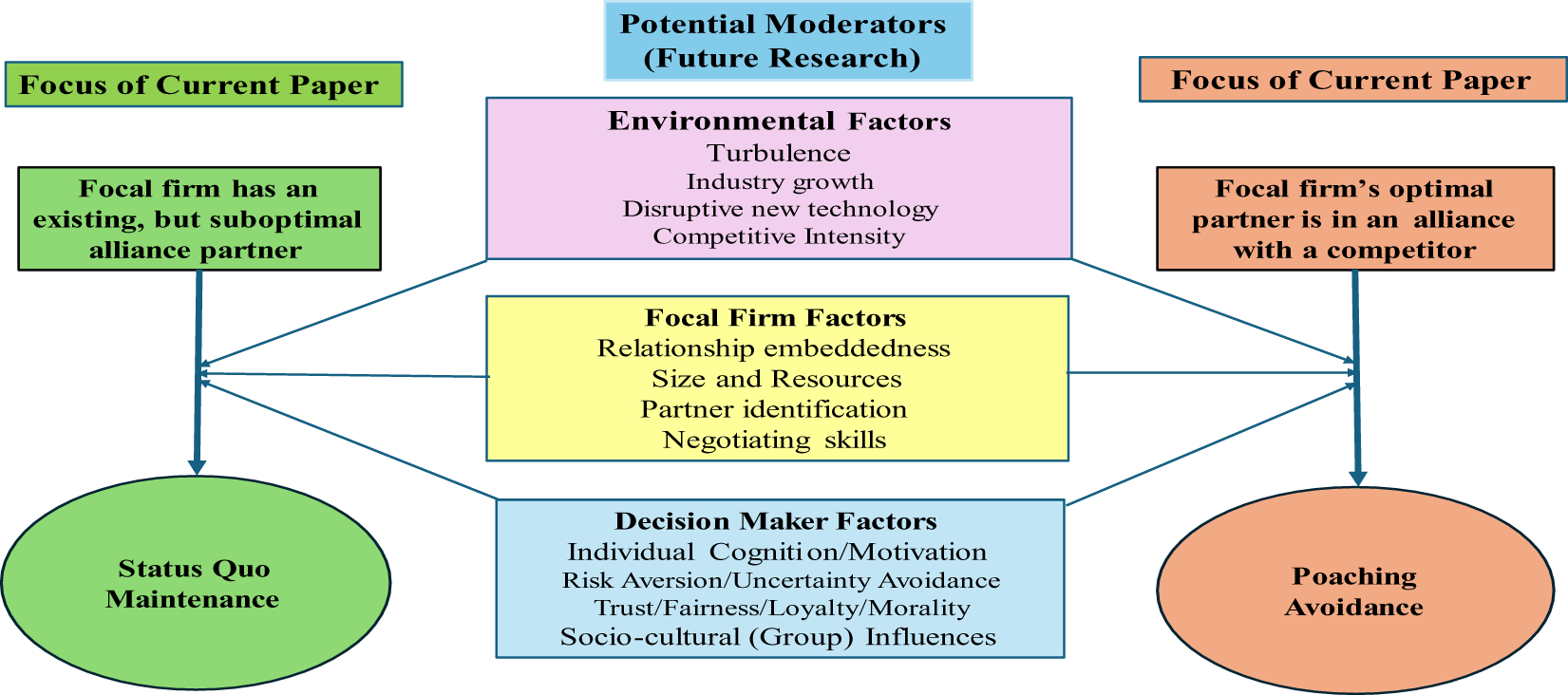


 Open access

