


Introduction
Separation anxiety disorder (SEPAD) is the most frequent manifestation of anxiety during childhood, and it was for a long time considered a time-limited condition, vanishingly rare among adolescents and adults.Reference Copeland, Angold and Shanahan1 Besides a large amount of data linking juvenile SEPAD to the heightened risk of developing panic disorder and other mental disorders during adulthoodReference Kossowsky, Pfaltz and Schneider2–Reference Vanderwerken, Jacobs, Parkes and Prigerson7 in the last decades growing attention has been focusing on the evidence that SEPAD may continue as such through the adult life and to the possibility that it may even begin at any age.Reference Manicavasagar and Silove8–Reference Silove, Slade, Marnane, Wagner, Brooks and Manicavasagar13 Based on this literature, the fifth edition of the Diagnostic and Statistical Manual of Mental Disorders (DSM-5) has removed the age restriction on the diagnosis of SEPAD and has assigned the category to the section of anxiety disorders,Reference Silove and Rees14 effectively recognizing that the disorder may span the entire life course.
As described in DSM-5, individuals with SEPAD experience excessive distress when separation from home or major attachment figures is anticipated or occurs; they worry about the well-being or potential death of their loved ones, particularly when separated from them; and they are preoccupied with knowing the whereabouts of their attachment figures, feeling compelled to stay in touch with them.
A few epidemiological studies evaluated the prevalence of SEPAD in the general population. Findings from the National Comorbidity Survey (NCS-R), involving the English-speaking household US population, have indicated that SEPAD has a lifetime prevalence in the adult general population of 6.6%.Reference Shear, Jin, Ruscio, Walters and Kessler15 More recently, a WHO epidemiological survey conducted across 18 countries worldwideReference Silove, Alonso, Bromet, Gruber, Sampson and Scott16 showed an overall lifetime prevalence of SEPAD as high as 4.8%, with large variability across different countries. SEPAD has also been shown to be highly frequent in several clinical settings, with prevalence estimates ranging from 23% to about 69%, depending on the nature of the sample.Reference Manicavasagar and Silove8, Reference Manicavasagar, Silove and Curtis9, Reference Manicavasagar, Silove, Curtis and Wagner10, Reference Pini, Gesi and Abelli12, Reference Carmassi, Gesi and Corsi17–Reference Carmassi, Gesi and Corsi21 A particularly high level of comorbidity has been shown between SEPAD and both prolonged grief disorder (PGD) and post-traumatic stress disorder (PTSD).Reference Carmassi, Gesi and Corsi21, Reference Gesi, Carmassi and Shear22 In a study conducted among pregnant women in war-affected Timor-Leste, women with core SEPAD symptoms reported exposure to multiple traumatic losses and intimate partner violence and showed a pattern of comorbidity with PTSD, which differentiated them from women with low or limited SEPAD symptoms.Reference Silove, Tay and Tol23 Further data from West Papua refugeesReference Tay, Rees, Chen, Kareth and Silove24 highlighted the mediating role of SEPAD symptoms in the relationship between traumatic losses and worry about family and PTSD symptoms. A study conducted on Bosnian RefugeesReference Silove, Momartin, Marnane, Steel and Manicavasagar25 found that virtually all participants with adult SEPAD had PTSD, although the majority of those with PTSD did not have adult SEPAD. Interestingly, authors proposed that traumas might have distinctive effects, with life threat being the key trigger of PTSD and disruptions or threats to interpersonal bonds leading to grief and SEPAD. Enriching such a perspective, we propose that SEPAD beginning during adulthood might ultimately be conceptualized as a trauma-related disorder, differentiating as such from forms beginning during childhood and either recovering before or continuing throughout adulthood. The present study aims to test the hypothesis that adult-onset SEPAD is associated with experiences of intense personal insecurity and/or worry about family, especially focusing on both traumatic and separation events that may be perceived as threatening interpersonal bonds.
Methods
Sample
Subjects with a principal diagnosis of mood (either depressive or bipolar) or anxiety disorder confirmed by the structured clinical interview for DSM-5 (SCID-5) and giving consent to take part in the study, were consecutively enrolled at the adult psychiatric outpatient clinic of Pisa between April 2016 and February 2017. Patients with psychotic spectrum symptoms, or intellectual disability/cognitive impairment before the index assessment were excluded. Subjects reporting substance use in the previous 3 years or endorsing DSM-5 criteria for substance use disorder during the lifetime were excluded as well. In a single session, participants were administered both self-report questionnaires and clinical interviews by experienced residents in psychiatry. The study was carried out in accordance with the Declaration of Helsinki and study design was reviewed by the University of Pisa Ethical Committee. All subjects were informed of the nature of study procedures and provided written informed consent prior to participation.
Assessments
Separation anxiety
The Structured Clinical Interview for Separation Anxiety Symptoms (SCI-SAS) was administered to assess the presence of SEPAD. This interview evaluates each of the eight DSM-5 criterion symptoms of separation anxiety, separately for Childhood (SCI-SAS-C) and Adult symptoms (SCI-SAS-A). In proceeding with the DSM-5 guidelines, endorsement of three or more of the eight criterion symptoms [symptoms rated as 2 (often)] was used as a threshold to determine categorical (yes /no) diagnosis of SEPAD in childhood and adulthood. In addition, criterion B (ie duration of at least 4 weeks) and C (ie the disturbance causes clinically significant distress or impairment in social, academic and occupational, or other important areas of functioning) were required. The Adult Separation Anxiety Checklist (ASA-27)Reference Silove and Steel26 was used to assess the severity of symptoms of SEPAD. It consists of 27 items rated on a scale from 0 (this never happens) to 3 (this happens all the time), with a total score ranging from 0 to 81.
Traumatic and separation events
To assess trauma exposure, participants were administered the SCID-5 criterion A module for PTSD. Endorsement of this criterion was differently coded if the traumatic event was directly experienced (self) or involved close ones (others). Lifetime exposure to separation events included the following instances: break-up with a partner or a friend, separation/divorce from partner, death of a loved one, moving to another town.
Statistical analyses
The mean values (±SD) of continuous variables such as age, and scale scores were compared between subject groups using the T test. Comparisons of categorical variables between groups were conducted using the chi-square test. Separation and traumatic events as predictors of adult-onset SEPAD (dependent variable) were investigated by a binary logistic regression analysis using sex and the diagnosis of panic, depressive and bipolar disorder as covariates. Data were analyzed using SPSS software version 24.0 (IBM Corp). All p values are 2-sided, and the statistical significance was set at p < .05.
Results
Three hundred and sixty-seven subjects referring to the outpatient service were screened during the enrollment period. Among them, 89 (35.8%) were diagnosed with a psychotic spectrum disorder, 39 (15.7%) with cognitive impairment, 36 (14.6%) with intellectual disability, and 84 (33.9%) with substance use (58 current substance use, and 26 substance use disorder in their lifetime). Thus, 119 subjects (32.4%) subjects met the inclusion criteria and were proposed for participation in the study. Of these, 13 (10.9%) did not want to participate (6 because they did not have time; 4 because they were not interested; 3 because they did not want to sign the consent form). The final sample thus included a group of 106 consecutive adult psychiatric outpatients with anxiety and/or mood (either depressive or bipolar) disorders as a principal diagnosis. As to mood disorders, 27 patients had a diagnosis of major depression and 56 of bipolar disorder. Overall, 72 had an anxiety disorder (33 panic disorder, 39 other anxiety disorders).
Of the total cohort of 106 patients with mood and anxiety disorders, 64 (60.4%) were categorized as not having separation anxiety in adulthood or in childhood (NO-SEPAD), 20 (18.9%) with childhood-onset SEPAD, and 22 (20.8%) with adult-onset SEPAD.
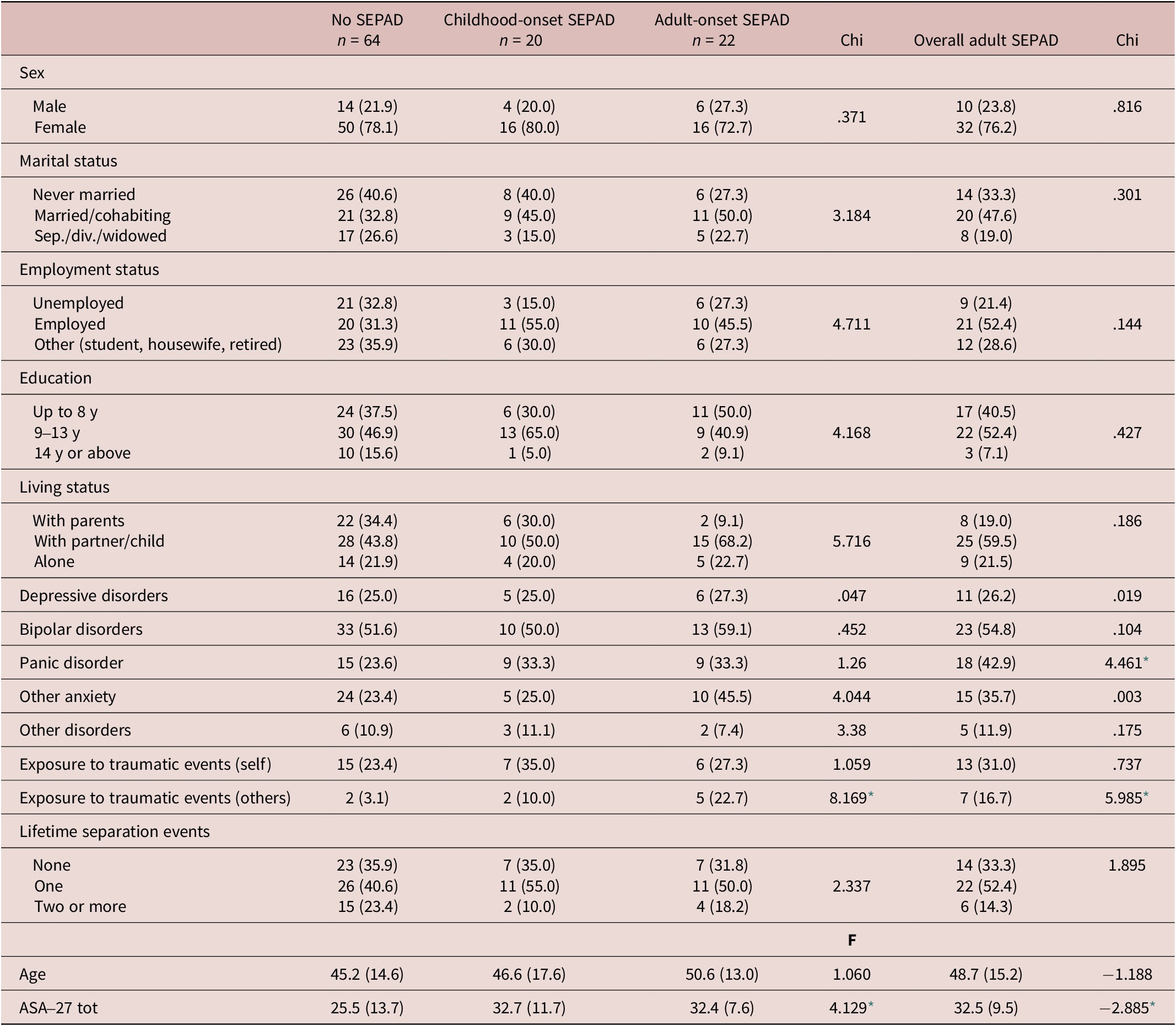
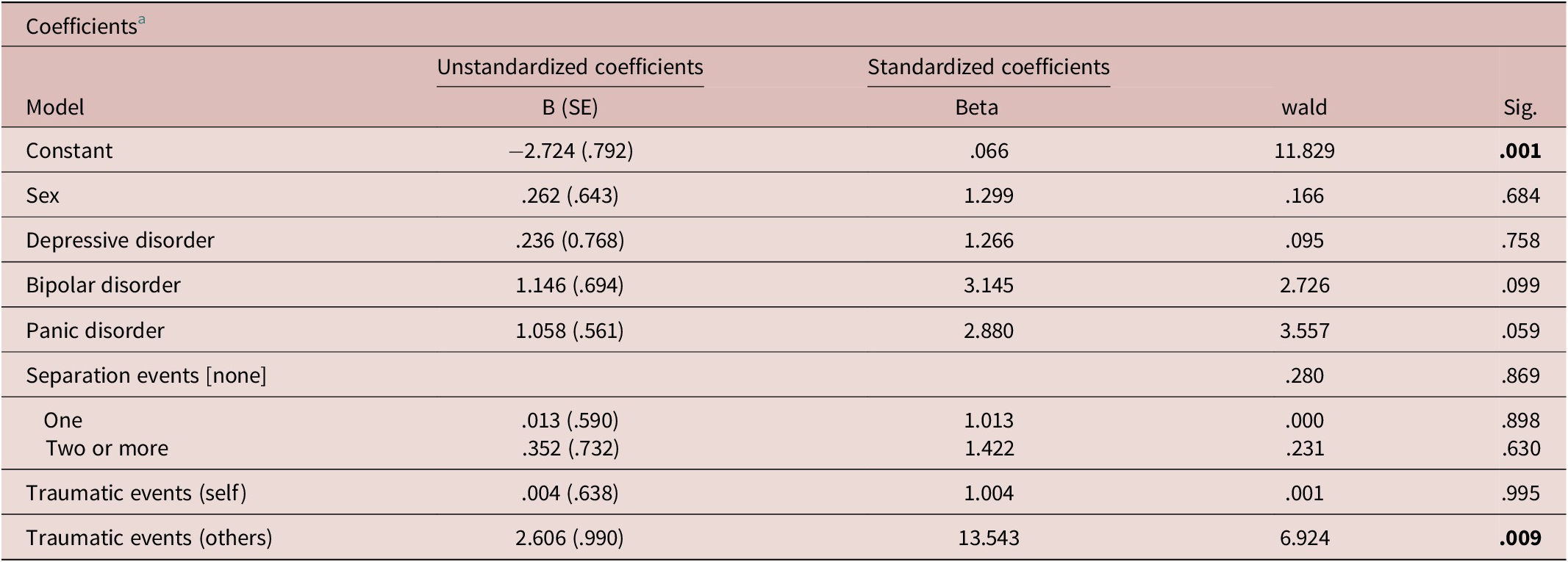
Mean age of onset among adult-onset SEPAD was 39.4 ± 16.6 years. Main socio-demographic and clinical characteristics of the study sample are shown in Table 1. Dichotomous lifetime exposure to traumatic events involving others (but not involving self) was higher among subjects with adult-onset SEPAD (p = .017). The number of lifetime separation events did not differ among the three groups (Table 1). Controlling for sex, major depression, bipolar disorder, and panic disorder, as well as for lifetime traumatic events involving self and separation events, traumatic events involving others significantly predicted adult-onset SEPAD (p = .017) (Table 2).
Socio-demographic and Clinical Characteristics of Study Sample

Note: Overall Adult adult SEPAD = all subjects with adult SEPAD, being childhood-onset SEPAD and adulthood-onset SEPAD together.
* p<.05.
Binary Logistic Regression of Predictors of Adult-onset SEPAD
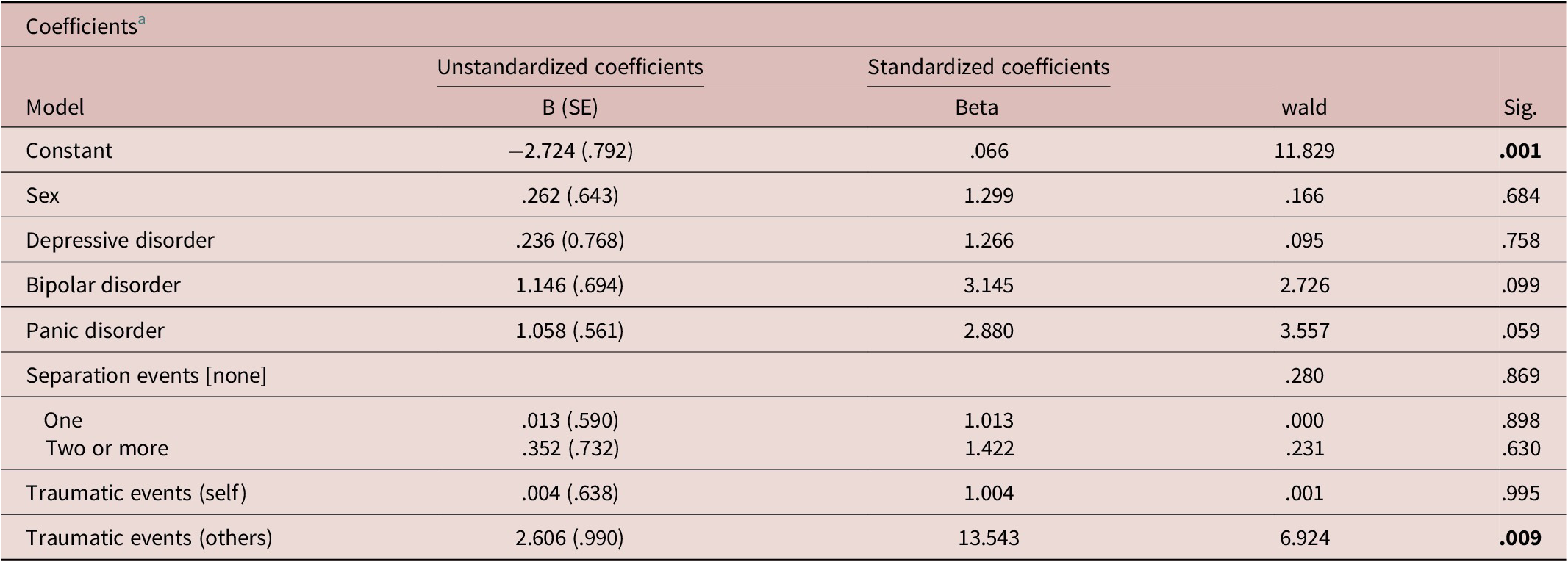
Hosmer-Lemeshow test: χ2(8) = 3.263, p = .917.
Cox R2 = .103, Nagelkerke R2 = .159.
Percentage of overall correct prediction = 80.2%.
a Dependent variable: Diagnosis of adult-onset SEPAD.
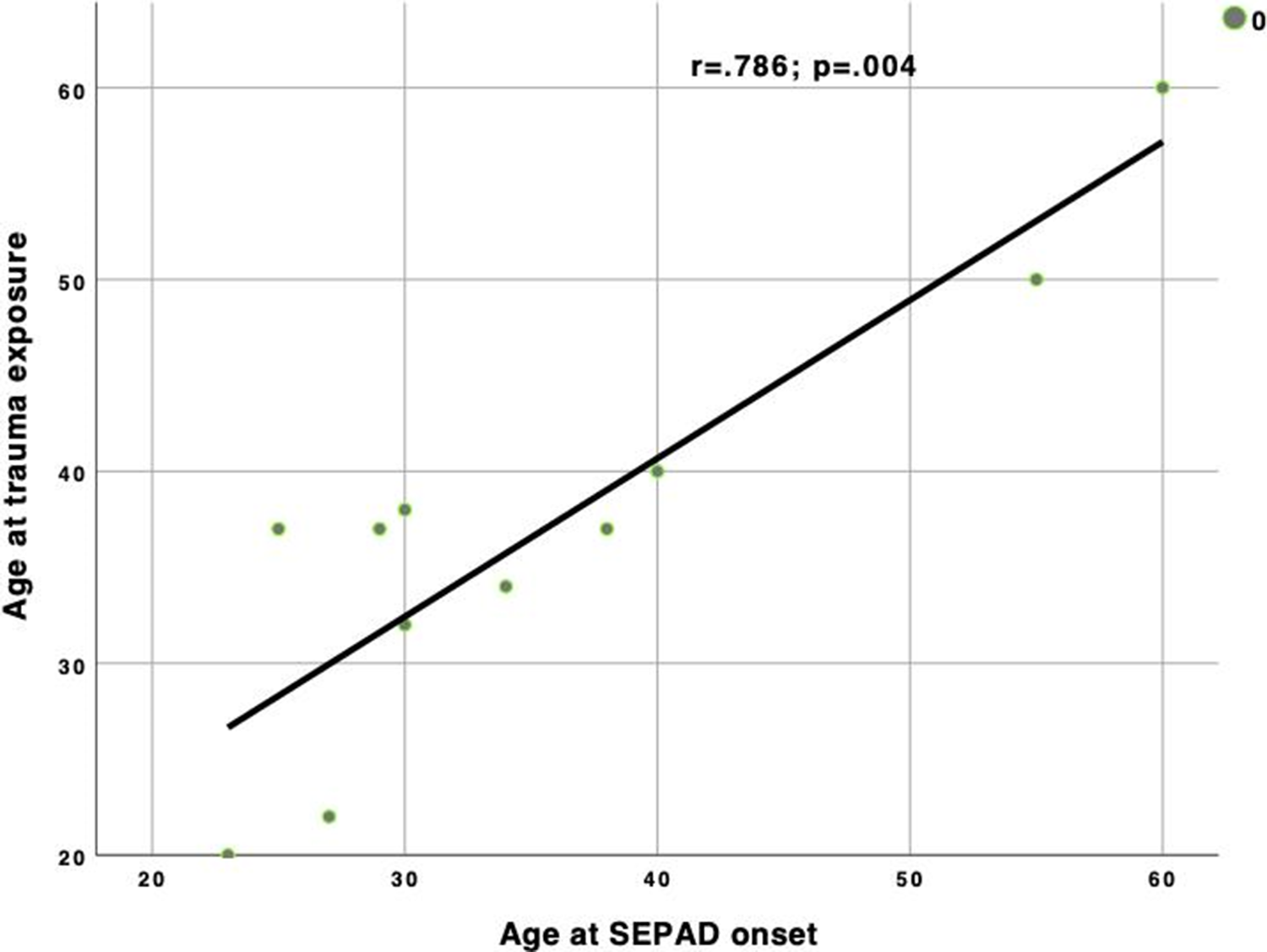
Among subjects with adult-onset SEPAD with exposure to trauma of others, the age of onset significantly correlated with the age at trauma exposure (r = .786; p = .004) (Figure 1).
Correlation between age at trauma exposure (other) and age at SEPAD onset in the adult-onset SEPAD group.

Discussion
The present paper was designed to evaluate whether SEPAD arising during adulthood, without a history of childhood separation anxiety, might relate to separation or traumatic events. To this aim, we investigated both separation and traumatic events occurring during the lifespan in a clinical group of subjects with mood and anxiety disorders additionally undergoing assessment for SEPAD. We found that subjects with adult-onset SEPAD show a positive history for traumatic events to a significantly greater extent than subjects with child-onset SEPAD or with no SEPAD. Moreover, traumatic events occurring to closest others significantly predicted adult-onset (but not childhood-onset) SEPAD, while separation events and traumas occurring to oneself did not. Intriguingly, participants with adult-onset SEPAD showed a positive, significant correlation between age at trauma exposure and the age of SEPAD onset.
Our results are consistent with the hypothesis that SEPAD symptoms manifesting for first-time during adulthood may represent an event-related disorder, having distinctive features from forms beginning during the developmental period and either recovering by adulthood or continuing as such through the adult life. This hypothesis was previously suggested by Silove et al.Reference Silove, Momartin, Marnane, Steel and Manicavasagar25 who found a 100% prevalence of SEPAD among Bosnian refugees with PTSD and speculatively called the role of events threatening relationship bonds in the pathophysiology of adult SEPAD. Furthering Silove’s findings, our data confirm the relationship between traumatic events and SEPAD, also distinguishing between subjects in whom SEPAD is a lifelong disorder from those who develop SEPAD during adulthood, with no history of childhood SEPAD.
In addition, we found that only traumatic events involving close attachment figures play a significant role in predicting adult-onset SEPAD. On the contrary, traumas concerning personal safety and separation events do not. This is consistent with most core symptoms of SEPAD, involving fear that harm could befall to significant others and the need to maintain proximity to them (DSM-5), and aligns with previously proposed models putting forward that traumas involving life threat are the key trigger of PTSD, and disruptions or threats to interpersonal bonds rather result in grief and SEPAD (ADAPT, adaptation and development after persecution and trauma).Reference Silove and Steel26 Our results are also consistent with negative results about the role of actual separation experiences in determining childhood SEPAD and confirm the relative weight of environmental vs genetic factors from childhood to adulthood in the pathophysiology of anxiety.Reference Costa, Pini and Martini27, Reference Waszczuk, Zavos, Gregory and Eley28 As tailored treatments are available for trauma-related disorders, this may ultimately have important implications for differentiating treatment choices on the basis of age of first onset of separation anxiety symptoms.
For example, psychotherapeutic treatment of adult-onset SEPAD could profitably incorporate techniques derived from trauma-focused psychotherapies, which are the current mainstay treatment for PTSD, with larger effect sizes than other currently available treatments. It is noteworthy, in this regard, that eye movement desensitization and reprocessing (EMDR), trauma-focused cognitive behavioral therapy (TF-CBT), and exposure techniques have already been tested in cases of childhood SEPAD following traumatic separation. Our results are still to be viewed considering some limitations. First, the sample size is quite small, dulling the generalizability of the findings and highlighting the need for replication studies in larger samples. Second, the study lacks a longitudinal perspective, and both traumatic/separation events and SEPAD symptom assessment relied on participants’ recall. Third, due to the low caseness of traumatic events, we could not investigate the impact of multiple traumas in the development of SEPAD, which was instead done for separation events. Fourth, we did not consider whether positive life events (ie marriage, childbirth, movings) might play a role in SEPAD onset. Furthermore, we must acknowledge that the prevalence of adult SEPAD was quite high in our sample (41.5%). Despite aligning with rates from some previous studies, we cannot rule out that such a high prevalence is due to the overlap between DSM-5 diagnostic criteria of SEPAD and some symptoms of PTSD, especially those in the domain of avoidance. In this regard, our finding of traumatic events involving close attachment figures as a key trigger of adult SEPAD may also help to disentangle the two psychopathological dimensions. Finally, the exclusion of subjects with current substance use/past substance use disorder, while ruling out a potential confounding effect of substance use, hampers the generalizability of results to dual diagnosis populations. Yet, our study contributes to inquiring about our knowledge on separation anxiety and may be of preliminary ground for further research on adult-onset SEPAD.
Author contribution
All authors have materially participated in the manuscript preparation.
Financial support
No funding was received for this study.
Disclosures
All authors declare no competing interests, nor financial affiliations, or industry-sponsored research.

 Open access

