


Introduction
Antimicrobials are essential medicines used to treat and prevent infectious diseases. These medicines enable many life-saving medical interventions such as surgical procedures, cytotoxic chemotherapy, and safe administration of immunosuppressants. Unfortunately, they are overused on a global scale, driving one of the greatest threats to humanity, known as antimicrobial resistance (AMR). 1 The impact and implications of AMR are far-reaching; in addition to mortality, AMR contributes to prolonged treatment times, increased healthcare costs, unnecessary hospitalizations for conditions generally managed in the community, Reference Costelloe, Metcalfe, Lovering, Mant and Hay2 and has hindered several countries in reaching their sustainable development goals. Reference van Hecke, Tonkin-Crine, Abel, Wang and Butler3
Addressing the issue of AMR necessitates immediate and coordinated actions. National action plans have been developed that incorporate antimicrobial stewardship (AMS) strategies in response to the rising threats of AMR. AMS is a coordinated set of strategies aimed at understanding antimicrobial use through quality and quantity of use surveillance, optimizing use by enhancing prescription appropriateness through interventions such as audit and feedback, and minimizing adverse effects associated with use. This is particularly critical in the primary care setting, where most antimicrobial prescribing occurs. 4–6 Primary care is defined as the “health care people seek first in their community,” this typically includes general practitioners, pharmacists, and other health professionals. 7,8 Despite its importance, AMS in primary care is often under-resourced and insufficiently implemented in many countries.
The advent of electronic medical records (EMRs) has signaled a positive change in improving health care. EMRs provide clinicians with well-organized, linked information in a format that is easy to search - functionality not previously possible with paper records. This has led to an improvement in chronic disease management and prevention, and attainment of screening targets. Reference Manca9,Reference Kern, Barrón, Dhopeshwarkar, Edwards and Kaushal10 Large, population-wide databases have become important resources for public health research, Reference Rezel-Potts and Gulliford11 with major projects throughout the world. Therefore, similarly, these data could be valuable for supporting AMS efforts at scale.
This systematic review aims to explore the use of primary care EMR data for supporting AMS internationally, an activity not previously undertaken. The objectives are to identify the types of studies and interventions performed with these data and their findings, investigate reported data quality issues, and identify facilitators and barriers to its use. Learnings can be applied to improve existing systems and to inform the design of future EMR systems and processes across various settings to better facilitate AMS in primary care.
Methods
This review was registered on The International Prospective Register of Systematic Reviews (PROSPERO) on the 14th of September 2023 (CRD42023460384) and followed the Preferred Reporting Items for Systematic Reviews and Meta-Analyses (PRISMA) guidelines. Reference Page, McKenzie and Bossuyt12
Eligibility criteria
All studies conducted in the primary care setting relating to primary care EMR data use for AMS interventions were included. In this study, we use the terms EMR and electronic health record (EHR) interchangeably as it is applicable in this context, although not synonymous. AMS interventions includes any or all of the following activities 13 : (i) acting on antimicrobial use and appropriateness audit results for continuous quality improvement, (ii) reviewing antimicrobial prescribing use, and ensuring appropriate documentation of indication, active ingredient, dose, frequency, route of administration, intended duration or review plan, and adverse reactions in a patient’s healthcare record, 1 (iii) using surveillance data on antimicrobial consumption, use, and resistance to support appropriate prescribing, (iv) evaluating AMS program performance, identifying areas for improvement, and act to improve appropriateness of antimicrobial prescribing and use, (v) reporting to clinicians and governing bodies on compliance with the AMS policy and guidance, areas of action for AMR, areas of action to improve appropriateness of prescribing and compliance with current evidence-based guidelines or resources on antimicrobial prescribing, and the health service organization’s performance over time.
Exclusion criteria
Studies were excluded if they (i) contained incomplete or unclear data, (ii) were review articles, meta-analyses, gray literature, editorials, opinion pieces, commentaries, conference proceedings, or posters, or (iii) were published in any language other than English.
Search strategy
Relevant articles were identified by a broad search of the following electronic databases: Cumulative Index to Nursing and Allied Health Literature (CINAHL), PubMed, Embase, Scopus, and Web of Science for articles between January 1, 2013 and September 23, 2023. The strategy included search terms to retrieve concepts of AMS, primary care, and EMR.
“Antimicrobial stewardship,” “primary care,” and “electronic medical records” are referred to by different terms depending on country and context. Common aliases for antimicrobial stewardship include “antibiotic stewardship” 14 and the acronyms “AMS” 15 or “ASP”; Reference Barlam, Cosgrove and Abbo16 other terms referring to primary care include “general practice” or the acronym “GP,” 17 “family practice” or “family medicine”; Reference Gutkin18 and “electronic medical records” are often referred to as its acronym “EMR.” Medical subject headings (MeSH) terms were used in addition to text words to increase search sensitivity. The final search strategy is available in supplementary Table S1.
Screening
Two independent reviewers (RC and CC) used Covidence® systematic review software to screen titles and abstracts for eligibility following deduplication. RC, DC, KT, and JMN collated a list of specific terms to be highlighted for reviewers to consider for potential inclusion or exclusion (supplementary Table S2). Reviewers manually screened articles based on these and sorted each into the following categories: (a) meets eligibility criteria (b) does not meet eligibility criteria, and (c) unclear if it meets eligibility criteria. Full-text screening was performed on the articles in categories (a) and (c) by the same two reviewers (RC and CC). Any disagreements between the screening authors were resolved by discussion with a third review author (KT, DC, or JMN). Only publications passing both abstract and full-text screens were included.
Study quality assessment
The final full-text studies deemed suitable for inclusion were further appraised for quality and risk of bias independently by two reviewers (RC and CC), with any disagreements resolved by discussion. A third reviewer was nominated to adjudicate any disputes (KT, DC, or JMN). The Joanna Briggs Institute suite of critical appraisal tools was used to perform these assessments, where the tool most relevant to the type of study being appraised was utilized. The overall risk of bias was assessed as low for all the included studies, with no significant concerns identified.
Data extraction and synthesis
A narrative synthesis was employed to classify and interpret results. Reviewers RC and CC independently grouped and tabulated data based on relevant similarities in themes and concepts, including strengths and facilitators, as well as barriers and limitations to the use of EMR for antimicrobial stewardship activities in primary care. “Strengths” in this context referred to characteristics inherent to the data sources, while “facilitators” were defined as external factors that facilitated the effective use of these data to support AMS. Similarly, “barriers” were any external factors that were perceived to hinder effective data use in this context, and “limitations” were framed as issues that could potentially impact data quality. Results were reported following PRISMA guidelines. Reference Page, McKenzie and Bossuyt12
Ethics
Ethics approval was not required.
Results
Characteristics of included studies
The literature search resulted in a total of 265 articles. After deduplication, a set of 188 articles underwent title and abstract screening where 138 articles were excluded as deemed irrelevant. The remaining 50 articles were included in a full-text review, where a further 16 articles were excluded. A final total of 34 full-text articles that met all criteria were included for review (Figure 1).
PRISMA 2020 flow diagram.

Most studies were from North America (USA, n = 15; Canada, n = 4), followed by Europe (The United Kingdom, n = 7; The Netherlands, n = 2; France, n = 1; Spain, n = 1; Switzerland, n = 1) and the remaining from Africa (Ghana, n = 1), Asia (China, n = 1), and Oceania (Australia, n = 1). Among these, there were 19 cohort studies, 5 cross-sectional studies, 5 quasi-experimental studies, 2 randomized controlled trials, 1 quality improvement study, 1 descriptive observational study, and 1 mixed-methods randomized controlled trial and cohort study. Twenty-nine unique data sources were identified in these studies; five studies were conducted with data from the Clinical Practice Research Datalink (CPRD) Reference Gulliford, Sun, Anjuman, Yelland and Murray-Thomas19–Reference Sun and Gulliford23 and two obtained data from the same two private family medicine clinics Reference Grigoryan, Zoorob, Shah, Wang, Arya and Trautner24,Reference Grigoryan, Zoorob and Germanos25
EMR data for supporting AMS
Six categories of EMR data used for supporting AMS were identified from the studies included in the review. These were, (i) assessing antimicrobial prescribing quality, Reference Sun and Gulliford23,Reference Grigoryan, Zoorob and Germanos25–Reference Vanstone, Patel and Berry40 (ii) measuring the effectiveness of an intervention, Reference Grigoryan, Zoorob and Germanos25,Reference Foreman, Westerhof, Benzer, Eid, Egwuatu and Dumkow28,Reference Frost, Lou, Keith, Byars and Jenkins29,Reference McCormick, Cardwell, Wheelock, Wong and Vander Weide34,Reference Ray, Martin and Wolfson37,Reference Robinson, Barsoumian, Aden and Giancola38,Reference Vanstone, Patel and Berry40–Reference May, Sickler, Robbins, Tang, Chugh and Tran44 (iii) analyzing antimicrobial prescribing trends, Reference Rockenschaub, Hayward and Shallcross22–Reference Grigoryan, Zoorob, Shah, Wang, Arya and Trautner24,Reference Brown, Wong, Kandiah, Moore and Quairoli26,Reference Chandra Deb, McGrath and Schlosser27,Reference Hawes, Turner, Buising and Mazza31,Reference Owusu, Thekkur and Ashubwe-Jalemba36,Reference Ray, Martin and Wolfson37,Reference Singer, Fanella and Kosowan39,Reference Adekanmbi, Jones, Farewell and Francis45–Reference Wong, Morkem, Salman, Barber and Leis52 , (iv) assessing patient and provider characteristics in prescribing Reference Rockenschaub, Jhass and Freemantle21–Reference Grigoryan, Zoorob, Shah, Wang, Arya and Trautner24,Reference Brown, Wong, Kandiah, Moore and Quairoli26,Reference Chandra Deb, McGrath and Schlosser27,Reference Hawes, Turner, Buising and Mazza31,Reference Ivanovska, Hek, Mantel-Teeuwisse, Leufkens and Van Dijk32,Reference Owusu, Thekkur and Ashubwe-Jalemba36,Reference Robinson, Barsoumian, Aden and Giancola38,Reference Singer, Fanella and Kosowan39,Reference Kitano, Langford and Brown47,Reference Martinez-Gonzalez, Di Gangi, Pichierri, Neuner-Jehle, Senn and Plate49,Reference Wang, Li and Chen51,Reference Wong, Morkem, Salman, Barber and Leis52 (v) evaluating novel tools or measures Reference Lautenbach, Hamilton and Grundmeier33,Reference Vernacchio, Herigon, Hatoun, Patane and Correa53 , and (vi) measuring specific conditions and outcomes. Reference Gulliford, Sun, Anjuman, Yelland and Murray-Thomas19,Reference Sun and Gulliford23,Reference Moskow, Cook, Champion-Lippmann, Amofah and Garcia35,Reference Loadsman, Verheij and Van Der Velden48,Reference Soudais, Lacroix-Hugues, Meunier, Gillibert, Darmon and Schuers50,Reference Wong, Morkem, Salman, Barber and Leis52 The specific conditions and outcomes measured were: serious infection rates due to lower antibiotic prescribing, impetigo incidence, treatment and recurrence, prevalence and documentation quality of beta-lactam allergies, changes in antibiotic prescribing for different patient demographics and indications over time, male urinary tract infection prevalence, and pre- and post-pandemic respiratory tract infection (RTI) presentations. These are described and summarized in Table 1.
Use categories matched to study outcomes of interest and key findings

Among all the use categories, the most common were for analyzing prescribing trends and examining patient and provider characteristics related to antimicrobial prescribing. Large databases such as CPRD, 54 NIVEL Primary Care Database, 55 Secure Anonymised Information Linkage, 56 Julius General Practitioners Network, Reference Smeets, Kortekaas and Rutten57 and POLAR 58 were used for this purpose. Individual practice and smaller-scale EMR data were used mainly for studies measuring the effectiveness of interventions, assessing antimicrobial prescribing quality, or evaluating specific conditions or outcomes.
Strengths and facilitators
Analysis revealed several descriptions of strengths of EMR data for AMS across each of the assessed publications. These were grouped into three overarching categories, which were (i) the availability of comprehensive data where patient, encounter, and practitioner-level data (e.g. comorbidities, signs and symptoms, encounter reason, age, sex, race, allergies, diagnosis, sociodemographic details) and prescription details were captured sufficiently to enable assessments that facilitated assessment of prescribing quality and trends, measurements of intervention effectiveness and outcomes, and evaluation of patient or provider characteristics and novel tools; Reference Gulliford, Sun, Anjuman, Yelland and Murray-Thomas19,Reference Gulliford, Prevost and Charlton20,Reference Rockenschaub, Hayward and Shallcross22,Reference Grigoryan, Zoorob, Shah, Wang, Arya and Trautner24,Reference Grigoryan, Zoorob and Germanos25,Reference Lautenbach, Hamilton and Grundmeier33,Reference Moskow, Cook, Champion-Lippmann, Amofah and Garcia35,Reference Owusu, Thekkur and Ashubwe-Jalemba36,Reference Robinson, Barsoumian, Aden and Giancola38,Reference Gerber, Prasad and Fiks42,Reference Soudais, Lacroix-Hugues, Meunier, Gillibert, Darmon and Schuers50,Reference Vernacchio, Herigon, Hatoun, Patane and Correa53 (ii) coded and standardized data which allowed effective identification of patients or conditions of interest, Reference Grigoryan, Zoorob, Shah, Wang, Arya and Trautner24,Reference Grigoryan, Zoorob and Germanos25,Reference Chandra Deb, McGrath and Schlosser27,Reference Giancola, Higginbotham, Sutter, Spencer, Aden and Barsoumian30,Reference Lautenbach, Hamilton and Grundmeier33–Reference Ray, Martin and Wolfson37,Reference Adekanmbi, Jones, Farewell and Francis45,Reference Gulliford, Sun and Charlton46 and (iii) large centralized databases with nationwide and longitudinal data which allows findings to be more broadly representative and likely more generalizable. Reference Gulliford, Sun, Anjuman, Yelland and Murray-Thomas19,Reference Rockenschaub, Jhass and Freemantle21–Reference Sun and Gulliford23,Reference Ivanovska, Hek, Mantel-Teeuwisse, Leufkens and Van Dijk32,Reference Adekanmbi, Jones, Farewell and Francis45,Reference Loadsman, Verheij and Van Der Velden48,Reference Martinez-Gonzalez, Di Gangi, Pichierri, Neuner-Jehle, Senn and Plate49,Reference Wang, Li and Chen51
Facilitators for effective EMR data use for AMS were: (i) availability of electronic prescriptions linked with EMR data enabling comparisons of dispensing rates and outcomes, and economic evaluations to be performed, Reference Singer, Fanella and Kosowan39,Reference Adekanmbi, Jones, Farewell and Francis45 (ii) automatic coding tools to improve the quality of data extracted, (iii) mandatory documentation of fields driven by financial incentives which contributes to improved data completeness, Reference Vernacchio, Herigon, Hatoun, Patane and Correa53 (iv) good EMR workflows for data entry which ensured cleaner and more complete data, Reference Owusu, Thekkur and Ashubwe-Jalemba36 (v) interoperability and data linkage between EHR systems and other databases, Reference Rockenschaub, Jhass and Freemantle21,Reference Frost, Lou, Keith, Byars and Jenkins29,Reference Gerber, Prasad and Fiks42,Reference Llor, Moragas and Cots43,Reference Gulliford, Sun and Charlton46,Reference Kitano, Langford and Brown47 and (vi) established processes data access and collection. Reference Sun and Gulliford23–Reference Grigoryan, Zoorob and Germanos25,Reference Frost, Lou, Keith, Byars and Jenkins29,Reference Hawes, Turner, Buising and Mazza31–Reference Lautenbach, Hamilton and Grundmeier33,Reference Adekanmbi, Jones, Farewell and Francis45,Reference Wong, Morkem, Salman, Barber and Leis52
Barriers and limitations
Descriptions of barriers were only included in a few studies. Barriers described were: (i) inconsistent EMR design across different systems leading to interoperability challenges, where standardization of data was required before use. Authors of one study concluded that “prescribing patterns can be influenced by system design” Reference Foreman, Westerhof, Benzer, Eid, Egwuatu and Dumkow28 and in another “each EMR system has different architecture, even within one EMR system there may be province-specific differences in the EMR structure where information is stored” Reference Wong, Morkem, Salman, Barber and Leis52 and (ii) cited “technical challenges in data extraction processes” leading to the exclusion of data from some regions. Reference Wong, Morkem, Salman, Barber and Leis52
Descriptions of potential data quality issues were identified in 23 out of 34 studies. Data quality descriptions could not be found in four studies; the absence of this does not suggest that there were no data quality problems. Thirteen studies described elements of data completeness as limitations, such as (i) encounters without corresponding diagnostic codes. Reference Kitano, Langford and Brown47 (ii) unlinked microbiology results Reference Owusu, Thekkur and Ashubwe-Jalemba36 and severity measures, Reference Rockenschaub, Jhass and Freemantle21 or key clinical observations Reference Robinson, Barsoumian, Aden and Giancola38 leading to less-comprehensive or unusable data for stewardship activities, (iii) absence of detailed records of the number of consultations causing problems in ascertaining whether an intervention was executed as intended, Reference Blair, Young and Clement41 and (iv) missing data fields in historical records leading to potential inconsistencies in longitudinal data. Reference Adekanmbi, Jones, Farewell and Francis45 Several studies highlighted the importance of mandatory documentation. One described poor allergy detail documentation where more than 36% (n = 13,679) of patients with a documented beta-lactam allergy failed to have any further description of their allergy, “making it difficult to know if the documented allergy is a true allergy and life-threatening (eg anaphylaxis); a known or anticipated, but undesirable, side effect (eg nausea); or a symptom of illness”. Reference Moskow, Cook, Champion-Lippmann, Amofah and Garcia35 Indication was also described to be poorly documented in several studies; Reference Rockenschaub, Hayward and Shallcross22,Reference Sun and Gulliford23,Reference Hawes, Turner, Buising and Mazza31 and were often captured in free-text in different places depending on the structure of the clinical software package used, Reference Hawes, Turner, Buising and Mazza31 leading to potential “underestimation of associations” where “the direction of bias cannot always be anticipated”. Reference Gulliford, Sun and Charlton46 One study noted this to be particularly problematic for “antibiotic prescriptions based on telephone calls”. Reference Robinson, Barsoumian, Aden and Giancola38 .
Issues surrounding the plausibility of data (the believability or truthfulness of data values Reference Kahn, Callahan and Barnard59 ) were described in fifteen studies. Several studies described unreliable, incomplete, or inaccurate documentation Reference Rockenschaub, Hayward and Shallcross22,Reference Foreman, Westerhof, Benzer, Eid, Egwuatu and Dumkow28,Reference Robinson, Barsoumian, Aden and Giancola38,Reference Gulliford, Sun and Charlton46,Reference Loadsman, Verheij and Van Der Velden48,Reference Wang, Li and Chen51 as potential issues, some reflected this through descriptions of manual review requirements to ensure accuracy. Reference Foreman, Westerhof, Benzer, Eid, Egwuatu and Dumkow28 Other issues were (i) EMR system design limitations potentially discouraging accurate reporting of antimicrobial prescriptions or diagnoses leading to incomplete or biased data, Reference Giancola, Higginbotham, Sutter, Spencer, Aden and Barsoumian30,Reference Singer, Fanella and Kosowan39,Reference Gerber, Prasad and Fiks42 (ii) inability to capture data regarding symptoms and comorbidities causing indication coding errors, Reference Giancola, Higginbotham, Sutter, Spencer, Aden and Barsoumian30 (iii) broken links between consultation and antibiotic data necessitating certain assumptions to be applied before use e.g., if an antibiotic prescription did not link directly to a consultation, the previous or subsequent consultation in that year was used to determine the patient’s age at time of consultation, Reference Hawes, Turner, Buising and Mazza31 (iv) differences in coding between practices contributing to data inconsistencies, Reference May, Sickler, Robbins, Tang, Chugh and Tran44 and (v) duplication in data entry through unstructured entries. Reference Moskow, Cook, Champion-Lippmann, Amofah and Garcia35 More general descriptions of potential limitations relevant to data quality were also described in some studies such as: “limitations of the EHR” Reference Foreman, Westerhof, Benzer, Eid, Egwuatu and Dumkow28 , “possible missing data from external sources”, Reference Gulliford, Prevost and Charlton20 issues “inherent to the quality of the databases through standardization and data structuring”, Reference Soudais, Lacroix-Hugues, Meunier, Gillibert, Darmon and Schuers50 and “limitations in the completeness of the GP records” Reference Ivanovska, Hek, Mantel-Teeuwisse, Leufkens and Van Dijk32 .
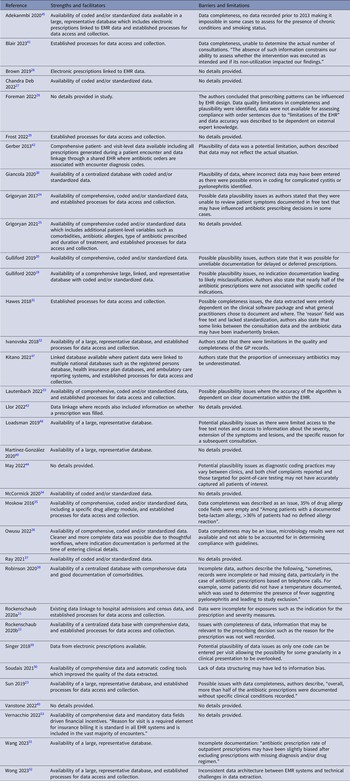
A summary of strengths, facilitators, barriers, and limitations for each study is presented in Table 2.
Summary of identified strengths, facilitators, barriers, and limitations by study

Discussion
AMS efforts such as ongoing surveillance, audit and feedback, and decision support are urgently needed in the primary care setting to address AMR and improve patient care. However, these programs are often not well-established compared to their secondary and tertiary counterparts. EMR data enables analysis of clinical data to be performed at scale to support AMS, relieving some of the additional human resource burden traditionally required to perform these activities. This review has provided evidence of how primary care EMR data have been used to aid with AMS and extracted strengths and facilitators of use, and barriers and limitations across different countries and settings.
EMR system design inconsistencies were the most commonly cited barrier among the reviewed studies suggesting an absence of a standardized approach in design across different vendors. “Technical challenges in data extraction processes” was also cited, emphasizing the need for improved technical infrastructure and data management practices. Issues of data completeness and plausibility were also commonly reported as limitations where key issues included potential negative impacts on patient care caused by poor documentation of allergies, and over-reliance on free-text data for data entry in EMR systems leading to implausible and/or unusable data.
Strengths and facilitators of EMR data included the availability of large centralized databases, comprehensive, linked, coded, and standardized data, facilitated by the implementation of mandatory documentation and standards, and automated coding tools for data extraction. Arguably, the most important facilitator identified was established processes for data access and collection through supportive regulation for data access and embedding data collection into standard practice. These approaches ensure timely access to the data necessary for AMS activities to be conducted efficiently and effectively.
A notable limitation of this review was that the methodology stipulated that articles published in languages other than English were to be excluded. The rationale for this was that authors felt that the accuracy and consistency of translation from software could not be guaranteed, especially for nuanced scientific and clinical content. That said, the initial database searches were not filtered by language, and yet, did not yield relevant non-English articles. Therefore, no publications were excluded based on language alone.
A glaring observation from this review was that the included publications were highly skewed towards high-income countries, with only one study from a low and middle-income country (LMIC). This is unsurprising for several possible reasons: (i) the ongoing phenomenon of under-representation of research literature in LMICs due to inequity in access to health systems research Reference Woods, Watson, Ranaweera, Tajuria and Sumathipala60,Reference Alemayehu, Mitchell and Nikles61 and (ii) the delayed uptake of EMR systems in LMICs due to infrastructure challenges, financial constraints, and the absence of resources required to maintain these systems. Reference Akwaowo, Sabi and Ekpenyong62–Reference Akhlaq, McKinstry, Muhammad and Sheikh67 These inequities hamper the ability to perform AMS optimally and potentially further exacerbate the impacts of AMR where such countries are ironically expected to bear the heaviest consequences. Reference Truppa and Abo-Shehada68,Reference Kobeissi, Menassa and Moussally69 Greater attention from the global community is required, and further efforts in capacity building, advocacy, and investment in infrastructure are urgently needed in these regions to ensure equity.
While this review highlights the importance of primary care EMR data as a useful resource for supporting AMS, equity in access to certain identified ‘strengths and facilitators’ such as large databases and automated coding tools are limited to higher-income settings. However, careful system design, effective data management practices, and supportive policies for reliable data access and collection processes, to overcome some of the identified barriers and limitations can still be implemented despite limited resources. Additionally, this review has proven that smaller-scale, high-quality EMR data, likely to be more assessable in most settings, are still extremely valuable for evaluating interventions and initiatives, and should continue to be the focus of investment to ensure effective AMS in the primary care setting.
Supplementary material
The supplementary material for this article can be found at https://doi.org/10.1017/ash.2024.499
Acknowledgments
The authors wish to acknowledge Prof Lisa Hall, Dr Courtney Ierano, and Dr Karolina Lisy for their support and valuable insights during the preparation of this manuscript.
Financial support
RC and VR have received funding from the Commonwealth of Australia, Department of Health and Aged Care, grant number MRFFRD000113. RC also receives funding from The National Centre for Antimicrobial Stewardship at The University of Melbourne.
Competing interests
The authors declare no conflicts of interest.




 Open access

