


1. Introduction
Design methods are formalised representations of design activities that support designers in achieving specific goals under given constraints. Classic engineering design literature, such as VDI 2221 (2019) and the systematic approach proposed by Reference Pahl, Beitz, Feldhusen and GrotePahl et al. (2007), describes methods not as isolated procedures, but as elements embedded in broader development processes, structured by activities, information flows, and artefacts. Following this understanding, Reference Gericke, Eckert, Campean, Clarkson, Flening, Isaksson, Kipouros, Kokkolaras, Köhler, Panarotto and WilmsenGericke et al. (2020) argue that design methods must be seen as part of a larger method ecosystem, in which methods interact with each other, with domain-specific constraints, and with artefacts produced throughout the development process. Consequently, method competence requires understanding not only the steps of a method but also its inputs, outputs, and role within a larger workflow.
1.1. Methods education in engineering design
However, in engineering education, methods are frequently presented as stand-alone, decontextualized procedures. Empirical studies consistently document the resulting difficulties. Reference Jänsch and BirkhoferJänsch & Birkhofer (2004) highlight a persistent transfer gap, where students can reproduce methods in controlled examples but struggle to adapt them to open-ended problems. Reference Cash, Daalhuizen and HekkertCash et al. (2023) further show that the effectiveness of design methods depends strongly on situational factors and users’ understanding of method goals and mechanisms. These conditions are rarely fulfilled by novices. Recent reviews confirm that students tend to rely on a small set of familiar methods and rarely explore alternatives. Reference Miller and SummersMiller & Summers (2013) found that, although novice engineers believed the methods they wanted to learn would help them create better products, they still rarely used those methods. This is primarily due to the effort required to understand (how and when to use) and implement the design methods. Reference Liu, Werder, Maedche and SunLiu et al. (2025) demonstrate that novices have particular difficulty in situational method selection, as they often fail to identify contextual cues and match them to appropriate methods. This illustrates the broader challenge of linking method knowledge with process understanding and decision-making. Design education research also shows that methods are embedded in complex learning dynamics. Reference Maya and GomesMaya & Gómez (2015) emphasise that pedagogical practices are highly fragmented and often disconnected from students’ learning processes. Reference Lavrsen, Carbon and DaalhuizenLavrsen et al. (2025) provide evidence that individual factors, such as ambiguity tolerance, motivation, or design confidence, and contextual factors such as team composition, significantly influence how students engage with and benefit from method teaching. Parallel to these pedagogical findings, engineering education is undergoing rapid digitalisation. Reference Vargas Carvajal, Mejía Aguilar and Támara CorredorCarvajal et al. (2024) show that institutions increasingly experiment with new digital learning resources, yet many remain descriptive and fail to support higher-order skills such as method planning, artefact linkage, or documentation coherence. Reference Escobar-Castillejos, Sigüenza-Noriega, Noguez, Escobar-Castillejos and Berumen-GlinzEscobar-Castillejos et al. (2024) propose a digital platform to support engineering design education, but also note limitations regarding process integration and the ability to represent method-to-artefact relationships. These observations align with challenges in our own teaching practice. Across multiple project-based courses (Reference Bhatt, Ammersdörfer and InkermannBhatt et al., 2025), we identified four recurring issues: 1. Students rarely explore methods beyond familiar categories, limiting the quality of their design reasoning. 2. A lack of distinction between activities, artefacts, and methods leads to misunderstandings of method purpose and outputs. 3. Documentation is inconsistent and fragmented, as artefacts are not clearly linked to process steps. 4. Students struggle to construct coherent method sequences because they cannot derive workflows from artefact dependencies or method requirements. Based on these findings, it can be concluded that method competence requires integrated, artefact-oriented, context-sensitive scaffolding.
1.2. Research gap and resulting approach
Despite advances in digital learning tools and repositories, current approaches fall short in addressing the systemic and contextual nature of methods. Existing resources provide valuable descriptions, yet they seldom support: 1. representing relationships between activities, methods, inputs, outputs, and artefacts, 2. guiding context-appropriate method selection c.f. (Reference Cash, Daalhuizen and HekkertCash et al., 2023; Reference Liu, Werder, Maedche and SunLiu et al., 2025), 3. supporting consistent, traceable documentation throughout student projects, and 4. fostering engagement with diverse method families c.f. (Reference Escobar-Castillejos, Sigüenza-Noriega, Noguez, Escobar-Castillejos and Berumen-GlinzEscobar-Castillejos et al., 2024; Reference Vargas Carvajal, Mejía Aguilar and Támara CorredorVargas Carvajal et al., 2024).
At the same time, current educational research shows that method learning depends on both individual and contextual factors (Reference Lavrsen, Carbon and DaalhuizenLavrsen et al., 2025), highlighting the need for tools that embed methods in process logic and artefact flows. To address this gap, the Systems Engineering Method Matrix (SEMM) was developed, c.f. Reference AmmersdörferAmmersdörfer et al. (2023). The SEMM tool links activities, methods, and artefacts in a unified matrix structure and provides students with a process-oriented environment that supports method selection, planning, and documentation. Building on concepts of method ecosystems (Reference Gericke, Eckert, Campean, Clarkson, Flening, Isaksson, Kipouros, Kokkolaras, Köhler, Panarotto and WilmsenGericke et al., 2020), access logics for situation-appropriate method use, and artefact-centered modelling principles, the SEMM tool aims to strengthen method literacy, improve documentation coherence, and support effective learning about design methods in project-based learning (PjBL) settings. The intention of this paper is to provide initial insights into the effectiveness of the SEMM tool as a pedagogical and methodological approach. The objective is to support instructors in planning and students in understanding, exploring, selecting, and applying design methods.
2. Background
Design methods must be understood in relation to the activities they support and the artefacts they create. This section, therefore, first clarifies the structure and role of design methods before analysing existing tools that provide method knowledge.
2.1. Design methods and their process context
Design methods are a specific category of design support intended to help designers carry out activities in a structured and goal-oriented way. Building on Blessing & Chakrabarti’s concept of design support, Gericke et al. distinguish between design methodologies, methods, guidelines, and tools and emphasise that a design methodology connects methods and tools through an organised process of activities (Reference Gericke, Eckert and StaceyGericke et al., 2022). In this view, methods are not stand-alone recipes, but elements embedded in a broader activity and process structure. Recent work on the elements of a design method proposes a clearer decomposition of what a method consists of. Reference Gericke, Eckert and StaceyGericke et al. (2022) identify several key elements: a core idea, an intended use (including scope and context), a procedure, one or more representations of information, and possible tool implementations. This decomposition supports a more transparent description and evaluation of methods and makes explicit that methods always assume a certain context, user capability, and type of artefact. In Systems Engineering, the relationship between activities, methods, and artefacts is made particularly explicit. Activities define what is to be done (e.g., define system requirements, generate a function structure), while methods support how the activity is carried out. INCOSE (2023) describes how activities are characterised by the artefacts they use (i.e., Input) and create (i.e., Output), whereas methods define the decomposition of these activities into tasks, required inputs, and produced outputs. Accordingly, methods should be described in such a way that their links to specific artefacts, and thus to upstream and downstream activities, are clear. This artefact-oriented view is also central in recent contributions on method ecosystems (Reference Gericke, Eckert, Campean, Clarkson, Flening, Isaksson, Kipouros, Kokkolaras, Köhler, Panarotto and WilmsenGericke et al., 2020; Reference InkermannInkermann, 2021). Rather than seeing methods as isolated procedures, method ecosystems conceptualise them as a system of interacting methods embedded in organisational processes, where inputs, outputs, and overlaps between methods must be understood to use them effectively. On the level of practical method access, InnoFox exemplifies how situational and artefact-related logic can be used to recommend methods in the development process (Reference Albers, Reiß, Bursac, Walter and GladyszAlbers et al., 2015): methods are suggested based on the specific situation and development context, using attributes that characterize both the method and the project environment. This reinforces the notion that method descriptions must go beyond a generic step-by-step explanation and include information about context, objectives, and artefact relationships to support selection and use. Taken together, these contributions converge on three points that are central to this paper: 1. Methods have multiple elements (purpose, procedure, representations, intended use, tool support) that must be described explicitly. 2. Methods are tightly coupled to activities and artefacts; they transform inputs into outputs within a process and cannot be treated independently of these structures. 3. Method ecosystems and artefact-oriented descriptions provide a promising basis for comparing, selecting, and chaining methods in a way that is consistent with real development processes. Building on this understanding of how methods relate to activities and artefacts, the following section reviews existing tools that provide method knowledge and support method selection.
2.2. Existing tools for providing method knowledge
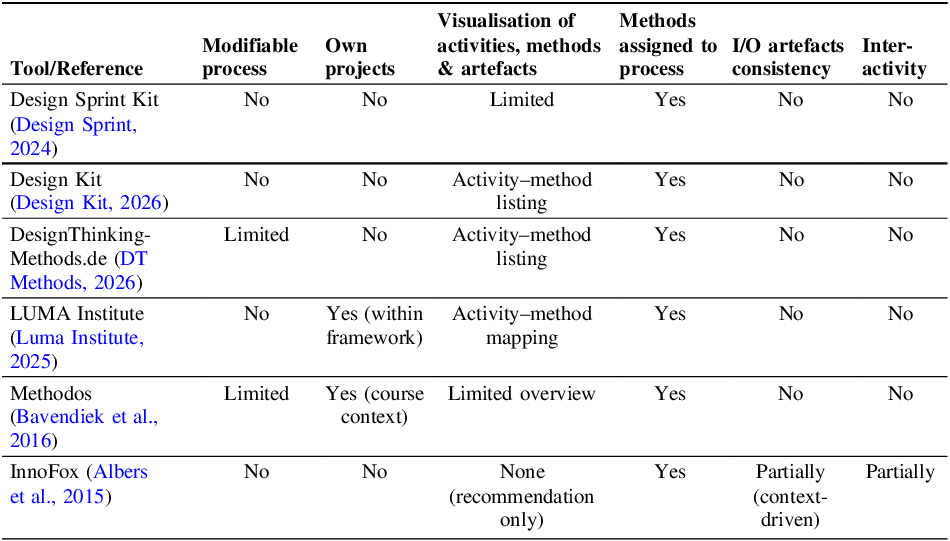
A broad range of tools and repositories has been developed to support designers in structuring their product development activities and accessing suitable methods. Prior work shows that many of these tools emerged in response to recurring challenges in design practice, such as insufficient integration of methods within processes (Reference Acharya, Chatty, Ranjan, Ghadge, Bharath and ChakrabartiAcharya et al., 2018) or difficulties in documenting and managing information during design activities (Reference Bhatt and ChakrabartiBhatt & Chakrabarti, 2025). Several case studies highlight that users frequently struggle to understand method application, identify appropriate methods, and maintain consistent artefact flows (Reference Acharya, Bhatt, Chakrabarti and NagaiAcharya et al., 2019; Reference Mayookh and SrinivasanMayookh & Srinivasan, 2024, Reference Mayookh, Srinivasan, Chakrabarti, Singh, Onkar and Shahid2025). Table 1 summarizes the results and highlights functional gaps across existing tools.
In particular, Reference Mayookh and SrinivasanMayookh & Srinivasan (2024) examined which features students expect from improved method repositories and identified limitations related to method clarity, process orientation, and artefact linkage. Their follow-up study analysed the advantages and drawbacks of existing repositories and outlined characteristics that could enhance future tools (Reference Mayookh, Srinivasan, Chakrabarti, Singh, Onkar and ShahidMayookh & Srinivasan, 2025). Across commonly used platforms, including Design Sprint Kit, Design Kit, DesignThinking-Methods.de, and the LUMA system, methods are generally well catalogued and linked to predefined activities. However, these repositories share important structural limitations. The Design Sprint Kit and Design Kit offer fixed, predefined processes with clearly assigned methods, but neither allows users to modify workflows or create their own development trajectories. Inputs, outputs, and artefact dependencies are not represented explicitly, and method descriptions remain non-interactive. Similarly, DesignThinking-Methods.de organises methods by design activities and occasionally provides alternatives, yet it still relies on a rigid process logic. Artefact flows are not visualised, and it remains unclear how method outputs could be reused in downstream activities. The LUMA Institute provides a more systematic set of 36 methods grouped into a unified framework, but the overall structure remains non-modifiable and does not model how artefacts propagate through sequences of methods. More recent platforms attempt to address specific gaps. Methodos provides an interactive learning environment with method descriptions, videos, and user experiences (Reference Bavendiek, Inkermann and VietorBavendiek et al., 2016). While this enhances accessibility and reflection, the platform does not represent method chains or artefact dependencies, and the underlying process remains largely predefined based on generic phases of the development process. The InnoFox application represents a notable step toward context-aware method selection (Reference Albers, Reiß, Bursac, Walter and GladyszAlbers et al., 2015). It recommends methods based on situational attributes such as available artefacts, task characteristics, or project constraints, providing more tailored guidance than traditional repositories.
Comparison of existing tools for providing method knowledge based on the criteria from Reference Mayookh, Srinivasan, Chakrabarti, Singh, Onkar and ShahidMayookh & Srinivasan, 2025

However, InnoFox focuses on the selection of individual methods and does not provide a process view or an end-to-end representation of artefact continuity across activities. Despite their different focuses, two consistent patterns become clear across all analyzed tools. First, process rigidity persists: none of the platforms enable the flexible modelling of development processes or the creation of user-defined workflows. Second, artefact integration is lacking: repositories do not represent input and output artefacts consistently, preventing users from understanding how method results feed into subsequent steps or how coherent method chains can be constructed. To make these differences explicit, all platforms were systematically evaluated using six criteria derived from Reference Mayookh, Srinivasan, Chakrabarti, Singh, Onkar and ShahidMayookh & Srinivasan (2025). These criteria address process flexibility, project support, the visibility of activity–method–artefact relationships, method-to-process assignment, artefact input/output consistency, and dynamic behaviour. Since current tools fall short in supporting artefact-consistent, adaptable process modelling, a new solution is required to structure and connect methods more effectively.
3. Systems engineering method matrix (SEMM)
To address the limitations of existing method repositories, we propose the Systems Engineering Method Matrix (SEMM) to integrate design activities, methods, artefacts, and information flows into a coherent and adaptable structure. This chapter presents the conceptual basis of the SEMM tool and presents the implementation of the web-based prototype used for the evaluation.
3.1. Conceptual foundations
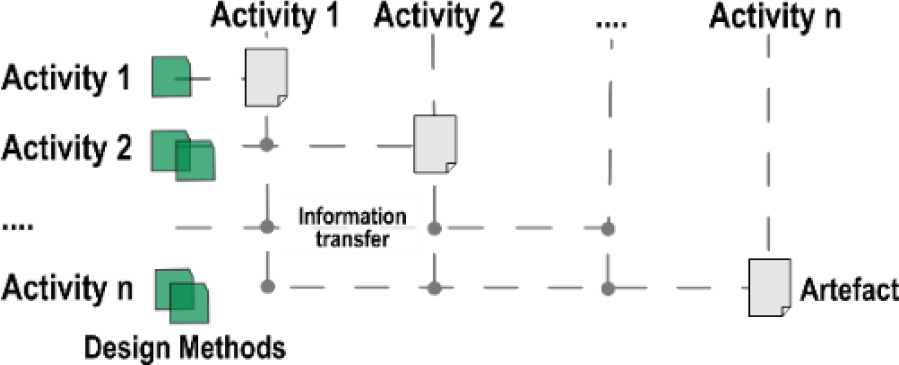
The SEMM tool builds on the artefact-oriented description of engineering activities. Each activity is defined by the artefacts it requires and the artefacts it produces (Reference AmmersdörferAmmersdörfer et al., 2023). Methods provide the procedures necessary to execute these activities and generate the required information. This creates a logical coupling: activities describe what must be achieved, methods describe how it is achieved, and artefacts describe what the result is, c.f. Figure 1.
The SEMM tool adopts a matrix-oriented structure (Reference WachWach, 1994), where activities form the organizing dimension and are linked to their input and output artefacts as well as the methods capable of producing the specific artefacts or parts of these. Because each method is defined by its required inputs and generated outputs, method chains arise naturally along the artefact flow. Missing or inconsistent artefacts can thus be detected and resolved by selecting appropriate methods. To ensure comparability and consistency, the SEMM tool uses uniform method profiles inspired by established method documentation approaches (Reference Ponn and LindemannPonn & Lindemann, 2008). Each profile describes the purpose, application context, procedural steps, required inputs, generated outputs, related tools, and upstream/downstream methods. This uniform structure enables systematic comparison and supports artefact-based method integration throughout the process. By the coupling of activities, methods, and artefacts, the SEMM tool serves as a coherent basis for designing traceable and artefact-consistent development processes.
Conceptual structure of the SEMM tool showing the coupling of activities, methods, and artefacts through input–output relationships

3.2. Implementation of the SEMM tool prototype
The conceptual model was implemented as a web-based prototype designed to ensure flexible configuration of development processes and consistent linking of activities, methods, and artefacts. The main interface of the prototype, including the activity–method–artefact structure and the navigation elements used to organize projects and libraries, is shown in Figure 2, left-hand side. This interface forms the central workspace for configuring processes, assigning methods, and managing artefacts throughout a project. The prototype provides an initial library of activities, artefacts, methods, and tools, c.f. Figure 2, right-hand side, which can be adapted or extended. Each method is represented by a structured method profile stored in a consistent data model, enabling the system to visualize input/output relationships and detect inconsistencies in method chains. Based on this data structure, artefact dependencies and method linkages can be automatically displayed. Within projects, activities specify the artefacts they require and those that must be generated. Methods can be assigned to activities to produce these artefacts, and the system provides feedback if required inputs are missing or not produced by prior steps. Work results, such as documents or graphical artefacts, can be uploaded, linked to the corresponding artefacts, and assigned status levels (e.g., draft or accepted), supporting traceability and document consistency while running the project.
Overview of the web-based SEMM tool interface showing the activity–method–artefact structure and library components used to configure and manage development processes

The SEMM tool is divided into a backend and a frontend. In the backend, data is stored in a partially configurable database that allows, for example, changes to a method configuration, but strictly distinguishes core components such as artifacts, activities, and others, which are needed for the method configuration. The frontend visually displays the data stored in the backend and provides a visually clear configuration, see Figure 2. Because all elements are interconnected through a unified data model, the prototype enables users to configure activity sequences, select suitable methods based on artefact requirements, maintain artefact continuity, and collaboratively structure development workflows. The interface shown in Figure 2, left-hand side, illustrates how these components are integrated.
4. Research methodology and environment
This chapter outlines the research methodology used to investigate the effectiveness of the SEMM tool within a project-based engineering design course. As highlighted in the Introduction, students frequently struggle to distinguish between design activities, methods, and artefacts, tend to rely on familiar or instructor-provided methods, and often produce inconsistent documentation. These challenges were reaffirmed in the analysis of 39 reflective reports from the Interdisciplinary Engineering Project (IEP) course (Reference Bhatt, Ammersdörfer and InkermannBhatt et al., 2025), which revealed limited exploration of design methods, strong emphasis on tools rather than methods, and conceptual confusion across key methodological concepts. Because effective method competence depends on understanding how activities, methods, and artefacts interrelate within a process, a structured intervention was required. Although the SEMM tool was initially developed and validated in the context of System engineering, its overall logic remains valid when applied in an engineering design context, where the design process is frequently modelled as a series of stages and activities (Reference BlessingBlessing, 1996). The SEMM tool was therefore integrated into the course.
4.1. Research objectives and research questions
Building on the research gap outlined in Section 1.2, this case study aims to evaluate the effectiveness of the SEMM tool as a pedagogical and methodological approach in a project-based engineering design course. The objective is twofold: 1) to support instructors in planning coherent design processes and proposing appropriate design methods, and 2) to support students in understanding, exploring, selecting, and applying design methods in a context-sensitive and artefact-consistent manner. From this objective, the following research questions (RQ) were derived:
-
• RQ1: How useful does the SEMM tool support instructors in planning design activities and compiling a coherent database of artefacts and methods?
-
• RQ2: How helpful is the SEMM tool for students in understanding the relationships between design activities, artefacts, and methods?
-
• RQ3: To what extent does the SEMM tool support students in planning their design projects by exploring and selecting suitable methods from the database?
-
• RQ4: How does the use of the SEMM tool influence the diversity of design methods applied by students during their project work?
These research questions guide the design of the pedagogical intervention, the implementation of the workshop, and the data collection and analysis methods described below.
4.2. Integration of the SEMM tool into the course
The SEMM tool was introduced into the IEP course as a structured intervention addressing the methodological challenges identified in the Introduction. Within the project-based learning environment, the SEMM tool thus functions simultaneously as a planning tool for instructors and a learning scaffold for students. During the course planning phase, the instructor used the SEMM tool to structure the first stage of the development process, Need Identification and Requirements Generation, by identifying relevant activities, defining associated artefacts, and selecting applicable methods. For example, for the activity “Engaging with Users and Experts”, the input artifacts include a Category of stakeholders, an Empathy map, and a list of stakeholders, and the output artifacts include a list of user statements, a list of problems, and a list of constraints. Lastly, the methods that support the activity can be a customer survey, an expert interview, a focus group, or a user interview. A total of 32 methods were integrated into the SEMM tool database, each documented through a unified method profile capturing purpose, procedure, artefact requirements, and outputs. This provided a traceable and artefact-consistent activity plan, forming the basis for evaluating the SEMM tool’s instructional value (RQ1). To address RQ2–RQ4, SEMM was introduced to students in a workshop. This workshop familiarised students with the SEMM’s structure and allowed them to use the tool to understand activity-method-artefact relationships, plan project activities, and select methods from the given database.
4.3. Workshop design and implementation
To address the research questions, a pre-experimental study with a one-group pre-test–post-test design was conducted as a workshop in a controlled environment. This approach is particularly valuable for pilot testing, assessing the tool’s feasibility, and obtaining preliminary evidence of changes in conceptual understanding. The workshop involved 38 Master’s students in the Intelligent Manufacturing program, organised into 11 project teams. All participants had prior engineering education and were engaged in semester-long projects centred on circular and smart small household products. This project context ensured authentic use of design methods and provided a realistic testing environment for evaluating the SEMM tool’s utility. The 100-minute workshop consisted of four components: 1. Pre-workshop survey: Baseline assessment of students’ understanding of activities, artefacts, and methods. 2. Introduction to the SEMM tool: Overview of design methodology, explanation of the SEMM tool’s conceptual structure, and demonstration of the interface. 3. SEMM interaction phase: Students explored the SEMM tool database in teams and selected methods for seven early-stage activities. Teams justified their selections according to project context and artefact requirements. 4. A post-workshop survey captured students’ perceptions of the SEMM tool’s usefulness and their conceptual understanding after the intervention.
4.4. Data collection methods and analysis procedure
A mixed-methods strategy addressed four research questions (RQ). For RQ1, the instructor documented reflections on SEMM’s use during course planning, providing qualitative insights into its support for structuring activities and creating a methods database. For RQ2, students completed pre- and post-workshop questionnaires with conceptual and applied tasks on activity–method–artefact relationships; the post-test included a conceptual question and Likert-scale items on self-assessed understanding. For RQ3, a post-workshop survey captured students’ perceived usefulness and usability of SEMM through six Likert-scale questions and three open-ended items, with qualitative responses analyzed to identify recurring themes (Section 5.1). RQ4 analyzed method-selection templates from each team to document methods chosen for early design activities, assessing method diversity and SEMM’s support for broader exploration. Data analysis combined descriptive statistics, comparative pre-/post-test analysis, and qualitative content analysis of instructor reflections and open-ended answers. Method-selection data were evaluated for frequency and variety. Triangulation across sources ensured a coherent assessment of SEMM’s effectiveness in supporting planning, conceptualization, and method selection in PjBL.
5. Results and findings
This chapter presents the results of the empirical evaluation of the SEMM tool, followed by conclusions derived from these results and framed in relation to the four research questions.
5.1. Results from the empirical evaluation
For RQ1, the instructor’s reflection showed that the SEMM tool provided a coherent structure for planning early design activities and building a corresponding database of methods and artefacts. The inheritance mechanism, whereby input and output artefacts defined at the activity level were automatically applied to all associated methods, substantially reduced the effort required to populate the database. This eliminated redundant artefact definitions and ensured consistency across methods. However, the same mechanism limited the representation of method-specific supplementary artefacts that only occur in particular methods. For example, a Field Visit may produce secondary artefacts such as contextual observations or environmental data that can inform later stages (e.g., constraint definition), but these cannot be added without assigning them to all methods in the activity.
Perceived understanding of relationships between activities, artefacts, and methods

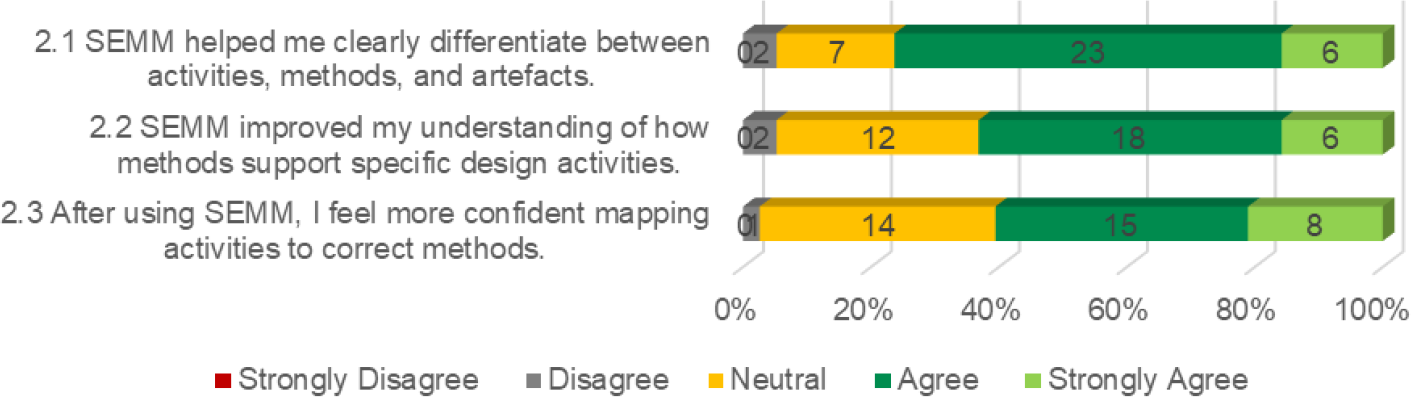
The results for RQ2 indicate that the SEMM tool improved students’ conceptual understanding of relationships among activities, methods, and artefacts. As shown in Figure 3, 76% of students agreed that the tool helped them differentiate between these elements, 63% reported a clearer understanding of how methods support activities, and 60% indicated an increase in confidence in selecting appropriate methods.
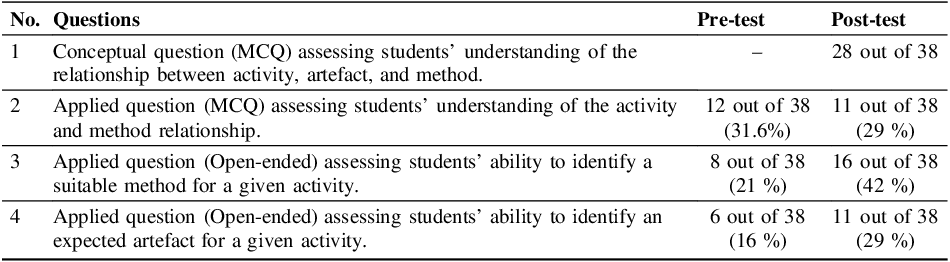
In the conceptual post-test, 28 out of 38 students (73.7%) selected the correct answer, a result significantly above chance (p < 0.01). In contrast, performance in the applied multiple-choice question (MCQ) assessing activity–method relationships did not improve from pre- to post-test, with both scores near chance level. However, open-ended applied tasks showed clear gains: correct method identification increased from 21% to 42%, and correct artefact identification from 16% to 29%, indicating that even brief exposure to the SEMM tool enhanced students’ ability to generate context-appropriate responses. These results are summarised in Table 2.
Comparison of pre-and post-tests

Results for RQ3 show broadly positive perceptions of the SEMM tool’s usability and usefulness, c.f. Figure 4. A majority of students found the tool intuitive to use (71%), easy to understand (55%), and helpful for exploring methods beyond those taught in class (65%). Furthermore, 68% indicated that the SEMM tool supported justification of their method choices, 76% reported that it helped structure their project work, and 71% experienced improved clarity in their project organisation.
Perceived usefulness and effectiveness of the SEMM tool

Open-ended responses nevertheless revealed several challenges: login failures and slow loading times under high server load, a steep learning curve for first-time users due to limited onboarding support, and cognitive overload caused by the high number of available methods. Students suggested improved server stability, interactive onboarding, and concise method summaries to enhance the user experience. For future use of the SEMM tool, focus should be on improving scalability and performance by enhancing infrastructure and conducting comprehensive load testing to ensure reliable access and responsiveness during peak usage.
No. of methods using the SEMM tool selected by the teams

For RQ4, the analysis of method-selection templates confirmed that the SEMM tool encouraged considerable methodological diversity. As shown in Table 3, teams selected an average of 10.5 methods for the first seven activities, of which 7.3 were not covered in the lectures. All teams combined familiar methods with newly discovered ones, and some explored up to 17 methods. These results show that the SEMM tool directly facilitated broader engagement with the available method set and supported more autonomous method selection.
5.2. Conclusions based on the results
The findings for RQ1 show that the SEMM tool provides effective support for instructors when planning design activities and compiling a coherent method–artifact database. It significantly reduced effort and ensured consistency, although it prevented the integration of method-specific secondary info. To fix this, students can be instructed to document additional method-specific insights alongside the required activity-specific artifacts. For RQ2, it improved students’ conceptual understanding of the relationships among activities, methods, and artefacts. The strong conceptual post-test performance and the improvements in open-ended applied tasks indicate meaningful learning gains, even with brief exposure. The absence of improvement in the applied MCQ suggests that procedural competence may require extended tool use or additional instructional scaffolding. Regarding RQ3, students perceived the SEMM tool as intuitive, useful, and supportive for project planning and method justification. While technical issues and initial navigation challenges reduced usability at times, the tool nonetheless contributed to a clearer project structure and more deliberate method reasoning. Cognitive overload can be reduced by gradually introducing activities into the course. For each activity, only a limited number of methods are provided. The instructor may ask students to choose one or two methods from the options after they understand all the methods. Students can make their choice based on method characteristics such as the no. of students, available time, and resources. Finally, the findings for RQ4 demonstrate that the SEMM tool significantly broadened the diversity of methods used by students. Most selected methods were not taught in class, revealing that the tool motivated exploration beyond familiar approaches and expanded students’ methodological repertoires. In conclusion, the results indicate that the SEMM tool provides substantial pedagogical and methodological support in project-based engineering design education. It enhances planning, conceptual clarity, and methodological diversity while identifying specific areas for improvement in usability and artefact granularity.
6. Summary, limitations, and future work
This article demonstrated the need for a learning environment that strengthens structure and consistency in product development. Existing method repositories lack an integrated representation of activities, methods, and artefacts, causing recurring student difficulties in understanding and applying methods. The SEMM tool was developed to address this gap, and the case study showed it helped students better understand these relationships, structure early design activities, and explore a broader range of methods than those taught in class. The study has several limitations: technical issues during the workshop and limited tool onboarding may have influenced student perceptions. Only short-term effects were measured, and the SEMM tool’s artefact inheritance mechanism restricts the modeling of method-specific outputs. The evaluation was based on a 100-minute workshop, so it cannot be fully verified how extensively students used SEMM during the semester. Future research should examine SEMM’s long-term use across a full semester, its impact on method application quality, and whether students can extend the method database themselves. Studies with Bachelor’s students, experienced industry participants, and cross-cohort comparisons would provide deeper insights into SEMM’s educational value, generalizability, and support for method selection and documentation. This paper discusses an initial pre-test with limitations; a subsequent controlled experiment is needed to eliminate these.




 Open access

