





On 25 December 1928, shortly after the Chinese Nationalist Party had established their new government in Nanjing in eastern China, Minister of Communications Wang Boqun submitted a report on the development of telecommunications to the government. In the report, Wang advocates for the concentration of control over telecommunications in the hands of the central government. He mentions three main elements of telecommunications, namely the telegraph, municipal telephone services and long-distance telephony, and highlights their interdependence:
Indeed as telecommunications are closely related to the people of the nation and telephone and telegraph closely linked, they cannot be separated. To give an analogy, the telegraph is a human’s body, the municipal telephone is its hands and feet, and the long-distance telephone is its blood vessels. They have to be connected as one. Only then can they support and use each other.Footnote 1
Wang’s report reflects that he saw long-distance telephony as an integral part of the national telecommunications infrastructure. Similarly, Wang’s successor Zhu Jiahua, who headed the Ministry of Communications between 1932 and 1935, also saw the development of long-distance telephony as a major task of his tenure as Minister of Communications.Footnote 2 Not only in the capital in Nanjing, but also in provincial capitals throughout China, officials recognised the importance of establishing long-distance telephone communications and made it a key part of their plans for provincial development.Footnote 3
This article uses the development of long-distance telephony to study state-building during the Chinese Republican period (1912–49) between the beginning of the Chinese republic in 1912 and the outbreak of the Second Sino-Japanese War in 1937. While the beginning of Chinese long-distance telephony precedes the year 1912 by several years, long-distance telephony in China witnessed its main initial growth during the Republican period. This study engages with and contributes to the literature on state-building in Republican China in two major ways. First, it adds to recent balanced views of Republican state-building, which emphasise both limitations and strengths in the state-building efforts of the Republican period, but brings in telecommunications as a new important dimension of the state-building process in Republican China. While older scholarship held largely negative views of state-building during the Republican period,Footnote 4 more recent studies have provided a more nuanced picture of Republican state-building.Footnote 5 By highlighting both the accomplishments in the development of long-distance telephony of different Republican governments, including the Nationalist central government, which acceded to power in 1927, and, at the same time, explicating the limitations of these efforts, this study further contributes to a more balanced view of state-building in Republican China.
More importantly, however, this article also adds the dimension of telecommunications to our understanding of state-building in Republican China. In doing so, I am building on Stephen Halsey’s recent positive assessment of late Qing state-building. In his analysis, Halsey stresses the importance of communications for state-building and discusses at length Qing efforts of developing telegraph infrastructure.Footnote 6 In contrast to Halsey’s emphasis on telecommunications infrastructure, the scholarship on Republican state-building has neglected telecommunications. This article demonstrates that particularly between 1927 and 1937, both the central and regional governments made substantial efforts to develop long-distance telephony and contends that telecommunications need to be taken into account as an important part of the record of state-building during the Chinese Republican period.
A second major way in which this article contributes to the scholarship on state-building in Republican China is that it develops a larger argument about the decentralised nature of state-building and the development of technological systems in Republican China. Recently, several historians of modern China have called for the decentring of the Chinese central state when studying state-building during the Republican period. Instead, they draw our attention to the state-building endeavours and accomplishments of the various regional regimes that coexisted with successive central governments and the ways in which these different regional regimes and central governments competed and cooperated with each other in their state-building efforts. They argue that political disunity was not necessarily detrimental to state-building.Footnote 7 Building on these insights, this article uses the case of long-distance telephony to juxtapose and compare the state-building performance of central and regional regimes, focusing in particular on the Nanjing Decade (1927–37) and the efforts of the central government in Nanjing and the provincial government of Guangdong in establishing long-distance telephone lines. To illuminate this juxtaposition, this article also draws on the work of historians of technology to connect the discussion of state-building of central and regional regimes with the literature on the development of technological systems. In particular, I make use of the differentiation between regional and national technological systems and the evolution of the former into the latter to trace how different long-distance telephone systems in modern China developed.Footnote 8
This article argues that throughout the Beiyang period (1912–27) and the Nanjing Decade, the development of long-distance telephony proceeded in a decentralised fashion and regional regimes played a key role in developing regional telephone networks and China’s long-distance telephone infrastructure more broadly. While the central government in Nanjing planned the construction of a national long-distance telephone system during the Nanjing Decade, these efforts eventually failed and remained incomplete and reliant on cooperation with regional regimes. By the end of the Nanjing Decade, no truly national telephone system existed, and China’s long-distance infrastructure instead continued to be dominated by regional systems. Although the development of China’s long-distance telephone infrastructure during the Republican period, and in particular during the Nanjing Decade, was overall significant, this development was to an important extent due to the contributions of regional regimes and thus further underlines their important role in state-building during the Republican Period. Thus, this article further endorses the need of studying the process of Republican state-building from the vantage points of both central and regional regimes. Moreover, as we will see, military necessities caused by internal and external strife during the Republican period were an important driving force for the development of long-distance telephony, an insight that adds to the wider literature on the connection between warfare and state-building in Republican China.Footnote 9
This article unites these two argumentative angles – the importance of telecommunications for state-building and the study of state-building from the perspective of both central and regional regimes – by using the concept of ‘infrastructural power’, which Michael Mann sees as a key dimension of state power and development. He describes it as ‘the capacity of the state to actually penetrate civil society, and to implement logistically political decisions throughout the realm’. Mann particularly highlights communications as a key determinant of infrastructural power.Footnote 10 Daniel Ziblatt has stressed the crucial role of the infrastructural power – as opposed to military power – of political subunits in political formation – more specifically federalism – in the European context. He argues that the degree of infrastructural power subunits developed was crucial in determining their relation and negotiations with a central state trying to unify a territory.Footnote 11 Using the concept and lens of infrastructural power not only emphasises the importance of telecommunications infrastructure for state-building. It also allows this article to use the case study of long-distance telephony to make larger comparisons and observations about state power and development across different central and regional regimes in Republican China, including the limited success of central regimes in consolidating their power vis-à-vis regional regimes.
Even though long-distance telephony was an integral part of Chinese efforts in telecommunications development, existing scholarship has largely neglected its development before 1937. Much has been written about the development of the telegraph in modern China.Footnote 12 Likewise, telephone communications on the municipal level have also attracted the attention of historians.Footnote 13 In contrast, only a few short dedicated studies that cover specific aspects of the development of long-distance telephone communications during the Nanjing Decade (1927–37) exist.Footnote 14 Larger studies of the development of communications in modern China have also largely neglected long-distance telephony.Footnote 15 Likewise, accounts that highlight the importance of the development of communications for the economic growth China witnessed in the decades before 1937 also only mention long-distance telephone communications in passing.Footnote 16 Thus, we so far lack a detailed account of the development of long-distance telephone communications in pre-1937 China that covers both national and provincial efforts and traces the origin of developments during the Nanjing Decade back to the beginning of the twentieth century. This article remedies this lacuna by tracing the development of the Chinese long-distance telephone network on both the national and provincial levels in detail from the beginning of the twentieth century to the outbreak of the Second Sino-Japanese War in 1937.Footnote 17 Accordingly, one other major contribution of this article is that it provides the first detailed and dedicated study of long-distance telephony in modern China before 1937 that pays proper attention to the development of long-distance telephony on the level of both central and regional government.
Finally, beyond China, this article also hopes to contribute to the wider literature on the history of the telephone. In the introduction to a recent special issue of History and Technology on the history of the telephone, Balbi and Berth have noted that ‘histories of the telephone have been narrated as a series of national histories and so many transnational, regional or local histories were not considered’. They lament the ‘scarcity of works dealing with Asian, African or Latin American experiences’.Footnote 18 By focusing on China and analytically considering both the national and regional level, this article speaks to both of these problems.
This article first explores the beginnings of long-distance telephone communications before 1927. The article then turns to the Nanjing Decade and first traces the ultimately unsuccessful efforts of the central government to bring long-distance telephony under its control and establish a national telephone system. Finally, the chapter contrasts these efforts with the development of long-distance telephony in the provinces. In particular, the article will focus on Guangdong province in southern China, which remained largely autonomous from Nanjing for much of the Nanjing Decade but carried out an ambitious programme for the development of long-distance telephony.
The beginnings of long-distance telephone communications in China
At the turn of the twentieth century, when the first long-distance telephone service appeared in China, the telegraph and telephone had already been in use in China for some time. The telegraph entered China in the 1870s and subsequently a telegraph network was established. By the end of the nineteenth century, the Chinese telegraph network extended to all provinces and in 1908 measured over 45,000 kilometres in length.Footnote 19 The first municipal telephone system was established in 1881 in Shanghai’s International Settlement. In 1900, the Chinese government opened the first Chinese-run telephone installation in Nanjing and exchanges in Beijing, Tianjin in northern China and Guangzhou in southern China followed in 1903. In the following years running up to 1927, telephone exchanges were established by the central government, provincial governments and private entrepreneurs.Footnote 20 In 1926, the North-China Herald could report that ‘Telephone Installations, whether Government or privately owned are to be found in all the principal cities of China.’Footnote 21
The development of long-distance telephony in China started in 1900. During the instability of the Boxer Uprising, a Chinese anti-foreign uprising that occurred in the north of China from 1899 to 1901, the Dane Carl Poulsen, who had previously been in the employ of the Chinese Tianjin Telegraph School (Tianjin Dianbao Xuetang), established a long-distance telephone connection from Tianjin to Beitang and Tanggu and in 1901 extended it to Beijing, thereby linking the capital of Beijing with the two sea entries at Beitang and Tanggu, located to its south-east, and the commercial and political centre Tianjin, also situated to the south-east of Beijing. In 1905, the long-distance telephone line was taken over by the Qing government’s Imperial Chinese Telegraph Administration.Footnote 22 In 1900, Germany also established a telephone connection between Tianjin, Tanggu and Dagu near Tianjin.Footnote 23 In 1904, the Qing government itself added another telephone line between Tianjin and Beijing and in the following two decades more lines were added, so that by 1918 five pairs of lines existed between the two cities. Further lines were added in the following years and by 1928, eleven pairs of lines ran between Beijing and Tianjin.Footnote 24 In 1909, the Qing central government had already bought back the line between Tianjin, Tanggu and Dagu originally established by Germany. Later, connections between Tianjin and Cangzhou and Yanshan further south were also added.Footnote 25 The Tianjin–Beijing long-distance telephone service thus emerged as an important regional telephone system, with 402,873 calls made in 1928, which far exceeded any other system or region listed in the long-distance telephone statistics of the Ministry of Communications.Footnote 26 Nevertheless, at least the late Qing state seems to have shown little interest in long-distance telephony except for the Tianjin–Beijing long-distance telephone service and there is no evidence of other major lines having been constructed during this period.Footnote 27
The connection between Tianjin and Beijing quickly proved popular with businesspeople, which probably was an important reason for its swift growth. As early as 1910, a group of merchants from Tianjin reported to the government that telephone communication with Beijing for business purposes had become a daily necessity.Footnote 28 More generally, long-distance telephone communications presented several advantages to users in China. As the Chinese journalist Hollington K. Tong explained in 1919:
The Chinese like to telephone. This is shown by the fact that the calling rate in Peking [Beijing] and Tientsin [Tianjin] is higher than the calling rate in corresponding cities of the United States or Europe. The reason is that the telephone offers a direct means of communication. Any dialect can be used in talking to one’s friend at a distance. The long distance telephone is even more appreciated by those who have urgent business to transact with those who are more than two hundred miles away – that is the approximate distance between Shanghai and Nanking – and are able to complete it in a few minutes. At present it takes them at least five hours to transmit a message from Shanghai to Nanking by telegraph, and much longer to go by train.
In China telegrams, which have to be put in code and to [sic] be decoded, are more costly in comparison with the telephone. A conversation between Peking and Tientsin can be held by means of the telephone for five minutes and costs only less than one [Chinese] dollar. During this period, brief though it may be, much business can be transacted. That is why the toll [long-distance] lines between these cities are popular.Footnote 29
The cost differential between telegraph and telephone can be further illustrated if we compare Tong’s example of Shanghai and Nanjing in terms of a telegraph message and a phone call between the two locales. In 1936, a standard telegram between the two cities would have costed 10 Chinese cents per Chinese character. In contrast, a normal three-minute call between Shanghai and Nanjing would have costed only around 1.40 Chinese dollars.Footnote 30 The higher speed and lower cost of the telephone compared to the telegraph combined with the directness of communications through the telephone and the fact that, unlike with the telegraph or other written communications, the telephone did not bind its users to the written language and allowed for the use of dialects, made use of long-distance telephony advantageous. While speed, cost and directness might be seen as the more obvious advantages, the ability to communicate in one’s own dialect should not be underestimated in a country as linguistically diverse as China.Footnote 31 A good illustration of this appears in the memoir of Huang Shaohong, a native of Guangxi in southern China who in 1937 became the chairman of the Hubei provincial government in central China. On the occasion of the inauguration of the long-distance telephone line between Wuchang in Hubei province and Guangzhou in Guangdong province, Huang spoke to Guangdong chairman and native Huang Musong. Huang Shaohong marvelled at their being able to converse in Cantonese and even though three provinces separated them, it was ‘like chatting in the Liangguang region [i.e. Guangdong and Guangxi provinces]’.Footnote 32 That being said, the development of long-distance telephony did not mean a halt in the use of the telegraph, which was likely due to the advantage of the existing network the telegraph possessed. According to an official Chinese government publication, while in 1932 3,974,085 telegrams were sent domestically, this number stood at 6,575,192 during the fiscal year from July 1935 and June 1936. This compared to 1,094,878 long-distance phone calls in 1932 and 3,329,384 long-distance phone calls in the fiscal year 1935/6.Footnote 33
Other regional long-distance telephone systems also sprang up during this period. In 1914, Japan attacked the German leasehold at Jiaozhou Bay in Shandong province in northern China and came to occupy parts of the province until 1922. In 1922, in what some have seen as a success for Chinese diplomacy, China and Japan came to an agreement about the return of the occupied territories to China at the Washington Conference.Footnote 34 During its occupation, Japan established a long-distance telephone connection along the railway between the coastal city Qingdao and the provincial capital Jinan with a branch line from Zhangdian to Boshan, both of which lie east of Jinan. This was taken over by the Beiyang government’s Ministry of Communication in 1923.Footnote 35 The Beijing–Tianjin and Jinan–Qingdao long-distance telephone connections were of foreign origin and later were taken over by the Chinese government. However, after China descended into internal warfare and disintegration following the fall of the Qing Dynasty in 1912, different regional warlord regimes also developed long-distance telephony. Unlike the ad-hoc take-over of long-distance telephone connections of foreign origin, these efforts by warlord regimes were more serious extensions of infrastructural power through long-distance telephony.
A first example of such development can be found in Manchuria in north-eastern China, which was under the control of warlord Zhang Zuolin during the 1920s until his death in 1928.Footnote 36 By 1923, long-distance telephone lines for military use had already been established between Fengtian, Jilin, Harbin and Changchun, all cities in north-eastern China.Footnote 37 Between 1922 and 1924, long-distance telephone connections covering a distance of at least 1,022 kilometres were established in Fengtian, Jilin and Heilongjiang provinces in north-eastern China. In this case the relevant report suggests that creating additional income seems to have been a prime motivator.Footnote 38 In December 1924, shortly after Zhang Zuolin had emerged victorious from the Second Zhili–Fengtian War and, together with Feng Yuxiang, had gained control of the central government in Beijing, the Ministry of Communications started work on a long-distance telephone line between Tianjin and Fengtian. Over 600 kilometres in length, it was linked with the provincial Telephone Bureau (dianhuaju) in Fengtian and the line successfully connected on 15 April 1925. Zhang stressed the importance of the line for the military and communications (jiaotong), and his army was directly involved in its laying.Footnote 39 By 1926, several lines existed in the provinces of Heilongjiang, Jilin and Fengtian.Footnote 40
Two further examples are Wu Peifu and Sun Chuanfang, two other major warlords active in pre-1927 China. Based in Luoyang in Henan province in central China between 1920 and 1924, Wu established long-distance telephone connections between Baoding in North China and Luoyang, Zhengzhou and Kaifeng in Henan province by 1922.Footnote 41 In early 1924, preparations were also made for the construction of a long-distance telephone line between Luoyang and Wuchang in Hubei province, which is also in central China, which promised to be useful militarily. Wu sent an engineer of the Ministry of Communications, which at the time was under Wu’s control, to Hubei to survey the line together with authorities there.Footnote 42 In eastern China, Sun Chuanfang ruled over the five provinces of Jiangsu, Zhejiang, Fujian, Jiangxi and Anhui between late 1925 and 1926 until his power declined with the advancement of the Northern Expedition from the second half of 1926.Footnote 43 During his rule, Sun planned the establishment of a large long-distance telephone network that was to connect all five provinces he controlled. Shanghai and Nanjing were to be amongst the main hubs of the network.Footnote 44 Sun was not able to realise his plans, though a telephone line between Shanghai and the nearby city of Wuxi was put into operation during his rule, which was to be part of a longer line between Shanghai and Nanjing. The Shanghai–Nanjing connection was only to be completed after the establishment of the new central government in Nanjing though.Footnote 45
Before the establishment of the Nationalist central government in 1927, long-distance telephony was only developed regionally. There is no evidence of a comprehensive plan towards the establishment of a national telephone network and the development that was carried out in the years immediately before 1927 was driven by local military needs.Footnote 46 As we have seen, it was regional regimes that drove and carried out the expansion of long-distance telephony. Indeed, when describing the recent progress of long-distance telephony in 1926, the North-China Herald explained that it ‘is in no small measure the result of military activity, commanders seeking to tie up their territory by telephone’.Footnote 47 For these warlords, the development of long-distance telephone lines promised not only a means of fast communications when at war, but potentially also a useful revenue stream.Footnote 48 The fact that military needs due to ongoing Chinese internal warfare took centre stage during this period should not distract us from the accomplishments made in terms of the development of long-distance telephony though.Footnote 49
The efforts of the central government’s Ministry of Communications remained very limited and, as we have seen in the case of Zhang Zuolin and the Tianjin–Fengtian line, even if the Ministry nominally carried out a project, warlord regimes could be involved in a major way.Footnote 50 Given the shifting control over the central government and general disunity of the country, the fact that the Ministry of Communications could not play a major role in developing long-distance telephony and that regional regimes emerged as the driving force is not surprising.Footnote 51
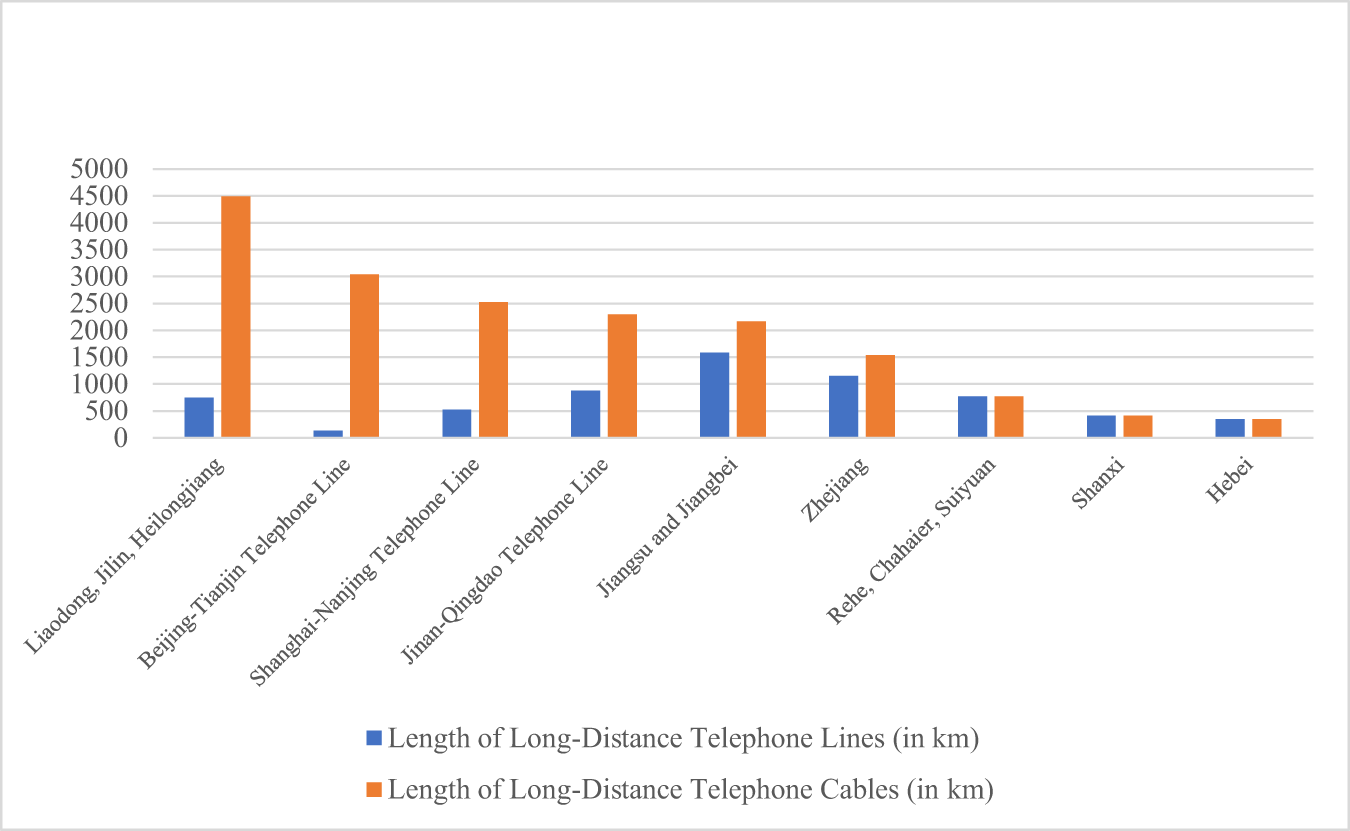
Despite these limitations, the development of long-distance telephony in China during the period between 1912 and 1927 should not be overlooked either. As Figure 1, which shows the length of long-distance telephone lines and telephone cables listed in a statistical publication of the Ministry of Communications, indicates, shortly after the Nationalist government had taken power, some long-distance infrastructure certainly existed in different regions.Footnote 52 In particular, we can highlight that in the provinces of Jilin, Heilongjiang and Liaodong (Fengtian) in north-eastern China, which had been under the rule of Zhang Zuolin, the long-distance telephone infrastructure had been developed to a certain extent. That being said, it would only be during the Nanjing Decade that long-distance telephony would be developed in China on a large scale. From the vantage point of infrastructural power, we can conclude that certain regional warlord regimes managed to develop infrastructural power through the establishment of long-distance telephone infrastructure to a certain extent, whilst the central government’s accomplishments in this regard were minimal.
Length of Chinese Ministry of Communications Long-Distance Telephone Lines and Cables, 1928.

The Nanjing government and long-distance telephony
In 1927, the Chinese Nationalists established a new government in Nanjing. The Chinese Nationalists were committed to nationalism, anti-imperialism, modernisation and state-building. In 1928, they completed their Northern Expedition and, for the first time since the fall of the Qing Dynasty, China had a relatively strong central unified government again. Yet, the actual control of this new Nanjing government over many of the provinces remained limited. Numerous regional leaders were unwilling to submit to the central government and warfare to bring them to heel ensued. Several important provinces, including, as we will see, Guangdong in the South, up to 1936 retained autonomy from the central government. In addition, the Nationalists waged war against the Chinese Communist Party and were faced with a growing external threat and military encroachment from Japan.Footnote 53 Part of the government’s state-building effort was the establishment of a national long-distance telephone system. In the end, the Nationalist government made some progress towards constructing such a national system and thereby developing infrastructural power through long-distance telephony but failed to establish a truly national telephone system and remained reliant on the cooperation of regional leaders who controlled regional systems.
As already indicated at the beginning of this article, long-distance telephony was high on the agenda of successive ministers of communications of the Nationalist government. In 1928, the Ministry of Communication authored a comprehensive plan for the reform and development of China’s communications infrastructure. The plan mentioned long-distance telephony as a major part of telecommunications development and included a detailed scheme for its expansion.Footnote 54 The detailed scheme first explained that China’s long-distance telephone lines were underdeveloped and measured less than 6,000 kilometres in length. It stressed the importance of the telephone for the welfare of the people (minsheng), a key pillar in the ideology of the Chinese nationalists, and economic development and that long-distance telephony needed to be developed because the people needed it. Most importantly, the scheme called for the development of a ‘national long-distance telephone service’.Footnote 55 Specifically, the Ministry envisioned a three-phase development plan. Each phase was to last three years. In total, the scheme was to see the construction of long-distance telephone connections so that the total length of long-distance telephone connections in China was to reach more than 57,000 kilometres. It lists over 200 lines and 600 different nodes. In great part, the plan relied on the existing telegraph infrastructure. Due to the limited resources of the government, costs were to be reduced by using existing telegraph poles and hanging telephone lines onto them. The plan also explained that the development of long-distance telephony was to be carried out by the Ministry of Communications. Finally, the Ministry made clear at this point already that this was only the first plan for the development of long-distance telephony and that a second plan would be necessary in the future. The plan was clearly national in scope, covering all eighteen provinces of ‘China proper’, the traditional heartland of China.Footnote 56 It would have clearly transcended any of the previously existing regional long-distance telephone systems.
Two years later, Zhuang Zhihuan, Director General of Telegraphs and Telephones, lamented in the Far Eastern Review that still ‘very few toll [long-distance] lines’ existed. As Zhuang explained, due to the poor state of both local and long-distance telephones, the Ministry of Communications was contemplating ‘a comprehensive scheme to develop the local and long distance telephone system into a national unit’. As Zhuang continued, ‘the proposed toll and long distance telephone system’ would allow ‘all political centers throughout the whole country to converse directly … [a]ll commercial centers which have close connection [sic] throughout the whole country to converse directly … [and] [a]ll districts in the country to have at least one toll [long-distance] cut-in station’. While several six-year plans would be necessary to achieve this goal, the first six-year plan was to include several trunk lines. The discussion in the article in the Far Eastern Review suggests that the first six-year plan would have also covered all eighteen provinces of China proper.Footnote 57
Early on the central government’s Ministry of Communications also made clear that it controlled and supervised the development of communications in China. In Wang Boqun’s petition quoted at the beginning of this article, he already vehemently asserted these rights.Footnote 58 In 1929, the Nationalist government published its Telecommunication Regulations (dianxin tiaoli). These clearly specified that the central government and specifically the Ministry of Communications were in charge of telecommunications. Public and private entities and local governments were only allowed to operate telecommunications under very narrow circumstances and if the central government had given its permission.Footnote 59 Clearly, the projection of infrastructural power through telecommunications infrastructure was meant to remain a prerogative of the central government.
Despite the grand plans for the establishment of a national telephone system, the Nanjing government’s initial efforts to develop large-distance telephone lines remained largely limited to the improvement of existing lines before 1931.Footnote 60 The Ministry cracked down on privately run long-distance telephone lines though. In 1930, it reported that the Ministry had already banned most of the long-distance lines established privately by private telephone companies in Zhejiang province in eastern China.Footnote 61 This pattern of moving against privately run long-distance telephone connections that had not obtained prior permission from the Ministry or were not congruent with the Ministry’s plans for telecommunications development was more widespread.Footnote 62 It is thus not surprising that private entrepreneurs did not come to play a major role in long-distance telephony.Footnote 63 However, as we will see, the central government was in a much weaker position vis-à-vis the development of long-distance telephony by provincial governments.
After 1931, the Ministry of Communications more actively pursued the construction of important long-distance telephone trunk lines. Besides trunk lines within individual provinces, a good number of trunk lines connecting different provinces were constructed.Footnote 64 At the same time, the central government also had to acknowledge the progress of the provinces in the construction of long-distance telephone infrastructure. In 1933, a new law was introduced that allowed provincial governments to open and manage long-distance telephone lines within their respective provinces. The legal text affirmed that long-distance telephony was supposed to be controlled by the Ministry of Communications. At the same time, it acknowledged that many long-distance lines had been opened locally. This led to competition and conflicts with the central government. Moreover, the legal text conceded that financial means were limited. Thus, some autonomy was to be given to the provinces in terms of establishing long-distance telephone lines. While the legal text provided a number of guidelines for managing long-distance telephony between provinces and the Ministry of Communications, it also explained that the Ministry should negotiate specific regulations with each province.Footnote 65 However, only Zhejiang Province came to an agreement with the Ministry of Communications.Footnote 66 Even in Jiangsu province, where the capital Nanjing was located, the 1933 law was met with resistance.Footnote 67
An important feature of the growth of long-distance telephony during the Nanjing decade that showed some continuities with the pre-1927 warlord period was that military necessities could lead to the growth of telephone infrastructure. For instance, in response to the 1932 battle of Shanghai against Japan, a long-distance telephone line between Yantai and Zhifu Island was erected in Shandong in North China for exclusive military use. When the line fell into disuse, the proposal was made to have it transferred to the Yantai telephone bureau and opened to the public and arrangements were made accordingly.Footnote 68 Similarly, due to the military action in Shanghai against Japan in 1932, long-distance telephone lines for military use were established in Jiangsu and Zhejiang and, after the end of the hostilities, the Ministry of War asked the Ministry of Communications to take over these lines.Footnote 69
In a work report from 1935, the Ministry of Communications said that due to the intensity of the military efforts of suppressing the Communists in Sichuan province (chuansheng jiaofei junshi) in South-west China, in its telecommunication efforts in the province, the Ministry had made specific plans for the establishment of long-distance telephony and completed lines between Chengdu and Baxian and Chengdu and Emei, as these were seen as particularly important for the suppression of the Communists.Footnote 70 Likewise, the long-distance connection between Baxian and Guiyang in Guizhou province in south-western China was also established by the Ministry of Communications based on the needs for suppressing the Communists. The line connected Baxian, Zunyi and Guiyang by phone and was also linked up with the lines between Chengdu and Baxian and Chengdu and Emei.Footnote 71 In 1936, the Ministry of Communications explained that the lines between Baxian and Chengdu and Baxian and Guiyang were initially only used for military purposes. However, their establishment had been costly and if exclusive military use was continued, the costs for establishment and maintenance could not be recouped. Moreover, in this way the lines would also not be of benefit to merchants. Subsequently, both lines were transferred to commercial use by June 1936.Footnote 72 It is unclear when the connection between Chengdu and Emei was opened to the public. However, as Figure 2 shows, by 1936 Chengdu, Emei, Baxian, Zunyi and Guiyang had become important nodes in the Ministry’s regional telephone system in western China and were openly advertised.Footnote 73 All in all, we thus see that military reasons – caused by both external conflict with Japan and internal conflict with the Communists – were an important driver of long-distance infrastructure establishment and thus the development of infrastructural power. This is not surprising given that from the early 1930s, ‘the need to prepare for war and actual war drove the Nationalist to devote their energies to state-building, with the military at its core’.Footnote 74 At the same time, we also see that an exclusive military focus for such lines does not seem to have been feasible financially. Moreover, the Ministry of Communications also seems to have been keen to serve commercial interests such as merchants with its long-distance telephone infrastructure.
Operational Trunk Long-Distance Telephone Connections of the Ministry of Communications, 1 September 1936. Adapted from ‘Jiaotongbu changtu dianhua ganxian lianluo tonghua’, Shenbao (1 September 1936), 3. Map by Kate Blackmer.

The most important project for the extension of Chinese long-distance telephony before 1937 was the Ministry’s scheme to build a ‘Nine-Province Telephone Net-Work’ for which work was begun in 1934.Footnote 75 As Minister of Communications Zhu Jiahua explained in 1935, this ‘nine-province network of trunk lines … will afford direct communication between any two principal cities in [the provinces of] Kiangsu [Jiangsu], Chekiang [Zhejiang], Anhwei [Anhui], Kiangsi [Jiangxi], Hupeh [Hubei], Hunan, Honan [Henan], Shantung [Shandong] and Hopei [Hebei]’, thus covering provinces in eastern, south-eastern, central and northern China. Later, this network was to be expanded to the north-west.Footnote 76 The motivation for this project was that while the Ministry possessed several important telephone trunk lines, these were not properly interconnected.Footnote 77 Another reason was that ‘most of the long-distance telephones previously in existence represent individual efforts of various provincial governments’, so that ‘no coherent plan was ever devised to link them up while being built’.Footnote 78 This again pointed to the fact that the provinces played a major role in the development of long-distance telephony during this period. More broadly, Zhu elsewhere explained that considerations of commerce, the transmission of political orders and national defence were behind the plans for the project to connect these nine provinces.Footnote 79
In addition to certain existing lines, at the core of the project was the construction of five new trunk lines. The network as a whole was to measure over 4,000 kilometres.Footnote 80 While the central government carried out this larger project, its overall planning also relied on the provinces. As Zhu explained in 1937: ‘While the [nine-province telephone] network serves to provide trunk lines between the principal cities of these provinces, each province thus served is expected to build up its local systems so as to bring parts of the province in contact with the main network.’Footnote 81 Even then, so Zhu continued, the nine-province telephone network would only ‘form the foundation of a truly national network to be built up in due course’.Footnote 82 Zhu was correct insofar as even this ambitious project only covered nine of the eighteen provinces of China proper. By the middle of 1937, shortly before the outbreak of war, construction of the nine-province long-distance telephone network had been completed but it was still in the process of being gradually opened up for communications.Footnote 83
By the outbreak of war in July 1937, the efforts of the central government had borne fruit to a certain extent. As Figure 2, a map adapted from an advertisement of the Ministry of Communications from autumn 1936, shows, by that time the Ministry operated a set of trunk lines. Besides smaller regional clusters in North China (covering Shandong and Hebei provinces), South-east China (covering Fujian and Zhejiang provinces) and western China (covering Sichuan and Guizhou provinces), most importantly there existed an interconnected core cluster that spanned the provinces of Jiangsu, Zhejiang, Anhui, Henan, Hubei, Hunan and Jiangxi. Thus, these trunk lines covered twelve of the eighteen provinces of China proper.Footnote 84 This mirrored the fact that by late 1936 the central government politically controlled eleven provinces within China proper.Footnote 85 This core cluster was most dense in the lower Yangzi region, which was the central government’s power base. At the same time, this system clearly was not national in scope. The trunk lines did not cover large swathes of China proper, such as Guangdong and Guangxi provinces in South China, Yunnan province in South-west China or Shaanxi province in North-west China. Figure 3, based on a list of long-distance connections between major cities from the same advertisement, shows that certain cities by 1936 enjoyed substantial long-distance telephone connectivity. In particular, Shanghai, Nanjing, Wuxian, Wuxi and Zhenjiang each possessed over 200 connections to other major cities.Footnote 86 However, a closer look here also reveals certain limitations. If we take the aforementioned five cities with over 200 connections and look at the locations of the long-distance telephone connections, these were mostly located in Zhejiang and Jiangsu provinces in eastern China, thus showing once again the geographical limitations of the long-distance telephone lines under the control of the Ministry of Communications.Footnote 87
Major Cities and Number of Mutual Long-Distance Telephone Connections to Other Major Cities, 1 September 1936. Source: ‘Jiaotongbu changtu dianhua ganxian lianluo tonghua’, Shenbao (1 September 1936), 3. Map by Kate Blackmer.

If we look at the length of the telephone network, the Nationalists’ record also was mixed. According to the Ministry of Communication’s published statistics, the length of China’s long-distance telephone lines grew from 6,564 kilometres in 1928 to 37,519 kilometres in June 1935. While this growth seems impressive, the regions included in the statistics varied over the years and in general their number increased over time. Moreover, it is not entirely clear to what extent the lines included were constructed and operated by the Ministry of Communications. This makes these statistics less reliable and clear for assessing the accomplishments of the central government. For instance, the big jump from 20,988 kilometres length in June 1934 to 37,519 kilometres in June 1935 is in part due to the addition of over 3,000 kilometres of long-distance telephone lines in Guangdong to the statistics, even though, as will be discussed below, the province was not under the sway of Nanjing until 1936 and there is no evidence that the Ministry of Communications had established any long-distance telephone lines there.Footnote 88
It is clear, then, that the central government failed to construct a national long-distance telephone system as it had envisioned in 1928. Rather, even though it might have exceeded other regional systems established by provincial governments discussed in the next section, the Ministry of Communication’s system of trunk lines remained regional in scope. While the Nationalist government thus made some strides in developing infrastructural power through long-distance telephony between 1927 and 1937, it failed to do so on a truly national level as planned and also had to give up on maintaining a monopoly in the development of long-distance telephony vis-à-vis provincial governments.
Long-distance telephony in Guangdong
As already pointed out at the beginning of this article, long-distance telephony also became a part of the development plans of provincial governments. Even after the establishment of the Nationalist government, the phenomenon of warlordism did not disappear and ‘[m]any warlords continued to command personal armies, control territory, and retain tax revenues after 1928'.Footnote 89 In this section, I will first focus on the example of Guangdong, a province that enjoyed significant autonomy from Nanjing during the Nanjing decade, particularly under the warlord Chen Jitang between 1931 and the latter’s defeat at the hands of Chiang Kai-shek in 1936.Footnote 90 This province made significant strides in developing its own long-distance telephone infrastructure and thereby extending its infrastructural power as a regional regime. Then, I will discuss more broadly the emergence of regional long-distance telephone systems at the provincial level during this period.
As early as 1928, the Construction Bureau (jiansheting) of the provincial government of Guangdong issued an initial plan for the development of long-distance telephone lines in the province. According to this plan, long-distance telephone communication was particularly beneficial for the development of industry and commerce. The plan cited the example of major ports that already used long-distance telephony to great effect and lamented that Guangdong had not developed long-distance telephone communications. The plan envisioned the initial construction of five major lines, all starting in the provincial capital Guangzhou, including a connection with the British colony of Hong Kong. The Guangdong provincial government first approved the construction of the Guangzhou–Hong Kong line.Footnote 91 The line was inaugurated in September 1931.Footnote 92 It soon carried over 80,000 calls per year.Footnote 93 In 1930, the Construction Bureau also drew up an extensive plan for the supervision and encouragement of the establishment of long-distance lines by cities and counties.Footnote 94
The Three-Year Administrative Plan (Sannian shizheng jihua) instituted under Chen Jitang in 1933, which focused on the economic development of the province, likewise stressed the importance of developing long-distance telephony. In a report on the Three-Year Administrative Plan, Lin Yungai, chairman of the provincial government of Guangdong, explained that unfortunately so far the province only possessed long-distance telephone connections between Guangzhou, which is in central Guangdong, and four locales, namely Foshan near Guangzhou, Huizhou east of Guangzhou, Shaozhou in northern Guangdong and Hong Kong, and did not properly span the entire province. Over the three-year period, an extensive extension of long-distance telephony was planned, including wireless telephony to supplement wired long-distance telephony. Overall, during the three-year period, long-distance telephony was to be ‘developed as much as possible for the benefit of the people’.Footnote 95 The Three-Year Administrative Plan included plans for the establishment of the Provincial Office for the Management of Long-Distance Telephony (Quansheng changtu dianhua guanlichu) under the Construction Bureau for the central holistic planning of long-distance telephony.Footnote 96 The tasks of the Provincial Office for the Management of Long-Distance Telephony were to include sorting out and improvement of existing lines, the planning and completion of connections already settled on previously and the testing of short-wave wireless telephony.Footnote 97 The Provincial Office for the Management of Long-Distance Telephony was established in December 1933 by the Construction Bureau and was subordinate to it.Footnote 98
In Guangdong, we once again also see how military necessities were a driving force for the development of long-distance telephony. In 1929 and 1930, long-distance telephone connections between Guangzhou and Huizhou, Guangzhou and Shaozhou and Guangzhou and Qingyuan and Hua County (Huaxian) were established. These were initially for military use only but were later transferred to civilian use with the Three-Year Administrative Plan and the establishment of the Provincial Office for the Management of Long-Distance Telephony.Footnote 99 This important role of military needs as a driving force for infrastructure development is not surprising given that, as Alfred H. Y. Lin has shown for the case of finance, Chen Jitang’s prime concern in Guangdong was his military strength. Chen ‘needed a strong military to ward off external threats [i.e. the central government in Nanjing and other warlords] and to wipe out bandits and communists within his domain’.Footnote 100 As pointed out above for other warlord regimes, this should not disvalue his success in establishing long-distance telephony infrastructure though.
By 1936, the three lines from Guangzhou to Shaozhou, Guangzhou to Huizhou and Guangzhou to Qingyuan and Hua County (the latter two located north of the provincial capital) – all under the control of the Provincial Office for the Management of Long-Distance Telephony – alone measured 660 kilometres in length. This does not include the line from Guangzhou to Hong Kong, which came to 181 kilometres in length.Footnote 101 The provincial government encouraged the establishment of long-distance telephone lines on the county level.Footnote 102 These lines by 1934 came to a length of almost 18,000 kilometres.Footnote 103 The provincial government also made plans for a wireless telephone service between Guangzhou and Shantou in eastern Guangdong.Footnote 104 On 20 October 1933, this wireless telephone connection between Guangzhou and Shantou was established.Footnote 105
All in all, we thus see that Guangdong province carried out its own programme for the development of long-distance telephony, including the establishment of related bureaucratic institutions, and thereby extended its infrastructural power in the province. Other provinces also showed progress in the construction of long-distance telephone lines. According to the 1935 Shenbao Nianjian, a yearbook published in Shanghai, Guangxi province possessed 1,981 kilometres and Shandong province 23,341 kilometres of long-distance telephone lines respectively not under the aegis of the central government. This compared to the Ministry of Communications having no presence in Guangxi and only 1,831 kilometres of long-distance telephone lines in Shandong.Footnote 106 Overall, clearly much development of long-distance telephony took place on the provincial level during the Nanjing Decade, with provincial regional regimes that enjoyed considerable autonomy from Nanjing, like those of Guangdong, Guangxi or Shandong, playing an important role in constructing long-distance telephone infrastructure.Footnote 107
Conclusion
The early development of long-distance telephony in China presented in this article contributes to our understanding of state-building in the Chinese Republican period. On the one hand, the case of long-distance telephony shows that telecommunications infrastructure occupied an important position within the state-building efforts of different regimes in Republican China.Footnote 108 On the other hand, we have seen that both before and after 1927, central as well as regional regimes made contributions towards the development of long-distance telephony. If we think of long-distance telephony during the Nanjing decade in terms of technological systems, we see that eventually several regional systems initiated by the Nationalist central government and provincial governments existed but had not yet evolved into a truly national system. This then, together with the development of long-distance telephony by regional regimes in the pre-1927 period, affirms the importance of studying state-building in Republican China not just from the perspective of central governments. In addition, this article has shown that the internal and external military conflicts that plagued China during the Republican period actually could have a positive effect on infrastructural development insofar as military necessities often drove infrastructure development.
Looking through the lens of infrastructural power, we can conclude that first, before 1927, it mainly was different warlord regimes that to a certain extent managed to build up infrastructural power through the establishment of long-distance telephone infrastructure. The central government was largely absent from this process. Then, after 1927, the Nationalist central government made the establishment of a national long-distance telephone system part of its state-building agenda. Although it made significant strides in establishing long-distance telephone infrastructure and thereby extended its infrastructural power, the projection of its infrastructural power remained regional. At the same time, provincial governments like that of Guangdong managed to build up infrastructural power of their own in their provinces through the establishment of long-distance telephone lines. All in all, we can thus see that between 1912 and 1937, Chinese central governments did not manage to use long-distance telephony to project their infrastructural power on a national level. At the same time, regional regimes extended their own infrastructural power through long-distance telephony.
These insights and the important role infrastructure played in state-building during the Republican period in China – as evidenced by the case study of long-distance telephony discussed in this article – also suggest that an infrastructural perspective is a fruitful avenue for studying both political competition and formation during the Republican period. On the one hand, infrastructural power can provide a valuable lens to view rivalries amongst different central and regional regimes in early twentieth century China.Footnote 109 The dynamics between central and provincial efforts at constructing long-distance telephone infrastructure depicted in this article – and the compromises the central government had to make in this regard – are examples of such rivalries, but these could, for instance, also play out in a single province.Footnote 110 On the other hand, we saw that the Nanjing government had to forfeit its prerogative of monopolising long-distance telephone development and eventually was unsuccessful in establishing and consolidating a national long-distance telephone system under its control before 1937. This shows that infrastructural power also provides a useful perspective for studying the process of regime consolidation and political formation in this period, particularly the successes and limitations of the Nanjing government’s efforts at political unification.
Acknowledgements
I presented previous versions of this article at the annual meeting of the Business History Society of Japan in 2021, the annual meeting of the Business History Conference in 2023, Osaka University and Fudan University. I thank the audiences and panelists for their comments. For various kinds of help, I am grateful to Brett Sheehan and Linh D. Vu. I would also like to thank the two anonymous reviewers and the editor of the Transactions for their very helpful comments and feedback.
Financial support
Research for this article was financially supported by a Sin Wai-Kin Fellowship from the Hong Kong Institute for the Humanities and Social Sciences and a grant from the Research Grants Council, Hong Kong (27601920).


 Open access

