

Introduction
Out-of-hospital emergency medical care is a very dynamic and complex environment. Personnel working in this setting have to struggle with time constraints and with acute patient conditions potentially subject to unpredictable changes.Reference Hakimzada, Green and Sayan 1 In order to ensure faster and safer provision of emergency care, rescue operations must be coordinated. This coordination is carried out in Italy by the emergency medical dispatch centre (EMDC).Reference Cooney, Millin and Carter 2 , Reference Hjalte, Suserud and Herlitz 3
In order to prevent serious patient harm, it is essential to better identify and understand the potential failures in the coordination of rescue operation processes.Reference Hjalte, Suserud and Herlitz 3 , Reference Gallagher and Kupas 4 , Reference O’Connor, Slovis and Hunt 5 Strong evidence on this topic is still lacking, as shown by a recent systematic literature review on patient safety in emergency medical services (EMS).Reference Bigham, JEs and Brooks 6 As suggested by the authors, a key priority is to develop a high-quality self-reporting system that can shed light on adverse events (AE) occurring in EMDC coordination, and guide future interventional research.
Implementing such a system needs a strong safety culture. Literature shows wide variation in safety culture for this setting, evidencing the need to develop more insights into prehospital safety issues.Reference Patterson, Huang and Fairbanks 7
The main aim of this study was to promote the implementation of an incident report (IR) system in the prehospital emergency care setting in Verona, and to analyse the preliminary results in order to identify main error types and to guide the implementation of safety improvement initiatives.
To our knowledge, this is the first study of its kind in Italy and one of the very few internationally.
Methods
Setting
The study took place at the EMDC of Verona, Italy. The Italian EMS, part of the National Health Care System and based on a public universalistic approach, adopts a stay-and-play model and is structured in a network of services, normally organized on a provincial basisReference Sticchi, Gasparini and Durando 8 :
-
1) The EMDC, which receives all medical emergency service calls (with a dedicated phone number, i.e., 118) and coordinates rescue operations across the local community 24 hours, 7 days a week
-
2) The community-based first aid system, including the various types of emergency vehicles available across the community, and which is responsible for providing prehospital emergency care
-
3) A number of hospital services, capable of meeting different health care needs, organized as a hub-and-spoke hospital network
The EMDC has a hierarchical organization, including:
-
∙ Chief medical director coordinating all activities
-
∙ Two (2) physicians responsible for appropriate on-site operations
-
∙ Chief nurse coordinating the nursing personnel
-
∙ Twenty-three (23) nurses as both dispatchers and active rescuers on the field
Vehicles differ according to the personnel onboard: basic life support ambulances (with only rescue or volunteer personnel), intermediate rescue ambulances (with both rescue and nursing personnel), advanced rescue ambulances (with rescue, nursing, and medical personnel), and a helicopter (with a specialized rescue team, comprising nurses and intensive care physicians). 9 , Reference Toniolo, Mantoan and Maresso 10
The EMDC of the Province of Verona (part of the National Health Service [NHS] Trust 20 of Verona) covers an area of 3,121 sq km, with a population of over 921,000 inhabitants, served by eight public hospitals belonging to three local NHS trusts and one hospital NHS trust, and by two private hospitals providing services to the NHS.
The system manages over 30 community first-aid stations, located in hospitals, emergency departments (EDs), charities, private providers, and the Mountain Rescue Station of Verona. Figure 1 shows the EMDC calls management process.
The EMDC calls management process.

Population
All of the staff working at the EMDC were invited to participate in the study. The staff included 20 nurses (6 female and 14 male) and 3 physicians (all male). The average age was 43.4 years (range 34–57).
Tool
System failures occurring within the EMDC of Verona were detected through an IR form (i.e., EMS failure report form), specifically developed for this setting by a group of nurses and physicians in order to guide staff in reporting main system failures and to promote adequate data collection on identified critical areas. System failures were defined as “any error occurring during the whole rescue operation process that results in or could result in patient harm.” This definition includes both AE and near-miss events. It was considered that reporting near misses would have been easier for staff; moreover, some AE are not visible to EMDC staff, because they might occur after patient admission to the hospital.
The form was developed in two steps:
-
1) A Healthcare Failure Mode and Effect Analysis (HFMEA) of the rescue operation process was performed in order to identify all critical phases associated with a risk for error, as well as all error-related causes.
-
2) All identified modes of errors were then used to create a list of items.
The final version of the form included six different phases: 1) emergency call, 2) identification of event site, 3) dispatch (severity code assignment), 4) resource allocation and timing, 5) clinical evaluation and transfer, and 6) delayed assistance or hospital admission. Each phase included a list of potential modes of error for a total of 30 items (see Appendix 1). In order to fill in the form, the participants had to select and sign off on the item(s) relating to the event being reported.
The form included a descriptive section to report any mistakes and/or error modes not considered in the 30-item list.
Before its implementation, the tool was used by a team of four expert nurses and two medical doctors in order to pinpoint any problems and misunderstandings in the phrasing of the various items. The group was asked to analyse a set of real cases and to report any errors by filling in the form. No changes to the initial form were necessary.
Data collection
The team was informed about the purpose of the project and invited to fill in the EMS failure report form whenever an error, near miss, or AE would be detected. The form was anonymous because the main aim was to learn from mistakes and implement suitable improvement strategies. Because this is a quality improvement project, using data collected as part of the routine care, no additional local ethics approval was requested.
The form included the following basic information:
-
1) Number identifying each medical emergency response
-
2) Level(s) of the process in which failure(s) occurred (phase)
-
3) Cause(s) of the malfunction (potential modes of error)
All of the EMS report forms relating to emergency calls followed by the dispatch of at least one emergency vehicle were included.
Each report was reviewed by an expert nurse directly involved in data collection in order to exclude any forms with unaccountable data.
Main outcome measures
The main outcome measures were: 1) participant satisfaction with the IR system and 2) usefulness of the tool to guide the implementation of corrective measures (number of corrective measures implemented for the critical areas identified using the tool).
Statistical analysis
All data were analysed considering four different variables: 1) frequency of reported interventions, 2) phase, 3) causes (both human and technical factors), and 4) severity (degree of potential harm).
The classification of the 30 error modes into failures either due or not due to non-technical (human) factors was done by two researchers according to the definition given by Flin et al.: “non-technical skills (NTS) are defined as the cognitive social and personal resource skills that complement technical skills and contribute to safe and efficient task performance.”Reference Flin, Martin and Goeters 11
Three degrees of severity were considered, following an adapted version of the National Coordinating Council for Medication Error Reporting and Prevention (NCC MERP) classification system for categorizing medication errors 12 :
-
∙ Mild: no potential consequences
-
∙ Moderate: potential temporary harm
-
∙ Severe: potential permanent harm or patient death
Results were then analysed by a working group in order to identify critical areas and adequate corrective measures.
Data collected were analysed using descriptive statistics.
Results
The study was run for 268 consecutive days from February to November 2010. All staff working at the EMDC of Verona were involved.
Staff satisfaction with the IR system
All participants were interviewed by the nurse responsible for data collection about their opinion of the implemented IR system. All of the staff reported that being directly involved in risk management had positive effects on patient safety. First, they felt more motivated to use errors as a learning opportunity and less fearful of reporting them. Second, they reported paying more attention to risky behaviors or situations. Third, they felt motivated to discuss any mistakes within the team in order to find solutions or preventive measures (with a positive effect also on teamwork).
Frequency of reported failures
All of the nurses filled in at least one form. During the 268-day period, 142 EMS failure report forms were collected, for a total of 161 error modes detected. Fifteen forms reported two error modes occurring during the same emergency response (11%), while two forms reported three errors occurring concomitantly (1%).
During the same period, the EMDC received a total of 46,584 emergency calls followed by the dispatch of an emergency vehicle. The error rate was 3.5 per 1,000 ambulance dispatches.
Phase (at what level in the process that the malfunction occurred)
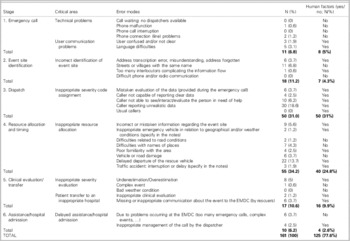
As shown in Table 1, the most frequent errors were related to resource allocation and timing (34.2%) and to dispatch (31.0%).
Frequency of reported errors according to the error modes (30) identified by the form
Influence of human factors
Of 161 detected errors, 125 were errors related to human factors (77.6%) (Table 1).
Severity (degree of potential harm)
52% (no. 84) of the error modes were classified as mild, 28% (no. 45) as moderate, and 20% (no. 32) as potentially severe.
Main critical areas and corrective measures identified
Table 2 summarizes the main critical areas defined by error modes with the highest occurrence (≥5%). The relevant corrective actions implemented are reported in the table.
Main critical areas defined by error modes with the highest occurrence (>5%) and their related corrective actions implemented

Discussion
Main findings
The majority of errors occurred during the central phases of the rescue operation process (phase 3, dispatch and phase 4, resource allocation and timing), consistent with other data in the literature. A study on IR implementation in prehospital settings identified clinical judgment and dispatch issues together with staffing/ambulance availability as two of the most reported problems.Reference Gallagher and Kupas 4 Another study on health providers’ perceptions of key issues in prehospital settings, evidenced poor clinical judgment as a critical issue, underlying the need for specific training.Reference Atack and Maher 13 Similar results are confirmed by a systematic review conducted on this topic.Reference Bigham, JEs and Brooks 6
With regard to the dispatching phase, most of the problems seem to be related to inefficient communication with the caller (not able to see/interact/evaluate the person in need of help or reporting unrealistic data). Almost 4% of errors were due to a mistaken evaluation of the data (provided during the emergency call). The dispatch phase has been improved through the adoption of an updated version of the Medical Priority Dispatch System. Compared with the previous version (based on a single flow chart to be adopted in all situations), the new version identifies a limited number of critical areas with a specific flow chart for each area. The software EMMA© (Emergency Management Mapping Application) guides the professional with a structured sequence of key questions, each associated with a specific set of answers. Based on the answer, the nurse assesses whether patient symptoms are associated with a severe condition. Each step is mandatory. In order to facilitate severity code assignment, a visual pattern has been developed, including information on 1) main diagnosis for each area with the corresponding severity color code (red, yellow, or green); 2) main scales used in the emergency setting (e.g., Glasgow Coma Scale, Cincinnati prehospital score); 3) major trauma criteria identification; 4) burn severity system identification; and 5) normal vital signs and major alterations. A specific section is dedicated to pediatric problem management. This approach allows staff to ask more appropriate questions, to better understand the situation, and to decide more quickly and efficiently what response needed dispatching. This system can add several advantages, such as an improvement in dispatcher-caller communications, a more structured assessment of patient severity conditions, better stress management, better coordination between the EMDC and the rescue team, and better resource allocation. The system would be further improved by implementing a multimedia interface capable of capturing images or video recordings via the caller’s mobile phone. This could help overcome misunderstandings due to verbal difficulties but would have to first pass legal consideration over patient confidentiality issues.
In this particular phase, an essential role is also played by the caller. A brochure explaining the role of 118 EMS (118 Instructions for Use) and translated into eight languages was sent by regular mail to all of the families living in the area of NHS Trust 20 of Verona. The booklet informs the public on when and how to call the EMS, and provides basic core information. The brochure is available for download on the website of NHS Trust 20 of Verona. With regard to phase 4 (resource allocation and timing), an important role is played by the delayed departure of the rescue vehicle. As defined by Cooney et al., the ambulance offload delay is the time that “it takes to transfer a patient to an ED stretcher and for the ED staff to assume the responsibility for the care of the patient.”Reference Rinke, Dietrich and Kodeck 14 A delay occurring at this stage can have important consequences for patients and ambulance turnover. The ongoing implementation of the global positioning system (GPS) allows for continuous updating of vehicle localization so that the dispatcher can save valuable time coordinating vehicle allocation. Moreover, a program has been developed to train dispatchers on how to deal with mass casualty emergencies. The training includes both classroom and hands-on activities and is mostly focused on developing the dispatchers’ coordination skills.
Errors during phase 5 occurred with a lower frequency. However, an inappropriate clinical evaluation can result in serious patient harm.Reference Cupera, Mannovà and Rihòvà 15 Prehospital emergency care education needs to be carefully structured. Continuous feedback and information exchange meetings with senior dispatchers provided an opportunity to recognize hazardous behaviors and to adopt the most suitable corrective actions.
Finally, results show that the majority of mistakes (78%) were due to human factors. Similar results are confirmed by the literature,Reference Fletcher, McGeorge and Flin 16 evidencing the need to implement specific training on NTS.Reference Flin and Maran 17 , Reference Gurses, Ozok and Pronovost 18 A specific course on communication and relational skills for the EMDC staff has been run to try and overcome these educational gaps.
The importance of adopting corrective actions is further confirmed by the evidence that almost half of the errors were moderate to severe. Risk management programs should be constantly implemented and integrated with the daily activities of the staff working in this setting.
Before the study, a single IR system was used for the entire NHS Trust 20. The project led to implementing an ad hoc form for the emergency care setting, thus promoting its ongoing use. The main results from the IR system are regularly analysed as part of clinical audits, in order to check for the efficacy of previously introduced corrective measures and to develop additional initiatives when necessary. The IR system has become an essential instrument in the development of a learning organization capable of implementing a continuous quality improvement system (plan-do-check-act system).
Strengths and limitations of the study
The main limitation of the study is the issue of under-reporting.Reference Cupera, Mannovà and Rihòvà 15 , Reference Evans, Berry and Smith 19 , Reference Hobgood, Bowen and Brice 20 The results of our study show a very low error rate. Few studies analysed the results from the implementation of an IR system in prehospital settings, but no data on error rates are reported. These studies found very low numbers of collected reports, compared to our results, even during longer observational times. A UK study collected 124 reports along 8 months of study, whereas a U.S. study collected 415 reports during 7 years.Reference Gallagher and Kupas 4 , Reference Shaw, Drever and Huges 21 One study showed that only half of EMS providers had reported an error in the previous year.Reference Hobgood, Bowen and Brice 20 These data confirm results from other researchers evidencing that error disclosure in the emergency medical setting represents a challenge for the staff.Reference Hobgood, Bowen and Brice 20 , Reference Lu, Guenther and Wesley 22 , Reference Jennings and Stella 23
In order to further encourage the implementation of an IR system in this setting, it would be important to 1) develop an error classification system specific to the emergency prehospital stage and 2) ensure a national data flow of all mistakes collected within this setting.Reference Bigham, Bull and Morrison 24 , Reference Mears, Ornato and Dawson 25 These initiatives may guarantee the collection and analysis of many more data and foster comparisons across different organizations.
Nevertheless, many efforts were made to inform all participants about the aims of the project and the importance of reporting as many events as possible. In order to overcome the limitations intrinsic to the IR process, it could be useful to implement an additional tool measuring the errors occurring in this specific setting. For example, in other settings of NHS Trust 20, IR results are routinely compared with the Institute for Healthcare Improvement’s Global Trigger Tool, which has not been designed for use in the emergency care setting.
Despite these limitations, the use of the form allowed a significant number of corrective measures to be implemented. Moreover, the improvement actions had a positive impact in all emergency management pathways from the site of intervention till the appropriate hospital care. Although the tool and the process were applied in the prehospital emergency care, the same methodology is sufficiently general to be adopted in any other medical setting.
Conclusions
Results suggest how the implementation of an efficient IR system may act as a major driver for the development of a “learning organization” and help overcome the blame and shame culture, which still affects many health care environments. Considering the low safety culture evidenced within this setting, the use of a prestructured instrument can help the staff develop a stronger critical thinking approach and promote continuous quality improvement.
Acknowledgements
The authors wish to thank all of the staff of the 118 EMDC of Verona for agreeing to participate in the study and for their essential collaboration.
Competing interests: None declared.
Supplementary material
To view supplementary material for this article, please visit http://dx.doi.org/10.1017/cem.2014.74



