




In an era when historical statues can be toppled and reputations smashed, critical editions remain one of the more durable monuments to the significance of a composer. Initiated by the nineteenth-century Bach-Gesellschaft and Händel-Gesellschaft editions, the practice of trying to produce a ‘correct’ text of the complete musical works of a single composer reached its apogee in the decades after World War II, leading to marquee projects like the Neue Bach-Ausgabe (1954–2007) and the Neue Mozart-Ausgabe (1955–91). So pervasive was edition-making in this era that it led Joseph Kerman to complain ‘there is something wrong with a discipline that spends (or spent) so much more of its time establishing texts than thinking about the texts thus established’.Footnote 1 But despite such criticisms and amid the proliferation of alternative forms of musicological research in the last 40 years or so, the making of critical editions has continued, with new projects taking in figures such as Janáček (1978–), Verdi (1983–), Donizetti (1989–) and Bartók (2016–), among many others.Footnote 2 Even if it may be nowhere near as dominant a part of musicological endeavour as it once was, edition-making has survived, a tacit refutation of the challenges that the canon has met with.
It is only very recently that Richard Strauss was accorded this treatment.Footnote 3 Given his widespread reputation around 1900 as one of the leaders of modernist music after Wagner, and the ubiquity of his music in concert halls and opera houses since then, it might seem surprising that it took until 2011 for his critical edition to be launched, with the first volumes only appearing in 2016. In part this was because existing non-scholarly editions of his works were easily available and seemed textually adequate. Whether the motivation for producing a Kritische Ausgabe at this juncture was purely a scholarly one is open to question; it is probably no coincidence that the project was begun in the decade before Strauss's works entered the public domain in January 2020. The earliest completed volumes certainly contain some of the composer's most bankable works: all the Lieder from Op. 10 onward, the first cycle of tone poems (Macbeth, Don Juan and Tod und Verklärung), and two of his most popular operas (Salome and Elektra), with the other two biggest stage hits (Rosenkavalier and Ariadne) in preparation.Footnote 4
The Richard Strauss Kritische Ausgabe is a joint venture of the Bavarian Academy of Sciences and Humanities (Bayerische Akademie der Wissenschaften) and the Richard-Strauss-Institut in Garmisch-Partenkirchen (hereafter RSI), with cooperation from Strauss's heirs who control the Richard-Strauss-Archiv, also in Garmisch-Partenkirchen. The resulting volumes have been issued by Verlag Dr. Richard Strauss, an imprint which has previously published the non-scholarly Richard Strauss Edition. Also cooperating are several firms who were the previous distributors of Strauss's music: Boosey & Hawkes, Peters, and Schott Music.Footnote 5
In this review, two sample volumes (Macbeth Footnote 6 and ElektraFootnote 7) from among those published to date in the Kritische Ausgabe will be examined; however, more space will be devoted to exploring the ancillary online sites: the Richard Strauss Quellen Verzeichnis (www.rsi-rsqv.de), hereafter ‘Sources Catalogue’, and the Kritische Ausgabe der Werke von Richard Strauss: Online-Plattform (www.richard-strauss-ausgabe.de), hereafter ‘Edition Online Platform’. It is these digital resources that mark the Strauss edition as a twenty-first century project.
Sources Catalogue
The earliest of these ventures, and a necessary precursor to the critical edition, was the assembly of sources related to Strauss's works. This project was run out of the RSI and was led by Jürgen May. The data assembly was the work of Claudia Heine and Adrian Kech, who have subsequently edited various volumes in the critical edition itself.Footnote 8 Everything in this database is in the German language only. The way the coding on the site has been done, clicking on a menu item changes the page configuration without changing the web address. The same is true when one performs a search, or even if one selects from among the results: a simple search for ‘Thuille’ (Strauss's childhood friend Ludwig Thuille, 1861–1907) brings up 11 results within the Quellen (sources) tab, and clicking on the last of these still leaves the url unaltered, with the information relevant to the chosen source showing up in the bottom panel of the page (see Fig. 1). It is only if one opts to click on the Permalink button in the lower right corner that a new browser window opens with a specific url for this individual source.Footnote 9
Page showing a selected item on the Sources Catalogue from among the search results for ‘Thuille’

The randomly selected item shown in Figure 1 happens to be a listing for a postcard Strauss sent Thuille at the beginning of April 1879; this is known to have existed once, but its current whereabouts are unknown, and the item has not been seen by those preparing the catalogue. Although the entry is listed as being ‘in preparation’, it seems likely that, absent some new discovery, this will remain the fragmentary reference it has been since it was last updated on 10 May 2012.Footnote 10 Other entries similarly marked as incomplete, however, could be updated: one such item is a letter Strauss wrote to Engelbert Humperdinck on 28 June 1892, which in fact has already been published.Footnote 11
By default, the home page for the Sources Catalogue will search within the Quellen (sources) tab, but one can alternately try to find items under the Werke (works) or Personen (people) tabs, each of which has a different set of search limiters (see Fig. 2). Practically speaking, unless one has a very particular query, it may be easiest just to put a term into the box marked ‘Einfache Suche’ (simple search, a welcome later addition to the options which is available in all the tabs).Footnote 12 Further tips for successfully finding relevant sources can be found by clicking on the Anleitung (guide) menu item.
The limiters when searching under different menus: (from left to right) Quellen, Werke, Personen

Since June 2016, it has also allegedly been possible to search for materials pertaining to specific sections of individual works (the ‘Inventarium’ options listed in the first column of Fig. 2). I say allegedly, as the few trials I undertook did not produce results. A search for bar 216 of Elektra (the first appearance of the so-called Elektra-chord at the start of the character's opening monologue) threw up a sketch pertaining instead to the Elektra–Aegisth dialogue near the end of the opera (see Fig. 3). This passage runs from shortly before Figure 214a to Figure 217a in the opera, which presumably explains why it turned up in the results for ‘216’, but amending the search to ‘34/12’ (the Elektra chord occurring in the twelfth bar after Figure 34), or ‘34/216’ did not lead to any hits. That such items actually exist is indisputable: Bryan Gilliam has noted the existence of ‘sixty bars of continuous sketches for scene 2, and they pertain to the opening B-flat-minor section of her speech: roughly the first fifty bars’; he has also transcribed an early version of the motif seen in bar 216 as found in a different Strauss sketchbook (admittedly it is in a different transposition, and one note in the chord differs by a semitone from the final version).Footnote 13 Similarly, one might have expected to find something for Der Rosenkavalier Figs. 236/4 (Och's waltz) or 285 (the start of the Act III trio), but again these drew blanks.
Source q01458, a sketch for the Elektra–Aegisth dialogue from shortly before Figure 214a to Figure 217a
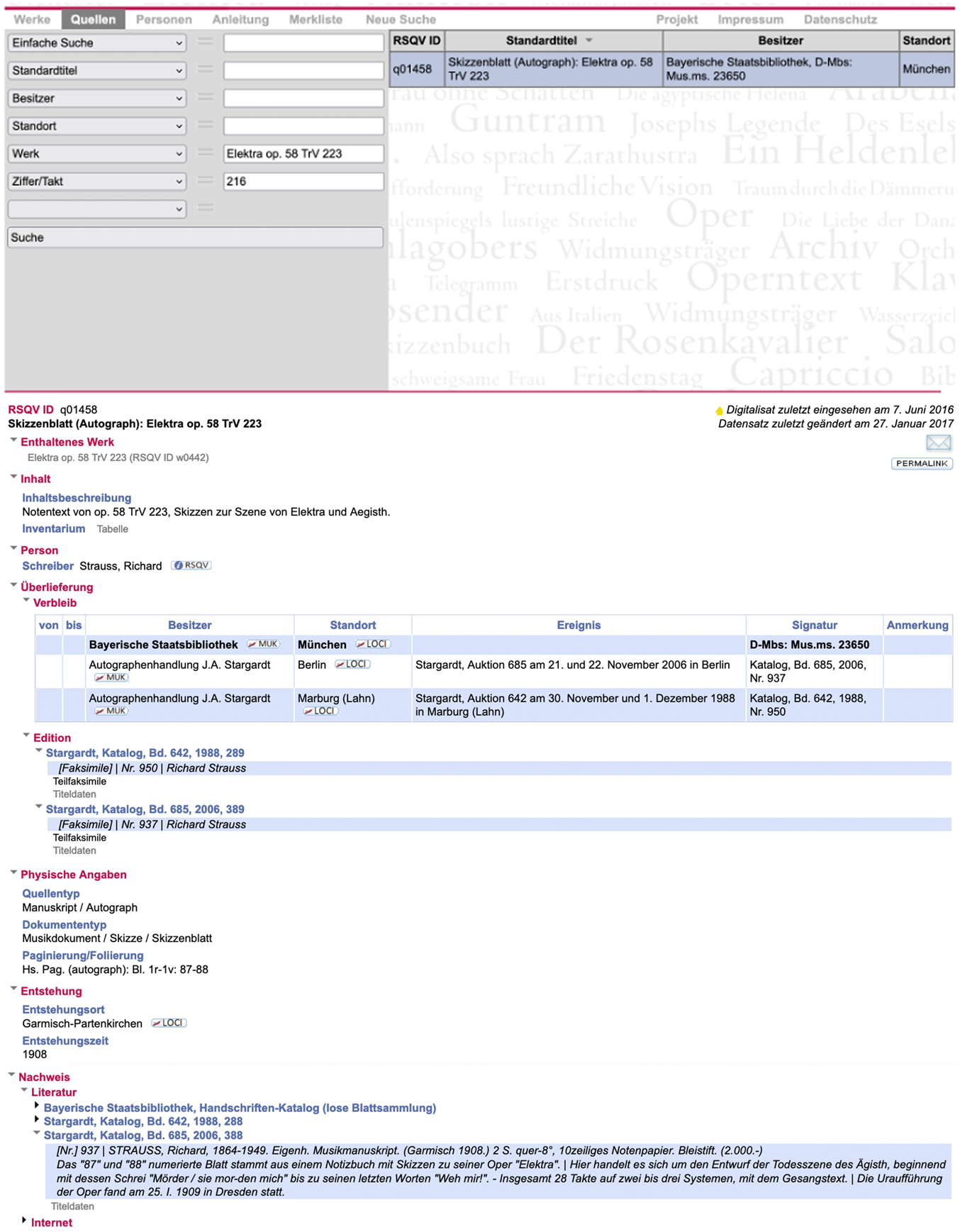
It may not have been what I was looking for, but Figure 3 is instructive as to what kinds of information are supplied for items in the Sources Catalogue. This sketch is currently held at the Bayerische Staatsbibliothek (call number supplied), and the item's provenance is also traced through two auctions in 1988 and 2006. The description of the contents of the manuscript merely identifies the general scene in the opera to which it relates (see ‘Inhaltsbeschreibung’), but the excerpts reproduced from the auction catalogues are more informative, with the text from the 2006 advertisement shown in blue at the bottom of Figure 3.Footnote 14 Sadly, the facsimiles of this item that were published in both auction catalogues have not been reproduced on this website, presumably for copyright reasons.
The compilers of the Sources Catalogue have used five-digit numbers preceded by a ‘q’ for Quelle (source) to identify individual items. Other entities also issued with identifiers include works (four digits prefaced by ‘w’, e.g. the third version of Macbeth is w0252), and people (‘n’, e.g. Ludwig Thuille himself is n05190, see Fig. 4).Footnote 15
Sources Catalogue listing for Ludwig Thuille

As this last example shows, Thuille was the dedicatee of three Strauss works (‘Widmungsträger’). His involvement in the sources (‘Quellenbeteiligung’) is additionally listed as scribe (‘Schreiber’) of two items (piano arrangements of Macbeth and Don Juan), recipient (‘Empfänger’) of four items (letters from Strauss) and owner (‘Besitzer’) of one (he was given the autograph of Twelve Variations, TrV 68 in 1881 and it remained in his possession until his death). Each of these listings is a hyperlink which opens a new window; for instance, clicking on ‘Widmungsträger’ reveals that the three works dedicated to him were the Suite in B-Flat Op. 4 (the version for 13 instruments), Don Juan and a Sonata No. 1 in E, each of which items is in turn clickable (see Fig. 5).Footnote 16 The danger, well known to Wikipedia users, of getting diverted by hyperlinks down an endless series of rabbit holes, is real here too.
Works by Strauss which were dedicated to Ludwig Thuille

Turning to sources used in the making of one of the critical editions, there are six items listed in the backmatter of the Macbeth volume: (1) the autograph score from which the first edition was made (identified in the print volume as ‘A*’, but equivalent to q00309 in the Sources Catalogue); (2) the first published edition (‘E’, q14425); (3) the first printed parts (‘E-St’, q14426); (4) the Eulenberg miniature score (‘DEU’, q14427); (5) the copy made from A* for the engraving of parts (‘St*’, q13509); and (6) the handwritten copy of the first nine bars made by the composer and dedicated to the Royal Philharmonic Society in 1936 (‘ARPS’, q13348).Footnote 17 Although they lack the uniformity of the Sources Catalogue identifiers, the sigla used in the Critical Report are more easily distinguished from each other. In the Sources Catalogue, a simple search for ‘Macbeth’ turns up 17 items: these six, plus piano reductions of the tone poem, isolated pages from earlier versions of Macbeth (more on this below), a letter from Strauss to Humperdinck, etc.
For comparison purposes, I have taken one source found in both edition and the online Sources Catalogue: the 1936 dedication page to the Royal Philharmonic Society (the online version is shown in Fig. 6).Footnote 18 On the website, under ‘Anmerkung zur Quelle’ (remarks on the source), it notes that the information is based on the examination (‘Autopsie’) of the original undertaken in conjunction with the Critical Edition project, confirming the close links between the two. The information found in both places is similar, but not identical (for instance, there are slight differences in the measurements of the page in the two places), and it is somewhat differently organized.Footnote 19 Among the details provided are the item's date of creation, current location (at the British Library, including the call number), an exhaustive description of the document's physical appearance, and a list of places where it has been discussed in the literature (in the present case, the website only lists the relevant volume of the Critical Edition). Although there is no formal listing of literature in the Critical Edition, there are two footnotes to relevant English-language materials unmentioned on the website.Footnote 20
Source q13348, the first page of Macbeth in Strauss's handwriting given to the Royal Philharmonic Society

In sum, the Sources Catalogue is a valuable assembly of information with a slightly clunky interface. The absence of English-language translations of any of the material is in practice not much of a drawback, as the user of a database of this kind is likely to be a Strauss specialist versed in German. For such a scholar, the Catalogue will be invaluable in pointing to the existence of primary documentation and its whereabouts, as well as telling whether an item has been published or discussed in the literature. In an ideal world, scans or transcriptions of these materials would be available within the database, but at least knowing what is out there in libraries and archives is a start.
Critical Edition
As the discussion of Figure 6 will have made clear, the Sources Catalogue was only ever a stepping stone towards a bigger goal: the production of a critical edition of the composer's scores. The preface common to each volume (and also reproduced on the Edition Online Platform) informs the reader that the Kritische Ausgabe is focussed on six genres, which will encompass much but by no means all of Strauss's output: stage works (series I), Lieder (II), symphonies and tone poems (III), shorter orchestral works and works for winds (IV), concerto-like works (V), and chamber music (VI). Of the 52 planned volumes, eleven have appeared as of January 2024, with another eight listed as in preparation.Footnote 21
Works lying outside these categories include the choral works, piano music, melodramas, and Strauss's arrangements (whether of his own music or the works of others, e.g. Mozart's Idomeneo). It is fair to say that these omitted genres are more peripheral to the composer's reputation, but failing to include them in a critical edition will perpetuate the perception that they do not matter. The project's leader, Hartmut Schick, notes that the existing limitations ‘by no means hinder the completion of the edition in the future’.Footnote 22 For the present, however, the project is a Kritische Ausgabe of selected Strauss compositions rather than an aspiring Sämtliche Werke.
The volumes themselves are beautiful objects, typeset with due attention to detail and printed on high-quality paper. The frontmatter in each volume contains the aforementioned series Preface, an Introductory essay on the specific work, and facsimiles of a selection of relevant primary documents and illustrations. For Elektra, we are given sample pages from the autograph score, engraver's copy, and galley proofs of the opera; excerpts from Strauss's personal copy of Hofmannsthal's play with the composer's sketches for musical ideas; first-edition cover illustrations; early playbills and cast photographs, and so forth. Macbeth is poorly served by comparison, with just a single illustration of the first page of the autograph manuscript of the second version of the tone poem; however, this is somewhat compensated for by the inclusion in the backmatter of all the extant pages of the discarded ending of the first version.Footnote 23
In the lapse of time between the appearance of the editions of Macbeth (2016) and Elektra (2020), a greater integration between print copy and digital materials has come about, so that in the score for Elektra, footnotes to letters, reviews and other contemporaneous items cited in the Introduction contain urls to where the item in question is reproduced on the Edition Online Platform; these are lacking in the Macbeth Introduction.Footnote 24 In the digital version of the Elektra Introduction on the Edition Online Platform itself, these footnotes are even more helpfully hyperlinked.Footnote 25
The Introduction to the later volume is also far more expansive: in the first part, which recounts the gestation of Elektra (‘Zur Entstehung’), Adrian Kech goes into granular detail on Strauss's interactions with his publishers and arrangers (often citing letters never previously published, but now thankfully available on the Online Platform).Footnote 26 In the second part, Sebastian Bolz provides a good overview of the early reception of Strauss's fourth opera, with plenty of fascinating quotes from the press (in the comparisons between Elektra and the immediately preceding Salome, one journalist remarked that the earlier opera's modernity had quickly faded in a kind of ‘Altersschwäche’ [senile decay]).Footnote 27 The translation by Lindsay Chalmers-Gebracht is generally very good, with Strauss's remark that conducting Elektra made him realize it was ‘ein Saustück für den Dirigenten’ stylishly if colloquially rendered as ‘it is a bitch of a piece to conduct’.Footnote 28 In his Introduction to Macbeth, volume co-editor Walter Werbeck provides a more succinct but still thorough account of Strauss's development as an artist leading up to first tone poem, the revisions the work underwent, and the composer's uncharacteristic lack of confidence even in the final product. A small slip sees the key of the third movement of Strauss's immediately preceding symphonic fantasy Aus Italien listed as F sharp minor instead of the correct A major.Footnote 29
This is not the place for a forensic exploration of the scores of the new editions themselves, although a few remarks should be made. It was always going to be more interesting to see what was made of Macbeth, as it is one of the most textually problematic works within Strauss's oeuvre. It went through no fewer than three versions. The first was completed in January 1888, and was subjected to severe criticism by Strauss's quondam mentor, Hans von Bülow. In a judgement with which Strauss concurred, Bülow ‘remarked very properly that the first final triumphal march in D major of Macduff was nonsense. It was all very well for an Egmont overture to conclude with a triumphal march of Egmont, but a symphonic poem Macbeth could never finish with the triumph of Macduff’.Footnote 30 Nothing daunted, Strauss reworked the piece, especially the ending section, and had a second version ready within the month. The third version, involving textural and orchestral revisions rather than large architectural changes, is dated 4 March 1891.Footnote 31
Although the editors Stefan Schenk and Walter Werbeck make it clear that, unlike the seemingly similar case of Ariadne auf Naxos, ‘only the final third version of Macbeth is considered as valid’ (xviii), what they have chosen to offer is a ‘synoptic edition’ of the second and third versions of the score on facing pages, the second version on the left-hand side and the third on the right, allowing for easy bar-for-bar comparisons of the two.Footnote 32 Separately, they have also included Strauss's own four-hand piano arrangement of the second version, and the surviving excerpts of the discarded first version. The face-to-face arrangement of the two complete orchestral versions facilities the study of Strauss's evolving command of orchestration and the greater refinements of phrasing and articulation he was capable of after the experience of writing and conducting Don Juan and Tod und Verklärung.Footnote 33 One recurrent difference is Strauss's more systematic use of rests in the later version: the revisions to bars 44–46 show that he wanted more pointed articulation between chords, possibly reflecting his experience with sluggish acoustics or lazy players. Only the first violin part is shown in Figure 7, but similar changes are found throughout the orchestra.
Strauss, Macbeth, bars 44–46, violin 1 part: (left) second version; (right) third version.

While the interleaving of versions may not make this edition of Macbeth unsuitable by itself for podium use by conductors (one can get used to looking at just the right-hand pages), those places where it was decided to fit two systems onto one page, with a consequent shrinking of staff and note-head size, does make it less practically suited. This begins with the entry of the Lady Macbeth music (bar 64), where the instrumentation is admittedly scaled back. However, from bar 81 two systems containing 16 and 17 staves respectively are squeezed onto a single page, rendering everything so small that, on first leafing through the score, I thought this passage was an extended ossia. In an edition where so much has been well calculated, it is a shame that a more visually friendly solution could not have been arrived at.
If any score was going to have to be squeezed to fit on a single page, Elektra is that score: the vast palette of instruments Strauss used is legendary (I counted 35 staves on p. 129 in the Klytämnestra scene). Perhaps because of this, the adjustments necessary when two comparatively less dense systems are arranged on a single page seem less disconcerting (compare the facing pp. 198 [one system, 26 staves] and 199 [two systems, 19 and 17 staves]: things are necessarily smaller on the second page, but not disturbingly so.
For an edition to be truly ‘critical’, there needs to be a report or editorial commentary justifying the decisions which informed the editing of the score, although when/if such documents are released and what information they contain has varied widely in practice. Most basically, there is the question of whether such a report is published as part of the score or issued separately. In major editorial projects such as the Neue Mozart-Ausgabe, the critical report can be issued separately, often years after the appearance of the edition itself (the Kritischer Bericht for Don Giovanni appeared in 2003, when the NMA score itself had been first published by Bärenreiter in 1968).Footnote 34 In the case of the Neue-Schubert Ausgabe, whose scores are also issued by Bärenreiter, the critical reports are published separately by the International Schubert Society (Internationale Schubert-Gesellschaft), again some time afterwards.Footnote 35 In other cases (for instance, the venerable Paderewski edition of Chopin's complete Études, or the recent Peters publication of the same composer's Op. 10 Studies edited by Roy Howat), the commentary is provided at the end of each volume.Footnote 36 This last approach is the one taken in the Strauss Critical Edition, although the paratextual materials in each volume are supplemented by what has been made available in the Edition Online Platform (discussed further in the next section).
Both Critical Reports follow a similar ordering: (I) a listing and (II) description of the relevant sources; (III) source criticism, i.e. evaluation of their significance for the establishment of the most correct text; (IV) a note on editorial methods and conventions of presentation; and (V) a listing of every intervention made in the chosen base text, and presentation of variant readings. In the case of the Elektra volume, there is additionally (VI) documentation of the cuts Strauss authorized. For those accessing the Reports in the print volumes, some passages, including the entirety of §§III and IV, are available in both German and English; however, the specifics of I and II and all of V are in German only. On the website, these Kritische Berichte are exclusively in German throughout.
The punctiliousness of all the editors is to be praised for their exhaustive listing of changes they made in correcting errors found in previous editions. At a cursory glance, few of the changes will dramatically affect perceptions of the music, and alterations to pitches are far fewer than amendments to dynamics, phrasing and the like. However, the new editions have removed any number of minor irritants and inconsistencies that will have vexed conductors and musicians in the past. For instance, previous editions of Elektra have an f1 quaver on the second beat of the Heckelphone in bar 794 (third bar after Figure 108), which is inconsistent with both the previous bars in this part, and with every other instrument playing this line (horns, violas, cellos all have a-flat1 in this place): this has been rectified in the Critical Edition.Footnote 37
Edition Online Platform
In the Preface to the Critical Edition volumes, the online platform is described as an ‘integral component of the project’, where all the supporting materials from the print edition (introduction, facsimiles and critical reports) will be made available in digital form after the lapse of a year.Footnote 38 This promise has been upheld, more or less, although there is often a considerable time lag between the appearance of print and digital versions, and the facsimiles have never been published online.Footnote 39 Readers should also be aware that the Introduction (Einleitung) to each volume is only available in German on the website even though there is an English translation in the print edition;Footnote 40 the same is true of the Critical Report (Kritischer Bericht), although, as was noted above, even in the print edition most of the detail is solely in German. English-language material on the website is limited to the series Preface, and any sources which were originally in English.
But the website contains far more than a linguistically limited version of what is found in the print volumes. Although the materials provided relate only to those works which have been published in the edition to date, it already is an impressive trove for the Strauss researcher. What is on offer is superbly organized, and the site is far easier to use than the clunky Sources Catalogue. On the home page one can find links to the bilingual Preface, Bände (a list of published and planned volumes), Dokumente (documents relating to the composition, publication, and early performance and reception history of the stage and orchestral works), Gesangstexte (texts of the operas and Lieder). The latter three sections are discussed separately below. There is also an external link Zum Projekt, which takes one to the Institute for musicology at the Ludwig-Maximilians-Universität, Munich, where one can read more about the back-end of the editorial project: lists of the people involved,Footnote 41 detailed guidelines for volume editors,Footnote 42 research publications emerging from the project,Footnote 43 and so forth.
Bände
This page shows the progress of the edition to date, with a list of the volumes published/in prosect and links to the online materials for each completed volume. As can be seen in Figure 8,Footnote 44 for Elektra one can access the volume introduction (Einleitung), critical report (Kritischer Bericht), documents (Dokumente) and something cryptically described as ‘documentation for the sung text’ (Dokumentation Gesangstexte). What these links provide is a shortcut to all the materials the editors consider specifically relevant to Elektra, many of which they have cited in the volume introduction. Having these collated by work saves one the pain of searching for oneself in the other top-menu items and filtering the results, and it may also be more comprehensive. Clicking the ‘Dokumente’ listed under Elektra brings up a list of 159 items, organized chronologically (although other ways of sorting the results are available), whereas searching using ‘Elektra’ as a keyword in the general Dokumente menu only turns up 138 items.
Published and planned volumes in the Critical Edition (only partially shown)

Dokumente
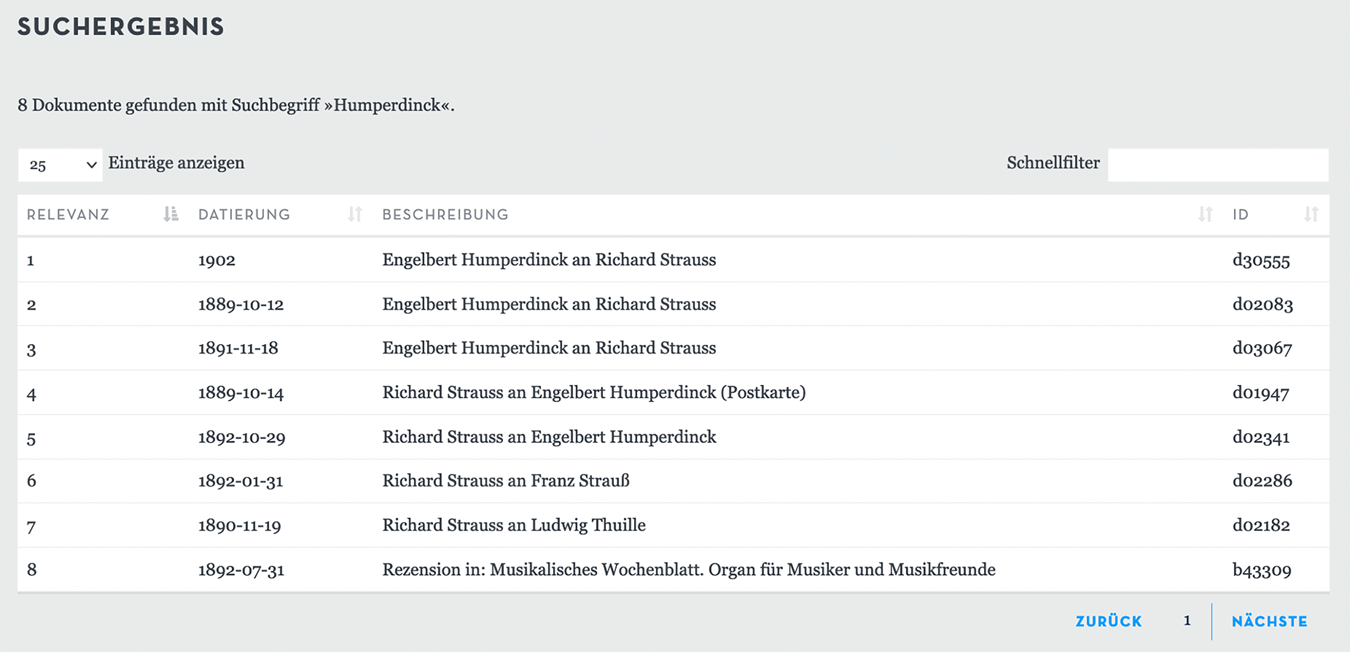
Those curious enough to explore the Dokumente menu directly will find nearly a thousand items available already across three categories: Korrespondenz (651 items, mostly letters to and from Strauss, but including some correspondence between third parties, e.g. from Hans von Bülow to his wife, Marie), Rezensionen (244 excerpts from reviews and essays dating between 1887 and 1933), and Sonstiges (47 random items, including advertisements, press interviews with the composer, etc.). As a test case, I searched for ‘Humperdinck’ without going into any specific category, which resulted in 8 hits listed according to relevance; this could be further reduced by using the quick filter (‘Schnellfilter’) in the top right of the results page (Fig. 9).Footnote 45
Search results for ‘Humperdinck’ within the Dokumente menu
Choosing item 3 from among these results gives the text of the letter Humperdinck sent Strauss on 18 November 1891 (see Fig. 10).Footnote 46 This text is unabridged (which is not the case with every document here, though excisions are always marked), and the letter is tagged as relevant to Vol. III/6 Tod und Verklärung, meaning that it would show up as part of the documentation for this tone poem. Two places where the letter has been published are cross-referenced (a third is omittedFootnote 47); additionally, the editor of this volume (Stefan Schenk) has examined the original item and added his own notes in red.
Letter from Engelbert Humperdinck to Strauss, 18 November 1891

Gesangstexte
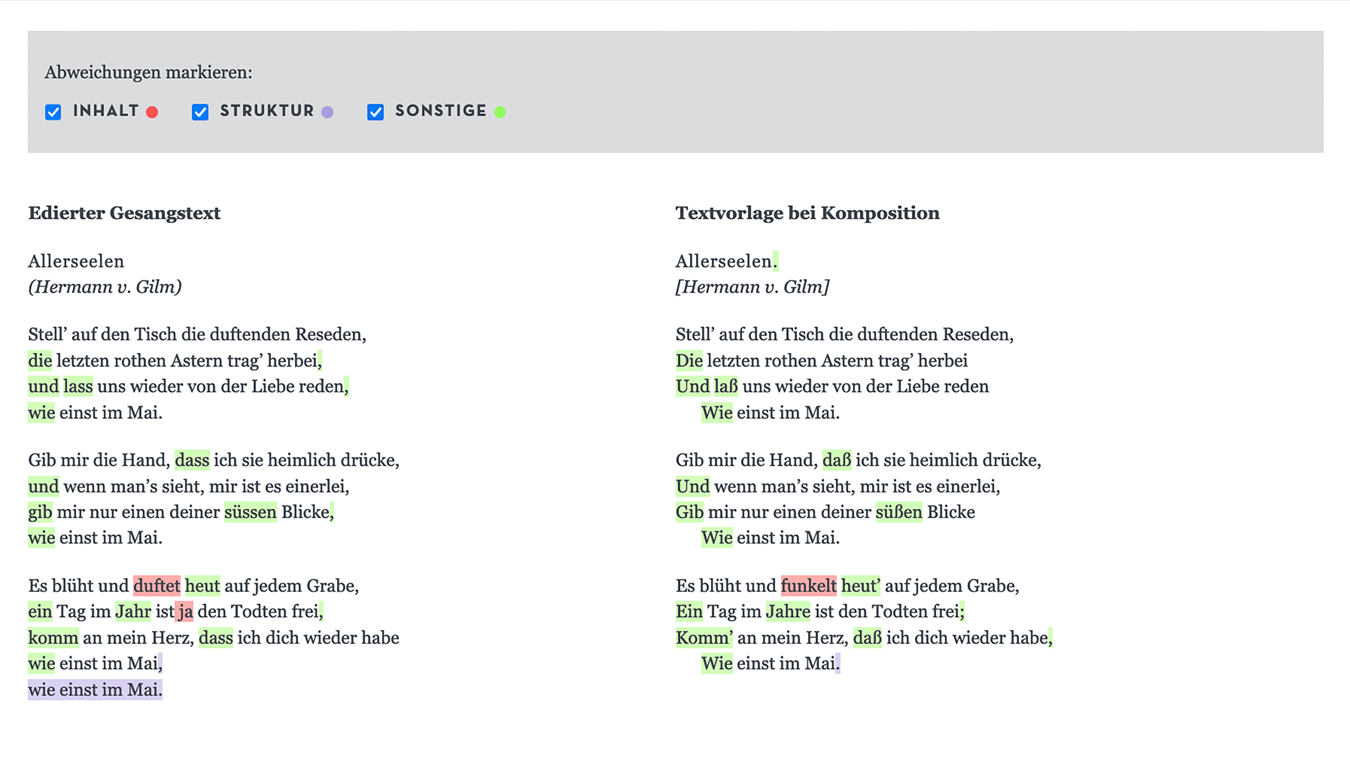
Even more impressive are the resources available for texts of the operas and songs published to date. In the case of the Lieder, the digital edition provides both the original poems and the adjusted texts found in Strauss's setting, with helpfully easy ways of showing the differences between the two. Figure 11 shows the text of the much-loved ‘Allerseelen’, the eighth and final song of Acht Gedichte Op. 10 (1882–83), with Hermann von Gilm's original poem on the right and the text as set by Strauss on the left. Checking the three boxes at the top reveals that Strauss made a couple of word changes (Inhalt, highlighted in red), repeated the final line of verse 3 (Struktur, in purple), and a host of minor adjustments in the matter of orthography, punctuation, and capitalization (Sonstige, in green).Footnote 48
Strauss, ‘Allerseelen’, in Acht Gedichte, Op. 10/8 (LHS); Hermann von Gilm, ‘Allerseelen’ (RHS)
Inevitably, matters are more complex in the case of Salome and Elektra. For each opera one is given three options: (a) the final operatic libretto by itself, (b) the operatic libretto alongside the text used during composition, or (c) the operatic libretto alongside the separately published operatic text. In the case of Salome, the edition of Wilde's play which Strauss drew on when composing the German version of the opera was Hedwig Lachmann's 1903 translation, and the differences highlighted via the textual comparison tools make it clear how often Strauss had to condense the rich ornamental language of the original, jettisoning extra metaphors and the like. In Figure 12, we see that the infatuated young Syrian guard (nameless in Wilde, but dubbed Narraboth in Strauss's opera) originally compared Salome not just to a dove who strayed, but also to ‘a narcissus trembling in the wind’ and ‘a silver flower’.Footnote 49 Similarly, Salome's catalogue of those at supper included barbarians and painted Greeks, as well as the Jews, Egyptians and brutal Romans mentioned in the final libretto.Footnote 50 The thinning of Wilde's text is perhaps most notable in Herodes's increasingly desperate offers of alternative prizes to Salome in place of Jokanaan's head, a passage chopped down to a third of its original length. Also ruthlessly cut are several exchanges between Herodes and Herodias. The only place where Strauss significantly expanded on the source material is in the dialogue of the five Jews, where insistent repetitions turn it into a babble of overlapping voices.
Strauss, Salome, scenes 1–2 (LHS); Wilde trans. Lachmann, Salome (RHS)

The differences between the score libretto and the stand-alone operatic text published separately are naturally fewer, but are still carefully documented. Of interest to singers and dramaturgs will be those performance directions which did not make their way into the final score. For instance, as Jokanaan's head is revealed by the executioner and Salome seizes it, the published text additionally notes that ‘Herod hides his face in his cloak. Herodias fans herself and laughs. The Nazarenes sink to their knees and begin to pray’.
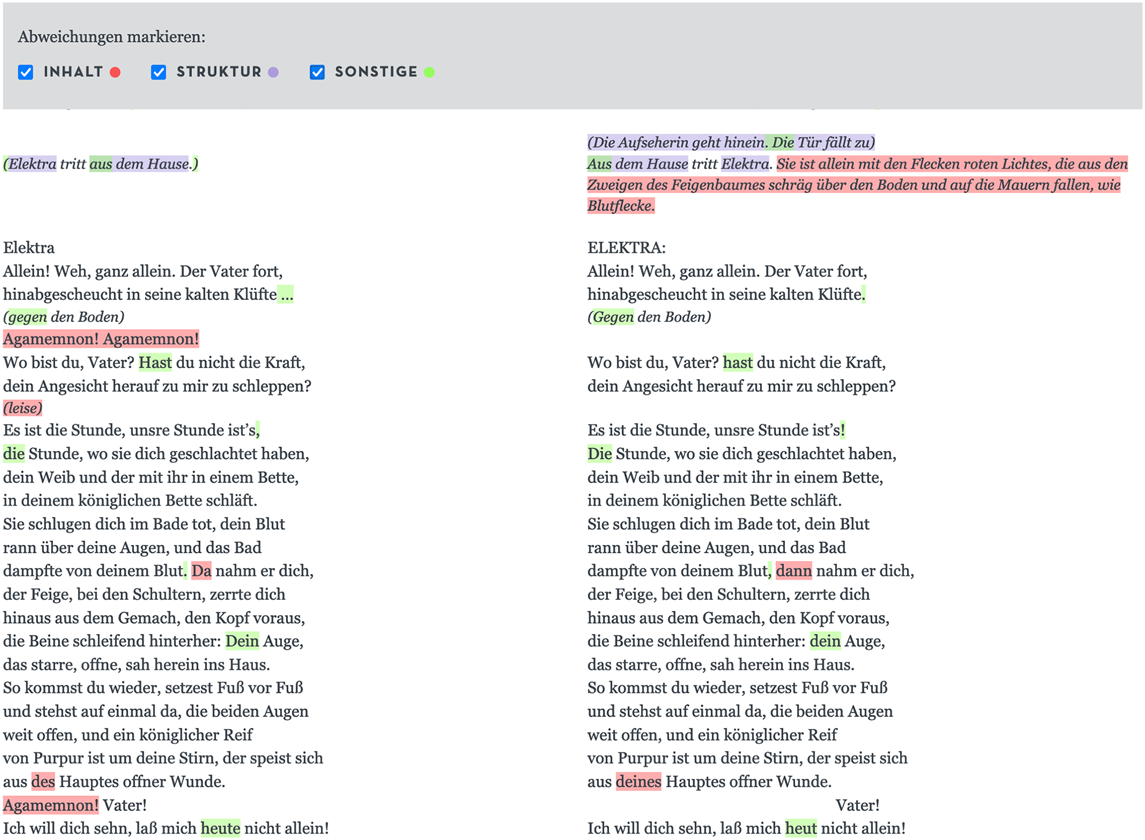
In the case of Elektra,Footnote 51 the text Strauss used was a 1904 fifth edition of Hofmannsthal's play of the same name. That Strauss marked up his personal copy of the play with motivic ideas and indications of tonalities has long been known;Footnote 52 the relevant Source Catalogue entry for this item is also cross-referenced here, although it is not clear that any use has been made of the composer's annotations in comparing play-text with opera libretto.Footnote 53 It is notable that in her first speech in the play Elektra never uses her father's name, while in the equivalent passage in the opera she says ‘Agamemnon’ six times, with the famous four-note motif associated with this name heard umpteen additional times in the orchestra (see Figure 13Footnote 54). As was the case with Salome, Strauss pruned his source material here, excising large parts of the Elektra–Klytämnestra scene, and thinning Elektra's exchanges with her siblings. The few passages where Strauss requested Hofmannsthal provide new text to amplify a scene (for instance, in the contrasting reactions of Chrysothemis and Elektra to the avenging acts of Orestes) are also easily discernible.Footnote 55 All of this is well-known in the Strauss literature, but seeing the colour-coded differences brings Strauss's editing vividly to life.
Strauss, Elektra (libretto from Kritische Ausgabe) (LHS); Hofmannsthal, Elektra (RHS)
***
The Critical Edition and the related online projects are game-changers for Strauss studies. The edition itself is a high quality, if conservative product, no different in kind from the volumes produced by the Neue Mozart Ausgabe or other mid-twentieth-century heritage editions. Nothing like the Chopin Online Variorum edition is being attempted here, because there is nothing nearly so complex about establishing a best text in the case of most of Strauss's compositions, error-strewn though the early editions have proven to be (as witnessed by the length of the Critical Reports in the present edition).Footnote 56 Where this really excels is in making so much ancillary material available online; that this is accessible for free aligns with the best traditions of democratizing knowledge enabled by the digital revolution. Hitherto, knowledge of Strauss's letters was mostly limited to specialists, and those items never before published (of which there still remain many) could only be accessed in archives at places like the Bayerische Staatsbibliothek or the RSI. But now scholars, performers and indeed the general public can access this wealth of primary documentation via a few clicks. The Edition Online Platform will enable interested parties to explore the circumstances surrounding the conception and early reception of Strauss's works with new ease.


 Open access

