


1. Introduction
In today’s world, product development is a multidisciplinary field that requires the expertise of a diverse range of professionals (Reference Ulrich and EppingerUlrich & Eppinger, 2016). While the objectives of a novel product may vary from one product to another, there are nevertheless certain requirements that demand consideration in every product. These include economic performance and customer satisfaction, among other factors. The field of product development is characterized by a high degree of dynamism, reflecting the evolving customer requirements that accompany the growing demand for individualized products (Reference Krause and GebhardtKrause & Gebhardt, 2023). This leads to a rise of variety in a company’s product portfolio to satisfy customer requirements.
A principal driver of material and product design innovation is the concept of lightweight design. The enhancement of weight-specific product performance and the optimization of resource efficiency are two key benefits of lightweight design. Moreover, the ongoing reduction of CO2 emissions in the transportation sector can be addressed through a reduction in the weight of vehicles, which primarily results in a reduction of CO2 emissions during the use phase of a product due to decreased fuel consumption. The conflict resulting from the increased variety of products on the market and the necessity to optimize products through lightweight design approaches is evident in many products. Lightweight design approaches are typically oriented towards optimizing a single product variant or component, they tend to neglect the broader implications for the product family as a whole. In contrast, Design for Variety strategies frequently do not incorporate lightweight design as a target size within the development process and often lead to oversizing of components due to standardization.
This contribution will contextualize the impact of product variety on lightweight design in product development. After this, a measurement is presented to offer an introspective into the development process of components for variant product families, in the context of lightweight design.
2. Research background and fundamentals
Before the introduction of a measurement to provide and interpret information for standardization and optimization purposes, through the analysis of optimization results, within the context of the product development process, the following section describes the underlying research background and relevant fundamentals.
2.1. Lightweight design
Lightweight design of a product is an important factor to consider at each stage of the product lifecycle, from the initial production stage through the deployment phase and beyond. In the production phase, lightweight design can help reduce material costs. In the use phase, it enables lower fuel consumption, thus increasing sustainability and reducing operating costs. (Reference Tempelman, Karana, Pedgley and RognoliTempelman, 2014)
In general, lightweight design focuses on the task of making a product lighter while also considering and fulfilling the existing requirements. The most widely known lightweight design strategy is material lightweight design. This approach involves the substitution of materials with lower densities while ensuring that the structural strength of the component is maintained (Reference Tempelman, Karana, Pedgley and RognoliKopp et al., 2011; Reference Kopp, Burkardt and MajicTempelman, 2014). Examples of material lightweight design are the use of composite materials like sandwich structures or fiber-reinforced polymers, which both have high weight-specific stiffness and strength (Reference Clyne and HullClyne & Hull, 2019; Zenkert, 1997). Optimizing a structure regarding material distribution and developing an optimal shape is called form lightweight design (Reference Kopp, Burkardt and MajicKopp et al., 2011). A more holistic procedure for lightweight design is the system lightweight design approach. In this approach, strategies like module, system, and function lightweight design are included, the used tools, for example, are the integration of functions, or optimized load-paths through the different components or modules of a product (Reference Kopp, Burkardt and MajicKopp et al., 2011). Modern products strive for more external variety to satisfy today’s customer requirements, this leads to a conflict in product development. The implementation of lightweight design across an entire product family is complicated due to a variety of components, each of which must be considered individually during the design process. (Reference Krause and GebhardtKrause & Gebhardt, 2023)
2.2. Design for variety
As previously stated, the current market requires products to be more individualized than ever before, which consequently increases product variety. In addition to individualization, other factors contributing to the dynamic change of requirements, include globalization, new consumption patterns, and new emerging technologies, which all come with a growing need for increased external product variety. (Reference Krause and GebhardtKrause & Gebhardt, 2023)
While Design for Manufacturability (DfM) or Design for Assembly (DfA) have improved process efficiency and product quality, neither approach addresses the challenge of rising product variety (Reference Boothroyd and DewhurstBarkan & Hinckley, 1994; Reference Barkan, Hinckley, Dasu and EastmanBoothroyd & Dewhurst, 1983). To combat the increasing variety, which comes with higher costs in every aspect of the product lifecycle, an approach called Design for Variety (DfV) was established by Martin & Ishii (Reference Martin and Ishii1996). To balance the demand for product variety, design modularity, component standardization, late point differentiation, and product offering should be considered in the product development process (Reference Martin and IshiiMartin & Ishii, 1996). The strategies used in DfV are often hardly distinguishable from strategies used in product architecture for variety, as the product architecture is also analyzed and optimized in the DfV. Different guidelines are present in the literature, taking the design of the product, the architecture of the product, and the development and production of product variants into account. (Reference Kipp and KrauseKipp & Krause, 2008)
2.3. Commonality and combinability
In the development of product families, commonality is a widely used concept to determine the degree of standardization and reuse of modules, interfaces, components, and processes (Reference Zhang, Yang, Ma, Dong, Dong, Tan and ZhangZhang et al., 2019). The assessment of commonality is also employed to evaluate variety as a cost-driving factor, thereby enabling the incorporation of these effects into DfV (Reference Martin and IshiiMartin & Ishii, 1996).
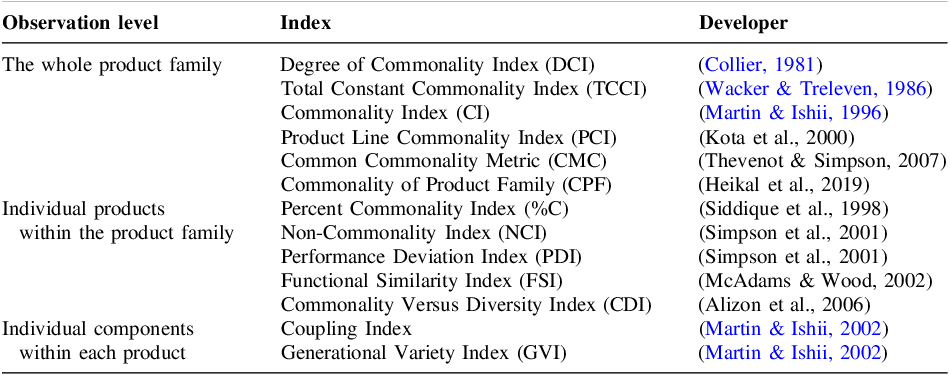
To quantify the commonality within a product or product family, there are many commonality indices existent. The indices differ in the overall method of calculation and the system boundaries for which the commonality is quantified. In the existing literature, the indices are categorized into the following categories: the whole product family, individual products within the product family and individual components within each product. A categorized overview of the indices is shown in Table 1. (Thevenot & Simpson, Reference Thevenot and Simpson2006, 2007; Zhang et al., Reference Zhang, Yang, Ma, Dong, Dong, Tan and Zhang2019)
Summary of commonality indices based on (Reference Thevenot and SimpsonThevenot & Simpson, 2006; Zhang et al., 2019).

As can be seen in the given literature, most of the indices determine the commonality for the whole product family or an individual product within the product family. Indices categorized into the first category quantify commonality based on the whole product family. The DCI by Collier (Reference Collier1981), is the first developed index and the following indices are mostly extensions of the DCI. It quantifies the ratio between the number of common components and the total number of components in a product family. An extension of the DCI is the TCCI by Wacker & Treleven (Reference Wacker and Treleven1986) which introduces the comparison between product families and competing designs. The CI by Martin & Ishii (Reference Martin and Ishii1996) extends the DCI for set-up costs and includes the point of product differentiation as an indicator for indirect costs due to variety. For purposes of product redesign and benchmarking Thevenot & Simpson (Reference Thevenot and Simpson2007) developed the CMC based on existing indices, the CMC extends the indices taking the desired variety and commonality of the product family into account. A relatively new index is the CPF by Heikal et al. (Reference Heikal, El-Kharbotly and El-Beheiry2019), which incorporates the consideration of production quantities of variants into existing indices.
The second category includes indices which determine the commonality of individual products, the %C is calculated by looking at components, component-to-component connections and the assembly (Reference Siddique, Rosen and WangSiddique et al., 1998). These three values are then added to an overall platform commonality measurement. The NCI and PDI, by Simpson et al. (Reference Simpson, Seepersad and Mistree2001), form a measurement to determine the appropriate level of commonality within a product family. How well a product meets the individual performance target is quantified with the PDI, while the NCI values parametric variation within a product family. To implement the evaluation of commonality and diversity in a product family, while also assessing functions, the CDI can be used when multiple platforms are used in one product family (Reference Alizon, Shooter and SimpsonAlizon et al., 2006).
In the last category, the Coupling Index and the GVI, both by Martin & Ishii (Reference Martin and Ishii2002) are assigned. The GVI gives an estimation of which components in a product are likely to change in new product generations, whereas the Coupling Index quantifies the strength of coupling between components.
Another index that is not a commonality index, but describes the combinability of components, is the Combinability Index (CI), the index quantifies to which extent the given product family is reaching the potential of theoretical optimal combinability (Reference SalvadorSalvador, 2007). In essence, combinability can be defined as the capacity to generate product variants through the configuration of existing components or modules (Reference Krause and GebhardtKrause & Gebhardt, 2023).
3. Scope of this contribution
The majority of established commonality indices focus on changes to product architecture, providing limited insight into the structural optimization of variant or standardized product components. This study analyzes the similarity between topology optimized components to determine the potential for geometric standardization and joint optimization of components while minimizing the compromise in volume reduction. This approach could facilitate a higher degree of standardization of optimized components and offers a promising initial exploration of the use of a metric like this in the development of variant product families, for which lightweight design is a crucial consideration. In the following chapters, geometric component similarity will be used to describe the resemblance between the components by considering the similarity in elements of different topology optimization results. Commonality is not used because the term is established in product development of variant product families at product architecture level, instead the term similarity is used to describe the comparison on component-to-component level.
4. Approach to quantify the potential for standardization of variant components
In this chapter, measures for describing component similarity are developed and the following implications for standardization are derived. Furthermore, a visualization of the introduced measures is provided to support decision-making for geometric component standardization and joint optimization.
4.1. Varying load cases due to product configuration and variety
The term “load cases” is employed to describe a range of scenarios that can be applied to a structure or product. In this context, the term “load case” is understood to refer to a variable set of acting or resulting loads.
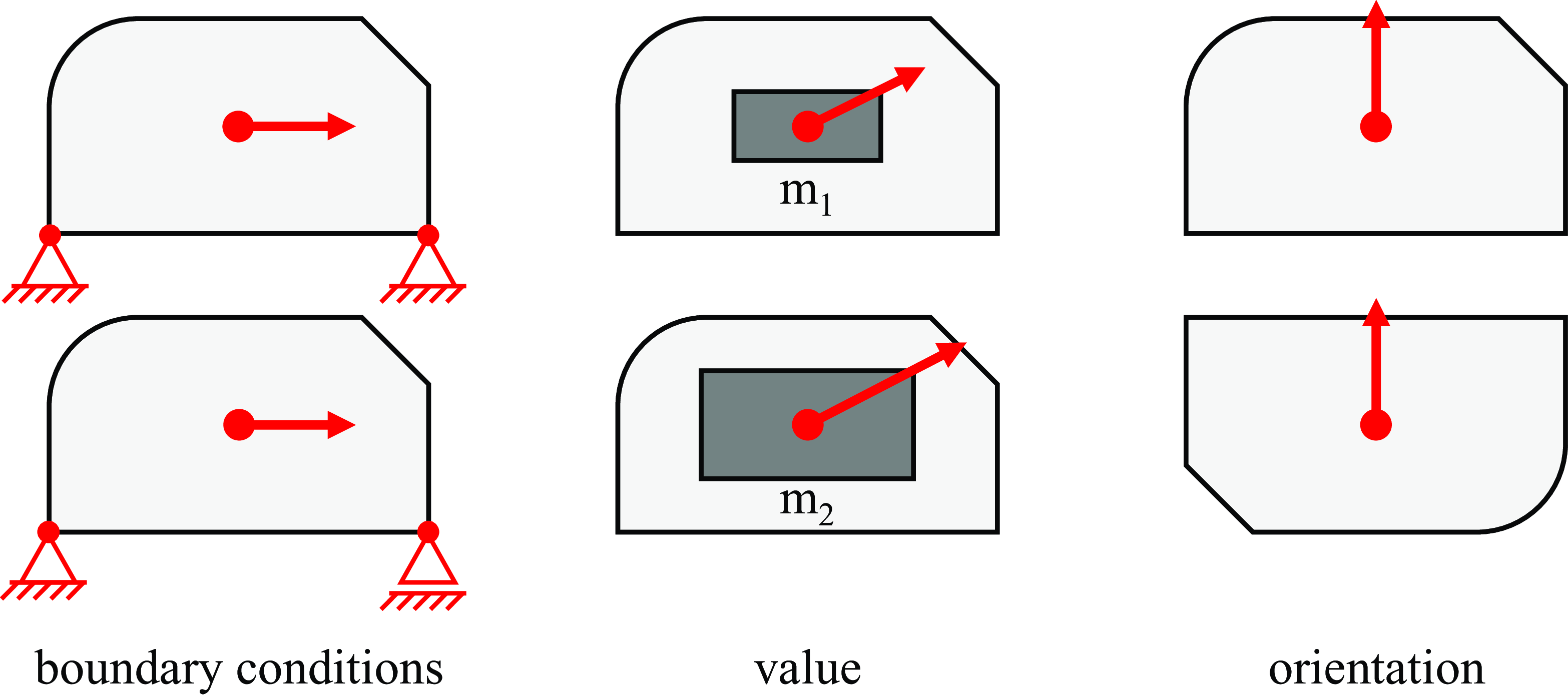
First, the causes for load cases are analyzed and practical reasons for these causes are exemplarily discussed. The first cause are the boundary conditions under which a component is mounted or connected to other components. Changing boundary conditions lead to different load paths in the component, thus accompanied by different reaction forces. Another influencing factor is the localization of the load application point. A practical example would be the case of a component that is installed in different product configurations and therefore subjected to varying boundary conditions. Varying load cases can also be attributed to variations of force values, given the load application point stays at the same place, the changing values result in different load cases. Different product configurations can result in different load values, for example, due to different masses of attachments or other components. This scenario illustrates that components utilized across different product variants may be subjected to disparate load cases as a consequence of the underlying product variety. The final cause for load cases considered in this contribution is the orientation of a component. A changing component orientation can lead to different load cases, due to directional acceleration. In the aviation industry, for example, components have to be tested for different accelerations in various directions resulting from different emergency flight maneuvers, which are specified by the European Union Aviation Safety Agency (2020). All the discussed and formulated load cases are depicted in Figure 1.
General causes of varying load cases

Further specifications are necessary for components that are exposed to multiple and combined load cases and can therefore be analyzed for different load cases. Considering the topology optimization results for each load case, the different optimization results propose an alternative design solution for a specific load case. In practical applications, multiple load cases are typically considered simultaneously in an optimization process. Alternatively, they may be simplified to a single or limited set of critical load cases (Reference Lógó, Balogh and PintérLógó et al., 2018). However, at the theoretical level, all load cases are considered individually to gather more information.
4.2. Degree of element similarity and volume reduction
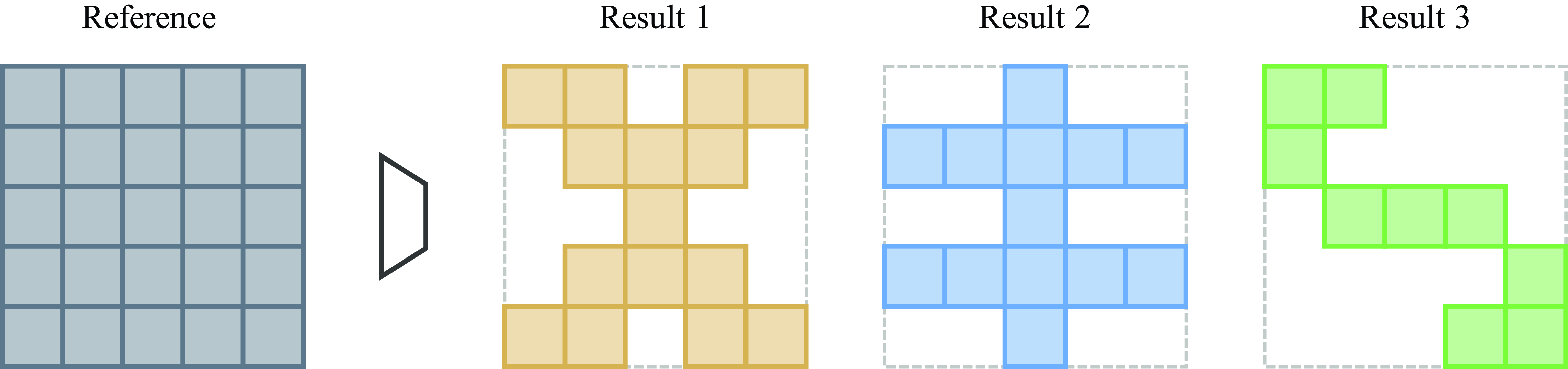
The definition of similarity used in this contribution consists of the comparison between geometrically different component variants. This could exemplary be components which are to be optimized regarding their weight, to increase the product’s weight specific performance. To introduce the similarity measure proposed in this contribution, a theoretical and simplified example is given in Figure 2. The reference is indicated on the left-hand side, while the right-hand side displays three topology optimized results derived from the reference.
Theoretical example for the calculation of the degree of element similarity

The reference in Figure 2 symbolizes the geometric constraints of the component. The optimization results are optimized given different boundary conditions, used in different product variants. Firstly, the volume reduction compared to the reference Δ ViR [%] is calculated based on a comparison of the elements between the result i and the reference R (Equation 1).
 $$V_{iR} = \bigg({1 - }{{{number of elements_{i}}} \over {{number of elements_{R}}}}\bigg) \cdot 100$$
Secondly, the degree of element similarity DS.ij [%] is calculated (Equation 2). Therefore, the number of similar elements from result i compared to result j has to be determined. It is important to note, that the degree of element similarity is directional, which necessitates the calculation of all combinations in both directions. The results are given in percent, whereby a higher percentage means greater element similarity between the results.
 $$D_{S,ij} = \frac{100 \cdot number \ of \ similar \ elements_{ij}} {{number \ of \ elements_i }}$$
In the case of the example, two degrees of element similarity are calculated for each result to each of the other two results. The calculated degree of element similarity and the volume reduction relative to the reference are presented in Table 2.
Calculated degree of element similarity and volume reduction to reference.

4.3. Visualization
To provide a visual representation of the calculated values, a diagram is proposed, wherein the volume reduction relative to the reference is plotted on the x-axis, while the degree of element similarity is plotted on the y-axis (Figure 3). For each result two points are plotted each with respect to one of the other results, this is visualized with the color of the data point. The vertical dashed line shows which result the point represents. Between the pairs of results, a dashed line is plotted to visualize the affiliation of the pairs. Because the volume reduction to the reference is not directional, both points for each result are located on the same x-value.
Diagram showing the degree of element similarity and volume reduction to the reference of the results

The dashed lines between the result pairs give a qualitative measure for the potential for geometric standardization of the component and the potential of volume reduction to the reference. Pairs with small differences in the degree of element similarity are more likely to be standardizable, given the geometric properties of the components. The greater the difference on the x-axis between a pair of results, the greater the trade-off in volume reduction for the result with the greater potential for volume reduction over the reference. In conclusion, this means that the pairs of results with the shortest distance to each other provide the best pair for possible standardization and joint optimization in terms of their geometric properties. It can be observed that the connecting lines all exhibit a positive slope. This is because results with a higher volume reduction have a lower number of elements, which results in a higher element similarity than that of the compared result with a lower volume reduction.
In the next chapter, these qualitative measures are evaluated for potential applications in the development of variant lightweight products.
5. Potential of element similarity in the development of variant lightweight products
As discussed in chapters 2.1 and 2.2, lightweight design and DfV are crucial factors in modern product development. However, these factors often stay in direct conflict with each other given the different motivations regarding their consideration in the product development process, while DfV and modularization approaches prioritize economic performance, lightweight design approaches prioritize weight-specific product performance (Reference WhitneyWhitney, 2002).
A fundamental aspect of DfV is the standardization of components. This can be accomplished through different strategies. When optimizing components for weight, mostly individual optima for different product configurations and load cases are achieved. With DfV in mind, the goal is to identify optimization results which show high similarities, so they can be concluded into one optimized component. The degree of element similarity enables the measurement of the needed similitude.
Looking at the results from chapter 4.2, visualized in Figure 2, it can be determined which pair of results is best suited for combination in a geometric context. In the example, pair 1-2 have the smallest distance on the x- and y-axis which makes them the first pair to consider for geometric standardization through joint optimization. This is also supported by the absolute value of element similarity between both results. Although pair 1-3 exhibit a comparable degree of element similarity, result three demonstrates a considerably greater volume reduction in relation to the reference, which would result in a noteworthy decrease in the potential for volume reduction, in the case of combinations of these two results. Therefore, the applied measure enables a qualitative indicator for the decrease in lightweight design potential due to standardization and joint optimization.
A measurement like element similarity could be used in DfV to support standardization to keep the internal variety low, while simultaneously supporting lightweight design in products that need to be provided with a high variety. Depending on the reason the variant components are subjected to different load cases, the measurement could also be adapted, with the consideration of non-design spaces within the topology optimization. This would enable the analysis of mechanical interfaces of the components and compare the geometric properties of the interfaces between components. The elements required for the interfaces could therefore be weighted higher in the calculation of the degree of element similarity, to provide more detailed information for geometric standardization and joint optimization efforts. In this context, it is crucial to recognize that solely considering the difference in the degree of element similarity is an insufficient indicator for standardization. Just because a result pair is close in the degree of element similarity, especially in low degrees of element similarity, the potential for geometric standardization should not be always rated highly. The degree of similarity between a pair of results should therefore exceed a certain threshold to warrant consideration of the standardization. To determine this threshold, each product must be evaluated separately. Additionally, to the decreased volume reduction potential due to standardization, other influences due to the standardization on variant components should be evaluated.
6. Application of similarity in optimization on a small-scale example
In this chapter, the introduced measurement and visualization will be applied to a small-scale example. For the example, five panels with the same geometric boundaries are considered for optimization. The panels are installed in different product variants of an aircraft cabin monument. The loads differ in direction and value, the panels are mounted with different boundary conditions, which exposes them to different load cases.
The panels are modeled with shell elements and discretized with a quad-mesh. The topology optimization is carried out for minimal volume with constraints in displacement and stress. For the optimization, Altair OptiStruct is used. The results are then analyzed and the degree of element similarity and the volume reduction is calculated in MATLAB (Table 3). In Figure 4 the panel for each product variant is shown with the given load case resulting from the mounting situation in the product variant. On the bottom, the optimization result is shown.
Optimization results for the panel respecting the different load cases

In the corners and the middle, multiple elements are evident in every component variant, this is due to the boundary conditions and the load application point, which lies in the middle for all product variants, with varying directions. This shows that elements that are directly affected by boundary conditions have a higher importance, in the context of geometric standardization. As proposed before, these elements should be weighted in the calculation of the degree of element similarity, because when elements for mechanical interfaces are similar, the practical potential for geometric standardization is higher.
Calculated degree of element similarity and volume reduction (rounded).

The calculated values in Table 3 are visualized in Figure 5 to simplify the identification of pairs with high potential for geometric standardization. As can be seen in Figure 5 variants two, three, four, and five are close in terms of volume reduction, but the degrees of element similarity show major differences.
Visualization of the results for the small-scale example

The initial step is to identify variant pairs that are closely related in terms of element similarity. Firstly, variant five shows a low degree of element similarity to all other four variants, this is because the boundary conditions are quite different to the compared variants. Following this observation, variant five is not further investigated for combination. The variant pair 1-4 is close together in element similarity and volume reduction. This is an indicator to consider the pair for joint optimization despite the different mechanical interface. Looking at the boundary conditions shown in Figure 4, variant three should also be considered, because the interface is identical to variant four. The pairs 3-1 and 3-4 have therefore to be looked at in the diagram. Especially the pair 3-1 shows a larger difference in volume reduction. It is to be evaluated if the compromise in weight reduction is worth it, to create a standardized and weight optimized component which can be commonally used in the product variants one, three, and four.
With this process it is possible to identify commonally used components which can be optimized jointly, to reduce the weight over the whole product family, while also keeping the internal variety as low as possible.
7. Conclusion and outlook
In this contribution, the potential for geometric standardization of variant components was investigated. To determine the potential for geometric standardization, the degree of element similarity was introduced as a measurement for similarity between optimized components.
First, the calculation and visualization of the degree of element similarity and the volume reduction to the reference were presented. Following an illustrative example, potentials regarding the decision process for standardization of analyzed components of different product variants, on the basis of the calculated values, were investigated. Through this measurement, components which can be jointly optimized within the product family can be identified. The visualization concept can assist in the selection process of these components, based on the degree of element similarity and the volume reduction. Next, the approach and visualization were performed on a small-scale example. The proposed approach to determining the potential for geometric standardization through the degree of element similarity and supporting the selection process through the presented visualization appears to be promising. It has the potential to contribute to the development of a new tool in the field of Design for Variety. Additionally, the conflict between the need for standardization to support modular product family design and the need to enhance lightweight design through structural optimization can be addressed through the introduced measures.
To further develop the approach for geometric standardization, a variety of research areas will require consideration and analysis. First, the optimization process for the selected parts could be changed in regard to specifying non-design spaces for all considered components, this could be done at elements that are necessary for interfaces, which need to be considered when standardizing and optimizing components with interfaces localized in different positions. This optimization could be realized in the future with approaches of multi-model optimization as already proposed by Christiansen et al. (Reference Christiansen, Inselmann and Krause2024). This would enable an optimization of standardized variants, considering all relevant load cases and boundary conditions, without increasing the internal variety of the product family. Secondly, the concept of potential for geometric standardization needs to be more clearly defined in the context of this proposed measurement. A crucial element is the definition of a threshold for the degree of element similarity that must be met to even consider the standardization and joint optimization of components. Furthermore, the consideration of standardizable variant components should be extended to compare not only pairs of variants, but multiple variants at the same time to reduce the number of variant components to a minimum.
It is crucial to acknowledge that actual products are predominantly three-dimensional. Consequently, the two-dimensional examples presented in this contribution are largely theoretical and may not be directly applicable to the product development process. To ensure a comprehensive approach, it is essential to extend the consideration to three-dimensional geometries. In addition, other factors in the standardization of components, such as functions and cost-related aspects, must be considered and related to geometric standardization.
Acknowledgments
Parts of this work are results of the research projects DISKUS (Disruptive Kabine für umweltschonendes Lufttransportsystem, contract number 20K2202H) and eKabKlima (Effiziente Kabinentechnologie für ein klimaneutrales Flugzeug, contract number 20K2203B), both funded by the German Federal Ministry for Economic Affairs and Climate Action as part of the Federal Aeronautical Research Program LuFo VI-3. The authors would like to thank all involved parties for their funding and support.






 Open access

