




Impact statement
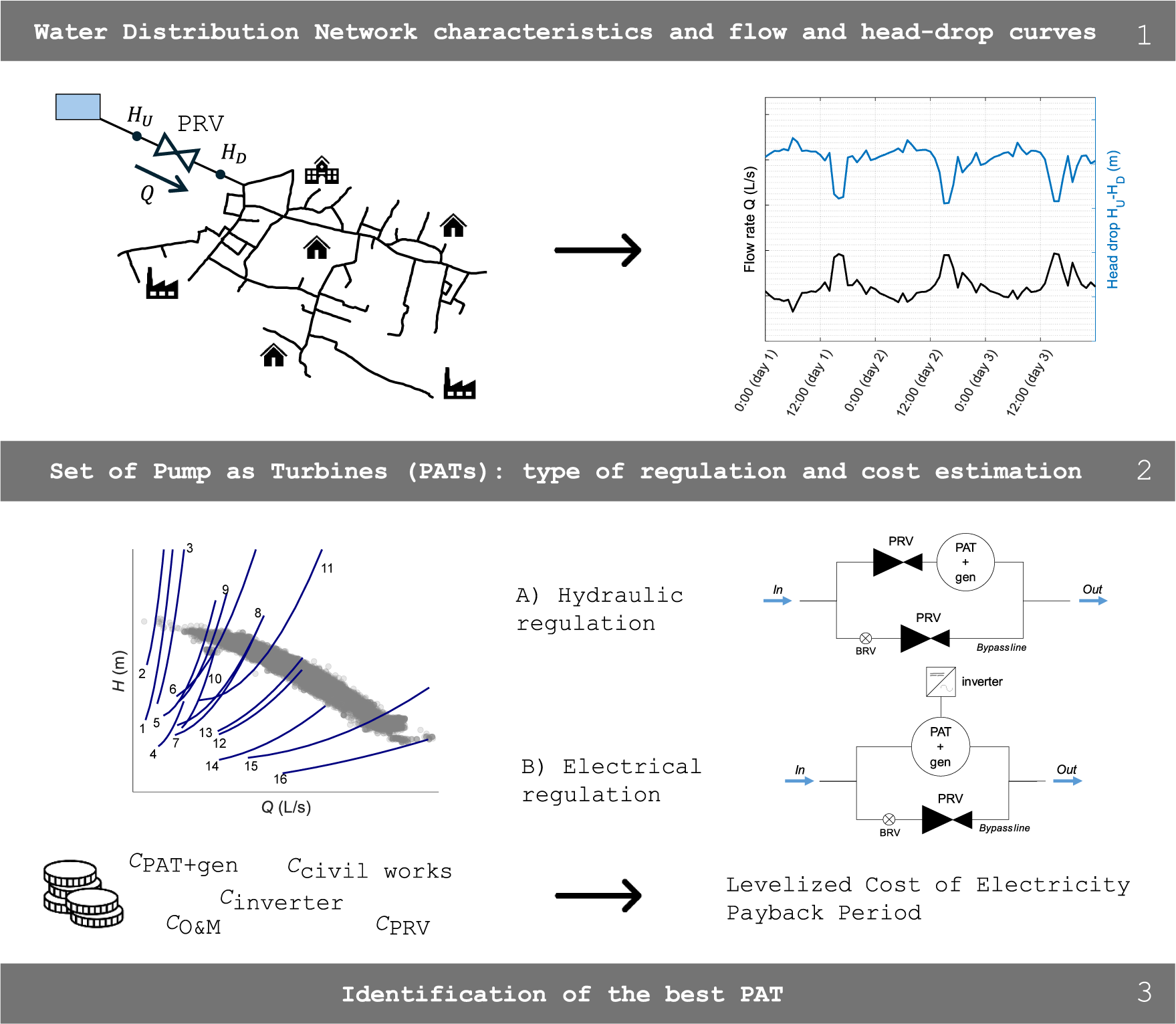
Nowadays, saving water and energy is crucial for the efficient management of water distribution networks (WDNs). This goal can be achieved by replacing pressure reducing valves with pumps as turbines (PATs), which dissipate excess energy while generating electricity. This study contributes to the state-of-the-art literature by first outlining the steps for identifying the optimal PAT to install in a given WDN by considering a real-world case study. Additionally, a comparison is made between two PAT regulation strategies (namely hydraulic and electrical regulations) from both an energy and economic perspective, providing practical guidelines for WDN managers. The added value of this article lies in its exclusive use of experimental data for investigating both WDN and PAT operations.
Highlights
-
• Approach for selecting a pump as turbine (PAT) to install in a water distribution network (WDN)
-
• Comparison between hydraulic and electrical regulation strategies
-
• Application to a real-world WDN and use of experimental data for PAT operation
-
• The optimal PAT recovers 44.1 % of the available energy, with a maximum investment cost of € 24,500
Introduction
Nowadays, saving water and energy is essential in the framework of an efficient management of water distribution networks (WDNs) and has become one of the water industry’s main concerns (Ferrarese and Malavasi, Reference Ferrarese and Malavasi2020). With regard to water conservation, pressure limitation has emerged as one of the most widely applied strategies to reduce water leakages, which are currently one of the major concerns for water utilities (Kostner et al., Reference Kostner, Zanfei, Alberizzi, Renzi, Righetti and Menapace2023; Alassio et al., Reference Alassio, Marsili, Mazzoni and Alvisi2024), also in light of the increasing water scarcity in several countries across the world due to population growth, urbanization and the effects of climate change (Marsili et al., Reference Marsili, Mazzoni, Alvisi and Franchini2024). Pressure limitation – consisting of reducing the excess water pressure in WDNs – is generally performed by means of dissipative devices, such as pressure reducing valves (PRVs). However, in the context of a virtuous energy policy and circular economy, the transition from energy dissipation to energy recovery should be attempted in light of the relevant energy footprint of water treatment and pumping operations, as well as the significant greenhouse gas emissions (Satish et al., Reference Satish, Doshi and Bade2021; Pirard et al., Reference Pirard, Kitsikoudis, Erpicum, Pirotton, Archambeau and Dewals2022).
To improve the energy efficiency of WDNs, researchers started to explore the technical and economic feasibility of replacing PRVs with energy-harvesting devices (Mitrovic et al., Reference Mitrovic, Novara, García Morillo, Rodríguez Díaz and Mc Nabola2022). As an alternative to the use of turbines in small and micro-hydropower schemes (Creaco et al., Reference Creaco, Campisano, Fontana, Marini, Page and Walski2019; Sinagra et al., Reference Sinagra, Creaco and Morreale2023), the installation of pumps as turbines (PATs) – that is, pumps used in turbine mode by reversing flow direction with the engine acting as a generator – is among the most investigated options for energy recovery in WDNs (Giudicianni et al., Reference Giudicianni, Mitrovic, Wu, Ferrarese, Pugliese, Fernández-García, Campisano, De Paola, Malavasi, Maier, Savic and Creaco2023). In fact, the use of PATs in WDNs has several advantages, for example, lower costs and larger availability compared to traditional turbines (Morani et al., Reference Morani, Crespo Chacón, Garcia Morillo, Mc Nabola and Fecarotta2023), as well as limited installation and maintenance costs (Novara et al., Reference Novara, Carravetta, McNabola and Ramos2019) and scalability to WDNs (Giudicianni et al., Reference Giudicianni, Mitrovic, Wu, Ferrarese, Pugliese, Fernández-García, Campisano, De Paola, Malavasi, Maier, Savic and Creaco2023). As a result, PATs are viable energy recovery devices for recovering a significant portion of WDN hydraulic energy – even exceeding 40 % (Venturini et al., Reference Venturini, Alvisi, Simani and Manservigi2017) – and reducing water leakages by more than 7 % (Kostner et al., Reference Kostner, Zanfei, Alberizzi, Renzi, Righetti and Menapace2023). However, in field applications, two main challenges arise: (i) machine selection and (ii) machine control.
With regard to machine selection, the choice of the most suitable PAT to install is not straightforward (Marini et al., Reference Marini, Di Menna, Maio and Fontana2023). On the one hand, the characteristic curves of pumps operating in reverse mode are not usually provided by pump manufacturers (Ramos et al., Reference Ramos, Pérez-Sánchez, Guruprasad, Carravetta, Kuriqi, Coronado-Hernández, Fernandes, Costa Branco and López-Jiménez2024). In addition, the operation of PATs is recommended at the maximum efficiency point, to avoid excessive efficiency reduction due to off-design operation that may limit the amount of recovered energy (Souza et al., Reference Souza, Mesquita and Blanco2023). Thus, establishing a correlation that enables the transfer of machine characteristics from pump (i.e., direct) mode to turbine (i.e., reverse) mode becomes crucial. This can be achieved through experimental or numerical techniques (Pugliese et al., Reference Pugliese, De Paola, Fontana, Giugni and Marini2016; Novara and McNabola, Reference Novara and McNabola2018; Venturini et al., Reference Venturini, Alvisi, Simani and Manservigi2018a; Reference Venturini, Manservigi, Alvisi and Simani2018b; Castorino et al., Reference Castorino, Manservigi, Barbarelli, Losi and Venturini2023). On the other hand, the selection of the optimal PAT depends on a careful economic and investment analysis, as demonstrated by several studies (e.g., Fecarotta et al., Reference Fecarotta, Aricò, Carravetta, Martino and Ramos2015; Muhammetoglu et al., Reference Muhammetoglu, Nursen, Karadirek and Muhammetoglu2018; Rossi et al., Reference Rossi, Nigro, Pisaturo and Renzi2018; Balacco et al., Reference Balacco, Fiorese, Alfio, Totaro, Binetti, Torresi and Stefanizzi2023; Souza et al., Reference Souza, Mesquita and Blanco2023; Stefanizzi et al., Reference Stefanizzi, Filannino, Fiorese, Torresi and Balacco2025).
With regard to the identification of PAT optimal control strategy (i.e., machine control), it must be observed that, unlike transmission systems, the availability of water and pressure surpluses rapidly changes in WDNs due to fluctuations in water demand (Oberascher et al., Reference Oberascher, Schartner and Sitzenfrei2023; Maio et al., Reference Maio, Marini, Zotti and Fontana2024). This makes sustainable energy production in WDNs an open issue (Venturini et al., Reference Venturini, Alvisi, Simani and Manservigi2017). A possible solution is represented by the implementation of real-time control systems, based on which PAT operation can be dynamically revised by considering time varying conditions of water pressure and water demand throughout the day, with the aim of maximizing the recovered energy while ensuring sufficient pressure in the downstream part of the WDN (Creaco et al., Reference Creaco, Campisano, Fontana, Marini, Page and Walski2019; Fontana et al., Reference Fontana, Marini and Creaco2021).
Identifying the optimal control strategy is a pivotal task as significantly affects the feasibility of PAT installation. For example, Marini et al. (Reference Marini, Di Menna, Maio and Fontana2023) found that energy recovery and net present value may increase more than 30 % and 15 %, respectively, if the optimal PAT regulation strategy is employed.
Real-time control technique can include two different regulation types, that is, hydraulic and electrical regulations. On the one hand, in the hydraulic regulation, a control valve located upstream of the PAT and a bypass line are controlled to modulate the flow running through the PAT and the available pressure (i.e., head) drop. Hydraulic regulation is widely investigated in the literature; several works focused on the implementation of this type of regulation and the related benefits (e.g. Fecarotta et al., Reference Fecarotta, Aricò, Carravetta, Martino and Ramos2015; De Marchis et al., Reference De Marchis, Milici, Volpe and Messineo2016; Muhammetoglu et al., Reference Muhammetoglu, Karadirek, Ozen and Muhammetoglu2017; Rossi et al., Reference Rossi, Nigro, Pisaturo and Renzi2018; Fontana et al., Reference Fontana, Marini and Creaco2021; Morani et al., Reference Morani, Carravetta, D’Ambrosio and Fecarotta2021; Carravetta et al., Reference Carravetta, Del Giudice, Fecarotta, Morani and Ramos2022; Manservigi et al., Reference Manservigi, Venturini, Losi and Castorino2023; Maio et al., Reference Maio, Marini, Zotti and Fontana2024; Stefanizzi et al., Reference Stefanizzi, Filannino, Fiorese, Torresi and Balacco2025). On the other hand, in the electrical regulation, an inverter between the PAT and the electrical grid enables the adjustment of PAT rotational speed, allowing the machine to work as close to the best efficiency point (BEP) as possible. However, this type of regulation has been generally less investigated, resulting in a lower number of available studies (e.g., Carravetta et al., Reference Carravetta, Del Giudice, Fecarotta and Ramos2013; Parra et al., Reference Parra, Krause, Krönlein, Günthert and Klunke2018; Alberizzi et al., Reference Alberizzi, Renzi, Righetti, Pisaturo and Rossi2019; Balacco et al., Reference Balacco, Binetti, Capurso, Stefanizzi, Torresi and Piccinni2020; Fontana et al., Reference Fontana, Marini and Creaco2021; Pugliese and Giugni, Reference Pugliese and Giugni2022; Souza et al., Reference Souza, Mesquita and Blanco2023). An even more limited number of comparative works investigates the advantages and disadvantages of the two types of regulation by benchmarking the same case study. In addition, the aforementioned studies on electrical regulation primarily addressed to the selection of the optimal machine based on predicted performance data or starting from experimental data referring to a very limited number of machines. Therefore, comparing hydraulic and electrical regulations based on the use of field performance data related to a plethora of machines, along with a detailed techno-economic analysis, constitutes the research gap that this article aims to fill.
In light of the literature survey discussed above, this study presents an approach to select the optimal PAT from a fleet of turbomachines based on the rate of energy recovery and the economic feasibility (i.e., levelized cost of electricity [LCOE] and payback period [PBP]) of each considered PAT. Unlike the large majority of available studies, this article investigates both hydraulic and electrical regulations by exploiting experimental data only, which is a fundamental requirement to infer the advantages and drawbacks of each regulation strategy. More in detail, real-world characteristic curves of 16 PATs are considered, and the potential PAT application is evaluated in relation to a real case study located in Northern Italy. In addition, the paper employs up-to-date equations to assess the cost of PAT installation.
Methodology
This section presents a general approach to assess whether a given PAT may be a suitable energy-harvesting device for a real-world WDN by exploiting the presence of a PRV. This approach allows considering two PAT regulation strategies (i.e., hydraulic and electrical regulations) and relies on data collected at the PRV location (i.e., upstream head, downstream head and flowrate). The availability of PAT’s characteristic curves (i.e., head-drop vs. flowrate and power vs. flowrate) is also mandatory. The optimal PAT is the one that simultaneously maximizes energy recovery and minimizes both the LCOE and the PBP.
Regulation strategies and energy recovery assessment
Hydraulic regulation
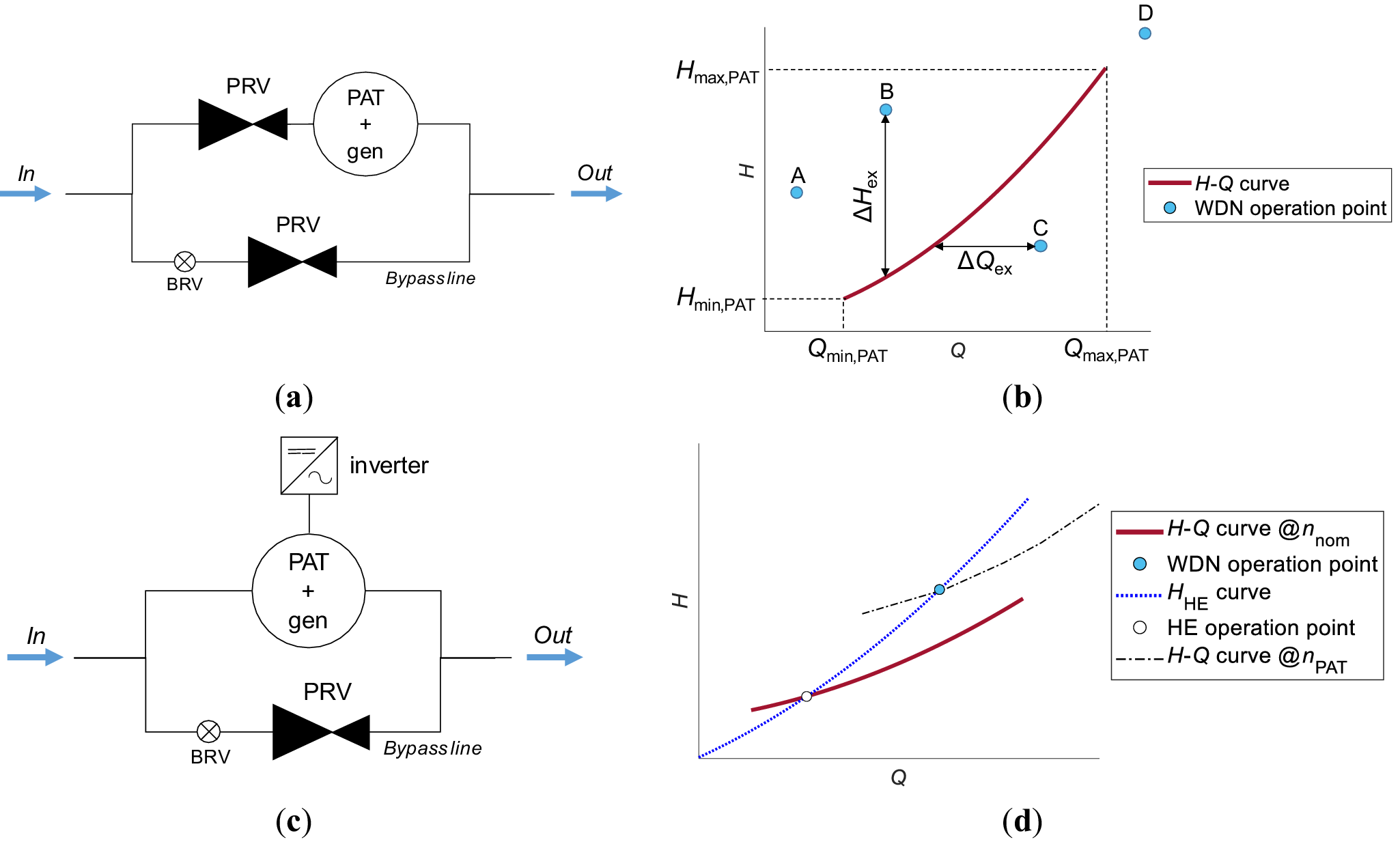
Throttle and bypass controls, also referred to as hydraulic regulation in the literature (e.g., Marini et al., Reference Marini, Di Menna, Maio and Fontana2023), were extensively described in Manservigi et al., Reference Manservigi, Venturini, Losi and Castorino2023 and Reference Manservigi, Marsili, Mazzoni, Castorino, Farsoni, Losi, Alvisi, Bonfè, Franchini, Spina and Venturini2024. In summary, the control strategy involves installing one PAT (connected to a generator to convert mechanical energy into electrical energy) in series with one PRV (Figure 1a), which dissipates exceeding head (i.e., throttle control). The excess flowrate is bypassed (i.e., bypass control) through a bypass regulating valve (BRV) and then passes through a second PRV that dissipates additional energy (Figure 1a). During operation, PAT rotational speed is kept constant. From an operational perspective, the control strategy is selected based on WDN’s operating point (i.e., head-drop and flowrate).
(a) Layout for hydraulic regulation, (b) H-Q representation of hydraulic regulation, (c) layout for electrical regulation and (d) H-Q representation of electrical regulation.

If both head-drop and flowrate of a given WDN operating point are lower than PAT’s operating range (e.g., point A in Figure 1b), the entire flowrate is bypassed, meaning that the PAT does not operate, and energy recovery is null (thus, WDN hydraulic energy is entirely wasted).
Throttle control is applied when a given WDN operating point is above the head-drop characteristic curve of the considered PAT (e.g., point B in Figure 1b) (Gulich, Reference Gulich2014). In this scenario, the PAT swallows the entire flowrate of the WDN, while the PRV in series with the PAT dissipates the excess head-drop (ΔH ex in Figure 1b). As a result, a fraction of WDN’s hydraulic energy, proportional to ΔH ex, is lost (Manservigi et al., Reference Manservigi, Venturini, Losi and Castorino2023).
Bypass control is employed when a given WDN operating point is below PAT’s characteristic curve (e.g., point C in Figure 1b) (Gulich, Reference Gulich2014). In this case, the entire head-drop is exploited by the PAT, while the excess flowrate (ΔQ ex in Figure 1b) is diverted through the bypass line. As in the case of throttle control, a fraction of WDN’s hydraulic energy is lost, but in this case, it is proportional to ΔQ ex (Manservigi et al., Reference Manservigi, Venturini, Losi and Castorino2023).
Finally, if WDN head-drop and flowrate (Q OP and H OP) exceed the maximum values of PAT characteristic curve (e.g., point D in Figure 1b) both throttle and bypass controls are applied, and flowrate is split as follows: (i) the maximum flowrate that the PAT can swallow (i.e., Q max,PAT) is throttled by PRV and then passes through the turbomachine and (ii) the excess flowrate (i.e., Q OP – Q max,PAT) is bypassed. In this scenario, the lost hydraulic energy is the difference between WDN’s hydraulic energy (i.e., ρ⋅g⋅Q OP⋅H OP⋅Δt) and the hydraulic energy at PAT inlet (i.e., ρ⋅g⋅Q PAT⋅H PAT⋅Δt).
Power generation is evaluated from PAT’s power characteristic curve as a function of the actual flowrate, which is multiplied by the time resolution Δt to estimate energy recovery. The rate of energy recovery E rec is the total energy recovery (i.e., the sum of each contribution) divided by the total WDN hydraulic energy.
Electrical regulation
In the “speed control” (Gulich, Reference Gulich2014), also referred to as electrical regulation, PAT rotational speed varies over time to match the WDN operating point, which is generally time dependent due to changes in WDN demand. The electrical regulation layout consists of one PAT connected to a generator, an inverter for speed control and a bypass line that includes a BRV and a PRV to throttle the excess head-drop (Figure 1c). It is worth noting that, in this configuration, the entire flowrate of each given WDN operation point is swallowed by the PAT or the PRV.
To calculate the energy recovery at each time-step, four pieces of information are required, that is: (i) WDN operating point (Q OP and H OP), (ii) PAT head-drop characteristic curve at nominal rotational speed (n nom), (iii) PAT power characteristic curve at n nom and (iv) minimum and maximum rotational speeds (n min and n max) allowed for PAT operation.
To identify PAT rotational speed (n PAT), the affinity law in Eq. (1) is first employed to derive the hydraulically equivalent curve (H HE) for the given WDN operating point (blue dotted curve in Figure 1d).
 $$ {H}_{\mathrm{HE}}=\frac{H_{\mathrm{OP}}}{Q_{\mathrm{OP}}^2}\cdot {Q}^2 $$
The flowrate that is hydraulically equivalent to the WDN flowrate (Q HE, represented by the white marker in Figure 1d) can be found at the intersection of the PAT head-drop characteristic curve at n nom and H HE. If Q HE falls outside PAT’s operating range (i.e., Q HE < Q min,PAT or Q HE > Q max,PAT), it is discarded, as PAT operation is not allowed. In this case, the entire flowrate is bypassed, and the excess head is throttled by the PRV (Figure 1c). As a result, the PAT does not operate, and no energy is recovered. Conversely, if Q HE falls within PAT’s operating range, PAT’s rotational speed is determined by using the affinity law, as shown in Eq. (2).
 $$ {n}_{\mathrm{PAT}}=\frac{Q_{\mathrm{OP}}}{Q_{\mathrm{HE}}}\cdot {n}_{\mathrm{nom}} $$
PAT rotational speed must be in the range from n min to n max. Otherwise, energy recovery is null. If n PAT is within such a range, the affinity law in Eq. (3) is exploited to calculate P PAT, which is proportional to the generated power when the PAT swallows Q HE at nominal rotational speed (i.e., P(Q HE) in Eq. (3)).
 $$ {P}_{\mathrm{PAT}}={\left(\frac{n_{\mathrm{PAT}}}{n_{\mathrm{nom}}}\right)}^3\cdot P({Q}_{\mathrm{HE}}) $$
Energy recovery E PAT is calculated by multiplying P PAT by the operating timeframe. Total energy recovery is the sum of all E PAT contributions.
Cost assessment
The total investment cost (C tot) related to the installation of a PAT depends on the adopted regulation strategy. In case of hydraulic regulation, the following costs must be considered: PAT and generator (C PAT+gen), PRV (C PRV) and civil works (C civ). Instead, in case of electrical regulation, the costs to be accounted for are the following: PAT and generator (C PAT+gen), inverter (C inv) and civil works C civ.
As in Novara et al. (Reference Novara, Carravetta, McNabola and Ramos2019), C PAT+gen is found by subtracting motor cost (C mot,p) from pump cost (C p), since it is replaced by a motor that is also used as a generator (C gen,PAT) (Eq. (4)).
 $$ {C}_{\mathrm{PAT}+\mathrm{gen}}={C}_{\mathrm{p}}-{C}_{\mathrm{mot},\mathrm{p}}+{C}_{\mathrm{gen},\mathrm{PAT}} $$
With respect to Novara et al. (Reference Novara, Carravetta, McNabola and Ramos2019), who considered costs from 2009 to 2018, the current paper exploits up-to-date equations that refer to costs from 2022 to 2024. Equation (5) accounts for 588 centrifugal end-suction pumps, with pp = 1 (264 pumps), pp = 2 (241 pumps) and pp = 3 (83 pumps) (Grundfos (2022)). The BEP of the considered pumps (i.e., Q BEP,p and P BEP,p) is up to 225 L/s and 173 kW, respectively. In addition, 599 IE3 asynchronous induction motors were collected, with pp = 1 (194 motors), pp = 2 (247 motors) and pp = 3 (158 motors) (ABB, 2024; OMEC, 2024). The range of rated power varied from 0.18 to 400 kW, independently of the number of pairs of magnetic poles. It is worth noting that P BEP in Eqs. (5) and (6) must be expressed in kW.
 $$ {\displaystyle \begin{array}{c}{C}_{\mathrm{PAT}+\mathrm{gen}}=192\cdot {P}_{\mathrm{BEP},\mathrm{p}}+64\cdot \frac{P_{\mathrm{BEP},\mathrm{PAT}}}{0.8}+3110\hskip0.96em \left( pp=1\right)\\ {}{C}_{\mathrm{PAT}+\mathrm{gen}}=240\cdot {P}_{\mathrm{BEP},\mathrm{p}}+65\cdot \frac{P_{\mathrm{BEP},\mathrm{PAT}}}{0.8}+3329\hskip0.96em \left( pp=2\right)\\ {}{C}_{\mathrm{PAT}+\mathrm{gen}}=306\cdot {P}_{\mathrm{BEP},\mathrm{p}}+89\cdot \frac{P_{\mathrm{BEP},\mathrm{PAT}}}{0.8}+5309\hskip1.08em \left( pp=3\right)\end{array}} $$
Eq. (4) directly applies to hydraulic regulation, since the rotational speed is constant.
For electrical regulation, a two-step approach has to be followed, as the pump cost also depends on its nominal rotational speed (Grundfos, 2022). Instead, the generator size can be selected based on the maximum rotational speed that can be achieved during operation, which may be higher than n nom. First, PAT cost (C PAT) is calculated as the difference between the total cost of PAT and generator (C PAT+gen, as in Eq. (5)) and the generator cost C gen (as in Eq. (6)). Both costs depend on PAT’s BEP at n nom. The cost of the generator is estimated using Eq. (6) by considering the BEP at PAT maximum rotational speed.
 $$ {\displaystyle \begin{array}{c}{C}_{\mathrm{gen}}=64\cdot \frac{P_{\mathrm{BEP},\mathrm{PAT}}}{0.8}+369\hskip0.84em \left( pp=1\right)\\ {}{C}_{\mathrm{gen}}=65\cdot \frac{P_{\mathrm{BEP},\mathrm{PAT}}}{0.8}+383\hskip0.84em \left( pp=2\right)\\ {}{C}_{\mathrm{gen}}=89\cdot \frac{P_{\mathrm{BEP},\mathrm{PAT}}}{0.8}+474\hskip0.96em \left( pp=3\right)\end{array}} $$
The costs C PRV and C inv are evaluated as made in Marini et al. (Reference Marini, Di Menna, Maio and Fontana2023). PRV cost depends on PRV nominal diameter (D PRV), which is expressed in mm in Eq. (7), whereas inverter cost (Eq. (8)) accounts for power generation (expressed in kW) at the BEP of the PAT. As previously discussed, inverter cost is accounted for in electrical regulation only, and the BEP at the maximum rotational speed achieved has to be considered.
 $$ {C}_{\mathrm{PRV}}=6.7\cdot {D}_{\mathrm{PRV}}^{1.3} $$
 $$ {C}_{\mathrm{inv}}=165.7\cdot {P}_{\mathrm{BEP},\mathrm{P}\mathrm{A}\mathrm{T}}+1239.9 $$
Finally, costs for civil works are assumed to be a fixed rate of C PAT+gen, that is, 30 %⋅C PAT+gen (Marini et al., Reference Marini, Di Menna, Maio and Fontana2023).
The LCOE is used to evaluate the net present cost of electricity generation using PAT over its lifetime (N years). LCOE allows to compare the feasibility of different PATs and regulation strategies. According to Eq. (9), the LCOE depends on the total costs of the plant (C tot), operation and maintenance (O&M) expenditures and the electrical energy generated during each year, which is proportional to the generator and inverter efficiencies (η gen, η inv). The weighted average cost of capital, or discount rate r, is also considered (IRENA, 2023).
 $$ LCOE=\frac{C_{\mathrm{t}\mathrm{ot}}+\sum \limits_{\mathrm{t}=1}^{\mathrm{N}}\frac{\mathrm{O}\&{\mathrm{M}}_{\mathrm{t}}}{{(1+\mathrm{r})}^{\mathrm{t}}}}{\eta_{\mathrm{gen}}\cdot {\eta}_{\mathrm{inv}}\cdot \sum \limits_{\mathrm{t}=1}^{\mathrm{N}}\frac{E_{\mathrm{PAT},\mathrm{t}}}{{(1+\mathrm{r})}^{\mathrm{t}}}} $$
Finally, the PBP, which represents the time required to recover the investment cost, is calculated as in Eq. (10), where R is the revenue from the electricity produced by the PAT.
 $$ PBP=\frac{C_{\mathrm{tot}}}{\eta_{\mathrm{gen}}\cdot {\eta}_{\mathrm{inv}}\cdot \sum \limits_{\mathrm{year}}{E}_{\mathrm{PAT}}\cdot R} $$
Case study
The methodology presented in Section 2 is applied to a real-world WDN located in Northern Italy. The considered WDN, with a total length of 261 km, supplies approximately 5,000 users, the majority of which are residential. The layout of the WDN is particularly suitable for the application of energy-recovery strategies: in fact, the major inlet consists of an elevated tank, the water level of which is nearly constant over time. The elevated tank supplies the network through a DN400 pipeline, on which a PRV is currently installed. From an operational standpoint, the PRV is controlled by the water utility responsible for WDN management to avoid excessive pressure and limit water leakages, while ensuring adequate pressure and flow conditions for water supply. This is made in real time by means of an SCADA system, which regulates the head downstream of the valve in the considered WDN.
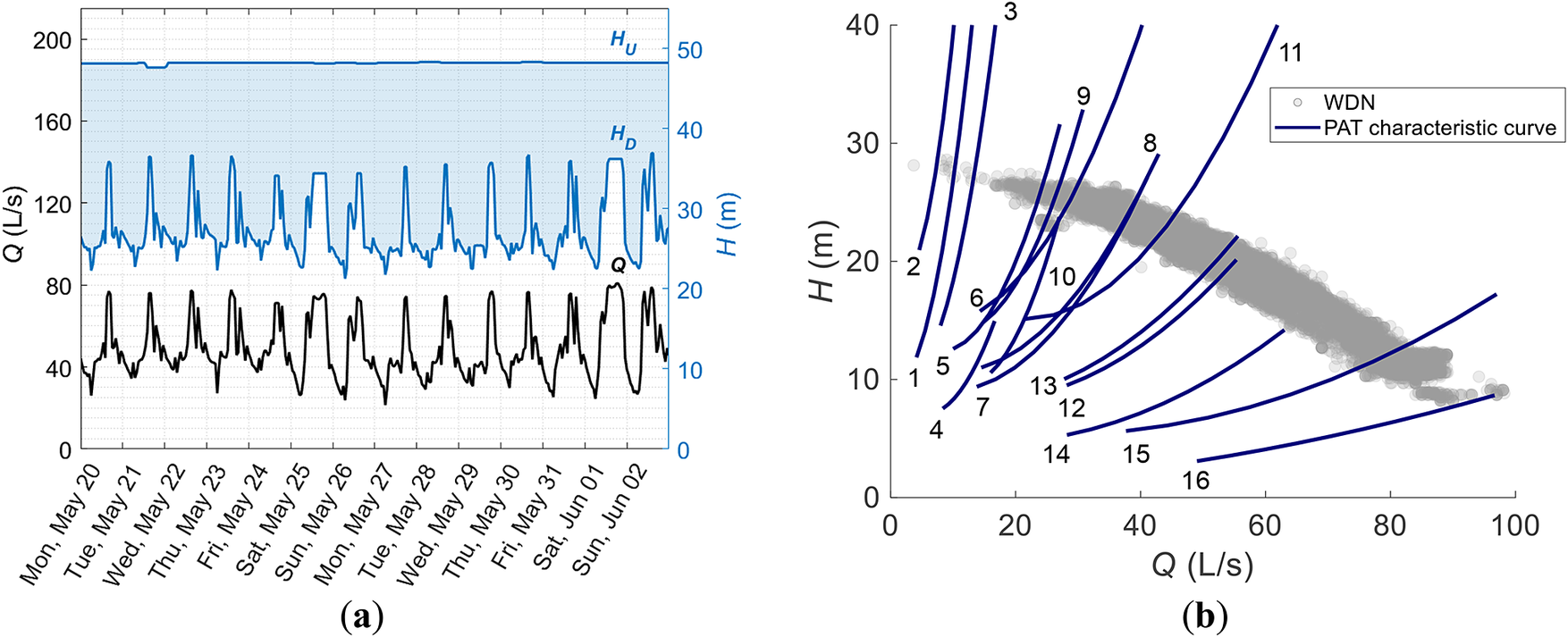
Data related to the PRV upstream head, downstream head and flowrate were collected with 15-min temporal resolution over a period of 5 months (i.e., from May 16 to October 15, 2019). Data observed over two representative weeks is shown in Figure 2a as an example. In this case, the dissipated head, that is, head drop ΔH = H U‑H D (shaded area in the figure), varies from a minimum of nearly 10 m to a maximum of over 25 m, whereas the flowrate Q entering the WDN varies between 20 and 80 L/s. The shaded area represents the head drop dissipated by the PRV, that is, the amount of energy available for recovery. It is also worth noting that the flowrate trend (black line) does not follow the typical pattern of residential contexts, with two peaks occurring in the morning and in the evening, respectively (DeOreo et al., Reference DeOreo, Mayer, Dziegielewski and Kiefer2016; Mazzoni et al., Reference Mazzoni, Marsili, Alvisi and Franchini2024). This is mainly because the considered WDN also provides water to a downstream tank responsible for water supply to other networks, and the PRV is also controlled based on the water level in this tank.
(a) Flowrate trend (black line), upstream-head trend (upper blue line) and downstream-head trend (lower blue line), over 2 weeks and (b) head-drop characteristic curve of both WDN and the 16 PATs.

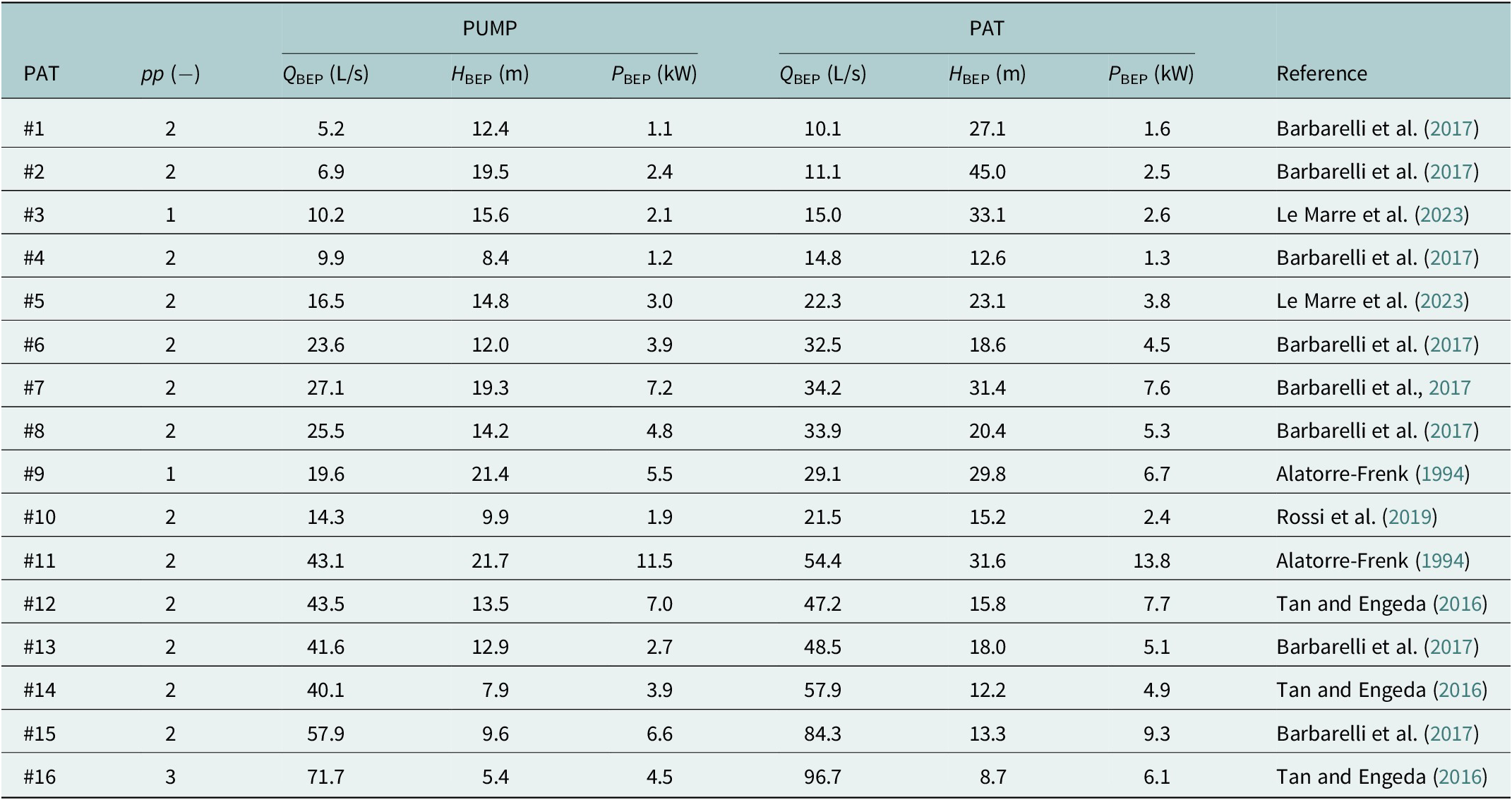
Over a period of 5 months, the WDN flowrate and head-drop are up to 98 L/s and 29 m (gray markers in Figure 2b), respectively, and its hydraulic energy is approximately 35 MWh. Specifically, the majority of operating point values fall within the ranges of 30–90 L/s and 10–25 m. To recover such energy, the installation of one PAT is investigated. The optimal machine to install is selected from a fleet of 16 centrifugal PATs, of which the characteristic curves (i.e., H vs. Q and P vs. Q) were derived from the literature (Alatorre-Frenk, Reference Alatorre-Frenk1994; Tan and Engeda, Reference Tan and Engeda2016; Barbarelli et al., Reference Barbarelli, Amelio and Florio2017; Rossi et al., Reference Rossi, Nigro and Renzi2019; Le Marre et al., Reference Le Marre, Mandin, Lanoiselle and Bezuglov2023). The 16 turbomachines (Table 1) were selected from the literature to meet the following criteria: (i) all pumps are centrifugal; (ii) both pump and PAT characteristic curves must be experimentally collected at the nominal rotational speed; (iii) the BEP for both operating modes falls within the operating range; (iv) the head-drop characteristic curve in PAT mode fits the flowrate and head-drop of the considered site. The nominal rotational speed n nom is 3,000 rpm for PATs #3 and #9, 1,050 rpm for PAT#16 and 1,450 rpm for the remaining 13 PATs. This value allows the determination of the number of magnetic pole pairs, which is one for PATs #3 and #9, three for PAT#16 and two in the remaining 13 PATs. The turbomachines cover a broad operating range, with a minimum flowrate of approximately 4 L/s, a maximum flowrate of 97 L/s and head-drop values ranging from 3 to 81 m (Figure 2b). Maximum power generation is slightly below 20 kW.
Pump and PAT characteristics

In case of hydraulic regulation, one PAT is installed in series with a brand-new PRV, while the existing PRV is located in the bypass line. Thus, only one PRV has to be bought together with the PAT and the generator. In case of electrical regulation, the existing PRV is located in the bypass line, and thus, only one PAT, one generator and one inverter must be purchased.
To estimate LCOE and PBP by means of Eqs. (8) and (9), this study assumes that O&M costs are 15 % of C tot (Marini et al., Reference Marini, Di Menna, Maio and Fontana2023), the lifetime (N) is 10 years (Marini et al., Reference Marini, Di Menna, Maio and Fontana2023) and the discount rate r is 5 % (IRENA, 2023). Moreover, the yearly energy recovery is assumed to be proportional to the energy recorded over a 5-month operational period, and it remains constant over the years. In addition, the efficiency of the generator is 85 % (IEC, 2014), the inverter efficiency is 95 % (Melfi, Reference Melfi2011) and the range of PAT rotational speed in case of electrical regulation is assumed to be from n min = 0.35⋅n nom to n max = 1.72⋅n nom, according to the experimental PAT curves employed in Castorino et al. (Reference Castorino, Manservigi, Barbarelli, Losi and Venturini2023). Finally, the revenue (R in Eq. (9)) is assumed to be equal to the guaranteed minimum price for hydropower plants, of which the yearly energy production is lower than 250 MWh. Thus, in this study, R is set equal to 163.9 €/MWh, which is the average value for the period 2020–2024 in Italy (ARERA, 2024).
Results and discussion
This section presents the results of the energy and economic analysis. The two regulation strategies are initially investigated for the entire fleet of PATs. Subsequently, the optimal PAT to install is identified.
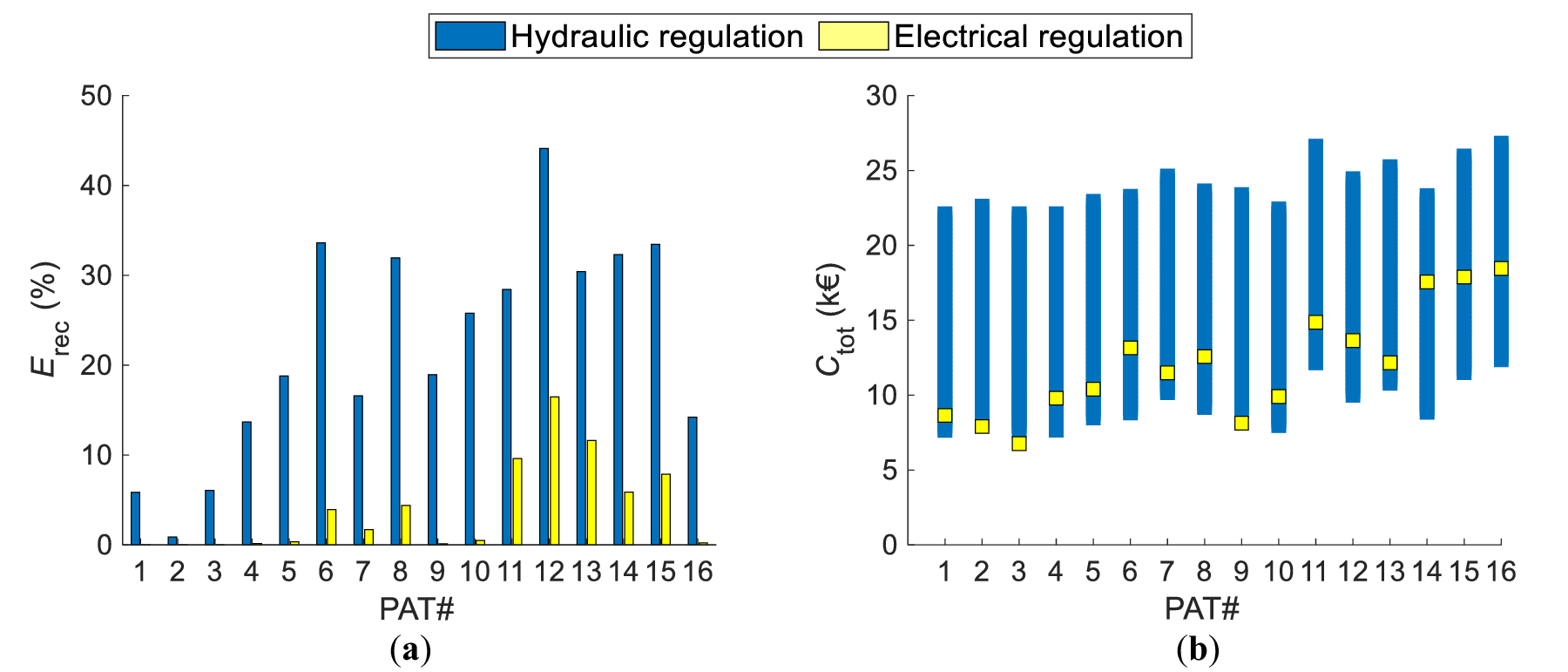
The application of the proposed approach to the considered WDN reveals that hydraulic regulation leads to a higher rate of energy recovery for all the considered turbomachines (Figure 3a). In fact, E rec with hydraulic regulation is at least twice the value achievable with electrical regulation. This outcome, consistent with several studies available in the literature (e.g., Carravetta et al., Reference Carravetta, Del Giudice, Fecarotta and Ramos2013; Parra et al., Reference Parra, Krause, Krönlein, Günthert and Klunke2018; Fontana et al., Reference Fontana, Marini and Creaco2021; Marini et al., Reference Marini, Di Menna, Maio and Fontana2023), is due to the more flexible management in case of hydraulic regulation. In fact, thanks to throttle and bypass controls, hydraulic regulation can exploit all the WDN operating points characterized by higher flowrate and head-drop than the minimum values allowed by the PAT (i.e., Q min,PAT and H min,PAT). In contrast, although electrical regulation allows varying PAT rotational speed, it must meet three constraints, that is, (i) the required head-drop must be solely provided by the PAT; (ii) the range of PAT rotational speeds must be between n min and n max and (iii) PAT operating range is between a minimum and maximum value that depend on PAT rotational speed. Otherwise, the entire WDN flowrate is bypassed, resulting in no energy recovery. The flexibility of hydraulic regulation is further demonstrated by the fact that six PATs (namely PATs #6, 8, 11, 13, 14 and 15) recover approximately the same amount of energy (from 30 % to 35 % of WDN hydraulic energy) regardless of their different characteristics (e.g., operating range and geometrical features).
(a) Rate of energy recovery and (b) total investment costs.

The total investment costs are shown in Figure 3b, where the blue bars represent the range of C tot as the diameter of the brand-new PRV is varied from 100 mm (D PRV,min) to 400 mm (D PRV,max). For both regulation strategies, the total investment cost generally increases by passing from PAT#1 to PAT#16, mainly because of the increase in flowrate and power at the BEP, which makes all costs increase (see Eqs. (5), (6) and (8)). In case of hydraulic regulation, a significant portion of the total investment cost comes from both C PAT+gen and C PRV, which are far greater than the costs for civil works. Specifically, C PAT+gen ranges from € 3,700 (PAT#1) to € 7,400 (PAT#16), and C PRV is highly sensitive to PRV diameter, varying from € 2,800 (for D PRV = 100 mm) to € 17,000 (for D PRV = 400 mm). Thus, the cost of PAT and generator assets may be comparable to PRV cost only if D PRV is minimum (100 mm), but PRV becomes the dominant cost factor (i.e., up to 78 % of C tot) when its diameter increases (400 mm). In case of electrical regulation, C PAT+gen is usually the predominant cost, being up to 63 % of the total investment cost, followed by C inv. Compared to hydraulic regulation, C PAT+gen is higher, as the cost of the hydraulic machine is the same, but the generator is sized for the maximum rotational speed of each PAT, which always exceeds the nominal value. Thus, C PAT + gen ranges from € 4,250 (PAT#3) to € 9,700 (PAT#16), being up to 64 % higher (PAT#14) than the corresponding cost in case of hydraulic regulation. As a result, total investment costs for electrical regulation are usually in-between the minimum and maximum values found for hydraulic regulation (Figure 3b).
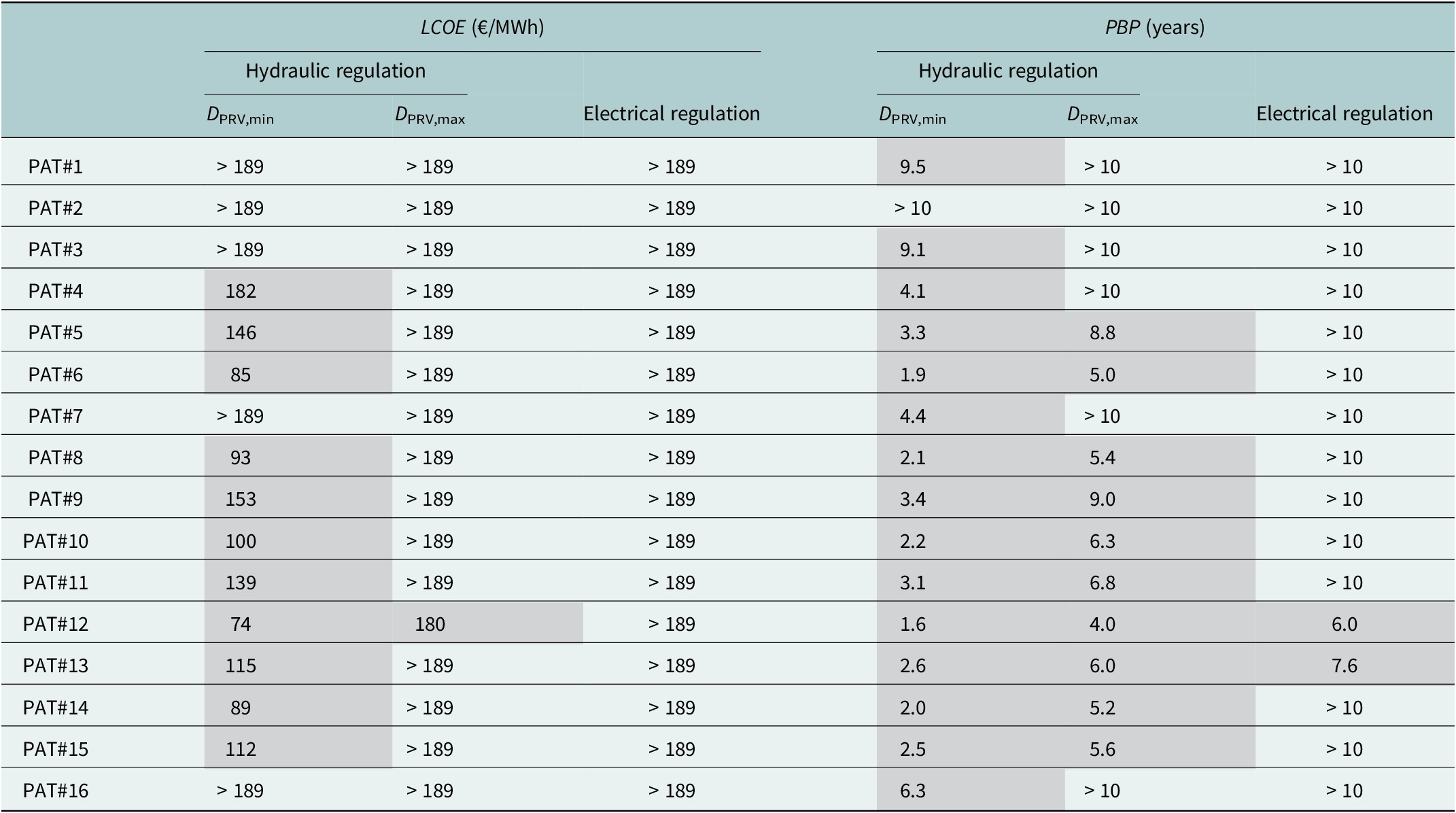
LCOE values are summarized in Table 2. As expected, LCOE increases with PRV diameter, as the total investment cost rises while energy recovery remains constant. In addition, electrical regulation makes LCOE values always higher (even more than 90 times) than the LCOE values obtained in case of hydraulic regulation due to the lower energy recovery. According to IRENA (2023), the LCOE for hydropower plants in Europe ranged from 42 €/MWh to 189 €/MWh in the period between 2016 and 2022. The solutions (i.e., PAT and regulation strategy) with LCOE values that fall within this range are highlighted in gray in Table 2. As can be seen, hydraulic regulation generally allows acceptably low LCOE values if the PRV diameter is 100 mm, and in PAT#12, only if the PRV diameter is 400 mm. Instead, the LCOE range is always exceeded in the case of electrical regulation. These results further prove that selecting the optimal configuration is crucial, and if properly chosen, the LCOE value is comparable to the minimum values found for hydropower plants.
LCOE and PBP

Finally, the cost-effectiveness of each solution is also evaluated by comparing the PBP to the considered lifetime of the power station, as shown in Table 2, where the PATs with PBP lower than 10 years are highlighted in gray. As expected, the PBP with hydraulic regulation is always shorter than with electrical regulation, as this strategy generally leads to a higher amount of recovered energy. Specifically, hydraulic regulation allows acceptable PBP values for nearly all PATs, whereas only PATs #12 and #13 are cost-effective in case of electrical regulation.
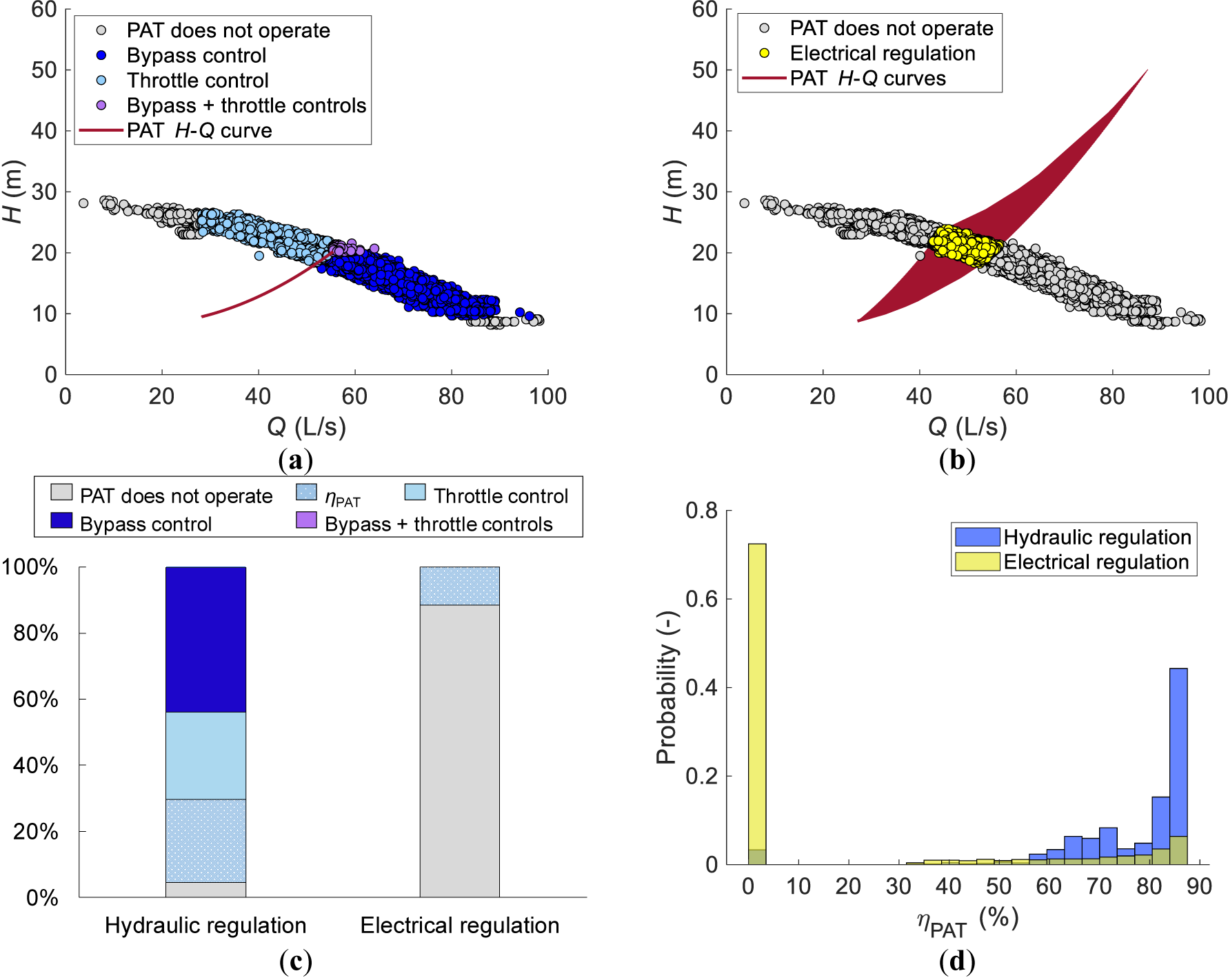
Overall, the results indicate that, regardless of the regulation strategy, PAT#12 is the optimal turbomachine to install. In fact, it allows the highest energy recovery and lowest LCOE and PBP. At its maximum, the energy recovery ranges from 16.5 % (electrical regulation) to 44.1 % (hydraulic regulation) of WDN’s hydraulic energy. This remarkable difference is due to the larger number of WDN operating points that the hydraulic regulation allows to exploit. In this case, the flowrate of the WDN operating points is entirely bypassed only a few times (i.e., in 3.3 % of the cases, as indicated by the gray markers in Figure 4a). Throttle and bypass controls occur approximately 43 % and 52 % of the time, respectively (light-blue and blue markers in Figure 4a), while the simultaneous occurrence of both controls is rare (purple markers in Figure 4a). As a result, bypass and throttle control strategies, when considered alone, are the primary causes of energy waste (Figure 4c). However, hydraulic energy losses related to PAT efficiency η PAT are also significant, accounting for 25.2 % of the total energy losses (Figure 4c). Finally, the contribution of the two remaining sources of hydraulic loss (i.e., bypass and throttle controls occurring simultaneously, and PAT not operating) is negligible, as they occur rarely. As shown in Figure 4a,d, PAT#12 operates frequently and, additionally, often runs close to its BEP, that is,
Operation of PAT#12: (a) hydraulic regulation, (b) electrical regulation, (c) cause of hydraulic energy losses and (d) PAT efficiency.

86 %.
In case of electrical regulation, the energy recovered by PAT#12 reduces more than half, as the flowrate of WDN operating points is entirely bypassed in 72.4 % of cases (gray markers in Figure 4b), which results in null η PAT values (the highest yellow bar in Figure 4d), and determines the waste of a considerable amount of hydraulic energy. This is the primary cause of hydraulic energy waste (Figure 4c) as PAT operation causes only 11.1 % of the total hydraulic energy losses.
The total investment cost C tot of PAT#12 falls within the middle range compared to the other turbomachines, varying from € 10,000 to € 24,500. The LCOE ranges from 74 €/MWh to 180 €/MWh with hydraulic regulation, whereas it increases to 269 €/MWh with electrical regulation (Table 2). The PBP for PAT#12 ranges from 1.6 to 6.0 years (Table 2), thus making this PAT always cost-effective. These values are in line with those reported in the literature, for example, Stefanizzi et al. (Reference Stefanizzi, Filannino, Capurso, Camporeale and Torresi2023).
Finally, it is worth noting that the considerations presented in this analysis are based on flowrate and head-drop data collected during a 5-month period (May–October). The results refer to a specific seasonal condition and may therefore reflect a specific configuration of the WDN in terms of demand and operational controls. Analyses conducted in different periods or under different conditions should account for potentially different flowrate and head-drop scenarios. With specific reference to the selected PAT #12, a 1-m increase in PRV downstream pressure (i.e., a 1-m decrease in available head-drop) would result in an increase of about 11 % in both LCOE and PBP in case of hydraulic regulation, and equal to 3 % in case of electrical regulation. These findings reveal that WDN data uncertainty and variability in the WDN characteristic curve may affect energy savings and investment costs. This underlines the importance of sensitivity analysis regarding WDN data (i.e., model input), which should be considered as a potential source of bias.
Conclusions
This article proposed an approach to assess the feasibility of pump as turbine (PAT) installation for recovering hydraulic energy at the inlet point of a real-world WDN. The energy recoverable by 16 turbomachines, with known characteristic curves, was evaluated by investigating two regulation strategies, namely hydraulic and electrical regulations. The results showed that hydraulic regulation was more flexible and efficient, since it recovered up to 44.1 % of the available hydraulic energy, whereas in case of electrical regulation, the rate of energy recovery reached a maximum of 16.5 %.
The advantages and disadvantages of installing PATs were also analyzed by evaluating the LCOE and the PBP, with the results confirming the greater feasibility of hydraulic regulation. For the considered WDN, one out of the 16 PATs was found to both maximize energy recovery and minimize LCOE and PBP regardless of the selected regulation strategy. For the optimal PAT, LCOE values ranged from 74 to 269 €/MWh, and PBP varied from 1.6 to 6.0 years.
Future works will explore the energy and economic feasibility of additional PAT regulation strategies (e.g., hybrid regulation), considering other pump types (e.g., axial) as well as other energy recovery devices, such as traditional turbines (e.g., Francis and Cross-flow). Future analyses will also focus on evaluating the uncertainty in the WDN characteristic curve and the related effects on energy savings and investment costs.
Nomenclature
- C
-
cost
- D
-
diameter
- E
-
energy
- g
-
gravitational acceleration
- H
-
head
- LCOE
-
levelized cost of electricity
- N
-
number of years
- n
-
rotational speed
- P
-
power
- PBP
-
payback period
- pp
-
number of magnetic pole pairs
- Q
-
flowrate
- R
-
evenue
- r
-
discount rate
- t
-
time
- η
-
efficiency
- ρ
-
water density
Subscripts
- nom
-
nominal
- OP
-
operating point
- rec
-
recovery
- tot
-
total
- U
-
upstream
Acronyms
- BEP
-
best efficiency point
- BRV
-
bypass regulating valve
- O&M
-
operation and maintenance
- PAT
-
pump as turbine
- PRV
-
pressure reducing valve
- WDN
-
water distribution network
Open peer review
To view the open peer review materials for this article, please visit http://doi.org/10.1017/wat.2025.10004.
Data availability statement
The data that support the findings of this study are available from the corresponding author, (L.M.), upon reasonable request.
Author contribution
Conceptualization, L.M., V.M., F.M.; methodology, L.M., V.M., F.M.; software, L.M., V.M., F.M.; validation, L.M, V.M., F.M., G.A.M.C., S.F., E.L., S.A., M.B., M.F., P.R.S., M.V.; formal analysis, L.M., V.M., F.M., S.A., M.B., M.F., P.R.S., M.V.; investigation, L.M., V.M., F.M., S.A., M.B., M.F., P.R.S., M.V.; writing – original draft preparation, L.M., V.M., F.M.; writing – review and editing, L.M, V.M., F.M., G.A.M.C., S.F., E.L., S.A., M.B., M.F., P.R.S., M.V.; visualization, L.M, V.M., F.M., G.A.M.C., S.F., E.L., S.A., M.B., M.F., P.R.S., M.V.; supervision, S.A., M.B., M.F., P.R.S., M.V.; project administration, S.A., P.R.S., M.V.; funding acquisition, L.M., P.R.S.
All authors have read and agreed to the published version of the manuscript.
Financial support
This research was funded by (i) the National Recovery and Resilience Plan (NRRP), Mission 04 Component 2 Investment 1.5 – NextGenerationEU, Call for tender n. 3277 dated December 30, 2021. Award Number: 0001052 dated June 23, 2022 and (ii) Bando FIRD anno 2024 – Fondo per l’incentivazione alla ricerca dipartimentale.
Competing interests
The authors declare none.

 Open access


Comments
Dear Editors of the Special Issue “Urban Water Systems - Computing, Control and Analysis”,
We wish to thank you and the reviewers for acknowledging the improvements with respect to the original draft, thus approving the paper for Journal publication.
These rebuttal and revised draft address the minor revision suggested by the Handling Editor.
This rebuttal reports the Handling Editor’ comment written in black, followed by the authors’ rebuttal in red. In the revised draft, all modifications with respect to the initial draft paper are highlighted in yellow, while all modifications with respect to the revised draft are highlighted in light-blue.