




1 Introduction
In [Reference Aschenbrenner, van den Dries and van der Hoeven5], Aschenbrenner, van den Dries, and van der Hoeven study the model theory of $\mathbb {T}$
as an ordered valued differential field, where
$\mathbb {T}$
as an ordered valued differential field, where $\mathbb {T}$
is the differential field of logarithmic-exponential transseries constructed in [Reference van den Dries, Macintyre and Marker23], there denoted by
$\mathbb {T}$
is the differential field of logarithmic-exponential transseries constructed in [Reference van den Dries, Macintyre and Marker23], there denoted by $\mathbb {R}(\!( t )\!)^{\operatorname {LE}}$
. As part of this project, Aschenbrenner and van den Dries introduced in [Reference Aschenbrenner and van den Dries4] the elementary class of pre-H-fields, which are ordered valued differential fields satisfying conditions capturing some of the basic interactions between the ordering, valuation, and derivation in transseries and Hardy fields. As such, the model theory of transseries leads naturally to the model theory of pre-H-fields. Among the many results of [Reference Aschenbrenner, van den Dries and van der Hoeven5], for which the three received the 2018 Karp Prize from the Association for Symbolic Logic, is an effective axiomatization of the theory of
$\mathbb {R}(\!( t )\!)^{\operatorname {LE}}$
. As part of this project, Aschenbrenner and van den Dries introduced in [Reference Aschenbrenner and van den Dries4] the elementary class of pre-H-fields, which are ordered valued differential fields satisfying conditions capturing some of the basic interactions between the ordering, valuation, and derivation in transseries and Hardy fields. As such, the model theory of transseries leads naturally to the model theory of pre-H-fields. Among the many results of [Reference Aschenbrenner, van den Dries and van der Hoeven5], for which the three received the 2018 Karp Prize from the Association for Symbolic Logic, is an effective axiomatization of the theory of $\mathbb {T}$
as a complete theory extending the theory of pre-H-fields.
$\mathbb {T}$
as a complete theory extending the theory of pre-H-fields.
But there are pre-H-fields satisfying different elementary conditions than $\mathbb {T}$
, including
$\mathbb {T}$
, including $\operatorname {d}$
-henselian ones (we use “
$\operatorname {d}$
-henselian ones (we use “ $\operatorname {d}$
” to abbreviate “differential” or “differentially,” as appropriate), which are the focus of this paper. This is a generalization of henselianity of a valued field to the class of valued differential fields with small derivation, a strong form of continuity of the derivation with respect to the valuation topology. To describe a family of completions of the theory of pre-H-fields, we call a pre-H-field
$\operatorname {d}$
” to abbreviate “differential” or “differentially,” as appropriate), which are the focus of this paper. This is a generalization of henselianity of a valued field to the class of valued differential fields with small derivation, a strong form of continuity of the derivation with respect to the valuation topology. To describe a family of completions of the theory of pre-H-fields, we call a pre-H-field $\operatorname {d}$
-Hensel–Liouville closed if it is
$\operatorname {d}$
-Hensel–Liouville closed if it is $\operatorname {d}$
-henselian, real closed, and closed under exponential integration (i.e., for each f there is
$\operatorname {d}$
-henselian, real closed, and closed under exponential integration (i.e., for each f there is $y \neq 0$
such that
$y \neq 0$
such that $y'/y = f$
). Given a complete theory T of ordered differential fields, the theory of
$y'/y = f$
). Given a complete theory T of ordered differential fields, the theory of $\operatorname {d}$
-Hensel–Liouville closed pre-H-fields whose ordered differential residue fields satisfy T is complete. Equivalently:
$\operatorname {d}$
-Hensel–Liouville closed pre-H-fields whose ordered differential residue fields satisfy T is complete. Equivalently:
Theorem 1. Let $K_1$
and
$K_1$
and $K_2$
be
$K_2$
be $\operatorname {d}$
-Hensel–Liouville closed pre-H-fields with ordered differential residue fields
$\operatorname {d}$
-Hensel–Liouville closed pre-H-fields with ordered differential residue fields $\boldsymbol k_1$
and
$\boldsymbol k_1$
and $\boldsymbol k_2$
. Then
$\boldsymbol k_2$
. Then $K_1 \equiv K_2$
if and only if
$K_1 \equiv K_2$
if and only if $\boldsymbol k_1 \equiv \boldsymbol k_2$
.
$\boldsymbol k_1 \equiv \boldsymbol k_2$
.
More precisely, the pre-H-field language is  , where, if $\mathcal O$
is the valuation ring,
$\mathcal O$
is the valuation ring, $f \preccurlyeq g$
means
$f \preccurlyeq g$
means $f \in g\mathcal O$
. Each residue field is equipped with the ordering and derivation induced by those of its pre-H-field and construed as a structure in the language
$f \in g\mathcal O$
. Each residue field is equipped with the ordering and derivation induced by those of its pre-H-field and construed as a structure in the language  .
.
Theorem 1 is a result in the spirit of Ax–Kochen [Reference Ax and Kochen7] and Ershov [Reference Ershov11], who showed that the theory of a henselian valued field of equicharacteristic $0$
is determined by the theory of its residue field and (ordered) value group. The value groups of
$0$
is determined by the theory of its residue field and (ordered) value group. The value groups of $K_1$
and
$K_1$
and $K_2$
do not appear in Theorem 1 because under its assumptions they are divisible ordered abelian groups, and hence elementarily equivalent. Moreover, they are even elementarily equivalent as asymptotic couples, as defined by Rosenlicht [Reference Rosenlicht19], which is to say after being expanded by the map induced by logarithmic differentiation (see Section 2). In addition to the axioms for divisible ordered abelian groups, the complete axiomatization is given by four universal axioms of asymptotic couples together with the statement that the logarithmic derivative map is surjective onto the set of negative elements of the group; this is Corollary 4.9 (where these structures are called “gap-closed H-asymptotic couples”).
$K_2$
do not appear in Theorem 1 because under its assumptions they are divisible ordered abelian groups, and hence elementarily equivalent. Moreover, they are even elementarily equivalent as asymptotic couples, as defined by Rosenlicht [Reference Rosenlicht19], which is to say after being expanded by the map induced by logarithmic differentiation (see Section 2). In addition to the axioms for divisible ordered abelian groups, the complete axiomatization is given by four universal axioms of asymptotic couples together with the statement that the logarithmic derivative map is surjective onto the set of negative elements of the group; this is Corollary 4.9 (where these structures are called “gap-closed H-asymptotic couples”).
Analogous AKE results for (unordered) valued differential fields have been established earlier for $\operatorname {d}$
-henselian monotone fields: first for those with many constants by Scanlon [Reference Scanlon21] and then in the general monotone case by Hakobyan [Reference Hakobyan12]. The interaction between the valuation and the derivation in a pre-H-field is opposite to the condition of monotonicity, and, indeed,
$\operatorname {d}$
-henselian monotone fields: first for those with many constants by Scanlon [Reference Scanlon21] and then in the general monotone case by Hakobyan [Reference Hakobyan12]. The interaction between the valuation and the derivation in a pre-H-field is opposite to the condition of monotonicity, and, indeed, $\operatorname {d}$
-henselian pre-H-fields are never monotone.
$\operatorname {d}$
-henselian pre-H-fields are never monotone.
To which pre-H-fields does Theorem 1 apply? Certainly not $\mathbb {T}$
, which is not
$\mathbb {T}$
, which is not $\operatorname {d}$
-henselian.Footnote
1
To construct an example, start with an
$\operatorname {d}$
-henselian.Footnote
1
To construct an example, start with an $\aleph _0$
-saturated elementary extension
$\aleph _0$
-saturated elementary extension $\mathbb {T}^{*}$
of
$\mathbb {T}^{*}$
of $\mathbb {T}$
. Although every element of
$\mathbb {T}$
. Although every element of $\mathbb {T}$
is exponentially bounded in the sense that it is bounded in absolute value by some finite iterate of the exponential,
$\mathbb {T}$
is exponentially bounded in the sense that it is bounded in absolute value by some finite iterate of the exponential, $\mathbb {T}^{*}$
contains transexponential (i.e., not exponentially bounded) elements. Enlarge the valuation ring
$\mathbb {T}^{*}$
contains transexponential (i.e., not exponentially bounded) elements. Enlarge the valuation ring $\mathcal O_{\mathbb {T}^{*}}$
of
$\mathcal O_{\mathbb {T}^{*}}$
of $\mathbb {T}^{*}$
to the set
$\mathbb {T}^{*}$
to the set $\dot {\mathcal O}_{\mathbb {T}^{*}}$
of exponentially bounded elements of
$\dot {\mathcal O}_{\mathbb {T}^{*}}$
of exponentially bounded elements of $\mathbb {T}^{*}$
. With this coarsened valuation,
$\mathbb {T}^{*}$
. With this coarsened valuation, $(\mathbb {T}^{*}, \dot {\mathcal O}_{\mathbb {T}^{*}})$
is a
$(\mathbb {T}^{*}, \dot {\mathcal O}_{\mathbb {T}^{*}})$
is a $\operatorname {d}$
-Hensel–Liouville closed pre-H-field whose valuation only distinguishes transexponentially different elements, and its ordered differential residue field
$\operatorname {d}$
-Hensel–Liouville closed pre-H-field whose valuation only distinguishes transexponentially different elements, and its ordered differential residue field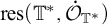 $\operatorname {\mathrm {res}}(\mathbb {T}^{*}, \dot {\mathcal O}_{\mathbb {T}^{*}})$
is a model of the theory of
$\operatorname {\mathrm {res}}(\mathbb {T}^{*}, \dot {\mathcal O}_{\mathbb {T}^{*}})$
is a model of the theory of $\mathbb {T}$
. This coarsening decomposes
$\mathbb {T}$
. This coarsening decomposes $\mathbb {T}^{*}$
into a transexponential part,
$\mathbb {T}^{*}$
into a transexponential part, $(\mathbb {T}^{*}, \dot {\mathcal O}_{\mathbb {T}^{*}})$
, whose model theory is the subject of this paper, and an exponentially bounded part,
$(\mathbb {T}^{*}, \dot {\mathcal O}_{\mathbb {T}^{*}})$
, whose model theory is the subject of this paper, and an exponentially bounded part,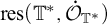 $\operatorname {\mathrm {res}}(\mathbb {T}^{*}, \dot {\mathcal O}_{\mathbb {T}^{*}})$
, whose model theory we understand by [Reference Aschenbrenner, van den Dries and van der Hoeven5]. The same coarsening procedure applied to a maximal Hardy field, which contains transexponential elements [Reference Boshernitzan9], yields a similar example.
$\operatorname {\mathrm {res}}(\mathbb {T}^{*}, \dot {\mathcal O}_{\mathbb {T}^{*}})$
, whose model theory we understand by [Reference Aschenbrenner, van den Dries and van der Hoeven5]. The same coarsening procedure applied to a maximal Hardy field, which contains transexponential elements [Reference Boshernitzan9], yields a similar example.
Theorem 1 follows easily from Theorem 7.2, which establishes a back-and-forth system in a two-sorted setting with a sort for a pre-H-field and a sort for its ordered differential residue field, connected by a binary residue map. This back-and-forth system allows us to eliminate quantifiers from the pre-H-field sort in Theorem 7.5, which is used to show the following two results. (In fact, we get more precise two-sorted versions.)
Theorem 2. Let K be a $\operatorname {d}$
-Hensel–Liouville closed pre-H-field with ordered differential residue field
$\operatorname {d}$
-Hensel–Liouville closed pre-H-field with ordered differential residue field $\boldsymbol k$
.
$\boldsymbol k$
.
-
(i) Every subset of $\boldsymbol k^n$
definable in K, with parameters, is definable in the ordered differential field
$\boldsymbol k$
with parameters from
$\boldsymbol k$
.
$\boldsymbol k^n$
definable in K, with parameters, is definable in the ordered differential field
$\boldsymbol k$
with parameters from
$\boldsymbol k$
. -
(ii) If the ordered differential field
$\boldsymbol k$
has NIP, then K has NIP.


Another of the central results of [Reference Aschenbrenner, van den Dries and van der Hoeven5] is that the class of existentially closed pre-H-fields is elementary and axiomatized by a theory $T^{\operatorname {nl}}$
; note that
$T^{\operatorname {nl}}$
; note that $T^{\operatorname {nl}}_{\operatorname {small}} = T^{\operatorname {nl}} + \text {"small derivation"}$
axiomatizes the theory of
$T^{\operatorname {nl}}_{\operatorname {small}} = T^{\operatorname {nl}} + \text {"small derivation"}$
axiomatizes the theory of $\mathbb {T}$
. Equivalently,
$\mathbb {T}$
. Equivalently, $T^{\operatorname {nl}}$
is the model companion of the theory of pre-H-fields, that is,
$T^{\operatorname {nl}}$
is the model companion of the theory of pre-H-fields, that is, $T^{\operatorname {nl}}$
is model complete and every pre-H-field extends to a model of
$T^{\operatorname {nl}}$
is model complete and every pre-H-field extends to a model of $T^{\operatorname {nl}}$
. Also,
$T^{\operatorname {nl}}$
. Also, $T^{\operatorname {nl}}_{\operatorname {small}}$
is the model companion of the theory of H-fields with small derivation, where an H-field is a pre-H-field whose valuation ring is the convex hull of its constant field. But a pre-H-field with small derivation extends to a model of
$T^{\operatorname {nl}}_{\operatorname {small}}$
is the model companion of the theory of H-fields with small derivation, where an H-field is a pre-H-field whose valuation ring is the convex hull of its constant field. But a pre-H-field with small derivation extends to a model of $T^{\operatorname {nl}}_{\operatorname {small}}$
if and only if the derivation induced on its residue field is trivial. This raises the question of whether the theory of pre-H-fields with nontrivial induced derivation on their residue field, which includes all
$T^{\operatorname {nl}}_{\operatorname {small}}$
if and only if the derivation induced on its residue field is trivial. This raises the question of whether the theory of pre-H-fields with nontrivial induced derivation on their residue field, which includes all $\operatorname {d}$
-henselian pre-H-fields, has a model companion.
$\operatorname {d}$
-henselian pre-H-fields, has a model companion.
We give a positive answer for the broader class of pre-H-fields with gap $0$
. In defining this, we use the notation
$0$
. In defining this, we use the notation $f \asymp g$
when
$f \asymp g$
when $f \preccurlyeq g$
and
$f \preccurlyeq g$
and $g \preccurlyeq f$
, and
$g \preccurlyeq f$
, and $f \prec g$
when
$f \prec g$
when $f \preccurlyeq g$
and
$f \preccurlyeq g$
and $f \not \asymp g$
. A pre-H-field has small derivation if
$f \not \asymp g$
. A pre-H-field has small derivation if $f' \prec 1$
for all
$f' \prec 1$
for all $f \prec 1$
and gap
$f \prec 1$
and gap $0$
if it has small derivation and every
$0$
if it has small derivation and every $f \succ 1$
satisfies
$f \succ 1$
satisfies $f' \succ f$
. If a pre-H-field with gap
$f' \succ f$
. If a pre-H-field with gap $0$
is closed under exponential integration (or even if its ordered differential residue field is), then any
$0$
is closed under exponential integration (or even if its ordered differential residue field is), then any $f \succ 1$
is “transexponential” in the sense that
$f \succ 1$
is “transexponential” in the sense that $f \succ e_n$
for each n, where
$f \succ e_n$
for each n, where $e_n$
is an nth iterated exponential integral of
$e_n$
is an nth iterated exponential integral of $1$
. To describe the axiomatization of the model completion, we recall that the theory of ordered differential fields, with no assumption on the interaction between the ordering and the derivation, has a model completion, the theory of closed ordered differential fields. This theory also has quantifier elimination and is complete [Reference Singer22]. Then:
$1$
. To describe the axiomatization of the model completion, we recall that the theory of ordered differential fields, with no assumption on the interaction between the ordering and the derivation, has a model completion, the theory of closed ordered differential fields. This theory also has quantifier elimination and is complete [Reference Singer22]. Then:
Theorem 3. The theory $T^{\operatorname {dhl}}_{\operatorname {codf}}$
of
$T^{\operatorname {dhl}}_{\operatorname {codf}}$
of $\operatorname {d}$
-Hensel–Liouville closed pre-H-fields with closed ordered differential residue field is the model completion of the theory of pre-H-fields with gap
$\operatorname {d}$
-Hensel–Liouville closed pre-H-fields with closed ordered differential residue field is the model completion of the theory of pre-H-fields with gap $0$
.
$0$
.
In fact, we prove a more general two-sorted version where other theories of the residue field are permitted, as in the previous two results. By Theorem 1, $T^{\operatorname {dhl}}_{\operatorname {codf}}$
is complete. This theory has quantifier elimination, so it is distal by [Reference Aschenbrenner, Chernikov, Gehret and Ziegler2] and locally o-minimal. The one-sorted results are collected in Theorem 7.9.
$T^{\operatorname {dhl}}_{\operatorname {codf}}$
is complete. This theory has quantifier elimination, so it is distal by [Reference Aschenbrenner, Chernikov, Gehret and Ziegler2] and locally o-minimal. The one-sorted results are collected in Theorem 7.9.
The assumptions of “real closed” and “exponential integration” are necessary in Theorem 3, but what of their appearance in Theorem 1? Even in the monotone setting, it is not true that the theory of a $\operatorname {d}$
-henselian field is determined by the theory of its differential residue field and its value group. Hakobyan provides an example of two
$\operatorname {d}$
-henselian field is determined by the theory of its differential residue field and its value group. Hakobyan provides an example of two $\operatorname {d}$
-henselian monotone fields that are not elementarily equivalent but have isomorphic value groups and differential residue fields [Reference Hakobyan12, Example after Corollary 4.2]. To remedy this, in his monotone AKE theorem there is an additive map from the value group to the residue field. Hence any AKE theorem for
$\operatorname {d}$
-henselian monotone fields that are not elementarily equivalent but have isomorphic value groups and differential residue fields [Reference Hakobyan12, Example after Corollary 4.2]. To remedy this, in his monotone AKE theorem there is an additive map from the value group to the residue field. Hence any AKE theorem for $\operatorname {d}$
-henselian fields requires either additional assumptions or extra structure on the value group or differential residue field. While it may be possible to remove the assumption that
$\operatorname {d}$
-henselian fields requires either additional assumptions or extra structure on the value group or differential residue field. While it may be possible to remove the assumption that $K_1$
and
$K_1$
and $K_2$
are real closed in Theorem 1 at the expense of incorporating their asymptotic couples, the next result shows that closure under exponential integration is necessary.
$K_2$
are real closed in Theorem 1 at the expense of incorporating their asymptotic couples, the next result shows that closure under exponential integration is necessary.
Theorem 4. There exist $\operatorname {d}$
-henselian, real closed pre-H-fields
$\operatorname {d}$
-henselian, real closed pre-H-fields $K_1$
and
$K_1$
and $K_2$
with ordered differential residue fields
$K_2$
with ordered differential residue fields $\boldsymbol k_1$
and
$\boldsymbol k_1$
and $\boldsymbol k_2$
such that
$\boldsymbol k_2$
such that $\boldsymbol k_1 \cong \boldsymbol k_2$
but
$\boldsymbol k_1 \cong \boldsymbol k_2$
but $K_1 \not \equiv K_2$
.
$K_1 \not \equiv K_2$
.
More precisely, one of $K_1$
and
$K_1$
and $K_2$
is closed under exponential integration but the other is not. Also, their asymptotic couples are elementarily equivalent, so any three-sorted improvement of Theorem 1 would still require some assumption on the behaviour of logarithmic derivatives.
$K_2$
is closed under exponential integration but the other is not. Also, their asymptotic couples are elementarily equivalent, so any three-sorted improvement of Theorem 1 would still require some assumption on the behaviour of logarithmic derivatives.
1.1 Structure of the paper
Section 2 contains basic definitions, notation, and remarks, which we keep close to [Reference Aschenbrenner, van den Dries and van der Hoeven5]. With the goal of back-and-forth arguments in mind, in subsequent sections we consider extensions controlled by the residue field, extensions controlled by the asymptotic couple, and those that involve adjoining exponential integrals.
In Section 3, we show how to extend embeddings of ordered valued differential fields by first extending the residue field.
We study extensions controlled by the asymptotic couple in Section 4, starting by studying asymptotic couples as structures in their own right in Section 4.1. We isolate the model completion of the theory of H-asymptotic couples with gap $0$
and prove that this theory has quantifier elimination in Theorem 4.8. In the rest of the section, this result, or rather its consequence Corollary 4.10, is used to study extensions of
$0$
and prove that this theory has quantifier elimination in Theorem 4.8. In the rest of the section, this result, or rather its consequence Corollary 4.10, is used to study extensions of $\operatorname {d}$
-henselian pre-H-fields whose asymptotic couples are existentially closed.
$\operatorname {d}$
-henselian pre-H-fields whose asymptotic couples are existentially closed.
The short Section 5 deals with extending the constant field and plays no role in the main results; it is used only to strengthen the statement of Theorem 6.15 in the next section.
Section 6 proves the most difficult embedding result of the paper, Theorem 6.16: the existence of $\operatorname {d}$
-Hensel–Liouville closures, which are extensions that are
$\operatorname {d}$
-Hensel–Liouville closures, which are extensions that are $\operatorname {d}$
-henselian, real closed, and closed under exponential integration, and that satisfy a semi-universal property. Uniqueness of
$\operatorname {d}$
-henselian, real closed, and closed under exponential integration, and that satisfy a semi-universal property. Uniqueness of $\operatorname {d}$
-Hensel–Liouville closures is Corollary 6.18.
$\operatorname {d}$
-Hensel–Liouville closures is Corollary 6.18.
Turning to the main results, in Section 7, first some embedding results from previous sections are combined in the key embedding lemma. Next we establish the two-sorted back-and-forth system, in Theorem 7.2. The AKE theorem, Theorem 1 (Corollary 7.3), follows immediately. The relative quantifier elimination is Theorem 7.5, from which the stable embeddedness of the residue field (the first part of Theorem 2) follows immediately. The two-sorted model companion result is Corollary 7.7, and the NIP transfer principle (the second part of Theorem 2) is Proposition 7.8. One-sorted results for $T^{\operatorname {dhl}}_{\operatorname {codf}}$
, including Theorem 3 but also quantifier elimination, distality, and local o-minimality, are collected in Theorem 7.9.
$T^{\operatorname {dhl}}_{\operatorname {codf}}$
, including Theorem 3 but also quantifier elimination, distality, and local o-minimality, are collected in Theorem 7.9.
Section 8 documents two examples of $\operatorname {d}$
-henselian pre-H-fields. The first, in Section 8.1, provides a fuller account of the example described in the introduction of a
$\operatorname {d}$
-henselian pre-H-fields. The first, in Section 8.1, provides a fuller account of the example described in the introduction of a $\operatorname {d}$
-Hensel–Liouville closed pre-H-field whose residue field is a model of
$\operatorname {d}$
-Hensel–Liouville closed pre-H-field whose residue field is a model of $T^{\operatorname {nl}}_{\operatorname {small}}$
, which arises from a transexponential extension of
$T^{\operatorname {nl}}_{\operatorname {small}}$
, which arises from a transexponential extension of $\mathbb {T}$
. This example motivates the earlier two-sorted results, in which the ordered differential residue field could have additional structure. The second, in Section 8.2, establishes Theorem 4 (Corollary 8.6), showing that the assumption of closure under exponential integration in the AKE theorem cannot be dropped. As part of the proof, we show that for every ordered differential field
$\mathbb {T}$
. This example motivates the earlier two-sorted results, in which the ordered differential residue field could have additional structure. The second, in Section 8.2, establishes Theorem 4 (Corollary 8.6), showing that the assumption of closure under exponential integration in the AKE theorem cannot be dropped. As part of the proof, we show that for every ordered differential field $\boldsymbol k$
satisfying three obviously necessary conditions, there is a
$\boldsymbol k$
satisfying three obviously necessary conditions, there is a $\operatorname {d}$
-Hensel–Liouville closed pre-H-field with ordered differential residue field isomorphic to
$\operatorname {d}$
-Hensel–Liouville closed pre-H-field with ordered differential residue field isomorphic to $\boldsymbol k$
.
$\boldsymbol k$
.
2 Preliminaries
We let m, n, and r range over $\mathbb {N} = \{0, 1, 2, \dots \}$
and
$\mathbb {N} = \{0, 1, 2, \dots \}$
and $\rho $
,
$\rho $
, $\lambda $
, and
$\lambda $
, and $\mu $
be ordinals. The main objects of this paper are kinds of ordered valued differential fields; all fields in this paper are assumed to be of characteristic
$\mu $
be ordinals. The main objects of this paper are kinds of ordered valued differential fields; all fields in this paper are assumed to be of characteristic $0$
. A valued field is a field K equipped with a surjective map
$0$
. A valued field is a field K equipped with a surjective map $v \colon K^{\times } \to \Gamma $
, where
$v \colon K^{\times } \to \Gamma $
, where $\Gamma $
is a (totally) ordered abelian group, satisfying for
$\Gamma $
is a (totally) ordered abelian group, satisfying for $f, g \in K^{\times }$
:
$f, g \in K^{\times }$
:
-
(V1)
$v(fg) = v(f)+v(g)$
; -
(V2)
$v(f+g) \geqslant \min \{v(f), v(g)\}$
whenever
$f+g \neq 0$
.


We also impose the condition that $v(\mathbb {Q}^{\times })=\{0\}$
, i.e., that K has equicharacteristic
$v(\mathbb {Q}^{\times })=\{0\}$
, i.e., that K has equicharacteristic $0$
. A differential field is a field K equipped with a derivation
$0$
. A differential field is a field K equipped with a derivation  , which satisfies for $f, g \in K$
:
$f, g \in K$
:
-
(D1)
; -
(D2)
.
 ;
; .
. Let K be a valued field. We add a new symbol $\infty $
to
$\infty $
to $\Gamma $
and extend the addition and ordering to
$\Gamma $
and extend the addition and ordering to  by
by $\infty +\gamma =\gamma +\infty =\infty $
and
$\infty +\gamma =\gamma +\infty =\infty $
and $\infty>\gamma $
for all
$\infty>\gamma $
for all $\gamma \in \Gamma $
. This allows us to extend v to K by setting
$\gamma \in \Gamma $
. This allows us to extend v to K by setting  . We often use the following more intuitive notation:
 $$\begin{align*}\begin{array}{lc} f \preccurlyeq g\ \Leftrightarrow\ v(f)\geqslant v(g),\qquad f \prec g\ \Leftrightarrow\ v(f)>v(g),\\ f \asymp g\ \Leftrightarrow\ v(f)=v(g),\qquad f\sim g\ \Leftrightarrow\ f-g \prec g. \end{array}\end{align*}$$
The relation $\preccurlyeq $
is called a dominance relation. Both
$\preccurlyeq $
is called a dominance relation. Both $\asymp $
and
$\asymp $
and $\sim $
are equivalence relations on K and
$\sim $
are equivalence relations on K and $K^{\times }$
respectively, with a consequence of (V2) being that if
$K^{\times }$
respectively, with a consequence of (V2) being that if $f \sim g$
, then
$f \sim g$
, then $f \asymp g$
. We set
$f \asymp g$
. We set  and call it the valuation ring of K. It has a (unique) maximal ideal
  , and we call
  the residue field of K, usually denoted by $\boldsymbol k$
. We also let
$\boldsymbol k$
. We also let $\overline {a}$
or
$\overline {a}$
or $\operatorname {\mathrm {res}}(a)$
denote the image of
$\operatorname {\mathrm {res}}(a)$
denote the image of $a \in \mathcal O$
under the natural map to
$a \in \mathcal O$
under the natural map to $\boldsymbol k$
. For another valued field L, we denote these objects by
$\boldsymbol k$
. For another valued field L, we denote these objects by $\mathcal O_L$
,
$\mathcal O_L$
, $\Gamma _L$
,
$\Gamma _L$
, $\boldsymbol k_L$
, etc.
$\boldsymbol k_L$
, etc.
Let K be a differential field. For $f \in K$
, we often write
$f \in K$
, we often write $f'$
for
$f'$
for  if the derivation is clear from context and set
  if
if $f \neq 0$
, the logarithmic derivative of f. We say that K has exponential integration if
$f \neq 0$
, the logarithmic derivative of f. We say that K has exponential integration if $(K^{\times })^{\dagger } = K$
. The field of constants of K is
$(K^{\times })^{\dagger } = K$
. The field of constants of K is  . For another differential field L, we denote this object by $C_L$
. We let
$C_L$
. We let  be the ring of differential polynomials over K and set
  . For
. For $P \in K\{Y\}^{\neq }$
, the order of P is the smallest r such that
$P \in K\{Y\}^{\neq }$
, the order of P is the smallest r such that $P \in K[Y, Y', \dots , Y^{(r)}]$
. We extend the derivation of K to
$P \in K[Y, Y', \dots , Y^{(r)}]$
. We extend the derivation of K to $K\{Y\}$
in the natural way. If L is a differential field extension of K and
$K\{Y\}$
in the natural way. If L is a differential field extension of K and $a \in L$
, then
$a \in L$
, then $K \langle a \rangle $
denotes the differential subfield of L generated by a over K. If K is additionally a valued field, we extend v to
$K \langle a \rangle $
denotes the differential subfield of L generated by a over K. If K is additionally a valued field, we extend v to $K\{Y\}$
by setting
$K\{Y\}$
by setting $v(P)$
to be the minimum valuation of the coefficients of P and thus also extend the relations
$v(P)$
to be the minimum valuation of the coefficients of P and thus also extend the relations $\preccurlyeq $
,
$\preccurlyeq $
, $\prec $
,
$\prec $
, $\asymp $
, and
$\asymp $
, and $\sim $
to
$\sim $
to $K\{Y\}$
.
$K\{Y\}$
.
Assumption. Suppose for the rest of the paper that K is (at least) a valued differential field, unless stated otherwise.
Relating the valuation and the derivation, we impose throughout most of this paper the condition that K has small derivation, which means that  . If K has small derivation,
  [Reference Aschenbrenner, van den Dries and van der Hoeven5, Lemma 4.4.2], so
  induces a derivation on $\boldsymbol k$
, and we always construe
$\boldsymbol k$
, and we always construe $\boldsymbol k$
as a differential field with this induced derivation. In contrast to the main results of [Reference Aschenbrenner, van den Dries and van der Hoeven5], we are interested in the case that it is nontrivial. We call
$\boldsymbol k$
as a differential field with this induced derivation. In contrast to the main results of [Reference Aschenbrenner, van den Dries and van der Hoeven5], we are interested in the case that it is nontrivial. We call $\boldsymbol k$
linearly surjective if for all
$\boldsymbol k$
linearly surjective if for all $a_0, \dots , a_r \in \boldsymbol k$
with
$a_0, \dots , a_r \in \boldsymbol k$
with $a_r \neq 0$
, the equation
$a_r \neq 0$
, the equation $1 + a_0y + a_1y' + \dots + a_r y^{(r)} = 0$
has a solution in
$1 + a_0y + a_1y' + \dots + a_r y^{(r)} = 0$
has a solution in $\boldsymbol k$
. We call K differential-henselian (
$\boldsymbol k$
. We call K differential-henselian ( $\operatorname {d}$
-henselian for short) if K has small derivation and:
$\operatorname {d}$
-henselian for short) if K has small derivation and:
-
(DH1)
$\boldsymbol k$
is linearly surjective; -
(DH2) whenever
$P \in \mathcal O\{Y\}$
of order r satisfies there is
$$\begin{align*}P(0)\ \prec\ 1\qquad \text{and} \qquad \sum_{n=0}^r \frac{\partial P}{\partial Y^{(n)}}(0)Y^{(n)}\ \asymp\ 1,\end{align*}$$
$y \prec 1$
in K with
$P(y) = 0$
.


Differential-henselianity, a generalization of henselianity to valued differential fields with small derivation, was introduced in [Reference Scanlon21] and studied more systematically in [Reference Aschenbrenner, van den Dries and van der Hoeven5].
Here is another relation between the valuation and derivation fundamental to this setting. We call K asymptotic if $f \prec g \iff f' \prec g'$
for all nonzero
$f \prec g \iff f' \prec g'$
for all nonzero  . In the rest of this paragraph, suppose that K is asymptotic. Note that $C \subseteq \mathcal O$
. Also, if
$C \subseteq \mathcal O$
. Also, if $f, g \in K^{\times }$
satisfy
$f, g \in K^{\times }$
satisfy $f \sim g \not \asymp 1$
, then
$f \sim g \not \asymp 1$
, then $f' \sim g'$
and
$f' \sim g'$
and $f^{\dagger } \sim g^{\dagger }$
. Similarly, for
$f^{\dagger } \sim g^{\dagger }$
. Similarly, for $g \in K^{\times }$
with
$g \in K^{\times }$
with $g \not \asymp 1$
,
$g \not \asymp 1$
, $v(g^{\dagger })$
and
$v(g^{\dagger })$
and $v(g')$
depend only on
$v(g')$
depend only on $vg$
and not on g, so for
$vg$
and not on g, so for $\gamma = vg$
we set
$\gamma = vg$
we set  and
and  ; note that $\gamma ^{\dagger }=\gamma '-\gamma $
. For any ordered abelian group G, set
$\gamma ^{\dagger }=\gamma '-\gamma $
. For any ordered abelian group G, set  ,
,  , and
, and  . Thus logarithmic differentiation induces a map
 $$ \begin{align*} \psi \colon \Gamma^{\neq} &\to \Gamma\\ \gamma &\mapsto \gamma^{\dagger}. \end{align*} $$
We call $(\Gamma , \psi )$
the asymptotic couple of K; such structures were introduced by Rosenlicht [Reference Rosenlicht19], and more about them can be found in [Reference Aschenbrenner, van den Dries and van der Hoeven5, Sections 6.5 and 9.2]. We set
$(\Gamma , \psi )$
the asymptotic couple of K; such structures were introduced by Rosenlicht [Reference Rosenlicht19], and more about them can be found in [Reference Aschenbrenner, van den Dries and van der Hoeven5, Sections 6.5 and 9.2]. We set  , and if we need to indicate the dependence on K, we denote this by $\Psi _K$
. When convenient, we extend
$\Psi _K$
. When convenient, we extend $\psi $
to a map
$\psi $
to a map $\psi \colon \Gamma _{\infty } \to \Gamma _{\infty }$
by setting
$\psi \colon \Gamma _{\infty } \to \Gamma _{\infty }$
by setting  .
.
Here are two additional properties an asymptotic K can have. We say that K is H-asymptotic or of H-type if, for all $f, g \in K^{\times }$
satisfying
$f, g \in K^{\times }$
satisfying $f \preccurlyeq g \prec 1$
, we have
$f \preccurlyeq g \prec 1$
, we have $f^{\dagger } \succcurlyeq g^{\dagger }$
. We say that K has gap
$f^{\dagger } \succcurlyeq g^{\dagger }$
. We say that K has gap $0$
if it has small derivation and
$0$
if it has small derivation and $f^{\dagger } \succ 1$
for all
$f^{\dagger } \succ 1$
for all $f \in K^{\times }$
with
$f \in K^{\times }$
with $f \prec 1$
. Properties of K are reflected in its asymptotic couple, but conversely some properties of K are determined by
$f \prec 1$
. Properties of K are reflected in its asymptotic couple, but conversely some properties of K are determined by $(\Gamma , \psi )$
. For instance, K has small derivation if and only if
$(\Gamma , \psi )$
. For instance, K has small derivation if and only if $(\Gamma ^>)' \subseteq \Gamma ^>$
, and K has gap
$(\Gamma ^>)' \subseteq \Gamma ^>$
, and K has gap $0$
if and only if
$0$
if and only if $(\Gamma ^>)' \subseteq \Gamma ^>$
and
$(\Gamma ^>)' \subseteq \Gamma ^>$
and $\Psi \subseteq \Gamma ^<$
. There can be at most one
$\Psi \subseteq \Gamma ^<$
. There can be at most one $\beta \in \Gamma $
with
$\beta \in \Gamma $
with $\Psi < \beta < (\Gamma ^>)'$
[Reference Aschenbrenner, van den Dries and van der Hoeven5, Corollary 9.2.4], so K having gap
$\Psi < \beta < (\Gamma ^>)'$
[Reference Aschenbrenner, van den Dries and van der Hoeven5, Corollary 9.2.4], so K having gap $0$
means that
$0$
means that $\beta =0$
separates
$\beta =0$
separates $\Psi $
and
$\Psi $
and $(\Gamma ^>)'$
in this way. Similarly, K is of H-type just in case
$(\Gamma ^>)'$
in this way. Similarly, K is of H-type just in case $\psi (\alpha )\leqslant \psi (\beta )$
whenever
$\psi (\alpha )\leqslant \psi (\beta )$
whenever $\alpha \leqslant \beta <0$
in
$\alpha \leqslant \beta <0$
in $\Gamma $
. For more on asymptotic fields, see [Reference Aschenbrenner, van den Dries and van der Hoeven5, Chapter 9].
$\Gamma $
. For more on asymptotic fields, see [Reference Aschenbrenner, van den Dries and van der Hoeven5, Chapter 9].
By the above, all asymptotic fields with gap $0$
are clearly pre-
$0$
are clearly pre- $\operatorname {d}$
-valued, where we say that K is pre-differential-valued (pre-
$\operatorname {d}$
-valued, where we say that K is pre-differential-valued (pre- $\operatorname {d}$
-valued for short) if:
$\operatorname {d}$
-valued for short) if:
-
(PDV) for all
$f, g \in K^{\times }$
with
$f \preccurlyeq 1$
and
$g \prec 1$
, we have
$f' \prec g^{\dagger }$
.


More on pre- $\operatorname {d}$
-valued fields can be found in [Reference Aschenbrenner, van den Dries and van der Hoeven5, Section 10.1], including a characterization of them as those K that satisfy
$\operatorname {d}$
-valued fields can be found in [Reference Aschenbrenner, van den Dries and van der Hoeven5, Section 10.1], including a characterization of them as those K that satisfy $C \subseteq \mathcal O$
and a valuation-theoretic analog of l’Hôpital’s Rule [Reference Aschenbrenner, van den Dries and van der Hoeven5, Lemma 10.1.4]. In the rest of this paragraph, let K be pre-
$C \subseteq \mathcal O$
and a valuation-theoretic analog of l’Hôpital’s Rule [Reference Aschenbrenner, van den Dries and van der Hoeven5, Lemma 10.1.4]. In the rest of this paragraph, let K be pre- $\operatorname {d}$
-valued. If K has small derivation and the derivation induced on
$\operatorname {d}$
-valued. If K has small derivation and the derivation induced on $\boldsymbol k$
is nontrivial (for instance, if K is
$\boldsymbol k$
is nontrivial (for instance, if K is $\operatorname {d}$
-henselian), then K has gap
$\operatorname {d}$
-henselian), then K has gap $0$
. Having gap
$0$
. Having gap $0$
is inherited by valued differential subfields, and thus if K has a
$0$
is inherited by valued differential subfields, and thus if K has a $\operatorname {d}$
-henselian valued differential field extension, then K has gap
$\operatorname {d}$
-henselian valued differential field extension, then K has gap $0$
. These remarks apply in particular to pre-H-fields with gap
$0$
. These remarks apply in particular to pre-H-fields with gap $0$
, which we now define.
$0$
, which we now define.
This paper is primarily concerned with certain ordered pre- $\operatorname {d}$
-valued fields called pre-H-fields. Here, K is an ordered valued differential field if, in addition to its valuation and derivation, K is equipped with a (total) ordering
$\operatorname {d}$
-valued fields called pre-H-fields. Here, K is an ordered valued differential field if, in addition to its valuation and derivation, K is equipped with a (total) ordering $\leqslant $
making it an ordered field. Relating the ordering, valuation, and derivation, we call K a pre- H-field if:
$\leqslant $
making it an ordered field. Relating the ordering, valuation, and derivation, we call K a pre- H-field if:
-
(PH1) K is pre-
$\operatorname {d}$
-valued; -
(PH2)
$\mathcal O$
is convex (with respect to
$\leqslant $
); -
(PH3) for all
$f \in K$
, if
$f> \mathcal O$
, then
$f'>0$
.


Condition (PH2) holds if and only if  is convex, which holds if and only if
  . Hence if (PH2) holds, then $\leqslant $
induces an ordering on
$\leqslant $
induces an ordering on $\boldsymbol k$
making it an ordered field. We thus construe the residue fields of pre-H-fields with small derivation as ordered differential fields. By [Reference Aschenbrenner, van den Dries and van der Hoeven5, Lemma 10.5.2(ii)], pre-H-fields are of H-type.
$\boldsymbol k$
making it an ordered field. We thus construe the residue fields of pre-H-fields with small derivation as ordered differential fields. By [Reference Aschenbrenner, van den Dries and van der Hoeven5, Lemma 10.5.2(ii)], pre-H-fields are of H-type.
We now discuss extensions of valued differential fields and ordered valued differential fields. Given an extension L of K, we identify $\Gamma $
with an ordered subgroup of
$\Gamma $
with an ordered subgroup of $\Gamma _L$
and
$\Gamma _L$
and $\boldsymbol k$
with a subfield of
$\boldsymbol k$
with a subfield of $\boldsymbol k_L$
in the obvious way. Here and in general we use the word extension as follows: if F is a valued differential field, “extension of F” means “valued differential field extension of F”; if F is an ordered valued differential field, “extension of F” means “ordered valued differential field extension of F”; etc. “Embedding,” “isomorphic,” and “isomorphism” are used similarly. Where there is particular danger of confusion, we are explicit.
$\boldsymbol k_L$
in the obvious way. Here and in general we use the word extension as follows: if F is a valued differential field, “extension of F” means “valued differential field extension of F”; if F is an ordered valued differential field, “extension of F” means “ordered valued differential field extension of F”; etc. “Embedding,” “isomorphic,” and “isomorphism” are used similarly. Where there is particular danger of confusion, we are explicit.
An important class of extensions are the immediate extensions: We say that an extension L of K is immediate if $\Gamma _L = \Gamma $
and
$\Gamma _L = \Gamma $
and $\boldsymbol k_L = \boldsymbol k$
; equivalently, for every
$\boldsymbol k_L = \boldsymbol k$
; equivalently, for every $b \in L^{\times }$
there is
$b \in L^{\times }$
there is $a \in K^{\times }$
such that
$a \in K^{\times }$
such that $b \sim a$
. If K is a pre-H-field and L is an immediate valued differential field extension of K that is asymptotic, then L can be given an ordering making it a pre-H-field extension of K; in fact, this is the unique ordering with respect to which
$b \sim a$
. If K is a pre-H-field and L is an immediate valued differential field extension of K that is asymptotic, then L can be given an ordering making it a pre-H-field extension of K; in fact, this is the unique ordering with respect to which $\mathcal O_L$
is convex, and hence any valued differential field embedding of L into a pre-H-field extension M of K is automatically an ordered valued differential field embedding [Reference Aschenbrenner, van den Dries and van der Hoeven5, Lemma 10.5.8].
$\mathcal O_L$
is convex, and hence any valued differential field embedding of L into a pre-H-field extension M of K is automatically an ordered valued differential field embedding [Reference Aschenbrenner, van den Dries and van der Hoeven5, Lemma 10.5.8].
3 Extensions controlled by the residue field
In this section we prove Lemma 3.1, which yields ordered variants of results from [Reference Aschenbrenner, van den Dries and van der Hoeven5, Sections 6.3 and 7.1] for use in Section 7. In the first lemma, K need not be equipped with a derivation.
Lemma 3.1. Suppose that K is an ordered valued field with convex valuation ring. Let L be a valued field extension of K with $\Gamma _L=\Gamma $
and suppose that
$\Gamma _L=\Gamma $
and suppose that $\boldsymbol k_L$
is an ordered field extension of
$\boldsymbol k_L$
is an ordered field extension of $\boldsymbol k$
. Then there exists a unique ordering on L making it an ordered field extension of K with convex valuation ring such that the induced ordering on
$\boldsymbol k$
. Then there exists a unique ordering on L making it an ordered field extension of K with convex valuation ring such that the induced ordering on $\boldsymbol k_L$
agrees with the given one.
$\boldsymbol k_L$
agrees with the given one.
If K is a pre-H-field with gap $0$
and L is moreover a differential field extension of K with small derivation, then L is also a pre-H-field with gap
$0$
and L is moreover a differential field extension of K with small derivation, then L is also a pre-H-field with gap $0$
.
$0$
.
Proof. Suppose that L is equipped with an ordering making it an ordered field extension of K with convex valuation ring such that the induced ordering on $\boldsymbol k_L$
agrees with the given one. Let
$\boldsymbol k_L$
agrees with the given one. Let $a \in L^{\times }$
. Then
$a \in L^{\times }$
. Then $a=su$
with
$a=su$
with $s \in K^>$
and
$s \in K^>$
and $u \asymp 1$
in L. Since
$u \asymp 1$
in L. Since $u>0 \iff \overline {u}>0$
, there is at most one such ordering on L, and this also shows how to define the ordering on L:
$u>0 \iff \overline {u}>0$
, there is at most one such ordering on L, and this also shows how to define the ordering on L: $a>0 \iff \overline {u}>0$
. This is independent of the choice of s and u: If
$a>0 \iff \overline {u}>0$
. This is independent of the choice of s and u: If $a=tu_1$
with
$a=tu_1$
with $t \in K^>$
and
$t \in K^>$
and $u_1 \asymp 1$
in L, then
$u_1 \asymp 1$
in L, then $u_1 = st^{-1}u$
and
$u_1 = st^{-1}u$
and $\overline {u_1} = \overline {st^{-1}}\cdot \overline {u}$
, so
$\overline {u_1} = \overline {st^{-1}}\cdot \overline {u}$
, so $\overline {u_1}>0 \iff \overline {u}>0$
. Obviously,
$\overline {u_1}>0 \iff \overline {u}>0$
. Obviously, $a>0$
or
$a>0$
or $-a>0$
.
$-a>0$
.
Next, assume that $a, b \in L^{>}$
; we will show that
$a, b \in L^{>}$
; we will show that $a+b>0$
and
$a+b>0$
and $ab>0$
. Then
$ab>0$
. Then $a=su_1$
and
$a=su_1$
and $b=tu_2$
with
$b=tu_2$
with $s, t \in K^>$
and
$s, t \in K^>$
and $u_1, u_2 \asymp 1$
in
$u_1, u_2 \asymp 1$
in $L^>$
. Without loss of generality,
$L^>$
. Without loss of generality, $s \preccurlyeq t$
, so
$s \preccurlyeq t$
, so $a+b=t(st^{-1}u_1+u_2)$
and
$a+b=t(st^{-1}u_1+u_2)$
and
 $$\begin{align*}\overline{st^{-1}u_1+u_2}\ =\ \overline{st^{-1}}\cdot\overline{u_1}+\overline{u_2} > 0. \end{align*}$$
Thus $st^{-1}u_1+u_2 \asymp 1$
and
$st^{-1}u_1+u_2 \asymp 1$
and $a+b>0$
. Also,
$a+b>0$
. Also, $ab = stu_1u_2$
with
$ab = stu_1u_2$
with $\overline {u_1u_2}=\overline {u_1}\cdot \overline {u_2}>0$
, so
$\overline {u_1u_2}=\overline {u_1}\cdot \overline {u_2}>0$
, so $ab>0$
. Similarly,
$ab>0$
. Similarly, $a^2>0$
. Thus we have defined an ordering on L making it an ordered field extension of K. Obviously, if
$a^2>0$
. Thus we have defined an ordering on L making it an ordered field extension of K. Obviously, if $a \prec 1$
, then
$a \prec 1$
, then $-1<a<1$
, so the valuation ring of L is convex with respect to this ordering, and by construction it induces the given ordering on
$-1<a<1$
, so the valuation ring of L is convex with respect to this ordering, and by construction it induces the given ordering on $\boldsymbol k_L$
.
$\boldsymbol k_L$
.
Finally, suppose that K is a pre-H-field with gap $0$
. Let
$0$
. Let $a,b \in L^{\times }$
with
$a,b \in L^{\times }$
with $a \preccurlyeq 1$
and
$a \preccurlyeq 1$
and $b \not \asymp 1$
. Since L has small derivation, we have
$b \not \asymp 1$
. Since L has small derivation, we have $a' \preccurlyeq 1$
. Write
$a' \preccurlyeq 1$
. Write $b=su$
with
$b=su$
with $s \in K^>$
and
$s \in K^>$
and $u \asymp 1$
in L, so then
$u \asymp 1$
in L, so then $b^{\dagger } = s^{\dagger }+u^{\dagger }\sim s^{\dagger } \succ 1$
, since K has gap
$b^{\dagger } = s^{\dagger }+u^{\dagger }\sim s^{\dagger } \succ 1$
, since K has gap $0$
. Thus
$0$
. Thus $a' \prec b^{\dagger }$
, showing that L is pre-
$a' \prec b^{\dagger }$
, showing that L is pre- $\operatorname {d}$
-valued. It has the same asymptotic couple as K, so still has gap
$\operatorname {d}$
-valued. It has the same asymptotic couple as K, so still has gap $0$
. To see that L is a pre-H-field, it remains to check (PH3): If
$0$
. To see that L is a pre-H-field, it remains to check (PH3): If $b>\mathcal O_L$
, then likewise
$b>\mathcal O_L$
, then likewise $b'\sim s'u> 0$
.
$b'\sim s'u> 0$
.
Lemma 3.2. Suppose that K is an ordered valued differential field with small derivation and convex valuation ring. Let $\boldsymbol k\langle y \rangle $
be an ordered differential field extension of
$\boldsymbol k\langle y \rangle $
be an ordered differential field extension of $\boldsymbol k$
with y
$\boldsymbol k$
with y $\operatorname {d}$
-algebraic over
$\operatorname {d}$
-algebraic over $\boldsymbol k$
. Then there exists an ordered valued differential field extension
$\boldsymbol k$
. Then there exists an ordered valued differential field extension $K\langle a \rangle $
of K such that:
$K\langle a \rangle $
of K such that:
-
(i)
$\Gamma _{K \langle a \rangle } = \Gamma $
; -
(ii)
$K \langle a \rangle $
has small derivation and convex valuation ring; -
(iii)
$a\asymp 1$
and
$\operatorname {\mathrm {res}}(K\langle a\rangle )=\boldsymbol k\langle \overline {a} \rangle \cong \boldsymbol k\langle y \rangle $
over
$\boldsymbol k$
(as ordered differential fields); -
(iv) for any ordered valued differential field extension M of K with convex valuation ring that is
$\operatorname {d}$
-henselian, every embedding
$\boldsymbol k\langle \overline {a}\rangle \to \boldsymbol k_M$
over
$\boldsymbol k$
is induced by an embedding
$K\langle a\rangle \to M$
over K.


Moreover, if K is a pre-H-field with gap $0$
, then so is
$0$
, then so is $K\langle a \rangle $
.
$K\langle a \rangle $
.
Proof. The existence of the valued differential field $K\langle a\rangle $
and its embedding property as a valued differential field are provided by [Reference Aschenbrenner, van den Dries and van der Hoeven5, Theorem 6.3.2 and Lemma 7.1.4]. Equipping
$K\langle a\rangle $
and its embedding property as a valued differential field are provided by [Reference Aschenbrenner, van den Dries and van der Hoeven5, Theorem 6.3.2 and Lemma 7.1.4]. Equipping $K\langle a\rangle $
with the ordering from Lemma 3.1 gives the rest, with the embedding property as an ordered valued differential field following from the uniqueness of the ordering on
$K\langle a\rangle $
with the ordering from Lemma 3.1 gives the rest, with the embedding property as an ordered valued differential field following from the uniqueness of the ordering on $K\langle a\rangle $
.
$K\langle a\rangle $
.
For the $\operatorname {d}$
-transcendental analog, which likewise follows from [Reference Aschenbrenner, van den Dries and van der Hoeven5, Lemma 6.3.1] and Lemma 3.1, we construe the fraction field
$\operatorname {d}$
-transcendental analog, which likewise follows from [Reference Aschenbrenner, van den Dries and van der Hoeven5, Lemma 6.3.1] and Lemma 3.1, we construe the fraction field $K \langle Y \rangle $
of
$K \langle Y \rangle $
of $K\{Y\}$
as a valued differential field extension of K by extending
$K\{Y\}$
as a valued differential field extension of K by extending  and the map $P \mapsto v(P)$
to
$P \mapsto v(P)$
to $K \langle Y \rangle $
in the obvious way. Then
$K \langle Y \rangle $
in the obvious way. Then $\Gamma _{K \langle Y \rangle }=\Gamma $
, and
$\Gamma _{K \langle Y \rangle }=\Gamma $
, and $K\langle Y\rangle $
has small derivation if K does, in which case
$K\langle Y\rangle $
has small derivation if K does, in which case $\overline {Y}$
is
$\overline {Y}$
is $\operatorname {d}$
-transcendental over
$\operatorname {d}$
-transcendental over $\boldsymbol k$
and
$\boldsymbol k$
and $\operatorname {\mathrm {res}}(K\langle Y\rangle ) = \boldsymbol k\langle \overline {Y}\rangle $
(see [Reference Aschenbrenner, van den Dries and van der Hoeven5, Section 6.3]).
$\operatorname {\mathrm {res}}(K\langle Y\rangle ) = \boldsymbol k\langle \overline {Y}\rangle $
(see [Reference Aschenbrenner, van den Dries and van der Hoeven5, Section 6.3]).
Lemma 3.3. Suppose that K is an ordered valued differential field with small derivation and convex valuation ring. Suppose that $\boldsymbol k\langle \overline {Y} \rangle $
is an ordered differential field extension of
$\boldsymbol k\langle \overline {Y} \rangle $
is an ordered differential field extension of $\boldsymbol k$
and equip
$\boldsymbol k$
and equip $K \langle Y \rangle $
with the ordering from Lemma 3.1. Let M be an ordered valued differential field extension of K with small derivation, convex valuation ring, and
$K \langle Y \rangle $
with the ordering from Lemma 3.1. Let M be an ordered valued differential field extension of K with small derivation, convex valuation ring, and $a \in M$
with
$a \in M$
with $a \asymp 1$
and
$a \asymp 1$
and $\overline {a}$ $\operatorname {d}$
-transcendental over
$\operatorname {d}$
-transcendental over $\boldsymbol k$
. Then there exists a unique embedding
$\boldsymbol k$
. Then there exists a unique embedding $K \langle Y \rangle \to M$
over K with
$K \langle Y \rangle \to M$
over K with $Y \mapsto a$
. If K is a pre-H-field with gap
$Y \mapsto a$
. If K is a pre-H-field with gap $0$
, then so is
$0$
, then so is $K\langle Y \rangle $
.
$K\langle Y \rangle $
.
Similarly, we have an ordered variant of [Reference Aschenbrenner, van den Dries and van der Hoeven5, Corollary 7.1.5].
Corollary 3.4. Suppose that K is an ordered valued differential field with small derivation and convex valuation ring. Let $\boldsymbol k_L$
be an ordered differential field extension of
$\boldsymbol k_L$
be an ordered differential field extension of $\boldsymbol k$
. Then K has an ordered valued differential field extension L with the following properties:
$\boldsymbol k$
. Then K has an ordered valued differential field extension L with the following properties:
-
(i)
$\Gamma _L = \Gamma $
; -
(ii) L has small derivation and convex valuation ring;
-
(iii)
$\operatorname {\mathrm {res}}(L) \cong \boldsymbol k_L$
over
$\boldsymbol k$
(as ordered differential fields); -
(iv) for any ordered valued differential field extension M of K with convex valuation ring that is
$\operatorname {d}$
-henselian, every embedding
$\operatorname {\mathrm {res}}(L) \to \boldsymbol k_M$
over
$\boldsymbol k$
is induced by an embedding
$L \to M$
over K.

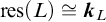


Moreover, if K is a pre-H-field with gap $0$
, then so is L.
$0$
, then so is L.
4 Extensions controlled by the asymptotic couple
Towards our quantifier elimination and model completion results for pre-H-fields with gap $0$
, in this section we study extensions controlled by the asymptotic couple. We begin by studying H-asymptotic couples with gap
$0$
, in this section we study extensions controlled by the asymptotic couple. We begin by studying H-asymptotic couples with gap $0$
in their own right and finding the model completion of this theory, which has quantifier elimination.
$0$
in their own right and finding the model completion of this theory, which has quantifier elimination.
4.1 Asymptotic couples with small derivation
The material in this subsection is based on [Reference Aschenbrenner, van den Dries and van der Hoeven6], which, apart from its new results, revisits quantifier elimination for the theory of closed H-asymptotic couples from [Reference Aschenbrenner and van den Dries3], introducing several new lemmas that simplify the arguments. For convenience, we use [Reference Aschenbrenner, van den Dries and van der Hoeven5, Sections 6.5 and 9.2] as a reference instead of the original sources [Reference Aschenbrenner and van den Dries3, Reference Aschenbrenner and van den Dries4, Reference Rosenlicht18, Reference Rosenlicht19, Reference Rosenlicht20] for asymptotic couples.
In contrast with the results of [Reference Aschenbrenner and van den Dries3, Reference Aschenbrenner, van den Dries and van der Hoeven6], here we do not need to expand the language by a predicate for the $\Psi $
-set or by functions for divisibility by nonzero natural numbers. Additionally, those authors work over an arbitrary ordered scalar field
$\Psi $
-set or by functions for divisibility by nonzero natural numbers. Additionally, those authors work over an arbitrary ordered scalar field $\boldsymbol k$
, but here we work over
$\boldsymbol k$
, but here we work over $\mathbb Q$
for concreteness (the results of this section hold in that setting in the language
$\mathbb Q$
for concreteness (the results of this section hold in that setting in the language $\mathcal L_{\operatorname {ac}}$
, described later, expanded by functions for scalar multiplication).
$\mathcal L_{\operatorname {ac}}$
, described later, expanded by functions for scalar multiplication).
4.1.1 Preliminaries
We suspend in this subsection the convention that $\Gamma $
is the value group of K. Instead,
$\Gamma $
is the value group of K. Instead, $(\Gamma , \psi )$
is an H-asymptotic couple, which means that
$(\Gamma , \psi )$
is an H-asymptotic couple, which means that $\Gamma $
is an ordered abelian group and
$\Gamma $
is an ordered abelian group and $\psi \colon \Gamma ^{\neq } \to \Gamma $
is a map satisfying, for all
$\psi \colon \Gamma ^{\neq } \to \Gamma $
is a map satisfying, for all $\gamma , \delta \in \Gamma ^{\neq }$
:
$\gamma , \delta \in \Gamma ^{\neq }$
:
-
(AC1) if
$\gamma +\delta \neq 0$
, then
$\psi (\gamma +\delta ) \geqslant \min \{\psi (\gamma ),\psi (\delta )\}$
; -
(AC2)
$\psi (k\gamma ) = \psi (\gamma )$
for all
$k \in \mathbb {Z}^{\neq }$
; -
(AC3) if
$\gamma>0$
, then
$\gamma +\psi (\gamma )>\psi (\delta )$
; -
(HC) if
$0<\gamma \leqslant \delta $
, then
$\psi (\gamma ) \geqslant \psi (\delta )$
.


Keeping in mind that later $(\Gamma , \psi )$
will be the asymptotic couple of an H-asymptotic field (such as a pre-H-field), we let
$(\Gamma , \psi )$
will be the asymptotic couple of an H-asymptotic field (such as a pre-H-field), we let  and
and  for
for $\gamma \in \Gamma ^{\neq }$
. The map
$\gamma \in \Gamma ^{\neq }$
. The map $\gamma \mapsto \gamma '$
for
$\gamma \mapsto \gamma '$
for $\gamma \in \Gamma ^{\neq }$
is strictly increasing [Reference Aschenbrenner, van den Dries and van der Hoeven5, Lemma 6.5.4(iii)]. We let
$\gamma \in \Gamma ^{\neq }$
is strictly increasing [Reference Aschenbrenner, van den Dries and van der Hoeven5, Lemma 6.5.4(iii)]. We let  and for any ordered abelian group G we set
  , having earlier defined $G^>$
and
$G^>$
and $G^<$
. Thus (AC3) says that
$G^<$
. Thus (AC3) says that $\Psi <(\Gamma ^>)'$
.
$\Psi <(\Gamma ^>)'$
.
A fundamental result is that $\Gamma \setminus (\Gamma ^{\neq })'$
has at most one element [Reference Aschenbrenner, van den Dries and van der Hoeven5, Theorem 9.2.1], and moreover exactly one of the following holds [Reference Aschenbrenner, van den Dries and van der Hoeven5, Corollary 9.2.16]:
$\Gamma \setminus (\Gamma ^{\neq })'$
has at most one element [Reference Aschenbrenner, van den Dries and van der Hoeven5, Theorem 9.2.1], and moreover exactly one of the following holds [Reference Aschenbrenner, van den Dries and van der Hoeven5, Corollary 9.2.16]:
-
(1) there exists
$\beta \in \Gamma $
such that
$\Psi <\beta <(\Gamma ^>)'$
, in which case
$(\Gamma , \psi )$
has gap
$\beta $
; -
(2) there exists
$\beta \in \Gamma $
such that
$\max \Psi =\beta $
, in which case
$(\Gamma , \psi )$
has max
$\beta $
; -
(3)
$(\Gamma ^{\neq })'=\Gamma $
, in which case
$(\Gamma , \psi )$
has asymptotic integration.


We are primarily concerned with H-asymptotic couples having gap $0$
, although we also consider the case of max
$0$
, although we also consider the case of max $0$
in this subsection. The material on H-asymptotic couples with max
$0$
in this subsection. The material on H-asymptotic couples with max $0$
is only used in one later theorem that itself is not used in the main results, but fits naturally with that of the gap
$0$
is only used in one later theorem that itself is not used in the main results, but fits naturally with that of the gap $0$
case. In contrast, the main results of [Reference Aschenbrenner and van den Dries3, Reference Aschenbrenner, van den Dries and van der Hoeven6] concern asymptotic couples with asymptotic integration, such as the asymptotic couple of
$0$
case. In contrast, the main results of [Reference Aschenbrenner and van den Dries3, Reference Aschenbrenner, van den Dries and van der Hoeven6] concern asymptotic couples with asymptotic integration, such as the asymptotic couple of $\mathbb {T}$
. In adapting their arguments, we try to highlight how the substitution of “gap
$\mathbb {T}$
. In adapting their arguments, we try to highlight how the substitution of “gap $0$
” or “max
$0$
” or “max $0$
” for “asymptotic integration” (or similar changes) alters the proofs.
$0$
” for “asymptotic integration” (or similar changes) alters the proofs.
Note that if $(\Gamma , \psi )$
is the asymptotic couple of an asymptotic field K, then K has gap
$(\Gamma , \psi )$
is the asymptotic couple of an asymptotic field K, then K has gap $0$
(in the sense of Section 2) if and only if
$0$
(in the sense of Section 2) if and only if $(\Gamma , \psi )$
has gap
$(\Gamma , \psi )$
has gap $0$
. It follows from [Reference Aschenbrenner, van den Dries and van der Hoeven5, Theorem 9.2.1 and Corollary 9.2.4] that
$0$
. It follows from [Reference Aschenbrenner, van den Dries and van der Hoeven5, Theorem 9.2.1 and Corollary 9.2.4] that $\sup \Psi =0 \iff (\Gamma ^>)' = \Gamma ^>$
and that
$\sup \Psi =0 \iff (\Gamma ^>)' = \Gamma ^>$
and that $\sup \Psi =0 \notin \Psi $
if and only if
$\sup \Psi =0 \notin \Psi $
if and only if $(\Gamma , \psi )$
has gap
$(\Gamma , \psi )$
has gap $0$
. Thus
$0$
. Thus $\sup \Psi =0$
if and only if
$\sup \Psi =0$
if and only if $(\Gamma , \psi )$
has gap
$(\Gamma , \psi )$
has gap $0$
or max
$0$
or max $0$
.
$0$
.
It follows from (AC2) and (HC) that $\psi $
is constant on archimedean classes of
$\psi $
is constant on archimedean classes of $\Gamma $
. For
$\Gamma $
. For $\gamma \in \Gamma $
, we let
$\gamma \in \Gamma $
, we let  denote its archimedean class, and set
  , ordering it by $[\delta ]<[\gamma ]$
if
$[\delta ]<[\gamma ]$
if $n|\delta |<|\gamma |$
for all n, where
$n|\delta |<|\gamma |$
for all n, where $\gamma , \delta \in \Gamma $
. The map
$\gamma , \delta \in \Gamma $
. The map $\psi $
extends uniquely to the divisible hull
$\psi $
extends uniquely to the divisible hull $\mathbb {Q}\Gamma $
of
$\mathbb {Q}\Gamma $
of $\Gamma $
, defined by
$\Gamma $
, defined by $\psi (q\gamma )=\psi (\gamma )$
for
$\psi (q\gamma )=\psi (\gamma )$
for $\gamma \in \Gamma ^{\neq }$
and
$\gamma \in \Gamma ^{\neq }$
and $q \in \mathbb {Q}^{\times }$
(use [Reference Aschenbrenner, van den Dries and van der Hoeven5, Lemma 6.5.3] to get (AC3)), and in this way we always construe
$q \in \mathbb {Q}^{\times }$
(use [Reference Aschenbrenner, van den Dries and van der Hoeven5, Lemma 6.5.3] to get (AC3)), and in this way we always construe $\mathbb {Q}\Gamma $
as an H-asymptotic couple
$\mathbb {Q}\Gamma $
as an H-asymptotic couple $(\mathbb {Q}\Gamma , \psi )$
extending
$(\mathbb {Q}\Gamma , \psi )$
extending $(\Gamma , \psi )$
. It satisfies
$(\Gamma , \psi )$
. It satisfies $\psi ((\mathbb {Q}\Gamma )^{\neq }) = \psi (\Gamma ^{\neq })$
, so if
$\psi ((\mathbb {Q}\Gamma )^{\neq }) = \psi (\Gamma ^{\neq })$
, so if $(\Gamma , \psi )$
has gap
$(\Gamma , \psi )$
has gap $0$
(respectively, max
$0$
(respectively, max $0$
), then so does
$0$
), then so does $(\mathbb {Q}\Gamma , \psi )$
. We also use that if
$(\mathbb {Q}\Gamma , \psi )$
. We also use that if $(\Gamma , \psi )$
has gap
$(\Gamma , \psi )$
has gap $0$
, then for every
$0$
, then for every $\gamma \in \Gamma ^{\neq }$
, we have
$\gamma \in \Gamma ^{\neq }$
, we have $[\gamma ]>[\gamma ^{\dagger }]$
by [Reference Aschenbrenner, van den Dries and van der Hoeven5, Lemma 9.2.10(iv)] and so
$[\gamma ]>[\gamma ^{\dagger }]$
by [Reference Aschenbrenner, van den Dries and van der Hoeven5, Lemma 9.2.10(iv)] and so $[\gamma ]=[\gamma ']$
; in particular, if
$[\gamma ]=[\gamma ']$
; in particular, if $\gamma <0$
, then
$\gamma <0$
, then $\gamma <\gamma ^{\dagger }<0$
.
$\gamma <\gamma ^{\dagger }<0$
.
We call $(\Gamma , \psi )$
gap-closed if
$(\Gamma , \psi )$
gap-closed if $\Gamma $
is nontrivial and divisible, and
$\Gamma $
is nontrivial and divisible, and $\Psi =\Gamma ^<$
. The goal of this section is Theorem 4.8, which states that the theory of gap-closed H-asymptotic couples has quantifier elimination and is the model completion of the theory of H-asymptotic couples with gap
$\Psi =\Gamma ^<$
. The goal of this section is Theorem 4.8, which states that the theory of gap-closed H-asymptotic couples has quantifier elimination and is the model completion of the theory of H-asymptotic couples with gap $0$
. Likewise, the theory of max-closed H-asymptotic couples, where
$0$
. Likewise, the theory of max-closed H-asymptotic couples, where $(\Gamma , \psi )$
is max-closed if
$(\Gamma , \psi )$
is max-closed if $\Gamma $
is divisible and
$\Gamma $
is divisible and $\Psi =\Gamma ^{\leqslant }$
, has quantifier elimination and is the model completion of the theory of H-asymptotic couples
$\Psi =\Gamma ^{\leqslant }$
, has quantifier elimination and is the model completion of the theory of H-asymptotic couples $(\Gamma , \psi )$
with
$(\Gamma , \psi )$
with $\sup \Psi =0$
. The language for these results is the language
$\sup \Psi =0$
. The language for these results is the language $\mathcal L_{\operatorname {ac}}=\{+, -, \leqslant , 0, \infty , \psi \}$
of asymptotic couples. The underlying set of
$\mathcal L_{\operatorname {ac}}=\{+, -, \leqslant , 0, \infty , \psi \}$
of asymptotic couples. The underlying set of $(\Gamma , \psi )$
in this language is
$(\Gamma , \psi )$
in this language is  , and we interpret $\infty $
in the following way: for all
$\infty $
in the following way: for all $\gamma \in \Gamma $
,
$\gamma \in \Gamma $
,  and
and $\gamma <\infty $
;
$\gamma <\infty $
;  ;
;  ;
;  . The other symbols have the expected interpretations.
One of the new extension lemmas of [Reference Aschenbrenner, van den Dries and van der Hoeven6] is [Reference Aschenbrenner, van den Dries and van der Hoeven6, Lemma 2.7]. Here is a variant that avoids assuming asymptotic integration by making a stronger cofinality assumption.
Lemma 4.1. Suppose that $\Psi $
is downward closed in
$\Psi $
is downward closed in $\Gamma $
. Let
$\Gamma $
. Let $(\Gamma _1, \psi _1)$
and
$(\Gamma _1, \psi _1)$
and $(\Gamma _*, \psi _*)$
be H-asymptotic couples extending
$(\Gamma _*, \psi _*)$
be H-asymptotic couples extending $(\Gamma , \psi )$
such that
$(\Gamma , \psi )$
such that $\Gamma ^<$
is cofinal in
$\Gamma ^<$
is cofinal in $\Gamma _1^<$
. Suppose that
$\Gamma _1^<$
. Suppose that $\gamma _1 \in \Gamma _1 \setminus \Gamma $
and
$\gamma _1 \in \Gamma _1 \setminus \Gamma $
and $\gamma _* \in \Gamma _* \setminus \Gamma $
realize the same cut in
$\gamma _* \in \Gamma _* \setminus \Gamma $
realize the same cut in $\Gamma $
and
$\Gamma $
and $\gamma _1^{\dagger } \notin \Gamma $
. Then
$\gamma _1^{\dagger } \notin \Gamma $
. Then $\gamma _*^{\dagger } \notin \Gamma $
and
$\gamma _*^{\dagger } \notin \Gamma $
and $\gamma _*^{\dagger }$
realizes the same cut in
$\gamma _*^{\dagger }$
realizes the same cut in $\Gamma $
as
$\Gamma $
as $\gamma _1^{\dagger }$
.
$\gamma _1^{\dagger }$
.
Proof. Let $\alpha \in \Gamma ^{\neq }$
. We first show that:
$\alpha \in \Gamma ^{\neq }$
. We first show that:
 $$\begin{align*}\gamma_1^{\dagger} < \alpha^{\dagger} \implies \gamma_*^{\dagger} < \alpha^{\dagger} \qquad \text{and} \qquad \gamma_1^{\dagger}> \alpha^{\dagger} \implies \gamma_*^{\dagger} > \alpha^{\dagger}. \end{align*}$$
The first implication follows exactly as in [Reference Aschenbrenner, van den Dries and van der Hoeven6, Lemma 2.7], which uses that $\Psi $
is downward closed but not that
$\Psi $
is downward closed but not that $(\Gamma , \psi )$
has asymptotic integration. The second implication has a hidden use of asymptotic integration, so here are the modifications.
$(\Gamma , \psi )$
has asymptotic integration. The second implication has a hidden use of asymptotic integration, so here are the modifications.
Suppose that $\gamma _1^{\dagger }>\alpha ^{\dagger }$
, so by the cofinality assumption, there is
$\gamma _1^{\dagger }>\alpha ^{\dagger }$
, so by the cofinality assumption, there is $\delta \in \Gamma $
with
$\delta \in \Gamma $
with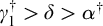 $\gamma _1^{\dagger }> \delta > \alpha ^{\dagger }$
. By the reasoning in the first implication (see [Reference Aschenbrenner, van den Dries and van der Hoeven6, Lemma 2.7]), it suffices to show that
$\gamma _1^{\dagger }> \delta > \alpha ^{\dagger }$
. By the reasoning in the first implication (see [Reference Aschenbrenner, van den Dries and van der Hoeven6, Lemma 2.7]), it suffices to show that $\delta \in \Psi $
; asymptotic integration is used in [Reference Aschenbrenner, van den Dries and van der Hoeven6, Lemma 2.7] to get this. By the stronger cofinality assumption here, take
$\delta \in \Psi $
; asymptotic integration is used in [Reference Aschenbrenner, van den Dries and van der Hoeven6, Lemma 2.7] to get this. By the stronger cofinality assumption here, take $\beta \in \Gamma ^{\neq }$
with
$\beta \in \Gamma ^{\neq }$
with $|\gamma _1|>|\beta |$
, so
$|\gamma _1|>|\beta |$
, so $\delta <\gamma _1^{\dagger }< \beta ^{\dagger } \in \Psi $
. Thus
$\delta <\gamma _1^{\dagger }< \beta ^{\dagger } \in \Psi $
. Thus $\delta \in \Psi $
, since
$\delta \in \Psi $
, since $\Psi $
is downward closed.
$\Psi $
is downward closed.
Finally, the last paragraph also shows that $\gamma _*^{\dagger } \notin \Gamma $
, since
$\gamma _*^{\dagger } \notin \Gamma $
, since $\gamma _{*}^{\dagger }\leqslant \beta ^{\dagger } \in \Psi $
and
$\gamma _{*}^{\dagger }\leqslant \beta ^{\dagger } \in \Psi $
and $\Psi $
is downward closed, and therefore it realizes the same cut as
$\Psi $
is downward closed, and therefore it realizes the same cut as $\gamma _1^{\dagger }$
by the displayed implications.
$\gamma _1^{\dagger }$
by the displayed implications.
Alternatively, we can weaken the cofinality assumption from $\Gamma ^<$
being cofinal in
$\Gamma ^<$
being cofinal in $\Gamma _1^<$
to
$\Gamma _1^<$
to $\Gamma ^<$
being cofinal in
$\Gamma ^<$
being cofinal in $(\Gamma + \mathbb {Q}\gamma _1^{\dagger })^<$
(as in [Reference Aschenbrenner, van den Dries and van der Hoeven6, Lemma 2.7]) in the case that
$(\Gamma + \mathbb {Q}\gamma _1^{\dagger })^<$
(as in [Reference Aschenbrenner, van den Dries and van der Hoeven6, Lemma 2.7]) in the case that $\sup \Psi _1=0$
; the only change in the proof is that now
$\sup \Psi _1=0$
; the only change in the proof is that now $\delta \in \Psi $
follows from
$\delta \in \Psi $
follows from $\delta <\gamma _1^{\dagger } \leqslant 0$
.
$\delta <\gamma _1^{\dagger } \leqslant 0$
.
Another of the new lemmas is the following, [Reference Aschenbrenner, van den Dries and van der Hoeven6, Lemma 2.8], which we also use in Section 4.2.
Lemma 4.2. Suppose that $(\Gamma _1, \psi _1)$
is an H-asymptotic couple extending
$(\Gamma _1, \psi _1)$
is an H-asymptotic couple extending $(\Gamma , \psi )$
, and let
$(\Gamma , \psi )$
, and let $\gamma _1 \in \Gamma _1 \setminus \Gamma $
and
$\gamma _1 \in \Gamma _1 \setminus \Gamma $
and $\alpha \in \Gamma $
. Suppose that
$\alpha \in \Gamma $
. Suppose that $\gamma _1$
and
$\gamma _1$
and  satisfy $\gamma _1^{\dagger } \notin \Gamma $
and
$\gamma _1^{\dagger } \notin \Gamma $
and $\beta ^{\dagger } \notin \Psi $
, and that
$\beta ^{\dagger } \notin \Psi $
, and that $|\gamma _1|>|\gamma |$
for some
$|\gamma _1|>|\gamma |$
for some $\gamma \in \Gamma ^{\neq }$
. Then
$\gamma \in \Gamma ^{\neq }$
. Then $\gamma _1^{\dagger } < \beta ^{\dagger }$
.
$\gamma _1^{\dagger } < \beta ^{\dagger }$
.
4.1.2 Embedding lemmas
We now turn to the proof of quantifier elimination for gap-closed and max-closed H-asymptotic couples, which we handle uniformly as much as possible. To that end, suppose that $(\Gamma , \psi )$
is a divisible H-asymptotic couple with
$(\Gamma , \psi )$
is a divisible H-asymptotic couple with $\sup \Psi =0$
, and let
$\sup \Psi =0$
, and let $(\Gamma _1, \psi _1)$
and
$(\Gamma _1, \psi _1)$
and $(\Gamma _*, \psi _*)$
be divisible H-asymptotic couples extending
$(\Gamma _*, \psi _*)$
be divisible H-asymptotic couples extending $(\Gamma , \psi )$
such that
$(\Gamma , \psi )$
such that $(\Gamma _*, \psi _*)$
is
$(\Gamma _*, \psi _*)$
is $|\Gamma |^+$
-saturated. Let
$|\Gamma |^+$
-saturated. Let $\gamma _1 \in \Gamma _1 \setminus \Gamma $
and
$\gamma _1 \in \Gamma _1 \setminus \Gamma $
and $(\Gamma \langle \gamma _1 \rangle , \psi _1)$
be the divisible H-asymptotic couple generated by
$(\Gamma \langle \gamma _1 \rangle , \psi _1)$
be the divisible H-asymptotic couple generated by $\Gamma \cup \{\gamma _1\}$
in
$\Gamma \cup \{\gamma _1\}$
in $(\Gamma _1, \psi _1)$
.
$(\Gamma _1, \psi _1)$
.
The first two lemmas are proved similarly to [Reference Aschenbrenner, van den Dries and van der Hoeven6, Lemmas 3.4 and 3.5], so we only sketch the proofs, omitting some details that are the same. The third lemma is particular to the case of gap $0$
. For convenience, we set
$0$
. For convenience, we set  , so
, so $\Gamma ^{\dagger } = \Psi \cup \{\infty \}$
.
$\Gamma ^{\dagger } = \Psi \cup \{\infty \}$
.
In the next lemma, the $\sup \Psi =0$
assumption simplifies the case distinctions needed in [Reference Aschenbrenner, van den Dries and van der Hoeven6, Lemma 3.4], and the assumption of asymptotic integration there is used only in Cases 1–2 of that lemma, which do not occur here. We also do not need the “H-cuts” of that paper for quantifier elimination since the
$\sup \Psi =0$
assumption simplifies the case distinctions needed in [Reference Aschenbrenner, van den Dries and van der Hoeven6, Lemma 3.4], and the assumption of asymptotic integration there is used only in Cases 1–2 of that lemma, which do not occur here. We also do not need the “H-cuts” of that paper for quantifier elimination since the $\Psi $
-set in a gap-closed or a max-closed H-asymptotic couple is already quantifier-free definable without parameters.
$\Psi $
-set in a gap-closed or a max-closed H-asymptotic couple is already quantifier-free definable without parameters.
Lemma 4.3. Suppose that $(\Gamma + \mathbb Q\gamma _1)^{\dagger } = \Gamma ^{\dagger }$
. Then
$(\Gamma + \mathbb Q\gamma _1)^{\dagger } = \Gamma ^{\dagger }$
. Then $(\Gamma \langle \gamma _1 \rangle , \psi _1)$
can be embedded into
$(\Gamma \langle \gamma _1 \rangle , \psi _1)$
can be embedded into $(\Gamma _*, \psi _*)$
over
$(\Gamma _*, \psi _*)$
over $\Gamma $
.
$\Gamma $
.
Proof. From $(\Gamma +\mathbb Q\gamma _1)^{\dagger } = \Gamma ^{\dagger }$
, we get
$(\Gamma +\mathbb Q\gamma _1)^{\dagger } = \Gamma ^{\dagger }$
, we get $\Gamma \langle \gamma _1 \rangle = \Gamma +\mathbb Q\gamma _1$
.
$\Gamma \langle \gamma _1 \rangle = \Gamma +\mathbb Q\gamma _1$
.
In case $[\Gamma +\mathbb Q\gamma _1] = [\Gamma ]$
, realizing in
$[\Gamma +\mathbb Q\gamma _1] = [\Gamma ]$
, realizing in $\Gamma _*$
the cut in
$\Gamma _*$
the cut in $\Gamma $
realized by
$\Gamma $
realized by $\gamma _1$
yields an embedding
$\gamma _1$
yields an embedding $i \colon \Gamma +\mathbb Q\gamma _1 \to \Gamma _*$
of ordered
$i \colon \Gamma +\mathbb Q\gamma _1 \to \Gamma _*$
of ordered $\mathbb {Q}$
-vector spaces fixing
$\mathbb {Q}$
-vector spaces fixing $\Gamma $
, and the assumption
$\Gamma $
, and the assumption $[\Gamma +\mathbb Q\gamma _1] = [\Gamma ]$
ensures that it is an embedding of H-asymptotic couples (see Case 3 of [Reference Aschenbrenner, van den Dries and van der Hoeven6, Lemma 3.4]).
$[\Gamma +\mathbb Q\gamma _1] = [\Gamma ]$
ensures that it is an embedding of H-asymptotic couples (see Case 3 of [Reference Aschenbrenner, van den Dries and van der Hoeven6, Lemma 3.4]).
In case $[\Gamma +\mathbb Q\gamma _1] \neq [\Gamma ]$
but
$[\Gamma +\mathbb Q\gamma _1] \neq [\Gamma ]$
but $\Gamma ^<$
is cofinal in
$\Gamma ^<$
is cofinal in $(\Gamma +\mathbb Q\gamma _1)^<$
, take
$(\Gamma +\mathbb Q\gamma _1)^<$
, take $\beta \in \Gamma _1 \setminus \Gamma $
with
$\beta \in \Gamma _1 \setminus \Gamma $
with $\beta>0$
and
$\beta>0$
and $[\beta ] \notin [\Gamma ]$
. Letting D
1 be the cut in
$[\beta ] \notin [\Gamma ]$
. Letting D
1 be the cut in $\Gamma $
realized by
$\Gamma $
realized by $\beta $
and
$\beta $
and  , it follows from the cofinality assumption that D
1 has no greatest element and D
2 has no least element. Then saturation gives
, it follows from the cofinality assumption that D
1 has no greatest element and D
2 has no least element. Then saturation gives $\beta _* \in \Gamma _*$
realizing the same cut as
$\beta _* \in \Gamma _*$
realizing the same cut as $\beta $
in
$\beta $
in $\Gamma $
and with
$\Gamma $
and with $\beta ^{\dagger } = \beta _*^{\dagger }$
, yielding an embedding
$\beta ^{\dagger } = \beta _*^{\dagger }$
, yielding an embedding $i \colon \Gamma +\mathbb Q\gamma _1 \to \Gamma _*$
of H-asymptotic couples fixing
$i \colon \Gamma +\mathbb Q\gamma _1 \to \Gamma _*$
of H-asymptotic couples fixing $\Gamma $
(see Cases 4–6 of [Reference Aschenbrenner, van den Dries and van der Hoeven6, Lemma 3.4]).
$\Gamma $
(see Cases 4–6 of [Reference Aschenbrenner, van den Dries and van der Hoeven6, Lemma 3.4]).
In case $\Gamma ^<$
is not cofinal in
$\Gamma ^<$
is not cofinal in $(\Gamma +\mathbb Q\gamma _1)^<$
, take
$(\Gamma +\mathbb Q\gamma _1)^<$
, take $\beta \in \Gamma +\mathbb Q\gamma _1$
satisfying
$\beta \in \Gamma +\mathbb Q\gamma _1$
satisfying $0<\beta <\Gamma ^>$
. In this case,
$0<\beta <\Gamma ^>$
. In this case, $(\Gamma , \psi )$
must have max
$(\Gamma , \psi )$
must have max $0$
, since if
$0$
, since if $(\Gamma , \psi )$
has gap
$(\Gamma , \psi )$
has gap $0$
, then
$0$
, then $\Psi <\psi _1(\beta ) \in \Psi $
, a contradiction. By saturation, take
$\Psi <\psi _1(\beta ) \in \Psi $
, a contradiction. By saturation, take $\beta _* \in \Gamma _*$
with
$\beta _* \in \Gamma _*$
with $0<\beta _*<\Gamma ^>$
and
$0<\beta _*<\Gamma ^>$
and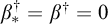 $\beta _*^{\dagger }=\beta ^{\dagger }=0$
, so we get an embedding
$\beta _*^{\dagger }=\beta ^{\dagger }=0$
, so we get an embedding $i \colon \Gamma +\mathbb Q\gamma _1 \to \Gamma _*$
of H-asymptotic couples as before.
$i \colon \Gamma +\mathbb Q\gamma _1 \to \Gamma _*$
of H-asymptotic couples as before.
In [Reference Aschenbrenner, van den Dries and van der Hoeven6, Lemma 3.5], the cofinality of $\Gamma ^<$
in
$\Gamma ^<$
in $\Gamma _1^<$
follows from asymptotic integration; In the max
$\Gamma _1^<$
follows from asymptotic integration; In the max $0$
case it is also automatic, but needs to be added as an assumption in the gap
$0$
case it is also automatic, but needs to be added as an assumption in the gap $0$
case, (i) in the next lemma.
$0$
case, (i) in the next lemma.
Lemma 4.4. Suppose that $(\Gamma +\mathbb Q\gamma )^{\dagger } \neq \Gamma ^{\dagger }$
for all
$(\Gamma +\mathbb Q\gamma )^{\dagger } \neq \Gamma ^{\dagger }$
for all $\gamma \in \Gamma _1 \setminus \Gamma $
. Also, suppose that either:
$\gamma \in \Gamma _1 \setminus \Gamma $
. Also, suppose that either:
-
(i)
$(\Gamma , \psi )$
is gap-closed,
$(\Gamma _1, \psi _1)$
has gap
$0$
, and
$\Gamma ^<$
is cofinal in
$\Gamma _1^<$
; or -
(ii)
$(\Gamma , \psi )$
is max-closed and
$(\Gamma _1,\psi _1)$
has max
$0$
.


Then $(\Gamma \langle \gamma _1\rangle , \psi _1)$
can be embedded into
$(\Gamma \langle \gamma _1\rangle , \psi _1)$
can be embedded into $(\Gamma _*, \psi _*)$
over
$(\Gamma _*, \psi _*)$
over $\Gamma $
.
$\Gamma $
.
Proof. Note that in case (ii), the cofinality assumption comes for free, for if $\gamma \in \Gamma _1 \setminus \Gamma $
satisfies
$\gamma \in \Gamma _1 \setminus \Gamma $
satisfies $0<\gamma <\Gamma ^>$
, then
$0<\gamma <\Gamma ^>$
, then $\gamma ^{\dagger } = 0$
and so
$\gamma ^{\dagger } = 0$
and so $(\Gamma +\mathbb Q\gamma )^{\dagger } = \Gamma ^{\dagger }$
, a contradiction.
$(\Gamma +\mathbb Q\gamma )^{\dagger } = \Gamma ^{\dagger }$
, a contradiction.
Take $\alpha _1 \in \Gamma $
such that
$\alpha _1 \in \Gamma $
such that $(\gamma _1-\alpha _1)^{\dagger } \notin \Gamma ^{\dagger }$
. Then
$(\gamma _1-\alpha _1)^{\dagger } \notin \Gamma ^{\dagger }$
. Then $(\gamma _1-\alpha _1)^{\dagger } \notin \Gamma $
, since
$(\gamma _1-\alpha _1)^{\dagger } \notin \Gamma $
, since $(\gamma _1-\alpha _1)^{\dagger }<0$
and in case (i) and case (ii),
$(\gamma _1-\alpha _1)^{\dagger }<0$
and in case (i) and case (ii), $\Psi =\Gamma ^{<}$
and
$\Psi =\Gamma ^{<}$
and $\Psi =\Gamma ^{\leqslant }$
, respectively. (In [Reference Aschenbrenner, van den Dries and van der Hoeven6, Lemma 3.5], this step uses asymptotic integration.)
$\Psi =\Gamma ^{\leqslant }$
, respectively. (In [Reference Aschenbrenner, van den Dries and van der Hoeven6, Lemma 3.5], this step uses asymptotic integration.)
The proof now proceeds exactly as in [Reference Aschenbrenner, van den Dries and van der Hoeven6, Lemma 3.5], substituting Lemma 4.1 for [Reference Aschenbrenner, van den Dries and van der Hoeven6, Lemma 2.7] (and $\mathbb {Q}$
for
$\mathbb {Q}$
for $\boldsymbol k$
); here is a sketch. Let
$\boldsymbol k$
); here is a sketch. Let $n \geqslant 1$
. Continue this procedure to construct sequences
$n \geqslant 1$
. Continue this procedure to construct sequences $\alpha _1, \alpha _2, \dots $
in
$\alpha _1, \alpha _2, \dots $
in $\Gamma $
and
$\Gamma $
and $\beta _1, \beta _2, \dots $
in
$\beta _1, \beta _2, \dots $
in $\Gamma \langle \gamma _1 \rangle \setminus \Gamma $
with
$\Gamma \langle \gamma _1 \rangle \setminus \Gamma $
with $\beta _1 = \gamma _1-\alpha _1$
and
$\beta _1 = \gamma _1-\alpha _1$
and $\beta _{n+1} = \beta _n^{\dagger }-\alpha _{n+1}$
. Then
$\beta _{n+1} = \beta _n^{\dagger }-\alpha _{n+1}$
. Then $\beta _n^{\dagger }<\beta _{n+1}^{\dagger }$
by Lemma 4.2 (with
$\beta _n^{\dagger }<\beta _{n+1}^{\dagger }$
by Lemma 4.2 (with $\beta _n$
in place of
$\beta _n$
in place of $\gamma _1$
and
$\gamma _1$
and $\beta _{n+1}$
in place of
$\beta _{n+1}$
in place of $\beta $
), so
$\beta $
), so $[\beta _n]>[\beta _{n+1}]$
, so
$[\beta _n]>[\beta _{n+1}]$
, so
 $$\begin{align*}\Gamma\langle \gamma_1 \rangle\ =\ \Gamma \oplus \mathbb Q\beta_1 \oplus \mathbb Q\beta_2 \oplus \cdots. \end{align*}$$
Saturation gives $\gamma _* \in \Gamma _* \setminus \Gamma $
realizing the same cut in
$\gamma _* \in \Gamma _* \setminus \Gamma $
realizing the same cut in $\Gamma $
as
$\Gamma $
as $\gamma _1$
, so use the same
$\gamma _1$
, so use the same $\alpha _n$
sequence to likewise define
$\alpha _n$
sequence to likewise define $\beta _{*n} \in (\Gamma _*)_{\infty }$
for
$\beta _{*n} \in (\Gamma _*)_{\infty }$
for $n \geqslant 1$
. Inductively construct an increasing sequence of
$n \geqslant 1$
. Inductively construct an increasing sequence of $\mathbb {Q}$
-vector space embeddings
$\mathbb {Q}$
-vector space embeddings
 $$\begin{align*}i_n \colon \Gamma + \mathbb Q\beta_1 + \dots + \mathbb Q\beta_n \to \Gamma_* \end{align*}$$
fixing $\Gamma $
and sending
$\Gamma $
and sending $\beta _n$
to
$\beta _n$
to $\beta _{*n}$
in two steps: Given that
$\beta _{*n}$
in two steps: Given that $\beta _n$
and
$\beta _n$
and $\beta _{*n}$
realize the same cut in
$\beta _{*n}$
realize the same cut in $\Gamma $
, use Lemma 4.1 to get that
$\Gamma $
, use Lemma 4.1 to get that $\beta _n^{\dagger }$
and
$\beta _n^{\dagger }$
and $\beta _{*n}^{\dagger }$
realize the same cut in
$\beta _{*n}^{\dagger }$
realize the same cut in $\Gamma $
. Then argue with archimedean classes, using Lemma 4.2 in
$\Gamma $
. Then argue with archimedean classes, using Lemma 4.2 in $(\Gamma _*,\psi _*)$
now, to extend the embedding to
$(\Gamma _*,\psi _*)$
now, to extend the embedding to $i_{n+1}$
. The union of these maps is the desired embedding of H-asymptotic couples.
$i_{n+1}$
. The union of these maps is the desired embedding of H-asymptotic couples.
In case (i) of the previous lemma, we added a cofinality assumption that was not present in [Reference Aschenbrenner, van den Dries and van der Hoeven6, Lemma 3.5]. The next lemma handles the non-cofinal case, which is particular to gap $0$
.
$0$
.
Lemma 4.5. Suppose that $\Gamma ^< < \gamma _1 <0$
, and
$\Gamma ^< < \gamma _1 <0$
, and $(\Gamma _1,\psi _1)$
and
$(\Gamma _1,\psi _1)$
and $(\Gamma _*,\psi _*)$
have gap
$(\Gamma _*,\psi _*)$
have gap $0$
. Then
$0$
. Then $(\Gamma \langle \gamma _1\rangle , \psi _1)$
can be embedded into
$(\Gamma \langle \gamma _1\rangle , \psi _1)$
can be embedded into $(\Gamma _*, \psi _*)$
over
$(\Gamma _*, \psi _*)$
over $\Gamma $
.
$\Gamma $
.
Proof. Set  and
and  for all n. We have
 $$\begin{align*}[\gamma_1]>[\gamma_1^{\langle 1 \rangle}]>[\gamma_1^{\langle 2 \rangle}]>\cdots, \end{align*}$$
and so
 $$\begin{align*}\Gamma^< < \gamma_1 < \gamma_1^{\langle 1 \rangle} < \gamma_1^{\langle 2 \rangle}<\dots<0 \qquad \text{and} \qquad [\gamma_1^{\langle n \rangle}] \notin [\Gamma]\ \text{for all}\ n. \end{align*}$$
Hence the family $(\gamma _1^{\langle n \rangle })_{n \in \mathbb N}$
is
$(\gamma _1^{\langle n \rangle })_{n \in \mathbb N}$
is $\mathbb Q$
-linearly independent over
$\mathbb Q$
-linearly independent over $\Gamma $
and
$\Gamma $
and
 $$\begin{align*}\Gamma\langle \gamma_1 \rangle\ =\ \Gamma \oplus \mathbb Q\gamma_1 \oplus \mathbb Q\gamma_1^{\langle 1 \rangle} \oplus \mathbb Q\gamma_1^{\langle 2 \rangle} \oplus \cdots. \end{align*}$$
By saturation, we may take $\gamma _* \in \Gamma _* \setminus \Gamma $
with
$\gamma _* \in \Gamma _* \setminus \Gamma $
with $\Gamma ^< < \gamma _* < 0$
. The above holds in
$\Gamma ^< < \gamma _* < 0$
. The above holds in $\Gamma _*$
with
$\Gamma _*$
with $\gamma _*$
replacing
$\gamma _*$
replacing $\gamma _1$
(and
$\gamma _1$
(and $\gamma _*^{\langle n \rangle }$
defined analogously), so we obtain an embedding of
$\gamma _*^{\langle n \rangle }$
defined analogously), so we obtain an embedding of $(\Gamma \langle \gamma _1 \rangle , \psi _1)$
into
$(\Gamma \langle \gamma _1 \rangle , \psi _1)$
into $(\Gamma _*, \psi _*)$
over
$(\Gamma _*, \psi _*)$
over $\Gamma $
that sends
$\Gamma $
that sends $\gamma _1$
to
$\gamma _1$
to $\gamma _*$
.
$\gamma _*$
.
4.1.3 Quantifier elimination
We call an H-asymptotic couple $(\Gamma _1, \psi _1)$
extending
$(\Gamma _1, \psi _1)$
extending $(\Gamma , \psi )$
a gap-closure of
$(\Gamma , \psi )$
a gap-closure of $(\Gamma , \psi )$
if it is gap-closed and it embeds over
$(\Gamma , \psi )$
if it is gap-closed and it embeds over $(\Gamma , \psi )$
into every gap-closed H-asymptotic couple extending
$(\Gamma , \psi )$
into every gap-closed H-asymptotic couple extending $(\Gamma , \psi )$
. Similarly, we call an H-asymptotic couple
$(\Gamma , \psi )$
. Similarly, we call an H-asymptotic couple $(\Gamma _1, \psi _1)$
extending
$(\Gamma _1, \psi _1)$
extending $(\Gamma , \psi )$
a max-closure of
$(\Gamma , \psi )$
a max-closure of $(\Gamma , \psi )$
if it is max-closed and it embeds over
$(\Gamma , \psi )$
if it is max-closed and it embeds over $(\Gamma , \psi )$
into every max-closed H-asymptotic couple extending
$(\Gamma , \psi )$
into every max-closed H-asymptotic couple extending $(\Gamma , \psi )$
. By the embedding lemmas of the previous subsection and a standard quantifier elimination test (see for example [Reference Aschenbrenner, van den Dries and van der Hoeven5, Corollary B.11.11]), quantifier elimination for gap-closed and max-closed H-asymptotic couples reduces to the existence of gap-closures and max-closures, respectively.
$(\Gamma , \psi )$
. By the embedding lemmas of the previous subsection and a standard quantifier elimination test (see for example [Reference Aschenbrenner, van den Dries and van der Hoeven5, Corollary B.11.11]), quantifier elimination for gap-closed and max-closed H-asymptotic couples reduces to the existence of gap-closures and max-closures, respectively.
For that, we need one more embedding lemma, Let $\Psi ^{\downarrow }$
be the downward closure of
$\Psi ^{\downarrow }$
be the downward closure of $\Psi $
in
$\Psi $
in $\Gamma $
.
$\Gamma $
.
Lemma 4.6. Let $\beta \in \Psi ^{\downarrow } \setminus \Psi $
or
$\beta \in \Psi ^{\downarrow } \setminus \Psi $
or $\beta $
be a gap in
$\beta $
be a gap in $(\Gamma , \psi )$
. Then there is an H-asymptotic couple
$(\Gamma , \psi )$
. Then there is an H-asymptotic couple $(\Gamma \oplus \mathbb Z\alpha , \psi ^\alpha )$
extending
$(\Gamma \oplus \mathbb Z\alpha , \psi ^\alpha )$
extending $(\Gamma , \psi )$
such that:
$(\Gamma , \psi )$
such that:
-
(i)
$\alpha>0$
and
$\psi ^\alpha (\alpha )=\beta $
; -
(ii) given an embedding i of
$(\Gamma , \psi )$
into an H-asymptotic couple
$(\Gamma ^{*}, \psi ^{*})$
and
$\alpha ^{*} \in \Gamma ^{*}$
with
$\alpha ^{*}>0$
and
$\psi ^{*}(\alpha ^{*})=i(\beta )$
, there is a unique extension of i to an embedding
$j \colon (\Gamma \oplus \mathbb Z\alpha , \psi ^\alpha ) \to (\Gamma ^{*}, \psi ^{*})$
with
$j(\alpha )=\alpha ^{*}$
.


Proof. This follows from [Reference Aschenbrenner, van den Dries and van der Hoeven5, Lemma 9.8.7] with $C=\{[\gamma ] : \gamma \in \Gamma ^{\neq },\ \psi (\gamma )>\beta \}$
, but here is an outline. Define the ordered abelian group
$C=\{[\gamma ] : \gamma \in \Gamma ^{\neq },\ \psi (\gamma )>\beta \}$
, but here is an outline. Define the ordered abelian group $\Gamma \oplus \mathbb Z\alpha $
so that
$\Gamma \oplus \mathbb Z\alpha $
so that
 $$\begin{align*}\{0\} \cup \{ \gamma \in \Gamma^> : \psi(\gamma)>\beta \}\ <\ \alpha\ <\ \{ \gamma \in \Gamma^> : \psi(\gamma)<\beta \}, \end{align*}$$
and thus $[\alpha ] \notin [\Gamma ^{\neq }]$
. Extend
$[\alpha ] \notin [\Gamma ^{\neq }]$
. Extend $\psi $
to
$\psi $
to $\psi ^{\alpha } \colon (\Gamma \oplus \mathbb Z\alpha )^{\neq } \to \Gamma $
by
$\psi ^{\alpha } \colon (\Gamma \oplus \mathbb Z\alpha )^{\neq } \to \Gamma $
by  , where $\gamma \in \Gamma $
and
$\gamma \in \Gamma $
and $k \in \mathbb Z^{\neq }$
. To verify that this makes
$k \in \mathbb Z^{\neq }$
. To verify that this makes $(\Gamma \oplus \mathbb Z\alpha , \psi ^\alpha )$
an H-asymptotic couple involves tedious case distinctions. The axioms (AC1), (AC2), and (HC) are straightforward, while (AC3) is more subtle and uses [Reference Aschenbrenner, van den Dries and van der Hoeven5, Lemma 6.5.4]. The universal property of
$(\Gamma \oplus \mathbb Z\alpha , \psi ^\alpha )$
an H-asymptotic couple involves tedious case distinctions. The axioms (AC1), (AC2), and (HC) are straightforward, while (AC3) is more subtle and uses [Reference Aschenbrenner, van den Dries and van der Hoeven5, Lemma 6.5.4]. The universal property of $(\Gamma \oplus \mathbb Z\alpha , \psi ^\alpha )$
is easy.
$(\Gamma \oplus \mathbb Z\alpha , \psi ^\alpha )$
is easy.
Corollary 4.7. Every H-asymptotic couple $(\Gamma , \psi )$
with gap
$(\Gamma , \psi )$
with gap $0$
has a gap-closure. Every H-asymptotic couple
$0$
has a gap-closure. Every H-asymptotic couple $(\Gamma , \psi )$
with
$(\Gamma , \psi )$
with $\sup \Psi =0$
has a max-closure.
$\sup \Psi =0$
has a max-closure.
Proof. If $(\Gamma ,\psi )$
has max
$(\Gamma ,\psi )$
has max $0$
, then by applying Lemma 4.6 for
$0$
, then by applying Lemma 4.6 for $\beta \in \Psi ^{\downarrow } \setminus \Psi $
, taking the divisible hull, and repeating these procedures, we get a max-closure of
$\beta \in \Psi ^{\downarrow } \setminus \Psi $
, taking the divisible hull, and repeating these procedures, we get a max-closure of $(\Gamma , \psi )$
. If
$(\Gamma , \psi )$
. If $(\Gamma ,\psi )$
has gap
$(\Gamma ,\psi )$
has gap $0$
and
$0$
and $\Gamma \neq \{0\}$
, the same procedure yields a gap-closure of
$\Gamma \neq \{0\}$
, the same procedure yields a gap-closure of $(\Gamma , \psi )$
. To obtain a max-closure of
$(\Gamma , \psi )$
. To obtain a max-closure of $(\Gamma ,\psi )$
when it has gap
$(\Gamma ,\psi )$
when it has gap $0$
, first apply Lemma 4.6 with
$0$
, first apply Lemma 4.6 with $\beta =0$
and then repeat the previous argument.
$\beta =0$
and then repeat the previous argument.
It remains to show that the trivial H-asymptotic couple $(\{0\},\psi )$
, where
$(\{0\},\psi )$
, where $\psi \colon \emptyset \to \{0\}$
is the empty function, has a gap-closure. Let
$\psi \colon \emptyset \to \{0\}$
is the empty function, has a gap-closure. Let  be the ordered $\mathbb {Q}$
-vector space satisfying
$\mathbb {Q}$
-vector space satisfying $\gamma _n<0$
and
$\gamma _n<0$
and $[\gamma _n]>[\gamma _{n+1}]$
for all n, and equip it with the function
$[\gamma _n]>[\gamma _{n+1}]$
for all n, and equip it with the function $\psi _0$
defined by
$\psi _0$
defined by $\psi _0(q_1\gamma _{n_1}+\dots +q_m\gamma _{n_m})=\gamma _{n_1+1}$
for all
$\psi _0(q_1\gamma _{n_1}+\dots +q_m\gamma _{n_m})=\gamma _{n_1+1}$
for all $m \geqslant 1$
,
$m \geqslant 1$
, $n_1>\dots >n_m$
, and
$n_1>\dots >n_m$
, and $q_1, \dots , q_m \in \mathbb {Q}^{\times }$
. Then by the proof of Lemma 4.5,
$q_1, \dots , q_m \in \mathbb {Q}^{\times }$
. Then by the proof of Lemma 4.5, $(\Gamma _0, \psi _0)$
is an H-asymptotic couple with gap
$(\Gamma _0, \psi _0)$
is an H-asymptotic couple with gap $0$
that embeds into every nontrivial H-asymptotic couple with gap
$0$
that embeds into every nontrivial H-asymptotic couple with gap $0$
. Hence, a gap-closure of
$0$
. Hence, a gap-closure of $(\Gamma _0,\psi _0)$
is a gap-closure of
$(\Gamma _0,\psi _0)$
is a gap-closure of $(\{0\},\psi )$
.
$(\{0\},\psi )$
.
Next we establish quantifier elimination, first proving it in  , the language $\mathcal L_{\operatorname {ac}}$
expanded by unary function symbols
$\mathcal L_{\operatorname {ac}}$
expanded by unary function symbols $\operatorname {div}_n$
interpreted as division by n with
$\operatorname {div}_n$
interpreted as division by n with  . As noted already, unlike in [Reference Aschenbrenner and van den Dries3, Reference Aschenbrenner, van den Dries and van der Hoeven6], we do not need the predicate for the $\Psi $
-set, since it is already quantifier-free definable without parameters.
$\Psi $
-set, since it is already quantifier-free definable without parameters.
Theorem 4.8. The theory of gap-closed H-asymptotic couples has quantifier elimination, and it is the model completion of the theory of H-asymptotic couples with gap $0$
. The theory of max-closed H-asymptotic couples has quantifier elimination, and it is the model completion of the theory of H-asymptotic couples
$0$
. The theory of max-closed H-asymptotic couples has quantifier elimination, and it is the model completion of the theory of H-asymptotic couples $(\Gamma , \psi )$
with
$(\Gamma , \psi )$
with $\sup \Psi =0$
.
$\sup \Psi =0$
.
Proof. That these theories have quantifier elimination in $\mathcal L_{\operatorname {ac}, \operatorname {div}}$
follows from Lemmas 4.3, 4.4, and 4.5, and Corollary 4.7 by a standard quantifier elimination test. To see that they have quantifier elimination in
$\mathcal L_{\operatorname {ac}, \operatorname {div}}$
follows from Lemmas 4.3, 4.4, and 4.5, and Corollary 4.7 by a standard quantifier elimination test. To see that they have quantifier elimination in $\mathcal L_{\operatorname {ac}}$
, recall how, for an H-asymptotic couple
$\mathcal L_{\operatorname {ac}}$
, recall how, for an H-asymptotic couple $(\Gamma , \psi )$
,
$(\Gamma , \psi )$
, $\psi $
extends uniquely to the divisible hull
$\psi $
extends uniquely to the divisible hull $\mathbb {Q}\Gamma $
of
$\mathbb {Q}\Gamma $
of $\Gamma $
, preserving the property of having gap
$\Gamma $
, preserving the property of having gap $0$
or max
$0$
or max $0$
.
$0$
.
The model completion statements follow from quantifier elimination and Corollary 4.7.
Corollary 4.9. The theory of gap-closed H-asymptotic couples is complete and has a prime model. The theory of max-closed H-asymptotic couples is complete and has a prime model.
Proof. The trivial H-asymptotic couple (see the proof of Corollary 4.7), embeds into every H-asymptotic couple, yielding completeness of the two theories. It also has gap $0$
, so its gap-closure and its max-closure are the respective prime models.
$0$
, so its gap-closure and its max-closure are the respective prime models.
As prime models of their respective complete theories, on standard model-theoretic grounds (see for instance [Reference Marker13, Corollary 4.2.16]) the gap-closure and the max-closure of the trivial H-asymptotic couple are unique up to isomorphism. By quantifier elimination and adding constants to the language, similar reasoning applies to the gap-closure and the max-closure of a countable H-asymptotic couple. However, we do not know in general if gap-closures and max-closures are unique up to isomorphism. One possibility is foreclosed: By adapting the arguments of [Reference Aschenbrenner1, Section 3], we can show that if an H-asymptotic couple $(\Gamma , \psi )$
with gap
$(\Gamma , \psi )$
with gap $0$
is not gap-closed, then a gap-closure of
$0$
is not gap-closed, then a gap-closure of $(\Gamma , \psi )$
is not minimal in the sense that it has a proper gap-closed substructure containing
$(\Gamma , \psi )$
is not minimal in the sense that it has a proper gap-closed substructure containing $\Gamma $
. The same is true replacing “gap
$\Gamma $
. The same is true replacing “gap $0$
” with “
$0$
” with “ $\sup \Psi =0$
,” “gap-closed” with “max-closed,” and “gap-closure” with “max-closure.” This nonminimality result has no bearing on the rest of the paper, so we do not present details here. With more work, one could likely obtain further model-theoretic results on such H-asymptotic couples, along the lines of [Reference Aschenbrenner and van den Dries3, Reference Aschenbrenner, van den Dries and van der Hoeven6].
$\sup \Psi =0$
,” “gap-closed” with “max-closed,” and “gap-closure” with “max-closure.” This nonminimality result has no bearing on the rest of the paper, so we do not present details here. With more work, one could likely obtain further model-theoretic results on such H-asymptotic couples, along the lines of [Reference Aschenbrenner and van den Dries3, Reference Aschenbrenner, van den Dries and van der Hoeven6].
We do use Theorem 4.8 via the following corollary. For $n \geqslant 1$
,
$n \geqslant 1$
, $\alpha _1, \dots , \alpha _n \in \Gamma $
, and
$\alpha _1, \dots , \alpha _n \in \Gamma $
, and $\gamma \in \Gamma $
, we define the function
$\gamma \in \Gamma $
, we define the function $\psi _{\alpha _1,\dots ,\alpha _n} \colon \Gamma _\infty \to \Gamma _\infty $
recursively by
$\psi _{\alpha _1,\dots ,\alpha _n} \colon \Gamma _\infty \to \Gamma _\infty $
recursively by

Corollary 4.10. Let $(\Gamma , \psi )$
be a gap-closed H-asymptotic couple and let
$(\Gamma , \psi )$
be a gap-closed H-asymptotic couple and let $(\Gamma ^{*}, \psi ^{*})$
be an H-asymptotic couple extending
$(\Gamma ^{*}, \psi ^{*})$
be an H-asymptotic couple extending $(\Gamma , \psi )$
with gap
$(\Gamma , \psi )$
with gap $0$
. Suppose
$0$
. Suppose $n \geqslant 1$
,
$n \geqslant 1$
, $\alpha _1, \dots , \alpha _n \in \Gamma $
,
$\alpha _1, \dots , \alpha _n \in \Gamma $
, $q_1, \dots , q_n \in \mathbb {Q}$
, and
$q_1, \dots , q_n \in \mathbb {Q}$
, and $\gamma ^{*} \in \Gamma ^{*}$
are such that:
$\gamma ^{*} \in \Gamma ^{*}$
are such that:
-
(i)
$\psi ^{*}_{\alpha _1, \dots , \alpha _n}(\gamma ^{*}) \neq \infty $
(so
$\psi ^{*}_{\alpha _1, \dots , \alpha _i}(\gamma ^{*}) \neq \infty $
for
$i=1,\dots ,n$
); -
(ii)
$\gamma ^{*} + q_1 \psi ^{*}_{\alpha _1}(\gamma ^{*}) + \dots + q_n \psi ^{*}_{\alpha _1, \dots , \alpha _n}(\gamma ^{*}) \in \Gamma $
(in
$\mathbb {Q}\Gamma ^{*}$
).


Then $\gamma ^{*} \in \Gamma $
.
$\gamma ^{*} \in \Gamma $
.
Proof. By Theorem 4.8, $(\Gamma , \psi )$
is an existentially closed H-asymptotic couple with gap
$(\Gamma , \psi )$
is an existentially closed H-asymptotic couple with gap $0$
, so we have
$0$
, so we have $\gamma \in \Gamma $
with
$\gamma \in \Gamma $
with
 $$\begin{align*}\gamma + q_1 \psi_{\alpha_1}(\gamma) + \dots + q_n \psi_{\alpha_1, \dots, \alpha_n}(\gamma)\ =\ \gamma^{*} + q_1 \psi^{*}_{\alpha_1}(\gamma^{*}) + \dots + q_n \psi^{*}_{\alpha_1, \dots, \alpha_n}(\gamma^{*}). \end{align*}$$
It remains to use [Reference Aschenbrenner, van den Dries and van der Hoeven5, Lemma 9.9.3] to obtain $\gamma ^{*}=\gamma \in \Gamma $
.
$\gamma ^{*}=\gamma \in \Gamma $
.
The same holds with “max-closed” replacing “gap-closed”and “ $\sup \Psi =0$
” replacing “gap
$\sup \Psi =0$
” replacing “gap $0$
.”
$0$
.”
4.2 A maximality theorem
The results and proofs of this section are adapted from [Reference Aschenbrenner, van den Dries and van der Hoeven5, Section 16.1]. In the next lemma and its consequences, we use the quantifier elimination for gap-closed asymptotic couples from Section 4.1 to study extensions of certain asymptotic fields whose asymptotic couples are gap-closed. Note that if K is an H-asymptotic field with exponential integration and gap $0$
, then
$0$
, then $\Psi = \Gamma ^<$
, so if additionally
$\Psi = \Gamma ^<$
, so if additionally $\Gamma $
is divisible then
$\Gamma $
is divisible then $(\Gamma , \psi )$
is gap-closed.
$(\Gamma , \psi )$
is gap-closed.
Assumption. In this subsection, K has small derivation.
The next lemma follows from Corollary 4.10 in the same way that [Reference Aschenbrenner, van den Dries and van der Hoeven5, Lemma 16.1.1] follows from [Reference Aschenbrenner, van den Dries and van der Hoeven5, Proposition 9.9.2], except with “ $\operatorname {d}$
-algebraically maximal” replacing “asymptotically
$\operatorname {d}$
-algebraically maximal” replacing “asymptotically $\operatorname {d}$
-algebraically maximal”: K is differential-algebraically maximal (
$\operatorname {d}$
-algebraically maximal”: K is differential-algebraically maximal ( $\operatorname {d}$
-algebraically maximal for short) if it has no proper differentially algebraic (“
$\operatorname {d}$
-algebraically maximal for short) if it has no proper differentially algebraic (“ $\operatorname {d}$
-algebraic” for short) immediate extension with small derivation. And instead of [Reference Aschenbrenner, van den Dries and van der Hoeven5, Theorem 14.0.2] (used implicitly in [Reference Aschenbrenner, van den Dries and van der Hoeven5, Lemma 16.1.1]), we need [Reference Pynn-Coates14, Theorem 3.6]. We also need the notion of a pseudocauchy sequence (“pc-sequence” for short); for the definition and basic facts about pc-sequences, see [Reference Aschenbrenner, van den Dries and van der Hoeven5, Section 2.2], and for pc-sequences in valued differential fields, see [Reference Aschenbrenner, van den Dries and van der Hoeven5, Sections 4.4 and 6.9]. In an immediate extension L of K, every element of
$\operatorname {d}$
-algebraic” for short) immediate extension with small derivation. And instead of [Reference Aschenbrenner, van den Dries and van der Hoeven5, Theorem 14.0.2] (used implicitly in [Reference Aschenbrenner, van den Dries and van der Hoeven5, Lemma 16.1.1]), we need [Reference Pynn-Coates14, Theorem 3.6]. We also need the notion of a pseudocauchy sequence (“pc-sequence” for short); for the definition and basic facts about pc-sequences, see [Reference Aschenbrenner, van den Dries and van der Hoeven5, Section 2.2], and for pc-sequences in valued differential fields, see [Reference Aschenbrenner, van den Dries and van der Hoeven5, Sections 4.4 and 6.9]. In an immediate extension L of K, every element of $L \setminus K$
is the pseudolimit of a pc-sequence in K that has no pseudolimit in K, called divergent in K, and divergent pc-sequences in K can be of
$L \setminus K$
is the pseudolimit of a pc-sequence in K that has no pseudolimit in K, called divergent in K, and divergent pc-sequences in K can be of $\operatorname {d}$
-algebraic or
$\operatorname {d}$
-algebraic or $\operatorname {d}$
-transcendental type over K. The exact definitions are not really important here, for which see the end of [Reference Aschenbrenner, van den Dries and van der Hoeven5, Section 4.4]. But note that if the derivation on
$\operatorname {d}$
-transcendental type over K. The exact definitions are not really important here, for which see the end of [Reference Aschenbrenner, van den Dries and van der Hoeven5, Section 4.4]. But note that if the derivation on $\boldsymbol k$
is nontrivial, then K is
$\boldsymbol k$
is nontrivial, then K is $\operatorname {d}$
-algebraically maximal if and only if there is no divergent pc-sequence in K of
$\operatorname {d}$
-algebraically maximal if and only if there is no divergent pc-sequence in K of $\operatorname {d}$
-algebraic type over K by [Reference Aschenbrenner, van den Dries and van der Hoeven5, Lemma 6.9.3].
$\operatorname {d}$
-algebraic type over K by [Reference Aschenbrenner, van den Dries and van der Hoeven5, Lemma 6.9.3].
Lemma 4.11. Suppose that K is a $\operatorname {d}$
-henselian H-asymptotic field with exponential integration and gap
$\operatorname {d}$
-henselian H-asymptotic field with exponential integration and gap $0$
whose value group is divisible. Let L be an H-asymptotic extension of K with gap
$0$
whose value group is divisible. Let L be an H-asymptotic extension of K with gap $0$
and
$0$
and $\boldsymbol k_L = \boldsymbol k$
, and suppose that there is no
$\boldsymbol k_L = \boldsymbol k$
, and suppose that there is no $y \in L \setminus K$
such that
$y \in L \setminus K$
such that $K\langle y \rangle $
is an immediate extension of K. Let
$K\langle y \rangle $
is an immediate extension of K. Let $f \in L \setminus K$
. Then the vector space
$f \in L \setminus K$
. Then the vector space $\mathbb {Q}\Gamma _{K\langle f \rangle }/\Gamma $
is infinite dimensional.
$\mathbb {Q}\Gamma _{K\langle f \rangle }/\Gamma $
is infinite dimensional.
Proof. First, we argue that there is no divergent pc-sequence in K with a pseudolimit in L. Towards a contradiction, suppose that $(a_\rho )$
is a divergent pc-sequence in K with pseudolimit
$(a_\rho )$
is a divergent pc-sequence in K with pseudolimit $\ell \in L$
. Since K is
$\ell \in L$
. Since K is $\operatorname {d}$
-henselian and asymptotic, it is
$\operatorname {d}$
-henselian and asymptotic, it is $\operatorname {d}$
-algebraically maximal [Reference Pynn-Coates14, Theorem 3.6], so
$\operatorname {d}$
-algebraically maximal [Reference Pynn-Coates14, Theorem 3.6], so $(a_\rho )$
is not of
$(a_\rho )$
is not of $\operatorname {d}$
-algebraic type over K. Hence
$\operatorname {d}$
-algebraic type over K. Hence $(a_\rho )$
is of
$(a_\rho )$
is of $\operatorname {d}$
-transcendental type over K, so
$\operatorname {d}$
-transcendental type over K, so $K\langle \ell \rangle $
is an immediate extension of K by [Reference Aschenbrenner, van den Dries and van der Hoeven5, Lemma 6.9.1], a contradiction.
$K\langle \ell \rangle $
is an immediate extension of K by [Reference Aschenbrenner, van den Dries and van der Hoeven5, Lemma 6.9.1], a contradiction.
Thus for all $y \in L \setminus K$
, the set
$y \in L \setminus K$
, the set $v(y-K) \subseteq \Gamma _L$
has a maximum. Take
$v(y-K) \subseteq \Gamma _L$
has a maximum. Take $b_0 \in K$
with
$b_0 \in K$
with $v(f-b_0) = \max v(f-K)$
, so
$v(f-b_0) = \max v(f-K)$
, so $v(f-b_0) \notin \Gamma $
since
$v(f-b_0) \notin \Gamma $
since $\boldsymbol k_L = \boldsymbol k$
. Set
$\boldsymbol k_L = \boldsymbol k$
. Set  . Then $f_1 \notin K$
, since otherwise, there would be
$f_1 \notin K$
, since otherwise, there would be $g \in K^{\times }$
with
$g \in K^{\times }$
with $(f-b_0)^{\dagger } = g^{\dagger }$
, so
$(f-b_0)^{\dagger } = g^{\dagger }$
, so $v(f-b_0) = vg \in \Gamma $
, a contradiction. Setting
$v(f-b_0) = vg \in \Gamma $
, a contradiction. Setting  , this leads to sequences $(f_n)$
in
$(f_n)$
in $L \setminus K$
and
$L \setminus K$
and $(b_n)$
in K such that for all n:
$(b_n)$
in K such that for all n:
-
(1)
$v(f_n-b_n) = \max v(f_n-K) \notin \Gamma $
; -
(2)
$f_{n+1} = (f_n-b_n)^{\dagger }$
.


To finish the proof of the lemma, show that
 $$\begin{align*}v(f_0-b_0),\ v(f_1-b_1),\ \dots\ \text{are } \mathbb{Q}\text{-linearly independent over } \Gamma. \end{align*}$$
If $\Gamma = \{ 0 \}$
, then this follows from [Reference Aschenbrenner, van den Dries and van der Hoeven5, Lemma 9.2.10(iv)]. Otherwise, the idea is that by taking for
$\Gamma = \{ 0 \}$
, then this follows from [Reference Aschenbrenner, van den Dries and van der Hoeven5, Lemma 9.2.10(iv)]. Otherwise, the idea is that by taking for $n \geqslant 1$
an
$n \geqslant 1$
an $a_n \in K^{\times }$
with
$a_n \in K^{\times }$
with $a_n^{\dagger }=b_n$
and setting
$a_n^{\dagger }=b_n$
and setting  , Corollary 4.10 (with one of the $v(f_n-b_n)$
in the role of
$v(f_n-b_n)$
in the role of $\gamma $
) shows that a
$\gamma $
) shows that a $\mathbb {Q}$
-linear dependence is impossible since each
$\mathbb {Q}$
-linear dependence is impossible since each $v(f_n-b_n) \notin \Gamma $
.
$v(f_n-b_n) \notin \Gamma $
.
The next result is a strengthening of [Reference Pynn-Coates14, Theorem 3.6] under additional hypotheses, including that the asymptotic couple of K is gap-closed. It follows from the Zariski–Abhyankar inequality by combining [Reference Pynn-Coates14, Theorem 3.6] and Lemma 4.11 just as [Reference Aschenbrenner, van den Dries and van der Hoeven5, Theorem 16.0.3] combines [Reference Aschenbrenner, van den Dries and van der Hoeven5, Theorem 14.0.2] and [Reference Aschenbrenner, van den Dries and van der Hoeven5, Lemma 16.1.1]. This result is used in Section 6 to prove the minimality of $\operatorname {d}$
-Hensel–Liouville closures.
$\operatorname {d}$
-Hensel–Liouville closures.
Theorem 4.12. Suppose that K is a $\operatorname {d}$
-henselian H-asymptotic field with exponential integration and gap
$\operatorname {d}$
-henselian H-asymptotic field with exponential integration and gap $0$
whose value group is divisible. Then K has no proper
$0$
whose value group is divisible. Then K has no proper $\operatorname {d}$
-algebraic H-asymptotic extension with gap
$\operatorname {d}$
-algebraic H-asymptotic extension with gap $0$
and the same residue field.
$0$
and the same residue field.
By quantifier elimination for max-closed H-asymptotic couples, the above result holds with “max $0$
” replacing “gap
$0$
” replacing “gap $0$
,” where we say an asymptotic field K has max
$0$
,” where we say an asymptotic field K has max $0$
if its asymptotic couple does.
$0$
if its asymptotic couple does.
We now summarize some facts about the asymptotic couple of the $K\langle f \rangle $
from Lemma 4.11 that we need in the next subsection.
$K\langle f \rangle $
from Lemma 4.11 that we need in the next subsection.
Lemma 4.13. Let K, L, and f be as in Lemma 4.11, and let the sequences $(f_n)$
,
$(f_n)$
, $(b_n)$
,
$(b_n)$
, $(a_n)_{n \geqslant 1}$
, and
$(a_n)_{n \geqslant 1}$
, and $(\alpha _n)_{n \geqslant 1}$
be as in the proof of Lemma 4.11. Set
$(\alpha _n)_{n \geqslant 1}$
be as in the proof of Lemma 4.11. Set  . The asymptotic couple $(\Gamma _{K\langle f \rangle }, \psi )$
of
$(\Gamma _{K\langle f \rangle }, \psi )$
of $K\langle f \rangle $
has the following properties:
$K\langle f \rangle $
has the following properties:
-
(i)
$(\beta _n)$
is
$\mathbb {Q}$
-linearly independent over
$\Gamma $
and
$\Gamma _{K\langle f \rangle } = \Gamma \oplus \bigoplus _n \mathbb {Z}\beta _n$
(internal direct sum); -
(ii)
$(\beta _n^{\dagger })$
is
$\mathbb {Q}$
-linearly independent over
$\Gamma $
, so
$\beta _n^{\dagger } \notin \Gamma $
and
$\beta _m^{\dagger } \neq \beta _n^{\dagger }$
for all
$m \neq n$
; -
(iii)
$\psi (\Gamma _{K\langle f \rangle }^{\neq }) = \Psi \cup \{ \beta _n^{\dagger } : n \in \mathbb {N} \}$
; -
(iv)
$[\beta _n] \notin [\Gamma ]$
for all n,
$[\beta _m] \neq [\beta _n]$
for all
$m \neq n$
, and
$[\Gamma _{K\langle f \rangle }] = [\Gamma ] \cup \{ [\beta _n] : n \in \mathbb {N} \}$
; -
(v) if
$\Gamma ^<$
is cofinal in
$\Gamma _{K\langle f \rangle }^<$
, then
$\beta _0^{\dagger } < \beta _1^{\dagger } < \beta _2^{\dagger } < \cdots $
.


Proof. The $\mathbb {Q}$
-linear independence of
$\mathbb {Q}$
-linear independence of $(\beta _n)$
over
$(\beta _n)$
over $\Gamma $
follows from the proof of Lemma 4.11. Items (i)–(iv) are proved exactly as in [Reference Aschenbrenner, van den Dries and van der Hoeven5, Lemma 16.1.2], without modification, but are sketched below. The only difference is (v): In [Reference Aschenbrenner, van den Dries and van der Hoeven5, Lemma 16.1.2], cofinality is established unconditionally. Here, Lemma 4.2 immediately gives (v).
$\Gamma $
follows from the proof of Lemma 4.11. Items (i)–(iv) are proved exactly as in [Reference Aschenbrenner, van den Dries and van der Hoeven5, Lemma 16.1.2], without modification, but are sketched below. The only difference is (v): In [Reference Aschenbrenner, van den Dries and van der Hoeven5, Lemma 16.1.2], cofinality is established unconditionally. Here, Lemma 4.2 immediately gives (v).
The hardest part is (i), which involves showing that the element $P(f) \in K\langle f \rangle $
, where
$P(f) \in K\langle f \rangle $
, where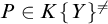 $P \in K\{Y\}^{\neq }$
, can be expressed as a polynomial in the “monomials”
$P \in K\{Y\}^{\neq }$
, can be expressed as a polynomial in the “monomials”  . Since $v(\mathfrak m_n) = \beta _n$
, item (i) then follows from the
$v(\mathfrak m_n) = \beta _n$
, item (i) then follows from the $\mathbb {Q}$
-linear independence of
$\mathbb {Q}$
-linear independence of $(\beta _n)$
over
$(\beta _n)$
over $\Gamma $
. With that done, the
$\Gamma $
. With that done, the $\mathbb {Q}$
-linear independence of
$\mathbb {Q}$
-linear independence of $(\beta _n^{\dagger })$
over
$(\beta _n^{\dagger })$
over $\Gamma $
follows from the
$\Gamma $
follows from the $\mathbb {Q}$
-linear independence of
$\mathbb {Q}$
-linear independence of $(\beta _n)_{n \geqslant 1}$
over
$(\beta _n)_{n \geqslant 1}$
over $\Gamma $
by noticing that
$\Gamma $
by noticing that $\beta _n^{\dagger } = \beta _{n+1}+\alpha _{n+2}$
, and the rest of (ii)–(iv) follows.
$\beta _n^{\dagger } = \beta _{n+1}+\alpha _{n+2}$
, and the rest of (ii)–(iv) follows.
4.3 Further consequences in the ordered setting
Now we develop further the results of the previous subsection in the pre-H-field setting. If K, L, and f are as before but additionally pre-H-fields, and M is a pre-H-field with $g \in M$
realizing the same cut in K as f, our goal is to embed
$g \in M$
realizing the same cut in K as f, our goal is to embed $K\langle f \rangle $
into M over K by sending f to g. This is accomplished in Proposition 4.15 and Lemma 4.16. The former handles the case that
$K\langle f \rangle $
into M over K by sending f to g. This is accomplished in Proposition 4.15 and Lemma 4.16. The former handles the case that $\Gamma ^<$
is cofinal in
$\Gamma ^<$
is cofinal in $\Gamma _{K\langle f \rangle }^<$
, which follows from the previous subsection by making small adjustments to the arguments for analogous results in [Reference Aschenbrenner, van den Dries and van der Hoeven5, Section 16.1]. The case that
$\Gamma _{K\langle f \rangle }^<$
, which follows from the previous subsection by making small adjustments to the arguments for analogous results in [Reference Aschenbrenner, van den Dries and van der Hoeven5, Section 16.1]. The case that $\Gamma ^<$
is not cofinal in
$\Gamma ^<$
is not cofinal in $\Gamma _{K\langle f \rangle }^<$
does not occur in that context, and here is handled in Lemma 4.16 by similar ideas.
$\Gamma _{K\langle f \rangle }^<$
does not occur in that context, and here is handled in Lemma 4.16 by similar ideas.
In the next lemma, the reader may assume without harm that K, L, and f additionally satisfy the assumptions of Lemma 4.11, but the lemma is stated in more generality to clarify which assumptions are used. In particular, it does not assume that K and L have gap $0$
or that K is
$0$
or that K is $\operatorname {d}$
-henselian. Small modifications to the proof of [Reference Aschenbrenner, van den Dries and van der Hoeven5, Lemma 16.1.4] yield the following generalization.
$\operatorname {d}$
-henselian. Small modifications to the proof of [Reference Aschenbrenner, van den Dries and van der Hoeven5, Lemma 16.1.4] yield the following generalization.
Lemma 4.14. Let K be a pre-H-field with exponential integration and let L be a pre-H-field extension of K with $\boldsymbol k_L = \boldsymbol k$
. Suppose that
$\boldsymbol k_L = \boldsymbol k$
. Suppose that $f \in L \setminus K$
and
$f \in L \setminus K$
and $b_0 \in K$
satisfy:
$b_0 \in K$
satisfy:
-
(i)
$v_L(f-K) \subseteq \Gamma _L$
has a maximum and
$v_L(f-b_0) = \max v_L(f-K)$
; -
(ii)
$\Gamma ^<$
is cofinal in
$\Gamma _{K\langle f \rangle }^<$
.


Suppose that M is a pre-H-field extension of K and $g \in M$
realizes the same cut in K as f. Then
$g \in M$
realizes the same cut in K as f. Then $v_M(g-b_0) = \max v_M(g-K) \notin \Gamma $
and
$v_M(g-b_0) = \max v_M(g-K) \notin \Gamma $
and $(g-b_0)^{\dagger }$
realizes the same cut in K as
$(g-b_0)^{\dagger }$
realizes the same cut in K as $(f-b_0)^{\dagger }$
.
$(f-b_0)^{\dagger }$
.
Proof. Let $\alpha \in \Gamma $
and
$\alpha \in \Gamma $
and $b \in K$
. First we use the convexity of
$b \in K$
. First we use the convexity of $\mathcal O_{K\langle f \rangle }$
and the cofinality assumption to show that
$\mathcal O_{K\langle f \rangle }$
and the cofinality assumption to show that
 $$\begin{align*}v_L(f-b)<\alpha \iff v_M(g-b)<\alpha \qquad \text{and} \qquad v_L(f-b)>\alpha \iff v_M(g-b)>\alpha. \end{align*}$$
To see this, take $a \in K^>$
with
$a \in K^>$
with $va = \alpha $
. Suppose that
$va = \alpha $
. Suppose that $v_L(f-b)<\alpha $
, so
$v_L(f-b)<\alpha $
, so $|f-b|>a$
. Hence
$|f-b|>a$
. Hence $|g-b|>a$
, and so
$|g-b|>a$
, and so $v_M(g-b)\leqslant \alpha $
. To get the strict inequality, use the cofinality assumption to take
$v_M(g-b)\leqslant \alpha $
. To get the strict inequality, use the cofinality assumption to take $\delta \in \Gamma $
with
$\delta \in \Gamma $
with $v_L(f-b)<\delta <\alpha $
, and thus
$v_L(f-b)<\delta <\alpha $
, and thus $v_M(g-b) \leqslant \delta < \alpha $
. One proves similarly that
$v_M(g-b) \leqslant \delta < \alpha $
. One proves similarly that $v_L(f-b)>\alpha \implies v_M(g-b)>\alpha $
. Finally, consider the case that
$v_L(f-b)>\alpha \implies v_M(g-b)>\alpha $
. Finally, consider the case that $v_L(f-b)=\alpha $
. This yields
$v_L(f-b)=\alpha $
. This yields $f-b \sim ua$
for
$f-b \sim ua$
for $u \in K$
with
$u \in K$
with $u \asymp 1$
, since
$u \asymp 1$
, since $\boldsymbol k = \boldsymbol k_L$
. Convexity yields
$\boldsymbol k = \boldsymbol k_L$
. Convexity yields $|u|a/2 < |f-b| < 2|u|a$
, so
$|u|a/2 < |f-b| < 2|u|a$
, so $|u|a/2 < |g-b| < 2|u|a$
, and thus
$|u|a/2 < |g-b| < 2|u|a$
, and thus $v_M(g-b)=va=\alpha $
, completing the proof of the displayed equivalences. Hence,
$v_M(g-b)=va=\alpha $
, completing the proof of the displayed equivalences. Hence, $v_M(g-b_0) \notin \Gamma $
, since
$v_M(g-b_0) \notin \Gamma $
, since $v_L(f-b_0) \notin \Gamma $
. This in turn yields
$v_L(f-b_0) \notin \Gamma $
. This in turn yields $v_M(g-b_0)=\max v_M(g-K)$
. It also follows that
$v_M(g-b_0)=\max v_M(g-K)$
. It also follows that $(g-b_0)^{\dagger } \notin K$
, as otherwise
$(g-b_0)^{\dagger } \notin K$
, as otherwise $(g-b_0)^{\dagger } = b^{\dagger }$
for some
$(g-b_0)^{\dagger } = b^{\dagger }$
for some $b \in K^{\times }$
, in which case
$b \in K^{\times }$
, in which case $v_M(g-b_0)=vb \in \Gamma $
.
$v_M(g-b_0)=vb \in \Gamma $
.
As written, the argument in [Reference Aschenbrenner, van den Dries and van der Hoeven5, Lemma 16.1.4] that $(g-b_0)^{\dagger }$
realizes the same cut in K as
$(g-b_0)^{\dagger }$
realizes the same cut in K as $(f-b_0)^{\dagger }$
uses that K and L are H-fields, so we give the following modified version. First, we may assume that
$(f-b_0)^{\dagger }$
uses that K and L are H-fields, so we give the following modified version. First, we may assume that $f>b_0$
, so
$f>b_0$
, so $g>b_0$
. Suppose towards a contradiction that we have
$g>b_0$
. Suppose towards a contradiction that we have $h \in K$
with
$h \in K$
with $(f-b_0)^{\dagger }<h$
and
$(f-b_0)^{\dagger }<h$
and $h<(g-b_0)^{\dagger }$
. Take
$h<(g-b_0)^{\dagger }$
. Take ${\phi \in K^>}$
with
${\phi \in K^>}$
with $h=\phi ^{\dagger }$
and set
$h=\phi ^{\dagger }$
and set  . Then we have $s>0$
and
$s>0$
and $s^{\dagger }=(f-b_0)^{\dagger }-h<0$
. Since L is a pre-H-field,
$s^{\dagger }=(f-b_0)^{\dagger }-h<0$
. Since L is a pre-H-field, $v_L(s) \geqslant 0$
by [Reference Aschenbrenner, van den Dries and van der Hoeven5, Lemma 10.5.2(i)], but since
$v_L(s) \geqslant 0$
by [Reference Aschenbrenner, van den Dries and van der Hoeven5, Lemma 10.5.2(i)], but since $v_L(f-b_0) \notin \Gamma $
, we have
$v_L(f-b_0) \notin \Gamma $
, we have $v_L(s)>0$
. Thus
$v_L(s)>0$
. Thus $0<s<1$
. Similarly,
$0<s<1$
. Similarly,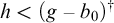 $h<(g-b_0)^{\dagger }$
gives
$h<(g-b_0)^{\dagger }$
gives  and
and $t^{\dagger }>0$
, so
$t^{\dagger }>0$
, so $v_M(t)<0$
and thus
$v_M(t)<0$
and thus $t>1$
. Putting this together yields
$t>1$
. Putting this together yields
 $$\begin{align*}f\ =\ b_0+\phi s\ <\ b_0+\phi\ \qquad \text{and}\ \qquad b_0+\phi\ <\ b_0 + \phi t\ =\ g, \end{align*}$$
contradicting that f and g realize the same cut in K. The other case, that there is $h \in K$
with
$h \in K$
with $(f-b_0)^{\dagger }>h$
and
$(f-b_0)^{\dagger }>h$
and $h>(g-b_0)^{\dagger }$
, is symmetric.
$h>(g-b_0)^{\dagger }$
, is symmetric.
The next embedding lemma follows from Lemma 4.14 in the same way that [Reference Aschenbrenner, van den Dries and van der Hoeven5, Proposition 16.1.5] follows from [Reference Aschenbrenner, van den Dries and van der Hoeven5, Lemma 16.1.4], without modification. The idea is to use Lemma 4.14 to carry out the proof of Lemma 4.13 in M and thereby construct the desired embedding.
Proposition 4.15. Let K, L, and f be as in Lemma 4.11 and suppose that $\Gamma ^<$
is cofinal in
$\Gamma ^<$
is cofinal in $\Gamma _{K\langle f \rangle }^<$
. Additionally, suppose that K and L are pre-H-fields and L is a pre-H-field extension of K with gap
$\Gamma _{K\langle f \rangle }^<$
. Additionally, suppose that K and L are pre-H-fields and L is a pre-H-field extension of K with gap $0$
. Suppose that M is a pre-H-field extension of K with gap
$0$
. Suppose that M is a pre-H-field extension of K with gap $0$
and
$0$
and $g \in M$
realizes the same cut in K as f. Then there exists an embedding
$g \in M$
realizes the same cut in K as f. Then there exists an embedding $K \langle f \rangle \to M$
over K with
$K \langle f \rangle \to M$
over K with $f \mapsto g$
.
$f \mapsto g$
.
Above we assumed that $\Gamma ^<$
was cofinal in
$\Gamma ^<$
was cofinal in $\Gamma _{K\langle f \rangle }^<$
, and now we turn to the other case, which does not occur in the H-field setting of [Reference Aschenbrenner, van den Dries and van der Hoeven5, Section 16.1].
$\Gamma _{K\langle f \rangle }^<$
, and now we turn to the other case, which does not occur in the H-field setting of [Reference Aschenbrenner, van den Dries and van der Hoeven5, Section 16.1].
Lemma 4.16. Let K be a pre-H-field and L be a pre-H-field extension of K with gap $0$
. Let
$0$
. Let $f \in L^>$
with
$f \in L^>$
with $\Gamma ^< < v_L(f) < 0$
. Suppose that M is a pre-H-field extension of K with gap
$\Gamma ^< < v_L(f) < 0$
. Suppose that M is a pre-H-field extension of K with gap $0$
and
$0$
and $g \in M^>$
satisfies
$g \in M^>$
satisfies $\Gamma ^< < v_M(g) < 0$
. Then there is an embedding
$\Gamma ^< < v_M(g) < 0$
. Then there is an embedding $K\langle f \rangle \to M$
over K with
$K\langle f \rangle \to M$
over K with $f \mapsto g$
.
$f \mapsto g$
.
Proof. Set  and
and  , and let
  . Then
 $$\begin{align*}[\Gamma^{\neq}]> [\beta_0]>[\beta_1]>[\beta_2]>\cdots>[0]. \end{align*}$$
In particular, $[\beta _n] \notin [\Gamma ]$
for all n and
$[\beta _n] \notin [\Gamma ]$
for all n and $\beta _0, \beta _1, \beta _2, \dots $
are
$\beta _0, \beta _1, \beta _2, \dots $
are $\mathbb {Q}$
-linearly independent over
$\mathbb {Q}$
-linearly independent over $\Gamma $
. Hence the vector space
$\Gamma $
. Hence the vector space $\mathbb {Q}\Gamma _{K\langle f \rangle }/\Gamma $
is infinite dimensional, so f is
$\mathbb {Q}\Gamma _{K\langle f \rangle }/\Gamma $
is infinite dimensional, so f is $\operatorname {d}$
-transcendental over K. Since
$\operatorname {d}$
-transcendental over K. Since $f=f_0$
and
$f=f_0$
and $f_n' = f_n f_{n+1}$
, induction yields
$f_n' = f_n f_{n+1}$
, induction yields $F_n \in K[Y_0, \dots , Y_n]$
of (total) degree at most
$F_n \in K[Y_0, \dots , Y_n]$
of (total) degree at most $n+1$
with
$n+1$
with $f^{(n)}=F_n(f_0, \dots , f_n)$
. Let
$f^{(n)}=F_n(f_0, \dots , f_n)$
. Let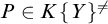 $P \in K\{Y\}^{\neq }$
of order at most r. Then
$P \in K\{Y\}^{\neq }$
of order at most r. Then $P(f)=\sum _{\boldsymbol i \in I} a_{\boldsymbol i} f_0^{i_0} \dots f_r^{i_r}$
, where I is a nonempty finite set of indices
$P(f)=\sum _{\boldsymbol i \in I} a_{\boldsymbol i} f_0^{i_0} \dots f_r^{i_r}$
, where I is a nonempty finite set of indices $\boldsymbol i=(i_0, \dots , i_r) \in \mathbb {N}^{1+r}$
. In particular,
$\boldsymbol i=(i_0, \dots , i_r) \in \mathbb {N}^{1+r}$
. In particular, $\Gamma _{K\langle f \rangle } = \Gamma \oplus \bigoplus _{n} \mathbb {Z}\beta _n$
.
$\Gamma _{K\langle f \rangle } = \Gamma \oplus \bigoplus _{n} \mathbb {Z}\beta _n$
.
Set  ,
,  , and
, and  . The same argument yields that g is $\operatorname {d}$
-transcendental over K and
$\operatorname {d}$
-transcendental over K and $P(g)=\sum _{\boldsymbol i \in I} a_{\boldsymbol i} g_0^{i_0} \dots g_r^{i_r}$
, where I is the same set of indices as in
$P(g)=\sum _{\boldsymbol i \in I} a_{\boldsymbol i} g_0^{i_0} \dots g_r^{i_r}$
, where I is the same set of indices as in $P(f)$
and
$P(f)$
and $a_{\boldsymbol i}$
are the same coefficients. Hence
$a_{\boldsymbol i}$
are the same coefficients. Hence $\Gamma _{K\langle g \rangle } = \Gamma \oplus \bigoplus _{n} \mathbb {Z}\beta _n^{*}$
. Thus we have an isomorphism of ordered abelian groups
$\Gamma _{K\langle g \rangle } = \Gamma \oplus \bigoplus _{n} \mathbb {Z}\beta _n^{*}$
. Thus we have an isomorphism of ordered abelian groups $j \colon \Gamma _{K\langle f \rangle } \to \Gamma _{K\langle g \rangle }$
with
$j \colon \Gamma _{K\langle f \rangle } \to \Gamma _{K\langle g \rangle }$
with $\beta _n \mapsto \beta _n^{*}$
. By the expressions for
$\beta _n \mapsto \beta _n^{*}$
. By the expressions for $P(f)$
and
$P(f)$
and $P(g)$
, we have
$P(g)$
, we have $j\big (v_L(P(f))\big ) = v_M(P(g))$
, which yields a valued differential field embedding from
$j\big (v_L(P(f))\big ) = v_M(P(g))$
, which yields a valued differential field embedding from $K\langle f \rangle \to M$
over K with
$K\langle f \rangle \to M$
over K with $f \mapsto g$
. To see that this is an ordered valued differential field embedding, note that
$f \mapsto g$
. To see that this is an ordered valued differential field embedding, note that $f_n>0$
and
$f_n>0$
and $g_n>0$
for all n, so
$g_n>0$
for all n, so $P(f)>0 \iff P(g)>0$
.
$P(f)>0 \iff P(g)>0$
.
5 Extending the constant field
The results of this short section are used mainly to strengthen the statement of Theorem 6.15 in the next section and play no role in the main results of Section 7. The term “residue constant closed” defined in the next paragraph, however, is used in some key lemmas of Section 6.
Assumption. In this section, K is asymptotic with small derivation.
Since $C \subseteq \mathcal O$
, C maps injectively into
$C \subseteq \mathcal O$
, C maps injectively into $\boldsymbol k$
under the residue field map, and hence into
$\boldsymbol k$
under the residue field map, and hence into $C_{\boldsymbol k}$
. We say that K is residue constant closed if K is henselian and C maps onto
$C_{\boldsymbol k}$
. We say that K is residue constant closed if K is henselian and C maps onto $C_{\boldsymbol k}$
, that is,
$C_{\boldsymbol k}$
, that is, $\operatorname {\mathrm {res}}(C)=C_{\boldsymbol k}$
. We say that L is a residue constant closure of K if it is a residue constant closed H-asymptotic extension of K with small derivation that embeds uniquely over K into every residue constant closed H-asymptotic extension M of K with small derivation. Note that if K has a residue constant closure, then it is unique up to unique isomorphism over K.
$\operatorname {\mathrm {res}}(C)=C_{\boldsymbol k}$
. We say that L is a residue constant closure of K if it is a residue constant closed H-asymptotic extension of K with small derivation that embeds uniquely over K into every residue constant closed H-asymptotic extension M of K with small derivation. Note that if K has a residue constant closure, then it is unique up to unique isomorphism over K.
Proposition 5.1. Suppose that K is pre- $\operatorname {d}$
-valued of H-type with
$\operatorname {d}$
-valued of H-type with $\sup \Psi =0$
. Then K has a residue constant closure that is an immediate extension of K.
$\sup \Psi =0$
. Then K has a residue constant closure that is an immediate extension of K.
Proof. Recall from Section 4.1 that $\sup \Psi =0 \iff (\Gamma ^>)'=\Gamma ^>$
. Also note that if L is an immediate asymptotic extension of K, then it is H-asymptotic, satisfies
$\sup \Psi =0 \iff (\Gamma ^>)'=\Gamma ^>$
. Also note that if L is an immediate asymptotic extension of K, then it is H-asymptotic, satisfies $\Psi _L=\Psi $
(in particular,
$\Psi _L=\Psi $
(in particular, $\sup \Psi _L=0$
), and is pre-
$\sup \Psi _L=0$
), and is pre- $\operatorname {d}$
-valued by [Reference Aschenbrenner, van den Dries and van der Hoeven5, Corollary 10.1.17].
$\operatorname {d}$
-valued by [Reference Aschenbrenner, van den Dries and van der Hoeven5, Corollary 10.1.17].
Build a tower of immediate asymptotic extensions of K as follows. Set  . If
. If $K_\lambda $
is not henselian, set
$K_\lambda $
is not henselian, set  , the henselization of $K_\lambda $
, which as an algebraic extension of
$K_\lambda $
, which as an algebraic extension of $K_\lambda $
is asymptotic [Reference Aschenbrenner, van den Dries and van der Hoeven5, Proposition 9.5.3]. If
$K_\lambda $
is asymptotic [Reference Aschenbrenner, van den Dries and van der Hoeven5, Proposition 9.5.3]. If $K_\lambda $
is residue constant closed, we are done, so suppose that
$K_\lambda $
is residue constant closed, we are done, so suppose that $K_\lambda $
is henselian but not residue constant closed. Then we have
$K_\lambda $
is henselian but not residue constant closed. Then we have $u \in K_\lambda $
with
$u \in K_\lambda $
with $u \asymp 1$
,
$u \asymp 1$
, $u'\prec 1$
, and
$u'\prec 1$
, and  . Let y be transcendental over $K_\lambda $
and equip
$K_\lambda $
and equip  with the unique derivation extending that of $K_\lambda $
such that
$K_\lambda $
such that $y'=u'$
. Since
$y'=u'$
. Since $\sup \Psi _{K_{\lambda }}=0$
, we have
$\sup \Psi _{K_{\lambda }}=0$
, we have $v(u') \in (\Gamma ^>)'$
, so the set
$v(u') \in (\Gamma ^>)'$
, so the set  has no maximum [Reference Aschenbrenner, van den Dries and van der Hoeven5, Lemma 10.2.5(iii)]. Thus by [Reference Aschenbrenner, van den Dries and van der Hoeven5, Lemma 10.2.4] we can equip $K_{\lambda +1}$
with the unique valuation making it an H-asymptotic extension of
$K_{\lambda +1}$
with the unique valuation making it an H-asymptotic extension of $K_\lambda $
with
$K_\lambda $
with $y \not \asymp 1$
; with this valuation,
$y \not \asymp 1$
; with this valuation, $y \prec 1$
and
$y \prec 1$
and $K_{\lambda +1}$
is an immediate extension of
$K_{\lambda +1}$
is an immediate extension of $K_{\lambda }$
. If
$K_{\lambda }$
. If $\lambda $
is a limit ordinal, set
$\lambda $
is a limit ordinal, set  . Since each extension is immediate, by Zorn’s lemma we may take a maximal such tower $(K_\lambda )_{\lambda \leqslant \mu }$
.
$(K_\lambda )_{\lambda \leqslant \mu }$
.
It is clear that $K_\mu $
is residue constant closed, and we show that it also has the desired universal property. Let M be an H-asymptotic extension of K with small derivation that is residue constant closed, and let
$K_\mu $
is residue constant closed, and we show that it also has the desired universal property. Let M be an H-asymptotic extension of K with small derivation that is residue constant closed, and let $\lambda <\mu $
and
$\lambda <\mu $
and $i \colon K_{\lambda } \to M$
be an embedding. It suffices by induction to extend i uniquely to an embedding
$i \colon K_{\lambda } \to M$
be an embedding. It suffices by induction to extend i uniquely to an embedding $K_{\lambda +1} \to M$
. If
$K_{\lambda +1} \to M$
. If $K_{\lambda +1}=K_{\lambda }^{\operatorname {\mathrm {h}}}$
, then this follows from the universal property of the henselization. Now suppose that
$K_{\lambda +1}=K_{\lambda }^{\operatorname {\mathrm {h}}}$
, then this follows from the universal property of the henselization. Now suppose that $K_{\lambda +1} = K_\lambda (y)$
with y and u as above. Take the unique
$K_{\lambda +1} = K_\lambda (y)$
with y and u as above. Take the unique $c \in C_M$
with
$c \in C_M$
with $c \sim i(u)$
and set
$c \sim i(u)$
and set  . Then $z'=i(u)'$
and
$z'=i(u)'$
and $z \prec 1$
, so by the remarks after [Reference Aschenbrenner, van den Dries and van der Hoeven5, Lemma 10.2.4], z is transcendental over
$z \prec 1$
, so by the remarks after [Reference Aschenbrenner, van den Dries and van der Hoeven5, Lemma 10.2.4], z is transcendental over $i(K_\lambda )$
, and thus mapping
$i(K_\lambda )$
, and thus mapping $y \mapsto z$
yields a differential field embedding
$y \mapsto z$
yields a differential field embedding $K_{\lambda +1} \to M$
extending i. By the uniqueness of [Reference Aschenbrenner, van den Dries and van der Hoeven5, Lemma 10.2.4], this is a valued differential field embedding. Finally, if i extends to an embedding with
$K_{\lambda +1} \to M$
extending i. By the uniqueness of [Reference Aschenbrenner, van den Dries and van der Hoeven5, Lemma 10.2.4], this is a valued differential field embedding. Finally, if i extends to an embedding with $y \mapsto z_1 \in M$
, then
$y \mapsto z_1 \in M$
, then $i(u)-z_1 \in C_M$
and
$i(u)-z_1 \in C_M$
and $i(u)-z_1 \sim i(u) \sim c$
, so
$i(u)-z_1 \sim i(u) \sim c$
, so $z_1=z$
.
$z_1=z$
.
Note that if K is a pre-H-field with $\sup \Psi =0$
, then as an immediate extension of K any residue constant closure of K embeds uniquely, as an ordered valued differential field, over K into every residue constant closed pre-H-field extension of K with small derivation.
$\sup \Psi =0$
, then as an immediate extension of K any residue constant closure of K embeds uniquely, as an ordered valued differential field, over K into every residue constant closed pre-H-field extension of K with small derivation.
The following result is worth recording but not needed later. In it, we construe an algebraic extension of a residue constant closed K as a valued differential field extension of K by equipping it with the unique derivation and valuation extending those of K (uniqueness of the valuation follows from the henselianity of K); if K is additionally an ordered field, then by henselianity $\mathcal O$
is necessarily convex.
$\mathcal O$
is necessarily convex.
Lemma 5.2. Suppose that K is residue constant closed. An algebraic extension L of K remains residue constant closed.
Proof. First, recall that an algebraic extension of a henselian valued field is henselian, and note that L is asymptotic [Reference Aschenbrenner, van den Dries and van der Hoeven5, Proposition 9.5.3] and has small derivation [Reference Aschenbrenner, van den Dries and van der Hoeven5, Proposition 6.2.1]. Let $u \in L$
with
$u \in L$
with $u \asymp 1$
and
$u \asymp 1$
and $u' \prec 1$
; we need to show that there is
$u' \prec 1$
; we need to show that there is $c \in C_{L}$
with
$c \in C_{L}$
with $c \sim u$
. Since
$c \sim u$
. Since $\overline {u} \in C_{\operatorname {\mathrm {res}}(L)}$
is algebraic over
$\overline {u} \in C_{\operatorname {\mathrm {res}}(L)}$
is algebraic over $\operatorname {\mathrm {res}}(K)$
, it is algebraic over
$\operatorname {\mathrm {res}}(K)$
, it is algebraic over $C_{\operatorname {\mathrm {res}}(K)}$
. Take a
$C_{\operatorname {\mathrm {res}}(K)}$
. Take a $P \in C[X]$
such that
$P \in C[X]$
such that $\overline {P} \in C_{\operatorname {\mathrm {res}}(K)}[X]$
is the minimum polynomial of
$\overline {P} \in C_{\operatorname {\mathrm {res}}(K)}[X]$
is the minimum polynomial of $\overline {u}$
over
$\overline {u}$
over $C_{\operatorname {\mathrm {res}}(K)}$
. Then
$C_{\operatorname {\mathrm {res}}(K)}$
. Then $P = Q\cdot \prod _{i=1}^n (X-c_i)$
, where
$P = Q\cdot \prod _{i=1}^n (X-c_i)$
, where $c_i \in C_{L}$
for
$c_i \in C_{L}$
for $i=1,\dots ,n$
and
$i=1,\dots ,n$
and $Q \in C_{L}[X]$
has no roots in
$Q \in C_{L}[X]$
has no roots in $C_{L}$
. Moreover, Q has no roots in L, so henselianity yields i with
$C_{L}$
. Moreover, Q has no roots in L, so henselianity yields i with $1 \leqslant i \leqslant n$
and
$1 \leqslant i \leqslant n$
and $\overline {c_i}=\overline {u}$
.
$\overline {c_i}=\overline {u}$
.
6 Differential-Hensel–Liouville closures
Assumption. In this section, K is a pre-H-field.
In this section we construct differential-Hensel–Liouville closures (Theorem 6.16) in analogy with the Newton–Liouville closures of [Reference Aschenbrenner, van den Dries and van der Hoeven5, Section 14.5] and prove that they are unique (Corollary 6.18). To do this, we first construct extensions that are real closed, have exponential integration, and satisfy an embedding property (Corollary 6.11, Lemma 6.14), in analogy with the Liouville closures of [Reference Aschenbrenner and van den Dries4]; however, we use [Reference Aschenbrenner, van den Dries and van der Hoeven5, Section 10.6] as a reference and also adapt some preliminaries from [Reference Aschenbrenner, van den Dries and van der Hoeven5, Sections 10.4–10.6]. Combining this with the residue constant closures from the previous section, we record in Theorem 6.15 an improvement that is not needed later.
Suppose momentarily that K has gap $0$
. In several results below, it is assumed that
$0$
. In several results below, it is assumed that $\boldsymbol k$
has exponential integration. It is worth noting that if K has exponential integration, then so does
$\boldsymbol k$
has exponential integration. It is worth noting that if K has exponential integration, then so does $\boldsymbol k$
. Hence, the assumption that
$\boldsymbol k$
. Hence, the assumption that $\boldsymbol k$
has exponential integration is necessary for K to have an extension with exponential integration and the same ordered differential residue field.
$\boldsymbol k$
has exponential integration is necessary for K to have an extension with exponential integration and the same ordered differential residue field.
6.1 Adjoining exponential integrals
Suppose that $s \in K \setminus (K^{\times })^{\dagger }$
and f is transcendental over K. We give
$s \in K \setminus (K^{\times })^{\dagger }$
and f is transcendental over K. We give $K(f)$
the unique derivation extending that of K with
$K(f)$
the unique derivation extending that of K with $f^{\dagger } = s$
. In the first lemma, K need only be an ordered differential field.
$f^{\dagger } = s$
. In the first lemma, K need only be an ordered differential field.
Lemma 6.1. If K is real closed and $K(f)$
can be ordered making it an ordered field extension of K, then
$K(f)$
can be ordered making it an ordered field extension of K, then $C_{K(f)} = C$
.
$C_{K(f)} = C$
.
Proof. Suppose towards a contradiction that we have $y \in K^{\times }$
and
$y \in K^{\times }$
and $m \geqslant 1$
with
$m \geqslant 1$
with $y^{\dagger } = ms$
. Then by taking a
$y^{\dagger } = ms$
. Then by taking a $z \in K^{\times }$
with
$z \in K^{\times }$
with $z^m=y$
, after arranging
$z^m=y$
, after arranging $y>0$
if necessary, we have
$y>0$
if necessary, we have $z^{\dagger }=s$
, a contradiction. Thus [Reference Aschenbrenner, van den Dries and van der Hoeven5, Lemma 4.6.11] (with
$z^{\dagger }=s$
, a contradiction. Thus [Reference Aschenbrenner, van den Dries and van der Hoeven5, Lemma 4.6.11] (with $R=K$
,
$R=K$
, $r=s$
, and
$r=s$
, and $x=f$
) and [Reference Aschenbrenner, van den Dries and van der Hoeven5, Corollary 4.6.12] (with
$x=f$
) and [Reference Aschenbrenner, van den Dries and van der Hoeven5, Corollary 4.6.12] (with $R=K[f, f^{-1}]$
) yield that
$R=K[f, f^{-1}]$
) yield that $C_{K(f)}$
is algebraic over C, so
$C_{K(f)}$
is algebraic over C, so $C_{K(f)} = C$
.
$C_{K(f)} = C$
.
In the next two lemmas, K is just a valued differential field, and need not be ordered. The first is based on [Reference Aschenbrenner, van den Dries and van der Hoeven5, Lemma 10.4.2].
Lemma 6.2. Suppose that K has small derivation and $\boldsymbol k = (\boldsymbol k^{\times })^{\dagger }$
. Let
$\boldsymbol k = (\boldsymbol k^{\times })^{\dagger }$
. Let $K(f)$
have a valuation that makes it an extension of K with
$K(f)$
have a valuation that makes it an extension of K with $\Gamma _{K(f)} = \Gamma $
and
$\Gamma _{K(f)} = \Gamma $
and  . Then $s-a^{\dagger } \prec 1$
for some
$s-a^{\dagger } \prec 1$
for some $a \in K^{\times }$
.
$a \in K^{\times }$
.
Proof. Since $vf \in \Gamma $
, there is
$vf \in \Gamma $
, there is $b \in K^{\times }$
with
$b \in K^{\times }$
with  . Then $s-b^{\dagger } = g^{\dagger } \asymp g' \preccurlyeq 1$
. If
$s-b^{\dagger } = g^{\dagger } \asymp g' \preccurlyeq 1$
. If $s-b^{\dagger } \prec 1$
, set
$s-b^{\dagger } \prec 1$
, set  . If
. If $s-b^{\dagger } \asymp 1$
, since
$s-b^{\dagger } \asymp 1$
, since $\boldsymbol k = (\boldsymbol k^{\times })^{\dagger }$
, we have
$\boldsymbol k = (\boldsymbol k^{\times })^{\dagger }$
, we have $u \asymp 1$
in
$u \asymp 1$
in $K^{\times }$
with
$K^{\times }$
with $s-b^{\dagger } \sim u^{\dagger }$
. Then set
$s-b^{\dagger } \sim u^{\dagger }$
. Then set  .
.
The last part of the previous argument also yields the following useful fact.
Lemma 6.3. Suppose that K has small derivation and $\boldsymbol k = (\boldsymbol k^{\times })^{\dagger }$
. If
$\boldsymbol k = (\boldsymbol k^{\times })^{\dagger }$
. If $s-a^{\dagger } \succcurlyeq 1$
for all
$s-a^{\dagger } \succcurlyeq 1$
for all $a \in K^{\times }$
, then
$a \in K^{\times }$
, then $s-a^{\dagger } \succ 1$
for all
$s-a^{\dagger } \succ 1$
for all $a \in K^{\times }$
.
$a \in K^{\times }$
.
Now we return to the situation that K is a pre-H-field.
Lemma 6.4 [Reference Aschenbrenner, van den Dries and van der Hoeven5, Lemma 10.5.18]
Suppose that K is henselian and $vs \in (\Gamma ^>)'$
. Then there is a unique valuation on
$vs \in (\Gamma ^>)'$
. Then there is a unique valuation on $K(f)$
making it an H-asymptotic extension of K with
$K(f)$
making it an H-asymptotic extension of K with $f \sim 1$
. With this valuation,
$f \sim 1$
. With this valuation, $K(f)$
is an immediate extension of K, so there is a unique ordering of
$K(f)$
is an immediate extension of K, so there is a unique ordering of $K(f)$
making it a pre-H-field extension of K.
$K(f)$
making it a pre-H-field extension of K.
Here is a pre-H-field version of [Reference Aschenbrenner, van den Dries and van der Hoeven5, Lemma 10.5.20] with the same proof; the assumption there that K is an H-field (rather than a pre-H-field) is only used at the end of the proof in showing that L too is an H-field. Recall that $\Psi ^{\downarrow }$
is the downward closure of
$\Psi ^{\downarrow }$
is the downward closure of $\Psi $
in
$\Psi $
in $\Gamma $
.
$\Gamma $
.
Lemma 6.5. Suppose that K is real closed, $s<0$
, and
$s<0$
, and $v(s-a^{\dagger }) \in \Psi ^{\downarrow }$
for all
$v(s-a^{\dagger }) \in \Psi ^{\downarrow }$
for all ${a \in K^{\times }}$
. Then there is a unique pair of a field ordering and a valuation on
${a \in K^{\times }}$
. Then there is a unique pair of a field ordering and a valuation on  making it a pre-H-field extension of K with $f>0$
. Moreover, we have:
$f>0$
. Moreover, we have:
-
(i)
$vf \notin \Gamma $
,
$\Gamma _L = \Gamma \oplus \mathbb {Z} vf$
,
$f \prec 1$
; -
(ii)
$\Psi $
is cofinal in ; -
(iii) a gap in K remains a gap in L;
-
(iv) if L has a gap not in
$\Gamma $
, then
$[\Gamma _L]=[\Gamma ]$
; -
(v)
$\boldsymbol k_L = \boldsymbol k$
.


 ;
;


6.2 Exponential integration closures
Let E be a differential field. We call a differential field extension F of E an exponential integration extension of E (expint-extension for short) if $C_F$
is algebraic over
$C_F$
is algebraic over $C_E$
and for every
$C_E$
and for every $a \in F$
there are
$a \in F$
there are $t_1, \dots , t_n \in F^{\times }$
with
$t_1, \dots , t_n \in F^{\times }$
with $a \in E(t_1, \dots , t_n)$
such that for
$a \in E(t_1, \dots , t_n)$
such that for $i=1,\dots ,n$
, either
$i=1,\dots ,n$
, either $t_i$
is algebraic over
$t_i$
is algebraic over $E(t_1,\dots ,t_{i-1})$
or
$E(t_1,\dots ,t_{i-1})$
or $t_i^{\dagger } \in E(t_1,\dots ,t_{i-1})$
. In particular, any expint-extension is
$t_i^{\dagger } \in E(t_1,\dots ,t_{i-1})$
. In particular, any expint-extension is $\operatorname {d}$
-algebraic. The following is routine.
$\operatorname {d}$
-algebraic. The following is routine.
Lemma 6.6. Let $E \subseteq F \subseteq M$
be a chain of differential field extensions.
$E \subseteq F \subseteq M$
be a chain of differential field extensions.
-
(i) If M is an expint-extension of E, then M is an expint-extension of F;
-
(ii) If M is an expint-extension of F and F is an expint-extension of E, then M is an expint-extension of E.
Lemma 6.7. If F is an expint-extension of E, then $|F|=|E|$
.
$|F|=|E|$
.
Proof. Supposing that F is an expint-extension of E, define an increasing sequence of differential subfields of F by setting  and
and $E_{n+1}$
to be the algebraic closure of
$E_{n+1}$
to be the algebraic closure of $E_n$
in F when n is even and
$E_n$
in F when n is even and  when n is odd. Clearly, $F = \bigcup _n E_n$
, so it remains to check by induction that
$F = \bigcup _n E_n$
, so it remains to check by induction that $|E_n|=|E|$
for all n.
$|E_n|=|E|$
for all n.
Now suppose that E is an ordered differential field. We call E exponential integration closed (expint-closed for short) if it is real closed and has exponential integration. We call an ordered differential field extension F of E an exponential integration closure (expint-closure for short) of E if it is an expint-extension of E that is expint-closed. Note that in this latter definition, “closure” does not include a universal property, unlike for instance the gap-closures of Section 4.1.
The next observation has the same proof as [Reference Aschenbrenner, van den Dries and van der Hoeven5, Lemma 10.6.9].
Lemma 6.8. If E is expint-closed, then E has no proper expint-extension with the same constants as E.
Assumption. For the rest of this subsection, suppose that K has gap $0$
.
$0$
.
From this assumption it follows that $(\Gamma ^>)'=\Gamma ^>$
and
$(\Gamma ^>)'=\Gamma ^>$
and $\Psi ^{\downarrow } = \Gamma ^<$
(see Section 4.1).
$\Psi ^{\downarrow } = \Gamma ^<$
(see Section 4.1).
Below, we construe the real closure $K^{\operatorname {rc}}$
of K as an ordered valued differential field by equipping it with the unique derivation extending that of K and the unique valuation extending that of K whose valuation ring is convex (see for example [Reference Aschenbrenner, van den Dries and van der Hoeven5, Corollary 3.5.18]). Then
$K^{\operatorname {rc}}$
of K as an ordered valued differential field by equipping it with the unique derivation extending that of K and the unique valuation extending that of K whose valuation ring is convex (see for example [Reference Aschenbrenner, van den Dries and van der Hoeven5, Corollary 3.5.18]). Then $\Gamma _{K^{\operatorname {rc}}}$
is the divisible hull
$\Gamma _{K^{\operatorname {rc}}}$
is the divisible hull $\mathbb {Q}\Gamma $
of
$\mathbb {Q}\Gamma $
of $\Gamma $
,
$\Gamma $
, $\boldsymbol k_{K^{\operatorname {rc}}}$
is the real closure of
$\boldsymbol k_{K^{\operatorname {rc}}}$
is the real closure of $\boldsymbol k$
, and
$\boldsymbol k$
, and $C_{K^{\operatorname {rc}}}$
is the real closure of C. Since K is a pre-H-field, so is
$C_{K^{\operatorname {rc}}}$
is the real closure of C. Since K is a pre-H-field, so is $K^{\operatorname {rc}}$
by [Reference Aschenbrenner, van den Dries and van der Hoeven5, Proposition 10.5.4], and it also has gap
$K^{\operatorname {rc}}$
by [Reference Aschenbrenner, van den Dries and van der Hoeven5, Proposition 10.5.4], and it also has gap $0$
(see Section 4.1 for details on the extensions of the asymptotic couples).
$0$
(see Section 4.1 for details on the extensions of the asymptotic couples).
Definition. We call a strictly increasing chain $(K_\lambda )_{\lambda \leqslant \mu }$
of pre-H-fields with gap
$(K_\lambda )_{\lambda \leqslant \mu }$
of pre-H-fields with gap $0$
an expint-tower on K if:
$0$
an expint-tower on K if:
-
(1)
$K_0=K$
; -
(2) if
$\lambda $
is a limit ordinal, then
$K_{\lambda } = \bigcup _{\rho <\lambda } K_\rho $
; -
(3) if
$\lambda <\lambda +1\leqslant \mu $
, then either:-
(a)
$K_\lambda $
is not real closed and
$K_{\lambda +1}$
is the real closure of
$K_\lambda $
; or -
(b)
$K_\lambda $
is real closed and
$K_{\lambda +1}=K_{\lambda }(y_\lambda )$
with
$y_\lambda \notin K_\lambda $
satisfying either:-
(b1)
$y_\lambda ^{\dagger } = s_\lambda \in K_\lambda $
with
$y_\lambda \sim 1$
,
$s_\lambda \prec 1$
, and
$s_\lambda \neq a^{\dagger }$
for all
$a \in K_\lambda ^{\times }$
; or -
(b2)
$y_\lambda ^{\dagger } = s_\lambda \in K_\lambda $
with
$s_\lambda <0$
,
$y_\lambda>0$
, and
$s_\lambda -a^{\dagger } \succ 1$
for all
$a \in K_\lambda ^{\times }$
.
-
-


Given such a tower, we call $K_{\mu }$
its top and set
$K_{\mu }$
its top and set  and
and  for
for $\lambda \leqslant \mu $
.
$\lambda \leqslant \mu $
.
Lemma 6.9. Let $(K_\lambda )_{\lambda \leqslant \mu }$
be an expint-tower on K. Then:
$(K_\lambda )_{\lambda \leqslant \mu }$
be an expint-tower on K. Then:
-
(i)
$K_\mu $
is an expint-extension of K; -
(ii)
$C_\mu $
is the real closure of C if
$\mu>0$
; -
(iii)
$\boldsymbol k_\mu $
is the real closure of
$\boldsymbol k$
if
$\mu>0$
; -
(iv)
$|K_\lambda |=|K|$
, and hence
$\mu <|K|^+$
.


Proof. For (i), go by induction on $\lambda \leqslant \mu $
. The main thing to check is the condition on the constant fields. If
$\lambda \leqslant \mu $
. The main thing to check is the condition on the constant fields. If $\lambda =0$
or
$\lambda =0$
or $\lambda $
is a limit ordinal, this is clear. If
$\lambda $
is a limit ordinal, this is clear. If $K_{\lambda +1}$
is the real closure of
$K_{\lambda +1}$
is the real closure of $K_\lambda $
, then
$K_\lambda $
, then $C_{\lambda +1}$
is the real closure of
$C_{\lambda +1}$
is the real closure of $C_{\lambda }$
. If
$C_{\lambda }$
. If $K_\lambda $
is real closed and
$K_\lambda $
is real closed and $K_{\lambda +1}$
is as in (b) above, then
$K_{\lambda +1}$
is as in (b) above, then $C_{\lambda +1}=C_{\lambda }$
by Lemma 6.1.
$C_{\lambda +1}=C_{\lambda }$
by Lemma 6.1.
For (ii), $C_1$
is the real closure of C, and then
$C_1$
is the real closure of C, and then $C_\lambda =C_1$
for all
$C_\lambda =C_1$
for all $\lambda \geqslant 1$
as in the proof of (i).
$\lambda \geqslant 1$
as in the proof of (i).
For (iii), $\boldsymbol k_1$
is the real closure of
$\boldsymbol k_1$
is the real closure of $\boldsymbol k$
, and then
$\boldsymbol k$
, and then $\boldsymbol k_\lambda = \boldsymbol k_1$
for all
$\boldsymbol k_\lambda = \boldsymbol k_1$
for all $\lambda \geqslant 1$
; in case (a) this is obvious, in case (b1) Lemma 6.4 applies, and in case (b2) Lemma 6.5 applies.
$\lambda \geqslant 1$
; in case (a) this is obvious, in case (b1) Lemma 6.4 applies, and in case (b2) Lemma 6.5 applies.
Finally, (iv) follows from (i) and Lemma 6.7.
Lemma 6.10. Let L be the top of a maximal expint-tower on K such that $\boldsymbol k_L$
has exponential integration. Then L is an expint-closure of K.
$\boldsymbol k_L$
has exponential integration. Then L is an expint-closure of K.
Proof. Suppose that L is not expint-closed. If L is not real closed, then its real closure is a proper pre-H-field extension of L with gap $0$
, so we could extend the expint-tower. We are left with the case that L is real closed and we have
$0$
, so we could extend the expint-tower. We are left with the case that L is real closed and we have $s \in L \setminus (L^{\times })^{\dagger }$
. In particular, L is henselian. We may assume that
$s \in L \setminus (L^{\times })^{\dagger }$
. In particular, L is henselian. We may assume that $s<0$
. Take f transcendental over L with
$s<0$
. Take f transcendental over L with $f^{\dagger } = s$
.
$f^{\dagger } = s$
.
First suppose that $s-a^{\dagger } \prec 1$
for some
$s-a^{\dagger } \prec 1$
for some $a \in L^{\times }$
. Then taking such an a and replacing f and s by
$a \in L^{\times }$
. Then taking such an a and replacing f and s by $f/a$
and
$f/a$
and $s-a^{\dagger }$
, we arrange that
$s-a^{\dagger }$
, we arrange that $s \prec 1$
. Giving
$s \prec 1$
. Giving $L(f)$
the valuation and ordering from Lemma 6.4 makes it a pre-H-field extension of L with gap
$L(f)$
the valuation and ordering from Lemma 6.4 makes it a pre-H-field extension of L with gap $0$
of type (b1).
$0$
of type (b1).
Now suppose that $s-a^{\dagger } \succcurlyeq 1$
for all
$s-a^{\dagger } \succcurlyeq 1$
for all $a \in L^{\times }$
. By Lemma 6.3,
$a \in L^{\times }$
. By Lemma 6.3, $s-a^{\dagger } \succ 1$
for all
$s-a^{\dagger } \succ 1$
for all $a \in L^{\times }$
. Then giving
$a \in L^{\times }$
. Then giving $L(f)$
the ordering and valuation from Lemma 6.5 makes it a pre-H-field extension of L with gap
$L(f)$
the ordering and valuation from Lemma 6.5 makes it a pre-H-field extension of L with gap $0$
of type (b2).
$0$
of type (b2).
Thus L is expint-closed, and hence an expint-closure of K by Lemma 6.9(i).
Recall from Section 5 the term “residue constant closed.” In a few arguments below, this property roughly plays the same role as “ $\operatorname {d}$
-valued” does in the construction of Liouville closures in [Reference Aschenbrenner, van den Dries and van der Hoeven5, Section 10.6].
$\operatorname {d}$
-valued” does in the construction of Liouville closures in [Reference Aschenbrenner, van den Dries and van der Hoeven5, Section 10.6].
Corollary 6.11. Suppose that $\boldsymbol k$
is expint-closed. Then K has an expint-closure that is a pre-H-field extension of K with gap
$\boldsymbol k$
is expint-closed. Then K has an expint-closure that is a pre-H-field extension of K with gap $0$
. If K is residue constant closed, then K has a residue constant closed expint-closure that is a pre-H-field extension of K with gap
$0$
. If K is residue constant closed, then K has a residue constant closed expint-closure that is a pre-H-field extension of K with gap $0$
.
$0$
.
Proof. By Lemma 6.9(iv), Zorn gives a maximal expint-tower $(K_\lambda )_{\lambda \leqslant \mu }$
on K. Then
$(K_\lambda )_{\lambda \leqslant \mu }$
on K. Then $\boldsymbol k_\mu = \boldsymbol k$
by Lemma 6.9(iii), so
$\boldsymbol k_\mu = \boldsymbol k$
by Lemma 6.9(iii), so $C_{\boldsymbol k_\mu }=C_{\boldsymbol k}$
, and
$C_{\boldsymbol k_\mu }=C_{\boldsymbol k}$
, and $C_{\mu }=C$
by Lemma 6.9(ii). Hence
$C_{\mu }=C$
by Lemma 6.9(ii). Hence $K_\mu $
is an expint-closure of K by Lemma 6.10. If K is residue constant closed, then so is
$K_\mu $
is an expint-closure of K by Lemma 6.10. If K is residue constant closed, then so is $K_\mu $
since it is real closed, so henselian, and
$K_\mu $
since it is real closed, so henselian, and $C=C_{\mu }$
maps onto
$C=C_{\mu }$
maps onto $C_{\boldsymbol k} = C_{\boldsymbol k_\mu }$
.
$C_{\boldsymbol k} = C_{\boldsymbol k_\mu }$
.
Lemma 6.12. Let M be a residue constant closed, expint-closed pre-H-field extension of K with gap $0$
. Suppose that
$0$
. Suppose that $(K_\lambda )_{\lambda \leqslant \mu }$
is an expint-tower on K in M (i.e., each
$(K_\lambda )_{\lambda \leqslant \mu }$
is an expint-tower on K in M (i.e., each $K_\lambda $
is a pre-H-subfield of M) and maximal in M (i.e., it cannot be extended to an expint-tower
$K_\lambda $
is a pre-H-subfield of M) and maximal in M (i.e., it cannot be extended to an expint-tower $(K_\lambda )_{\lambda \leqslant \mu +1}$
on K in M) such that
$(K_\lambda )_{\lambda \leqslant \mu +1}$
on K in M) such that $\boldsymbol k_\mu $
has exponential integration. Then
$\boldsymbol k_\mu $
has exponential integration. Then $(K_\lambda )_{\lambda \leqslant \mu }$
is a maximal expint-tower on K.
$(K_\lambda )_{\lambda \leqslant \mu }$
is a maximal expint-tower on K.
Proof. Since M is real closed, $K_\mu $
must be real closed by maximality in M. So supposing
$K_\mu $
must be real closed by maximality in M. So supposing $(K_\lambda )_{\lambda \leqslant \mu }$
is not a maximal expint-tower on K, we have
$(K_\lambda )_{\lambda \leqslant \mu }$
is not a maximal expint-tower on K, we have $s_\mu \in K_\mu $
such that
$s_\mu \in K_\mu $
such that $s_\mu \neq a^{\dagger }$
for all
$s_\mu \neq a^{\dagger }$
for all $a \in K_\mu ^{\times }$
; we may assume that
$a \in K_\mu ^{\times }$
; we may assume that $s_\mu <0$
. Since M is expint-closed, we have
$s_\mu <0$
. Since M is expint-closed, we have $y_\mu \in M$
with
$y_\mu \in M$
with $y_\mu ^{\dagger }=s_\mu $
; we may assume that
$y_\mu ^{\dagger }=s_\mu $
; we may assume that $y_\mu>0$
.
$y_\mu>0$
.
First suppose that $s_\mu -a^{\dagger } \succcurlyeq 1$
for all
$s_\mu -a^{\dagger } \succcurlyeq 1$
for all $a \in K_\mu ^{\times }$
, so actually
$a \in K_\mu ^{\times }$
, so actually $s_\mu -a^{\dagger } \succ 1$
for all
$s_\mu -a^{\dagger } \succ 1$
for all $a \in K_\mu ^{\times }$
by Lemma 6.3. Thus setting
$a \in K_\mu ^{\times }$
by Lemma 6.3. Thus setting  yields an extension of $(K_\lambda )_{\lambda \leqslant \mu }$
in M of type (b2).
$(K_\lambda )_{\lambda \leqslant \mu }$
in M of type (b2).
Now suppose that $s_\mu -a^{\dagger } \prec 1$
for some
$s_\mu -a^{\dagger } \prec 1$
for some $a \in K_\mu ^{\times }$
. Taking such an a and replacing
$a \in K_\mu ^{\times }$
. Taking such an a and replacing $s_\mu $
and
$s_\mu $
and $y_\mu $
by
$y_\mu $
by $s_\mu -a^{\dagger }$
and
$s_\mu -a^{\dagger }$
and $y_\mu /a$
, we may assume that
$y_\mu /a$
, we may assume that $s_\mu \prec 1$
. Since M has gap
$s_\mu \prec 1$
. Since M has gap $0$
, we have
$0$
, we have $y_\mu \asymp 1$
and so
$y_\mu \asymp 1$
and so $y_\mu ' \asymp s_\mu \prec 1$
. That is,
$y_\mu ' \asymp s_\mu \prec 1$
. That is, $\overline {y_\mu } \in C_{\operatorname {\mathrm {res}}(M)}$
, so we have
$\overline {y_\mu } \in C_{\operatorname {\mathrm {res}}(M)}$
, so we have $c \in C_M$
with
$c \in C_M$
with $y_\mu \sim c$
. Replacing
$y_\mu \sim c$
. Replacing $y_\mu $
by
$y_\mu $
by $y_\mu /c$
, we obtain the desired extension of
$y_\mu /c$
, we obtain the desired extension of $(K_\lambda )_{\lambda \leqslant \mu }$
in M of type (b1).
$(K_\lambda )_{\lambda \leqslant \mu }$
in M of type (b1).
This comment is not used later, but in the above lemma, we can replace the assumption that M is residue constant closed (so $C_{\operatorname {\mathrm {res}}(M)} = \operatorname {\mathrm {res}}(C_{M})$
) with
$C_{\operatorname {\mathrm {res}}(M)} = \operatorname {\mathrm {res}}(C_{M})$
) with $C_{\operatorname {\mathrm {res}}(M)} = C_{\operatorname {\mathrm {res}}(K)}$
. In the final argument, instead of
$C_{\operatorname {\mathrm {res}}(M)} = C_{\operatorname {\mathrm {res}}(K)}$
. In the final argument, instead of $c \in C_M$
we have
$c \in C_M$
we have $u \in K$
with
$u \in K$
with $u \asymp 1$
and
$u \asymp 1$
and $u' \prec 1$
, so we also replace
$u' \prec 1$
, so we also replace $s_\mu $
with
$s_\mu $
with $s_\mu -u^{\dagger }$
.
$s_\mu -u^{\dagger }$
.
Corollary 6.13. Suppose that L is an expint-closed pre-H-field extension of K.
-
(i) If L is an expint-closure of K, then no proper differential subfield of L containing K is expint-closed.
-
(ii) Suppose that
$\boldsymbol k$
is expint-closed, and that L has gap
$0$
and is residue constant closed. If no proper differential subfield of L containing K is expint-closed, then L is an expint-closure of K.


Proof. For (i), if L is an expint-closure of K, then no proper differential subfield of L containing K is expint-closed by Lemmas 6.6 and 6.8.
For (ii), suppose that no proper differential subfield of L containing K is expint-closed. Take an expint-tower $(K_\lambda )_{\lambda \leqslant \mu }$
on K in L that is maximal in L. Since
$(K_\lambda )_{\lambda \leqslant \mu }$
on K in L that is maximal in L. Since $\boldsymbol k$
is real closed,
$\boldsymbol k$
is real closed, $\boldsymbol k_\mu =\boldsymbol k$
, and hence
$\boldsymbol k_\mu =\boldsymbol k$
, and hence $\boldsymbol k_\mu $
has exponential integration. Then
$\boldsymbol k_\mu $
has exponential integration. Then $(K_\lambda )_{\lambda \leqslant \mu }$
is a maximal expint-tower on K by Lemma 6.12. By Lemma 6.10,
$(K_\lambda )_{\lambda \leqslant \mu }$
is a maximal expint-tower on K by Lemma 6.12. By Lemma 6.10, $K_\mu $
is expint-closed and hence equal to L.
$K_\mu $
is expint-closed and hence equal to L.
Lemma 6.14. Let $(K_\lambda )_{\lambda \leqslant \mu }$
be an expint-tower on K. Then any embedding of K into a residue constant closed, expint-closed pre-H-field extension M of K with gap
$(K_\lambda )_{\lambda \leqslant \mu }$
be an expint-tower on K. Then any embedding of K into a residue constant closed, expint-closed pre-H-field extension M of K with gap $0$
extends to an embedding of
$0$
extends to an embedding of $K_\mu $
. If K is residue constant closed and
$K_\mu $
. If K is residue constant closed and $\boldsymbol k$
is expint-closed, then any two residue constant closed expint-closures of K that are pre-H-field extensions of K with gap
$\boldsymbol k$
is expint-closed, then any two residue constant closed expint-closures of K that are pre-H-field extensions of K with gap $0$
are isomorphic over K.
$0$
are isomorphic over K.
Proof. Let M be a residue constant closed, expint-closed pre-H-field with gap $0$
. We prove that for
$0$
. We prove that for $\lambda <\mu $
any embedding
$\lambda <\mu $
any embedding $K_\lambda \to M$
extends to an embedding
$K_\lambda \to M$
extends to an embedding ${K_{\lambda +1} \to M}$
, which yields the result by induction. Suppose that
${K_{\lambda +1} \to M}$
, which yields the result by induction. Suppose that $i \colon K_\lambda \to M$
is an embedding. If
$i \colon K_\lambda \to M$
is an embedding. If $K_{\lambda +1}$
is the real closure of
$K_{\lambda +1}$
is the real closure of $K_\lambda $
, then we may extend i to
$K_\lambda $
, then we may extend i to $K_{\lambda +1}$
.
$K_{\lambda +1}$
.
So suppose that $K_\lambda $
is real closed and we have
$K_\lambda $
is real closed and we have $s_\lambda \in K_{\lambda }$
and
$s_\lambda \in K_{\lambda }$
and $y_\lambda \in K_{\lambda +1}\setminus K_{\lambda }$
with
$y_\lambda \in K_{\lambda +1}\setminus K_{\lambda }$
with $K_{\lambda +1}=K_{\lambda }(y_\lambda )$
,
$K_{\lambda +1}=K_{\lambda }(y_\lambda )$
, $y_\lambda ^{\dagger } = s_\lambda $
,
$y_\lambda ^{\dagger } = s_\lambda $
, $y_\lambda \sim 1$
,
$y_\lambda \sim 1$
, $s_\lambda \prec 1$
, and
$s_\lambda \prec 1$
, and $s_\lambda \neq a^{\dagger }$
for all
$s_\lambda \neq a^{\dagger }$
for all $a \in K_\lambda ^{\times }$
. Take
$a \in K_\lambda ^{\times }$
. Take $z \in M$
with
$z \in M$
with $z^{\dagger } = i(s_\lambda )$
. Hence
$z^{\dagger } = i(s_\lambda )$
. Hence $z \asymp 1$
and
$z \asymp 1$
and $\overline {z} \in C_{\operatorname {\mathrm {res}}(M)}$
, so we have
$\overline {z} \in C_{\operatorname {\mathrm {res}}(M)}$
, so we have $c \in C_M$
with
$c \in C_M$
with $z \sim c$
. By the uniqueness of Lemma 6.4, we may extend i to an embedding of
$z \sim c$
. By the uniqueness of Lemma 6.4, we may extend i to an embedding of $K_\lambda (y_\lambda )$
into M sending
$K_\lambda (y_\lambda )$
into M sending $y_\lambda $
to
$y_\lambda $
to $z/c$
.
$z/c$
.
Now suppose that $K_\lambda $
is real closed and we have
$K_\lambda $
is real closed and we have $s_\lambda \in K_\lambda $
and
$s_\lambda \in K_\lambda $
and $y_\lambda \in K_{\lambda +1}\setminus K_\lambda $
with
$y_\lambda \in K_{\lambda +1}\setminus K_\lambda $
with $K_{\lambda +1}=K_{\lambda }(y_\lambda )$
,
$K_{\lambda +1}=K_{\lambda }(y_\lambda )$
, $y_\lambda ^{\dagger } = s_\lambda $
,
$y_\lambda ^{\dagger } = s_\lambda $
, $s_\lambda <0$
,
$s_\lambda <0$
, $y_\lambda>0$
, and
$y_\lambda>0$
, and $s_\lambda -a^{\dagger } \succ 1$
for all
$s_\lambda -a^{\dagger } \succ 1$
for all $a \in K^{\times }_\lambda $
. Take
$a \in K^{\times }_\lambda $
. Take $z \in M$
with
$z \in M$
with $z^{\dagger } = i(s_\lambda )$
; we may assume that
$z^{\dagger } = i(s_\lambda )$
; we may assume that $z>0$
. Then by the uniqueness of Lemma 6.5, we can extend i to an embedding of
$z>0$
. Then by the uniqueness of Lemma 6.5, we can extend i to an embedding of $K_\lambda (y_\lambda )$
into M sending
$K_\lambda (y_\lambda )$
into M sending $y_\lambda $
to z.
$y_\lambda $
to z.
The second statement follows from the first by Corollary 6.13(i) and the proof of Corollary 6.11.
Combining these results with Proposition 5.1 yields the following theorem, although for the construction of differential-Hensel–Liouville closures in Theorem 6.16, Corollary 6.11 and Lemma 6.14 already suffice.
Theorem 6.15. Suppose that $\boldsymbol k$
is expint-closed. Then K has a pre-H-field extension L with gap
$\boldsymbol k$
is expint-closed. Then K has a pre-H-field extension L with gap $0$
such that:
$0$
such that:
-
(i) L is a residue constant closed, expint-closed extension of K;
-
(ii) L embeds over K into any residue constant closed, expint-closed pre-H-field extension of K with gap
$0$
; -
(iii) L has no proper differential subfield containing K that is residue constant closed and expint-closed.

Proof. By Proposition 5.1, let $K_0$
be the residue constant closure of K. Taking the top of a maximal expint-tower on
$K_0$
be the residue constant closure of K. Taking the top of a maximal expint-tower on $K_0$
yields an expint-closure L of
$K_0$
yields an expint-closure L of $K_0$
that is residue constant closed as in Corollary 6.11. For (ii), let M be a pre-H-field extension of K with gap
$K_0$
that is residue constant closed as in Corollary 6.11. For (ii), let M be a pre-H-field extension of K with gap $0$
that is residue constant closed and expint-closed. Then
$0$
that is residue constant closed and expint-closed. Then $K_0$
embeds uniquely into M over K, so by Lemma 6.14 we can extend this to an embedding of L. For (iii), suppose that
$K_0$
embeds uniquely into M over K, so by Lemma 6.14 we can extend this to an embedding of L. For (iii), suppose that $L_0 \supseteq K$
is a differential subfield of L that is residue constant closed and expint-closed. Then
$L_0 \supseteq K$
is a differential subfield of L that is residue constant closed and expint-closed. Then $L_0 \supseteq K_0$
, and hence
$L_0 \supseteq K_0$
, and hence $L_0=L$
by Corollary 6.13(i).
$L_0=L$
by Corollary 6.13(i).
Let L be as above. Then any pre-H-field extension of K with gap $0$
satisfying (i) and (ii) is isomorphic to L over K by (iii). Also, L is a Liouville extensionFootnote
2
of K, since
$0$
satisfying (i) and (ii) is isomorphic to L over K by (iii). Also, L is a Liouville extensionFootnote
2
of K, since $K_0$
is a Liouville extension of K by construction and expint-extensions are Liouville extensions.
$K_0$
is a Liouville extension of K by construction and expint-extensions are Liouville extensions.
6.3 Differential-Hensel–Liouville closures
Assumption. We continue to assume in this subsection that the pre-H-field K has gap $0$
.
$0$
.
Definition. We call K differential-Hensel–Liouville closed (slightly shorter: $\operatorname {d}$
-Hensel–Liouville closed) if it is
$\operatorname {d}$
-Hensel–Liouville closed) if it is $\operatorname {d}$
-henselian and expint-closed. We call a pre-H-field extension L of K a differential-Hensel–Liouville closure (slightly shorter:
$\operatorname {d}$
-henselian and expint-closed. We call a pre-H-field extension L of K a differential-Hensel–Liouville closure (slightly shorter: $\operatorname {d}$
-Hensel–Liouville closure) of K if it is
$\operatorname {d}$
-Hensel–Liouville closure) of K if it is $\operatorname {d}$
-Hensel–Liouville closed and embeds over K into every
$\operatorname {d}$
-Hensel–Liouville closed and embeds over K into every $\operatorname {d}$
-Hensel–Liouville closed pre-H-field extension of K.
$\operatorname {d}$
-Hensel–Liouville closed pre-H-field extension of K.
Note that if K is $\operatorname {d}$
-henselian, then K is also closed under integration in the sense that
$\operatorname {d}$
-henselian, then K is also closed under integration in the sense that  is surjective [Reference Aschenbrenner, van den Dries and van der Hoeven5, Lemma 7.1.8], hence the use of “Liouville” in the terms just defined.
To build $\operatorname {d}$
-Hensel–Liouville closures, we use the fact that if F is an asymptotic valued differential field with small derivation and linearly surjective differential residue field, then it has a (unique) differential-henselization (
$\operatorname {d}$
-Hensel–Liouville closures, we use the fact that if F is an asymptotic valued differential field with small derivation and linearly surjective differential residue field, then it has a (unique) differential-henselization ( $\operatorname {d}$
-henselization for short)
$\operatorname {d}$
-henselization for short) $F^{\operatorname {dh}}$
by [Reference Pynn-Coates14, Theorem 3.7]. For such F,
$F^{\operatorname {dh}}$
by [Reference Pynn-Coates14, Theorem 3.7]. For such F, $F^{\operatorname {dh}}$
is an immediate asymptotic
$F^{\operatorname {dh}}$
is an immediate asymptotic $\operatorname {d}$
-algebraic extension of F that is
$\operatorname {d}$
-algebraic extension of F that is $\operatorname {d}$
-henselian and embeds over F into every
$\operatorname {d}$
-henselian and embeds over F into every $\operatorname {d}$
-henselian asymptotic extension of F; if F is a pre-H-field, then
$\operatorname {d}$
-henselian asymptotic extension of F; if F is a pre-H-field, then $F^{\operatorname {dh}}$
is too and embeds (as an ordered valued differential field) into every
$F^{\operatorname {dh}}$
is too and embeds (as an ordered valued differential field) into every $\operatorname {d}$
-henselian pre-H-field extension of F.
$\operatorname {d}$
-henselian pre-H-field extension of F.
Theorem 6.16. Suppose that $\boldsymbol k$
is expint-closed and linearly surjective. Then K has a
$\boldsymbol k$
is expint-closed and linearly surjective. Then K has a $\operatorname {d}$
-Hensel–Liouville closure
$\operatorname {d}$
-Hensel–Liouville closure $K^{\operatorname {dhl}}$
.
$K^{\operatorname {dhl}}$
.
Proof. We use below that any $\operatorname {d}$
-henselian asymptotic field is residue constant closed by [Reference Aschenbrenner, van den Dries and van der Hoeven5, Lemma 9.4.10]. Define a sequence of pre-H-field extensions of K with gap
$\operatorname {d}$
-henselian asymptotic field is residue constant closed by [Reference Aschenbrenner, van den Dries and van der Hoeven5, Lemma 9.4.10]. Define a sequence of pre-H-field extensions of K with gap $0$
as follows. Set
$0$
as follows. Set  . For
. For $n \geqslant 1$
, if n is odd, let
$n \geqslant 1$
, if n is odd, let $K_n$
be the
$K_n$
be the $\operatorname {d}$
-henselization of
$\operatorname {d}$
-henselization of $K_{n-1}$
, and if n is even, let
$K_{n-1}$
, and if n is even, let $K_n$
be the expint-closure of
$K_n$
be the expint-closure of $K_{n-1}$
from Corollary 6.11. Note that
$K_{n-1}$
from Corollary 6.11. Note that $\boldsymbol k_{K_n} = \boldsymbol k$
for all n. We set
$\boldsymbol k_{K_n} = \boldsymbol k$
for all n. We set  and show that $K^{\operatorname {dhl}}$
is a
$K^{\operatorname {dhl}}$
is a $\operatorname {d}$
-Hensel–Liouville closure of K.
$\operatorname {d}$
-Hensel–Liouville closure of K.
Let L be a pre-H-field extension of K that is $\operatorname {d}$
-henselian and expint-closed. We show by induction on n that we can extend any embedding
$\operatorname {d}$
-henselian and expint-closed. We show by induction on n that we can extend any embedding $K_n \to L$
to an embedding
$K_n \to L$
to an embedding $K_{n+1} \to L$
, so suppose that we have an embedding
$K_{n+1} \to L$
, so suppose that we have an embedding $i \colon K_n \to L$
. If n is even, then
$i \colon K_n \to L$
. If n is even, then $K_{n+1}$
is the
$K_{n+1}$
is the $\operatorname {d}$
-henselization of
$\operatorname {d}$
-henselization of $K_n$
, so we may extend i to an embedding
$K_n$
, so we may extend i to an embedding $K_{n+1} \to L$
. If n is odd, then
$K_{n+1} \to L$
. If n is odd, then $K_n$
is
$K_n$
is $\operatorname {d}$
-henselian and
$\operatorname {d}$
-henselian and $K_{n+1}$
is the expint-closure of
$K_{n+1}$
is the expint-closure of $K_n$
, so we can extend i to an embedding
$K_n$
, so we can extend i to an embedding $K_{n+1} \to L$
by Lemma 6.14.
$K_{n+1} \to L$
by Lemma 6.14.
Note that $K^{\operatorname {dhl}}$
is a
$K^{\operatorname {dhl}}$
is a $\operatorname {d}$
-algebraic extension of K with the same residue field. In the next two results, adapted from [Reference Aschenbrenner, van den Dries and van der Hoeven5, Section 16.2], we show that
$\operatorname {d}$
-algebraic extension of K with the same residue field. In the next two results, adapted from [Reference Aschenbrenner, van den Dries and van der Hoeven5, Section 16.2], we show that $K^{\operatorname {dhl}}$
is the unique, up to isomorphism over K,
$K^{\operatorname {dhl}}$
is the unique, up to isomorphism over K, $\operatorname {d}$
-Hensel–Liouville closure of K.
$\operatorname {d}$
-Hensel–Liouville closure of K.
Lemma 6.17. Suppose that $\boldsymbol k$
is expint-closed and linearly surjective. Let
$\boldsymbol k$
is expint-closed and linearly surjective. Let ${i \colon K^{\operatorname {dhl}} \to L}$
be an embedding into a pre-H-field L with gap
${i \colon K^{\operatorname {dhl}} \to L}$
be an embedding into a pre-H-field L with gap $0$
such that
$0$
such that $\operatorname {\mathrm {res}}\big (i(K^{\operatorname {dhl}})\big )=\operatorname {\mathrm {res}}(L)$
. Then
$\operatorname {\mathrm {res}}\big (i(K^{\operatorname {dhl}})\big )=\operatorname {\mathrm {res}}(L)$
. Then

Proof. We have $i(K^{\operatorname {dhl}}) \subseteq i(K)^{\operatorname {dalg}}$
since
$i(K^{\operatorname {dhl}}) \subseteq i(K)^{\operatorname {dalg}}$
since $K^{\operatorname {dhl}}$
is a
$K^{\operatorname {dhl}}$
is a $\operatorname {d}$
-algebraic extension of K. For the other direction, note that
$\operatorname {d}$
-algebraic extension of K. For the other direction, note that $i(K^{\operatorname {dhl}})$
is a
$i(K^{\operatorname {dhl}})$
is a $\operatorname {d}$
-henselian, expint-closed pre-H-subfield of
$\operatorname {d}$
-henselian, expint-closed pre-H-subfield of $i(K)^{\operatorname {dalg}}$
, so
$i(K)^{\operatorname {dalg}}$
, so $i(K^{\operatorname {dhl}})=i(K)^{\operatorname {dalg}}$
by Theorem 4.12.
$i(K^{\operatorname {dhl}})=i(K)^{\operatorname {dalg}}$
by Theorem 4.12.
Hence for K as in the lemma above, any $\operatorname {d}$
-algebraic extension of K that is a
$\operatorname {d}$
-algebraic extension of K that is a $\operatorname {d}$
-henselian, expint-closed pre-H-field with the same residue field as K is isomorphic to
$\operatorname {d}$
-henselian, expint-closed pre-H-field with the same residue field as K is isomorphic to $K^{\operatorname {dhl}}$
over K, and is thus a
$K^{\operatorname {dhl}}$
over K, and is thus a $\operatorname {d}$
-Hensel–Liouville closure of K.
$\operatorname {d}$
-Hensel–Liouville closure of K.
Corollary 6.18. Suppose that $\boldsymbol k$
is expint-closed and linearly surjective. Then
$\boldsymbol k$
is expint-closed and linearly surjective. Then $K^{\operatorname {dhl}}$
has no proper differential subfield containing K that is
$K^{\operatorname {dhl}}$
has no proper differential subfield containing K that is $\operatorname {d}$
-Hensel–Liouville closed. Thus any
$\operatorname {d}$
-Hensel–Liouville closed. Thus any $\operatorname {d}$
-Hensel–Liouville closure of K is isomorphic to
$\operatorname {d}$
-Hensel–Liouville closure of K is isomorphic to $K^{\operatorname {dhl}}$
over K.
$K^{\operatorname {dhl}}$
over K.
Proof. If $L \supseteq K$
is a
$L \supseteq K$
is a $\operatorname {d}$
-Hensel–Liouville closed differential subfield of
$\operatorname {d}$
-Hensel–Liouville closed differential subfield of $K^{\operatorname {dhl}}$
, then we have an embedding
$K^{\operatorname {dhl}}$
, then we have an embedding $i \colon K^{\operatorname {dhl}} \to L$
over K. Viewing this as an embedding into
$i \colon K^{\operatorname {dhl}} \to L$
over K. Viewing this as an embedding into $K^{\operatorname {dhl}}$
, by Lemma 6.17 we have
$K^{\operatorname {dhl}}$
, by Lemma 6.17 we have $K^{\operatorname {dhl}} = i(K^{\operatorname {dhl}})$
, so
$K^{\operatorname {dhl}} = i(K^{\operatorname {dhl}})$
, so $K^{\operatorname {dhl}}=L$
.
$K^{\operatorname {dhl}}=L$
.
7 Main results
Assumption. In this section, K is a pre-H-field with gap $0$
.
$0$
.
7.1 Two-sorted results
We first combine earlier results to establish the key embedding lemma. For an ordered set S we denote the cofinality of S by $\operatorname {\mathrm {cf}}(S)$
. In Case 2 of the next lemma, recall from Section 4.2 the brief discussion of pc-sequences and the notion “
$\operatorname {\mathrm {cf}}(S)$
. In Case 2 of the next lemma, recall from Section 4.2 the brief discussion of pc-sequences and the notion “ $\operatorname {d}$
-algebraically maximal,” along with its connection to pc-sequences.
$\operatorname {d}$
-algebraically maximal,” along with its connection to pc-sequences.
Lemma 7.1. Suppose that K is $\operatorname {d}$
-Hensel–Liouville closed, and let E be a pre-H-subfield of K with
$\operatorname {d}$
-Hensel–Liouville closed, and let E be a pre-H-subfield of K with $\operatorname {\mathrm {res}}(E) = \operatorname {\mathrm {res}}(K)$
. Let L be a
$\operatorname {\mathrm {res}}(E) = \operatorname {\mathrm {res}}(K)$
. Let L be a $\operatorname {d}$
-Hensel–Liouville closed pre-H-field such that L is
$\operatorname {d}$
-Hensel–Liouville closed pre-H-field such that L is $|K|^+$
-saturated as an ordered set and
$|K|^+$
-saturated as an ordered set and $\operatorname {\mathrm {cf}}(\Gamma _L^<)>|\Gamma |$
. Then any embedding
$\operatorname {\mathrm {cf}}(\Gamma _L^<)>|\Gamma |$
. Then any embedding $E \to L$
can be extended to an embedding
$E \to L$
can be extended to an embedding $K \to L$
.
$K \to L$
.
Proof. Let $i \colon E \to L$
be an embedding. We may assume that
$i \colon E \to L$
be an embedding. We may assume that $E \neq K$
. It suffices to show that i can be extended to an embedding
$E \neq K$
. It suffices to show that i can be extended to an embedding $F \to L$
for some pre-H-subfield F of K properly containing E.
$F \to L$
for some pre-H-subfield F of K properly containing E.
First, suppose that $\Gamma _E^<$
is not cofinal in
$\Gamma _E^<$
is not cofinal in $\Gamma ^<$
and let
$\Gamma ^<$
and let $f \in K^>$
with
$f \in K^>$
with $\Gamma _E^< < vf < 0$
. By the cofinality assumption on
$\Gamma _E^< < vf < 0$
. By the cofinality assumption on $\Gamma _L^<$
, take
$\Gamma _L^<$
, take $g \in L^>$
with
$g \in L^>$
with $\Gamma _{i(E)}^< < v_L(g) < 0$
. Then we extend i to an embedding
$\Gamma _{i(E)}^< < v_L(g) < 0$
. Then we extend i to an embedding $E \langle f \rangle \to L$
sending
$E \langle f \rangle \to L$
sending $f \mapsto g$
by Lemma 4.16.
$f \mapsto g$
by Lemma 4.16.
Now suppose that $\Gamma _E^<$
is cofinal in
$\Gamma _E^<$
is cofinal in $\Gamma ^<$
and consider the following three cases.
$\Gamma ^<$
and consider the following three cases.
Case 1: E is not $\operatorname {d}$
-Hensel–Liouville closed. From the assumptions on K, we get that
$\operatorname {d}$
-Hensel–Liouville closed. From the assumptions on K, we get that $\operatorname {\mathrm {res}}(K)$
is expint-closed and linearly surjective. Since
$\operatorname {\mathrm {res}}(K)$
is expint-closed and linearly surjective. Since $\operatorname {\mathrm {res}}(E) = \operatorname {\mathrm {res}}(K)$
, we may extend i to an embedding of the
$\operatorname {\mathrm {res}}(E) = \operatorname {\mathrm {res}}(K)$
, we may extend i to an embedding of the $\operatorname {d}$
-Hensel–Liouville closure of E into L by Theorem 6.16.
$\operatorname {d}$
-Hensel–Liouville closure of E into L by Theorem 6.16.
Case 2: E is $\operatorname {d}$
-Hensel–Liouville closed and
$\operatorname {d}$
-Hensel–Liouville closed and $E\langle y \rangle $
is an immediate extension of E for some
$E\langle y \rangle $
is an immediate extension of E for some $y \in K \setminus E$
. Take such a y and let
$y \in K \setminus E$
. Take such a y and let $(a_\rho )$
be a divergent pc-sequence in K with
$(a_\rho )$
be a divergent pc-sequence in K with $a_\rho \rightsquigarrow y$
. Since E is
$a_\rho \rightsquigarrow y$
. Since E is $\operatorname {d}$
-henselian, it is
$\operatorname {d}$
-henselian, it is $\operatorname {d}$
-algebraically maximal [Reference Pynn-Coates14, Theorem 3.6], and so
$\operatorname {d}$
-algebraically maximal [Reference Pynn-Coates14, Theorem 3.6], and so $(a_\rho )$
is of
$(a_\rho )$
is of $\operatorname {d}$
-transcendental type over E. By the saturation assumption on L and [Reference Aschenbrenner, van den Dries and van der Hoeven5, Lemma 2.4.2], we have
$\operatorname {d}$
-transcendental type over E. By the saturation assumption on L and [Reference Aschenbrenner, van den Dries and van der Hoeven5, Lemma 2.4.2], we have $z \in L$
with
$z \in L$
with $i(a_\rho ) \rightsquigarrow z$
. Then [Reference Aschenbrenner, van den Dries and van der Hoeven5, Lemma 6.9.1] yields a valued differential field embedding
$i(a_\rho ) \rightsquigarrow z$
. Then [Reference Aschenbrenner, van den Dries and van der Hoeven5, Lemma 6.9.1] yields a valued differential field embedding $E\langle y \rangle \to L$
sending
$E\langle y \rangle \to L$
sending $y \mapsto z$
. Since
$y \mapsto z$
. Since $E\langle y \rangle $
is an immediate extension of E, this is also an ordered field embedding.
$E\langle y \rangle $
is an immediate extension of E, this is also an ordered field embedding.
Case 3: E is $\operatorname {d}$
-Hensel–Liouville closed and there is no
$\operatorname {d}$
-Hensel–Liouville closed and there is no $y \in K \setminus E$
with
$y \in K \setminus E$
with $E\langle y \rangle $
an immediate extension of E. Take any
$E\langle y \rangle $
an immediate extension of E. Take any $f \in K \setminus E$
. By saturation, take
$f \in K \setminus E$
. By saturation, take $g \in L$
such that for all
$g \in L$
such that for all $a \in E$
, we have
$a \in E$
, we have
 $$\begin{align*}a<f \implies i(a)<g \qquad \text{and} \qquad f<a \implies g<i(a). \end{align*}$$
Then we can extend i to an embedding $E\langle f \rangle \to L$
with
$E\langle f \rangle \to L$
with $f \mapsto g$
by Proposition 4.15.
$f \mapsto g$
by Proposition 4.15.
We now suspend the convention that $\boldsymbol k$
is the ordered differential residue field of K, and instead let
$\boldsymbol k$
is the ordered differential residue field of K, and instead let $\boldsymbol k$
be an ordered differential field such that we have a surjective ordered differential ring homomorphism
$\boldsymbol k$
be an ordered differential field such that we have a surjective ordered differential ring homomorphism $\pi \colon \mathcal O \to \boldsymbol k$
; note that
$\pi \colon \mathcal O \to \boldsymbol k$
; note that $\pi $
has kernel
$\pi $
has kernel  , so it induces an ordered differential field isomorphism $\operatorname {\mathrm {res}}(K) \to \boldsymbol k$
. Thus we continue to think of
$\operatorname {\mathrm {res}}(K) \to \boldsymbol k$
. Thus we continue to think of $\boldsymbol k$
as the ordered differential residue field of K, but below possibly equipped with additional structure. We consider two-sorted structures of the form
$\boldsymbol k$
as the ordered differential residue field of K, but below possibly equipped with additional structure. We consider two-sorted structures of the form $\boldsymbol K = (K, \boldsymbol k; \pi _2)$
in the language
$\boldsymbol K = (K, \boldsymbol k; \pi _2)$
in the language $\mathcal L_2$
, where the language on the sort K is
$\mathcal L_2$
, where the language on the sort K is  , the language on the sort $\boldsymbol k$
is
$\boldsymbol k$
is  , and
, and $\pi _2 \colon K^2 \to \boldsymbol k$
is defined by:
$\pi _2 \colon K^2 \to \boldsymbol k$
is defined by:
-
(1)
$\pi _2(a, b) = \pi (ab^{-1})$
for
$a \in K$
and
$b \in K^{\times }$
with
$a \preccurlyeq b$
; -
(2)
$\pi _2(a, b) = 0$
for
$a,b \in K$
with
$a \succ b$
; -
(3)
$\pi _2(0, 0) = 0$
.


Note that the dominance relation $\preccurlyeq $
can be axiomatized as a binary relation on K, without reference to v or
$\preccurlyeq $
can be axiomatized as a binary relation on K, without reference to v or $\Gamma $
(see for example [Reference Aschenbrenner, van den Dries and van der Hoeven5, Definition 3.1.1] and successive remarks). Also, the only reason for including a binary residue map here instead of the unary residue map is so we can avoid including multiplicative inversion in the language.
$\Gamma $
(see for example [Reference Aschenbrenner, van den Dries and van der Hoeven5, Definition 3.1.1] and successive remarks). Also, the only reason for including a binary residue map here instead of the unary residue map is so we can avoid including multiplicative inversion in the language.
Fix an $\mathcal L_{\operatorname {\mathrm {res}}}$
-theory
$\mathcal L_{\operatorname {\mathrm {res}}}$
-theory $T_{\operatorname {\mathrm {res}}}$
extending the theory of ordered differential fields that are linearly surjective and expint-closed, and let
$T_{\operatorname {\mathrm {res}}}$
extending the theory of ordered differential fields that are linearly surjective and expint-closed, and let $T^{\operatorname {dhl}}$
be the
$T^{\operatorname {dhl}}$
be the $\mathcal L_2$
-theory whose models are structures
$\mathcal L_2$
-theory whose models are structures $\boldsymbol K = (K, \boldsymbol k; \pi _2)$
as above such that K is
$\boldsymbol K = (K, \boldsymbol k; \pi _2)$
as above such that K is $\operatorname {d}$
-Hensel–Liouville closed,
$\operatorname {d}$
-Hensel–Liouville closed, $\Gamma \neq \{0\}$
, and
$\Gamma \neq \{0\}$
, and $\boldsymbol k \models T_{\operatorname {\mathrm {res}}}$
.
$\boldsymbol k \models T_{\operatorname {\mathrm {res}}}$
.
7.1.1 Equivalence theorem
Let $\boldsymbol K = (K, \boldsymbol k; \pi _2)$
and
$\boldsymbol K = (K, \boldsymbol k; \pi _2)$
and $\boldsymbol K^{*} = (K^{*}, \boldsymbol k^{*}; \pi _2^{*})$
be models of
$\boldsymbol K^{*} = (K^{*}, \boldsymbol k^{*}; \pi _2^{*})$
be models of $T^{\operatorname {dhl}}$
. We aim to construct a back-and-forth system from
$T^{\operatorname {dhl}}$
. We aim to construct a back-and-forth system from $\boldsymbol K$
to
$\boldsymbol K$
to $\boldsymbol K^{*}$
(when
$\boldsymbol K^{*}$
(when $\boldsymbol K$
and
$\boldsymbol K$
and $\boldsymbol K^{*}$
are sufficiently saturated). To that end, a good substructure of
$\boldsymbol K^{*}$
are sufficiently saturated). To that end, a good substructure of $\boldsymbol K$
is an
$\boldsymbol K$
is an $\mathcal L_2$
-substructure
$\mathcal L_2$
-substructure $\boldsymbol E = (E, \boldsymbol k_{\boldsymbol E})$
of
$\boldsymbol E = (E, \boldsymbol k_{\boldsymbol E})$
of $\boldsymbol K$
such that E and
$\boldsymbol K$
such that E and $\boldsymbol k_E$
are fields, where we drop the
$\boldsymbol k_E$
are fields, where we drop the $\pi _2$
from the notation. Note that then E is a pre-H-subfield of K with gap
$\pi _2$
from the notation. Note that then E is a pre-H-subfield of K with gap $0$
and also that the restriction
$0$
and also that the restriction $\pi _2 \colon E^2 \to \boldsymbol k_E$
need not be surjective. Let
$\pi _2 \colon E^2 \to \boldsymbol k_E$
need not be surjective. Let $\boldsymbol E$
and
$\boldsymbol E$
and $\boldsymbol E^{*}$
be good substructures of
$\boldsymbol E^{*}$
be good substructures of $\boldsymbol K$
and
$\boldsymbol K$
and $\boldsymbol K^{*}$
, respectively. We say that a map
$\boldsymbol K^{*}$
, respectively. We say that a map $\boldsymbol f \colon \boldsymbol E \to \boldsymbol E^{*}$
is a good map if
$\boldsymbol f \colon \boldsymbol E \to \boldsymbol E^{*}$
is a good map if $\boldsymbol f = (f, f_{\operatorname {r}})$
is an
$\boldsymbol f = (f, f_{\operatorname {r}})$
is an $\mathcal L_2$
-isomorphism such that
$\mathcal L_2$
-isomorphism such that $f_{\operatorname {r}} \colon \boldsymbol k_{\boldsymbol E} \to \boldsymbol k_{\boldsymbol E^{*}}$
is moreover elementary as a partial map from
$f_{\operatorname {r}} \colon \boldsymbol k_{\boldsymbol E} \to \boldsymbol k_{\boldsymbol E^{*}}$
is moreover elementary as a partial map from $\boldsymbol k$
to
$\boldsymbol k$
to $\boldsymbol k^{*}$
. In particular,
$\boldsymbol k^{*}$
. In particular, $f \colon E \to E^{*}$
is a pre-H-field isomorphism and
$f \colon E \to E^{*}$
is a pre-H-field isomorphism and $f_{r} \colon \boldsymbol{k}_{\boldsymbol{E}} \to \boldsymbol{k}_{\boldsymbol{E}^*}$
is an
$f_{r} \colon \boldsymbol{k}_{\boldsymbol{E}} \to \boldsymbol{k}_{\boldsymbol{E}^*}$
is an $\mathcal L_{\operatorname {\mathrm {res}}}$
-isomorphism.
$\mathcal L_{\operatorname {\mathrm {res}}}$
-isomorphism.
Theorem 7.2 (Equivalence theorem)
Every good map $\boldsymbol E \to \boldsymbol E^{*}$
is elementary as a partial map from
$\boldsymbol E \to \boldsymbol E^{*}$
is elementary as a partial map from $\boldsymbol K$
to
$\boldsymbol K$
to $\boldsymbol K^{*}$
.
$\boldsymbol K^{*}$
.
Proof. Let $\boldsymbol f = (f, f_{\operatorname {r}})$
be a good map from
$\boldsymbol f = (f, f_{\operatorname {r}})$
be a good map from $\boldsymbol E$
to
$\boldsymbol E$
to $\boldsymbol E^{*}$
. Let
$\boldsymbol E^{*}$
. Let $\kappa $
be a cardinal of uncountable cofinality such that
$\kappa $
be a cardinal of uncountable cofinality such that $\max \{|E|, |\boldsymbol k_{\boldsymbol E}|, |\mathcal L_{\operatorname {\mathrm {res}}}|\}<\kappa $
and
$\max \{|E|, |\boldsymbol k_{\boldsymbol E}|, |\mathcal L_{\operatorname {\mathrm {res}}}|\}<\kappa $
and $2^\lambda < \kappa $
for every cardinal
$2^\lambda < \kappa $
for every cardinal $\lambda <\kappa $
. By passing to elementary extensions, we may suppose that
$\lambda <\kappa $
. By passing to elementary extensions, we may suppose that $\boldsymbol K$
and
$\boldsymbol K$
and $\boldsymbol K^{*}$
are
$\boldsymbol K^{*}$
are $\kappa $
-saturated. We say a good substructure
$\kappa $
-saturated. We say a good substructure $(E_1, \boldsymbol k_1)$
of
$(E_1, \boldsymbol k_1)$
of $\boldsymbol K$
is small if
$\boldsymbol K$
is small if $\max \{|E_1|, |\boldsymbol k_1|\}<\kappa $
; note that if
$\max \{|E_1|, |\boldsymbol k_1|\}<\kappa $
; note that if $(E_1, \boldsymbol k_1)$
is small and
$(E_1, \boldsymbol k_1)$
is small and $E_2 \subseteq K$
is a pre-H-field extension of
$E_2 \subseteq K$
is a pre-H-field extension of $E_1$
with
$E_1$
with $\Gamma _{E_2}=\Gamma _{E_1}$
and
$\Gamma _{E_2}=\Gamma _{E_1}$
and $\pi _2(E_2, E_2) \subseteq \boldsymbol k_1$
, then
$\pi _2(E_2, E_2) \subseteq \boldsymbol k_1$
, then $(E_2, \boldsymbol k_1)$
is small. To establish the theorem, it suffices to show that the set of good maps with small domain is a back-and-forth system from
$(E_2, \boldsymbol k_1)$
is small. To establish the theorem, it suffices to show that the set of good maps with small domain is a back-and-forth system from $\boldsymbol K$
to
$\boldsymbol K$
to $\boldsymbol K^{*}$
.
$\boldsymbol K^{*}$
.
Given $a \in K$
, we need to extend
$a \in K$
, we need to extend $\boldsymbol f$
to a good map with small domain
$\boldsymbol f$
to a good map with small domain $(F, \boldsymbol k_{\boldsymbol F})$
such that
$(F, \boldsymbol k_{\boldsymbol F})$
such that $a \in F$
. First, we note two basic procedures for extending
$a \in F$
. First, we note two basic procedures for extending $\boldsymbol k_{\boldsymbol E}$
and
$\boldsymbol k_{\boldsymbol E}$
and $\pi _2(E, E)$
:
$\pi _2(E, E)$
:
-
(1) Given
$d \in \boldsymbol k$
, arranging that
$d \in \boldsymbol k_{\boldsymbol E}$
: By the saturation assumption, we can extend
$f_{\operatorname {r}}$
to a partial elementary map with d in its domain. Without changing f or E, this yields an extension of
$\boldsymbol f$
to a good map with small domain. -
(2) Given
$d \in \boldsymbol k_{\boldsymbol E} \setminus \pi _2(E, E)$
, arranging that
$d \in \pi _2(E, E)$
: By Lemmas 3.2 and 3.3, we have
$b \in K$
such that
$\pi _2(E\langle b \rangle , E\langle b \rangle ) = \pi _2(E, E)\langle d \rangle $
and
$\Gamma _{E\langle b \rangle } = \Gamma _E$
, and a good map
$(g, f_{\operatorname {r}})$
extending
$\boldsymbol f$
with small domain
$(E\langle b \rangle , \boldsymbol k_{\boldsymbol E})$
.


In this proof only, we call an ordered differential field closed if it is real closed, linearly surjective, and has exponential integration. Consider $E \langle a \rangle $
. By (1), we extend
$E \langle a \rangle $
. By (1), we extend $f_{\operatorname {r}}$
to a partial elementary map
$f_{\operatorname {r}}$
to a partial elementary map $f_{1, \operatorname {r}}$
with domain
$f_{1, \operatorname {r}}$
with domain $\boldsymbol k_1$
such that
$\boldsymbol k_1$
such that $\boldsymbol k_1$
is closed,
$\boldsymbol k_1$
is closed, $\pi _2(E \langle a \rangle , E \langle a \rangle ) \subseteq \boldsymbol k_1$
, and
$\pi _2(E \langle a \rangle , E \langle a \rangle ) \subseteq \boldsymbol k_1$
, and $|\boldsymbol k_1|<\kappa $
. By (2), we extend f to
$|\boldsymbol k_1|<\kappa $
. By (2), we extend f to $f_1$
so that
$f_1$
so that $\boldsymbol f_1 = (f_1, f_{1, \operatorname {r}})$
is a good map with small domain
$\boldsymbol f_1 = (f_1, f_{1, \operatorname {r}})$
is a good map with small domain $(E_1, \boldsymbol k_1)$
satisfying
$(E_1, \boldsymbol k_1)$
satisfying $\pi _2(E_1, E_1) = \boldsymbol k_1$
. In the same way, we extend
$\pi _2(E_1, E_1) = \boldsymbol k_1$
. In the same way, we extend $\boldsymbol f_1$
to a good map
$\boldsymbol f_1$
to a good map $\boldsymbol f_2 = (f_2, f_{2, \operatorname {r}})$
with small domain
$\boldsymbol f_2 = (f_2, f_{2, \operatorname {r}})$
with small domain $(E_2, \boldsymbol k_2)$
such that
$(E_2, \boldsymbol k_2)$
such that $\boldsymbol k_2$
is closed and
$\boldsymbol k_2$
is closed and $\pi _2(E_1 \langle a \rangle , E_1 \langle a \rangle ) \subseteq \boldsymbol k_2 = \pi _2(E_2, E_2)$
. Iterating this procedure and taking unions yields a good map
$\pi _2(E_1 \langle a \rangle , E_1 \langle a \rangle ) \subseteq \boldsymbol k_2 = \pi _2(E_2, E_2)$
. Iterating this procedure and taking unions yields a good map $\boldsymbol f_\omega = (f_\omega , f_{\omega , \operatorname {r}})$
with small domain
$\boldsymbol f_\omega = (f_\omega , f_{\omega , \operatorname {r}})$
with small domain $\boldsymbol E_\omega = (E_\omega , \boldsymbol k_\omega )$
such that
$\boldsymbol E_\omega = (E_\omega , \boldsymbol k_\omega )$
such that $\boldsymbol k_\omega $
is closed and
$\boldsymbol k_\omega $
is closed and $\pi _2(E_\omega \langle a \rangle , E_\omega \langle a \rangle ) = \boldsymbol k_\omega = \pi _2(E_\omega , E_\omega )$
.
$\pi _2(E_\omega \langle a \rangle , E_\omega \langle a \rangle ) = \boldsymbol k_\omega = \pi _2(E_\omega , E_\omega )$
.
Now take the $\operatorname {d}$
-Hensel–Liouville closure
$\operatorname {d}$
-Hensel–Liouville closure $F \subseteq K$
of
$F \subseteq K$
of $E_\omega \langle a \rangle $
by Theorem 6.16. By construction,
$E_\omega \langle a \rangle $
by Theorem 6.16. By construction, $\pi _2(F,F)=\boldsymbol k_\omega $
and
$\pi _2(F,F)=\boldsymbol k_\omega $
and $F = \bigcup _n F_n$
is a countable increasing union of pre-H-fields
$F = \bigcup _n F_n$
is a countable increasing union of pre-H-fields $F_n$
such that
$F_n$
such that $F_0 = E_\omega \langle a \rangle $
and for all n, either
$F_0 = E_\omega \langle a \rangle $
and for all n, either $|F_{n+1}|=|F_n|$
or
$|F_{n+1}|=|F_n|$
or $F_{n+1}$
is an immediate extension of
$F_{n+1}$
is an immediate extension of $F_n$
. It follows that
$F_n$
. It follows that $(F, \boldsymbol k_\omega )$
is small. Thus we may apply Lemma 7.1 to extend
$(F, \boldsymbol k_\omega )$
is small. Thus we may apply Lemma 7.1 to extend $f_\omega $
to
$f_\omega $
to $f_{\omega +1}$
so that
$f_{\omega +1}$
so that $(f_{\omega +1}, f_{\omega , \operatorname {r}})$
is a good map with small domain
$(f_{\omega +1}, f_{\omega , \operatorname {r}})$
is a good map with small domain $(F, \boldsymbol k_\omega )$
.
$(F, \boldsymbol k_\omega )$
.
Corollary 7.3. We have $\boldsymbol K \equiv \boldsymbol K^{*}$
if and only if
$\boldsymbol K \equiv \boldsymbol K^{*}$
if and only if $\boldsymbol k \equiv \boldsymbol k^{*}$
.
$\boldsymbol k \equiv \boldsymbol k^{*}$
.
Proof. The left-to-right direction is trivial, so suppose that $\boldsymbol k \equiv \boldsymbol k^{*}$
. We may assume that
$\boldsymbol k \equiv \boldsymbol k^{*}$
. We may assume that $\mathcal L_{\operatorname {\mathrm {res}}}$
is an expansion of
$\mathcal L_{\operatorname {\mathrm {res}}}$
is an expansion of  by relation symbols, so then we can identify $\mathbb {Q}$
with an
$\mathbb {Q}$
with an $\mathcal L_{\operatorname {\mathrm {res}}}$
-substructure of
$\mathcal L_{\operatorname {\mathrm {res}}}$
-substructure of $\boldsymbol k$
and an
$\boldsymbol k$
and an $\mathcal L_{\operatorname {\mathrm {res}}}$
-substructure of
$\mathcal L_{\operatorname {\mathrm {res}}}$
-substructure of $\boldsymbol k^{*}$
, respectively, and by assumption, these are isomorphic. Consider
$\boldsymbol k^{*}$
, respectively, and by assumption, these are isomorphic. Consider $(\mathbb {Q}, \mathbb {Q}; \pi _2)$
: the first
$(\mathbb {Q}, \mathbb {Q}; \pi _2)$
: the first $\mathbb {Q}$
is endowed with its usual ordered ring structure, the trivial derivation, and the trivial dominance relation
$\mathbb {Q}$
is endowed with its usual ordered ring structure, the trivial derivation, and the trivial dominance relation $\preccurlyeq $
; the second
$\preccurlyeq $
; the second $\mathbb {Q}$
is an
$\mathbb {Q}$
is an $\mathcal L_{\operatorname {\mathrm {res}}}$
-structure as above; and
$\mathcal L_{\operatorname {\mathrm {res}}}$
-structure as above; and $\pi _2 \colon \mathbb {Q}^2 \to \mathbb {Q}$
is defined by, for
$\pi _2 \colon \mathbb {Q}^2 \to \mathbb {Q}$
is defined by, for $q_1, q_2 \in \mathbb {Q}$
,
$q_1, q_2 \in \mathbb {Q}$
, $\pi _2(q_1, q_2) = q_1q_2^{-1}$
if
$\pi _2(q_1, q_2) = q_1q_2^{-1}$
if $q_2 \neq 0$
and
$q_2 \neq 0$
and ${\pi _2(q_1, 0) = 0}$
. This structure embeds into both
${\pi _2(q_1, 0) = 0}$
. This structure embeds into both $\boldsymbol K$
and
$\boldsymbol K$
and $\boldsymbol K^{*}$
, inducing an obvious good map between good substructures, which is then elementary as a partial map from
$\boldsymbol K^{*}$
, inducing an obvious good map between good substructures, which is then elementary as a partial map from $\boldsymbol K$
to
$\boldsymbol K$
to $\boldsymbol K^{*}$
by Theorem 7.2. Hence
$\boldsymbol K^{*}$
by Theorem 7.2. Hence $\boldsymbol K \equiv \boldsymbol K^{*}$
.
$\boldsymbol K \equiv \boldsymbol K^{*}$
.
Corollary 7.4. Let $\boldsymbol E = (E, \boldsymbol k_E; \pi _2) \subseteq \boldsymbol K$
with
$\boldsymbol E = (E, \boldsymbol k_E; \pi _2) \subseteq \boldsymbol K$
with $\boldsymbol E \models T^{\operatorname {dhl}}$
and
$\boldsymbol E \models T^{\operatorname {dhl}}$
and $\boldsymbol k_E \preccurlyeq \boldsymbol k$
. Then
$\boldsymbol k_E \preccurlyeq \boldsymbol k$
. Then ${\boldsymbol E \preccurlyeq \boldsymbol K}$
.
${\boldsymbol E \preccurlyeq \boldsymbol K}$
.
Proof. View the identity map on $(E, \boldsymbol k_E)$
as a map from
$(E, \boldsymbol k_E)$
as a map from $\boldsymbol E$
to
$\boldsymbol E$
to $\boldsymbol K$
and note that it is good.
$\boldsymbol K$
and note that it is good.
In particular, if $T_{\operatorname {\mathrm {res}}}$
is model complete, then so is
$T_{\operatorname {\mathrm {res}}}$
is model complete, then so is $T^{\operatorname {dhl}}$
. We now prove relative quantifier elimination, using much more of the strength of the Equivalence theorem than the previous corollaries did.
$T^{\operatorname {dhl}}$
. We now prove relative quantifier elimination, using much more of the strength of the Equivalence theorem than the previous corollaries did.
7.1.2 Relative quantifier elimination
Let $x = (x_1, \dots , x_m)$
be a tuple of distinct variables of sort K and
$x = (x_1, \dots , x_m)$
be a tuple of distinct variables of sort K and $y = (y_1, \dots , y_n)$
be a tuple of distinct variables of sort
$y = (y_1, \dots , y_n)$
be a tuple of distinct variables of sort $\boldsymbol k$
. We call an
$\boldsymbol k$
. We call an $\mathcal L_2$
-formula
$\mathcal L_2$
-formula $\psi (x, y)$
special if
$\psi (x, y)$
special if $\psi (x, y)$
is
$\psi (x, y)$
is
 $$\begin{align*}\psi_{\operatorname{r}}\big(\pi_2(P_1(x), Q_1(x)), \dots, \pi_2(P_\ell(x), Q_\ell(x)), y\big), \end{align*}$$
for some $\ell \in \mathbb {N}$
,
$\ell \in \mathbb {N}$
, $\mathcal L_{\operatorname {\mathrm {res}}}$
-formula
$\mathcal L_{\operatorname {\mathrm {res}}}$
-formula $\psi _{\operatorname {r}}(u_1, \dots , u_\ell, y)$
, and
$\psi _{\operatorname {r}}(u_1, \dots , u_\ell, y)$
, and $P_1, Q_1, \dots , P_\ell, Q_\ell \in \mathbb {Z}\{X_1, \dots , X_m\}$
.
$P_1, Q_1, \dots , P_\ell, Q_\ell \in \mathbb {Z}\{X_1, \dots , X_m\}$
.
Theorem 7.5. Let $\phi (x, y)$
be an
$\phi (x, y)$
be an $\mathcal L_2$
-formula with x and y as above. Then
$\mathcal L_2$
-formula with x and y as above. Then $\phi (x, y)$
is
$\phi (x, y)$
is $T^{\operatorname {dhl}}$
-equivalent to
$T^{\operatorname {dhl}}$
-equivalent to
 $$ \begin{align} \big(\theta_1(x) \wedge \psi_1(x,y)\big) \vee \dots \vee \big(\theta_N(x) \wedge \psi_N(x,y)\big) \end{align} $$
for some $N \in \mathbb {N}$
, quantifier-free
$N \in \mathbb {N}$
, quantifier-free $\mathcal L$
-formulas
$\mathcal L$
-formulas $\theta _1(x)$
, …,
$\theta _1(x)$
, …, $\theta _N(x)$
, and special formulas
$\theta _N(x)$
, and special formulas $\psi _1(x,y)$
, …,
$\psi _1(x,y)$
, …, $\psi _N(x,y)$
.
$\psi _N(x,y)$
.
Proof. Let $\Theta (x, y)$
be the set of
$\Theta (x, y)$
be the set of $\mathcal L_2$
-formulas displayed in (*). Then
$\mathcal L_2$
-formulas displayed in (*). Then $\Theta (x, y)$
is obviously closed under disjunction and also closed under negation, up to logical equivalence. It suffices to show that every
$\Theta (x, y)$
is obviously closed under disjunction and also closed under negation, up to logical equivalence. It suffices to show that every $(x,y)$
-type (consistent with
$(x,y)$
-type (consistent with $T^{\operatorname {dhl}}$
) is determined by its intersection with
$T^{\operatorname {dhl}}$
) is determined by its intersection with $\Theta (x, y)$
. Below,
$\Theta (x, y)$
. Below, $\theta (x)$
ranges over quantifier-free
$\theta (x)$
ranges over quantifier-free $\mathcal L$
-formulas and
$\mathcal L$
-formulas and $\psi (x, y)$
ranges over special formulas. For a model
$\psi (x, y)$
ranges over special formulas. For a model $\boldsymbol K = (K, \boldsymbol k; \pi _2)$
of
$\boldsymbol K = (K, \boldsymbol k; \pi _2)$
of $T^{\operatorname {dhl}}$
and
$T^{\operatorname {dhl}}$
and $a \in K^{m}$
and
$a \in K^{m}$
and $d \in \boldsymbol k^{n}$
, we set
$d \in \boldsymbol k^{n}$
, we set

and

Let $\boldsymbol K = (K, \boldsymbol k; \pi _2)$
and
$\boldsymbol K = (K, \boldsymbol k; \pi _2)$
and $\boldsymbol K^{*} = (K^{*}, \boldsymbol k^{*}; \pi _2^{*})$
be models of
$\boldsymbol K^{*} = (K^{*}, \boldsymbol k^{*}; \pi _2^{*})$
be models of $T^{\operatorname {dhl}}$
. Let
$T^{\operatorname {dhl}}$
. Let $a \in K^{m}$
,
$a \in K^{m}$
, $a^{*} \in (K^{*})^{m}$
,
$a^{*} \in (K^{*})^{m}$
, $d \in \boldsymbol k^{n}$
, and
$d \in \boldsymbol k^{n}$
, and $d^{*} \in (\boldsymbol k^{*})^{n}$
, and assume that
$d^{*} \in (\boldsymbol k^{*})^{n}$
, and assume that $\operatorname {\mathrm {qftp}}^K(a) = \operatorname {\mathrm {qftp}}^{K^{*}}(a^{*})$
and
$\operatorname {\mathrm {qftp}}^K(a) = \operatorname {\mathrm {qftp}}^{K^{*}}(a^{*})$
and $\operatorname {\mathrm {tp}}_{\operatorname {r}}^{\boldsymbol K}(a, d) = \operatorname {\mathrm {tp}}_{\operatorname {r}}^{\boldsymbol K^{*}}(a^{*}, d^{*})$
. We need to show that
$\operatorname {\mathrm {tp}}_{\operatorname {r}}^{\boldsymbol K}(a, d) = \operatorname {\mathrm {tp}}_{\operatorname {r}}^{\boldsymbol K^{*}}(a^{*}, d^{*})$
. We need to show that $\operatorname {\mathrm {tp}}^{\boldsymbol K}(a, d) = \operatorname {\mathrm {tp}}^{\boldsymbol K^{*}}(a^{*}, d^{*})$
.
$\operatorname {\mathrm {tp}}^{\boldsymbol K}(a, d) = \operatorname {\mathrm {tp}}^{\boldsymbol K^{*}}(a^{*}, d^{*})$
.
Let  be the differential subfield of K generated by a, construed as a pre-H-subfield of K, and let $\boldsymbol k_{\boldsymbol E}$
be the
$\boldsymbol k_{\boldsymbol E}$
be the $\mathcal L_{\operatorname {\mathrm {res}}}$
-substructure and subfield of
$\mathcal L_{\operatorname {\mathrm {res}}}$
-substructure and subfield of $\boldsymbol k$
generated by
$\boldsymbol k$
generated by $\pi _2(E,E)$
and d. Then
$\pi _2(E,E)$
and d. Then $\boldsymbol E = (E, \boldsymbol k_{\boldsymbol E})$
is a good substructure of
$\boldsymbol E = (E, \boldsymbol k_{\boldsymbol E})$
is a good substructure of $\boldsymbol K$
. Defining
$\boldsymbol K$
. Defining $E^{*}$
and
$E^{*}$
and $\boldsymbol k_{\boldsymbol E^{*}}$
likewise yields a good substructure
$\boldsymbol k_{\boldsymbol E^{*}}$
likewise yields a good substructure $\boldsymbol E^{*} = (E^{*}, \boldsymbol k_{\boldsymbol E^{*}})$
of
$\boldsymbol E^{*} = (E^{*}, \boldsymbol k_{\boldsymbol E^{*}})$
of $\boldsymbol K^{*}$
. Since we have
$\boldsymbol K^{*}$
. Since we have $\operatorname {\mathrm {qftp}}^{K}(a) = \operatorname {\mathrm {qftp}}^{K^{*}}(a^{*})$
and
$\operatorname {\mathrm {qftp}}^{K}(a) = \operatorname {\mathrm {qftp}}^{K^{*}}(a^{*})$
and $\operatorname {\mathrm {tp}}_{\operatorname {r}}^{\boldsymbol K}(a, d) = \operatorname {\mathrm {tp}}_{\operatorname {r}}^{\boldsymbol K^{*}}(a^{*}, d^{*})$
, the natural map
$\operatorname {\mathrm {tp}}_{\operatorname {r}}^{\boldsymbol K}(a, d) = \operatorname {\mathrm {tp}}_{\operatorname {r}}^{\boldsymbol K^{*}}(a^{*}, d^{*})$
, the natural map $\boldsymbol E \to \boldsymbol E^{*}$
sending
$\boldsymbol E \to \boldsymbol E^{*}$
sending $a \mapsto a^{*}$
and
$a \mapsto a^{*}$
and $d \mapsto d^{*}$
is good, and hence
$d \mapsto d^{*}$
is good, and hence $\operatorname {\mathrm {tp}}^{\boldsymbol K}(a, d) = \operatorname {\mathrm {tp}}^{\boldsymbol K^{*}}(a^{*}, d^{*})$
by Theorem 7.2.
$\operatorname {\mathrm {tp}}^{\boldsymbol K}(a, d) = \operatorname {\mathrm {tp}}^{\boldsymbol K^{*}}(a^{*}, d^{*})$
by Theorem 7.2.
Note that the outer $\mathcal L_{\operatorname {\mathrm {res}}}$
-formula in a special formula may have quantifiers, so the previous theorem eliminates quantifiers down to quantifiers over the sort
$\mathcal L_{\operatorname {\mathrm {res}}}$
-formula in a special formula may have quantifiers, so the previous theorem eliminates quantifiers down to quantifiers over the sort $\boldsymbol k$
. In particular, if
$\boldsymbol k$
. In particular, if $T_{\operatorname {\mathrm {res}}}$
has quantifier elimination, then so does
$T_{\operatorname {\mathrm {res}}}$
has quantifier elimination, then so does $T^{\operatorname {dhl}}$
. Also,
$T^{\operatorname {dhl}}$
. Also, $\boldsymbol k$
is purely stably embedded in
$\boldsymbol k$
is purely stably embedded in $\boldsymbol K$
in the following sense.
$\boldsymbol K$
in the following sense.
Corollary 7.6. Let $\boldsymbol K = (K, \boldsymbol k; \pi _2) \models T^{\operatorname {dhl}}$
. Every subset of
$\boldsymbol K = (K, \boldsymbol k; \pi _2) \models T^{\operatorname {dhl}}$
. Every subset of $\boldsymbol k^n$
definable in
$\boldsymbol k^n$
definable in $\boldsymbol K$
(with parameters from
$\boldsymbol K$
(with parameters from $\boldsymbol K$
) is definable in the
$\boldsymbol K$
) is definable in the $\mathcal L_{\operatorname {\mathrm {res}}}$
-structure
$\mathcal L_{\operatorname {\mathrm {res}}}$
-structure $\boldsymbol k$
(with parameters from
$\boldsymbol k$
(with parameters from $\boldsymbol k$
).
$\boldsymbol k$
).
Let $T^{\prime }_{\operatorname {\mathrm {res}}} \subseteq T_{\operatorname {\mathrm {res}}}$
and let T be the
$T^{\prime }_{\operatorname {\mathrm {res}}} \subseteq T_{\operatorname {\mathrm {res}}}$
and let T be the $\mathcal L_2$
-theory of structures
$\mathcal L_2$
-theory of structures $(K, \boldsymbol k; \pi _2)$
such that K is a pre-H-field with gap
$(K, \boldsymbol k; \pi _2)$
such that K is a pre-H-field with gap $0$
,
$0$
, $\boldsymbol k \models T^{\prime }_{\operatorname {\mathrm {res}}}$
, and we no longer require
$\boldsymbol k \models T^{\prime }_{\operatorname {\mathrm {res}}}$
, and we no longer require $\pi \colon \mathcal O \to \boldsymbol k$
to be surjective.
$\pi \colon \mathcal O \to \boldsymbol k$
to be surjective.
Corollary 7.7. If $T_{\operatorname {\mathrm {res}}}$
is the model companion of
$T_{\operatorname {\mathrm {res}}}$
is the model companion of $T^{\prime }_{\operatorname {\mathrm {res}}}$
, then
$T^{\prime }_{\operatorname {\mathrm {res}}}$
, then $T^{\operatorname {dhl}}$
is the model companion of T. If
$T^{\operatorname {dhl}}$
is the model companion of T. If $T_{\operatorname {\mathrm {res}}}$
additionally has quantifier elimination, then
$T_{\operatorname {\mathrm {res}}}$
additionally has quantifier elimination, then $T^{\operatorname {dhl}}$
is the model completion of T.
$T^{\operatorname {dhl}}$
is the model completion of T.
Proof. Suppose that every model of $T^{\prime }_{\operatorname {\mathrm {res}}}$
can be extended to a model of
$T^{\prime }_{\operatorname {\mathrm {res}}}$
can be extended to a model of $T_{\operatorname {\mathrm {res}}}$
. By Corollary 7.4 and Theorem 7.5, it remains to show that every model of T can be extended to a model of
$T_{\operatorname {\mathrm {res}}}$
. By Corollary 7.4 and Theorem 7.5, it remains to show that every model of T can be extended to a model of $T^{\operatorname {dhl}}$
. Let
$T^{\operatorname {dhl}}$
. Let $(K, \boldsymbol k; \pi _2) \models T$
. First extend
$(K, \boldsymbol k; \pi _2) \models T$
. First extend $\boldsymbol k$
to
$\boldsymbol k$
to $\boldsymbol k^{*} \models T_{\operatorname {\mathrm {res}}}$
and apply Corollary 3.4 to obtain a pre-H-field extension
$\boldsymbol k^{*} \models T_{\operatorname {\mathrm {res}}}$
and apply Corollary 3.4 to obtain a pre-H-field extension $K^{*}$
of K with gap
$K^{*}$
of K with gap $0$
and a surjective ordered differential ring homomorphism
$0$
and a surjective ordered differential ring homomorphism $\pi ^{*} \colon \mathcal O_{K^{*}} \to \boldsymbol k^{*}$
. Now by Theorem 6.16 extend
$\pi ^{*} \colon \mathcal O_{K^{*}} \to \boldsymbol k^{*}$
. Now by Theorem 6.16 extend $K^{*}$
to its
$K^{*}$
to its $\operatorname {d}$
-Hensel–Liouville closure
$\operatorname {d}$
-Hensel–Liouville closure $(K^{*})^{\operatorname {dhl}}$
and
$(K^{*})^{\operatorname {dhl}}$
and $\pi ^{*}$
to
$\pi ^{*}$
to $\pi ^{*} \colon \mathcal O_{(K^{*})^{\operatorname {dhl}}} \to \boldsymbol k^{*}$
, and note that
$\pi ^{*} \colon \mathcal O_{(K^{*})^{\operatorname {dhl}}} \to \boldsymbol k^{*}$
, and note that $\big ((K^{*})^{\operatorname {dhl}}, \boldsymbol k^{*}; \pi _2^{*}\big ) \models T^{\operatorname {dhl}}$
.
$\big ((K^{*})^{\operatorname {dhl}}, \boldsymbol k^{*}; \pi _2^{*}\big ) \models T^{\operatorname {dhl}}$
.
The NIP transfer principle in Proposition 7.8 below follows from Theorem 7.5 and an analogous transfer principle from [Reference Bélair and Bousquet8, Reference Delon10] by the standard trick of “forgetting” the derivation. In those papers, it is shown that the three-sorted theory of henselian valued fields of equicharacteristic $0$
has NIP if the residue field does. More explicitly, let
$0$
has NIP if the residue field does. More explicitly, let $(K, \boldsymbol k, \Gamma; \pi , v)$
be a valued field of equicharacteristic
$(K, \boldsymbol k, \Gamma; \pi , v)$
be a valued field of equicharacteristic $0$
construed as a three-sorted structure. That is, K is a field in the language of rings,
$0$
construed as a three-sorted structure. That is, K is a field in the language of rings, $\Gamma $
is an ordered abelian group, and
$\Gamma $
is an ordered abelian group, and $\boldsymbol k$
is a field of characteristic
$\boldsymbol k$
is a field of characteristic $0$
in the language of rings such that the surjective map
$0$
in the language of rings such that the surjective map $v \colon K^{\times } \to \Gamma $
makes K a henselian valued field with residue field (isomorphic to)
$v \colon K^{\times } \to \Gamma $
makes K a henselian valued field with residue field (isomorphic to) $\boldsymbol k$
and residue field map
$\boldsymbol k$
and residue field map $\pi \colon \mathcal O \to \boldsymbol k$
. The relevant NIP transfer principle from [Reference Bélair and Bousquet8, Reference Delon10] is that if
$\pi \colon \mathcal O \to \boldsymbol k$
. The relevant NIP transfer principle from [Reference Bélair and Bousquet8, Reference Delon10] is that if $\boldsymbol k$
has NIP, then so does
$\boldsymbol k$
has NIP, then so does $(K, \boldsymbol k, \Gamma; \pi , v)$
. Moreover, although not explicitly stated there, the proof goes through when
$(K, \boldsymbol k, \Gamma; \pi , v)$
. Moreover, although not explicitly stated there, the proof goes through when $\boldsymbol k$
has extra structure. It is not relevant here, but one can also expand
$\boldsymbol k$
has extra structure. It is not relevant here, but one can also expand $(K, \boldsymbol k, \Gamma; \pi , v)$
by an angular component map, as done in [Reference Bélair and Bousquet8].
$(K, \boldsymbol k, \Gamma; \pi , v)$
by an angular component map, as done in [Reference Bélair and Bousquet8].
What is the difference with our setup? We have $\boldsymbol K = (K, \boldsymbol k; \pi _2) \models T^{\operatorname {dhl}}$
, a two-sorted structure in which K is additionally equipped with a derivation, an ordering, and a dominance relation, and we have a binary rather than unary version of the residue field map. Although
$\boldsymbol K = (K, \boldsymbol k; \pi _2) \models T^{\operatorname {dhl}}$
, a two-sorted structure in which K is additionally equipped with a derivation, an ordering, and a dominance relation, and we have a binary rather than unary version of the residue field map. Although $\boldsymbol k$
too is equipped with additional structure, this is taken care of already, as mentioned above. Let
$\boldsymbol k$
too is equipped with additional structure, this is taken care of already, as mentioned above. Let $K_{\mathrm {ring}}$
be the reduct of K to the language of rings. Then the ordering, the dominance relation, and
$K_{\mathrm {ring}}$
be the reduct of K to the language of rings. Then the ordering, the dominance relation, and $\pi _2$
are definable without parameters in
$\pi _2$
are definable without parameters in $(K_{\mathrm {ring}}, \boldsymbol k, \Gamma; \pi , v)$
: Since K is real closed, its ordering is definable in
$(K_{\mathrm {ring}}, \boldsymbol k, \Gamma; \pi , v)$
: Since K is real closed, its ordering is definable in $K_{\mathrm {ring}}$
, and its dominance relation is definable from v and
$K_{\mathrm {ring}}$
, and its dominance relation is definable from v and $\Gamma $
. Finally,
$\Gamma $
. Finally, $\pi _2$
is definable from
$\pi _2$
is definable from $\pi $
. Thus, we must only deal with the derivation, as done in detail in the proposition.
$\pi $
. Thus, we must only deal with the derivation, as done in detail in the proposition.
Proposition 7.8. Let $\boldsymbol K = (K, \boldsymbol k; \pi _2) \models T^{\operatorname {dhl}}$
. If the
$\boldsymbol K = (K, \boldsymbol k; \pi _2) \models T^{\operatorname {dhl}}$
. If the $\mathcal L_{\operatorname {\mathrm {res}}}$
-structure
$\mathcal L_{\operatorname {\mathrm {res}}}$
-structure $\boldsymbol k$
has NIP, then so does
$\boldsymbol k$
has NIP, then so does $\boldsymbol K$
.
$\boldsymbol K$
.
Proof. Suppose that $\boldsymbol k$
has NIP. Recall that a boolean combination of formulas that have NIP has NIP, so by Theorem 7.5 it suffices to show that every quantifier-free
$\boldsymbol k$
has NIP. Recall that a boolean combination of formulas that have NIP has NIP, so by Theorem 7.5 it suffices to show that every quantifier-free $\mathcal L$
-formula has NIP and every special formula has NIP.
$\mathcal L$
-formula has NIP and every special formula has NIP.
First, consider a special formula $\psi (x; y, z)$
, where y is an m-tuple of distinct variables of sort K, z is an n-tuple of distinct variables of sort
$\psi (x; y, z)$
, where y is an m-tuple of distinct variables of sort K, z is an n-tuple of distinct variables of sort $\boldsymbol k$
, and x is a single variable distinct from the variables in y and z, and suppose towards a contradiction that
$\boldsymbol k$
, and x is a single variable distinct from the variables in y and z, and suppose towards a contradiction that $\psi (x; y, z)$
is independent in
$\psi (x; y, z)$
is independent in $\boldsymbol K$
. As a reminder, this means that the family defined by
$\boldsymbol K$
. As a reminder, this means that the family defined by $\psi (x; y, z)$
has infinite VC-dimension, where, by convention, the semicolon indicates that x is the object variable and
$\psi (x; y, z)$
has infinite VC-dimension, where, by convention, the semicolon indicates that x is the object variable and $y,z$
are the parameter variables. That is, for every
$y,z$
are the parameter variables. That is, for every $N \in \mathbb {N}$
with
$N \in \mathbb {N}$
with $N \geqslant 1$
, there exist
$N \geqslant 1$
, there exist $a_1, \dots , a_N$
of the same sort as x such that, for all
$a_1, \dots , a_N$
of the same sort as x such that, for all $I \subseteq \{1, \dots , N\}$
, there exist
$I \subseteq \{1, \dots , N\}$
, there exist $b_I \in K^{m}$
and
$b_I \in K^{m}$
and $d_I \in \boldsymbol k^{n}$
with:
$d_I \in \boldsymbol k^{n}$
with:
 $$\begin{align*}\boldsymbol K \models \psi(a_i; b_I, d_I)\ \iff\ i \in I. \end{align*}$$
First suppose that the variable x is of sort $\boldsymbol k$
. As a special formula,
$\boldsymbol k$
. As a special formula, $\psi (x; y, z)$
is thus
$\psi (x; y, z)$
is thus
 $$\begin{align*}\psi_{\operatorname{r}}\big(x; \pi_2(P_1(y), Q_1(y)), \dots, \pi_2(P_\ell(y), Q_\ell(y)), z\big),\end{align*}$$
where $\ell \in \mathbb {N}$
,
$\ell \in \mathbb {N}$
, $P_1, Q_1, \dots , P_\ell, Q_\ell \in \mathbb {Z}\{Y_1, \dots , Y_m\}$
, and
$P_1, Q_1, \dots , P_\ell, Q_\ell \in \mathbb {Z}\{Y_1, \dots , Y_m\}$
, and $\psi _{\operatorname {r}}(x; u_1, \dots , u_\ell, z)$
is an
$\psi _{\operatorname {r}}(x; u_1, \dots , u_\ell, z)$
is an $\mathcal L_{\operatorname {\mathrm {res}}}$
-formula. Then
$\mathcal L_{\operatorname {\mathrm {res}}}$
-formula. Then $\psi _{\operatorname {r}}(x; u_1, \dots , u_\ell, z)$
itself is independent in
$\psi _{\operatorname {r}}(x; u_1, \dots , u_\ell, z)$
itself is independent in $\boldsymbol k$
. To see this, let
$\boldsymbol k$
. To see this, let $N \geqslant 1$
and
$N \geqslant 1$
and $I \subseteq \{1, \dots , N\}$
, and take
$I \subseteq \{1, \dots , N\}$
, and take $a_1, \dots , a_N \in \boldsymbol k$
,
$a_1, \dots , a_N \in \boldsymbol k$
, $b_I \in K^{m}$
, and
$b_I \in K^{m}$
, and $d_I \in \boldsymbol k^{n}$
as above. Then letting
$d_I \in \boldsymbol k^{n}$
as above. Then letting

we have
 $$ \begin{align*} \boldsymbol k \models \psi_{\operatorname{r}}(a_i; e_I, d_I)\ &\iff\ \boldsymbol K \models \psi_{\operatorname{r}}\big(a_i; \pi_2(P_1(b_I), Q_1(b_I)), \dots, \pi_2(P_\ell(b_I), Q_\ell(b_I)), d_I\big)\\ &\iff\ i \in I. \end{align*} $$
Now suppose that x is of sort K, so then $\psi (x; y, z)$
is
$\psi (x; y, z)$
is
 $$\begin{align*}\psi_{\operatorname{r}}\big(\pi_2(P_1(x, y), Q_1(x, y)), \dots, \pi_2(P_\ell(x, y), Q_\ell(x, y)), z\big), \end{align*}$$
where $\ell \in \mathbb {N}$
,
$\ell \in \mathbb {N}$
, $P_1, Q_1, \dots , P_\ell, Q_\ell \in \mathbb {Z}\{X, Y_1, \dots , Y_m\}$
, and
$P_1, Q_1, \dots , P_\ell, Q_\ell \in \mathbb {Z}\{X, Y_1, \dots , Y_m\}$
, and $\psi _{\operatorname {r}}(u_1, \dots , u_\ell, z)$
is an
$\psi _{\operatorname {r}}(u_1, \dots , u_\ell, z)$
is an $\mathcal L_{\operatorname {\mathrm {res}}}$
-formula. For notational simplicity, we assume that
$\mathcal L_{\operatorname {\mathrm {res}}}$
-formula. For notational simplicity, we assume that $\ell=m=n=1$
and replace
$\ell=m=n=1$
and replace $P_1$
by P,
$P_1$
by P, $Q_1$
by Q, and
$Q_1$
by Q, and $Y_1$
by Y. It is no longer obvious how to extract an independent
$Y_1$
by Y. It is no longer obvious how to extract an independent $\mathcal L_{\operatorname {\mathrm {res}}}$
-formula from
$\mathcal L_{\operatorname {\mathrm {res}}}$
-formula from $\psi $
now that x and y both appear in the term
$\psi $
now that x and y both appear in the term $\pi _2(P(x,y),Q(x,y))$
, so for this case we instead appeal to the results of [Reference Bélair and Bousquet8, Reference Delon10] (this works too for the previous case, but the goal in separating the cases is to illustrate the reason for using [Reference Bélair and Bousquet8, Reference Delon10]). Now comes the “forgetting” of the derivation. Explicitly, take r and
$\pi _2(P(x,y),Q(x,y))$
, so for this case we instead appeal to the results of [Reference Bélair and Bousquet8, Reference Delon10] (this works too for the previous case, but the goal in separating the cases is to illustrate the reason for using [Reference Bélair and Bousquet8, Reference Delon10]). Now comes the “forgetting” of the derivation. Explicitly, take r and $p, q \in \mathbb {Z}[X_0, \dots , X_r, Y_{0}, \dots , Y_{r}]$
such that
$p, q \in \mathbb {Z}[X_0, \dots , X_r, Y_{0}, \dots , Y_{r}]$
such that
 $$\begin{align*}P(a, b) = p(a, a', \dots, a^{(r)}, b, b', \dots, b^{(r)})\quad \text{and}\quad Q(a, b) = q(a, a', \dots, a^{(r)}, b, b', \dots, b^{(r)})\end{align*}$$
for all $a, b \in K$
. Then for all
$a, b \in K$
. Then for all $a,b \in K$
and
$a,b \in K$
and $d \in \boldsymbol k$
, we have
$d \in \boldsymbol k$
, we have $\boldsymbol K \models \psi (a; b, d)$
if and only if
$\boldsymbol K \models \psi (a; b, d)$
if and only if
 $$\begin{align*}(K_{\mathrm{ring}}, \boldsymbol k; \pi_2) \models \psi_{\operatorname{r}}\big(\pi_2(p(a, \dots, a^{(r)}, b, \dots, b^{(r)}), q(a, \dots, a^{(r)}, b, \dots, b^{(r)})), d\big), \end{align*}$$
where $K_{\mathrm {ring}}$
is the reduct of K to the language of rings (no change is made here to the sort
$K_{\mathrm {ring}}$
is the reduct of K to the language of rings (no change is made here to the sort $\boldsymbol k$
, which in particular retains its derivation). Letting
$\boldsymbol k$
, which in particular retains its derivation). Letting $\varphi (x_0, \dots , x_r; y_0, \dots , y_r, z)$
be
$\varphi (x_0, \dots , x_r; y_0, \dots , y_r, z)$
be
 $$\begin{align*}\psi_{\operatorname{r}}\big(\pi_2(p(x_0, \dots, x_r, y_0, \dots, y_r), q(x_0, \dots, x_r, y_0, \dots, y_r)), z\big), \end{align*}$$ $\varphi $
is independent in
$\varphi $
is independent in $(K_{\mathrm {ring}}, \boldsymbol k; \pi _2)$
, but since
$(K_{\mathrm {ring}}, \boldsymbol k; \pi _2)$
, but since $\pi _2$
is definable in
$\pi _2$
is definable in $(K_{\mathrm {ring}}, \boldsymbol k, \Gamma; \pi , v)$
, this yields an independent formula in
$(K_{\mathrm {ring}}, \boldsymbol k, \Gamma; \pi , v)$
, this yields an independent formula in $(K_{\mathrm {ring}}, \boldsymbol k, \Gamma; \pi , v)$
, contradicting [Reference Bélair and Bousquet8, Reference Delon10].
$(K_{\mathrm {ring}}, \boldsymbol k, \Gamma; \pi , v)$
, contradicting [Reference Bélair and Bousquet8, Reference Delon10].
A similar argument shows that every quantifier-free $\mathcal L$
-formula has NIP; alternatively, reduce to the fact that RCVF, the theory of real closed fields with a nontrivial valuation whose valuation ring is convex, has NIP, bypassing [Reference Bélair and Bousquet8, Reference Delon10].
$\mathcal L$
-formula has NIP; alternatively, reduce to the fact that RCVF, the theory of real closed fields with a nontrivial valuation whose valuation ring is convex, has NIP, bypassing [Reference Bélair and Bousquet8, Reference Delon10].
7.2 One-sorted results
Recall that the theory of closed ordered differential fields is the model completion of the theory of ordered differential fields, where no interaction is assumed between the ordering and the derivation. This theory has quantifier elimination and is complete [Reference Singer22]. We have the following results for $T^{\operatorname {dhl}}_{\operatorname {codf}}$
, the one-sorted theory of
$T^{\operatorname {dhl}}_{\operatorname {codf}}$
, the one-sorted theory of $\operatorname {d}$
-Hensel–Liouville closed pre-H-fields with nontrivial value group and closed ordered differential residue field.
$\operatorname {d}$
-Hensel–Liouville closed pre-H-fields with nontrivial value group and closed ordered differential residue field.
Theorem 7.9. The theory $T^{\operatorname {dhl}}_{\operatorname {codf}}$
:
$T^{\operatorname {dhl}}_{\operatorname {codf}}$
:
-
(i) has quantifier elimination;
-
(ii) is the model completion of the theory of pre-H-fields with gap
$0$
; -
(iii) is complete, and hence decidable;
-
(iv) is distal, and hence has NIP;
-
(v) is locally o-minimal.

Proof. Item (i) follows from a standard quantifier elimination test (see for example [Reference Aschenbrenner, van den Dries and van der Hoeven5, Corollary B.11.9]), using quantifier elimination for closed ordered differential fields, Corollary 3.4, and Lemma 7.1.
For item (ii), argue as in Corollary 7.7 that every pre-H-field with gap $0$
extends to a model of
$0$
extends to a model of $T^{\operatorname {dhl}}_{\operatorname {codf}}$
, using the definition of closed ordered differential fields to check that they are expint-closed and linearly surjective.
$T^{\operatorname {dhl}}_{\operatorname {codf}}$
, using the definition of closed ordered differential fields to check that they are expint-closed and linearly surjective.
The completeness in item (iii) follows from (i) using that the ordered ring $(\mathbb {Z}; +, -,\cdot ,0,1,\leqslant )$
expanded by the trivial derivation and dominance relation embeds into every pre-H-field (or use Corollary 7.3). Decidability then follows, since
$(\mathbb {Z}; +, -,\cdot ,0,1,\leqslant )$
expanded by the trivial derivation and dominance relation embeds into every pre-H-field (or use Corollary 7.3). Decidability then follows, since $T^{\operatorname {dhl}}_{\operatorname {codf}}$
has a recursive axiomatization.
$T^{\operatorname {dhl}}_{\operatorname {codf}}$
has a recursive axiomatization.
Item (iv) follows by [Reference Aschenbrenner, Chernikov, Gehret and Ziegler2, Proposition 7.1] from (i) and the fact that RCVF, the theory of real closed fields with a nontrivial valuation whose valuation ring is convex, is distal; in applying [Reference Aschenbrenner, Chernikov, Gehret and Ziegler2, Proposition 7.1], note that a derivation satisfies its assumptions, as shown implicitly in the proof of Proposition 7.8.
Item (v) is similar to [Reference Aschenbrenner, van den Dries and van der Hoeven5, Proposition 16.6.8], which is the statement of local o-minimality of $T^{\operatorname {nl}}$
(strictly speaking, it is equivalent to local o-minimality by taking fractional linear transformations). By (i) and compactness, it suffices to show that for
$T^{\operatorname {nl}}$
(strictly speaking, it is equivalent to local o-minimality by taking fractional linear transformations). By (i) and compactness, it suffices to show that for $L \succcurlyeq K \models T^{\operatorname {dhl}}_{\operatorname {codf}}$
with
$L \succcurlyeq K \models T^{\operatorname {dhl}}_{\operatorname {codf}}$
with $f,g>K$
in L, there is an isomorphism
$f,g>K$
in L, there is an isomorphism $K\langle f \rangle \to K\langle g \rangle $
over K, which is done as in Lemma 4.16. The only difference is that now
$K\langle f \rangle \to K\langle g \rangle $
over K, which is done as in Lemma 4.16. The only difference is that now $vf<\Gamma $
instead of
$vf<\Gamma $
instead of $\Gamma ^< < vf < 0$
, so use that
$\Gamma ^< < vf < 0$
, so use that $\Psi =\Gamma ^<$
to get
$\Psi =\Gamma ^<$
to get $vf_n<\Gamma $
for all n, where
$vf_n<\Gamma $
for all n, where $f_n$
is as in the proof of Lemma 4.16.
$f_n$
is as in the proof of Lemma 4.16.
8 Examples
In this section, we provide two examples of pre-H-fields with gap $0$
. The first, outlined in the introduction, is a model of
$0$
. The first, outlined in the introduction, is a model of $T^{\operatorname {dhl}}$
, with
$T^{\operatorname {dhl}}$
, with $T_{\operatorname {\mathrm {res}}} = T^{\operatorname {nl}}_{\operatorname {small}}$
, that is transexponential and whose residue field is exponentially bounded; we have continued the study of such structures in [Reference Pynn-Coates15, Reference Pynn-Coates16]. The second shows that the assumption of exponential integration is necessary in Corollary 7.3 and also that
$T_{\operatorname {\mathrm {res}}} = T^{\operatorname {nl}}_{\operatorname {small}}$
, that is transexponential and whose residue field is exponentially bounded; we have continued the study of such structures in [Reference Pynn-Coates15, Reference Pynn-Coates16]. The second shows that the assumption of exponential integration is necessary in Corollary 7.3 and also that $T^{\operatorname {dhl}}$
is satisfiable for any
$T^{\operatorname {dhl}}$
is satisfiable for any $T_{\operatorname {\mathrm {res}}}$
extending the theory of ordered differential fields that are real closed, linearly surjective, and have exponential integration.
$T_{\operatorname {\mathrm {res}}}$
extending the theory of ordered differential fields that are real closed, linearly surjective, and have exponential integration.
8.1 A transexponential pre-H-field
This subsection elaborates on [Reference Aschenbrenner, van den Dries and van der Hoeven5, Example 10.1.7]. Let $\mathbb {T}^{*}$
be an
$\mathbb {T}^{*}$
be an $\aleph _0$
-saturated elementary extension of
$\aleph _0$
-saturated elementary extension of $\mathbb {T}$
. Enlarging the valuation ring
$\mathbb {T}$
. Enlarging the valuation ring $\mathcal O_{\mathbb {T}^{*}}$
of
$\mathcal O_{\mathbb {T}^{*}}$
of $\mathbb {T}^{*}$
to
$\mathbb {T}^{*}$
to $\dot {\mathcal O}_{\mathbb {T}^{*}} = \{ f \in \mathbb {T}^{*} : |f| \leqslant \exp ^n (x)\ \text {for some}\ n \geqslant 1 \}$
, where
$\dot {\mathcal O}_{\mathbb {T}^{*}} = \{ f \in \mathbb {T}^{*} : |f| \leqslant \exp ^n (x)\ \text {for some}\ n \geqslant 1 \}$
, where $\exp ^n$
denotes the nth iterate of the exponential function, yields a pre-H-field
$\exp ^n$
denotes the nth iterate of the exponential function, yields a pre-H-field $(\mathbb {T}^{*}, \dot {\mathcal O}_{\mathbb {T}^{*}})$
that is
$(\mathbb {T}^{*}, \dot {\mathcal O}_{\mathbb {T}^{*}})$
that is $\operatorname {d}$
-henselian, real closed, and has exponential integration. The saturation ensures that
$\operatorname {d}$
-henselian, real closed, and has exponential integration. The saturation ensures that $\dot {\mathcal O}_{\mathbb {T}^{*}}$
is a proper subring of K, i.e., K contains a transexponential element. Moreover, the residue field of
$\dot {\mathcal O}_{\mathbb {T}^{*}}$
is a proper subring of K, i.e., K contains a transexponential element. Moreover, the residue field of $(\mathbb {T}^{*}, \dot {\mathcal O}_{\mathbb {T}^{*}})$
is elementarily equivalent to
$(\mathbb {T}^{*}, \dot {\mathcal O}_{\mathbb {T}^{*}})$
is elementarily equivalent to $\mathbb {T}$
as an ordered valued differential field. To explain this, we first review the theory of
$\mathbb {T}$
as an ordered valued differential field. To explain this, we first review the theory of $\mathbb {T}$
.
$\mathbb {T}$
.
In the language  the theory of $\mathbb {T}$
is model complete and axiomatized by the theory
$\mathbb {T}$
is model complete and axiomatized by the theory $T^{\operatorname {nl}}_{\operatorname {small}}$
of newtonian,
$T^{\operatorname {nl}}_{\operatorname {small}}$
of newtonian, $\unicode{x3c9} $
-free, Liouville closed H-fields with small derivation. An asymptotic field K is differential-valued (
$\unicode{x3c9} $
-free, Liouville closed H-fields with small derivation. An asymptotic field K is differential-valued ( $\operatorname {d}$
-valued for short) if
$\operatorname {d}$
-valued for short) if  ;
; $\operatorname {d}$
-valued fields are pre-
$\operatorname {d}$
-valued fields are pre- $\operatorname {d}$
-valued and an H-fields is a
$\operatorname {d}$
-valued and an H-fields is a ${d}$
-valued pre-H-fields. An H-field K is Liouville closed if it is real closed, has exponential integration, and has integration in the sense that
${d}$
-valued pre-H-fields. An H-field K is Liouville closed if it is real closed, has exponential integration, and has integration in the sense that  is surjective. For more on H-fields and related notions, see [Reference Aschenbrenner, van den Dries and van der Hoeven5, Chapter 10]. The property of $\unicode{x3c9} $
-freeness is crucial to studying
$\unicode{x3c9} $
-freeness is crucial to studying $\mathbb {T}$
but incidental here, so we refer the reader to [Reference Aschenbrenner, van den Dries and van der Hoeven5, Section 11.7]. Likewise, we do not define newtonianity, a technical cousin of
$\mathbb {T}$
but incidental here, so we refer the reader to [Reference Aschenbrenner, van den Dries and van der Hoeven5, Section 11.7]. Likewise, we do not define newtonianity, a technical cousin of $\operatorname {d}$
-henselianity, and instead refer the reader to [Reference Aschenbrenner, van den Dries and van der Hoeven5, Chapter 14].
$\operatorname {d}$
-henselianity, and instead refer the reader to [Reference Aschenbrenner, van den Dries and van der Hoeven5, Chapter 14].
To describe $(\mathbb {T}^{*}, \dot {\mathcal O}_{\mathbb {T}^{*}})$
and its residue field, it is convenient to work with value groups instead of valuation rings via the notions of coarsening and specialization. Let K be pre-H-field with small derivation and let
$(\mathbb {T}^{*}, \dot {\mathcal O}_{\mathbb {T}^{*}})$
and its residue field, it is convenient to work with value groups instead of valuation rings via the notions of coarsening and specialization. Let K be pre-H-field with small derivation and let $\Delta $
be a nontrivial proper convex subgroup of
$\Delta $
be a nontrivial proper convex subgroup of $\Gamma $
such that
$\Gamma $
such that $\psi (\Delta ^{\neq }) \subseteq \Delta $
and
$\psi (\Delta ^{\neq }) \subseteq \Delta $
and $\psi (\Gamma \setminus \Delta ) \subseteq \Gamma \setminus \Delta $
. The coarsening of K by
$\psi (\Gamma \setminus \Delta ) \subseteq \Gamma \setminus \Delta $
. The coarsening of K by $\Delta $
is the ordered differential field K with the valuation
$\Delta $
is the ordered differential field K with the valuation
 $$ \begin{align*} v_\Delta \colon K^{\times} &\to \Gamma/\Delta\\ a &\mapsto va + \Delta, \end{align*} $$
denoted by $K_\Delta $
. Its valuation ring is
$K_\Delta $
. Its valuation ring is

with maximal ideal

Then $K_\Delta $
is asymptotic with gap
$K_\Delta $
is asymptotic with gap $0$
by [Reference Aschenbrenner, van den Dries and van der Hoeven5, Corollary 9.2.26 and Lemma 9.2.24], so it is pre-
$0$
by [Reference Aschenbrenner, van den Dries and van der Hoeven5, Corollary 9.2.26 and Lemma 9.2.24], so it is pre- $\operatorname {d}$
-valued. Moreover,
$\operatorname {d}$
-valued. Moreover, $K_\Delta $
is a pre-H-field:
$K_\Delta $
is a pre-H-field: $\dot {\mathcal O}$
remains convex since
$\dot {\mathcal O}$
remains convex since  and
and $K_{\Delta }$
still satisfies (PH3) since
$K_{\Delta }$
still satisfies (PH3) since $\dot {\mathcal O}\supseteq \mathcal O$
.
$\dot {\mathcal O}\supseteq \mathcal O$
.
Setting  for
for $a \in \dot {\mathcal O}$
, we equip the ordered differential residue field
$a \in \dot {\mathcal O}$
, we equip the ordered differential residue field  of
of $K_\Delta $
with the valuation
$K_\Delta $
with the valuation
 $$ \begin{align*} v \colon \dot{K}^{\times} &\to \Delta\\ \dot{a} &\mapsto va, \end{align*} $$
making $\dot K$
an ordered valued differential field with small derivation called the specialization of K to
$\dot K$
an ordered valued differential field with small derivation called the specialization of K to $\Delta $
. Its valuation ring is
$\Delta $
. Its valuation ring is  with maximal ideal
  . Clearly, $\mathcal O_{\dot K}$
is convex. The map
$\mathcal O_{\dot K}$
is convex. The map $\mathcal O \to \mathcal O_{\dot K}$
given by
$\mathcal O \to \mathcal O_{\dot K}$
given by $a \mapsto \dot {a}$
induces an isomorphism
$a \mapsto \dot {a}$
induces an isomorphism $\operatorname {\mathrm {res}}(K) \cong \operatorname {\mathrm {res}}(\dot {K})$
of ordered differential fields. By [Reference Aschenbrenner, van den Dries and van der Hoeven5, Lemma 10.1.8],
$\operatorname {\mathrm {res}}(K) \cong \operatorname {\mathrm {res}}(\dot {K})$
of ordered differential fields. By [Reference Aschenbrenner, van den Dries and van der Hoeven5, Lemma 10.1.8], $\dot K$
is pre-
$\dot K$
is pre- $\operatorname {d}$
-valued and if K is
$\operatorname {d}$
-valued and if K is $\operatorname {d}$
-valued, then so is
$\operatorname {d}$
-valued, then so is $\dot {K}$
with
$\dot {K}$
with $C_{\dot K}=C$
, where we identify C with a subfield of
$C_{\dot K}=C$
, where we identify C with a subfield of $C_{\dot K}$
via
$C_{\dot K}$
via $a \mapsto \dot a$
. To see that
$a \mapsto \dot a$
. To see that $\dot K$
is a pre-H-field, it remains to check (PH3), so let
$\dot K$
is a pre-H-field, it remains to check (PH3), so let $a \in \dot {\mathcal O}$
with
$a \in \dot {\mathcal O}$
with $\dot a> \mathcal O_{\dot {K}}$
. Then
$\dot a> \mathcal O_{\dot {K}}$
. Then $va \in \Delta ^{<}$
and so
$va \in \Delta ^{<}$
and so $v(a')=va+\psi (va) \in \Delta $
. Also,
$v(a')=va+\psi (va) \in \Delta $
. Also, $a'>0$
, so
$a'>0$
, so  , and thus $\dot {a}'>0$
. If K is an H-field, then so is
$\dot {a}'>0$
. If K is an H-field, then so is $\dot {K}$
, since H-fields are exactly the
$\dot {K}$
, since H-fields are exactly the $\operatorname {d}$
-valued pre-H-fields.
$\operatorname {d}$
-valued pre-H-fields.
Suppose now that $K=\mathbb {T}^{*}$
and set
$K=\mathbb {T}^{*}$
and set  , a nontrivial proper convex subgroup of $\Gamma $
with
$\Gamma $
with $\psi (\Delta ^{\neq }) \subseteq \Delta $
and
$\psi (\Delta ^{\neq }) \subseteq \Delta $
and $\psi (\Gamma \setminus \Delta ) \subseteq \Gamma \setminus \Delta $
, as in [Reference Aschenbrenner, van den Dries and van der Hoeven5, Example 10.1.7]. It is an exercise to check that
$\psi (\Gamma \setminus \Delta ) \subseteq \Gamma \setminus \Delta $
, as in [Reference Aschenbrenner, van den Dries and van der Hoeven5, Example 10.1.7]. It is an exercise to check that $\dot {\mathcal O}=\dot {\mathcal O}_{\mathbb {T}^{*}}$
as defined above. To summarize the preceding discussion,
$\dot {\mathcal O}=\dot {\mathcal O}_{\mathbb {T}^{*}}$
as defined above. To summarize the preceding discussion, $K_\Delta $
is a pre-H-field with gap
$K_\Delta $
is a pre-H-field with gap $0$
and
$0$
and $\dot {K}$
is an H-field with
$\dot {K}$
is an H-field with $C_{\dot {K}}=C$
, an elementary extension of
$C_{\dot {K}}=C$
, an elementary extension of $\mathbb {R}$
. As the differential field structure is unchanged, K is still real closed and has exponential integration. And since K is newtonian,
$\mathbb {R}$
. As the differential field structure is unchanged, K is still real closed and has exponential integration. And since K is newtonian, $K_\Delta $
is
$K_\Delta $
is $\operatorname {d}$
-henselian by [Reference Aschenbrenner, van den Dries and van der Hoeven5, Lemma 14.1.2]; this also uses that
$\operatorname {d}$
-henselian by [Reference Aschenbrenner, van den Dries and van der Hoeven5, Lemma 14.1.2]; this also uses that  is the unique element of $\Gamma ^{\neq }$
with
$\Gamma ^{\neq }$
with $\psi (1)=1$
(see [Reference Aschenbrenner, van den Dries and van der Hoeven5, Lemma 9.2.15]), so automatically
$\psi (1)=1$
(see [Reference Aschenbrenner, van den Dries and van der Hoeven5, Lemma 9.2.15]), so automatically $1 \in \Delta $
.
$1 \in \Delta $
.
We now proceed to show that $\dot K \models T^{\operatorname {nl}}_{\operatorname {small}}$
. First, since K is
$\dot K \models T^{\operatorname {nl}}_{\operatorname {small}}$
. First, since K is $\unicode{x3c9} $
-free, so is
$\unicode{x3c9} $
-free, so is $\dot K$
by [Reference Aschenbrenner, van den Dries and van der Hoeven5, Lemma 11.7.24]. Since K is real closed, so is
$\dot K$
by [Reference Aschenbrenner, van den Dries and van der Hoeven5, Lemma 11.7.24]. Since K is real closed, so is $\dot K$
, and since K has integration, so does
$\dot K$
, and since K has integration, so does $\dot K$
by [Reference Aschenbrenner, van den Dries and van der Hoeven5, Lemma 9.4.13]. To see that
$\dot K$
by [Reference Aschenbrenner, van den Dries and van der Hoeven5, Lemma 9.4.13]. To see that $\dot K$
has exponential integration, let
$\dot K$
has exponential integration, let  and take $y \in K^{\times }$
with
$y \in K^{\times }$
with $y^{\dagger }=a$
. We may have
$y^{\dagger }=a$
. We may have $vy=0 \in \Delta $
. If
$vy=0 \in \Delta $
. If $vy\neq 0$
, from
$vy\neq 0$
, from $\psi (vy)=v(y^{\dagger })=va \in \Delta $
, we get
$\psi (vy)=v(y^{\dagger })=va \in \Delta $
, we get $vy \in \Delta $
. In either case,
$vy \in \Delta $
. In either case, $\dot {y} \in \dot {K}^{\times }$
and
$\dot {y} \in \dot {K}^{\times }$
and $\dot {y}^{\dagger } = \dot a$
. Hence,
$\dot {y}^{\dagger } = \dot a$
. Hence, $\dot K$
is Liouville closed.
$\dot K$
is Liouville closed.
It remains to see that $\dot K$
is newtonian. To explain this, for a valued differential field F and
$\dot K$
is newtonian. To explain this, for a valued differential field F and $a \in F^{\times }$
, we let
$a \in F^{\times }$
, we let $F^{a}$
denote the valued field F equipped with the derivation
$F^{a}$
denote the valued field F equipped with the derivation  ; if F is newtonian, then so is $F^{a}$
. Let
$F^{a}$
. Let  be such that $\psi (\delta ) \geqslant v\phi \in \Delta $
for some
$\psi (\delta ) \geqslant v\phi \in \Delta $
for some $\delta \in \Delta ^{\neq }$
. Then by [Reference Aschenbrenner, van den Dries and van der Hoeven5, Lemma 14.1.4], it suffices to show that
$\delta \in \Delta ^{\neq }$
. Then by [Reference Aschenbrenner, van den Dries and van der Hoeven5, Lemma 14.1.4], it suffices to show that $(\dot {K}^{\dot \phi }, v_{\dot \phi }^{\flat })$
, the coarsening of
$(\dot {K}^{\dot \phi }, v_{\dot \phi }^{\flat })$
, the coarsening of $\dot {K}^{\dot \phi }$
by
$\dot {K}^{\dot \phi }$
by  , is
, is $\operatorname {d}$
-henselian. First, note that
$\operatorname {d}$
-henselian. First, note that $\Delta _{\dot \phi }^{\flat } \neq \emptyset $
, since
$\Delta _{\dot \phi }^{\flat } \neq \emptyset $
, since $\psi(\Delta^{\neq})$
has no maximum, and that
$\psi(\Delta^{\neq})$
has no maximum, and that  , since for any $\gamma \in \Gamma _\phi ^{\flat }$
we have
$\gamma \in \Gamma _\phi ^{\flat }$
we have $\psi (\gamma ) \in \Delta $
and thus
$\psi (\gamma ) \in \Delta $
and thus $\gamma \in \Delta $
. It follows that
$\gamma \in \Delta $
. It follows that $(\dot {K}^{\dot \phi }, v_{\dot \phi }^{\flat })$
is isomorphic to the specialization of
$(\dot {K}^{\dot \phi }, v_{\dot \phi }^{\flat })$
is isomorphic to the specialization of $(K^{\phi }, v_\phi ^{\flat })$
to
$(K^{\phi }, v_\phi ^{\flat })$
to $\Delta /\Gamma _\phi ^{\flat }$
, where
$\Delta /\Gamma _\phi ^{\flat }$
, where $(K^{\phi }, v_\phi ^{\flat })$
denotes the coarsening of
$(K^{\phi }, v_\phi ^{\flat })$
denotes the coarsening of $K^{\phi }$
by
$K^{\phi }$
by $\Gamma _\phi ^{\flat }$
. Since K is newtonian, so is
$\Gamma _\phi ^{\flat }$
. Since K is newtonian, so is $K^{\phi }$
. Hence,
$K^{\phi }$
. Hence, $(K^{\phi }, v_\phi ^{\flat })$
is
$(K^{\phi }, v_\phi ^{\flat })$
is $\operatorname {d}$
-henselian by [Reference Aschenbrenner, van den Dries and van der Hoeven5, Lemma 14.1.2] again; in applying this lemma, note that the new
$\operatorname {d}$
-henselian by [Reference Aschenbrenner, van den Dries and van der Hoeven5, Lemma 14.1.2] again; in applying this lemma, note that the new $1_{\phi }>0$
is the unique element of
$1_{\phi }>0$
is the unique element of $\Gamma ^{\neq }$
with
$\Gamma ^{\neq }$
with $\psi (1_{\phi })-v\phi = 1_{\phi }$
, so again
$\psi (1_{\phi })-v\phi = 1_{\phi }$
, so again $1_{\phi } \in \Gamma _\phi ^{\flat }$
. Thus the specialization of
$1_{\phi } \in \Gamma _\phi ^{\flat }$
. Thus the specialization of $(K^{\phi }, v_\phi ^{\flat })$
to
$(K^{\phi }, v_\phi ^{\flat })$
to $\Delta /\Gamma _\phi ^{\flat }$
is also
$\Delta /\Gamma _\phi ^{\flat }$
is also $\operatorname {d}$
-henselian by [Reference Aschenbrenner, van den Dries and van der Hoeven5, Lemma 7.1.6].
$\operatorname {d}$
-henselian by [Reference Aschenbrenner, van den Dries and van der Hoeven5, Lemma 7.1.6].
Putting this together, we have established:
Proposition 8.1. Let  be an
be an $\aleph _0$
-saturated elementary extension of
$\aleph _0$
-saturated elementary extension of $\mathbb {T}$
and set
$\mathbb {T}$
and set  Then the coarsening $K_{\Delta }$
of K by
$K_{\Delta }$
of K by $\Delta $
(equivalently, K equipped with the valuation ring
$\Delta $
(equivalently, K equipped with the valuation ring $\dot {\mathcal O} = \{ f \in \mathbb {T}^{*} : |f| \leqslant \exp ^n (x)\ \text {for some}\ n \geqslant 1 \}$
) is a pre-H-field that is
$\dot {\mathcal O} = \{ f \in \mathbb {T}^{*} : |f| \leqslant \exp ^n (x)\ \text {for some}\ n \geqslant 1 \}$
) is a pre-H-field that is $\operatorname {d}$
-henselian, real closed, and has exponential integration. The residue field
$\operatorname {d}$
-henselian, real closed, and has exponential integration. The residue field $\dot {K}$
of
$\dot {K}$
of $K_{\Delta }$
is elementarily equivalent to
$K_{\Delta }$
is elementarily equivalent to $\mathbb {T}$
as an ordered valued differential field.
$\mathbb {T}$
as an ordered valued differential field.
In summary, we have thus decomposed $\mathbb {T}^{*}$
into a transexponential pre-H-field with gap
$\mathbb {T}^{*}$
into a transexponential pre-H-field with gap $0$
,
$0$
, $K_{\Delta }$
, and an exponentially bounded model of
$K_{\Delta }$
, and an exponentially bounded model of $T^{\operatorname {nl}}_{\operatorname {small}}$
,
$T^{\operatorname {nl}}_{\operatorname {small}}$
, $\dot {K}$
. Combining this with the results of the previous section and facts about
$\dot {K}$
. Combining this with the results of the previous section and facts about $T^{\operatorname {nl}}_{\operatorname {small}}$
from [Reference Aschenbrenner, van den Dries and van der Hoeven5], we obtain:
$T^{\operatorname {nl}}_{\operatorname {small}}$
from [Reference Aschenbrenner, van den Dries and van der Hoeven5], we obtain:
Corollary 8.2. Let  and
and $T_{\operatorname {\mathrm {res}}} = T^{\operatorname {nl}}_{\operatorname {small}}$
. Then
$T_{\operatorname {\mathrm {res}}} = T^{\operatorname {nl}}_{\operatorname {small}}$
. Then $(K_\Delta , \dot {K}; \pi _2) \models T^{\operatorname {dhl}}$
, where
$(K_\Delta , \dot {K}; \pi _2) \models T^{\operatorname {dhl}}$
, where $\pi _2$
is the binary version of the residue map
$\pi _2$
is the binary version of the residue map $K \to \dot {K}$
, and
$K \to \dot {K}$
, and $\dot {K}$
is purely stably embedded in
$\dot {K}$
is purely stably embedded in $(K_\Delta , \dot {K}; \pi _2)$
in the sense of Corollary 7.6. Also,
$(K_\Delta , \dot {K}; \pi _2)$
in the sense of Corollary 7.6. Also, $T^{\operatorname {dhl}}$
:
$T^{\operatorname {dhl}}$
:
-
(i) is complete;
-
(ii) is model complete, and moreover is the model companion of the theory T from Corollary 7.7 with
$T^{\prime }_{\operatorname {\mathrm {res}}}$
being the theory of H-fields with small derivation; -
(iii) has NIP;
-
(iv) has quantifier elimination if
$\mathcal L_{\operatorname {\mathrm {res}}}$
and
$T^{\operatorname {nl}}_{\operatorname {small}}$
are expanded by a function symbol for multiplicative inversion and two unary predicates and as in [Reference Aschenbrenner, van den Dries and van der Hoeven5, Chapter 16].


 and
and  as in [
Proof. Note that $T_{\operatorname {\mathrm {res}}}$
is required to expand the theory of linearly surjective, expint-closed ordered differential fields, and indeed newtonian fields are linearly surjective by [Reference Aschenbrenner, van den Dries and van der Hoeven5, Corollary 14.2.2]. Then the completeness of
$T_{\operatorname {\mathrm {res}}}$
is required to expand the theory of linearly surjective, expint-closed ordered differential fields, and indeed newtonian fields are linearly surjective by [Reference Aschenbrenner, van den Dries and van der Hoeven5, Corollary 14.2.2]. Then the completeness of $T^{\operatorname {dhl}}$
follows from the completeness of
$T^{\operatorname {dhl}}$
follows from the completeness of $T^{\operatorname {nl}}_{\operatorname {small}}$
[Reference Aschenbrenner, van den Dries and van der Hoeven5, Corollary 16.6.3] by Corollary 7.3. Likewise, the model completeness and model companion statements follow from [Reference Aschenbrenner, van den Dries and van der Hoeven5, Corollary 16.2.5] and Corollary 7.4, NIP follows from [Reference Aschenbrenner, van den Dries and van der Hoeven5, Proposition 16.6.6] and Proposition 7.8, and quantifier elimination from [Reference Aschenbrenner, van den Dries and van der Hoeven5, Theorem 16.0.1] and Theorem 7.5.
$T^{\operatorname {nl}}_{\operatorname {small}}$
[Reference Aschenbrenner, van den Dries and van der Hoeven5, Corollary 16.6.3] by Corollary 7.3. Likewise, the model completeness and model companion statements follow from [Reference Aschenbrenner, van den Dries and van der Hoeven5, Corollary 16.2.5] and Corollary 7.4, NIP follows from [Reference Aschenbrenner, van den Dries and van der Hoeven5, Proposition 16.6.6] and Proposition 7.8, and quantifier elimination from [Reference Aschenbrenner, van den Dries and van der Hoeven5, Theorem 16.0.1] and Theorem 7.5.
8.2 Exponential integration is necessary
Unlike the AKE theorems for monotone fields, Corollary 7.3 includes the assumption of closure under exponential integration. Corollary 8.6 shows that the theorem fails when this assumption is dropped by exhibiting two $\operatorname {d}$
-henselian, real closed pre-H-fields that are not elementarily equivalent but have isomorphic ordered differential residue fields. More precisely, one of these pre-H-fields has exponential integration but the other does not, and, indeed, the issue is pervasive in the sense that it works for any ordered differential residue field that is linearly surjective and expint-closed. Additionally, the asymptotic couples of these pre-H-fields are elementarily equivalent, which shows that some assumption on logarithmic derivatives is necessary not just in Corollary 7.3, but even in any possible three-sorted extension of it.
$\operatorname {d}$
-henselian, real closed pre-H-fields that are not elementarily equivalent but have isomorphic ordered differential residue fields. More precisely, one of these pre-H-fields has exponential integration but the other does not, and, indeed, the issue is pervasive in the sense that it works for any ordered differential residue field that is linearly surjective and expint-closed. Additionally, the asymptotic couples of these pre-H-fields are elementarily equivalent, which shows that some assumption on logarithmic derivatives is necessary not just in Corollary 7.3, but even in any possible three-sorted extension of it.
This lemma is a variant of [Reference Aschenbrenner, van den Dries and van der Hoeven5, Lemma 10.4.6]. We now set  for
for $A \subseteq K$
, and make use of the background material on asymptotic couples from Section 4.1.
$A \subseteq K$
, and make use of the background material on asymptotic couples from Section 4.1.
Lemma 8.3. Suppose that K is pre- $\operatorname {d}$
-valued of H-type with gap
$\operatorname {d}$
-valued of H-type with gap $0$
. Let
$0$
. Let $s \in K$
such that
$s \in K$
such that $vs \in \Gamma ^< \setminus \Psi $
. Take a transcendental over K with
$vs \in \Gamma ^< \setminus \Psi $
. Take a transcendental over K with $a^{\dagger } = s$
. Then the differential field
$a^{\dagger } = s$
. Then the differential field  can be equipped with a unique valuation making $K_a$
a pre-
$K_a$
a pre- $\operatorname {d}$
-valued extension of K of H-type such that
$\operatorname {d}$
-valued extension of K of H-type such that $a \succ 1$
. With this valuation,
$a \succ 1$
. With this valuation, $K_a$
has gap
$K_a$
has gap $0$
and satisfies:
$0$
and satisfies:
-
(i)
$\operatorname {\mathrm {res}}(K_a)=\operatorname {\mathrm {res}}(K)$
; -
(ii) for every
$f \in K_a^{\succ 1}$
, either
$f^{\dagger } \sim g^{\dagger }$
for some
$g \in K^{\succ 1}$
or
$f^{\dagger } \sim es$
for some
$e \in \mathbb {Q}^{>}$
; -
(iii) the asymptotic couple
$(\Gamma _a, \psi _a)$
of
$K_a$
satisfies
$\Gamma _a = \Gamma \oplus \mathbb {Q}\alpha $
, with
${\alpha = v(a)<0}$
and
$[\alpha ] \notin [\Gamma ]$
, and
$\psi _a(\gamma + e\alpha ) = \min \{\psi (\gamma ), v(es)\}$
for all
$\gamma \in \Gamma $
and
$e \in \mathbb {Q}$
; -
(iv) if K is a pre-H-field with
$s>0$
, then
$K_a$
can be equipped with a unique ordering making
$K_a$
an ordered field extension of K such that the valuation ring
$\mathcal O_a$
of
$K_a$
is convex; with this ordering,
$K_a$
is a pre-H-field.


Proof. We first explain how we adjoin a new element $\alpha $
to the asymptotic couple
$\alpha $
to the asymptotic couple $(\Gamma , \psi )$
, which later will satisfy
$(\Gamma , \psi )$
, which later will satisfy $\alpha =v(a)$
. Let
$\alpha =v(a)$
. Let $D_1=\{\gamma \in \Gamma ^< : \psi (\gamma )<vs\}$
and
$D_1=\{\gamma \in \Gamma ^< : \psi (\gamma )<vs\}$
and $D_2=\{\gamma \in \Gamma ^{\leqslant } : \psi (\gamma )>vs\}$
, and take
$D_2=\{\gamma \in \Gamma ^{\leqslant } : \psi (\gamma )>vs\}$
, and take $\alpha $
such that
$\alpha $
such that $D_1<\alpha <D_2$
and
$D_1<\alpha <D_2$
and $[D_1]>[\alpha ]>[D_2]$
. Recall that since
$[D_1]>[\alpha ]>[D_2]$
. Recall that since $(\Gamma , \psi )$
has gap
$(\Gamma , \psi )$
has gap $0$
, for any
$0$
, for any $\gamma \in \Gamma ^<$
, we have
$\gamma \in \Gamma ^<$
, we have $\gamma <\psi (\gamma )<0$
. In particular,
$\gamma <\psi (\gamma )<0$
. In particular, $vs \in D_1$
and
$vs \in D_1$
and $[\alpha ]>[vs]$
. Set
$[\alpha ]>[vs]$
. Set  . Let
. Let $\gamma \in \Gamma $
and
$\gamma \in \Gamma $
and $e \in \mathbb {Q}$
, and define
$e \in \mathbb {Q}$
, and define $\gamma + e\alpha>0$
if either
$\gamma + e\alpha>0$
if either $[\gamma ]>[e\alpha ]$
and
$[\gamma ]>[e\alpha ]$
and $\gamma>0$
or
$\gamma>0$
or $[e\alpha ]>[\gamma ]$
and
$[e\alpha ]>[\gamma ]$
and $e<0$
; if
$e<0$
; if $e \neq 0$
, then
$e \neq 0$
, then $\gamma + e\alpha>0$
if and only if either
$\gamma + e\alpha>0$
if and only if either $[\gamma ]\in [D_1]$
and
$[\gamma ]\in [D_1]$
and $\gamma>0$
or
$\gamma>0$
or $[\gamma ]\in [D_2]$
and
$[\gamma ]\in [D_2]$
and $e<0$
. This makes
$e<0$
. This makes $\Gamma _a$
an ordered abelian group extending
$\Gamma _a$
an ordered abelian group extending $\Gamma $
such that
$\Gamma $
such that $\alpha <0$
. Now we extend
$\alpha <0$
. Now we extend $v \colon K^{\times } \to \Gamma $
to the unique valuation
$v \colon K^{\times } \to \Gamma $
to the unique valuation $v \colon K_a^{\times } \to \Gamma _a$
satisfying
$v \colon K_a^{\times } \to \Gamma _a$
satisfying $v(a)=\alpha $
. More explicitly, every element of
$v(a)=\alpha $
. More explicitly, every element of $K_a^{\times }$
is of the form
$K_a^{\times }$
is of the form $p/q$
for some
$p/q$
for some $p=\sum _{e \in \mathbb {Q}} p_e a^e$
and
$p=\sum _{e \in \mathbb {Q}} p_e a^e$
and $q=\sum _{e \in \mathbb {Q}} q_e a^e$
, where all
$q=\sum _{e \in \mathbb {Q}} q_e a^e$
, where all $p_e, q_e \in K$
with only finitely many of them nonzero and at least one
$p_e, q_e \in K$
with only finitely many of them nonzero and at least one $p_e$
and one
$p_e$
and one $q_e$
are nonzero. For such p and q, we set
$q_e$
are nonzero. For such p and q, we set

and it is routine to check that this map is a valuation. If w is any valuation on $K_a$
making it a pre-
$K_a$
making it a pre- $\operatorname {d}$
-valued extension of K of H-type such that
$\operatorname {d}$
-valued extension of K of H-type such that $wa<0$
, then
$wa<0$
, then $D_1<wa<D_2$
and
$D_1<wa<D_2$
and $[D_1]>[wa]>[D_2]$
, and it follows that
$[D_1]>[wa]>[D_2]$
, and it follows that $w = v$
after identifying their value groups via
$w = v$
after identifying their value groups via $wa \mapsto \alpha $
.
$wa \mapsto \alpha $
.
For every $f \in K_a^{\times }$
, there are
$f \in K_a^{\times }$
, there are $g \in K^{\times }$
and a unique
$g \in K^{\times }$
and a unique $e \in \mathbb {Q}$
such that
$e \in \mathbb {Q}$
such that $f \sim ga^e$
. Item (i) follows. Now we use [Reference Aschenbrenner, van den Dries and van der Hoeven5, Lemma 10.1.19] with
$f \sim ga^e$
. Item (i) follows. Now we use [Reference Aschenbrenner, van den Dries and van der Hoeven5, Lemma 10.1.19] with $T = K^{\times }a^{\mathbb {Q}}$
and
$T = K^{\times }a^{\mathbb {Q}}$
and $L = K_a$
to show that
$L = K_a$
to show that $K_a$
is pre-
$K_a$
is pre- $\operatorname {d}$
-valued. Let
$\operatorname {d}$
-valued. Let $t=ga^e \in T$
, where
$t=ga^e \in T$
, where $g \in K^{\times }$
and
$g \in K^{\times }$
and $e \in \mathbb {Q}$
, and suppose that
$e \in \mathbb {Q}$
, and suppose that $t\prec 1$
. It suffices to show that
$t\prec 1$
. It suffices to show that $t^{\dagger } \succ 1$
and
$t^{\dagger } \succ 1$
and $t' \prec 1$
. We may assume that
$t' \prec 1$
. We may assume that $e \neq 0$
. Then
$e \neq 0$
. Then $v(g^{\dagger }) \neq vs=v(es)$
, so
$v(g^{\dagger }) \neq vs=v(es)$
, so $v(t^{\dagger })=v(g^{\dagger }+es) = \min \{v(g^{\dagger }), vs\}<0$
. If
$v(t^{\dagger })=v(g^{\dagger }+es) = \min \{v(g^{\dagger }), vs\}<0$
. If $[vg]<[\alpha ]$
, then
$[vg]<[\alpha ]$
, then $e<0$
and
$e<0$
and $v(g^{\dagger })>vs$
, and so
$v(g^{\dagger })>vs$
, and so
 $$\begin{align*}v(t')\ =\ v(t^{\dagger})+vt\ =\ vs+e\alpha+vg\>\ 0. \end{align*}$$
If $[vg]>[\alpha ]$
, then similarly
$[vg]>[\alpha ]$
, then similarly $v(t') = vg'+e\alpha> 0$
. Hence
$v(t') = vg'+e\alpha> 0$
. Hence $K_a$
is pre-
$K_a$
is pre- $\operatorname {d}$
-valued with gap
$\operatorname {d}$
-valued with gap $0$
. To prove (ii), let
$0$
. To prove (ii), let $f \in K_a^{\succ 1}$
and take
$f \in K_a^{\succ 1}$
and take $g \in K^{\times }$
and
$g \in K^{\times }$
and $e \in \mathbb {Q}$
with
$e \in \mathbb {Q}$
with $f \sim ga^e$
. Then
$f \sim ga^e$
. Then $f^{\dagger } \sim g^{\dagger } + es$
, so likewise either
$f^{\dagger } \sim g^{\dagger } + es$
, so likewise either $f^{\dagger } \sim g^{\dagger }$
and
$f^{\dagger } \sim g^{\dagger }$
and $vg<0$
or
$vg<0$
or $f^{\dagger } \sim es$
and
$f^{\dagger } \sim es$
and $e>0$
. This also finishes the proof of (iii).
$e>0$
. This also finishes the proof of (iii).
Now we show that $(\Gamma _a, \psi _a)$
is of H-type. Let
$(\Gamma _a, \psi _a)$
is of H-type. Let $\gamma _1, \gamma _2 \in \Gamma $
and
$\gamma _1, \gamma _2 \in \Gamma $
and $e_1, e_2 \in \mathbb {Q}$
and suppose that
$e_1, e_2 \in \mathbb {Q}$
and suppose that $\gamma _1+e_1\alpha <\gamma _2+e_2\alpha <0$
; we need to show that
$\gamma _1+e_1\alpha <\gamma _2+e_2\alpha <0$
; we need to show that $\psi (\gamma _1+e_1\alpha ) \leqslant \psi (\gamma _2+e_2\alpha )$
. If
$\psi (\gamma _1+e_1\alpha ) \leqslant \psi (\gamma _2+e_2\alpha )$
. If $[\gamma _i]>[e_i\alpha ]$
for
$[\gamma _i]>[e_i\alpha ]$
for $i=1,2$
, then
$i=1,2$
, then $[\gamma _1] \geqslant [\gamma _2]$
and
$[\gamma _1] \geqslant [\gamma _2]$
and $\psi (\gamma _1+e_1\alpha )=\psi (\gamma _1) \leqslant \psi (\gamma _2)=\psi (\gamma _2+e_2\alpha )$
. If
$\psi (\gamma _1+e_1\alpha )=\psi (\gamma _1) \leqslant \psi (\gamma _2)=\psi (\gamma _2+e_2\alpha )$
. If $[\gamma _i]<[e_i\alpha ]$
for
$[\gamma _i]<[e_i\alpha ]$
for $i=1,2$
, then
$i=1,2$
, then $\psi (\gamma _1+e_1\alpha )=vs=\psi (\gamma _2+e_2\alpha )$
. If
$\psi (\gamma _1+e_1\alpha )=vs=\psi (\gamma _2+e_2\alpha )$
. If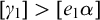 $[\gamma _1]>[e_1\alpha ]$
and
$[\gamma _1]>[e_1\alpha ]$
and $[\gamma _2]<[e_2\alpha ]$
, then
$[\gamma _2]<[e_2\alpha ]$
, then $\psi (\gamma _1+e_1\alpha )=\psi (\gamma _1)<vs=\psi (\gamma _2+e_2\alpha )$
. Finally, if
$\psi (\gamma _1+e_1\alpha )=\psi (\gamma _1)<vs=\psi (\gamma _2+e_2\alpha )$
. Finally, if $[\gamma _1]<[e_1\alpha ]$
and
$[\gamma _1]<[e_1\alpha ]$
and $[\gamma _2]>[e_2\alpha ]$
, then
$[\gamma _2]>[e_2\alpha ]$
, then $[e_1\alpha ]>[\gamma _2]$
and
$[e_1\alpha ]>[\gamma _2]$
and $\psi (\gamma _1+e_1\alpha )=vs<\psi (\gamma _2)=\psi (\gamma _2+e_2\alpha )$
(in this case,
$\psi (\gamma _1+e_1\alpha )=vs<\psi (\gamma _2)=\psi (\gamma _2+e_2\alpha )$
(in this case, $e_2=0$
).
$e_2=0$
).
To show (iv), suppose that K is a pre-H-field and $s>0$
. Let
$s>0$
. Let $f \in K_a^{\times }$
, and take
$f \in K_a^{\times }$
, and take $g \in K^{\times }$
and
$g \in K^{\times }$
and $e \in \mathbb {Q}$
with
$e \in \mathbb {Q}$
with $f \sim ga^e$
. For
$f \sim ga^e$
. For $K_a$
to be an ordered field extension of K, we must have
$K_a$
to be an ordered field extension of K, we must have $a^e>0$
for all
$a^e>0$
for all $e \in \mathbb {Q}$
, and hence there is at most one way to define the ordering:
$e \in \mathbb {Q}$
, and hence there is at most one way to define the ordering: $f>0$
if and only if
$f>0$
if and only if $g>0$
. First, this is independent of the choice of g: if
$g>0$
. First, this is independent of the choice of g: if $f \sim g_1a^{e}$
with
$f \sim g_1a^{e}$
with $g_1 \in K^{\times }$
, then
$g_1 \in K^{\times }$
, then $g_1 \sim g$
, so
$g_1 \sim g$
, so $g_1>0$
if and only if
$g_1>0$
if and only if $g>0$
. To see that this makes
$g>0$
. To see that this makes $K_a$
an ordered field, let
$K_a$
an ordered field, let $f_1, f_2 \in K_a^{\times }$
with
$f_1, f_2 \in K_a^{\times }$
with $f_1, f_2>0$
. For
$f_1, f_2>0$
. For $i=1,2$
, take
$i=1,2$
, take $g_i \in K^{\times }$
and
$g_i \in K^{\times }$
and $e_i \in \mathbb {Q}$
such that
$e_i \in \mathbb {Q}$
such that $f_i \sim g_ia^{e_i}$
, so
$f_i \sim g_ia^{e_i}$
, so $g_i>0$
. Then
$g_i>0$
. Then $f_1f_2 \sim g_1g_2a^{e_1+e_2}>0$
. Similarly,
$f_1f_2 \sim g_1g_2a^{e_1+e_2}>0$
. Similarly, $f^2>0$
for all
$f^2>0$
for all $f \in K_a^{\times }$
. If
$f \in K_a^{\times }$
. If $f_1\prec f_2$
, then
$f_1\prec f_2$
, then $f_1+f_2 \sim f_2> 0$
; the case
$f_1+f_2 \sim f_2> 0$
; the case $f_1 \succ f_2$
is symmetric. Suppose that
$f_1 \succ f_2$
is symmetric. Suppose that $f_1 \asymp f_2$
, so
$f_1 \asymp f_2$
, so $e_1=e_2$
and
$e_1=e_2$
and $g_1 \asymp g_2$
. Then since
$g_1 \asymp g_2$
. Then since $g_1, g_2>0$
, we have
$g_1, g_2>0$
, we have $g_1+g_2 \asymp g_1$
and thus
$g_1+g_2 \asymp g_1$
and thus $f_1+f_2 \sim (g_1+g_2)a^{e_1}>0$
.
$f_1+f_2 \sim (g_1+g_2)a^{e_1}>0$
.
To see that $\mathcal O_a$
is convex with respect to this ordering, we show that its maximal ideal
$\mathcal O_a$
is convex with respect to this ordering, we show that its maximal ideal  satisfies
  : If
: If  , then $1 \pm f \sim 1a^0>0$
. To show that
$1 \pm f \sim 1a^0>0$
. To show that $K_a$
is a pre-H-field, it remains to check that
$K_a$
is a pre-H-field, it remains to check that $f^{\dagger }>0$
whenever
$f^{\dagger }>0$
whenever $f \in K_a$
satisfies
$f \in K_a$
satisfies $f>\mathcal O_a$
, which follows from the proof of (ii) and the fact that K is a pre-H-field.
$f>\mathcal O_a$
, which follows from the proof of (ii) and the fact that K is a pre-H-field.
Proposition 8.4. Let $\boldsymbol k$
be an ordered differential field that is linearly surjective and real closed. Then there is a
$\boldsymbol k$
be an ordered differential field that is linearly surjective and real closed. Then there is a $\operatorname {d}$
-henselian, real closed pre-H-field K such that
$\operatorname {d}$
-henselian, real closed pre-H-field K such that $\Psi = \Gamma ^<$
and
$\Psi = \Gamma ^<$
and $\operatorname {\mathrm {res}}(K) \cong \boldsymbol k$
, but
$\operatorname {\mathrm {res}}(K) \cong \boldsymbol k$
, but $(K^{\times })^{\dagger } \neq K$
.
$(K^{\times })^{\dagger } \neq K$
.
Proof. We construct increasing sequences of pre-H-fields with gap $0$
$0$ $(K_n)$
and sets
$(K_n)$
and sets $(\mathfrak M_n)$
satisfying, for all n:
$(\mathfrak M_n)$
satisfying, for all n:
-
(1)
$K_n = \boldsymbol k(\mathfrak M_{n+1})$
; -
(2)
$\mathfrak M_{n+1}$
is a divisible monomial group for
$K_n$
; -
(3)
$\mathfrak m>0$
for all
$\mathfrak m \in \mathfrak M_n$
; -
(4)
$\mathfrak M_n^{\succ 1} \subseteq (\mathfrak M_{n+1}^{\succ 1})^{\dagger }$
; -
(5) for every
$f \in K_n^{\succ 1}$
, there are
$\mathfrak m \in \mathfrak M_n^{\succ 1}$
and
$e \in \mathbb {Q}^{>}$
such that
$f^{\dagger } \sim e\mathfrak m$
.





In particular, each $K_n$
has ordered differential residue field naturally isomorphic to
$K_n$
has ordered differential residue field naturally isomorphic to $\boldsymbol k$
.
$\boldsymbol k$
.
Let $(b_i)_{i \in \mathbb {Q}}$
be algebraically independent over
$(b_i)_{i \in \mathbb {Q}}$
be algebraically independent over $\boldsymbol k$
and set
$\boldsymbol k$
and set  . Let k range over
  and
and $\boldsymbol i = (i_1, \dots , i_k)$
and
$\boldsymbol i = (i_1, \dots , i_k)$
and $\boldsymbol e = (e_1, \dots , e_k)$
over
$\boldsymbol e = (e_1, \dots , e_k)$
over $\mathbb {Q}^{k}$
with
$\mathbb {Q}^{k}$
with $i_1<\dots <i_k$
. We set
$i_1<\dots <i_k$
. We set  and define
  and
and  . Set
. Set  with
with $(\beta _i)_{i \in \mathbb {Q}}$ $\mathbb {Q}$
-linearly independent, and order
$\mathbb {Q}$
-linearly independent, and order $\Gamma _0$
lexicographically with each
$\Gamma _0$
lexicographically with each $\beta _i<0$
. That is, if
$\beta _i<0$
. That is, if $e_1 \neq 0$
, define
$e_1 \neq 0$
, define $e_1\beta _{i_1} + \dots + e_k\beta _{i_k}>0$
if
$e_1\beta _{i_1} + \dots + e_k\beta _{i_k}>0$
if $e_1<0$
, so
$e_1<0$
, so $[e_1\beta _{i_1} + \dots + e_k\beta _{i_k}] = [\beta _{i_1}]$
, and
$[e_1\beta _{i_1} + \dots + e_k\beta _{i_k}] = [\beta _{i_1}]$
, and $[\beta _i]> [\beta _j]$
if and only if
$[\beta _i]> [\beta _j]$
if and only if $i<j$
, for
$i<j$
, for $i, j \in \mathbb {Q}$
.
$i, j \in \mathbb {Q}$
.
We equip $K_0$
with the unique valuation
$K_0$
with the unique valuation $v \colon K_0^{\times } \to \Gamma _0$
satisfying
$v \colon K_0^{\times } \to \Gamma _0$
satisfying $v(u)=0$
and
$v(u)=0$
and $v(b_i)=\beta _i$
for all
$v(b_i)=\beta _i$
for all $u \in \boldsymbol k^{\times }$
and
$u \in \boldsymbol k^{\times }$
and $i \in \mathbb {Q}$
. To do so more explicitly, note that every element
$i \in \mathbb {Q}$
. To do so more explicitly, note that every element $y \in K_0^{\times }$
has the form
$y \in K_0^{\times }$
has the form $y=(\sum _{\boldsymbol e} f_{\boldsymbol e}b_{\boldsymbol i}^{\boldsymbol e})/(\sum _{\boldsymbol e} g_{\boldsymbol e}b_{\boldsymbol i}^{\boldsymbol e})$
for some
$y=(\sum _{\boldsymbol e} f_{\boldsymbol e}b_{\boldsymbol i}^{\boldsymbol e})/(\sum _{\boldsymbol e} g_{\boldsymbol e}b_{\boldsymbol i}^{\boldsymbol e})$
for some $\boldsymbol i$
and some
$\boldsymbol i$
and some $f_{\boldsymbol e}, g_{\boldsymbol e} \in \boldsymbol k$
such that only finitely many
$f_{\boldsymbol e}, g_{\boldsymbol e} \in \boldsymbol k$
such that only finitely many $f_{\boldsymbol e}$
and
$f_{\boldsymbol e}$
and $g_{\boldsymbol e}$
are nonzero and at least one
$g_{\boldsymbol e}$
are nonzero and at least one $f_{\boldsymbol e}$
and one
$f_{\boldsymbol e}$
and one $g_{\boldsymbol e}$
are nonzero. Define
$g_{\boldsymbol e}$
are nonzero. Define $v \colon K_0^{\times } \to \Gamma _0$
by
$v \colon K_0^{\times } \to \Gamma _0$
by  , for
, for $u \in \boldsymbol k^{\times }$
, and, for
$u \in \boldsymbol k^{\times }$
, and, for $y \in K_0^{\times }$
as above
$y \in K_0^{\times }$
as above

It is routine to check that this map is a valuation. Hence $\mathfrak M_1$
is a divisible monomial group for
$\mathfrak M_1$
is a divisible monomial group for $K_0$
. Moreover, for all
$K_0$
. Moreover, for all $f \in K_0^{\times }$
with
$f \in K_0^{\times }$
with $f \not \asymp 1$
, there exist unique
$f \not \asymp 1$
, there exist unique $u \in \boldsymbol k^{\times }$
,
$u \in \boldsymbol k^{\times }$
, $\boldsymbol i$
, and
$\boldsymbol i$
, and $\boldsymbol e \in (\mathbb {Q}^{\times })^k$
such that
$\boldsymbol e \in (\mathbb {Q}^{\times })^k$
such that $f \sim ub_{\boldsymbol i}^{\boldsymbol e}$
; for all
$f \sim ub_{\boldsymbol i}^{\boldsymbol e}$
; for all $f \in K_0^{\times }$
with
$f \in K_0^{\times }$
with $f \asymp 1$
, there exists a unique
$f \asymp 1$
, there exists a unique $u \in \boldsymbol k^{\times }$
such that
$u \in \boldsymbol k^{\times }$
such that $f \sim u$
.
$f \sim u$
.
We extend the derivation on $\boldsymbol k$
to
$\boldsymbol k$
to $K_0$
so that
$K_0$
so that $(b_i^e)^{\dagger } = eb_{i+1}$
for all
$(b_i^e)^{\dagger } = eb_{i+1}$
for all $i, e \in \mathbb {Q}$
. It is easy to verify that for all
$i, e \in \mathbb {Q}$
. It is easy to verify that for all  , if
, if $t \prec 1$
, then
$t \prec 1$
, then $t' \prec 1$
and
$t' \prec 1$
and $t^{\dagger } \succ 1$
. Then by [Reference Aschenbrenner, van den Dries and van der Hoeven5, Lemma 10.1.19] (with
$t^{\dagger } \succ 1$
. Then by [Reference Aschenbrenner, van den Dries and van der Hoeven5, Lemma 10.1.19] (with $K=\boldsymbol k$
and
$K=\boldsymbol k$
and $L=K_0$
),
$L=K_0$
), $K_0$
is pre-
$K_0$
is pre- $\operatorname {d}$
-valued and has gap
$\operatorname {d}$
-valued and has gap $0$
. Also, for every
$0$
. Also, for every $f \in K_0^{\succ 1}$
, there exist
$f \in K_0^{\succ 1}$
, there exist $i, e \in \mathbb {Q}$
with
$i, e \in \mathbb {Q}$
with $e> 0$
and
$e> 0$
and $f^{\dagger } \sim eb_i$
. Hence the asymptotic couple of
$f^{\dagger } \sim eb_i$
. Hence the asymptotic couple of $K_0$
is
$K_0$
is $(\Gamma _0, \psi _0)$
, where
$(\Gamma _0, \psi _0)$
, where $\psi _0$
is defined by
$\psi _0$
is defined by $\psi _0(e_1\beta _{i_1} + \dots + e_k\beta _{i_k}) = \beta _{i_1+1}$
if
$\psi _0(e_1\beta _{i_1} + \dots + e_k\beta _{i_k}) = \beta _{i_1+1}$
if $e_1 \neq 0$
, and it satisfies
$e_1 \neq 0$
, and it satisfies  .
.
To extend the ordering on $\boldsymbol k$
to
$\boldsymbol k$
to $K_0$
, let
$K_0$
, let $f \in K_0^{\times }$
and take
$f \in K_0^{\times }$
and take $u \in \boldsymbol k^{\times }$
and
$u \in \boldsymbol k^{\times }$
and $\mathfrak m \in \mathfrak M_1$
with
$\mathfrak m \in \mathfrak M_1$
with $f \sim u\mathfrak m$
. Then define
$f \sim u\mathfrak m$
. Then define $f>0$
if
$f>0$
if $u>0$
. The proof that this makes
$u>0$
. The proof that this makes $K_0$
a pre-H-field is similar to the corresponding part of the proof of Lemma 8.3.
$K_0$
a pre-H-field is similar to the corresponding part of the proof of Lemma 8.3.
To construct $K_1$
and
$K_1$
and $\mathfrak M_2$
, enumerate
$\mathfrak M_2$
, enumerate $(\mathfrak M_1 \setminus \mathfrak M_0)^{\succ 1}$
by
$(\mathfrak M_1 \setminus \mathfrak M_0)^{\succ 1}$
by $(\mathfrak m_n)$
and set
$(\mathfrak m_n)$
and set  and
and  . By (5), $v\mathfrak m_n \in \Gamma _{0}^< \setminus \Psi _{0}$
for all n. Hence by repeated applications of Lemma 8.3, we construct increasing sequences of pre-H-fields with gap
$v\mathfrak m_n \in \Gamma _{0}^< \setminus \Psi _{0}$
for all n. Hence by repeated applications of Lemma 8.3, we construct increasing sequences of pre-H-fields with gap $0$
$0$ $(L_{n})$
, sets
$(L_{n})$
, sets $(\mathfrak N_{n})$
, and elements
$(\mathfrak N_{n})$
, and elements $(\mathfrak n_n)$
such that, for all n:
$(\mathfrak n_n)$
such that, for all n:
-
(a)
$L_{n} = \boldsymbol k(\mathfrak N_{n})$
; -
(b)
$\mathfrak N_{n}$
is a divisible monomial group for
$L_{n}$
; -
(c)
$\mathfrak N_{n+1} = \mathfrak N_{n}\mathfrak n_n^{\mathbb {Q}}$
; -
(d)
$\mathfrak n_n^{\dagger } = \mathfrak m_n$
,
$\mathfrak n_n \succ 1$
, and
$\mathfrak n_n^e>0$
for all
$e \in \mathbb {Q}$
; -
(e) for every
$f \in L_{n+1}^{\succ 1}$
, either
$f^{\dagger } \sim g^{\dagger }$
for some
$g \in L_{n}^{\succ 1}$
or
$f^{\dagger } \sim e\mathfrak m_n$
for some
$e \in \mathbb {Q}^{>}$
; -
(f)
$v\mathfrak m_m \notin \Psi _{L_{n}}$
for all
$m \geqslant n$
.


Now we set  and
and  . Iterating this procedure yields the desired sequences $(K_n)$
and
$(K_n)$
and $(\mathfrak M_n)$
. Set
$(\mathfrak M_n)$
. Set  , where
  . Then K is a pre-H-field with gap $0$
such that:
$0$
such that:
-
(i) K has ordered differential residue field (isomorphic to)
$\boldsymbol k$
; -
(ii)
$\Gamma $
is nontrivial and divisible, and satisfies
$\Gamma ^< = \Psi $
; -
(iii) for every
$f \in K^{\succ 1}$
, there are
$\mathfrak m \in \mathfrak M^{\succ 1}$
and
$e \in \mathbb {Q}^{>}$
such that
$f^{\dagger } \sim e\mathfrak m$
.


We have not yet needed the assumptions on $\boldsymbol k$
. Using that
$\boldsymbol k$
. Using that $\boldsymbol k$
is linearly surjective, we pass to the
$\boldsymbol k$
is linearly surjective, we pass to the $\operatorname {d}$
-henselization of K, an immediate pre-H-field extension of K, thereby arranging that K is
$\operatorname {d}$
-henselization of K, an immediate pre-H-field extension of K, thereby arranging that K is $\operatorname {d}$
-henselian while preserving (i)–(iii). Then
$\operatorname {d}$
-henselian while preserving (i)–(iii). Then $K$
is real closed, since
$K$
is real closed, since $\boldsymbol{k} $
is real closed,
$\boldsymbol{k} $
is real closed, $\Gamma $
is divisible, and K is henselian. Finally, by (iii) we have
$\Gamma $
is divisible, and K is henselian. Finally, by (iii) we have $u\mathfrak m \notin (K^{\times })^{\dagger }$
for all
$u\mathfrak m \notin (K^{\times })^{\dagger }$
for all $u \in \boldsymbol k \setminus \mathbb {Q}$
and
$u \in \boldsymbol k \setminus \mathbb {Q}$
and $\mathfrak m \in \mathfrak M^{\succ 1}$
.
$\mathfrak m \in \mathfrak M^{\succ 1}$
.
By taking a $\boldsymbol k$
as above that additionally has exponential integration, we obtain:
$\boldsymbol k$
as above that additionally has exponential integration, we obtain:
Corollary 8.5. There exists a $\operatorname {d}$
-henselian, real closed pre-H-field K such that
$\operatorname {d}$
-henselian, real closed pre-H-field K such that $\Psi = \Gamma ^<$
and
$\Psi = \Gamma ^<$
and $(\operatorname {\mathrm {res}}(K)^{\times })^{\dagger } = \operatorname {\mathrm {res}}(K)$
, but
$(\operatorname {\mathrm {res}}(K)^{\times })^{\dagger } = \operatorname {\mathrm {res}}(K)$
, but $(K^{\times })^{\dagger } \neq K$
.
$(K^{\times })^{\dagger } \neq K$
.
Corollary 8.6. There exist $\operatorname {d}$
-henselian, real closed pre-H-fields
$\operatorname {d}$
-henselian, real closed pre-H-fields $K_1$
and
$K_1$
and $K_2$
such that
$K_2$
such that $\operatorname {\mathrm {res}}(K_1) \cong \operatorname {\mathrm {res}}(K_2)$
(as ordered differential fields) and
$\operatorname {\mathrm {res}}(K_1) \cong \operatorname {\mathrm {res}}(K_2)$
(as ordered differential fields) and $(\Gamma _1, \psi _1) \equiv (\Gamma _2, \psi _2)$
, but
$(\Gamma _1, \psi _1) \equiv (\Gamma _2, \psi _2)$
, but $(K_1^{\times })^{\dagger } \neq K_1$
and
$(K_1^{\times })^{\dagger } \neq K_1$
and $(K_2^{\times })^{\dagger } = K_2$
; in particular,
$(K_2^{\times })^{\dagger } = K_2$
; in particular, $K_1 \not \equiv K_2$
.
$K_1 \not \equiv K_2$
.
Proof. Let $\boldsymbol k$
be an ordered differential field that is linearly surjective and expint-closed. Then Proposition 8.4 yields a
$\boldsymbol k$
be an ordered differential field that is linearly surjective and expint-closed. Then Proposition 8.4 yields a $\operatorname {d}$
-henselian, real closed pre-H-field
$\operatorname {d}$
-henselian, real closed pre-H-field $K_1$
with ordered differential residue field isomorphic to
$K_1$
with ordered differential residue field isomorphic to $\boldsymbol k$
, nontrivial divisible asymptotic couple
$\boldsymbol k$
, nontrivial divisible asymptotic couple $(\Gamma _1, \psi _1)$
satisfying
$(\Gamma _1, \psi _1)$
satisfying $\Gamma _1^< = \Psi _1$
, and
$\Gamma _1^< = \Psi _1$
, and $(K_1^{\times })^{\dagger } \neq K_1$
. Now let
$(K_1^{\times })^{\dagger } \neq K_1$
. Now let $K_2$
be the
$K_2$
be the $\operatorname {d}$
-Hensel–Liouville closure of
$\operatorname {d}$
-Hensel–Liouville closure of $K_1$
by Theorem 6.16. Then
$K_1$
by Theorem 6.16. Then $\operatorname {\mathrm {res}}(K_2)=\operatorname {\mathrm {res}}(K_1)$
and the nontrivial divisible asymptotic couple
$\operatorname {\mathrm {res}}(K_2)=\operatorname {\mathrm {res}}(K_1)$
and the nontrivial divisible asymptotic couple $(\Gamma _2, \psi _2)$
of
$(\Gamma _2, \psi _2)$
of $K_2$
satisfies
$K_2$
satisfies $\Gamma _2^< = \Psi _2$
. Hence
$\Gamma _2^< = \Psi _2$
. Hence $(\Gamma _1, \psi _1) \equiv (\Gamma _2, \psi _2)$
by Corollary 4.9.
$(\Gamma _1, \psi _1) \equiv (\Gamma _2, \psi _2)$
by Corollary 4.9.
Acknowledgments
Thanks are due to Lou van den Dries for helpful discussions and for comments on an earlier draft of this paper, to Anton Bernshteyn and Chris Miller for suggestions on an earlier draft of this paper, and to Matthias Aschenbrenner for comments related to Proposition 7.8. I am also grateful to the anonymous referee for carefully reading the paper and suggesting many improvements. Some of this research appeared in an earlier form in the author’s PhD thesis [Reference Pynn-Coates17].
Funding
This research was funded in whole or in part by the Austrian Science Fund (FWF) 10.55776/ESP450. For open access purposes, the author has applied a CC BY public copyright licence to any author accepted manuscript version arising from this submission. This material is based upon work supported by the National Science Foundation under Grant No. DMS-2154086. Presentation of some of this research at DART X was supported by NSF Grant No. DMS-1952694.


 Open access

