

Introduction
Joseph A. Schumpeter famously likened social classes to tramcars: always full yet continually occupied by different individuals.Footnote 1 This metaphor captures a central question in the study of elites: whether changes in personnel reflect genuine changes in the social composition of elites or merely the replacement of old actors by new ones who occupy the same positions of power. This article examines that question through the case of Spain’s corporate elite over the past century.
Focusing on the boards of directors of Spain’s largest companies between 1920 and 2020, the article asks how, when, and through which mechanisms the Spanish corporate elite experienced processes of renewal and circulation. Conceiving the corporate elite as a positional group—defined by access to strategic decision-making roles rather than by individual attributesFootnote 2—the study investigates whether entry into the highest levels of corporate power became more socially open over time, and which historical processes facilitated or constrained such change.
Spain provides a particularly revealing case for examining elite renewal. Over the past century, the country experienced profound political, economic, and institutional transformations: civil war and dictatorship, late industrialization and state-led development, democratic transition, European integration, and globalization.Footnote 3 Previous research has shown that political and economic elites in Spain maintained close and often overlapping ties across successive regimes,Footnote 4 while network-based studies have documented both the long-term continuity of corporate structures and specific episodes of reconfiguration.Footnote 5 Yet the extent to which these transformations altered the social composition of those at the center of corporate power, and the mechanisms through which new actors gained access, remains insufficiently understood. If renewal occurred, it is therefore necessary to identify not only its timing but also its underlying mechanisms. Did managerial professionalization and economic modernization weaken the dominance of traditional family elites? Did political power and public administration operate as gateways into the corporate elite? Or did entrenched structures of influence limit renewal despite major institutional change?
To address these questions, the article combines Social Network Analysis (SNA) and prosopography to identify and characterize the most central directors within the interlocking board networks of Spain’s 200 largest firms at different points in time. By reconstructing corporate networks across three long historical periods and tracing the social origins and career trajectories of their most central actors, the study provides a systematic assessment of continuity and change within the corporate elite. International research on interlocking directorates has substantially advanced our understanding of corporate network structures over the long run,Footnote 6 but has paid less systematic attention to the social composition of those occupying the most central network positions and to the pathways through which they gain access to them. The few studies that have moved in this direction have done so within predominantly firm-centered frameworksFootnote 7 or for shorter periods.Footnote 8 By adopting an explicitly interpersonal perspective over a full century, this article addresses that gap and contributes to international research on corporate networks and elite dynamics by offering a long-run, person-centered analysis of elite renewal in a Southern European economy.
The article proceeds as follows. The next section situates the Spanish case within the broader international research on corporate networks, while also building on the existing national literature. The third section outlines the data and methodology. The fourth section presents the results, followed by a discussion of their broader implications. The conclusion summarizes the main findings and reflects on their significance for understanding elite renewal and the persistence of corporate power.
Corporate Elite and Interlocking Directorates: A Positional Perspective
Scholars have long debated how elites have been defined and studied. Early sociological approaches often conceived elites as small minorities endowed with superior qualities, whose leadership derived from personal attributes or exceptional capacities. While influential, such perspectives offered limited analytical leverage for comparing elites across different historical and institutional contexts. A decisive shift occurred with the work of C. Wright Mills, who reframed elites not as individuals with intrinsic traits but as groups defined by their access to strategic positions of power.Footnote 9
In Mills’s positional approach, elites are those who occupy locations within political, economic, and military organizations that allow them to shape decisions of broad societal consequence. This conceptualization proved particularly fruitful for the study of economic power, as it identified the boards and executive structures of large corporations as key sites where elite influence is exercised. By focusing on positions rather than attributes, the positional perspective enables systematic comparison across time and space and provides a common framework for analyzing elite continuity and renewal under changing institutional conditions.
Subsequent research extended Mills’s insights by emphasizing the relational dimension of elite power. Scholars such as Domhoff and Useem highlighted how elites are embedded in networks of overlapping affiliations that connect corporate leaders to one another and, in some cases, to other spheres of power.Footnote 10 From this perspective, elite status is not only a matter of formal position but also of location within a network of relationships that structures access to information, resources, and influence. Contemporary elite research has largely retained this positional and relational understanding, defining elites as actors whose strategic locations within organizations and networks enable them to exert regular and substantial influence over collective outcomes.
This article builds on that tradition. It adopts a positional definition of the corporate elite as the group of directors who occupy the most structurally central positions within the network of interlocking directorships among large firms. Such an approach shifts attention away from individual prestige or reputational markers and toward the organizational and relational foundations of corporate power. It also provides a conceptually coherent basis for examining elite renewal: changes in the composition of the elite can be assessed by tracking who gains access to these positions over time, and through which social, institutional, or political mechanisms.
Since the early twentieth century, interlocking directorates have been one of the main analytical tools used to study the structure of corporate power. Pioneering works such as those by Jeidels, as well as the investigation conducted by the U.S. House of Representatives’ Pujo Committee, used shared directorships among large firms as indicators of economic concentration, coordination, and financial control.Footnote 11 Within business history, this approach was subsequently developed to reconstruct corporate networks and to examine how economic power is organized and reproduced across firms in different national and historical contexts. From the 1980s onward, a growing body of historical research, often drawing on relational and network-analytic approaches, reconstructed the evolution of corporate networks over extended periods. Studies covering countries such as the Netherlands, Switzerland, Italy, and Great Britain have consistently shown that corporate networks tend to display high levels of structural persistence, even in periods of profound political or institutional change.Footnote 12
Over time, this tradition evolved toward a more explicitly relational understanding of corporate power. Rather than treating interlocks as isolated coincidences among individuals, scholars began to conceptualize them as networks of relations among firms, in which the structural position of organizations matters as much as the number of ties they maintain. The adoption of Social Network Analysis reinforced this shift by enabling aggregated analyses of corporate networks, focusing on patterns of cohesion, centralization, and segmentation. From a historical perspective, these studies have consistently shown that corporate networks tend to display high levels of structural persistence, even in periods of profound political, economic, or institutional change, while also revealing significant cross-national variation associated with financial systems, ownership structures, and broader models of capitalism.Footnote 13
These insights were synthesized and extended in the edited volume by David and Westerhuis, which brought together a set of long-run national case studies and helped consolidate a comparative agenda for the historical analysis of corporate networks.Footnote 14 While most contributions in the volume focus on intercorporate structures, some chapters also begin to explore the individuals who occupy central positions within those networks. Specifically, in their study of the Finnish case, Fellman, Piilahti, and Härmälä examined the profiles and career trajectories of highly connected directors, drawing attention to the social characteristics of “big linkers” and anticipating later efforts to connect network positions with the social composition of corporate elite.Footnote 15
Within this literature, several studies have acknowledged the role of highly connected directors in shaping corporate networks without abandoning a firm-centered perspective. These studies have highlighted the concentration of board seats among a small group of individuals and their contribution to network cohesion and stability, examining the distribution of directorships, the institutional profiles of multiple directors, or the contribution of a limited number of “big linkers” to the overall architecture of corporate networks.Footnote 16 Despite their differences, these studies share a common feature: directors are considered primarily insofar as they help explain the structure and evolution of intercorporate networks, rather than as objects of systematic analysis in their own right.
Attempts to shift the analytical focus more explicitly toward directors themselves have remained comparatively limited. An important step in this direction is the study by De Jong, Fliers, and Westerhuis, which examines “big linkers” as individual actors using long-run data on interlocks in the Netherlands.Footnote 17 Their findings show that holding multiple board positions does not automatically translate into influence, and that the impact of central directors depends on their trajectories, institutional affiliations, and accumulated resources. Even here, however, directors are analyzed primarily to explain the dynamics of corporate networks, rather than as an autonomous object of study.
The explicit adoption of an interpersonal perspective, in which interlocking directorates are analyzed as networks of directors rather than as projections of intercorporate ties, has been even rarer in historical research. A notable early exception is the work of Heemskerk and Fennema, who demonstrate that treating directors as nodes in a social network allows for a more precise analysis of elite cohesion, brokerage, and the configuration of an inner circle.Footnote 18 Despite its conceptual importance, this approach remained marginal within a literature largely oriented toward firm-level networks. Only recently has this perspective been taken up more explicitly, as illustrated by the study of van Lieshout, Bennett, and Smith, which reconstructs director-centered networks in Britain and links network positions to social characteristics and career trajectories. At the same time, this work confirms that interpersonal approaches remain exceptional within the field.Footnote 19 Recent research on women’s participation in corporate boards further reinforces this point by showing that, even when individual attributes or social categories are incorporated into predominantly firm-centered analyses, access to central positions within corporate networks remains highly uneven over the long run.Footnote 20
Taken together, research on interlocking directorates has substantially improved our understanding of the structure and evolution of corporate power. By mapping intercorporate ties and identifying structurally central positions, network-based studies have clarified how economic power is organized and reproduced over time. Yet this literature has paid less attention to the social composition of those who occupy the most central positions within corporate networks, and to the pathways through which individuals gain access to them.
Prosopography provides a useful framework for addressing this limitation. Rather than offering isolated biographies, prosopographical analysis reconstructs patterns of social origin, education, and career across defined populations, allowing historians to identify regularities in elite recruitment and reproduction. Although prosopography has not been widely employed within economic history, its relevance for the study of business elites has been increasingly recognized. Within business history, it has been explicitly advocated to move beyond anecdotal accounts of prominent business figures toward more systematic analyses of elite composition,Footnote 21 and has been applied in studies that examine how business elites are shaped by national institutional settings, educational systems, and career hierarchies.Footnote 22
Several authors have emphasized the complementarity between prosopography and network analysis. While network analysis is well suited to identifying positions of power within corporate structures, it offers limited insight into why particular individuals repeatedly gain access to those positions or how access criteria evolve over time. Prosopography addresses this gap by making it possible to examine whether entry into central positions is associated with specific social origins, educational credentials, or career trajectories, and whether these associations remain stable or change in response to broader political, economic, or institutional transformations.Footnote 23 From this perspective, prosopography should be seen not as an alternative to the analysis of interlocking directorates, but as a necessary complement to it.
Research on elites in Spain has been extensive, particularly in political science, sociology, and political history. In contrast, business historical work has tended to focus on case studies of prominent business leaders, entrepreneurial families, or individual firms, while aggregated, long-run analyses of the corporate elite as a group have been comparatively rare, especially those centered on board members of large firms. As a result, much of the scholarship on Spain’s corporate elite has drawn on the positional perspective developed by C. Wright Mills, often in dialogue with approaches originating outside business history.
Within this literature, two broad lines of inquiry can be identified. The first situates corporate elite within wider constellations of power that include political leaders and senior civil servants, emphasizing the persistence of overlapping circles of influence across different political regimes.Footnote 24 The second focuses more directly on corporate elite and interlocking directorates, highlighting the concentration of economic power—particularly within the financial sector—and the long-term continuity of core positions.Footnote 25 More recent work by Rubio-Mondéjar and Garrués-Irurzun has, across a series of studies, combined this focus on corporate power with explicit network-based approaches, reconstructing the long-run evolution of corporate networks and documenting both structural continuity and episodes of elite renewal, as well as the close and enduring ties between corporate elite and the state.Footnote 26 By adopting tools from Social Network Analysis, these studies have brought the Spanish case into closer dialogue with international research on interlocking directorates, elite cohesion, and varieties of capitalism, while remaining largely focused on firm-centered networks.
Taken together, this body of research provides a rich account of the structure and evolution of corporate power in Spain and identifies several historical junctures at which elite renewal may have occurred, notably during the economic opening of the late 1950s and the transition from dictatorship to democracy. Within this framework, scholars have also highlighted the role of business schools and state-owned enterprises as institutional channels through which new cohorts of managers were trained and subsequently incorporated into the private sector.Footnote 27 In addition, recent work has examined the process through which women entered the corporate elite, stressing that their incorporation has largely taken place from structurally peripheral positions within corporate networks rather than through access to their central nodes.Footnote 28 However, this focus on gendered patterns of incorporation has not been accompanied by a systematic analysis of the long-run social composition of those occupying the most central positions within corporate networks, nor of the mechanisms through which individuals from different social backgrounds gain access to them. While recent network-based analyses have clarified patterns of cohesion and change at the level of firms, they have not systematically examined corporate elite from an explicitly interpersonal perspective in which directors themselves constitute the primary units of analysis. By combining network analysis with a prosopographical approach over the period 1920–2020, this article seeks to address that gap and to provide a systematic assessment of how, when, and through which mechanisms Spain’s corporate elite has renewed itself.
Methodology and Data
To address the research questions regarding elite renewal, this article draws on an original prosopographical database and applies social network analysis (SNA) to reconstruct interpersonal connections across the period 1920–2020. Consistent with the positional perspective outlined in the previous section, the analysis focuses on the relational configuration of corporate power and on the actors who occupy structurally central positions within it.
The methodological strategy proceeds in two steps. First, SNA is used to map the structure of interlocking directorates and identify the “core” of the network—that is, the group of directors holding the most strategically significant positions. Second, prosopography is employed to examine the social characteristics and career trajectories of these central actors. This combination allows the analysis to distinguish clearly between continuity in the structural organization of corporate power and changes in the social composition of those who wield it. Accordingly, elite renewal is defined here not as short-term turnover in board membership, but as changes in the social composition and recruitment mechanisms of those occupying structurally central positions within corporate networks. Renewal is assessed through shifts in prosopographical indicators—such as social origin, family ties, education, and state-linked careers—among the structural core across periods.
It is important to distinguish analytically between social class (social origins) and corporate elite status (institutional position). While “upper class” refers to socioeconomic background—often proxied here by aristocratic titles or family lineage— “corporate elite” refers strictly to those holding board positions in the top firms. In our analysis, we observe how the mechanism for entering the corporate elite shifted: from relying on class resources (titles, land) to leveraging state resources (competitive civil service examinations and technical degrees).
The empirical analysis is based on interlocking directorates among the 200 largest companies headquartered in Spain at selected benchmark years: 1920, 1935, 1950, 1960, 1970, 1980, 1990, 2000, 2010, and 2020. Firms are ranked consistently by total assets across the entire period to ensure comparability over time. Board membership data were compiled from a broad set of historical and contemporary sources. Information for earlier decades was drawn primarily from financial yearbooks, company reports, and archival materials, while data for the contemporary period were obtained from business databases, including Axesor, Dicodi, and SABI. For the most recent years, these sources were supplemented with documents published by the National Securities Market Commission (CNMV) and the annual reports of the Spanish Banking Association (AEB). All director names were standardized through a rigorous process of data cleaning to resolve homonyms and variations in spelling, ensuring consistent identification of individuals across sources and years.
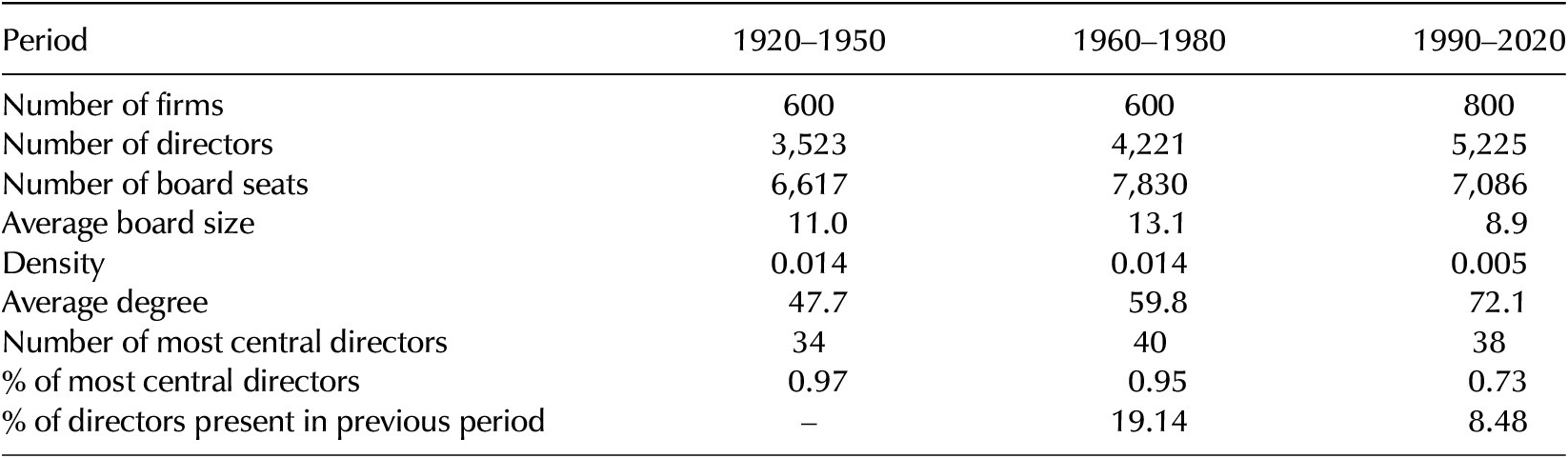
Rather than examining interlocking directorates on an annual basis, this study constructs aggregated corporate networks for three extended historical periods: 1920–1950, 1960–1980, and 1990–2020. Each period combines several benchmark years to capture relatively durable relational structures, as opposed to short-term fluctuations. Importantly, this aggregation strategy does not confine the analysis to directors who appear in multiple benchmark years. Instead, each aggregated network includes all individuals who served on the boards of the two hundred largest firms in at least one benchmark year within the period. As a result, the networks represent the full population of board members active in each period, rather than only those with long individual tenures. This approach reflects a well-established assumption in the interlocking directorates literature that board co-membership creates ties that may endure and structure relations beyond the year of observation. Detailed statistics for each individual benchmark year, including board composition, director and firm continuity, and network measures, are reported in Appendix 1. Table 1 provides a descriptive overview of the aggregated corporate networks for each period.
Descriptive characteristics of the aggregated corporate networks

Table 1. Long description
The table consists of four columns: Period, 1920–1950, 1960–1980, and 1990–2020.
* Number of firms: 600 in the first two periods, increasing to 800 in 1990–2020.
* Number of directors: 3,523 in 1920–1950; 4,221 in 1960–1980; 5,225 in 1990–2020.
* Number of board seats: 6,617 in 1920–1950; 7,830 in 1960–1980; 7,086 in 1990–2020.
* Average board size: 11.0 in 1920–1950; 13.1 in 1960–1980; 8.9 in 1990–2020.
* Density: 0.014 in the first two periods, dropping to 0.005 in 1990–2020.
* Average degree: Increases steadily from 47.7 to 59.8 to 72.1 across the periods.
* Number of most central directors: 34 in 1920–1950; 40 in 1960–1980; 38 in 1990–2020.
* Percentage of most central directors: 0.97 in 1920–1950; 0.95 in 1960–1980; 0.73 in 1990–2020.
* Percentage of directors present in previous period: Not applicable for the first period; 19.14 in 1960–1980; 8.48 in 1990–2020.
Note: While the size of the networks increases over time and density declines in the late twentieth century, the number and relative weight of the most structurally central directors remain remarkably stable across periods.
Source: Financial yearbooks, Sabi, Dicodi, Axesor, CNMV, and AEB.
To identify structurally central positions within each aggregated network, the analysis relies on two standard indicators from Social Network Analysis: degree centrality and betweenness centrality. Degree centrality refers to the number of direct ties linking a director to others in the network and thus reflects their immediate connectedness. Betweenness centrality captures a director’s position on the shortest paths connecting other pairs of directors, highlighting their potential to act as an intermediary. Following established practice in historical studies of interlocking directorates, both measures are calculated on the aggregated director networks for each period.Footnote 29
For each aggregated period, directors are ranked according to their degree and betweenness centrality. The analysis then identifies the twenty-five most central directors under each measure and combines these rankings to delineate the set of structurally central actors for the period. Because many actors rank highly on both measures, the size of this group varies across periods. This procedure provides a transparent and replicable basis for identifying the structural core of the corporate elite while avoiding reliance on a single measure of centrality.Footnote 30 Although the total size of the network increases over time and density declines—consistent with the growing size of boards and the fragmentation of the corporate landscape in the late twentieth century—the number and relative weight of the most structurally central directors remain remarkably stable, representing less than 1 percent of the total population of directors in each period (Table 1).
Following the identification of structurally central directors, the study applies a prosopographical approach to examine their social characteristics and career trajectories. Biographical and career information was collected from archival sources, published directories, company records, and secondary literature, and complete information is available for all identified central actors (N = 107 across three periods). Prosopographical variables capture key dimensions of social origin, education, professional background, and career paths leading to board membership. Throughout this article, “class” is used as a pragmatic shorthand for social origin rather than as a comprehensive sociological theory. This approach follows recent prosopographical studies of business elites that employ similar operational distinctions between upper-class and middle-class backgrounds based on parental occupation and economic position.Footnote 31 Upper-class social origin is defined as having parents who were major entrepreneurs or large landowners, while nobility refers to the possession of a formally recognized noble title. Family ties to other directors capture whether a given director had close relatives (fathers, sons, brothers, or spouses) who also served on the boards of large firms. A separate indicator identifies whether any of these relatives were themselves among the most structurally central actors in the network (Top 107). Political experience is measured through prior service in national political institutions, including government positions (such as ministers) and legislative offices, encompassing parliamentarians, senators, and members of the Cortes under the Franco regime. Administrative experience, in turn, captures senior positions within the state administration, including membership in elite civil service bodies (such as state lawyers, engineers, and economists) as well as other high-ranking administrative appointments. Together, these variables are used to construct collective profiles of the corporate elite for each period and to trace changes over time in the mechanisms through which individuals gained access to structurally central positions.
By combining aggregated network analysis with a prosopographical approach, the study provides a systematic framework for assessing elite renewal over the century under study. Structural continuity and change are evaluated through network indicators, while renewal is assessed through shifts in the social composition and career trajectories of those occupying the most central positions within corporate networks. This methodological strategy forms the basis for the empirical analysis presented in the following section.
Results: The Spanish Corporate Elite, 1920–2020
This section examines the evolution of the Spanish corporate elite between 1920 and 2020, focusing on patterns of continuity and renewal within the interlocking directorate networks of the country’s largest firms. By combining aggregated network analysis with a long-run perspective, this study captures both the structural resilience of corporate power and historically specific moments of elite reconfiguration. Descriptive characteristics of the aggregated corporate networks for each period are reported in Table 1 (see Methodology and Data).
Continuity and change in the Spanish corporate elite are assessed through the structural properties of aggregated interlocking directorate networks. By reconstructing networks for three extended historical periods (1920–1950, 1960–1980, and 1990–2020), the analysis captures durable relational structures that extend beyond short-term turnover in board membership. Across all three periods, corporate power is organized around a very small group of directors who occupy disproportionately central positions within the network. Although the total population of board members changes substantially over time, the size of this structural core remains remarkably stable: between thirty-four and forty individuals, representing roughly 1 percent of all directors in each period. (see Appendix 2, which lists the twenty-five most central directors by degree centrality and the twenty-five most central by betweenness centrality for each of the three periods). This persistence at the level of network centrality indicates that, despite major political, economic, and institutional transformations, the organization of corporate power in Spain was characterized by strong structural continuity. As the following analysis shows, this continuity at the level of positions coexisted with significant change in the social composition and career trajectories of those who occupied them.
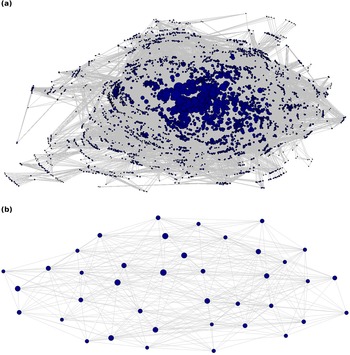
To make this structural configuration visible, the analysis turns to the identification of themost centrally positioned directors within each aggregated network. Figure 1 visualizes the aggregated interlocking directorate network for the period 1960–1980. Panel (a) displays the full network of over 4,000 directors, where node size is proportional to degree centrality, revealing the strongly unequal distribution of network positions: a very large number of weakly connected directors coexist with a much smaller group of highly connected actors concentrated at the center. Panel (b) isolates the 40 most central directors, identified through a combination of degree centrality and betweenness centrality (see Methodology and Data). By shifting attention from the overall structure to its core, the figure provides a visual bridge between the analysis of interlocking directorates as a network and the subsequent focus on the individuals who occupy the most central positions within it.
Aggregated Network of Directors, 1960–1980.

Figure 1. Long description
Panel a shows a highly dense, complex network diagram. At the center is a core of large, dark blue circular nodes packed tightly together. Moving outward, the nodes become smaller and more dispersed, connected by a vast web of light gray lines. The overall shape is an irregular, horizontal oval with thin clusters of nodes extending toward the left and right edges. Panel b, located below panel a, shows a simplified network diagram with significantly fewer nodes. The nodes are dark blue circles of varying sizes, distributed across the space with clear gaps between them. They are interconnected by a sparse mesh of light gray lines, forming a hexagonal or diamond-like overall boundary.
From this aggregated network, the analysis isolates the structural core of corporate power by identifying the directors who occupy the most central positions according to two complementary indicators: degree centrality and betweenness centrality (see Methodology and Data). Together, these measures distinguish between directors who are deeply embedded in dense clusters of corporate ties and those who bridge otherwise disconnected parts of the network.
The corporate elite is defined relationally as the set of directors whose positions within the network place them at the structural core of corporate power, rather than by reputational criteria, firm size alone, or a predefined number of board seats. Although the aggregated networks comprise several thousand directors in each period, the intersection of the top-ranked actors according to degree and betweenness centrality (as noted above) yields a relatively small group, numbering between 34 and 40 individuals per period, who collectively form the backbone of the corporate network. It is this group of structurally central directors that provides the empirical basis for the subsequent analysis of continuity, renewal, and social composition.
Change and Continuity in Social Composition
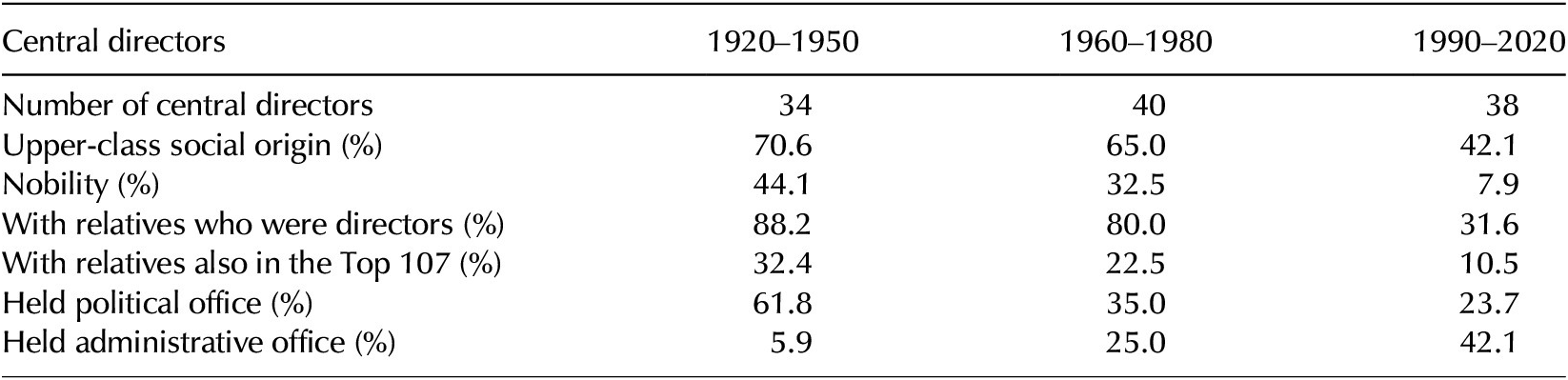
Table 2 summarizes the prosopographical characteristics of the most structurally central directors in Spain’s corporate network across the three periods under study. As outlined in the methodology section, “upper-class” and “middle-class” origins refer to parental occupation and economic position rather than to a comprehensive theory of social class. Taken together, the indicators reveal a clear pattern: while the structural core of corporate power remained remarkably stable in size over the century under study, the social composition of those occupying its most central positions changed substantially.
Prosopographical profile of the most central directors in the Spanish Corporate Network, by period (1920–2020)
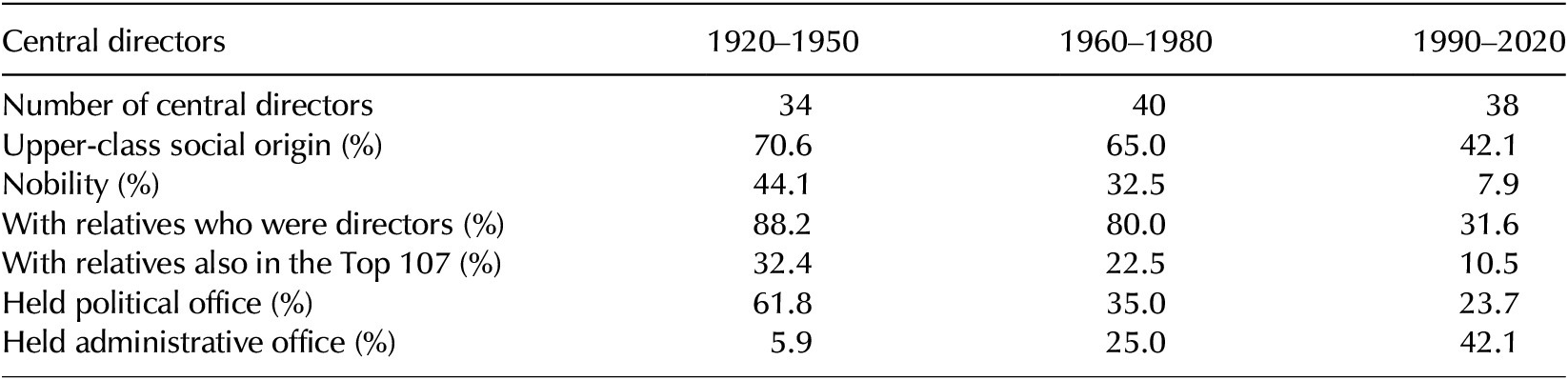
Table 2. Long description
The table compares seven characteristics of central directors across three time periods: 1920 to 1950, 1960 to 1980, and 1990 to 2020.
* Number of central directors: 34 in the first period, 40 in the second, and 38 in the third.
* Upper-class social origin (percent): Decreases from 70.6 to 65.0, then drops to 42.1.
* Nobility (percent): Shows a significant decline from 44.1 to 32.5, ending at 7.9.
* With relatives who were directors (percent): Decreases from 88.2 to 80.0, then drops sharply to 31.6.
* With relatives also in the Top 107 (percent): Decreases from 32.4 to 22.5, ending at 10.5.
* Held political office (percent): Decreases from 61.8 to 35.0, then to 23.7.
* Held administrative office (percent): Increases from 5.9 to 25.0, reaching 42.1 in the final period.
Source: Author’s own elaboration; see text.
Social origin provides a first and fundamental measure of continuity and renewal. In the first two periods, the corporate elite was overwhelmingly drawn from Spain’s upper classes. This pattern should be read against the backdrop of Spain’s late industrialization and repeated regime change, in which established economic and social hierarchies retained privileged access to corporate decision-making roles.Footnote 32 Directors from established business families, landowning elites, and high-status professional backgrounds dominated the network core. This configuration reflects the strong social closure that characterized access to corporate power during the Restoration and the Francoist developmentalist era.
By contrast, the most recent period displays a marked shift. Although individuals from elite backgrounds did not disappear from the corporate core, they no longer formed its majority. Entry into the most central positions increasingly included individuals from middle-class families—often merchants, civil servants, professionals, or small entrepreneurs—indicating a significant opening of the elite recruitment base.
The decline of aristocratic influence reinforces this interpretation. Noble titles were relatively common among central directors in the early twentieth century and remained present, though less prominently, during the Franco era. These titles were rarely associated with the old landed nobility; instead, they typically reflected ennoblement linked to business success or political service in the late nineteenth and early twentieth centuries.Footnote 33 Over time, however, aristocratic status lost much of its relevance as a marker of elite position. By the late twentieth and early twenty-first centuries, noble titles had become exceptional within the corporate core, signaling the erosion of hereditary privilege as a pathway to central corporate power.
Family ties to other board members constitute a third indicator of continuity and change. In the first period, dense kinship networks structured access to corporate boards: most central directors were closely related to other board members, and a substantial share belonged to intergenerational dynasties embedded in Spain’s largest firms. These family connections remained strong during the developmentalist decades, though they began to weaken. In the most recent period, the role of family capitalism declined sharply. While family ownership and influence did not disappear from the Spanish economy, access to the most central network positions became far less dependent on kinship, pointing to a partial decoupling between family lineage and elite corporate status.
A similar trend emerges when considering ties among the elite itself. Early in the century, a significant proportion of central directors were directly related to one another, reinforcing the cohesion of a relatively closed power group. Over time, these intra-elite family connections diminished, indicating that continuity within the corporate elite increasingly relied on shared professional trajectories rather than on blood ties.
Political and administrative careers provide further insight into the mechanisms of elite renewal. In the first period, political office was a common complement to corporate power. Business leaders moved fluidly between parliament, government, and corporate boards, reflecting the close integration of economic and political elites during the Restoration and early dictatorship. Under Franco, direct political involvement declined, but positions within the higher civil service became more prominent as a pathway into corporate leadership. This pattern became even more pronounced in the democratic era: fewer central directors held elected political office, whereas backgrounds in public administration, particularly within elite segments of the civil service, grew increasingly common. Overall, these shifts suggest that the state continued to function as a key gateway to corporate power across regimes, albeit increasingly through administrative expertise rather than direct political participation.
Taken together, the indicators in Table 2 point to a process of elite renewal that was neither abrupt nor uniform. Structural continuity persisted: a small group of directors continued to occupy the most central positions within corporate networks. Yet the social foundations of that group changed profoundly. Over the course of the twentieth century, the Spanish corporate elite moved away from aristocratic status and family lineage toward educational credentials, professional careers, and administrative experience as the main bases of elite reproduction. In this sense, the tramcar remained full, but its passengers increasingly came from different social backgrounds, and they boarded through new institutional routes.
These patterns of continuity and renewal draw attention to the institutional channels through which individuals from different social backgrounds gained access to the corporate elite. Two such channels proved decisive: the state, through political office and public administration; and the public university system, which provided the educational credentials that increasingly replaced inherited status as the basis of elite recruitment. The following sections examine each in turn.
Politics and Public Administration
Drawing on the positional perspective, this section examines the extent to which political and administrative careers functioned as gateways into the corporate elite. It focuses on the political offices and senior bureaucratic positions held by the 107 most central directors identified in the network analysis, distinguishing between different historical regimes and institutional contexts. Given Spain’s repeated regime changes, from parliamentary monarchy to dictatorship, from authoritarian rule to democracy, the meaning and consequences of these public positions varied substantially over time.
The analysis therefore proceeds comparatively across the three periods under study. It first assesses the prevalence of political office among central directors, before turning to the growing importance of high-level civil service careers, particularly in the second half of the twentieth century. In doing so, it seeks to clarify whether the observed renewal of the corporate elite was driven primarily by shifts in political power, by the expansion and professionalization of the state apparatus, or by the interaction of both processes.
During the first period (1920–1950), political office was a defining feature of access to the corporate elite. Of the thirty-four most central directors identified in the aggregated network for this period, twenty-one (61.8 percent) held political office at some point in their careers. This high proportion reflects the close intertwining of economic and political power during the final decades of Restoration, the Second Republic, and the early years of the Franco dictatorship.Footnote 34
Political participation among these directors took multiple institutional forms, shaped by regime change. Three central directors, José Gómez Acebo y Cortina (Marquess of Cortina), Pablo Garnica y Echevarría, and Juan Ventosa y Calvell, served as cabinet ministers under the Restoration regime. Eighteen held seats in the Cortes, either in Congress, the Senate, or both, during this period.Footnote 35 Following the establishment of the Second Republic, three continued their political careers as deputies, while four later became procuradores in the Francoist legislature after 1939. This institutional continuity across radically different political systems underscores the resilience of elite trajectories and the capacity of central business figures to adapt to shifting regimes without relinquishing their positions of influence.
Despite this strong political presence, relatively few members of the corporate elite in this period followed careers within the higher civil service. Only two of the thirty-four central directors (5.9 percent) held senior administrative positions prior to or alongside their corporate careers. Both Gómez Acebo and Garnica y Echevarría entered public administration as State Lawyers before moving into ministerial office and subsequently consolidating their roles within major corporations, particularly Banco Español de Crédito (Banesto). Their trajectories suggest that, in the first half of the twentieth century, political office, rather than bureaucratic expertise, constituted the primary institutional bridge between the state and the corporate elite.
The overlap between business and politics in this period complicates any clear-cut distinction between “politicians” and “businessmen.” Archival records from the Spanish Congress reveal that, although at least fourteen of the politically active central directors had already built substantial business careers before entering public office, only a small minority identified themselves professionally as bankers or industrialists. Most described their occupations in terms of academic credentials (typically law or engineering) or as property owners. This ambiguity reflects a broader pattern characteristic of the Restoration and early Francoist eras, in which elite status derived as much from social position and political access as from narrowly defined business roles.
In combination, the evidence from 1920–1950 points to a corporate elite deeply embedded in political institutions, with political office serving as the dominant trajectory into the core of corporate power. At the same time, the limited role of the civil service suggests that bureaucratic careers had not yet emerged as a systematic channel for elite renewal. This configuration would change markedly in the subsequent period, as the expansion and professionalization of the state altered the relationship between political authority, administrative expertise, and corporate leadership.
During the second period (1960–1980), the relationship between corporate elite and the state underwent a significant transformation. Although political office continued to play an important role, its relative weight declined, while senior positions within the public administration emerged as a more prominent pathway into the corporate elite. Of the forty most central directors identified for this period, fourteen (35 percent) held political office, a substantial decrease compared to the 61.8 percent observed in 1920–1950.
Political participation during this period was shaped by the institutional framework of the Franco dictatorship. Two central directors, Gregorio López Bravo and Rafael Cabello de Alba y Gracia, served as cabinet ministers, while eleven held seats as procuradores in the Francoist Cortes. One of the latter had previously served as a deputy during the Restoration, illustrating once again the persistence of elite trajectories across regime boundaries. Nevertheless, compared to the earlier period, political office was less universal among central directors and less decisive as a gateway into corporate power.
Conversely, careers within the higher civil service became markedly more significant. Ten of the forty central directors (25 percent) held senior administrative positions, a fourfold increase relative to the previous period. State Lawyers (Abogados del Estado) were particularly prominent, reflecting the growing importance of legal and regulatory expertise within an expanding developmental state. These bureaucratic careers followed two main trajectories. Four directors moved from the civil service into political office before joining corporate boards, while six transitioned directly from administrative positions into top executive roles within major firms, without holding formal political office.
This shift reflects broader changes in Spain’s political economy during the developmentalist decades. The expansion of state-owned enterprises, the increasing complexity of economic regulation, and the technocratic orientation of late Francoism enhanced the value of administrative expertise as a form of elite capital. Corporate boards increasingly recruited individuals with deep knowledge of public policy, regulation, and state planning, blurring the boundary between public administration and private enterprise while reducing reliance on direct political office.
Despite these changes, elite continuity remained substantial. Many of the central directors in this period had already accumulated long careers within corporate networks, and some had been present in earlier periods. Political and administrative pathways thus complemented, rather than replaced, established mechanisms of elite reproduction. The key difference lies in the institutional locus of state-linked careers: whereas political office dominated access to corporate power in the first half of the century, the developmentalist era elevated the civil service as a parallel, and increasingly autonomous, route into the corporate elite.
This reconfiguration set the stage for the final period, in which democratic consolidation, regulatory reform, and European integration would further reshape the relationship between the state and corporate elite, with important consequences for elite renewal.
In this later phase (1990–2020), the relationship between the Spanish corporate elite and the state changed in both scale and form. The presence of directors with formal political careers declined further, while experience within the public administration became the most important state-linked pathway into the corporate elite. Of the thirty-eight most central directors identified for this period, nine (23.7 percent) held political office, confirming a long-term downward trend in direct political participation among central corporate actors.
Those who did hold political positions tended to enter corporate boards after completing their political careers, reflecting the institutionalization of restrictions on direct transitions between public office and private enterprise in democratic Spain. A small number of figures, such as José Lladó, Abel Matutes, and Jaime Carvajal Urquijo, represent partial exceptions, having combined political visibility with sustained business influence.Footnote 36 Four directors served as ministers under the Unión de Centro Democrático governments that oversaw the democratic transition, while others held ministerial or secretarial posts under Socialist or Popular Party administrations.Footnote 37 Compared to earlier periods, however, political office functioned less as a direct gateway into corporate power and more as a credential accumulated prior to entry into elite corporate positions.
By contrast, senior positions within the public administration expanded significantly as a channel of elite recruitment. Sixteen of the thirty-eight central directors (42.1 percent) had careers in the higher civil service, marking the highest proportion across the three periods. This shift reflects the growing importance of technocratic expertise, regulatory knowledge, and state–market coordination in a context shaped by privatization, European integration, and global competition. Corps such as State Economists and State Lawyers were particularly prominent. Many of these individuals advanced through multiple ministries, accumulating administrative capital before transitioning directly into corporate boards, often without holding political office.
Several trajectories illustrate this pattern clearly. Pablo Isla, long-time CEO of Inditex, moved from a career as a State Lawyer into corporate leadership without occupying political office. Others, such as Óscar Fanjul, transitioned from senior roles in state-owned enterprises (he served as president of the National Institute of Hydrocarbons) into the private sector following privatization. These cases underscore the central role of public administration, rather than partisan politics, in structuring access to corporate power in democratic Spain.
The declining weight of political office and the rising importance of administrative careers signal a qualitative shift in the mechanisms of elite renewal. Unlike earlier periods, in which political and business elites were deeply intertwined, the democratic era favored technocratic profiles whose legitimacy rested on expertise and institutional experience rather than on partisan affiliation. At the same time, this transformation did not sever ties between the state and corporate elite. Instead, it reconfigured them, replacing overt political overlap with more institutionalized forms of circulation between public administration and large firms.
In sum, the evidence from 1920–1950, 1960–1980, and 1990–2020 reveals a long-term reorientation in the role of the state as a channel of corporate elite formation. While state-linked careers consistently facilitated access to central corporate positions, the specific institutional pathways shifted over time—from political office, to administrative—political hybrids, to predominantly technocratic trajectories. This evolution constitutes one of the key mechanisms through which Spain’s corporate elite renewed itself over the course of the twentieth century.
Higher Education and Public Universities
Higher education constituted a second fundamental mechanism of elite renewal. As documented in the preceding sections, the decline of aristocratic origins and the weakening of family ties among central directors point to a broadening of the social base from which the corporate elite was recruited. Formal educational credentials, particularly those obtained at public universities, were the principal vehicle through which this opening occurred. Across all three periods, the most central directors displayed markedly higher levels of educational attainment than the general population, a pattern consistent with their elite status. Yet the role played by higher education evolved substantially over time, both in terms of access and in its relationship to social origin.
During the first period (1920–1950), 68 percent of the most central directors held a university degree. Higher education was already an important resource, but it remained largely concentrated among individuals from privileged backgrounds. Law and engineering overwhelmingly dominated the educational profiles of elite directors, together accounting for nearly 90 percent of degrees. University education at this stage functioned primarily as a mechanism of elite reproduction, reinforcing existing social hierarchies rather than opening new pathways of access.
In the second period (1960–1980), the proportion of university-educated central directors remained high, at 62 percent, while the social meaning of higher education began to change. The expansion of public universities and the growing demand for technical and legal expertise within the developmentalist state increased the value of formal credentials.Footnote 38 Law and engineering continued to dominate, but university education increasingly served as a bridge between middle-class origins and elite corporate positions. Among the fifteen central directors in this period who did not come from elite families, eleven obtained their degrees from public universities, indicating a gradual opening of elite recruitment channels.
This trend became fully consolidated in the final period (1990–2020). All thirty-eight central directors identified for this stage held university degrees, marking a clear shift from earlier periods. Educational profiles also diversified, with law and economics-related disciplines accounting for around 80 percent of degrees, while engineering declined to approximately 15 percent. This shift reflects the transformation of Spain’s corporate economy toward finance, services, and multinational business, as well as the convergence of managerial profiles with those observed in other advanced economies.
Public universities played a decisive role in this process. Among directors in the 1990–2020 cohort who pursued careers in public administration, fourteen of the sixteen obtained their undergraduate degrees from public institutions.Footnote 39 Considering the entire group of central directors, more than 70 percent earned their first degrees at public universities, particularly in Madrid and Barcelona, though institutions in smaller cities also served as important entry points. At the same time, postgraduate education increasingly complemented undergraduate training: 42 percent of central directors completed advanced studies at private universities or business schools, most commonly through executive or graduate programs. IESE emerged as the most prominent institution in this regard.Footnote 40
The link between education and social mobility is especially evident among directors from non-elite backgrounds. In the 1990–2020 period, eighteen of the twenty-two central directors without elite family origins graduated from public universities. For these individuals, higher education constituted the primary mechanism through which social capital was converted into corporate influence. Educational credentials, often combined with careers in public administration, enabled sustained upward mobility into the highest levels of corporate power.
This evidence indicates that higher education, particularly within the public university system, shifted from a mechanism of elite reproduction to a key driver of elite renewal. While access to corporate power remained highly selective, educational expansion created institutional pathways through which individuals from middle-class backgrounds could enter the corporate elite, especially in the late twentieth and early twenty-first centuries. In combination with state-linked careers, higher education thus played a central role in reshaping the social composition of Spain’s corporate elite over the long run.
Discussion
This article set out to examine how, when, and through which mechanisms Spain’s corporate elite renewed itself between 1920 and 2020. By combining social network analysis with a prosopographical approach, the article moves beyond firm-centered reconstructions of corporate networks to address a recurrent blind spot in the literature: the social composition of those occupying the most central positions within structures of corporate power. The findings point to a pattern of partial and uneven renewal, in which significant changes in elite recruitment coexisted with persistent forms of concentration and selectivity.
The analysis shows that Spain’s corporate elite did not remain socially static. Measured through social origin, family ties, and inherited elite status, the group of most central directors underwent a gradual process of renewal, particularly from the late twentieth century onward. The decline of aristocratic backgrounds, the weakening of dynastic family connections, and the increasing presence of individuals from middle-class origins all indicate that access to central corporate positions became more open over time. This renewal, however, should not be equated with democratization.Footnote 41 Entry into the corporate elite continued to be highly selective, and the boundaries of the group remained sharply defined. Even in the most recent period, the proportion of directors occupying the structural core of the corporate network was extremely small relative to the total population of board members. Renewal thus took the form of “controlled circulation” rather than broad-based inclusion.
A central finding of the article concerns the role of the state as a key mechanism of elite renewal. Across all three periods, political and administrative careers provided important pathways into the corporate elite. Their relative weight and meaning, however, changed over time. In the first half of the twentieth century, political office functioned largely as an extension of elite status, reflecting the overlapping nature of economic and political power.Footnote 42 From the 1960s onward, and especially after the democratic transition, the role of the public administration became increasingly prominent. Senior civil service careers emerged as a distinct route into corporate leadership.Footnote 43 This shift did not eliminate elite selectivity, but it altered its logic. The state acted less as a direct source of political patronage and more as a selective gatekeeper, rewarding educational credentials and bureaucratic capital rather than broad social inclusion. In this regard, the Spanish pattern bears a notable resemblance to the French case, where members of the grands corps de l’État , trained at selective institutions such as the École Polytechnique and the ENA, have historically moved into corporate leadership through a well-documented process of pantouflage .Footnote 44 Yet the comparison also reveals a significant difference. In France, the pantouflage system channels a highly homogeneous elite, trained in a small number of grandes écoles , into both public administration and corporate leadership. In Spain, by contrast, the pathways into the corporate elite were institutionally more diverse: public universities of varying prestige, different branches of the senior civil service, and political careers under successive regimes all served as entry channels. The result was a less socially uniform but equally selective mechanism of elite recruitment.
Placed in an international perspective, the Spanish case both aligns with and extends existing research on corporate networks and elites. Unlike smaller open economies such as Switzerland or Portugal,Footnote 45 the Spanish case is characterized by a predominance of domestically recruited managerial and coordinating directors. Indeed, virtually all the most central directors identified in this study were Spanish nationals; the proportion of foreign directors on the boards of Spain’s largest firms remained negligible until the 1990s and 2000s, reinforcing the centrality of domestic institutional channels in shaping elite recruitment. The Spanish trajectory shares some features, however, with the Italian case, where the state-owned holding IRI similarly occupied a central position within corporate networks.Footnote 46 Yet while in Italy the progressive marginalization of SOEs from the network core contributed to its fragmentation, in Spain the privatization process facilitated a transfer of managerial elites from the public to the private sector that reinforced, rather than weakened, elite circulation. This pattern underscores the continued importance of national institutional channels—particularly the state and public universities—in shaping elite recruitment. As in other European countries, Spain exhibited strong structural continuity in its corporate networks, even during periods of profound political and economic change.Footnote 47 The persistence of a dense core of interlocking directorates confirms the resilience of corporate power structures documented in comparative studies.
Conclusions
Returning to the metaphor that opened this article, the analysis confirms that the tramcar of Spain’s corporate elite was never empty, but neither was it permanently occupied by the same passengers. Over the course of the twentieth century, individuals boarded and disembarked at different moments, while the vehicle itself—defined by structurally central positions within corporate networks—continued its journey with remarkable resilience.
The findings demonstrate that structural continuity in corporate power does not require social immobility. While the architecture of the network remained stable, anchored by a small core of highly connected directors, the social profile of those inhabiting it evolved profoundly. The shift from an elite defined by aristocratic titles and dynastic lineage to one legitimized by educational credentials and technocratic expertise reflects the modernization of Spanish capitalism. However, this renewal did not amount to a democratization of power. Access to the structural core remained socially restricted, shifting from criteria based on blood and property to criteria based on meritocratic exclusivity and bureaucratic capital.
Crucially, the analysis highlights that elite renewal in Spain was not driven primarily by market forces, but by institutional gateways. The state and the public university system acted as the decisive mechanisms of circulation. By channeling individuals from middle-class backgrounds into the highest levels of corporate decision-making, these institutions allowed the elite to absorb new talent without dismantling the underlying structure of power. This capacity to integrate new actors—from the politicians of the Restoration to the state lawyers of Francoism and the economists of democracy—explains the remarkable survival of the Spanish corporate elite across repeated regime changes.
Beyond the Spanish case, the findings carry broader implications for the understanding of corporate elites. Unlike research focused on stable liberal democracies, the Spanish trajectory shows that the corporate elite can successfully reproduce its structural dominance even amidst civil war, dictatorship, and radical regime change. This challenges the assumption that corporate stability relies on political continuity. Instead, the findings suggest that in state-influenced economies, the interpenetration between the state and the corporate sector functions as a stabilizing mechanism that allows elites to adapt to political shocks without losing their grip on economic power. Furthermore, by validating the positional perspective through long-run data, the analysis demonstrates that network analysis alone is insufficient: understanding the survival of corporate power requires looking beyond the nodes to the social trajectories of the actors who inhabit them.
The article is not without limitations. The prosopographical analysis relies on the availability and quality of biographical sources, which are inevitably more uneven for earlier periods than for recent decades. Moreover, by focusing on the most structurally central directors, the analysis leaves aside the broader population of board members who occupy less prominent but nonetheless significant positions within corporate networks. How elite renewal operates at the periphery of these networks, and whether similar mechanisms of social mobility apply beyond the structural core, remain open questions. Further limitations concern the gendered dimension of elite renewal. As recent research has shown, women’s incorporation into Spain’s corporate elite has been recent, limited, and largely confined to nonexecutive positions, suggesting that the processes of renewal documented here have operated within a persistently male-dominated structure.Footnote 48 Finally, this study has examined elite renewal within a single national case. Systematic comparison with other Southern European economies—particularly Italy, Portugal, and France, where similar patterns of state-corporate interpenetration have been documented—would help clarify to what extent the mechanisms identified here reflect specifically Spanish dynamics or broader features of state-influenced market economies.
Ultimately, the tramcar keeps running not just because the tracks are fixed, but because the passengers have successfully updated their tickets. While the faces in the window have changed, the vehicle itself—as a structure of coordinated power—continues to operate along largely unchanged tracks.
Acknowledgments
We would like to thank Professor Andrew Popp and the anonymous reviewers for their careful reading and constructive comments throughout the review process, as well as colleagues at seminars and conferences for valuable discussions on earlier versions of this work.
Appendix 1
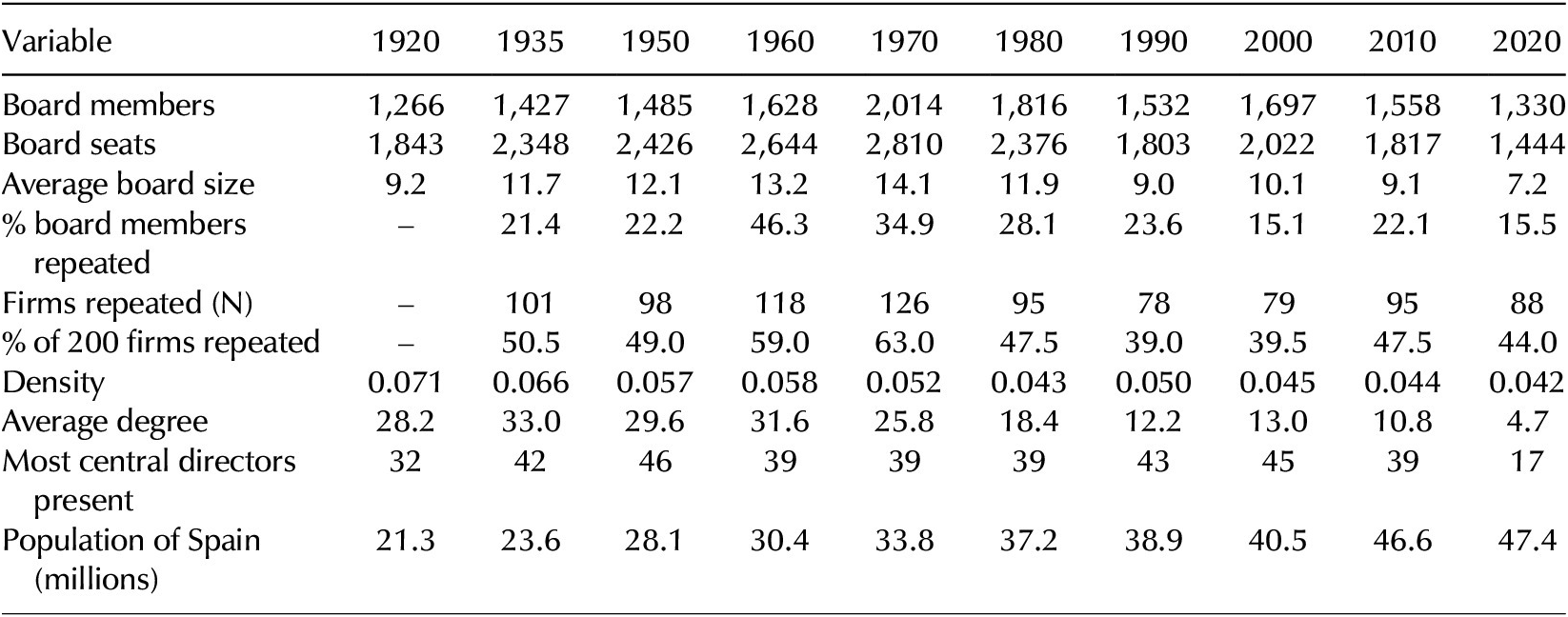
Board Composition, Firm and Director Continuity, and Network Statistics at each Benchmark Year

Table A1. Long description
The table contains 10 rows of variables across 10 benchmark years (1920, 1935, 1950, 1960, 1970, 1980, 1990, 2000, 2010, 2020).
* Board members: Peaks at 2,014 in 1970 and declines to 1,330 by 2020.
* Board seats: Peaks at 2,810 in 1970 and declines to 1,444 by 2020.
* Average board size: Increases from 9.2 in 1920 to a peak of 14.1 in 1970, then decreases to 7.2 in 2020.
* Percent board members repeated: Fluctuates with a high of 46.3 percent in 1960 and a low of 15.1 percent in 2000.
* Firms repeated (N): Ranges from a low of 78 in 1990 to a high of 126 in 1970.
* Percent of 200 firms repeated: Peaks at 63.0 percent in 1970 and reaches a low of 39.0 percent in 1990.
* Density: Shows a steady decline from 0.071 in 1920 to 0.042 in 2020.
* Average degree: Peaks at 33.0 in 1935 and declines significantly to 4.7 by 2020.
* Most central directors present: Peaks at 46 in 1950 and drops to 17 in 2020.
* Population of Spain (millions): Shows a continuous linear increase from 21.3 in 1920 to 47.4 in 2020.
Note: % board members repeated: percentage of board members in each benchmark year who were also present in the immediately preceding benchmark year. Firms repeated (N) and % of 200 firms repeated: number and percentage of the 200 largest firms in each benchmark year also ranked among the 200 largest in the immediately preceding benchmark year, based on exact name matches and confirmed equivalences reflecting mergers, acquisitions, and changes in corporate denomination. Density: density of the director network (undirected, unweighted). Most central directors present: number of the 107 most central directors identified across the three aggregated periods who held at least one board seat in the given benchmark year. No figure reported for 1920 in continuity rows (first benchmark year in the series). Population data from INE.
Source: Authors’ own elaboration. Network statistics calculated using UCINET (Borgatti, Everett, and Freeman, 2002). Population data from INE.
Appendix 2
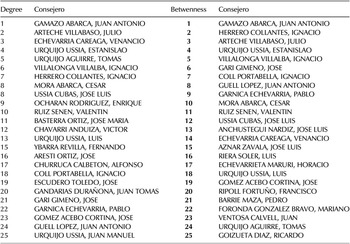
Most Central Board Members, 1920–1950

Table A2. Long description
The table consists of four columns organized into two comparative ranking sets. The first set (left) ranks individuals by Degree, and the second set (right) ranks individuals by Betweenness.
Top rankings for Degree include:
1. GAMAZO ABARCA, JUAN ANTONIO
2. ARTECHE VILLABASO, JULIO
3. ECHEVARRIA CAREAGA, VENANCIO
4. URQUIJO USSIA, ESTANISLAO
5. URQUIJO AGUIRRE, TOMAS
Top rankings for Betweenness include:
1. GAMAZO ABARCA, JUAN ANTONIO
2. HERRERO COLLANTES, IGNACIO
3. ARTECHE VILLABASO, JULIO
4. URQUIJO USSIA, ESTANISLAO
5. VILLALONGA VILLALBA, IGNACIO
Notable differences in the rankings include HERRERO COLLANTES, IGNACIO, who is ranked 7th in Degree but 2nd in Betweenness, and ECHEVARRIA CAREAGA, VENANCIO, who is 3rd in Degree but 14th in Betweenness. The list continues down to rank 25, where URQUIJO USSIA, JUAN MANUEL holds the 25th spot for Degree and GOIZUETA DIAZ, RICARDO holds the 25th spot for Betweenness.
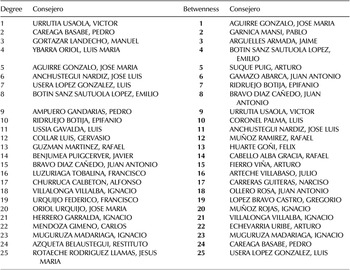
Most Central Board Members, 1960–1980

Table A3. Long description
The table consists of 25 rows and 4 columns. The first column, Degree, lists ranks 1 through 25. The second column, Consejero, lists the names associated with the Degree rank. The third column, Betweenness, repeats the rank numbers 1 through 25. The fourth column, Consejero, lists the names associated with the Betweenness rank.
Top rankings for Degree:
1. URRUTIA USAOLA, VICTOR
2. CAREAGA BASABE, PEDRO
3. GORTAZAR LANDECHO, MANUEL
4. YBARRA ORIOL, LUIS MARIA
5. AGUIRRE GONZALO, JOSE MARIA
Top rankings for Betweenness:
1. AGUIRRE GONZALO, JOSE MARIA
2. GARNICA MANSI, PABLO
3. ARGUELLES ARMADA, JAIME
4. BOTIN SANZ SAUTUOLA LOPEZ, EMILIO
5. SUQUE PUIG, ARTURO
Notable individuals appearing in both top 10 lists include AGUIRRE GONZALO, JOSE MARIA; BOTIN SANZ SAUTUOLA LOPEZ, EMILIO; RIDRUEJO BOTIJA, EPIFANIO; and URRUTIA USAOLA, VICTOR.
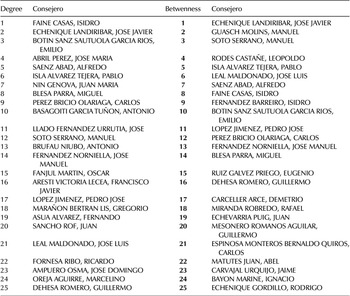
Most Central Board Members, 1990–2020

Table A4. Long description
The table consists of four columns: Degree, Consejero (associated with Degree), Betweenness, and Consejero (associated with Betweenness). It lists 25 entries.
* Rank 1: Degree - FAINE CASAS, ISIDRO; Betweenness - ECHENIQUE LANDIRIBAR, JOSE JAVIER.
* Rank 2: Degree - ECHENIQUE LANDIRIBAR, JOSE JAVIER; Betweenness - GUASCH MOLINS, MANUEL.
* Rank 3: Degree - BOTIN SANZ SAUTUOLA GARCIA RIOS, EMILIO; Betweenness - SOTO SERRANO, MANUEL.
* Rank 4: Degree - ABRIL PEREZ, JOSE MARIA; Betweenness - RODES CASTAÑE, LEOPOLDO.
* Rank 5: Degree - SAENZ ABAD, ALFREDO; Betweenness - ISLA ALVAREZ TEJERA, PABLO.
* Rank 6: Degree - ISLA ALVAREZ TEJERA, PABLO; Betweenness - LEAL MALDONADO, JOSE LUIS.
* Rank 7: Degree - NIN GENOVA, JUAN MARIA; Betweenness - SAENZ ABAD, ALFREDO.
* Rank 8: Degree - BLESA PARRA, MIGUEL; Betweenness - FAINE CASAS, ISIDRO.
* Rank 9: Degree - PEREZ BRICIO OLARIAGA, CARLOS; Betweenness - FERNANDEZ BARREIRO, ISIDRO.
* Rank 10: Degree - BASAGOITI GARCIA TUÑON, ANTONIO; Betweenness - BOTIN SANZ SAUTUOLA GARCIA RIOS, EMILIO.
* Rank 11: Degree - LLADO FERNANDEZ URRUTIA, JOSE; Betweenness - LOPEZ JIMENEZ, PEDRO JOSE.
* Rank 12: Degree - SOTO SERRANO, MANUEL; Betweenness - PEREZ BRICIO OLARIAGA, CARLOS.
* Rank 13: Degree - BRUFAU NIUBO, ANTONIO; Betweenness - FERNANDEZ NORNIELLA, JOSE MANUEL.
* Rank 14: Degree - FERNANDEZ NORNIELLA, JOSE MANUEL; Betweenness - BLESA PARRA, MIGUEL.
* Rank 15: Degree - FANJUL MARTIN, OSCAR; Betweenness - RUIZ GALVEZ PRIEGO, EUGENIO.
* Rank 16: Degree - ARESTI VICTORIA LECEA, FRANCISCO JAVIER; Betweenness - DEHESA ROMERO, GUILLERMO.
* Rank 17: Degree - LOPEZ JIMENEZ, PEDRO JOSE; Betweenness - CARCELLER ARCE, DEMETRIO.
* Rank 18: Degree - MARAÑON BERTRAN LIS, GREGORIO; Betweenness - MIRANDA ROBREDO, RAFAEL.
* Rank 19: Degree - ASUA ALVAREZ, FERNANDO; Betweenness - ECHEVARRIA PUIG, JUAN.
* Rank 20: Degree - SANCHO ROF, JUAN; Betweenness - MESONERO ROMANOS AGUILAR, GUILLERMO.
* Rank 21: Degree - LEAL MALDONADO, JOSE LUIS; Betweenness - ESPINOSA MONTEROS BERNALDO QUIROS, CARLOS.
* Rank 22: Degree - FORNESA RIBO, RICARDO; Betweenness - MATUTES JUAN, ABEL.
* Rank 23: Degree - AMPUERO OSMA, JOSE DOMINGO; Betweenness - CARVAJAL URQUIJO, JAIME.
* Rank 24: Degree - OREJA AGUIRRE, MARCELINO; Betweenness - BAYON MARINE, IGNACIO.
* Rank 25: Degree - DEHESA ROMERO, GUILLERMO; Betweenness - ECHENIQUE GORDILLO, RODRIGO.

 Open access

