





Introduction
Conversational exchanges (Snow, Reference Snow1977) between children and their adult caregivers are filled with nuances that can significantly influence language growth. While research extensively examines various aspects of caregivers’ speech patterns and responses, such as word count, lexical diversity (Bergelson et al., Reference Bergelson, Amatuni, Dailey, Koorathota and Tor2019; d’Apice, Latham, & von Stumm, Reference d’Apice, Latham and von Stumm2019), and responsiveness (Begus et al., Reference Begus, Gliga and Southgate2014; Tamis-LeMonda & Bornstein, Reference Tamis-LeMonda and Bornstein2002; Warrent & Brady, Reference Warren and Brady2007), limited attention has been given to how infants contribute to and influence adults’ responses (Murray & Trevarthen, Reference Murray and Trevarthen1986; Smith & Trainor, Reference Smith and Trainor2008). Although there is considerable research on infants’ turn-taking skills via vocalisation and gaze within these exchanges (Bloom et al., Reference Bloom, Russell and Wassenberg1987; Casillas & Frank, Reference Casillas and Frank2017; Bornstein et al., Reference Bornstein, Putnick, Cote, Haynes and Suwalsky2015; Rutter & Durkin, Reference Rutter and Durkin1987; Levinson & Torreira, Reference Levinson and Torreira2015; Lourenço et al., Reference Lourenço, Pereira, Sampaio and Coutinho2021), insufficient attention has been given to exploring the broader role infants play in shaping these interactions beyond their response patterns. While adults are typically perceived as the primary drivers of these interactions (Kochanska & Aksan, Reference Kochanska and Aksan2004; Vygotsky & Cole, Reference Vygotsky and Cole1978), further research is needed to elucidate the nuanced intricacies of dyadic interactions (Ko et al., Reference Ko, Seidl, Cristia, Reimchen and Soderstrom2016). This study aims to uncover the bidirectional nature of initiative in dyadic interactions, exploring caregivers’ and infants’ roles in shaping these exchanges, across children’s ages and language abilities.
The initiator effect
The interlocutory order in dyadic turn-taking in conversations, in which each agent takes the role as an initiator and respondent, has been found to impact response patterns, with the initiator typically playing a more active role (hereinafter initiator effect; Ko et al., Reference Ko, Seidl, Cristia, Reimchen and Soderstrom2016). Ko et al. (Reference Ko, Seidl, Cristia, Reimchen and Soderstrom2016) investigated adult–child interactions among monolingual English-learning toddlers aged 12–30 months and found that when individuals initiated a conversational block (defined as a series of exchanges separated by a pause of 5 seconds or longer, see Figure 1). They tended to produce longer utterances and respond more quickly than when they assumed the role of respondent – an indication of the active role of both the adult and the young children in the conversational exchange. However, the persistence of these interaction dynamics across development and their connection to children’s language abilities remain unclear, necessitating further investigation into how conversational roles evolve and adapt as a function of children’s age and language abilities.
Example of adult-child dyadic interaction at the segment and block levels. At the segment level, C/S represents speech-related child vocalization, whereas C/N is non-speech related and ADT represents adult vocalization (female in female-child dyad or male in male-child dyad). In each segment, utterances from a single speaker are captured, where an individual utterance has a minimum duration of 50 ms. A subsequent utterance requires a silence of at least 300 ms for differentiation. Notably, for speaker classification, LENA defines a segment’s minimum duration as 1000 ms for adult male (MAN), adult female (FAN), television (TVN), overlapping noise (OLN) categories, and 600 ms for key child (CHN). Segments are typically separated by periods of silence. When two segments are not separated by silence (i.e., they are back-to-back), they are distinguished based on changes in speaker. A silence of 800ms or more is represented with SIL1 in our annotation. The segment that follows the end of a preceding segment by a different speaker is considered a response. Adult’s responses to the child’s speech-related vocalization (C-to-A conversational turn) are represented with blue curves, whereas red curves represent a child’s response to an adult’s vocalization (A-to-C conversational turn). Each block is separated by a minimum of 5000 ms of silence between the two blocks, represented with SIL2. As illustrated here, the first conversational block begins with a child’s vocalization, making it a child-initiated block, followed by SIL2 then an adult’s vocalization which starts an adult-initiated block.

In a study on conversational dynamics, VanDam et al. (Reference VanDam, Thompson, Wilson-Fowler, Campanella, Wolfenstein and De Palma2022) showed that older children (25–37 months old) initiated conversations more frequently than their parents, suggesting a developmental shift towards increased conversational autonomy. Yet, the relationship between interaction dynamics in dyadic conversational interactions and a child’s language abilities remains to be further explored. Furthermore, Salo, King, Gotlib, and Humphreys (Reference Salo, King, Gotlib and Humphreys2022) reported that the number of adult-initiated conversations with infants at 6 months was positively correlated with expressive language skills of the infants at 18 months. This correlation remained even when controlling for infant-initiated conversations, highlighting the robustness of the association between adult-initiated interactions and language outcomes. Additionally, they found that adult-initiated conversations were more frequent, longer, and contained more adult words than infant-initiated conversations at 6 months.
While these findings shed light on the caregiver’s role in conversational exchanges and its relation to child development, the complexities of this dynamic, particularly the initiator effect as observed in Ko et al. (Reference Ko, Seidl, Cristia, Reimchen and Soderstrom2016), warrant a more in-depth analysis to understand how initiating conversations may shape the nature of children’s language experiences and development. Although the findings in Salo et al. (Reference Salo, King, Gotlib and Humphreys2022) support the initiator effect reported in Ko et al. (Reference Ko, Seidl, Cristia, Reimchen and Soderstrom2016), the nuances of these dynamics, including their variability across age and language abilities, remain largely unexplored. This study aims to further our understanding of how these social interactions are associated with children’s language experiences, potentially shaping the context for language development through the role of interlocutory order in adult−child exchanges.
Theoretical contexts
While limited research exists on the social-cognitive foundation of the initiator effect observed in this study, Goffman’s (Reference Goffman1974) frame analysis offers a valuable perspective for comprehending the intricate dynamics of social interactions. Central to Goffman’s framework is the notion of shared frames, wherein participants collectively construct a shared understanding of the situation or context. When an interaction begins, individuals establish a shared frame of reference, facilitating their interpretation and navigation of the ongoing exchange. The initiator’s role in “keying”, or establishing the framework for the interaction, is particularly relevant to the initiator effect investigated in our research. By initiating a conversation, individuals dictate its tone, shaping its trajectory and exerting influence over its dynamics and outcomes. This action establishes the framework for the exchange, affecting both the initiator’s and respondent’s behaviour. As the initiator steers the initial direction and focus of the conversation, they are more likely to take an active role in the interaction. This often manifests in prolonged speaking durations and quicker responses compared to the respondent, etc., i.e., the initiator effect. Further theoretical insights on this topic will be provided in the discussion section.
The present study
We investigate the intricacies of dyadic conversational patterns within Korean parent−child interactions across various age groups, examining a spectrum of speech patterns extracted from Language ENvironment Analysis (LENA)-coded data. While our investigation does not encompass cross-cultural and cross-linguistic comparisons, our primary focus lies in investigating whether the initiator effect, as previously documented in studies conducted with North American populations (Ko et al., Reference Ko, Seidl, Cristia, Reimchen and Soderstrom2016), manifests similarly in our Korean dataset. Linguistic differences, such as Korean’s practice of frequent subject/object drop − a grammatical feature not permissible in English − may lead to unique conversational patterns, such as Korean mothers’ heightened repetition of nouns than American mothers (Ko et al., Reference Ko, Jo and Chai2023). Cultural differences in parenting attitudes also exist: Korean mothers often prioritise children’s conformity and character building (Rodd, Reference Rodd1996), while American mothers emphasise autonomy and enjoyment in learning (Vinden, Reference Vinden2001). Despite these cultural differences, we posit that the dynamics underlying interaction patterns may signify a broader cross-cultural phenomenon, potentially universal if the initiator effect’s mechanism derives from general conversational dynamics (Tomasello, Reference Tomasello1988) or social dynamics like framing (Goffman, Reference Goffman1974). This assertion finds support in the research of Stivers et al. (Reference Stivers, Enfield, Brown, Englert, Hayashi, Heinemann, Hoymann, Rossano, de Ruiter, Yoon and Levinson2009), who uncovered robust turn-taking patterns across 10 languages, characterised by a consistent aversion to overlapping speech and minimal pauses between turn transitionsFootnote 1. Should our hypothesis hold true, we anticipate identifying shared underlying mechanisms in dyadic conversational patterns concerning the manifestation of the initiator effect, transcending cultural boundaries.
Furthermore, we explore the presence of the initiator effect, extending beyond the variables examined in previous research, such as Ko et al. (Reference Ko, Seidl, Cristia, Reimchen and Soderstrom2016) or Salo et al. (Reference Salo, King, Gotlib and Humphreys2022), and examine how these patterns may vary as a function of children’s age. We hypothesise that as children’s linguistic and cognitive development progresses, they become more active in their interactions. We expect that the mechanism governing the initiator effect in conversation is not age-specific and remains independent from age despite developmental changes.
In addition, we explore how initiator effects in specific conversational measures during dyadic interactions relate to children’s language abilities. To avoid potential age-related biases associated with developmental stages, we focused our analysis on a single, coherent age group, i.e., children aged 13–14 months, where we had the largest dataset (N = 40). This age range is particularly interesting as it coincides with the onset of children’s first words, offering a unique opportunity to observe the emergence of language skills and their relationship with parental behaviours.
Our research questions can be summarised as follows: (1) Does the initiator effect, as observed in Ko et al. (Reference Ko, Seidl, Cristia, Reimchen and Soderstrom2016), replicate in a different population, such as Korean caregiver-child dyads? We hypothesise that the conversational initiator will demonstrate greater attentiveness when initiating conversations compared to when responding. This heightened attentiveness likely arises from the initiator’s role in setting the initial frame for the interaction (Goffman, Reference Goffman1974). We expect this to be reflected in features such as longer utterance durations, a greater number of utterances, shorter response times, and a higher frequency of responses. (2) Is the initiator effect robust across children’s ages? Ko et al. (Reference Ko, Seidl, Cristia, Reimchen and Soderstrom2016) were among the early studies to document the initiator effect in mother−child dyads but did not examine age-related influences, a gap our study seeks to address. We expect that the overall effect to remain consistent across children aged 7 and 30 months, with older children initiating more conversations, producing longer and more frequent utterances, and responding more quickly and more frequently than younger children. (3) How do adult and child initiator effects in conversational dynamics vary across different levels of children’s language abilities? Since no prior research has explored the initiator effect in relation to children’s language abilities, this is a new avenue of investigation, allowing for a range of hypotheses. If the initiator effect is indeed a fundamental aspect of human interaction, we might expect it to persist regardless of language abilities. However, it is also plausible that a child’s language abilities could modulate the magnitude and characteristics of the initiator effect. For instance, children with lower language abilities might depend more on adult-initiated interactions, while those with more advanced skills may engage in more balanced conversations with less need for adult intervention. Conversely, it is possible that children who receive more support through adult-led exchanges could display stronger language skills.
Methods
Participants
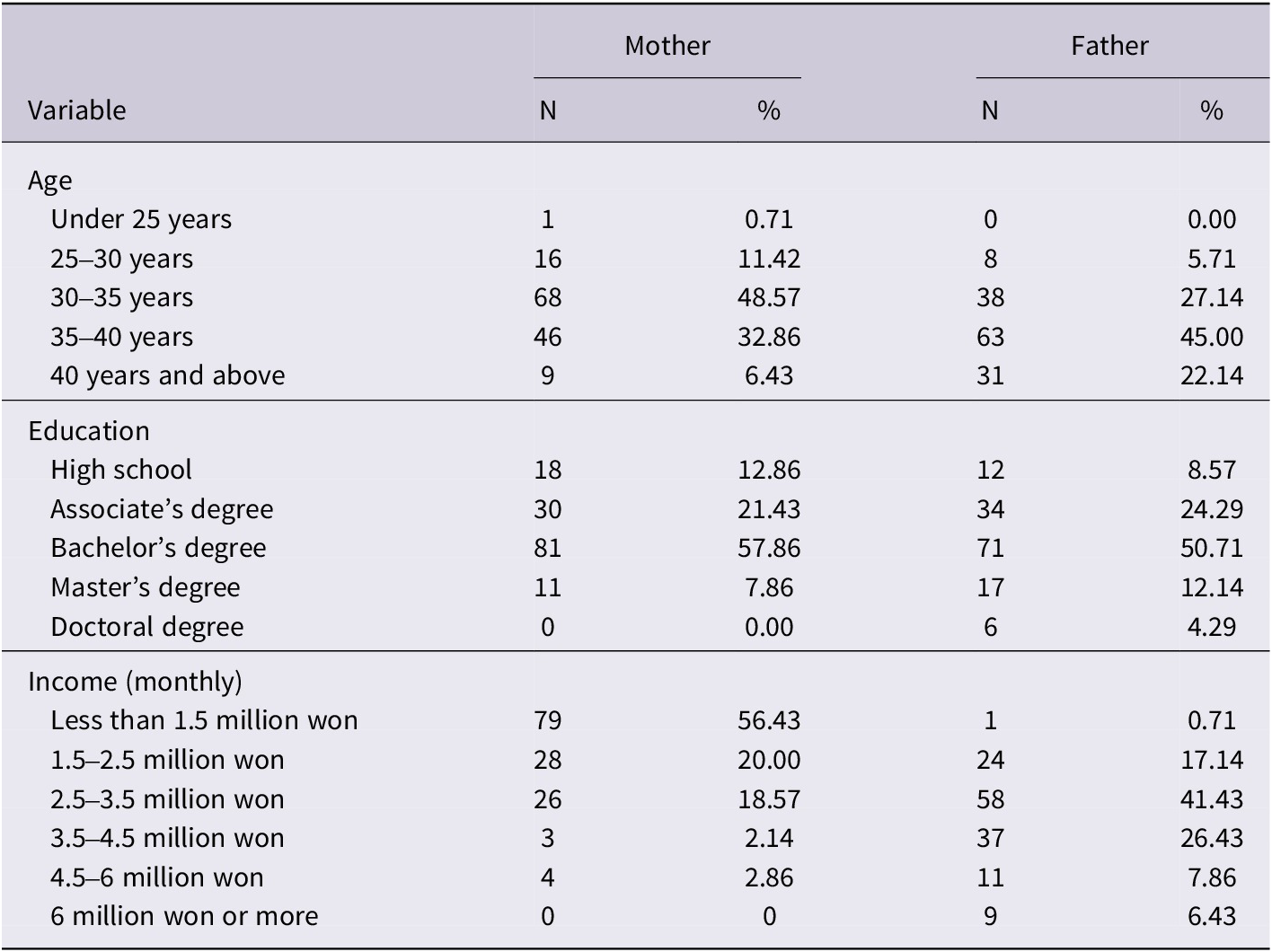
228 daylong LENA recordings were collected from 141 Korean adult–child dyads (60 girls) with children aged between 7 and 30 months (M = 13.84, SD = 7.05) residing in the Gwangju area of South Korea between November 2018 and March 2021. The collection of the data was carried out in accordance with the ethical standards of the Institutional Review Board of Chosun University. (Approval No. 2-1041055-AB-N-01-2018-51). They were recruited through in-person campaigns at baby fairs and online advertisements on social networking platforms. Prior to participation, we sent out a pre-screening questionnaire and only the families with infants that were born full-term were invited for the study. One family did not submit their socio-economic status (SES) demographics (see Table 1 for full description).
Descriptive statistics of parental age, education and monthly income
In addition to analysing the full sample, we focused on a subset of children aged 13–14 months (N = 40) to explore the relationship between the initiator role in parent–child interactions and children’s language outcomes. Language outcomes were measured by using the MacArthur-Bates Communicative Development Inventories – Korean adaptation (K-CDI; Pae & Kwak, Reference Pae and Kwak2011), with percentile scores derived from the Korean data repository available in WordBank (Frank et al., Reference Frank, Braginsky, Yurovsky and Marchman2017).
Apparatus and materials
Adult–child naturalistic interactions were recorded using the LENA system. The LENA system facilitates home-based naturalistic observation of children’s environments and interactions using a small digital recorder that fits into a pocket (Zimmerman et al., Reference Zimmerman, Gilkerson, Richards, Christakis, Xu, Gray and Yapanel2009). The device is capable of storing up to 16 hours of running speech, thus capturing the child’s and their conversational-partner’s vocalizations and interactions throughout the day. LENA preprocesses the recording, categorising it into segments , as depicted in Figure 1, and classifies them based on the speaker (e.g., child, adult female, adult male, other child, and electronic/media sounds). It also identifies conversational blocks, as illustrated in Figure 1, and categorises them according to the initiator (i.e., adult vs. child-initiated block).
Analysis framework for interaction metric
To examine the relationship between adult–child interactions and their response patterns, we analyse the interaction metrics at the level of segment and block (see Figure 1). At the segment level, we examined whether the role of being an initiator of a conversational block has any effects on how long (mean segment duration) and how much (number of segments) each person speaks. At the conversational block level, we investigated whether the initiator status of a speaker influences the speed of response and number of turns (responses). It is noteworthy that Figure 1 is a simplified example of adult-child interactions because naturalistic language environments can involve sound segments from sources other than the dyads, e.g., second adult speakers, other children, far sounds and sounds from electronics (TV, radio etc.). Responses are counted when a child segment occurs within five seconds before or after an adult segment and without any sound segment from a third speaker (different sex adult or another child), but either silence or far sounds and sounds from electronics are allowed in the initiation-response interim (Gilkerson & Richards, Reference Gilkerson and Richards2020).
At both levels of analyses, differences between being initiator or not would provide directional evidence of the initiator effect (e.g., Figures 4–5). In addition, we examine the association between interaction patterns and children’s concurrent language outcomes as measured by the K-CDI percentile.
Validation of temporal patterns based on LENA-automated annotations
A number of studies have validated LENA’s speaker identification across diverse languages (Dutch: Bruyneel et. al., Reference Bruyneel, Demurie, Boterberg, Warreyn and Roeyers2021, English: Xu, Yapanel & Gray, Reference Xu, Yapanel and Gray2009, French: Canault et al., Reference Canault, Le Normand, Foudil, Loundon and Thai-Van2016, Italian: Bastianello et al., Reference Bastianello, Lorenzini, Nazzi and Majorano2023, Korean: McDonald et al., Reference McDonald, Kwon, Kim, Lee and Ko2021, Vietnamese: Ganek & Eriks-Brophy, Reference Ganek and Eriks-Brophy2018), with promising predictability for child language (Wang et al., Reference Wang, Williams, Dilley and Houston2020). Previous research (McDonald et al., Reference McDonald, Kwon, Kim, Lee and Ko2021) has validated LENA’s performance with Korean, demonstrating a comparable rate of accuracy with findings in other languages regarding speaker identification and word count. However, our understanding of the degree of correspondence between LENA-defined segment durations or response times and those determined through human coding remains limited. This is primarily attributed to the scarcity of research on the timing of caregiver responses to infants or vice versa (Yoo, et al., Reference Yoo, Bowman and Oller2018). To validate our findings, we conducted a comparative analysis using manual annotations on 60 five-min audio clips from McDonald et al. (Reference McDonald, Kwon, Kim, Lee and Ko2021). Our analysis of the manually annotated dataset revealed patterns consistent with those found in the LENA data: adults generated more segments, with longer durations, and responded more promptly to infants compared to their child counterparts. This alignment underscores the utility of LENA automated annotations for studying adult–child dyadic interactionsFootnote 2.
Procedure
Parents were given a 4-page instruction sheet to review, a log sheet, and a custom-made vest that had a pocket to hold the recorder in the upper front part of the garment. For parents who visited the laboratory in person with their child to participate in another study, we demonstrated the device to the mothers, provided instructions on the recording process, and addressed any questions they had. We requested that parents keep an hourly log of the activities on the day of the recording and informed them of the option to request the deletion of all or a portion of the recording that they might feel uncomfortable sharing. They were instructed to make the recording within three days after receiving the device and return it via prepaid package delivery service. In cases where parents failed to return the device within the designated time frame, we sent them with another device that had a fully charged battery to ensure uninterrupted recording of up to 16 hours. Children’s vocabulary size was measured using the Korean adaptation of the K-CDI. We administered the K-CDI before their visit via an online form. Full recording instructions and a sample of the activity log sheet are available in the project’s OSF repository: https://osf.io/fqj43/, along with the data in this study and scripts for analysing them.
Results
To provide context for interpreting the outcomes of our investigation, we first analyse the frequency of initiated blocks across speakers and age groups. While this analysis is not directly tied to our primary research questions, it establishes a baseline understanding of conversational initiation patterns. Subsequently, we present the findings related to our main research questions in three parts. For the first research question, we report findings on interaction patterns of Korean adults and children as a function of initiator roles (Speaker/Turn × Block Type). To address the second research question, we extend this analysis to explore interactions with children’s age (Speaker/Turn × Block Type x Child Age). The initiator effect, our primary focus is captured by the interaction between Speaker/Turn × Block Type. If no interaction with Child Age is found, this suggests that the initiator effect is consistent regardless of the child’s age. However, if an interaction with Child Age is observed, the initiator effect may still persist but varies depending on the interaction pattern. For the third research question, we present results indicating the important role of an adult’s initiative effort in children’s language outcomes.
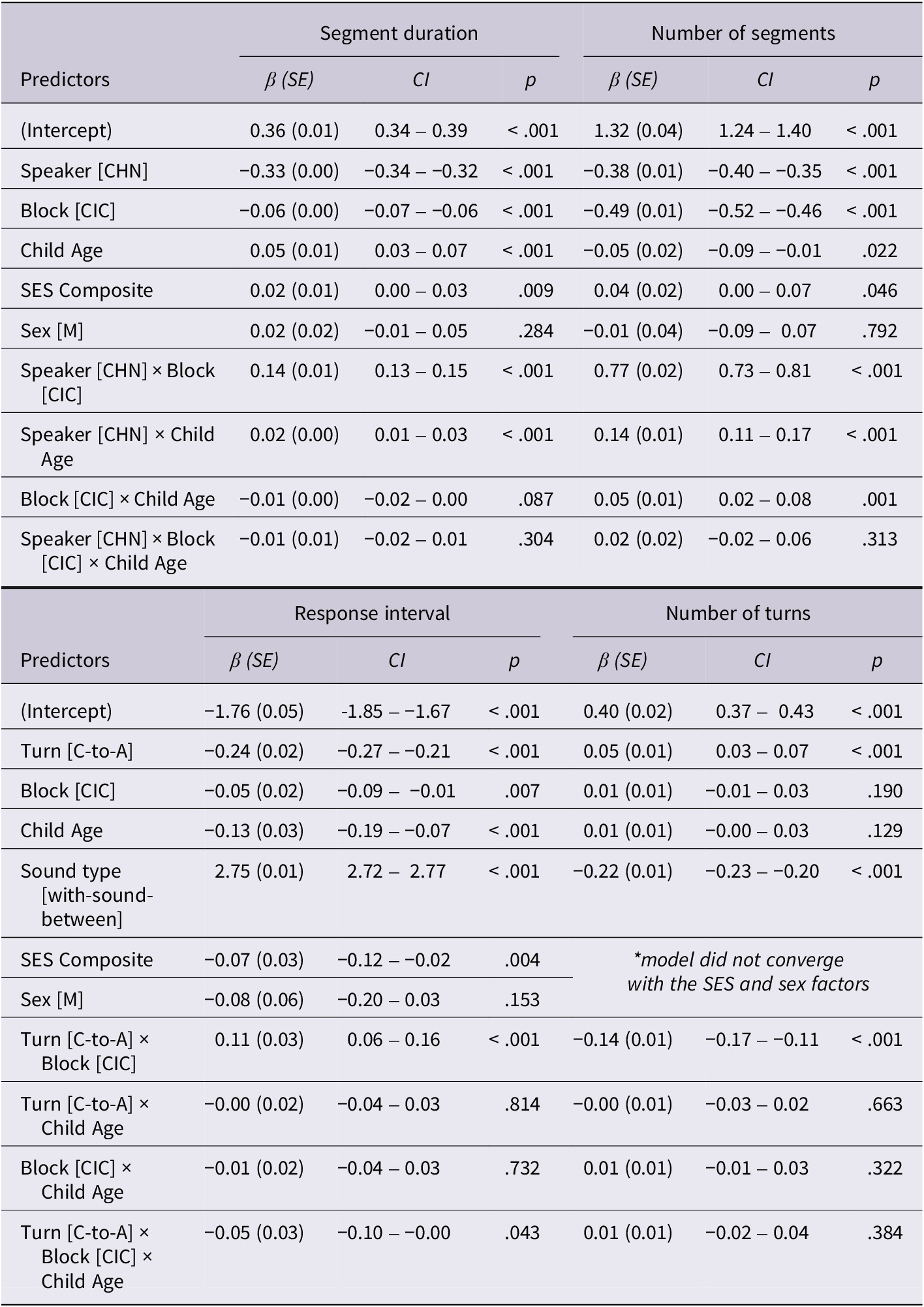
Using the Anova() function in the car package (Fox, Reference Fox2009), we evaluate whether adding a particular fixed effect or interaction significantly improves the model’s fit. We report chi-squares (χ2), degree of freedoms (df) and p-values to summarise the significance of main and interaction effects for each model. Regression statistics are provided in tables (Tables 2 & 3), including standardised beta estimates (β), confidence intervals (CI), and p-values using the tab_model()function in the sjPlot package (Lüdecke, Reference Lüdecke2021). This dual approach offers a comprehensive assessment: ANOVA evaluates the overall contribution and significance of variables and their interactions, justifying post-hoc analyses, whereas regression coefficients indicate effect direction and strength for specific nested variable levels. For pairwise comparisons involving variables with multiple levels contrasts, we report the estimated marginal means (EMMs) for each factor level, along with the differences between levels, standard errors (SE), and p-values using the estimate_contrasts()function from the modelbased package (Makowski et al., Reference Makowski, Ben-Shachar, Patil and Lüdecke2020), with accompanying graphical illustrations (Figures 3–5).
Model outputs on initiator effect, its interaction with age and other covariates
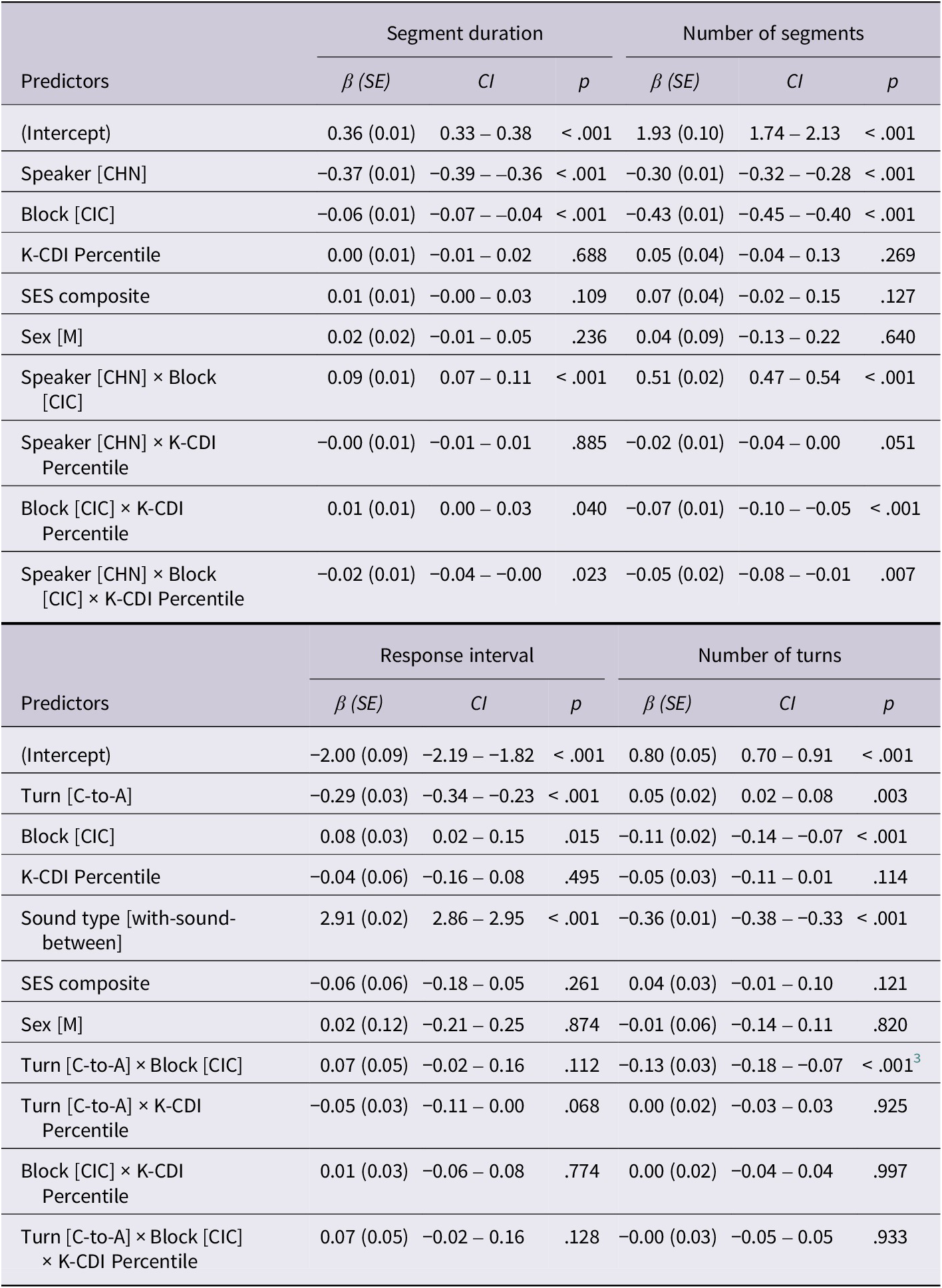
Modelled with CDI percentile and its interaction with adult–child interactions and concurrent language skills.
Frequency of initiation across children’s age
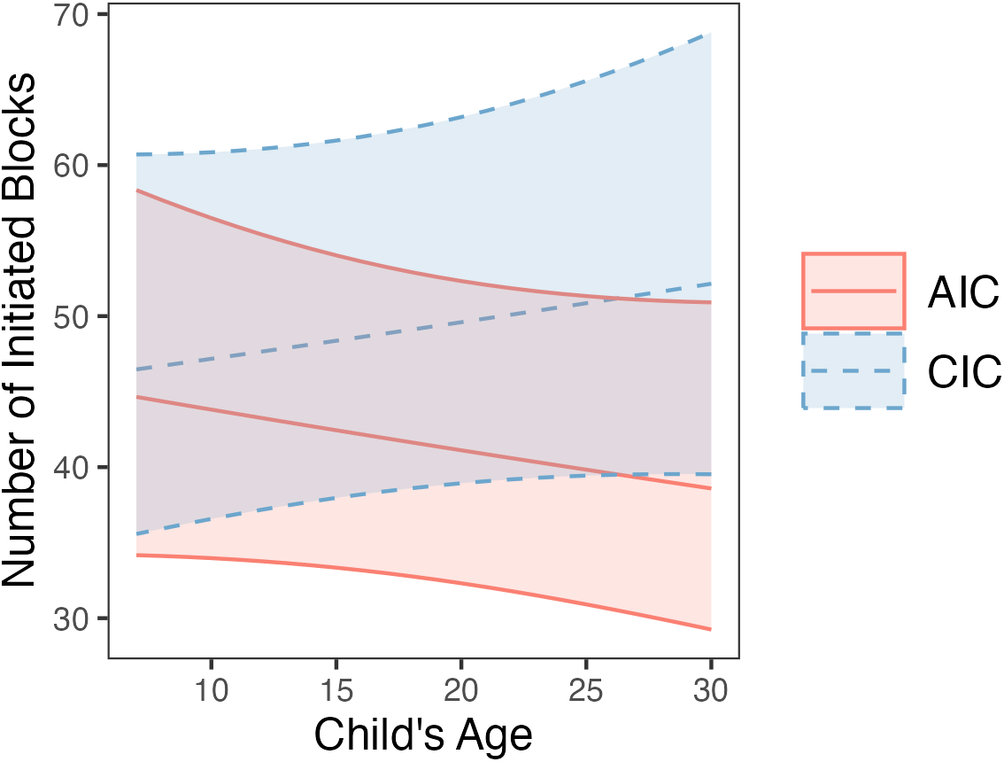
We first examined whether the number of initiated blocks differs between speakers (adult and child) and across age. We constructed a generalised linear mixed model (negative binomial GLMM for overdispersed count data) on the number of initiated blocks with the model formula: block numbers ~ Block_Type * Child_Age + (1 + adult’s gender | dyad). This model included Block Type (adult-initiated or child-initiated), Child Age, and their interactions as fixed factors. Additionally, we included dyads as random intercepts to account for individual differences among participants. The model, analysed with the Anova() function in the car package (Fox, Reference Fox2009), showed no significant main effect of Block Type, χ2(1) = .21, p = .648, and no significant main effect of Child Age, χ2(1) = 1.22, p = .267. However, there was a significant interaction between Block Type and Child Age, χ2(1) = 4.22, p = .040. The interaction between Block Type and Child Age, as illustrated in Figure 2, shows that children between 7 and 10 months old show no significant differences (p > .05) in the number of initiated blocks. However, from 11 months onwards, children initiate a greater number of blocks than adults (p < .05).
Model’s predicted number of initiated blocks in AIC (adult-initiated conversational block) and CIC (child-initiated conversational block) across children’s ages.
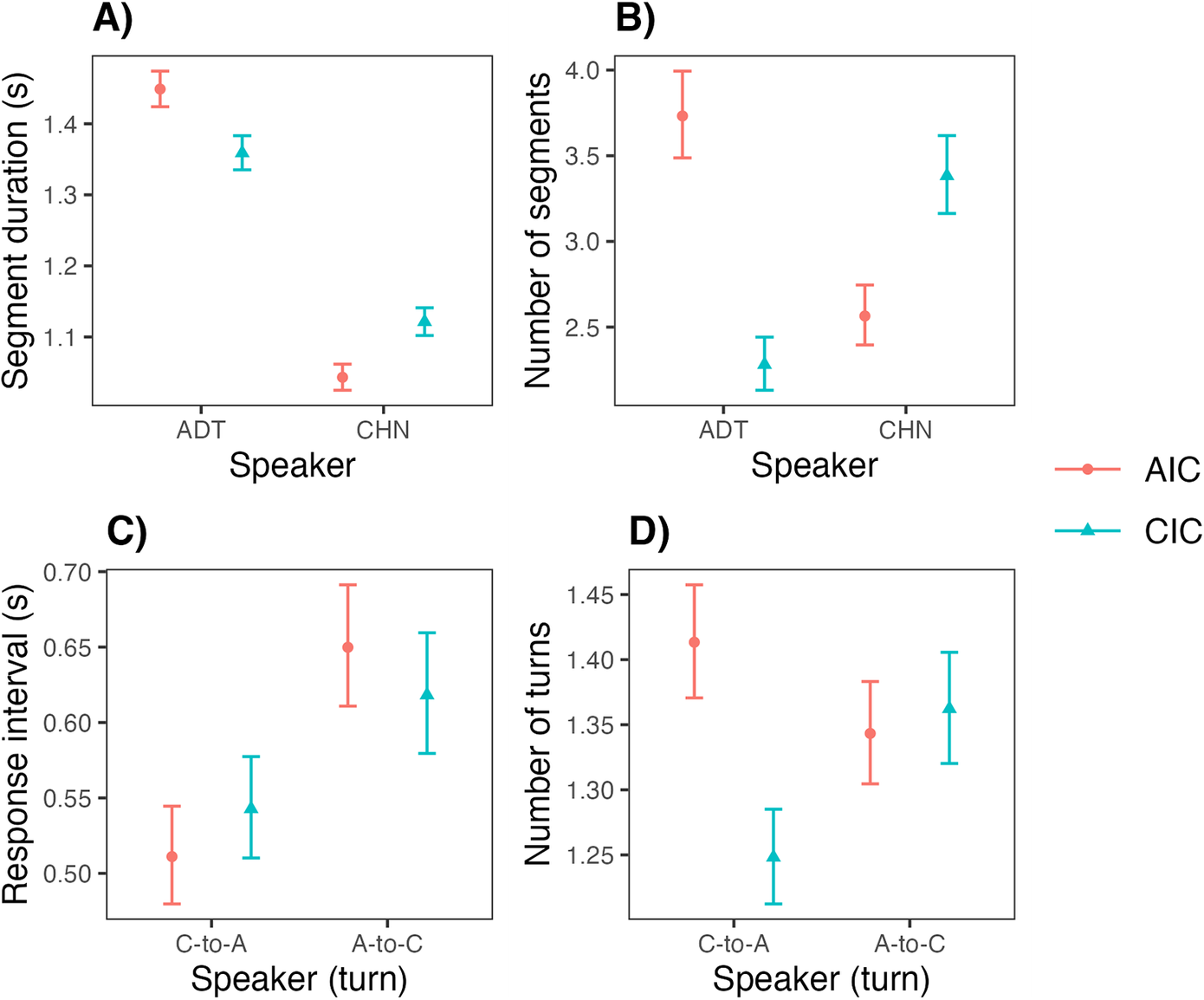
Errorbar plots of four metrics: at the segment level, A) segment duration and B) the number of segments; and at the conversational turn level, C) response interval, and D) the number of turns. ADT represents the adult, C-to-A represents child-to-adult turn, CHN represents the child and A-to-C represents adult-to-child turn in adult-initiated (AIC) and child-initiated (CIC) blocks.
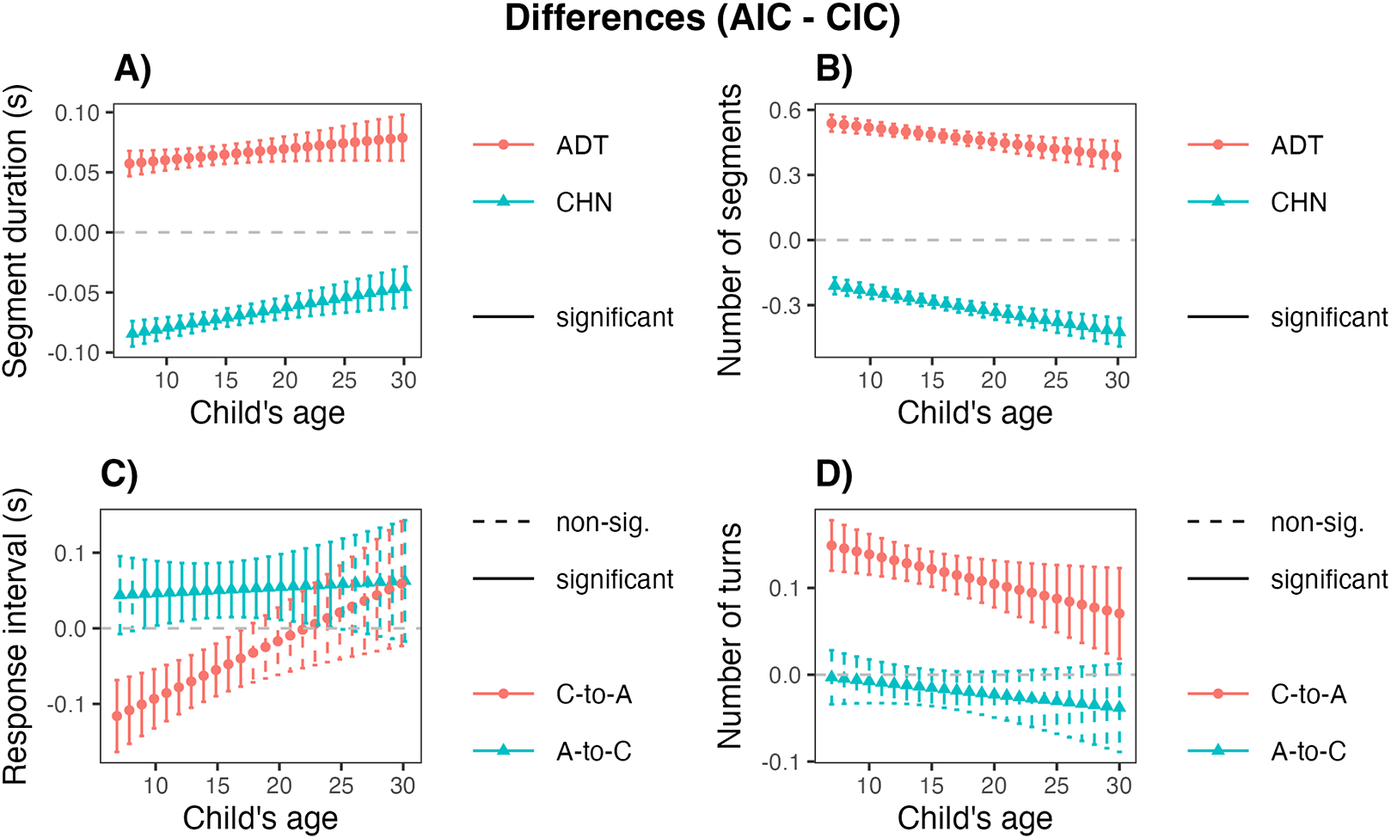
Initiator effect (defined as differences in EMMs between AIC and CIC) across age for adults (ADT/C-to-A) and children (CHN/A-to-C) across four metrics. Positive values for adults and negative values for children indicate the presence of the initiator effect in (A), (B), (D), the opposite direction is expected for (C). Note that only initiator effects in response intervals show significant interaction with the child’s age.
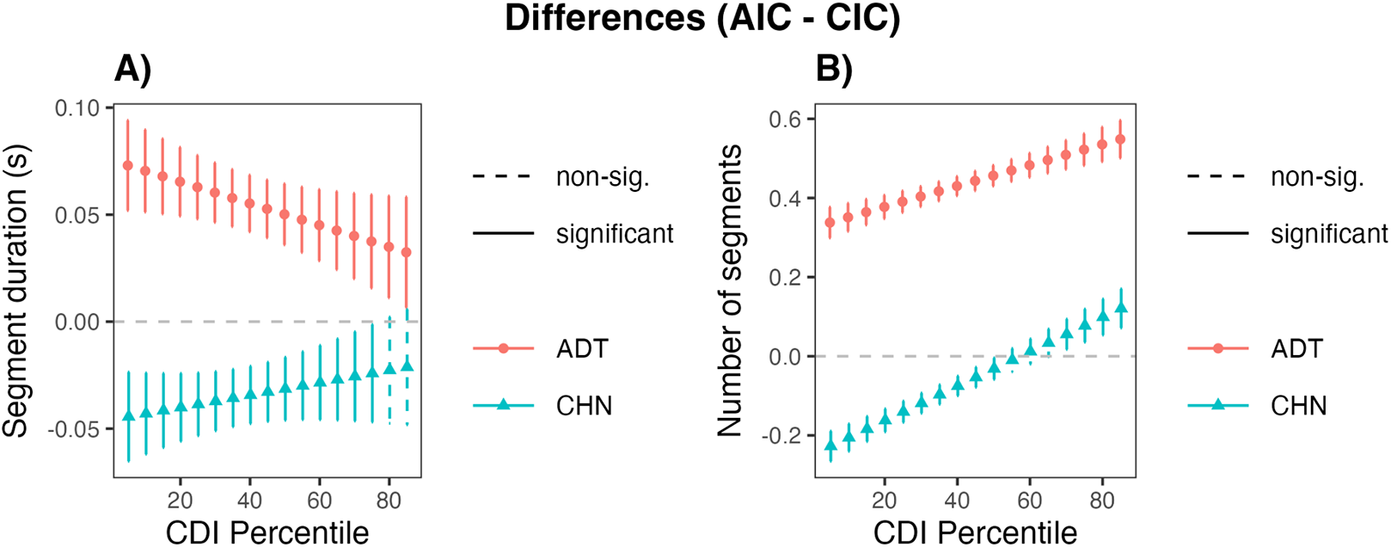
Initiator effect (defined as differences in EMMs between AIC and CIC) across K-CDI percentiles for adults (ADT/C-to-A) and children (CHN/A-to-C) in segment duration and number. Positive values for adults and negative values for children indicate the presence of initiator effect. Each error bar represents the model-estimated pairwise comparisons of EMMs at 5-percentile intervals of K-CDI scores.
The main model
We examine the effect of interlocutory order by measuring four aspects of adult–child interactions: segment duration, number of segments, response interval, and the number of turns, in a series of GLMMs. The models’ ANOVA outputs are summarily reported in Table 2. Each measure in the first column of Table 2 represents a dependent variable (i.e., segment duration, number of segments, response interval, and number of turns) which is separately fitted in a GLMM model and thus four GLMM models are fitted in total.
The models for segment duration and number of segments included fixed factors such as Speaker (adult or child), Block Type (adult-initiated or child-initiated), and Child Age (children’s age). We also included SES compositeFootnote 4 and sex as covariates due to their potential influence on children’s language development, with the model formula: measure (segment duration/number of segments) ~ Speaker * Block_Type * Child_Age + SES_composite + sex + (1 + adult’s sex | dyad).
In contrast, the models for response interval and number of turns included fixed factors such as Block Type, Turn Type (adult-to-child turn, i.e., child’s response to the adult, A-to-C, or child-to-adult turn, i.e., adult’s response to the child, C-to-A), Intermittent Sound Type (with-intermittent-sound, i.e., far sounds and sounds from electronics in the initiation-response interim, or no-intermittent-sound, i.e., only SIL (silence) segments allowed in the interim), and Child Age. The intermittent sound variable in the response metrics is included to account for the potential impact of background sounds on response latency and possible interruptionsFootnote 5, with the model formula: measure (response interval/number of turns) ~ Turn * Block_Type * Child_Age + sound_type + SES_composite + sex + (1 + adult’s sex | dyad). SES effects were found consistently across all variables, while sex effects were not observed. The next section focuses on the effects directly related to our main research questions.
Q1: Does the initiator effect (Ko et al., Reference Ko, Seidl, Cristia, Reimchen and Soderstrom2016) replicate in Korean caregiver-child dyads?
To investigate whether the initiator effect observed in previous research extends to a different population, we examined its presence in Korean caregiver–child dyads. We found a consistent initiator effect across multiple conversational metrics (Figure 3), with partial effect for turn number. Specifically, for segment duration, there was a significant interaction between Speaker and Block Type (χ²(1) = 158.243, p < .001). Initiators spoke longer (ADT in AIC: EMM = 1.45, SE = .01; CHN in CIC: EMM = 1.12, SE = .01) than respondents (ADT in CIC: EMM = 1.36, SE = .01; CHN in AIC: EMM = 1.04, SE = .01; p’s < .001). For the number of segments, there was also a significant interaction between Speaker and Block Type (χ²(1) = 288.818, p < .001). Initiators produced more segments (ADT in AIC: EMM = 3.73, SE = .13; CHN in CIC: EMM = 3.38, SE = .12) than respondents (ADT in CIC: EMM = 2.28, SE = .09; CHN in AIC: EMM = 2.56, SE = .09; p’s < .001).
For response intervals, there was a significant interaction between Turn and Block Type (χ²(1) = 14.496, p < .001). Initiators responded quicker (C-to-A in AIC: EMM = 0.51, SE = .02; A-to-C in CIC: EMM = 0.62, SE = .02) than respondents (C-to-A in CIC: EMM = 0.54, SE = .02; A-to-C in AIC: EMM = 0.65, SE = .02; p’s < .001). For the number of conversational turns, there was a significant interaction between Turn and Block Type (χ²(1) = 23.177, p < .001). The number of conversational turns showed a partial initiator effect, with adults responded more frequently when they were the initiator (in AIC, EMM = 1.41, SE = .02) than when they were not (in CIC, EMM = 1.25, SE = .02, p < .001), but no differences were found for children (p = .556).
Q2: Is the initiator effect robust across child age?
Children’s age was included as an interaction term in the main model to examine developmental changes in initiator effect, i.e., Speaker × Block Type × Child Age for segment duration and number of segments; Turn × Block Type × Child Age for response interval and number of turns). There were no significant three-way interactions involving Child Age for segment duration, number of segments, or turn number (p’s > .05), indicating that the initiator effect is held consistent regardless of childrens’ age. However, a significant three-way interaction was found between Turn × Block Type × Child Age (χ²(1) = 4.107, p < .001) for response interval. Pairwise comparisons as depicted in Figure 4-C shows that the initiator effect in adult’s response interval was significant between 7 and 17 months but diminished with children’s age, with no evidence of the effect from 18 months onwards, whereas initiator effect in children’s response interval was significant between 9 and 24 months old.
Q3: Is the initiator effect robust across varying language abilities?
Building on the question of whether the initiator effect is robust across cultures and ages, we now explore whether it remains consistent across varying levels of children’s language abilities. Specifically, we investigated how patterns of adult–child dyadic interactions relate to children’s concurrent language abilities, measured using K-CDI, with a focus on children between 13 and 14 months of age (N = 40). We employed a simplified model to compare interaction patterns with children’s receptive vocabulary scores, with the model formula: segment measure (segment duration/number of segments) ~ Speaker * Block_Type * CDI_Percentile + SES_composite + sex + (1 + adult’s sex | dyad); turn measure (response interval/number of turns) ~ Turn * Block_Type * K-CDI_Percentile + sound_type + SES_composite + sex + (1 + adult’s sex | dyad).
We found significant interactions between block type and speaker in segment duration (χ²(1) = 54.763, p < .001) and numbers (χ²(1) = 369.738, p < .001), in turn number (χ²(1) = 7.722, p = .005), but not in response intervals (χ²(1) = 0.095, p = .758). Pairwise comparisons revealed initiator effect, in which speakers producing longer segments (ADT: EMM = 1.45, SE = .01; CHN: EMM = 1.03, SE = .01), more segments (ADT: EMM = 7.10, SE = .56; CHN: EMM = 5.70, SE = .45) when initiating compared to responding (p’s < .001), and partially in turn number, in which both adults and children produce more responses in AIC (ADT: EMM = 1.95, SE = .07; CHN: EMM = 1.86, SE = .07) than in CIC (ADT: EMM = 1.55, SE = .05; CHN: EMM = 1.67, SE = .06, p’s < .001).
However, the analysis also revealed significant interactions between children’s K-CDI Percentile Scores, Speaker, and Block Type for segment duration (χ²(1) = 5.200, p = .02) and numbers (χ²(1) = 7.292, p = .007), thus further pairwise comparisons are conducted. For segment duration, the initiator effect in both adult and children segment duration remains significant throughout K-CDI (p’s < 0.05), with exceptions at higher K-CDI percentile score bands for children (77th percentile and above, see Figure 5). The segment duration results show an attenuation of the initiator effect with higher K-CDI percentiles, with differences approaching zero for both speakers. In contrast, for segment numbers, pairwise comparisons reveal that the initiator effect in children attenuates across K-CDI percentiles (between 52th and 65th) and even reverses with higher K-CDI children (66th percentile and above), whereas the effect continues to increase in adults.
Discussion
Caregivers’ speech input plays a pivotal role in children’s language development, where both the quantity and the quality of speech hold significant importance (Bornstein et al., Reference Bornstein, Putnick, Bohr, Abdelmaseh, Lee and Esposito2020; Hart & Risley, Reference Hart and Risley1995; Hoff, Reference Hoff2003; Huttenlocher, Reference Huttenlocher1998; Rowe, Reference Rowe2012). Yet, the initiative role in these exchanges and its impact on language development has remained relatively unexplored. With the aim of identifying adult–child interaction patterns that might be associated with children’s language abilities, we examined naturalistic Korean adult-child interactions with children aged between 7 and 30 months.
The initiator effect and its robustness
Our study on Korean caregiver–child dyads confirms and extends the initiator effect observed by Ko et al. (Reference Ko, Seidl, Cristia, Reimchen and Soderstrom2016). In addressing Q1, we found consistent evidence of this effect across multiple conversational metrics, including segment duration, number of segments, and response intervals, aligning with Goffman’s (Reference Goffman1974) frame theory, which we will discuss later. We observed the effect of interlocutory order (initiator effect), in which both adults and children produced longer and more segments and responded more quickly in their own-initiated blocks, whereas both speakers responded more frequently in their own-initiated blocks than the other speakers.
In Q2, we investigated the robustness of the effect and found that the initiator effect in segment duration and number remained independent from children’s age, sex, and SES. This outcome is in line with our hypothesis that the mechanism behind the initiative role in conversational exchanges is rooted in the more general properties of conversational dynamics (Tomasello, Reference Tomasello1988) rather than tied to a specific group or an age. The identification of initiator effects in both adult and child challenges conventional assumptions that conversations are mainly steered by adults. Our results highlight that infant-adult interactions are mutual, dynamic exchanges, underscoring the active participation of both interlocutors.
Furthermore, the study revealed clear evidence of cross-sectional developmental changes, i.e., greater ability to engage in conversational interactions among older children. Specifically, it was observed that older children initiated more conversations, produced more segments, and lasted for a longer duration than younger children. The developmental trajectory corresponded with a shift in adult–child interaction dynamics, in which adults tend to initiate fewer conversations, producing shorter and fewer segments when interacting with older children. These findings align with a previous study conducted by VanDam et al. (Reference VanDam, Thompson, Wilson-Fowler, Campanella, Wolfenstein and De Palma2022), which also reported a higher rate of initiation among 25–37-month-old children compared to their parents. This suggests that older children possess greater sense of control within conversations as a result of enhanced spoken language abilities. Moreover, the adjustments observed in adult–child interaction dynamics provide additional opportunities for the children to practice their speaking skills.
While SES was not the primary focus of our study, we included it as a covariate to assess its impact on conversational dynamics, particularly regarding the initiator effect. Our results indicated that higher SES composite scores were associated with longer segment durations, more segments, and shorter response intervals. This aligns with the well-established link between SES and infants’ language development. A more detailed modelling of the SES effect is beyond the scope of this paper and remains a topic for future research. Crucially, all significant initiator effects observed in both models remained robust even after accounting for SES, suggesting that these effects are independent of SES. The findings of our study, alongside our previous investigations involving Canadian and American infants (Ko et al., Reference Ko, Seidl, Cristia, Reimchen and Soderstrom2016; Ko, Reference Ko2021), suggest that this phenomenon embodies fundamental interactional mechanisms inherent in verbal exchanges across various socio-economic and cultural contexts.
Relation between adult’s initiative roles and children’s language abilities
Our aim in Q3 was to investigate the robustness of the initiator effect across a range of children’s vocabulary abilities. To accomplish this, we narrowed our focus to a specific subsample of children who were 13 and 14 months old and compared their receptive vocabulary scores measured by K-CDI percentile. The relationship between the initiator effect and children’s vocabulary abilities was more nuanced than we expected. Our analysis showed that the initiator effect generally persists in adults across a wide range of CDI percentiles; we found a significant initiator effect in segment numbers, segment duration, and adult turn numbers. In contrast, children showed a significant initiator effect in segment numbers, attenuated effect in segment duration, but no effect in response interval and response turn numbers.
When considering children’s receptive vocabulary abilities alongside initiator effects in the number and duration of segments, adults consistently showed a significant effect across all percentile scores. Our findings suggest that caregivers tended to increase the relative amount of input in adult-initiated conversation and adjust their speech duration when their children understood more vocabulary, while maintaining the initiator effect. In contrast, children only showed a limited effect when incorporating their vocabulary abilities; Children with higher receptive vocabulary abilities produced more segments in AIC than in CIC and showed an attenuated initiator effect for segment duration. Three possible explanations may account for the observed patterns of interaction in segment duration: (1) adults speak more in their initiated interactions with children of greater scores in K-CDI because of children’s more advanced linguistic capabilities and propensity to engage in contingent interaction (i.e., adults’ contributions to conversation as a reaction of child’s capabilities); (2) adults’ propensity to speak more in their initiated interactions promote children’s outcome (i.e., adults’ active effort in conversation leading to a greater K-CDI scores); (3) on the other hand, it is also possible that, through parents’ active participation in their conversations, they had more information about their children’s word knowledge thus being able to report more words in the K-CDI. It is not easy to tease apart these possibilities with the results in the current study, and it might not be even possible to do that since the hypotheses are not mutually exclusive. Interpreting the patterns observed in segment duration is challenging given the minimal differences in the raw signal, making it difficult to draw meaningful conclusions. Further research is needed to explore the relationship between interaction patterns and language abilities, particularly given the contrasting trends observed in segment duration. Future studies that examine both receptive and expressive language skills could provide a more comprehensive understanding of these dynamics, as children’s active participation may be more closely tied to expressive rather than receptive language development.
Mechanism of the initiator effect related to learning
Our primary focus centres on the implications of the initiator effect for child language acquisition. Nonetheless, we recognise that our findings may extend to broader theoretical discussions regarding human communication and interaction. With limited research directly targeting this phenomenon, Goffman (Reference Goffman1974)‘s framework provides insight into how the initiator effect manifests in social interactions. By initiating the conversation and establishing the initial frame, the initiator shapes the interaction’s dynamics, leading to observable differences in speaking patterns between initiators and respondents. However, Goffman also emphasises the active involvement of all participants in the interpretive process. While the initiator sets the interaction’s initial direction, others actively engage in interpretation and response based on their perspectives, motivations, and goals. This dynamic interplay allows for a complex negotiation of meanings and agendas within the interaction. To further illuminate our understanding, we suggest that future research investigate the speech acts (Searle, Reference Searle1969) accompanying the onset of conversational blocks. Such an investigation should encompass non-verbal cues preceding verbal interactions, considering the multifaceted nature of communication cues. As Tomasello (Reference Tomasello2008) discusses, a pointing could be a request for help (imperative), a sharing of attitudes (expressive), or an offer to help (informative). Therefore, a comprehensive evaluation of the context will be essential for this endeavour. Exploring the initiator effect within the context of these theoretical frameworks will further enrich the significance and implications of our research for understanding the dynamics of human communication.
This discussion naturally leads us to the broader consideration of how the initiator effect might exert universal impacts across different cultures and facilitate early language development, especially given our finding that adult-initiated speech correlated with infants’ comprehension development in 13–14-month olds. Infants initially lack the ability to actively participate in social interactions, thereby necessitating adults to take the lead in initiating and sustaining engagement (Tomasello, Reference Tomasello1988). Consequently, adults typically assume the role of initiators in these interactions, often by aligning themselves with the infant’s existing focus of attention or by guiding the infant’s attention towards a shared external stimulus. This process, as observed in studies such as Collis and Schaffer (Reference Collis and Schaffer1975) and Murphy and Messer (Reference Murphy, Messer and Schaffer1977), underscores the critical role of adults in facilitating early social interactions. Adults who initiate interactions with children typically hold more conversational control, selecting topics, posing questions, and steering the flow of communication. This notion resonates with Goffman’s idea that initiators often have some influence on the frame and content of the exchange. Such interactions provide invaluable opportunities for children to enrich their vocabulary, hone turn-taking skills, and develop conversational proficiency, thus laying essential foundations for their linguistic and social growth.
Validity of LENA-defined conversational blocks
While we value the efficiency of LENA’s automated analysis in categorising conversational dynamics, it is important to recognise certain limitations due to its mechanistic approach. In particular, we recognise uncertainties regarding what LENA identifies as conversational blocks and how they relate to the participants’ experiences of verbal interaction. The concept of conversational blocks originates from Hart & Risley (Reference Hart and Risley1992), who isolated child-participating interactional episodes ending when there was no response within 5 seconds of a speaker’s utterance for transcription. They documented the activities for that episode and whether the parent was in the same room as the child. In comparison, LENA identifies a conversational block regardless of the child’s participation, resulting in some methodological differences. It remains unclear whether a LENA-defined conversational block necessarily contains topic-coherent bursts of interactions, making it uncertain if the same annotations applied in the original Hart and Risley’s scheme would be appropriate. For example, LENA will mechanically define a conversation even when the interaction constitutes episodes of behavioural turn-taking, or proto-conversations (Bateson, Reference Bateson1979), in which the conventional topic-comment structure of an utterance is lacking and the baby simply behaves and adults simply fills in the gaps (Tomasello, Reference Tomasello1988). At present, there is a scarcity of research addressing these intricacies, calling for a deeper investigation into the nature of units in conversational interactions. Nevertheless, studies utilising extensive human-annotated datasets, such as the Providence corpus in CHILDES, as demonstrated by Ko (Reference Ko2021), have similarly identified initiator effects in both utterance duration and response time using manually coded data. This consistency observed across LENA and human-coded data highlights the robustness and reliability of the initiator effect, as well as the validity of automated analysis tools like LENA in accurately capturing and interpreting these interactions.
Avenues for future research
As a cross-sectional study utilising concurrent speech data collected via LENA, it poses certain constraints concerning the adult-initiated interactions as a predictive measure of child language outcome. Nevertheless, our results are consistent with the findings in earlier research. For example, as mentioned earlier, infants who engage in a higher number of adult-initiated conversations at 6 months of age exhibited more advanced expressive language when they were 18 months old (Salo et al., Reference Salo, King, Gotlib and Humphreys2022). Moreover, intervention studies have demonstrated that encouraging parents to actively engage in conversations with their children, though not specifically in the context of the initiator effect, leads to improved language outcomes up to 30 months (Ferjan Ramírez et al., Reference Ferjan Ramírez, Lytle and Kuhl2020; Huber et al., Reference Huber, Ferjan Ramírez, Corrigan and Kuhl2023). These consistent results suggest that our study’s findings may hold true with predictive measures. To confirm this prediction, future research could explore child language outcomes across development using age-appropriate assessment tools, with eye-tracking methodology providing direct measurements of early word recognition for infants (Zettersten et al., Reference Zettersten, Yurovsky, Xu, Uner, Tsui, Schneider and Frank2023; for Korean infants, Chai et al., Reference Chai, McDonald and Ko2023) and tablet-based assessments for toddlers’ word comprehension from 18 months onward (Frank et al., Reference Frank, Sugarman, Horowitz, Lewis and Yurovsky2016; Lo et al., Reference Lo, Rosslund, Chai, Mayor and Kartushina2021).
Additionally, the current work examined the quantitative aspects of adult–child interactions based on the audio-only data. Parent’s interactions with their infants are multimodal – they point, direct their gaze, touch the infants and/or the objects while they speak, and infants can benefit from nonspeech contextual information when learning words (Yu, Ballard, & Aslin, Reference Yu, Ballard and Aslin2005). However, our LENA-generated data may have overlooked initiative behaviours that were triggered by non-audio signals. For example, a conversational block could have been initiated by child’s pointing to an object and an adult responding to it, but such an interaction would have been labelled as an adult-initiated block based on the audio. It is thus important to extend the current research with consideration of the multimodal aspects and its effect on adult–child interaction and language learning.
We acknowledge that the current work does not explore the nuanced differences in parenting styles between mothers and fathers. Research suggests that parents interact differently with their children, for example, mothers often being more soothing and responsive (e.g., Berman, Reference Berman1980; Dayton et al., Reference Dayton, Walsh, Oh and Volling2015), potentially fostering emotional development, whereas fathers posing more wh-questions (e.g., Rowe, Leech & Cabrera, Reference Rowe, Leech and Cabrera2017) that might stimulate cognitive development. Differences in interaction styles such as these mentioned could potentially influence children’s language development in unique ways. While our study does not specifically address these role-based distinctions, we recognise their potential importance and suggest this as an area for future research.
Conclusion
Our study of Korean adult–child interactions corroborates and extends the initiator effect observed in Western populations (Ko et al., Reference Ko, Seidl, Cristia, Reimchen and Soderstrom2016), revealing its persistence across cultural contexts and ages. We found that both adults and children exhibit more active engagement when initiating conversations, suggesting this effect represents a fundamental aspect of human interaction. Our investigation reveals a nuanced relationship between adult-initiated interactions and children’s language abilities as their first words begin to emerge. For segment numbers, stronger initiator effects were observed in adults interacting with children of higher receptive language abilities, with reversed effect in children. Conversely, for segment duration, the effect attenuated at higher CDI percentiles, possibly indicating adults’ adjustment to children’s receptive vocabulary abilities. This study underscores the complexity of early language development and the importance of considering both quantitative and qualitative aspects of adult–child interactions. Future research should explore multimodal aspects, potential differences in parenting styles, and long-term language outcomes to further elucidate the role of the initiator effect in language acquisition.
Acknowledgments
We express our gratitude to the families who participated in our study. We also extend our heartfelt appreciation to our dedicated research assistants, Hyunji Kim, Jihyo Kim, Hyeonah Jeong, and Suhan Kim, without whose help this research would not have been possible. This work was supported by the Ministry of Education of the Republic of Korea and the National Research Foundation of Korea (NRF-2021S1A5A2A01073515).
Competing interest
The author(s) declare none.
Data availability statement
The data that support the findings of this study are openly available at https://osf.io/fqj43/.


 Open access

