





Introduction
Metaphor and autism
Understanding metaphors can be challenging for autistic individuals (Lampri et al., Reference Lampri, Peristeri, Marinis and Andreou2024; Morra, Reference Morra2016; Vicente et al., Reference Vicente, Abalos, Martin-Gonzalez, Ramos-Cabo, Castroviejo, Vandenbroucke, Declercq, Brisard and D’hondt2024), as attested by the numerous intervention programs for autistic children that tap into abilities that are relevant to understanding metaphors and other figurative language uses (Lee et al., Reference Lee, Xu, Zou, Gilic and Lee2019; Lynch, Reference Lynch2024; Mashal & Kasirer, Reference Mashal and Kasirer2011; McMahon et al., Reference McMahon, Lerner and Britton2013; Melogno et al., Reference Melogno, Pinto and Di Filippo2017a; Melogno et al., Reference Melogno, Pinto and Orsolini2017b).
Laboratory results on metaphor comprehension by autistic individuals, however, are mixed. Some research has shown that autistic individuals with typical general linguistic and intellectual skills have metaphor comprehension skills similar to those of non-autistic peers (Chahboun et al., Reference Chahboun, Vulchanov, Saldaña, Eshuis and Vulchanova2016; Giora et al., Reference Giora, Gazal, Goldstein, Fein and Stringaris2012; Kasirer & Mashal, Reference Kasirer and Mashal2016; Norbury, Reference Norbury2005; Whyte et al., Reference Whyte, Nelson and Scherf2014). However, other studies report differences between autistic and non-autistic individuals, especially when online methods such as eye-tracker or event-related potentials (ERP) are employed (Chahboun et al., Reference Chahboun, Vulchanov, Saldaña, Eshuis and Vulchanova2017; Gold et al., Reference Gold, Faust and Goldstein2010; Vulchanova et al., Reference Vulchanova, Chahboun, Galindo-Prieto and Vulchanov2019, Martin-González et al., Reference Martín-González, Schroeder, Falkum, Castroviejo and Vicente2025; O’Shea et al., Reference O’Shea, Cersosimo and Engelhardt2024,). These latter studies reveal differing processing patterns in autistic children and adults, even if such processing differences do not result in differences in behavioral measures (picture selection, multiple choice, meaningfulness judgments, etc.; see Martín-González et al., Reference Martín-González, Schroeder, Falkum, Castroviejo and Vicente2025).
Based on such mixed findings, and especially motivated by behavioral studies, some researchers have questioned the notion that autistic individuals characteristically struggle with metaphors (Gernsbacher & Pripas-Kapit, Reference Gernsbacher and Pripas-Kapit2012; Marocchini, Reference Marocchini2023). In fact, recent approaches in cognitive pragmatics do not predict specific difficulties with metaphor comprehension in autism. Kissine (Reference Kissine2016) distinguishes between egocentric and allocentric pragmatics, while Andrés-Roqueta and Katsos (Reference Andrés-Roqueta and Katsos2020) propose a similar distinction between social and linguistic pragmatics. In both frameworks, the distinctions concern pragmatic processes that either do or do not require perspective shifting (e.g., generating an ignorance implicature involves perspective shifting; Kissine, Reference Kissine2016; see Katsos & Kissine, Reference Katsos and Kissine2025, for further examples). Metaphor comprehension appears to fall within non–perspective-shifting pragmatics, as interpreting a metaphor typically does not require adopting the interlocutor’s perspective. Since, according to Katsos and Kissine (Reference Katsos and Kissine2025), autistic individuals experience particular difficulty only with perspective-shifting pragmatics, we should not expect marked difficulties with metaphor comprehension—as noted, an expectation supported by several empirical studies.
Nevertheless, the issue of metaphor in autism remains puzzling on several fronts. The first concerns the mixed results of behavioral studies, for which the above-mentioned theoretical accounts may provide a partial explanation. A second puzzle concerns the interpretation of the processing differences observed in several studies (see above). In this regard, Marocchini (Reference Marocchini2023) cautions against assuming that such differences reflect a compensatory strategy, as if autistic individuals were compensating for a deficit.
A third, and perhaps more pressing, puzzle arises from the observation that many autistic individuals with average linguistic and intellectual abilities still experience challenges with metaphors in real-life situations (see, for instance, Stephen McHugh’s Stephen’s Evolution blog, December 9, 2024). In this respect, Petit et al. (Reference Petit, Geoffray Cassar and Baltazar2025) recently noted that autistic individuals often perform markedly differently on figurative language tasks depending on whether these are conducted in highly structured or more spontaneous communicative contexts (see also Vicente et al., Reference Vicente, Abalos, Martin-Gonzalez, Ramos-Cabo, Castroviejo, Vandenbroucke, Declercq, Brisard and D’hondt2024; for a similar observation regarding executive functions, see Geurts et al., Reference Geurts, Corbett and Solomon2009).
As a final observation, it is important to consider the possibility, highlighted by Marocchini (Reference Marocchini2023), that the selection of materials and experimental paradigms in metaphor research may reflect a neurotypical (NT) bias. This, in turn, suggests a potential analogue to the double empathy problem (Milton, Reference Milton2012) within the domain of metaphor comprehension.
In this respect, first-person accounts reported by Morra (Reference Morra2016) highlight the difficulties some autistic individuals encounter when using figurative language themselves. For instance, consider the following exchange:
Speaker A: “I understand metaphors just fine and use them quite often […]”
Speaker B: “Same here, but sometimes they aren’t caught by others.”
Speaker C: “I try to use metaphors to help them understand. Unfortunately, motorcycle metaphors are lost on most people.”
These experiences suggest that autistic individuals do not necessarily struggle with metaphors per se; rather, the challenge lies in interpreting unpredictable, open-ended metaphorical expressions that frequently arise in NT communication.
Overall, current empirical findings and theoretical analyses indicate that, given certain cognitive and linguistic conditions, autistic individuals can both produce and comprehend metaphors, yet may find it more difficult to keep pace with metaphorical usage in NT discourse. Through time and exposure, they may learn and internalize metaphorical meanings, potentially relying on cognitive mechanisms or strategies distinct from those employed by NT speakers, as the aforementioned processing studies suggest.
A key distinction that is sometimes overridden in the metaphor comprehension literature, which may be behind some of the puzzling results, is the alleged processing difference between novel and conventional metaphors. The following subsection offers a brief examination of empirical results concerning both types of metaphoric language.
Novel and conventional metaphors
Some of the studies mentioned thus far investigate metaphor comprehension in general, whereas others distinguish between conventional and novel metaphors (e.g., Gold et al., Reference Gold, Faust and Goldstein2010; Kasirer & Mashal, Reference Kasirer and Mashal2016). Conventional metaphors are typically assumed to be stored in the lexicon of proficient language users, indicating a close relationship between structural language abilities and metaphor comprehension (Norbury, Reference Norbury2005). In contrast, understanding novel metaphors appears to require the recruitment of pragmatic–inferential abilities, at least according to several prominent pragmatic theories (e.g., Carston, Reference Carston2010; see Martín-González, Reference Martín-González2025, for an in-depth discussion of the novel–conventional distinction). Ultimately, conventional and novel metaphors may represent distinct categories and vary considerably in terms of cognitive demands and ease of comprehension.
Overall, evidence comparing comprehension of conventional and novel metaphors in autism suggests that conventional metaphors tend to be more challenging for autistic children and adolescents than novel ones (Kasirer & Mashal, Reference Kasirer and Mashal2016; Zheng et al., Reference Zheng, Jia and Liang2015; but see Pastor-Cerezuela et al., Reference Pastor-Cerezuela, Fernández-Andrés, Tordera-Yllescas and González-Sala2020, for opposite findings). Moreover, in child samples, vocabulary level has been found to correlate with performance on conventional metaphors but not on novel metaphors (Kasirer & Mashal, Reference Kasirer and Mashal2014; Olofson et al., Reference Olofson, Casey, Oluyedun, van Herwegen, Beccera and Rundblad2014).
It remains unclear, however, why conventional metaphors should pose a greater challenge for autistic children than novel ones. According to Pouscoulous (Reference Pouscoulous2011, Reference Pouscoulous and Matthews2014), conventional metaphors often rely on specific cultural knowledge that non-autistic and autistic children alike may not have acquired yet (Pouscoulous & Perovic, Reference Pouscoulous and Perovic2023), and though they might be easier for adults to process, children may struggle to understand them, especially in cases where they have to process them as if they were novel metaphors.
In this same line, Chahboun et al. (Reference Chahboun, Vulchanov, Saldaña, Eshuis and Vulchanova2017) suggest that conventional metaphors share certain features with idiomatic expressions, such as diminished transparency, which may affect their processing. Such similarities could account for the observed difficulties, given that idioms are often reported to be particularly challenging for autistic individuals (Lampri et al., Reference Lampri, Peristeri, Marinis and Andreou2024; Morsanyi & Stamenković, Reference Morsanyi and Stamenković2021; Walenski & Love, Reference Walenski and Love2018). Nonetheless, these interpretations remain speculative, as empirical research directly comparing conventional and novel metaphor processing in both typical and atypical development is still scarce.
Our study sought to contribute specifically to the literature on the processing of conventional metaphors in autism, adopting a perspective aimed at clarifying the potential differences underlying metaphor comprehension in autistic individuals. We employed online methods to examine possible differences between autistic and non-autistic adults with comparable linguistic and cognitive profiles in their access to conventional metaphorical meanings. The study design was inspired by research on polysemy processing and aimed to determine whether autistic individuals store metaphor-derived senses as additional senses of a polysemous expression or as distinct lexical entries, as non-autistic individuals are thought to store the meanings of homonymous words (this will be elaborated in the next section).
We reasoned that autistic individuals may be able to understand the meaning of a metaphor yet fail to clearly perceive the relationship between its metaphorical and literal senses. This difficulty could stem from the issues previously discussed regarding challenges in grasping metaphors couched by non-autistic interlocutors (especially in the case of conventional metaphors, which, as explained, recruit more cultural background knowledge)
Another possible explanation involves literalism—a tendency to interpret language literally—which has been observed in various aspects of figurative language processing (Vicente & Falkum, Reference Vicente and Falkum2023; see also O’Shea et al., Reference O’Shea, Cersosimo and Engelhardt2024; Walenski & Love, Reference Walenski and Love2018, for processing evidence of literalism in autistic individuals with differing profiles). In this respect, Gold et al. (Reference Gold, Faust and Goldstein2010) reported that autistic adults exhibit an increased N400 amplitude—indicative of greater semantic integration difficultyFootnote 1 —during both novel and conventional metaphor comprehension in ERP studies. These findings are consistent with the notion that autistic individuals ultimately understand metaphors, as discussed in the previous subsection.
If autistic individuals experience difficulties recognizing the relationship between metaphorical and literal meanings, they may establish a new lexical entry to store the metaphorical sense. For instance, an individual might understand that the root of the problem refers to the underlying cause of an issue, yet fail to perceive the similarity between this metaphorical use of root and its literal meaning in the root of a plant. In such cases, the metaphorical use might be represented similarly to how distinct meanings of homonyms, such as bank (riverbank vs. financial institution), are stored. By comparing the performance of autistic and non-autistic adults in tasks involving polysemy and homonymy processing, we aimed to obtain evidence regarding whether autistic individuals who have mastered conventional metaphorical meanings still experience difficulties in processing metaphors.
In summary, our main hypothesis was that autistic individuals store the sense of a word associated with a conventional metaphor and its literal meaning in separate lexical entries. This hypothesis implies that, for autistic individuals, metaphorical meanings are inhibited by literal meanings and are consequently more difficult to access than for non-autistic individuals. The following section elaborates on the rationale and implications of these hypotheses.
Theoretical background: Polysemy and homonymy
Several studies of polysemy processing have found that dominant (e.g., used more frequently in a given language) and subordinate (less frequent) senses of polysemous expressions tend to co-activate each other, contrasting with meanings of homonymous terms, in which case, the activation of the dominant meaning tends to inhibit the activation of the subordinate (see Frisson, Reference Frisson2009; Haro et al., Reference Haro, López-Cortés and Ferré2023; Klepousniotou et al., Reference Klepousniotou, Titone and Romero2008, Reference Klepousniotou, Pike, Steinhauer and Gracco2012; MacGregor et al., Reference MacGregor, Bouwsema and Klepousniotou2015 in English, and López-Cortés & Horno-Chéliz, Reference López-Cortés and Horno-Chéliz2023, in Spanish, though see Foraker & Murphy, Reference Foraker and Murphy2012; Li and Slevc, Reference Li and Slevc2017; and Haro et al., Reference Haro, López-Cortés and Ferré2023, in Spanish, for results suggesting no polysemy/homonymy processing differences).
This result is known as the “dominance-effect” in homonymy (Falkum & Vicente, Reference Falkum and Vicente2015; Vicente, Reference Vicente2024). A possible explanation is that dominant meanings benefit from higher frequency and are thus more salient, while subordinate senses decay once the dominant sense is accessed; that is, they are inhibited by the activation of the dominant meaning (see Klepousniotou, Reference Klepousniotou2002, for this interpretation). The absence of such dominance-effect in polysemy, and its presence in homonymy is a robust experimental effect, which has been replicated under different paradigms and conditions (see, for instance, MacGregor et al., Reference MacGregor, Bouwsema and Klepousniotou2015 for a study that combines lexical decision with ERP, or Kleposnioutou, Reference Klepousniotou2002, for a semantic priming study).
When it comes to the interpretation of these findings, several psycholinguists hold that they support a “one representation” approach to polysemy (Falkum & Vicente, Reference Falkum and Vicente2015; Frisson, Reference Frisson2009; Klepousniotou et al., Reference Klepousniotou, Titone and Romero2008; Vicente & Falkum, Reference Vicente and Falkum2017). This theory holds that, while homonymous meanings are stored in separate lexical entries (i.e., they are different words), polysemous senses relate to just one lexical representation. The fact that all senses of a polysemous expression are stored under the same representation would explain their co-activation and the absence of a dominance effect observed in experimental literature. Conversely, the storage of homonymous meanings under different labels would explain the competition between senses and the resulting observed dominance effect.
The difference between polysemy and homonymy processing is greaterin the case of regular polysemy based on metonymy (such as content/container polysemy, for instance, beer-bottle, beer-drink) and somewhat weaker in the case of irregular, metaphor-based polysemy (such as mouth in John’s mouth and the river’s mouth: Brocher et al., Reference Brocher, Koenig, Mauner and Foraker2018; MacGregor at al., Reference MacGregor, Bouwsema and Klepousniotou2015). In fact, metaphor-based polysemy seems to occupy a middle point between regular polysemy and homonymy, that is, varying degrees of dominance effects have been encountered when tested alongside metonymical polysemy and homonymy (Damirjian, Reference Damirjian2024; Kleposnioutou, Reference Klepousniotou2002; Kleposnioutou et al., Reference Klepousniotou, Pike, Steinhauer and Gracco2012; MacGregor et al., Reference MacGregor, Bouwsema and Klepousniotou2015, Yurchenko et al., Reference Yurchenko, Lopukhina and Dragoy2020). In this case, dominant senses are typically literal meanings, while subordinate senses are typically conventional metaphors.
While in that respect, the processing of metaphor-based polysemes resembles the processing of homonyms, in another respect, they differ. MacGregor et al. (Reference MacGregor, Bouwsema and Klepousniotou2015) found that subordinate metaphorical senses remain active and retrievable even 750 ms after the dominant sense has been activated. In contrast, in homonymy, activation of one meaning inhibits the other, making access to subordinate meanings more costly, as evidenced by greater N400 effects (Kleposnioutou et al., Reference Klepousniotou, Pike, Steinhauer and Gracco2012). McGregor et al. (Reference MacGregor, Bouwsema and Klepousniotou2015) put this in terms of competition vs collaboration: meanings of homonyms compete for activation, while senses of polysemes collaborate, so that all senses of a polyseme become active at some point.
These findings suggest that metaphorical polysemy involves degrees of collaboration that facilitate access to subordinate senses, albeit with more effort than in regular polysemy. Therefore, in spite of its difference from regular polysemy and the presence of dominance effects, metaphoric senses are taken to be stored in the same lexical entry as literal senses.
The methodology employed in many of these experiments is the semantic priming paradigm (see, for instance, Kleposnioutou, Reference Klepousniotou2002). The paradigm works under the assumption that a lexical decision on a target word will be facilitated by a semantically related prime (see Hutchinson et al., Reference Hutchison, Balota, Neely, Cortese, Cohen-Shikora, Tse, Yap, Bengson, Niemeyer and Buchanan2013). For example, subjects may be more likely to recognize the word cat after having been exposed to the word dog, which is thematically related to cat, in comparison to when they have been previously exposed to a non-related word, like, for example, democracy. This occurs because subjects tend to associate dogs with cats, whereas there is no similar association between dogs and concepts like democracy.
Applied to metaphorical polysemy and homonymy processing, the semantic priming paradigm compares priming relations between, e.g., mouth-lips and mouth-river, in the polysemy condition, to priming relations between, e.g., bank-money and bank-river. In these tasks, the prime is an ambiguous (polysemous or homonymous) word, and the targets are words related to each of the possible meanings of the prime. The task consists of a lexical decision about the target word, which means that participants must decide whether a particular combination of letters is an actual word or a pseudo-word. The main comparison is made between the time it takes to access the dominant and the subordinate target with a control (unrelated target) in both polysemy and homonymy conditions. The dominance effect in semantic priming experiments with reaction times (RTs) implies that the time it takes to access a dominant target is significantly less than the time it takes to access a control target, while the subordinate sense takes a similar RT as the control non-related target. In general, the leading interpretation of results is that in the polysemy-homonymy comparison between mouth and bank mentioned above, accessing the subordinate meaning river takes longer than accessing subordinates lips and money, respectively, but still, that in the case of mouth, due to collaboration effects, river is still primed, while in the case of bank, due to competition, access to river is inhibited by the activation of the dominant meaning money (Kleposnioutou, Reference Klepousniotou2002; Kleposnioutou et al., Reference Klepousniotou, Pike, Steinhauer and Gracco2012; MacGregor et al., Reference MacGregor, Bouwsema and Klepousniotou2015).
In sum, activation of the dominant meaning of irregular polysemes does not inhibit the activation of the subordinate meaning. This, in turn, means that conventional metaphors are typically activated by literal meanings and vice versa. At least, that is what seems to occur in the case of non-autistic adults.
The present study
In our study, we aimed at comparing the behavior of homonyms and metaphor-based irregular polysemes in autistic vs non-autistic adults. As mentioned, in non-autistic adults, a word such as mouth is expected to activate features related to its metaphorical meaning (as in mouth of the river). This is interpreted as indicating that the metaphorical sense of mouth is not stored in a separate lexical entry, but in the same entry as its literal sense (Frisson, Reference Frisson2009; Vicente & Falkum, Reference Vicente and Falkum2017; Vicente, Reference Vicente2024).
The aim of the study was to observe if this was also the case in autistic adults. As explained, the hypothesis was that, if autistic individuals exhibit difficulties understanding metaphors (i.e., perceiving the relation between vehicle and target in a metaphorical mapping), they may end up storing the meaning of conventional metaphors in separate lexical entries, like non-autistic individuals do in the case of homonyms. That is, the sense of mouth that applies to river mouth would not be related in their lexicon to the literal sense of mouth.
Our experiment was carried out in Spanish with a control group of non-autistic participants and a group of autistic participants. It consisted of a lexical decision task with three variables: the type of prime (metaphoric vs. homonymous vs. unrelated), the type of target (dominant vs. subordinate), and the group (autistic vs. non-autistic). After the lexical decision task, autistic participants completed a survey to ensure that they knew and understood the figurative meanings of the conventional metaphors selected for the study.
Including homonymy alongside metaphorical polysemy in the lexical decision task served two purposes. First, it provided a baseline against which to compare the dominance effect in the metaphoric condition. Second, for the autistic group in particular, it helped to determine whether a potential difficulty in accessing subordinate metaphorical senses was due to their metaphorical nature specifically or, more generally, to their subordinate status. This latter possibility is motivated by predictions from local processing accounts and executive dysfunction accounts that aim to explain figurative language processing issues in autism. Such predictions converge on the idea that autistic individuals have difficulty accessing less frequent, subordinate senses, either because they struggle to integrate broader context in order to select the appropriate meaning (Happé & Frith, Reference Happé and Frith2006), or because they experience difficulty inhibiting the dominant, more immediately available sense (see Demetriou et al., Reference Demetriou, DeMayo and Guastella2019; Lampri et al., Reference Lampri, Peristeri, Marinis and Andreou2024).
Besides, including the “unrelated” level in the type of prime condition enabled an RT baseline, in order to operationalize priming or facilitation, and inhibition. In this study, on the one hand, semantic priming is defined as a significant reduction in RT compared to the unrelated prime condition. Inhibition, on the other hand, is defined as a significantly slower or similar RT to the unrelated prime condition. We will be interpreting inhibition effects as caused by the automatic, default activation of a dominant meaning inhibiting the access to the subordinate one, in line with the previous literature (MacGregor et al., Reference MacGregor, Bouwsema and Klepousniotou2015).
Our main hypothesis was the following:
(H): In general, autistic individuals store the sense of a word w related to a conventional metaphor and the sense related to its literal meaning in separate lexical entries.
In our specific experimental design, this hypothesis entails the following two predictions:
(P1) For autistic individuals, the metaphorical sense will be inhibited by the literal sense. This means that words related to metaphorical senses should have longer or similar RT than an unrelated condition (where the prime and the target are not related), while literal senses should have significantly shorter RT than the unrelated condition.
(P2) For autistic individuals, metaphorical senses should be significantly more difficult to access than for non-autistic individuals. In other words, autistic individuals will exhibit longer RT in accessing metaphorical senses than non-autistic individuals.
(P1) and (P2) find support in the abovementioned difficulties that autistic individuals exhibit with understanding metaphors and in results that seem to show that, in the case of non-autistic individuals, (H) does not hold. Such results, which we expected to replicate in our investigation, suggested that we would find inhibition effects in the homonymy condition and not in the polysemy (conventional metaphor) condition. Concerning homonymy in autism, we also expected to find the same inhibition effects as in the non-autistic group.
Methods
Participants
Sixty-four native speakers of Spanish voluntarily participated in a cross-modal lexical-semantic priming decision task. Participants in the control group were 42 non-autistic adults (Mage = 27.36 years old, Range = 18–39). Participants in the experimental group were 22 autistic individuals (Mage = 28.19, Range = 14–55). All participants of the second group either had an autism diagnosis issued by a clinician or scored above threshold in the Autism Diagnostic Observation Schedule (ADOS-2, Lord et al., Reference Lord, Rutter, DiLavore, Risi, Gotham and Bishop2012) scale, Modules three or four, or over 40 in the Baron-Cohen’s Autism Quotient (Baron-Cohen et al., Reference Baron-Cohen, Wheelwright, Skinner, Martin and Clubley2001), both administered by a qualified professional in our laboratory. To be included, autistic participants were required to score over 100 on non-verbal IQ, measured with either the Leiter-3 non-verbal intelligence scale (Roid & Miller, Reference Roid and Miller2013) or the Wechsler Scales (WAIS-IV, Wechsler, Reference Wechsler2012).
Materials
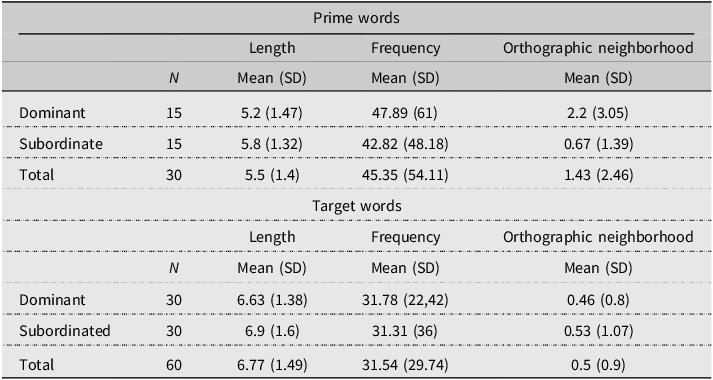
Materials in the semantic priming task consisted of 120 prime words (15 homonymous, 15 metaphorical, 30 unrelated, 60 fillers) and 120 target words (30 subordinate, 30 dominant, 60 pseudo-words). The targets were words in Spanish related to the dominant or the subordinate sense of the primes. Fillers included 60 homonymous and polysemous prime words selected from Cortés’ (Reference Cortés2020) normative study of polysemy and homonymy in Spanish. Pseudo-words were extracted from Aguado (Reference Aguado, Cuetos, Domezáin and Pascual2006). The experimental primes and targets were selected through two norming studies with native Spanish non-autistic speakers. The initial norming study for the prime words (N = 120) aimed to evaluate semantic relatedness and sense dominance based on participants’ intuitive judgments. Subsequently, a second norming study was conducted to identify the target words (N = 60), with the primary objective of eliciting associative responses to the previously selected subset of 30 Prime words, again guided by speaker intuition. Both studies were meticulously designed to ensure the lexical sample reflected naturalistic language use to the greatest extent possible. The methodology, outcomes, and subsequent analyses are presented in Appendices I and II, located following the References section of this manuscript. Table 1 presents a summary of the characteristics of the selected primes and targets.
Characteristics of primes and targets

Design of the semantic priming and lexical decision task
Each participant was presented with a list of 120 pairs of words. Pairs consisted of a prime (Metaphorical, Homonymous, or Unrelated) and a target (Dominant, Subordinate, or Pseudo-word).
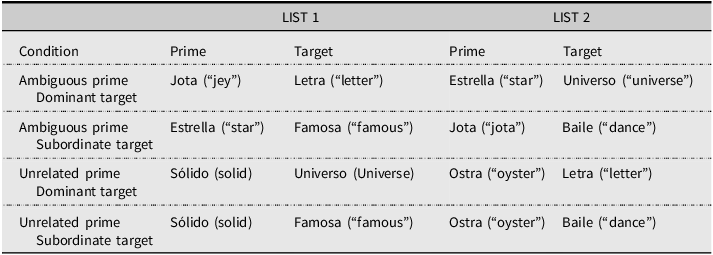
The primes and targets were paired so that each prime had two targets: one dominant and one subordinate. For example, the homonymous prime jota—which in Spanish can mean the letter J or a traditional Spanish dance—was paired with the dominant target letra (letter) and with the subordinate target baile (dance). In turn, the metaphorical word estrella (star) was paired with universo (universe) and with famosa (famous-feminine). Previous studies have shown that seeing the same target more than once can contribute to ease of processing (Sánchez-Casas et al., Reference Sánchez-Casas, Ferré, García-Albea and Guasch2006). To make sure that participants could not see the same prime or target twice, we created two counterbalanced lists, and participants were randomly assigned to one list or the other. Thus, some participants saw the pair jota-baile, and some other participants saw the pair jota-letra. Moreover, targets were paired in one list with their related prime and in the other list with an unrelated prime. For example, the target letra (letter) was paired with the homonymous word jota in one list and with the unrelated prime ostra (oyster). Participants who saw jota-baile (homonymous prime-subordinate target) also saw ostra-letra (unrelated prime-dominant target), and participants who saw jota-letra (homonymous prime-dominant target) also saw ostra-baile (unrelated prime-subordinate target).
Pairs with unrelated primes were created to compare the RTs of the targets when they were preceded by non-related words with the other four conditions in which the prime and the target were semantically related. A reduction of the RT compared to the unrelated condition was interpreted as priming or facilitation. When the RT was similar to or greater than the unrelated condition, it was interpreted as a possible indicator of inhibition.
In sum, the design of the task had five different conditions distributed in two different lists: homonymous prime-dominant target (jota-letra); homonymous prime-subordinate target (jota-baile); metaphorical prime-dominant target (estrella-universo); metaphorical prime-subordinate target (estrella-famosa); unrelated prime-dominant target (ostra-letra)/subordinate target (ostra-baile). We unified pairs of unrelated prime-dominant target and unrelated prime-subordinate target, under one condition, since those targets were not dominant or subordinate meanings of the unrelated prime. The structure is detailed in Table 2 with some examples.
List structure

Procedure
The semantic priming lexical decision task
The entire experimental session lasted around 15 min., although slightly longer for autistic participants, since they had to complete the extra metalinguistic questionnaire (around 25 min total for autistic participants).
This study was conducted with the approval of the “Comité de Ética para la Investigación con Seres Humanos, CEISH UPV/EHU” at the University of the Basque Country (UPV/EHU). Ethical approval was granted on 23/01/2020, with reference number M10_2019_205MR.
The semantic priming task was performed on a laptop, using E-Prime (Psychology Software Tools, Inc., 2016). Participants first read a welcome message on the screen with a brief explanation about the experiment and what was expected of them: to read a word and respond whether they thought it was actually a word in Spanish, pressing either Yes or No. Participants were told that the experiment was like a game, and that they had to be as quick as possible in their answers. After understanding the instructions, participants pressed the space bar to start the practice trials. There were only four practice trials, and the participant had to be correct in at least two of them to continue with the experiment (no participant was excluded after this phase). Practice trials were exactly like experimental trials. After each lexical decision trial, participants could briefly see on screen whether their answer was correct or incorrect, and their score with the number of right responses.
At the beginning of each trial, three exclamation signs appeared on the screen for 1000 ms to draw the participant’s attention. After that, a blank screen came up for 200 ms and a fixation point (+) for 500 ms, to fix the participant’s gaze where the words were going to appear. Then, the prime word appeared for 300 ms, and after a brief blank screen for 50 ms, the target word came up for 1500 ms alongside a question mark, signaling the time to make the lexical decision (see Figure 1). There were two stickers on the keyboard. One of the stickers said “Si” (yes in Spanish) and the other said “No” (no in Spanish). Participants had to press “Si” if they believed the word written above the “?” symbol was a real word in Spanish, or “No” if they believed the word was not a real word in Spanish.
Procedure.

Time latencies were selected following recommendations from Hutchinson et al. (Reference Hutchison, Balota, Cortese and Watson2008, Reference Hutchison, Balota, Neely, Cortese, Cohen-Shikora, Tse, Yap, Bengson, Niemeyer and Buchanan2013) and Perea and Rosa (Reference Perea and Rosa2002) with regard to the minimum time required to make an automatic decision. According to this literature, lexical decision times over 350 ms are enough for the subject to make a conscious decision; it leaves enough time to reflect on the word itself. As we were after automatic priming, i.e., subconscious associations between words, we chose 350 ms as our stimulus onset asynchrony (SOA). Although even briefer times are recommended in the above-mentioned literature (around 200 ms), the inclusion of autistic participants, who are known to be somewhat slower in RT measures (Zapparrata et al., Reference Zapparrata, Brooks and Ober2023), led us to keep a SOA of 350 ms for both groups.
Final metalinguistic questionnaire
Participants from the autistic group answered a questionnaire on paper after the semantic priming task. The aim of this questionnaire was to ensure that participants had some familiarity with the metaphorical meaning of the experimental words. Since the aim of the study was to test whether autistic participants had stored those senses in a separate entry from the literal one, we had to ensure that none of these metaphors were novel to the participants and that they had conventional meanings to them. The questionnaire had two questions: a production question—see example (1)—and an introspective question—see example (2). In the production question, participants had to write down what they thought that the word meant in that specific sentence. In the introspective question, participants were asked to report whether they had heard that specific metaphorical meaning before and were offered three answer options “sí” (yes), “no” (no), “no sé” (I do not know).
-
(1) ¿Qué significa la palabra en mayúsculas en este contexto?
BOCA del túnel.
“What does the word in uppercase mean in this context?”
“The MOUTH of the tunnel”
-
(2) ¿Conocías el significado de la expresión “boca del túnel” antes de participar en este estudio?
“Did you know the meaning of the expression ‘mouth of the tunnel’ before participating in this study?”
Analysis
To examine inhibition/facilitation effects, we used a Linear Mixed-Effects Model (LMM) and two post hoc contrast analyses using emmeans (Lenth et al., Reference Lenth, Love and Herve2022). All the statistical analyses were performed in R 4.4.2 (R Core Team, 2024) with a significance level of α = .05. The dependent variable of our model was log-transformed RTs. The group (autistic and non-autistic participants) and condition (coded as “Unrelated,” “Homonymy dominant,” “Homonymy subordinate,” “Metaphor dominant,” and “Metaphor subordinate”) were included as fixed effects. Since all predictors are categorical and we were mainly interested in the contrast analysis, we removed the intercept of the model, and the predictors were only included via the interaction syntax (DV ∼ 0 + Group: Condition). This syntax returns one estimation for each combination of condition and group (for example: RT of autistic participants for dominant targets and homonymous primes) in comparison with 0 (see Urrestarazu-Porta, 2025, 23 February 2025). Results of the model can be found in the repository, since our main analyses are the contrasts between groups and between conditions.
The random factor structure of our model was intended to be maximal and constructed following a hypothesis-driven approach (Barr et al., Reference Barr, Levy, Scheepers and Tily2013). Given singularity issues in the first model, the random intercept adjustment of list (list 1 or 2) and the slope adjustments by the target word and the subject were not included in our final analysis. Our final model only included the target word and the subject as random effects.
Incorrect answers to the lexical decision task and trials over 1000 ms were not included in the analysis. RT over one second and wrong answers could point to a lack of attention that would lower the reliability of that trial. We also did not take into account the accuracy of the lexical decision. It is expected in this type of task that autistic individuals make more mistakes, since they demand a quick response time, but we do not take this as a sign of them being generally less accurate with metaphors in our task (see Chahboun et al., Reference Chahboun, Vulchanov, Saldaña, Eshuis and Vulchanova2017 for a similar reasoning with lexical decision). Our analysis with RT only included correct responses.
As mentioned, we conducted two post hoc contrast comparisons to compare the log-transformed RT between conditions of each group and to compare both groups of participants on each condition. As our predictions are based on the comparisons of the RT between different conditions and between different populations, the results of these analyses are the main interest of this study. The first analysis allowed us to compare the RT between conditions in the same group, for example, log (RT) of the autistic group with the subordinate target of the metaphorical prime vs. log (RT) of the autistic group with the unrelated prime and target.
In the case of non-autistic participants, we expected only the subordinate sense of homonymous words to have similar RT to the unrelated target. These results would have suggested that while there is inhibition in the case of homonyms’ subordinate meanings, there is facilitation in the case of metaphorical senses, which aligns with the theory that senses of conventional metaphors are stored together while meanings of homonymous words are stored separately. In the case of the autistic group, we expected that both subordinate meanings of homonyms and metaphorical senses would have similar RT to the unrelated condition. This result would suggest that there is inhibition in the case of metaphorical senses in the autistic group.
Our second contrast comparison allowed us to test the differences between the two groups on each condition, for example, log (RT) of the autistic group with the subordinate target of the metaphorical prime vs. log (RT) of the non-autistic group with the subordinate target of the metaphorical prime. We expected RT to be longer in the autistic group than in the non-autistic group, especially in the case of metaphor-subordinates.
Finally, to better understand whether the meanings of metaphors were conventional for the autistic group and whether their understanding of these meanings affected their performance in the lexical decision task, we conducted an additional analysis focusing only on the autistic group and the metaphorical subordinate condition. This analysis included the results of the two questions in the metalinguistic questionnaire as fixed effects, as well as their interaction, with log (RT) as the dependent variable. Results of the production questions were coded as 1 when the participant correctly explained the metaphorical meaning of the expression that was referred to the lexical decision task and as 0 when the explanation was inaccurate. Responses that were focused on the literal interpretation (example: BOCA del túnel: “el sitio por donde entra la comida y la bebida,” in English: MOUTH of the tunnel: “The place where food and drink enter.”) or referred to a different (non-conventional) metaphor (example: Alicia es un LINCE: “Alicia ve muy bien,” in English: Alice is a LYNX: “Alice sees very well”) were coded as inaccurate (coded as 0). Results of the introspective question, where participants were asked if they knew the word before, were coded as 1 = “yes” and 0 = “no lo sé”/“no”.
The complete list of materials, the relevant data from participants, the results and analysis from the norming and the experiments, and all plots are included in the following URL: https://osf.io/j3e5y/
Results
Facilitation and inhibition in non-autistic participants
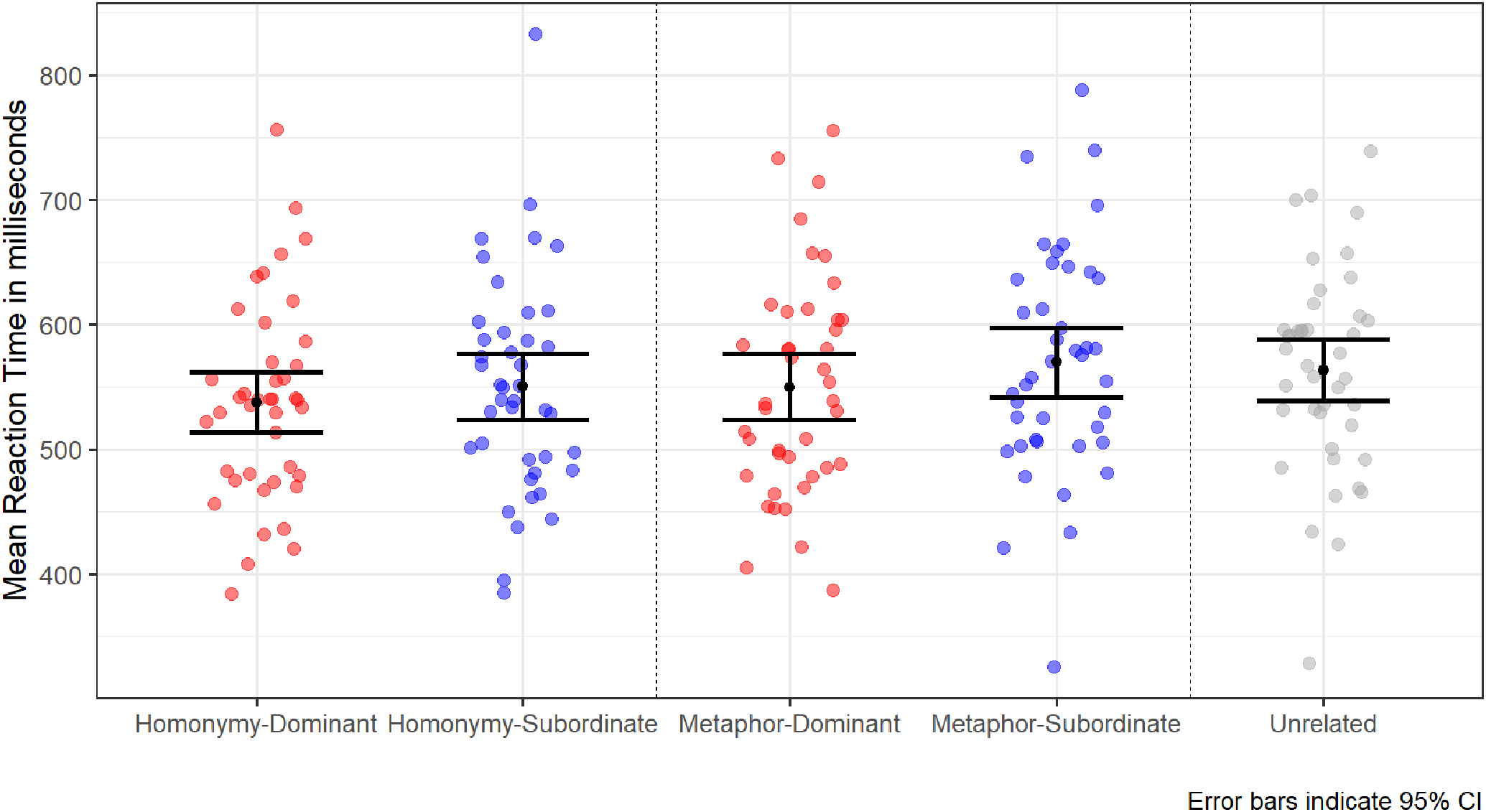
To explore facilitation and inhibition effects in the non-autistic group, we used pairwise comparisons, comparing all conditions against the unrelated baseline (see Figure 2). Since the unrelated condition consisted of two semantically unrelated words, no priming should be expected from them. This condition is the baseline to compare with the other conditions, where the two words (prime and target) were related, and therefore priming was expected.
Reaction times of non-autistic participants.

Our results suggest that both homonymy-dominant (β = −0.042, SE = 0.016, p = 0.009) and metaphor-dominant (β = −0.032, SE = 0.016, p = 0.044) were significantly faster than the unrelated condition, whereas homonymy-subordinate (β = −0.010, SE = 0.016, p = 0.523) and metaphor-subordinate (β = −0.003, SE = 0.016, p = 0.837) presented no significant differences in RT. According to our working definition of priming and inhibition (see the beginning of Section “The present study” of this paper), this would point to priming of dominant senses in both conditions, as well as inhibition of subordinate senses.
Interestingly, we did not find significant differences between the RTs to the dominant and subordinate targets, neither in the homonymous condition (β = −0.032, SE = 0.021, p = 0.139) nor in the metaphorical (β = −0.029, SE = 0.022, p = 0.183). This means that in either condition, accessing subordinate meanings was not significantly costlier than accessing dominant ones.
In sum, our results suggest dominance effects for both the homonymous and the metaphorical conditions. In addition, they point to a slight inhibition effect of subordinate meanings in both conditions.
Facilitation and inhibition in autistic participants
Our results in the case of autistic participants show that both homonymy-dominant (β = −0.045, SE = 0.021, p = 0.031) and metaphor-dominant (β = −0.053, SE = 0.021, p = 0.012) were significantly faster than the unrelated condition, in a similar fashion to the pattern found in non-autistic participants. However, we also found unexpected significant differences between the unrelated condition and homonymy-subordinate (β = −0.044, SE = 0.021, p = 0.036), as in the dominant case, which suggests that there are no dominance effects in the case of homonymy, contrary to what we found in the non-autistic group. Nonetheless, and similarly to what happened with controls, we did not find significant differences between the metaphor-subordinate and the unrelated (β = 0.004, SE = 0.021, p = 0.838), which again, would be suggestive of inhibition.
In addition, we found significant differences between the dominant and the subordinate senses of metaphors (β = −0.057, SE = 0.028, p = 0.039), but we did not find significant differences between the dominant and the subordinate in the case of homonymous words (β = −0.001, SE = 0.027, p = 0.96). In this case, conversely to what happened with non-autistic participants, accessing the subordinate meaning in metaphorical polysemy incurred a significantly higher cognitive cost than accessing the dominant, literal one.
In sum, results with autistic participants showed that all conditions were significantly faster than the unrelated condition, except for the access to subordinate targets with metaphorical primes (see Figure 3). Moreover, in the case of metaphors, the access to subordinate senses was significantly slower than to dominant, literal senses.
Reaction times of autistic participants.

Differences in reaction times between non-autistic and autistic participants
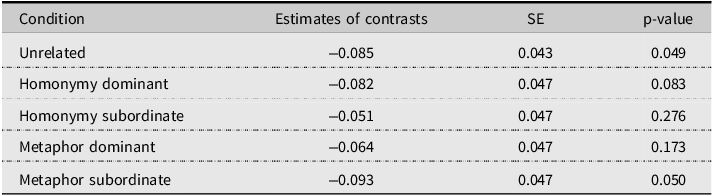
We found significant differences between autistic and non-autistic participants (see Table 3), with significantly shorter RT in the non-autistic group than in the autistic group in the case of targets that were unrelated to the prime (p = .049) and marginally significant shorter RT in subordinate metaphorical targets (p = .050). The autistic group was also slower in the other cases, but these differences are not significant.
Results of pairwise contrast analysis between the non-autistic group and the autistic group

The significantly slower RT in the unrelated condition suggests that autistic individuals are generally slower at baseline, which coincides with the literature (Zaparrata et al., Reference Zapparrata, Brooks and Ober2023) and our own expectations on autistic performance.
The slower RT in the access to subordinate targets in the metaphorical condition reinforces the idea that the inhibition of subordinate metaphoric senses by the literal, dominant ones is stronger in autistic individuals.
Reaction times in metaphorical meanings and the metalinguistic questionnaire in autistic participants
One possible explanation why the autistic participants had similar RT in metaphor-subordinates in comparison with the unrelated is that they may have had difficulties understanding the metaphorical meaning of the word, or they may have never heard about it before. If that were the case, autistic participants would not have these non-literal meanings lexicalized as conventional metaphors, which would explain why they have longer RT. The subordinate meaning would behave as non-conventional metaphors. The two questions that we asked the participants after the lexical semantic priming aimed to test whether autistic participants had listened to the metaphor-subordinates before and whether they understood these meanings. As explained, the first task was a production question: “What does the word in uppercase mean in this context?” The second question was an introspective knowledge question: “Did you know the meaning of the expression before participating in this study?” As a preliminary descriptive analysis, we found that only 6.3% of the answers by autistic participants in this experiment corresponded to expressions that they claimed to not know in the second question.
Moreover, we did not find any significant differences between the RT of autistic participants in the subordinate metaphor depending on their accuracy in the production question (β = 0.149, SE = 0.113, p = 0.191), nor on the second introspective question (β = −0.104, SE = 0.151, p = 0.492) and nor in the interaction between the two questions (β = 0.,97 SE = 0.169, p = 0.247).
Discussion
The purpose of our study was to examine potential differences in how conventional metaphorical polysemous senses are accessed by autistic and non-autistic adults.
Our main hypothesis was as follows:
(H): Autistic individuals tend to store the sense of a word (w) associated with a conventional metaphor and the sense associated with its literal meaning in separate lexical entries.
As detailed in Section “The present study,” hypothesis (H) yields two specific predictions:
(P1) For autistic individuals, subordinate target words related to metaphorical primes should elicit RTs that are longer than or comparable to those in an unrelated condition (in which the prime and target are unrelated), whereas literal senses should yield significantly shorter RTs than the unrelated condition. In other words, the metaphorical sense will be inhibited by the literal sense.
(P2) For autistic individuals, metaphorical senses should be more difficult to access than for non-autistic individuals. That is, autistic participants are expected to exhibit longer RTs in accessing metaphorical senses compared with non-autistic participants.
Based on previous findings, we also expected to observe inhibition effects for homonymous words in the non-autistic group—specifically, significant differences between the dominant target and the unrelated condition, but not between the subordinate target and the unrelated condition—and no such inhibition in the case of polysemous (i.e., conventional metaphor) words. Regarding homonymy in autism, we likewise predicted inhibition effects in the homonymy condition within the autistic group.
Our results indicate that both homonymy and metaphorical polysemy exhibit significant dominance effects among non-autistic participants, contrary to our expectations. Regarding behavior in the homonymy condition, this outcome aligns with findings from most prior studies in the field (see Klepousnioutou et al., Reference Klepousniotou, Titone and Romero2008, Reference Klepousniotou, Pike, Steinhauer and Gracco2012). However, the results observed in the metaphorical condition for non-autistic participants do not replicate those of earlier studies. Instead, they are consistent with research questioning the sharp divide between homonymy and polysemy (e.g., Damirjian, Reference Damirjian2024; Yurchenko et al., Reference Yurchenko, Lopukhina and Dragoy2020), which posits a continuum ranging from regular polysemy to homonymy, with irregular polysemy situated closer to homonymy than to regular polysemy.
In the autistic group, we also found a significant dominance effect in the metaphor condition, suggestive of inhibition, thereby confirming our first prediction (P1). This finding cannot be attributed to a general difficulty in accessing subordinate meanings, since, interestingly, subordinate and dominant meanings of homonymous words were accessed with comparable ease in this group.
Moreover, we observed significant differences between the accessibility of subordinate and dominant targets in the metaphorical condition among autistic participants—differences that were not present in the non-autistic group. This result strengthens the hypothesis that accessing subordinate metaphorical senses is particularly costly for autistic individuals, or that the inhibition effect is especially pronounced in this group.
In contrast, within the homonymy condition, both dominant and subordinate senses were accessed significantly faster than in the unrelated condition among autistic participants, showing no dominance effect. Thus, in the autistic group, the homonymy and metaphor conditions displayed different patterns, whereas in the non-autistic group, both conditions behaved similarly, each showing significant dominance effects.
Finally, when comparing RTs across groups (see Table 3), we found a marginally significant difference in the metaphor–subordinate condition, with autistic participants showing slower responses. However, no significant group differences were observed for the literal sense of conventional metaphors or for either the dominant or subordinate senses of homonymous words. This partially confirms our second prediction (P2) and further supports the view that metaphor processing differs in autistic individuals (Martín-González et al., Reference Martín-González, Schroeder, Falkum, Castroviejo and Vicente2025; O’Shea et al., Reference O’Shea, Cersosimo and Engelhardt2024; Vulchanova et al., Reference Vulchanova, Chahboun, Galindo-Prieto and Vulchanov2019). Nonetheless, given the marginal nature of the effect, these findings should be interpreted cautiously and warrant replication to strengthen the statistical validity of the conclusion.
It is also worth noting that longer RTs for metaphorical subordinate senses did not correlate with incorrect responses in the metalinguistic production task or with negative responses in the introspective task. Thus, the results suggest that some degree of difficulty with metaphor processing persists throughout development, even among participants already familiar with the non-literal meaning of the word.
The reviewed results confirm both of our predictions and are therefore compatible with our hypothesis (H), namely, that because autistic individuals appear to experience difficulties in grasping metaphors as such—or at least NT metaphors—they may ultimately store the meanings of conventional metaphors as if they were the meanings of homonymous terms.
However, this interpretation is challenged by two aspects of our findings. The first, already discussed, is that we observed only a marginal difference between the autistic and non-autistic groups in the time they take to access metaphorical meanings.
The second concerns the results obtained in the homonymy condition for the autistic group: we did not observe dominance effects in this condition. That is, we have no evidence suggesting that autistic individuals store homonymous meanings in separate lexical entries. This is a completely unexpected and difficult-to-interpret result. At face value, it is surprising that meanings that are entirely unrelated would be stored within a single lexical entry.
Nonetheless, this finding mirrors results reported in a series of studies by Haro et al. (Reference Haro, Demestre, Boada and Ferré2017a, Reference Haro, López-Cortés and Ferré2023), conducted in Spanish with non-autistic participants (but see López-Cortés & Horno-Chéliz, Reference López-Cortés and Horno-Chéliz2023, for divergent results). In both articles, using different methodologies, the authors report no processing differences between polysemy and homonymy. More specifically, in the case of homonymy, they find no evidence of competition between the different meanings. Their processing measures—a reduced N400 in Haro et al. (Reference Haro, Demestre, Boada and Ferré2017a) and non-significant pupil dilation in Haro et al. (Reference Haro, López-Cortés and Ferré2023)—suggest that homonymous meanings may in fact co-activate one another.
So, our results with non-autistic participants suggest that non-autistic adults store both homonymous meanings and the literal and metaphorical senses of polysemous words in separate lexical entries, at least under the standard interpretation of priming studies. In contrast, our findings for autistic participants would indicate separate entries for metaphorical polysemy but a single entry for homonymy—this last bit consistent with the pattern reported by Haro and collaborators for Spanish non-autistic speakers.
Taken together, these outcomes lead to an interpretation that is less clear-cut than we initially anticipated. While we do observe difficulties in autistic participants’ access to conventional metaphors, these difficulties cannot be straightforwardly interpreted as evidence that autistic individuals treat conventional metaphors as if they were homonymous meanings. Instead, the overall pattern of results points to a more nuanced conclusion: for autistic individuals, literal meanings exert a stronger inhibitory influence than they do for non-autistic individuals. Importantly, this inhibitory effect appears to be characteristic of metaphorical senses, as it is not observed in the case of homonymous meanings.
In any case, the homonymy results help clarify the interpretation of the inter-group comparison in the metaphorical condition. Although our findings show that metaphorical senses are more difficult to access for autistic participants, this difficulty does not appear to stem from treating metaphorical senses as homonymous meanings, nor, consequently, from a lack of semantic relatedness between literal and metaphorical senses. Rather, the increased difficulty seems to arise from the inhibitory influence exerted by literal senses. That is, literal meanings may inhibit access to metaphorical senses not because they are dominant, but because they are literal.
To our knowledge, this is the first study to examine the processing of conventional metaphors in autistic adults using this specific experimental paradigm, although it is not the first to investigate metaphor comprehension using a semantic-priming methodology (see Chahboun et al., Reference Chahboun, Vulchanov, Saldaña, Eshuis and Vulchanova2017). Chahboun et al.’s study differs from ours in that their primes consisted of metaphorical word pairs and included both novel and conventional metaphors. In their results, autistic adults showed no reaction-time differences between targets that required selecting the metaphorical meaning and those that required selecting the literal meaning. Non-autistic adults, by contrast, responded significantly faster to targets selecting the literal meaning. Chahboun et al. interpret this pattern as indicating that autistic individuals experience greater difficulty grasping the metaphorical meaning of an expression, as if they primarily accessed its literal interpretation.
This interpretation aligns with the results of Gold et al. (Reference Gold, Faust and Goldstein2010), whose ERP study suggests that autistic adults exhibit difficulties in processing metaphorical word pairs. Collectively, these findings—including ours and those from Vulchanova et al.’s (Reference Vulchanova, Chahboun, Galindo-Prieto and Vulchanov2019) eye-tracking study—support the view that literalism is stronger in autism than in the non-autistic population (Vicente & Falkum, Reference Vicente and Falkum2023; Vicente & Martín-González, Reference Vicente and Martín-González2021).
Limitations
An obvious limitation of our study is the sample size of the autistic group (N = 22). A second limitation concerns the age range of this group (14 to 55 years). As a reviewer noted, including adolescents in the autistic sample may have skewed the results, since autistic adolescents may still be developing pragmatic skills.
To address this second limitation, we conducted a preliminary exploration using a descriptive analysis of raw RTs (see Figure A1, Appendix III). If the prolonged RTs observed among autistic participants were driven by the younger subgroup’s ongoing pragmatic development, we would expect adolescents to exhibit slower responses than older participants. However, our observations do not support this expectation. Autistic individuals aged over 18 continued to show the slowest access to metaphorical targets, specifically within the metaphor–subordinate condition (represented by the pink bars), compared with all other conditions. Although these descriptive results do not establish statistical significance, they are consistent with the patterns identified in the analyses presented in Subsections 5.1 and 5.3.
The limited age range and small sample size of the autistic group therefore, constitute constraints that underscore the need for further replication of this paradigm in larger and more age-balanced samples. In addition, future research should explore other potential predictors of access to metaphorical meanings, such as the Theory of Mind and Executive Functions.
Conclusions
We examined how the meanings of conventional metaphors are accessed by two groups: non-autistic and autistic adults. We first compared the processing profiles of metaphor-generated polysemy and homonymy in non-autistic individuals. Our results showed that senses corresponding to conventional metaphors were as difficult to access as subordinate meanings of homonyms. In contrast, autistic participants displayed a different pattern: senses derived from conventional metaphors were more difficult to access than the subordinate meanings of homonyms. Furthermore, autistic adults found conventional metaphorical senses more difficult to access than non-autistic adults. These findings demonstrate that accessing the meaning of a conventional metaphor is particularly challenging for autistic individuals.
Interestingly, we did not observe a comparable difficulty in accessing subordinate meanings of homonymous expressions in the autistic group. These homonymy results are difficult to reconcile with previous literature, which typically reports a dominance effect in homonymy whereby dominant meanings inhibit subordinate ones. At the same time, the homonymy findings offer indirect evidence that metaphor processing remains challenging for autistic individuals across development. Literal senses appear to hinder access to metaphorical meanings more strongly than other types of dominant meanings. In other words, inhibition by literal competitors is stronger than inhibition by other dominant competitors in the autistic population, suggesting a characteristic tendency toward literalism, at least with respect to non-autistic individuals.
Replication package
Materials, data, and analyses for both the norming studies and the experiment can be accessed through the following URL: https://osf.io/j3e5y/.
Acknowledgments
First and foremost, we would like to thank all the autistic and non-autistic participants who participated in this study. Their willingness to share their intuitions and experiences, particularly their reflections on metaphor understanding, was invaluable and deeply enlightening. We also extend our warmest appreciation to Inigo Urrestarazu, whose support was central to the conception and development of the data analysis. Our sincere thanks go as well to José Manuel Igoa for his helpful insights regarding key technical aspects of the experimental design and to José Vicente Hernández-Conde, whose guidance during the early stages of the investigation greatly contributed to shaping the analytic approach. Last but not least, we are grateful to our Lindy Lab colleague and mentor Elena Castroviejo, whose suggestions and comments were also of great value throughout the project.
This research was partially supported by the project grants PGC2018-093464-B-I00, PGC2018-096870-B-I00, PID2021-122233OB-I00 and the pre-doctoral grant PRE2019-089758, all funded by the Spanish Ministry of Science and Innovation and the Spanish Research Agency (MICIU/AEI/10.13039/501100011033), with co-funding from the European Regional Development Fund (ERDF/EU), and by the IT1396-19 and IT1537-22 Research Group Grants, and POS_2021 postdoctoral grant (Eusko Jaurlaritza - Basque Government).
Additional support was provided by the BBVA Foundation Grants for Scientific Research Projects 2021 (RILITEA). The BBVA Foundation bears no responsibility for the opinions, statements, or content of this publication, which are solely those of the authors.
Competing interests
The author(s) declare none.
Ethics and consent
This study was conducted with the approval of the “Comité de Ética para la Investigación con Seres Humanos, CEISH UPV/EHU” at University of the Basque Country (UPV/EHU). Ethical approval was granted on 23/01/2020, with reference number M10_2019_205MR.
Appendices
Appendix I: Norming study for PRIME words
We followed Haro et al.’s (Reference Haro, Ferré, Boada and Demestre2017b) methodological recommendations to examine the type of ambiguity in lexical items of the targets. The main goal was to check whether meanings were related or not according to speakers’ intuitions, and to establish dominance relations. We drafted the words from a normative study of ambiguous words in Spanish (Haro et al., Reference Haro, Ferré, Boada and Demestre2017b), selecting 30 words from a list provided by the authors.
Participants (n = 120) had to answer to a questionnaire with two questions. The aim of the first question was to discern which meaning of the word was dominant and which meaning was subordinate. Participants had to rate which sense was more familiar to them, as shown in the example (1). We selected words with a minimum of 66% of dominance, i.e., the dominant meaning had to be rated by 66% of the participants as more dominant.
(1)¿Qué sentido de la palabra “boca” te parece más familiar?
“Which sense of the word ‘mouth’ is more familiar to you?”
-
a. Estoy entrando en la boca del túnel.
“I’m entering the mouth of the tunnel.”
-
b. Tengo una herida en la boca.
“I’ve got a wound in my mouth.”
The second question purported to classify the ambiguous words as either polysemous or homonymous, following speakers’ intuitions about how related the senses of words were. Participants had to rate how related the two senses/meanings were in a 5-point Likert scale. See example (2):
(2) ¿Cómo de relacionados están esos sentidos?
“How related are these two senses?”
Weakly related 1 2 3 4 5 Strongly related
Prime words were classified as polysemous if they received a median score of 4 or higher, and as homonymous if their median score was 2 or lower. We attended to mean length (number of letters), frequency (measured in counts per million in the Sketch Engine’s Wordlist corpus, Sketch Engine, 2021) and the orthographic neighborhood of the already established experimental primes (detailed in Table 1). These variables have been shown to be relevant for lexical decision tasks in previous studies (González-Nosti et al., Reference González-Nosti, Barbón, Rodríguez-Ferreiro and Cuetos2014; Hutchison et al., Reference Hutchison, Balota, Neely, Cortese, Cohen-Shikora, Tse, Yap, Bengson, Niemeyer and Buchanan2013). Additional 30 extra prime words were selected as unrelated primes, following the same criteria of length, frequency and orthographic neighborhood.
Appendix II: Norming study for TARGET words
The second norming study focused on obtaining word-associates to each of the senses/meanings of our 30 ambiguous primes, to ensure that primes and targets were semantically related. We tested 60 native Spanish speakers, with an open-ended questionnaire, in which we asked participants to provide with expressions that they considered to be associated to a particular sense of a word, as in (3):
(3) Escribe palabras asociadas con el significado de la palabra en MAYÚSCULA en este contexto:
“Write words that are associated with the meaning of the UPPERCASE word in this context:”
“Ella sufrió una parada cardíaca y entró en COMA.”
“She suffered a heart attack and entered a COMA.”
Words that were mentioned in at least 16% of the answers were selected in a first pass (following Sánchez-Casas et al.’s Reference Sánchez-Casas, Ferré, García-Albea and Guasch2006 recommendations). From them, we selected a total of 60 words, following the same criteria of length, frequency, and orthographic neighborhood as in the case of prime words. We also decided that target words should all be either nouns or adjectives, as all prime words were nouns.
Appendix III: Descriptive data per item in the autistic sample
Descriptive results per item in autistic participants above 18 years.





 Open access

