


15.1 EU Law Litigation and Empirical Legal Studies
An outsider perusing studies of litigation in the EU might be struck by how they ‘have a distinctly American air about [them]’ (Kelemen Reference Kelemen2011: 5). And for good reason. Just as empirical legal studies (ELS) in its most influential contemporary form developed in the interwar US before making its transatlantic crossing (Pavone and Mayoral Reference Pavone, Mayoral, Bartl and Lawrence2022), so too was the post-World War II US a progenitor of empirical research on litigation (Trubek Reference Trubek1990) before Europeanists took up this agenda and analysts began worrying about adversarial legalism spreading to the European Union (EU) (Kagan Reference Kagan1997). A telltale sign of this crossover is that most of the pioneers of EU legal mobilisation and litigation studies were trained in the US (ex. Alter Reference Alter2000, Reference Alter2001; Alter and Vargas Reference Alter and Vargas2000; Conant Reference Conant, Risse, Caporaso and Green Cowles2001, Reference Conant2002; Cichowski Reference Cichowski1998, Reference Cichowski2004, Reference Cichowski2007) and built on scholarship on the rule of law and judicialisation spearheaded by US-based scholars (Burley and Mattli Reference Burley and Mattli1993; ex. Scheingold Reference Scheingold1965; Stone Sweet Reference Stone Sweet1999; Weiler Reference Weiler1994).
Today, empirical studies of EU law litigation are more home-grown than transplants. Thanks to a new generation of scholars, we know a lot more about which interest groups litigate, and whether litigation substitutes or complements other advocacy strategies (Hofmann and Naurin Reference Hofmann and Naurin2020; Lejeune and Ringleheim Reference Lejeune and Ringelheim2023; van der Pas Reference van der Pas2024; Vanhala Reference Vanhala2018); the role that activist lawyers, scholars, and judges have played in mobilising European law and soliciting national court referrals to the Court of Justice of the EU (CJEU) (Avril Reference Avril2019; Byberg Reference Byberg2017a, Reference Byberg2017b, Reference Byberg2017c; Mayoral and Perez Reference Mayoral and Pérez2020; Pavone Reference Pavone2019, Reference Pavone2022; Vauchez Reference Vauchez2015); how varying levels of litigation have shaped EU policies toward the environment, consumer protection, disability rights, migration, labour, and free movement (Hofmann Reference Hofmann2025; Krommendijk and van der Pas Reference Krommendijk and Van der Pas2022; Lejeune Reference Lejeune2017; Passalacqua Reference Passalacqua2021; Pavone Reference Pavone2019; Vanhala Reference Vanhala2009; Zglinski Reference Zglinski2024); and why EU law remains unmobilised in particular places or among classes of prospective litigants (van der Pas Reference van der Pas2024; Passalacqua Reference Passalacqua2022; Pavone Reference Pavone2020a, Reference Pavone2020b, Reference Pavone2022).
We unpack some of the foregoing insights in this chapter, but we also aim to resuscitate the fertility of the US–EU comparison that sparked this field of study in the first place. By comparing whether well-established patterns of legal mobilisation and strategic litigation in the US also arise in the EU, we can ponder the relative distinctiveness of the European context. We focus on one phase of legal mobilisation – litigation – while recognising that it constitutes ‘just one potential dimension or phase of a larger, complex, dynamic, multistage process of disputing’ (McCann Reference McCann, Caldeira, Kelemen and Whittington2008: 525). While research in both the US and EU suggests that the ‘haves’ (businesses and interest groups clustered in cities) disproportionately litigate, we will show that EU-centered studies disagree about whether litigation capacity begets judicial influence and downstream effects. To advance this debate, we borrow from Galanter (Reference Galanter1983a) and ‘read the landscape of disputes’ by drawing on an original dataset of parties involved in all preliminary references to the CJEU from 1958 to 2018 (Hermansen et al. Reference Hermansen and Voeten2024). We query (1) who litigates, (2) who influences judicial decisions, (3) with what downstream ‘radiating effects?’ (Galanter Reference Galanter, Boyum and Mather1983b). As we will demonstrate, although the corporate ‘haves’ are ubiquitous participants in EU law litigation, they are neither its sole nor arguably most effective agents: individual ‘have nots’ punch above their weight.
15.2 Who Goes to Court?
15.2.1 What We Know from the American Context
If disputing is like an iceberg, then litigation is but its tip. The subsurface process of ‘naming, blaming, and claiming’ (Felstiner et al. Reference Felstiner, Richard and Sarat1980) has often eschewed quantitative analysis given the challenges of gathering comprehensive data, leaving it mostly to qualitative scholars to unpack via fieldwork, ethnographic observation, and interviews (Ellickson Reference Ellickson1991; Ewick and Silbey Reference Ewick and Silbey1998; Nielsen Reference Nielsen2000).
These studies suggest several intriguing findings. First, marginalised classes of people are just as willing and able to name injustices and to attribute blame in disputes, but they are less likely than more privileged social classes to go to court. Some justify leaving entitlements and rights unmobilised by arguing that they would be difficult to enforce or that it would be impractical to go to court, given their unfamiliarity with the legal system (Ellickson Reference Ellickson1991: 49; Ewick and Silbey Reference Ewick and Silbey1998: 47; Nielsen Reference Nielsen2000: 1081–82). Others project their distrust of authority upon courts, particularly when their marginalisation is abetted by the state (Ewick and Silbey Reference Ewick and Silbey1998: 47–50). Second, homogenous communities often in rural areas are more likely to resolve disputes by tapping into shared norms of neighborliness and reciprocity (Ellickson Reference Ellickson1991: vii–1). As a result, urbanised and heterogenous communities, as well as more privileged socioeconomic classes, are more likely to litigate.
Despite the predominance of qualitative case studies of ‘naming, blaming, claiming,’ there are a few quantitative surveys verifying their external validity. In a survey of 780 households in Detroit, Michigan, Mayhew and Reiss (Reference Mayhew and Reiss1969: 310) found that white, more educated, and wealthier residents were significantly more likely to lawyer-up compared to black, less educated, and poorer residents. Disputes among equals and those involving larger sums of money (such as business disputes) were also more likely to trigger litigation than disputes involving parties with unequal power or smaller sums of money (such as landlord–tenant disputes) (Mayhew and Reiss Reference Mayhew and Reiss1969: 313). More broadly, quantitative surveys confirm that going to court is but the tiny tip of the iceberg. Miller and Sarat (1980), Kritzer et al. (Reference Kritzer, Bogart and Vidmar1991), and Kritzer (Reference Kritzer1998) find that across various types of disputes – consumer, tax, housing, and torts – less than 10 per cent of disputants seek out a lawyer, and usually only 1–5 per cent go to court. Even in a society cast as home to a ‘litigation explosion’ (Galanter Reference Galanter1986; Kagan Reference Kagan2019), most prospective litigants lump their losses, resolve disputes amicably, or resist litigation.
One of the more relevant empirical findings for conducting a US–EU comparison concerns the variegated litigation of US federal law, since it plays a similar role to EU law vis-à-vis Member States. Epp (Reference Epp1998: 2) has demonstrated that businesses long monopolised litigation before the US Supreme Court. As late as the 1930s, up to 90 per cent of the Supreme Court’s docket involved property and business disputes. After all, the disputes implicated privileged actors with knowledge of constitutional law and the financial means to hire dexterous lawyers to climb the judicial hierarchy. Then in the postwar era, a network of nongovernmental organisations – like the American Civil Liberties Union (ACLU) and the National Association for the Advancement of Colored People (NAACP) – solicited funding from philanthropists and private foundations to build a ‘litigation support structure’ and ‘pursue the forms of constitutional litigation perfected by organised businesses, but for very different ends’ (Epp Reference Epp1998: 4, 44–70). As a result, litigation of the rights of the incarcerated, racial minorities, and women spiked from 10 per cent of the Supreme Court’s caseload in the 1930s to 70 per cent in the 1960s (Epp Reference Epp1998: 2). Although marginalised groups tend to be unable or reluctant to litigate, civil society organisations collabourating with ‘cause lawyers’ (Sarat and Scheingold Reference Sarat and Scheingold2006) can tip the scales to a more equitable distribution.
Finally, American interest groups are not ubiquitously litigious. This presumption was popularised by Gerald Rosenberg’s publication The Hollow Hope that sharpened Scheingold’s (Reference Scheingold1974) ‘myth of rights’ thesis to lament how interest groups ‘succumb[ed] to the “lure of litigation”’ at the expense of more effective political organisation (Rosenberg Reference Rosenberg2008a: 419, Reference Rosenberg2008b). The empirical reality painted by case studies is more complex. During the 1960s and 1970s, for instance, civil rights organisations were much more prone to litigate than labour unions, which were often the targets of desegregation lawsuits (Frymer Reference Frymer2003). Epstein (Reference Epstein1993: 649) also demonstrates that business and trade associations are far more active in Supreme Court litigation than labour unions. LGBTQ rights NGOs often dissuaded litigants from going to court and only took on risky cases when they concluded that they would be brought before a judge ‘with or without them’ (Keck Reference Keck2009: 176). In her study of one these NGOs – Lambda Legal – Andersen (Reference Andersen2006: 214–15) finds that the group was ‘well aware that the struggle for legal reform does not begin and end in the courtroom’ and strategically avoided taking on cases that might set the movement back. McCann (Reference McCann1992) uncovered a similar dynamic among pay equity advocates: few believed litigation was a one-size-fits-all strategy, and many recognised the value in sometimes forbearing from litigation.
15.2.2 What We Know from the EU Context
Early efforts to theorise EU law litigation paid less attention to the variation and complexities unearthed in the US context. Channeling structural functionalism, scholars tended to presume that EU law would uniformly pull litigants toward it. Weiler (Reference Weiler1991: 2421) claimed that although ‘individual litigants are usually not politically motivated’, ‘small as well as big violations [of EU law] are adjudicated’ and ‘the Community citizen becomes, willy nilly,’ an agent of EU legal mobilisation. Similarly, Fligstein and Stone Sweet (Reference Fligstein and Stone Sweet2002: 1212, 1222) posited that the EU legal system had created a ‘self-reinforcing causal system’ of ‘lawyers activated by their clients and judges activated by lawyers’.
Yet, once empirical studies began to unpack who litigates, where, and how much, they reintroduced nuance and variation into the picture. When it comes to cross-state variation, the most sustained litigation campaigns of EU gender equality and pay equity laws were spearheaded by individual litigants, cause lawyers, and NGOs in the UK and Belgium (Alter and Vargas Reference Alter and Vargas2000; Cichowski Reference Cichowski2004). These case studies suggest that the more unfavorable the national legislative environment, the greater the comparative advantage of litigating EU law (Alter and Vargas Reference Alter and Vargas2000; Blom et al. 2005). Empirical case studies also confirm that – like in the US – national ‘litigation support structures’ makes a difference (Epp Reference Epp1998). In a paired comparison of litigation of EU environmental law in Spain and Germany, Börzel (Reference Börzel2006: 136) found that EU law litigation was substantially lower in Spain due to the absence of environmental NGOs and Green political parties, as well as ‘[higher] economic costs … and lack of sensibility and technical training of public prosecutors and judges’. Börzel’s (Reference Börzel2006: 128) pessimistic interpretation is that EU law litigation ‘empowers the already powerful’; a more optimistic interpretation is that EU law can be mobilised for the public interest wherever a support structure emerges.
Turning to evidence of more local variation, several studies have uncovered a stark urban–rural divide in EU law litigation by wielding preliminary references to the CJEU as a geospatial proxy. Capital cities like Rome and Berlin attract EU lawsuits by individuals and businesses against state regulatory agencies, whereas port cities and financial hubs like Hamburg and Frankfurt attract EU law litigation centered on trade, tax, and freedom of establishment rules (Dyevre et al. Reference Dyevre, Glavina and Ovádek2021; Kelemen and Pavone Reference Kelemen and Pavone2016, Reference Kelemen and Pavone2018; Lampach et al. Reference Lampach, Wijtvliet and Dyevre2020; Pavone Reference Pavone2020a). Conversely, disputants in rural and economically marginalised cities are less prone to mobilising EU law – a shortfall that Pavone (Reference Pavone2020a, Reference Pavone2022) links to the lack of specialist law firms and ‘Euro-lawyers’. These findings are consistent with studies in the US setting that rural communities and more socioeconomically marginalised classes are less prone to litigation. Local perceptions of the legitimacy of the CJEU and EU law may also play a role. For instance, Pavone (Reference Pavone2019, Reference Pavone2020b, Reference Pavone2022) compares two similarly disruptive litigation campaigns in Genoa in the 1990s – where judges and the public had a favourable view of EU law – and Puglia in the 2010s – where Euroscepticism was diffuse – to explain why EU law litigation took off in the former and faltered in the latter.
When it comes to interest group litigation, empirical case studies confirm that interest groups and NGOs in Europe have varying propensities to litigate, like their American counterparts. However, European interest groups tend to prefer more conciliatory advocacy strategies – consistent with Kelemen’s (Reference Kelemen2011) thesis that corporatist modes of state-interest group intermediation temper adversarial legalism (see also Kagan Reference Kagan1997). In a survey of more than 3,000 interest groups across Belgium, Lithuania, Netherlands, Slovenia, and Sweden, Hofmann and Naurin (Reference Hofmann and Naurin2020: 1242) found that litigation was used by only 19 per cent of respondents, whereas a majority adopted more conciliatory strategies like contacting civil servants. Unlike the US – where labour unions tend to be less litigious than business groups – in Europe 58 per cent of trade unions – but only 20 per cent of business groups – litigate (Hofmann and Naurin Reference Hofmann and Naurin2020: 1244). And – in contrast with Rosenberg’s (Reference Rosenberg2008a) claim that litigation substitutes for political organising – European interest groups that litigate are more active in general; interest groups that protest weekly have over a 50 per cent probability of also launching lawsuits, whereas interest groups that never protest have less than a 20 per cent probability of litigating (Hofmann and Naurin Reference Hofmann and Naurin2020: 1249).
Empirical case studies suggest that the propensity to litigate EU law varies even among similar groups – hinging on their resource endowments, expertise, collective identities, and the openness or closure of a Member State’s ‘legal opportunity structure’ (Conant et al. Reference Conant, Hofmann, Soennecken and Vanhala2016; De Fazio Reference De Fazio2012). National judges unfamiliar with EU law or overburdened by their workload – as in Italy or Greece – or wary about breaking from the caselaw of their superiors – as in France – are reluctant to refer cases to the CJEU, pushing interest groups to scout for alternative litigation paths (van der Pas Reference van der Pas2024; Passalacqua Reference Passalacqua2024; Pavone Reference Pavone2018, Reference Pavone2022). Yet even when holding legal opportunity structure constant, interest groups make different strategic choices. In comparing refugee-rights-promoting NGOs in Italy and the Netherlands with similar staffs and resources, van der Pas (Reference van der Pas2024: 536) finds that some of these groups specialise in mobilising EU law and the CJEU – particularly when they perceive it as more open to their claims than national law – whereas other, more generalist groups prefer to treat EU law as one resource among many. In a complementary study of migrant rights groups in Italy, the UK, and the Netherlands, Passalacqua (Reference Passalacqua2021) finds that their propensity to embrace EU law litigation hinges on a group’s in-house ‘Euro-expertise’, which is critical to overcome national judges’ reluctance to refer (see also Pavone Reference Pavone2022). And in a paired comparison of two pan-European interest groups focused on antidiscrimination advocacy – the European Women’s Lobby (EWL) and the European Roma and Travellers Forum (ERTF) – Jacquot and Vitale (Reference Jacquot and Vitale2014) uncover stark differences. The ERTF wielded its larger staff and resources to build a reputation as an adversarial outsider wielding EU law litigation, while the more short-staffed EWL positioned itself as an insider group lobbying the Commission (Jacquot and Vitale Reference Jacquot and Vitale2014: 595–98).
Finally, we have a preliminary sense of which interest groups avoid mobilising EU law or seek alternative paths of supranational adjudication. Conservative and religious groups have favoured litigation of family rights and religious freedom before the European Court of Human Rights (ECtHR), although the ECtHR’s limited receptivity to such claims has recently rendered the CJEU ‘a more attractive forum’ (Fokas Reference Fokas2016: 572). Environmental and climate change NGOs facing onerous standing rules before the CJEU have strategically sought to mobilise lateral pressure by bringing suit in Strasbourg instead (Pagano Reference Pagano2022). And NGOs that tend to adopt a collective identity as ‘human rights’ groups are more prone to mobilising the ECtHR over litigating EU law (Passalacqua Reference Passalacqua2024: 30).
15.2.3 Our Data: Individuals, Businesses, and Organised Interests in Preliminary References
Where case studies have examined the strategic choices of interest groups and surveys have measured their litigation tendencies, we have lacked a comprehensive picture of who litigates before the CJEU and their broader impact, such as shaping legal integration or attracting attention. To address this, we analyse a dataset of 7,353 national court referrals (preliminary references) to the Court from 1957 to 2018, starting with the key question: who litigates?
Figure 15.1 shows the types of litigants involved in preliminary references to the CJEU. The procedure enables private actors to challenge national policies with EU legal claims. The Court is often depicted as a business-oriented forum where corporations and trade associations push economic liberalisation (Kahraman Reference Kahraman2023; Scharpf Reference Scharpf2010). Consistent with this view, businesses make up a large share of the caseload (62 per cent), alongside public institutions and different social welfare organisations (70 per cent). Yet two patterns stand out: a substantial number of cases involve individual litigants, while advocacy groups are strikingly underrepresented.

Figure 15.1 Long description
The X-axis represents the number of cases, ranging from 0 to 5000. The graph plots bars for public institution, company, individual, N G O, other, and E U institution. The values are 5100, 4550, 3450, 700, 200, and 25, respectively. Note, all values are approximated.
The patterns in Figure 15.1 are even more striking when considering that EU law grants relatively few justiciable rights to individuals compared to businesses. Surprisingly, some 47 per cent of the preliminary references involve individual litigants – a significantly higher share than individuals’ presence on the US Supreme Court docket before the civil rights era (Epp Reference Epp1998). Why, then, are individuals such active participants in EU law litigation? And what does this reveal about the Court’s role in European integration?
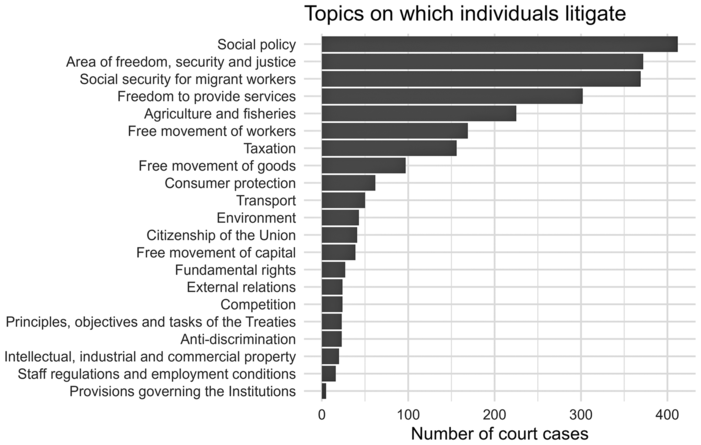
A closer look at the policy areas (‘subject matter’) where individuals litigate sheds light on the first question (Figure 15.2). Their involvement with EU law is often tied to cross-border economic activities, which seems to align with the CJEU’s reputation as an economic court. Individuals sometimes litigate on similar issues to – or even alongside – businesses, particularly in disputes concerning the products they sell and the taxes they pay (‘agriculture and fisheries,’ ‘free movement of goods,’ ‘competition,’ ‘intellectual property,’ ‘taxation’).
CJEU cases involving individual litigants (1957–2018), classified by their subject matter.

Figure 15.2 Long description
The X-axis represents the number of court cases, ranging from 0 to 400. The Y-axis lists the topics on which individuals litigate. Social policy, 410. Area of freedom security and justice, 320. Social security for migrant workers, 320. Freedom to provide services, 300. Agriculture and fisheries, 250. Free movement of workers, 170. Taxation, 160. Free movement of goods, 99. Consumer protection, 60. Transport, 50. Environment, 45. Citizenship of the Union, 43. Free movement of capital, 40. Fundamental rights, 25. External relations, 20. Competition, 20. Principles, objectives, and tasks of the treaties, 20. Anti-discrimination, 20. Intellectual, industrial, and commercial property, 20. Staff regulations and employment conditions, 15. Provisions governing the Institutions, 5. Note, all values are approximated.
Yet, a significant portion of cases involve relatively resourceless individual litigants in disputes over social rights (‘social policy’, ‘social security’, and ‘staff regulations and employment conditions’), often overlapping with cross-border activities, such as litigation on the free movement of workers and service providers (e.g., self-employed migrants). The Court’s longstanding case law grants rights to migrant workers and their families, adding a crucial social and human element to what might otherwise be seen as a purely (neo-)liberal economic project (Caporaso and Tarrow Reference Caporaso and Tarrow2009). Figure 15.2 also illustrates the Court’s central role in EU-level social policies (Martinsen Reference Martinsen2015b). Deprived of the fiscal capacity to pursue redistributive policies, the EU instead acts as a litigation-centered regulatory state, creating rights that citizens can – and have – claimed (Kelemen Reference Kelemen2011).
Lastly, many individuals are involved in litigation on relatively new or increasingly salient EU policy areas. These include consumer rights, antidiscrimination, and fundamental rights – fields where EU legislation has become central and increasingly attracts lawyers’ and scholars’ attention (Dyevre et al. Reference Dyevre, Glavina and Ovádek2021). The second-most frequent topic involves individuals’ interactions with the justice system, particularly within the Union’s area of freedom, security, and justice. This reflects the EU’s broader goal of harmonising justice standards across borders. For example, the Schengen Agreement and the European Arrest Warrant (EAW) ensure mutual recognition in criminal matters and the handling of asylum seekers.
From an EU scholar’s perspective, these topics are neither new nor surprising. However, from a legal mobilisation standpoint, the implications are puzzling: Individuals play a far greater role in EU law litigation than in the American context, and many CJEU cases rely on the participation of relatively dispossessed groups – migrants, workers deprived of income, asylum-seekers, and (suspected) criminals. What explains their presence? Answering this question opens fertile avenues for future research. To what extent have organised interests empowered individuals and/or business interests – in line with Epp (Reference Epp1998)’s argument about ‘litigation support structures’? Or building on Conant et al. (Reference Conant, Hofmann, Soennecken and Vanhala2016), what are the EU-level factors – the stock of EU law and rights, the receptivity of the Court itself, and the support provided by Euro-lawyers – that may explain the difference with our American example? As evidenced by the distribution of policy areas, clearly the European legal stock – the legal protections given by the EU legislator – structures the litigation we see. New policy areas such as judicial cooperation and social policies, as well as the EU’s stricter standards on data protection may catalyse substantial changes in the role of individuals also in the future.
The legal mobilisation literature also highlights the pivotal role of interest groups in shaping judicial agendas. However, unlike the US Supreme Court, which accepts input through amicus curiae briefs, the CJEU only admits observations by Member States and EU institutions, whereas standing is determined by national regulations (Case and Givens Reference Case and Givens2010). Consequently, many organisations operate behind the scenes, remaining absent in the Court’s official documents. No comprehensive overview of interest organisations’ involvement in CJEU litigation exists to date. Yet in our data, we find that only about 10 per cent of preliminary references during the period involved such organisations. Their limited presence contrasts sharply with the legislative arena, where the Commission often forms proactive alliances with diverse interest groups (Hix and Høyland Reference Hix and Høyland2022: 234–39).
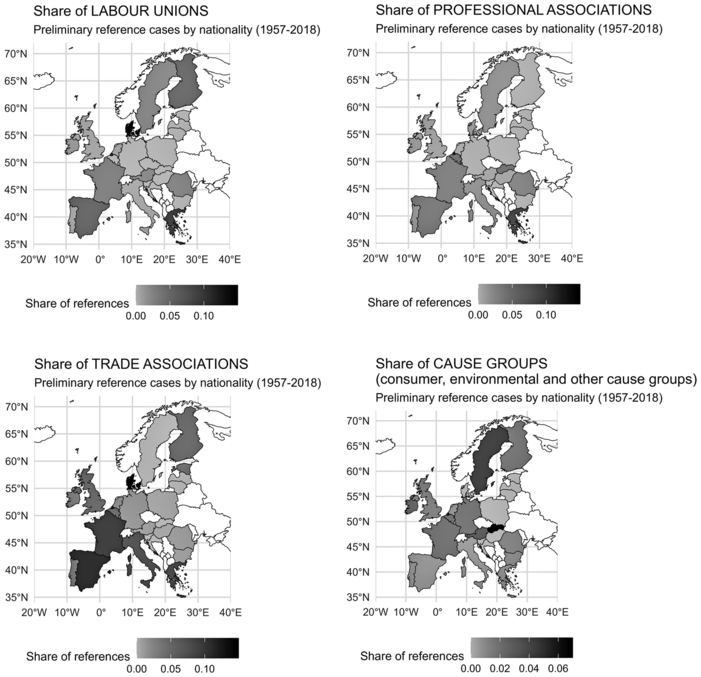
Figure 15.3 shows significant cross-national differences in cases involving professional organisations and cause groups. Litigation by professional organisations is most common in northern and southern Europe. Denmark, known for its strict political control over preliminary references (Rytter and Wind Reference Rytter and Wind2011; Wind Reference Wind2010), has the highest share of cases involving industry/employer organisations and trade unions. Labour unions are also highly active in Denmark, followed by Finland, Sweden, France, and Spain. Trade associations feature prominently in references from Italy, France, Spain, Belgium, the UK, Denmark, Estonia, and Finland.

Figure 15.3 Long description
The top left map presents the share of labor unions. The color gradient scale ranges from light to dark shades, representing the share of references from 0 to 0.10. The map indicates that countries such as Germany, the U K, and certain Scandinavian countries have a higher proportion of references, while countries in Eastern Europe and parts of Southern Europe have a lower proportion. The top right map presents the share of professional associations. The color gradient scale ranges from light to dark shades, representing the share of references from 0 to 0.10. This map indicates a slightly different pattern, with a higher share of references in countries like Germany, Switzerland, and some parts of Scandinavia. The bottom left map presents the share of trade associations. The color gradient scale ranges from light to dark shades, representing the share of references from 0 to 0.10. This map highlights a higher share of references in countries like Germany, Italy, and Spain. The bottom right map illustrates the share of cause groups. The color gradient scale ranges from light to dark shades, representing the share of references from 0 to 0.6. This map shows a higher share of references in countries like Germany, Austria, and some parts of Scandinavia. In all four maps, the countries, including Ukraine, Belarus, and Norway, have the lowest value.
Figure 15.4 highlights the dominance of corporate actors among organised interests. Trade associations outnumber labour unions and professional associations by a ratio of 3 to 1. This aligns with Olson’s (Reference Olson1965) observation that diffuse interest organisations face greater coordination challenges than business groups. Labour unions and professional associations often view labour mobility as a threat to their members’ economic activities, making EU law litigation for migrant rights less appealing. Egan (Reference Egan2014) notes a similar tradeoff for professional organisations in her comparative study of interstate labour mobility in the US and EU. These groups set standards that shield members from outside competition. Listing hundreds of state-regulated professions on both sides of the Atlantic, Egan underscores that integration remains incomplete even in federal systems.

Figure 15.4 Long description
The X-axis represents the number of cases, ranging from 0 to 300. The Y-axis represents 9 organized interests in E C J preliminary reference cases. Trade association, 297. Professional association, 95. Labor union, 95. Cause group, 70. Environment, 60. Consumer, 50. Other, 47. Leisure, 35. Humanitarian, 20. Note, all values are approximated.
Unlike labour unions and professional associations, trade associations are generally assumed to support European-level regulation, as a single framework facilitates cross-border trade. Sandholtz and Zysman (Reference Sandholtz and Zysman1989) illustrate this dynamic, showing how business interests lobbied the Commission and national governments to advance the single market. Stone Sweet and Sandholtz (Reference Stone Sweet and Sandholtz1998) expand on this logic by conceptualising ‘transactors’ as businesses engaged in cross-border trade: by bringing lawsuits that trigger preliminary references, transactors help dismantle trade barriers, fostering further trade and demand for the Court’s services. This dynamic, however, does not seem to generalise to business organisations. In our data, only five of 137 trade associations are international; most are national producer organisations. Can we really expect these organisations to push for dismantling protectionist policies? To preview the answer we unpack in the next section: no.
15.3 Who Influences Judges?
15.3.1 What We Know from the American Context
Going to court is one thing, influencing judicial decisions and winning your case is another. Although legal opportunity structure approaches treat ‘judicial receptivity’ as a structural constraint (de Fazio Reference De Fazio2012), US studies of strategic litigation have demonstrated that litigants can favourably shape judicial receptivity with varying degrees of success.
This empirical agenda is known as ‘party capability’ research, and it was framed by Galanter’s (Reference Galanter1974) influential article, ‘Why the “Haves” Come out Ahead’. Galanter reasoned that the dispossessed are not only less likely to litigate; they are also less likely to win. Compare an individual – a retired person – with a multinational corporation – Walmart. The retiree is less likely to engage regularly with the court system and will be less familiar with it than Walmart: the former is a ‘one-shotter’, the latter a ‘repeat-player’ (Galanter Reference Galanter1974: 97–100). The retiree is more likely to seek short-term relief whereas Walmart is more likely to seek to change the law to gain a structural advantage: the former ‘plays for cases’, the latter ‘plays for rules’ (Galanter Reference Galanter1974: 99–100). And the retiree is more likely to turn to a solo-practicing generalist lawyer rather than the specialised law firms that a business like Walmart can afford: the former lacks the ‘legal capability’ of the latter (Galanter Reference Galanter1974: 114–17). Galanter thus channeled the same logic as Heinz and Laumann (Reference Heinz and Laumann1982)’s famous study of the Chicago bar, which uncovered two distinct ‘hemispheres’: large, corporate law firms serving businesses, and generalist solo-practitioners serving individuals. Good attorneys have ‘process expertise’ – knowledge of the legal ritual and the biases of particular judges – as well as ‘substantive expertise’ – mastery of specialised legal fields and arguments. Process expertise correlates with experience (repeat-player lawyers) whereas substantive expertise correlates with size (larger law firms) (Kritzer Reference Kritzer1990, Reference Kritzer2015).
Studies of judicial decision-making before the US courts largely confirmed Galanter’s logic. The more resources and repeat-player advantages a litigant has, the more likely they are to win. At the apex is the federal government represented at the Supreme Court by the Solicitor General, whose office is nicknamed the ‘tenth justice’ (Caplan Reference Caplan1987). Whereas certiorari petitions for the Supreme Court to hear cases succeed less than 3 per cent of the time, the Solicitor General’s petitions succeed 70 per cent of the time (Chandler Reference Chandler2011: 728). And of those cases the Supreme Court hears, the Solicitor General wins 62 per cent as a direct party and 66 per cent of cases where it files amicus briefs (Black and Owens Reference Black and Owens2011: 766). In a study of over 8,000 cases adjudicated by the federal courts of appeal, Songer et al. (Reference Songer, Sheehan and Haire1999: 821) found that the federal government wins roughly 70 per cent of its cases. State and local governments have the next highest win rates at 60 to 70 per cent, followed by businesses at 45 to 50 per cent and, lastly, individuals at 30 to 40 per cent (Songer et al. Reference Songer, Sheehan and Haire1999: 821). If one pits the most capacious litigant – the federal government – against the least capacious – individuals – the federal government’s net advantage is 34.5 per cent (Songer et al. Reference Songer, Sheehan and Haire1999: 822). Interest groups tend to fall somewhere in the middle. In an analysis of Supreme Court decisions from the 1960s to the 1970s, interest group win rates range between 40 and 50 per cent (Epstein Reference Epstein1993: 691). For all interest groups, receiving the support of the Solicitor General spikes the win rate to 64–69 per cent (Epstein Reference Epstein1993: 691; Epstein and Rowland Reference Epstein and Rowland1991).
In line with Galanter and Kritzer’s work, differential success in court appears tied to the experience and expertise of lawyers. Leveraging a dataset of 1,080 cases adjudicated by the Supreme Court from 1980 to 2017, Nelson and Epstein (Reference Nelson and Epstein2022: 76) find that an ‘experienced attorney, relative to a novice, increases the likelihood of capturing a justice’s vote by 11 per centage points’, broadly consistent with previous studies (McGuire Reference McGuire1995: 194). The most experienced attorneys are from the Solicitor General’s office: Johnson et al. (Reference Johnson, Wahlbeck and Spriggs2006: 107–10) reveal that justices informally assign significantly higher grades to the oral arguments of the Solicitor General, and these grades are positively associated with the likelihood of success.
15.3.2 What We Know from the EU Context
Compared to who litigates EU law, our knowledge of who influences CJEU decisions is more patchworked. For many years, studies of EU law litigation focused on states and the Commission rather than private actors and NGOs. These studies found that the Commission is the EU-equivalent of the US Solicitor General – ‘the prototypical repeat player on the European legal stage’ – although Member States can also succeed in influencing CJEU decisions (Hofmann Reference Hofmann2013: 9).
Beginning with the Commission, there are good reasons to expect it to be a uniquely successful litigant. It boasts hundreds of lawyers in its Legal Service specialising in EU law, and it intervenes in almost all cases before the Court, endowing it with process and substantive expertise (Pavone Reference Pavone, Epstein, Grendstad, Šadl and Weinshall2024). These advantages are borne out by existing data. In infringements launched by the Commission against Member States, the Commission wins 90 per cent of the time (Kelemen and Pavone Reference Kelemen and Pavone2023: 797). When the Commission submits observations in preliminary references by national courts, the CJEU sides with the Commission just under 80 per cent of the time (Stone Sweet and Brunell Reference Stone Sweet and Brunell2012: 211). And just as the US Solicitor General can put its thumb on the scale by endorsing a litigant’s position, when ‘the Commission favors the plaintiff [in a case], the Court listens’ and the plaintiff’s success rate doubles (Stone Sweet and Brunell Reference Stone Sweet and Brunell2012: 210).
Yet member governments are also repeat players, and as the primary actors capable of implementing EU law, defying the CJEU’s rulings, and overriding the Court, states can wield their observations to sway judicial decisions. Drawing on a dataset of 3,176 rulings by the CJEU from 1987 to 1997, Carrubba et al. (Reference Carrubba, Gabel and Hankla2008: 441) find that when ‘net [Member State] observations weighted by share of qualified-majority votes in the Council’ support the plaintiff, the plaintiff is more likely to win. For instance, a private litigant or NGO challenging a government who receives the endorsement of one large Member State (like France or Germany) has a 13 per cent higher success rate than a plaintiff lacking this endorsement (Carrubba et al. Reference Carrubba, Gabel and Hankla2008: 443). Larsson and Naurin (Reference Larsson and Naurin2016) conduct a similar analysis of 3,845 cases adjudicated by the CJEU from 1997 to 2008 and find that these results are consistent over time. When two large Member States submit observations asking the CJEU to preserve national sovereignty, the CJEU is 30 per cent less likely to issue an expansive ruling that constrains Member States (Larsson and Naurin Reference Larsson and Naurin2016: 398). Notably, scholars have emphasised the threat of noncompliance or override to explain judicial influence while neglecting the mechanism stressed by party capability studies: the differential capacity to mobilise resources and experienced lawyers.
As we turn to the success rate of individuals, businesses, and NGOs, two competing narratives have emerged. On the one hand, some studies support the rhetoric of CJEU judges and posit that the Court is a weapon of the weak that favours individual litigants (Cichowski Reference Cichowski2004, Reference Cichowski2007; Lecourt Reference Lecourt1976; Mancini and Keeling Reference Mancini and Keeling1994). Former CJEU Judge Federico Mancini argued that the Court ‘has attempted to distill as much equality as possible from the [EU] Treaty and secondary legislation’ to ‘enable ordinary men and women to savour the fruits of integration’ (Mancini Reference Mancini2000: 128; Mancini and Keeling Reference Mancini and Keeling1994: 100). Complementarily, Cichowski (Reference Cichowski2007) traced how women and allied cause lawyers successfully pushed the CJEU to enshrine pay equity as a fundamental principle under EU law, while Loth (Reference Loth2020) and Hofmann (Reference Hofmann2025) surfaced how labour and social rights lawyers helped pensioners and workers successfully wield EU law litigation. On the other hand, some studies build on Galanter’s (Reference Galanter1974) thesis to claim that EU law litigation empowers powerful interest groups and the corporate ‘haves’ (Börzel Reference Börzel2006; Conant Reference Conant2002; Scharpf Reference Scharpf2010). Avril (Reference Avril2019) and Pavone (Reference Pavone2022) show that businesses employing large ‘Euro-firms’ of lawyers gradually came to dominate several fields of EU law litigation, although they do not assess the success rates of their lawsuits. And in her interviews with human rights lawyers, Kahraman (Reference Kahraman2023: 74) finds that most prefer to mobilise the ECtHR because they perceive the CJEU ‘as a different kind of court: its priority is to protect business interests’. In the absence of systematic quantitative data, scholars have struck an ambivalent truce: ‘Greater empirical insight into how individuals and interest groups use courts will allow us to discern whether European law can be a weapon of the weak or remains a “hollow hope”’ (Conant et al. Reference Conant, Hofmann, Soennecken and Vanhala2016: 1385; Hofmann Reference Hofmann2025: 20).
In short, what remains lacking in the EU context is a systematic empirical assessment of the role of private litigants in shaping the CJEU’s decisions. We probe this question next.
15.3.3 Our Data: Who Are the Vehicles of European Legal Integration?
The Court’s decisions often align with the observations of the Commission and Member State governments. However, neither actor sets the agenda in preliminary references, which are mainly initiated by private parties, including individuals, businesses, and interest groups. To what extent can these parties influence the CJEU’s decisions, and what are the implications for European integration?
To address this question, we draw on data from the IUROPA project, which tracks litigants’ and observers’ positions in 3,246 legal questions from 1,748 preliminary references adjudicated between 1995 and 2011 (Lindholm et al. Reference Lindholm, Naurin and Šadl2023). We focus on which private parties are most effective at advancing European integration by limiting national autonomy. The logit model in Table 15.1 and Figure 15.5 estimates the likelihood of a restriction in national autonomy, based on the involvement of various actors: professional organisations, cause groups, individuals, public institutions, and others. Cases involving two businesses serve as the baseline, and the model controls for the net number of governments supporting restrictions.
| Dependent variable: | |
|---|---|
| Restrict national autonomy | |
| Labour union involved (ref. business) | 0.882*** |
| (0.291) | |
| Trade association involved (national) | −0.402** |
| (0.173) | |
| Trade association involved (international) | 0.795 |
| (0.597) | |
| Professional association involved | −0.205 |
| (0.292) | |
| Cause group involved | 0.369* |
| (0.216) | |
| Individual involved | 0.375*** |
| (0.076) | |
| Public institution involved | −0.125 |
| (0.098) | |
| Other actor type involved | −0.080 |
| (0.308) | |
| Net government support for restriction of national autonomy | 0.242*** |
| (0.021) | |
| Constant | 0.332*** |
| (0.101) | |
| Observations | 3,246 |
| Log Likelihood | −2,278.336 |
| Akaike Information Criterion | 4,576.671 |
Note: *p<0.1; **p<0.05; ***p<0.01
What are the vehicles of European integration? Types of actors linked to restrictions in national autonomy (Illustration of the results presented in Table 15.1).

Figure 15.5 Long description
The X-axis represents log-odds, ranging from negative 1 to 3. The Y-axis represents the effect of organized involvement on the restriction of national autonomy, reference level is businesses. The minimum, median, and maximum values for the following are. Labor union involved, 0.3, 0.9, and 1.45. Trade association involved, international, negative 0.4, 0.8, and 1.95. Individual involved, 0.3, 0.4, and 0.5. Cause group involved, negative 0.05, 0.4, and 0.8. Other actor type involved, negative 0.7, negative 1, and 0.5. Public institution involved, 0.2, 0.4, and 0.5. Professional association involved, negative 0.75, negative 0.2, and 0.4. Trade association involved, negative 0.7, negative 4, and negative 0.1, respectively. Note, all values are approximated.
We find little evidence that businesses are effective liberalisers driving European integration. Instead, individuals, labour unions, and cause groups are significantly associated with decisions restricting national autonomy. Of these, individuals exert the greatest influence. Their involvement implies a 46 per cent higher likelihood of a restriction compared to cases involving only businesses. Although rare, labour union cases are also impactful, being 2.4 times more likely to lead to such restrictions. Similarly, cases involving cause groups, such as those advocating for environmental or consumer protection, are associated with a 45 per cent higher likelihood of restricting national autonomy. In contrast, national trade associations are linked to fewer restrictions, with a 33 per cent reduction in likelihood compared to cases involving only businesses. EU-wide trade associations show the opposite trend, but this finding is not statistically significant. Professional associations also appear linked to preserving national autonomy, though this effect is likewise not statistically significant.
The findings challenge influential studies of EU law litigation. Where Stone Sweet and Sandholtz (Reference Stone Sweet and Sandholtz1998) identified businesses as ‘transactors’ driving European integration, we find that individuals, more than businesses, fulfill this role: their cross-border activities have significantly shaped the CJEU’s integrationist case law (Zglinski Reference Zglinski2024). Furthermore, the predominance of national, rather than EU-wide, trade associations tends to produce decisions that uphold protectionist policies. Rather than dismantling borders, business associations often reinforce them.
Our findings raise pressing questions for future research. How much of individuals’ influence stems from agenda-setting – bringing transformative cases to the Court – or from their legal capability, such as strong arguments or skilled lawyers? Hermansen et al. (Reference Hermansen, Tommaso and Boulaziz2025) show that individuals generally enjoy lower-quality legal representation than businesses, so unlike decades of research in the American context, it seems that resource inequalities do not explain individuals’ high litigation success. Contrary to assumptions of pro-business bias, could the CJEU have a pro-individual bias?
15.4 What Are the Downstream Effects of Litigation?
15.4.1 What We Know from the American Context
Winning in court is not the only outcome of litigation. As Galanter (Reference Galanter, Boyum and Mather1983b) memorably put it, litigation generates downstream ‘radiating effects’ beyond distributing wins and losses. These radiating effects can be both sought and unsought, including direct institutional reforms and policy changes (Epp Reference Epp2010; Rosenberg Reference Rosenberg2008a), tactical emulation by other litigants (Meyer and Boutcher Reference Meyer and Boutcher2007), raised right consciousness and awareness of the law (Andersen Reference Andersen2006; Ewick and Silbey Reference Ewick and Silbey1998; McCann Reference McCann1994), publicity and media attention (Haltom and McCann Reference Haltom and McCann2009), shifts in public opinion (Bishin et al. Reference Bishin, Hayes, Incantalupo and Smith2021), and backlash movements (Klarman Reference Klarman2012). While there are multiple statistical studies demonstrating that the policy impact of strategic litigation before the Supreme Court is conditioned by favourable public opinion, legislation appropriating resources for implementation, and executive pressure for compliance (Hall Reference Hall2010; Rosenberg Reference Rosenberg2008a), other radiating effects have mostly been probed qualitatively.
First, sociolegal scholars have demonstrated that litigants’ identities and legal consciousness are impacted by going to court. Rebutting Rosenberg’s (Reference Rosenberg2008a) claim that the allure of litigation blinds and disempowers litigants, McCann’s (Reference McCann1994) study of pay equity litigation and Andersen (Reference Andersen2006) and Keck’s (Reference Keck2009) research of LGBTQ rights litigation found that litigation raised people’s expectations for social change alongside their sense of self-respect, collective empowerment, and solidarity, even when lawsuits were lost. Litigation campaigns can also spur tactical emulation. The NAACP’s renowned litigation campaign to desegregate public schools influenced the litigation strategy of womens’ rights groups and inspired the creation of dozens of civil rights litigation organisations – despite the decreasing receptivity of federal judges to civil rights lawsuits (Meyer and Boutcher Reference Meyer and Boutcher2007: 85–88).
One of the most important radiating effects of litigation is its capacity to place issues on the public and media agenda. Interest groups specialising in strategic litigation sometimes wield lawsuits to generate press coverage. As one pay equity lawyer confided in McCann (Reference McCann1994: 62), ‘I learned … that a lawsuit is a wonderful occasion for calling a press conference … and give it a lot of publicity’. Research on LGBTQ rights litigation found that lawsuits and favourable rulings by state courts and the Supreme Court spiked coverage of LGBTQ rights in mainstream newspapers by upwards of 1,000 per cent (Keck Reference Keck2009: 158; Rosenberg Reference Rosenberg2008a: 387) and galvanised specialised media serving the LGBTQ community (Bailey et al. Reference Bailey, Collins, Rhodes and Rice2025). Media coverage can in turn shape broader public opinion. Bishin et al. (Reference Bishin, Hayes, Incantalupo and Smith2021: 81, 33) find that litigation for same-sex marriage significantly increased support for other, seemingly less ‘radical’ reforms, like workplace nondiscrimination laws and adoption.
Finally, successful litigation campaigns can invite backlash and counter-litigation. Progressive civil rights litigation motivated conservative philanthropists, political elites, and lawyers to gradually forge a ‘conservative legal movement’ pushing the appointment of conservative judges and strategic litigation campaigns to reverse prior civil rights rulings (Hollis-Brusky Reference Hollis-Brusky2015; Teles Reference Teles2008; TerBeek Reference TerBeek2021). This movement not only succeeded in transforming the membership of the Supreme Court, but it mobilised test cases to overturn prior progressive decisions. In a similar vein, Rosenberg (Reference Rosenberg2008a) and Klarman (Reference Klarman2012) document massive backlash following the Massachusetts Supreme Court’s Goodridge decision legalising same-sex marriage: Both scholars argue that the ruling galvanised evangelical Christians to push dozens of state constitutional bans on marriage equality.
15.4.2 What We Know from the EU Context
To date, Europeanists have only probed some of the radiating effects of CJEU litigation. Most studies have focused on compliance and policy change while generally neglecting more indirect effects such as raising expectations, cultivating legal consciousness, changing public opinion, and attracting media attention.
Compliance with CJEU rulings spurred by strategic litigation is conditioned by bottom-up interest group pressure, top-down Commission entrepreneurship, and the intermediary discretion of Member States. From the bottom-up, Conant (Reference Conant2002) reorients Epp’s (Reference Epp1998) ‘litigation support structure’ theory by arguing that support structures also matter downstream. Via case studies of the variegated policy impact of EU law litigation on the liberalisation of telecommunications, electricity, public-sector employment, and social benefits, she traces how concentrated and well-resourced interest groups (such as trade and business associations) are best able to pressure governments to implement favoured CJEU rulings or ‘contain compliance’ with disfavoured decisions (Conant Reference Conant2002: 80, 213–42). From the top-down, Alter and Meunier-Aitsahalia (Reference Alter and Meunier-Aitsahalia1994: 541–45) find that the CJEU’s mutual recognition case law in Dassonville (1974) and Cassis de Dijon (1979) was only incorporated in the Single European Act (1986) once the Commission seized upon these rulings to propose a ‘new policy of harmonisation’ that interest groups then lobbied governments to support. At the intermediate level, member governments in the Council can also condition the implementation of CJEU rulings. Martinsen (Reference Martinsen2015a) conducts an analysis of all EU legislation on social policy (125 binding acts from 1958 to 2014) and finds that 22 proposals specifically responded to CJEU calls for policy change. Of this subset, only 13 (59 per cent) codified the CJEU’s position: the rest either modified and diluted the CJEU’s prescriptions (n = 5), failed to adopt them leading to nonimplementation (n = 3), or overrode the court (n = 1) (Martinsen Reference Martinsen2015a: 1634–36; Martinsen Reference Martinsen2015b). Finally, in a study of the implementation of CJEU rulings broadening social benefit rights in Denmark, Austria, and France, Martinsen et al. (Reference Martinsen, Blauberger, Heindlmaier and Thierry2019: 826) find that ‘frontline bureaucrats’ respond to signals from agency heads to adopt a ‘more restrictive line towards EU migrants and their cross-border access to welfare benefits’.
In contrast, studies of how strategic litigation and CJEU rulings spur other radiating effects remain lacking, with a few notable exceptions. There is some evidence that CJEU intervention can impact public opinion and foment backlash. For instance, after a prominent Catalan separatist – Oriol Junqueras – was convicted for sedition by the Spanish Supreme Court, his lawyers solicited a referral to the CJEU. The Court’s ruling finding him immune as a member of the European Parliament sparked backlash: Spaniards interviewed for the European Social Survey ‘exposed to the CJEU verdict became 13 per cent more eurosceptic than those who were not exposed’ (Turnbull-Dugarte and Devine Reference Turnbull-Dugarte and Devine2022: 872–73, 867). Pavone (Reference Pavone2020b, Reference Pavone2022) traces a similar public backlash in 2016 among farmers and allied politicians in southern Italy after the CJEU repelled their litigation campaign contesting the EU-mandated eradication of thousands of olive trees to contain the spread of a phytosanitary virus. But beyond public opinion backlash, ELS research has yet to probe whether EU law litigation spurs counter-litigation and conservative legal movements – a well-established phenomenon in the US that also appears (albeit more haphazardly) in strategic litigation before the ECtHR (Fokas Reference Fokas2016). This glaring gap should not be assumed to mean the absence of counter-litigation. For example, new archival evidence from Britain in the early 1990s has revealed an organised media and litigation campaign spearheaded by conservative lawyers to challenge the Maastricht Treaty before national courts. Although the ‘anti-Maastricht brigade’ failed to persuade judges to join their resistance, it spurred the creation of the first Eurosceptic party in Britain and it corresponded with Eurosceptic lawyers in Germany and Denmark (Lawton Reference Lawton2024: 404–05).
Finally, we know almost nothing about how successful litigation campaigns raise the legal consciousness of those involved. Pavone (Reference Pavone2019) does find suggestive evidence from the city of Genoa that strategic litigation and CJEU rulings can cultivate a pro-EU legal consciousness among lawyers and judges, but the generalisability of these findings remains uncertain. And despite research tracing how CJEU judges seek to cultivate favourable coverage in law journals (Byberg Reference Byberg2017c) and wield press releases to attract media attention to specific rulings (Dederke Reference Dederke2022), we know precious little about the success of these efforts. Recent evidence from survey experiments suggests that when citizens are exposed to information that a national court they trust is implementing CJEU rulings they become more supportive of the CJEU, but the external validity of this finding is untested (Cheruvu and Krehbiel Reference Cheruvu and Krehbiel2024). In the next section, we probe one of these underappreciated radiating effects – the impact of EU law litigation on attracting academic attention and law journal commentaries.
15.4.3 Our Data: Unequal Academic Attention
For CJEU rulings to spur follow-up litigation and bottom-up compliance pressures, the legal community must be aware of emerging legal opportunities (Hermansen et al. Reference Hermansen, Tommaso and Boulaziz2025; Weiler Reference Weiler1994). Law journals play a crucial role in dissemination, serving practitioners scouting litigation strategies, national judges seeking precedents, and future lawyers in training. This heightened awareness of CJEU cases contributes to the radiating effects of litigation, extending beyond direct policy compliance to knowledge diffusion.
Our analysis examines the number of law journal commentaries on preliminary rulings (1957–2018) as a function of the types of parties involved. The first model (Table 15.2) compares the mean number of commentaries across national and international law journals, while the second focuses on the Common Market Law Review (CMLR). Established in the 1950s as part of the CJEU’s outreach efforts (Byberg Reference Byberg2017c), the CMLR publishes commentaries on only about 10 per cent of cases. To account for national variation in references and publication practices, the first model includes random intercepts for the Member States where cases originate. Does the type of litigants involved draw varying levels of attention from legal scholars?
| Dependent variable | ||
|---|---|---|
| All journals | CMLR | |
| linear | logistic | |
| mixed-effects | ||
| (1) | (2) | |
| Labour union | 2.770*** | −0.524 |
| (0.875) | (0.468) | |
| Trade association | 0.027 | 0.190 |
| (0.505) | (0.216) | |
| Professional association | 1.817** | 0.329 |
| (0.841) | (0.314) | |
| Cause group | 3.496*** | 0.963*** |
| (0.615) | (0.202) | |
| Other NGOs | 1.652*** | 0.111 |
| (0.560) | (0.242) | |
| Individual | 0.705*** | 0.441*** |
| (0.204) | (0.092) | |
| Public institution | −3.921*** | −0.345*** |
| (0.221) | (0.093) | |
| Other organisation | 0.472 | 0.107 |
| (0.707) | (0.297) | |
| Constant | 7.647*** | −2.558*** |
| (0.309) | (0.097) | |
| Observations | 7,345 | 7,353 |
| Log Likelihood | −26,086.530 | −1,935.700 |
| Akaike Information Criterion | 52,195.060 | 3,889.401 |
| Bayesian Information Criterion | 52,270.980 | |
Note: *p<0.1; **p<0.05; ***p<0.01
Unsurprisingly, given our review of EU legal mobilisation scholarship, both models indicate that cases involving cause groups attract significant academic attention. Such cases generate 3.5 more articles on average than cases involving only businesses and are 2.6 times more likely to be discussed in at least one CMLR commentary. Though rare, these cases often disrupt national autonomy, reflecting our earlier finding that cause groups and individuals are more likely to spur integrationist case law. A similar pattern appears for cases involving individuals. On average, these cases generate twice as many commentaries across all venues and are 55 per cent more likely to attract commentaries in the CMLR than businesses (see Figure 15.6). This aligns with Dyevre et al. (Reference Dyevre, Glavina and Ovádek2021)’s observation that legal scholars disproportionately focus on rulings involving fundamental rights raised by individuals rather than cases involving competition and taxation typically brought by corporate litigants.
The probability of a case commentary in the Common Market Law Review (CMLR) as a function of the type of litigants involved (comparisons are done with cases involving businesses only).

Figure 15.6 Long description
The X-axis represents log-odds, ranging from negative 2 to 2. The Y-axis represents academic attention to cases where interest groups are involved, results from a linear model, reference level is businesses. The following are the minimum, median, and maximum values. Cause group involved, 0.6, 0.9, and 1.3. Individual involved, 0.3, 0.4, and 0.6. Professional association involved, negative 0.3, 0.4, and 0.9. Trade association involved, negative 0.4, 0.1, and 0.6. Other N G O involved, negative 0.4, 0.1, and 0.6. Other involved, negative 0.5, 0.1, and 0.6. Public institution involved, negative 0.5, negative 0.3, and negative 0.2. Labor union involved, negative 1.1, negative 0.5, and 0.3, respectively. Note, all values are approximated.
Comparing across models, it seems national law journals are more sensitive to challenges to national autonomy than the European-wide focus of the CMLR. For instance, cases involving labour unions and trade associations receive significantly more attention than those involving businesses in the broader academic community, but this effect is absent in the CMLR. This highlights how radiating effects, such as knowledge diffusion through academic journals, are influenced by the actors and stakes in litigation, deepening our understanding of strategic litigation’s downstream impacts. It also shows that the economic advantages enjoyed by businesses and trade associations do not necessarily translate into radiating effects. As US-based studies suggest, being a sympathetic litigant often garners more attention than being a resourceful one.
15.5 Conclusion
EU law litigation is an excellent propellant for understanding legal mobilisation and strategic litigation more broadly. Our goals in this chapter were threefold: (1) to compare litigation in the EU to well-established litigation patterns in the US; (2) to surface who litigates EU law, who influences CJEU decisions, with what downstream effects; and (3) to spotlight striking empirical patterns that can serve as springboards for future research.
Does EU law litigation match litigation patterns in the US? Yes: in some respects – but more importantly, no in others. Yes: when we compare litigation of US federal and constitutional law with litigation of EU law, resourceful litigants capable of lawyering-up and absorbing the costs of litigation tend to dominate the scene. The corporate ‘haves’, often clustered in economically prosperous and trade-prone cities, are protagonists in both contexts. Our results also support the inference that labour unions are reluctant litigators in both contexts, particularly compared to trade associations.
But beyond these similarities, what is most striking are the empirical differences that emerge when comparing the EU and American contexts, alongside the surprising patterns of EU law litigation that beg for further analysis. Individuals, for instance, comprise a majority of litigants involved in referrals to the CJEU across 14 Member States, and these individuals cannot be dismissed as ‘haves’ in disguise: they tend to be migratory workers, asylum seekers, and retirees. Yet despite their relative dispossession, it is individuals (alongside labour unions and cause groups, although the latter are infrequent litigators) who exert the highest influence over CJEU decisions. And this judicial influence cuts against existing presumptions: they – not businesses and trade associations – are the primary drivers of European integration, because it is they who tend to catalyse liberalising CJEU rulings that impose restrictions on national autonomy. Contra some portrayals of EU law litigation as a neoliberal corporate tool, businesses and trade associations are less effective in influencing CJEU decisions, and when they do it is usually to safeguard protectionist policies. Furthermore, the ‘haves’ appear to have little advantage in catalysing a key radiating effect of litigation: attracting attention and spurring debates within the legal community.
On balance, then, it is individuals who appear to punch above their weight in the EU context: individuals litigate EU law more than we might expect, are surprisingly effective at influencing CJEU decisions in ways that advance European integration, and are magnets of issue attention, particularly among legal professionals who are well-positioned to organise follow-up litigation and pro-compliance campaigns. To invoke a musical analogy, it is as if businesses and trade associations are the nominal protagonists in an opera – they have more lines and nearly constant stage presence – yet the most striking and memorable arias are delivered by a supporting cast of individuals, cause groups, and to a lesser extent labour unions. What makes an effective protagonist in an opera? Or, what makes an effective litigant in the EU legal system? There are many answers to this question, because like an opera, EU law litigation is a complex, evolving, disharmonious, multistage process. But if we had to venture an answer, it is this: the ‘haves’ are certainly protagonists of EU law litigation, but they are neither the sole nor arguably the most effective protagonists.



 Open access