

Introduction
At the beginning of the fourth millennium bc a new cultural phenomenon emerged in north-eastern Europe and the eastern Baltic area. The Typical Comb Ware culture (TCW hereafter) is characterized by a conspicuous material culture, often symbolized by comb-and-pit ornamented ceramics. The TCW is the westernmost part of a wider Comb Ware Complex that stretched from the Baltic Sea to the Urals in the Middle Holocene (see e.g. Europaeus-Äyräpää, Reference Europaeus-Äyräpää1930; Jaanits, Reference Jaanits1959; Zagorskis, Reference Zagorskis1967; Oshibkina, Reference Oshibkina1996). The distribution of the TCW extended from northern Finland and north-western Russia to Lithuania and northern Belarus (Figure 1), and dates approximately to the first half of the fourth millennium bc (Nordqvist, Reference Nordqvist2018; Pesonen, Reference Pesonen2021). Because of many new elements appearing in the archaeological record, the spread of the TCW has been associated with population movements (e.g. Zagorskis, Reference Zagorskis1967; Meinander, Reference Meinander and Åström1984), a view recently supported by the first aDNA studies in the Baltic States (Jones et al., Reference Jones, Zariņa, Moiseyev, Lightfoot, Nigst and Manica2017; Saag et al., Reference Saag, Varul, Lyn Scheib, Stenderup, Allentoft and Saag2017; Mathieson et al., Reference Mathieson, Alpaslan-Roodenberg, Posth, Szécsényi-Nagy, Rohland and Mallick2018; Mittnik et al., Reference Mittnik, Wang, Pfrengle, Daubaras, Zariņa and Hallgren2018). In addition to distinctive pottery and other rich material culture, the TCW saw new settlement patterns in some areas and engagement in long-distance exchange networks (e.g. Mökkönen, Reference Mökkönen2011; Nordqvist, Reference Nordqvist, Rehren and Nikita2024). Despite versatile technoeconomic and sociocultural diversification, livelihoods continued to be based on hunting, fishing, and gathering.
Distribution of Typical Comb Ware (after Nordqvist, Reference Nordqvist2018) and location of sites analysed in this article: 1: Bosmalm; 2: Hartikka; 3: Holopainen; 4: Kanava; 5: Kangas; 6: Kariaho; 7: Kolmhaara; 8: Kotikangas; 9: Kukkarkoski 1; 10: Laajamaa 1; 11: Lappfjärd-Björnåsen; 12: Nikeli; 13: Pispa; 14: Stenkulla; 15: Säterigatan; 16: Sätös; 17: Vaateranta; 18: Vihi 1; 19: Häyrynmäki; 20: Sommee; 21: Kõljala; 22: Valma; 23: Zvejnieki.

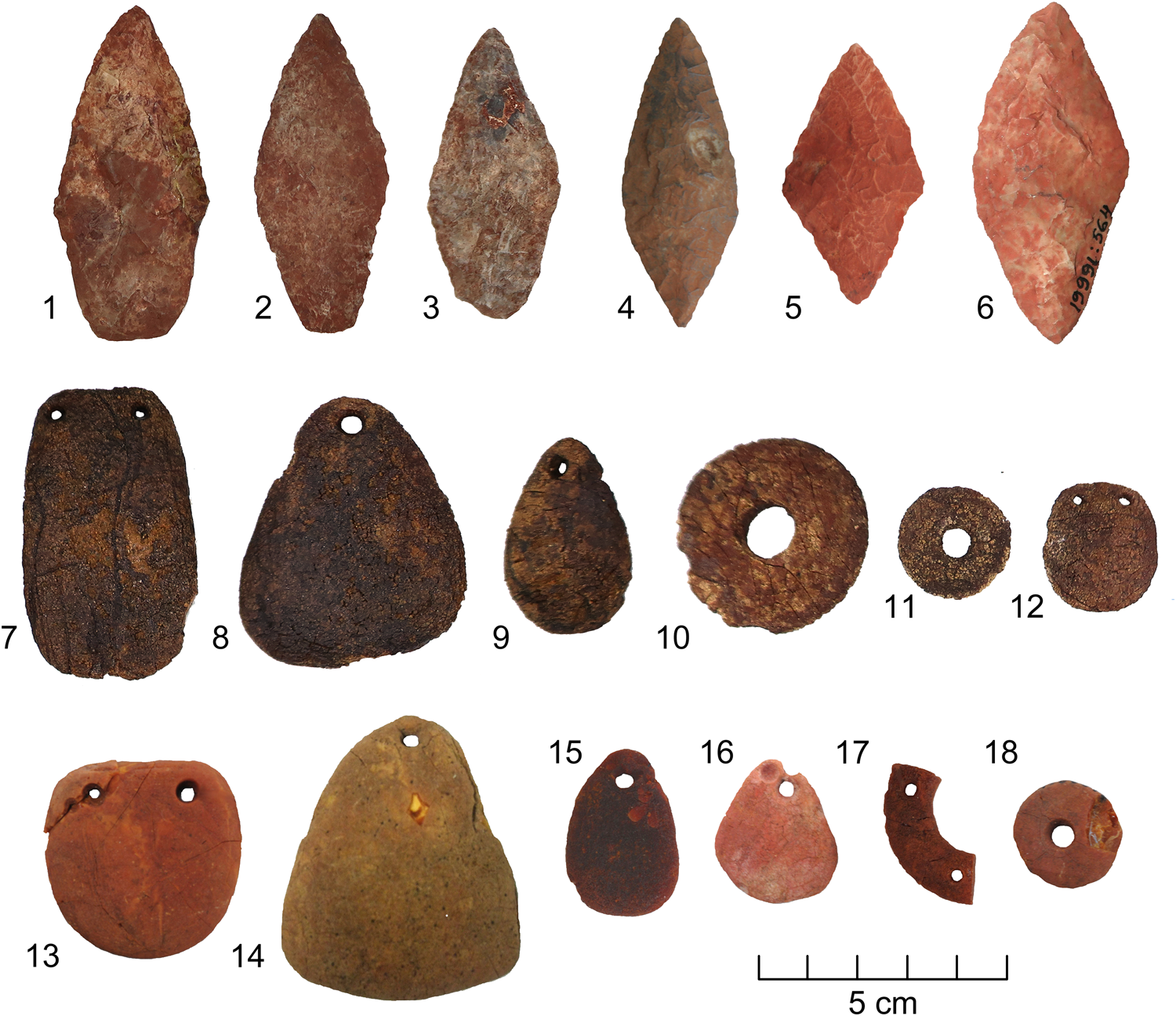
The TCW is known for its rich ‘amber’ or ‘ochre’ graves (Zagorska, Reference Zagorska and Butrimas2001, Reference Zagorska, Larsson and Zagorska2006; Ahola, Reference Ahola2019), mostly located in Finland. Many such graves were also found in the Zvejnieki cemetery in northern Latvia while only a few burials are known in Estonia and north-western Russia. The descriptors ‘amber’ and ‘ochre’ echo the two key elements customarily associated with TCW graves: the presence of amber ornaments regularly accompanied by other characteristic artefacts (Figure 2) and the extensive use of ochre. National research traditions, however, tend to view material from different perspectives. The Finnish tradition, perhaps because of the absence of skeletal material due to poor organic preservation (see Ahola et al., Reference Ahola, Salo and Mannermaa2016), places an emphasis on ochre (Ahola, Reference Ahola2019: 15), while Latvian research does not give it so much prominence. The latter tradition highlights other qualities of visually impressive multiple burials, occasionally accompanied by additional deposits (Macāne & Zagorska, Reference Macāne, Zagorska and Gerasimov2017). These characteristics have received minimal attention in Finland despite being present in burial features (Ahola, Reference Ahola2019: 44–45). Indeed, the TCW material culture of death has never been studied in all its complexity although there are many publications dealing separately with Finnish and Latvian materials (Edgren, Reference Edgren1959, Reference Edgren1966; Luho, Reference Luho1961; Torvinen, Reference Torvinen1979; Zagorskis, Reference Zagorskis1987, Reference Zagorskis2004; Miettinen, Reference Miettinen1992a and Reference Miettinen, Lang and Selirandb; Halinen, Reference Halinen1997; Zagorska, Reference Zagorska and Butrimas2001; Katiskoski, Reference Katiskoski2004; Larsson & Zagorska, Reference Larsson and Zagorska2006; Nilsson Stutz et al., Reference Nilsson Stutz, Larsson and Zagorska2013; Ahola, Reference Ahola2015). We lack an adequate material-based analysis and a synthetic review that would probe potential similarities and dissimilarities in TCW mortuary practices and explore the possible reasons for their emergence and spread beyond the traditionally employed notions of status and prestige.
Flint bifaces (1–6) and amber ornaments (7–18) are the most common grave goods in TCW graves. Bifaces, 1–3: Zvejnieki (VI93:387, VI93:388, VI93:386); 4: Kolmhaara (KM 14717:14); 5: Kangas (KM 29906:2015); 6: Kukkarkoski 1 (KM 19991:564). Amber, 7–12: Zvejnieki (VI93:556, VI93:577, VI93:589, VI93:748, VI93:761, VI93:752); 13 and 16: Kangas (KM 29906:2052, KM 29906:2009); 14: Kukkarkoski 1 (KM 19272:392); 15 and 17: Kanava (KM 33288:18, KM 33288:5); 18 Lappfjärd-Björnåsen (KM 26222:1). By permission of the Department of Archaeology, National History Museum of Latvia (VI) and the National Museum of Finland/Finnish Heritage Agency (KM).
Our aim in this study is to address these issues by collating data from all potential TCW graves from north-eastern Europe and to focus on these ‘amber-and-ochre’ graves. We address the following questions. What are the key elements of the TCW graves and mortuary practices? What is the geographical and temporal distribution and frequency of these graves and practices? How is this prominent set of burial practices and the materials used linked to wider trends noted in early fourth-millennium bc north-eastern Europe and what does this say about the ways people perceived and communicated with the world? Our fourth and final goal is to make the TCW funerary material culture, previously published in several languages in various regional media, better known to scholars outside north-eastern Europe.
Materials and Methods
The research material consists of TCW graves (i.e. interments with one or more individuals) and additional deposits known from north-eastern Europe, that is, Finland, north-western Russia, Estonia, and Latvia (no TCW graves are known in Lithuania or Belarus). The data were collected from publications and unpublished excavation reports. If necessary, the original finds were investigated in person at the National History Museum of Latvia (Riga) and the Nautelankoski Museum (Lieto, Finland). Previous analyses of the collections of the National Museum of Finland (Helsinki) were also used. The data are available in the accompanying online Supplementary Material.
The main criterion for a ‘TCW grave’ is a particular archaeological material culture and burial practice. Radiocarbon determinations serve only as secondary evidence. This is because there are currently few 14C dates from TCW graves and direct dating of human bone is affected by dietary reservoir effects with significant uncertainties (see Meadows et al., Reference Meadows, Ber̄ziņš, Brinker, Lübke, Schmölcke and Staude2016, Reference Meadows, Ber̄ziņš, Legzdiņa, Lübke, Schmölcke and Zagorska2018 and below). Accordingly, the material culture takes precedence over radiocarbon determinations in conflicting situations. Furthermore, since more than eighty per cent of the available material is unsuitable not only for 14C dating but also for other currently available laboratory methods, including aDNA analysis, owing to poor preservation, archaeological analysis of the material culture and context is the only way to gain insights into these burials and the people behind them.
The TCW funerary material culture contains certain features and sets of objects that delimit a recognizable pool of TCW graves (but see discussion below). The most common element is amber: pendants, beads, rings, discs, and buttons (Figure 2, nos. 7–18; Edgren, Reference Edgren1966; Torvinen, Reference Torvinen1979; Zagorskis, Reference Zagorskis1987; Zagorska, Reference Zagorska and Butrimas2001). Amber buttons with V-shaped perforations are, however, related to contexts other than the TCW (see Loze, Reference Loze2004; Rimantienė, Reference Rimantienė2005) and thus all graves with such items are excluded from the present material. Other diagnostic TCW artefacts include large flint bifaces (points) (Figure 2, nos. 1–6), slate ring ornaments and their fragments, and occasional TCW pottery vessels and sherds.
Since organic materials are unevenly preserved, no antler or bone tools can be considered typical of TCW graves. The same applies to body postures and placement: even if all graves bar one (Vaateranta grave D) can be interpreted as inhumations, most remains are decayed. The TCW graves are often oval or rectangular pits located in or near a TCW settlement and may or may not contain ochre or cultural layers from the settlement site. Nevertheless, since such soils are also present in graves from other periods (Zagorskis, Reference Zagorskis1987: 89; Ahola, Reference Ahola2019: 43–46), they cannot be used as typo-chronological markers without additional evidence.
Burials (individuals) lacking typical material culture were considered as TCW graves only if they were closely associated with another TCW grave. These individuals were found in the same pits, above, below, or next to clearly defined TCW graves (but are not intrusive to them) and can be viewed as broadly contemporaneous burials (for example, Zvejnieki, individuals 258–61 in a multiple burial). These graves are indicated with a question mark in the Supplementary Material. On the other hand, we did not include individual inhumation-sized ochre features without bones or clear grave goods from several Finnish burial sites (Hartikka, Kangas, Kukkarkoski 1, Pispa, and Vaateranta). Although these features are located among clearly defined TCW graves, they cannot be securely linked with this burial tradition. In addition, graves with overlapping radiocarbon dates but no direct physical association or typical TCW material culture are excluded at Zvejnieki (e.g. graves 226, 282–84). These graves, similar to the inhumation-sized ochre features, may represent temporally close or even overlapping, but different, mortuary practices (cf. Zagorska, Reference Zagorska, Larsson and Zagorska2006: 102–03; Tõrv, Reference Tõrv2018) or reflect problems of absolute dating.
In addition to human interments, data on additional deposits are presented in the Supplementary Material. Often referred to as ‘votive deposits’ or ‘offerings’, we prefer the more neutral term ‘additional deposits’, as the function or functions of these depositional acts remain unknown. At Zvejnieki, concentrations of amber, flint, and bone artefacts embedded in intensive ochre or other cultural soil near or within the TCW graves were classified as additional deposits (after Zagorska, Reference Zagorska and Butrimas2001). In the Finnish material, small pits (too small even for the burial of an infant) filled with ochre and/or artefacts and located adjacent to a TCW grave were accepted as additional deposits. Unlike in earlier research (Ahola, Reference Ahola2017, Reference Ahola2019), a distinction was made between artefacts associated with the buried body (i.e. at burial level) and those deposited above or below it: the latter two are categorized as additional deposits.
TCW Graves, Additional Deposits, and Their Materials
Burying the dead
Our research included seventy-seven TCW graves from twenty-three sites (Figure 1). Geographically, most of these sites (sixty-one graves, twenty sites) are located north of the Gulf of Finland, while the southernmost site is situated in northern Latvia. The connection between the TCW graves and settlement sites is strong and only one burial (Kõljala) is not associated with known settlement remains. Most of the sites contain a single grave or a few graves, but larger concentrations of graves are also known. We do not know whether inhumation took place during the active use of settlement sites or after their abandonment. Be this as it may, the proximity and manipulation of material remains from human (settlement) activity—whether from the living community or past generations—seem to play a significant role in TCW mortuary practices (Nilsson Stutz et al., Reference Nilsson Stutz, Larsson and Zagorska2013; Larsson, Reference Larsson2017; Ahola, Reference Ahola2019).
The graves contain adults and subadults, male and female, interred in both single and multiple burials (see Supplementary Material). No human bones were preserved in most graves; the data on the age-at-death are patchy and the sex of only thirty individuals has been determined, including five cases of genetic sexing (for methods and analyses, see Zagorskis, Reference Zagorskis1987, Reference Zagorskis2004; Ahola et al., Reference Ahola, Salo and Mannermaa2016; Tõrv, Reference Tõrv2018). At the better-preserved sites in Estonia and Latvia, nearly two-thirds of the graves (ten out of sixteen) are double or collective burials. In Finland and Russia, multiple burials are fewer (thirteen out of sixty-one graves). However, since the number of individuals in a burial is determined here on the basis of clear burial features (soil colouration), this figure should be treated with caution. Indeed, in only three cases (Kanava grave 2003, Vaateranta graves 14 and D) do actual human remains from more than one individual attest to the presence of multiple burials.
Where data are available, the bodies have mainly been interred in an extended supine position (n = 27); other burial positions (e.g. extended on the side, prone, or human remains in non-anatomical order) are less common. Curiously, these ‘odd’ positions only occur in multiple burials; as for the only cremation grave in our data (Vaateranta grave D), it also contains the remains of several individuals (see Supplementary Material). Overall, given the limited data, it is not possible to distinguish age- or sex-specific patterns in TCW burials.
The material culture of death
Despite the relatively large number of graves studied here, much of the data are associated with just a few sites. Only the Zvejnieki and Vaateranta sites include more than ten graves, while the Pispa, Kukkarkoski 1, Hartikka, Kolmhaara, and Sätös sites each have four or more graves. The largest quantity of grave goods is also associated with these sites. Zvejnieki is exceptional, with more than 650 finds, followed by Vaateranta (over 280), Kukkarkoski 1 (over 180), and Kolmhaara (over 110), while all other sites have fewer than fifty finds. The number of finds given excludes TCW pottery sherds, since their fragmentary nature makes their quantification difficult. Similarly, the number of grave goods per grave varies. In approximately fifty cases it is between one and ten, while the maximum values (over 100) are explained either by the presence of flint and quartz debitage (Vaateranta graves 2 and D) and/or amber and other ornaments (Zvejnieki graves 220–25 and 316–17, the latter with over 360 items). One grave (Zvejnieki 252) contained no grave goods but an additional deposit at burial level (see below). Often, the material is too small for reliable statistical analysis; amber and flint, well preserved everywhere, are the dominant raw materials.
Flint is the most common lithic material (present in fifty-six of the seventy-seven graves and six additional deposits) and oval and rhomboid bifaces (also called arrowheads or spearheads or points) are the most numerous flint artefacts (in twenty-nine graves and five additional deposits). Other formal tools are mostly scrapers, but knives and retouched pieces are also present. In some graves, flakes or blades and their fragments are numerous. In a few cases (Kolmhaara grave 1, Vaateranta grave 2, Pispa grave XIV, and Zvejnieki grave 207), flint flakes were clearly concentrated at the burial level (Figure 3). Furthermore, the additional deposits in graves 207 and 211 at Zvejnieki contained concentrations of flint flakes, mostly knapped from one nodule. In other words, flint flakes were deliberately placed in the grave and do not represent settlement debris brought in when the burial pit was being backfilled. The connection between these flint items and the burial event is reinforced by their proximity to the deceased and the ochre staining of these samples.
Ochre-coloured flint flakes found in a concentration in grave 1 at Kolmhaara (KM 14717:24). By permission of the National Museum of Finland/Finnish Heritage Agency (KM).

The use of quartz is more modest (attested in fifteen graves) and, apart from a few formal artefacts and cores, consists of debitage. However, quartz is not necessarily merely part of a fill derived from settlement material; the rock crystal scraper, flake, and two unmodified crystals deposited in graves 3, 9, and 12 at Vaateranta and rock crystal flakes in graves 1 and 1a at Kukkarkoski emphasize the intention and meaning associated with these shiny and translucent objects.
Other stone artefacts are less numerous. Whetstones constitute the largest group of tools, present in nine graves and one additional deposit (Figure 4). These items have been largely overlooked in previous studies but, unlike many other forager funerary assemblages, whetstones appear to be part of the TCW ‘ritual kit’. They are often made of sandstone, have a bar-like or roundish shape and are intensely ochre-coloured. Like flint bifaces, whetstones are associated with the head or upper torso in a grave, but occasionally also with the pelvis and legs (Zagorskis, Reference Zagorskis1987: 73; Katiskoski, Reference Katiskoski2004: 106).
Whetstones from TCW burials and deposits at Zvejnieki (1, 3–5: grave 207, deposit VI93:452; grave 213 VI93:533–534; grave 221 VI93:604; grave 264 VI93:725) and Kukkarkoski 1 (2: grave 1a KM 19727:141). By permission of the Department of Archaeology, National History Museum of Latvia (VI) and the National Museum of Finland/ Finnish Heritage Agency (KM).

The next group of stone tools consists of axes/adzes (found in four graves), followed by other tools and flakes (in seven graves). Nevertheless, the largest group of ground stone items consists of ornaments, rings, and pendants (recovered from fifteen graves). Similar ornaments are made of other raw materials, especially amber (altogether in forty-one graves). Amber pendants of various shapes and sizes are numerous. Large, flat and elongated or oval pendants with one, two, or occasionally multiple perforations are the most common, but smaller oval- or drop-shaped pendants as well as round and tubular beads and buttons, rings, and discs are regularly found (see e.g. Edgren, Reference Edgren1966; Torvinen, Reference Torvinen1979; Miettinen, Reference Miettinen1992a and Reference Miettinen, Lang and Selirandb; Zagorska, Reference Zagorska and Butrimas2001 for overviews). They were probably used as pendants and as adornments for dress, garments, and body wrappings and can be found in various arrangements and associated with all parts of the body from head to toe. In some fifteen cases (including burials at Hartikka, Kolmhaara, Pispa, Vaateranta, and Zvejnieki), amber rings or discs were discovered in the eye sockets of the deceased while the head or face was covered with red or blue clay, suggesting the presence of a death mask (Zagorskis, Reference Zagorskis1987: 93; Zagorska, Reference Zagorska and Butrimas2001: 112; Katiskoski, Reference Katiskoski2004; Edgren, Reference Edgren, Larsson and Zagorska2006; Ahola, Reference Ahola2017). In at least one case in Finland (Kolmhaara), amber and clay were also found elsewhere in the grave, possibly representing a ‘clay container’ in which amber ornaments had been pressed into soft ochre-mixed clay (Figure 5). The multiple ways of positioning amber—decorating the body or containers individually or as part of composite items—emphasize the importance, but perhaps also the diverse meanings, of this material.
Unburnt clay stained with ochre from the Kolmhaara grave I viewd from two sides. Note the impressions on both sides. These impressions fit an amber ring fragment (KM 14717:7) and a fragmented amber disc (KM 14717:4) from the same grave. As small fragments of amber were found within the clay outside the impressions, it is likely that all other amber ornaments (KM 14717:5, 6, 8) discovered next to the clay were also pressed into it. By permission of the National Museum of Finland/Finnish Heritage Agency (KM).

Bone and antler artefacts were found only in one grave in Finland (preservation bias) but were present in seventy-five per cent of the graves and in three additional deposits in the Baltic States; their number is therefore underrepresented considering the total amount of finds. Most bone and antler artefacts come from Zvejnieki and consist of tools (found in eight graves) such as awls, harpoons, fishhooks, knives, and adzes that are relatively common in boreal hunter-gatherer burials, as are ornaments such as tubular beads and figurines (recovered from four graves) (Figure 6). Some osseous artefacts, however, are unique to the TCW graves (at Zvejnieki) including bone rings and pendants, antler maces, and metapodial elk bones with holes.
Bone and antler artefacts preserved at Zvejnieki. 1–2: awls made from elk metacarpals (from grave 317 (2007/448) and grave 264 (VI93:726) respectively) are found quite regularly in hunter-fisher-gatherer burials; 3–6: beaver teeth (3: grave 201 (VI93:400); 4: grave 211 (VI93:471); 5: grave 252, deposit (VI93:703); 6: grave 207, deposit (VI93:441)) are found virtually only in TCW graves; 7: the bone pendants (from grave 317 (2009/1028, 1035, 1018, 1021, 1030, 1017, 1008, 1020) also appear unique and were found together with beads of fossilized sea lilies (not illustrated). By permission of the Department of Archaeology, National History Museum of Latvia (VI).

In contrast to earlier hunter-gatherer graves (see Macāne, Reference Macāne2022), animal teeth do not play an important role in the TCW funerary material culture. Only twenty teeth from seven graves are included in the material, in contrast to the thousands of pendants made from teeth and dated to other periods. Acknowledging the constraints of the limited material, approximately half of the teeth belong to carnivores, which also constitutes a difference from previous herbivore-dominated sets (Macāne, Reference Macāne2022: 288). Furthermore, the non-carnivore teeth mostly belong to beaver, which, with one exception, appear exclusively in TCW contexts at Zvejnieki (in four burials and three additional deposits; Macāne, Reference Macāne2022: 230, fig. 7.5).
Figurines are occasionally present and are made of different raw materials: flint at Kukkarkoski, amber at Kukkarkoski and Valma, bone at Valma and Zvejnieki, and clay at Sätös and Zvejnieki. They often depict animals but also people and are paralleled among TCW material recovered in non-grave contexts. Copper rings from Zvejnieki 277 are the oldest metal finds in Latvia, and therefore unique, but reflect the general diversification and exploration of the material world during the fourth millennium bc (see Herva et al., Reference Herva, Nordqvist, Lahelma and Ikäheimo2014, Reference Herva, Mökkönen and Nordqvist2017; Mökkönen et al., Reference Mökkönen, Nordqvist and Herva2017a). The small tubular beads made of fossilized sea lilies (crinoids) found in Zvejnieki 316–17 (Macāne, Reference Macāne2020) represent another similarly unique raw material category in the TCW burial context.
Complete or partial TCW vessels are found in six graves at Bosmalm, Kukkarkoski 1, Laajamaa 1, Sätös, Vaateranta, and Zvejnieki. In addition, pottery sherds were recorded at five further sites. As noted previously (Edgren, Reference Edgren1982; Ahola, Reference Ahola2017: 207–08), the pottery recovered from graves is often anomalous (miniature or unfinished vessels), partial (only the bottom part or rim sherds of one or more vessels are present), or treated in a special manner (e.g. placed upside down). Pottery sherds may have been used to line the walls of the burial pit but may only be represented by individual pieces at burial level.
Additional deposits
We recorded a total of thirteen additional deposits at six sites (see Supplementary Material). Of the deposits retained for examination, two were located above the burial level (Hartikka grave 5 and Bosmalm grave 1) while in three cases one or more small pits were dug below the grave (Bosmalm grave 1, Vaateranta graves 3 and 10). In addition, seven deposits were made at the burial level or in additional pits next to the graves (Zvejnieki graves 207, 211 and 252; Kolmhaara grave 1; Holopainen grave 1). Additional deposits are not common in hunter-fisher-gatherer graves of earlier periods and have their closest parallels in the deposits (or ‘hoards’) associated with the Volosovo mortuary culture of the mid to late fourth millennium bc in central Russia (see Kostyleva & Utkin, Reference Kostyleva and Utkin2010; Macāne et al., Reference Macāne, Nordqvist and Kostyleva2019).
A common feature of these deposits is the abundant use of ochre. The finds made in them partially follow the trends exhibited by grave goods but also shows differences (see Supplementary Material). Flint bifaces and debitage are also dominant in the additional deposits. In one case, the deposit included a whetstone. On the other hand, the almost complete absence of amber (only five items in two deposits) clearly differentiates additional deposits from burial assemblages and suggests that amber was more strongly associated with living or dead bodies. Regional deviations may partly reflect local traditions but also preservation conditions: bone and antler objects are found in all deposits in Latvia, while the number of pottery sherds and whole vessels is high in Finland.
Dating
Research on the absolute chronology of the TCW varies greatly across its distribution area, but in general the emergence of the TCW dates to between 3900 and 3800 bc. Determining the end date is more difficult as the transition between the TCW and subsequent phases is not clear in many areas; nevertheless, a boundary can be drawn at approximately 3500 bc (see Nordqvist, Reference Nordqvist2018; Pesonen, Reference Pesonen2021 for Finland; Tarasov et al., Reference Tarasov, Nordqvist, Mökkönen and Khoroshun2017 for north-western Russia; Kriiska, Reference Kriiska and Lang2020 for Estonia; Piličiauskas et al., Reference Piličiauskas, Kisielienė, Piličiauskienė, Gaižauskas and Kalinauskas2019 for Lithuania).
Eighteen TCW graves included in this study were dated (see Supplementary Material). Most of the dates were obtained directly from the bones of the inhumed but, aside from Zvejnieki grave 201 and Vaateranta grave D, all the dates are either older or only overlap with the beginning of the TCW period. In other words, the dates obtained on human bones are generally too old because of the consumption of 14C-depleted aquatic resources. Using stable dietary isotopes of carbon and nitrogen, modelled corrections have been obtained for some graves (at Zvejnieki the estimated freshwater reservoir effect applied for Lake Burtnieks is 750 ± 50 radiocarbon years and the resulting uncertainties in human freshwater reservoir effect >±100 radiocarbon years; Meadows et al., Reference Meadows, Ber̄ziņš, Brinker, Lübke, Schmölcke and Staude2016, Reference Meadows, Ber̄ziņš, Legzdiņa, Lübke, Schmölcke and Zagorska2018; for Kõljala, see also Tõrv, Reference Tõrv2018). Although the corrected dates may be more accurate, they result in very broad age estimates that occasionally still appear old compared to the typo-chronological age.
Paired dates of terrestrial, non-human bones from two graves at Zvejnieki (burial 208, a cervid tooth, and burial 317, an awl of elk bone) indicate that the probable age of these interments is between 3800 and 3500 cal bc. Looking at the context dates of wood, bark, and birch bark tar lumps from the Finnish burials, the median values are similar—between 3800 and 3600 cal bc (excluding clearly deviant dates; see Supplementary Material). Thus, it appears that the TCW graves date to a short period of just a few centuries after 3800 bc, consistent with the dating of the TCW itself. The lack of reliable dates makes it impossible, however, to establish an internal chronology of the graves or their individual features, or to identify other possibly contemporary or parallel (TCW) burial traditions.
Discussion
‘Symbolically overloaded’ burials
Our analysis indicates that TCW graves are a materialization of a complex set of practices in which visuality (colours, contrasts, and combinations), performance, manifestation of communication, and social identity play a key role. Indeed, although many artefact types found in the TCW graves, i.e. personal ornaments and ordinary tools, also follow traditions present in earlier forager graves in the region (Zagorskis, Reference Zagorskis1987, Reference Zagorskis2004; Zagorska, Reference Zagorska, Larsson and Zagorska2006; Tõrv, Reference Tõrv2018; Ahola, Reference Ahola2019; Macāne, Reference Macāne2022), there is a clear change in raw materials, when the previously dominant osseous material is largely replaced by colourful and non-local materials and artefacts. The latter are made of flint (Carboniferous and Cretaceous, originating in central Russia or southern Lithuania and Belarus, respectively) and amber (from coastal Latvia and Lithuania), but examples also include slate and copper ornaments and tools (from Finland, north-western Russia) or Crinoid beads (from the Estonian Islands?). These materials testify to the wide-ranging transport and exchange of goods between different areas. Such evidence of symbolically charged communication of social identity and material manifestation of group membership and belonging (networks) characterize the TCW period in other contexts too (see Herva et al., Reference Herva, Nordqvist, Lahelma and Ikäheimo2014, Reference Herva, Mökkönen and Nordqvist2017; Mökkönen et al., Reference Mökkönen, Nordqvist and Herva2017a; Ahola et al., Reference Ahola, Holmqvist and Pesonen2022).
Importantly, many of these materials are sensorially appealing. In addition to the intensely red-coloured ochre commonly used in hunter-fisher-gatherer interments, the TCW communities intentionally placed artefacts made of colourful, translucent, or light-reflective materials in the graves and decorated the pit itself with black soil or pottery sherds. Simultaneously, associated activities such as making additional deposits, carefully positioning the dead bodies in various entangled and layered arrangements, or sometimes covering the facial region with colourful clay and placing amber rings or buttons over the eyes and on and around the head, suggest that these practices were clearly meant to be seen. Changes are also visible in the human‒animal relationships displayed in the graves. The decreasing importance of animal teeth, especially those of herbivores, and the introduction of beavers not only in the form of teeth but also as figurines (at Valma) reflect definite changes in the ritual sphere, previously dominated by elks and other ungulates (see Lahelma, Reference Lahelma2008 and Mantere, Reference Mantere2023 for rock art and portable art). Although we cannot fully understand the meaning of these acts, the novel practices conveyed new cosmological considerations emerging in the region, new ideologies in which visuality and performance played a greater role than before.
Overall, we find it appropriate to define the TCW graves as ‘symbolically overloaded’. We chose this expression to highlight the TCW's excessive use of material signals (Figure 7). At the same time, defining TCW graves as ‘symbolically overloaded’ may create a circular argument. Is this concept merely an artefact of our classification criteria and the typo-chronological dating used, or can there be TCW graves without such a distinctive material culture? The number of ‘symbolically overloaded’ TCW graves is admittedly small compared with the duration and geographical scale of the phenomenon, and there must have been other ways of burying or handling human remains during this period. Some of these practices may be completely invisible archaeologically, and assigning a cultural affiliation to burials devoid of human remains, material culture, or radiocarbon determinations is impossible. While the question is valid, we nevertheless maintain that the ‘symbolically overloaded burials’ represent a clear set of practices: burials that were made only occasionally, perhaps just for certain people or for a particular reason.
Two examples of ‘symbolically overloaded’ graves from Zvejnieki. Graves 220–25 and 275–78 contain several individuals and illustrate many other typical features of the TCW burial ritual: heavy use of ochre, clay-plastered skulls, and rich grave goods with various non-local items. Drawing by permission of B. Vaska/the Institute of Latvian History, University of Latvia.

In this respect, Vaateranta grave D, a cremation of at least three people, is a significant departure from the other graves and shows that human cadavers could be treated in different ways in the ‘symbolically overloaded’ TCW graves. More importantly, this grave blurs the boundary between a ‘burial’ and a ‘deposit’ as its properties are closer to those of the latter. Perhaps we should not make such a clear division between these categories and instead talk about ‘intentional depositional acts’ in which different kinds of materials (including human remains) are buried in certain locations according to specific rules (see Baires & Baltus, Reference Baires and Baltus2017).
Mobility and performance
When the symbolism of graves is unpacked, it is worth noting that in many areas the arrival of the TCW is connected with population movements. The first aDNA results reported from the Baltic States suggest that individuals associated with the Comb Ware culture, including the five Zvejnieki individuals (numbers 207, 221, 224, 261, and 278) discussed in this article, have a stronger association with Eastern Hunter-Gatherer genetic ancestry compared with previous, more Western Hunter-Gatherer-like populations (Jones et al., Reference Jones, Zariņa, Moiseyev, Lightfoot, Nigst and Manica2017; Mathieson et al., Reference Mathieson, Alpaslan-Roodenberg, Posth, Szécsényi-Nagy, Rohland and Mallick2018; see also Saag et al., Reference Saag, Varul, Lyn Scheib, Stenderup, Allentoft and Saag2017; Mittnik et al., Reference Mittnik, Wang, Pfrengle, Daubaras, Zariņa and Hallgren2018). Therefore, the emergence of TCW in the Baltic States is linked with genetic input, presumed to have originated in the (north-)east. While there is no osteological material further north, sharp changes in material culture are attributed to migration in southern Finland (Mökkönen et al., Reference Mökkönen, Nordqvist, Herva and Gerasimov2017b; Nordqvist, Reference Nordqvist2018: 101–02). Be that as it may, the scale and mechanisms of this population flow are currently unknown in all areas.
Most TCW graves are located north of the Gulf of Finland in an area where the TCW material culture is traditionally described as very strong (e.g. Meinander, Reference Meinander and Åström1984). This may suggest that the burials were intended primarily to establish and manipulate social relationships within particular TCW communities or with the surrounding other-than-human world rather than with human ‘outsiders’. On the other hand, Zvejnieki, for example, had been in use for thousands of years by the early fourth millennium bc; thus, it is plausible that an incoming population buried their dead (and other items) in this particular location in order to live in or use the resources of the region (see Ahola, Reference Ahola2020). At the same time, it may be significant that the ‘symbolically overloaded burials’ cluster tightly in an area of only 15 × 20 m in the eastern part of the almost 300 m-long cemetery, thus underlining the interconnectedness of these ritual depositions.
Although the TCW communities clearly emphasized their interconnectedness, their performative depositional acts may not have been strictly exclusive but also open to other communities or individuals. The introduction of novel ritual practices and connected beliefs can also take place as broadly participatory actions, which can be promoted, for example, as a way for participants to gain access to new supernatural powers (Baltus & Wilson, Reference Baltus and Wilson2019). From this perspective, the focus would not be on direct territorial claims (and therefore the practices need not take place, for example, in border areas) but rather on expressing the fact that power is in the hands of individuals who have access to this esoteric knowledge, i.e. in the hands of the people conducting these rituals. In this type of power acquisition, the visibility and visuality of the actions play crucial roles and excessive symbolism provides a means to an end.
Conclusions
Our compilation of and analysis of TCW graves from north-eastern Europe provide several new insights into this phenomenon. To the long-known features of TCW burial assemblages—amber ornaments and flint bifaces—we can now add whetstones, bone awls, beaver incisors, and flint flake concentrations. In addition, the tradition of making additional deposits near, below, or above the graves has proven to be a relatively common phenomenon. The intentional use of appealing and colourful (non-local) materials and their combinations testifies that visuality and symbolism were at the heart of these performative depositional acts. This clearly distinguishes these interments from the preceding hunter-fisher-gatherer graves in the region, which are often characterized by single burials furnished with items made of osseous materials. Acknowledging the possible biases caused by varying preservation conditions, the TCW material culture of death seems quite uniform in the area studied. Some differences, however, probably reflect local traditions, such as the more common use of pottery in burials in Finland.
Even though our definition of a ‘TCW grave’ is exclusive and normative, the manner in which the ‘symbolically overloaded burials’ were performed appears to have been quite strictly defined in material terms. At the same time, such burials are rare and only undertaken for certain people in specific situations and/or at particular places. Thus ‘symbolically overloaded burials’ cannot be viewed as the normative way of disposing of the dead but should be seen as a materialization of excessive symbolism, strong manifestations of belonging, identity, and relationships, highlighted through performances in which bodies, artefacts, and connected activities were obviously meant to be seen before or during the event. Given that the emergence of the TCW represents population movements, the changing burial practices are considered to relate to the introduction by newcomers of novel ways of perceiving and communicating with (and to) the world and its inhabitants. An evaluation of the radiocarbon dates obtained from these graves shows that this unique phenomenon lasted only a few centuries in north-eastern Europe, from approximately 3800 to 3500 bc.
Acknowledgements
This work was supported by the Research Council of Finland under grant no. 347716 and the European Research Council under grant no. 864358. The authors would like to thank Normunds Grasis (National History Museum of Latvia) and Leena Viskari (Lieto Museum/Nautelankoski Museum) for their help with museum collections and the anonymous reviewers for their comments on an earlier version of this article.
Supplementary Material
To view supplementary material for this article, please visit https://doi.org/10.1017/eaa.2024.54.



 Open access

