


1. Introduction
The emergence of new technologies such as additive manufacturing, has triggered the creation of places like fablabs and makers spaces, designed to democratize access to advanced tools and equipment. These environments foster a Maker community characterized by a “making do with what is at hand” mindset (Reference Baker and NelsonBaker & Nelson, 2005) with core principles extracted from the DIY movement (Reference Camburn, Sng, Perez, Otto, Wood, Jensen and CrawfordCamburn et al., 2015) and their design practices.
Some of these places aim at supporting the innovation journey of their audiences: researchers, entrepreneurs, institutions, private companies or public associations. Their processes often inspired by design thinking methodologies, put a significant emphasis on hands-on experimentation and rapid prototyping as key drivers of creativity and problem-solving. Innovation in this context covers a wide range of projects at different phases of innovation process (Reference Furr and DyerFurr & Dyer, 2014). In addition to project-specific workflows suggested implicitly by the nature of the project, we also consider the status of the project as well as its classes of development model (i.e. as technology push, market demand (Reference Bishop and MaglebyBishop & Magleby, 2004) or user innovation (Reference BrunsBruns, 2014)).
These ecosystems have facilitated the development of new methodologies based on prototyping. From problem definition to customer validation, prototypes can play a role in supporting the different phases of the innovation process but also later stages of the product development process. The biggest challenge being to design the right prototype to meet the specific objectives of each phase.
There are different definitions of prototyping. In this paper we adopt the more inclusive definition from Lim (Reference Lim, Stolterman and TenenbergLim et al., 2008): “Prototyping is an activity with the purpose of creating a manifestation that, in its simplest form, filters the qualities in which designers are interested, without distorting the understanding of the whole”. One interesting aspect of this definition is that it doesn’t limit prototyping to the creation of an object but opens it to a broader interpretation.
There are several approaches to guiding prototyping activities. They can be classified based on their objectives (e.g. active learning, exploration, communication or refinement (Reference Camburn, Viswanathan, Linsey, Anderson, Jensen, Crawford, Otto and WoodCamburn et al., 2017)) or on forms they take (e.g. visual prototype, proof of concept, presentation prototype (Reference UllmanUlman, 2010)). Additionally, strategic aspects of prototyping are well-documented in the literature, highlighting its role in navigating divergence and convergence within design space through iterations (Reference Camburn, Sng, Perez, Otto, Wood, Jensen and CrawfordCamburn et al., 2015) (Reference Bushnell, Steber, Matta, Cutkosky and LeiferBushnell et al., 2013), filtering the characteristics of interest in a prototype (Reference Lim, Stolterman and TenenbergLim et al. 2008), but also proposing techniques that intend to validate the customer interest for the project being developed such as minimum viable product or Wizard of Oz prototypes (Reference SavoiaSavoia, 2011).
Prototyping is manifold considering the numerous variables involved to reach a successful process: the purpose of the prototype, the strategy to achieve your objective, the techniques to materialize the project. Each aspect being considered with a will to optimize the resources invested regarding time, manpower and materials. More recent works emphasize the need to properly prepare a prototyping activity with the guidance of dedicated tools (Reference Menold, Simpson and JablokowMenold et al., 2019) (Reference Lauff, Menold and WoodLauff et al., 2019), including the end-user in the reflection for a more user-centric approach to the design.
This paper proposes a tool to support the preparation of the prototyping activities. Developing from Houde & Hill’s model for human-computer interaction (Reference Houde and HillHoude & Hill, 1997) and its application to the field of design sciences (Reference YangYang, 2005), we introduce a framework that proposes to characterize prototypes based on their “role”, “look and feel” and “implementation” dimension, offering a structured approach to align prototyping strategies with the design phase objectives.
2. State of the art - the triangle model of ‘what prototype prototypes’ (Reference Houde and HillHoude and Hill, 1997)
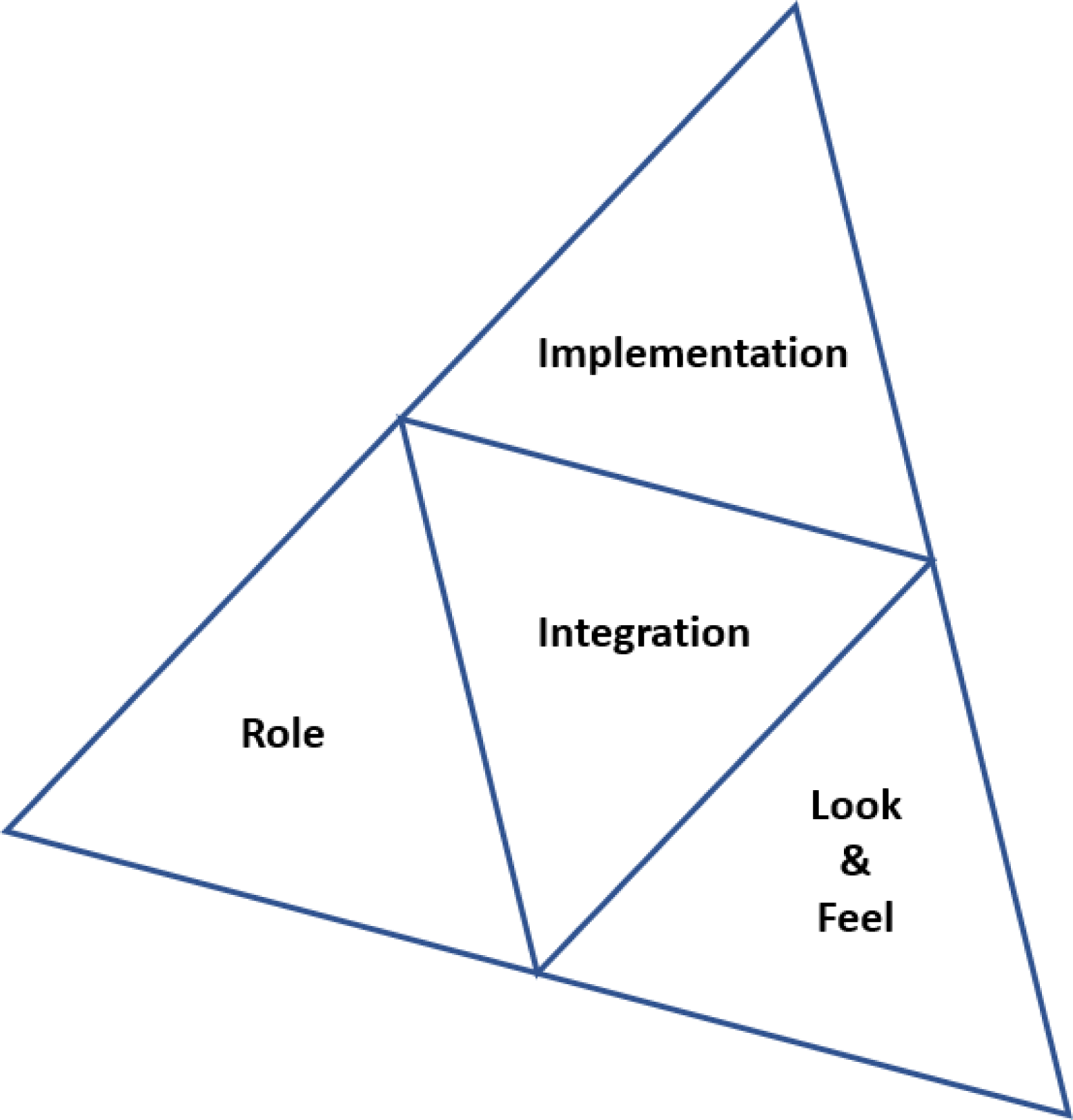
The starting point to our prototyping compass is the triangle model of ‘what prototype prototypes’ represented in Figure 1. This model extends beyond the conventional focus on the technical and material aspects of the prototyping activity often emphasized in engineering-oriented approaches; it offers a broader framework (Reference YangYang, 2005). Originally developed to support human-computer interactions, this model also integrates the users and the context of use in its classification of prototyping activities. It answers a need for a framework supporting a user-centred design practices, addressing the 3 lenses of design thinking: viability, feasibility and desirability (Reference Menold, Simpson and JablokowMenold et al., 2019).
The triangle prototype classification model (adapted from Reference Houde and HillHoude & Hill, 1997)

In the triangle model, each corner of the triangle represents a different dimension of a prototype
-
Implementation: This dimension addresses the prototype’s ability to perform its intended functions, focusing on how the project works.
-
Look and feel: This aspect conveys information relative to the form and appearance of a design, defining how the project will look like.
-
Role: This dimension highlights the use and context of use, defining whether and how the project will be used.
To validate the applicability of this model to physical prototypes, Hernley (Hernley, Reference Hernley2011) positioned different hardware prototypes within the triangle. One of the findings revealed the challenge to distinguish the purpose of certain design questions. Since there was no clear characterization of the different categories, the position on the triangle was open for different interpretations. In the next section of this paper, we will develop on this model looking to answer a need for more precise characterizations when leveraging the model in practical applications.
3. The prototyping compass: a proposal for improvement.
The triangle model proposed by Houde identifies 4 distinct classes of prototypes. However, positioning prototypes within this framework remains a challenge as soon as a prototype possess characteristics of multiple dimensions. In this section, we propose to reinterpret the 3 classes as dimensions of a prototype, each representing a critical aspect of design exploration. We detail the key characteristics of each dimension and associate them with hierarchical definitions, ranging from the lowest to the highest level of maturity. These definitions allow us to assign a specific weight to each dimension, enabling a systematic evaluation of prototypes and removing the ambiguity that can be associated to the Integration category. Finally, to compare the different dimensions maturity, the final weight of each dimension is normalized to 1.
The purpose of this approach is twofold.
-
To clarify the various leverage points available when designing and iterating prototypes.
-
To identify the smallest incremental steps necessary to create prototypes that effectively address their intended objectives.
By providing a structured framework, this model empowers designers and coaches to orient prototyping activities and maximize their impact throughout the innovation process.
3.1. Defining an ‘implementation’ scale: the technical readiness level scale
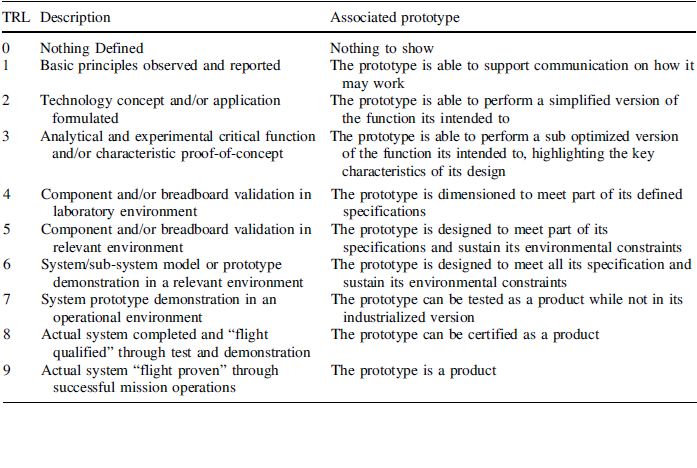
The ‘Implementation’ category focuses on validating that a prototype can perform its intended function, effectively addressing the question “how the project will work”. To characterize the level of development required for a prototype within this category, we can refer to the Technical Readiness Level (TRL) scale (Reference MankinsMankins, 1995). Originally developed by NASA, this scale provides a systematic metric for assessing the functional maturity of a given technology. Table 1 presents a qualitative description of each TRL, outlining the expected level of functionality at each stage, and how to translate it to characterize a prototype associated to the stage. In this dimension, the TRL score is simply the result of the TRL level divided by 9 for normalization.
NASA technology readiness level scale (adapted from Reference MankinsMankins, 1995) and its associated prototype recommendation

From the table 1, we can see that the first technical readiness levels are potentially independent from the components and/or environment conditions associated to the final version of the project. At some point, these factors start to come in consideration. This transition aligns with the Integration category from the triangle model, which begins to encompass prototypes with enough maturity to address multiple questions.
As expected from the purpose of this model, we can clearly position the functional readiness level of the project and anticipate what would be the objective associated to the next readiness level. This structured approach helps avoiding to target too much too fast. Furthermore, it leaves room to develop in other categories, either role or look and feel, based on the project needs.
3.2. Defining a ‘look and feel’ scale: the hierarchical morphological prototyping taxonomy (Reference StoweStowe, 2009)
The message associated to the ‘Look and feel’ category covers the aspects of prototypes aiming to characterize the level of information regarding the product assembly, from the first sketch to the final product Bill of material, to answer the question “how the project will look like”.
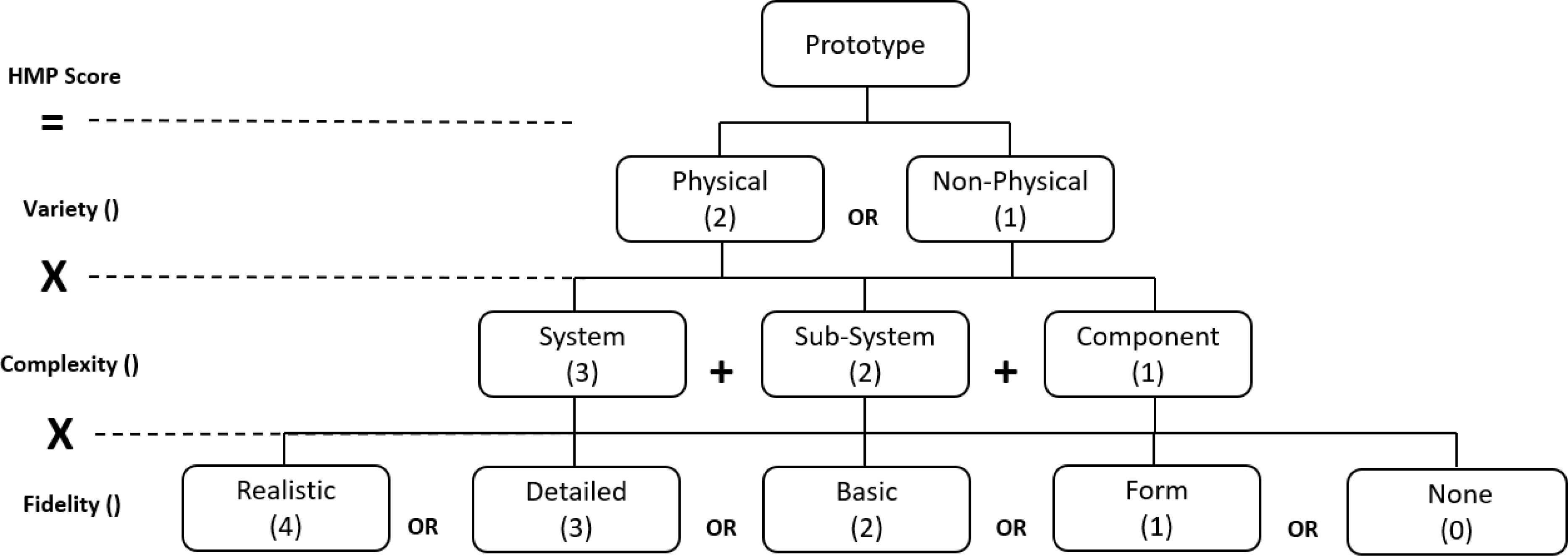
In order to cover these aspects of a prototype, we consider the hierarchical morphological prototyping (HMP) taxonomy proposed by Stowe (Reference StoweStowe, 2009) and represented in Figure 2. The HMP taxonomy aims at describing prototypes as a design representation which enable designers to communicate, test or validate design ideas with a classification that is independent from the design goals. To this end, it describes a prototype in term of variety, complexity and fidelity with each of these characteristics proposing a qualitative progression to support a description from the first “cardboard” prototype to the final product.
Hierarchical morphogical prototyping taxonomy representation with its associated weights (adapted from Reference StoweStowe, 2009)

While Variety and Complexity are straightforward to interpret, fidelity deserves a more detailed definition to align on impact on the prototype:
-
None: can be associated to prototypes not meant to convey intentionally information associated to the product design itself
-
Form: defines prototypes made out of one main material with the purpose of conveying one major information (i.e. shape, volume, weight…)
-
Basic: defines prototypes made out of multiple materials or parts selected for their availability with limited properties required for the final product
-
Detailed: defines prototypes made out of materials or parts selected to support reflection on manufacturing the final product
-
Realistic: defines prototypes made out of materials or parts representative of the final product
3.2.1. From Taxonomy to Scale
To quantify the HMP taxonomy, we propose a scoring approach that translates its dimensions into measurable attributes:
-
Variety and Fidelity: These dimensions are treated as exclusive categories. For each prototype, the selected definition is assigned a weight, reflecting its position along a spectrum from the lowest level of maturity to the highest.
-
Complexity: Unlike variety and fidelity, complexity allows for combination of definition. The weight for complexity is calculated as the sum of the weights of all applicable definitions.
These weights, associated with each characteristic, are then combined. Since the dimensions are orthogonal, the overall HMP score is computed as the product of the weights (see Figure 2). The score ranges from 0 to a maximum of 48 before normalization, providing a relative measure of completion across prototypes.
Prototypes with the lowest scores may focus solely on the look and feel aspects, more advanced prototypes will need to integrate functional parts, start to prepare for mass production and/or use it to challenge its intended role. These later prototypes would be associated to the Integration category identified from the original triangle model.
The separation of the ‘look and feel’ aspects from other design challenges creates opportunity for prototyping allowing to envision various combinations with different levels of completion not only to serve the iterative progression on the ‘look and feel’ and the manufacturing aspects of your product, but also to support advancements in ‘implementation’ and ‘role’ dimensions, ensuring that prototypes meet both immediate and future design objectives.
3.3. Defining a ‘role’ scale
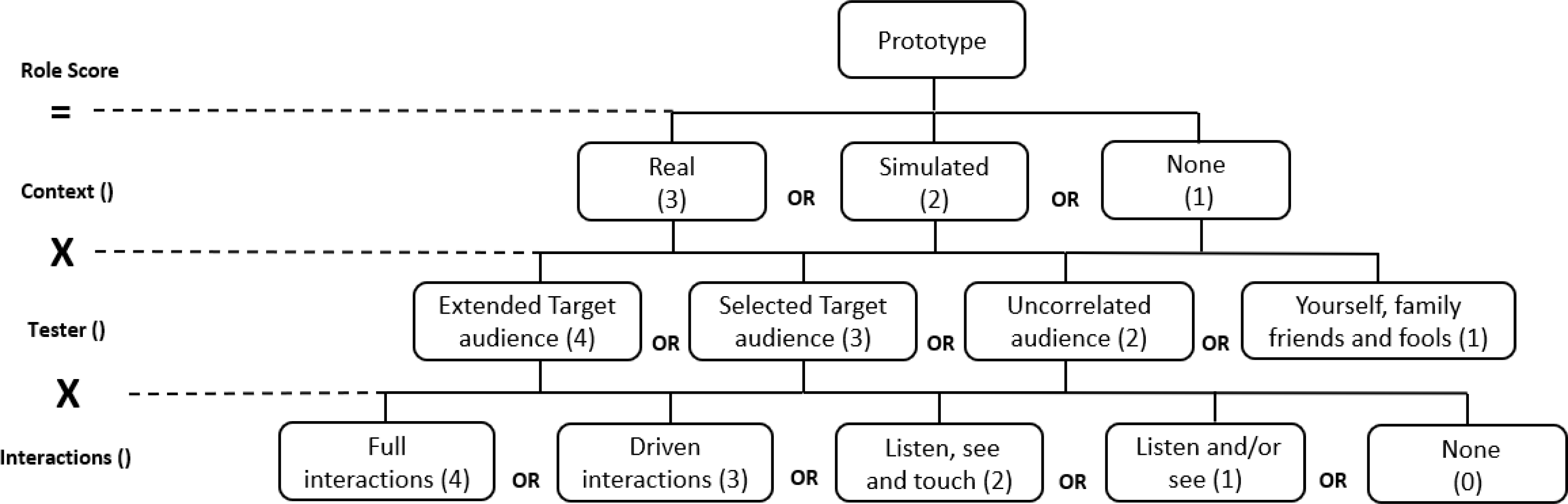
When it comes to defining the role, it’s not as straightforward as for the other dimensions. The motivation to characterize the role comes from the Design Thinking process and its user-oriented approach supported by observation and testing (Reference Mueller-RoterbergMueller-Roterberg, C. 2018), Role prototypes aim to challenge if and how the project will be used in real-world conditions. To achieve this, three characteristics can be manipulated in a prototyping setup:
-
Context: represent the environment and conditions in which the project is intended to operate.
-
Target audience: represent the quality of the tester considered to represent the user for whom the project is designed
-
Interactions: The level of engagement between the audience and the prototype.
3.3.1. Context
The context determines how closely the prototype reflects the intended use environment. This can be categorized as:
-
None: For some role prototypes, the context is disregarded and rely on the imagination of the testers.
-
Simulated: A controlled environment is created to mimic key aspects of the real context. A simulated context may be useful when the actual context is too difficult to access or too restrictive to be constructive within the constraints defined by the prototyping setup.
-
Real: The prototype is tested in the actual context, with minimal assumptions or alterations. This provides the most accurate and reliable insights.
3.3.2. Target audience
Second, the quality of feedback depends heavily on the audience selected for testing. Different levels include:
-
Yourself, Family, Friends and Fools: While convenient, this group is often too biased to provide constructive criticism.
-
Random people: While offering varied perspectives and a more neutral approach, random individuals may lack the investment or understanding needed to provide deep insights.
-
Selected Target Audience: Engaging a representative subset of the intended users can generate focused and constructive feedback.
-
Extended Target Audience: A larger “extended target audience” should provide valuable information from a broader spectrum of the target audience, from the first-time buyers to the non-buyers, with an audience potentially unaware of being tested.
3.3.3. Interactions
Third, the level of interaction determines how immersive the experience is for the tester, depending on the feedbacks expected from the prototyping setup. The interactions can be with the context to gain understanding of its mechanism and/or with the product evaluated to confirm its role from the tester point of view.
Different levels of interactions can be described as:
-
None: The prototype is not meant to gather intentionally user’s feedback
-
Listen and/or see: The audience passively observes the prototype
-
Touch: Testers physically interact with the prototype, allowing to develop more personal feedbacks from their own perspective
-
Driven Interaction: Guided interactions ensure to provide the testers with the expected user experiences focusing on the prototype intended purpose
-
Full interactions: Users freely engage with the prototype in conditions close to the final product. Generating the most authentic insights into the user behaviour
3.3.4. Scoring the Role Dimension
To provide the role dimension with a relative sense of reach, we propose a weighted scoring similar to that used for ‘look and feel’. Each characteristic is assigned a weight based on its ranking in the level of representativeness, from the lowest to the highest. The overall score is calculated as the product of the three weights, as illustrated in Figure 3.
Role score = context weight x tester weight x interactions weight /48

The resulting score ranges from 0 to 48 before normalization, enabling comparisons across prototypes. In the early stages of a project, this score can function independently, helping to evaluate problem statements, highlight solution opportunity and uncover user needs. As the project progresses, the role dimension will support validation of functionality but also prototypes.
4. Many prototypes: one product
To illustrate how the compass can support the prototyping activity, we propose to review different prototypes created within the project “Pylon Unbending” (ELIA, 2020) for the product development of a mechanical tool to unbend pylons for an electricity system operator company in Belgium. The latest development of the project is available on wikifactory: https://wikifactory.com/@rlomba-3c934/pylon-unbending
4.1. Exploring the problem
To start this project, the sole information available was that pylons get damaged and repairs are costly and impactful. A first workshop was planned, involving different work-profiles from both the electricity system company and the university’s engineering department, with the goal of leveraging prototyping to explore the problem.
Referring to the compass, it was straightforward to determine that functional and look-and-feel aspects were not yet relevant, as no concept had been defined. This left the role dimension as the focus.
Tester: Reviewing the characterization of the role dimension, the workshop participants representing “the selected target audience” was booked for the workshop, this audience included field specialist from ELIA, with a stability engineer, a pylon engineer and an innovation project manager. The university provided its own expertise with an electro-mechanical chief research logistician in addition to its fablab manager. The next step was to define the context to maximize engagement and insight.
Context: Testing in the real context was deemed impractical due to resource constraints; deforming actual pylons requires significant human and technological resources. ‘No context’ would not facilitate meaningful interaction. Exploring the “simulated context”, we prototyped a pylon with a similar shape to the real life.
Interaction: We relaxed the constraints by choosing thinner and more deformable structural parts in order to make “driven interaction” possible, but still looked for the parts behaviour to be representative of a real one. Figure 4 illustrates the prototype and its associated prototyping compass.
(Left) the compass associated to the pylon unbending prototype workshop: role score = 2 (context simulated) x 3 (selected target audience) x 3 (driven interactions) /48 = 0.375 (Right) picture of the context prototype associated, a pylon prototype made of thinner structural parts to make manipulations possible

The workshop yielded significant insights. The simulated context enabled stakeholders to identify critical design constraints for the tool and encouraged creative exploration in a more accessible environment. The simplified setup also facilitated brainstorming, ultimately leading to a concept proposition that might not have emerged under nominal conditions.
4.2. Testing the concept
From the ideation process, the emerging solution would be a device that would be able to apply a pressure on the bended profile for a step by step correction. Having generated this idea on a simplified setup, there was a need to confirm the validity of this concept before moving on with the tool design. To answer this question, we applied a hydraulic press on a bent profile from a real case pylon. From that simple setup, we could straightforward confirm the validity of our solution, before considering the question of ‘how to build that tool’. Figure 5 illustrates the different setups and their associated compass.
(Left) a first test on a simplified setup and its associated compass focused on validating how the project could work. (Right) a more realistic test with a hydraulic press to unbend a real case bended pylon part and its associated compass

In this case, relying on the compass highlight the fact that the underlying question is purely about creating a manifestation of how the project works. There was no attempt to actually build a prototype and therefore the Look and Feel score is null. Questions on how to integrate the concept within a device that can be operated on the field are left for other prototypes.
4.3. Evaluating the user experience
In order to discuss the user experience, we want our prototype’s compasses to focus on the role while creating a manifestation of the look and feel dimensions to support the evaluation process.
The first low-level prototype illustrated Figure 6, was used to challenge end-users regarding the concept proposed and the potential issues to anticipate during its development, engaging it on the simplified setup created for the workshop.

Later in the process, a full system was ready to be produced and assembled. However, the design had been realized away from the end user, with the engineer making a couple of assumption regarding the ergonomic and practical aspects of the tool. A couple of prototypes were fabricated to validate these aspects, the one illustrated in Figure 7 intend to validate the workflow from the user’s point of view. To do so, a prototype was made out of plastics and painted woods to propose an experience as close as possible to the intended one without actually building the tool itself. Then we proposed a field operator from the electrical company to pretend that he was actually using the tool in a real-life situation in order to collect its feedback.
This approach allowed to build a prototype with cheap materials and easily accessible tools such as 3D printers and laser cutter to efficiently provides feedback about the user experience. Other prototypes where associated to this validation with even lesser fidelity, focusing on the volume and weight associated to the prototypes.
This case represents well how a prototype may address multiples dimensions of prototyping, clarifying the main focus of the setup to keep the effort in other dimensions to the minimum required.
5. Discussion
The proposition behind this model iteration is to separate the design question through the three dimensions identified as Implementation, Look and Feel, and Role in order to answer questions on viability, feasibility and desirability of a product. In the literature review from Menold (Reference Menold, Simpson and JablokowMenold et al, 2019) four specification were derived for a holistic and structured prototyping framework. We propose to discuss how this iteration of the triangle model answer these:
-
Encouraging iterative prototyping (Specification #1): Breaking down the different dimensions of prototyping into different levels of maturity highlight opportunities for designers to engage in an iterative process from the early stage of the project.
-
Supporting prototype selection (Specification #2): Designers are guided towards the prototype definition decision process through the clarification of the various characteristics that can be leveraged or ignored when constructing a prototype. By breaking down prototypes into these dimensions, the compass offers a more granular view of prototyping activities, allowing to orient the effort.
-
Engaging a user-centred approach (Specification #3): Selecting the triangle model as a starting point ensured to develop a more user-centred approach: introducing the role dimension of prototyping invites the designers to challenge on the opportunity to engage the end-users and the context of use in its prototyping strategy.
-
Allowing Flexibility (Specification #4): First, the dimensions are characterized with high level definitions, challenging designers to make the best decision based on their context and competences, but not constraining them to a specific decision. Second, there may be different combination for a similar score, highlighting the potential for different prototype configuration for a specific level of maturity.
6. Conclusion and future work
In an environment dedicated to prototyping, there is real need to have a global understanding of what are the different leverages available to support the practices in its larger definition, from discussed sketches to approved product. The prototyping compass develop on different other models in an attempt to support the planning, allowing designers to focus on the key characteristic of a prototype iteration.
A potential development for this work is to standardize the characterisation of prototypes, depending on their classification or intended application, reference charts can allow to set specific prototyping objectives to entrepreneurs after assessing their advancement state. Similar effort could be made to clarify key characteristics of different classes of prototypes.
As of today, the prototyping compass has been challenged to support different situations:
-
In classrooms to support teaching prototyping by setting clear qualitative objectives to project-based assignment whether it’s an innovation or an engineering course
-
In entrepreneurship programs to support early stages of the product development process for entrepreneurs of all sorts.
where prototypes shall support communication, answer business-oriented questions such as customer validation, or more engineering oriented questions where prototypes address either or both feasibility and manufacturability.
The next step could be to setup a formal validation of the model in these different situations.


 Open access

