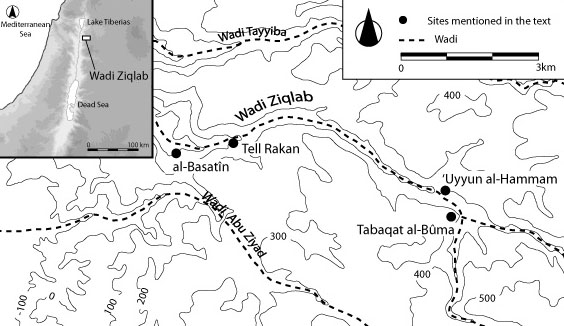


Map showing the location of al-Basatîn in the southern Levant.

In June and July of 2009, the University of Toronto's Wadi Ziqlab Project resumed excavations at al-Basatîn (Figure 1), where evidence of occupation during the Epipalaeolithic, Late Neolithic (c.5800-5300 cal BC), and Early Bronze Age (c.3500 cal BC) is buried in a colluvium (Maher & Banning 2001; Banning et al. 2003, 2004; Gibbs et al. 2006, 2009; Kadowaki et al. 2008).
The new excavations exposed Early Bronze I deposits over an additional 70m², to a total of 145m². The EBI architecture includes substantial parts of two circular or oval buildings and the stone foundations of several rectilinear buildings, one of which exhibits a potsherd-paved floor and a circular stone feature (Figure 2). The 2009 excavations also substantially augmented the sample of pottery, which includes coarsely tempered holemouth and flaring neck jars, carinated, hemispherical and V-shaped bowls (Gibbs et al. 2009). Decoration continued to include rows of oblique impressions just below the rim and rope moldings, but now also includes a small number of impressed ledge handles.
Sherd-paved floor in an EBI room in Area M31/N31.

A noteworthy discovery from the EBI deposits was a concentration of probable crucible fragments in Area M23, some with green copper corrosion products adhering to them. One of these preserved enough of its form to show that it came from a crude, thick, bowl-like vessel with a pinched spout. If further analysis confirms this, it will suggest that copper working occurred on the site during EBI, even though the nearest copper ore lies some 180km to the south.
Where the excavations exposed Late Neolithic deposits below the EBI ones, these again only rarely exhibited architecture. In previous excavations, most of the Late Neolithic architecture consisted of cobblestone floors and platforms, without walls (Figure 3), while there were a few short segments of straight walls and one arc of stones with associated hearth that could be the remnant of a circular structure. This year, excavations uncovered one additional cobblestone floor, at least two examples of stone-filled pits, and one clear example of a stone-walled, circular structure about 3m in diameter (Figure 4). Thus, this site still appears rather different in nature than the contemporary or near-contemporary settlement of Tabaqat al-Bûma just 6km upstream (Banning et al. 1994), where rectangular, stone-walled houses were typical, despite close similarities in other aspects of material culture.
Late Neolithic cobblestone floor in Area Q35.

Stone-walled circular structure of the Late Neolithic in Area P39/Q39.

Of the Late Neolithic artefacts found in 2009, there continue to be denticulated sickle elements, including additional unfinished ones (Reference KadowakiKadowaki 2005), cortical scrapers, and basalt grinding equipment. The only projectile point found in 2009 is an Amuq point undoubtedly residual from a Pre-Pottery Neolithic B occupation elsewhere on the site or perhaps originating in the nearby site of Tell Rakan (Banning & Najjar 1999). Other typical PPNB artefacts, including a naviform core, have been found in previous field seasons.
As in previous seasons (Kadowaki et al. 2008), the poorly fired and friable Late Neolithic pottery includes jars and bowls that occasionally show combing, sometimes with wavy or alternating patterns of combing. Red slip is not uncommon, with or without burnishing. A few bases show pebble impressions on the bottom. Both ledge and loop handles occur. Recent analyses by GC-MS and GC-C-IRMS of adsorbed C16:0 and C18:0 saturated fatty acids in sherds from the 2006 field season indicate animal fats in some of the vessels from the site (Gregg et al. 2009).
The 2009 excavations also uncovered considerable numbers of Epipalaeolithic artefacts, although usually as residuals in Late Neolithic deposits or in the deepest deposits reached. This is consistent with other evidence that many paleosol exposures in Wadi Ziqlab contain Epipalaeolithic material, including the substantial Geometric Kebaran site of 'Uyyun al-Hammam (Maher and Banning 2001; Reference MaherMaher 2005, 2006).
Acknowledgements
The authors would like to thank 'Ali Abu Zeitun, Adam Allentuck, Amjed Batainah, Danielle Cornacchia, Mark Dolynskyj, Jennifer Everhart, Fawwaz al-Khraysheh, Steven Goldstein, Lisa Maher, Danielle Macdonald, Holly Miller, Jay Stock, Isaac Ullah, Ibrahim Zu'bi, and the Department of Antiquities of Jordan. Fieldwork was supported by the Social Sciences and Humanities Research Council of Canada, the Palestine Exploration Fund, the Prehistoric Society, and the Japan Society for the Promotion of Science.