


The study
In the context of evidence that the incidence of anorexia nervosa (see Reference Eagles, Johnston and HunterEagles et al, 1995; Reference Pawluck and GoreyPawluck & Gorey, 1998) and bulimia nervosa (Reference Soundy, Lucas and SumanSoundy et al, 1995) have increased in recent years, the aim of the study was to describe eating disorder services in Scotland. Other studies have described specialist eating disorder services in the UK (Royal College of Psychiatrists, 1992; Consumers' Association, 1998), but there is little systematic information available about services in Scotland, and none about services provided outwith specialist eating disorder services. The survey was undertaken in light of recommendations produced by the Royal College of Psychiatrists and the Eating Disorders Association (Consumers' Association, 1998). Stage one identified services and individuals through the Scottish Eating Disorders Interest Group (SEDIG) contact list and by telephone enquiries at NHS trusts. Stage two comprised a postal questionnaire survey of services and individuals identified in stage one.
Findings
Stage one identified 258 individuals for the questionnaire survey. Several professionals within a service may have received questionnaires to maximise coverage, in which case they were asked to collaborate to ensure the return of at least one questionnaire, and only one complete questionnaire per service was retained for analysis. After excluding duplications and very incomplete returns, 52 questionnaires describing discrete services were analysed. In addition we obtained limited information about a few professional staff and self-help/support groups outside the NHS. Among the 52 questionnaires, the proportion of respondents answering each question varied somewhat. Throughout this report, therefore, the denominators for the calculations of percentages vary accordingly.
Numbers and types of services
Eighteen (35%) services were designated general adult psychiatry, 10 (19%) clinical psychology, 12 (23%) child and adolescent, four (8%) dietetic and eight (15%) identified themselves as ‘specialist’ services. Of these, one was a psychiatric service, one a team within a regional psychiatric service for adolescents and families, one a child psychiatry service and one was within a community mental health team. The remaining four did not further define their service. Health board distribution of services is shown in Table 1. Population sizes served varied considerably. Six of the 12 mainland Scottish Health Board areas, representing a total population of 1.5 million, were not covered by any ‘specialist’ service.
Eating disorders services identified in Scotland
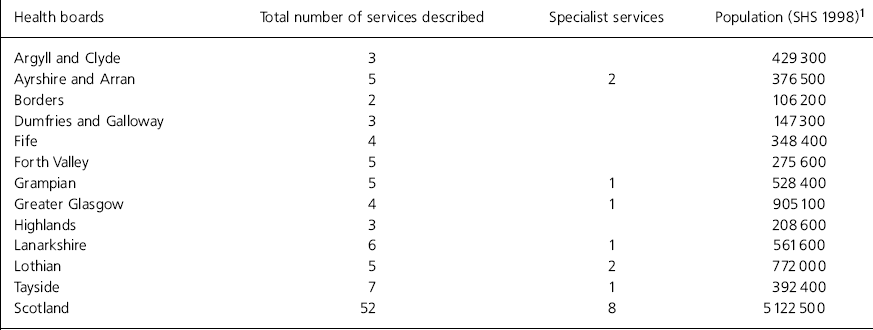
| Health boards | Total number of services described | Specialist services | Population (SHS 1998)1 |
|---|---|---|---|
| Argyll and Clyde | 3 | 429 300 | |
| Ayrshire and Arran | 5 | 2 | 376 500 |
| Borders | 2 | 106 200 | |
| Dumfries and Galloway | 3 | 147 300 | |
| Fife | 4 | 348 400 | |
| Forth Valley | 5 | 275 600 | |
| Grampian | 5 | 1 | 528 400 |
| Greater Glasgow | 4 | 1 | 905 100 |
| Highlands | 3 | 208 600 | |
| Lanarkshire | 6 | 1 | 561 600 |
| Lothian | 5 | 2 | 772 000 |
| Tayside | 7 | 1 | 392 400 |
| Scotland | 52 | 8 | 5 122 500 |
Outwith the NHS, we identified two counsellors, a development worker, a postgraduate research student and self-help/support groups in nine cities and towns in Scotland.
Patients
The numbers of patients seen by each service in 1997 varied greatly, with a median (interquartile range) of 16 (30%). Four ‘specialist’ and three non-specialist services reported more than 25 patients seen in the year.
For the year there were 87 reported admissions, of which 71 were of anorexia nervosa. Two services admitted a total of three patients under sections of the Mental Health (Scotland) Act.
General practitioners contributed 71.5% of referrals, and psychiatrists 8%. Very few (3.5%) referrals were deemed by services to be inappropriate, but 18 (43%) reported refusing referrals from outwith the catchment area.
Waiting times
Most services (84%) saw and assessed urgent cases within 3 weeks of referral. However, 8 (16%) had urgent cases waiting more than 6 weeks before assessment. For routine cases, 30% of services had a wait of 10 or more weeks. Most services began treatment within 3 weeks of assessment, patients with anorexia nervosa began treatment more rapidly than other groups.
Facilities
Almost all services, including the eight ‘specialist’ services, reported out-patient care facilities (Table 2). The majority (64%) had access to in-patient facilities for the treatment of eating disorders, but day care and domiciliary care were not available in most services.
Facilities available for treatment of eating disorders
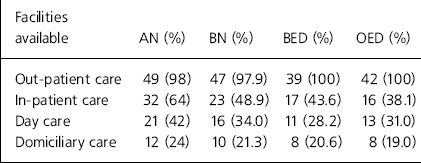
| Facilities available | AN (%) | BN (%) | BED (%) | OED (%) |
|---|---|---|---|---|
| Out-patient care | 49 (98) | 47 (97.9) | 39 (100) | 42 (100) |
| In-patient care | 32 (64) | 23 (48.9) | 17 (43.6) | 16 (38.1) |
| Day care | 21 (42) | 16 (34.0) | 11 (28.2) | 13 (31.0) |
| Domiciliary care | 12 (24) | 10 (21.3) | 8 (20.6) | 8 (19.0) |
Only one service (non-specialist) had a designated bed for admitting patients with eating disorders. Most commonly, adults could be admitted to general psychiatry wards or to medical/surgical wards (Table 3). Most commonly, adolescents would be admitted to general psychiatry units (61%), to other medical/surgical wards (32%) or to other facilities (25%). Nineteen (79%) would admit children to paediatric units, including the three ‘specialist’ services seeing children. Four (17%) said that other locations could be suitable for children's admissions, such as child or adolescent in-patient units.
Location of beds for admissions of children, adolescents and adults
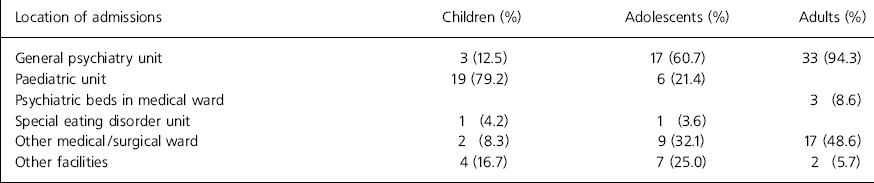
| Location of admissions | Children (%) | Adolescents (%) | Adults (%) |
|---|---|---|---|
| General psychiatry unit | 3 (12.5) | 17 (60.7) | 33 (94.3) |
| Paediatric unit | 19 (79.2) | 6 (21.4) | |
| Psychiatric beds in medical ward | 3 (8.6) | ||
| Special eating disorder unit | 1 (4.2) | 1 (3.6) | |
| Other medical/surgical ward | 2 (8.3) | 9 (32.1) | 17 (48.6) |
| Other facilities | 4 (16.7) | 7 (25.0) | 2 (5.7) |
Professionals
Dieticians, consultant psychiatrists and clinical psychologists were the professionals most commonly involved in assessment and treatment (Table 4). Specialist nurses were reported in over half of services. Seventeen (36%) services, including six ‘specialist’ services, reported that all their staff were specially trained in the management of eating disorders. Twenty-five (54%) respondents said they were involved in training other professionals and 34 (72%), including seven from ‘specialist’ services, reported providing advice and support about eating disorders to primary care staff.
Professional disciplines involved in assessment and treatment of patients
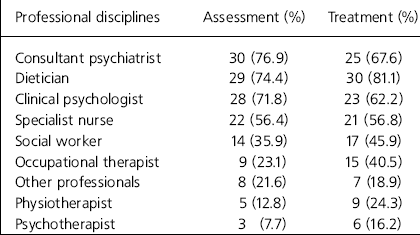
| Professional disciplines | Assessment (%) | Treatment (%) |
|---|---|---|
| Consultant psychiatrist | 30 (76.9) | 25 (67.6) |
| Dietician | 29 (74.4) | 30 (81.1) |
| Clinical psychologist | 28 (71.8) | 23 (62.2) |
| Specialist nurse | 22 (56.4) | 21 (56.8) |
| Social worker | 14 (35.9) | 17 (45.9) |
| Occupational therapist | 9 (23.1) | 15 (40.5) |
| Other professionals | 8 (21.6) | 7 (18.9) |
| Physiotherapist | 5 (12.8) | 9 (24.3) |
| Psychotherapist | 3 (7.7) | 6 (16.2) |
Assessment and treatment
Thirty (60%) services, including seven ‘specialist’ services, undertook multi-disciplinary assessments of patients (at least two disciplines involved). Thirty (60%), including five ‘specialist’ services, undertook physical assessments. Although 19 respondents specified these examinations, many answers were imprecise, such as ‘physical screening’, ‘physical examination’ or ‘paediatric assessment’. For two respondents, physical assessment consisted only of measurements of height and weight, while nine also included blood screening. Measurements of bone density were reported by five respondents, as were endocrine investigations.
In 42 (84%) services a care plan was agreed with patients. Thirty (61%) provided coordinated treatment plans involving several therapeutic approaches or different agencies.
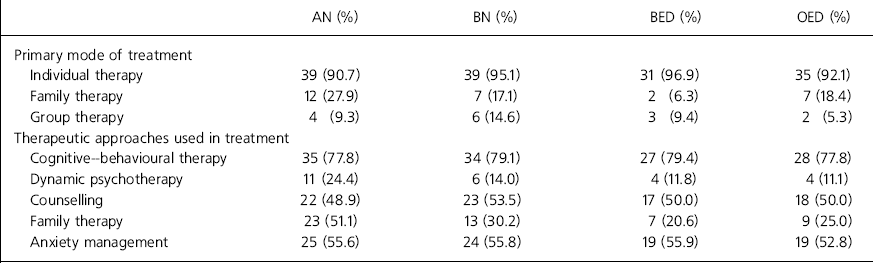
Individual therapy was the most frequently reported primary mode of delivering treatment, used by at least 90% of services (Table 5). Family therapy was the primary mode in 28% of services, but a therapeutic approach was sometimes used in 51%. Cognitive therapy was the most common therapeutic approach (80%), with counselling and anxiety management also reported by many services.
Treatment models and therapeutic approaches
| AN (%) | BN (%) | BED (%) | OED (%) | |
|---|---|---|---|---|
| Primary mode of treatment | ||||
| Individual therapy | 39 (90.7) | 39 (95.1) | 31 (96.9) | 35 (92.1) |
| Family therapy | 12 (27.9) | 7 (17.1) | 2 (6.3) | 7 (18.4) |
| Group therapy | 4 (9.3) | 6 (14.6) | 3 (9.4) | 2 (5.3) |
| Therapeutic approaches used in treatment | ||||
| Cognitive—behavioural therapy | 35 (77.8) | 34 (79.1) | 27 (79.4) | 28 (77.8) |
| Dynamic psychotherapy | 11 (24.4) | 6 (14.0) | 4 (11.8) | 4 (11.1) |
| Counselling | 22 (48.9) | 23 (53.5) | 17 (50.0) | 18 (50.0) |
| Family therapy | 23 (51.1) | 13 (30.2) | 7 (20.6) | 9 (25.0) |
| Anxiety management | 25 (55.6) | 24 (55.8) | 19 (55.9) | 19 (52.8) |
Twenty-one (49%) services used selective serotonin reuptake inhibitors for bulimia nervosa. Most services provided nutritional advice (89%) and self-help literature (64%) for patients. Among other therapeutic approaches reported in very small numbers were art therapy, action therapy and cognitive—analytic therapy.
Outcomes
Twenty (56%) services, including six ‘specialist’, reported measuring the outcomes of their treatments. Some reported using routine clinical assessment to measure outcomes, such as weight (six), bone density (one), menstrual and hormonal status (one), body mass index (two), general physical state (two) or mortality (one). Other methods included questionnaires measuring patients' satisfaction, symptoms of eating disorders, depression or anxiety. Two services reported measuring the frequency of symptoms such as vomiting, or the achievement of set goals.
Research
Seven (15%) services, including five ‘specialist’, were involved in research. Topics cited included clinical studies (e.g. loss of bone mineralisation) and epidemiological studies (e.g. incidence of anorexia nervosa, relationships between eating disorders and sexual abuse).
Criteria and guidelines
Only 13 (27%) services, including four ‘specialist’, were aware of any published guidelines for the provision of services and only four of these services thought that the guidelines had a positive impact on service provision. Only seven (15%) services were aware of local strategies for eating disorder services.
Discussion
This national survey focused on health service provision for those with eating disorders. In contrast to previous surveys, we obtained information about what is provided by general mental health services as well as more specialised eating disorders services. We found substantial variation and significant gaps in service provision across Scotland. It is reassuring that in our survey many general adult psychiatry, clinical psychology and child and adolescent services recognise a commitment to provide help for eating disorders. However, experience appears to be spread very thinly, provision is inconsistent, ‘specialist’ services are lacking in many areas and existing services have limited resources and experience. Specialist in-patient provision appeared to be completely absent from the NHS in Scotland.
Our results allow us to derive some indication of the quality of service provision, and the extent to which recommended standards are being met. The Royal College of Psychiatrists, the Consumers' Association and a mature self-help organisation, the Eating Disorders Association, suggested that there should be comprehensive services, with one service being provided for every million people in the population (Consumers' Association, 1998). They recommended that such a service should:
-
(a) include staff with expertise in eating disorders (e.g. clinical psychologist, dietician and psychiatric nurses)
-
(b) include, and preferably be led by, a consultant psychiatrist who spends at least one-third of his or her time treating patients with eating disorders
-
(c) offer a range of psychotherapies, including family therapy
-
(d) offer in-patient and/or day care places and medical support to anyone with anorexia who becomes critically underweight
-
(e) see at least 25 patients a year (to ensure that the service has enough experience to deal with eating disorders).
When set against these criteria, our survey indicates that just one service in Scotland meets them, but even that service does not offer any specialist in-patient care. All the others defining themselves as ‘specialist’ services fail to meet these criteria. Four see more than 25 patients a year, four have an adequate multi-disciplinary team, three provide a day patient service and four provide family therapy. Nine mainland health board areas (representing the majority of the Scottish population) have no identified specialist service that sees more than 25 patients a year. Access to specialised help for children and adolescents was even less available, with only two self-defined ‘specialist’ services within child and adolescent psychiatry.
The survey identified only one specialised in-patient bed for eating disorders, curiously in a non-specialist service. The only credible specialised in-patient provision in Scotland is in a private hospital that attracts many NHS-funded referrals, but that hospital was not among the respondents to this survey. Although there is growing experience of day treatment (Reference FreemanFreeman, 1992, Reference Piran, Langdon and KaplanPiran et al, 1990), only three specialist day patient programmes were identified. There remains a strong body of opinion in the UK, as with other countries, in favour of admission units (Reference Palmer and TreasurePalmer & Treasure, 1999). Moreover, it is clearly preferable, when admission is necessary, that patients be admitted as near as possible to their homes, that there is as much continuity as possible with treatment and care services prior to and after admission and that admission is into a unit with special expertise for dealing with eating disorders.
The data on professional staffing must be interpreted with caution because it is not possible to say how much cross-referral there might be between different services within a locality. However, specialist psychotherapists seem to be lacking, being identified in just three services, and only 60% of services undertook recommended multi-disciplinary assessment. Although 60% undertook physical assessments, our data suggest that in many cases this was rudimentary.
Most respondents reported that their services provided CBT that has a well-established evidence base in the treatment of bulimia nervosa (Reference Fairburn, Norman and WelchFairburn et al, 1995). Family therapy was less widely available, but was provided in the child and adolescent services, which is in keeping with the evidence of effectiveness in younger patients (Reference Eisler, Dare and RussellEisler et al, 1997). Appropriate drug treatment advice seemed to be available in less than half of the services.
In the light of these worrying findings, a national Scottish strategy for the development of services would be appropriate. This is because the recommended population base on which to plan services (at least one million) is too large for most health boards. A national needs-assessment exercise might help to delineate needs with more precision, but it is clear from referral rates to specialist services (Reference MillarMillar, 1998) and Scottish epidemiological work (Reference Eagles, Johnston and HunterEagles et al, 1995) that substantial need does exist. This is reflected in expensive extra-contractual demand. Our own contact with local and national self-help groups, for example at meetings of the SEDIG, confirm that many patients feel badly served by general services. Consequently it is timely to begin to develop a strategy for improved services. A proposed four tier model of services gives a useful structure on which to base such a strategy.
The first tier includes primary care, self-help groups and non-NHS services. These will often be the first point of contact where an initial assessment can be made and effective help provided for milder illnesses.
The second tier is the general mental health service provision for children, adolescents and adults. Psychiatrists, nurses and psychologists in each sector would liaise with other professionals, particularly dieticians. Generic skills, for example in CBT, may be effective at this level.
The third tier would be provided by a more specialised dedicated team, one for each health board area, with special arrangements for the small or more isolated health board areas. In addition to providing direct clinical services, they would have responsibility for training, consultation and, ideally, research. The team would include psychiatrists, specialist nurses, clinical psychologists, dieticians, psychotherapists and perhaps other professionals such as physiotherapists, social workers and occupational therapists. There would need to be skills in physical assessments or links to those who have such expertise, such as physicians, biochemists and dentists. The team would also need expertise in supporting and rehabilitating those with chronic treatment-resistant illness. Ideally, arrangements would be negotiated to allow the service to bridge the traditional divisions between child and adolescent services and adult services.
The fourth tier would be between three and four regional/national units that would provide in-patient services, probably each sited alongside a third tier specialist service. These units would definitely have a research role and would need close links with the local specialist services that would refer patients for admission and to which they would return on discharge. Hogg (Reference Hogg1995) estimated that 1-2 patients per 100 000 population would require admission in a year for severe anorexia nervosa requiring intensive medical care. This would mean 50-100 admissions a year in Scotland, a figure that corresponds to the 71 identified in this survey. Assuming an average 3-month admission, this would represent 100% occupancy of between 12 and 25 beds nationally, which could be provided in three units of eight beds or four units of six beds. There will have to be special consideration of the needs of children and younger adolescents.
At present our survey suggests that there is substantial unmet need. Many patients are likely to be seen by staff in relative professional isolation or with limited experience of dealing with eating disorders, and there may be no one available to help with more difficult and complex problems. Our proposed strategy to improve the provision of specialist services for eating disorders would address these issues and may be greatly welcomed by patients and their families.
Acknowledgements
We wish to express our thanks to all those colleagues who completed the questionnaire. We are also grateful to the SEDIG for help in identifying the study population and to Joaane Badenoch and Kathleen McIntosh for secretarial support. The Health Services Research Unit is funded by the Chief Scientist Office of the Scottish Executive Department of Health. The opinions expressed, however, are those of the authors.


 Open access


eLetters
No eLetters have been published for this article.