

“It’s very emotional for me because I see European people with blue eyes and blond hair […] being killed every day.”
“I understand and respect the emotion.”
— BBC News, March 2022
Introduction
The contentiously designated “Global North,” driven by racial hierarchization, has long-refused to acknowledge victimhood beyond the confines of the White race (Pyke Reference Pyke2010; DiAngelo Reference DiAngelo2011, Reference DiAngelo2016). Embedded within colonialism, imperialism, and systems of power, this refusal to recognize the suffering of non-White communities has deep historical roots (Ibid). The legacy of this refusal manifests in various forms, from the erasure of Indigenous histories to the perpetuation of stereotypes that dehumanize people of color’s experiences in movement and displacement (Jardina & Piston Reference Jardina and Piston2023; Najdowski Reference Najdowski2023). Structural inequalities, economic exploitation, and cultural appropriation further reinforce this denial of victimhood, perpetuating a vicious cycle of marginalization, oppression and reinforced narratives (Ibid). Addressing this entrenched denial remains tangled in systems of privilege, as well as a fundamental absence of a much needed shift in perspective—one that acknowledges the interconnectedness of not only human experiences, but the manners in which they are framed, depicted, communicated and narrated.
The onset of Russia’s invasion of Ukraine has not only sparked geopolitical tensions, but has also brought to the forefront critical discussions regarding the treatment and portrayal of refugees in Western and international media,Footnote 1 as well as in political and humanitarian landscapes (Martikainen & Sakki Reference Martikainen and Sakki2023). In particular, the media coverage and political discourse surrounding Ukrainian refugees has exposed underlying racial dimensions that shape the international response to providing refuge, compassion and protection (Sales Reference Sales2023; Skordas Reference Skordas2022).
This paper delves into the disparities evident in the media’s depiction of Ukrainian refugees as compared to those from the Middle East and North Africa (MENA) region, highlighting systemic inequalities and biases prevalent in the refugee and migration discourse. It aims to establish what the paper calls the “politics-media cycle of reinforcement” to describe the symbiotic relationship between the political sphere and the media landscape, where each influences and reinforces the other’s narratives and agendas. In this cycle, politicians use media platforms to disseminate racially-charged messages, shape public opinion, and advance their political goals. Simultaneously, the media relies on political discourses, positionalities, and personalities for content, sensationalism, and audience engagement. This cycle can perpetuate various patterns, including polarization, agenda-setting, and the amplification of narratives of victimhood, vulnerability, and threat (McCombs & Shaw 1972). Politicians may tailor their messaging to fit these media narratives, or in turn, use media coverage to manipulate public perception. Meanwhile, media outlets may prioritize stories that align with their ideological leanings or cater to their target audiences, thereby reinforcing existing political and racial divides.
While this cycle of reinforcement may contribute to the erosion of trust in both politics and media, as well as skepticism about the impartiality and integrity of news coverage, what is certain is that it leads to the proliferation of mis- and disinformation. By adopting a comparative approach and employing thematic analysis, this paper aims to unravel the underlying mechanisms driving these differential representations of refugees. Through a critical examination of media narratives, as they reflect political positionalities and undertones, it becomes evident that racial considerations heavily influence the perception of who is deemed worthy of refuge and support. This biassed framing not only reinforces entrenched stereotypes but also perpetuates a narrow, predetermined image of what a refugee typically looks like, whose responsibilities they are, and how they should be treated (Entman Reference Entman1993; Bayoumi Reference Bayoumi2022).
Importance of Media in Shaping and Reinforcing Societal Perceptions of Refugees
In times of crisis, such as armed conflict or disasters, media outlets play a crucial role in shaping public perception and garnering support for those affected (Liao Reference Liao2023). However, the coverage of Ukrainian refugees during the ongoing conflict with Russia has raised concerns about the selective empathy and attention afforded to different refugee populations—even when displaced from the same conflict (Xuereb Reference Xuereb2023). Despite facing similar dire circumstances and urgent needs for safety, Ukrainian refugees have often been portrayed more sympathetically than other refugee groups, once again, evoking narratives of victimhood and deserving compassion (Ibid). Conversely, refugees from the MENA region, including those fleeing conflicts such as in Syria, Iraq, and Libya, encounter a markedly different portrayal in the media (McCann et al Reference McCann, Sienkiewicz and Zard2023; Gowayed Reference Gowayed2022; Hinz et al Reference Hinz2023). They are frequently subjected to stereotypical and biassed depictions, characterized by negative connotations often associated with terrorism, extremism, or threats to societal stability (Bier Reference Bier2018; Cooper Reference Cooper2020). This disparity in coverage underscores deep-seated prejudices and systemic racism, perpetuating hierarchies that dictate which refugees receive empathy and support based on their perceived proximity to Western norms and values (Ibid).
The media plays a central role in shaping societal perceptions of refugees by disseminating information, framing narratives, representing refugees, setting the public agenda, and reflecting broader cultural and political contexts (Lueders et al Reference Lueders2019; Allotey et al Reference Allotey2019; Danilova Reference Danilova2014; Talaat Reference Talaat2022). Recognizing the importance of media in shaping public attitudes toward refugees is essential for promoting informed discourse, challenging stereotypes, and fostering empathy and solidarity toward displaced populations (Ibid). It serves as a powerful mediator between global events and public understanding, exerting significant influence on societal perceptions of refugees (Ibid). Through various platforms, media constructs narratives that shape how individuals perceive and interpret not only refugees themselves, but refugee “crises” more broadly—and more importantly, how they internalize, externalize and/or sympathize with human suffering. On another level, understanding the pivotal role of the media in shaping public opinion is crucial for comprehending the complexities surrounding the reception and treatment of refugees in host communities, as well as the extent to which they are integrated, celebrated, protected, and welcome.
While media outlets are intended as primary sources of information regarding refugee crises, providing updates on the latest developments, humanitarian efforts, and policy responses, the information presented is often filtered through editorial decisions and narrative constructions that influence/reinforce how their respective audiences perceive refugees. Several key factors underscore the impact of these processes in shaping societal perceptions of refugees. Primarily, media coverage of refugee issues is characterized by framing, wherein specific aspects of a story are emphasized, while others are downplayed or disregarded entirely (Georgiou & Zaborowski Reference Georgiou and Zaborowski2017; Liu Reference Liu2022; Wenzel & Żerkowska-Balas Reference Wenzel and Żerkowska-Balas2019). This is additionally true when it comes to the extent to which certain refugee crises are reported, coupled with decisions on when to shift the focus away from certain coverage or decrease this coverage regardless of whether or not the conflict itself has concluded. This further extends to the frequency of stories around a specific conflict or humanitarian crisis, as well as the time intervals between one update and the next.
Beyond this, as discussed, coverage also extends to the depiction of refugees’ visibility and recognition as legitimate actors deserving of empathy and assistance (Bullinger et al Reference Bullinger2022). Positive representations of refugees that humanize their experiences and emphasize their resilience and contributions to society can foster empathy and solidarity among audiences and the wider public (Chouliaraki & Stolic Reference Chouliaraki and Stolic2017). Conversely, negative portrayals that perpetuate stereotypes and stigmatize refugees have the potential to exacerbate social tensions and hinder their integration and reception (Ibid). Finally, the media plays a pivotal role in agenda-setting mechanisms, influencing policy priorities, humanitarian responses, and public opinion. As such, representations of refugees on their platforms are deeply influenced by broader cultural and political contexts, including historical legacies, socio-economic disparities, and prevailing ideologies (Greussing & Boomgaarden Reference Greussing and Boomgaarden2017). On the other end of the spectrum, cultural stereotypes, racial biases, and political agendas further shape how refugees are depicted in the media, perpetuating inequalities and reinforcing dominant power structures (Ibid).
Methodology
Approach, Sampling, and Analysis
This study employs qualitative comparative content analysis to investigate the representations of Ukrainian refugees and refugees from the MENA region within Western media and political narratives. The comparative analysis is designed to identify and contrast the similarities and differences in how these two groups of refugees are portrayed, revealing underlying biases, hierarchies, and systemic inequalities within refugee and migration discourses.
To ensure a diverse and comprehensive dataset, the media sources were systematically selected based on the following criteria: the prominence of the media outlets (e.g., major news organizations with significant reach and influence), geographical spread, and political diversity. Political statements were similarly chosen from speeches and official communications by policymakers across Western countries.
The media texts and political speeches were predominantly collected over a defined period from January 2022 to December 2023, a timeframe that captures a significant rise in refugee-related discourse, coinciding with the start of the Ukraine war in February 2022 and its subsequent impact on global refugee politics. This period was selected to ensure that the analysis covered a time of heightened attention to Ukrainian refugees, allowing for a meaningful comparison of how this group was discussed during a period of high media and political focus.
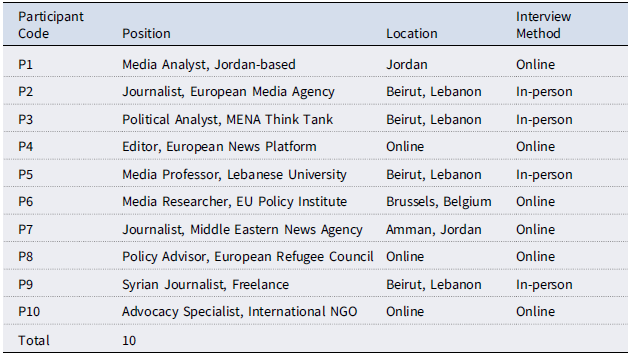
In addition to the media and political text analysis, semi-structured interviews were conducted throughout 2023 with 10 media professionals from the MENA region and 8 political analysts from Europe and the MENA region. These participants were selected based on their expertise in refugee-related issues, their involvement in media representation, and their knowledge of broader EU refugee policymaking. The semi-structured format allowed for an in-depth exploration of their insights and experiences, providing rich qualitative data that complements the content analysis of media and political texts. Interviews were conducted both in person and online, depending on participant availability.
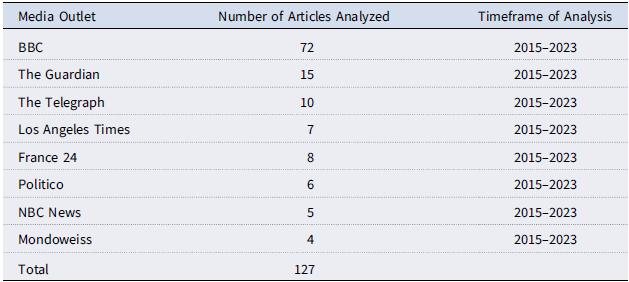
A clear breakdown of the number of articles analyzed and the interviews conducted can be found in the tables below. The media articles were selected to ensure a diversity of perspectives, including various geographic regions, political leanings, and reach. These outlets were chosen because of their prominent role in shaping public opinion about refugees during the specified periods.
List of media sources consulted

Table 1 Long description
A table listing media outlets, number of articles analyzed, and timeframe of analysis. The table has three columns: Media Outlet, Number of Articles Analyzed, and Timeframe of Analysis. It contains 9 rows, including a total row. Row 1: Media Outlet, BBC; Number of Articles Analyzed, 72; Timeframe of Analysis, 2015-2023. Row 2: Media Outlet, The Guardian; Number of Articles Analyzed, 15; Timeframe of Analysis, 2015-2023. Row 3: Media Outlet, The Telegraph; Number of Articles Analyzed, 10; Timeframe of Analysis, 2015-2023. Row 4: Media Outlet, Los Angeles Times; Number of Articles Analyzed, 7; Timeframe of Analysis, 2015-2023. Row 5: Media Outlet, France 24; Number of Articles Analyzed, 8; Timeframe of Analysis, 2015-2023. Row 6: Media Outlet, Politico; Number of Articles Analyzed, 6; Timeframe of Analysis, 2015-2023. Row 7: Media Outlet, NBC News; Number of Articles Analyzed, 5; Timeframe of Analysis, 2015-2023. Row 8: Media Outlet, Mondoweiss; Number of Articles Analyzed, 4; Timeframe of Analysis, 2015-2023. Row 9: Media Outlet, Total; Number of Articles Analyzed, 127; Timeframe of Analysis, not applicable.
Profiles of key informants and experts interviewed

Table 2 Long description
A table with ten rows and four columns detailing the profiles of key informants and experts interviewed. The columns are labeled Participant Code, Position, Location, and Interview Method. Row 1: Participant Code, P1; Position, Media Analyst, Jordan-based; Location, Jordan; Interview Method, Online. Row 2: Participant Code, P2; Position, Journalist, European Media Agency; Location, Beirut, Lebanon; Interview Method, In-person. Row 3: Participant Code, P3; Position, Political Analyst, MENA Think Tank; Location, Beirut, Lebanon; Interview Method, In-person. Row 4: Participant Code, P4; Position, Editor, European News Platform; Location, Online; Interview Method, Online. Row 5: Participant Code, P5; Position, Media Professor, Lebanese University; Location, Beirut, Lebanon; Interview Method, In-person. Row 6: Participant Code, P6; Position, Media Researcher, EU Policy Institute; Location, Brussels, Belgium; Interview Method, Online. Row 7: Participant Code, P7; Position, Journalist, Middle Eastern News Agency; Location, Amman, Jordan; Interview Method, Online. Row 8: Participant Code, P8; Position, Policy Advisor, European Refugee Council; Location, Online; Interview Method, Online. Row 9: Participant Code, P9; Position, Syrian Journalist, Freelance; Location, Beirut, Lebanon; Interview Method, In-person. Row 10: Participant Code, P10; Position, Advocacy Specialist, International NGO; Location, Online; Interview Method, Online. Row 11: Total, 10.
The analysis employed qualitative comparative content analysis to systematically code and examine the data. The coding process involved both open coding and theoretical coding. Initially, open coding was used to identify recurring themes and discursive patterns directly from the media texts and interviews, allowing key themes to emerge organically from the data. This was followed by theoretical coding, where the emerging themes were aligned with existing theoretical frameworks on media representation, refugee discourses, and systemic inequality (Corbin & Strauss Reference Corbin and Strauss2015; Braun & Clarke Reference Braun and Clarke2006).
To clarify, coding in this study refers to the systematic categorization of the media content, political statements, and interview transcripts. Each unit of analysis (whether a media article, political speech, or interview response) was assigned codes based on identified themes, such as portrayals of victimhood, heroism, criminality, or economic burden. These codes were then grouped into broader categories, allowing for a structured comparison between the representations of Ukrainian refugees and refugees from the MENA region.
The thematic analysis of media content and political statements was complemented by the thematic coding of interview data. The responses from the interviewees were analyzed to provide contextual insights and to confirm or challenge patterns identified in the media texts. By juxtaposing the depictions of Ukrainian refugees with those from the MENA region, this methodological approach provides a nuanced understanding of how biases and inequities in refugee discourses are constructed and maintained.
This multi-layered approach allows for a comprehensive analysis of how different refugee groups are portrayed in the media and political narratives, as well as the broader implications for international responses to refugee crises. The findings contribute to a deeper understanding of systemic inequalities within global refugee policies. This approach builds on established methodologies for qualitative content analysis and thematic coding (Corbin & Strauss Reference Corbin and Strauss2015; Braun & Clarke Reference Braun and Clarke2006). It also draws from previous research on refugee representation and media discourses (Holmes & Castañeda Reference Holmes and Castañeda2016; Czachur & Smykała Reference Czachur, Smykała and Fábián2023; Fuller Reference Fuller2024), positioning this study within a broader scholarly context of media analysis and refugee studies.
Working Definitions
This paper employs the UNHCR’s definitions of “refugees” and “migrants” to clarify the distinctions between these two groups. According to UNHCR, a migrant is someone who “chooses to move, not because of a direct threat of persecution or death, but primarily to improve their life through better work opportunities, education, family reunification, or other personal reasons. Unlike refugees, migrants do not face significant barriers to returning to their home country” (UNHCR 2022).
In contrast, a refugee is someone who “has been forced to flee their home country due to persecution, war, or violence. Refugees have a well-founded fear of persecution based on race, religion, nationality, political opinion, or membership in a particular social group (Ibid). For them, returning home is either impossible or would put their lives at serious risk. The main drivers of such displacement include war, as well as ethnic, tribal, and religious violence” (Ibid).
Refugees are recognized and protected under international law, with the 1951 Refugee Convention, its 1967 Protocol, and other legal instruments like the 1969 OAU Refugee Convention serving as the foundation for modern refugee protection (Feller et al Reference Feller, Türk and Nicholson2003). According to UNHCR, this legal distinction is crucial for individual governments, as migrants, unlike refugees, are not protected under international law and are subject to the immigration laws and processes of the countries they seek to enter. There remains a concerning history of governments manipulating these definitions to evade their responsibilities toward refugees. By labeling those fleeing persecution as “migrants,” many governments attempt to diminish their legal obligations and justify restrictive policies. This manipulation undermines the international protection framework and leaves vulnerable populations at greater risk.
Having said that, the paper additionally positions itself around the pretense that the very concept of a “refugee” is deeply intertwined with colonial logic (Abuya et al Reference Abuya, Krause and Mayblin2021). The modern refugee regime, established primarily by Western powers, reflects the colonial mindset that prioritizes the needs and interests of the Global North over those of the Global South. The classification and treatment of refugees have historically been influenced by colonial power dynamics, where the Global North determines who is deserving of protection and under what conditions (Ibid). This colonial legacy continues to shape the uneven application of refugee protections and the global response to displacement, often to the detriment of those most affected by violence and persecution.
A Comparative Analysis of Refugee Portrayals
On Selectivity and Racist Undertones
Various studies have shed light on the framing of asylum seekers and refugees in mainstream media, revealing distinct patterns shaped by ideological leanings and geographical proximity to conflict regions. For instance, a quantitative content analysis (Blumel et al Reference Blumel, Bunce, Cooper and McDowell2019) indicated that left-leaning newspapers tend to portray refugees as victims, whereas right-leaning publications often depict them as criminals. Studies on refugee coverage in European countries such as Hungary, Germany, Sweden, the UK, and Spain (Heidenreich et al Reference Heidenreich, Lind, Eberl and Boomgaardenm2019), as well as in Germany specifically (Holzberg, Kolbe & Zaborowski Reference Holzberg, Kolbe and Zaborowski2018), emphasized the recurring theme of border control, particularly in nations closer to the Middle East, with measures like closing borders and expelling refugees framed as defensive responses. Additionally, research analyzing media discourse during the 2015 refugee “crisis” in Europe (Chouliaraki & Zaborowski Reference Chouliaraki and Zaborowski2017) underscored the marginalization of refugee voices, reinforcing their invisibility and delegitimization in news narratives.
Furthermore, discourse analysis of Western and international news coverage highlighted a tendency to associate Syrian refugees with threat and criminality (Dykstra Reference Dykstra2016), while studies examining representation in European newspapers like The Guardian and El Pais (Romano & Porto Reference Romano, Porto, Filardo, Morales and Floyd2021) revealed contrasting frames emphasizing conflict and morality. Meanwhile, critical discourse analysis of coverage in newspapers from Turkey, Bulgaria, and the UK (Ozdora-Aksak et al Reference Ozdora-Aksak, Connolly-Ahern and Dimitrova2021) pointed to a lack of portrayal of refugees’ daily lives and aspirations, contributing to their dehumanization. According to a European media expert based in Beirut, these studies “[…] collectively illustrate the multifaceted ways in which media frames shape public perceptions of refugees, influenced by political ideologies, geographical proximity, and narratives of threat and dependency.” She further explains:
“[…] The thing is that the way we present people online, in the media, and in public spaces will form part of our subconsciousness whether we agree with this depiction or not. And we are all guilty of this. When we think of a refugee, a profile of an individual comes to mind. This is not a random thought, this is a systematic, intentional shaping of who a refugee is, and who you are meant to think about when you think of a refugee. This is the same for when you think of a conflict zone, when you think of poverty, when you think of famine. Take a minute to reflect, the first images of individuals that come to mind are racialized, stereotyped, and often, from certain parts of the world.” (Interview, Beirut, January 2024)
Across Western and international media, Ukrainian refugees are depicted as innocent bystanders caught in the crossfire of war, with emotive language and personal narratives highlighting their vulnerability and resilience. The media appeals to humanitarian values, emphasizing the moral imperative to assist those in need and galvanizing public support for refugee assistance programs (Diab Reference Diab2022a). In contrast, MENA refugees are often portrayed in a manner that emphasizes their otherness, using terms like “migrant crisis” and “invasion” to frame their arrival as a burden or threat, and in turn undermining efforts to foster understanding and empathy (Georgiou & Zaborowski Reference Georgiou and Zaborowski2017). The framing of MENA refugees as destabilizing forces perpetuate exclusionary rhetoric and justifies restrictive immigration and asylum policies, reinforcing barriers to their integration and inclusion (Sales Reference Sales2023; Klein Reference Klein2021; el-Nawawy & ElMasry Reference el-Nawawy and Elmasry2024; Wenzel & Żerkowska-Balas Reference Wenzel and Żerkowska-Balas2019). A political analyst from a Beirut-based think tank elaborates:
“[…] the Global North, and Europe specifically, have worked diligently across both political and broadcast media spaces to portray migrants and refugees as burdens, a problem, and most importantly, as clashing with whatever their value system and culture is perceived to be. Importantly, this depiction does not only shape public perception broadly, it also desensitises Europe’s local population to atrocities that their governments commit against refugees and migrants —whether this is a boat sinking in European territorial waters, or migrants losing their lives attempting to cross irregularly by land. When these vulnerable groups are criminalised and made to look like a ‘threat’, people quite simply do not react. Look at the difference between when a blond little White girl gets kidnapped —the sheer outrage and coverage, and when hundreds of little brown and black girls drown on a boat at sea. […] Politicians are responsible for the policies, but the media is just as complicit in this.” (Interview, Beirut, January 2024)
On the point of media complicity, during a public broadcast, CBS News senior foreign correspondent Charlie D’Agata remarked that Ukraine, “[…] isn’t a place, with all due respect, like Iraq or Afghanistan, that has seen conflict raging for decades. This is a relatively civilised, relatively European—I have to choose those words carefully, too—city, one where you wouldn’t expect that, or hope that it’s going to happen” (Bayoumi Reference Bayoumi2022). This comment sparked immediate public backlash, prompting D’Agata to issue a swift apology. Across the MENA region, this was particularly felt according to qualitative findings—as this form of racist reporting not only impacted public discourse, but further instilled a sense of hierarchy in vulnerability, and an overall sense of re-prioritization within the humanitarian space that once again, prioritized people based on their race and their perceived proximity to what one Syrian political analyst calls “Europe’s obsession with Whiteness,” she explains:
“[…] it is nothing new that Europe has a racism problem. I will not need to elaborate on this. The issue for the MENA region was that all of a sudden, even though deep down we knew this, that the statements were being made to our faces, publicly, all over the news, and blatantly by European officials. They were basically all telling us that now that there were White people in crisis, that the world would essentially stop! That the attention would now be diverted to that one crisis, and that the humanitarian and political spaces would hover around these White people and protect them before us —and most frustratingly, that they would rectify this White refugee crisis immediately. In fact, I would insist, they never even let it become a crisis.” (Interview, Beirut, January 2024)
In another incident, during a broadcast interview with BBC, a former deputy prosecutor general of Ukraine expressed emotional distress, sharing “[…] it’s very emotional for me because I see European people with blue eyes and blond hair […] being killed every day.” Rather than challenging this statement, the BBC host responded with, “I understand and respect the emotion” (Arria Reference Arria2022). Similarly, on France’s BFMTV, journalist Phillipe Corbé remarked, “[…] we’re not talking here about Syrians fleeing the bombing of the Syrian regime backed by Putin. We’re talking about Europeans leaving in cars that look like ours to save their lives” (Ali Reference Ali2022). In The Telegraph, Daniel Hannan remarked, “[…] they seem so like us. That is what makes it so shocking. Ukraine is a European country. Its people watch Netflix and have Instagram accounts, vote in free elections and read uncensored newspapers. War is no longer something visited upon impoverished and remote populations” (Hannan Reference Hannan2022). On the evident shift and contradiction in media narratives and tones depending on the conflict they are covering, a Syrian reporter elaborates:
“[…] days into the Ukrainian conflict we were having a discussion on empathy, outrage and the need for immediate protection for Ukrainians fleeing. And rightfully so. In contrast, days into the Syrian conflict, we were having much less emotive conversations. European leaders were silent. If anything, immediately strategizing around how to contain the potential outward flows of Syrians into Europe. Humanitarian and protection approaches centred around containing people. The media reported on this matter factually, as something that ‘typically’ happens in a ‘conflict-ridden’ Middle East. No reporters were outraged, emotional, or calling for support. Soon after, we were speaking about a European ‘migration crisis’, and the media was using words to refer to Syrians, Libyans and others from the region as illegal, criminals that were trying to ‘invade’ Europe.” (Interview, Beirut, January 2024)
Incidents of racist reporting around the Ukrainian conflict persisted well into the first few weeks—often highlighting that “war” is exclusively associated with developing, third-world nations, overlooking Ukraine’s ongoing conflicts since 2014 as an example (Bock et al Reference Bock, Henneberg and Plank2015; Mykhnenko Reference Mykhnenko2014; Lakomy Reference Lakomy2016; Van Metre et al Reference Van Metre, Gienger and Kuehnast2015). Much of this reporting, further suggested that appearing “middle class” equates to being akin to an average European, White family (Ibid). On ITV, a journalist reporting from Poland remarked, “[…] now the unthinkable has happened to them. And this is not a developing, third world nation. This is Europe!” (Twaij Reference Twaij2022). According to a Palestinian-Syrian political and media analyst, a close look at previous reporting on refugee crises by the same outlets highlights a decidedly different reality:
“[…] the important reality at play here is that we are talking about the same media agencies, the same reporters, the same broadcasting networks, and the same politicians framing two refugee crises [Syrian and Ukrainian] in such an obviously racist and discriminatory fashion that it’s almost laughable. The same news agencies call Ukrainians civilised victims and Libyans, Syrians and refugees from across the African continent as illegal criminals. They also do this within similar timeframes of the beginning of the conflicts themselves. Compare BBC’s reporting on Syria a few months into the conflict, with its reporting on Ukraine a few months in. This is supposedly the same initial period whereby a conflict should be shocking us, apaling us, before we are desensitised and the conflict becomes ‘normalised’. The thing is that the conflicts in our part of the world are normalised as a benchmark. A ‘White’ conflict in Europe will never be normalised that soon —nor will a ‘White’ refugee. Or more specifically, assumed to be a norm.” (Interview, Beirut, February 2024)
BBC’s inconsistent coverage of refugee crises has been the subject of multiple debates examining the publication’s use of sources, its values, and its tone (Nielsen and Fletcher Reference Nielsen and Fletcher2023; UK Gov. Reference Gov2019).
Having said this, the BBC’s reporting has yet to be scrutinized and combed through to the extent this study aims to. Often, finding that refugees from the MENA region are depicted as passive in the narrative, that their reporting lacked participatory approaches for prolonged periods of time, and that refugees from the MENA were hardly even interviewed in person. In a study that examines all coverage of the Syrian conflict published between 2015 and 2016 in BBC Religion, Perreault and Paul (Reference Perreault and Paul2019) found that “[…] Syrian refugees were this voiceless group, one not even quoted by the news media, and yet were the subject of suspicion and even disdain by the powerful British government.” While this is a very specific period of reporting examined here, it importantly coincides with what the EU deemed the peak of its “migration crisis” (European Commission 2015; European Commission 2017; Peters et al Reference Peters2023), highlighting that reporting is not only complementary to existing political narratives and positionalities being perpetuated but once again served as a reinforcer of broader discourse surrounding certain vulnerable groups. According to a French political analyst whose work focuses on conflict zones in the North African region, this is “no coincidence” and “only goes to prove how much synergy there is between the media and political landscapes,” he explains:
“[…] The EU’s ‘migration crisis’ as they framed it, was a media sensation. On one hand, you had news agencies capitalising on it for clicks, and readership and views —and of course to cater to their constituencies and what they want to read and hear. On the other hand, politicians across the EU were capitalising on this massive coverage and negative framing of MENA and African refugees as a means to justify their isolationist and externalisation policies. It is one giant beast in my opinion —one that not only feeds off of itself, but also one that is made stronger the more negativity is put out there. How else would you convince an entire European population that the conditions in the detention centres across the EU, and the drowning of people at sea is for their own [Europeans’] safety and security? How else would you get them to selectively forget about human rights depending on the colour of skin and country of origin of the refugees in question?” (Interview, Online, January 2024)
A blatant example of a racist depiction of refugees occurred yet again on ITV’s flagship show, This Morning, when British media personality Matthew Wright expressed concern over the possibility of a thermobaric bomb being used in Europe, stating: “[…] the US has used a thermobaric bomb before in Afghanistan. But the idea of it being used in Europe is stomach-churning,” thereby highlighting the stark contrast in the perceived significance of European lives versus those in developing nations, particularly in the context of armed conflict (Syed Reference Syed2022). The juxtaposition of concern for European safety with a seemingly indifferent attitude toward the suffering of people in the Global South deemed less economically or politically significant exposes a troubling pattern of implicit bias and devaluation of lives based on geographic and cultural factors. CNN further adds to this narrative through a quote from Julia Ioffe, who underscores racial biases in perceptions of chemical attacks. Her statement, “[…] It’s one thing for sarin gas to be used on people in faraway Syria who are Muslim and of a different culture. What is Europe going to do when it is on European soil, done to Europeans?” exposes a double standard in how victims are perceived and treated based on their proximity to Western audiences and cultural backgrounds (The New Arab 2022).
Racist sentiments perpetuated by media representations of refugees have undoubtedly influenced public sentiment, as evidenced by disturbing remarks made by individuals in the public sphere. For instance, during an interview on the Spanish TV news channel La Sexta, a man articulated his perception of Ukrainian refugees in a manner reflective of deep-seated racial biases. He stated, “[…] these aren’t like the other children that we’ve become accustomed to seeing suffer on TV, these children are blond with blue eyes, [so] this is very important” (Khoudary Reference Khoudary2022). This statement not only underscores the racialized lens through which some individuals perceive suffering but also reveals the extent to which media and political narratives can and have both shaped and reinforced discriminatory attitudes. By highlighting the physical attributes of Ukrainian refugees, such as blond hair and blue eyes, as markers of worthiness or deservingness of sympathy, this comment exemplifies how racist tropes permeate public discourse, exacerbating divisions and fostering a sense of otherness and hierarchization based on racial characteristics.
How Wording Frames a ‘Crisis’: BBC as a Case Study
This disparity in terminology and wording adopted by media outlets and political actors underscores the complexities and nuances of the migration discourse within Europe. Media coverage of the EU’s “migration crisis” often portrayed it as a divisive issue within Europe, contrasting sharply with the depiction of the Ukrainian conflict as a unifying force for the continent, promoting a shared approach to integration and protection (BBC 2016b; Krastev & Leonard Reference Krastev and Leonard2023a; Tocci Reference Tocci2023). Interestingly, there was an overemphasis on the use of the term “European,” seemingly to incorporate Ukraine into a broader European narrative without it being part of the EU (Krastev & Leonard Reference Krastev and Leonard2023a; Krastev & Leonard Reference Krastev and Leonard2023b). While Ukraine is not officially part of the EU yet, there have been strong statements from EU politicians expressing solidarity and support for Ukraine’s eventual membership—a narrative evidently building toward the establishment of a more emotive stance toward Ukraine from the EU’s general public. Ursula von der Leyen, President of the European Commission, said in 2022 that “[…] Ukraine belongs in the European Union,” (Anderson Reference Anderson2022). In June 2022, the EU granted Ukraine candidate status, which is a formal step toward eventual membership, albeit membership remains out of reach (Ruppert Reference Ruppert2023; Darvas et al Reference Darvas and Dabrowski2024; Malingre Reference Malingre2024; Valero & Krasnolutska Reference Valero and Krasnolutska2024). Furthermore, significant differences in language use and framing are evident in the comparison between phrases such as “sharing the burden” and “sharing the responsibility” (BBC 2016d; BBC 2016b; De Somer & Neidhardt Reference De Somer and Neidhardt2022; Linos Reference Linos2022). While the influx of Ukrainians reached into the hundreds of thousands, even millions at times, the label “migrant crisis” was applied to situations where comparatively smaller numbers, such as 9,000 (BBC 2015a) or 40,000 individuals (BBC 2015b), arrived at EU borders from MENA countries and from across the African continent.
An evident demonstration of the influential power of language and its implications can be discerned in the BBC’s reporting and framing of migration and asylum within the EU from 2015 to 2016 at the “migration crisis” peak. This encompassed an excessive focus on numerical data, not only inflating narratives surrounding these figures but also involving selective highlighting and downplaying of statistics to amplify perceived threats. Notably, the strategic use of temporal markers like “just a few months”’ or “in the last year alone” was employed to magnify the scale of arrivals within a condensed time frame, thereby fostering a sense of urgency and crisis. This narrative conveniently reinforced the portrayal of the EU as perpetually overwhelmed. Furthermore, the deliberate overuse of the term “crisis” in nearly every headline during this period perpetuated the notion of constant peril faced by the EU. Within this reporting, there was a discernible pattern of constructing stereotypical images of refugees and their journeys, reinforcing societal biases. Expressions such as “figures do not include those who got in undetected” and descriptions of arrivals in “flimsy rubber dinghies or small wooden boats” served to depict chaos and threat while reinforcing racial and socio-economic profiling of refugees (BBC 2016a). On this point, a Beirut-based Lebanese media analyst shares:
“[…] the BBC and other Western outlets are all guilty of this. How many times is the word ‘crisis’ used in the headlines when describing the influx of Ukrainian refugees? I do not recall seeing that at all. I barely recall seeing the word ‘influx’. Look at how many times the word ‘crisis’ is used for every other type of coverage focusing on migrants and refugees from our [MENA] region. Importantly, refugees from the MENA are not only framed as a threat, and as being part of ‘floods and floods’ of people entering the EU in a ‘short’ period of time, but they are also framed in such a demeaning and stereotypical way —which ultimately serves to reinforce the typical depiction of a refugee in our minds. Always chaotic, unhuman, in little boats, skinny, brown, black, veiled, in ripped clothes. And this is important, you know why? Because it explains how and why a reporter says things like ‘these people have Netflix accounts, and cars like ours,’ things like ‘they are dressed like us and look like us.’ It shows you how political and media discourse have succeeded in painting a deep-seeded picture of a refugee for us.” (Interview, Beirut, January 2024)
Crucially, this narrative remained remarkably consistent over time; it persisted unchanged not only in the immediate aftermath of MENA region conflicts but also three and even five years later. There was no discernible escalation in the emotive language used as these conflicts unfolded, nor did media coverage become more frequent or focused. Instead, coverage gradually shifted away from conflict-specific reporting, with many refugee groups from different conflicts, gradually assimilated into broader discussions on migration influxes from the Global South. Once again, they were collectively portrayed as a threat to EU security and stability. This underscores the notion that the conflict itself mattered less than the identities of the displaced individuals and their perceived trajectory, revealing broader patterns of framing and perception within media discourse. A political analyst from Syria explains:
“[…] slowly but surely, the nationalities of the people constituting this migration ‘crisis’ to the EU were less and less relevant, as were the conflicts that produced them. At some point, all the EU cared about was the region they came from, and where they were headed. The intricacies of the conflicts themselves mattered less to the politicians in the EU, and thus, mattered less to media outlets. At some point reporting on the ‘migrant crisis’ barely even got specific about the regions, and used terms like ‘mostly from the Middle East’ and ‘mostly from the MENA region and African continent.’ At times you would also see terms like ‘developing and conflict-ridden regions.’ People’s stories, nationalities and individual experiences mattered less and less as the years passed, and the longer the conflicts in their countries went on.” (Interview, Online, January 2024)
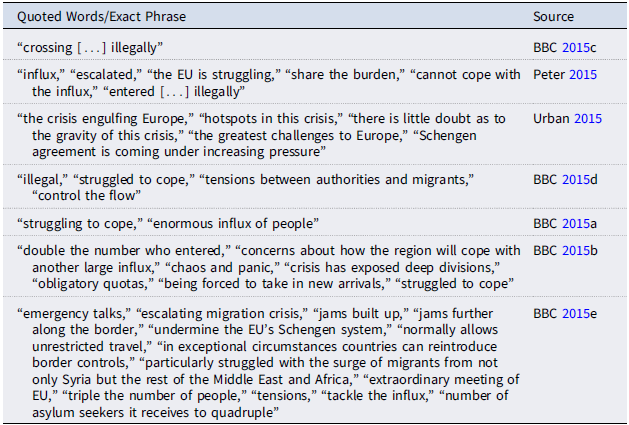
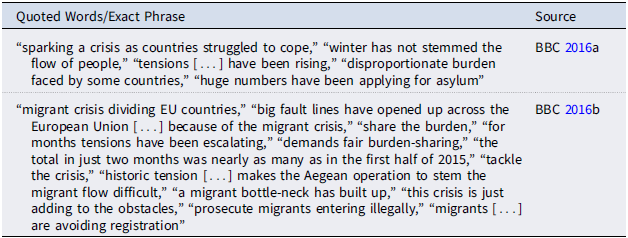
Below is a tracking of the specific wording and terminology used by BBC in a sample of coverage of the EU’s “migration crisis” between 2015 and 2016:
Problematically, at the conclusion of its articles covering refugees from the MENA during this period, the BBC inserted the following note: “A note on terminology: The BBC uses the term ‘migrant’ to refer to all people on the move who have yet to complete the legal process of claiming asylum. This group includes people fleeing war-torn countries such as Syria, who are likely to be granted refugee status, as well as people who are seeking jobs and better lives, who governments are likely to rule are economic migrants.” (BBC 2016a; BBC 2016c; BBC 2015b).
Media monitoring, 2015

Table 3 Long description
A table with two columns: Quoted Words/Exact Phrase and Source. The table has 8 rows, each containing a quoted phrase and its corresponding source. Row 1: crossing illegally, BBC 2015c. Row 2: influx, escalated, the EU is struggling, share the burden, cannot cope with the influx, entered illegally, Peter 2015. Row 3: the crisis engulfing Europe, hotspots in this crisis, there is little doubt as to the gravity of this crisis, the greatest challenges to Europe, Schengen agreement is coming under increasing pressure, Urban 2015. Row 4: illegal, struggled to cope, tensions between authorities and migrants, control the flow, BBC 2015d. Row 5: struggling to cope, enormous influx of people, BBC 2015a. Row 6: double the number who entered, concerns about how the region will cope with another large influx, chaos and panic, crisis has exposed deep divisions, obligatory quotas, being forced to take in new arrivals, struggled to cope, BBC 2015b. Row 7: emergency talks, escalating migration crisis, jams built up, jams further along the border, undermine the EU's Schengen system, normally allows unrestricted travel, in exceptional circumstances countries can reintroduce border controls, particularly struggled with the surge of migrants from not only Syria but the rest of the Middle East and Africa, extraordinary meeting of EU, triple the number of people, tensions, tackle the influx, number of asylum seekers it receives to quadruple, BBC 2015e.
Media monitoring, 2016

Table 4 Long description
A table summarizing quoted phrases from media monitoring in 2016. The table has two columns: Quoted Words/Exact Phrase and Source. The Quoted Words/Exact Phrase column contains phrases related to the migrant crisis and its impact. The Source column lists the sources of these quotes. The table has two rows of data. Row 1: Quoted Words/Exact Phrase: sparking a crisis as countries struggled to cope, winter has not stemmed the flow of people, tensions [] have been rising, disproportionate burden faced by some countries, huge numbers have been applying for asylum; Source: BBC 2016a. Row 2: Quoted Words/Exact Phrase: migrant crisis dividing EU countries, big fault lines have opened up across the European Union [] because of the migrant crisis, share the burden, for months tensions have been escalating, demands fair burden-sharing, the total in just two months was nearly as many as in the first half of 2015, tackle the crisis, historic tension [] makes the Aegean operation to stem the migrant flow difficult, a migrant bottle-neck has built up, this crisis is just adding to the obstacles, prosecute migrants entering illegally, migrants [] are avoiding registration; Source: BBC 2016b.
This note reveals several significant points: not only does it echo the EU’s deliberate use of the blanket term “migrant” to diminish its responsibility toward MENA refugees and evade commitments to providing them protection and non-refoulement, but it also portrays them as individuals unworthy of sympathy until the EU deems them deserving, in a clear effort to adopt a “guilty until proven refugee” approach (Diab Reference Diab2022b). In contrast, reporting on Ukrainians did not include such a note at the end of articles even once regardless of the period of coverage; they were consistently referred to as refugees without dispute throughout the coverage. This discrepancy reinforces the narrative of the EU and its stance, which did not require Ukrainians to prove their refugee status or entitlement to protection—they were automatically recognized as refugees without question, by the political class first, and by the media second (BBC 2024; Farmer Reference Farmer2024; Taylor Reference Taylor2024; Campbell & Cleak Reference Campbell and Cleak2024).
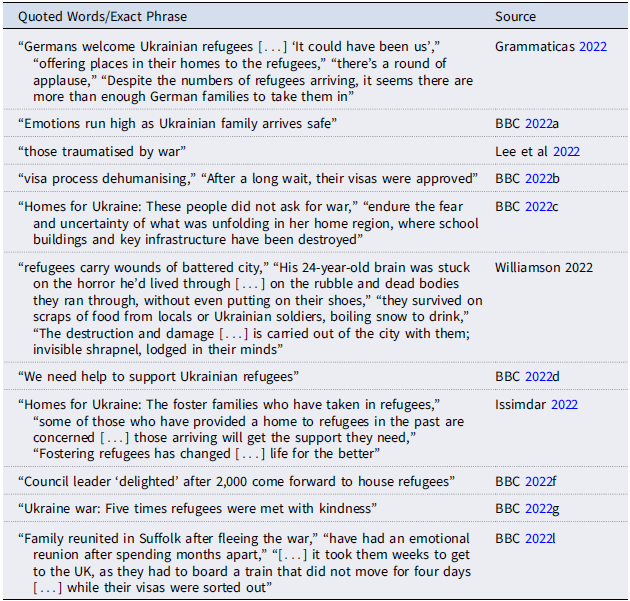
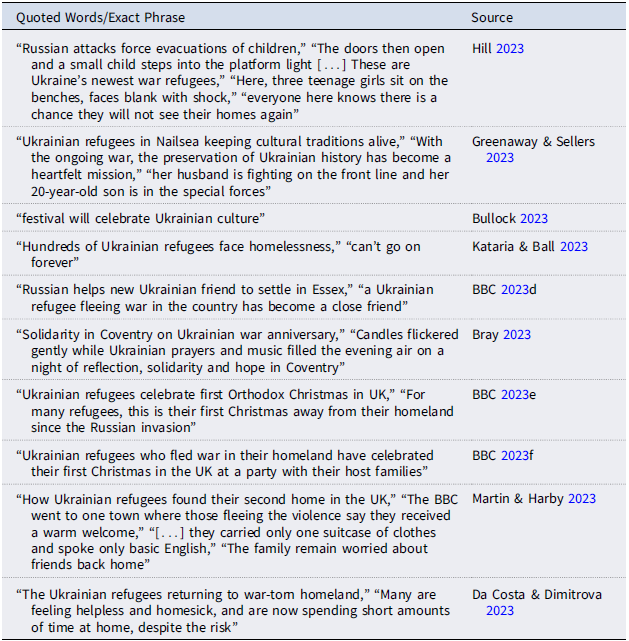
In a sample of its coverage of refugees from Ukraine, BBC used the following emotive phrases and headlines to describe their entry into Europe and their displacement between 2022 and 2023:
Importantly, Ukrainian refugees were thoroughly interviewed and visually depicted throughout the coverage on them, in stark contrast to other coverage focusing on refugees from the MENA region. While the former are subject to meticulous interviewing and comprehensive coverage, the latter often encounter a dearth of such substantive engagement. This contrast not only reflects a nuanced manifestation of media bias but also holds profound implications for reader engagement and empathetic connection. Through the lens of media psychology, in-depth interviews with subjects, and their visual framing, contribute significantly to their humanization within news narratives (Zhang & Hellmueller Reference Zhang and Hellmueller2017; Azevedo et al Reference Azevedo, De Beukelaer and Jones2021; Martikainen & Sakki Reference Martikainen and Sakki2023). Such interviews and visual framings provide a platform for refugees to share their experiences, perspectives, and aspirations, thereby fostering a sense of relatability and empathy among audiences. Conversely, the absence of thorough interrogation and representation in coverage can perpetuate stereotypical depictions and contribute to the dehumanization of refugee populations.
Media monitoring, 2022

Table 5 Long description
The table has two columns: Quoted Words/Exact Phrase and Source. It contains 13 rows of data. Row 1: Germans welcome Ukrainian refugees, it could have been us, offering places in their homes to the refugees, there's a round of applause, despite the numbers of refugees arriving, it seems there are more than enough German families to take them in, Grammaticas 2022. Row 2: Emotions run high as Ukrainian family arrives safe, BBC 2022a. Row 3: those traumatised by war, Lee et al 2022. Row 4: visa process dehumanising, after a long wait, their visas were approved, BBC 2022b. Row 5: Homes for Ukraine: These people did not ask for war, endure the fear and uncertainty of what was unfolding in her home region, where school buildings and key infrastructure have been destroyed, BBC 2022c. Row 6: refugees carry wounds of battered city, his 24-year-old brain was stuck on the horror he'd lived through on the rubble and dead bodies they ran through, without even putting on their shoes, they survived on scraps of food from locals or Ukrainian soldiers, boiling snow to drink, the destruction and damage is carried out of the city with them; invisible shrapnel, lodged in their minds, Williamson 2022. Row 7: We need help to support Ukrainian refugees, BBC 2022d. Row 8: Homes for Ukraine: The foster families who have taken in refugees, some of those who have provided a home to refugees in the past are concerned those arriving will get the support they need, fostering refugees has changed life for the better, Issimdar 2022. Row 9: Council leader delighted after 2,000 come forward to house refugees, BBC 2022f. Row 10: Ukraine war: Five times refugees were met with kindness, BBC 2022g. Row 11: Family reunited in Suffolk after fleeing the war, have had an emotional reunion after spending months apart, it took them weeks to get to the UK, as they had to board a train that did not move for four days while their visas were sorted out, BBC 2022l.
Media monitoring, 2023

Table 6 Long description
Table with two columns and eight rows. The columns are labeled 'Quoted Words/Exact Phrase' and 'Source'. Row 1: Quoted Words/Exact Phrase, Russian attacks force evacuations of children, The doors then open and a small child steps into the platform light [] These are Ukraines newest war refugees, Here, three teenage girls sit on the benches, faces blank with shock, everyone here knows there is a chance they will not see their homes again; Source, Hill 2023. Row 2: Quoted Words/Exact Phrase, Ukrainian refugees in Nailsea keeping cultural traditions alive, With the ongoing war, the preservation of Ukrainian history has become a heartfelt mission, her husband is fighting on the front line and her 20-year-old son is in the special forces; Source, Greenaway & Sellers 2023. Row 3: Quoted Words/Exact Phrase, festival will celebrate Ukrainian culture; Source, Bullock 2023. Row 4: Quoted Words/Exact Phrase, Hundreds of Ukrainian refugees face homelessness, cant go on forever; Source, Kataria & Ball 2023. Row 5: Quoted Words/Exact Phrase, Russian helps new Ukrainian friend to settle in Essex, a Ukrainian refugee fleeing war in the country has become a close friend; Source, BBC 2023d. Row 6: Quoted Words/Exact Phrase, Solidarity in Coventry on Ukrainian war anniversary, Candles flickered gently while Ukrainian prayers and music filled the evening air on a night of reflection, solidarity and hope in Coventry; Source, Bray 2023. Row 7: Quoted Words/Exact Phrase, Ukrainian refugees celebrate first Orthodox Christmas in UK, For many refugees, this is their first Christmas away from their homeland since the Russian invasion; Source, BBC 2023e. Row 8: Quoted Words/Exact Phrase, Ukrainian refugees who fled war in their homeland have celebrated their first Christmas in the UK at a party with their host families; Source, BBC 2023f. Row 9: Quoted Words/Exact Phrase, How Ukrainian refugees found their second home in the UK, The BBC went to one town where those fleeing the violence say they received a warm welcome, [] they carried only one suitcase of clothes and spoke only basic English, The family remain worried about friends back home; Source, Martin & Harby 2023. Row 10: Quoted Words/Exact Phrase, The Ukrainian refugees returning to war-torn homeland, Many are feeling helpless and homesick, and are now spending short amounts of time at home, despite the risk; Source, Da Costa & Dimitrova 2023.
Furthermore, drawing from social cognitive theory, it can be argued that the quality and depth of media coverage play a pivotal role in shaping audience perceptions and attitudes toward marginalized groups (Medianu Reference Medianu2014; Ghanim & Abed Reference Ghanim and Abed2023; Khan et al Reference Khan, Jahangir and Khan2023). By affording Ukrainian refugees extensive interview coverage, media outlets facilitate a cognitive and emotional bond between readers and the subjects of the narrative (Ibid). Using pull quotes such as “we run because we have to” (as though no one else has ever had to) (Moreland Reference Moreland2022a), and “we’re one extended family now,” (Ball & Wade Reference Ball and Wade2022) further serves in the creation of this bond. In contrast, the limited representation of MENA refugees diminishes the potential for empathetic connection, thereby exacerbating the psychological distance between readers and the individuals being portrayed.
An important evolution in reporting regarding Ukrainian refugees in the EU is the empowerment and overemphasis of these individuals as primary storytellers in the media through interviews, signifying a commendable shift toward participatory journalism (BBC 2022d; BBC 2022e; BBC 2022i; Ghobadi Reference Ghobadi2022; BBC 2022j; BBC 2022k; Thierij Reference Theirij2022; Moreland Reference Moreland2022a; BBC 2022m; Brooks & Murray Reference Brooks and Murray2022; BBC 2022nn); Booth & Harby Reference Booth and Harby2023; O’Grady Reference O’Grady2023; Media & Airey Reference Media and Airey2023; Pound-Woods Reference Pound-Woods2023). However, this empowering trend, while noteworthy, faces limitations in its applicability beyond the Ukrainian context, thereby posing challenges to achieving broader inclusivity in representing diverse refugee experiences. This disparity is particularly evident when contrasting the empowered voices of Ukrainians with the marginalized narratives from the MENA region. While the unprecedented participatory approach to reporting empowers Ukrainians as primary storytellers, its impact remains largely confined to the Ukrainian context. This confinement potentially undermines its broader influence and relevance across diverse cultural and geopolitical landscapes. Unlike Ukrainian refugees, individuals from the MENA region have not been afforded a similar platform, thus depriving them of the opportunity to authentically represent themselves or shape narratives about their communities and experiences.
Reporting went beyond this, to insist on framing Ukrainian refugees’ seemingly easy and smooth integration into the EU—once again, reinforcing the political narrative of “they’re just like us” and part of a “European way of life” (Bayoumi Reference Bayoumi2022; Malik Reference Malik2022; BBC 2023c; Cerys Reference Cerys2023). They did this by highlighting their professions and hireability, and ultimately, giving them even more humanizing characteristics (BBC 2023b). On multiple occasions, BBC went to great lengths to frame Ukrainian refugees as “dancers” (Vandy Reference Vandy2022; Vandy Reference Vandy2023; Bryson & Jaiyeola Reference Bryson and Jaiyeola2023), to frame a female Ukrainian musician as a “young, talented refugee” who was “still waiting for a visa” (BBC 2022n). The article’s headline read “Ukrainian refugee with Royal College of Music scholarship in visa limbo” (Ibid). In fact, “musicians” and “singers” formed part of multiple headlines (Brooks & Murray Reference Brooks and Murray2022; O’Hare Reference O’Hare2022; Duggan Reference Duggan2023; BBC 2022p; Cox Reference Cox2023; Bullock & Miller Reference Bullock and Miller2023). Beyond this, Ukrainians were framed as butchers (Lonsdale & Johnston Reference Lonsdale and Johnston2023), translators (BBC 2023a; Messenger Reference Messenger2023), dry-cleaners (O’Grady Reference O’Grady2023), artists (Zaccaro & Moore Reference Zaccaro and Moore2023; Earp & Liggins Reference Earp and Liggins2023), chefs (BBC 2022o), bus drivers (Gupta & PA News Reference Gupta and News2023) and business owners (Brewer Reference Brewer2023; Humphrey & White Reference Humphrey and White2023).
Reporting on Ukrainian refugees was further observingly covered through an undertone of temporal “urgency”—a sense of urgency once again reinforced by EU politicians. This is evident in the number of times “delays,” “waits,” and “issues” in visa processes made the headlines between 2022 and 2023 (BBC 2022w; BBC 2022x; BBC 2022z; Foran Reference Foran2022; Bird Reference Bird2022; Johal & Phipps Reference Johal and Phipps2022; BBC 2022ab; BBC 2022ad; BBC 2022r; BBC 2022s; BBC 2022v; BBC 2022ae). Some of the most emotive headlines read: “[…] visa process wakes me in middle of the night” (Schofield & Cooper Reference Schofield and Cooper2022), and “[…] family’s ‘torturous’ wait for a UK visa” whilst describing the “weeks-long” wait before a Ukrainian refugee family a British woman was sponsoring received visas to travel (Lee Reference Lee2022). In other articles and their headlines, visa processing periods were described as “an obstacle course” (BBC 2022u), and their “silence” was described as “unwelcoming” (BBC 2022t). In other coverage, visa processes were described as “beyond lengthy” whilst covering one Ukrainian refugee’s “weeks for permission to enter the UK” (Moreland Reference Moreland2022b). The UK visa process was described as “dehumanising” on a separate occasion (BBC 2022b), and in multiple reports, criticized for its long waiting periods (BBC 2022y), resulting in Ukrainians living in “limbo” and in “a race against time” to get visas (BBC 2022tt; Manning & Bell, Reference Manning and Bell2022). The number of hours it took one Ukrainian refugee to fill out her visa forms even warranted its own headline. (BBC 2022aa)
Importantly, politicians once again reinforce this framing, ultimately apologizing for waiting periods, and insisting that processes are either too long or not efficient enough (BBC 2022pp; BBC 2022q). In an interview with BBC Nicola Sturgeon, Member of the Scottish Parliament, described the number of visas granted as “woefully small” and “not good enough,” further insisting that “[…] the process of translating applications into visas is unacceptably slow,” and that “[…] the UK government is letting the people of Ukraine down and also letting down people across Scotland who have opened their homes” (BBC 2022ac). In a separate incident, Lord Harrington of Watford, UK Minister of State for Refugees, described the visa application forms as “too long” to fill in and shared that the government was working to shorten the process (Turner Reference Turner2022). For her part, Home Secretary Priti Patel apologized “with frustration” about delays in the Ukraine refugee visa process (BBC 2022pp). A media analyst from Jordan weighs in on this cycle of reinforcement, insisting:
“[…] you can expect visas for MENA refugees to take years—including their need to build a case, make legal arrangements, and essentially, ‘prove’ that they are refugees to begin with. How many families are broken apart because family reunification is denied or prolonged for refugees from Syria, Afghanistan and Libya? You read reports depicting how many ‘hours’ it has taken refugees to fill out visa applications, and how many ‘weeks’ they waited for a response to their application. Then politicians apologise to them [Ukrainians] for how long they’ve had to wait. How long have refugees from the MENA been waiting in detention centres? Ukrainians have never been held in detention centres while they waited. Where are all the articles on waiting periods for MENA refugees? On how much they have to endure and prove before they even get to the visa stage?” (Interview, Online, January 2024)
Significantly, the sympathetic disposition toward the plight of displaced Ukrainians entering the EU not only remained steadfast from its inception but also notably intensified. This culminated in a profound sense of obligation among European hosts, whose commendable acts were lauded and even encouraged by the media, underscoring the emergence of a narrative wherein hosting Ukrainians in private residences became a symbol of humanitarian duty (BBC 2022af; Ellis Reference Ellis2022; Collinson & Polachowska Reference Collinson and Polachowska2022; Pearson Reference Pearson2023; Hinman Reference Hinman2023; Heath Reference Heath2023; Jenkins & Morgan Reference Jenkins and Morgan2023; Waple & Leyland Reference Waple and Leyland2023; Bennet Reference Bennett2023). Notably, this narrative found reinforcement through the actions of politicians who publicly welcomed refugees into their own homes, thereby adding further weight to the prevailing narrative of solidarity (BBC 2022ad; Faulkner Reference Faulkner2022). Conversely, the treatment of Europeans aiding or sheltering refugees from the MENA region diverged sharply in media discourse. Such individuals were often depicted as transgressors, criminalized for their acts of rescuing “migrants” (Kirby Reference Kirby2023). This portrayal, persistently eschewing the term “refugee,” perpetuates the very cycle of reinforcement that this paper endeavors to illuminate (Ibid).
Discussion
How can refugees be categorically framed as “others” or a “threat” when they resemble you? And, perhaps more significantly, how do you sustain the rationale behind asylum policies predicated on the notion that the EU’s refugee crisis fundamentally threatens European values and culture? The existence of White refugees presents a profound challenge to a meticulously crafted depiction that authorities have labored to uphold—specifically, the portrayal of refugees in racial and categorical terms.
This study delves into the contrasting media and political portrayals of refugees hailing from Ukraine and the MENA region, shedding light on the pervasive racial biases and hierarchies ingrained within the refugee narrative. Employing a rigorous comparative analysis, the research uncovers a glaring disparity in how Ukrainian refugees are depicted, often with empathy as victims of conflict deserving compassion and support, while MENA refugees face biased representations rife with stereotypes associating them with terrorism, extremism, and societal instability—often by the same media outlet. These prejudiced depictions underscore broader trends of racialized othering, exacerbating the marginalization and exclusion of specific refugee communities. The works of Said and Bhabha, for instance, have long-unpacked these forms of othering explicitly (Said Reference Said1985; Clines Reference Clines2020; Newton Reference Newton and Newton1997).
Media agencies reporting on different conflicts often exhibit a striking divergence in tone, even when the same reporter is responsible for the written or live coverage. This phenomenon can be attributed to the positionality of both the media agency and the reporter in question. The positionality of the media agency encompasses its geopolitical stance, ideological leanings, and audience demographics, all of which influence its editorial decisions and narrative framing. Consequently, a media agency aligned with a particular government or interest group may adopt a biased perspective that colors its reporting on a conflict, amplifying certain aspects while downplaying others. Similarly, the positionality of the reporter, shaped by their personal beliefs, experiences, and affiliations, can significantly influence their portrayal of the conflict. A reporter who empathizes deeply with the plight of the affected vulnerable persons may convey a more emotionally charged narrative, employing language that evokes sympathy and condemnation for the injustices witnessed.
The language used in reporting often reflects the emotional investment of the reporter, with sympathies toward the conflict’s victims influencing the tone and rhetoric employed. Authors who identify strongly with the suffering of those affected by the conflict may employ emotive language and vivid descriptions to convey the human toll and injustices perpetrated. Conversely, reporters who maintain a more detached stance or align with the interests of one side may adopt a more neutral or even adversarial tone, focusing on strategic analysis or political ramifications rather than human suffering. Thus, the positionality of both the media agency and the reporter plays a pivotal role in shaping the narrative arc of conflict reporting, determining which voices are amplified, which perspectives are marginalized, and ultimately, how the audience perceives and interprets the events unfolding in distant lands.
Typically, refugees are not merely depicted negatively as threats; they are also often portrayed through a lens of detachment and indifference in both media and political discourses—often, complimentarily. This phenomenon has long facilitated the desensitization of audiences toward specific groups, perpetuating the notion that these individuals are mostly embroiled in conflict and suffering, and are invariably categorized as “typical” or “illegal” migrants and refugees. Such reporting and political discourse is not only cyclical but also lacks the emotional impact that could potentially evoke shock or empathy. Paradoxically, this indifference is as perilous as hostile language, as it not only normalizes and desensitizes audiences to the plight of certain populations and racial groups but also emboldens governments to downplay the political urgency of addressing specific refugee crises while insisting on the urgency and “moral” obligation to address others. Consequently, through a political lens, this leads to a reduction in efforts directed toward protection and humanitarian response, while simultaneously bolstering initiatives focused on securitization, deterrence, and the externalization of borders.
When there exists a synergy, as outlined in this paper, between the political and media landscapes’ emotive language and messaging, there is a heightened sense of urgency, public pressure, and responsiveness toward adopting protective and humanitarian measures. The case of Ukrainian refugees is an evident example of this, whereby the reinforcement of narratives depicting victimization and a sense of kinship laid the groundwork for widespread support across Europe. This was evident in the public display of solidarity, with Ukrainian flags adorning windows of European homes and the enactment of the Temporary Protection Directive for the first time in over two decades (EUAA 2023). Crucially, the influx of Ukrainian refugees highlighted a rare moment of unanimity across EU member states regarding the concept of “integration,” a term historically subject to disparate interpretations and approaches. While the need for a unified definition of “integration” has long been argued (Cajvan Reference Cajvan2020), historical instances of such consensus are scarce within the EU. The absence of a formal definition in international refugee law, coupled with varying legislation and policies across EU member states, has perpetuated this lack of cohesion in addressing refugee integration even when refugee groups in question are from one nationality or escaping the same conflict. Thus, the unified approach toward Ukrainian refugees stands out as an exception rather than the norm within the EU’s historical context.
The propagation of these pro-Ukrainian narratives not only influenced political discourse but also reshaped debates surrounding asylum application processes. Despite enduring conflict in the MENA region or African continent, asylum seekers from these areas are often required to meticulously prove their refugee status. In stark contrast, Ukrainians, portrayed as “friendly European neighbours,” were spared this burden, highlighting a double standard not only in the treatment of refugees, but in the decision around who is entitled to protection, and who needs to build a case for it. Significantly, as refugees from the MENA region are deemed the quintessential depiction of a “typical refugee,” the portrayal of White, blond, blue-eyed Christian Ukrainians not only challenges this stereotype but fundamentally challenges European-centered notions around otherness, difference, and “threat.” As such, we continue to witness that the burden of proof still falls upon the “typical refugee,” perpetuating a “guilty until proven refugee” approach by European governments and media. By framing Ukrainians as exceptions to this rule, European states effectively bypassed the refugee designation altogether, integrating them into society without the usual scrutiny. This selective treatment not only underscores the Eurocentric lens through which victimhood is perceived but also reflects deliberate efforts to preserve a particular narrative surrounding refugees—one that excludes the possibility of a “White” refugee crisis.
Conclusion
The study underscores that the differential treatment of Ukrainian and MENA refugees is a manifestation of deep-seated racial biases within European media and political discourses. By challenging the established narratives of otherness and threat, white refugees disrupt the Eurocentric framework that has traditionally dictated asylum policies. This disruption highlights the need for a more equitable and consistent approach to refugee protection that transcends racial and ethnic biases. The selective empathy shown toward Ukrainian refugees, contrasted with the skepticism faced by MENA refugees, reveals a critical flaw in the global refugee system—one that demands urgent reevaluation and reform to ensure that all refugees, regardless of origin, are treated with dignity and fairness.
Funding statement
No funding has been received for this research.

 Open access

