


Introduction
Nowadays, organisations face the challenges of a constantly changing environment. For this reason, the search for innovation and the ability to adapt are key drivers to responding to increasingly complex problems that require the joint efforts of diverse team members with different skills, experiences, and knowledge (Bertolotti, Mattarelli, Vignoli & Macrì, Reference Bertolotti, Mattarelli, Vignoli and Macrì2015; Wolfson, D’Innocenzo & Bell, Reference Wolfson, D’Innocenzo and Bell2021). In addition, digital technologies facilitate new forms of interaction – through the offer of novel devices and tools – which are rapidly changing the way organisations work, interact, and collaborate (Bertolotti et al., Reference Bertolotti, Mattarelli, Vignoli and Macrì2015). As a result, the way organisations work in teams is being redefined by configuring teams as dynamic structures that are set up for different projects, which can be redesigned and organised according to the demands of the task (Mathieu, Gallagher, Domingo & Klock, Reference Mathieu, Gallagher, Domingo, Klock, Morgeson, Ashford and Aguinis2019; Meinecke, de Sanchez, Lehmann-Willenbrock & Buengeler, Reference Meinecke, de Sanchez, Lehmann-Willenbrock and Buengeler2019; O’Leary, Mortensen & Woolley, Reference O’Leary, Mortensen and Woolley2011).
The dynamic nature of teams is widely recognised as one of its fundamental characteristics (Kozlowski & Chao, Reference Kozlowski and Chao2018; McGrath, Reference McGrath1991; McGrath & Tschan, Reference McGrath and Tschan2007; Wolfson et al., Reference Wolfson, D’Innocenzo and Bell2021); however, teams have historically been studied as if they were ‘static entities, with no past, no future, and only an input-output present’ (McGrath, Arrow & Berdahl, Reference McGrath, Arrow and Berdahl2000, p. 3), considering that the characteristics of the team are stable (Benishek & Lazzara, Reference Benishek and Lazzara2019), that their members operate in a single organisation, that they keep the same membership and function in the same geographic environment, and that tasks and objectives – which are determined – do not change (Mathieu, Wolfson & Park, Reference Mathieu, Wolfson and Park2018).
In response to calls to include change in the study of teams (e.g., research suggestions for advancing understanding of team dynamic process mechanisms) (Kozlowski, Reference Kozlowski2015; Kozlowski & Chao, Reference Kozlowski and Chao2018); new theories, tools and methodologies for modelling dynamic team properties, there has been a growing interest in the study of teams as dynamic entities.
Recent reviews have examined the field of dynamic teams from different perspectives. Some researchers have questioned how to study change in teams, offering methodological (Delice, Rousseau & Feitosa, Reference Delice, Rousseau and Feitosa2019; Kerrissey, Satterstrom & Edmondson, Reference Kerrissey, Satterstrom and Edmondson2020; Nyein, Caylor, Duong, Fry & Wildman, Reference Nyein, Caylor, Duong, Fry and Wildman2020), theoretical (Matusik, Hollenbeck & Mitchell, Reference Matusik, Hollenbeck and Mitchell2021; Park, Grosser, Roebuck & Mathieu, Reference Park, Grosser, Roebuck and Mathieu2020; Ramos-Villagrasa, Marques-Quinteiro, Navarro & Rico, Reference Ramos-Villagrasa, Marques-Quinteiro, Navarro and Rico2018) or empirical contributions (Courtright, Thurgood, Stewart & Pierotti, Reference Courtright, Thurgood, Stewart and Pierotti2015; De Jong, Dirks & Gillespie, Reference De Jong, Dirks and Gillespie2016). In turn, other scholars have studied some instability factors, such as membership, dynamics, interdependence, goals, and boundaries (Benishek & Lazzara, Reference Benishek and Lazzara2019; Blanchet & Michinov, Reference Blanchet and Michinov2016; Trainer, Jones, Pendergraft, Maupin & Carter, Reference Trainer, Jones, Pendergraft, Maupin and Carter2020).
Prior literature has also researched how time and team dynamics affect the processes occurring in the team (Christian, Christian, Pearsall & Long, Reference Christian, Christian, Pearsall and Long2017; Fyhn, Schei & Sverdrup, Reference Fyhn, Schei and Sverdrup2023), the team development (Delice et al., Reference Delice, Rousseau and Feitosa2019), its diversity (Li, Meyer, Shemla & Wegge, Reference Li, Meyer, Shemla and Wegge2018), its conflict (O’Neill & McLarnon, Reference O’Neill and McLarnon2018), fault lines (Maltarich, Thatcher, Schepker & Park, Reference Maltarich, Thatcher, Schepker and Park2021), and context (Bush, LePine & Newton, Reference Bush, LePine and Newton2018). Some other studies have focused on who is on the team, what traits they possess, and what the team’s composition is. In this vein, membership types have been investigated (Gonzalez‐Mulé, Cockburn, McCormick & Zhao, Reference Gonzalez‐Mulé, Cockburn, McCormick and Zhao2020; Trainer et al., Reference Trainer, Jones, Pendergraft, Maupin and Carter2020) as well as the reasons behind compositional changes and their effects (Li & van Knippenberg, Reference Li and van Knippenberg2021), the participation in multiple teams (Fodor, Curseu & Meslec, Reference Fodor, Curseu and Meslec2021; Margolis, Reference Margolis2020) and the efficacy models for compositional alterations (Mathieu, Tannenbaum, Donsbach & Alliger, Reference Mathieu, Tannenbaum, Donsbach and Alliger2014; Wolfson et al., Reference Wolfson, D’Innocenzo and Bell2021). Finally, the study of dynamic teams has captivated researchers from a diverse array of fields including psychology (Bedwell, Reference Bedwell2019), management (Zhu, Wolfson, Dalal & Mathieu, Reference Zhu, Wolfson, Dalal and Mathieu2021), engineering (Jho & Youn, Reference Jho and Youn2020), computer science (Demir, McNeese & Cooke, Reference Demir, McNeese and Cooke2018), and organisational behaviour (Mortensen & Haas, Reference Mortensen and Haas2018).
In spite of the valuable contributions offered by the extant literature, the dynamic teams’ field remains compartmentalised (He, Xiao-Yun, Ling & Feng, Reference He, Xiao-Yun, Ling and Feng2023) and to our knowledge, exception made of Wolfson et al. (Reference Wolfson, D’Innocenzo and Bell2021) whose focus was limited to dynamic team composition, no literature review has examined the dynamic teams’ field in an integrative way. This omission is relevant since the amalgamation of this ‘melting pot’ could help to integrate the disparate literatures (Margolis, Reference Margolis2020; Wolfson et al., Reference Wolfson, D’Innocenzo and Bell2021) and strengthen the dynamic teams’ empirical and theoretical bases to move research forward effectively. For example, prior literature highlighted the benefits of identifying cross-fertilisation opportunities regarding the composition and formation of effective teams that could help disciplines – Computer Science and Organisational Psychology – benefit from one another (Andrejczuk, Berger, Rodriguez-Aguilar, Sierra & Marín-Puchades, Reference Andrejczuk, Berger, Rodriguez-Aguilar, Sierra and Marín-Puchades2018).
Thus, in line with Wolfson et al. (Reference Wolfson, D’Innocenzo and Bell2021), we take an interdisciplinary integrative approach, and we include, in this review, papers from all disciplines that have studied dynamic teams as well as all publications that have investigated teams as dynamic entities. Consequently, given the above considerations, this article aims to address the following research questions:
RQ1: How has the research field of dynamic teams been structured?
RQ2: Taking into account all the disciplines that have examined the dynamics teams’ subject, which are its main research lines, as well as the methods and key theoretical frameworks employed?
RQ3: Which are the opportunities for further research in this comprehensive/wide-ranging field?
To answer our research questions, we performed a literature review using both quantitative methods like co-word analysis and strategic diagram maps and qualitative techniques such as content analysis. Bibliometrics consist of various quantitative methods, being co-word analysis one of the most common ones (Van Eck & Waltman, Reference Van Eck, Waltman, Ding, Rousseau and Wolfram2014). It provides objective criteria to evaluate the research development in a field and constitutes a helpful tool for measuring scholarship quality and productivity (Cobo, Martínez, Gutiérrez-Salcedo, Fujita & Herrera-Viedma, Reference Cobo, Martínez, Gutiérrez-Salcedo, Fujita and Herrera-Viedma2015). Besides, it offers a methodical, transparent, and reproducible review process, which allows for a better description, assessment, and monitoring of published studies (Zupic & Cater, Reference Zupic and Cater2015). In this way, bibliometrics complement previous research through a new perspective because they allow for a wide-ranging examination of the complete scholarly discourse, classifying key contributors, seminal works, and emerging trends (Van Eck & Waltman, Reference Van Eck and Waltman2009b). Results revealed eight research lines some of them understood as motor themes while some others are emerging and are likely to become central and developed.
In so doing, our study contributes to the literature by offering an integrated view of what has been a fragmented field of study (He et al., Reference He, Xiao-Yun, Ling and Feng2023), which we consider as a necessary initiative to propel the development of future research. At the same time, this study answers the call for advancement in the study of teams as dynamic systems (Meinecke et al., Reference Meinecke, de Sanchez, Lehmann-Willenbrock and Buengeler2019) and the incorporation for the dynamic condition in teams (Kozlowski, Reference Kozlowski2015; Mathieu et al., Reference Mathieu, Wolfson and Park2018). Finally, our review will also be relevant to those conducting research on dynamic teams, since a detailed agenda for further studies is suggested.
The paper is organised as follows. First, we begin by introducing the dynamic teams’ concept and the review methodology adopted. Second, we show and briefly discuss several performance analysis-related metrics. Third, we outline the organisation of the field of study and the findings of the bibliometric and content analyses. Finally, based on those findings and discussion, we acknowledge the limitations of this study and propose an agenda for future lines of research.
Theoretical background
It was previously mentioned that a considerable amount of research has been conducted from different disciplines, and, consequently, teams cannot be understood as «stable entities» anymore. Teams, recognised as ‘interdependent collections of individuals who share responsibility for specific outcomes for their organizations’ (Sundstrom, Demeuse & Futrell, Reference Sundstrom, Demeuse and Futrell1990, p. 120), have to be considered as complex, open, adaptable, changing over time, and dynamic systems (Blanchet & Michinov, Reference Blanchet and Michinov2016; Mathieu et al., Reference Mathieu, Wolfson and Park2018).
Dynamic systems theory explains how interaction between members configures a higher-level system called a team (Demir et al., Reference Demir, McNeese and Cooke2018). This theory has been used to study the collective behaviour of a group of agents who must achieve a goal efficiently (Gupta, Yüksel, Basar & Langbort, Reference Gupta, Yüksel, Basar and Langbort2015). It has also been widely used as a general framework for advancing knowledge about teams as dynamic entities (Mathieu et al., Reference Mathieu, Wolfson and Park2018; Ramos-Villagrasa et al., Reference Ramos-Villagrasa, Marques-Quinteiro, Navarro and Rico2018).
Organisational psychology literature understands teams as ‘distinguishable sets of two or more people who interact, dynamically, interdependently, and adaptively toward a common and valued goal/objective’ (Salas, Dickinson, Converse & Tannenbaum, Reference Salas, Dickinson, Converse and Tannenbaum1992, p. 4). Within the same field, teams are also defined as ‘complex dynamic systems that exist in a context, develop as members interact over time, and evolve and adapt as situational demands unfold’ (Kozlowski & Ilgen, Reference Kozlowski and Ilgen2006, p. 78). And those team members possess different attitudes, behaviours, and cognitions which are constantly shaped by those of other colleagues and vice-versa (Delice et al., Reference Delice, Rousseau and Feitosa2019; Dyer, Reference Dyer1984; Kozlowski & Chao, Reference Kozlowski and Chao2018).
In turn, scholars from the computer science field, define a team as a group of agents who act collectively – not necessarily sharing all the information – to optimise a common cost function. The team is said to be a static if each agent’s information is only determined by primitive/exogenous random variables while it is dynamic if at least one agent’s information is affected by another agent’s action (Gupta, Yüksel, Basar & Langbort, Reference Gupta, Yüksel, Basar and Langbort2015).
Moreover, combining contributions from the psychology and management fields, organisational teams have been researched as dynamic systems with the potential for change over time (Wolfson et al., Reference Wolfson, D’Innocenzo and Bell2021). These authors rely upon team development theory (Morgan, Salas & Glickman, Reference Morgan, Salas and Glickman1993; Tuckman, Reference Tuckman1965) and team cognition constructs (Kozlowski, Reference Kozlowski2015; Kozlowski & Bell, Reference Kozlowski and Bell2013) to support their statements.
As to the dynamic conditions of teams, they can be grouped into several dimensions: the magnitude of the change of members (produced by addition, subtraction, or replacement); the place where change occurs (within the group or the system); who changes (roles, positions); the frequency of change, its duration and continuity, regularity, and timing; or what changes (task, diversity, context) (Arrow & McGrath, Reference Arrow and McGrath1993, Reference Arrow and McGrath1995).
It is worth mentioning that the changes in the composition of the team have concentrated the interest of researchers. And, different terms were employed such as fluid teams (Benishek & Lazzara, Reference Benishek and Lazzara2019), multiple team membership (Fodor et al., Reference Fodor, Curseu and Meslec2021), team membership change, dynamic team composition (Wolfson et al., Reference Wolfson, D’Innocenzo and Bell2021), turnover (Hom, Lee, Shaw & Hausknecht, Reference Hom, Lee, Shaw and Hausknecht2017), staffing (Finn, Clay & Creaden, Reference Finn, Clay and Creaden2022), membership fluidity (Bedwell, Reference Bedwell2019), membership churn (Mathieu, Hollenbeck, van Knippenberg & Ilgen, Reference Mathieu, Hollenbeck, van Knippenberg and Ilgen2017) and dynamic team (Li et al., Reference Li, Meyer, Shemla and Wegge2018; Wolfson et al., Reference Wolfson, D’Innocenzo and Bell2021).
Recently, regarding membership, Mortensen and Haas (Reference Mortensen and Haas2018), from the organisational behaviour field, pointed out that limits were assumed in a binary way, concerning who were members and were not. Nevertheless, teams nowadays show three characteristics: fluidity, since members enter and leave the team while developing their tasks; over-dimension, because members participate in different teams at the same time, and dispersion, since members belong to teams from different organisations and work in different places or units. Then, membership should be represented as a continuum evidencing the different forms of collaboration, at different times, intensity, tasks, or roles.
Methodology
In order to address our research questions, since the key aims of this paper were to examine the intellectual organisation of the dynamic teams’ field and to understand their main research lines, methods and theoretical frameworks, we deemed suitable to rely on bibliometric as well as qualitative tools, such as a content analysis.
Based on the bibliometric results we conducted a literature review, where the second-generation bibliometric tools (Callon, Courtial, Penan & Arenas, Reference Callon, Courtial, Penan and Arenas1995), such as the strategic diagram maps (based on the co-occurrence of keywords), allowed us to answer our research questions 1 and 2 since they make it possible to identify the knowledge structure of a field of study, and distinguish key contributions and gaps in research (Van Eck & Waltman, Reference Van Eck and Waltman2009a). It is worth noting that strategic diagrams are visualisation tools that show, based on the bibliometric analysis of co-words, the lines of research within a field of study (Cobo, Lopez-Herrera, Herrera-Viedma & Herrera, Reference Cobo, Lopez-Herrera, Herrera-Viedma and Herrera2011). Finally, having considered the strategic diagram developed in the previous stage as our input, we carried out a content analysis of each quadrant and its research lines, to answer question 3. Bibliometric techniques enable us to analyse enormous amounts of data, and they offer a logical and reliable approach to study and examine the relationships they preserve (Donthu, Kumar, Mukherjee, Pandey & Lim, Reference Donthu, Kumar, Mukherjee, Pandey and Lim2021; Mukherjee, Lim, Kumar & Donthu, Reference Mukherjee, Lim, Kumar and Donthu2022).
We relied upon, co-word analysis which is a bibliometric technique used to identify and analyse the relationships between words or terms within a body of academic literature, rather than the words academics use to describe the content of their work (Borner, Chen & Boyack, Reference Borner, Chen and Boyack2003). This technique involves the identification of co-occurring terms within documents to reveal the thematic structure and intellectual connections within a specific research domain. It is a methodological approach that provides insights into the conceptual relationships between terms and the thematic structure of a scientific field (Zupic & Cater, Reference Zupic and Cater2015). The decision not to use other bibliometrics techniques such as citation, co-citation, co-author, bibliographic coupling or enrichment techniques was based on the specific nature and focus of our analysis. For example, the graphical visualisation can be a powerful tool for representing networks and relationships, but our study concentrated on a detailed and qualitative analysis of the relationships between terms. To enrich the co-word analysis in accordance with the research objectives we relied upon content analysis rather than others bibliometrics’ techniques.
Qualitative content analysis is understood as ‘a research method for the subjective interpretation of the content of text data through the systematic classification process of coding and identifying themes or patterns’ (Hsieh & Shannon, Reference Hsieh and Shannon2005, p. 1278). Considering the different approaches to qualitative content analysis, in this study we relied on the directed content analysis (Hsieh & Shannon, Reference Hsieh and Shannon2005).
The analysis process we have followed consists of several stages (Cobo et al., Reference Cobo, Lopez-Herrera, Herrera-Viedma and Herrera2011): selection of documents and keywords, extraction of co-occurrence frequencies, quantification of similarities and thematic clustering, which describe in detail below.
Search procedure
We obtained the documents from the Web of Science (WoS), which is a collection of databases of recognised prestige in the field of social sciences and it is considered certified knowledge. The following databases were selected for the query: Social Citation Index Expanded (SCIE), Social Science Citation Index (SCI), Art and Citation Index (A&HCI) and Science Citation Index Expanded (ESCI).
We ran the query in October 2022 covering a 31-year analysis period, with the following search string in topic: ‘membership churn’, ‘membership change’, ‘membership dynamics’, ‘membership dynamics’, ‘fluid teams’, ‘membership fluidity’, ‘dynamic team composition’, ‘dynamic team’, ‘dynamic teams’, ‘membership dynamic’, or ‘fluid team’. In our search for papers, we used all the keywords used by Wolfson et al. (Reference Wolfson, D’Innocenzo and Bell2021), except for the keyword Flux, which was changed to fluidity as it was considered more precise, and we additionally included the term ‘Dynamic Team’ which specifically identifies the purpose of this study.
The result of the search was 306 documents that were filtered to select articles, reviews, and early access, excluding those catalogued as ‘proceedings’, ‘meeting’, ‘book’, ‘editorial material’, ‘reference material’, or ‘other’. At the end of this review, 295 articles remained and were reviewed again to check for duplication. As a result, two conference papers and eight journal notes were removed. At the end of the standardisation process, 285 documents remained, representing the final sample used for analysis.
We used Bibexcel software to process the data because it is very flexible and compatible with different data management tools. From the 285 papers in the sample, all the keywords identified by the authors were extracted, resulting in a total of 1082 keywords. This list of keywords was then purified by cleaning plurals, acronyms and synonyms. The process of filtering and analysing the 1082 keywords resulted in a sample of 804 different keywords used in the 285 papers under study.
We determined, then, the co-occurrence frequencies of these keywords, i.e., the number of documents in which two keywords occur together (Callon, Courtial & Laville, Reference Callon, Courtial and Laville1991). According to Price (Reference Price1965), the selection of high-frequency keywords (those that most accurately reflect the topic) should be between 40 and 50. In our study, the closest limit is obtained with a co-occurrence frequency equal to or greater than three. We, then, selected the 52 words pairs with a co-occurrence frequency equal to or greater than three and used the equivalence index or proximity index, which is the most appropriate measure for normalising co-occurrence frequencies (Cobo et al., Reference Cobo, Lopez-Herrera, Herrera-Viedma and Herrera2011).
The clustering procedure extracts the thematic subfields of the research lines that make up the field structure, using an algorithm to organise keywords into groups that preserve close relationships among them (Cobo et al., Reference Cobo, Lopez-Herrera, Herrera-Viedma and Herrera2011). In our case, we used the Ucinet6 software for the clustering process and to obtain the density and centrality indices (Callon et al., Reference Callon, Courtial and Laville1991). The clustering process involves the following steps: (a) Ucinet uses the Freeman index from the final Bibexcel data to calculate the centrality of the keywords and form an initial partition; (b) The algorithm uses the equivalence index to identify research clusters based on centrality and density measures (Callon et al., Reference Callon, Courtial and Laville1991). The density index is a metric that captures the internal linkages between cluster topics. Conversely, the centrality index has been demonstrated to capture the external links between clusters (Cobo et al., Reference Cobo, Lopez-Herrera, Herrera-Viedma and Herrera2011).
From these two data, we categorised the clusters and represented them graphically on coordinate axes, where the x-axis was the centrality, and the y-axis was the density. Each point (x, y) in this space represents a thematic area or research line, and the research area is defined by the set of research lines represented (Cobo et al., Reference Cobo, Lopez-Herrera, Herrera-Viedma and Herrera2011). The cluster centrality and density parameters’ median or mode values determine the four quadrants that constitute the strategy diagram space (Callon et al., Reference Callon, Courtial and Laville1991), with the median being the most commonly used as it is more readable (Cobo et al., Reference Cobo, Lopez-Herrera, Herrera-Viedma and Herrera2011), and which is the one we used. It is worth noting that density is used to measure the strength of the links that tie together the words making up the cluster, providing a good representation of the cluster’s capacity to maintain itself and to develop over in the field (Callon et al., Reference Callon, Courtial and Laville1991). Centrality, in turn, is used to measure the strength of a subject area’s interaction with other subject areas. The greater the number and strength of a subject area’s connections with others, the more central this subject area will be in the research network.
Since the QI quadrant is the one where the motor themes are located, we examined it more deeply, through a content analysis, focusing on each of the research lines. Those findings will be shown in several tables below. We coded the information detailing whether it is theoretical or empirical, and the type of study; the theoretical framework used; the sample (composition and place of origin); the level of analysis (individual, group, or organisational – whether the team is composed of individuals, agents, or both and its main topic).
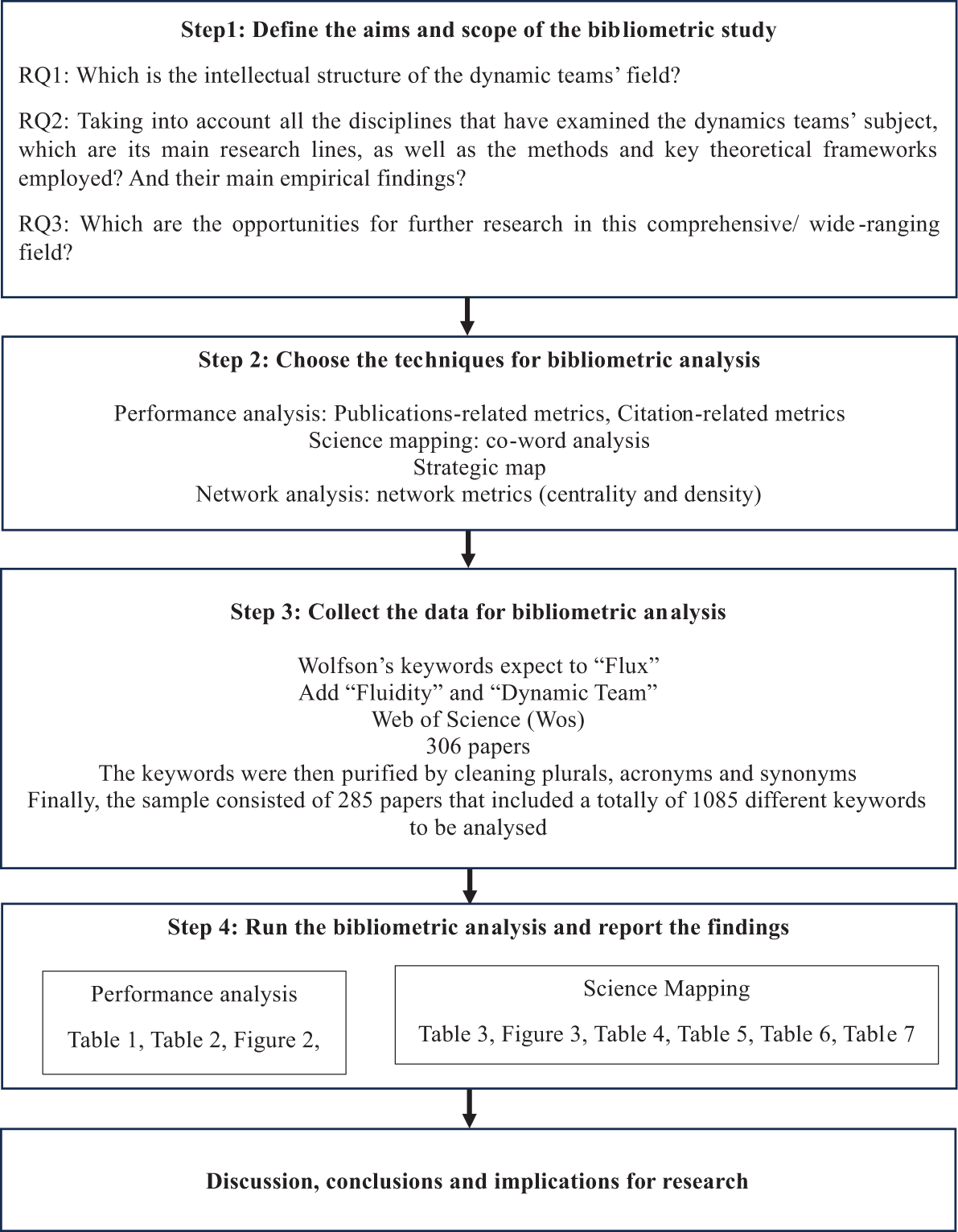
Figure 1 shows a summary of the methodology used for the bibliometric analysis following Donthu et al. (Reference Donthu, Kumar, Mukherjee, Pandey and Lim2021) and the PRISMA protocol.
Bibliometric analysis procedure. Adapted from Donthu et al. (Reference Donthu, Kumar, Mukherjee, Pandey and Lim2021) and PRISMA protocol.

Findings
Descriptive analysis
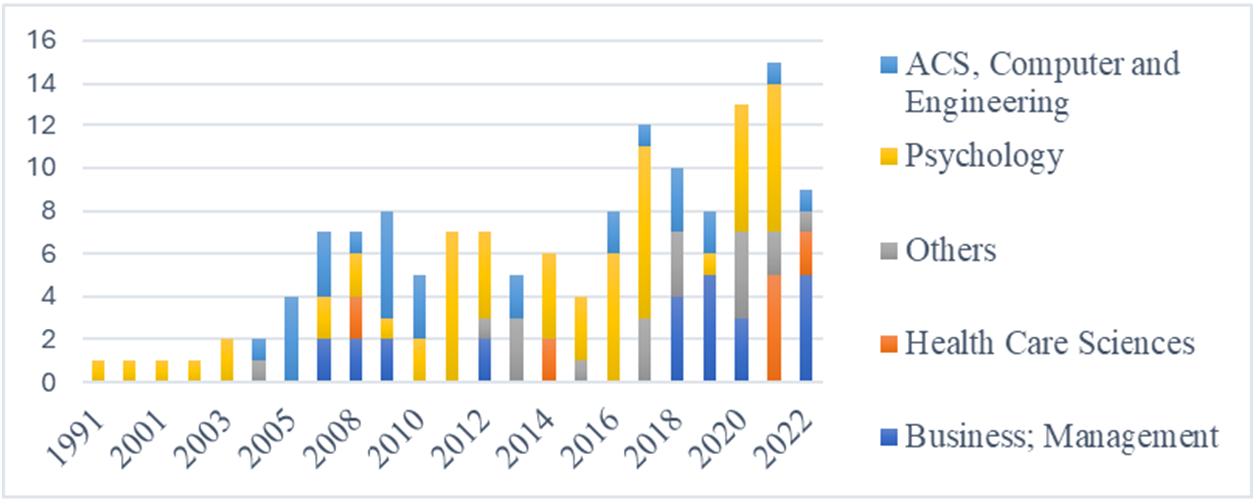
In this section we offer a brief quantitative analysis of the publications, considering the outlets where they were issued as well as its impact factor and their citations to identify the most influential ones (Table 1) as well as the most influential papers (Table 2). Besides, the temporal distribution of the analysed documents and their WoS field categories are shown next (Fig. 2).
Quantitative information about outlets

(a)Source: Web of Science.
(b)The number of keywords shown in the table refers to the total number of keywords in the sample included in the articles published in this journal.
Top 10 most quoted documents in the analysed sample

(a)Average citation refers to the average number of citations per year and is calculated by dividing the total number of citations by the number of years the author or journal has been publishing papers.
As shown in Table 1, the top 10 outlets are organised in terms of total citations, and the most influential ones are Organizational Behavior and Human Decision Process and Journal of Management. Just over 80% of the 143 journals published just one paper on the dynamic teams’ subject. The number of citations was obtained by Web of Science and considering the total number of citations, 67.65% of them were received in 13 journals.
Even when, according to the number of articles issued, Siam Journal on Control and Optimization and Frontiers in Psychology, each with six publications, have shown the greatest interest in our field of study, Organizational Behavior and Human Decision Process may be regarded as the most influential journal due to the highest average number of papers published each year and its highest citations.
As to the indexing of the journals, they were ranked in the quartile indicated at the date of data collection. Table 1 reveals that the most influential outlets are concentrated in the top three quartiles.
It can also be highlighted that interest is focused on the psychology, management, and information systems fields. The journals that have issued the greatest number of research themes within the dynamic teams’ topic are Frontiers in Psychology (6 papers), and Organization Science (4 articles). These publications have looked at 28.85% and 26.92% of the concepts in relation to dynamic teams, respectively. It should be mentioned that 88% of the journals utilised fewer than five concepts, while 9.8% used five to 13 concepts.
Regarding the articles’ contributions to the research field, it can be seen, in Table 2 that, from the top 10 most cited papers (average citations), ‘A Century of Work Teams in the Journal of Applied Psychology’ is the one with the greatest number of average citations. In addition, the two most cited documents, which are literature reviews, show John Mathieu (University of Connecticut, USA) as first author.
Finally, we also aimed to understand the evolution and field composition of the publications of the study. Please see Fig. 2.
Figure 2 reveals that most of the contributions were published in the fields of psychology, business/management and ACS Computer and Engineering. Our study covers a lapse of 21 years, evidencing the novelty of the field as well as a growing interest in it, shown by the upward trend over the years.
Temporal distribution about documents and WoS categories (1991-2022).

Strategic diagram
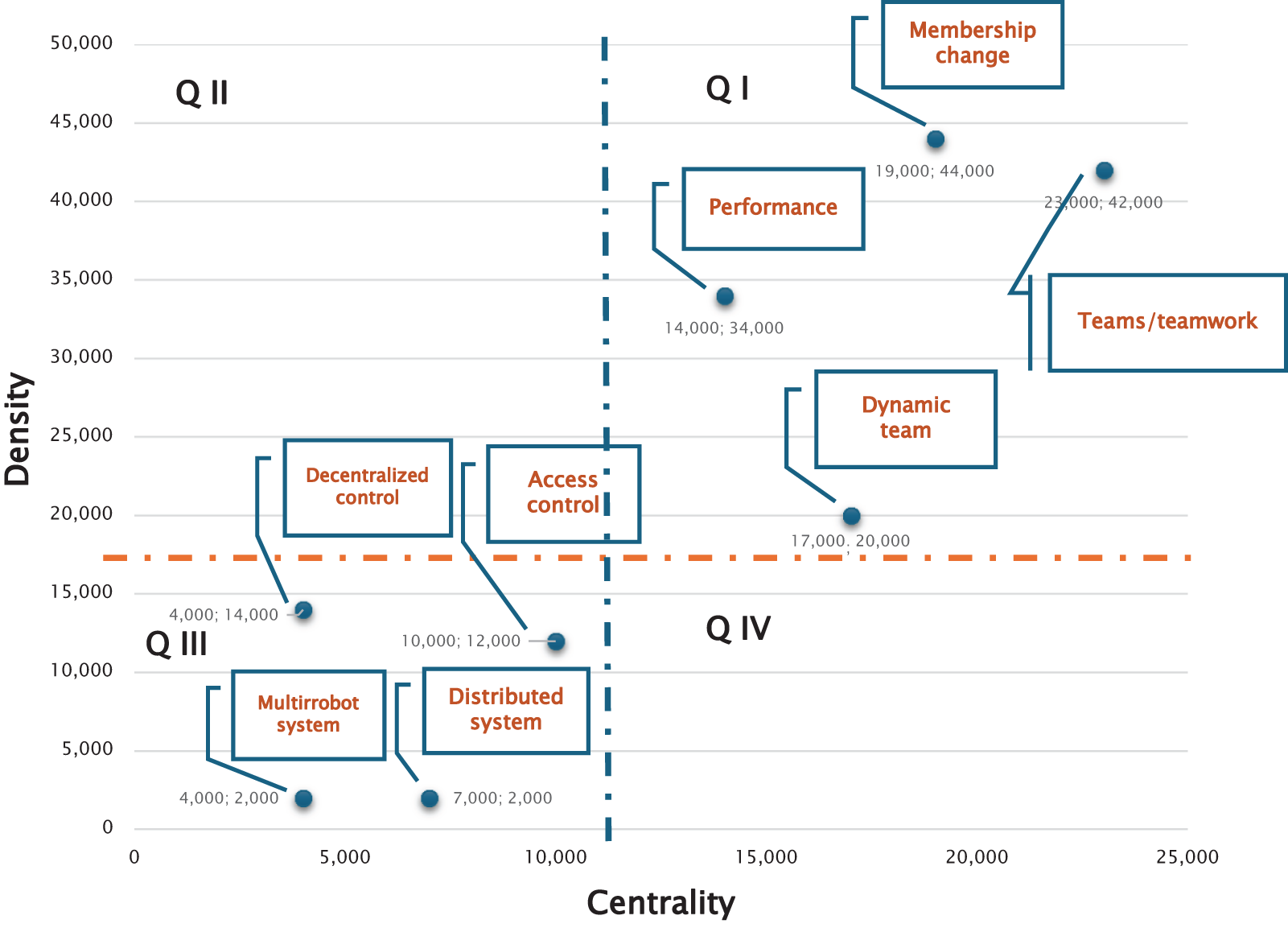
The documents are divided into eight research lines: teams/teamwork, membership change, performance, decentralised control, access control, dynamic team, multi-robot system, and distributed system. To name each of these lines of research we have considered the Freeman index of the keywords that make them up. In this vein, each of the eight lines of research is named by the keyword within its group with the highest Freeman index.
Table 3 lists the research lines, their degrees of centrality and density, the number of topics they cover, and the overall number of citations their papers have received, in descending order of the number of documents.
Quantitative information about the lines of research

According to the findings exhibited in Table 3, the research line teams/teamwork involves the greatest number of documents and themes, is the most frequently cited, and shows the highest number of external links, which is a sign of its degree of centrality. In turn, even when membership change has not received much attention from scholars considering the number of citations, it is the research line with the strongest internal links or the highest degree of development, according to its density. Besides, it is the research line with the highest density index, indicating that the documents are strongly linked to each other and have a higher degree of development. However, it has received less attention from scholars.
Figure 3 illustrates how the eight research lines from the strategic diagram are arranged on the bisector made by the quadrants QI and QIII. According to Callon et al. (Reference Callon, Courtial, Penan and Arenas1995, p. 79), this type of structure is considered as Category 1, ‘a sign that the field is organised around well-structured and developed themes to which a number of peripheral themes are related.’
Strategic diagram.

The motor research lines in the QI quadrant are those that are closely connected among themselves and with others. They represent fundamental research lines of study in the area and show a high degree of centrality, indicating that they have strong ties with other clusters and constitute an integrated area. In addition, they have a high level of density, indicating that they have strong links among them (Callon et al., Reference Callon, Courtial and Laville1991). As to the QIII quadrant, it represents the network’s edges and the thematic regions with lower centrality and density; these are themes that are either emerging or disappearing in relation to the research field. Thus, to assess their contribution it is necessary to compare them with other networks (Callon et al., Reference Callon, Courtial and Laville1991). Additionally, the QII quadrant shows the highly developed and isolated themes. The absence of results in it indicates that no topics have been highly developed. In turn, the lack of outcomes in QIV that contains key and underdeveloped themes reveals that some of the identified emerging themes in our study may develop as part of this quadrant later, as future key themes.
We will analyse the strategic diagram (Fig. 3), which shows how the clusters are spatially arranged, in the following sections.
Peripheral research lines
The peripheral research lines include a total of 55 words which, are divided in four lines access control-, decentralised control-, multi-robot system-, and distributed system- and the keywords are: decentralised control, access control/optimal control, multi-robot system, and distributed system/group creativity. These studies focused on the investigation of problems involving groups of agents or objects that must cooperate to reach decisions, as well as the creation of algorithms to control the modification of access keys in distributed systems and mobile networks.
Access control research line
It includes 17 articles which use the keywords: communication, dynamic membership change, and secure group communication. Group key is the theme with most citations and it is present in most papers. These studies rely on network analysis and are mostly theoretical.
This area of study focused on membership protocols, which are used in mobile networks to manage access keys and regulate communication security. Every time a member changes, the algorithm must adjust the access keys while simultaneously managing the membership and the locations of the members, which causes conflict and reduces performance. One way to deal with this is to scale important changes by developing a hierarchical membership structure. Various models were employed such as ring-based hierarchy (Wang, Cao & Chan, Reference Wang, Cao and Chan2005); tree shape (Kim, Lee, Park & Yoon, Reference Kim, Lee, Park and Yoon2007; Poornima, Aparna & Amberker, Reference Poornima, Aparna and Amberker2007); regions (Cho, Chen & Wang, Reference Cho, Chen and Wang2008); hypersphere representing group members (Tang et al., Reference Tang, Xu, Liu, Huang, Ding and Yang2014) and last encounter routing. Furthermore, the results are measured in terms of communication and computational costs (Lee, Lui & Yau, Reference Lee, Lui and Yau2007; Mansour, Malik, Alkaff & Kanaan, Reference Mansour, Malik, Alkaff and Kanaan2021; Shin, Lee, Dressler & Yoon, Reference Shin, Lee, Dressler and Yoon2016), system performance, network traffic and confidentiality requirements (Cho et al., Reference Cho, Chen and Wang2008) or affected members (Daghighi, Kiah, Iqbal, Rehman & Martin, Reference Daghighi, Kiah, Iqbal, Rehman and Martin2018).
Decentralised control or optimal control research line
Thirteen works in this line of research combine discussions of stochastic control, collective knowledge, team theory, and team decision theory. Decentralised control received the highest number of citations and concentrated the greatest number of papers, making it the most represented topic. The studies are theoretical, and they use decision theory as their framework. Researchers were interested in stochastic teams and conditions for optimal decision making. They analysed the issue of the volume of information transferred among agents and the various interpretations and decision-making processes that go along with it. They discussed stochastic control problems in line with the Witsenhausen’s mathematical model, for real-time communication with noisy channels (Mahajan & Teneketzis, Reference Mahajan and Teneketzis2008); in static and dynamic sequential teams with uncertainty using Witsenhausen’s reduction (Saldi, Reference Saldi2020; Yuksel, Reference Yuksel2020). Other authors concentrated on task assignments and how it affected problem solving (Bauso & Pesenti, Reference Bauso and Pesenti2012; Sanjari & Yuksel, Reference Sanjari and Yuksel2021).
Multi-robot system research line
The keywords of multiagent systems, dynamic team building, and energy efficiency are grouped in 15 documents that represent this line of research. ‘Multiagent systems’ is the theme that has attracted the greatest scholar interest, considering the number of articles and citations. These articles analyse how agents learn to coordinate to cooperate and share pertinent information. The research is mainly theoretical and it is focused on the study of algorithms for decision making in teams formed by agents, robots, or devices that must demonstrate individual and collective intelligence through a joint decision (Fang, Groen, Li & Zhang, Reference Fang, Groen, Li and Zhang2014; Simoes, Lau & Reis, Reference Simoes, Lau and Reis2020; Tavafoghi, Ouyang & Teneketzis, Reference Tavafoghi, Ouyang and Teneketzis2022); besides, coordination is also studied when information is expensive and it is needed to maximise it globally (Knudson & Tumer, Reference Knudson and Tumer2013; Ren, Zhang, Soetanto & Su, Reference Ren, Zhang, Soetanto and Su2012). Other articles apply decision making in various situations, such as manufacturing control and customer order management systems (Jana, Saha, Sarkar & Saha, Reference Jana, Saha, Sarkar and Saha2013), or processes that integrate computing into everyday objects (Casadei, Viroli, Audrito, Pianini & Damiani, Reference Casadei, Viroli, Audrito, Pianini and Damiani2021), or the allocation of radio resources (Kaur & Kumar, Reference Kaur and Kumar2020); and robot trajectory planning (Otte & Correll, Reference Otte and Correll2018).
Group creativity and distributed system research line
The four main topics around the 12 documents that constitute this research line are collaboration, distributed systems, peer to peer, and group creation. Group creativity is the most frequently mentioned theme, while distributed system is the one that appears in the greatest number of articles. The papers are theoretical in nature and rely on systems theory framework, exploring systemic or human group collaboration. Some authors examined the effects of member turnover on the outcome: on group creativity (Choi & Thompson, Reference Choi and Thompson2005; Wu, Nijstad & Yuan, Reference Wu, Nijstad and Yuan2022); the application of common norms (Otten, Buskens, Przepiorka & Ellemers, Reference Otten, Buskens, Przepiorka and Ellemers2021); coordination in aerial robot teams (Acevedo, Arrue, Maza & Ollero, Reference Acevedo, Arrue, Maza and Ollero2013) and project-based teams (Zhou, Luo, Du & Kolmos, Reference Zhou, Luo, Du and Kolmos2010). Other researchers were interested in the iTrust system (Chuang, Reference Chuang2015; Chuang, Melliar-Smith, Moser & Lombera, Reference Chuang, Melliar-Smith, Moser and Lombera2016) and information security (Chuang & Lee, Reference Chuang and Lee2018; Fonseca, Rodrigues, Gupta & Liskov, Reference Fonseca, Rodrigues, Gupta and Liskov2009).
Motor research lines
The motor research lines include a total of 105 papers representing the research lines that are crucial to advance the field. We will detail the themes involved in the cluster as well as the centrality and density measures and the publications that are most representative, taking into consideration this index and the number of citations. Next, due to its relevance, the content analysis was focused on these research lines and its findings are summarised and shown in the tables below.
In the following tables (Table 4 onwards) the results from the content analysis – divided in theoretical and empirical studies – are presented. Moreover, we display, for each group, the theoretical framework, level of analysis (individual, group or organisational), synopsis, and authors.
Summary of findings from performance research line

Performance research line
Twenty articles in this line of research examined performance, experience, key management, multicast security, and performance analysis. As it can be observed from the cluster position in the strategy diagram (Fig. 3), their internal ties are more powerful than their external ones in terms of their measures of association. Performance has received 304 mentions, becoming the most cited subject. Key management is the most covered theme in the documents, with seven mentions.
Most of the documents are theoretical and draw upon the dynamic systems’ theory. Topics centre around the creation of algorithms to manage security keys in systems with dynamic membership. This is essential for human and non-human teams since when team members change, their collective cognition suffers and, this demands them to re-encode information or expend additional effort to return where they were before. Teams work less efficiently as a result of network overload and vulnerability problems. On the one hand, for device teams, the solution is determined using an algorithm, while, on the other hand, research on human members’ teams is primarily experimental and it focuses on team instability factors (Blanchet & Michinov, Reference Blanchet and Michinov2016), team synergy factors (Araujo & Davids, Reference Araujo and Davids2016), and methods to enhance team performance when team membership changes (Hirst, Reference Hirst2009; Huckman, Staats & Upton, Reference Huckman, Staats and Upton2009). This experimental approach has a collective viewpoint and primarily employs quantitative methodologies, with an equal proportion of longitudinal and cross-sectional studies. The samples are composed of human members: employees, managers, or employees from colleges around the world.
Teams/teamwork research line
48 papers contribute to this research line, which can be considered the most representative one, since it covers the greatest number of themes and materials. And it seems to be the one attracting the highest interest from scholars due to the number of citations (1,377). In addition to the previously mentioned keywords, 12 more were identified: network analysis, fluid team, team familiarity, newcomers, team dynamics, team performance, team process, and dynamics. However, its association measures illustrate that it retains strong external and internal links, as shown by its centre position in the strategic diagram (Fig. 3), then, scholars regard these themes as key. The theme that gives the name to the research line has received the highest attention in terms of citations and the number of papers (Table 3).
The theoretical articles’ emphasis is focused on two areas: compositional change and its impacts, and the examination of the temporal behaviour of processes and emergent states. They are conceptualised within the framework of dynamic systems (Table 5). Research on changes in the composition of the team includes theoretical models (Trainer et al., Reference Trainer, Jones, Pendergraft, Maupin and Carter2020; Wolfson et al., Reference Wolfson, D’Innocenzo and Bell2021), methodological and metrics studies (Kerrissey et al., Reference Kerrissey, Satterstrom and Edmondson2020), a categorisation of dynamic teams (Blanchet & Michinov, Reference Blanchet and Michinov2016), and a model of team dynamic diversity (Li et al., Reference Li, Meyer, Shemla and Wegge2018). Having analysed emergent processes and states, their effects on performance are examined from a temporal perspective, either generally (Meinecke et al., Reference Meinecke, de Sanchez, Lehmann-Willenbrock and Buengeler2019) or specifically, exploring team knowledge and cognition or temporal reflection (Koc-Menard, Reference Koc-Menard2009; Salazar, Lant, Fiore & Salas, Reference Salazar, Lant, Fiore and Salas2012; Vogel, Knebel, Faupel-Badger, Portilla & Simeonov, Reference Vogel, Knebel, Faupel-Badger, Portilla and Simeonov2021).
Summary of findings from team-teamwork research line

Regarding the empirical studies, some of them focus on the team performance when members change, including how it affects the task (Van der Vegt, Bunderson & Kuipers, Reference Van der Vegt, Bunderson and Kuipers2010), the firm’s outcome (Lynch, Reference Lynch2019), and the team behaviour, also investigating how it affects performance when teams are human-autonomous hybrids (Demir et al., Reference Demir, McNeese and Cooke2018). Other studies examine the temporal evolution of emergent processes and states, such as positivity and its temporal evolution (Lehmann-Willenbrock, Chiu, Lei & Kauffeld, Reference Lehmann-Willenbrock, Chiu, Lei and Kauffeld2017), familiarity and its temporal evolution (Roberts, Novicevic, Thomas & Kase, Reference Roberts, Novicevic, Thomas and Kase2021), or cohesion and coordination (Braun, Kozlowski, Brown & DeShon, Reference Braun, Kozlowski, Brown and DeShon2020). The most recent focus has been on team cognition and team familiarity (Aksin, Deo, Jonasson & Ramdas, Reference Aksin, Deo, Jonasson and Ramdas2021; Avgerinos & Gokpinar, Reference Avgerinos and Gokpinar2017; Huckman et al., Reference Huckman, Staats and Upton2009) or the use of information resources by central or peripheral members (Valentine, Tan, Staats & Edmondson, Reference Valentine, Tan, Staats and Edmondson2019). As to methodology, they are equally longitudinal and cross-sectional and mainly quantitative. As shown in Table 5, some documents do not include the theoretical framework on which they base their research. Finally, most of the sample’s teams are made up of managers and employees that work for businesses across a variety of industries and nations.
Dynamic team research line
The 21 publications in this line of research are divided into five groups based on the following five keywords: dynamic team, team adaptation, team composition, team cognition, and team membership. This is the second most attractive research line for scholars, having received 674 citations. The measures of centrality and density show that there are moderate internal and external connections. Considering that the dynamic team has the greatest number of publications – 10 –, it is the most representative (Table 2).
As shown in Table 6, the methodology of the publications is mostly theoretical, grounded in the theory of dynamic systems, and composed of human and non-human teams. Theoretical studies predominantly concentrate on two themes: firstly, the fluid composition of teams and its influence on performance (Mathieu et al., Reference Mathieu, Tannenbaum, Donsbach and Alliger2014), and secondly, research on cognition, on how ‘collective intelligence’ is employed to finalise tasks such a selecting a course of action or making a decision (Mahajan & Teneketzis, Reference Mahajan and Teneketzis2008, Reference Mahajan and Teneketzis2009a, Reference Mahajan and Teneketzis2009b), or designing specific training actions in teams of people (Salas, Rosen, Burke, Nicholson & Howse, Reference Salas, Rosen, Burke, Nicholson and Howse2007). In turn, studies focused on group dynamics examine how emergent states or processes, such as confidence or cognitive ability, operate within teams in both stable and changing conditions (Bedwell, Reference Bedwell2019; Kowalzick & Appels, Reference Kowalzick and Appels2023); member change and performance, for their impact on creativity (Guo & Wang, Reference Guo and Wang2017), interdependence (Mayo, Reference Mayo2022), or on integration, learning, or focus on resources or task (Van der Vegt et al., Reference Van der Vegt, Bunderson and Kuipers2010). Regarding the sample, five of them are teams of non-human agents focusing on communication to reach decisions, while most of them are teams of managers and employees from US organisations.
Summary of findings from dynamic team research line

Membership change research line
Thirty-three papers are included in this research line, serving the term ‘membership change’ as their organising principle. And this line involves nine keywords: membership change, social networks and decision-making, knowledge transfer, group learning, groups, and transactive memory. Even when it maintains strong internal connections, as determined by its centrality and density measures, outward connections seem to be a little weaker. While group learning is the topic with most citations, changing membership is the one included in the greatest number of articles.
The theoretical studies focus on understanding the dynamics of affiliation: algorithms for mobile networks to prevent information censorship (Chuang, Reference Chuang2015; Chuang & Lee, Reference Chuang and Lee2018); the temporal selection of teams (Pinto, Reference Pinto2017); performance while taking into account the network’s structure (Shi, Dokshin, Genkin & Brashears, Reference Shi, Dokshin, Genkin and Brashears2017; Wang & Liu, Reference Wang and Liu2021); the absorption capacity (Lee & Chen, Reference Lee and Chen2020); and the adaptation (Bedwell, Ramsay & Salas, Reference Bedwell, Ramsay and Salas2012). But in these research line, studies are primarily empirical ones (Table 7). Concerning the level of analysis, it is group-based, and the samples are composed of managers and staff from businesses and universities from various continents and countries. They explore, for instance, how to use group communication networks to their full potential (Argote, Aven & Kush, Reference Argote, Aven and Kush2018) or draw on the knowledge of veterans and newcomers (Bunderson, Van der Vegt & Sparrowe, Reference Bunderson, Van der Vegt and Sparrowe2014; Kane & Rink, Reference Kane and Rink2015; Lewis, Belliveau, Herndon & Keller, Reference Lewis, Belliveau, Herndon and Keller2007) or make the most organisational knowledge by creating superior group identities (Kane, Reference Kane2010). In turn, others concentrate on how change membership affects performance (Hirst, Reference Hirst2009; Mathiyalakan, Reference Mathiyalakan2002) or on creativity (Choi & Thompson, Reference Choi and Thompson2005; Wu et al., Reference Wu, Nijstad and Yuan2022).
Summary of findings from membership change research line

Table 8 contains a summary of findings by line of research.
Summary of findings by line of research

Discussion
To fulfil our research objectives, we conducted a bibliometric analysis of keywords and a later content analysis of the literature on dynamic teams. We have carefully reviewed the documents that constitute the periphery themes, those that are found in the lower right quadrant of the strategic matrix, as well as the documents that make up the motor themes, those located in the upper right quadrant of the strategic matrix. Additionally, we performed a brief descriptive analysis of the research area.
As to the descriptive findings, Organizational Behavior and Human Decision Process was identified as the most influential journal due to the highest number of citations. Nevertheless, in terms of the number of publications, Frontiers in Psychology and Siam Journal on Control and Optimization are the ones which have shown greater interest in the field. Then, returning to our interdisciplinary lens, outlets from the psychology, organisational behaviour/management and operations field are the key players in the dynamic team literature. This trend is also confirmed taking into account the top three most cited articles.
Concerning the first objective, aimed at identifying the intellectual structure of the field, results reveal the separation of the field into two different areas: the first one related to automation, computer science, and technology, and the second one connected with psychology and management. These two areas, which are based on the idea of dynamic systems, deal with issues related to decision-making, knowledge-sharing, information management, and collaboration in regularly changing teams. It is also seen as crucial to provide team member security and effective change management. Performance and results of the team are the main objectives.
In addition, the research areas in the QIII quadrant, according to Callon et al. (Reference Callon, Courtial and Laville1991), can significantly advance our understanding of teams as dynamic entities. A team of people or non-humans working together to complete a job or achieve an objective is an area of study in both quadrants, QI and QIII (see Fig. 3), and these two quadrants are related in a number of ways. Additionally, their shared research interests include topics like team composition changes, team cognition, and the use of shared knowledge for decision-making. The term ‘dynamic’ is most frequently used to refer to teams whose membership is continually changing, even if it can also apply to changes in events or processes, changes throughout time, or the reasons for change in human teams.
In relation to the second goal, which aimed to identify and analyse the different research lines, the results obtained after the content analysis of peripheral research lines reveal that most of the theoretical studies rely on the dynamic systems theory. The studies adopt a group-based level of analysis and most of them focus on non-human teams of agents or equipment carrying out a similar task. Four key research areas have been identified: access control, which investigates the algorithms used to manage access keys in mobile networks; optimal control and distributed control, which examines the planning and judgement of a group of devices; multi robotic systems, which explores the cooperation and decision-making of robot teams; and distributed systems and group creativity, which studies coordination in distributed systems and creativity in teams that frequently change members. These research areas are studied in disciplines related to automatic and control systems, computing, automation, and engineering.
In turn, in relation to the motor research line, four research lines have been identified: the management of security keys to ensure team members’ affiliation; composition change and emergent processes and states, especially for their effects on group cognition; the effects of member change on results for their effects on group cognition, knowledge management, learning, and decision-making. As to the type of studies, there is an equal number of theoretical and empirical ones, and the predominant framework is the dynamic systems theory even when some scholars drew upon network analysis. Finally, 25.5% of the research focuses on teams composed of non-human members from a group study perspective. The empirical ones, on the other hand, centre on the team/teamwork and membership change research lines, which are focused on the study of fluid teams, collaboration, familiarity, functioning, member fluidity, transactive memory, group learning, and team knowledge. These studies are primarily cross-sectional (64.4% of them), with equal representation for qualitative and quantitative approaches and only a few of them use a combined methodology (0.04%). Furthermore, surprisingly, 34% of the papers – most of which are experimental investigations based on earlier research – do not explicitly mention the theoretical framework they rely upon. The articles’ multidisciplinary nature is highlighted by their affiliation with different disciplines including psychology, management, economics, informatics, artificial intelligence, robotics, nursing, medicine, and sociology, among others. The change of members, on the other hand, focuses either on the entry of members, the exit of members, or the entry of members and the exit of members. Researchers refer to the latter case as team fluidity or fluid membership when it happens frequently.
Regarding our third objective, related to the opportunities for further research taking into account all the disciplines involved, we will offer some of our views below and our suggestions in the next section.
We consider that there is an urgent need for an agreed the definition about what a dynamic team is. The examined studies are based on the idea that teams are dynamic because members’ locations and/or composition may vary. While some scholars define change as the influx and exodus of members, others understand it as a shift in diversity, and in other instances, authors refer to the traits of the members. As a result, the team is regarded as dynamic either due to changes in the team’s composition, location, relationships, and features, or due to modifications in processes and emerging states throughout time. Then, the study of the dimensions or agents of change, such as events (Trainer et al., Reference Trainer, Jones, Pendergraft, Maupin and Carter2020), agents of instability, or characteristics of dynamic teams, offer another point of view about dynamics (Blanchet & Michinov, Reference Blanchet and Michinov2016). However, other studies refer to a dynamic team without defining it, making it unclear what they are referring to. Additionally, researchers occasionally use the same words to describe various occurrences. For instance, turnover is described as ‘a form of membership change including the departure and/or arrival of one or more members’ (Hom et al., Reference Hom, Lee, Shaw and Hausknecht2017, p. 1) and as ‘a type of departure and/or arrival of members’ (Van der Vegt et al., Reference Van der Vegt, Bunderson and Kuipers2010, p. 4). This definition of turnover is related to the idea of frequent membership changes, which is used to describe fluid teams: ‘teams that function for a limited amount of time, after which they dissolve and their members can work together as part of another team’ (Avgerinos & Gokpinar, Reference Avgerinos and Gokpinar2017, p. 1). On the other hand, when members are on numerous teams at once, researchers also refer to dynamic teams as multiple teams (Fodor et al., Reference Fodor, Curseu and Meslec2021).
In teams of individuals, it is assumed that when members join and leave the team, they bring or take their talents, abilities, knowledge, other diverse qualities with them. As a result, there is a mismatch between the ‘skill sets’ before and after the transition, which reduces the efficacy of the team. It can sometimes help to transfer resources and have a good impact, but it can also have a negative impact on the team’s cognition (Li et al., Reference Li, Meyer, Shemla and Wegge2018). The question then becomes how team constructions or traits, such as familiarity (Aksin et al., Reference Aksin, Deo, Jonasson and Ramdas2021), cognition (Valentine et al., Reference Valentine, Tan, Staats and Edmondson2019), or collaboration (Otten et al., Reference Otten, Buskens, Przepiorka and Ellemers2021) change as team members change and how this affects performance. On the other hand, this argument suggests that, in order to maintain or improve effectiveness, teams can be reconfigured according to specific members’ qualities and can attain the perfect combination of team traits. These studies offer us crucial knowledge about how teams function. Nevertheless, organisations frequently are unable to create a certain mix, so they must make the most of the competencies they already have to provide with the greatest results.
Moreover, in device teams, knowledge management constitutes a critical issue: Who knows what and how is it shared? This relates to the secure exchange of information and the planning and collaboration of systems that share information for decision making, with a focus on team cognition. A key difference between human and non-human studies is that in the latter, the focus is on the information shared because the relationship is based on information and decision making, which is the team’s goal, whereas in human teams, the focus is on the team’s goal and the relationships between members.
Finally, other theoretical studies centre on the ‘dynamic’ of processes or emergent team states, either from a temporal point of view (Braun et al., Reference Braun, Kozlowski, Brown and DeShon2020; Lehmann-Willenbrock et al., Reference Lehmann-Willenbrock, Chiu, Lei and Kauffeld2017), or the effect of member changes on a particular phenomenon, e.g., on cooperation and because of normative disagreement (Otten et al., Reference Otten, Buskens, Przepiorka and Ellemers2021) or on familiarity in fluid team outcomes (Roberts et al., Reference Roberts, Webster, Salmon, Flin, Salas, Cooke and Stanton2022).
As to the theoretical frameworks, although dynamic systems theory is the dominating one in human team samples, not all studies rely on a theoretical background, and it is frequently employed as a definition of teams. Additionally, the research still contains an implicit representation of the causal input-process-outcome paradigm. Because of this, the team is perceived as a collection of causal links that do not accurately reflect the emergent and dynamic characteristics of team functioning (Hackman, Reference Hackman2012).
Limitations
Despite the rigorous and reliable approach of the bibliometric analysis, this study could be subject to some limitations. Firstly, even when we believe that we obtained a sufficiently reliable sample because we selected articles, reviews, and early access exclusively from WoS, one of the most prominent and well-respected database in the field of social sciences (Nájera-Sánchez, Mora-Valentín, Ortiz-De-Urbina-Criado & Moura-Díez, Reference Nájera-Sánchez, Mora-Valentín, Ortiz-De-Urbina-Criado and Moura-Díez2019); the integration of other data sources such as Scopus could expand the sample of this study.
Secondly, the choice of keywords may have biased the results, although the keywords of the Wolfson research have been expanded and refined. We chose to refer to the subject of our research, dynamic teams, rather than the broader terms teams or groups, in accordance with the nomenclature which Wolfson et al. (Reference Wolfson, D’Innocenzo and Bell2021) used, to characterise the notion of dynamic teams in the literature.
Thirdly, there is also a degree of subjectivity in the keyword normalisation criteria. However, to make this research replicable, all decisions were recorded in detail. Besides, co-word analysis also has its limitations due to term changes over time (Leydesdorff, Reference Leydesdorff1997) and its inability to differentiate between influential and less relevant connections. Thus, complementary qualitative analyses or expert validations could enhance the robustness of our findings.
Finally, the difficulty of establishing a balance between giving a comprehensive overview and simultaneously focusing on the content’s most pertinent details, which invariably involves the authors’ own viewpoint, is one of the limits of bibliometric work (Zupic & Cater, Reference Zupic and Cater2015). In this sense, complementing this co-word analysis with other types of techniques, such as network visualisation, could enrich the understanding of this area of study.
Implications for research
We outline a future research agenda based on our analysis.
Regarding methodology, theoretical studies may concentrate on investigations into the root causes of variability and features of change in teams other than changes in composition. As already stated, and in line with the suggestions made by Ramos-Villagrasa et al. (Reference Ramos-Villagrasa, Marques-Quinteiro, Navarro and Rico2018), future research might concentrate on understanding dynamic teams. In order to do this, scholars might evaluate what is dynamic in teams, as well as the emerging processes and states, how and with whom they relate, by effectively utilising the theory of dynamic systems. In the same vein, network theory may aid to develop a comprehensive understanding of the team and the relationships that develop within it. The integration of several research areas, such as work on composition, adaptability, affiliation, and cognition with work on teams employing new methodological tools, such as the work of Meinecke et al. (Reference Meinecke, de Sanchez, Lehmann-Willenbrock and Buengeler2019), could conform another contribution to the field. To strengthen communication among researchers and fields, future studies could focus on defining the concept of dynamic teams or identifying the various types of dynamic teams, their dimensions, similarities, and differences. It would also be beneficial to encourage the transferability of findings from one type of team to another.
Longitudinal studies in empirical research were found to refer to relatively short periods of time. To better understand the dynamics of processes and emergent states, future studies could consider analysing data over longer periods of time and employing qualitative and mixed-methods research approaches. As to samples, health teams, project teams, and crew teams have been studied as samples of dynamic teams with high variability, or so-called fluid teams. Nevertheless, teams in organisations can take many different forms, so future research could focus on how the findings obtained in prior literature could be generalised or not to other types of teams.
Future studies could also go more into organisational and individual views, for instance, about how organisations adapt and function when they are organised as dynamic teams, or what ratio of stable and dynamic teams is most efficient in attaining organisational objectives. Similar to this, as these phenomena are shaped by interactions among members and share a multilevel character, future research may benefit from concentrating on the general study of ‘dynamic’ emergent processes and states (Kozlowski, Reference Kozlowski2015). Additionally, because these phenomena have historically been researched in ‘static’ teams, there are unsure if it is possible to apply what we know about how they work to what occurs in dynamic teams (Hackman, Reference Hackman2012). Moreover, because studies are based on teams that have already been created, additional scenarios in which members are added, dropped, or changed are not considered in the research. Work on the creation or reorganisation of many dynamic teams, for instance, at the same time as mergers, facilities openings, or new designs. The same is true when members leave all at once or gradually due to size modifications (Mathieu et al., Reference Mathieu, Tannenbaum, Donsbach and Alliger2014).
A particularly fertile venue for future studies concerns the circumstances in which dynamic teams are effective, how the organisation may contribute to this, and the extent to which the findings on turnover can be generalised to other types of member turnover, given that the organisational perspective has also received less attention. Future studies may also include existing understanding about how teams, people, and organisations adjust to new member arrivals and departures as well as fluidity traits.
Our opinion is that there is a large research field for the interdisciplinary study of teams that include autonomous systems or artificial intelligence as members. Technology is enabling the creation of automated device systems with varying degrees of autonomy, and teams are being formed with both human and non-human members. In the near future, the formation of human teams with autonomous systems or artificial intelligence will probably have the greatest impact on team composition. For instance, our research suggests that cooperation, communication, and cognition issues are crucial in teams of agents in non-human environments (Mahajan & Teneketzis, Reference Mahajan and Teneketzis2008; Otten et al., Reference Otten, Buskens, Przepiorka and Ellemers2021; Tang et al., Reference Tang, Xu, Liu, Huang, Ding and Yang2014), which will open up new research opportunities to examine how knowledge is integrated in human-autonomous teams. It will be feasible to research and develop the most effective training for people working with these autonomous systems if people are aware of how teams of agents or robots operate. Studying task allocation between human and non-human members can be a very intriguing area of research since, similarly, teams of devices try to find the optimal approach to make a goal-directed decision, and job allocation is extremely crucial for the effectiveness of the decision.
Finally, to enhance the relevance of the research results obtained, this research could be complemented as a bibliographic linkage analysis that uses the number of references shared by two documents as a measure of the similarity between them (Zupic & Cater, Reference Zupic and Cater2015). The results of this research could be confirmatory results of bibliographic linkage providing further robustness to the mapping of the knowledge field.
Practical implications
As to practical implications, considering that membership change was the research line that offered the greatest number of empirical studies within the motor theme, and relying on the non-linear dynamic systems framework, we propose that managers could play a key role regarding their interventions, for example, reducing the cognitive decline of the team in the case of the most active member’s departure (Hojbota, Rusu, Curseu & Constantin, Reference Hojbota, Rusu, Curseu and Constantin2023) or increasing the creativity of ‘old timers’ and open groups (Choi & Thompson, Reference Choi and Thompson2005). In addition, HR managers could also contribute to the cognition of teams if they prepare the newcomers to be socially accepted by preparing them through the onboarding process and ask them to use an integrating language-based strategy (i.e., plural pronouns) instead of the differentiating one (i.e., singular pronouns) (Kane & Rink, Reference Kane and Rink2015).
Conclusion
In the current work, we have conceptually examined the substance of the literature on dynamic teams as well as the connections between the various research strands. Through this bibliometric analysis, results revealed that the research field of dynamic teams is organised around two distinct blocks, which takes an integrative perspective, and they consider various disciplines, methodologies, and publications. These two blocks maintain some links that can be further explored in the future. First, there is the field of autonomous systems, computers, and engineering, where team members are not human and are concerned in membership, information security, coordination, and decisions. The second is the area of psychology and business/management, where team members can be human or non-human and where the emphasis is on team composition, cognition, coordination, and adaptation to changes in the team. With this paper, we contribute to the cross-disciplinary dissemination of research and the organisation of the field of study of teams as dynamic entities by linking works that have remained scattered throughout the literature. We hope that our contribution will serve as a roadmap for future study in this significant field.
Data availability statement
The raw data supporting the conclusions of this article are available from the author upon reasonable request.
Competing interests
The authors declare none.
Elena Fernández-Gascueña is professor at Facultad de Ciencias de la Economía y la Empresa, Universidad Rey Juan Carlos. She has worked for 25 years in the Spanish publishing industry, in different positions. She is PhD student, and her research interests lie in teams and behavioral economics. Rey Juan Carlos University, Email: elena.fernandez@urjc.es
Luisa-Eugenia Reyes is senior professor at Facultad de Ciencias de la Economía y la Empresa, Universidad Rey Juan Carlos. Her research interests lie in corporate governance (area in which she developed her doctoral thesis, obtaining the award of the Social Economic Council of the Community of Madrid), corporate social responsibility and entrepreneurship, currently the areas of development are focused on managerial skills, talent management and innovation in business and entrepreneurship. Rey Juan Carlos University, Email: luisa.reyes@urjc.es
Maria Rita Blanco is professor at Facultad de Economía y Empresa, Universidad Nebrija. Her research interests lie in talent management and careers. Her research has been published in several journals including, Personnel Review, The International Journal of Human Resource Management, and Human Resource Development International. Nebrija University. Email: mblancdo@nebrija.es





 Open access

