

Introduction
The refinement of ancient DNA (aDNA) studies has been one of the most important developments in archaeology over the past two decades. Next Generation Sequencing (NGS), the recovery of dense concentrations of endogenous DNA from the petrous bone of the human skull, and the sequencing of entire human genomes (the complete set of genetic information for a given organism) have revolutionized the investigation of biological relationships among past human populations (Eisenmann et al. Reference Eisenmann, Bánffy and Van Dommelen2018, 1; Jones & Bösl Reference Jones and Bösl2021, 236; Linderholm Reference Linderholm2016). One of the most striking findings of aDNA analysis has been that the dispersal of domesticated species of plants and animals from western Asia into Europe occurred in tandem with that of a distinct set of human genetic lineages, suggesting a pattern of migration across the continent (Reich Reference Reich2018, 101; Robinson Reference Robinson2010). More recently, a similar approach has been employed to address the vexed question of the beginning of the Neolithic in Britain (Brace et al. Reference Brace, Diekmann and Booth2019, following initial analyses reported in Olalde et al. Reference Olalde, Brace and Allentoft2018). Genomes for six British Mesolithic and 67 British Neolithic skeletons have been acquired and compared, and a pattern of discontinuity has been discerned between the two. On average, greater than 56 per cent to 74 per cent of the genetic ancestry of people of Early Neolithic date in Britain is identified as having been ultimately derived from Aegean Neolithic Farmers (ANFs) (Brace et al. Reference Brace, Diekmann and Booth2019, 766). Comparable results have been reported in Ireland, although there are suggestions that here the proportion of indigenous hunter-gatherer ancestry in Neolithic genomes was rather smaller (Cassidy et al. Reference Cassidy, Martiniano, Murphy, Teasdale, Mallory, Hardwell and Bradley2016; Reference Cassidy, Maoldúin and Kador2020, supplementary information 4).
Neolithic economic and material resources proliferated into Europe through two distinct ‘routes’: along the Mediterranean basin to Italy, the south of France and Iberia, and through the Balkans to central Europe and the north European plain (de Vareilles et al. Reference de Vareilles, Bouby, Jesus, Martin, Rottoli, Vander Linden and Antolín2020, 1). Brace and colleagues argue that people living in Britain during the Neolithic period generally had a closer genetic affinity to Neolithic populations in Iberia than those in central Europe, although connections with the latter were also represented in Britain to a lesser extent, particularly in England. Haplotype matching and inferred ancestry coefficients suggested significant genetic connections between Neolithic populations in Iberia, Britain and Ireland (Brace et al. Reference Brace, Diekmann and Booth2019, 767). Brace and colleagues consequently argue that groups from Iberia, who already possessed a significant hunter-gatherer ancestry, may have entered France either along the Atlantic seaboard or via southern France, and that British Neolithic populations were closely related to these (Brace et al. Reference Brace, Diekmann and Booth2019, 769).
The Mesolithic population of Britain belonged to a grouping defined by some geneticists as Western Hunter-Gatherers (WHGs), who are distinguished from contemporary foragers in Scandinavia and Eastern Europe. WHG ancestry is present in the genomes of almost all analysed individuals of Neolithic date in Britain, at levels that are among the highest in Neolithic populations anywhere in Europe (Lipson et al. Reference Lipson, Szécsényi-Nagy and Mallick2017, 370). Despite this, Brace and colleagues argue that, in contrast with other areas of the continent, there was no increase in hunter-gatherer ancestry in later stages of the British Neolithic, and therefore no surviving indigenous population continuing in parallel with the continental incomers, and later absorbed by the latter. Furthermore, they suggest that WHG ancestry is only manifested within the most recent 10 generations of Neolithic genomes in Britain in one area, western Scotland. The inference is that this is the only place in Britain where an appreciable hunter-gatherer introgression took place, and that elsewhere the WHG component of Neolithic genomes was more ancient, and must have been acquired on the continent, before these people had arrived in Britain. The variable proportion of hunter-gatherer ancestry in different parts of the country is attributed to the presence of multiple continental source populations, who already had varying proportions of WHG admixture, entering different areas of Britain (Brace et al. Reference Brace, Diekmann and Booth2019, 769). However, since the genomes with the highest proportions of WHG ancestry are found in northern and western Scotland, this would demand that areas like Orkney and Caithness had been colonized directly from the continent.
The conclusion that Brace and colleagues come to is therefore that ‘the appearance of Neolithic practices and domesticates was mediated overwhelmingly by immigration of farmers from continental Europe, and [we] strongly reject the adoption of farming by indigenous hunter-gatherers as the main process’ (Brace et al. Reference Brace, Diekmann and Booth2019, 769). These immigrant communities were immediately able to thrive within the British landscape because they had already mastered the appropriate technologies and practices required to conduct an agropastoral way of life in northern and western Europe (Brace et al. Reference Brace, Diekmann and Booth2019, 770).
Migrants and natives
The work of Brace and colleagues is a landmark achievement, and it seems beyond question that substantial numbers of people of continental origin entered Britain during the earlier part of the Neolithic period. It is therefore incumbent on archaeologists such as the present author who have previously emphasized the importance of insular processes in the emergence of the British Neolithic (e.g. Thomas Reference Thomas2013) to take this evidence into account. However, rather than accept the proposed model of swift colonization and population turnover at face value, the intention of this contribution is to consider whether alternative interpretations can be presented to account for these findings, by addressing the social mechanisms of change and the temporal structure of the processes involved. While the argument developed here will rely on some of the current debate on archaeogenetics, this is employed primarily as a heuristic, in order to arrive at a new and hopefully novel interpretation. This is not intended to be definitive, but should be seen as a means of opening up debate by exploring the possibilities suggested by different strands of evidence, including the aDNA itself. Brace and colleagues present an argument that can (perhaps unintentionally) be read to present human migration as an event rather than a process, and to suggest that the multifarious developments of the British Neolithic were grounded in a discrete episode (or series of episodes) of folk movement. Further, their argument appears to imply (again, perhaps unintentionally) that population biology, cultural practices and subsistence economy exhibited a high degree of mutual congruence, so that innovative things and practices were the largely exclusive prerogative of communities with distinctive genetic characteristics. Finally, they frame their argument in terms of population replacement, and present a narrative in which the hunting and gathering populations of Britain were quickly displaced by pioneer farmers, owing either to the greater numbers of the latter, or their superior organization and subsistence practices. These points suggest a stepwise model of social evolution, in which people who have one assemblage of artefacts and practices and a distinctive genetic inheritance neatly replace those with another. Such a perspective arguably lacks the messiness, intricacy and complexity of real social life.
It has often been noted in recent years that ancient DNA studies have a tendency to default to notions of mass migration that resemble the arguments of culture-historic archaeology in the earlier twentieth century (Furholt Reference Furholt2018, 162). These latter sometimes incorporated the notion of passive indigenes being overwhelmed by culturally superior migrants (Holton Reference Holton2004, 176; McNiven & Russell Reference McNiven and Russell2005, 88). DNA-based models of swift and comprehensive population change sometimes conflict with other aspects of the evidence, as has been noted in the case of the Beaker period in Britain and Ireland (Carlin Reference Carlin2020, 32). Indeed, it has been argued that a focus on the putative activities of large and internally homogeneous social entities promotes a concern with sudden and abrupt events rather than entangled or incremental processes (Lewis-Kraus Reference Lewis-Kraus2019, 18). Ancient DNA evidence undoubtedly represents ‘big data’ (Kitchen Reference Kitchen2014, 2; Van Valkenburgh & Dufton Reference VanValkenburgh and Dufton2020), since each genome relates to very large numbers of ancestors (Armit & Reich Reference Armit and Reich2021, 1468). Despite this, geographically extensive studies have sometimes been generated from a modest number of samples, introducing a scalar tension with conventional forms of archaeology which may be more fine-grained in their focus. Further, aDNA analysis does not directly identify the specific geographical locations in which these many ancestors resided and encountered one another. Consequently, it is open to interpretation how far an isolated genome will be representative of the local population at the time and place where a person died and was buried. The results therefore need to be integrated with other classes of evidence (Jesch Reference Jesch2021, 226). However, narratives of sudden and sweeping population change have proved particularly attractive to the popular media (Jones & Bösl Reference Jones and Bösl2021, 246; Kallén et al. Reference Kallén, Mulcare, Nyblom and Strand2019, 72), who are sometimes given to reporting such findings in a lurid and sensationalist fashion (e.g. Pinkstone Reference Pinkstone2019). It is for this reason that it is important to question whether a model of hunter-gatherers being swiftly and comprehensively displaced by farming migrants is the only valid interpretation of Neolithization in Britain. Having said that, it is clear that the authors of the original paper discussed here are sensitive to these issues, and in some cases have been at pains to demonstrate how attention to the fine detail of archaeogenetic evidence can undermine overgeneralized narratives (Booth et al. Reference Booth, Brück, Brace and Barnes2021, 379).
Although it can be suggested that migration has been under-explored in recent archaeology (Kristiansen Reference Kristiansen2014, 14; Reference Kristiansen and Daniels2022), a renewed interest in the topic need not involve a return to culture-historic modes of explanation (Crellin & Harris Reference Crellin and Harris2020, 40). David Anthony and others have developed sophisticated conceptions of human mobility, which emphasize that the abrupt transplantation of entire populations is quite rare (Anthony Reference Anthony1990; Van Oyen Reference Van Oyen, Heitz and Stapfer2018). As Anthony (Reference Anthony, Chapman and Hamerow1997, 27) memorably puts it, ‘cultures don't migrate, people do’. Established archaeological views of population movement often implicitly treat past societies as internally undifferentiated, responding collectively to external pressures as if they were integral organisms. Arguably, this approach owes something to the late nineteenth-century belief that each human population had an enduring ‘character’ or essence, which expressed itself in art and material culture, and which formed a strand of continuity between modern nations and their ancient ancestors (Voutsaki Reference Voutsaki2002, 111). In practice, historical and ethnographic observations demonstrate that most migrants are single persons or sub-groups who have detached themselves from a larger community in order to achieve some form of perceived advantage (see below), and that their movement takes the form of a protracted and fluctuating stream rather than a short-lived wave (Burmeister Reference Burmeister2000, 540). The consequence of this is that migrant communities seldom amount to displaced social totalities, whose organization, composition and leadership survive in unmodified form, derived from a unique place of origin. On the contrary, societies that include migrants are often hybrids, composed of the shards and fragments of a number of other groups, frequently marginal in character, and emerging at the fringes of existing social entities (Kopytoff Reference Kopytoff and Kopytoff1987, 5).
Archaeologists have often presumed that migration was something that was imposed upon communities by resource depletion, climatic decline, population pressure, epidemics, religious schisms, or conflict with other groups. Migration is therefore understood as a kind of crisis response (Frieman & Hofmann Reference Frieman and Hofmann2019, 534). This is of a piece with the belief that migration is something that affects entire social units: it is occasioned by some kind of external causal agency, whether human or environmental, and responded to at a superorganic level (Blakey Reference Blakey2020, 1; Leppard Reference Leppard2014, 486). But there are problems with these proposed extrinsic prime movers. For instance, Anthony points out that there will be no law-like relationship between population density and migration, since the former is always culturally defined. Conversely, he suggests that the positive incentives to population movement have not always been addressed in sufficient detail: it is important to identify both ‘push’ and ‘pull’ factors (Anthony Reference Anthony, Chapman and Hamerow1997, 22). Migration can be a social strategy that is engaged in as a choice rather than a reaction, often for reasons of personal advancement or self-realization (Duff Reference Duff and Spielmann1998, 31; Hakenbeck Reference Hakenbeck2008, 19). For Anthony, out-migration is mostly a consequence of social segments fissioning from a parent community, as a means of taking advantage of opportunities of various kinds. At the same time, migrating may involve dangers or discomforts, and not all people will be willing to accept (or are capable of enduring) the risks and stresses involved (Hofmann Reference Hofmann2015, 464; Leppard Reference Leppard2014, 489). This will often mean that migrants are a self-selecting minority who desire to change their circumstances or achieve greater independence, and this may not include the old, the infirm, infants, or those who enjoy positions of authority, influence and wealth in their existing location (Duff Reference Duff and Spielmann1998, 32). Those who do relocate are often disgruntled or disinherited persons, who opt to leave a particular area for a plurality of reasons: disputes over marriage or inheritance, personal feuds and vendettas, the failure of crops or herds, witchcraft accusations, or unresolved ambitions (Kopytoff Reference Kopytoff and Kopytoff1987, 6). Moving to another region may enable these people to obtain greater prestige or wealth and to accumulate followers or clients. One way in which this can be achieved is by acquiring the status of a ‘founder’, the person who brings a new kin group or political entity into being (Anthony Reference Anthony, Chapman and Hamerow1997, 23).
Migration on the small scale is virtually ubiquitous in human societies, and we should surely expect a degree of continuous genetic ‘churn’ throughout prehistory, which need not always correspond with major horizons of cultural or economic change. While people obviously do sometimes enter unpopulated landscapes as pioneers, it is far more common for them to attach themselves to existing groups (Anthony Reference Anthony, Chapman and Hamerow1997, 23; Duff Reference Duff and Spielmann1998, 34). It is more unusual for groups to set off to colonize places about which they have no information, and generally they will prefer locations where they already have established friends, exchange partners or kin (Brown & Sanders Reference Brown, Sanders, DeJong and Gardner1981, 150). At the very least, they may enter zones where they have previously engaged in hunting, trapping, scouting, or resource acquisition. This is particularly the case for agriculturalists, for whom an ignorance of local environmental conditions can be fatal (Meltzer Reference Meltzer, Rockman and Steele2003).
The problem of admixture
As we have noted, in much of Britain the WHG contribution to genomes dated to the fourth millennium bc is greater than most of those documented elsewhere in Europe for the same period (Lipson et al. Reference Lipson, Szécsényi-Nagy and Mallick2017). It is significant that one area where hunter-gatherer ancestry amongst Neolithic groups was also substantial was in Iberia, where large Mesolithic populations had been concentrated on the Atlantic coast of Portugal, in the Algarve and on the Sado and Tagus estuaries (Zilhão Reference Zilhão2001). However, it appears that in this region hunting and farming groups were gradually merging over a very long period, between 6000 and 3000 bc (Rivollat et al. Reference Rivollat, Jeong and Schiffels2020, 4). While Brace and colleagues suggest that groups from Iberia may have made their way to Britain by way of France, this is somewhat at odds with the existing evidence. The dispersal of Cardial-Epicardial Neolithic people from the ‘Mediterranean arch’ of the Côte d'Azur, Languedoc, Valencia and Catalonia took the form of a radial expansion along the river corridors of the Rhone, Garonne and Ebro (Guilaine Reference Guilaine, Fowler, Harding and Hofmann2015, 94; Hamon & Manen Reference Hamon and Manen2021, 720). Neolithic populations were established in the Aquitaine basin appreciably earlier than on the coast of Cantabria (Arias Reference Arias, Cummings and Whittle2007, 60; Perrin et al. Reference Perrin, Manen, Valdeyron and Guilaine2018, 322), and there is less indication of any movement eastwards from Spain into France. The genetic similarities between Neolithic people in Iberia, France and Britain arguably derive from their common origin in the percolation of Impressa groups into the western Mediterranean, so that French and Iberian Neolithic populations should be seen as having developed in parallel, rather than one having been derived from the other. Indeed, it appears that Neolithic populations in Britain were significantly more closely related to those of northern France than those of Spain or Portugal in genetic terms (Rivollat et al. Reference Rivollat, Jeong and Schiffels2020, 7). Moreover, the comparatively high proportion of WHG ancestry identified in Iberian Neolithic genomes did not reach its peak until a time by which the Neolithic had already begun in Britain, and this may cast some doubt on whether British Neolithic populations originated in Iberia.
Brace and colleagues argue that, with a few isolated exceptions, the population of Neolithic Britain had already acquired their hunter-gatherer ancestry before they arrived in these islands. The necessary condition for this to have been the case is that there must have been Neolithic donor populations in continental Europe that had already accumulated a rich hunter-gatherer genetic inheritance before Neolithic activity had begun in Britain, towards the end of the fifth millennium bc. Although the advent of the Neolithic across Europe was accompanied by changes in the composition of human populations, it is widely acknowledged that this involved a mosaic of diverse, localized processes of change (Robb Reference Robb2013, 660). The proportion of hunter-gatherer admixture amongst Neolithic people varied across northern and western Europe, although it generally became progressively greater as time went on (Fernandes et al. Reference Fernandes, Strapagiel and Borówka2018, 4). Although in Iberia there was a very slow increase in WHG ancestry between the Early Neolithic and the Chalcolithic, in much of northwest Europe there was a more marked rise in the representation of the WHG genetic inheritance from the late fifth millennium bc onwards (Lipson et al. Reference Lipson, Szécsényi-Nagy and Mallick2017, 4), a period in which many ‘hunters became farmers’ (Louwe Kooijmans Reference Louwe Kooijmans, Louwe Kooijmans, Fokkens and Van Gijn2005, 249). In contrast, there was only a very modest WHG contribution in any Linearbandkeramik or immediately post-LBK genome in Europe (Bickle Reference Bickle, Leary and Kador2016, 17; Bramanti et al. Reference Bramanti, Thomas and Haak2009; Haak et al. Reference Haak, Balanovsky and Sanchez2010). At the regional scale, the integration of Mesolithic and Neolithic populations nonetheless appears to have been a protracted process, rather than a singular event. Thus, in the Middle Elbe–Saale area of Germany, which has for some while been a focus for intensive archaeogenetic investigations (Vander Linden Reference Vander Linden2016, 718), the pattern is of a gradual escalation in the contribution of indigenous hunter-gatherers to the genetic history of Neolithic communities, covering the period between 4100 and 3100 bc (Brandt et al. Reference Brandt, Haak and Adler2013, 260). Significantly, this development had barely begun before the start of the British Neolithic. A similar pattern has recently been identified further to the west among a series of genomes sequenced from human remains from two hypogea at Mont-Aimé in the Paris Basin, which suggest the fusion of Neolithic and Mesolithic populations over the period between 4300 and 3800 bc (Seguin-Orlando et al. Reference Seguin-Orlando, Donat, Der Sarkissian, Dulén, Guilaine and Orlando2021, 1072). Similarly, the Wartberg collective burial at Nierdertiefenbach near Koblenz (3300–3200 bc) produced genomes with a very significant hunter-gatherer ancestry, yet the admixture of hunters and farmers was here calculated to have taken place in 3860–3550 cal. bc (Immel et al. Reference Immel, Pierini and Rinne2021, 4).
We have seen that Brace et al. (2019, 4) argue that only a small number of Neolithic genomes from Britain give an indication of hunter-gatherer admixture at any point in the most recent 10 generations or so, all identified in western Scotland. In order to identify the date at which the remaining WHG ancestry had been acquired they employed a program called ALDER, which works on the principle of linkage disequilibrium (Slatkin Reference Slatkin2008, 477). ALDER estimates the last date at which admixture between two distinct populations took place, expressed as a number of generations, on the basis of the recombination-induced breakdown of blocks of ancestry over time (Lipson et al. Reference Lipson, Szécsényi-Nagy and Mallick2017, 9). However, the results of the analysis may be compromised if there have been multiple episodes of admixture between similar populations, resulting in a kind of palimpsest (Lipson et al. Reference Lipson, Szécsényi-Nagy and Mallick2017, 12). In order to overcome the problem that there will probably have been numerous such episodes involving WHG and ANF populations in western Europe, Brace and colleagues combined groups of genomes to produce estimates of the number of generations since introgression last took place in different parts of Britain. While some of those for western Scotland were very recent, those for other parts of the country are surprisingly ancient. Assuming a duration for each generation of 28 years, and calculating from 3600 bc (the approximate radiocarbon date attributable to many of the British genomes), the dates estimated for the last introgression of WHG are: 6988 bc for Wales, 6624 bc for southeast England, 5642 bc for central England, and various dates between 6063 bc and 4323 bc for southwest England (Brace et al. Reference Brace, Diekmann and Booth2019, appendix 3). Most of these dates appreciably predate the first Neolithic presence in northern France, and the older ones precede any Neolithic activity in the western Mediterranean. They are therefore unlikely to date the last admixture between ANF and WHG elements in these genomes accurately. This may not affect the paucity of WHG ancestors in the past ten generations of genomes from Neolithic Britain, but it potentially does open up the question of when they acquired their hunter-gatherer inheritance.
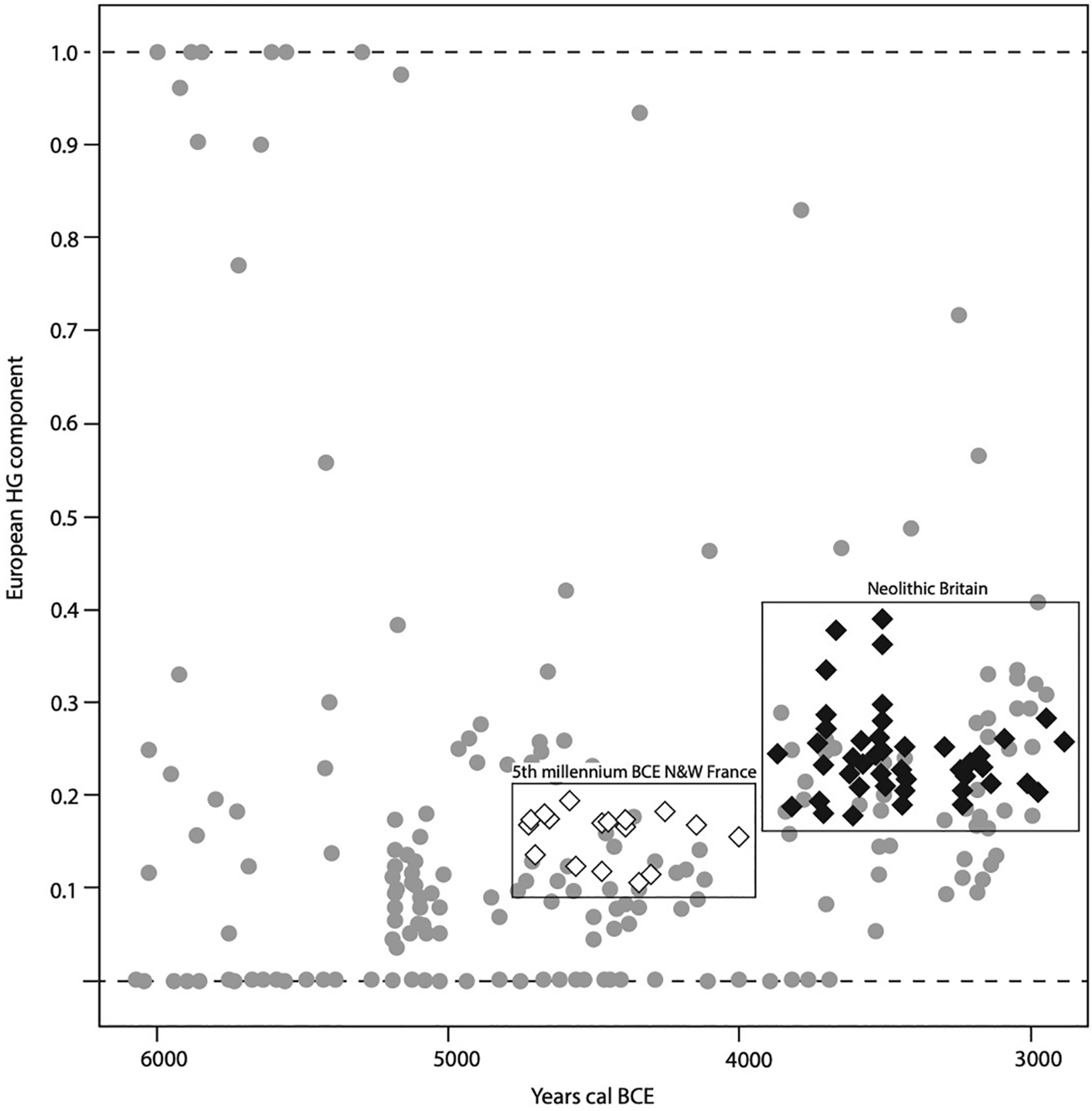
More recently, Rivollat and colleagues have used a different program, DATES, to estimate when WHG admixture took place amongst populations from various parts of Britain and Ireland. The dates presented are 5030 bc for England, 4347 bc for Wales, 5376 bc for Scotland and 5103 bc for Ireland (Rivollat et al. Reference Rivollat, Jeong and Schiffels2020, supplementary material S17). All of these are consistent with a plausible date for interaction between Neolithic groups and hunter-gatherers in northern France. However, these estimates present admixture as a singular discrete event, and do not entertain the possibility of protracted or sporadic interactions. In the same publication, a series of new genomes are reported for populations who might reasonably be expected to represent the donor communities for Neolithic migrants to Britain, retrieved from various parts of northern and western France and dating to the fifth millennium bc. They include samples from Fleury-sur-Orne in Normandy, Gurgy ‘Les Noisats’ in the Paris Basin and Prissé-la-Charrière in Deux-Sèvres. All of these reveal a proportion of WHG ancestry with a mean value of around 15 per cent throughout this period, significantly lower than fourth-millennium results from Iberia or Britain. This is consonant with the view that these populations had not migrated into France from Iberia, but directly from Mediterranean France. Rivollat and colleagues’ results reveal a clear step-change between these French genomes and the British examples, with their mean WHG component of around 26 per cent (see Figure 1). Archaeogenetic work has been relatively scarce in northern France, in part owing to soil conditions that are inimical to the preservation of bone in general and DNA in particular. It may be that as more fifth- and fourth-millennium bc genomes are investigated, proportions of WHG ancestry more comparable with those from Britain will begin to emerge, although the argument presented by Brace and colleagues depends upon there having been a number of such populations, each with different but elevated levels of hunter-gatherer ancestry. But on present evidence it appears that genomes from fourth-millennium bc Britain had acquired an additional 11–12 per cent of WHG genetic inheritance over and above those from fifth-millennium bc France. The most obvious explanation is that further admixture must have taken place in Britain, but this is clearly difficult to reconcile with the argument that there was no recent WHG element in British Neolithic genomes. However, for the sake of argument, we will explore the implications of this possibility.
Proportions of HG ancestry over time amongst genomes in Europe, emphasizing the relationship between genomes from fifth-millennium bc northern and western France, and from the British Isles. (After Rivollat et al. Reference Rivollat, Jeong and Schiffels2020, with amendments.)
Rates of change
The observation that the coalescence of Mesolithic and Neolithic populations in Europe was generally a gradual process rather than a series of discrete regional episodes prompts a consideration of the rate at which both the arrival of migrants and the potential integration of different communities within Britain occurred. One of the arguments that Brace and colleagues deploy in support of the notion that indigenous populations did not long survive the arrival of continental migrants is that there was no resurgence of WHG ancestry later in on the Neolithic (Brace et al. Reference Brace, Diekmann and Booth2019, 770). This suggests a very particular model of migration, in which a coherent pioneer group enters a landscape and lives for a period in parallel with the local hunter-gatherers. Only after a considerable interval of coexistence do the two blend together. This kind of pattern has indeed been observed in areas such as Saxony and Westphalia, where Mesolithic hunter-gatherers and Linearbandkeramik farmers occupied mutually exclusive areas of the landscape for an appreciable time (Hofmann Reference Hofmann2015, 465). But this can be attributed to the very specific character of the LBK expansion, in which groups ‘budded off’ from parent communities to colonize homogeneous and ecologically predictable areas of loess plateau that were little used by foragers. Other patterns are possible: the movement of migrants may have been extended and progressive rather than sudden and episodic, and convivial or intimate relations with the indigenes may have existed from the start, rather than having been deferred for many generations.
Certainly, the archaeological evidence increasingly does not support the view that hunter-gatherers disappeared from the British landscape swiftly and without trace. On the basis of chronological modelling, Griffiths (Reference Griffiths2014, 24) has demonstrated that groups pursuing Mesolithic and Neolithic lifeways continued to exist alongside each other for some centuries in northern England, and there are suggestions that this may have been the case in other parts of Britain as well (Elliott & Griffiths Reference Elliott and Griffiths2018, 357; Wickham-Jones et al. Reference Wickham-Jones, Noble and Fraser2020, 36). In Wiltshire, Gron et al. (Reference Gron, Rowley-Conwy, Fernandez-Dominguez, Gröcke, Montgomery, Nowell and Patterson2018) argue that the distinctive deposits in the large pit known as the Coneybury Anomaly resulted from coordinated activities on the part of groups of hunters and farmers during the thirty-eighth century bc, three centuries after the start of the Neolithic. In the much later case of the British Chalcolithic, it has recently been suggested that significant numbers of people of Neolithic ancestry survived alongside newcomers with Steppe and other continental origins after 2450 bc (Booth et al. Reference Booth, Brück, Brace and Barnes2021, 382). These groups remained archaeogenetically invisible for a period, since they practised funerary rites such as cremation that do not provide suitable samples for DNA analysis, and only began to have children with the incomers after 2000 bc. Yet if relations between indigenous Mesolithic people and continental migrants were initially cordial, but had soured as the numbers of the latter had gradually increased, leading to the marginalization and out-competition of the former, we should not expect this kind of ‘return’ to the genomic record. We should further remember that later Mesolithic people in Britain also treated their dead in ways that are largely archaeologically invisible, which is why Mesolithic genomes have proved so difficult to acquire (Conneller Reference Conneller, Conneller and Warren2006).
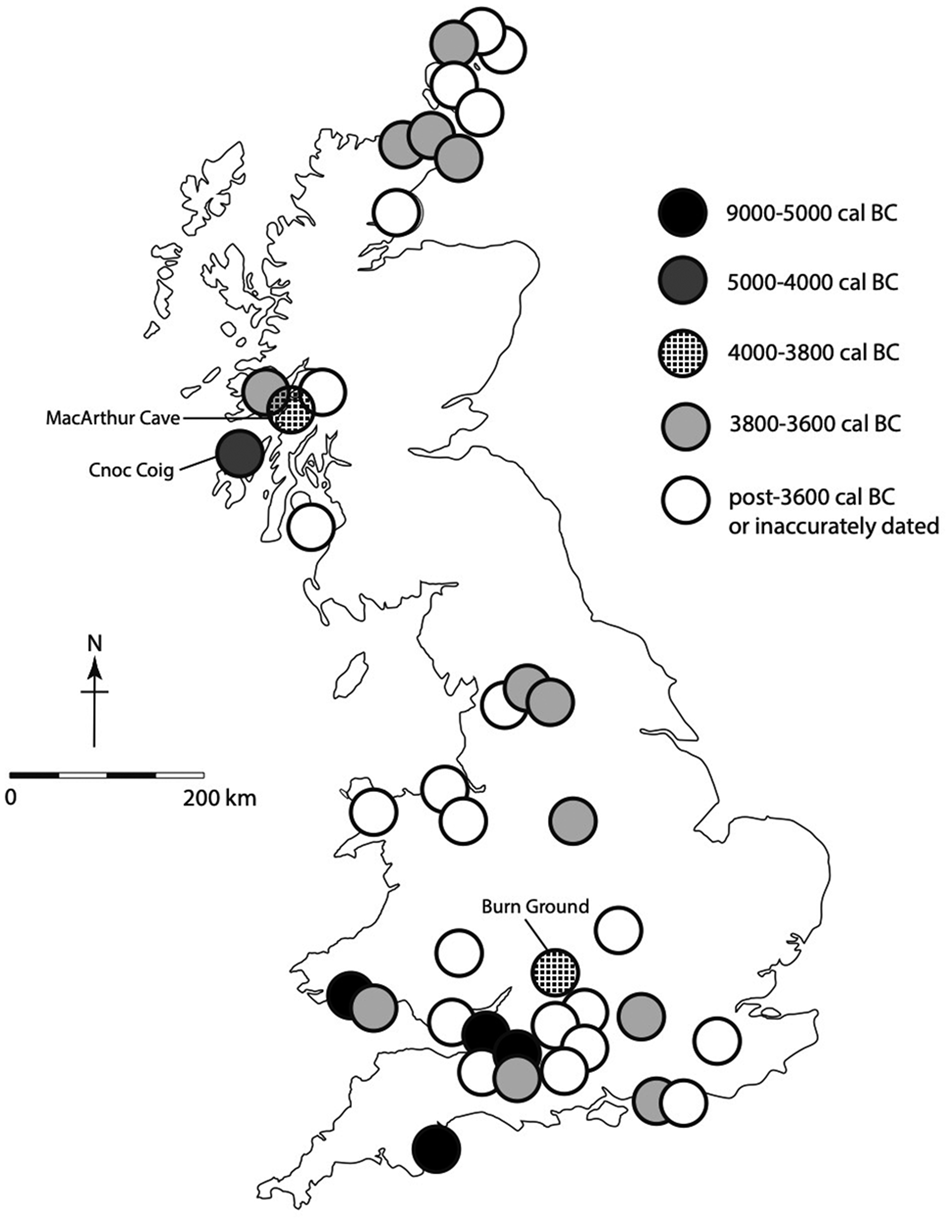
Only one of the hunter-gatherer genomes reported by Brace and colleagues, that from Cnoc Coig on the Hebridean island of Oronsay, dates within the final three millennia of the Mesolithic (4256–3803 cal. bc: SUERC-69249), and there may so far be none that relate to the first two centuries or more of the British Neolithic. The earliest genomes cited from Neolithic contexts in Britain are from the Burn Ground long cairn in Gloucestershire (3930–3710 cal. bc: OxA-17173) and MacArthur Cave near Oban (3952–3781 cal. bc: SUERC-68701) (Fig. 2). Around 95 per cent of the existing British Neolithic genomes date to the second quarter of the fourth millennium bc or later, and many to later than 3500 bc. The paucity of data across the Mesolithic–Neolithic boundary should not be a problem, since each genome contains DNA inherited from many hundreds of ancestors, which would clearly cover that time. But beyond 10 generations, the number of ancestors represented by stretches of ancestral DNA in a given genome increasingly becomes a fraction of the real total (Reich Reference Reich2018, 11). Since most of the British Neolithic genomes in the sample date to periods 15 to 20 or more generations after the first appearance of Neolithic artefacts and activities in Britain, they might reveal only an indistinct picture of what was going on in the earliest part of the period. This would be complicated further if these ancestors had not all arrived in Britain simultaneously, at the start of the Neolithic, but had migrated sporadically over a period of some centuries. It would be even more problematic if the scale of migration had escalated over time, starting modestly but becoming more extensive. Any individual genome might then constitute an unpredictable patchwork of local and continental population histories, which might to some extent occlude developments that had taken place in the forty-first and fortieth centuries bc. That is to say, if the reproducing population of Britain were being periodically and increasingly ‘topped up’ with continental migrants during the Early Neolithic, it might prove hard to untangle the genetic profile of the earliest Neolithic. The problem is that we know little of the rate at which population change took place in Britain, whether swiftly (within a couple of generations) or gradually (over a period of some centuries).
Locations of samples used for genomic analysis by Brace and colleagues, with radiocarbon dating indicated. (After Brace et al. Reference Brace, Diekmann and Booth2019, with additions.)
One form of evidence that complements the genomic data in providing information about when people had moved between regions is provided by strontium and other isotopic measurements from human teeth and bones, which indicate whether a person was buried in a location remote from their place of birth and upbringing. At the Whitwell long cairn in Derbyshire, seven of the 10 skeletons analysed produced results suggesting that they had spent all or some of their childhood in a region whose geology resembled that of northwest France (Neil et al. Reference Neil, Evans, Montgomery and Scarre2020, 10). This was also the case for one skeleton from the Penywyrlod long cairn in the Black Mountains of Wales (Neil et al. Reference Neil, Montgomery, Evans, Cook and Scarre2017). Yet all of these bodies were interred in the period around 3700 bc, three or four centuries after the start of the British Neolithic. According to the calculations presented by Johannes Müller (Reference Müller, Kristiansen, Šmejda and Turek2015, 210) on the basis of a range of different sources of demographic information, the population of Middle Neolithic mainland Britain might be expected to have been of the order of 120,000 people. If migrants were continuing to travel from the continent throughout the period between 4100 and 3700 bc or later, allowing for only a modest level of population growth, this might mean that no more than a few hundred people had arrived in Britain during any particular year, a trickle rather than a ‘massive migration’. Having said this, it is rather improbable that the rate of migration would have been constant throughout the whole of this period. So can we address the question of when and where migration took place?
Timing and continuity
Brace and colleagues suggest (2019, 768) that the population change that they detect from its genetic signature probably began in the period 3975–3725 bc, and perhaps in the thirty-ninth century bc, manifesting itself earlier in the west than the east of Britain. This contrasts to some extent with the most comprehensive analysis of the radiocarbon dating of the British Neolithic transition so far available, which concludes that Neolithic activity was first established rather earlier than this, in the southeast of England (specifically in the Thames Estuary and Kent), in 4145–4005 bc (Whittle et al. Reference Whittle, Healy and Bayliss2011, 204). The introduction of the new IntCal20 radiocarbon calibration curve may shift this estimate slightly, but is unlikely to bring about a major revision of the sequence (Bayliss et al. Reference Bayliss, Marshall, Dee, Friedrich, Heaton and Wacker2020, 1068). More recent work has extended the dating of the Early Neolithic flint mines of Sussex back to the start of the fourth millennium bc (Edinborough et al. Reference Edinborough, Shennan, Teather, Baczkowski, Bevan, Bradley and Schauer2020). Arguably, there is reason to suppose that their origins may even be slightly earlier. The existing dates come from a small excavated sample, often recovered in fieldwork conducted in the earlier twentieth century, from groups of mine shafts that were opened and used sequentially, and among which the earliest workings were often hidden by the upcast from the later ones (Barber et al. Reference Barber, Field and Topping1999, 58). It is unlikely that the available radiocarbon evidence relates to either the earliest or the latest flint extraction that took place at each complex. Future work may therefore bring the earliest Neolithic activity in southeast England back to around 4100 bc, although perhaps not much earlier.
Another account of the beginning of the Neolithic in Britain, which again departs a little from the chronology outlined by Whittle, Healy and Bayliss, is that proposed by Sheridan (Reference Sheridan, Whittle and Cummings2007; Reference Sheridan, Finlayson and Warren2010), who identifies a series of separate events of colonization, each precipitated by distinct pressures and crises in different parts of northwest Europe (see Table 1 for a comparison of these different models of Neolithization in Britain). The first of these was an abortive attempt to settle southwest Ireland from northwest France, in the third quarter of the fifth millennium bc, revealed by the presence of bones of domestic cattle at the Mesolithic site of Ferriter's Cove in Co. Kerry (Woodman & McCarthy Reference Woodman, McCarthy, Armit, Murphy, Nelis and Simpson2003). Subsequently, groups identified by the construction of tombs with small closed chambers, and simple passage tombs, dispersed from Brittany into the areas surrounding the Irish Sea in the period between 4300 and 4000 bc (Sheridan Reference Sheridan, Finlayson and Warren2010, 92). Thirdly, from around 4000 bc, people who used Carinated Bowl pottery and brought with them a range of innovations including cereal cultivation, cattle herding and polished stone axes, spread from northeast France and Belgium into eastern Britain, and thence to Ireland (Sheridan Reference Sheridan, Whittle and Cummings2007). Finally, in the first quarter of the fourth millennium bc, a further burst of colonization brought people from Normandy into southern and western Britain, bringing distinctive pottery styles, slightly different types of passage tombs and small drystone-built monuments with closed chambers, which sometimes formed the primary element of chambered long cairns in the Cotswold–Severn region (Sheridan Reference Sheridan, Finlayson and Warren2010, 99). It is notable that only this latest, ‘trans-Manche west’ strand of migration is fully congruent with the chronology proposed by Brace and colleagues (although they do not explicitly exclude Neolithic beginnings before the thirty-ninth century). It is of course conceivable that significant numbers of people with ANF ancestry were already present in Britain before the thirty-ninth century bc, and that their DNA has simply not yet been sampled, perhaps for taphonomic reasons. But it is also worth considering whether Neolithic innovations had been introduced to southeast England some centuries before the more marked and substantial movements of population took place. This would contradict the argument that the disjunction between Mesolithic and Neolithic material culture indicates that Britain had been culturally isolated from the continent during the fifth millennium bc, and that contact was only re-established by the arrival of migrant groups (Sheridan Reference Sheridan, Finlayson and Warren2010, 89).
Comparison of models of Neolithization in Britain proposed by Sheridan (Reference Sheridan, Whittle and Cummings2007; Reference Sheridan, Finlayson and Warren2010), Brace et al. (Reference Brace, Diekmann and Booth2019) and Whittle et al. (Reference Whittle, Healy and Bayliss2011), and the alternative proposed in this contribution.

In practice there is a growing corpus of evidence that supports Garrow and Sturt's (Reference Garrow and Sturt2011) general view that there was extensive maritime activity in the waters surrounding Britain and Ireland before the start of the Neolithic, involving contacts between potentially quite diverse societies. This includes the presence of T-shaped antler axes of continental Neolithic inspiration found in Late Mesolithic contexts on both sides of the North Sea (Elliott Reference Elliott2015), land snails that may have been imported to Ireland from Iberia during the seventh or eighth millennia bc (Carlsson et al. Reference Carlsson, Cross, Mcginnity, Prodöhl and Mcdevitt2014), the presence of a microlithic assemblage of northeast French affinity at Old Quay, St Martin's on the Isles of Scilly (Garrow & Sturt Reference Garrow and Sturt2017), and the discovery of an oak post from an immediately pre-Neolithic context at Maerdy in Glamorgan which bears carved concentric oval and zigzag decoration reminiscent of Breton megalithic art (Jones Reference Jones2014; Jones & Díaz-Guardamino Reference Jones and Díaz-Guardamino2019, 84–5). There is also the more contentious discovery of wheat DNA in a Mesolithic sedimentary context at Bouldnor Cliff, Isle of Wight, whose age and authenticity now appear to be relatively secure (Callaway Reference Callaway2015; Smith et al. Reference Smith, Momber and Bates2015; Watson Reference Watson2018; Weiß et al. Reference Weiß, Dannemann, Prüfer and Burbano2015). Furthermore, I have suggested elsewhere that some of the Alpine jadeitite axes found in Britain, which were often manufactured before the start of the British Neolithic and are rarely found in closed Neolithic contexts, may have arrived in cross-Channel exchanges conducted during the later fifth millennium bc (Thomas Reference Thomas2013, 282). There may therefore have been at least sporadic contacts across the English Channel before 4000 bc, which might have had only a limited impact on the DNA record, depending on whether the exchange of marriage partners was involved.
It has sometimes been suggested that the later Mesolithic communities of Britain were not only isolated, but sparsely distributed and culturally impoverished (see, for example, Miles Reference Miles2016). In all probability there was considerable variation in patterns of settlement, mobility and subsistence during this period (Preston & Kador Reference Preston and Kador2018), although a picture of very numerous small sites that had been repeatedly returned to is quite widespread throughout much of Britain, in a variety of different environments (Champness Reference Champness2014; Simmonds et al. Reference Simmonds, Hosfield, Branch and Black2019, 52; Waughman Reference Waughman2017, 12; Wickham-Jones et al. Reference Wickham-Jones, Noble and Fraser2020). However, there are also sites like Stainton West in Cumbria (Brown Reference Brown, Hey and Frodsham2021) and Blick Mead in Wiltshire (Jacques & Phillips Reference Jacques and Phillips2014, 24), which attest dense accumulations of population and appreciable logistical sophistication. Studies that employ numbers of radiocarbon dates as proxies for population size, concluding that later Mesolithic people were few in number (e.g. Bevan et al. Reference Bevan, Colledge, Fuller, Fyfe, Shennan and Stevens2017), neglect the systematic underrepresentation of mobile hunter-gatherers in the radiometric record (Elliott et al. Reference Elliott, Little, Warren, Lucquin, Blinkhorn and Craig2020, 1161). Similarly, there may be a growing tendency to rely on models of hunter-gatherer population derived from genomic evidence, but these may estimate the effective reproducing population rather than the census population (Matsumura & Forster Reference Matsumura and Forster2008). Depending on a variety of aspects of population and kinship structure, this may result in a very considerable underestimation of the actual living community (Storz et al. Reference Storz, Ramakrishnan and Alberts2001). Furthermore, the sizes of hunter-gatherer populations may be far more volatile and dynamic than long-term archaeological estimates predict, ultimately limited but not determined by ecological conditions (Tallavaara & Jørgenson Reference Tallavaara and Jørgensen2021). In contrast to these results, Tallavaara, Eronen and Luoto (Reference Tallavaara, Eronen and Luoto2018, 1234) argue on the basis of ecological productivity, biodiversity and levels of pathogen stress that hunter-gatherers should be expected to have been relatively abundant in postglacial Britain (particularly in western coastal areas), when compared with more recent foraging populations known from ethnographic investigations.
Elsewhere, Keith Ray and I have pointed to the extensive evidence for the re-use of places and objects across the boundary between the Mesolithic and Neolithic (Ray & Thomas Reference Ray and Thomas2018, 57–66). Gron et al. (Reference Gron, Rowley-Conwy, Fernandez-Dominguez, Gröcke, Montgomery, Nowell and Patterson2018, 9) object that Neolithic people may have disturbed earlier features and reburied their contents, or they may simply not have noticed small stone tools that found their way into the contents of pits or middens. But this does not really do justice to the richness of this material: the curation of Mesolithic tools and faunal remains into the Neolithic; the construction of chambered tombs over Mesolithic occupation sites and middens; the insertion of Neolithic burials into Mesolithic shell middens; the re-digging of Mesolithic pits, and the introduction of Neolithic artefacts into them; the construction of later monuments and buildings close to Mesolithic pits and post settings. In few cases is there anything that could be identified as direct continuity between the two periods, although the newly excavated site of Windy Harbour on the Fylde peninsula may prove an exception (Brown Reference Brown2020). More often, the pattern is one of the recurring spatial or contextual co-occurrence of material from the two periods (Healy Reference Healy, Debert, Larsson and Thomas2016). In some cases it might be possible to dismiss this evidence as mere coincidence, but it is clearly non-random in character, occurring in some kinds of places and not others. Thus, traces of Mesolithic occupation are rarely found in the ditches or beneath the banks of causewayed enclosures (Whittle Reference Whittle, Barclay, Field and Leary2020, 82).
This kind of evidence is found in many parts of Britain, including southeast England, where Neolithic artefacts and practices arguably occurred earliest. Thus at the Chestnuts megalithic tomb, near Addington in Kent, the monument was superimposed on an extensive Mesolithic occupation site, and the excavator believed that little time had elapsed between the two periods of use (Alexander Reference Alexander1961, 5); while at White Horse Stone, also in Kent, the Neolithic timber hall may have overlain the traces of a much older Mesolithic wooden structure (Hayden & Stafford Reference Hayden and Stafford2006; Ray & Thomas Reference Ray and Thomas2018, 77). We suggest that locations of Mesolithic activity were often recognized as ‘ancestral places’, and that their significance continued to be acknowledged over long periods. That non-western communities can be highly attentive to the most intimate traces of past occupation has been demonstrated by ethnographic evidence (Urwin Reference Urwin2019, 11). The landscape inhabited by the earliest Neolithic communities in Britain was not a blank canvas, but was densely freighted with the vestiges of the past, to which further marks and monuments continued to be added as time progressed. While artefactual assemblages demonstrate considerable discontinuity from the Mesolithic, the earliest Neolithic communities in Britain operated in ways that indicate a familiarity with the landscape and a comprehension of the importance of specific persistent places. This suggests a continuity in the understanding of place over time, which is difficult to reconcile with the picture of a sudden wave of colonists, before whom the hunting peoples melted away into obscurity.
A minimal Neolithic?
Looking at Europe as a whole, John Robb (Reference Robb2013, 667) has pointed out that the various components of the Neolithic ‘package’ sometimes first appeared independently in particular regions, only later gaining coherence and interdependence. Whittle, Healy and Bayliss (2011, fig. 14.179) observe that in many parts of Britain and Ireland cereals, domesticated animals, plain pottery, timber buildings and funerary monuments all became established within a short period of time. But the earliest Neolithic in southeast England was rather different, with the first occurrence of the separate elements more temporally dispersed. Indeed, it might be possible to identify a ‘minimal Neolithic’ in this area prior to 3900 bc. Here, funerary monuments were absent and timber buildings were few in number, although flint mines had already begun to be worked. Ceramic assemblages were very small, and composed of a narrower range of vessel forms than the continental repertoires that inspired them (Thomas Reference Thomas2013, 371). Leaf-shaped arrowheads appeared, but they were technologically distinct from those of the Michelsberg, and thus potentially copied rather than straightforwardly transferred (Anderson-Whymark & Garrow Reference Anderson-Whymark, Garrow, Anderson-Whymark, Garrow and Sturt2015, 70). Chipped flint assemblages from this period contain only very modest numbers of diagnostically Neolithic tool types, such as polished axes, arrowheads, certain types of knives and laurel leaves, and are dominated by elements that could equally be Mesolithic in inspiration. On the basis of a simulation study, Cummings and Morris (Reference Cummings and Morris2018, 7) argue that the numbers of cattle introduced into Britain at the start of the Neolithic may have been very small, only developing into larger herds over many decades. Equally, a Bayesian chronological analysis by Seren Griffiths (Reference Griffiths2018, 5) indicates that there might have been only modest levels of cereal cultivation in Britain before 3800 bc. The composition of crop assemblages at that time suggests that they may have been introduced from northwest France rather than the Low Countries, which reinforces the impression that they were not prominent amongst the first Neolithic novelties to arrive in Britain (McClatchie et al. Reference Whitehouse, Schulting and McClatchie2014, 8).
This earliest Neolithic in Britain might, as Whittle, Healy and Bayliss (Reference Whittle, Healy and Bayliss2011, 859) suggest, have represented a discrete episode of colonization by a small number of people from somewhere in northeast France or the Low Countries. Only gradually, through sustained connections with a putative homeland, would these people have achieved the critical mass necessary to expand out from the southeast tip of England. But this evidence might equally by explained by an intensification of long-established cross-Channel links, and the progressive introduction of individual Neolithic innovations by hybrid communities composed of natives and increasing numbers of migrants, drawn from a variety of continental locations. Such newcomers might have established themselves in positions of authority and influence from an early date, presiding over the construction of timber halls and the opening of flint mines. In other words, they might have had the status of David Anthony's ‘founders’ of new social groups. Their halls, mines and other projects can best be seen as integral to a process of social transformation, rather than merely reflecting the transfer of a pre-given Neolithic identity.
The same might be said of the distinctive Carinated Bowl pottery of the period, the earliest of which had affinities with assemblages from northeast France and the Low Countries rather than Normandy or Brittany (Barclay Reference Barclay2008, 5; Pioffet Reference Pioffet2017, 6). Shared by a series of different cultural traditions on the continent, among which they generally only represented a small part of an assemblage (Seidel Reference Seidel, Heitz and Stapfer2017, 108), fine, sharply carinated upright bowls arguably represented an example of what the sociologist Susan Leigh Star referred to as ‘boundary objects’ (Star & Griesemer Reference Star and Griesemer1989, 387). A boundary object is an entity that can be employed or understood in different ways by different constituencies, in situations where heterogenous communities of social actors come into contact, and must find a common framework for cooperation, coexistence or interaction. What provides them with the capacity to function in this way is their distinctiveness and ease of recognition. Pottery vessels, as objects involved in hospitality and the sharing of food, used conspicuously in encounters between people with different social or cultural backgrounds, are ideally suited to serve as boundary objects. Since similar pots would have been manufactured and used by quite different societies across a significant area of northwest Europe, they would have represented a readily comprehensible means of integrating and coordinating communities and persons who had been brought up within different cultural traditions, both Neolithic and hunter-gatherer. This would also explain why they were the first pots introduced into hitherto aceramic regions such as Britain, where interactions may have been taking place between native communities and incomers, and new hybrid groups may have been coming into being.
One of the notable conclusions of the chronometric analysis presented in Gathering Time was that the spread of Neolithic artefacts and activities escalated appreciably during the thirty-eighth century bc, extending to southwest England, Wales, Ireland and lowland Scotland from this time onwards (Whittle et al. Reference Whittle, Healy and Bayliss2011, 862). We have seen that it has also been suggested that western areas had been separately colonized by way of the Irish Sea from an earlier date (Sheridan Reference Sheridan, Cummings and Fowler2004), although to date this argument has not been supported by radiometric evidence (the anomalously early dates for the causewayed enclosure at Magheraboy in County Sligo may be attributable to the ‘old wood’ effect, for instance: McLaughlin et al. Reference McLaughlin, Whitehouse, Schulting, McClatchie, Barratt and Bogaard2016, 141). From the thirty-eighth century bc onwards, ceramic assemblages in Britain became larger and more diverse, increasingly drawing on the forms and styles of Breton and Norman pottery, such as baggy and hemispherical vessel forms and perforated lugs (Barclay et al. Reference Barclay, Bayliss and Bronk Ramsay2021, 14), and we have seen that Sheridan (Reference Sheridan, Finlayson and Warren2010, 200) suggests that this period may have seen an influx of population from northwest France. Yet these innovations were added to artefactual assemblages that had already accumulated in Britain, including leaf-shaped arrowheads and carinated vessels. If the first two or three centuries of the British Neolithic had been ‘minimal’ and slow-moving, the period from the thirty-ninth and thirty-eighth centuries bc onwards saw not only the start of an acceleration of Neolithization, but also an enrichment and broadening of the range of Neolithic ‘things and practices’.
Another aspect of this process was the proliferation of earthen long barrows and chambered cairns, of south Scandinavian and northwest French affinity respectively (Rassmann Reference Rassmann, Furholt, Lüth and Müller2011, 10; Scarre Reference Scarre, Anderson-Whymark, Garrow and Sturt2015, 81). The building of these funerary monuments may have escalated from the thirty-eighth to the thirty-seventh century bc, and the new radiocarbon calibration curve enhances the impression that each tomb may only have been used for the deposition of human remains for a short period, in some cases as little as one to four generations (Bayliss et al. Reference Bayliss, Marshall, Dee, Friedrich, Heaton and Wacker2020, 1070). They therefore did not represent ‘cemeteries’ used by entire communities over many centuries, so much as repositories for the remains of the founding generations of specific communities (Thomas Reference Thomas, Renfrew, Boyd and Morley2015). It may be that this new emphasis on monumentality and the veneration of the dead reflects the consolidation of lineages, and even a growing concern with the definition of community membership and the exclusion of ‘others’ on the part of groups of migrants, who were by now growing in number. This may have been the case at Hazleton long cairn in Gloucestershire, where remarkable new aDNA analysis demonstrates that the majority of the 35 individuals sampled (from a total of 41 in the tomb) were linked by descent from a single male progenitor, or founder (Fowler et al. Reference Fowler, Olalde and Cummings2021, 3).
We have argued here that it is open to question whether the significant WHG component in British Neolithic genomes was exclusively acquired on the continent, given the contrast in ancestry between Britain and France, and that there may also have been some element of mixing of populations in the insular context, at least during the messy, confused circumstances of the forty-first and fortieth centuries bc. But equally, it is conceivable that the genomic evidence for people with west Mediterranean ancestry arriving in Britain may relate disproportionately to a relatively mature phase of the Neolithic, irrespective of the degree to which they had already acquired a hunter-gatherer genetic heritage. Their appearance may have increased significantly from the thirty-ninth century bc onwards. Neolithic objects and activities first appeared in the southeast of England, during the forty-first century bc, in a context of interaction between indigenous people and a gradually increasing number of incomers from northeast France or the Low Countries. But only the hardiest and most motivated of adventurers might have been involved in these initial developments, rather than entire communities. Migration might at this point have been principally a consequence of enhanced contact, only becoming a driver of change at a later stage. Only after two centuries or so was a new and more extensive migration stream opened up, bringing growing numbers of people from Normandy into the southwest of Britain, attaching themselves to emerging Neolithic communities, and subsequently founding new ones. It was during this period of enhanced migration that cereal cultivation was initiated in Britain on a significant scale (perhaps only gradually to decline again from the thirty-seventh century bc onwards, as argued by Stevens & Fuller Reference Stevens and Fuller2012). Clearly, the attractiveness of relocation for these migrants would have increased considerably once stable social conditions favourable to a Neolithic way of life had begun to emerge in Britain.
This process apparently continued until at least the thirty-seventh century bc, and was arguably the engine behind the increasing spread of Neolithic innovations into the west and north of Britain, and subsequently Ireland. This may conceivably explain the differing proportions of Mediterranean and hunter-gatherer ancestry observed in genomes from different parts of Britain. In the southwest of England, and in south Wales, where the north French connection was most direct, the ANF inheritance was at its strongest. In the southeast of England, where hybrid Neolithic communities that may have included some indigenous people had already become firmly established by different processes, the contribution was appreciably smaller. And in Scotland, the continental genetic heritage was most restricted. This may have been because this was where the migration stream began to lose momentum and became attenuated, but it may also have been because areas like the Highlands and Orkney were entered by migrants from further south, whose lineages had acquired significant WHG ancestry since entering southern Britain many decades earlier. The character of the interaction between indigenous hunter-gatherers and continental migrants may therefore have differed from area to area, in terms of both intensity and duration. This diversity may have been a contributory factor in the emergence of regional variability in the subsequent period. The sequence in Ireland may have been quite distinct from that on the British mainland, with a very different hunter-gatherer background (Cassidy et al. Reference Cassidy, Maoldúin and Kador2020, 387), and a potentially quite late inception of Neolithic activity that may have been both swift and widespread (Whittle et al. Reference Whittle, Healy and Bayliss2011, 562). This was shortly followed by a proliferation of small timber houses and evidence for cereal cultivation over an extensive area (Smyth Reference Smyth2014; Whitehouse et al. Reference Whitehouse, Schulting and McClatchie2014, 196). These many buildings contrast with the rather restricted number of causewayed enclosures that succeeded them, suggesting the playing out of a very different social trajectory from that in much of the British mainland (Carlin & Cooney Reference Carlin, Cooney, Stanley, Swan and O'Sullivan2017).
Conclusion
Brace and colleagues have demonstrated beyond any reasonable doubt that large numbers of people of ultimately Near Eastern genetic origin settled in Britain during the earlier part of the Neolithic period. But it is open to question whether they arrived in one or more concentrated horizons of colonization, and whether the various material, economic and behavioural innovations of the Neolithic first appeared as the exclusive belongings and properties of coherent and bounded groups of immigrants. It is also arguable whether the start of the Neolithic heralded a comprehensive turnover of population, in which the indigenous hunter-gatherers were entirely replaced by people from the continent who already possessed a significant WHG genetic heritage. As we have seen, it is not certain that arrivals in Britain during the Early Neolithic were descended from people who had migrated into France from Iberia, while their immediate ancestors on the European continent may have possessed a somewhat more limited hunter-gatherer genetic inheritance. The population of Neolithic Britain had a proportion of WHG ancestry that appears to have been at least 10 per cent higher than those of fifth-millennium bc northern and western France, and it is worth considering whether this excess was acquired in Britain. That is, there may have been a degree of interbreeding between incomers and indigenes, at least in the very earliest stages of Neolithization. The evidence that suggests that only a few of the genomes that have been investigated to date reveal a WHG introgression within the past 10 generations may be accurate, but the picture is complicated by the probability that people from the continent were entering Britain over a period of more than 400 years, at a rate that may have escalated appreciably after 3900 bc. Episodes of intermarriage that occurred early on in the process might be less easy to detect, while some bodies buried throughout the earlier fourth millennium bc may have been those of recent arrivals, or of people some of whose kin had migrated to Britain only a generation or two earlier. This may be particularly the case with persons deposited in tombs and barrows, who might easily have represented the ‘founders’ who were responsible for establishing new kinship-based communities, and are therefore potentially more likely to have been first- or second-generation migrants. In other words, the period might be expected to have been messier and more chaotic than a situation involving the rapid replacement of one population by another.
The alternative interpretation presented here is one in which the Neolithization of Britain was a two-stage process, the second part of which was distinguished by a much more substantial transfer of population from the continent. In may not be that a coherent and comprehensive Neolithic ‘package’ was brought to Britain by a bounded group of pioneers in a foundational episode during the thirty-ninth century bc. While significant movement of individuals and small groups probably occurred from the start, large-scale migration may have been as much a consequence of the proliferation of Neolithic material and immaterial innovations as the means by which they initially arrived in Britain. The possibility explored here is that in the period between 4100 and 3900 bc, a ‘minimal Neolithic’ was co-created in the interaction between indigenous communities in southeast England and Neolithic groups in northeast France and Belgium. This may have involved growing numbers of continental migrants establishing themselves in southeast England, acquiring followers, initiating flint-mining, building halls, sharing skills and fermenting social change. This first phase set the scene and provided the conditions for the establishment of a more durable migration stream from central northern France into southwest Britain. As this latter process mushroomed, new elements were added to the British Neolithic repertoire: more diverse ceramic assemblages, funerary monuments, cereal cultivation and the herding of cattle on an appreciable scale.
Another innovation that was added in southern Britain from around 3700 bc onwards was the construction of causewayed-ditched enclosures, employed for gathering, feasting and exchange, and which had already existed on the other side of the Channel for some centuries (e.g. Praud Reference Praud2015; Whittle et al. Reference Whittle, Healy and Bayliss2011, 704). As with timber halls and mortuary monuments, it may be that causewayed enclosures did not reflect the prior existence of relationships that brought people together in larger numbers, so much as representing a medium through which these ties and obligations could be newly established. The increasing evidence for more intensive collective activity, the regionalization of material culture, the accumulation of large herds of livestock and the development of networks of interregional exchange suggests that a more competitive social milieu was generated in the wake of this ‘upscaling’, and may not have been so pronounced a feature of the initial Neolithic. Possibly, these two different stages of development have something to tell us about the respective organizational characteristics of the central European and Mediterranean strands of Neolithization, but it is equally plausible that a fully realized Neolithic way of life was more likely to become established only once certain conditions were firmly in place.
If the indigenous hunter-gatherers of Britain had been engaged in the development of the British Neolithic from the start, some of them may have been absorbed by the growing continental population, although it is also conceivable that in the period after 3900 bc they may have found themselves progressively marginalized. Those Mesolithic people who had not been involved in the initial stages of Neolithization, particularly in areas where the influx of newcomers was strongest, may have been ostracized by communities that were increasingly organized around ties of blood and descent. The west of Scotland may not have been the only area where Mesolithic and Neolithic populations interbred, but rather one of the last regions in which such an interaction took place. The differing histories of interaction between incomers from various regions and indigenous populations arguably provides at least part of an explanation for the patchwork of different proportions of WHG heritage found amongst Neolithic genomes in different parts of Britain. These histories would undoubtedly have involved negotiation, tension and localized episodes of conflict.
Acknowledgements
This paper has been immeasurably improved by the comments of Rachel Crellin, Seren Griffiths, Oliver Harris, Nick Overton and Keith Ray on an earlier draft. Particular thanks to Cathy Walton for discussion of the aDNA evidence. Thanks also to three anonymous referees for their detailed and perceptive comments.


 Open access

