
Hostname: page-component-76d6cb85b7-6jg5l Total loading time: 0 Render date: 2026-07-17T16:18:12.511Z Has data issue: false hasContentIssue false

Genetic relationships among some old walnuts (Juglans regia L.) genotypes in Iran and selection of superior genotypes

Published online by Cambridge University Press:  10 December 2024

Maryam Zarinkolah
Affiliation:
Department of Horticultural Science, Faculty of Agriculture, Vali-e-Asr University of Rafsanjan, Rafsanjan, Iran
Hamid Reza Karimi*
Affiliation:
Department of Horticultural Science, Faculty of Agriculture, Vali-e-Asr University of Rafsanjan, Rafsanjan, Iran
Majid Esmaeilizadeh
Affiliation:
Department of Horticultural Science, Faculty of Agriculture, Vali-e-Asr University of Rafsanjan, Rafsanjan, Iran
Khalil Malekzadeh
Affiliation:
Department of Genetics and Plant Production, Faculty of Agriculture, Vali-e-Asr University of Rafsanjan, Rafsanjan, Iran
Seyyed Rasoul Sahhafi
Affiliation:
Department of Genetics and Plant Production, Faculty of Agriculture, Vali-e-Asr University of Rafsanjan, Rafsanjan, Iran
*
Corresponding author: Hamid Reza Karimi; Email: hrkarimi2017@gmail.com

Abstract

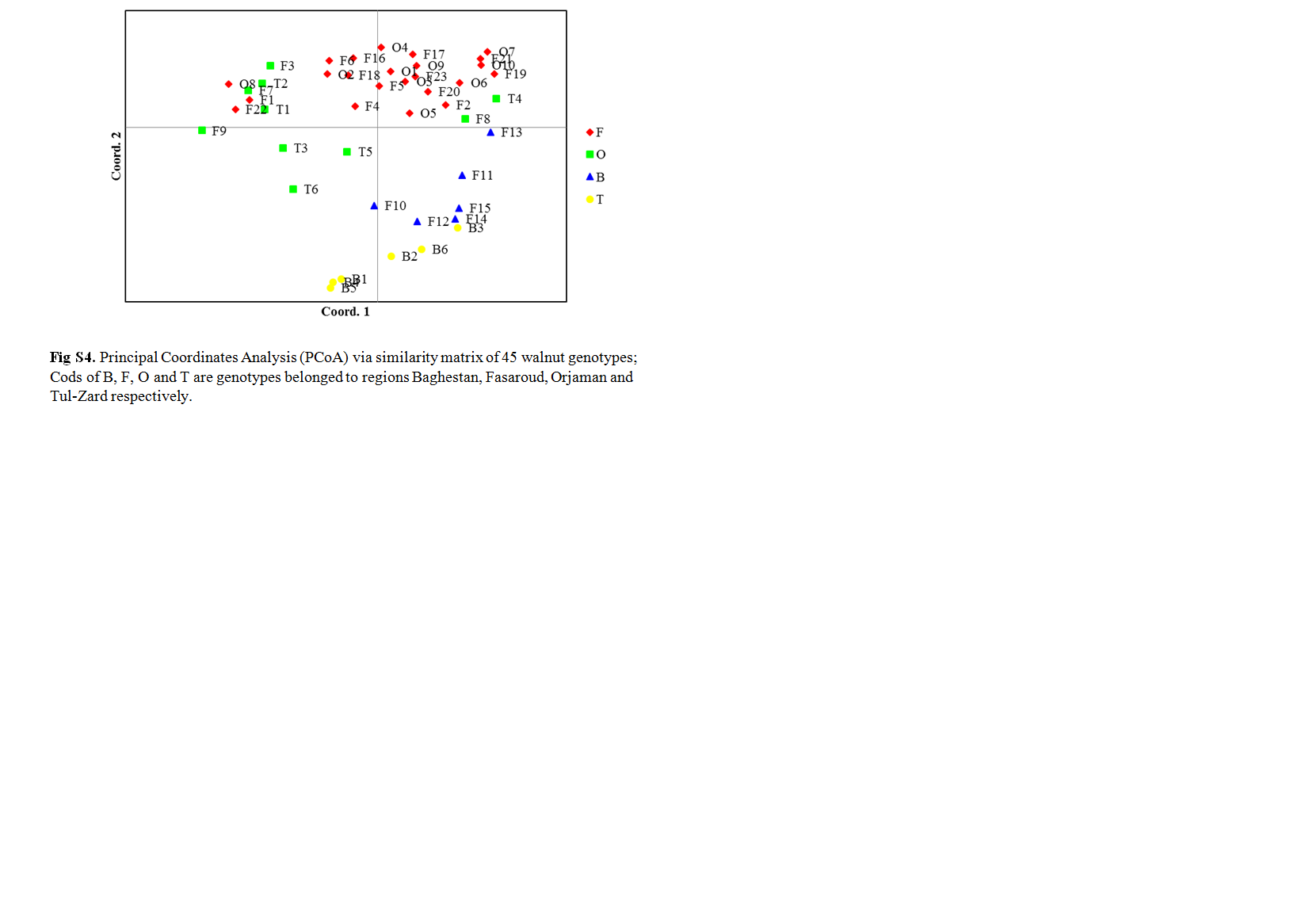
Walnut (Juglans regia L.) is one of the oldest and most economically important edible nut species due to its high nutritional value. Iran is known as one of the most important centres of the origin and diversity of walnuts worldwide. This research was carried out to determine the genetic relationships of some old walnut genotypes in Iran in order to select superior genotypes and better conserve them. The results of morphological evaluation of the fruits showed that the highest coefficients of variation were related to nut weight, kernel weight, percentage kernel, thickness and weight of the shell, and thickness and weight of the packing tissue in both years. The average morphological traits among the studied genotypes were different, such that the highest nut weights in the first and second years were 15.59 and 14.79 g and the corresponding lowest values were 7.37 and 7.79 g, respectively. The highest and lowest kernel weights were observed in the first years to be 8.09 and 3.80 g and in the second years were 6.94 and 2.65 g, respectively. The highest kernel percentages in the first and second years were 64.97 and 59.79% and the lowest percentages were 39.52 and 27.80% in the first and second years, respectively. Molecular evaluation results showed that the 16 start codon of target (SCoT) primers amplified a total of 166 bands with an average of 10.44 bands per primer. The number of polymorphic bands was changed from 2 to 19 in primers SCoT-19 and SCoT-15. The average polymorphism information content value was 0.30 and the highest amount of this index (0.36) was observed in SCoT-14 and SCoT-19 primers. The results of principal component analysis and analysis of molecular variance indicated the presence of relatively high diversity within the investigated genotypes. The amount of genetic diversity within the investigated regions was 84% and that between areas was 16%. Based on the obtained results, it was concluded that SCoT markers could provide helpful information on the genetic relationships among walnut genotypes, which can be used in future walnut breeding and conservation programmes.

Information

Type
Research Article
Copyright
Copyright © The Author(s), 2024. Published by Cambridge University Press on behalf of National Institute of Agricultural Botany

Access options

Get access to the full version of this content by using one of the access options below. (Log in options will check for institutional or personal access. Content may require purchase if you do not have access.)

Article purchase

Temporarily unavailable

Supplementary material: File

Zarinkolah et al. supplementary material 1

Zarinkolah et al. supplementary material
Download Zarinkolah et al. supplementary material 1(File)
File 604.7 KB
Supplementary material: File

Zarinkolah et al. supplementary material 2

Zarinkolah et al. supplementary material
Download Zarinkolah et al. supplementary material 2(File)
File 478.5 KB
Supplementary material: File

Zarinkolah et al. supplementary material 3

Zarinkolah et al. supplementary material
Download Zarinkolah et al. supplementary material 3(File)
File 870.5 KB
Supplementary material: File

Zarinkolah et al. supplementary material 4

Zarinkolah et al. supplementary material
Download Zarinkolah et al. supplementary material 4(File)
File 55.1 KB
Supplementary material: File

Zarinkolah et al. supplementary material 5

Zarinkolah et al. supplementary material
Download Zarinkolah et al. supplementary material 5(File)
File 23.5 KB