


1. Introduction
The digitalisation of Design has resulted in an explosion of commercial and open-source software tools that can support teams in developing products. The old adage “the right tool for the job” remains relevant, but with the proliferation in options it has become harder to identify what the right tool is. Anecdotes from industry partners in the Digital Design Network PlusFootnote 1 indicate the number and range of options is increasing, with the landscape fragmented, making the decision more difficult. Choosing tools is often a long-term commitment for users as migration between tools is time-consuming and expensive, especially when considering how they perform when connected to others within a digital workflow. This can both open and close doors in terms of interoperability between other tools in digital design workflows and a simple swap of one tool with another of similar function may not be feasible without impacting other programs in the workflow. An analogous idea is that of the “tech stack” or “solution stack” present in software engineering. The selection of this stack is critical to enabling developers to meet requirements of organisations’ design processes. The stack can also provide competitive advantages by enabling design processes that other stacks are unable to replicate and influences the employees’ skillset that organisations will seek when hiring. This means it can be extremely costly to swap stacks, often to the point where it’s not a feasible option for a business. Hence, it is a vital decision to get correct early in design processes (Reference FoxonFoxon, 2014).
A “Design Stack” represents a multi-stakeholder, multi-objective, constraint-based problem. Design, consulting and educational organisations find it difficult to objectively assess the ecosystem and consequently select suitable platforms. Given these differing perspectives and priorities, it is unlikely that a single best method of selection is possible or indeed appropriate. It therefore follows that a long-term objective of the aforementioned Network, is to create a community-driven resource to map and catalogue the digital design ecosystem and aid stakeholders in developing their Design Stack. This paper reports the start of this process by presenting a schema, and implementation of the schema, in a community-driven cataloguing tool.
This paper continues with the Related Work (Section 2) that has sought to classify design tools and existing digital repositories. The prior art has then been used to inform the development of a schema and its implementation in a prototype catalogue, inventory of design, engineering & analysis tool environments (IDEATE), to demonstrate a potential implementation. The schema was evaluated using a survey to capture the information designers use when selecting and evaluating tools and how formatting might influence their judgement. Initial feedback on IDEATE was also captured with these results reported and discussed with specific focus on analysing what a useful classification and implementation structure is to support effective digital design tool selection for Design Stacks.
2. Related work
This section reviews approaches to design tool classification and previous attempts to detail and format the relevant information, highlighting research gaps and Design Stack requirements.
2.1. Previous design stack selections and requirements
Early studies into digital engineering tool adoption highlighted a division in the set of requirements based on stakeholder needs and wants. Reference Sales de Araujo JúniorSales de Araujo Júnior (2001) identified practical cases of digital design tool acquisition by two companies – digital prototyping software and structural analysis software. The first company pinpointed factors including “enterprise-wide product visualisation”, “collaboration” and “digital mock-up capabilities” during marketing discussions as reasons for tool selection. “Virtual designs” preventing costly manufacturing mistakes and integration seamlessly with existing software are also identified as reasons for adoption. The second company focused more on the reliability of the software during benchmark testing and the customer assistance offered by the vendor.
These findings align with the “promised benefits” of early Computer Aided Design (CAD) program adoption specifically in relation to the electronic design databases which enabled seamless transfer of design ideas to analysis programs and manufacturing teams. CAD also promised to enable a paperless design process which reduced the costs associated with managing blueprints and sped up communications with customers and suppliers (Reference Liker, Fleischer and ArnsdorfLiker et al., 1992).
These early studies established the baseline for modern Design Stack requirements which included data interoperability, process efficiency and program reliability. However, a significant gap exists in the understanding of how these legacy requirements translate into the modern, diversified digital design tool landscape. Factors such as financial accessibility, learning curves or hardware compatibility, among others, are not encapsulated by this baseline. Furthermore, the user base has diversified from industrial companies only to include independent designers and educational institutions, meaning further development of these requirements is necessary to establish criteria for selecting suitable digital design tools for modern Design Stacks.
2.2. Design tool classifications
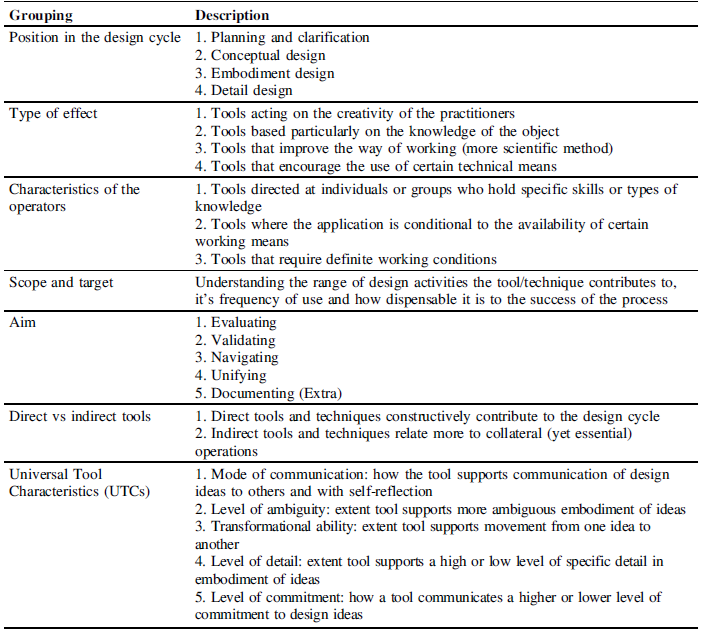
Reference Lutters, van Houten, Bernard, Mermoz and SchutteLutters et al. (2014) stated that design tools can be grouped according to their scope, breadth, performance and aim in the design cycle (Table 2). This was based upon research by Reference Self, Dalke and EvansSelf et al. (2009) whom proposed Universal Tool Characteristics (UTCs) to describe common attributes when analysing the capabilities of tools in supporting design activities. Reference Purcell and GeroPurcell and Gero (1998) developed a similar classification process for physical sketching (often an ambiguous and unstructured design method) which associated types of drawings with research in cognitive psychology. Reference Zhang, Ranscombe, Radcliffe and JacksonZhang et al. (2019) furthered these groupings for digital sketching by building a more comprehensive framework to help optimise and select which tools to use and when during the industrial design process. However, these methods focus on design visualisation tools with case studies only involving sketching with Zhang et al. stating the need for more rigorous methods of applying design tool characteristics with consideration of tool use context and purposes. Following this, the Digital Engineering Technology & Innovation (DETI) project proposed the Digital Modelling Toolbox (Reference GibbonsGibbons, 2022) which was structured in two ways: first the tools’ position in the product lifecycle and second the tool output formats (i.e. pictorial, linguistic, algorithmic). DETI identified a taxonomy of methods from an industrial partner and then classified 78 tools against the Systems Engineering “Vee”. However, the metadata collected was minimal and the tabularised presentation does not enable exploration.
Characteristic groupings of design tools identified by Reference Lutters, van Houten, Bernard, Mermoz and SchutteLutters et al. (2014)

2.3. Existing digital repositories
Currently information on digital design tools resides in two main categories: educational summaries and comprehensive vendor-specific libraries. The former provides high-level functional descriptions with some relevant engineering applications detailed (BBC Bitesize, 2025). The latter vendor-specific repositories – such as those by Autodesk (Autodesk, 2025), Dassault Systèmes (3ds, 2022), Siemens (Reference SiemensSiemens DI, 2025) – offer granular detail with technical specifications, industrial case studies, and community support information signposted. However, these resources are often siloed, focusing on individual products and lacking a unified framework to allow unbiased comparative analysis.
One broader digital repository, Wikipedia’s tabular list of CAD programs (2025), provides a compilation of information about design tools. It includes metadata including specialty fields, release history, license types, import/export file types and rough pricing. However, the factual, appraised format gives little indication to the tools’ position within the design cycle or relevant case studies. Furthermore, the list is not comprehensive with the table scope only covering traditional CAD software excluding other design program types (e.g. blender). Other community-driven resources, such as The Engineering ToolBox (2010) and Reddit (2019) offer similar inventories but were updated 5+ years ago and lack the standardised metadata to facilitate comparative analysis. Commonly, it is recognised that these list formats only deliver superficial descriptions without contextual examples which doesn’t facilitate a disquisition into the capabilities of tools.
Furthermore, the preceding analysis highlighted that current resources for digital design tool selection are fragmented and incomprehensive. Extant catalogues are typically vendor-specific libraries or superficial, non-evaluative lists which fail to address the complexity of selection decisions nor accommodate a wide range of stakeholders and potential usage scenarios. This results in a critical gap: existing classifications are narrow and do not capture the full range of technical, commercial or lifecycle attributes necessary to make informed tool selection. Hence, there is a need for an impartial community-driven framework to provide stakeholders with a structured platform – such as IDEATE – to uncover and choose the appropriate tools within the digital design ecosystem.
3. Methodology
A parallel approach of developing a prototype catalogue for evaluation and capturing current tool selection practices via a survey was performed.
3.1. Solution scope and requirements
To begin, it was essential to define a Digital Design Tool. The DETI Engineering Committee 2 (EC2) report (Reference GibbonsGibbons, 2022) defined a tool as something that “provides a specific engineering capability” with a toolchain identified as “a sequence of tools that provide an engineering capability”. Examples of tools include Computer Aided Design (CAD) and finite element analysis (FEA) programs, while a toolchain could be using CAD to generate a geometric model which is imported to a FEA package to run analysis for stress testing. Following this, a Digital Design Tool in this context was defined as:
“Software that provides a design capability comprising engineering and graphical design application”.
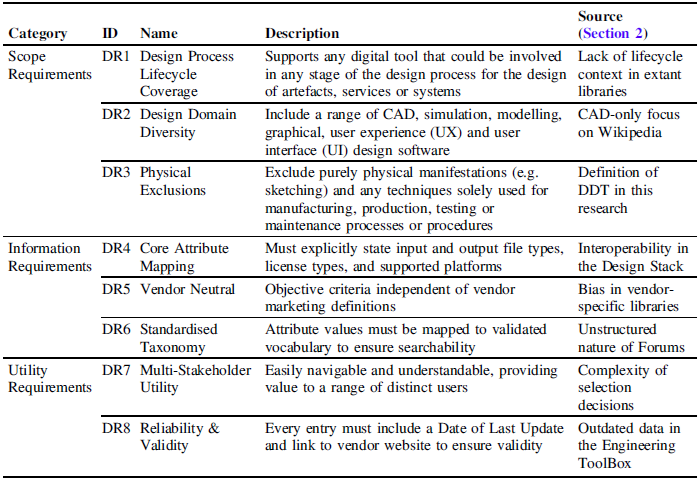
Subsequently, it was essential to formalise a set of Design Requirements (DR) (Table 2) as the pre-requisites for a digital design tool catalogue based upon gaps identified in Section 2.
Design requirements for the catalogue

3.2. Schema development
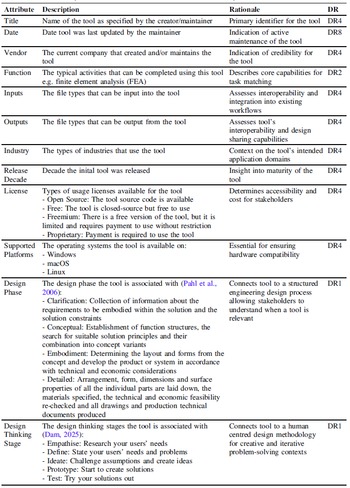
Following the establishment of the scope and design requirements of this repository, a classification schema was constructed to organise the relevant attributes (Table 3). This schema was developed through a compilation of design stage frameworks (Reference DamDam, 2025; Reference Pahl, Beitz, Feldhusen and GrotePahl et al., 2006), analysis of market-leading tools’ common metadata and the Design Stack requirements identified in Section 2.1. These candidate attributes were collated and down-selected based upon relevance to the DRs established in Table 2. Each attribute was then assigned a data type with standardised vocabulary identified to ensure searchability.
Developed classification schema attributes with descriptions and rationale detailed

While a comprehensive schema might include complex constraints, default values and inter-attribute relationships, such features were viewed as out of scope as they were not required to fulfil the specification set out in Table 2. Although attribute hierarchy relationships can aid design tool selections decisions, especially in relation to different phases of design and applications a tool is appropriate for, these techniques were deemed as premature and hence a flat hierarchy assumed.
3.3. Prototype catalogue
A prototype implementation of the schema within a decision support tool was produced for testing and evaluation by the design community to determine if a catalogue can effectively address the identified gaps in Design Stack program selection. The catalogue was implemented as a wiki-style website that used the Zola – Rust-based web framework and named IDEATE.
IDEATE was organised into five primary tabs: Home, Catalogue, Stories, Schema and Collaborate. The Home page contextualises the catalogue whilst the Collaborate page outlined the step-by-step guide to submitting a contribution. The core content of the catalogue was housed within the Catalogue and Stories pages hosting 46 tools and 37 stories, with pages bidirectionally linked. This allowed seamless navigation between software information and real-world case studies or testimonials with a mix of articles from vendor websites and third-party sources. Individual tool entries featured tabularised metadata, a short description, core capability summaries, file format versatility and availability information alongside links to specific vendor webpages. To enhance attribute understanding, descriptions appeared when an attribute is hovered over. Tools could also be sorted by name or vendor to increase discoverability on the main Catalogue page.
All content was collated and collected utilising web scraping methods, both manual and automated, and was stored in plain-text markdown files featuring a TOML header block to specify metadata tags. This allowed users flexibility in data exploration whilst enabling contributors to easily categorise the information by multiple taxonomies. For example, users could view all tools associated with early-stage design, or all tools capable of importing a specific file format. The simple, descriptive layout of the markdown file enabled streamlined contributions and modification of content by forking the existing GitHub repository, creating a new markdown file, filling in the required fields and submitting a Pull Request for review by the community to ensure inventory integrity and effective maintenance. Overall, the intent of IDEATE was to elicit feedback from users and investigate the appropriateness of this method in classifying tools to support selection.
3.4. Survey design
A Microsoft Forms survey was distributed via email and LinkedIn to collate feedback on the catalogue, amass tool selection anecdotes and pinpoint the needs of designers when choosing digital tools. It asked some initial demographic questions about the participants occupation, industry, experience and size of organisation and followed by enquiring about the last time they selected a new tool for design. This was accompanied by an open long answer textbox to summarise the decision process requesting details of their requirements and examination of tools with minimal guidance. Participants were then asked to rate the relevance of a list of factors when choosing a design tool on a scale of 1-5. These factors were intended to be broad and non-specific (e.g. features, learning curve) to allow participants to deliberate about which aspects of design programs are essential to their workflow. A textbox also allowed respondents to enter any additional factors not present which was then followed by similar textboxes asking about the arrangement of tools and any additional comments. The form finished by asking participants to test IDEATE and the Wikipedia table of CAD software (2025), asking for a rating out of 10 and their reasoning why. It was desired that this would identify a concrete appetite for such an inventory alongside uncovering opinions about the content and formatting.
4. Results
The results from the user survey are presented in the following section. Participant demographics for this study (N=19) are detailed in Figure 1 showing a cross-section of occupations and experience within the design community.
Demographic information of survey respondents

Ten different occupations and a range of experience was present in the dataset. Notably, 84% of respondents work in very large organisations (250+ employees) and 74% work within the academia and education industry potentially narrowing the range and types of tools used. Respondents had generally selected design tools relatively recently with 63% within the last year and 27% within the last quarter meaning participants gave comprehensive summaries of the selection process.
Qualitative excerpts identified common selection driving factors and restrictions including “cross-OS compatibility”, “pricing models”, “customer need” and “familiarity with approaches”. A regularly reported method was also to seek the appropriateness of tools by peer experiences (e.g. blogs) with a focus on evaluating the features to fit the needs of users. A distinctive evaluation method was “building the same model” in two tools and then “ensuring they produced similar enough results” before “comparing qualitatively about ease of use and flexibility”.
Figure 2 quantifies the importance of factors when selecting digital design tools. Usability, pricing model and features were selected as the most important factors with mean scores of 4.44 (σ=0.705), 4.22 (σ=0.878) and 4.00 (σ=1.029) respectively. Conversely, attributes such as real-time collaboration, platform and product lifecycle management (PLM) integration exhibited significantly larger ranges with standard deviations of 1.299, 1.310 and 1.283. This variance across the cohort likely reflects the specialised needs of different design disciplines and industries. Factors such as post-processing capabilities and hardware requirements were scored low with mean scores of 2.50 and 2.61 with real-time collaboration and PLM integration also lower scoring with 2.38 and 2.67.
Average importance score of factors when choosing a digital design tool

Participants were then surveyed about the arrangement of information. This question generated a range of answers from structural preferences such as hierarchical trees and filterable databases to format-specific requests like PDFs or e-commerce style comparison webpages. Furthermore, some respondents pinpoint specific metadata hierarchy opinions such as “platform/hardware requirements > industry > position in the design process > connectivity > features” and “group ecosystems, pricing and licensing models”. Others advocate for more graphical interfaces including independent video review links, searchable FAQs, chatbot interfaces for niche question and a summary panel listing attributes such as “cost” and “popularity” suggested.
Finally, participants were asked to evaluate the prototype and existing Wikipedia page. The results are shown in Table 4 with IDEATE outperforming the Wikipedia page in Mean and Median scores. Qualitative responses provide critical context for these values with some respondents praising the tabular format of Wikipedia for its “highly visual breakdown of important aspects” and sorting capabilities but commonly participants found it “very dense” and “hard to navigate and compare” with the acknowledgement that the “table could get very large depending on the total number of categories”. In contrast, IDEATE was praised for the “clean layout” and “helpful schema page”.
Results of the scoring of IDEATE and Wikipedia in the survey (N=19)

5. Discussion
To begin, IDEATE successfully fulfils the Design Requirements (DRs) set out in Section 3.1. DR1, DR2 and DR3 were met by incorporating 46 tools spanning the four design phases from approximately 30 design domains; notably purely physical manifestations such as manufacturing software were excluded. This range provides value for a wide range of stakeholders (DR7) and utilised a standard taxonomy wherever possible (DR6) to increase navigability and understanding, though further refinement is needed in future iterations. Core attributes (DR4) including input and output file types, license options and supported platforms were mapped alongside a date of last entry (DR8). Finally, all descriptions and lists of core-capabilities were kept as vendor neutral as possible (DR5).
Subsequently, the comprehensive survey delivered valuable insights into tool selection methods and IDEATE’s suitability in a short period of time. The study’s scope was limited by low diversity in size of organisation and type of industry; specifically, the over-representation of the academic sector, constrains the generalisability of results to specialised industry contexts with stratification deemed inappropriate due to the small cohort size. A separate criticism concerned potential survey bias with the fact that participants were shown IDEATE first “so my score may be lower” for Wikipedia “than it would have been otherwise”. This is potentially why a lower score are present for Wikipedia in Table 4, suggesting that for some participants, the resource was incomprehensible in comparison. While attempts were made to mitigate this by giving respondents no time pressure and presenting both websites before asking any questions, future surveys should separate the evaluation sections of comparative tools to prevent carry-over effects. Despite these limitations, the feedback solicited provides a robust baseline for understanding community opinions on IDEATE’s core functionality and the appropriateness of the DRs and corresponding schema.
The survey results suggest that the proposed DRs and classification schema largely align with the priority factors identified by participants. Factual attributes such as features, connectivity and pricing models (DR4) were successfully integrated into IDEATE with position in the design cycle (DR1) also identified as important. Participants also validated DR3 as manufacturing techniques integration and post processing were both scored low on average. However, the range of importance scores outlined in Figure 2 highlight the diversity of the design community and hence the need for a range of software to be encompassed (DR2) for multiple stakeholders (DR7). But the relatively low standard deviation for the usability, pricing model and features attributes indicates consensus among participants that these are consistently the most important factors when choosing tools for a Design Stack.
While factual information has been easily mapped in IDEATE, subjective items such as usability and learning curve presented a significant challenge to encompass as part of this schema. Although usability was consistently the highest-rated factor in the survey, quantifying it within a rigid schema risks introducing bias, especially as DR5 and DR8 specify that this collation of information must be reliable, valid and vendor neutral. A strong method to address this flaw is to is to incorporate the suggested “independent reviews” model. This approach aligns with a critical consideration highlighted by Reference Lutters, van Houten, Bernard, Mermoz and SchutteLutters et al. (2014) that “for a classification scheme that is too granular, it would disregard broadly employable tools”. By using structured proxies instead of arbitrary scorings, IDEATE maintains the lean, manageable scope of information whilst capturing essential data on tools for Design Stack selection.
Participants identified two additional factors that weren’t in the matrix named as “flexibility” defined as “the ability to affect how the tool works if need be” and the “level of in app purchases” specifically referring to AI implementation in some of these tools. Whilst it could be argued that the former may fit into factors such as usability the respondent gave an example of AnyLogic allowing the user to insert code into certain areas of the software meaning an attribute such as extensibility may be more appropriate. The latter on the other hand doesn’t discretely fit into the factors of plug-in ecosystem or pricing model with LLMs also seen as a sort of support system too. Although IDEATE’s scope only focuses on tools rather than toolchains, these are strong considerations for future schema refinement.
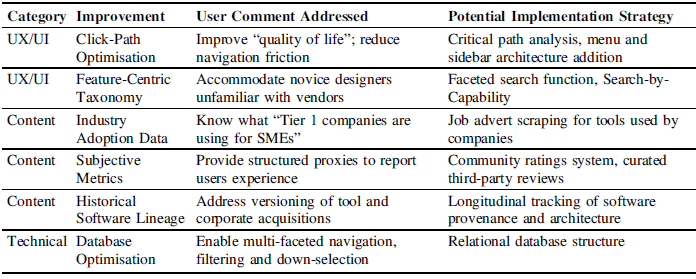
General observations of the survey identified that IDEATE could be a useful asset in the digital design tool selection process. It showed promise in the format with a “clean, modern layout” identified in comparison to the Wikipedia site’s “dense” tabularised layout and generally scored higher, suggesting there is a space for such a repository. Future developments of IDEATE should look to integrate other key nonpartisan items such as learning curves and training resource availability. Similarly, the understanding of what industry standard is has not fully been encompassed as part of IDEATE with vendors often catering to multiple industries within a single tool. Furthermore, vendors frequently release multiple versions of tools (e.g. CATIA V5 and V6), whilst other legacy programs been acquired or rebranded with historical lineage that should be captured by future refinements to the schema. Finally, the repository must account for contextual user bias; as one participant noted if they “needed a PLM system, obviously my requirements would be very different”. Consequently, Table 5 suggests a plethora of improvements to ensure that the catalogue becomes an easy-to-navigate, high-level repository for Design Stack selection to help stakeholders narrow the ecosystem enough to match their needs while also delivering an objective, holistic presentation of the options available.
Suggested prototype improvements for future catalogues

The potential implications of IDEATE are extensive. Primarily, it is hoped that this framework could help designers, engineers and managers of diverse domains select the “the right tool for the job” first time round. However, the true value of such a repository lies in its potential to evolve from individual tool identification into a decision-support framework for holistic Design Stack configuration. By mapping interoperability between software, IDEATE could provide a solid foundation for building integrated toolchains. Furthermore, decision support could be enhanced by vendors submitting contributions to the catalogue, helping to showcase their software in a comprehensive and transparent light, whilst maintaining objectiveness in line with DR5. Ultimately, the key contribution of an objective, community-driven catalogue is the ability to offer impartial information allowing designers to explore the ecosystem in an unbiased, encyclopaedic manner to aid in the assembly of Design Stacks.
6. Conclusions
This research addressed the growing complexity of selecting design tools for a Design Stack in a fragmented ecosystem. By analysing the gaps in existing repositories and literature – specifically in scope, depth and impartiality – and combining this with studies of design tool selection a set of Design Requirements, a classification schema and prototype catalogue (IDEATE) were developed. The proposed community-driven repository was evaluated via a survey with accompanying experiences and requirements of participants in previous design tool selection also captured.
This evaluation yielded two primary findings:
-
• Digital design tool selection is primarily driven by the usability, features and pricing model attributes.
-
• A structured, unbiased catalogue is a valuable method of aiding designers in selecting digital design tools compared to unstructured legacy repositories (mean score of 6.44/10 to 5.28/10).
Discussion of these results suggests furthering the development of tool support systems requires “quality of life” additions. Specifically, enhanced navigational efficiency, implementation of a feature-centric taxonomy and addition of subjective metrics via structured proxies could broaden exploration of the tools available and bridge the gap between technical vendor specifications and users. Ultimately, the expansion of this repository through community contributions will enhance the navigation of an increasingly fragmented digital design tool ecosystem and ensure that stakeholders can select “the right tool for the job”.
Acknowledgements
This work was supported by the Engineering and Physical Sciences Research Council [grant number UKRI394]. Thanks are extended to the design practitioners who participated in the survey and to the Digital Design Network Plus for supporting this work.




 Open access

