

Cows live in complex hierarchical social structures. In many dairy farms, cows are kept in loose housing systems where they form relatively stable herds. A subset of the herd, consisting of youngstock and dry cows, is usually housed separately. This results in frequent introductions of fresh heifers and re-introductions of previously dried-off cows into the milking herd, while other cows leave for dry-off, health issues or culling. Repetitive regrouping of animals is, therefore, a common management practice (Bøe and Færevik, Reference Bøe and Færevik2003). Some dairy farms introduce multiple animals at once, while others introduce one animal at a time. Previous studies showed that introducing heifers as a pair to the group diminished the anticipated negative effects of regrouping on the introduced animals (O'Connell et al., Reference O'Connell, Wicks, Carson and McCoy2008; Gygax et al., Reference Gygax, Neisen and Wechsler2009; Neisen et al., Reference Neisen, Wechsler and Gygax2009). We hypothesize, however, that all regroupings may disturb the social hierarchy and behaviour of individuals already in the herd with negative effects on welfare and productivity.
Effects of regrouping on milk yield, feed intake, rumination time, lying time, lying bouts and standing bouts have been studied before (Brakel and Leis, Reference Brakel and Leis1976; Hasegawa et al., Reference Hasegawa, Nishiwaki, Sugawara and Ito1997; von Keyserlingk et al., Reference von Keyserlingk, Olenick and Weary2008; Schirmann et al., Reference Schirmann, Chapinal, Weary, Heuwieser and von Keyserlingk2011; Smid et al., Reference Smid, Weary, Bokkers and von Keyserlingk2019). Most of these studies reported the effects of regrouping on the introduced animals. Schirmann et al. (Reference Schirmann, Chapinal, Weary, Heuwieser and von Keyserlingk2011) examined the short-term effects of regrouping on dry cows already in the herd, but only regarded a limited time span of 8 d. The effects of regrouping found in other studies lasted in duration from hours to weeks (Brakel and Leis, Reference Brakel and Leis1976; Hasegawa et al., Reference Hasegawa, Nishiwaki, Sugawara and Ito1997; Raussi et al., Reference Raussi, Boissy, Delva, Pradel, Kaihilahti and Veissier2005; von Keyserlingk et al., Reference von Keyserlingk, Olenick and Weary2008). Interpretation is challenging, as changes could also be affected by other factors, like oestrus and weather conditions (Reith et al., Reference Reith, Brandt and Hoy2014; Stone et al., Reference Stone, Jones, Becker and Bewley2016). Effects of regrouping on the behaviour of individual cows may be highly variable (Schrader, Reference Schrader2002; Ito et al., Reference Ito, Weary and von Keyserlingk2009; Byskov et al., Reference Byskov, Nadeau, Johansson and Nørgaar2016).
The more recent studies include sensor data to monitor health and behaviour (Halachmi et al., Reference Halachmi, Guarino, Bewley and Pastell2019; Leliveld and Provolo, Reference Leliveld and Provolo2020). The use of sensor data allows non-invasive, low work-intensive analyses of a diverse range of behavioural aspects. Moreover, sensors allow effects to be studied continuously, facilitating detection of effects probably indiscernible in short observation periods.
The current study investigates the effects of regrouping on behaviour and milk production of animals in the receiving herd. Data were collected using sensors and were compared between a treatment period, when new cows were introduced, and a control period. To be able to detect even subtle changes many potentially influencing factors were taken into account.
Materials and methods
Experimental design
The study was performed from April 3, 2017 until May 29, 2017 in a herd used for teaching purposes at the Department of Farm Animal Health, Faculty of Veterinary Medicine, Utrecht University, Utrecht, the Netherlands. Animal procedures were approved by and in accordance with the guidelines of the Dutch Committee of Animal Experiments.
A herd of 53 lactating dairy cows was divided into two groups by stratified randomization in order to create two groups (Group A and Group B) that were comparable with respect to average days in milk and parity. An additional eight cows that were not previously exposed to any of the other animals were housed separately.
Group A and B were managed as separate groups and enrolled in a cross-over study of two consecutive experimental periods of three weeks. Both periods were preceded by a one-week run-in period followed by three weeks of data collection. During the run-in period, cows were familiarized with the experimental design to optimize similarity between both test periods. In the first experimental period, Group A received the replacement treatment and Group B acted as control. In the second period this was reversed. The treatment consisted of replacing three cows twice a week and one cow, not previously exposed to any of the other animals, once a week. For details see online Supplementary Materials & Methods and Supplementary Figure S1. Data were collected only from a subset of 25 cows, denoted as focal cows. The non-focal cows were used for replacements (Fig. 1). The focal animals were not pregnant and selected based on breed (Holstein Friesian) and health (no evident signs of lameness or other health impairments, somatic cell count <200 000 cells/ml). Five rumen-fistulated cows were excluded as focal animals.
Schematic overview of cows in the different stables during the experiment. An experiment of 2 × 3 weeks with a cross-over design where the effects of cow replacements on the remaining focal cows were studied. Spotted cows were non-focal animals not previously exposed to any of the other animals. Striped cows in the figure represent non-focal animals that had been used for replacements in the treatment period. Focal cows were used for data collection. Black cows represent focal animals in Group A and white cows represent focal animals in group B. Data was collected from focal animals not used for replacements.

Animals and husbandry
Group matching of the focal animals at the start of the experiment was based on days in milk (DIM) and parity. This resulted in two groups with comparable DIM with mean 97 (SD 30) and 98 (SD 34) and parity with mean 2.75 (SD 0.97) and 2.77 (SD 1.17) for the focal animals in group A and group B, respectively. The same matching criteria were used for grouping of the non-focal animals at the beginning of both test periods.
Group A and B were housed in separate but identical free-stall housings. Both free-stall housings had slatted floors equipped with an automatic scraper and 27 cubicles with soft rubber mats. There was always more than one feeding and lying space available for each cow.
The six non-focal cows from the animal replacement treatment group and the eight cows not previously exposed to any of the other animals were housed in an adjacent tie-stall barn. There was no visual, auditory or physical contact between those cows and the groups in the free-stall housing.
During the experiment, only the non-focal cows from group A and B were sometimes taken out of the group, individually, for a few hours a day for regular teaching activities such as physical examination, rectal examination and anatomy classes. The same small number of non-focal animals in both groups was taken out at the same time in both groups. All animals were accustomed to frequent handling by students. These teaching activities were comparable and equally balanced over both periods and between both groups.
The cows were milked twice a day in the same milking parlour (5 × 2 herringbone) between 06 : 00–08 : 00 h and 18 : 00–20 : 00 h. Group A was always milked first.
The diet consisted of 4.5 kg DM/day maize silage and ad libitum wilted grass silage at the feeding gate after morning and afternoon milking. A protein-rich supplement was supplied on top of the maize silage. One kg of concentrates was fed during each milking. Cows were provided with additional concentrates depending on milk production level by means of a computerized feed station. Fresh water was supplied ad libitum.
Measurements and data collection
Focal cows were equipped with a Smarttag leg sensor (Nedap livestock management, Groenlo, the Netherlands). The Smarttag leg sensors were strapped to each cow's left front leg just above the fetlock joint on March 31, 2017. The Smarttag leg sensor collected, within 15-minute time blocks, the number of minutes the cow spent lying down, standing and walking, and the number of transitions from lying down to standing. All data streams were synchronized to the daily clock time. Unrestricted movement started after unlocking the feed gate after milking and lasted until the gathering of the cows for the next milking. Data of 15-minute time blocks were averaged on an hourly basis to obtain one parameter for the day and one for the night. This resulted in 42 measurements in the first and second experimental period each for standing time, walking time, lying time, and number of lying-to-standing transitions for each focal cow.
Additionally, eight out of the 13 focal cows in group A and seven out of the 12 focal cows in group B were also equipped with an HR Tag neck sensor (SCR Dairy, Netanya, Israel). There were 15 neck sensors available for this research. The HR-Tag neck sensor was positioned on a collar behind the left jaw of the cow; the sensor monitored the number of minutes the cow spent on rumination in 2-hour time blocks. The 15 focal cows were equipped with sensors on March 31, 2017 and data were collected during the whole study period. Average rumination time per hour was calculated per day and per night as described for the Smarttag sensor, resulting in 42 measurements in both periods for each of the 15 focal cows. To assign rumination time within the free time, each 2-hour data time block of the neck sensor was reproportioned into 15-minutes blocks. All reported measurements are for unrestricted movement (free time).
A video camera system recorded the cows continuously during the whole experiment. Oestrous behaviour was determined by observations daily at 04 : 00–05 : 00 h, 10 : 00–11 : 00 h, 16 : 00–17 : 00 h, and 22 : 00–23 : 00 h. Oestrous behaviour of a cow was defined as allowing another cow to mount, or when a cow attempted to mount another cow. Because a cow can already be restless during the hours before oestrus, the cow was defined to be in oestrus the day on which oestrous behaviour was observed, as well as the day before. Twelve cows in Group A vs. 13 cows in Group B were detected to be in oestrus during the total experiment.
Individual milk yield (kg) was recorded at each AM and PM milking in the milking parlour by the milking machine, with a precision of one decimal point.
Temperature and relative humidity were recorded hourly by the Dutch National Weather Service (KNMI) throughout the experiment at a location 2 km from the research location. The atmospheric temperatures ranged from −2.9°C to 31.1°C during the experiment. Heat and cold stress were defined based on the Temperature Humidity Index (see online Supplementary Materials & Methods).
At the start of the experiment, the categories for days in milk were classified as follows: 0–60 d (DIM = 0), 61–120 d (DIM = 1), 121–200 d (DIM = 2), 201–305 d (DIM = 3) and >305 d (DIM = 4). The parity of each cow was classified into three groups: first, second, and third or higher.
Two focal cows did not provide complete data for the experiment, because of illness. One became lame in the second run-in period, and the other showed colic in the second week of the second period.
On 12 occasions milking data for an individual cow was missing due to technical issues; we used the average milk production per milking in the valid measurements of these cows as estimate for the missing data.
Statistical analysis
Cows were the sampling units in this research and individually randomized over both groups. In this study, data was collected from individual cows and differences in both groups were minimized; therefore, cow was taken as the experimental unit.
Average lying time, the median of log-transformed walking time, average standing time, and average rumination time, all in minutes per hour free time, were analysed using linear mixed effects models. Treatment was included as main effect and corrected for design-related aspects such as week (1, 2, 3), group (A, B), period (1st, 2nd), day or night, weekday, and weekday-week interaction as fixed effects, when appropriate. As the composition of the groups changed on particular weekdays, we also included every day of the week as a weekday-treatment interaction.
Cow-related aspects such as heat or cold stress, parity, DIM, milk production (kg milk per milking), and daily presence of oestrus were included as fixed effects. Cow ID was included as a random effect to correct for multiple observations per cow. Similarly, the correlations between measurements are expected to depend on the day in the three-week period. Therefore, ‘Day’ (1–21) was included as a potential random effect but was checked to be included for each model beforehand. The treatment effect on milk production was analysed using a similar linear mixed effect model but without the correction for milk production as a cow-related fixed effect. For all models, residuals were plotted to check for normality.
The average lying-to-standing transitions per hour were analysed using a generalized linear mixed model with a Poisson distribution, with random and fixed effects as before. A Poisson distribution is used because the outcomes are non-negative integer values that count the number of events. For the effects in the reduced models, 95% profile (log-) likelihood confidence intervals were estimated. When the treatment-weekday interaction was in the reduced model, a nested model was used to estimate the treatment effect for each day of the week. Data were analysed using R version 3.5.1 (2018-07-02) library lme4 (R Core Team, 2018). Akaike's information Criterion was used for model reductions where all variables could be dropped (Burnham and Anderson, Reference Burnham and Anderson2002). When the treatment effect did not remain in the final reduced model, the treatment effect was forced in the model to achieve an estimate with a confidence interval.
Results
Considering restricted and unrestricted time together, cows spent on average 8.5 h (SD 2.0) per day ruminating, 9.5 h (SD 3.2) lying down, 13.2 h (SD 3.4) standing and 0.7 h (SD 0.2) walking. The mean number of lying-to-standing transitions per day was 6.7 (SD 2.2). The average milk production in group A was 29 kg/day and in group B 31 kg/day. Online Supplementary Figure S2 illustrates the variation of the sensor data and the milk production per milking over the experimental period for all focal cows. The following model results are based on time blocks with unrestricted animal movements only (see online Supplementary file for the full models).
Behavioural data
The mixed model analysis showed no difference in average lying time per hour between the treatment period and the control period (online Supplementary Table S1). The average lying time per hour was higher during the night than during the day. Cows in oestrus spent on average less time lying per hour, as did cows during heat stress. The average standing time per hour was not different in the treatment and control period (online Supplementary Table S2). The average standing time was only affected by day or night, with a longer average standing time during the day.
For the lying-to-standing transitions, the full Poisson model could not be fitted, therefore, we started with a smaller model and excluded the following variables beforehand: treatment-weekday interaction, weekday-week interaction, milk production, DIM, and parity. The average number of lying-to-standing transitions per hour were not different between the treatment and control periods (online Supplementary Table S3). In general, transitions from a lying to a standing position occurred less frequently during the daytime than at night. Furthermore, no relevant effects on the average number of lying-to-standing transitions per hour were found for oestrus, heat or cold stress, period, group, weekday.
For the median walking time, the treatment-weekday interaction remained in the reduced model. The treatment effect for each day of the week was estimated with a nested version of the model. The median walking time of cows on Saturday and Sunday was increased in the treatment period compared to the control period (Table 1). During the weekend the median walking time per hour in the treatment period was 1.14 times higher than in the control period. The median walking time per hour was not different between the treatment and control group on the other days of the week. Overall, the median of the walking time was higher during the day than during the night. Cows in oestrus walked for longer periods of time. Cows walked more on the days that they experienced heat stress and milk production was also positively related with the median of the walking time per hour.
Variables in the final model of walking time (N = 25) in minutes per hour during the unrestricted time period
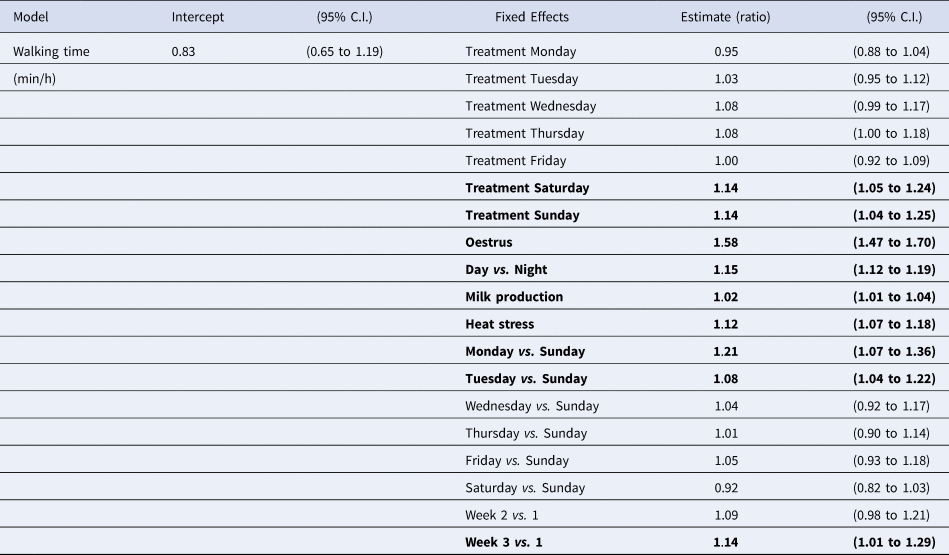
Effects are shown for the focal cows remaining in the herd in a 2 × 3 week trial with a cross-over design where other cows were replaced. Walking time was corrected for weekday-week interaction and random effects included were ‘cow’ and ‘day’. The treatment effect remained in the model during the model reduction steps. The model was nested for treatment. Variables are in bold excluding the H 0-value in the 95% confidence interval.
Rumination data
The average rumination time per hour of unrestricted movement was 28 min. Results of the mixed model analysis demonstrated that the average rumination time in the treatment period was one minute per hour more on Saturday and one minute per hour less on Thursday compared to the control period on these days (Table 2). During the day, the average rumination time was five minutes per hour lower compared to the night; when a cow was in oestrus the rumination time was four minutes lower. The increase of rumination time in the treatment period on Saturday was unexpected and because the data were based on only fifteen cows, we estimated the mean and standard deviation of the rumination time for individual cows. One cow had a large standard deviation compared to the others (data not shown). When the data were analysed without this specific cow, an overall treatment effect of one minute less rumination per hour remained (online Supplementary Table S4).
Variables in the final model for rumination time (N = 15) in minutes per hour during the unrestricted time period
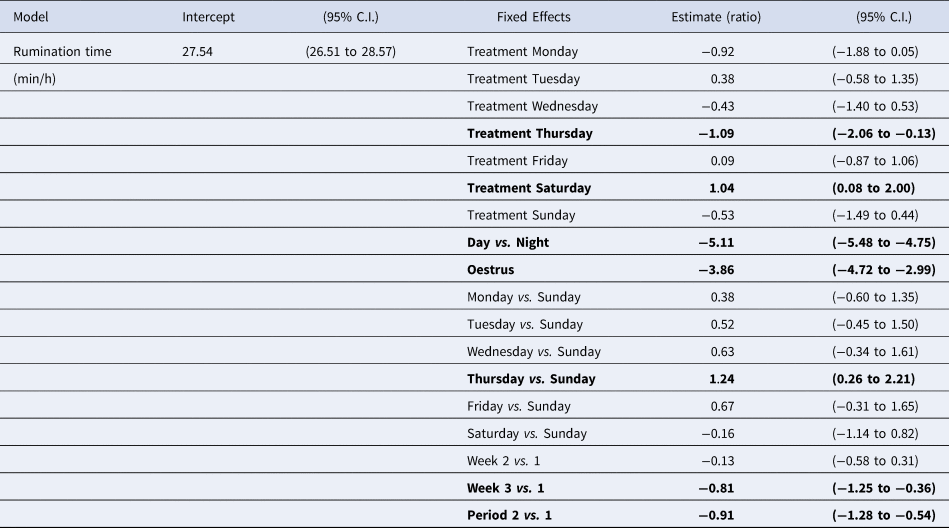
Effects are shown for the focal cows remaining in the herd in a 2 × 3 week trial with a cross-over design where other cows were replaced. The random effect included in the model was ‘cow’. The treatment effect remained in the model on specific weekdays during the model reduction steps and the model was nested for treatment. Variables are in bold excluding the H 0-value in the 95% confidence interval.
Milk production
The average milk production per milking was lower in the treatment period compared to the control period. On Tuesday, Wednesday and Thursday the average milk production decreased by 0.32–0.37 kg per milking in the treatment group (Table 3).
Variables in the final model for milk production (N = 25) in kg per milking, cows milked twice a day
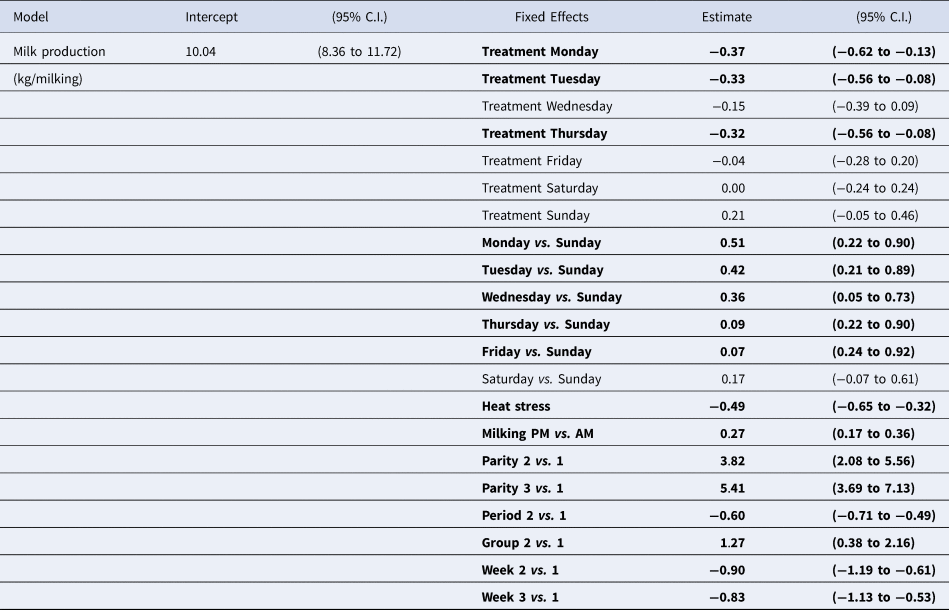
Effects are shown for the focal cows remaining in the herd in a 2 × 3 week trial with a cross-over design where other cows were replaced. The random effect included in the model was ‘cow’ and the rumination time was corrected for weekday-week interaction. The treatment effect remained in the model during the model reduction steps and the model was nested for treatment. Variables are in bold excluding the H 0-value in the 95% confidence interval.
A number of variables showed associations with milk production, corrected for the day of the week. Milk production during the PM milking was higher than during the AM milking. Heat stress had a negative effect on milk production and cows in oestrus produced 0.49 kg less per milking. The milk production was higher for higher parity cows, decreased every week and was therefore on average lower in the second period for all cows.
Discussion
The results demonstrate the effects of regrouping cows in a dairy herd, when continuously monitored by sensors during a six-week experimental period. For this research we used two validated sensors widely used in the Netherlands (Schirmann et al., Reference Schirmann, von Keyserlingk, Weary, Veira and Heuwieser2009; Nielsen et al., Reference Nielsen, Fontana, Sloth, Guarino and Blokhuis2018). Most previous studies focus on the effects of regrouping on the introduced animals only. One of the few studies that also examined the effects on animals already in the herd, reports that short-term effects on regrouped dry cows are more severe compared to the animals already in the group. The introduced animals can experience stress not only because of the new group, but also because of moving to another environment (Schirmann et al., Reference Schirmann, Chapinal, Weary, Heuwieser and von Keyserlingk2011).
In our study walking time increased slightly after regrouping, corroborating the results of other studies (Hasegawa et al., Reference Hasegawa, Nishiwaki, Sugawara and Ito1997). Remarkably, the walking time was higher on Saturday and Sunday in the treatment group compared to the control group, while during the other days of the week no significant treatment effect was found. The absence of a treatment effect during weekdays may be related to the use of non-focal cows for educational purposes, which could have blurred a subtly increased activity of the focal animals. Even though walking, standing and lying time add up to 15 min/h of unrestricted movement, relatively large changes in walking time could amount to only small changes in the other behaviours.
Lying time was not different between the treatment and control periods, which is in line with earlier work (Schirmann et al., Reference Schirmann, Chapinal, Weary, Heuwieser and von Keyserlingk2011). Several other studies focusing on the introduced animals showed variable effects on the first day after regrouping or no effects (Hasegawa et al., Reference Hasegawa, Nishiwaki, Sugawara and Ito1997; von Keyserlingk et al., Reference von Keyserlingk, Olenick and Weary2008; Schirmann et al., Reference Schirmann, Chapinal, Weary, Heuwieser and von Keyserlingk2011; Talebi et al., Reference Talebi, von Keyserlingk, Telezhenko and Weary2014; Smid et al., Reference Smid, Weary, Bokkers and von Keyserlingk2019). A possible explanation is that dairy cows are highly motivated to lie down. Lying even appears to have a higher priority than eating and social contact in both early and late lactation cows (Munksgaard et al., Reference Munksgaard, Jensen, Pedersen, Hansen and Matthews2005). In agreement with Smid et al. (Reference Smid, Weary, Bokkers and von Keyserlingk2019), lying behaviour does not appear to be a sensitive indicator of regrouping disturbance.
Similar to our results for the remaining animals, Smid et al. (Reference Smid, Weary, Bokkers and von Keyserlingk2019) found no effect on standing bouts after regrouping, while others report decreased frequencies in the exchanged animals (Hasegawa et al., Reference Hasegawa, Nishiwaki, Sugawara and Ito1997). This may be explained by study differences as the latter results are based on physical observations every five minutes on only one day a week after regrouping took place (Hasegawa et al., Reference Hasegawa, Nishiwaki, Sugawara and Ito1997). In agreement with others, we found no difference in standing time after introducing new cows in a herd (Hasegawa et al., Reference Hasegawa, Nishiwaki, Sugawara and Ito1997; Smid et al., Reference Smid, Weary, Bokkers and von Keyserlingk2019).
In our study a small overall treatment effect on rumination time was found only after exclusion of one animal with highly variable rumination time. As the results were sensitive to a single individual in the group of 15 cows with rumination sensors, strong conclusions are difficult to draw. Other studies with similarly low numbers of remaining animals found either no effect (Hasegawa et al., Reference Hasegawa, Nishiwaki, Sugawara and Ito1997) or a reduction of rumination time by 9% (Schirmann et al., Reference Schirmann, Chapinal, Weary, Heuwieser and von Keyserlingk2011), both with a 50% replacement rate.
We found an average drop in milk production on Tuesday, Wednesday and Thursday during the treatment period. Grant and Albright (Reference Grant and Albright2001) summarized that the effects of regrouping appear to be variable at reducing milk production. Temporarily reduced average milk yield of a few regrouped animals has a lower economic impact than a reduced average milk yield of the entire herd. A small drop of average milk yield of all the animals could be a serious loss in kg milk for a commercial dairy farm.
The experiment was performed in a research and education centre, comparable with most other studies. Dairy cows spend in general 7–10 h/day ruminating and approximately 10 h/day lying and (or) resting (Grant and Albright, Reference Grant and Albright2001), both of which are in line with our observations.
In our study, no regroupings or teaching took place on Saturdays and Sundays while a treatment effect on walking time was found on these days. This suggests that effects on walking time may last for at least two days, which is in line with previous reviews that report that changes in social cow behaviour after regrouping normally return to basic levels within 3 to 7 d (Grant and Albright, Reference Grant and Albright2001) or days to weeks (Bøe and Færevik, Reference Bøe and Færevik2003).
We assumed that when we re-introduced animals that were housed separately from the herd for a week, this would be enough to disturb the social hierarchy of the herd. There is no agreement on the question whether habituation might influence the effect of regrouping (Sowerby and Polan, Reference Sowerby and Polan1978; Bøe and Færevik, Reference Bøe and Færevik2003; Raussi et al., Reference Raussi, Boissy, Delva, Pradel, Kaihilahti and Veissier2005). As in most other studies, we used cows familiar with repeated regroupings.
In our opinion, a cross-over design is favourable over comparison of individual animals, which vary considerably in behaviour and presumably in coping to potentially stressful situations. Furthermore, we utilized a large quantity of repeated observations of two groups and the data were analysed by models to be able to utilize all the information of the whole study period and to correct for many influences, resulting in robust estimates of subtle effects.
In contrast to others (Brakel and Leis, Reference Brakel and Leis1976; Hasegawa et al., Reference Hasegawa, Nishiwaki, Sugawara and Ito1997), our study did not take hierarchical positioning of animals into account when assessing the effects of regrouping because we focused on sensor data, not physical observations. Any possible compounding effect of rank on the effect of regrouping was ignored. To this end, the results may have been influenced by the dominance level of animals used in replacements. However, we assume that these effects were mitigated by the three-week period, the use of repeated replacements of randomly chosen animals, and the inclusion of animals new to the herd.
In conclusion, introduction of new cows into a herd negatively influenced sensor-based behaviour and milk production of focal animals already established in the herd. The effects consisted of a slightly increased walking time and decreased milk production in weeks with replacements, and an indication for reduced rumination time. Lying and standing behaviour did not seem to be very sensitive indicators of the disturbance from regrouping. Therefore, the common cow introductions in modern dairy production might negatively influence the milk production as well as the welfare of all the cows present in a herd. This study suggests that regrouping research should not focus solely on behavioural effects on the regrouped animals but should also take the entire herd into account.
Supplementary material
The supplementary material for this article can be found at https://doi.org/10.1017/S0022029921000856
Acknowledgements
This research project was funded by the ‘Cor Wit Fonds’. SCR neck sensors and the raw data were made available by SCR Dairy and the raw data of the Nedap leg sensors were made available by Nedap livestock management. We are indebted to the staff of NetcamCenter. We also indebted to Jelle Scheurwater, Tim Nijhof and the animal technicians.


 Open access

