




1. Introduction
In its most common understanding, musical notation ‘can be applied to any formal indication of how sounds and silences intended as music should be reproduced’ (Pryer Reference Pryer2011: 1). This definition allows us to consider notation as polymorphic, sometimes taking the form of graphic scores, textual indications or common notes on a staff. This variety of ways to write scores expanded in the 20th century with a multiplication of approaches and mediums for transmitting musical indications.
Throughout history, musical notation has varied greatly, taking different forms depending on the repertoires and the cultures of interpretation surrounding them. Early Western notations, such as neumes, indicated melodic contours without distinguishing intervals (Strayer Reference Strayer2013: 3), providing partial information that required additional oral transmission. In the 17th and 18th centuries, the Baroque era saw notable experiments in notation for instrumental and vocal music. The treble clef gained popularity, and tempo was generally indicated by descriptive words (Pryer Reference Pryer2011: 9). In the 19th century, the gradual separation of the roles of composer and performer led to more explicit instructions in music, and the printed score became the primary intermediary between the composer and the audience (Pryer Reference Pryer2011: 12). The layout of scores became more standardised, with orchestration treatises written by Berlioz, Rimsky-Korsakov and others (Pryer Reference Pryer2011: 12), becoming what we know today as CWN (Common Western Notation).
In the mid-20th century, less deterministic alternatives within the notational approaches emerged with action-based notation, graphic scores and the notation of electronic music (Karkoschka Reference Karkoschka1972: 5), among others.
Today, alongside CWN, we observe interactive graphic scores disseminated in VR, textual scores on paper, or animated scores generated in real-time on screens.
Technological developments and the advent of Digital Musical Instruments (DMI) (Miranda and Wanderley Reference Miranda and Wanderley2006) have brought new challenges to musical notation, resulting in idiomatic approaches such as tangible scores (Tomás and Kaltenbrunner Reference Tomás and Kaltenbrunner2018) and notations for modular synthesisers (Bjørn and Meyer Reference Bjørn and Meyer2018; Lecours and Bernier Reference Lecours and Bernier2024), for example.
The multiplication of notational approaches and transmission mediums has given rise to specialised terminology and a multitude of ways to encode and transmit musical indications. However, to our knowledge, there is still no article showing an overview of those terms. This article will present the most cited approaches and mediums based on a review of scientific literature focused on recent modern notations. We will also propose a typology of the notational approaches explained in the article and the mediums by which they are transmitted.
2. Methodology
This research was conducted in four stages: literature scoping review, initial classification, narrative literature review and nomenclature validation within a selected literature compilation.
To begin with, we conducted a scoping review of the literature on new notations of the 20th century by consulting all the conference papers from the International Conference on Technologies for Music Notation and Representation (TENOR) (242 articles between 2015 and 2024) and the papers referring to musical notation in the title, abstract or keywords of the New Interfaces for Musical Expression (NIME) conference publications (between 2001 and 2024). During this initial review, we also searched for relevant articles and books in the bibliographies of these papers, and those that seemed most pertinent to new notations were added to a digital classification system.
Inspired by the grounded theory methodology, the initial classification was based on what seems to be the most noteworthy terms used in the reviewed literature. Using keywords in a Zotero database, our classification was built using the comparative technique (Strauss and Corbin Reference Strauss and Corbin1998). In this inductive method, the data are evaluated in several stages, enabling a gradual identification of concepts in order to develop a theory grounded in this data. Our first nomenclature was divided into two main categories: the encodingFootnote 1 of musical indications and the mediums for transmitting scores.
Next, we conducted a narrative literature review to find more concepts related to the musical indications encoding and mediums. We created a first version of the proposed diagram at this point.
Finally, to validate the nomenclature identified during the literature review, we compiled all the conference papers from TENOR and NIME to enable keyword searches within the texts. Each notational concept we identified during the second phase has been subject to a search within the corpus of articles, and a mention of the keyword’s usage and its recurrence was added to its digital record. The digital classification folder with the selected articles can be consulted at this address: https://www.zotero.org/groups/5526868/contemporary-notation-framework/library.
It is important to note that in the end, we made some editorial decisions concerning the proposed typology. In some cases, certain terms were cited in a significant number of articles but were set aside because they referred to too many different concepts and were not specific enough to have a clear category within our classification’s parameters (‘digital score’ is an example of this).
There are certain limitations to consider regarding this research. Firstly, the analyses are based on a narrative and non-systematic literature review. This type of literature review can be somewhat biased as it involves a selection of articles and books made by the authors. Secondly, the proposed nomenclature is based on a manual compilation of terms by the authors, and there may be biases and/or compilation errors. There is also an under-representation of female composers in the examples cited. In fact, the literature on the subject shows an over-representation of men in their cited examples.
3. A typology of notation approaches
The following diagram (Figure 1) shows in a single image our proposal for the classification of notation approaches, indication encoding, semantic encoding, temporal encoding and mediums used for score transmission. The diagram is divided into three sections and is read from top to bottom.
Contemporary notation framework (CNF) diagram. This figure encapsulates in a single image the nomenclature suggested in this article.

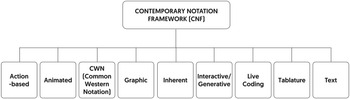
The following notation approaches (grouped in Figure 2) are described according to the definitions provided by the authors who wrote about them. It is therefore important to consider that these approaches often revolve around a culture of interpretation specific to these authors. Therefore, a proximity can be found in some approaches (e.g., animated, interactive and generative score). Although some approaches are often associated with specific mediums (e.g., animated scores with screen-based media), they will be discussed separately, as these approaches can theoretically be applied across various mediums.
Contemporary notation approaches diagram.

3.1. Action-based or gestural
Action-based or gestural notation ‘[…] mediates the intrinsic relationship between composition, performance and listening, as shown in the variety of its notation methods. Composers such as Luigi Russolo, Luciano Berio, Helmut Lachenmann and Franco Donatoni (to name only a few) notated their actions using expansions to the conventional notation, such as invented symbols, graphics and text’ (Kojs Reference Kojs2011: 67). This notational approach emphasises indications describing the actions to be performed to play the music: ‘The importance of gestural notation in musical scores has been increasing with the overwhelming exploitation of Extended Techniques and the implementation of choreographies inside the compositional process, sometimes even detached from the need for a resulting sound’ (Santini Reference Santini2018: 33). These approaches are cited in 19 references of the reviewed literature.
3.2. Animated
Animated scores/notation are defined in several ways. Smith (Reference Smith2016) describes them: ‘An Animated Score is any score that contains perceptibly dynamic characteristics that are essential to the symbolic representation of the compositional idea. The symbols and dynamic functionalities that populate these scores are here designated as Animated Music Notation [AMN]’ (98). This definition puts forward the idea of dynamism in the score (animation) as a characteristic defining the approach. The DigiScoreFootnote 2 website defines them as ‘a visual-based scoring system in which the design and signalling components are dynamic in time’. Composer and instigator of the Decibel ScorePlayer, Hope (Reference Hope2017), defines the approach of animated notation ‘as a predominantly graphic music notation that engages the dynamic characteristics of screen media’ (21).
Smith and DigiScore’s definitions emphasise dynamic components of animated scores (independent graphical elements in motion) while Hope specifies the representational encoding generally used including fixed scrolling scores and the medium of the notation. This approach is cited in 66 references of the reviewed literature.
3.3. CWN (common Western notation)
CWN which is also sometimes named CPN (Common Practice Notation) or traditional notation is the music notation typically used to write Western music on scores. With its staves, clefs and notes, it has encoded most of the pitch and rhythm-based music of the past centuries. We include it in a category because it is still a very common approach, and it is sometimes used in conjunction with other approaches (scores mixing graphic elements with CWN ones for example). We did not research the terminology recurrence in our literature sample.
3.4. Graphic
Graphic score is an approach to musical notation that uses visual symbols and images to convey musical ideas, allowing musicians considerable freedom in interpreting the scores (Kennedy, Kennedy and Rutherford-Johnson Reference Kennedy, Kennedy and Rutherford-Johnson2013: 1). Early examples include Morton Feldman’s Projections, Else Marie Pade’s Faust and Graciela Castillo’s El Pozo. Some graphic scores indicate specific musical parameters, as in the works of Feldman, Stockhausen and Ligeti, while others, like those of Bussotti, Brown and Cardew, propose abstract symbols, placing the performer in a creative position regarding the musical indications (Kennedy, Kennedy and Rutherford-Johnson Reference Kennedy, Kennedy and Rutherford-Johnson2013: 1). Cage and Knowles (Reference Cage and Knowles1969) notably published the book Notations, which includes several graphic scores. A new iteration of this initiative was published by Sauer (Reference Sauer2009) with the book Notations 21.
One of the specificities of graphic scores is that the ‘grammar’ of the score – the syntax and semantics of its visual elements – is invented by the composer as part of the creative process. This approach allows a greater structural abstraction and a departure from the analytical systems associated with conventional notations (Stead, Blackwell and Aaron Reference Stead, Blackwell and Aaron2012: 1).
Rebelo (Reference Rebelo2015: 229) also discusses how, without a formal code, the graphic elements of a score propose a system of mapping, establishing relationships between the graphic approach and its musical correspondence. This mapping can be literal (e.g., dense graphics representing a dense musical texture) or more formalised and codified. Performers must decide how this mapping will be realised and how it will be articulated on their instrument.
This approach is cited in 106 references of the reviewed literature.
3.5. Inherent score
An inherent score refers to a type of musical notation that is embedded within the instrument itself. The instrument implies gestures and sounds, integrating various elements of musical expression (Maestri and Antoniadis Reference Maestri and Antoniadis2015: 212).
Lucier (Reference Lucier1998), when speaking about David Behrman’s piece Runthrough and his collaboration with Gordon Mumma on Hornpipe, stated, ‘there were no scores to follow; the scores were inherent in the circuitry’ (6). This quote implies that the musical instructions were embedded within the electronic circuits of the instruments themselves, giving access to a pre-mapped network of expressive possibilities. In this case, playing the instrument reveals the musical work inherently integrated into the circuitry or the instrument itself. Thus, performers do not need an external score; instead, they interact with the instrument to produce music (Tomás Reference Tomás2016: 110), allowing them to explore the musical affordances and reactions induced by the system (Maestri and Antoniadis Reference Maestri and Antoniadis2015: 212).
One type of score directly linked to the inherent score is the tangible score. Tomás and Kaltenbrunner (Reference Tomás and Kaltenbrunner2018) define them as ‘[…] the physical layer that is incorporated into the configuration of a digital instrument with the intention of conducting the tactile gestures and movements. […] A tangible score determines only the gestural constraints and as such does not define any sonic results’ (610). The tangible score then becomes a guide through the inherent possibilities of the instruments.
These approaches are cited in 18 documents of the reviewed literature.
3.6. Interactive/generative
Interactive and generative approaches to notation are often described as real-time score in the literature. We chose to blend them into one category since they have a lot of characteristics in common.
Emphasising the possibility of hybridisation between fixed and interactive elements, Allombert, Assayag and Desainte-Catherine (Reference Allombert, Assayag and Desainte-Catherine2007) describe the interactive score as ‘[…] a musical score involving static and interactive events, that are bound by some logical properties’ (158).
Celerier et al. (Reference Celerier, Baltazar, Bossut, Vuaille, Couturier and Desainte-Catherine2015) highlight the controlled variability between performances of the same score introduced by this approach:
Interactive scores, […], allow a composer to write musical scores in a hierarchical fashion and introduce interactivity by setting interaction points. This enables different executions of the same score to be performed, while maintaining a global consistency by the use of constraints on either the values of the controlled parameters or the time when they must occur. (82)
Winkler (Reference Winkler2004) describes his vision of the real-time generated score (the usual temporal encoding of interactive scores) as being ‘for one or more musicians playing on stage [that] is generated in real-time by the computer during a performance’ (1). Musicians can influence the evolution of the piece by interacting with a dynamic system, with each performance creating a unique version of the work (Winkler Reference Winkler2004). Although Winkler does not explicitly use the term ‘Interactive score’, he describes it under the umbrella of real-time score. This approach is cited in 27 references of the reviewed literature.
The generative approach to notation is linked to the generative music that ‘can be understood to be compositions that are created by a process – for example, a computer programme – that operates on its own to generate entire compositions that will change with each run of the system’ (Eigenfeldt Reference Eigenfeldt2014: 179). Hope and Vickery (Reference Hope and Vickery2011) include interactive elements in their definition: ‘The generative score constructs components of the score in real-time. The components may comprise traditional or graphical notation or a combination of both. Algorithmic or interactive methods of generation may be employed, with the score moving from left to right or cyclically like a closed loop of paper’ (227). This concept has been found in 18 references.
3.7. Live coding
Live coding score refers to a form of notation written in real-time as code, which generates a musical performance and composition. According to Magnusson (Reference Magnusson2011), the practice of live coding:
Live coding is a form of musical performance that involves the real-time composition of music by means of writing code. This is done in front of an audience, which follows the proceedings on a projected screen. Typically, performers start with a clean sheet, a tabula rasa, and build their compositions from scratch. The compositions evolve through the writing of new code, changing code, pausing code or copying a large block in order to transform it into something entirely different. The code is in constant change, often modifying itself. (21)
In this context, ‘The live coder is primarily a composer, writing a score for the computer to perform. It is therefore appropriate that the computer science term for the system in which the live coder evaluates code is normally ‘interpreter’’ (Magnusson Reference Magnusson2011: 22).
Rohrhuber et al. (Reference Rohrhuber, de Campo, Wieser, Van Kampen, Ho and Hölzl2007: 4) establish that during the performance, the projected code can be seen as a written musical score, highlighting the dialogue between the musician, the audience, and the system in place.
The code not only highlights the compositional process but also represents what is happening in the sound domain (Magnusson Reference Magnusson2011: 21). ‘By inspecting the code, one can learn about the instruments, the voices and the form of the musical piece. This representational aspect of code enables performers to externalise their thoughts, thereby freeing some cognitive load and enabling other explorations’ (Magnusson Reference Magnusson2011: 21). This approach is cited in 15 references of the reviewed literature.
3.8. Tablature
Tablature refers to a notational approach used in Western music since the early 14th century (Dart, Morehen and Rastall Reference Dart, Morehen and Rastall2001). ‘[…] Tablature systems in general use one symbol to show how to produce a sound of the required pitch from the instrument in question […] and another to show its duration’ (2).
In the context of new notations:
[…] it is possible to affirm that notation has a prescriptive function: it is an instruction manual or a user’s guide. One manifestation of this function is the tablature. Variations of it can be found in the indication of the gestures that the musician must make on his instrument in contemporary scores (cf. Lachenmann’s scores for strings) (Carinola and Geoffroy Reference Carinola and Geoffroy2022: 149).
This notational approach is cited 40 times in our literature sample. However, we observed that very few articles theorise about tablature, but rather use the term in a common manner.
3.9. Text
Text scores are musical scores that use words instead of traditional musical symbols to guide performers. ‘Text scores are known by different names. The Fluxus group of artists, poets, dancers, typographers and composers who flourished in New York in the early 1960s called text scores ‘Event’ or ‘Action’ scores’ (Anderson Reference Anderson2013: 132).
Anderson (Reference Anderson2013) suggests that text scores can be divided into two main types: instruction scores and allusive scores. In the case of the former, ‘Instruction scores resemble recipes or instructions for assembling flat-pack furniture, in that the performer (or cook or do-it-yourselfer) reads the instructions and follows them to achieve a performance (or dinner or a bookcase)’ (Anderson Reference Anderson2013: 132). The latter type, allusive scores (conceptual or ambiguous), do not directly refer to actions but become an inspiration for the execution of the piece (Anderson Reference Anderson2013: 133).
Anderson (Reference Anderson2013) cites Veselinović-Hofman to discuss these two types of text scores (the term verbal score is used here in reference to text scores):
A verbal score may not only consist of more or less professionally emphasised instructions for and descriptions of a performing procedure which should be followed, but also of texts which suggest a sound interpretation indirectly inspiring it through their own literary, poetical or philosophical contents. Due to these contents, the texts can gain their own integrity, becoming independent of their possible and expected music ‘fulfilment’. (Veselinović-Hofman Reference Veselinović-Hofman2010: 54–5).
An example of an artist who worked with text scores is Pauline Oliveros. ‘Even though text scores hold a visual component that is functional to their transmission, in Oliveros’ works a different informational layer emerges and unfolds within the relation of the interpreters with each other and with the environment’ (Privato, Magnusson and Einarsson Reference Privato, Magnusson and Einarsson2023: 37). This approach is cited in 7 references of the reviewed literature sample.
4. Notation encodings
This section covers the encoding approaches we have identified in the literature (Figure 3). These are based on their types of indications (prescriptive and/or descriptive) and their semantic encoding, on their temporal representation, elaboration and linearity.
Notation encoding diagram.

4.1. Indication
In the mid-20th century, Charles Seeger developed the concepts of prescriptive and descriptive notation (Seeger Reference Seeger1958), which still remain pertinent to contemporary discussions on musical notation.
Prescriptive notation is defined ‘as a notation system in which the composer specifies the method of making music’ (Kanno Reference Kanno2007: 235). It focuses on the actions required to produce sound rather than the sound itself. This type of indication is cited in 36 publications.
Descriptive notation describes the sound of a musical work by providing information that allows one to identify and ‘hear’ the resulting sound (Kanno Reference Kanno2007: 232). An example of descriptive notation is CWN, which indicates pitch, rhythm, structure and timbre (assuming the reader is familiar with the timbral parameters of what is notated). This concept is cited in 24 publications. We included a hybrid category in our diagram, since it is possible to use both prescriptive and descriptive indications in the same score.
4.2. Semantic
Semantics refers to the meaning or significance given to symbols or signs. In the musical context, the symbols used can refer to a shared semantic construction, for example CWN, text or images that might convey a meaning that multiple musicians understand the same way. In the case of contemporary notation using more abstract representations, the symbols used may not have a pre-established semantic meaning. In this case, we can think of scores that use images or symbols that do not have a shared understanding, but where the musicians need to establish a personal interpretation of the notation.
The use of these terms to discuss how musical indications are semantically encoded has been cited 40 times. The negation of semantics (non-semantic or asemic) is also addressed in the literature. Vickery discusses this in several publications (Vickery Reference Vickery2014; Vickery Reference Vickery2016), designating a ‘[…] a continuum from greater ambiguity to greater specificity’ (Vickery Reference Vickery2016: 398).
As musical indications in a score can also be encoded semantically and non-semantically, a hybrid encoding is also possible for scores using both approaches. For example, a score could feature CWN alongside abstract graphics indications.
4.3. Temporal score elaboration
The category of the Temporal Score Elaboration refers to the temporality in which the score is created. It consists of two poles: the first, where the score is fixed in advance of its performance and the second, where it is generated in real-time. Vickery (Reference Vickery2012) presented a similar classification of the type of score from its most static form the ‘traditional score’, then ‘mobile score’, ‘segmented score’, ‘scrolling score’ and finally to the ‘real-time score’ (131–2).
The fixed score refers to the traditional posture toward notation where a musical idea is fixed on a medium and then played subsequently by musicians. The score does not change after being written. This definition includes animated or scrolling score where the notation has been established and fixed before the performance when the piece has been composed.
The real-time temporal score elaboration refers to any notation, whether traditional or graphic, created or transformed during a musical performance (Clay and Freeman Reference Clay and Freeman2010: 1). Clay and Freeman (Reference Clay and Freeman2010: 1) note that terms such as ‘dynamic music notation’, ‘live scoring’, ‘virtual scoring’ and ‘reactive notation’ are used to describe this practice.
Also, Shafer (Reference Shafer2016) proposes a typology of real-time scores that includes several approaches cited in this article:
Real-time notation encompasses scores that contain material open to some change during the performance of the piece. Many works fit this definition, from those that use predetermined musical segments that are reordered in performance to those that are completely notated in the moment of performance. Non-real-time notation accounts for all other uses of the computer display as a notational medium. Both static and animated scores occupy this category (65).
Kim-Boyle (Reference Kim-Boyle2010) notes:
The development of real-time scores is motivated by many of the aesthetic concerns that have traditionally stimulated developments in open forms, mobile forms, aleatoric processes and graphic notations. […] In many open-form or mobile-form works, for example, the order of musical sections is outlined either just before or during performance (4).
Here the author highlights the unique formal possibilities of real-time scores that cannot be realised in a fixed format.
It is possible to observe some variability in how the real-time score elaboration is defined. Given the classification we propose in this article, the definition proposed by Clay and Freeman (Reference Clay and Freeman2010) is the one we adopt for the real-time score elaboration. This term is cited in 33 references of the reviewed literature.
4.3.1. Temporal linearity
Temporal linearity refers to how musical indications are read and how they structure the formal progress of a work. Temporal linearity is found in CWN notation, where annotated events are temporally organised in a series of consecutive events. In contrast, the concept of non-linear progression, introduced by Earle Brown as part of the ‘open-form’ approach (Welsh Reference Welsh1994: 255), allows for multiple pathways through the score, redefining the relationship between notation and the temporal interpretation of the work more freely. The concept of non-linear temporality is cited in 27 articles. We included a hybrid category for score using both temporal linearity approaches.
4.3.2. Temporal representation
Temporal representation refers to the way musical indications represent time in scores. Metrical representation, predominant in CWN, structures temporal events according to a system of measures and regular subdivisions. This term was not specifically researched in the database, as it is well established in classical and contemporary musical literature and culture.
The proportional approach is another important method of time encoding that we identified. This refers to a visual representation of temporality in durations, where ‘[…] the spacing and length of the notes on the page, are put into a more or less direct relation to the timing and duration of the sounds’ (Cardew Reference Cardew1961: 21). This concept appeared in 27 publications. By opposition, we include a non-proportional notation approach in the typology and an atemporal representation category for scores without temporal indications (such as Feldman’s Two Pianos). Although metrical representation is non-proportional, given its predominance in musical scores we believe it is appropriate to give it a specific category. We also include a hybrid category for scores using multiple temporal representations.
5. Transmission medium
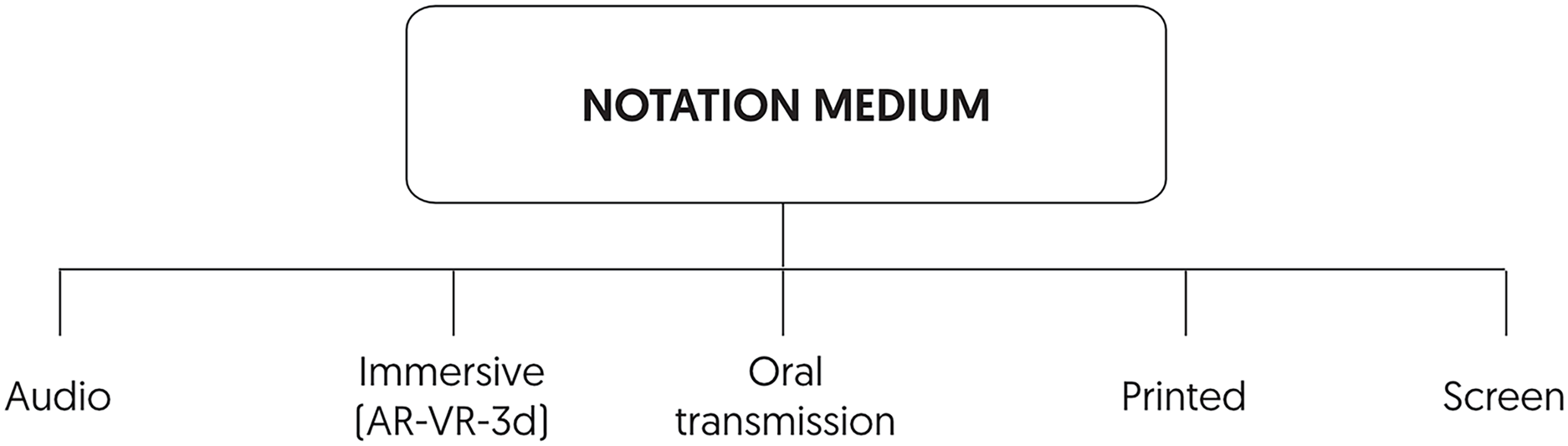
The modes of transmission of scores have greatly diversified since the mid-20th century, largely due to the emergence of new mediums. We have identified several mediums for the transmission of musical indications (Figure 4). These mediums are sometimes strongly linked to notational approaches, such as screens with animated scores or graphic scores and printed notation. However, we believe it is important to distinguish them because the same notational approach can often be disseminated via more than one medium. For example, the same graphic score could be printed on paper and also displayed on a screen. Scores can also sometimes use multiple different mediums to transmit their indications (e.g., a combination of audio scores and paper scores).
Notation medium diagram.

5.1. Audio
Audio scores ‘are scores that primarily use auditory communication to convey such composer-defined aspects to the performers’ (Bhagwati Reference Bhagwati2018: 25). Bhagwati (Reference Bhagwati2018: 25) establishes that this medium can transmit information via different modes: information, imitation, inspiration and instances. Additionally, Sdraulig and Lortie (Reference Sdraulig and Lortie2019: 39) identify two temporalities in the relationship to audio scores: the first is ‘reactive’ and refers to the direct reactive relationship the performer has with the indications during the performance, and the second is ‘rehearsed’, relating to how the audio score shapes the musician’s interpretation during rehearsals. This medium is cited in 9 references of the reviewed literature.
5.2. Immersive (AR-VR-3D)
The category of immersive technologies refers to virtual reality, augmented reality and 3D representations of scores. These forms of transmission are relatively new and are not predominant in the literature. Since this category includes mediums with their own characteristics, we deemed important to include it in this article. Additionally, although 3D representation is not a transmission medium in itself, it is often discussed alongside VR and AR and is part of the graphical specificities of immersive medias.
The 3D representation of scores made possible by immersive technology offers unique perspectives. As Kim-Boyle (Reference Kim-Boyle2019) notes, ‘Three-dimensional scores fundamentally present an effort to transcend the materiality of the printed page. While visual artists have grappled with the affordances of perspective since the fourteenth century, the applications of perspective and three-dimensional structures in musical notations have been of only relatively recent interest’ (39).
Immersive technology brings new aesthetic affordances by establishing a physical relationship between performers and the notational representation (Kim-Boyle Reference Kim-Boyle2019: 41). Kim-Boyle (Reference Kim-Boyle2019) illustrates this with an example of his HoloLens pieces 64 × 4 × 4, stating: ‘[…] the physical engagement with the score becomes an essential means of uncovering its various potentialities. The pathways through the score, uniquely instantiated for each performance, may only be discovered when the performers physically navigate the space in which the score is displayed’ (41). Thus, the score becomes a virtual physical space to explore and navigate.
However, there are challenges in adopting this medium. Santini (Reference Santini2022), speaking about AR, states: ‘Relatively few experiments have been conducted so far, presumably due to the technical challenges and the absence of an already established corpus of background work to help researchers’ (38). Therefore, technological accessibility becomes an issue in the use and adoption of this medium. This medium is cited in 6 articles of the reviewed literature sample.
5.3. Oral transmission
Oral transmission refers to the communication of musical indications, practices, approaches and traditions through speech or singing. This method of transmission is closely linked to oral tradition, encompassing cultural and contextual aspects. This medium is rarely discussed in the selected literature, being cited in only 5 articles from the reviewed sample.
5.4. Printed
Scores printed on paper have been the standard medium of transmission for the past centuries. As with common Western notation practices, there is an extensive amount of literature on music written on paper. For the purposes of this article, which is mainly interested in contemporary approaches, we will simply name this category without counting the number of citations in our sample.
5.5. Screen
The screen is a medium that allows scores to be shown on a computer, tablet, or any other screen device. It is characterised by its ability to present dynamic, interactive and real-time notational elements, which enhance both the compositional process and the performance experience (Vickery Reference Vickery2012). According to Vickery (Reference Vickery2012: 128), the concept of the screen score emerged as a response to the challenges faced by avant-garde composers in the mid-20th century, who sought greater flexibility and openness in their notational practices.
Screen scores offer specific characteristics that are not possible on paper, such as their ability to display ‘continuous notational graphics that move from left to right, allowing performers to execute events as they strike a fixed ‘playhead’ (Vickery Reference Vickery2012: 132). Another characteristic of screen scores is their capacity for permutation. Screen-based scores can translocate, insert, duplicate or delete musical materials in real-time (Vickery Reference Vickery2012: 132).
Vickery (Reference Vickery2012: 133) cites two more specificities of screen scores: transformative screen scores, where transformations can be applied graphically, modifying how the score is to be performed in real-time, and generative screen scores, where algorithmic or interactive processes construct components of the score in real-time. This medium is cited in 20 references of the reviewed literature.
6. An analysis tool
The complete set of elements in the diagram (Figure 1) at the beginning of the article allows for the categorisation of scores based on the notation approach used, the way it encodes its instructions, and the medium employed.
For example, we could analyse the piece Treatise by Cornelius Cardew as follows: a graphical notation approach has been used, with descriptive indications (here, an abstract visual description). The encoding is hybrid because the score contains non-semantic elements (abstract geometric shapes, lines without shared references) and semantic elements (some pages include elements of the CWN). The temporal encoding is non-linear (the temporal reading of the score is open to any interpretation), and the temporal representation is non-proportional (there is no correlation between the visual distance of elements and their positioning in time). The medium used is printed paper.
This categorisation can help to have a quick understanding of the underlying characteristics of a contemporary score.
7. Conclusions
The typology proposed in this article aims to lay the foundation for the ongoing research field on musical notation. It is designed as an adaptive framework that should facilitate its expansion with further approaches and developing mediums while working towards terminological standardisation. We believe it will serve as a valuable analytical tool for future research in the domains of instrumental, electronic and electroacoustic music notation.
In this paper, we have explored various approaches to musical notation, highlighting the diversity and complexity inherent in the field. One of the goals of this research was to propose a coherent and contemporary portrayal of the new musical notation landscape. As specified in the limitations section, we did not include every approach we encountered, which inevitably introduces some bias. However, we believe it is representative of the concepts, musical encoding approaches and mediums we encountered in our research.
Acknowledgments
Pierre-Luc Lecours would like to thank the Social Sciences and Humanities Research Council of Canada (SSHRC) for funding his doctoral research. This article is also part of the Performative Notation project directed by Nicolas Bernier and funded by Fonds de recherche du Québec – Société et culture (FRQSC), a research project held at Laboratoire formes • ondes (LFO) at Université de Montréal.



 Open access

